
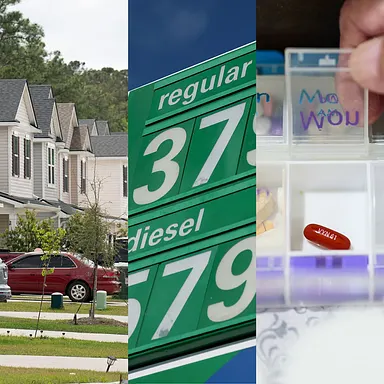
This episode of The Daily examines what Democrats can realistically do about the cost of living after winning control of Congress, facing a president who holds veto power. Reporters Rebecca Elliott, Margot Sanger-Katz and Ben Casselman walk through gas prices and the Iran war, health insurance subsidies and Medicaid cuts, housing, tariffs, the federal minimum wage and the economic effects of AI data centers.
Listeners will hear why the guests see most options as limited or slow, and where they see room for bipartisan compromise, such as drug prices and insulin caps. The conversation also weighs whether quick, visible wins matter more to voters than long-term reforms.
In this episode Rachel Abrams, Ben Casselman, Margot Sanger-Katz, Rebecca Elliott
This episode's transcript on Democrats' affordability promises was made with HappyScribe technology, the same kind behind a Google Meet note taker.
Ads in this audio differ from the text. Tap the sentence you're hearing to follow along.
Synced: the text now follows the audio.
From The New York Times, I'm Rachel Abrams, and this is The Daily.
People in Michigan can't afford their groceries. They can't afford their gas. They can't afford to see a doctor.
Across the state, including here in Southeast Texas, folks are drowning. They can't afford utilities. They can't afford groceries.
Together, we are going to make life more affordable.
We can make stuff cost less, and we need leaders who will do that.
The Democratic Party swept the midterm elections by making big promises to Americans about bringing down the high cost of living.
I'm going to the Senate to fight for affordable housing.
To lower gas and diesel prices by suspending the federal gas and diesel tax and finding our way out of this war with Iran.
I am going to fight for Medicare for all.
We will fight to lower your costs and open up paths to the middle class.
But when Democrats actually take control of Congress in January, they will face a president who can veto anything they put forward, and who has also sent mixed signals about his willingness to work with them.
I'll get along, probably, with the Democrats, unless they want to be destructive. But they have the power of the veto, so if we don't like what they're doing...
And so today, we are calling up our resident experts, Rebecca Elliott, Margo Singer Katz, and Ben Kasselman, one by one, to ask what, if anything, Democrats can actually do to fix the key issues that propelled them into office. It's Tuesday, November 17. Okay, so, Rebecca, you cover oil and gas for The Times, and we obviously know that high gas prices have been a major concern for voters.
So I want to start there: what options do Democrats have to try to bring down the price of gas?
So I have some bad news for you, Rachel.
Uh-huh.
Which is that Congress, in general, has very few good options when it comes to trying to bring down gas prices.
Right.
One would imagine that if there were easy, good options on the table, that President Trump or the Republican-controlled House and Senate would have availed themselves of said options before the election. That said, let's talk about the war.
Okay.
That is the most direct cause of the higher gas and diesel prices that Americans have been seeing for the past many months. And so the question, of course, is: what can Democrats do, theoretically, to try to end the war once they're sworn in?
Right.
So option one would be to pass a war powers resolution seeking to compel the president to put an end to the hostilities, but it's not actually clear that that would have teeth. Option two is to threaten to withhold funding for the conflict.
Power of the purse, yes.
But it's important to remember that Democrats don't have a veto-proof majority.
In the House, in the Senate, right. Because even with their sweeping victories in the midterms, without a two-thirds majority, both of these options that you just outlined, they both run up against the president basically just saying, "Absolutely not," and vetoing whatever comes across his desk.
That's right. But even if the war does end, one way or another, on paper, that doesn't necessarily flow directly through to prices at the pump.
And just explain what you mean by that and why that would be the case.
The big question is: how dangerous is it to move oil out of the Middle East through the Strait of Hormuz? If the war is over on paper, but there are still drones and a risk of damage to tankers and shipping costs.
Landmines.
Stay really high, right, mines that haven't been cleared yet, that is likely to keep oil prices and, therefore, gasoline and diesel prices elevated.
Another huge factor right now is all of the refineries that have been damaged or shut down because of the war in the Middle East. And so you also have to be able to give companies the kind of time and security to make repairs to infrastructure, like refineries that have been damaged.
Mm-hmm.
And suffice it to say, this is very complicated, and it's not as if Democrats, day one in January, can flick a switch and say, "Okay, it's all better now." So let's just say that the war ends up being in kind of a stalemate-holding pattern. I wonder what else Democrats could actually do that would affect gas prices, if anything. The president, for example, has talked about, temporarily at least, halting of the federal gas tax.
Can you just talk about some of the other options that either Democrats have or Democrats have to pressure the president into, and how likely any of those are?
You're right. There are options that could, on the margins, lower gasoline and diesel prices. You mentioned the federal gas tax. That's an $0.18 tax per gallon on gasoline, higher for diesel. It has never been suspended, but Congress does have the power to do that.
Mm-hmm.
Now, could it provide some relief? Sure. But it's not going to be game-changing. You also have tools such as suspending fuel exports, which would essentially mean saying companies cannot sell the gasoline or perhaps diesel that they are producing here.
Mm-hmm.
Overseas. This is something that President Trump explored before the midterms, when he was under a great deal of pressure, particularly on diesel prices. And doing that could very well bring prices down in the near term. The problem is, there's a really big risk that you end up causing prices to rise longer term. And that's because if there's a smaller market, what do companies typically do?
They cut back on production.
Mm-hmm.
And so this would be really tricky territory.
The idea here being that if you make the domestic industry only sell to the United States, it's basically supply and demand. They're going to shrink the amount of supply. The demand in the United States presumably is the same, therefore prices go up.
Exactly.
But I just want to linger on sort of the domestic infrastructure and energy sector that we have here for a minute, because I think, on a very basic level, I'm not sure that people understand why, if we have invested so much time and money in developing our own energy infrastructure to gain some kind of energy independence, for the exact reason that we could maybe insulate ourselves from the costs of a war, why are Americans still paying such high gas prices if we have so much robust domestic oil production?
Right. I mean, the United States has indeed benefited during this war from producing so much at home, in that it hasn't faced shortages the way many other countries around the world have, particularly in the early weeks and months of the conflict. That said, it is not as if prices are set by any one person or company in the United States.
It's a global market. And so what happens in the Persian Gulf or in Europe affects the price of fuel in the U.S.
Okay, so at this point, Rebecca, you have told us that Democrats have very limited options, and the options that they do have are not that great. So you're kind of making me think that we're just living in a world of higher gas prices, at least for the foreseeable future.
Yes, that's right. We could be living in a world where prices at the pump stay elevated for some time. But there's another scenario that I think is worth considering, as strange as it might feel after all of these months of paying very high energy prices.
Okay, go on.
And that is, in the background, companies have been investing in places like the United States and South America in ramping up oil production. And so there is this alternate scenario where, if the war were to end, if shipping through the Strait of Hormuz becomes much safer, the world could be facing a glut of oil.
And you could see prices come down considerably very quickly.
Okay, that is, in fact, kind of hard to imagine, given this period of time we've just been through. But if it did happen, would it have anything to do with Democrats?
No.
Rebecca Elliott, thank you so much.
Thanks for having me.
Hi, Margo.
Hi.
So, Margo, we have come to you to talk about what Democrats can do to help with health care costs. But before we even talk about the potential solutions that they might be looking at, I want you to help us understand what the problems are that they're even trying to solve.
Well, I think there are a lot of problems in the health care system, and I don't know if they can solve all of them. But there are some really specific problems that they're focused on. One is that health insurance has gotten really expensive for people who buy coverage through Obamacare, and that's because of subsidies that expired last year.
Mm-hmm.
Another is that a lot of people are set to lose Medicaid coverage next year because of changes that Republicans made to the Medicaid program as part of their big tax and domestic policy bill that they passed last year. And then I think there's just a general sense that the U.S. health care system is too expensive for everyone, that our drug prices are high, that people can't afford their insurance, that it doesn't cover things when they need it.
Mm-hmm.
I think Democrats are probably going to focus first on those discrete policy things where they think they can reverse changes that were made by the Trump administration and Republicans when they controlled Congress. And then, I think, in the future, they're going to have to think bigger about what they're going to do about this broader set of problems that is affecting everyone else.
Okay, so first, let's talk about those, those discrete policy changes that Democrats could try to make. Explain what tools Democrats actually have to at least try to restore the Obamacare subsidies or the Medicaid cuts.
So Hakeem Jeffries, the new speaker-to-be of the House of Representatives, he has already said that the Democrats in the House have a 100-hour plan. As soon as they take power, they are going to take votes on two major health care bills. We know what those are. One, that would restore these lost Obamacare subsidies, lowering the cost for people who buy their own health insurance, affects maybe, like, 20 million Americans. And then the second thing would reverse a lot of these Medicaid cuts that were made in last year's tax bill. Those mostly have not taken effect yet, but they are coming, and they are expected to result in something like 5 million Americans losing health insurance and also a big financial hit to hospitals and to state budgets.
And, Margo, just want to remind our audience here that in the House, the Democrats have a very clear majority, but in the Senate, it is narrower. Democrats currently have 55 seats. If they take Alaska, they could have 56. So this proposed legislation that you have mentioned, what would Democrats actually need in order to pass anything in the Senate and actually get it into law?
So now we're getting into how aggressive does the Senate leadership want to be, and a little bit of nerdery. In general, the Senate needs 60 votes to overcome a filibuster and pass legislation, bring it to the president's desk. There is a way around that.
Okay.
That's a reconciliation bill. That's how Congress passed the big tax bill last year. If the Senate and the House got together and said, "We want to do this through a reconciliation bill," then they could pass it with just their majority vote in the Senate. And then it would really be up to Trump. Is he going to veto that bill, or is he going to sign it?
I do want to talk about the Trump veto for a second, because since the midterms, we've gotten a lot of different mixed signals from the president about how willing he's going to be to work with Democrats. So I just wonder, as a person who covers this health care space, where do you think he might lean when it comes to health care specifically?
Well, I would guess that he is probably likely to veto a lot of this agenda. In particular, it seems very unlikely to me that he is going to support a reversal of a portion of his signature legislative achievement in this presidency. That tax bill that they passed last year, that is the main legislative thing that has happened on his watch. It was a huge priority of his. Very hard for me to imagine that he would just sign a bill that is reversing a big part of it. But I do think that the president is less ideological about a lot of these health care issues than the average Republican in Congress.
I think one area where he's shown the most openness to ideas that Democrats could get behind is in the area of drug prices. I think the president, like a lot of Democrats, feels like it's unfair that the United States pays such high prices for prescription drugs compared to the rest of the world. And he launched his TrumpRx website earlier this year, and he's been making these deals with pharmaceutical executives. So I could maybe see some potential for a compromise there.
Okay.
There has been bipartisan legislation that's been under debate for a while to try to cap the amount that people have to pay for insulin every month to $35. That seems like the kind of initiative that maybe the president and both Democrats and Republicans in Congress might want to go for and take a win.
Can I just raise one other thing that we heard a lot about during the election cycle, which was Medicare for all? What is actually feasible on that front while Trump is still in office?
It seems extremely difficult to imagine something as ambitious, as expensive, as difficult, as transformative as Medicare for all really getting very far with this president. I would say it's actually also pretty hard to imagine it going forward very quickly, even if the president didn't veto anything.
Mm-hmm.
Because I think Democrats are not all on the same page about this issue. But I do think that it is something that they are thinking about and that they are going to want to start talking about in this Congress. You know, historically, I think Democrats have wanted to kind of tinker on the edges. Let's just make this part work a little better. Let's make this part a little bit cheaper. But I think there's a growing desire to think about more wholesale change. Could we change the whole system and just kind of make it work better, build it from scratch? And Bernie Sanders, this has been one of the core issues of his whole political career.
He will become the chairman of the Senate Health Committee. That's a committee with jurisdiction over health care. He has a bill that he's introduced to numerous congresses. It has more co-sponsors now than it's ever had before. There are some of these new members of Congress, including Al-Sayyed in Michigan. This is one of his core issues that he ran on, and so I think he's going to want to talk about it. And so I think Democrats are kind of going to be working in this space. But I would think about Medicare for all as something that's more, like, future administrations, when there's a Democrat in the White House, when there's more time for them to build consensus on something bigger.
Margo, thank you so much.
Thanks for having me.
We'll be right back.
So, Ben, we just talked to our colleagues Margo Singer Katz and Rebecca Elliott about two major areas where Americans spend a lot of money and where they've really felt the pinch in their pocketbooks: health care spending and gas prices. But obviously, as you know from covering the economy, there are a million other drags on people's wallets. So we're coming to you, Ben, because we want to understand, of the other categories that Americans are really feeling the pinch right now, what are other things that Democrats could do to try to lower prices and to lower costs?
So, look, affordability covers a lot of ground, but I think the number one thing that we have to talk about here, almost the first, second, and third thing, is housing.
Okay, so let's talk about housing, then. Tell us what the problem is and what are the solutions that we should be talking about that are on Democrats' minds.
Yeah, so, I mean, I think housing is, in some ways, the original affordability concern, right? I mean, this dates back even to before the inflation surge, before the pandemic. And it's a really challenging, intractable problem. This is not the kind of thing that one piece of legislation or one policy is going to address. We saw this year, actually, Congress passed a fairly substantial piece of housing legislation, the most substantial piece in decades, encouraging some building, doing some other things.
Right.
And there are economists and experts who are optimistic that it will kind of make some differences at the margins, but nobody thinks that that piece of legislation is going to suddenly make housing affordable everywhere. The sort of long-term challenge facing housing is that we don't have enough of it.
Mm-hmm.
And we specifically don't have enough of it in the places, the mostly coastal cities where there are the most job opportunities, the most economic growth, where people want to live.
But can I just ask, Ben, I feel like people listening to this might think, like, well, if the problem is that there isn't enough housing, couldn't Congress pass, I don't know, some kind of legislation that would even more so encourage building? Couldn't there be some sort of tax incentives? Like, can you just help us understand what is so difficult about the prospect of encouraging building exactly?
So, look, I mean, this is an incredibly complex area. But I'll highlight a couple of things. I mean, one is just that a lot of the obstacles to building would require changes at the state and local level that, frankly, face a lot of opposition from existing homeowners who don't want to see a ton more construction that maybe would limit their home values, right, that's their most important asset. And there are some other things that I think we could see Democrats kind of try to do around the edges, around down payment assistance and rental assistance and access to mortgages.
But these are all relatively minor things that could help a relatively modest group of Americans.
So still not talking about the sort of the sweeping change that Democrats basically took the midterms with. But obviously, there are other things that Americans are spending their money on. Are there other things that Democrats could try to do to tackle and potentially have more success in those other areas?
The first thing that I would highlight is tariffs.
Mm.
Tariffs are a tax on imported goods. There's a lot of debate among economists about exactly how much President Trump's tariffs increased prices of exactly which products, but there's broad-based agreement that the tariffs did drive up prices, particularly of certain categories of goods, and that that cost a few hundred dollars, maybe a couple of thousand dollars a year per household. And it is Congress, ultimately, that has the power to impose tariffs.
They've given a lot of that power to the president, and there's a lot of debate over exactly how much of that power he has and whether he's used all of that power legally. But Congress could take it back.
Well, can I just ask you, Ben, number one, what you think the chances are that Congress will, in fact, repeal these tariffs? And number two, what impact do you think that that will actually have?
I think it's very likely that the Democrats, possibly with some Republican support, will pass legislation to roll back the tariffs on Canada specifically.
Mm-hmm.
These are tariffs that have been really controversial, drawn a lot of opposition even from Republicans, right, who sort of say, "Why are we, you know, in a trade war with our neighbor and ally and friend, Canada?" Canada, of course, has imposed retaliatory tariffs that have hit a lot of American industries. It's done real damage to communities along the border.
Mm-hmm.
So it seems very likely that Democrats are going to try to get something through.
But what would the effect of that be? Or what would the effect of anything be that you are currently looking at as, like, a likely option that they would try to roll back and may be successful at?
Yeah, I mean, so, look, when we're thinking about this in the context of affordability broadly, I think the answer is not very much, right? I mean, tariffs played a role in raising consumer prices, particularly last year, but they weren't a huge driver of inflation. And, you know, if there's one thing that we've learned over the past few years, right, it's that companies are quick to raise prices. They tend to be pretty slow to bring them down.
Right.
I don't think that we should assume that even if you could sort of snap your fingers and eliminate all of the tariffs, that suddenly all of these prices are going to come back down to where they were before those tariffs were imposed.
Sure. Okay, so eliminating tariffs not going to make affordability better in a big, meaningful way. What else is on our list, Ben?
Well, so, you know, when we talk about affordability, we tend to focus on the price side of the equation.
Mm-hmm.
But the income side of the equation matters here too, right? What is affordability?
Of course.
It's your ability to buy things with the income that you have. And, you know, one place I do think we're very likely to see Democrats push is on the minimum wage.
Wait, really? I feel like that has not come up as a campaign issue during the midterms, at least.
So, you know, the minimum wage hasn't gotten quite as much attention maybe in the last few years. But if you look at the agendas of a large number of the Democrats who were running and who won in November, it's in a lot of their platforms. And it's worth sort of just stepping back here and remembering that the federal minimum wage is $7.25 an hour. That's unchanged since 2009.
Mm.
And, you know, we've gone through this 15-year now Fight for $15 movement, pushes to raise minimum wages at the state level, at the local level. We've seen a ton of mostly blue states raise their minimum wages.
Mm-hmm.
And the federal minimum wage has not budged in that entire time, to the point that when I talk to economists, they say there functionally is no federal minimum wage.
But the idea being, Ben, what? That if Congress passes a new federal minimum wage that is significantly higher than what most states are paying, that it'll push wages up in all 50 states?
Yeah, I mean, look, I ran some numbers before I came on here. Raising the federal minimum wage to $15 an hour would give an immediate raise to something like 9 million American workers.
Mm.
There are more than 30 million workers who are in between the current minimum wage and $20 an hour. So we're talking about millions and millions of workers who, in theory, right, if they raise the federal minimum wage, would get basically an overnight pay increase.
I do want to just point out, though, that the idea of Democrats getting enough Republicans on board to raise the federal minimum wage, there's a reason why it hasn't budged in as many years, as you mentioned, right? Like, conservatives argue all the time that raising minimum wage has all kinds of detrimental effects to businesses and effects growth that affect the economy, and that raising the minimum wage too quickly can actually put many businesses out of work. They simply cannot afford labor costs that shoot up. So I just sort of wonder what the chances are that something like a significantly higher minimum wage federally passes and how Democrats might be thinking about the blowback to anything like that.
You're exactly right. The minimum wage has long been a controversial policy, right? The research on this has really evolved over the years. And, you know, we now have a direct experiment with all of these states and cities that have raised minimum wages really substantially. And while the studies on this vary a little bit, I think we can say generally there hasn't been any evidence of the apocalyptic fallout that critics promised.
Mm-hmm.
And we know that the minimum wage is an incredibly popular policy, including in traditionally red states. I think the real question here becomes, what do Democrats push for? Do they push for $15 or $17 an hour? Do they push for $20? Do they push for $25, as some are talking about? Over what time period do you allow carve-outs for small businesses, for example, or phase it in more slowly for smaller businesses? There are a lot of things you could imagine Democrats doing to sort of soften the blow a little bit.
Whether that gets past President Trump's veto pen, I think, is another question.
Ben, can I ask you about something that came up a lot during the midterms that did not feel connected on its face to affordability and yet was also generating just so much anger and so much backlash? And that is AI. We obviously saw all these data center moratoriums pass. And I just wonder if there is something actually to talk about in terms of affordability when we're talking about AI and data centers and all of sort of the related effects on the economy right now.
Yeah, I absolutely think that AI is an affordability issue. It's not only an affordability issue.
Mm.
But I do think that that is a piece of this. So, I mean, one is just directly. Data centers use a tremendous amount of power, and we've seen, you know, real concerns about what that means for electricity prices in many parts of the country. But, you know, there's an argument that the sort of whole AI data center boom has contributed to our inflation problem more generally.
Mm-hmm.
I mean, it's driven up the cost of building materials. It's driven up the cost of construction labor, right? If you're trying to build a factory or a warehouse or an apartment building or a home these days, right, that's going to be more expensive because of this massive data center build-out. And those concerns over inflation are part of why the Federal Reserve has taken to raising interest rates again.
Mm-hmm.
And so that shows up, as we've talked about before, in your credit card, in your auto loan, potentially in your mortgage. And I think that we will see to what extent there are sort of real pushes at the congressional level or at the state level to sort of rein some of this in. But in addition to the moratoriums that actually passed in ballot measures, we're seeing a number of governors who were elected on promises to impose moratoriums or to rein in data center construction, which could potentially have an impact in those states.
And, I mean, there's actually a bill in Congress now, a bipartisan effort to make it easier to build electrical infrastructure and also to require data centers to foot more of the bill of the strain that they put onto the grid, which could have the effect, if it passes, of softening some of the impact of the data center build-out on electrical prices.
I do wonder, though, Ben, just given all the ways that AI has been propping up our economy and not just the stock market, I mean, the data center build-out alone has obviously created a huge number of jobs. If Democrats did anything to slow down the growth of AI, however they might do it, there's a real concern that that could seriously hurt the economy. And so I just wonder if it is not just a question of what Democrats could do but what they should do.
Yeah, no, I think this is a really interesting question, right, which is sort of, if Democrats try to rein in the AI boom too much, do they risk sort of kicking the legs out from under this stool that is holding up the economy right now?
Right.
And actually, right in the wake of the election, I set out talking to economists and experts sort of trying to understand exactly this question. And I was surprised, frankly, by what I heard in those conversations, which was a lot of optimism that in some ways actually slowing down the boom could be pretty positive in terms of sort of making the economy a little bit more sustainable here, that the boom has been so intense that it is pushing up prices, it is pushing up interest rates, it is threatening to create this bubble, and that maybe just sort of letting a little bit of air out of that balloon could allow this to go on in a little bit more of a sustainable fashion and address some of these cost concerns without killing off the economy in doing so.
You know, I've been thinking in this whole conversation with both you and Rebecca and Margo, Ben, about just sort of what it means to run on affordability the way that Democrats did in the midterms, probably knowing that these issues were very complicated and very few had easy short-term solutions. I mean, frankly, it sounds like none of them have really easy short-term and broadly substantively effective solutions. I don't want to be naive here. We are talking at the end of the day about politics, and politicians make promises all the time to win elections that they can't actually keep.
And so I guess I just sort of wonder, as someone who's covered the intersection of politics and the economy for as long as you have, Ben, whether these promises, this sort of populist economic messaging that we saw from Democrats in the midterms, did that strike you as particularly empty or maybe less empty or just, I don't know, status quo empty?
So, so, look, we've just had two straight elections, the 2024 presidential election and the 2026 midterm election, that were on some basic level about affordability.
Mm-hmm.
Right? And voters punished Democrats for failing to improve affordability in 2024. They punished Republicans for failing to make good on their promises to address affordability in 2026. And I think it's pretty likely, based on everything we've been talking about here, that affordability is still going to be a major issue in 2028. I don't think anybody thinks that, you know, Democrats are going to be able to wave some magic wand and solve this problem in the next two years.
Mm-hmm.
But, you know, when I talk to a lot of veterans of the Biden administration, one of the lessons that they say they learned from that experience is that they have to do things that will have a real discernible impact on a relatively short time frame. The Biden folks argue, "Pass this infrastructure bill and we passed this, you know, CHIPS Act and we passed the Inflation Reduction Act, and these things are going to have really important impacts on people's lives.
They just are going to take a while to play out." And, you know, we can debate to what extent it's true that those bills will help people. But I think one thing that we learned from this is voters aren't willing to just sit back and say, "We'll give it 10 years and then we'll check in and we'll see whether we think this worked out," right? They want something that's faster than that. And so I think that what we're going to see from the Democrats is real effort to pass legislation that would have an immediate impact of one sort or another, you know, restore some of these health care subsidies, raise the minimum wage, you know, take sort of concrete steps.
And yes, maybe President Trump vetoes those, but at least then they're able to go to voters in 2028 and say, "Listen, we passed these things that would have made an immediate concrete difference in your lives, and Republicans blocked them," right? That's a very different thing from saying, "We tried to pass some incredibly complicated housing reform that is going to pay off in years or decades." Not that they don't want to do those things as well, but there's a recognition that they have to pass some things that could have a more immediate real-world impact.
Well, Ben Kassimin, if they do pass any of these things and we need them explained to us, we'll be sure to bring you back. Thank you so much.
Looking forward to it.
We'll be right back.
Here's what else you need to know today. The Trump administration said that it was moving forward with a new rule that would clamp down on China's ability to access advanced AI chips. The rule aims to close a loophole that allows Chinese companies to sidestep a ban to buy the most advanced AI chips made by companies like Nvidia by renting the chips from data centers in Southeast Asia and elsewhere. Closing the loophole has been a contentious issue within the Trump administration. Closing it would theoretically make it harder for Chinese firms to remotely access the chips.
And President Trump said on Monday that he was open to seeing Jensen Huang reinstated as the head of Nvidia, his latest public expression of support for the tech executive who resigned after admitting to an affair with a woman whom U.S. officials had identified as a Chinese intelligence asset.
I would not mind that, but I would say that Jensen's reinstatement, I think he learned a big lesson. I guess maybe one lesson is more important than another.
The president's remarks were his first in days after a scandal that has engulfed the chip-making giant at the heart of the artificial intelligence boom and raised questions about the executive's handling of a potential national security threat. Today's episode was produced by Adriane Hirst, Lexi Dio, and Caitlin O'Keefe. It was edited by Lisa Chow and Mark George with help from Lizzo Balin. Today's music by Alicia Baiytoub, Pat McCusker, Marian Lozano, and Dan Powell, and was engineered by Alyssa Moxley.
Our theme music is by Wonderly. Special thanks to Anna Swanson, Katie Edmondson, and Connor Dougherty. That's it for The Daily. I'm Rachel Abrams. See you tomorrow.
The Democratic Party swept the midterm elections by making big promises to Americans about bringing down the high cost of living. But when they take control of Congress in January, they will face a president who can veto anything they put forward.
The New York Times reporters Rebecca F. Elliot, Margot Sanger-Katz and Ben Casselman each discuss what, if anything, Democrats can really do to fix the key problems that propelled them into office.
Guest:
Rebecca F. Elliott, an energy reporter for The New York Times.
Margot Sanger-Katz, a reporter on health care policy and government spending for The New York Times.
Ben Casselman, the chief economics correspondent for The New York Times.
Background reading:
A top Democrat is eyeing a filibuster-proof bill to unlock the affordability agenda.
Could the voter backlash against A.I. help the economy?
Photo: Sean Rayford for The New York Times, Joe Raedle/Getty Images, Melyssa St. Michael for The New York Times
For more information on today’s episode, visit nytimes.com/thedaily. Transcripts of each episode will be made available by the next workday.
For more information on today’s episode, visit nytimes.com/thedaily. Transcripts of each episode will be made available by the next workday.
Subscribe today at nytimes.com/podcasts or on Apple Podcasts, Spotify and Amazon Music. You can also subscribe via your favorite podcast app here https://www.nytimes.com/activate-access/audio?source=podcatcher. For more podcasts and narrated articles, download The New York Times app at nytimes.com/app.
Hosted by Simplecast, an AdsWizz company. See pcm.adswizz.com for information about our collection and use of personal data for advertising.