
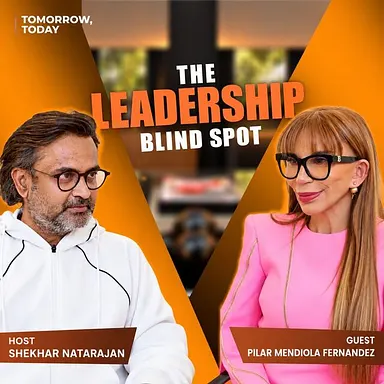
This transcript of “Leadership Beyond Strategy With Pilar Mendiola Fernandez | Shekhar Natarajan” from Tomorrow, Today was made with HappyScribe’s speech-to-text technology. Related: Zoom transcription.
Ads in this audio differ from the text. Tap the sentence you're hearing to follow along.
Synced: the text now follows the audio.
Of course you need to future-proof the strategy, but you need to future-proof the human that is leading the strategy.
Do I have childlike curiosity that actually helps me ask the question why all the time?
I think that it's more, more the challenge challenge more than naiveness, it's ego.
But if you're naive about learning some of the things which are very important for your business, then you're not a good business leader.
I basically transform data constraints and complexities Into a very valuable information.
Welcome to yet another episode of Tomorrow Today with Shekhar Natrajan. It's my great honor and and privilege to have one of my very good friends, Pilar Fernandez. She's an amazing, amazing, amazing person. First, like, beautiful story. She's lived across, like, you know, she's gone across 102 countries, you know, like, I'm sure, like, you're still counting the stamps on your passport.
Well, after the pandemic, never.
And she's one of the top mentors, you know, listed along with Michelle Obama. You know Michelle Obama as well. And a true inspiration, corporate specialist, like you've been like in the— you've run like, you know, leading organizations as a group CEO. You've developed your own methodologies of how transformations work within the organizations and how should it work and how should leadership work. Oh my God, like, you know, I can have like so many good conversations, including like Washington.
So That's a good one. Yes.
Yeah. So there's, you know, like, so I think a lot of things to unpack, Pilar. So, but let's start from the origin story. Yes. Of, you know, who you are and, you know, what you do. So primarily, like, you know, when you date yourself back, like, you're from Mexico.
Yes.
And basically, like, you know, you came to the United States as an accident, but Tell me like your household, your father, what does he do? You briefly touched about like, you know, the speech that he had given in Washington, DC, and hence that, you know, you went to tag along with him. But prior to that, all of this happening, what's your life in Mexico? Who are you? What's your father? Who's your mother? What are their values? Walk me back.
Well, thank you so much for the invitation. I'm very pleased to be here, and really it's an honor to be invited to your podcast. So I am very excited to join you today. I also like that your conversations are very human-centric, which I am very proud of that. My life in Mexico, I, well, I was, I have been very fortunate in my life because I had the best parents I could ever hope for. Both of them are lawyers. My mother is one of the first lawyers, women in Mexico. And my house was filled with a lot of debates, philosophy, music, and a person permanent, really, environment of learning. So that environment shaped us completely because it was a responsibility in our house to keep on learning because we were given the faculties and the capacity to do so. So it was it was a responsibility and a core discipline to keep on learning and really trying to ask better questions. So my mother really, beyond the fact that she was one of the first women lawyers, she's the smartest woman I know, and she was very clever while really raising us. And my father, he came from very humble origins, and he was the first person who actually, like, finished elementary school in his region.
And at the end of the day, he went all the way to do a doctorate in law. So it was always about thinking How can we learn more and how can we contribute more? That's the kind of house I grew up with.
Very beautiful. I used to be that person hunched over my laptop during meetings, frantically taking notes to capture every single word without really paying attention to what the other person is saying. But the irony was there was so much time spent on screen and very little time engaging and contributing. I'm sure a lot of you guys face that.
I realized something had to change, and Granola changed that for me. Granola is an AI-powered notepad that makes your meeting notes useful. It captures what happens in your meetings and turns them into clean, structured notes with decision and action items pulled out and made easy to find. And here's the best part: Granola integrates seamlessly with how you work today. There's no setup, there's no configuration, and there's no friction whatsoever. Think about those typical post-meeting routines. Well, I go through them all the time, and it takes me hours to clean up those messy notes, trying to recollect and piece all of them together, create the action items, and rewriting and making sense of all of it. Post facto. And I used to spend quite a bit of time, sometimes many hours, trying to do that. I'm swamped with meetings every day, and I cannot simply afford it. And hence, Granola changed my life. What used to take me 2 or 3 hours now gets done in minutes, if not in seconds. And to make it all accessible for you, Granola is your partner. You can try Granola totally free today. Head to granola.ai/today. That's granola.ai/today.
So, um, were you always like a, uh, a great student growing up?
A great student? Yes. Yes. We had to, you know, like actually we will come to my father and said, hey, Look, my grades are wonderful. Can you, like, can you send us to Disneyland with my friends because we did so well? And he said, like, no, that's your responsibility. That's, like, that's what is expected from you. I'm not going to reward you for doing what you must do. So it wasn't, it wasn't an accomplishment in our house. It was like an obligation.
Yeah. And so you have siblings?
Yes, I have a brother and a sister.
Very good. And what did you major in? Like, you know, like, very fascinated by some things versus others?
Well, I think that since I was very young, I always had this question because of the grades about why some people get better grades and others not so much. And I was very curious about that. And my mom was the one who first introduced the word potential. And I truly obsessed with that, trying to understand, because it's something that you cannot predict, not measured. So how do you go about it? And that was one of my first obsessions, and my mother truly explained, like, to me that it was about a lot of effort, a lot of attention, and a toolkit of strategies, and a good environment in which you are exhorted to learn. And with that, although it's unknown and unpredictable, you could have the chance of actually growing into your potential. And that was one of the first obsessions I had, of many, because my mind was always very curious. I always wanted to know where things came from and very curious about humans. and anthropology and societies and cultures.
Very good. So when did you go to Washington, D.C.? What age were you? What did you do there?
I believe I was probably 23, 24.
You'd already done your bachelor's?
I'd done my bachelor's.
And what did you do then?
Communications and research, basically. And actually, I wanted to write books because I love— I really love reading, and my father didn't want me to. He said, no, because you can still read and you don't have to go to university for that, and you will just really not make a good living. That was the way he— He was thinking. he thought. Later in life, he didn't feel as good for doing that, but I chose then communications and research. And what happened was that my dad was giving a speech in Washington, D.C. He was— well, he's a lawyer and a politician, so he was invited. And I was in Purdue University studying to take the GRE test. And he said, well, just come, come along and take your— you can take— you can bring your friends with you. And I went to Washington, and that night I went to see his speech, and I was like helping him also with his newfound friends. There was a whole delegation from Thailand, and he was hanging out with them, and we were just— That's amazing. talking. And at the end of the night, we crossed the Key Bridge, which is the bridge that connects Virginia to Washington.
And I don't think I'd ever in my life felt such a connection, and I fell in love with it. And I said, I am going to Washington and moving to Washington. Yeah. My dad got really upset, and he said, if you move to Washington, I am just calling you off.
Oh my
God. And I'm not paying for anything. And my mom actually, she had some funding out of like something that she had. And she said, no, you are going to Washington. And here is that something I can help you with. 4 months later, so I was in Washington, and one of my professors actually from my university in Mexico had a connection. So I also started helping as a TA in George Washington, and then I just did also a lot of different jobs. Like, I was also like an office boy from Capitol Hill that I would just bring sandwiches around and dry cleaning and things like that. And that was kind of like the reason why I moved to Washington. And a few months later, I read a newspaper ad about the Washington Center and I applied for that position.
My dad would have said like, you know, if I told my dad I'm actually moving to US, he wouldn't say like, you know, I wouldn't pay for it. He would say, please go. Of course. That's why, like, you know, I— no, no, like, I'm like— so the reason why I moved was very different. Like, the reason why I moved was because I have a brother and he was not well. And basically, like, you know, I got a call and I had to decide. Like, I decided to help him because I had a job already after my graduation. And but I did not want to take the job. And instead I chose to come because, you know, he needed me more. Of course. You know, so I just applied for universities. My choice of university was like top-tier ones and or like, you know, Georgia Tech, which is close to my brother's college. And then I just said, you know, Tuscaloosa, Alabama is like only like 4 hours from Atlanta. So I ended up taking Georgia Tech. not knowing that it was supposed to be a good school for industrial engineering. And then my life starts over and all that stuff.
So that's, yeah. So my parents were very happy to get me out of the house because it was not so much like, you know, I was a troublemaker. I was not. It was just that, you know, I was going for a good cause. Okay. So, you know, but like, I love my dad. Like, you know, I used to sit on his lap and like, you know, talk every day, like growing up, that was That was my favorite pastime and very nice man. Your first major initiative, what was that? What was your first major initiative?
In the Washington Center? It was called the NAFTA Leaders Internship Program. We would bring people from— we started with Mexico and Canada. Basically, the NAFTA agreement was signed in 1996, And right off that, we— '94, I'm sorry. So in '96, that was the initiative to bring young people from Mexico, US, and Canada to do a high-impact internship program. And that was the first one, the first time that the Washington Center would do anything international. And I was supposed to coordinate everything, and that detonated lots of much many more initiatives. They I guess they thought that it was just going to be Mexico and Canada, and then we end up yeah we had a lot of cultures working with us like like a hundred, but we really work with sixty like in a very concrete way of developing leadership programs, which was which has been one of the highlights of my life.
Got it, got it, got it, got it. So then you ended up basically building the Global Leadership Initiative.
Yeah. So what happened was—
So after you did this, you know, your first stint at NAFTA, then you went into Global Leadership?
No, immediately we did the Governors Program, which was an invite like governors, not only to do leadership programs, but also to sponsor as a way of sponsoring university students into the program. And that initiative provided us with a very interesting insight that, like, governors and prime ministers and all sorts of, like, high-level positions, they didn't have at that time, like a place to do leadership development. And in some countries, what happened was that they end up in these big offices, from defense to urban development to education, but it was a political post, and they really did not know a lot about that office in the cabinet, in the cabinets. So we end up designing very custom-made leadership training programs for high-level officials. In return, not only that, they would go to Washington very discreetly, like a couple of days within a 3-month period, and will basically speak to a lot of experts so that they could learn about the different, not only different areas that they were not as familiar, but what the other people in the world were doing. Because Washington, what it has also is people from all over the world and experts that are very hyper-specialized, and you just call them.
So we will do these customized leadership trainings for them, and then they will also provide scholarships for the university students of their regions or their countries. And that's how it started, the whole Advanced Leadership Initiative that allowed us to be quite influential with leaders because you were in a very intimate space. Like, you got to talk to all of them and you saw them at the time that they were learning and training. So that was, you know, that was like a very good way of having the conversations of how many scholarships are you going to provide for the next generation of students? And that's really how it was built.
Got it. Got it. So then you raised $60 million.
Yeah, probably more.
So over 2 decades, is that right?
Yes.
So who are the funders? How did you go about it? Everyone is trying to raise money. It's such a great program, but who pays for leadership development?
Well, the governments paid for leadership. And that's where the decision really, it's very It's very interesting to see from where I sit at, like how one person can decide to change the life of a lot of people or not. And at that point, I was really obsessed with understanding the whys and why not. I truly saw that depending on the leader was the actual investment on education. And that was very impressive to me because after that, the question of responsible leadership was always in front of
me. So when you think about leadership, like, are you, Is this a nonprofit? What is it? Is it like a corporate?
It was a nonprofit independent organization.
And so the government is funding the nonprofit for leadership. So how do you measure the efficacy of the leaders coming out?
Well, actually, what we did, and what they are more now, more than ever sophisticated into trying to measure that, because now it's also, you have to measure that. not a question of whether you will. It's where they end up in their careers, basically, and the type of influence the experience had within their pathway. Basically, it's more of a study into the impact of a high-impact program, basically, which is like an intensive immersion program within their pathways.
Okay, and then like, what do they do when they come out?
Well, at the time, it's been almost, I don't know, a long time that I have not been there, but the wonderful thing was that we have a plethora of different sectors. So they went into politics, but some of them went into the private sector. We also had Fortune 500 companies after we started started the entire area of the advanced leadership programs. We had customized initiatives that Fortune 500 companies like Prudential, Coca-Cola, American Express, GE, they founded Ford Motors, they founded actually entire initiatives that we will design for them for different countries. So that was also very helpful because they will want to do a program where they had operations. So in the crisis of 2008, when everything was looking not so great in the United States, the companies started looking at international regions, and that's when we started getting the most funded basically investment from Fortune 500 to invest in education in different countries.
Got it. Got it. So who are you like outside of work? Like, you know, like now, if you think about like Pilar, yes, like, so who are you? Like, how do people— that's basically a very impressive, like amazing leader, like someone you can look up to and someone who's dedicated like her life for leadership training. How do we know Pilar, the actual person?
Today? Well, I think that for me, it's one of the most important questions today. Because for 2 decades, I think, and for 100 years, we had focus on identity, and in the Western world, we tie identity to what we do so close, and it's almost, it's almost a question that you didn't know how to answer. No. before, right? Like, so who are you or what? And you will say, well, I am a group CEO of Alamo Holding Group. And I think that today, after doing a transition and completely transition to working on advanced technologies and rare minerals and defense and sustainability, I can say that I am an alchemist. A strategic alchemist, I would say I am.
What does that mean?
I basically transform data constraints and complexities into very valuable information. I like to—
What, like, give me an example.
Yes, for example, if we have data and we want to go into an expansion, right? And we have complexities because we don't know how to go about it, and we have constraints. I take a look at all the ecosystem and really try to find the magic of orchestrating an answer to Complexity. And I do that in my personal life and professional life. I like to create magic with things that are not relatable or that make no sense.
Ah, non-obvious, looking for the non-obvious.
Exactly. And also, I always think that there's always an answer. To everything.
Where do you go search though?
No, well, everything is in front of you.
I need answers to so many of my questions. I have a secret recipe.
I have a secret recipe. And I think there's always an answer, but you have to look at blind spots, ecosystems, agents, pay attention, really pay attention to what's happening, because all the signs are there. You just have to orchestrated, and that's part of who I am. I am also an explorer, I think, of the inner and outer works of the mind. I am an avid learner, basically consumed by the love of learning. I am also a treasure hunter because I always want to find that insight that will be a game changer for me. And certainly a collector of moments and miracles, and a love— a lover of music, a woman, a daughter, a sister, and a cool boss.
No, like, I'm sure you're a cool person too. So, so that was a good one. So basically, you see the non-obvious, but like, there are so many amazing virtues about— so when— don't you— have you failed?
Yes. Yes, I've failed. Failing is an interesting verb. I think that for me, I just, when I was younger, I saw it like that because I think that we were in that game, right? Like, do you succeed, do you fail? Like, you were not into reframing, I guess. It was like, and I think that early, early 2000s, like the 2010 decade for me, when we really start working with the companies and really paying attention to working with very different countries that you needed to learn a lot and learn fast, and you needed to see basically the differences that were out there and customize an approach, and there were a lot of preconceived notions I had as a designer of initiatives that were completely wrong, and I started in, like, not only designing with a researcher's and a beginner's mindset, but understanding everything as feedback, but I would completely, at that point, I would say that, oh, I failed because the ending evaluations of these programs weren't that high, and I myself, I am very into high standards, so I would like be devastated for results until I learned that it was feedback. And that if I tied my identity to the way that I achieve results, then I was over.
Because this could not be done at all with a mentality of succeeding and failing. This was about learning and learning agility to be able to get those insights and put them right back in the strategy and the programs.
So if I step back and think about your career graph and like what you've done, what did like Washington Center do for you? Like, what did it like essentially do? Like, you came out, you started like, you know, with the NAFTA, then went to the Washington Center. Like, from a From a personality perspective, from your confidence, from your sense of self-belief, what did it do for you? Well— What was it like working there?
It was wonderful. I mean, for me, I was privileged to—
You said you're pretty rich?
Privileged. Privileged.
If you're pretty rich, I know I can ask you some money.
No, no, no, I was privileged. Good. I'm just kidding. You know, being raised by parents who— my father was very huge on work ethic and super huge. And I think on job security too, because he would say, you need to become indispensable. Nobody can come and do something after you. If you are cleaning or sweeping the floor, I don't care, nobody should come after you. And you really need to become indispensable. So you go and do whatever you need to do all of the time, and you have to be the most prepared person in the room. So I basically took that into my job, and And I just executed his philosophy, and I basically will tell you that he was pretty right, that performance will set you free. And I, even though I was super young, and I was, it was very young, and I was, not a lot of women around, not that today I see a difference, but— Within 3 years, I was part of executive committee of the organization where it was all men that doubled my age. For me, like the founder of the Washington Center and also when the founder died, the one who became president of the Washington Center, They had a lot of confidence in me, and because of performance, they started giving me more and more and more and more responsibility.
And certainly, I was able to create like very, very interesting impact because of them, because they gave me the floor to do it, and they were very excited to be able to provide visions, and that someone actually said, oh, no problem, let me go ahead and do it. And that was working with them. I mean, that's what they gave me. They gave me a lot of— Confidence. Confidence to keep on going, and they never stopped believing in what I was doing. And I was able also to train very high-productive teams and high-performing teams. And to me, like, the 2 principles of my life, they have always been partnerships. The power of partnerships and the magic of human potential. So basically, I was the one drafting my job descriptions through 2 decades. So Washington also, it's a place where a lot of hyper-specialized people live close to each other and from different parts of the world. So Coming from Mexico, I was very ethnocentric because it's Mexico, the United States, maybe Canada, Argentina, Europe, and Asia. It's just like Latin America did not exist, like growing up, it's not an emphasis. And I was very, very into learning about the different cultures, and that also gave me different perspectives about the world, and I was basically living within the vicinity of every nationality on Earth.
And that was, to me, as a human, as a woman, as a leader, as a follower, it just gave me this sound floor, this space where I— never felt out of place. It always felt like home to me because of people that were around me.
Did anyone that you remember who went through this leadership program that you fondly remember has turned out to be like a superstar?
Well, yeah, I mean, there are a lot of—
The one that you like in the world knows the most?
Well, I think that we have a lot of people in politics or in private sector. Like who? We had, for example, in Mexico, we had governors of different states. We have right now people who are leading a different transition for energy, for Mexico as the one leading as the controller of the CFE, which is in energy. We also had congresswomen and congressmen. I think that it really, they are everywhere. The most important thing I think is that when you ask what Washington gave them, It's always the—
Confidence.
The confidence. The confidence and the opening of their eyes because we were always between very important people that it never felt that they were that important. Because everybody is important, so they don't act like they aren't important. That was very good for them, for me, for everyone who went through these decades. I don't think I can choose one, but I can tell you that the impact within their careers has been very transformational for the communities they serve.
Oh, wow. Yeah. So I know that for a fact because, like, you know, there's a scholarship that is named after you.
Yes. Yes, well, that was a hard thing for me to do, to leave the Washington Center. Mm-hmm. That was one of the, probably one of the hardest moments of my life, and it really like pushed me into the question of identity. That's why I started really trying to understand that. And when I left there, there was this scholarship that they created to provide educational opportunities and funding for women in colleges and universities that aspire to be in leadership positions and that also had kind of like a passion for learning. That was kind of the profile that we were aiming to aspire. And I was very touched about it because obviously that was a huge part of my energy and my life and everything. And I didn't see women at all when I was growing up professionally, not that I see a lot today. Cannot say I see a lot today, but through my career, that was very evident. And I think that aspirational capital is very important. And that was a very special moment for me that we had that scholarship.
Got it. So the CEOx program, the leadership methodology.
the methodology.
So why did you come up with that?
Well, when I— so my current job and what I have been doing for the past years has been a very completely different sector, completely different sectors. What we do, one of the business lines or business units of our work focuses on calibrating strategies for companies that are, that have a budget of €500 million and above. And the way that we calibrate these strategies is with experts, with hyper-specialized experts. So, we go with the boards of administration, they present the strategy, and we assemble dream teams of experts for them to really pressure test the strategy. So, that task has been game-changing for strategies, and this is a concept that actually Juan Verde, that he was on the post- podcast as well, and Jorge Brown that you know, they both came up with that model and it proved to be super helpful for the companies because they could not only really calibrate and pressure test the strategy, but also they could avoid a hefty sum of investment if things were not as they thought so before the calibration. And this is, again, I'll say it's mainly energy, but energy, water, technology, rare minerals, all sorts of sectors.
And when we continue to do this, roundtables and really have these experts from all over the sectors, I started to see that the CEOs and the executive committees, they sometimes, it was very hard for them to hear these calibrations because they were not actually validated what they had spent so much time working on. And that moment, when it was a pattern of seeing this, I said, no, no, no, no, no, no, I think I got it all wrong. Like, the strategy, of course you would need to future-proof the strategy, but you need to future-proof the human. that it's leading the strategy.
So basically, like, future-proof the CEO.
Future-proof the CEO.
But the CEO doesn't stay more than 4 years.
Well, not in Europe.
Is it like a job till the pension comes?
Not in Europe. In Europe, they stay for longer.
Longer period. What is a typical tenure in this office?
They can stay for decades.
Decades?
Yes.
But how does the organization evolve when you're staying there for decades? Don't you get a little rusty?
I should not comment on that. I plead the Fifth. Well, they stay there for a long time.
Why is that? CEOs stay for a long time. Do they? Because it's a nice job? You make a lot of money?
I think it's a nice job. Sometimes it comes from an evolution of a family business, or, so, I mean, even they are very big.
Yeah.
It really, like, it really did not so much evolve in terms of the, well, they started to evolve. I think the pandemic completely pushed to that question, of what are we going to do, and the world is not as the way we thought it was. So when I saw that, I started also, we started to look at vulnerabilities, like what was the constant vulnerability that was happening, right? And I started to see that it was a prospective blindness, like not being able to really take into account megatrends and prospections into their strategy. I also saw that it was like a technology vertigo, that it was like a lot of AI and a lot of machine learning and a lot of different things, but even one got the boss, it was like what are we going to do? Then it was also data overload, like lots of data, and what do we do and how do we work machine learning with actually predictive systems? It was also generational collision. You have 5 generations within the labor market and you didn't really figure that out earlier or how to work with that. Then it was modality fraction, like not all people present in a building.
Now you had remote, then you have people in different countries, and that the model, the modality just completely changed. Then it was sustainability imperative. You needed to be in front of sustainability all the time. Then it was cognitive overload. The CEOs were like overloaded. And then you have a geopolitical earthquake. That nobody would even, 5 years from the pandemic, would ever even expect to happen. And then the paradox between purpose and prosperity. And I start seeing these patterns and patterns and patterns, and that's how—
You came up with the methodology.
I came with the methodology. I said, we're going to take this vulnerabilities, and we're going to build a competency for each of them.
But is the vulnerability same across all of the different aspects for a CEO, or like it would be different for different like levers, right? Like different attributes will have— I may be technologically smarter because I have a grandson who's teaching me how to use a phone. I don't know if I'm a CEO, but like, you know, I may be not so good at predicting geopolitics and how does it impact because I've always locally produced, done businesses. So everyone is different. And so do you score them in that case? What happens?
Well, what happens is that the vulnerabilities give birth to the competency, right? And the model, what
it does— Vulnerabilities create competency, but you have to have the capability To perform the job.
Right. So if you like, the model is built on very specific knowledge and understanding of how things work in one or the other so that you can do your job. However, the work starts with identity. Because what happens is that for a century, you have the omnipresent commander-in-chief. Everything was like total control, I know everything, and I'm going to do basically, I'm going to lead with that, with certainty, with control, I know the answers and everything. And this era completely disrupted that model.
So I have a fundamental question on the philosophy of what you're trying to do. Is it a CEO's job to know all these different dimensions you're talking about, or does he need to have leaders who would actually know a lot more about this than he would, but he would use them as a counsel to actually make the decision?
Well, I think that you have a bare minimum. You need to have a bare minimum.
Oh, you're saying like they don't even have the eye?
No, what I'm saying is like, you can be, as you said, like I can be super good at tech, catalyst because I know technologies and I will be able to inform my strategies with that. But what I'm saying is that these vulnerabilities that are very scary for some, like if you are in a leadership position, you must know a little bit of each of them or at least 30% of understanding.
So you could ask the right questions.
So yes, because Not only do you ask the right questions, but also the company will never grow beyond the leader's identity.
True.
And you need to be able to—
Is that better for them to then move on and give way to another person who could do, who's more—
No, I think that it has to be part of a responsible Management practice. I think that—
I get it, but like, you know, at some point in time, like, you know, you're like so— you're lagging on so many different dimensions that doesn't make sense for you to hang on. Like, you just move on.
Well, I mean, what I— the premise of that, of the model, is that if you understand these vulnerabilities and you actually have an understanding of how can you bring megatrends and disruptions into your strategy, or data alchemy, like how do you use data, or things like that, the competencies, they multiply, and they basically create a synergy in which you can really be prepared to confront the challenges that are happening from the premise that you have to unlearn what you are used to, which is total control and knowing everything, and really go from that mindset of not being scared of different, or just not only scared, but or have been just kidnapped by paralysis of not acting because you don't know if you're doing the right thing, or if you are choosing the right person with the right mindset, uh, of the one of your team as well.
Got it. So, but like, if, if you're lagging on so many different dimensions, are you not a conservative CEO who would not act on all these things? Is that not like the symptom of what would happen?
No. Well, I think that it, it gives them—
Why wouldn't you learn? Like, you know, like, let's take you and I, right?
Yeah.
Like, you got to be super naive not to know all these different things. And you may know some, but you may not know others. That's your argument.
Yeah.
But if you're naive about learning some of the things which are very important for your business, then you're not a good business leader.
I think so. One more. I think that it's more the challenge more than naiveness. It's ego.
That they think they know, but they don't know. But that is even more dangerous. Even if you show them like a digital mirror of what they know and what they don't know. would they not be narcissistic? They would not argue with you that they know, but you're telling them they don't know.
Well, what I have found is that you have different levels of awareness within leaders.
So you're like the spiritual guru or the leadership guru. No. Welcome, Gigi Provincer.
You'll be so surprised that of The lack of awareness, for example, if we divide the competencies more than the 10 competencies that the model, if you divide it— No, I was just kidding. No, of course. If you divide them in like a strategic foresight and intelligence, then you have their like foresight dynamics, you have global pulse, and you have data alchemy. And then the second, which is optimization of financial optimization and resilience. Then you have Growth Forge, which is disrupt yourself mainly. You have Tech Catalyst, like knowing 30% of technology so you can make an informed decision.
Yeah.
And then you also have not only that, but also have the Sustain Agility. which is merging sustainability with prosperity. And then the third category can be human capital leadership. And then you have the Omni-Synergy, which is creating synergies between modalities, the Emo-Agility about working with the generations, the Purpose Drive, and also the—
So there are a lot of dimensions then?
Yes, so 3 main dimensions and 10 competencies.
Got it. That seems to be very comprehensive. When you offer this to a leader, what happens to the leadership then? Their performance goes up and then—
Well, what I've seen is that the way they approach—
The problems.
The problems is more with questions and with the actual acknowledge that it's okay to not know everything. We have experts, we'll have people that can go into the different specifics of the company in the different areas, but I can ask better questions and I can also be excited that, for example, technology is not about buying just whatever AI somebody is basically giving you, but understanding that It's never about the technology, it's always about my problems and the challenges and the objectives I want to achieve, and then technology partners with us, and it's just a better feeling.
So would the leaders then have leadership assessment tools to say their ability to learn, unlearn, and relearn is also measured in the skills?
Yes, well, I think that One of the main debates on identity has always been that it's now settled, thanks to neuroplasticity, whether identity was fixed or made, and it is settled. It's basically made. So your ability to learn and unlearn, it's basically all of us have it. We have 86 million neurons and 100 trillion connections, and we are able to learn and unlearn. And I think the main, the core difference is whether or not you have that awareness. But yes, there is an assessment to understand where you are at and whether or not you want to start with one competency or or all of them at the same time because it's not as complicated, but more than anything, it's like, when do they need it? They all need different things, but certainly there are some, for example, global polls, understanding geopolitics now can completely change or has to, it's obligated to change everything. Mm-hmm. And utilizing the right data or choosing the right technology, it helps a lot. And it's always an assessment that you— that is pushed through this understanding that, okay, I understand better the landscape and I think that I can start in a lower baseline in one or the others, but at least I have that notion.
that I can do this progress and I can also lead the groups and I can also create synergies among the different challenges.
Got it. Fantastic points, like, I love it. So the leaders go through that, they understand themselves, they understand the vulnerabilities through which you create competency and then you map it to the capability needed. And then that capability then may mean that Like you bring in people to like, you know, do the work for you and, you know, what questions to ask and what not to ask of them and how do you facilitate the team? Like all of this makes sense. So what is the tangible— what did you see as a tangible benefit implementing this methodology? Like, so is there a— like, does the revenue double? Does basically like, you know, what happens?
Yes, well, definitely. Like if you see like the statistics and the repercussions of understanding sustainability, for example, as a smart business strategy and being able to, instead of the myth of just a regulation or just for people who are obsessed with green economies, and you see it as a prosperity tool, then you can clearly— clearly make better decisions and they will impact the bottom line. Like at the end of the day, age competency, if you bring that awareness not only into you but to your executive team and the actual company, it has very specific repercussions in revenue. Well, all of these, I wrote a book about it. Very good. It's a start of a conversation, and that's what I wanted to do, an invitation to question your identity, not to be scared of not being the same person or leader that you were in the past, because the past had different circumstances. Mm-hmm. And the past had a different set of characteristics that they are no longer
valid. Yeah. So I think, I don't know how you feel about this, but I feel one of the things that we don't measure, and I don't know if there is a measurement tool that, like, you know, we have, the best leaders I've worked with, and I've seen, like, the CEOs I've seen, of the companies I have worked for. They had like, there is EQ, there is IQ, but there's nothing called CQ. Curiosity quotient.
Curiosity, it's ours. So that's the whole premise.
So you like, so like, and I don't know how to define it. People like talk about EQ, like, you know, like, you know, is this guy emotional? Aware and like you know, like you know how what sort of a leader is he and da da da da da. And then there's IQ like you know which is like you know how how smart you know they are and like you know how can they process information. But I think like most one of the most fundamental skill that is lacking is like what I call CQ, which is how curious are you? Like do you do you hold the heart and the mind of a 3-year-old? Even though I'm a CEO, I mean, I must be a grown-up. I could be a grown-up like 60 years, you know, I don't care. But do I have childlike curiosity that actually helps me ask the question why all the time?
All the time. Completely. Like, that's my whole premise. I started from there. Like, if you, if you don't exchange what you currently hold for curiosity, basically you are done.
Yeah.
And to me, it's not only work-related because right now I also can see people who retired, CEOs who retired, and And certainly, and that did not have that curiosity, and what I can tell you is that I see that their lives are not as fulfilling, nor I see them happier than before. And I think that curiosity is the one thing that will keep you alive.
So one program that I have seen that works, that I have— people thought I'm already retired. I don't know why they think that. Like, you know, I'm like, I'm not like seriously old. Maybe they think I am.
No, of course not. Who thinks you're old?
No, but I did get like an email and an invitation from, you know, like, you know, Chicago, University of Chicago. There's a program called Leadership and Societal Impact, LSI. And that is all collecting all the CEOs of large companies and unleashing them into the society to create a greater impact. Like, you know, that they can live beyond the organization they live. They can live for the country. Yes. Like the world. And so they go through a program and they basically get trained on, like, you know, kind of what is needed to be a good contributor, like, and they look for different people from different walks of life and leadership, like, you know, positions they've had. And I found that interesting as a thought, like, you know, that— So there are many ways to stay curious in your life, you know, though you have retired, there are many ways you could stay curious. and also continue to contribute to the society, I feel.
Well, I think that's a responsibility. I mean, like, to me, it's the impact and how you make that contribution. It's what— it's the cornerstone of not only my life, but what I think also leadership is for, right?
No, I admire you as a leader because you've sacrificed all your life for like one, only one thing I know, like leadership, you know. So not a lot of people do that. Like, you know, I wish I got trained by you. I would have turned out to be a better leader, like, you know, and not a loser. Like, you know.
Well, you know, it's clear to me that you have that curiosity and you always ask those questions, like your company is called Orchestra, right? That like, who, like how do you, to me that was a similar question, like how do you orchestrate ecosystems that you don't own, right? And how do you lead with the person first? And I think that's essential. If I learn anything, is that you are never replacing a human.
In an AI world?
No, no, no, no, no, no, no.
I think the jury's out there. But I think a large portion of the current economy that we know will go through a massive transformation of the the professional identity we know today.
Yeah.
I don't necessarily think like, you know, I'm not one of those guys who feel like there is going to be a huge job loss and like, you know, people are going to be out of jobs. I think we're going to have job loss for sure. I think we've got to address the reskilling capability of people, like, you know, what do they do? I think that is going to definitely happen. So there's going to be a little bit of a bumpy ride for the next, like, you know, 3, 4, 5 years. But I think like, you know, there are also a lot of interesting problems that AI presents that we haven't solved yet. Yes. That I think needs to get solved. And hence I feel like there will be a newer class of like, you know, professional career that would be created that would actually lend itself for, you know, neurodiverse people, people who are curious because in AI, like It's all probability. So you have to be Curious Joe, you have to think about probability of something happening. It never happened, may not happen, it could happen.
It could happen.
So that's what you, you have to process in that world. And so what used to be a key weakness of a lot of people, which used to be ADHD, will be a strength in this world. Yes, because they will be neurodiverse. And those will be the best problem solvers of the world. I feel like there's going to be a huge class of new type of work which gets like, you know, sort of its renaissance.
Yes, elevated.
And then we got to figure out like, how do we do this? So, and I don't know if like, you know, I think juries out there, like what type of jobs will be completely replaced and will take out humans, maybe the jobs that we never wanted. And there are quite a few of them. It's 80% of the jobs.
Yes.
So that scares— that side of it scares me a little bit. But I also know that when we get to that sort of problem, then we as humans have the opposite tendency. When we see that something is going to encroach our control, our dignity, and our access, we push back very hard. We push back very hard. So I think there is going to be as the pendulum on AI is swinging, I think there will be like, like sort of like this resurgence, so to say, of people either like not trusting it or not wanting to use it or making the adoption difficult. You know, there's going to be a change management problem. And I think there's going to be huge backlash and pushback. And I think we'll find some sort of balance.
Yes.
So I think that's my hope. And that's my dream that we, you know, because I think the other side is very bad. This side is also bad because we're not efficient. So we got to find the balance. And finding the balance is always the toughest thing. Who defines balance? And what is balance?
Yes.
So, you know, it's all interesting. So 102 countries, how did you like, what is your passport? Like, how many passports do
you have? Well, they have changed because Like, your
passport is this big.
It's only 10. It's only, you know, the pandemic was like 2020. That changed it completely.
Oh, you don't travel as much?
I don't travel as much anymore.
You're like always based in Madrid?
Yeah, yes, in Madrid now. And that was like, I think, one of the start of the big changes in my life. You know, I traveled enough for my lifetime, but I do love learning about cultures and people.
That I want to touch on. So you visited 102 countries?
Well, probably like 80.
Okay.
Yeah.
Okay, I got to go search your passport. Maybe 22 left off, like, because, like, you didn't count them. No, I'm just kidding. So, like, what is universal about cultures you find? What is not universal about the cultures? Like those 80 countries you have, what is the universal primitive? Like, you know, I'm sure, like, don't do any harm to anyone, like the way you don't like to be harmed. That could be a universal principle. You know, don't willingly cause hurt and pain to others, that could be a universal primitive. Respect is a universal primitive. But besides those, like, I cannot come up with more. Are there some similarities in universal principles?
Yeah, I mean, I found, you know, very simple, answer. I think that in all the countries that I visited with a lot of respect and curiosity, because there was no other way of doing it, it was not in fashion or not in fashion, it was like you had to go with curiosity to be able to design something that was helpful for the countries, and every country was different. But at the core of everything, I found that we were all the same. It was like, as you call it, universal principles. Everything I learned, I learned it in kindergarten. If you respect people, you build a connection. try to understand before being understood.
No, so universal primitives, yes, yes, yes. Universal primitives.
Yes.
You were saying something about, like, universal primitives.
Yeah, no, that, like, really, for my work, for example, at the end of the day, it was about the forging of partnerships. And there are countries, obviously, that were my favorite, or regions, Because they were effective, they were fun, respectful doers, very human-centric. And I believe that if you had decency, if you work hard, if you treated people with respect, if you were curious and respectful of understanding what they needed instead of Jumping to an assessment that was quick to say, oh, I know the answer. I think that if you led with curiosity, people will be very open into what they were needing. And the initiative's success was basically based on how good the partnership was.
Got it. So let's do rapid fire and then I wanna come back to questions on AI and leadership. Okay. So the most important quality in an exponential CEO?
Reinvention.
Reinvention. Beautiful. The biggest leadership mistake organizations make
nowadays? I think thinking that it's all about disrupting the organization and not the leadership.
Good. The leader, living or dead, you most admire?
My father.
Your father. CEOX in one word?
I think amplification or amplifying impact.
Amplifying impact. A country that surprised you the most?
India.
Oh, wow. Why?
Well, I think I thought I I was gonna find more cows and I found—
More cars?
Chaos. It was, you know—
You thought you'll find cows and you found cars?
No, chaos. Like, because I, you know, just, you know, from going to the country and the colors, the noises, the senses and all of that and really Found in choreographies, like really orchestration of
chaos.
Of chaos, yes.
Beautiful orchestration of chaos.
Yes.
And we make good music too.
Yes.
And dancing too. The country that most surprised you is India. The most important thing that 102 countries teaches that one cannot learn?
Uh, that you don't know what you don't know.
Got it. It's like so weird, like when I came here, like, you know, everyone was like expecting a, uh, a kiss on the, the cheek on both sides. I'm like, I'm, I'm very like, I'm like, I don't know, I don't want to, I'd like, I don't know if I have to. That was one thing I didn't know. Um, universal or local, which is more, which leadership is more? Universal or local?
I think it's universal in principle and
local
in execution.
Got it.
You sound like one of those value statements in a company. Global thinking, local execution. Yes, exactly.
That was their mission for a while.
Country you would go back to tomorrow?
China.
Oh, not India? I thought you liked the dance.
Yes, of course. China, I am also very fond of their strategists.
Got it. The most important thing a mentor can do?
I think see you bigger than you see yourself.
Got it. The thing most people confuse mentorship with? Advice. Michelle Obama, one quality that defines her as a good mentor?
Vulnerability as a superpower.
Got it. The moment in your career you are most proud of?
Wow. Well, many, I think, very a lot. But I think that 2 moments. One, that when I brought, like, with our teams, we brought an initiative for women. for leadership women since it was lacking. We were able to build that solid initiative for all ages of women from 19 to 84, and that was a very good moment for us. Then I think when I retired from the Washington Center and they gave me my statistics of how many minutes and moments I had spent spend building leadership programs. And I was happy to see that.
Washington, DC or field, which one was the best work?
Oh, I'm an operations person.
The field.
The field, yes.
If not this career, what else would you have done?
Doctor.
Doctor. My mom thinks I would make a lousy doctor. Yes?
Yeah,
I don't have any patience.
Oh,
well, like, I'll be like, you know, I'll be like going through a surgery.
But you have curiosity.
Well, like, if I'm curious, I'll be like, you know, probably like cutting all the different places I'm not supposed to. That's also a dangerous doctor.
Well, that's it. And you're more impulsive.
I'm curious. Let me cut through.
Curious and impulsive. Yeah, well, maybe we'll stay in this lane.
The elephant in the room, AI, and the implication of leadership. Like, where do you think AI is headed first? And like, what advice do you have for leaders?
No, well, I think that AI, as I see everything, AI is going to exponentially help us humans to do many things, as you were saying earlier. like some of the things that we don't want to do. We're not competing with speed or memory. And I think it's a very exciting partnership the way I see it. And I think that since it's a partnership, it will help you completely amplify what you are able to do, you, your teams, the community, all of that, if you see it from that point of view. I do know and very well I'm aware that we need regulations and many other things that we don't have right now, but I see it as a pulse, as you mentioned it. And I think that if mindset, it's everything. If you are able to see AI as a partner that will help you either solve challenges or help you with your objectives, then you have a winning scenario. If you see it with fear and you are kidnapped by notions of what could happen or different scenarios, and I think that catastrophizing something, it is like really a very bad way of looking at the future.
It is about hope and opportunity, and we have the ability to unlearn and learn. And I think that's the core of everything. If we're able to change our identity and reinvent ourselves, all of us, including those where jobs are not going to be longer there, if you can yourself in a different light and not a fixed light. I think this is a very exciting time.
What scares you the most about AI?
Well, the human programming the AI, because it's— who programs it?
The Big Four.
Yeah, I mean, it's just That's scary because always—
But how do you democratize that? How do you take the power away from the big guy and give it to all the small guys? It feels like a David-Goliath game. But I don't think King David with a sling will come and slay Goliath with a single stone. I don't think that's going to happen.
Yeah.
So I think that's the thing that keeps me up at night. If you ask me why I'm worried, if I'm worried, who's dictating how we should behave? Who dictates intelligence? How is intelligence created? Is it the right intelligence? Because, you know, that's the same problem we had social media, but this is amplified.
Yes.
You know, so that, that's one niggly thing I have. But I think, like, am I excited about it? Yes. But I think we should be cautiously Yeah,
cautiously moving at a slower pace. It
doesn't mean that slow down the train, like, it's not like stop the train, just slow down the train. Like, you know, why are we in a hurry? What are we going to get?
Yes.
And it feels like, you know, we are in this arms race, trying to outwit the other guy with like better models and better models and more better models. At some point in time, it's like nuclear treaty disarmament. Stop. We're not going to fight each other. We are going to like declare like an AI disarmament treaty or whatever it is. And we just slow it down and try to understand the implication of what we're trying to create. So I think that is what is sort of needed right now.
Yes.
It's like a nuclear moment, right? Like, you know, like everyone said, like, oh, nuclear seems to be a disaster. Let's like basically Yes, we created it, but let's disarm ourselves that way. We don't use it against wrong things. I think that needs to happen in the world. I don't think we have thought through that yet.
Absolutely.
I'm excited. Thank you so much, Pilar. I love the conversation. You are so, so amazing. You're such a sweet person.
No, thank you. This was like a real conversation. I really enjoyed it. Thank you for having me.
Thank you so much.
• Pilar’s journey from Mexico to Washington D.C.• Growing up in a family where learning and asking better questions were part of everyday life• Why her father did not want her to move to Washington• How she followed her instinct and built a new life in Washington D.C.• Her early experiences at George Washington University and on Capitol Hill• How the Washington Center became a turning point in her leadership journey• Building international leadership programs across different countries• The importance of partnerships and human potential in leadership• Why Pilar calls herself a Strategic Alchemist• How she transforms data constraints and complexity into valuable information• Why there is always an answer to a complex problem• The importance of understanding blind spots and ecosystems• Why failure should be treated as feedback• How a beginner’s mindset creates learning agility• Why leaders need to future proof themselves along with their strategies• Why the company will never go beyond the leader’s identity• Moving from control and certainty toward curiosity and better questions• Why ego can become a major leadership challenge• The importance of asking better questions instead of trying to know everything• How AI can become a partner rather than something leaders should fear• Why technology should begin with the problem rather than the technology itself• What working across different cultures taught Pilar about leadership• Why respect curiosity and partnership matter across cultures• Why you do not know what you do not know• The role of mentors in helping people see a bigger version of themselves• Why contribution and impact are central to leadership• How leaders can reinvent themselves through learning and unlearning• Pilar’s perspective on the future of AI and human leadership• Why the human programming AI matters• Why the future should be approached with hope opportunity and adaptability
Subscribe to Tomorrow Today Show by SKN for more transformative global conversations. Hosted by Simplecast, an AdsWizz company. See pcm.adswizz.com for information about our collection and use of personal data for advertising.