
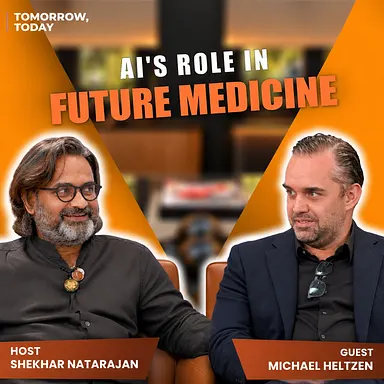
Shekhar Natarajan talks with Michael Heltzen about his path from day trading and accounting to bioinformatics, starting in 2004 with CLC Bio's software for analysing DNA sequencing data. The conversation covers how scientific advances become invisible parts of everyday life, the risks and governance questions around AI, and why representing diverse cultures and languages in models matters.
They also discuss Heltzen's work with graphene biosensors and Exozyme, which uses enzymes outside living cells to make rare natural compounds such as NCT, a molecule linked to metabolism and fatty liver disease. Listeners will hear his views on longevity and on the human skills he thinks will matter most in future work.
In this episode Shekhar Natarajan, Michael Heltzen
The transcript of this episode on enzymes, graphene biosensors and AI in biology was made with HappyScribe technology, the tool HappyScribe built to transcribe audio to text.
Ads in this audio differ from the text. Tap the sentence you're hearing to follow along.
Synced: the text now follows the audio.
Just basically, they had found a way of harnessing the enzymatic pathways, but running it without the cell. And everybody knows you need the cell to run the enzymatic pathways.
And they were essentially basically placing a bet on 80% of humanity getting wiped out because AI has already like gotten out of control.
When people ask me for career advice, I answer that you should try to become really good at being human. Be really good at being human, because I, I think that's going to be insanely valuable.
So an ignorant guy who doesn't know what he's doing is equally as dangerous as a very smart guy who knows what the heck he's doing.
disease right now that very few people talk about compared to how big it is, and it's fatty liver disease.
Yeah, fatty liver.
30% of everybody alive right now have a disease.
Welcome to yet another episode of Tomorrow Today with Shekhar Natarajan. This is our 98th episode that we're shooting. Uh, we are up to like 1.5 million subscribers. Thanks for all the love and all of the comments and all of the views. Um, we were recently at CERN, like, you know, we were talking to a lot of scientists. And today in the studio with me here in San Francisco, I have Michael Helsen. So Michael is a very interesting guy. He was a day trader who happened to have fascination for biology and then was intersecting with computing and is working on something really, really, really cool. And Michael is going to walk us through his journey today and also what does it mean for society in the next 50 years. That's what I would love to see. I don't know where we're going to be in 50 years, maybe on Mars.
We'll see.
Or maybe here stranded, or maybe like we all may be dead because of AI.
Let's try to avoid that.
Exactly. So, but Michael, welcome to the studio.
Thank you so much for having me.
Okay. So let me get started and like, you know, because this is rather a technical sort of a field of what you're trying to do. So we'll go a little bit more deeper. We'll spend about close to an hour plus on this show trying to unpack some deeper concepts. That way people have a better understanding of what you try to do, and then they can appreciate how it could be applied as well to the day-to-day, right? Yep. So as I mentioned in the beginning of the show that you were a day trader first,
So I did, first of all, I don't know how you know that. So that's interesting. Second of all—
Is it right or wrong?
It is true. Very early on, I was trading stocks.
I do a little bit of my research, buddy.
Okay, that's very impressive. I had early on in my life almost like an existential crisis of like, what What is it all about? What is the purpose of life? What am I supposed to do with it? I was so bad at a lot of things and I was good at a few things. So I was kind of like, how do I fit in? And I happened to be really good with logics and with numbers. And therefore I did have a short sprint as a very young day trader that did well. on that, but—
How do you day trade? What
do you do in day trading? So back in those days, this is before the automatic trading that is going on today, you basically sat down and you could be a group of typically young guys that was surveillancing the press releases that was coming out. And then you were taking a bid on, is this order for this wind turbine, Vistas, for example. Is this bigger than the market expects, or is it what the market expects? And then if you expected it to be bigger, then you would basically gear your money, pool your money together, gear it, and then be in the stock until the trading floors around the world saw the news and started buying up the news or buying up on the news. And then you would sell relatively shortly thereafter, and you could make a fair amount of money by basically spotting those momentums. And we were doing that by human. Today that's done by algorithm and you don't stand a chance as a human.
Those like, you know, like, you know, like the reason why I ask, and this is a very interesting story that you brought up and we'll not like spend too much time on it, but like probably touch on it. The Indian stock market almost crashed because of a guy, a single guy.
Wow.
His name is Harshad Mehta. Okay. And like this guy used to like trade on the floor, like in Bombay. And like, you know, so he would like artificially jack up all these prices of all the shares. And then he would take the— he would skim off all the profits.
Wow.
And then the market almost crashed, literally crashed on us. This was like late '80s, early '90s. This is a famous story, by the way, in India. And day trading became like much more like regularized, much more computerized, much more like, Like there was rules to, you know, with which you could play, but it was like almost like a cowboy's game at that time. Like, you know, you run around with a paper and basically like, you know, make a bet. And then like every, all the, everyone is actually going in the market in the same direction. And then someone is skimming everything off the top.
I struggled back then with
the ethics of
that, the feeling of that you were gaming other people and also kind of like—
Is it a game though?
You can argue it both ways, I would say. But on the simple fact of like, I wanted to make a difference for other people, it didn't really mesh well. And that was where my other passions of computational power and computers back then, and on the other side, nature and the raw power behind nature, how does it all work? Those were my other passion areas. And when they started coming together in the first startup we did, that was that's where I had that feeling of like, wow, this is where I belong.
So how did you get into the first startup?
Well, a little randomly, I was kind of utilizing my logic skills and my number skills. So I was hired by one of the big accounting firms in this talent development program and everything. And I was such a misfit because I was good at certain things, but I wasn't motivated at all by what we were doing there. And then I run into this guy that has a brother with a PhD. And then he says the word for the first time I've ever heard it, bioinformatics. Those are my 2 passion areas that I thought had nothing to do with each other as one word. And I was just like, bioinformatics, what is that? Using computational power to understand how DNA, RNA, and proteins work. And they were thinking about doing a startup. And I was basically just hands down in the moment, I want to be a part of that. So that was how I kind of got into the first startup and ended up being very passion motivational driven in the beginning because I didn't have the right background, but I did have the right passion. And with that, I could acquire all the hard skills, the technical skills needed to be available.
I used to be that person hunched over my laptop during meetings, frantically taking notes to capture every single word without really paying attention to what the other person is saying. But the irony was there was so much time spent on screen and very little time engaging and contributing. I'm sure a lot of you guys face that. I realized something had to change, and Granola changed that for me. Granola is an AI-powered notepad that makes your meeting notes useful. It captures what happens in your meetings and turns them into clean, structured notes With decision and action items pulled out and made easy to find. And here's the best part. Granola integrates seamlessly with how you work today. There's no setup, there's no configuration, and there's no friction whatsoever. Think about those typical post-meeting routines. Well, I go through them all the time, and it takes me hours to clean up those messy notes, trying to recollect and piece all of them together, create the action items, and rewriting and making sense of all of it post facto. And I used to spend quite a bit of time, sometimes many hours, trying to do that. I'm swamped with meetings every day and I cannot simply afford it.
And hence Granola changed my life. What used to take me 2 or 3 hours now gets done in minutes, if not in seconds. And to make it all accessible for you, Granola is your partner. You can try Granola totally free today. Head to granola.ai/today. That's granola.ai/today. And when was this? Like, what time this?
This is 2004.
2004. Okay. Early days of bioinformatics was actually on the high at the time.
So, yep.
Yeah. So what was the name of the company?
So that company back then was called CLC Bio and ended up being one of the world's larger bioinformatics platforms. So to this day, 20-plus years later, it is still one of the programs that is used by geneticists and other people when they sit down and you do a DNA test or genomic sequencing. And then the data comes out of that. How do you make good choices and insights and knowledge out of that? That's what that software does.
What was that one thing that changed like DNA sequencing and like, you know, the ability to really understand like, you know, who you are as a person because like till then like DNA sequencing was a thing like people were afraid of because like, you know, you'd never have the compute to actually go figure it out.
So imagine if you were a book full of the knowledge about you, how you work. Back in those days, we could read maybe a line of text and it was relatively expensive just to read one line of text. And maybe if you had a sense of where in your book something was wrong, you could go and look at that one gene and look at that one mutation. And maybe there was a genetics test that could help you as a patient. But for most people, you would never find out what was wrong on a genetic level. So we were just blind to it. What changed was a startup over in the UK called Solexa that sat down and came up with a whole new way of sequencing and sequencing all of it in one go. There was a lot of challenges with that. It wasn't easy. We ended up getting like tiny bits and pieces of words out and we had to put them back together bioinformatically and try to assess what the book was saying. But that is what have led to today that people are talking about having their genomes, all of their genetics basically mapped out.
And it only costs in the hundreds of dollars. Back in those days where the first genome was done, we were talking about billions.
Wow. Yeah, I spoke to recently Walter Bodmer. Like, you know, he was in the Human Genome Project.
Yep, yep, exactly.
He's one of the founding members of the Human Genome Project. Like, and like, you know, he's—
That was the one I just referenced as costing that much.
Yeah. So, and at that time, like, you know, it was very unpopular because it was costing too much and they didn't know like what's going to come out of it. Looks like the CERN project too. Like, you know, like, why are you like, you know, trying to like collide all these like, you know, like hydrogens together? Because what are you gonna find out? Well, like how we like, uh, came about. Like, and why is that important again? Like, and so there's—
That's, that's true with a lot of science, right?
A lot of science, exactly. Like science actually goes through this invention, like, you know, innovation, operationalization, and then it becomes invisible. Like, you know,
it's just baked in.
It's just baked in into your life and you don't even like figure out like it really happened to you.
No, nobody finds it fancy that you have a supercomputer in your pocket that can connect with persons on the other side of the world. That's just baked in.
Exactly. Like, you know, everything about like food, like, you know, people talk about food safety and this and that, like food safety and food regulation actually works in the background. No one even notices that there was food safety and regulation. But we just like, we know like, you know, we can cut that safe, unsafe food. We know that it's just like part of society. And I think like, you know, AI and other things are going to be the same in the future that we would like hardly recognize its existence.
Don't you think that there's a lot of things that is kind of like not appreciated until it's gone? Like how much have you appreciated the plumbing in this building today? Not that much. that it doesn't work, there's nothing else to talk about than how do we get the plumbing fixed? Because we're in deep, deep trouble at that point. And that picture of plumbing that is kind of just taken for granted, but then it's broken. There's a lot of those layers. And I would argue things like health is the same. We don't really appreciate it until all of a sudden it's the only thing we can think about because we're now sick.
Dude, like, I, my, you know what my father used to do? My father used to deliver telegrams. Okay. Um, I don't know when did you last, like, you know, even think about a word called telegram, but like, you know, my, my dad used to work in the '90s, like, you know, like '80s, '90s. And like in those days, telegram, like there were only 2 forms of communication to anyone you wanted to communicate. One is through a telegram. The other one is through a mail, a handwritten mail. Yeah. The handwritten mail will show up 5 days later or 7 days later, depending on the city you live in. And the telegrams are usually like there to actually send money to someone that you want or to inform that someone has passed away. Like, so my dad used to either carry money in his pocket or bad news.
Ooh, wow.
So
people were always a little jittery when they saw him.
Like, they say, is he a telegram guy? Like, you know, either like it's like eyes full of like tears or like, you know, eyes full of joy. It depends on who it is. And so, and when I was growing up, like, you know, I, like, I grew up in slums in India, so we didn't even have electricity.
Wow.
So electricity is a thing that, like, you know, I know, like, people take it for granted, like, but I lived without, like, under the streetlights. We used to sit and study, me and my brothers. So, so I think a lot of technology is underappreciated that way. So now,
do you think that, that when you get to to struggle a little bit, especially in the beginning of life, that you then also fundamentally, your ability to appreciate just is a little higher? Is it, is it, it's so obvious to me at least that sometimes we take things for granted. We are kind of like, this is my right to have.
Mm-hmm.
But the reality is that a lot of people are complaining about what they have today. But if you look back like even 100 years ago, even the king of the wealthiest country didn't have what the average person have today. Absolutely. So I think that's a part of trick to all of it is to like become really good at appreciating things. Then that unlocks a lot of good energy and opportunity.
Yeah, like, you know, and we also like, you know, like as an example, right? Like, you know, I never had a phone till 2003, till my brother actually like got me a phone. And the phones like used to be singular phones, which basically used to be like a little bit of a small brick, like, you know, probably this size. And like, you know, it's the dial pad and you just call. And prior to that, when my brother came to United States, we used to make what we call the trunk call. So we used to call an operator. The operator would then like, you know, put the lines in and then connect it to the other side. And then the other side would just like, like basically pick up the call. That's the way we would book a call from India to US.
Yeah.
And my brother would basically like have a calling card that he would call and he would call into my neighbor's house and then we would go pick up the phone. So that's how we used to communicate. Now FaceTime, I can see my mom.
Doesn't even cost anything.
That doesn't even cost you anything. So it's just like, it's just the world has changed so much. And like my son now, he cannot, I don't think he can ever survive without a phone. Like it's impossible for him to survive without a phone. Like, you know, like you ask him anything, like, you know, he today, like he's turned 6. Like he could like use his voice and the voice would convert it into a text. And he would keep telling my wife where we are. Like, you know, if I'm driving to Safeway, he will say like, I'm at the Safeway. I'm getting out of the Safeway. I'm getting into the car. We just like came into the neighborhood. So he would give like running updates to my wife just by actually speaking into the phone and converting into text and sending messages.
That's the most normal thing in the world today.
Exactly. And then like both my wife and I are like surprised because like we didn't even know like how to use a phone till like 2004 maybe.
That is such a fun connection between your dad running around with short messages, good or bad, and your son just having it literally like liquid.
And this is like within like a generation away, right? Like, you know, like 2 spectrums.
So where are we going to be in one generation from now?
I guess like in, in one generation from now, like, you know, I'm a, I'm a little, um, uh, uh, less optimistic, uh, uh, in terms of the future. Um, because, you know, as a society, I think like, you know, we had this ability to advance and regress, advance and regress in many, you know, walks of life. So what my assumption is, and this is by all, like, you know, conversations I've had with a lot of interesting people, like, I was recently with, like, you know, some of the very top scientists and was invited for a private meeting with, like, 10 other quantum guys in Malibu. Like with a company that I'm not going to name, like it's one of the largest tech companies. You could imagine who it is. And they were essentially basically placing a bet on 80% of humanity getting wiped out because AI has already like gotten out of control according to them. This is like a very large tech company, seriously big. And it's around here in San Francisco, by the way. So I'm giving you all the hints what or who it is. Their quantum office is based in LA, in Malibu.
And they convened some of the top physicists across the world for a meeting. And I happened to be there along with them. Like, I have nothing to do with physics, but I have connections. And basically, I was invited for that meeting. And the scenarios that they were pasting actually made me scared. Scared. And so what I think is going to happen is something, something, something bad will happen. And then we will regret, we will, we will figure out that bad has happened. And then we will all put our sane minds together. And then we will prevent from further harm from happening. And then the society will progress forward. So we have this ability, like, Like it's almost like a whack-a-mole that we play. And I think like, you know, we are playing this game of whack-a-mole at this time with no sense of what is the next whack-a-mole which is going to come at us. And then when we have a little bit of steady state of how all these things will play out, I think like, you know, science will prevail. I feel science will solve science problem. Bullshit is not going to solve science problem.
But then you're also talking yourself away from the darkness and into that the future will be bright.
Yeah, the future, the future is going to be where I feel we will be much more focused in terms of the right use of technology in the right places. I think the right places for technological innovation is absolutely medicine, is absolutely education, is absolutely finance, is absolutely like being able to Take away tasks which were what I call very cumbersome. Like there are certain tasks which should never exist in life that we do as like, like someone being harnessed on a forklift and going 4 levels high to count like a pallet of inventory. It's, it's never safe to do that. You should never do that. But we do it today. Mm-hmm. So spatial intelligence would like get to a place where we don't have to do it, right? Um, so I think there are some jobs like, you know, why do we have to go into a mine? Why do we have to go like figure out like, why do we, why do I have to send a human to go figure out where the landmines are, right? Uh, like, so there are many jobs which are, why do I have to send like something in someone into a cave or to dig, uh, to find like where the minerals are?
Right? Like, so there are jobs which are like, which should never exist as a society that like would, should be like focused with technology and AI and robotics.
So let me, I'm gonna take a little bit of a counter position.
Oh, please do.
Just so we can have a bit of debate and to explore, to unpack it together, to see it from different sides. I actually think that there's more good people than there's bad people. And I therefore think that team good will win.
Mm-hmm.
And I think that as long as, there's all of these famous sentences, as long as good men and women stand up, and there's some truth to that. We're not just, like, I'm not gonna allow something really bad to happen on my duty. If it's me defending my family, my friends, my community, my country, whatever level, I'm going to stand up and push back. I think you're right though, that there might end up being bad things happening that becomes the activation power to get out of the chair and do something about it. And I also think it's a confusing time where right now it's so different. It's almost like outside of the scope of what could happen is happening. And therefore it's difficult to kind of even wrap our heads around and like, superintelligence, what does that even mean? Is it conscious? Is it not conscious? Does it have rights? Should it have rights? All of those things. So I absolutely agree with that. It can be terrifying and it can be used in the wrong ways, but that's more from a Bad people can use technology in bad ways and good people in good ways.
And the reality is that there's no really only bad and only good. There's at least very few of those. And most of us, we're somewhere in the middle where we have a sprinkle of everything. So I hope and believe and will actively fight for that the future becomes a bright place. And I'm one of these guys that are using together with my team a lot of AI. Not exactly the way most people use AI today. We use it in a different form that we can unpack together in a minute. But basically because I believe and we believe as a team that we can, for example, make medicines that otherwise would not exist for diseases that doesn't have any treatments. And those are missions worth pursuing. And I actually think that loops back to some of the things you were saying of like, there's certain jobs that I absolutely agree with, like removing mines in a minefield. If we could let— if we could avoid people getting harmed by that, we should absolutely do that. But I think jobs and us doing things for each other ties back to our purpose as individuals. And I think that's one of the things that, if nothing else, standing up for a good cause gives you purpose in life.
Mm-hmm. So I'm pretty sure we will find our way through. I'm not saying there won't be
Challenges.
Challenges, or even really, really big problems and things that goes wrong to a degree where I hope we could avoid that, but maybe we can't. But at least I believe in that darkness, light is going to come as an activation energy where people will then push back.
For sure, for sure, for sure. So I think like, you know, AI is one of those technologies which actually equalizes. I love the bell curve. I really love the bell curve. And I use the bell curve basically always to the right of the bell curve, meaning the good side of the bell curve, right? But here is a technology where basically like being on the left side of the bell curve and the right side of the bell curve is equally dangerous. True, right? So an ignorant guy who doesn't know what he's doing is equally as dangerous as a very smart guy who knows what the heck he's doing, right?
Yeah.
So, and, and both are equally scary thoughts, like, you know, like Like, you know, when, when, when you hear someone like 16-year-old trying to actually like, you know, being very persistent with Claude to solve a mathematical problem, which was never solved for many years and was able to really solve that problem just by pure persistence. He lacked all of the mathematical capabilities, but he had the curiosity. Well, like that was a good example. It was a good example of someone. Let's imagine like someone like very naive, like, you know, saying like, you know, let me create like a, biohazardous material. They were not intending to, but they can. And there is no way to stop it because there are not enough smart people, like, like solving the problem faster than how the capabilities is getting rolled out yet. Right? Like, it's just like code writing code and more code and more code and more code. Like, so it's just becoming like a mushroom that we're not able to control. And I'm sure like, I'm sure there'll be like structures that will— people will come up either governance regulations, internal alignment, mechanistic estimation. Like there are many ways to solve the problem.
I think many things will be solved over a period of time. My worry is the now through that catastrophic event before we all realize. Like we had to We had to drop a nuclear bomb somewhere to know that nuclear bombs are bad. Everyone knew it was bad, but we dropped it no matter what. And then we realized, oh shit, like, you know, we can destroy cities.
So what is the smallest catastrophe that is big enough for the world to wake up? There must be a balance in that, right? Where it's like, if it's too small, nobody notices. If it's way too big, then the whole planet explodes and that's it.
Something cyber.
Yes.
I would, I would say something cyber would be the first line of attack because I think like, um, you know, systems basically like, you know, agents proliferating the cyber world, like, you know, without like any kind of guardrails and controls, you know, and guardrails is a very loosely used term. Like, you know, when people talk about guardrails, they're really talking about basically like, you know, some safety and security measure that they could put in place like within a company and govern better, like some rules and like private data not leaking, but like, God, like, you know, alignment is a very big problem. Alignment is a rather complicated problem to solve in a probabilistic model. Literally, like mechanistic estimation, like for a very small, tiny latent space and how it behaves, like, you know, a 256-byte like chunk, right? You would need to run like trillions of Monte Carlo simulations to figure out the distribution, to figure out why a certain thing really behaved a certain way. Now explode it to like, you know, a 3 trillion parameter model. Good luck.
It could go anywhere.
Right. So that's the challenge, you know, like, you know, like we rather are clueless in terms of what we just created. And I think it's going to take a little bit of a reset. I like, you know, like, I don't think like the world is going to end. I don't think that's going to happen. But is there going to be some problem that makes us all think enough is enough and we should all get together and we should figure out like what's the right way to do it? I think that's, there's going to be a reckoning like that for sure.
So I guarantee it. So let's say the internet breaks down for a week. Global internet is down for a week.
Yeah.
Would that be enough to make us all—
Even for a day is a bad thing because like, you know, internet powers everything, including your electricity.
Yeah. We won't be able to pay anything. We won't like— Your house would be down. Like,
Please live without having electricity for a day.
So maybe that's enough of a slap on the wrist too, but it is interesting that we can sit and talk about that we have to get into some kind of accident, that we are not smart enough to say, could we just collectively agree on not doing that then and step away from it? But it's driven I find this race fascinating that it's driven by some really, really basic human things like afraid of missing out. This company over there is doing it. Therefore, us over here, we have to do it. Like I'm talking about how the AI labs are arguing.
Oh, I don't even know why they call it a lab.
And well, that's a good point. It's AI companies.
They're all companies. They're all companies.
AI companies trying to win a financial race And of course you can make the argument like, if it's not the US winning it, who would then win it? What would that mean? And all of those.
The humans should win.
So we should have human-focused outcomes. I'm very pro-human. Let me just state that. I actually, I think it has been a driving force for us for good. I think the world has become a better place. over the generation I've gotten to be on planet Earth. And I'm not saying that's not yet, there's so much still to fix and make better and frankly wrongs to be righted. But we have trended in a good direction and it would be nice if we used this superpower that we are talking about here to kind of continue that journey instead of doing something opposite. But
It's the ship has sailed quite a bit. And I think like, you know, that's why let's take one simple example and then I want to discuss you. Let's take a very simple example and like, you know, how much of a model could you actually— let's take, I'll just take bright lines. Bright lines being like do no harm. Like, you know, like don't use bad words. Don't harm someone. Like, you know, just because you don't want to harm someone, just like no one should harm you. That's the first universal primitive of life. And if someone harms you, just forgive them. That's one of the primitives of life. So like there's no place for hate, like all those things, right? Like let's take that. And there are 1,800 languages. And lots and lots of dialects. But most of the large language models today account for, look, just Quen, like, is proficient in 129 languages. There's a large representation of languages which is not even represented anywhere. And bright lines would just break loose if basically those languages are not accounted for. I'll give you another example, human rights. Right? Every LLM can regurgitate what the rules of human rights say, but you take it to the cognitive level and say, how does it really apply in this context?
Good luck getting an answer from that.
So how do we do that? Because I fundamentally agree with you. It would be nice if we trained our large language models on input data that had built-in good values. And of course, then it becomes difficult to agree on what is good values. And I don't want to go into like a political version of that, but there are maybe a starting point by saying, I don't know if you've been on the internet, but there's a lot of junk out there. And that's what it's trained on right now. Why is that our starting point? Why have we not— Because it was easy. Because it was available. It was easy. Yes. And the needed big datasets. But maybe the next challenge we humankind should give ourselves is like, what are the good values that we know from a collective of all the cultures around the world? There are some things we can agree on is a good value and a direction and so on. And then take that as the starting point. Maybe instead of trying to harness it in afterwards, create the monster and then make it behave like a good student, maybe we should start by giving it a lot of love and values to be built on fundamentally.
I'm just thinking out loud here.
Yeah, yeah, yeah. Like, you know, like even you forget love and like compassion and all that stuff for a second. Like, you know, those like are like, you know, human aspirations. Like, you know, like just coverage of data. Like, is a small village in India represented? Is a small village in like Taiwan or like Vietnam represented? Like, is women's health fairly represented? Right? Like, women have many problems, right? Like, health-wise. And some of them are not even diagnosed. Like, cycles could change, like, even like how oral contraceptives would work on you as a person, as a female. Because I'm surrounded by a lot of like female, like my, like, like, you know, my nieces, my family members, my aunt, my mom, like, you know, I've seen like all the struggles. Yeah. And like, are they represented in the models? Hell no. Is like a— is a slum in India like represented? Hell no. Who are we representing then? Like, the models are all trained on like, you know, like till like 2025 sometime, uh, you could ask Reddit like how to hold like, you know, cheese on a pizza and it would say like put some glue on the pizza.
Hmm. Because that was a famous Reddit joke, which had like a lot of views that got picked up during the training process. And so that's the— so let's solve the representation problem and the coverage problem, like what's covered, what's not covered. And then we can say, how do I now add a layer of contextual, you know, human deliberation and communication capabilities that are needed. How does a human deliberate? In what context does it deliberate? And then I think we sort of build up like, you know, what does good mean? And like, you know, good from whose point of view? How do we resolve what is good, what is bad? Like, who gets to decide? There's a lot of questions we got to unpack.
You're reminding me, one of the reasons why the way we use AI and the way we do things we try to simplify and say, we're not trying to solve the whole world. We're trying to solve this challenge, this bottleneck, is that there's so many layers. And that is what we humankind are challenged with, that there's so many layers on this. And it's not straightforward to say what the solution is. Then it's easier for the kind of work we do where it's kind of like, we have this drug receptor, there's a protein in your body that has basically a turn-off, turn-on function. We need to turn it off, we need to turn it on, dial it up, dial it down. There's different things we can do, but it's very concrete what we are up against. It's like, okay, we can then simulate what is this small molecule that should be the key to do that. Then we can look at that key and say like, how are we going to build that key? And so despite A lot of the things we do is considered like very, very advanced and very state of the art. Then actually at its core, it's because we have cut out the problem we want to solve.
And we get to work on one thing at the time where the challenges that we are up against here is that there's so many challenges at the same time that have to be solved at the same time. I hope we find our way through it, but—
I think there's a solution to it. Like, and we'll talk about it in the next episode. the story. So because I have a view of like how, and that's my own like, you know, cognitive brain saying, but like, I mean, maybe there are 50 million ways of doing it, like, you know, but I have thought about it hard enough to say like, you know, there's probably a better way to do it. And like, I think, you know, we'll touch on that. But let's talk about like, let's talk about like your journey, like Nanosense. And like basically—
Nanosense was a former company. Yeah, it's Exoscience.
Now it is Exoscience, but like Nanosense was like, you know, in 2019 you were part of it, right? Like so, and it was over a 4-hour coffee, like, you know, discussion that you had with one of your founders. And then basically you guys said, oh, okay, like, you know, let's go start this. And so what was that all about? And then what happened to Exozyme?
How did you get to— To keep it relatively simple, I was lucky to be involved in one startup where there were some guys that had come up with a really smart biosensor, a way of kind of sensing biology. And one of those guys introduced me to my co-founder of what became who became my co-founder of Nanosense. And she sat down and basically blew my mind with an idea. And I was just hands down like, why don't we try to build that? Why don't we try to make a company out of that? Maybe that's the background that I owe your viewers and listeners to kind of introduce myself as like, I'm the entrepreneurial guy that sees large technology breakthroughs. And then I go and commercialize them together with those scientists. That journey of like, wow, science works like this. Now we can do these new things, but what does it matter? That journey in between, how do we actually make that solution something that becomes a service or a product or a treatment out in the real world? So it makes the real impact, not just theoretically, but in real life.
So you took like CRISPR and tried to put it on
graphene. That's basically—
Tell me, like, how does that work?
That's Kiana Rand's idea. She basically had realized that we had very little insight.
What is CRISPR?
CRISPR is, really simply said, it's kind of like a search engine inside of cells to go to the right part of the DNA and then do an edit. So we humankind have come to know CRISPR as gene engineering methodologies. But what it actually is for the cell is an immune system defense system. So it scans for, is there any viruses? There's not supposed to be any viruses inside of a living bacteria, for example. So it scans for the the genetic code of the virus. And if it finds it, it cuts it in 2 pieces, so it dies. So that's the defense mechanism. We humankind have harvested that as a way of like that scanning methodology to look through our own genome and the cutting. We have made it a cut and then put something else in so we can start editing. So this was a big breakthrough done by scientists. a couple of different places in the world, but in Berkeley was one of the big places. And Kiana Rahn, my co-founder back then, she was working as a researcher at Berkeley and she had this—
Why graphene?
Because it's a material that you can build in principle computer chips with because it's a semiconductor. But at the same time, it's biocompatible. So it means you can start introducing DNA and RNA and proteins.
Into your body?
Not into the body. We did nothing.
In the body?
In the body. We did everything as a sensor outside of the body. So it was like, can you build a sensor that basically senses these different molecular signals? So think of it as a CPU is basically your processing unit in a computer, your GPU is the graphic processing unit, and now other kind of TPUs and so on. But fundamentally, it was a biosignal processing unit that we built. So the signals in biology is always something comes and binds to another.
But this is all outside. This is all outside.
All outside.
Outside on the graphene, like, you know, you're trying to basically like
recreate So from a technical perspective, we made the electronic gate into being, that is how you get the 1 and the 0 in the digital world. We made that into, is there a molecular binding or is there not a molecular binding? Because all biosignals are 2 things binding to each other in biology. So we basically said, if we want the one side to the gate and we want to sense the other thing, we could basically sense when it was present because it bound to it. So it was a way of starting to get insight into biology and molecular biology on the DNA, RNA, and protein level that had not been done before. So it opened up a lot of applications for diagnostics, but also research tools. And today it's amongst other things used for quality assurance for CRISPR. So basically a way of knowing if someone is going to change someone's genetics and the DNA that they need to be absolutely right about that. You do not make spelling mistakes in people's genome.
How big of a problem is calibration in all of this?
That's obviously kind of being sure, being absolutely sure that you're right about things. That was the reason why there was a product right there.
Got it. So it solved the calibration problem. Like to a great degree, like, and what was the math behind it? Is there like a specific math that actually like, you know, created that? Like, was it mechanistic in nature, the estimation, or like how was it derived? Or is it like—
That becomes a little complex because it depends on the kind of application. It depends on how you use it. But fundamentally, if you think of a semiconductor, you run current through it and you have a gate that is either off and on, Because graphene is one atom thick, there's no inside. So the current runs over it.
Over that.
And that means you can start reading up over it in different arches and you can start having insight. So if you, instead of having an electronic gate—
It's like a helix.
Yeah. So if you, for example, put a DNA helix up, then the different base pairs, you can start reading those. So it was a new way of getting electronic insight into biology. And that obviously was a good example of one of those things where I, with a technical interest and wanting to build something that is the next generation, could then sit down and help going from concept to not just building one, but putting it into production, getting it out to the right people for the right applications, building the business layers around it so that it's financially viable. not just research, but it becomes products. And when we sold that company, I thought I was going to have a little bit of a break because my entrepreneurial journey had been very one after the other, but it didn't take me more than a couple of weeks. I was walking around at home like a lion in a cage. I was like, what am I gonna do all of this free time? It was a pain. And therefore I was lucky when one of my former investors introduced me to this new technology breakthrough that is what has been done today.
Exactly. Yeah, exactly. And they basically made a statement that if you are in molecular biology, you have been taught this cannot be right. It's basically, they had found a way of harnessing the enzymatic pathways, but running it without the cell. And everybody knows you need the cell to run the enzymatic pathway. So it's a little bit like that cannot be true. But Intrigued enough that I went and met with the co-founders, the scientists coming out of UCLA. And it didn't take me long to realize these guys were stand-up guys that knew exactly what they were talking about and had had a really big tech breakthrough. But what is that going to be used for? How is that going to matter? How do we build a company around that? And all of those things were basically then what I was tasked with.
Okay. So tell me like, what was that all about?
Yeah.
So what is NCT? What is—
Yeah, let's talk about some of the products that come out of it. And then we can talk about why all of these things matter.
And so the idea is to take the enzyme out. Is that what it is? Exo means out.
Yep.
And the enzyme is out.
It's a biochemical reaction inside of a cell. So you're watching from outside. So we— let me unpack it all for you. So What we do as a company is that we make new ways of making natural products that are otherwise inaccessible. And the things I'm talking about here is, for example, NCT that you mentioned. NCT does exist in nature in tiny, tiny amounts. So NCT is very valuable because it basically accelerates metabolism. That means the process of turning fat into energy. It's a very desirable thing to be able to speed up. Therefore, there has been a lot of interest in NCT.
How is that different from GLP-1?
GLP-1 turns off your hunger, turns off a number of your signals, your bowel movement, your muscle growth, and a number of other things. That's basically just like putting a hold on the system. This other thing boosts the metabolism. That means it burns more, gives you more energy than otherwise. And that's a different value proposition. But they could, and it is a product that can be combined with GLP-1s most likely out in the future. That's kind of some of the things we are working on. So maybe people could take less GLP-1s and take some NCT instead of, or maybe if they want to get off GLP-1s but don't want to regain the weight, that is a more natural product-inspired way of taking something so you don't gain the weight that you have lost with the GLP-1s. You maintain that more desirable weight. So those are some of the use cases. NCT exists in nature, for example, in black pepper. So you've already had it. Everybody have already had it. And it's like, okay, why don't I just eat a lot of black pepper? Well, because you would need a houseful worth of black pepper to get one dose of NCT.
So unless you really, really, really like black pepper and you have really easy access to it, that's not going to work for you. It's inaccessible. So it's financially unachievable, it's practically unachievable, but it does exist. And what we then—
So what percent, like, you know, so when you say it's accessible, like it's 0.001%?
So let me see if I can remember this right. 0.00014%. It's literally like you round it up to zero because it's literally almost nothing, right? So from that perspective, inaccessible. And what we as a company can uniquely do because of our great scientists and our co-founders that sat down, they basically said like, why don't we study how nature does it? And then we built biology as technology and we recreate that magic that happens inside of the raw nature. We recreate that outside but without living cells. And I'll unpack this for you a little bit. So What happens in nature is that a cell that is the building blocks that makes up me and trees and all kinds of things, it's all cells. That's kind of like the system of system that makes something happen. Inside of a cell, you have some kind of feedstock, could be sugar, and a breakdown enzyme comes and takes out a very precise building block of that sugar. So it's the breakdown enzymes. That's how we get the building blocks. Then there's the buildup enzymes that are the guys that comes and says like, these 2 building blocks needs to sit exactly like this.
Think Lego blocks right now. Mm-hmm. And they build up to the molecule of, for example, NCT. That's how nature creates these things. What our team did when they were a research organization was that they theorized that you didn't have to have the living cell. And everybody else would tell you, you cannot have all of these magical things happening if there's not all the different support systems from the cell. It's called thermodynamics, cofactor regeneration, a lot of really, really fancy science that means keeping things in balance and in place. And they challenged that and said, why don't we try to figure out exactly what is needed? We create that outside of the cell so we don't have something that is alive. And why is that important? Because it can get sick. And it's never the same day to day because it changes all the time by literally definition of being alive. And cells frankly don't want to be a chemical factory for humans. They want to produce certain things, but only certain things.
Because they fight, the cell fights you.
The cell basically is ending up in a position where if you genetically try to force it to do something for you— It fights back. Then it fights back. It's like, no, thank you. I do not need this. It's actually poisonous for the cell if you make something it doesn't need. And the reason why it had a hard time turning into a business case is that you have all of these other things going on in the cell. So you never get a pure product in the end. So the Exoscience researchers sat down and said, what if we just took this magic or this power of nature. And we moved that out and we learned how to genetically rebuild those enzymes, but in Superman versions of themselves. We'll call them exozymes. They will be the enzymes that can live outside of the cell and can do these things that everybody says is impossible without the cell. And that was what they sat down and did. And that's why I said like, that can't be true. And then they showed it to me and I was just like, I trust my eyes. I am now in catch-up mode, I need to understand how they made this happen.
And that's basically what we built a company on. And to a degree where there's enough people that understand—
How do you hack the climate and everything? Like, you know, because like cells don't like just grow like out in the weed, like, you know, like it needs like a certain condition of like, you know, nature.
So a cell is, you are, for example, 200 different kinds of cells and 3 trillion of them.
Yeah.
That's you. The plant over there, if it's not a fake one, I think it's a real plant, that is also built of a lot of different cells. And there's single-cell organisms that can be a type of virus or bacteria where it's just one cell is the whole thing. But most times it's a combination of cells that then gets built up and becomes—
But they live in a certain context and condition and temperature and— All of that, right?
That's how evolution have kind of like created all kind of different things, yes. So
you have to hack all of that, like to basically like create like enzymes to behave exactly the way outside versus inside?
I wouldn't call it hack. I would say we get inspired by, we sit down and we DNA sequence, so we understand the DNA that leads to the plant or whatever organism. being able to make whatever we would like to replicate. And then we sit down with an AI platform that is, it's not a large language model, it's a protein language model. This was—
Specific to that domain, specific to like protein science.
So the language of DNA is literally what it can kind of predict if I change something, what does that change up in the enzyme? So the DNA is the code. The enzyme is the physical manifestation of that code. And therefore you can start basically making really good educated guesses on if I optimize this base pair, this one code bit, would that be an advantage or disadvantage to the thing I'm trying to do?
But how do you test that?
We have a laboratory that is uniquely set to test that. So what other people would typically do is like, okay, now let's say we have made 1,000 guesses on how one mutation would lead to an improvement. That means you would have to go out and create 1,000 new living molecules to get the enzyme and to get it harvested, get it tested, and then you can come back to the computer and say you're right or wrong about it. What we are in a—
Are these controlled experiments in the sense like in enzymes, themselves mutate and create bad behavior or?
So much more if you put it into a live cell that has a life of its own, where what we have done and what we uniquely—
You isolate it.
We make cell-free systems. Got it. So this whole idea of moving the enzymes outside is a cell-free way of thinking. And what we also do is we have basically recreated that system from DNA to then fold it into becoming the enzyme. And that's not inside of anything living. So we don't have any mutations. We don't have anything that changes its mind or tries different things. So one of the reasons why we as a company are being recognized, for example, by the US government with the Genesis Grant, as being one of these very unique AI applications where you can sit down and from one change and up to the change in the enzyme, and back again, you can make reinforcement training, but on something that isn't fully biology, but it's the raw power of nature. So this ability to— the way I typically explain it to people is like a Tesla actually, or any driverless car, Waymo, if you're on that team, any driverless car actually benefits not from driving a perfect day around the streets, but the days where it bumps into something where something happens. That's the teaching moment, that ability to come to a, like, this shouldn't have happened.
So what we do when we, you can argue, we calculate through all of evolution on behalf of an enzyme because we want to make the Superman version over to the exosyme is that we say, we guess this is an improvement. Now let's go to the lab real quick and make it to an enzyme. We can do that much faster, much cheaper than anyone else. So our competitive advantage in this industry is that we are good at generating data that nobody else has access to. And then we can go back to our algorithm and say, you're right about this one. Take this building block and put it in the pile of things we'll build with. But equally important is that when the algorithm was very sure about something and it was wrong, then we go back and say like, uh-uh, this is the whole training methodology of like, you were wrong about this. Now learn from it. So we actually, we get stronger algorithms when they're guessing wrong because we are correcting them. And we are already at a point where the algorithms are good enough that we can start making these exosomes. But the more we use this system, the smarter it becomes.
So it's basically the language of biochemistry that we are uniquely able to generate a lot of data on. And this is back to our conversation about good and bad data and so on. Like, we are lucky that we are in a relatively isolated reality. You can argue that a little bit the same way neural networks was trained on Go and chess and other things in the beginning, that is an isolated, complex but isolated set of challenges, not trying to take on the whole human set of challenges. That's the same thing we have done. We have taken out biochemistry, enzymes specifically, and we are then applying this AI calculation pressure on finding out how does it actually work and we have become surprisingly good at it and can now build products like NCT that otherwise didn't really exist in amounts that was enough for even a few people, but for sure not for everybody. And now we are this way unlocking new generation of natural resources for humankind. And that makes me super excited. Fired up. Yeah, exactly.
So NCT is one product. So what else is another product?
The next product line is we are working on—
Is NCT already out?
NCT is not already out. It is a manufacturing process that is being booted up right now together with our partner, Curia. And we are going through basically the regulatory elements of being able to bring it to market as a supplement. This is not a medicine. This is a supplement that because It's already been in human food for so long. It's already been proven by a lot of other researchers that it's safe. So you can get what is called generally recognized as safe, GRAS, regulatory—
So you don't have to get like FDA approval and all that stuff?
You can only sell it as a supplement and you can't make a lot of medical claims. You can't say it's good for this disease. If you want to do for a specific disease, then we have to go and do that path and we'll probably do that. If we are going to put it together with GLP-1s, we are going to go that route of say, this is—
But GLP, is GLP all like— Yeah, it is approved by FDA.
Yes, that's exciting. So you asked about the next products. What else is in the pipeline? So NCT is right now being brought to market. We are a year-ish from that people can buy it. So that's super exciting. The next are non-intoxicating cannabinoids. So people have heard about cannabinoids, but people also know that if you harvest it from the plant, there'll be THC in it and that gets people high. And as fun as that maybe sounds, that I'm taking a medicine that gets me drunk or high, that would be fun the first day, but it'll ruin your life if you have to be on that medicine, right? So there has been a big push for, are there a way that we can utilize. We humankind can utilize all the benefits of cannabinoids without getting the THC. And that's just very difficult if you harvest it from plants. It's very difficult, or at least very costly if you do it in other methodologies. And therefore, basically the National Institute of Health came to us and said like, you can uniquely control exactly what you do Because we step by step control via the exosomes what happens in the reactions.
Could you please build these cannabinoids, but definitely not these cannabinoids? And we sat down and calculated and I was like, yeah, we can do that. So the next generation of products coming out is what is called the rare or ultra-rare cannabinoids that only exist in trace amounts in the plant. You can't isolate it from a financial practical, the same story as NCT. but has already been realized by researchers. If we just had this molecule, we could do this thing either from a medicine point of view or from other use cases such as supplements, skincare, other things. So we are unlocking these very rare, very inaccessible natural products molecules that has been considered or already have been realized being very valuable and being safe and good. But there was just not enough of it or no access point to it.
But like, can you solve like through any of these like rare diseases like cancer or like, you know, there's a lot of advancement in cancer and other things going on, right? Like, you know, can you use the combination of what you did with like, you know, Nanosense and this company Exozyme? So is there an intersection of the 2 ideas?
That's a big question. Let's save that. Just, I'll ask the first one and then the The next one, the first level is, for example, NCT. There is a real good potential that they can address one of the largest unmet medical needs, and it's why we are taking on that molecule. Of course, we would be proud if we could help people with their, basically their general wellness, their different layers of supplement use. But the disease stages are the ones that get us excited. And there's a disease right now that very few people talk about compared to how big it is. And it's fatty liver disease.
Yeah, fatty liver disease.
30% of everybody alive right now have a disease called fatty liver disease.
I have it too.
It is literally—
Why do you have it?
So it comes from our lifestyle. It comes because we live too well, we eat too well, we drink too well. And it means we—
Is that why you have fatty liver?
So you
eat or you drink and you, what else?
There can be genetic reasons for it as well.
Because I don't eat as much, I don't drink as well.
Then you are—
I still have like—
Your good excuse is going to be the genetics then. But it is, anyone that lives in this generation probably lives too well compared to if we had lived a generation ago.
Is it like diabetes? Like everyone said, like, you know, like diabetes has become like so normal these days. Like, is fatty liver like just another thing? Like, you know, like the—
So the challenge with fatty liver is basically the liver is your recycling center of the body. It's supposed to take all the toxins out and throw them out of your body and take all the good building blocks and send them back where they belong.
You're solving the metabolism problem, so it's connected.
So your liver is this recycling center that also helps basically make sure the resources are put in the right places. When you start having fat on your liver, it literally slows down its process. It goes, it's just not as effective. That's bad. That will make you, from a longevity point of view, basically live a shorter life. It will make you more sick when you get sick. It's one of the functions in the body that is really important to have. 30% of everybody has it. And we humankind do not have a good solution for that. And there is a potential. I'm not making promises and it will have to take the FDA route, but there is very nice educated guesses why NCT can be the molecule that helps remove fat from the liver. So that's a 30% of everybody alive in one generation from now, more than 50% of everybody is projected to have it. That's a very big problem that we like taking on. But as a relatively small company, we can take that on and we can hopefully succeed in that, but we need to live off something in the meantime. And if we can help by boosting general metabolism with a non-drug version of it, the natural product version, and then we can make much more potent versions of it for treatments.
That's what we hope to do.
Got it. Got it. Got it. But like you said, like you're going to come back to Nanosense and You
are super fascinated by nanoscience. I want to start by saying, which I am, by the way, as well, you should have Kiana Aran on your show as well. She deserves all the fame and glory for the CRISPR chip and all of that. So I'll give you a little bit more of a snippet, but you should really invite her on and she can then unpack what she does today that is even wilder. That would be my—
No, no, my question was very simple. Can you bring the two of them?
Can you bring the two together?
Yeah, enzyme science and like, you know.
So it would definitely be very cool if we could start using electronic feedback loops instead of the analog feedback loops that we're training on. So absolutely, this idea of having electronic insight to molecular biology, is something we would love, but it doesn't— it's not cheap enough to use in our company, for example, for the things we wanted to use it for. So that is a semiconductor journey of giving it some years more so that the manufacturing of it comes up in a scale so the unit price goes down so that we can start using it for these applications. But yeah, if we could sit down and not just see if a certain chemical reaction happens, but we could see all the way down to the enzyme actually doing its job and have that as a live feedback, then our AI training capabilities would go through the roof.
Yeah. And you should be able to do early detections and also corrections, right? Like into the enzyme itself.
So
like, you know, like people talk about gene editing, like you could be doing enzyme editing.
Yep.
And then like, you know, that enzyme editing is so basic that you would be able to solve a lot of your—
So if you could, for example, Am
I making sense or am I just like smoking dope?
The dope smoking is on your own time and I don't judge you for it. You are not using exactly the right technical terms, but you are onto the premise of that when we humans can start using giant datasets via AI, then we can start doing things where we, for example, if we get in better control of biochemistry, then that changes the kind of materials, natural products, things, medicine, fuels that will be available to us. So it's kind of an important thing because right now we are a lot of ants sitting on an apple. Sorry, this is people sitting on a planet. We can't just like eat it all up, right? We can't just overspend the limited resources there. We need to take a lesson from nature that is basically that it can recreate everything. So what is a waste product one place becomes the input product, becomes the product itself like that. That whole ability to rebuild things and use things that nature is so good at, that is one of the things we are hunting for. We would like to unlock that next generation of natural products and inspired products from nature.
Why even have a product when basically like, you know, something in your system can auto-regulate itself?
If it can, then it doesn't make sense.
No, in the sense like, you know, let's say like, you know, like science gets to a point where like it auto-detects like nature does.
Oh, who knows in which order things are going to happen. So I'm not going to pretend that I can predict the future, but I can tell you from my educated and able to show a lot of battle scars on things that works and doesn't work, I am pretty sure that when people start talking about that they can genetically engineer—
Self-engineer.
And to the degree where people are talking about it and talking about creating recreating new animals and so on, that is, the BS filter should kick in because that's going to be so far out in the future compared to what we can actually do. Just changing one disease, one base pair at a time, working on that right now is so difficult that whole companies are started up on it and 10-year journeys. That's what we are talking about. So it is, I'm not saying it can't be possible in the future. I'm just saying from the in-wits order things are going to happen.
So when people say that you're going to live up to 300 years, are they like bullshitting you?
Me personally, that would probably be bullshitting. My generation, I don't think we are. They're talking about longevity takeoff points and so on where you're basically—
David Sinclair is famous for that in MIT.
Yes. I'm not going to call out an individual person, And—
Well, I love to, but like, because he said so.
So that's your job. But if people think they're going to be 300 years old in this generation, yeah, I would probably unfortunately have to bet on or believe in that that's difficult. But could we get to 100 years? That could be pretty wild as well. And can future generations— but at some point, 300 years, you're going to have a lot of things that wears down.
Mm-hmm.
So it's, maybe you can repair some of it, maybe you can regenerate certain things and keep yourself young, but there's a lot of systems in a human body. You would have to be on top of all of them. If you started talking about driving a car for 300 years every day, it would just be one of the parts on the car that would have to break for it not to work. And remember I told you, it's 3, it's in the trillions of cells. There's a few of them that needs to go wrong, then your system doesn't work anymore. So I'm probably a little doubtful that we in my generation will get to 300 years, but let's shoot for 100.
Yeah. I got a couple of questions for you.
Go for it.
Once biology becomes programmable, Who writes to get the requirement?
Yeah, that's hopefully all of us, at least from a beneficial point of view that we all get to benefit from it.
But who sets the rules? Like, who's writing it? Like, is it a biologist? Is it like the scientist? Is it like the guy who's recipient of it? Like,
is
it the company?
It's a fair question. Right now it's difficult to answer unless we take a very concrete case and I could give some guidance on like there's regulatory landscapes that controls that.
But NCT didn't have one. Like, you know, you basically went around it.
No, NCT follows what is called generally recognized as safe. So that's, you can argue we as a company have done ourselves a favor of picking something that a lot of other people have studied for a long time to make sure it's safe. So I didn't want to build something and then have to wait 5, 10 years to know if the product could come to market. So I'm piggybacking off a lot of great work by other great people. So from that perspective, and we'll keep, you can argue the non-intoxicating cannabinoids, we also know are relatively safe because it's been used by people for a really long time. The intoxicating part can have its own challenges, but the non-intoxicating ones are generally recognized as safe and they're not grass-approved. That's not what I'm saying, but I'm basically saying that there's good reason to believe that they can be beneficial.
Very good. So what becomes dangerous when the ability to build something advances faster than your ability to manage the consequences?
Yeah, that's a question that—
Which is where we are today with AI.
Be asked with a lot of AI things. This is probably why I was leaning into our otherwise not correlated conversation in the beginning, but like, I hope the powerful tools ends up in the hand of good people, at least people that are trying, trying to be good.
Who are good, like capitalists, you mean?
And that's then a definition question. I actually think you're better at those questions than I am, so I'll just throw them back to you. You probably know better than I do.
Yeah, I don't know anything.
At least trying to take responsibility, finding a level where, yeah, we will break into new territory. There will be things that will go wrong, but we take it very serious as they explorers, as the innovators, that when it goes wrong, we learn from it real quick so it doesn't harm a lot of people. Hopefully it's just us that burns our fingers. And because there has to be feedback mechanisms. And you're right, sometimes it can feel like you're going so fast that wonder if that feedback loop is even fast enough to give feedback before they have taken the next step again.
Yeah. So I think like, which is where I'm sort of a little concerned, but like, you know, let's get to the rapid fire because I want to have you on the show again once more. Okay. Enzymes or cell in one word?
Who? Say again?
Enzymes or cells? Which one do you prefer?
Enzymes.
Okay. Why enzymes?
Because that is the natural power. The cell itself is where all the trouble sits.
Okay.
So the reason why we can't build with cells is because we were talking about, we're fighting all of that. We prefer to have, I optimize towards making something available for other people. Therefore, I want something simple that I can take responsibility for and make progress with.
Okay, great. The most underrated molecule in nature?
Wow.
Looks like I stumped you, but like, it's okay.
There's just so many. And you're asking me to pick my favorite child kind of thing. So give me one. I could maybe—
Your firstborn.
I could argue that it's NCT because we picked it as the firstborn.
Got it. Okay. Good one. Digital twins, overhyped or underhyped?
Definitely underhyped if used for good.
AI tool that you use most this week?
I personally or we the company? I'm a Claude user, so that's what I'm stuck in right now. Who knows? I'm not trying to take sides in that. As a company, it's the protein language models. The zero-shot algorithms that are trying to predict basically evolution of enzymes.
Got it. Investor or operator, which is harder?
By far the operator.
Okay. Best piece of advice from a scientific co-founder?
Focus, focus, focus, focus.
Okay.
Because that's where we, the startup people, we hurt ourselves is that we think it's about unleashing so much potential and talk about the potential and it can do this and can do this and can do this, it can do everything. And then we don't get anything done. That ability to sit down and take the really hard choice on like, what is the, I've described this as like, again, if the different projects are my kids, then which one kid gets to go to school?
Oh, that's like tough.
So you have to say like—
Like you're not my mom's favorite child.
So, so that's—
my mom wanted every one of us to go to the same school.
So, so that, that's— which is, which is obviously what every parent wants. But, but if, if you're in that heartbreaking situation where there's enough resource to, to bring one thing forward, and that's—
What if you get it wrong? Yeah, what if you send the wrong kid to school and he becomes a drug addict? The other 2, like, suffered.
Exactly. Like, I, I keep asking my parents why they sent my, my siblings to school Should I have it? No, no, I'm kidding. I love my siblings and they, fortunately, they love my crooked humor. So they will get it. But no, it is from an entrepreneurial co-founder point of view, you are taking choices that are so big and you're well aware that it's a T-cross and it's again and again. And there's no guarantee that you're off on the right way and that there will not just be a drop cliff in front of you or something.
One leadership principle you would never give up?
I have 8 leadership principles. I literally numbered them. And my favorite of the 8 is the number 2, is starting with the end in mind.
I think that's—
start with the end in mind. That's the most powerful thing. If I can sit down and say, We want to end up out here instead of like, what should we do one step in front of us, but get like a North Star, a mission so big and grand that the team or you as an individual always knows what the direction is. Then you can break it down from there. That makes it much easier.
Platform or product? Platform.
But you have to prove a platform with a product. Otherwise it's not worthwhile. Like people that are just building platforms, but nothing ever comes from it is not the real thing, but it's platforms is what can make the most impact.
If not biology, what would you do?
I would probably—
Do day trading?
No, definitely not.
Thank you.
I am—
Would you be a banker?
No, no, no, no, no, no. I would, I am so curious that anything science, and if you're taking biology away from me, it would be another kind of science. I, for a number of different reasons, are fascinated by computer science and for mathematics, physics, astrophysics. So plenty of things, anything where I could kind of get my curiosity triggered and being in that constant learning mode.
I thought you were gonna say like you wanted to be a plumber because that's what like Jensen Huang wants to be. He keeps saying like, he keeps telling like everyone that you have to become a plumber and like, or a carpenter because those are the jobs which are gonna stay.
Yeah.
Jensen Huang.
Sorry. You invite him to your show and make him explain himself because it, but there is probably some truth to that. If you're giving career advice right now, that's actually really, really difficult.
It is.
And anything—
but like someone, like someone shouldn't be like saying like, go get like, you know, plumber's degree because that's the job. there's so many AI jobs that are going to get created. Like, you know, name a few of them and like, please, like, you know, do the society a favor by actually not demeaning everyone to become a plumber. Like, not that plumbers are bad, but like, you know, like you're asking someone—
We appreciate plumbers.
Yeah, you're asking someone to unskill themselves and become a plumber.
So I think it's when I'm asked for career advice, I answer that you should try to become really good at being human. Be really good at being human because I think that's gonna be insanely valuable. And I even, when we internally talk about in our company, what is talent? And talent in our organization is defined as not just one person being good at something, but the amount of impact a person can do via a team. If you hold that talent up against where does that come from, a lot of people talk about it as if it's talent equals hard skills. I can program. I can, I'm an auditor. I have a certificate so I can audit those kind of things. I think that's probably where you will get the most feeling of AI coming in and taking your territory. But if you take a step back and say, what is talent really? Yeah, it's the hard skills, but that's multiplied by your human skills, your ability to interact with other people. The capability of listening is a human skill that I sometimes poke people, including myself, and say like, hey, go train that some more.
It's not just about talking 2 ears, 1 mouth. Go really study listening. So the human skills, showing empathy, And then the last element of this whole equation is motivational factors. If you as an individual figure out your motivational factors, what is your North Star, what is your why, then I think you have something that drives— that's leadership principle number 1, being proactive. Starting with the end in mind, you can see how they kind of interloop with each other. If you know where you're going and you have the willingness to go and pursue, despite you don't know the exact road there. I think that drive, that motivation is something that is uniquely human that will become very, very valuable. So don't turn into a couch potato. Go out and make a difference for people.
Michael, thanks a lot for being on the show. It was fantastic and I really enjoyed it.
Yeah, I really enjoyed it too. Thank you. Thank you.
What happens when biology, artificial intelligence, and computing come together? Could we use technology to understand nature more deeply, recreate biological processes, and develop solutions that were once considered impossible?Michael shares his journey from day trading and accounting to discovering bioinformatics in 2004. He explains how his early work with CLC bio connected computing with genomic research and contributed to making DNA sequencing data more accessible and useful for scientists.Shekhar and Michael also discuss the opportunities and risks of artificial intelligence, AI alignment, governance, human values, and the importance of representing different cultures and communities in AI systems.IN THIS EPISODE, WE EXPLORE:• Michael Heltzen’s journey from day trading to biotechnology• What bioinformatics means and how it connects biology with computing• The evolution of DNA sequencing and genomic research• How scientific breakthroughs become invisible parts of everyday life• AI risks, alignment, governance, and human-centred outcomes• Why representation and cultural diversity matter in AI models• Graphene-based biosensors and molecular signal detection• How enzymes can recreate natural processes outside living cells• Protein language models and AI-powered biological research• The potential of biotechnology in exploring fatty liver disease• Rare cannabinoids and the future of natural product development• Longevity, sustainability, and nature-inspired innovation• Why focus, empathy, listening, and purpose matter in the future of work
Tune in to Tomorrow Today Show by SKN for powerful conversations with global changemakers, visionary leaders and extraordinary minds shaping our future. Hosted by Simplecast, an AdsWizz company. See pcm.adswizz.com for information about our collection and use of personal data for advertising.