
Every line of this episode of Tomorrow, Today was transcribed with HappyScribe technology. See also: AI meeting minutes.
Ads in this audio differ from the text. Tap the sentence you're hearing to follow along.
Synced: the text now follows the audio.
Now onwards, your children will go to the next grade, higher grade. And then a few started bringing books, putting them on my cart. 3, 4 hours, my cart was filled with books. So more than 2,000 books were collected in one day. In a few months, more than 10,000 books were collected. Then they set up a book bank. So people started calling me Kailash Book Bankwala.
Tell me why, like, we have this problem. Like, is it feudalistic society? Are we a feudalistic society? Is that why it is, or is it like—
It's a combination of several factors. One is the greediness of employers and the vulnerability of poor people, societies, communities deliberately kept backward or poor, who wanted to make easy money out of poor people, poor people and children in particular. Children cannot raise their voice, cannot form the unions. They cannot go to the court of law, you know, exploited physically, mentally, but also sexually in many cases. This is The biggest reason.
Can you go back to the day you stopped writing and then someone came to you and said like, my daughter getting trafficked? So tell me that whole like story, what happened.
And, uh, his daughter's name was Sabo. When she was about to be sold to a brothel, one day parents saw that some unknown people came from a brothel and they were bargaining the price. They wanted to buy that girl and this girl is virgin and you have to pay more money. Girl was taken to a room and there these people have touched their body and all kind of nonsense happened. I started feeling something different that, look, my brother, I am going to rescue your daughter at any cost.
You lost 3 people of your own.
I lost 3 people. One was shot dead, one was beaten to death, and one died in the operation. And according to it, there were more than 1 million children working in carpet making in South Asia. At least 800,000
kids were rescued.
Kids were rescued and they might have gone to school. Many of them I cannot guarantee because the demand for fair carpet, demand for labeled carpet has increased. This initiative was able to create at least 800 adult jobs in place of children.
History is never written by those who just sit and clap at the fans. You need not to look outside. I always say that don't look heroes and worship them outside. There is a hero inside each one of you.
So when you talked about like, you know, carpet industry, so you introduced Good Weave, which was like a certification for like basically people not using child labor. As a way to do it. So how did that idea come about?
All these ideas came when I was angry.
Or in the shower.
Or I was sad. So if I'm fine, having a good cup of tea or coffee, which I will have again. I had one cup of tea, another will I have. Yeah, yeah, please. So Then the idea would not come. Yeah. So that one day, as usual, me and my colleagues have rescued a group of children from a carpet unit, carpet weaving unit that was in Uttar Pradesh. I was very happy. Because those children were very young in very bad conditions. And one of the children has impacted me so much emotionally because he was a very angry child. He had a scar in his body, on his head, because he was hit with— Beaten. Some knife or something, some tool. Because he was again, you know, crying for his mother and father. But he didn't know that his father passed away. He was having tuberculosis. But during those 4-5 years of his slavery time, the father passed away in the native village. Because he was trafficked along with many more children to a place which was about 200 miles away from that. Hometown, home village. So he, every child was very happy because some parents came, but he was sitting in the corner angrily.
I went close to him. He did not speak initially. Then he shouted that, where is my father? Who are you? Why did you come? My father should come to take me. I knew that his father passed away, but I had no courage to say to him. So then he— I decided that I will take him to his mother. So I drove and we went with many more children. In Bihar, another state. I took that child to his village, but he could not recognize his own mother because when he was stolen, he was very— Too small. Too small. And the mother also could not recognize him because She lost her eyesight. I was told by the villagers that every morning and evening she used to sit at that place where she was waiting for her son and crying every time. So she lost her eyesight. But somehow I was able to unite them, reunite them. And that was a great joy for me because it was a Muslim family and the village was predominantly Muslim village. And coincidentally that day was the day of Eid. So that was the greatest ever celebration for them and as well, as well as for me.
So I was happy. When I came back to railway station after a long drive, several hours of drive to catch my train to Delhi in the middle of the night, I found at least 40-50 children were being pushed from the train on the platform by some people. There were 2 people, and I could easily understand that they are being trafficked for carpet industry because that area was carpet industry area in Mirzapur. So I tried to stop them and I said, what are you doing here? And there was some arguments. And then 2 police personnel came to me and they caught me and put me in a small police lockup at the railway station, railway police lockup. So whole night I was lying there on a stone bench where there was no water, there was no washroom. And it was such filthy place because it was not properly cleaned. And those who were caught before. They could urinate there. They had to stay there. So it was stinking very badly. And I was very angry, very, very angry. But because of cold, it was middle of the winter, December night in India. So North India. Then I, so half of the night I was thinking that tomorrow I will sit on the hunger fast.
I will write letters, I will make complaints, I will go to media, all kinds of things to expose this. But then I realized that—
You're never going to stop it.
You never stop it like that. So by early morning, I had an idea that I have to approach the consumers. And the consumers were mainly in Europe and America. Only 10% of hand-knotted carpets were used in India, 90% those days were for export. So I thought that let me call some of my friends or at least one organization in Germany which used to support us financially in my work. So next morning I rushed to Delhi and I went straight to my office and then I made a phone call to my friend who was working in that organization, Bread for the World. His name was Rainer. So I asked Rainer that this was the case and I free 10 children. You may support partially for some of my activities, but 50 more children are arriving and entering in slavery. So this is not just a vicious circle, but this circle is enlarging and getting more and more tightened. So I wanted to launch a consumer campaign. He said, we are a charity organization, we are not campaigners, so we are not going to do anything. I said, if you don't do, then don't send any money for my work, because it is not just to keep this perpetuated.
We have to find the solution. So then he said that, let me think and talk to my people and I'll get back to you. So he got back to me in a few days. And in the meanwhile, I have sent the full note that what I wanted to do. Then they invited me to present my case in front of their board. Which was even more difficult because I was quite young and these people were elderly guys with white and black robes, bishops and so on. That was the group of people, professors of university or so on, social scientists, etc. But somehow I said that this is the case. If you agree, you have to change your character to be a campaigner. Which you don't look like, but without that, it is not possible. So it took several rounds of talk in a few hours, 2 hours or so. For 20 minutes, I used to say something, and then they call again, back and forth. And finally, I heard the good news. They said that, okay, we can try it out. You have convinced us that, because I was emphasizing that your people in Germany also have children or grandchildren or sisters or brothers, or at least they were children themselves once upon.
So why can't we touch that chord in their heart? And I'm ready to do. So they said that, yes, in a few months' time, you can come again and we will launch that. We will plan and we will— launch a campaign, consumers' campaign. That was the first consumers' campaign on the issues of children again in the history. Wow. It never happened. And I was surprised. And my argument was that you are campaigning for animal first, animal, you know, yeah, these things, animal rights. But you are, you sometimes you also campaign for the human rights in general, on war issues and peace and so on. But these children are dying every minute. And you are benefiting out of it. Your people are enjoying those carpets which are made by these children like Kalu. So they, they were convinced. So the campaign was launched. So the first day there was a live media on Channel 1 in Germany, ARD, the biggest channel. So I had to say something and then any person, viewer, can ask a question and I have to answer that question. Translated, of course, in English. So after my conversation with the anchor and my presentation, somebody, an elderly lady called from somewhere.
And she said that, look, I have bought a carpet, very beautiful carpet. And while you were speaking, I checked that it was made in India. Beautiful job, but very expensive. I saved money for that. And this is the last carpet in my life. But listening to you, I'm going to throw it away. Hmm. Which I was not expecting. I mean, somebody can do it. She said that, I am going to throw it away on my door because I don't want to put my leg on dirty carpet. Then she questioned, can you tell, is there any alternative? Can I enjoy any other carpet? And I had no answer because I know that there was nothing. Then suddenly I said spontaneously that, look, Mom— she was an elderly lady— I promise you, you need not to die early. You have to wait for a few years. I'm pragmatic. I'm not saying that tomorrow I can do it, but it will take 3, 4 years at least. You will definitely find a rug with a guarantee. a label ensuring that this is not made by children. So she was happy, everybody was happy, except my host. As soon as I got out of that, they were very angry.
What did you do? We invited you to launch a campaign to educate the consumers, but not to promise that in 3, 4 years' time, you're going to develop a full system of monitoring, labeling, certification, guaranteeing, all kinds of things. That is not an easy thing. And that does not exist in the world. I said, everything— We'll figure out. Which we see now did not exist in the past. So this is a dream and everything is born out of dream. So I have a dream. So that was the argument. But then I had to find some other supporters or who can financially support and technically support. And I went to Switzerland. There was a quality control system, but Not like that. So I argued that if you can control the quality, if you can monitor the quality of things, not rugs, but other things, why can't we monitor whether child labor is involved? So it took some years, but finally, we were able to introduce the first label of its kind in the history in the world that was known as Rugmark those days. Now the name has changed and it is known as GoodWeave. So, Shekharji, when this campaign was built up in Germany and then rest of Europe and America, it took a lot of hard work, a lot of questions, a lot of attacks, not only physical attacks in India, but also, you know, A lot of bad fake news in local newspapers and international newspapers as well, Germany and America both, because these importers were benefiting quite a lot as exporters from India and Pakistan and Nepal were earning huge money out of child slavery.
So very tough time. But consumers welcomed it. US Department of Labor has carried out a study about it. And according to it, there were more than 1 million children working in carpet making in South Asia, India, Pakistan, and Nepal.
That number fell to half a quarter million.
No, that number has gone now to hardly 150,000.
Wow. So, because when I was doing the research, you said like 250,000, but like—
Yeah, now 150,000. It's growing, it's dropping because of many other things.
Almost like 85% decline.
Yeah. That means at least 800,000
kids
were rescued and they might have gone to school. Many of them I cannot guarantee. But one thing I can say that at least 800,000 adult people were able to get job. in their replacement because the demand for fair carpet, demand for labeled carpet has increased. So the companies benefited, everyone benefited, but most importantly, this initiative was able to create at least 800 adult jobs in place of children.
Rajaji, I have to ask you a question. So basically, like, you know, when I was reading your profile, Uh, one of the things that like was very interesting is you dropped your name Sharma and you became Satyatri, like the seeker of truth, right? And then like you went to a temple and basically you said like Dalits are not allowed, like, you know, I'll walk into the temple. This was in '88. Um, like where does that courage come from?
Well, um, Now the courage is coming from your laughter. And that is pure laughter. So that is good. But anyway, courage comes from compassion, I tell you. Let me jump a little bit.
Yeah, which is the Corona book.
Yeah, which is the Corona book. I did not know That where the courage is coming from. The question was asked several times. Because I remember that when I decided to give up my job, my mother, widow mother, brought rest of her ornaments and the papers of my small house. It was a kutcha house, but even then it was a house. And she Plead it. She was crying, holding my hand that, look, my son, if you wanted to help children, then this is your property. Your brother's also agreeing for that. You can run a school, you can run an orphanage. There are so many poor children in that area. So why don't you help them and sell all my leftover? ornaments and other things. So help the children. It was impossible for me to convince her that— That's
not going to be enough.
This is not the solution. I was thinking something else. Nobody was, except my wife, Sumedha, newly married wife. She understood that this is a fight against systems, institutions, traditions, mindset, everything, and vested interest, mafias. This is not an easy thing. So, but my mother's pain and my brother's, you know, advice and sometimes scolding did not deter me. So people were asking this question that, why did you do it? You have been beaten up several times. I narrowly escaped death many, many times. I could not even recall.
You famously say you have as many international awards as, as many scars on your body.
I don't know.
I counted all your international awards. It's like plenty.
It's a good idea, actually. I never thought about it. That's why we need a genius person like you to Think more than what I could think. So I will really figure out. So anyway, so then I came to a conclusion that my inner power or my drive—
Thank you, beta.
Was much more Deeper. Because I'm not a person who believed in careers, who believed in the conventional definitions and notions of success. I never imagined for these kinds of awards, including Nobel Prize. This was beyond my imagination. I never thought about these things. I never wanted to go to heaven. Or paradise. What would I do there alone if many of my friends will stay back or go somewhere else? So I'm not— I believe in God very deeply, which is omnipresent, which is omnipotent, which resides in you and me both, and everything and anything. So I'm not a typical religious person in that sense, but my roots in deeper spirituality, not in traditional religions. Then I started thinking that this is compassion. People said that you are not a compassionate person. You are a good person, good human being. But compassion is a soft emotion. Compassion is feeling and so on. It is like a value or virtue. You never spoke about you are driven by compassion. But during the corona time, I had some free space and time to reflect on my journey. The reasons of my being and my purpose and so on. Whether I have decided some purpose or the purpose came.
Yeah. All these things. And then I realized that compassion, if I call it compassion, then I had a big challenge. I had to challenge the age-old definition of compassion. Age-old understanding of compassion. Normally, people put compassion, kindness, mercy, pity, benevolence, forgiveness, all those good human traits in one basket. But then I took out the compassion from that basket. It is good to be kind for others, do service, love. Other— to other people. But I was not the guy. I was polite, but it is not because of— I was just kind. If I could not tolerate injustice, slavery, cry of children, and wrongs around me, what gives me— What gives you the right to tolerate injustice? Power, energy, courage to challenge and try to change. I can't say that everything is possible to change through a person or a group of people, but I always dream that things will change, or I had to make some contribution in that change, change for better world, better humanity. So, I was looking at, I tell you, I was looking for a better word for it because it was not the ideological or political thought behind my work and life.
Then I said, I have to dare to use the word compassion and redefine it, rearticulate, relaunch it. Compassion, not as feeling or soft emotion. But as an action. But as force. So compassion is a force born from feeling the sufferings of others as your own that drives to take mindful action to alleviate that suffering or to solve the problem of others as your own. with a deep feeling that gives a power, that gives a sense of responsibility, inner sense of responsibility, unseen, unknown accountability, which is moral accountability. Nobody is asking these questions if I just leave the child, if gun is in front of me and I said that, okay, I can leave it now. But that courage comes with a sense of deeper moral responsibility and moral accountability because I am accountable to myself, but I am also accountable to that child's dream or his father's dream. So this was what? So I started writing, that is compassion. Kindness, mercy, pity, they cannot solve the structural, systemic, or even systematic injustices or wrongs. Abuses, sufferings of— mass sufferings of people because they are so deep-rooted. They can help the people for time being. That is good, but not the sustainable solution to those serious, I would say, age-old curses against humanity.
That is compassion. That force is needed with courage, moral responsibility, with innovative ideas, mindful problem solving. All those things I put together and started learning more and examining not only from my life, but life of Kalu, for example, life of Dhoomdas, life of Adash Kishore, who sacrificed their life. And I know them so closely. As my family, because my people who work with me, I always consider as my family, and they slowly consider me as their family. So in that relationship for so long, how— what were they? Their drive was not political drive. They did not stay with me for career. They did not want to go to heaven as I never did. So what was that? Their life was driven by that force of compassion. And then I realized that all the religions in the world and all revolutions in the world, they were born from that spark of compassion. Hmm. But slowly they got institutionalized. Many of the good sparks, many of the good thoughts and good initiatives, when they take shape of an organization and then they become institutions, then there is hierarchy, there are demands, there are You know, resources and all kinds of things come from outside.
And then slowly they lose that spark. So my challenge is that we have lost oxygen in institutions. That oxygen is compassion. We have lost that oxygen in the religions. You can make big temples, you can make big mosques, big churches, big synagogues, synagogues, and all kinds of things, religious places. You can create hundreds and thousands and millions of these gurus and, you know, priests and, you know, all kinds of holy person or godmen or godwomen, but you cannot solve any single problem. Yeah. So, Revolutions, religions, institutions, constitutions, governance systems and structures, they are failing common people. They are failing the poor people in the world. They are deliberately failing them because the wealth for some people comes at the cost of
exploitation
of others. So all these—
99% get exploited, 1%—
Exactly, exactly. So How we can justify it? And then how we can solve it? That is the reason I was convinced that anything which comes in me, good things, there are so many weaknesses and evils in me as in other human beings. But if there is any goodness, It is because of this innate power of compassion. All human beings are born with 2 natural gifts. One is consciousness, which is the reason of life, which is the reason of sensation or senses. But compassion is the reason of connectivity. Compassion is the reason of, or the force of feeling others as your own. And then you can see others in you. And you in others. That quality comes only through compassion. And that feeling drives to take action to solve each other's problem. And that is needed. And that's why I'm calling for globalization of compassion. And that is explained in this book, Karuna: The Power of Compassion. So compassion is a disruptive, dynamic, and transformative force within us, within each one of us.
So the role of AI in trying to do this, because I think like what I believe is you cannot like code what you haven't felt. And people who code are going to determine like what's going to happen in the future. Like how this, because like, you know, today, like We are surrounded by slavery of one kind, which is like human, right? I believe that like, you know, if it is— if it has gone unchecked, algorithms will actually do more damage, right? Like, you know, you can sexualize like kids and like you can watch them. Like, you know, you could take information and create pornography. You can create deepfakes. You can— so the people who are actually building these systems, they have to have the moral responsibility. Not to like, like build things which is going to be disruptive to the society.
So when I call for globalization of compassion, it means we have to build compassionate leadership in all walks of life. Just digging out the inherent, the innate compassion from that person, trusting that this person has compassion. We have to dig it out. In the course of our journey of knowledge, information, technology, we have learned how to grab power and how to grab wealth, profit. That becomes the core drive of individuals and organizations, even within the families, in the politics everywhere. So compassionate politics, compassionate economy, compassionate business, compassionate medical sector or healthcare sector, or compassionate, you know, police, compassionate judiciary, compassionate education system. These things are needed. And that is possible. When I say compassionate, say, any organization, any system, it means the basic things. The 4 things have to be there because they are the 4 wings, or I would say the 4 manifestations, or 4 elements in compassion. Mm-hmm. You can subdivide it. The first is Awareness. Second one is connectedness. Third is feeling. And the fourth is action. In between, there are other things, subcomponents. So awareness does not mean that awareness about the knowledge you have gathered through a machine, or now evolving new tools or new agents through that machine.
Or the knowledge you have to run a hospital or to just treat a patient. But awareness means the awareness about humanity, about the forces which are behind it. You just mentioned artificial intelligence. Yes. So we are writing and asking for compassionate intelligence. I like it because awareness is needed. Connectedness is needed. Connectedness not with your bosses or your subordinates. Connectedness not only with the information and data you are dealing with and creating algorithms in it. But awareness and connectedness with the issues of the world, which are going to determine the future of humankind. Not the short term, not the quick benefits, not the quick convenience, you know, or quick happiness. If you get money, you feel happy about it. And then feeling. So how your action, whether you are sitting in front of a computer, creating algorithms and the bots or what you call agents or so on, that awareness, that connectedness, that feeling for others, and then action would be driven simultaneously. That also in simplest world, compassion is mindful problem solving. Mindful problem solving. So if we are mindful, means we have to feel others. We have to have wisdom, not for immediate gain, but the wisdom that is beyond time or beyond space.
We have to be trained for that. And that is the reason when I started calling compassionate AI, that means these 4 elements. But how to bring these elements? The machine cannot feel, but human behind the machine can feel. But that feeling is lost when you are driven by—
Profit.
A very narrow profit or your career, because the career orientation is a big, big thing. So what I've been trying to bring it, we all know that AI has tremendous power, tremendous possibility, tremendous potential, etc., etc. And everybody is crazy about it. The world is crazy about it. But my fear is multifold. Sure. I'm not talking about the issues of joblessness or unemployment or you know, layoffs and so on. I'm talking about one big thing, that we live in a world which is already driven by a power troika. Power of knowledge or information, power of wealth, and the power of state. So the mighty states, the wealthiest companies, And the most intelligent, knowledgeable, well-informed people with big data and all kinds of things, they created a power trike. In the history, there were people who were knowledgeable, wise people who kept check and balance with their moral authority. But where is that moral authority now? Where is that moral compass now? Where is that moral accountability now? That is lost. Because these 3 powers have merged together, embedded together, and now they are making the decisions. Yes. So if these companies or these countries who are monopolizing the AI, its benefits can go to the people, but you are the beneficiary, you are not sitting in decision-making.
And the purpose You don't know the purpose. You are happy with using something that you can just give some prompt and get some good answers through one of the AI tools and be happy about it that, oh, we have done it. Oh God. Oh, this is miracle. This is miracle. When I did it first, I was so amazed to see that some years ago, recently. Then I realized that why these people are creating, they are not the saintly people. They are not coming from there. from heaven. They have a different purpose. They are monopolizing power and wealth and knowledge together. So we see wars, insurgencies, the geopolitical injustices, geoeconomical injustices. Look at the situation of the sub-Saharan African countries. They could be happy. And I meet some of those presidents and prime ministers, they are jumping on, oh yeah, AI, we are going to teach AI. We are teaching coding. And one of the leaders, I said that when you teach your coding for your children in 2 years, 5 years' time, that is too late because the coding is already done by machine. Yes. So you're wasting time in teaching them coding and investing and being happy and pride that, oh, you are teaching now AI coding.
So this is funny, but that is a serious challenge. So the gap and divide between the rich countries and poor countries. A few wealthier countries, few powerful countries who have nuclear weapons, who have artificial intelligence now, in addition to it, the control on it. So that is a big danger of global divide. It's not digital divide, but the divide of power and wealth and decision-making. Everything is divided. And that is one of the reasons of this power tricycle is in the hands of some countries. United Nations has almost failed. They are, they have become preachers.
Yeah.
Nobody is listening to them. Why people should listen to them? That is a serious situation that if there is no global governance, which is morally effective and politically effective, then what kind of world we are going to make it? This is one serious danger in this uncontrolled AI. The second thing is that people started talking of ethical. AI or regulations in AI.
Do no harm.
Yeah, do no harm. This slogan and these kinds of things, these are all slogans. But who decides which is harm? Who decides which is ethics? Who decides which is morality? And I doubt all these words because these moralities and ethics and regulations and laws are so manipulative. Those who are controlling the power and knowledge and techniques and tactics, they manipulate it. That I have been facing in my fight against child slavery and for education of all children.
All your life?
For the whole of my life, almost 50 years.
Absolutely.
That how the morality, ethics are just taught and preached and so on and so forth, but they are manipulated. But then you say that there should be laws and regulations and that should be synced with machines and so on. But that machine which is created now is a million times more powerful and faster, and it is going to be a billion times faster when the quantum AI is coming soon. And all these things are changing so fast, nobody can predict what is going to happen with that. So my sense is that whatever ethics and regulations you make, machine is going— this AI, the fast-growing AI, is beyond that. It can run faster and can break those things. If human beings can break their own laws and regulations, the machine can break it much more faster. And then you will see that you cannot control it. So when we talk of compassionate AI, we are suggesting, and I have seen in your short film now about Angelic AI, and it is so resonant with what I'm saying, is that the people who are constructing these things, they must be trained. They must be— we have to invest in igniting compassion.
Means? sense of moral responsibility, sense of moral accountability, sense of belonging, sense of feeling for others, for the future. That kind of things are there in those engineers and those people who are working on it, technicians and so on. So right from the problem defining to data collection, to data analysis, to algorithms at every single level. If these people who are involved in this process of monitoring, then evaluation and repairing and all kinds of the entire process, right from the development to deployment. So those who are controlling AI, I think we have to—
Educate them.
Educate them, sensitize them, but more importantly, sensitize through the lens of Compassion. That is one thing. And then everyone who is involved, even those who are, who feel that they are benefiting immensely out of it, they are in the receiving end and they will always receive in the, they will always remain in the receiving end. They will help themselves for some time, but at what cost? Because the purpose is not yet Defined and not known to them.
The purpose right now is only efficiency.
The purpose is efficiency, but at all costs. How, how can you compromise it
with human dignity?
With human dignity. The more important is human dignity. More important, human freedom. Freedom is not physical freedom, freedom of the mind. You are making the people more enslaved. Look at the situation. Young people are using very, you know, primitive AI in Social media, very primitive AI.
And they're already deranged.
They are already deranged. And the hatred and divide and loneliness and then depression and then, you know, mental health
problems,
mental health issues that is growing so fast. Even without the full-fledged AI, they are still able to use.
Yes.
This is primitive AI.
See, this is what was my biggest worry, sir. Like when I looked at like, you know, The world, like from my son's lens, right? I was like freaked out. I'll tell you like how angelic intelligence actually came about, like the idea. So my son, because he was born during COVID like he was very shy kid. He like he only saw me, my wife, and my nanny who was there like for a year in our house. She quarantined for 14 days and then she spent a year with us. Nice lady, elderly lady from like Afghanistan. So, uh, that, that guy used to get freaked out with small animals, big people, anything. So we used to take him to the playground, and in playground many kids are falling, many kids are playing. Like AI today, the way it is trained, it is only objectively aligned, so it doesn't know the difference between playing and falling. You got to be perceptual. You got to see, like, you know, you were able to see the 50 kids who are getting dragged. That is perceptual. That's seeing the things. You have to train the AI to see the right thing first.
The second thing is, of the range of actions you have, what is like the most right thing for me to do in that context? I'm the father of a son who's born like— and I'm a late bloomer, so I will be more compassionate. I'll say like, that fellow's falling low, let me go run. And you know, like, he's not, uh, this thing. I go hug him, I give him like, you know, I take him to a hospital if needed. I'll do all the right things. And so that is basically of the range of action, picking the right thing to do, which is basically alignment of disposition.
True.
Right? And the third is moral consistency. I cannot be like apathetic on Monday, very kind on Tuesday, like cynical on Wednesday.
No, no, no.
That will confuse the kid.
No, no, no, that will confuse the kid. If you are compassionate, you are compassionate.
Compassionate. So you got to have moral consistency of what you're trying to do. Yeah. So I said, you know, like, boy, like, the systems, the modern-day systems have nothing like this. How do I train? What are the right range of actions I take? And how do I exhibit moral consistency? If I don't get the same answer twice, how do I trust the system to make a decision on my behalf? I unplugged my father because he was in a vegetative state, and I couldn't unplug him for 13 days.
Oh.
Because that, like, like grief, like feeling the love, thinking about all the things he did— I could not go and tell I will unplug my father and I don't know he's going to live or not. I sat with the decision for 13 days. The modern-day AI system will take the decision in 0.3 seconds. Unplug the guy because he's a government employee, like he's occupying a bed, 80% brain is dead. Like he doesn't have, like, you know, ability to pay, unplug him. Hmm. Is that the most— and so if, if machines make decisions that fast,
yeah,
you're gonna make more wrong decisions than right decisions.
And this is the philosophical question also.
Yes.
That eventually, who will, who will make the decision? Yeah, that is the philosophical question. What is the purpose of humanity, the human race? Yes, the human race is sitting on the receiving end and machine will make the precision. Machine will fight the wars. Yes, it will. AI is— yeah, it is being used in some of the wars for this precision and efficiency.
And it is saying, I want to take that fellow out and there are 20 other people, what should I do? Take it out.
Yeah,
like 20 lives are gone because you're taking out one life you think is bad. Who decided that that fellow is bad? How are you morally good?
Yeah, no, there's question— no question of morality. So, whatever I would say, the knowledge which is turned into data is available in the world. It is full with wrongdoings. It is filled with hatred and divide and, you know, violent and all kinds of vulgarity. These things are there. So, they are already there. On the basis of that,
you're training the models.
You're training the models. Yeah, you're training the models.
And then you're reinforcing that behavior.
Yeah, reinforcing. And the people will be— people are very happy. Oh yeah, we got this thing. And then this is also creating a kind of deep divide between— in terms of faith, in terms of trust among human beings. Because if you are fully dependent, the children— think of a situation that if the children become almost full dependent on AI advice, on AI girlfriend, on AI boyfriend, AI teacher. Then they connect with their own parents, they connect with their own siblings, they connect with their friends. The physical connect where they are talking, they are learning, they are being scolded, they are being listened, it is gone. Gone. Gone. So you are the part of that machine. So they are serious, I would say, not only psychological but philosophical questions of human existence and the purpose of being human.
We are trying to make machines work like humans or behave like humans, and we'll find ourselves that we have— what we have done is we made humans like machines.
Yeah, yeah,
yeah. Like, you know, like robots trying to become like humans. is like, people think is a great thing, but like, you know, in essence, what we're trying to do is taking humans and making them robotic. Right. You know, like there's no memory, there's no like emotion, there is no—
Yeah, the brain conditioning, that brain conditioning will bring more and more disaster. You are not able to— what has prompted or pushed me to take this challenge of Compassion. Globalization of compassion. Because everybody knew me for saving children, not only in India, but across 140, 150 countries for several decades. And that is me, people used to think. But I said that I cannot solve these problems completely. Look today, look today, what we are spending in Wars. That is last year's figure. This year's figures could be much more bigger, higher. $2.7 trillion. So that is 30 times more than what is needed.
To take children out of slavery.
To end hunger in the world, to ensure— for taking children out from slavery is much lesser. For ensuring education for every single child on Earth,
It's 50, like the total number is 50 billion is what I hear.
Yeah, 50, 60 billion.
Yeah.
So we are spending 30, 40 times more than that, 30 times more than that. So if this is the state now, you cannot stop wars, you cannot stop hatred, violence, emergency conflicts. Conflict is something which is manifested outside later on, but the conflicts and violence remain in your minds. They are already inside you. And then they manifest outside. When the politicians make decisions, then the conflicts are visible in wars and, you know, armed conflicts and so on. But that is there. So what is going to stop them? We are not able to solve any problem today. Earlier, we used to believe that the problems have the solutions in their womb. That was my saying all the time because I saw the problem and I felt that I can solve this problem. It is in the womb of problem, the solution. But now solutions are giving birth to new problems, multiple problems. You solve one problem and the solution creates many more problems. 10 problems. 10 problems. You wanted to become rich. Everybody wanted to become rich. So country wanted to become rich. GDP. GDP. GDP is possible when there is a lot of consumption, there's a lot of demand, there are a lot of consumer power, there's a lot of supply, a lot of production, a lot of industry.
A lot of industry, a lot of production means you do every possible abuse and exploitation to Mother Earth. You kept on exploiting Mother Earth, and then you say that you are making More GDP. More GDP. So the solution came from the World Bank. That is the philosophy, or IMF and other institutions, financial institutions. And those people thought that if GDP growth is maintained in a country, then everybody would be happy. Can we really say ourselves that we are safe, we are happy? Not really. So we have to look for different approach of success, different approach of purpose, different approach of life and society. That is much more needed. And that is the reason I have come out with this idea of building compassion in every walk of life, especially among young people. And that has given birth to a new idea of Compassion Quotient. Considering that IQ is very individualistic and also hierarchical, it creates differences and You know, on the basis of measuring IQ, and so is EQ. EQ is essentially developed and getting developed for better productivity, better efficiency, better team building, better corporate leadership, etc., etc., etc. But you cannot enhance them, you can somehow regulate them.
When I started talking about the compassion quotient, means compassion is innate. We are born with power. If we believe in God or if we believe in the nature, if we believe in the power of brain, even then it is true that we can make use of it much more bigger in terms of quantity and quality, which is already inside us. So If compassion is there, we can measure the compassion, level of compassion of individuals, organizations, institutions at a given point of time. Means mindful problem solving, these 4 elements, awareness, connectedness, you know—
Actioning.
Feeling and action. Genuine feeling, which drives action. These things are measurable. So, On the basis of measurement, we can encourage people, we can motivate people to enhance that level of compassion. So IQ cannot be enhanced, but CQ can be enhanced. And I tell you, now you are married, you have a son, beautiful son. I will see him one day and meet your family. But for young people, I say, That wait for a few more years if you have— you're looking for partner, life partner, or part-time partner, or whatever. Then wait for some time, the CQ will come. You can measure your own level of compassion, means mindful problem solving. The ability to mindfully solve your problem and others' problem. Then intelligence is not enough. Neither the artificial intelligence, nor human intelligence. Your— the power of your heart, power of your soul, power of you, that is compassion that could be measured and enhanced. And on the basis of that, people will marry. People will look for their employees, their organizations where they should work. If that organization has a higher CQ, then they would love to work there and enhance their own CQ for a better life and better society and better world.
So that is you.
Kailash ji, like, this is like such a great honor and fortune. Like, I'm really fortunate, uh, and I want to be part of your revolution. Like, you know, consider me—
I thought that you have already become the partner.
Yes, I am already there. Like, I will do everything in my life. I know,
I
know, uh, to kind of enhance your journey. And, uh, likewise, like, you know, I would love for you to be part of what I'm trying to do and enhance it as well, because I think it's the same vision that we're going after. And it's like incredible, incredible, incredible honor. Like, what a nice conversation. I really love it. And I could sit here for the next 10 hours with you. Thank
you. Me too.
Actually,
my people were making some
signs already saying, like, it's getting late. We didn't
know.
2 hours, actually.
2 hours? We decided to talk for 2 hours. 1 hour, 1 hour and 90 minutes. But anyway, I think it was good. Great.
Yeah.
Because our chemistry
is great, sir.
It was great.
Yes, sir.
So we can frankly talk, though we are meeting first time, but it does not look that we are meeting for the first time.
Yes. Feel like kindred spirits. Yes. So, no, like, I want to come back and meet you again, spend a lot of time. Gabriella also mentioned that, like, you know, she wants to spend time with you. Yeah.
So next time when you come, you can visit our ashram where Gabriella has visited a couple of times. That is what we call the laboratory of compassion, where we are learning from children who have undergone a lot of trauma and all kinds of abuses and atrocities and slavery, how these Children giving hope for others, and of course love and compassion and all this. So that is great.
Thank you, sir.
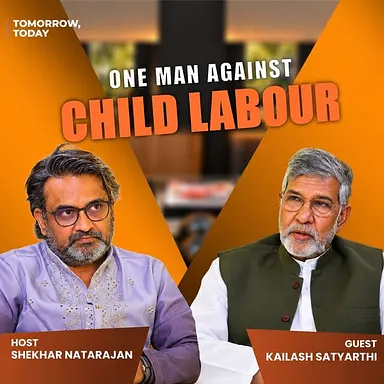
• Kailash Satyarthi's journey against child labour and bonded slavery• Stories of children rescued from exploitation• The role of consumer awareness in fighting child labour• The creation of GoodWeave certification• The courage and sacrifices behind child rights activism• Compassion as a force for meaningful action• Understanding Compassion Quotient or CQ• The four elements of compassion: Awareness, Connectedness, Feeling and Action• Ethical AI and the importance of moral responsibility• The risks of concentrated technological power• AI, inequality and the future of humanity• Rethinking success beyond wealth and productivity• Building compassionate leadership across business and society• Creating a better future through compassion and collective responsibility
Tune in to Tomorrow Today Show by SKN for powerful conversations with global changemakers, visionary leaders and extraordinary minds shaping our future. Hosted by Simplecast, an AdsWizz company. See pcm.adswizz.com for information about our collection and use of personal data for advertising.