
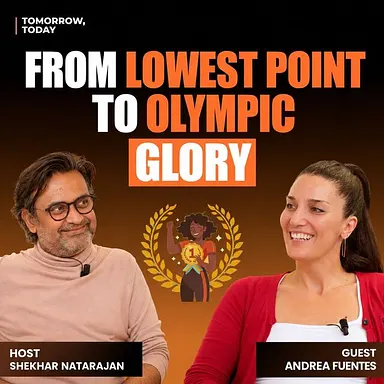
“Andrea Fuentes: Olympic Medals, Failure, Leadership & Finding Purpose | Shekhar Natarajan” was turned into text by HappyScribe’s speech recognition. Related tool: AI meeting transcription.
Ads in this audio differ from the text. Tap the sentence you're hearing to follow along.
Synced: the text now follows the audio.
And I would change courage for curiosity so many times.
The, the worst time to quit is when you're emotional.
Fear to drown, to die underwater. It's our biggest fear.
Yeah.
You save lives.
You've done amazing things for the country, beautiful human being, and more than that, like, you're a fierce competitor.
Pain is compulsory. You don't escape from pain, but suffering, it's optional.
Welcome to yet another episode of Tomorrow Today with Shaker Natarajan. It's my great honor to have a real champion here and also a very beautiful person. She's very beautiful for many, many reasons. which I would love to unpack. You've saved lives, you've done amazing things for the country, beautiful human being, and more than that, like, you're a fierce competitor. I don't know how you do all of it together. So welcome to the show, Andrea Fuentes.
Yes.
And you have to tell, like, what does your last name really mean?
It means, um, yes, it means fountain. But more than one, and generally a water one, which makes sense now. But yeah, it means this.
Yeah. So you were born a water queen and then you're a water queen.
Yeah. I was meant to be, I guess. But now my job is to make other water queens.
Very good. Uh, let's, um, go back and try to unpack your early days of your life. Um, so you were born in Valls, Tarragona. Yes. Um, and I saw your— is it your mom?
No, she's my manager, agent.
Okay, got it. So, uh, so tell me about your family. Tell me about, like, you know, your upbringing.
Yeah.
Your parents and so on and so
forth. I, I was born in a family, um, pretty different from what I'm used to see around me. My father was a teacher, philosophy teacher, and my mom, she's French, and she was a French teacher in Spain. So they met together and it was a pretty life based on let's enjoy what we do and let's go deep. You know, like we don't do nothing without a reason. Sometimes yes, but mostly we do things for a reason and we go deep in everything. And conversations, I remember they were always pretty intense and I thought it was normal. Sure. And then now that I'm being more grown up, I understand a lot of things of why a lot of people tell me, you see, you're a little bit different, your head thinks differently. And I think it comes from this, from from my education and my childhood.
So how would you characterize your mom and your dad? Like, you know, what is it like?
My dad was extremely— he will never talk and like do small talk. He would always like, I don't speak if it's not to write a book, like too much sometimes. Which was interesting, but extremely smart, but non-social at all, or not seeing the point of just going to a party or a dinner. Sometimes we were having dinner in silence, completely in silence. And if somebody has to talk, it's because it's something important, but also funny sometimes. And my mom was like extremely demanding, you know, like a 9 out of 10 is not enough, no? Like your scores at school have to be extremely high and very perfectionist, but more simple with life in this sense, which was also good to balance. And so that was more or less the pattern.
Oh, very beautiful. So you have, I know we'll get to your siblings in the later half. So as you think about like your formative years. How did you get into swimming? And yeah, what is— I know that a lot of people, uh, know swimming, but like, you know, also there's a flavor of swimming that you do, which is artistic swimming.
Yes, yes.
Which is different.
It's very different.
Yeah.
And I have been always doing artistic sports. I started with gymnastics, which is artistic also. Um, I saw, um, then I did, um, I don't know, it's not, um, in the US you don't see it that much. Um, it's like rolling skater, but like in the ice, but, but with wheels in the, in the floor. Um, it's exactly the same as figure skating, but no ice. Um, so which is also artistic. And, and then artistic swimming. So I did all the artistic sports. But artistic swimming, when I saw it, my current coach, not now, but when I was a swimmer, came to all the schools around the club and she showed us a video about artistic swimming, which in that moment in Spain was absolutely nonsense because it was so small that nobody knew what it was. So when I saw the sport, I was like, what's that? It's everything that I like. It's water, it's sport, it's dance also. And it's a team sport, which is everything that I wanted. So I started first just like leisure and just enjoying it. And then it became serious and more and more and more. It's a sport that you train a lot of hours, almost 8 to 10 hours a day.
Wow.
Yeah. When you get serious in that, because it's very perfectionist. You have to synchronize every swimmer. with the movement. Then you have to learn about expression. You need to choreograph. It's a long one. It's very difficult because water, it's— if you think about it, it's crazy. You're upside down most of the time, not breathing. We're not water animals. You cannot see underwater, but you have to be in line with everyone. And then you have to express a feeling at the rhythm of a song. And your heartbeat—
And everyone has to be coordinated too.
Yeah. And against gravity. And then throw a teammate in the air with a touching the bottom, which is crazy. If you think about it, it's like there's nothing more difficult than this to invent. And, and that's why I like it because it's so difficult, but, but also it has something that, I don't know, it, it gets you there and you cannot escape.
So what, what drew you to water? Like, because I was, I was talking to different people and they had different, uh, ways of communicating the same thing. I was talking to Araceli yesterday.
Yeah.
Uh, she's the first Spanish, like, you know, uh, mountain He's an alpinist, climber. And then I had Alvaro in the morning today. He basically is a surfer. And both of them were telling me the same thing, Andrea. They were saying that they felt one with nature. They felt that they could connect into the space.
Yes.
So when you're in water, do you feel one with it? Or how do you feel? What happens?
With the years, I've been 20 years in super high performance.
When did you start?
Yeah, when I was 9. And, but serious, serious, 12, 13. And then 8 hours, 10 hours, sometimes 12 hours a day until I was 30. And so it's a lot of years, like, more in the water than walking. You know, like we were 8 hours in bed, sometimes 6.
Yeah.
If I was partying on Saturday, 4. But then all the time in a non-gravity space and then sitting, eating, and studying. So I felt more a water person than an earth person. And sometimes we were going somewhere like a museum, no, because I love art. And 1 hour and my bones were You know, like, I cannot stand here. I have to be in the water again, like a fish. Honestly, there was a moment that we were like, I need to be in the water. And with time, when I'm a coach now, I feel my bones very different. You know, like, I'm comfortable on the floor. But it was not like this before, which is crazy, no? You've been so many years, more than a third part of your life, In the water. Yeah.
And so, uh, so you started training at the age 9?
Yes.
And then, uh, how did you transition from there?
Yeah, there's a moment that—
And were your parents convinced that you should do this, or?
No, my parents were like, it's too much, too many hours. My school was very alternative, and we think that this is too much for a kid. But I was obsessed. I liked it too much. And if I am enjoying it, I am learning a lot of good values for my life. It's a team sport, it's creative. You gotta discover your limits and push them further. I think this is good. And we create emotion to others. Like, where is the bad thing or the problem? You will lose your childhood. No, you're gonna sacrifice so much. But I felt I was not sacrificing. Like, I wanted to be there. And my father always was telling me, I don't care if you win or not, because I was very competitive. I only want you to enjoy the sport. And that was always in my mind. And the results came, but because I was, you know, like enjoying every day and wanting to be 1% better every day, you know, like perfectionism from my mother. But I never thought about Olympic medals. I remember my father one day telling me, are you going to go to the Olympics? I was like, me?
Why? No. And 10 years later, I was a female, Spanish female with more Olympic medals in history. I was like, how did that happen?
That
happened. And it's because I was really, you know, like in the how to be better and how to enjoy the process. And as a coach, because my husband, for example, was educated in the opposite. It was like, you have to win. And if you're second, out of home, no? Okay, like, you're gonna be there. And, and this is completely different to grow up with this. And there's a lot of athletes with this mindset, and I'm always teaching the opposite.
Got it.
I think that was one of the keys that I— if I would be born again, I would repeat the same life, which I have a lot of teammates that would not do it.
Got
it. Yeah,
got
it.
So, um, so how did you— like, obviously there, there is preparation of, uh, your body.
Yes.
Uh, but also there's a preparation of your mind.
Yes.
And, and also, like, you know, your, uh, your rhythm and, like, you know, all of that. Like, so there's a lot of dimensions to artistic swimming.
There was, uh, because some people ask me, how do you enjoy, you know, like, suffering that much physically? Because we don't breathe, we have a heartbeat, like, it's very painful. Um, And then one day I discovered, we do a lot of underwater swims to hold our breath longer. And there was, it was like horrible. It was like butterfly coming back underwater, like 25 meters like this, 10 times, no resting. Sometimes you lose consciousness. And it was like painful. And one day my mind did boom. And I was like, instead of focusing on pain, I was focusing on— What? the beauty of the space, you know, like the shapes of the light, the music that was sounding, the instruments, my teammates with me underwater. And it was like suddenly I was on the wall and I was not feeling the need of breathing. And it was the same as before, the same distance, the same tiredness, but I didn't suffer. I was like, wait, it's everything here? Yeah. And I was from 13. And then everything changed from that day. And I discovered that, you, like, pain is compulsory. You don't escape from pain, but suffering, it's optional.
Which, you know, well, this phrase, I guess. It was good. And I think, yeah, I mean, I learned it from meditation. And it makes sense because when I teach this to my athletes, Okay, now we're doing flexibility. Now you have to put your leg here and then it's painful. But think about the progress that you're making. Think about the muscle that it's stretching and having oxygen instead of how painful it is. You relax and everything goes much better. So it's not so much the physical capacity, but the mindset. And if the process can be enjoyable, much better.
So, but it takes a lot of also conditioning. Like, you know, do you do a lot of yoga, meditation as well?
No, yoga and meditation only because I want it. But our practice requires strength conditioning, a lot of cardio because we need to hold our breath. We do speed swimming, normal speed swimming, and then a lot of technical You know, like balance, because we have to be upside down turning and you fall because it's not the floor, it's the water. And also acrobatics, because when we throw one teammate out of the water in the air, she has to do maybe 2 backflips and 2 twists. So she has to learn how to do it. And flexibility, like rhythmic gymnastics, but not that much because we need to be stronger. So, that's mainly the thing. But meditation came from my sister because she traveled around the world, and that was a tool that helped me a lot. Not only for sports, but also to understand people and create a better team. Because when you understand everything, where it comes from, then you create better bonds. And then the team becomes stronger. And so I think it was very useful for me, and, and I teach it to my athletes a lot.
Got it. So the, uh, there is a lot of like orchestration or coordination between multiple people while you're performing this artistic swimming.
Yes.
So how do you build trust?
Yeah.
With people that like, you know, you're doing this with? Like
communication, for me, transparency.
So, do you guys spend a lot of, like, how do you—
I talk a lot. And not me, but I ask them also a lot. And sometimes I see, first, because I was taught and educated in a transparency environment, very transparent, very honest, like sometimes brutally honest. And my coach was also like this. extremely honest, sometimes painful, which sometimes was too much because you have to understand also if people are prepared or not, and you have to say it in a way that they can understand, not only your way, you know.
Mm-hmm.
And as a coach, a lot of times I stop practice when I see somebody struggling or somebody is struggling with another person, not only individually. And we talk about this problem, which is human social, and sometimes psychological. And we always look at the background and the reasons why, but always, like, don't feel guilty to feel this, no? Or like, you're attacking this person or feeling offended, and it's normal. It's not a problem. Let's learn from this and let's talk completely honest about what are you feeling, no? And for example, this year we had a very good World Championship, in summer with the Spanish team. And it was so good, we made history, that it was very in the media. And 2 of my swimmers became famous. So in the street, they can recognize them. And so the rest of the team started to feel, you know, like jealous. And it was a natural reaction. Yeah. But nobody wanted to say it out loud, no? And there was starting to be crisis, a crisis in the team, and we didn't know where it came from. But at some point, manage the success, but also manage the new feelings that are arising that are completely human and normal.
And so I stopped practicing, we talked about it, and I told them, we're going to talk about one topic that all of you are going to neglect. It's not me who feels this, but it's normal that you feel it and that we're going to learn from this. And we're going to decide that we're not going to stay in this level of consciousness. We're going to go a little bit bit higher because this doesn't serve us as a team. If we want to inspire everyone, we need to go like a little higher than this. So let's talk about envy, no? Let's talk about all of these feelings. And at the end of the conversation, it was 2 hours that we didn't practice what we just talked, and it became so powerful and so everybody, you know, like took out everything that was in front of them. Yeah. And the mask went out, you know, and it really from all the sides, from the ones who were feeling the envy and the ones who were feeling attacked by it. And also when they expressed what they felt, you know, like, I feel guilty to be famous, but I don't know how to—
Not be famous.
Yes. Like, it's not my fault, you know? And it's not so easy neither, because everywhere I go, I have to take care of what I say. If I explain one thing and I do it wrong, everybody criticizes me. Or, you know, like, I cannot go in a restaurant and be, you know, like, just quiet. And then they understood a lot of things that, you know, and if you want to be famous, then you can work your way out. Like, you build up everything, especially now with social media. It was very good. And this was a problem, but many others came. And it's, I think, trust starts when there's total transparency and that I know you're not hiding anything. You know, I know you deeper than I thought and what you explained to me—
Makes sense.
It makes sense. And also because I see what you say and also we share it together because we use each other to grow to a higher place. So I think this is trust, complete transparency, and it starts from the leader. Because if you ask for transparency but you don't give it, it's never gonna happen. So I'm the first opening my vulnerability and showing everything inside. At the beginning, they were shocked because they were used to a coach who was extremely closed. And sometimes they were like, whoa, I'm not used to this level of truth. I was like, that's okay, you can just listen, you don't need to speak. One day you're gonna be brave to speak as well. And I don't mind, I don't mind that you feel nervous about it because I want you to go from this place to this place and I'm gonna push you to go here because my mission as a coach is to teach you this part, no? Because I know it's good. And that's the part that I'm more passionate about, to build trust and to open minds, basically.
So how do you be a... A team player and also competitive at the same time. How do you do that? How do you balance that?
Yeah, that's very difficult. Because at the end, you have to convince the team that the program is the success of what we're working for. And sometimes you're the swimmer inside the team, but sometimes you're the one who pushes the team to be in a higher place in that moment that everybody's watching. But one day you're going to be here and another one is going to help you be there, no? And it is everything together. I don't swim either now, but I give all my insight for this team to be here, no? Because at the end, it's not about people, it's about the team.
Team.
So I think that when they understand this, that one day somebody's gonna be there helping you in the invisible part of it, then it becomes magic, no? And I always try to give credit to the people who worked behind the curtain, because then everybody can feel recognized. It is important. They do a lot of work. We do a lot of work behind the scenes, no? But recognition is important. Otherwise, you feel invisible.
So, when did you first start representing Spain, like in events, national events?
I was in the senior stage. My first Olympic Games were in 2004. Yeah, because 2000 in Sydney, we didn't qualify for one spot. It was the most painful moment of my career because we worked so hard. Like, we're literally not resting. We're eating with a psychologist explaining training us how to be better, you know. Not even having lunch, we were resting. Imagine every minute was like squeezed. And we didn't qualify, you know. And I was like, what? And like, I cannot work more and we didn't have success. But that was the seed of the future, you know, because then the next 10 years we went boom.
But how did you feel that in the moment?
But like, my heart was open and bleeding, bleeding out loud. Yeah. Um, I, I think that I was almost, I almost quit and my coach told me, no, you're, you're too valuable for the team and you cannot, you cannot leave now. You have to wait until the emotions are quiet and then you think. So she didn't allow me to leave, to escape. And then she was right, because if I would quit that moment, I would miss all these years that went after. No, that was very good. The second Olympics were in 2008 in Beijing, and we already got 2 Olympic medals, and then the next ones also. So it was good. representing your country in Spain is not the same as in the US. We're not so patriotic, but we felt we represent the team and the effort and our history, you know, which is also very powerful. And all the families and friends that were helping us. But in Spain, it's not— because I've been the coach of the US as well for some years, and I feel the difference is very strong.
Strong, yeah.
And you don't motivate a Spanish swimmer with a flag. You're motivated with bravery or values, but the flag is not so powerful.
Yeah, is the flag— why do you need a flag though?
Yeah.
Why do you need it?
I don't know, I don't need it. That's why, yeah, at some point when I was in the US and it was like so much flaggy, I was like, wow. But also it's powerful because it doesn't matter which political party you like, There's a moment where everybody is
together. Like an American.
Yeah. And that's beautiful also.
So I think without the flag, you can still do that. Don't you think?
Yeah, yeah, yeah. Yeah, because then it's about the people and the specific team that you are with. And also there is a flag in the culture and then, you know, like we are Spanish because— but it's not so much, you know? Yeah. You motivate the people with other things. And there has been history of a lot of division in our country. In the States, it's different because there was Islam, you know, like the history is different.
Got it. So, um, uh, so what happened after your heart was bleeding? I had
to grab it from the floor and then like stitch it.
Yeah.
And then, and then it was stronger. And then it is—
But how did you overcome that? Like, you know, because people, um, I always, uh, um, tell people like the worst time to quit is when you're emotional.
Yeah. Yes.
And, uh,
I didn't know this until that moment. No, because then, especially artistic people, we're very emotional. And then, yes, you know, I tell to my swimmers always, like, everything that happens, like, don't quit your boyfriend in an emotional moment. Yeah. You know, like, just wait, wait and see things from far, like zoom out. And then you decide, maybe it's 2 weeks, maybe it's a month, maybe you need 2 years, you don't know. It depends on the situation. But yeah, it's always like this. You need to wait, emotions come, and then decide, because it's not the same part of the brain. You cannot decide. Logical part with emotions, not good together.
Yeah. So, who helped you overcome that?
My coach, mostly. At that moment, my coach was very good at convincing and And she was a genius, very hard to manage genius, very strong character, but a genius. And I felt honored to be there and be part of the teaching, even if it was very hard. And I think I wanted to listen and I felt I had to learn still more from her and from my teammates. So I was like, okay, at least I'm gonna grow somehow. or become stronger. And then when I don't enjoy it for more than a month, then I quit, but not for one day, no. Mm-hmm. And so, and then it was much better. Yeah. I think it's just like sometimes wait and see other kinds of growth that are not result-based, but more, you know, like what I'm— in which area I'm growing. And if you're growing in something, then it's worth it.
Yeah. But when do you know when to quit?
When I was 30.
When I
was like, too much pain in my body. And I felt that my life in this field, like this kind of situation was not giving me enough teaching lessons than in other parts that I was more interested in. And I didn't feel like giving up. I was already 13. In an athlete, it's okay. But if I was 25 and I would decide the same, for me, when you think there's another place where you're gonna grow more, that's not giving up. It's, okay, my interest now is in this area, so, and I feel I'm gonna, you know, take advantage. So I don't think sometimes I'd never give up weight. If it's in a better place, why not? You know, like, as changes, growth. It's not give up, it's evolution.
Because people also sit with a lot of things for longer than they're supposed to, and it makes it miserable.
Yesterday I found in the street an old friend, and she's a teacher. She was an athlete as me, but even though maybe 15 years I didn't see her, and she's a teacher, and she was telling me that teachers here in Spain are suffering a lot, and the situation is very bad. And she's like, The whole day I'm waiting for the day to finish. And I'm like, wait, how old are you? And she's like, 45. And I'm like, you have 20 years at least of suffering and you're gonna be okay with that? I'm not gonna change now. And I'm like, what? Like, how you can, you know, like project your life with this, finish the time in my job? Like, you have to love your job. And not every day is gonna be amazing, but you cannot hate it. Like, life is too precious to, I'm gonna finish at 65 thinking I regret blah, blah, blah, blah, blah, blah. No. And I'm like, I'm gonna call you every day and you're gonna look like half an hour a day to learn new things and to start planting the seed of your next thing. But no way.
But there's a lot of people in the comfort zone, which becomes sometimes non-comfort anymore, but they think it's better. There's a phrase in Spain that it's better One bird, no, 100, wait, how is measurement for, ¿cómo es?
One bird in the hand is better than 100 flying.
Flying, yeah. Yes, es que no me salía. Sorry, it was in Spanish. It's better one bird in the hand than 100 flying away. I have this at least and the other ones I don't know if I can catch, but I have one. Like, this is death sentence. This is like, you're gonna get cancer in 5 years. No way. Like, for me, this is so scary. Like, very difficult. And you don't need to quit your job tomorrow, but start building with the comfort of having your salary every month, but start building. And it makes me sad when I see too much people like this. Actually, my father, which was a teacher, philosopher, philosophy teacher. His dream was to write a book, but he was afraid to write it in case it was not successful. And he was not a true teacher, you know, like he was not meant to be a teacher and he didn't like his job. And he died too early because of a sickness. But I think that Part of when your body becomes sick is because you're not respecting your, you know, your path or your motivations. Yeah.
So, um, then you proceeded to go to 2004 Olympics.
Yes.
So, uh,
and then we, um, it was very, um, very—
You were 12.
Yes. And at the beginning, in the first Olympics, we were almost medal.
Like bronze, silver, or medal?
Not in Athens. In 2004, we were 4th. Good enough to be hungry for the next ones, but still not tired or burned out. So it was good because we learned a lot. We had a lot of fun also because first Olympics, it's amazing. All the sports, everybody there, all the countries, and it's magical. You'll never forget those games and the first time you go into the stadium when it's the inauguration, it's incredible. And that was an experience that motivated us a lot for the next 4 years to work harder.
Was it the same team of 2000 that was in 2004?
Yes. And the same team that in 2000 didn't qualify, in 2004 was 4th, and in 2008 got the first Olympic medal for the history of Spain. it was the same team. And that was beautiful because we were, you know—
Always together.
Yes. And we knew how hard, you know, like where we come from. Nobody came the last year to have the fruits. Everybody was planting the seed 10 years earlier, you know? And that was very meaningful when we got there. So this team was a good experience to live with. And then they all quit except me and 2 more that we were younger because we came when we were younger. And then a new generation came. And that was also interesting because a lot of new people came and we didn't want to lose our level. So we taught as much as possible. And usually when you change a team with so many people, with young ones, your level goes down. Mm-hmm. But we managed to keep it there. but way more creatively. And very interesting also because the new generation was very different with my coach because my coach was very authoritarian. So everybody was afraid of her, but the new young people was not afraid of her. And that was so refreshing. Yeah, because it was— I was like, wait, she dares to speak with them? Like, she answered and we're like, wait, and she was not angry?
Like, she was adapting to the new generation also. And it was very interesting socially to live the new ages, you know, the refreshing people who was like, I do this because I want to, and if I don't like it, I'm gonna leave. You know, like, I'm not in a jail, which was very different because in artistic sports, usually it's too hard emotionally. Like, there's a lot of emotional abuse, no? So you just like go and support. But then now it cannot exist anymore. And it's beautiful also to see that you have to motivate your swimmers or they are not going to stay.
So how many Olympic medals did you win?
In total, 4. And as a coach, 1 more later. And now I'm for the 2nd and 3rd and 4th and whichever comes. But yeah, as a swimmer, 4, which is the maximum a female has ever won in Spain.
And what were they like? Silver?
Yes. No gold. No, only silvers and one bronze, which is also good because now I'm more motivated as a coach
to
give gold to my swimmers. Yeah. If I had gold, I think it would not be the same. You know, like I'm still hungry. I don't know. There's something to look up to. If you're gold already, you can only keep yourself in the same stage. or look behind, which I don't like it. But for example, last year we got our first gold world medals, and that was the very first time ever for all of us. And it was not the Olympics, it was the World Championship. Yeah. And then the best swimmer asked me, and now what? No, like, and I told her, enjoy this moment because from now on it's never going to be the first again, the first, your first gold. Now it's only or gold or worse, which is very hard, very hard because it spends the battery way more than trying to go higher. And I told her, okay, now let's forget about medals completely and you only look about progress, your personal progress, like what we can do better, how we can inspire more people, how we can create more amazing choreographies or something that has nobody done before. But forget about the results.
How do you score the game? Like, how do you— what's the scoring?
Yeah, so in artistic swimming, the more amount of body out of the water, the stronger you are, no? Or the more technical you understand the water. So it's harder physically because you have to go stronger with the legs. We do like this to— it's not like pushing normally. It's like with water, it's more wavy. And also balance. For example, if you are very high, you can fall easier. So you have to turn a lot and hold your breath a lot. The more you hold your breath, more difficulty you can do. And then in acrobatics, that has become very important in our sport. The difficulty is everything, like how many flips you can do, how many twists, how many new things you can invent. And then there's the artistic part, which is how many hairs you can— Count. Rise in your skin. Meaning that how much emotion you can create, which means do something new, do something that it's, you know, like I can pretend I'm expressing, but it's not true. Like if I'm really into the emotion, I make you feel the same, no? Like in all theater or actors, actresses, or dancers. So apart from the physical part, there is this artistic part and how you create the pattern to make something visually attractive.
So how do you apportion the scores? Is it like—
From 0 to 10, 10 meaning the best.
The highest? But do they give artistry or basically 2 points? Yes,
there's 3 scores. Difficulty, which every movement has a point. So you have 23 points of difficulty. and the other one has 18. So you have an advantage. But also execution means how good you do it. It can be very difficult, but if you don't do it well, you have a low execution score. And then there's the artistic impression score. So 3 dimensions. Dimensions. And the last competition we did 2 weeks ago, we got our first 10 in artistic impression, which we are very proud of. And so now we are trying to become better in execution.
So do you train differently for each of those 3 dimensions?
Yeah. For example, in artistic impression, sometimes I call experts.
Like, do you look at art and cinema?
Yes. Personally, yes. I know a lot of coaches don't do it, or swimmers, but I get inspired from different disciplines because If you want to bring something new and you only stay in your space, you can invent so much. But maybe you see, I don't know, I see this paint and I'm like, wait, this reminds me, you know? Or I grab this from a song from a dancer who danced to this song in a different way that I have never seen before. So I try to bring it to the water. So I try to, you know, like feed myself. Mm-hmm. But in expression also, because the face expresses and the body expresses, We go also to the theater and ask for experts. And then for the technical side of it, it's more like, you know, ballet and a lot of physical conditioning and rhythmic gymnastics. They have a lot of balance. So yeah, a little bit of everything.
And so there's a mix and match of different learning skills from different places for you?
Yes. And we do also CrossFit. to be able to push our teammate as high as possible in the air for the acrobatic part. And this requires a lot of strength. So we do weights to be stronger also, not only flexible and endurance-wise holding our breath.
So how much is breath control important in all of this?
It is that we still don't know how to bring it from the experts in apnea. Because usually the other disciplines, it's with, you know, like a quiet body in the sense of I'm gonna mentally control my breath and my heartbeat, but I'm sitting or I'm swimming very slow, no, if I go deeper in the ocean. But there's no sport that has to do it with a heartbeat at 200 per minute. You know, like imagine you start running all you can do as fast as you can and then hold your breath. and you want to breathe. So it's very different than relaxing and sitting. So it's important for us to know how to breathe, but we don't have opportunity to breathe because we're moving, we're moving, and we cannot sit, wait, I have to hold my breath. No, there's no time because you are dancing, you know? So it's different. So we still don't know how to adapt the knowledge from other disciplines to ours. So for now it's just like, hold your and do what you can. And if you don't hold it, then there's problems. Like you start— sometimes your body needs to breathe, but then you faint and then you start convulsing and it's a problem.
In our sport, it happens sometimes.
Yeah. So what else is important besides breath control practice, Uh, learning like different types of— like, is there any, any other special thing that you need to know, like,
um,
to make it through this one?
I think it's a very mental sport because it's much harder than it looks like. So psychology is very important. Um, but mostly—
Is there a fear that you have to overcome?
Yes, fear to drown, to, to die underwater. I live with that. It's our biggest fear. Yeah. Yeah. Because the sensation is so painful and so uncomfortable. Because there's a moment that you really need to breathe, but there's no— your mind is saying no because it's not time to breathe. Like you're holding on purpose, no? And so you have to have this mind control while you move a lot and try to turn and express and everything. But there's a moment that And your lungs start doing this spasm, like, mm, mm, mm. And there's a moment that you stop doing this and you start like, woo, like a little bit drunk. And then you don't feel the pain anymore. And then is when you— in this moment is the dangerous one, when you are okay, because then it's because you're going to faint very soon.
Oh.
So it's better to recognize the moment of no more pain. You enjoy it, but because you're a little bit like this, but then you have to go out fast. So it's this line. Yeah.
So, um, then you retired, um, at the age of 30.
Yes.
After 16, like, world medals.
Yes. And then I had no clue what to do. I was like, enough.
So did your body tell you that, like, you're done? Or like you said, you wanted to pursue other things?
Honestly, they fired my coach because of problems, emotional abuse and everything. Federation said, you're out. And then the coach who replaced her for me was not inspirational enough. And actually, the level of things was like 10 years in Olympic medal went down. The next Olympic Games, didn't qualify. Mm-hmm. So it was like, boom. But at that moment, we didn't know. I just felt that I was not motivated enough. Like, I don't have nothing to learn here. Let's go in another place. So my body also like was painful, 'cause after so many years you have injuries. But I was like, okay, let's go. go out of the nest, open the egg, and then there was this world of a thousand million possibilities that I never had before. I never had to decide anything too hard. And then it was like, wow, that's too many options. That's so scary. It felt like a cliff. Like, wow, and now what do I do? And this is the most difficult thing about about sports retirement because you are 30 and it's like you're born again and like you're 5. You know, it's like, wait, but I don't have tools and everybody has 10 years of experience in every job except you.
And then it's like, okay, let's go. So, I decided, I'm like, where's the place where I can learn more about life? And then I'm like, let's travel. And then with my boyfriend at that moment, we like, one way out and let's start heart until we find out. Exactly. Yes. And then it was this process. It took some years. And then at the end, I was like, I have so much knowledge inside that I need to share it. I cannot die with this inside. You know, I need to teach. I need to explain all I know. And then I started to become a coach and I enjoyed it a lot. I would never think I would be a coach before. but it motivated me a lot. And every time that I was coaching someone, you could see these eyes of, thank you, you know, and of helping these people who wanted to learn more, especially in the mindset part of it. And then I was like, okay, I'm gonna be a coach, which I like it more than being an athlete almost. Yes.
Mm-hmm.
And so it took like 5 years from athlete to, okay, I'm gonna be a coach.
So, what did you do in that 5 years?
Um, um, travel first. Um, and then I, I had no idea how to do it, but I was like, let's dive into it. I built a company and it was very interesting because I didn't have any teaching on how to do it, but I was like, okay, let's learn from the internet and, and learn. Let's go. And I built a company that was about products for artistic swimming, our sport. But for example, um, we put in our head to— in our hair to be able to swim without a cap, we put a kind of jelly that you have to be a lot of times doing it by yourself before competition and it's stressful. So I went, wait one moment, let's build it, like let's do it already done so you only have to heat it and put it, which is so silly, but it didn't exist before. And it was an idea of my boyfriend at that moment. I was like, wait, that's so smart. So we said, let's build a company and sell it. Do you know how to build a company? clue. Neither. Okay, let's start with a book. And then we just built a company and it was very interesting and I learned a lot.
And then, um, so it was working well, it was working well. And then we did, okay, let's open to this company also camps to teach artistic swimming as part of the company. And, and then I became in love with, you know, like coaching. And it was like this part was becoming stronger, stronger, stronger until the US called me and said, we You need a head coach and we believe in you. And I was like, wait, that's a super—
Interesting thing.
It's not a consultant coach, you know, because I was like, one week New Zealand, one week in Switzerland, one week Italy, you know, like we were just one week going working and traveling the next part of the month and discovering the country, which was very interesting. We already had kids together, so we were traveling all the family. But then I was like, okay, it's time to go to school because they are learning a lot. But my son was already almost 5. And then I was like, he's learning a lot more traveling and what we're doing than in a school, but it's time to go. And I was like, where do we go? The world is big. And then we were in New Zealand and I remember the sky was extremely clear, like the Milky Way, every single spot you could see. And I was like, Wow, it looks like a picture. It cannot be real. And then I remember asking, send me to California. I don't know why I said that.
Finally, it
became. And then 2 days later, I received this email from the USA Artistic Swimming Company, organization. And then I was like, wow. I showed it to my husband. I was like, they listen to me, whoever is there. And I'm not religious at all. I'm spiritual, but not religious. And then suddenly I was like, where do they practice the national anthem?
California.
California. I was like, what? And I was like, let's go. And then we became kind of Americans almost because my daughter was 1. So she has been a lot of years there. And we built the thing because the lady who called me, the email, she was like, the organization is completely destroyed. There was a lot of corruption. I'm the only one in the organization and I'm a volunteer and I'm 70, but I love the sport and I want to rebuild it. And I'm like, thank you for the trust. I have never been a coach of a national team, but let's go. We're going to build it together. So we moved with our whole family, 4 of us and the dog. We sold everything because it was like an adventure, no? And we're like, let's go and learn. And so we started building the team and we were 15 in the world. And we started, you know, like gaining the trust from the Olympic Committee, growing little by little. At the beginning, we had no pools. Sometimes we were into the ocean because, you know, there was no resources. And then I told my athletes every day, you know, like, the day that we're gonna make it anyways without the resources, there's gonna be an amazing book to write, you know?
Like, let's not complain. Let's make it anyways. Let's imagine how we can build it. And then, you know, like, step by step, in— that was 2019. In 2023, we got our first world medals, and 2024, Olympic medals. And it was interesting because the process was so, so strong. There was a moment that the team, in my contract, you had qualify the team for the Olympic Games. Only 8 teams in the world could qualify. And in 2024, win an Olympic medal, which was like, wait, I have no resources. I come from Spain. Here you have high performance and There's a lot of money for the sport. It's a popular sport. And here there's nothing. And you want me to win an Olympic medal? I know how much it costs.
And this is bad.
I was like, okay, I'm just gonna sign and whatever. And then we were practicing every time stronger and stronger because I know what you need to do to have an Olympic medal. And there was a moment that the team told me, this is too much. We are not capable of following this amount of rhythm. And they were very tired. It was also, I didn't know, in Spain we don't have this, college is not so important. It's not everything in life. In the US, it's so important. In Spain, you go to college, but you have your life apart. And college is just college. But I didn't know at that moment, I didn't understand. And they were, you know, like, we're here to go to college. National team is important, but college is the most important thing. I was like, what? Like, you represent your country, it's much more important than your college. But at that moment, the applications were very stressful. They were just in the age of going into, you know, choose your college and everything. everything. And I told them, I give you 3 days to think about it. If you want to be Olympians, we need to work hard.
If you don't want to work hard, we cannot be Olympians. But you all want to be Olympians. That's why you moved from New York, from Seattle, from Florida. You didn't move for nothing. If you wanted to go to college, you didn't need to come here. So you're here for a reason. And you want to be Olympians because that's your dream. Um, so I gave them 3 days to rest. When they came back, they told me I was ready for, okay, let's work. And they told me, we've been thinking about it and we have decided that we don't want to be Olympians.
No.
No. And I was like, what? And that was the most shocking moment of my life as a coach because I didn't know what to do. Like, I moved from Europe here with all my family. My husband left his job to support, you know, like in my contract, everything. Like, they don't want to be all intense. And I was like, okay, what do you want to do here? Like, what do you want then? And they told me, we want to be happy. I was like, okay, I also want to be happy. Everybody wants to be happy, but what do we do here together? Like, what motivates you? And we took like 5 hours of just on the whiteboard writing words that were coming. Like, this thing motivates me. It's not the final phrase, but I like this, I like this, and like, this gives me strength. And at the end, we had this phrase, grow together. That was the phrase. And so I removed all the Olympic flags from the pool, which was the motivation. And from that moment, we decided that we didn't care about the Olympics. We were just going to grow together. And in that moment, I changed all the way of my coaching style completely.
And I made sometimes, you know, like, we're gonna stop practicing, we're gonna talk about whatever happened today and how we can apply this to the team. Today you have this problem, let's share it together and let's, you know, learn from it. Oh, sometimes I was giving them challenge. And I built the Friday challenge. It was always Fridays because it's the day that you're most tired. And then I created the week challenge, weekly challenge, and it was always very difficult, but it was made to collaborate together and achieve a very difficult goal. Sometimes it was crazy. Like, there's an object in the diving platform in the 3-meter platform and you have to grab it, but you cannot touch any solid surface. Like, do it how you want. And you can only achieve it if you are collaborating as a team. But every Friday there was a big challenge to achieve that had nothing to do with what we're gonna compete with, but it was building the team and it was giving them tools, leadership tools, collaboration tools, learning the strengths of each other tools, you know? Knowing your limits. Okay, we are not achieving it, we're not achieving it.
Let's go out of the box. Let's problem solving. And suddenly we, okay, we have a competition in 1 month, let's go because it's part of the program and let's grow. We don't care about the result. And suddenly we went there and we beat like 5 countries. Boom. And we're like, wait, what? Yeah. And that was a moment of a big lesson for me, which I already knew, but sometimes you forget because you have this pressure outside of, you have to, you know, like become an Olympian and have results. And when I forgot about this and I only thought about the how to achieve this, but how to every day, and that's when we achieved this. Good point. And that's the moment where we actually grew together, no? And the outcome Um, was the results, but it was not the goal. That was interesting. Yeah.
So what happened in Budapest?
That was a difficult moment. Um, we were in this moment of like, we are not 15th in the world, but we're starting to make people uncomfortable with our level, you know? Like, the rivals are looking at us and we're nobody— we're not nobody anymore. And so we were like going strong And Anita Álvarez was the soloist of the country and we were building a very strong relationship because, you know, this kind of people who's extremely talented, but there's a personal block and that you don't want to achieve your true potentials for some reason. And it was not laziness, it was something strange. Fear to win. Fear of success. Yeah. And then we kind of threw all personal limitations out and we were there. And she went full out. But at the end of the routine, the choreography, she fainted. So she just like lost consciousness and she fell And then this never happened in competition before in a solo event. Usually you have it at practice because you practice harder than competition. But because nobody was close, usually when it happens at practice, you have your teammate grab her and suddenly you breathe and that's it.
Rest a little bit and continue practice. And they pull you up. But she was far because the pool was an Olympic pool, so it was at least 25 meters. So I was like, lifeguard, you know, like, go! But the lifeguard was like not understanding because, you know, like she was just going to the bottom of the pool. But in his head, you know, like a world championship would never have a swimmer who doesn't know how to swim, you know? But the thing is that she lost consciousness. So she was just boom, boom, boom, boom, boom, drowning. And then I was like, he's not going in, he's not going in. Okay, I cannot watch how she's dying, you know? So I just went. and start swimming as fast as I could because, you know, like, she was like slowly going and the floor is deep. It's like at least 3 meters. Finally, I got there and she was very heavy because it was also my 25 meters without breathing. And then, okay, if I'm an artistic swimmer, I know how to grab somebody and pull it out because that's our job basically. So usually you breathe in that moment when your face feels the It's unconscious.
But that was the only time that no breathing. And I was like, I got scared. And luckily, when I was 16, I did a, you know, this kind of— Cardioid. Yes. Like, you know how to bring somebody out of the water and everything, and you have to put your face sideways because otherwise you'll— all the things that I don't know how I remember from when I was 16. In that moment, I was like, thanks God I did this class. And then, okay, everything, but she was not breathing. So I was trying to wake her up while I was swimming to all the doctors and everything. And at the end, when Marisa was very scared because still it was already 2 minutes not breathing with a heartbeat at 200, which never happened before. So we didn't know what's going to happen. Everybody was like, boom, like thousands of people watching. And then at the end, we woke her up with a lot of pain because it creates adrenaline, which wakes you up. And it's like, um, you grab something like this and you— as hard as you can. And it's very painful. And if you don't wake up with this, you can, you can worry.
But, but she woke up and I was like, thanks. And, and, and it ended like this. But the problem was after because the Federation, the International Federation didn't allow her to swim again, which she was fine. Doctors said she was fine. Nothing dangerous happened. In everybody's mind, it was very shocking, but physical-wise, she was not in danger and no secondary effects. But okay, we cannot have this liability, so you have to discover why it happened. And we know that there's no studies about it. So I start searching, contacting the best doctors in the US. It's a neurological thing. It's because, you know, a lot of people do this sport and they don't have the same problem, but she had this problem more than other people. So we went to the neurological field, then the heart, then— and nobody was finding anything. But at the end, cardiology. Cardiology. from the Navy SEALs, and that was very close to LA. He said, I have, you know, like, we can watch how the heart works in the water because I'm from the Navy SEALs and we have everything that she can— we can test it while she does artistic swimming, which didn't exist in the world, no?
So at the end, he told me, you have to such a strong practice that she faints so we can monitor the heart and see what happens. So imagine that day, because the goal is we're going to do such a hard practice that you have to faint. And we were scared because it was very traumatic for everyone and for her. So we start practicing and we have only 1 hour because the battery lasts only 1 hour in the water. So the strongest practice you can imagine. And as soon as she was starting to get like this, she was stopping and breathing. And we're like, push, Anita, push! And at some point, I was like, okay, it's only 10 minutes, she didn't faint. If we want to see what happens, she needs to go harder. So I told her, if you want, we stop. But if you want to actually be able to compete the rest of your life, we need an answer. And there's nothing else that we can find. And so she said, okay, let's do it. And she told me, can you put music? Because it was a hard set of butterfly underwater, butterfly underwater, with like, it's the hardest.
And she told me, and I asked her which song, and she tells me Stairways to Heaven.
And
I was like, sense of humor at least. So we put that song, the entire song, which is 7 minutes, that I have here every time I hear it, it. But she didn't faint. She pushed very hard. So we found out that the problem was not in the heart. It was another one with a— how do you say it— iron. A very silly thing. And so when we found out, we discovered the solution. And that was 2 years before the Olympics. And so she put the picture, which went viral. It was in the Times 100 pictures of the She printed it and put it on the wall of her room to see it every day, this picture that she's underwater almost dying. And every day she was watching this picture. And now she has the Olympic medal that she won 2 years later in the same place. You know, like the lowest point of your life to the highest. And it was a big lesson these 2 years on how to get rid of fear. which was very interesting. And also how to push limits further than you think you didn't have before. And on top of it, enjoy the process of pushing those limits.
And that's for me the most beautiful story of an athlete I have ever seen because you could give up, you could be afraid and paralyzed with fear, But not only did she overcome the fear, and also she led the team to a much better place, no? And that was— I'm super grateful because it was a good ending. Of course, it could be much worse. But to see this lowest point of the life of someone almost dying to the highest high an athlete can have, no? And, and that person was beautiful. Yeah.
And so your sister, Tina. Yeah. And you lost her.
Yes. My father died from cancer. It was as it has to be in our family. It was inside the sadness and hard part of the process, it was beautiful it was a good way to die in this sense, if we can talk clearly about everything. And so he died in my arms at home because he wanted to do it this way. And my sister and my mom also. And 4 years later, my sister had the same sickness.
What was that they had?
What?
What sickness did they have?
Cancer.
Cancer.
In the guts. And so when we— my sister was 33, very young. And the process that she wanted to fight the sickness was also very powerful. She accepted everything, but also tried to heal in a different way than my father did, because no result in that case. So she tried another way, not the most normal way. But she ended the same way. But she also had this surrounded by family and in our arms. And I told her, I remember telling her, because at the beginning, no acceptance. And, you know, like, why me? Is the phrase that everybody has when they tell you you have a mortal sickness. Now it's much easier to heal from, but in that moment, still not. And actually, it's like, you lived in 33 years way more than people who live, you know, like 90. Sometimes it's not a matter of time, but how you live your time. So I think that in her case, to accept that at least she had the life she wanted and lived it the fullest way you can live it, I think it gave her peace to, if we can say this phrase, die properly in the sense of— at peace, you know?
Like, I did all I wanted. Of course, I wish I had more time, but I didn't waste any day, you know? And in that moment, I want to live like this also, no? And I try to teach this when we are in sports and teaching my athletes, to my kids also, that, you know, life can be very short, you know? Like, if you are not here Completely enjoying the process, go in another place. You're going to feel fulfilled in another place, but don't fight against yourself. It's not worth it. I'm grateful for this part, even if it has been very hard, the experience. And when I remember her, of course, it's hard, but I'm grateful for the teachings of the process. that she has given me.
But in the moment though, it feels very painful.
Yes.
What about your mom? How did she—
My mom was completely destroyed. She did not accept it until the moment of death. 4 years of sickness, like I knew from the first day she is going to die. My mom, until the minute after dying, She did not realize that she was really sick. So I think that when you are a mom, you are like, this cannot be true. You know, like she denied completely everything. And at the moment of, you know, I had my sister in my arms and my mom was like shopping. And I was like, Mom, or you come now or you do not tell her. She is not going to be here in an hour. You know, like you have to come. Yes. And then she is like, but what are you talking about? You know, like that is not true. And I am like, come right now. and she had time to say goodbye. And then the band in her eyes went off and then she realized it. But it took much longer to accept it later, when it happened, like almost 5 years. Still very painful for her. But now I admire her a lot because she's having— I want to be like her when I will grow up.
because she does everything you can imagine, a lot of activities. She's very active and she's not paralyzed with life. She moved on, even if every time we talk about my sister, we both cry together. But I don't think my sister wanted you to be in the couch crying every day. Right. But of course it was hard. Yeah. That
was 2018, right?
Yes. The year, one month before I moved to the US.
Wow.
Yeah. And then the most difficult thing to move was, Mom, there's opportunity. You lost your sister, your daughter. You lost your daughter a month ago and I'm leaving, I don't know how many miles away. But if you ask me to stay, I'm going to stay. And she told me that finally it happens, like, past this one, go. And it was hard for me to leave my mom because my father died, my sister died. She was alone and I left. But I'm grateful she— and now we're together again. So I'm here again. Insane. So, yeah.
Yeah. So you went and, uh, uh, you know, started coaching. And so what were the lessons that you took from all of your years of learning that makes you an excellent coach? Like, apparently, like, you know, you took like a, a team that never even existed, infrastructure which never even was available to you, and then you were still able to produce.
I, I think the key is love, and I'm not afraid to say it. Sometimes love is very strong, and when a coach says this, is like, love your— Yeah, I love my athletes. They are not mine, actually. I'm honored to coach the people I coach. But mostly, I think I always have this curiosity mindset or want to, you know, like every person I know, I meet, I want to learn one thing from them. And then I apply it to what I can give to others. And my coach, one thing that she was very good at is that And she knew what she didn't know enough. So she invited a lot of international coaches, a lot of different experts that gave us a lot of knowledge in very different things. So I have, you know, like 1% of every people I met and then brought my own thing, no? But it's a harvest of a lot in the past and I still want to learn a lot. I try to learn more from other disciplines It means even no sport. For example, okay, I'm gonna have to lead a team now and I'm close to Silicon Valley and I have the most powerful companies here, no?
'Cause we're in San Francisco. I'm gonna go there, okay. Apple, Google, I want to learn. And I was like, okay. And so I met some people who was working there. My neighbor was working for Apple also. Oh, wow. They ask everything you can imagine, like 3 hours of questions of how they lead you, how your team works, how you manage to be the most powerful company, and you look happy on top of it. So what's going on? And so I learned a lot from other companies that are not sports-related, but they break boundaries and they create new things. So, okay, how can I apply this to my team? And so I brought a lot of things from the surroundings. You? Yes. And also because otherwise I get bored, you know, like I'm like, okay, I need to learn something new. Okay, let's look where, let's see this, let's see what's there, not in this box. And I think, and when it's interesting that yesterday, team, yeah, let's sit. Yesterday I learned this from this part, how we could apply this to our team. I make them participate a lot. a lot. I make them be part of the process.
I don't want them to serve me, I want to serve them. So, if I make them independent and empowering kind of thing, I think it's much better because at the end— Yesterday I told them, one year ago I arrived, I got to back from the US, and they didn't know at all how to push somebody in the air. And they were very, you know, like kind of when you feel like a dog with a tail inside the legs, like they're not good at acrobatics. And I was like, you're gonna be good, don't worry. And they were doing an acrobatic and looking at me like, why it fell? No idea. And then, you know, like one year later, yesterday, they failed one acrobatic. Before they were out, no, no, no, no, no, no, no, no. They saw I had to say nothing. I said, wait a moment, like, you just solved it and you didn't even look at me. That's amazing. That's the best thing that could happen. You know the problem, you know why, and you know how to solve it. That's the best thing that could happen. And that's beautiful to see when your team gets the reins of the horse.
And that's my job basically. And then I'm like, okay, now we're too comfortable in the same path. Let's go there. I love it. They're like, are you crazy? And I'm like, yes, it is too boring. Everybody goes this way. Let's go this way.
Yeah.
And that's too scary. And I'm like, I don't care if we fall, we will go this way, but not this one. And that makes it more interesting. Otherwise, yeah, for me, if it's not something new and I have curiosity for the unknown and what we can bring, not only receive, but bring to the outside, even, even if it's our mini world of artistic swimming, no? Yeah.
So what do you now know that you did not know when you were growing up as a professional athlete? Like, you know, yeah, you go back to your learning days to now you're teaching.
Yes.
What would you like— what is that new knowledge that you have?
Like what I would do differently or wish I knew?
Yeah.
How to— because I remember this moment of, I want to know why we're doing this, no? And it was hard at times and I understand my coach completely. But why you're asking why? You don't trust. And I'm like, no, I just want to know why we're doing this. I'm not questioning you. I'm really curious. curious, because if I know why, I'm gonna do it better, because I know the reasons, and then I can, you know, like, what's the goal? And just do it, you know, because I say so. And this, okay, so we learned how to not ask anymore, no? Because sometimes I was like, you don't trust? Let's go underwater, let's go, you know? And this, I was like, when I will be a coach, I will always explain why, because, you know, I had to invent it. And after studying, when I know why we do things, I always explain it. Okay, team, we're do this thing, it's very hard, but we're doing this because blah, blah, blah, blah. And because the mind works like this. And because, I don't know, today it was about expectations, no? Yeah. So I think that I wish I had more resources.
I mean, there was not so much internet and YouTube, no? Now you can learn from very easy, no? And you have a lot of tools that you can grab from anyone. But I wish I had more, you know, like bravery to say, no, I want to know why, you know? Like, I'm not gonna shut up. Or I'm not questioning you, I'm really curious. But at that moment you feel like, it's not the moment, no? But I coach differently in this sense.
Because you have more information too now.
Yes. And also because I think I want to share the information because the more everybody knows, the more we can create something bigger. Because instead of one brain thinking, we're 15 brains thinking that even if you're You're very powerful. Like, sometimes you know more than me in this topic. Maybe. Let's find out.
So, what is courage?
Hmm. Okay, I don't know the word in English. Temerario. It's like when somebody is not afraid. I don't know. For example, Alex Honnold, the climber, he's not afraid of falling as much as other So, for me, this is not so much courage, but he's very afraid, not now anymore, but at the beginning, of speaking in public, but he does it anyways, no? So, this is courage. Not the known rope climbing El Cap, but for me, this is like him speaking in front of 1,000 people when he's so scared of this and not of dying from a fall. that's courage. And I think that sometimes we're like, no, I'm gonna do it anyways and I'm afraid, but curiosity makes you be courageous, not brave. Because if you change your mindset of like, what happens if I fail or if it doesn't work, change it for what's gonna happen if I go this way, you know, that changes everything. It's not about the outcome again, it's about what I'm gonna find out, what I'm gonna learn in this path. And if I learn how to feel the pain, okay, it's something. But this helps so much. And I would change courage for curiosity so many times.
That would make so much easier every decision. Like, I'm not afraid of the outcome. I'm gonna learn something.
Very beautiful. So let's do some rapid fire.
Yes.
And we'll wrap up. So, uh, the most important quality an elite athlete has, should have?
Um, emotional control.
Emotional control. Olympic medal or world championship, which one feels—
Olympic medal, a thousand times. Yes.
Athens, Beijing, or London, which one was the best Games?
Um, London.
London.
Yes.
The hardest thing about coaching that competition didn't prepare you for?
Um, uh, feeling the nerves and keeping yourself with a heartbeat quiet. That's the hardest. Emotional control again.
Again.
Yeah.
Budapest, what were you thinking in the moment you hit the water?
Save her. Yeah, like it's your mission.
Yeah, the photo or the act, which do you want people to remember?
Again, again?
The photo or the act, which one do you want people to remember?
The act. Yeah, yeah.
If the lifeguards had moved first, would you still have gone in?
Yeah, because I swim faster than them. I mean, I've been in the water 8 hours a day for a lot of years, more than them, for For sure. So I'm gonna get there faster.
Spain or the US, where do you feel most at home?
That's very hard to answer. I feel I should have been born in the US because I feel a lot of American values resonate to me. But I also have the Spanish passion and, you know, like brutal honesty. So I'm half and half. I guess, yeah.
Got it. The lesson that Tina taught you that nobody else could have?
Be authentic, like just raw.
What Kilian has taught about you that you know?
Same as my sister. Yeah, my son Kilian. Yeah, like he doesn't care about what people think. Just go. It's scary sometimes.
The competition that still keeps you up at night?
Um, the, the moment we didn't qualify with the American team the first Olympics. Yes.
The most important thing 20 years in water has taught you?
I tell you in 1 minute, 20 years of practice. Wow. Um, I think enthusiasm is the key, you know, like, yeah, enthusiasm is the key to open Yes.
So if it was not for swimming, what would you be?
NASA scientist going to— yeah, I have this inside. Yeah, astrophysics is for me, the universe like keeps me up at night trying to imagine it and in another life.
In another
life.
Yeah. This was like wonderful. I think like everyone will be really inspired by your story because it's like very fascinating.
Thank you.
And so much hard work, so much, so much of energy that you put in all your life. And yet you are such an humble person, though you have so much recognition.
Yeah, I think like it's humility with ambition. This combination makes an athlete. I said emotional, emotional control. Can I change it?
Sure.
To the combination of humility and ambition. of both because this makes you want to learn more. I only know that I don't know enough, but I want to go to my biggest stage. That combination, magical. Yes.
Fantastic.
Thank you. It was very interesting.
Thank you.
Yeah.
In this episode, Andrea Fuentes reflects on her journey through elite sport, from her early Olympic ambitions and the disappointment of missing qualification to becoming an Olympic medalist and later an elite coach.She shares the lessons she learned from failure, pressure and emotional moments, including why she believes you should never make major decisions when you are overwhelmed by emotion.Andrea also discusses her transition from athlete to coach, rebuilding the US Artistic Swimming team, creating trust within a team and turning limited resources into Olympic success.The conversation goes deeper into emotional control, fear, courage and curiosity. Andrea explains why athletes should focus less on the final result and more on what they can learn from the process.She also shares the powerful story of rescuing a swimmer in Budapest, overcoming fear and helping an athlete move from one of her lowest moments to an Olympic medal.From competition and coaching to retirement, purpose and personal growth, this episode explores what it really takes to keep moving forward when the path doesn't go as planned.#AndreaFuentes #ShekharNatarajan #TomorrowToday #Olympics #ArtisticSwimming #OlympicAthlete #Leadership #Resilience #AthleteMindset #MentalStrength #Teamwork #FindingPurpose #PersonalGrowth #SportsPsychology
Subscribe to Tomorrow Today Show by SKN for more transformative global conversations. Hosted by Simplecast, an AdsWizz company. See pcm.adswizz.com for information about our collection and use of personal data for advertising.