
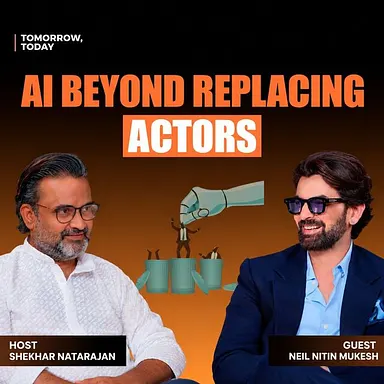
Every line of this episode of Tomorrow, Today was transcribed with HappyScribe technology. See also: transcribe video to text.
Ads in this audio differ from the text. Tap the sentence you're hearing to follow along.
Synced: the text now follows the audio.
Wrong. If you think I'm a nepo kid, you don't know my story. I get that questioning a lot. You don't know my struggles.
And we, we try to actually extract the soul of the person we are talking to because that's what makes them unique.
A struggle is not a bad thing. At least you're struggling. At least you're struggling. Why? Because you have a dream.
What were your aspirations of your father that he wanted you to be? And, uh, what are you relieved that you're not?
I said, no, Mom, you don't understand. I have to do this. This is the only way people will take notice of me. I have to do something drastic for me.
Welcome to yet another episode of Tomorrow Today with Shaker Natarajan. It's an honor to have Neel Nitin Mukesh. He's a Bollywood actor, amazing human being, acted in over 35 films. His lineage is, by God, like the most excellent one. Thank you. So my father is a big fan of his grandfather. We've like grown up listening music. We've actually seen Neil work in some amazing movies. It's like an exciting, exciting conversation ahead of us, like for the next 2, 2 and a half hours. Like, Neil, like, I don't know, like I heard like you, you like to express yourself. I love to express myself. I think it's going to be—
I am very expressive, Shekhar. But first of all, I have to really thank you for that beautiful and humbling introduction. Thank you so much. And of course, a very warm welcome to the audience who's watching this. Yeah. I have, you know, mutual admiration. Let's put it that way. I had the opportunity of, you know, going through a lot of your contribution, not just, you know, to our industry, but the society in general. And I have to say, I'm extremely honored, and it's such an honor and a pleasure sitting right in front of you. Waiting for this, I'm generally never nervous about you know, podcasts, but first time I'm in awe sitting in front of someone who I kind of admire right now.
Thank you so much. Thank you so much, sir. Like, and like, so nothing that we do here is controversial. We try to keep it very simple. We try to basically—
And I'm hoping that.
Yes.
I'm very away from controversy.
And we try to actually extract the soul of the person we are talking to, because that's what makes them unique. That's what we want the audience to see.
And that's the one reason I wanted to do this, because I do podcasts, very few podcasts. But the moment I saw a few of yours and I, of course, I got to know what your true intention was behind this podcast, I said, I have to be a part of this because where do you really get to be yourself and speak from your heart? And I try and do that as much as possible through my social media, through my films, as an artist, through my message that I put across. As you know, I'm a very family-oriented person, very close to my mother, my father, to my grandmother. I never had the opportunity of meeting my
grandfather.
Grandfather. But she had always bridged this gap. She was a Gujarati lady and we are very you know, a very tightly connected family. And I think somewhere, you know, with the Gen Z crowd trying to be a little independent, somewhere I believe that all of us have that still somewhere in us. And I really liked the way you had incorporated AI along with, you know, human emotions. That fascinated me. I said, I have to maybe educate myself through this.
Sure. Thank you. Thank you. Thank you. So let's actually transport you back to when, like, you know, you were 4 or 5 years old, you know, in your house. I know your father, Nitin Mukesh ji, is like an awesome singer. Like, your grandfather was an amazing singer too. I'm sure there is like a lot of like music and practice and riyaaz going on in the house. Even now. Even now. Yeah.
And then the 4th generation in the Mukesh family, my daughter Nurvi, does riyaaz every single day with her grandfather.
Wow.
Of course, right now my father's in the States. He's touring as we speak. He has his world tour on. He's 75.
Yeah.
Still extremely active. So great inspiration for all of us. But I love to see the way grandfather and granddaughter bond. And somewhere I never used to feel that, you know, art is genetically passed on, some, you know, the craft and the art as we may call it. But I think Nurvi is a brilliant example of that. Like now after having my own child is when I realized, oh my God, हुनर तो वाकई में खून में होता है, है
ना? ये
सिखाया नहीं जाता क्योंकि उसे तो मैंने कुछ सिखाया नहीं है। हाँ हाँ
So, so at that time, like, you know, tell me, like, what was your, uh, breakfast table conversations like? Your mom, your father, your grandmother, like, you know, and, and their role in your life, all of that. Like, you know, I just want to capture the essence of, like, your family and the values.
Simple middle-class family, and I consider us to be that even now. And very nice values, you know. So going back then, I remember the way my mother used to, you know, selflessly, you know, be with my grandmother and look after her. My grandmother was a bit of, you know, I mean, she was a little obese and had a bit of a knee problem. But my father and my mother, the way they have looked after her. And that, you know, for me has always been my calling for my family. Like, I've only learned this from my father. And my father had a very responsible beginning, let's put it that way. My grandfather passed away when he was in Detroit for a world tour.
Yeah.
And he was only—
he was very young. He was 53.
He was just about 53. And my father was with him and he flew him down again after the incident, he flew his body down all alone, you know, with his father's. And at that point, my father was an aspiring filmmaker. He was working with Rishikesh Mukherjee, Anand, Julie, Namak Haram.
Yeah.
Multiple films. And he was the associate director to a point, and he wanted to turn into a filmmaker. Everything was almost set. And unfortunately, something like this happened and overnight, you know, the responsibilities shifted to my father. Now he had not just his mother,
siblings
too. But his siblings who were 20 years younger than him back then.
Wow.
You know, that's the age gap that they used to have. And so 2 sisters, 3 sisters, a younger brother, their education, their marriage, their upbringing, Settling them down, plus you know financially what we what one presumes is कि हाँ नाम के बड़े रईस हैं but bank balance उस समय इतना लोग ध्यान नहीं देते थे
and singer was not like making a lot of
money that
time
नहीं ना so presumptions were कि हाँ यार illustrious family of course Mukesh ji must have left but it was a struggle for for him It was, there was hardly any financial support. And of course, जो बेरासत में मिली उन्हें, वो तो नाम जो मिला उन्हें, उसकी उसका तो हम भी आज भी खा रहे हैं, है ना? जी जी जी मुकेश जी left a legacy because of which I think we are all surviving today. And there can be nothing bigger than that. And but the reality check was that, you know, living in a home with literally no furniture. And so for me, I've seen, you know, us as a family go through that grind and grow up. Like, you know, I used to be so excited as a child when we used to get even a dining table. Wow. Yeah, like that was like almost like Diwali celebration. My father used to travel abroad. He would give my mother, you know, some money for the entire month. He would go for his shows and my mother would take me shopping. So besides acting, if I wasn't an actor and why even now that I'm an actor and I have a production house, I'm extremely passionate about home interiors.
And somebody one day was asking me, where do you get it?
Your mom.
It's that journey. It's with mom going, you know, to all the shops when we were young. And her asking me, okay, how would this cupboard look? How is this, you know, stool for the hall? How is it? So that kind of stayed back with me, and I was very young. Hmm. So today also, when I make a property and I have to do interiors, I do the interiors all by myself. I have a team and I understand it technically, extremely knowledgeable friends in the fraternity, of course, who you know, support me in my vision. But I don't call myself trial and error. I'm quite professional there now with quite a few, you know, homes done and interior projects done.
Mm-hmm.
So, but I'm saying, how at such a young age, you know, something as simple as home interiors can affect you and then stay with you. So we had a very simple upbringing with great values and great culture. Conversations over tables used to be about, you know, about how simple life is supposed to be. Mm-hmm. And, you know, even now I've realized through my father's journey, my mother's, and, you know, through the stories that my grandmother would tell me about my grandfather, is that they never derived their happiness out of anything material. It was always about family. And I think for me, that's exactly how I want it to be for me and my generations to come.
So what did you learn from your father and what did you learn from your mother?
From my father, I learned how to keep a smiling face through the on the highs and lows. I've never seen— and I know that I'm, you know, a father myself. Of course, by the grace of God, no complaints about, you know, financial or anything. God has been really supportive. But I sometimes, I look at Him and I wonder, how can a man be so selfless?
Hmm.
How can a human being be like Him? I can't. I will not lie. I'm not like my father. There can't be another man like my father. I'm talking about small instances. Like, वो अपने लिए कभी सोचते ही नहीं हैं। वो सिर्फ अपने family के लिए सोचते हैं। यानि अगर कहीं जाना हो, कभी होता है ना कि यार let me also buy a pair of shoes or I'll buy a watch. No, it's not that. If he is gifted also something. Even now, it happens like that. If he's gifted something and we say, oh, Dad, wow, that's a great watch. Thanks. Yeah, it's yours. He's simple in his, you know, his kurta pajama. Hmm. He's somewhere in his mind, he's so content. He's a happy soul. He's a good human being. And the one thing that I've really learned from him is never wish ill for anybody. I can't. मेरे साथ कोई कितना भी बुरा करे, मेरे ज़बान से और मेरे दिल में उसके लिए मैं कोसूँगा नहीं, मैं curse नहीं करूँगा। I will not. ऐसे भाई जिसका जो कर्म है, वो लेके आया है, वो अपने कर्म से आगे बढ़ेगा। मैं अपने कर्म ठीक रखूँ और शायद कुछ गलत हुआ होगा जिसकी वजह से हो रहा है। But I will never curse anybody.
Like you know कि इस इंसान के साथ ऐसा हो रहा है मैं ऐसा हूँ नहीं और ये मैंने सिर्फ़ और सिर्फ़ अपने पिताजी से सीखा है
ये mom
मेरी माँ से मैंने बहुत कुछ सीखा है वो है पापा जितने मेरे पिताजी महंती हैं और उन्होंने बहुत संघर्ष देखा है life में बहुत मेहनत की है but जैसे मैंने आपसे कहा कि बहुत सारी responsibilities आई थी तो कहीं ना कहीं मुझे लगता है कि आज भी एक किस्म का उनमें डर बैठा है कि वो constantly डरते हैं कुछ नया करने से पहले दस बार सोचेंगे कुछ बदलाव आ रहा है you know हमारे सिस्टम में यानी for example छोटी सी चीज़ अगर घर खरीद लिया है हमने और उसे भाड़े पे चढ़ाना है नहीं नहीं भाड़े पे मत चढ़ो उसने अगर ले ल But my mother is a go-getter. My mother has taught me nothing but power. She's my really pillar of strength and my support who's encouraged me to balance the values that my father has given me. And at the same time, without being disrespectful, go out there and achieve and get what you want to get done. Can't be afraid, you know. So it's a great balance. I think it's a great combination.
Super, huh? So growing up, like, you know, we used to have that old radio, and then like we used to have one of my dad's very—
LP records and gramophones and all that.
So like we had to— we used to have like this cassette recorder like player, and we— the only songs, honest to God, in my house that we heard growing up was only Mukesh ji's songs.
How sweet.
Right? So it was not even like, you know, maybe sometimes Muhammad Rafi songs, maybe sometimes basically like Rakish Horda songs, but 99% was Mukesh ji's songs.
Mukesh ji's songs are very simple. And, you know, as much as you as a common man would think that they are very simple and easy to sing, they are the most difficult songs. Because he sang it literally from his heart.
Yeah.
And each emotion could be felt.
Yeah.
So it penetrated through, straight through, you know, into your soul.
Yeah.
And it touched you.
Yeah.
I mean, simple song like Jina Ya Mar Na Ya, it's iconic. It's not just iconic, it's— I think Mukesh Ji has reached a level of immortality in that sense because of his songs. You know, people He's gone 50 years, but people still celebrate him and still remember him. And that's truly a blessing.
Absolutely. So, you know, and like having coming from that lineage and not being able to see him,
you
know, like you were born like 6 years later after his passing. So what were, you know, I know that your father basically always lived sort of like, you know, living up to like Mukesh Ji's expectations.
Yes.
Right. And then like now, like you're trying to, like, you know, take over all the legacy from the father and basically like, so what did it feel like in the family?
Like, I'm glad you asked this, uh, Shikhar. You know, my name is Neel Nitin Mukesh. Yes.
Right. And I know what origins of Neel. I'll get to that.
Okay. Okay. So the reason behind Neel Nitin Mukesh is actually I'm Neel Mathur.
Huh.
I'm a Kayast boy and an extremely proud Kayast family. For me, like I said, I'm very attached to my father. I get a lot of—
Energy.
Energy from him. For me, my work, my life, my every move is not for me. I can swear to God on that. For me, it's always to see, have I validated him? respected him? Is there a smile on his face? Is he honored? Why? Not because I want to honor my father alone. I want to honor that son who has given his entire life and dedicated his entire life to keep his father alive. Which son does that? After his father passed away, he could have still done, you know, filmmaking. But he said no. And mind you, my father's songs are— his own original songs are all super hit songs.
Absolutely.
All blockbuster songs.
And he has a very similar tone of voice and everything.
But still, on stage, he sings only Mukesh Ji's songs. Most of them, 90% would be only Mukesh Ji's songs. Why? So one day I asked him, I said, Dad, Why are you not singing more of your own such big hit songs? He sang Bita because I chose to keep my father's name alive. And he made— he coined himself as Nitin Mukesh because somewhere in his mind he felt that, you know, Detroit show could not get completed, that tour wasn't completed. Now every time he performs on stage, he thinks of my grandfather and he thinks that he's completed his show. What an emotion to live with all your life.
Absolutely. And also like it's such a see like star kids like you know always also have they graded like you know they all like you know सचिन तेंदुलकर है तो उसका बेटा भी अच्छे पसंद हो जाएगा तो होगा
ही
हाँ like you know अमिताभ बच्चन है तो तो होता
ही है तो अभिषेक के साथ तुलना की जाएगी कि यार you know बच्चन साहब ऐसे mind you I've worked with both
I've worked with the owner of Amitabh Bachchan साहब
and and
अभिषेक And
Abhishek is a phenomenal actor. He's outstanding. It takes guts to stand up to that kind of legacy and work so hard and deliver every time.
Yeah. But did it create pressure?
You know, so like I was completing my emotional thread on the previous question that you had asked and we moved here, was for me, when I started my career, I had a lot of advice. You know, from insiders and from outsiders and friends and family. You know, keep your name just Neel Mathur. Sounds cool. Or maybe just Neel. Generations have shifted. People have— I said, no. I said, I'm going to keep myself, my name as Neel Nitin Mukesh, because this is the least I can do for my own father.
Beautiful.
I can't be such a good human being. I can't even fathom to think I'm not as selfless as him. I might, you know, be a little selfish in on that front because as actors, you know, somewhere we are all narcissists. You know, कि मैं ठीक लग रहा हूँ, मेरे कपड़े अच्छे हैं, मैंने क्या पहना? सोच तो वहाँ से भी शुरू होती है ना
कि
अच्छा पर्दे पे मैं अच्छा लग रहा हूँ, मेरा परफॉर्मेंस वो होता है, वो सबकॉन्शियसली आपका दिमाग एक ऐसे रूप पे चला जाता है, जहाँ पे ऐसे आपका इनहेरेंट एक हल्का सा नेचर हो जाता है। पर मैं अपने आप को वहाँ से खींचते रहता हूँ, मैं अपनी तुलना यहाँ पे करता हूँ अपने परिवार से कि यहाँ पे तो ऐसे सब बड़े नॉर्मल हैं, तो मैं भी मुझे भी अच्छा मैं अपना नाम रखूँगा नील नितिन मुकेश because this is the only way I can give my father you know that respect and the honor that he has given his father for all his life
wow
yeah
beautiful
है so but pressure है जो आपका अगला सवाल था कि pressure होता है और इस वजह से शायद मैंने गायकी नहीं चुनी मस्ती कर रहा हूँ बचपन से ही शौक था एक्टिंग का पता नहीं शायद मेरे पिताजी ने ये कीड़ा देखा है but I was really young and I used to go and stay with my grandmother I was very close to her so she would stay on the seventh floor and we on the first floor and Friday and Saturday we would go and stay with her because Friday Saturday is off and then Sunday is off Sunday की सुबह सुबह हम सब बैठके दादी के साथ रामायण देखते तो वो हमारे लिए सबसे कीमती समय उनके साथ बिताना वो था। And Friday night, of course, because Saturday is off from school, so we would my sister and I would spend time with my grandmother. But I would every time go up to the house and I would see you know so many awards, national awards, filmfare awards, this award, that award. And I have multiple questions. For me at 4 years. I used to think, who's won these in sack races? I was like, okay, maybe somebody won it for a 100-meter sprint.
Hmm.
Okay. So I used to question her and she so politely and so sweetly— I've never seen love like that, my friend. When I'm saying love, if you ever met my grandmother, you'd know what love really is. I mean, she lost her husband, but she kept him alive in her heart, in her soul, in the house, in, you know, through his stories. She passed on his legacy and his stories to us so beautifully. I've never seen anyone talk about their spouse with so much love that my grandmother had for my grandfather. And their stories are insane. So they eloped and got married. And that was a beautiful story about Mukesh Ji and my grandmother. She, you know, she was a Gujarati.
Yeah.
I mean, Gujarati. And he's a Kayastha
boy. Kayastha, yeah.
So, you know.
How did they meet and how did they— what happened?
So he came from Delhi. He was spotted by Motilal Ji, the great Motilal Ji, in a wedding. Motilal Ji said, you sing really well, why don't you come to Bombay? And back then, you know, it was quite taboo to get into the film— Singing? No, the film world. You know, okay, A, you're a Kayastha boy, you're coming from a highly educated family, you should be getting yourself a job. What are you doing? You're getting into the film industry. So father, his grandfather disregarded that, and he was a Daryaganj boy, born and brought up in Daryaganj in Delhi. And so he just came to Bombay to try his luck with Motilal Ji, stayed with him for a couple of days. And of course, luck wasn't favoring him. And so he would sleep on the Chowpatty Beach benches, you know, get up in the morning, do riyas. And my grandmother would stay in the Chowpatty Chamber building, an extremely affluent family. And, you know, so she would go for her morning walks to the beach while he was singing, and they just fell in love. And of course, you know, very filmy, very, literally very filmy. She was locked in her bedroom.
Family said, you can't marry this man. He's a struggling singer. He hasn't got any job, nowhere to stay, nothing. no way to support you. And finally, he came under the building with a truck and she jumped off from her balcony into the truck, which were with gaddas and pretending to go to a temple. She was wanting to go to a temple is what I had heard, to a Shiv temple for puja. And everything was already set there. And somehow her parents got to know and they locked her and she jumped out of the balcony right into the truck while he is down. They ran, they didn't even know. They got married and they came back home. Okay, you know, now you can bless us. And initially, my grandmother's parents never accepted him. And slowly, slowly, by the time my great-grandmother, Moti Ben, we used to call her, she was alive. And we spent a lot of time as kids with her. She was in love with my grandfather. She said that he is a son that I never had. The way my grandfather just wooed them and, you know, won their heart is yet another story.
But my grandmother got my grandfather a lot of luck. They got married and he recorded a song called Dil Jalta Hai Tu Jalne.
Wow.
And producer said, you know, it's a very depressive song, not going to keep this song. And he literally pleaded them and said, okay, give it one show at least. If the audience isn't lapping it, isn't liking it, you edit it out. And that's what happened. The film, first show got over and the audience came out singing, Dil Jalta Hai To Jalne De. And that became a cult classic even till date.
Yeah.
That song is remembered. And that's what made Mukesh Jain. That's where the journey started. Yeah.
Wow, wow. So Neil, like the Neil part of the story, like that came from Lata ji.
From Lata ji.
Yeah. So like tell me like why, why you were named Neil? I, I,
but simple, I have mentioned this also. My name was supposed to be kept with an N. So there were options, Neeraj, Nikhil, many others. And Neel was there, but N-E-E-L, Neel. But when she came, she came and she took me in her arms. And this is what my father said. And of course, I've heard it from her and from Ashaji. And that when she took, she said, Are, iska naam toh Neel nahi rak sakte? So ये तो अंग्रेज़ का बच्चा दिखता है। तो इसका नाम Neil Armstrong के Neil के बाद होना चाहिए। So it was me, I was named after Neil Armstrong, N E I L. It came from there.
Yeah.
And then if it's come from Ma Saraswati herself,
then
who's going to ever question? Yeah.
So now like you know, but you chose not to sing. Because like everyone in your family has been—
You know, people say that I chose. It's not about me choosing. I think acting chose me.
But you did not want to get into like singing?
I'm very passionate about singing.
You are?
I'm very passionate.
You can sing well?
I play the piano as well.
Okay.
I do try and sing. I'm not as trained as my grandfather or my father, but I am Mukesh Ji's grandson. So I don't call myself a bathroom singer. I'm definitely way better than a lot of the youngsters that I hear today. I can sing better than them for sure. Sorry, I'm being a little immodest on this, but but it's just that I don't I haven't taken it up professionally because I don't want my audience to be confused. कि ये गाता है, ये actor है, ये ये कर रहा है, वो नहीं। मैं actor हूँ। मैं पहले एक actor हूँ। मेरी रोजी रोटी acting से आती है। मैंने अपनी तालिम हासिल की है वहाँ उस शेतर में और मैं हमेशा पहले एक एक्टर की हैसियत से जाना जाओंगा और उम्मीद कर रहा हूँ कि मेरी आडियन्स वही मुझे वैसे ही पहचाने बट हूँ तो कलाकारीन न चाहे वो गायकी क्यों न हो, फिल्म मेकिंग क्यों न हो, प्रोड़क्शन क्यों न हो मुकेश जी के परिवार में कलाकार ह बस रूप बदल गए हमारे उन्हीं का एक गाना था ना जीना यहाँ मरना आया हमें उन गाने में एक लाइन भी है कि यू नो कि अगला कौन से रूप में आएगा जनरेशन तो वैसे ही मैं अपने आप को मानता हूँ कि एज एन एक्टर हाँ ये सवाल लोगों में आता है क्योंकि मेरे पिताजी भी एक गायक हैं तो लोग कहते हैं नहीं मैंने आपसे कहा कि मेरे शायद मेरे पापा ने ये कुछ एक खुनर मेरे में देख ली होगी बड़ी कम उमर में एक ओफर आया था यश अंकल यश शुप्रा जी ने पापा से पूछा के नील बतौर रिशीकपूर जी का जूनियर रोल कर पाएगा पापा ने कहा अरे बड़ा नटखट है बहुत हर दिन कुछ ना कुछ परफॉर्म करते रहता है घर
पे जरूर करेगा I was all about 4 or 5.
That movie was Vijay.
Vijay. And I went. Now for me, how I'm connecting that for you also and my emotion with my grandmother. I asked, you know, I used to go and get mesmerized by all these trophies and not know what my grandfather's profession truly was. What do you mean by playback singing? So she would say, see, that's Raj Kapoor uncle. You know, there's Rajankal singing. Now Rajankal's voice is actually your grandfather. And I was like,
what?
That's Rajankal singing. How can Rajankal's voice be my grandfather? That's his voice. Then cut to all these months or years later, you know, when I was just about 4 or 5, I was shooting in Bangalore in a hotel called Windsor Manor. That's where I shot my first film. Yash Chopra ji was directing it. And he came to me and said, beta, there's this song. Just try and see if you can hear it. And we'll take one, one line. But you only have to move your lips. I said, okay. The song was, akkad bakkad bambey bo, assi nambey poore so, swaminu kanditan mutha, thera pesa koota. Something like that. And I heard the song. Okay, now I'm singing the song. Now the camera started rolling.
Then you're really singing the song.
Now I'm singing the song and he's like, no, you don't need to sing the song, you'll get tired, just move your lip. And the song is singing, playing on the Nagra. You know, they used to have a Nagra, big Nagra machine. They would put it on a loop. And so that nagara uncle, I would call the gentleman who would rewind it for every take. So, and that's when it hit me. Oh my God, this is what my grandfather does. That voice playing on the nagara is actually like my grandfather.
Yeah.
And I'm like Raj Kapoor, who's just moving his lips. So I now was very excited and uncomfortable because I had to go back to Bombay and explain this to my grandmother that I finally cracked it. So after shoot, I went back and I straight went up to her house. I said, "Listen, I've now figured out what my grandfather really does." She's saying, "Yeah, I know. How? Now tell me." So I said, "I did this. I did that." Now okay, play a song of my grandfather's. So she played एक दिन बिक जाएगा, one of my most favorite songs of my grandfather's. और उन्होंने फिर वो गाना लगाया और उस गाने पे मैंने अपने हो बस lip sync किया and she's like. ब्रिलिएंट और आज भी बड़ा अच्छा लगता है जब यू नो उनके गानों पे लिपसिंक करता हूँ सो आई आई डू दैट यू नो कभी-कभार अच्छा लगता है कि मुकेश जी के गानों पर एस एक्टर्स यू नो क्योंकि उस जमाने के इमोशन जो थे वो गानों में थे तो मैं अपने एक एस अ पार्ट ऑफ माय एक्सरसाइज रूटीन for lip sync and for all of that, I hear a lot of old songs and I just record it for myself, not for my audience or not for anybody.
It's just like an exercise and a little bit of homework and to sharpen the ax, you know.
Hmm.
I go back to old songs and I just recreate the emotion. You know, there are so many of those songs there. I mean, you don't get to hear them today.
Yeah.
Yeah.
It's like so fantastic. So like, you're reminding me of my 4-year-old will ask like all these like questions that will stump you. Like, you know, like that question that you asked of your grandmother.
Yeah.
I was just laughing to myself. What do you mean? Like, you know, he's singing. Like, what do you mean it's not his voice?
Yeah. Yeah. You know, I recently had my daughter, not recently, about a year. or 2. We've kept her very, you know, she's a lovely kid, very simple upbringing, like the way we had. So we're trying to inculcate the same values in Nurvi as well. So about a year ago, you know, she and I, we all were traveling and just, she'll turn 7 this year. So she questions me and she's asking me at an airport lounge, She's like, are you famous?
I
was like, uh, why? What happened? Why is everyone looking at you? Why is everyone wanting a photograph with you? So very subtly I had to explain to her, okay, you know, I'm actually an actor. An actor? What is an actor? Means you act in movies? I said, uh, yeah. So then I, you know, slowly had to kind of break the ice and show her a film too, etc. And then she's now kind of understood.
She got it, yeah.
Yeah. I don't want her to be too serious about it. As in, she's an artist, I can see that already. But I don't want her to take me or my legacy or her grandfather or her great-grandfather's legacy too seriously while she's still growing up and has to understand the greater values of life as well.
No, no, the kids are like so
funny,
like sponge. Yeah, they're just like, yeah.
And
so then you actually acted as a child version of Govinda. And then like, you know, people thought like your acting was better than Govinda's
acting. Oh no, that can never, that's never possible. No, no, that's not possible. What a legend and what an honor just to have even played, you know, his younger role. And
what movie was this?
Jesse Karni Veseli.
Jesse Karni Veseli.
This was directed by a legendary filmmaker called Vimal Kumar ji. And the film was a blockbuster. And believe it or not, I have a lot of people who meet me at airports or, you know, fans who message me through my DMs on Insta. and a certain generation, but, you know, who you might say, yes, these guys would have definitely seen the film, who would message me about the film. But I have a lot of youngsters because the film's on repeat even now and comes very often on telecast. So a lot of people will take screenshots from the television and DM me, sir, is that you? It looks just like you. So we want— I said, yeah, that's me. You know, he's like, okay. And then of course the song moves into my father's voice. The title song of Jaise Karni Waise Bani. So that song is sung as me as a child and it transitions into Govinda Ji. And the voice for Govinda Ji is my father.
Wow.
The title track. So that's the first time that father and son shared on-screen name together.
What were your aspirations of your father that he wanted you to be? And what are you relieved that you're not?
I think I'm living my father's dream.
You are?
I am. My father always wanted me to be an actor. No, he saw it. He knew it. And my biggest strength comes from my father for my profession. If it wasn't for him and his check, like, you know, to a point where he would also— I remember this incident. I was all about 13. And, you know, at 13, you're a little— I knew it from the age of 4 that I'm going to be an actor.
Hmm.
I had nothing else in my mind. I'm not highly educated. And worldly-wise, I'm well-spoken, that yes, of course. But And I read a lot, so just to understand and get basic knowledge about what's happening all around the world. But I'm not a bookworm, I'm not somebody who would say that I've done a PhD and a diploma and none of that. But I'm educated in my field. I wanted to do that, and there I would say that I've mastered quite a bit of craft. And I'm only learning every day as we move forward. The reason I'm also here today, and I've spoken about you earlier, Shekhar, is that a man who's done so much in his life and achieved so much, I'm talking about you, is still learning, right?
Yeah.
You're also evolving with every conversation, every podcast of yours, you're educating somebody about your— about how AI should be adapted and how people should, you know, move forward with it, and how you You must humanize it, etc. So for me, that was extremely important to come and do this and try and, you know, get an exchange and understand from you quite a bit. So that's how I am. Now, it's him who saw me as that actor. So at 13, I had gained a little weight.
Hmm.
And he just came one day very politely and he sat me down. So one of my, my elder bua came home from— she would stay in Africa. And she opened the door, hi, what's up? How are you kids? Neel, you've gained weight. Now I didn't take it too seriously at that point. I mean, okay, I've gained some weight. You know what? No big deal. I'm 13 years old.
Yeah.
My father came to me in the evening, sat me down, saying, beta, you know, You know, I was just thinking that Bua had come and she said this. So I just thought, let me point it out to you that if you want to join a gym or anything, or you want to go and start doing some exercise, you know. He's saying, I know you want to be an actor. You can't afford to be putting on weight like how I have. My father's acute round fellow, you know, and he's known for that great personality. He said, but you can't afford to let go of yourself. Your discipline has to be much more than what all ours is. Yours is a much tougher field because people are going to judge you every time about every aspect of yours.
Do you think it's fair to be treated that way in cinema? Like fair and lovely hair, fair with— Not really.
It's not about fair and lovely hair or skin tone or anything.
But like also like, you know, the physique, does it matter?
I mean, I would say why not? Not from a bad point. Hear me out. It's only purely out of being inspirational to somebody else. If I at 44 can look after myself, why are you at 44 letting yourself go? I've seen so many youngsters who are much younger than me who've just let themselves go. Why? Wait, I'm not an actor. So? So what, you're not an actor? Don't you want to feel good about yourself and take care of your health? You know, one of my friends, I gave up alcohol quite a few years ago. It's been quite a few years ago. And I gave it up, I wasn't a very heavy drinker either. You know, once in a while, occasional sipping here or there. But I don't smoke, I don't drink, none of that. A very disciplined lifestyle in that sense. So, one of my friend's birthday parties, you know, he turned 40. And he's like, what have you given up on life? You know, you're not drinking, you're not smoking, you're not partying, you're not this. And I said, not really. I mean, I'm enjoying my life better, to be very honest. So, it's a very It's about how each one perceives and, you know, looks at life in the way they want to.
I don't have a problem. I'm not judgmental at all. But I feel that there has to be a certain discipline. Why not? Just because you're making money doesn't mean that you're going to go and ruin your health because you're making money. On the contrary, if you see all the, you know, stories of You know, all these inspirational people all across the world. I don't think none of them indulge too much. They don't have the time to drink and they have such a disciplined life. They'll wake up in the morning, they'll hit their gym. They're looking after themselves first. If you can't look after yourself first, you can't afford to dream, you know, further on. So I feel, I mean, that's the only thing that I can afford to at least pass down to a certain generation that If I can be disciplined and through me, if you can feel inspired, then why not? So it's not about saying, oh, good look or this and that. Sometimes that can be a problem also in our cinema. It's for me, ask me, I struggle, you know.
Yeah, they rather want you like a character actor.
Then no, then they'll typecast you. He's too good looking, he can't play this role. Why? I'm an actor. Try me out. I've done a film called Saath Koon Maaf. At the age of 27. I'm a one-legged army officer in that and playing much older a character than I am, 42, what my current age is. And I did this about, what, 15 years ago?
15 years ago.
Yeah. I could do that with Vishal Bhardwaj. And I've done Jail with Madhur Pandarkar. I've done Wazir with Bachchan Saab and, you know, Biju Enambiar and Vidhu Vinod Chopra. I've done multiple of these. I've done Hindu Sarkar with Madhur again.
You
know, and played Sanjay Gandhi on screen, transformed myself. So as an actor, why are you judging me that this is how I'm personally? Why Johnny Depp can't become you know Jack Sparrow in Pirates of the Caribbean? Does he have to be swinging and drunk all the time in person? Come on, yeah. And how how are we casting?
Yeah, yeah.
अच्छा ये सवाल कभी उल्टा नहीं किसी और को पूछेंगे हाँ. है ना उनको पूरा हक है कि अगर एक गुड लुकिंग बंदा अगर रईस का रोल करना जा रहा है तो जो बंदा नहीं इतना गुड दिखता रईस आप उसको भी तो कास्ट कर रहे हैं ना रईस के रोल में तो उसको मत कीजिए है ना तो ये ये ये ये टाइप
कास्टिंग
नहीं टाइप कास्टिंग नहीं I find this hypocritical I I just find that little hypocritical sometimes and I mean, of course I I face that, but ठीक है करते करते फिर भी यहाँ तक पहुँचे हैं और no complaint.
You made thirty five movies.
Yeah, I'm and I'm you're
going
strong. संघर्ष चालू है, जारी है, करते रहेंगे, मजा आ रहा है उसका। बगैर उसके ही कोई ज़िंदगी तो है ही नहीं।
In fact, I I actually like met with कैलाश सत्यात्री जी
yesterday.
So he is a Nobel laureate as you probably know
he saved like
hundred and fifty thousand people तो उनका first magazine का नाम था संघर्ष जारी है
वाह देखिए क्या बात कर रहे हैं seriously देखिए
fight is
on telepathy है कि क्या है मैं अब भी कह रहा हूँ अच्छा बड़ा इसका लोग शायद बुरा भी माने कि संघर्ष के बारे में क्यों बात कर रहे हैं हम संघर्ष से दोस्ती कर लो मैं तो हमेशा कहता हूँ क्योंकि संघर्ष बुरी चीज़ है नहीं, बल्कि बहुत अच्छी चीज़ होती है, बहुत कुछ सिखाती है आपको लाइफ में, है ना? और ये आप इसका आप मत सोचे कि अरे यार ये आप अपने इर्दगिर्द आप अपना ओरा जो है नेगेटिव कर रहे हैं अगर आपने कहा संघर्ष। No struggle is not a bad thing. At least you're struggling. At least you're struggling why? Because you have a dream. At least you're not content. At least you've not said बस हो गया है। नहीं भाई, I'm not content. I'm struggling because I know I have yet a dream to achieve. मेरी अब एक फिल्म खत्म हुई है, अब मेरा संघर्ष शुरू होगा कि अब अगला कौनसा? अगली फिल्म कौनसी होगी? अगला निर्देशक कौनसा होगा जिसके साथ मैं कुछ सीखूँ? है ना? तो वो तो क्यों नहीं आज शाहरुख़ खान साहब इतने पूरे दुनिया के सबसे बड़े सुपरस्टार माने जाते हैं और हैं भी उन्हें भी तो संघर्ष करना होगा अब भी कर रहे होंगे कि अब मैं इस मकाम को कैसे कायम रखूं और बरकरार रखूं और इसके आगे अब क्या यहाँ तक पहुँचाऊं क्यों आदमी सपने नहीं देख सकता हम्म हम और कोई और अगर आपके सपनों के ऊपर उंगली उठाए तो लानत है उसपे
क्यों
आपने अगर संघर्ष के माध्यम से अगर आपने देखा हाँ यार मैं एक्टर हूँ मुझे कभी मैं एक फिल्मेकर भी बनूँगा मैं मुझे राइटिंग भी करनी है मेरा प्रोडक्शन हाउस भी खोलना है यहाँ पे क्वेश्चन आने लगते हैं यहाँ सवाल जवाब अरे क्यों भाई ये सब ये क्यों करना है तुम एक्टर हो एक्टर ही बने रहो क्यों क्या ये सही नहीं है कि मैं सपने देखूँ अगर अगर सक्सेस स्टोरी होती और अगर कोई सक्सेस होता आप ये सवाल उससे कभी नहीं करेंगे कि भाई अरे यार तुम तो प्रोडक्शन प्रोड्यूसर हो एक्टिंग अब क्यों कर रहे हो है ना क्यों पैसे उसने अपने लगाए हैं सक्सेस स्टोरी है वो आपको इंप्लॉय करके आपको पैसे दे रहा है आपका घर चल रहा है तो यहाँ पे ये भी बहुत देखने को मिलता है so you'll get a lot of people who will try and bog you down
yeah
but every time I've got let's put it this way every time I've got a kick I've only gone further you know that's okay that's how it is that's what life is and that's what life teaches you
absolutely
yeah
So after that, like, you know, there was a conscious sort of looking for like the right role. And like in between, like, you know, did you go to like, did you like, I know that your father wanted you to get like a B.Com degree and run a college. Yes,
so I did. I did. It's not like when I said that I'm uneducated.
I know that you're not.
No, no. So I did, I did go to college. In fact, I I give a lot of my credit of, you know, what I am today to my college, HR College. And that one iron lady, Mrs. Indushani, my principal, she encouraged me a lot, you know, culturally, you know, to be active, you know, and to aspire and to dream and to think that, yes, I can do it. Otherwise, not many teachers Even during my school days, very encouraging about it. So I got my confidence from that one woman who said, no, don't you worry, you will manage your studies. But I know I can see that craft and that art in you. You go ahead, I'm there, I'm supporting you. Because sometimes lectures would, you know, I'd had to miss them. I was the cultural head of my college. So I used to handle fashion shows. I used to choreograph fashion shows as well.
Wow.
You know, at a much younger age. Also, I used to get a nice pocket money back then when, you know, you're struggling and you're finding your first job, you know. So she would encourage me and, you know, get me on board and pay me and, you know, all of that also. So I've learned a lot from my college days. And that's where life kind of started. But I'll tell you a very interesting story. So I passed out of school with a 72%, which wasn't bad, with honors in mathematics. I got 95 out of 100, which was considered at that point a fantastic number, gold medal certificate, all of that. And I was a commercial arts student, means I do portraits. If you're sitting here right now, I can make a portrait of yours with charcoal.
Oh, wow.
Yeah. I don't really showcase that talent at all, but, and I've lost a certain amount of touch. I'll brush it up and then maybe start that again. I want to do that. I miss doing that. But I've been a, you know, a commercial arts student. And so I had secured a certain percentage in school, but it wasn't a cutoff percentage to get into an HR. You know, neither am I Sindhi with a Sindhi quota. You know, and neither was I With a 90% that I could get in a walk-in. So पहला list आया उसपे नाम नहीं था, second list आया उसपे नाम नहीं था। अच्छा मैंने कई और किसी और college में apply किया भी नहीं था।
अरे वापरे!
क्योंकि सारे दोस्त यहीं जा रहे थे।
हाँ।
तो ये भी था कि अगर college जाऊँगा तो इसी college। और थोड़ा कहीं उस समय एक किस्म का confidence था कि अगर खुद से नहीं मिला तो म But unfortunately, हुआ क्या? I had just finished the world tour with my father for the first time, and we had come back, and he got the news that his sister wasn't well. And he had to fly out to Africa to be with her, and she was critical at that point. God was kind that you know everything became okay, but he wasn't there, and I was left all alone out here. माय मदर माय फादर बोथ नॉट देयर हु टू आस्क इफ एट ऑल अब कोई भी एक भी लिस्ट पे चार लिस्ट होते हैं और लास्ट परसेंटेज जो कटऑफ हो गया था वो 86 वाओ आई से हे भगवान अभी 86 और 72 यानि जमीन आसमान का फर्क है यहाँ तो माय फादर थ्रू अ पार्टी थिंकिंग दैट आई एम नाइट आई हैव गोट सम 99 But somehow I passed and he had this big party, so I was very confident. हाँ पास तो हो गए। College में तो दाखलाना मिल ही जाएगा। हालाँकि एक भी list पे नाम नहीं आया। और मैं सोचूँ अब क्या करूँ यार कोई और college में तो apply भी नहीं किया। अब करूँगा तो already late हो गया हूँ क्योंकि simultaneously admission होता है ना?
तो तभी मैं mayus वहाँ से निकल रहा था college में से। वो पीछे घंटा बजा टंग टंग टंग टंग और एक बंदा वहाँ पे अपने यूनिफॉर्म में चिल्ला रहा है कल्चरल कोटा वाले सब इधर आओ कल्चरल कोटा क्या है सर बेटी-बेटी बजाता है नाचता-वाचता है गाना वाला गाता है ये सब तो करता हूँ मैं ये सभी यही तो करता हूँ हाँ तो कुछ सर्टिफिकेट में I said sir बहुत पड़े घर पे है ना मेरे बचपन के जितने मेर Fondly call Rambo. He's like my elder brother. So he's my father's manager. So he was there. I said, Rambo, सब लेके college भाग के इधर पहुँच। और मैंने वहाँ पहली बार, पहली बार क्यों ये कहानी सुना रहा हूँ आपको? क्योंकि तब तक तो था नील माथुर, है ना? पहले list के लिए भी नील माथुर ही भरा। अब मैंने बोला यार cultural quota है।
तो नील
नितेश क्या? तो पहली बार जो है, मैंने नील नितिन मुकेश और कैपिटल लेक्चरों में ताकि लोग पढ़े कि नील तो छोड़ दो नितिन मुकेश का नाम ध्यान में आए और मुकेश जी का सबसे इम्पोर्टेंट और हुआ वही कि आखरी में अपना नाम मैंने भरा होगा लिस्ट में but पहले बुलावा आ गया वापरे मैं अंदर गया और मिसेज साहनी और पूरी एचआर कॉलेज की फैक पहला सवाल या मुकेश जी के ग्रैंडसन आई सेड यस मैम सर वाज़ आल्सो देयर एंड दे सेड सो व्हाई इज़ योर परसेंटेज सो बैड आई सेड मैम एक्चुअली आई वांट टू बी एन एक्टर आई वाज़ ब्रुटली हॉनेस्ट बट देन व्हाई एचआर कॉलेज आई सेड बिकॉज़ आई नीड अ सर्टेन यू नो एक्सपोज़र एंड एंड एंड Sure. Then she's looking at— she's like, you're not bad in mathematics, very good. This, that. Okay, tell me something. If you get admission in this college, will you handle the cultural department? I knew I got in. That question was the answer. And I said, nobody better than me.
Yeah.
And she just gave me a smile, I remember very clearly. And she said, do you play? Do you sing? I said, I have my keyboard with me. I've carried it. And she said, why don't you sing a song of your grandfather's for us? So I played Ek Din Bikh Jाएगा and I sang that song out. And before my friends who had secured 90%, I had my ID card. I had my ID card ready. So I knew, okay, this name works. Yeah. God was kind.
Oh wow. It's like so cool. So then you did like a few things in between. So you assisted like Aditya Chopra.
I was an assistant in YRF, in Yash Raj Films, for quite a few years. I worked on a film called Mujhse Dost Thi Karoge. It was directed by Kunal Kohli. It had Hrithik Roshan, Rani Mukerji, Kareena Kapoor, Uday Chopra, and multiple, you know, star cast, very big film. That was my first stint as an assistant and Needless to say, what a learning experience. And so for me, you know, with Yash Raj Films, it's been very special. I was a child star and directed by Yash uncle himself. Then Adi bhaiya gave me the opportunity of being an assistant with the company. So I worked there and I learned a lot from them as an assistant. And then of course, when Johnny Gaddaar happened, he called me for New York and then— New York. Subsequently gave me love अंगे परंदे as well.
Wow. Yeah. So, uh, Johnny Gaddar.
हाँ जी।
So you had to you did not want to do like a romantic movie, love movies, this that. So you you were waiting for this script. Why why did you want to?
शेखू you know I was extremely confident कि यार actor तो बनूँगा ही। मुकेश जी का पोता हूँ, नितिन मुकेश का बेटा हूँ। I'm going to be an actor. I had confidence in myself and that, of course, that I'm training and I have my craft. Very humble, not arrogant at all. But what happened is when I got out there to find work, reality hit me.
Hmm.
You know, everyone would entertain me, meet me, but everyone had this question, कि कैन अ सिंगल्स ग्रैंडसन एक्ट कैन अ सिंगल्स सन एक्ट अरे नहीं बेटा तू गुड लुकिंग है हाँ but एक्टिंग करेगा क्या ठीक है so घंटों घंटों बाहर बैठना पड़ता था ऑडिशंस करने पड़ते थे
even for you
हाँ हाँ
हाँ बाप रे
फिर तो
बाहर वालों की तो लगी
पड़ी रही नहीं आप आपको मेरी कहानी अब तक नहीं माल चाहे आप अपना जैसे मैंने कहा अपनी संघर्ष से मैंने तभी दोस्ती करी उसी समय समझ में आ गया कि भाई ये दस्तूर है और अभी से इसका मजा लेना शुरू करो वरना बड़े नाराज हो जाओगे लाइफ में so I used to enjoy it कि अच्छा सुबह उठो टाइमटेबल what time I should leave very disciplined about time I'm very punctual like if you say eleven o'clock I'll be there by ten thirty You're ready, you know, all of that kind of thing. So
today also you were.
I was, I was here by 10:15 for 11 o'clock roll. Yeah.
And, uh, and I actually stood you up.
No, no, not at all.
So sorry.
No, please don't. You're embarrassing me here. You're embarrassing me. It's such a pleasure being here. And I understand, yeah, you know, the—
I had that ritual, otherwise I wouldn't have come.
No, no. And I'm so happy that I waited this time. I got to visit this beautiful studio, get to know about Kalyan and his journey up until now. So I made friends out here, I got to understand something more, I learnt a lot more. And Kalyan looked after me like a brother. And when you came and you told me your story of why and where you were, I was so happy. And somewhere still now, I'm still thinking of doing that when I get back
sure
yeah we'll talk about that but so what happened was that you know I was I started struggling finding work कि हाँ यार मुकेश का पोता है तो आप मिल तो रहे हो but काम नहीं दे रहे हो oh तो यहाँ पे मेरा जो है एक reality check hit होने लगा था कि शायद काम मिलना इतना आसान नहीं होगा कि हाँ You know the love for my grandfather is insane and it's immense. But I have chosen a very different path. अगर गायकी होती तो शायद आसान हो जाता। But अब अभिनेता बनना चाह रहा हूँ, actor बनना चाह रहा हूँ, तो लोगों में शक पैदा हो रहा है। तो मैं उस एक ऐसी फिल्म, एक ऐसे director, एक ऐसे producer की तलाश में था जो पहली बात तो launch करता है नए actorों को और जो इस किस्म की फिल्में बनाएं कि भाई अगर कोई भले लव स्टोरी हो या भले कोई थ्रिलर हो या कुछ भी कम से कम मैं अपना हुनर तो दिखाता हूँ कोई ऐसा फिल्मेकर जिनके यू नो गाइडेंस और जिनके निर्देशन में अगर मैं अपनी कला को भी यू नो कुछ सवार सकूँ तो शायद ऐसे एक डायरेक्टर की तलाश थी अब ये ये constantly फिर मैं list बनाता कि अच्छा you know there's रामगोपाल वर्मा जी who who does the kind this kind of cinema he launches young boys there's you know झामू सुगंध जी who's also produced these kind of films but they were names only back then we didn't have social media we weren't exposed to faces and थाका थाकाया मैं कहीं कोई directorी से number निकाला BST bus पकड़ के नेपेंसी road से जो हर दिन जाना उनके ऑफिसेज के एड्रेस निकालना, वो ऑफिसेज के बाहर बैठना, ये सब कर चुके हैं लाइफ में, है ना?
और ये और मैं ही नहीं, बहुतों ने ये किया है। So I'm not glorifying my struggle days, but हाँ, मुझे देखकर लगता नहीं कि शायद मैंने स्ट्रगल किया हो, क्योंकि I keep myself like that and of course because of the legacy I belong, but काफी था वो। हालाँकि, without glorifying that aspect बहुत कुछ वहाँ से सीखने को मिला, but सबसे बड़ी ये चीज थी कि भाई अब लॉन्च एक एस्पेक्ट है किस किस्म की फिल्म होनी चाहिए क्योंकि अब मेरे दिमाग में ये आने लगा यार बड़े पैमाने पे तो बड़े स्टार के बच्चों को लॉन्च किया जा रहा है कोई ये इतनी बड़ी लव स्टोरी कर रहा है अब सब हम उम्र के तो हुआ क्या था कि coincidentally मैं एक पार्टी में गया और हालांकि मैं आज भी ये कहता हूँ कि पार्टी से काम नहीं मिलता पार्टी जाने से आपको काम नहीं मिलेगा but ironically मेरा काम वहीं से निकला है ना कि मैं मैं in fact तब एहसास हुआ कि जैसे ना कि right place and the right time I wasn't supposed to be there My father was supposed to attend that party and he had a show to go to. So he sent me on his behalf and he said, Neil, you must go and represent the family.
I went and as luck would have it, I was a popular young boy, you know, and had done my acting classes. So amongst all the youngsters back then, they all knew me, you know, and especially the girls, they all knew me and we would stand around, you know, by the bar, chill around, relax. This one tall gentleman, you know, white-haired, you know, just walked up to me. I had no idea by face who this man is. And he looked at me and he was like, hey yo. So I said, yeah. He said, you are Mokesh's grandson, na? I said, yes sir. Nithin Mokesh's son? I said, jee. I have seen you, I have seen you with your father. I said, "जी, you want to be an actor, हाँ?" तो फिर मेरा attention गया। जी, he said, "I am a producer." Said जी, you know आपको लोगों हाथ में glass था वो भी उतर, नीचे रख दिया और जो एक चड़ी थी वो भी उतर गई। I said जी, तो he is saying, "My name is Jammu Sugand." I said, "च च चाहा मुझे सुगंध ऐसे रोजा दिन से हमा हमदल दे चुके सनम में" तो सैनिया, "You come to my office tomorrow.
We'll talk about संबक." I said, "Sir, please sir. Now the problem was see back then like I said we didn't have social media. So we used to rely only on film magazines to see people's faces and recognize कि अच्छा यार सुबाष गाय looks like this, रामगोपाल धर्मा looks like this." You know, these are the popular faces. Faces. There were some big producers who were very camera shy and not, you know, as recognized back then, you know, by face, but by stature and name, instantly people would. And Jamooji was one such lovely gentleman. Next day I went, I'm waiting downstairs, and he rolled in in his beautiful swanky car. And I'm standing with the watchman because watchman didn't allow me to
go upstairs.
He's saying, yeah, there are many struggling actors who come. You sit down here. I'm like, okay, I'm sitting down and I'm waiting. It's 9 o'clock, he told me, but I've reached at 8:30. Okay. My half an hour early syndrome since then. I've reached at 8:30. I'm waiting. 9 sharp, his car drove in and he— I'm like, sir. Sir. And the car just went by. He got off the car. So I'm like, sir, namaste. He just walked off and I'm like, oh God.
Yeah. You knew that would be the case.
I knew.
Yeah.
I fell for this one. Yeah. I fell for this. You know, maybe I'm such a fool. I should have seen this coming. And I was just ranting away, you know, with the watchman and cursing, you know, my situation at that point. Okay. I should have figured this out and all. So his secretary came down. कि नील, I said जी, आपको सर ऊपर बुला रहे हैं। सही हो गया। मैंने कुछ बोला नहीं है, तो बिल्कुल सुना नहीं है टू में वॉच पे। हमने ऊपर चला गया। I went upstairs and he's saying कि you know I've been following your work, I've been looking out about you for you, and I've learned that you've assisted, you've done these acting workshops and you've— and people generally say that there's some potential in you. I'm looking for a young face for one of my films. In fact, I'm doing 2 films. I said, okay. And he put 2 scripts in front of me. I said, arrey baar, bhagwan, 2 scripts toh dekhe.
One
film was Johnny Gaddar and one film was Jaanetu Ya Jaanena, Imran Khan's debut film. by Abbas Tahirwala. He said, read both of them and come back to me and tell me what you think and which one would you like to do. And I saw Johnny Kandar, Shri Ram Rakwan, and I said, oh my God, Ek Hasina Thi, you know, RGV Camp, you know, I was thinking about which producer. So I'd done all my homework on all of that. And both are stalwart filmmakers in the sense Abbas Tahirwala What an illustrious name, you know, a writer and his debut film as a director. And here was Sriram Rakwan right out of Ek Hasina Thi. I had to go for a wedding to Delhi with my mom. And I said, okay, sir, give me 2-3 days. I'm just going for a family meeting. Yeah, yeah, don't worry. You come back whenever you're ready, you tell me. So I, on my way to the house, from there in the bus, I And by the time I reached home, I had read Jaane Tu Ya Jaane Na because I loved the title. You know, of course, I loved Johnny Gaddar, but I saved that because a thriller you need to focus a little more on.
And Jaane Tu Ya Jaane Na, I read as a love story. What a beautiful film. I said, oh my God, what writing, yeah. What— and you know, Rahman Saab's music is going to be there, etc. That's what the conversation was happening. I said, okay, I said, now let me read Johnny Gaddar. Right the next morning, we flew off Delhi. So my mother and I were sitting in economy and there was another gentleman. I was in the middle, my mom by the window seat, me in the middle seat and somebody on the aisle seat. So just the two of us were flying that day. And I said, Ma, can you read for me? I just want to Hear this as a story. She said, yeah. But it was a 2-hour flight and they— you know, the moment— I mean, from the time we were taxiing till the time we eventually landed and got out, she had finished reading. And I said, oh my God, this is the film I want to do. And she shut the script and she said, you cannot do this film. I said, why? How can you murder 5 people in a film?
You're Mukesh's grandson. I said, no, Mom, you don't understand. I have to do this. This is the only way people will take notice of me. I have to do something that's different. Not that I didn't like Jaane Tu Ya Jaane Na, I loved it. But honest to God, I don't think— it wasn't meant for me. It was destined for Imran. And I think there's no better actor than Imran Khan to have done Jaane Tu Ya Jaane Na. And no better director than Abbas Tyarwala to have made the film. I didn't get chosen for that film is what I'm definitely saying, you know, more than— because when I came back to Bombay, Chamuji told me, he said, hey, you'll still have to go and read for— I said, Johnny Gaddaar. He said, no, you meet Abbas Tyarwala also. So I had to go and do a reading. Somewhere in my mind, I knew I My mind is in Johnny Gaddar and I want to do that. And by now my father is upset that I'm wanting to do Johnny Gaddar. He's also said, how can you even think? And Dharam Ji was the only one who was cast.
So Dharam Ji's first playback song was done by your grandfather and you're going to do your first film in which you're killing him.
I
said, I said, Dad, it's cinema. Don't take it so personally.
Seriously.
We love him. How can you do that? I said, we all love him. And till date, I love the family. The Deol family is the best family ever in this industry. You know, I've had the opportunity of working with Bobby also in Players, and I hope someday with Sunny sir also. But I said, let me go and meet Abbas. So I went and I met him, and of course I did a reading. And in my reading only Abbas figured out that your mind is somewhere else. I said, yeah, boss, actually, you know, he said, yeah, I understand, cool. You know, he just casually nodded it off and I went out. I said, Jammu ji, can I— he's saying, hi. So his manager was with him and I said, sir, actually I want to do Johnny. So he looked at the manager and he's doing this. So manager's took out some like a ₹500 note or something and put it on the table. He had had a bet that Neel is going to come back and he's going to say Johnny Gaddar.
Johnny
Gaddar. So I said Johnny Gaddar is the film. And he said, okay, fine, you know, take— now I won the bet, but take the money and go to this Chandivali studio. You'll meet— Sriram met me there. So Sriram said, you know, somebody called Anurag will come and meet you out there. He'll take your audition. I said, right now, sir? I don't have hair, makeup, nothing. I've come in a BST bus to meet you. I'm sweating and all like that. He said, yeah, so what happened? Don't want to be an actor? You want to be a star? You want to do all this nonsense? I said, no, no, no, sir, you're getting me wrong. I just thought maybe if I'm facing the camera, I should look a certain— He's saying, no. You don't worry, you concentrate on your acting. So I said, okay. I said, done, sir. I left, I reached Chandivali Studio, and I started finding a gentleman called Anurag. And that gentleman turned out to be Anurag Kashyap.
Kashyap.
And he auditioned me, and it was Natarajan Subramaniam, the cinematographer, who was on a set for Pradeep Sarkar shooting with Vidya Balan and Saif Ali Khan for a film called Parineetha. Parineetha. And he rolled the camera for me. And, you know, I worked with all of them again after that on Lafange Parinde. Natarajan was the cinematographer. Dada, Pradeep Dada was the director. And of course, so I finished audition and next day I was called to Dimple Studio and Sriram. And I saw what we shot and he had made a few points and so had I and they matched. And he said, okay, we'll get your workshop started. And 6, 7 months of rigorous workshop, he broke me, but he made me. If today, if I consider myself, you know, worthy of performing with some stalwart filmmakers, it's only because of Shri Ram Rakwan. He's my guru. And he's the man who taught me everything. He stripped everything out of my head and rebuilt it. He, Pooja Ladhasurti, Sanjay Rautre, the entire Johnny Gaddar gang is a family that will always be, you know, mine. I consider them mine. I haven't had the opportunity of working with them, unfortunately, after that.
And I don't know why this industry is like that, but I miss them a lot and hope that someday, you know, I get that phone call from them and I get the chance to work again. But, you know, one tends to get busy. There's no— it's not a complaint. It's just that I miss them and I hope that I get to work with them at some point.
That movie, like, you know, was amazing. Like, for—
Johnny Gaddaar became a cult. So also the reason why I chose Johnny was that I had heard about a very big launch happening of a of another star kid and I said यार अगर ये love story 40 करोड़ की है तो ये जो love story table पे है वो इतनी महंगी तो नहीं है तो तुलना तो वहीं पे शुरू होगी और फिर अगर film by mistake भी अगर 19-20 नहीं चली तो क्या होता है कि back then I was educated enough to understand कि अगर एक film आपकी नहीं चली
तो बहुत मुश्किल हो जाएगा
बहुत मुश्किल नहीं खतम खतम कि आपको फिर उस नजरिए से कोई और फिर देखेगा नहीं और कोई और फिर लॉन्च हो चुका है उसके बाद कोई बैकअप ऐसे आने वाला है नहीं I never came from that you know wealth or that pedigree of filmmakers where you could back another film up if the first one didn't work I had only one chance So for me, I had to make that choice, you know, though it was an extremely difficult one, though I know my family was really upset, but I vindicated my honor on the day of the release of the film. And my father saw—
The reviews were like so outstanding.
Phenomenal. Phenomenal. It did wonders for me as a, as, you know, this young boy who's just launched. Everyone took notice until date. I get a lot of praise for Johnny Gaddar. I'm known as Johnny, you know, people call me that, you know, with love, they'll call me, you know, by the nickname. So, I mean, that film's given me everything. And it's not, it never came easy. It didn't just happen. The film was stuck for 2 years, for almost a year and a half. There was, you know, financial problems. Cut-offs. Then Jamooji unfortunately passed away. And then the film was taken over by Manmohan Shetty sir and Pooja Shetty, and they completed the film. And finally, when it released, for me, my biggest moment was that the Friday that the film released and my father saw it for the first time. I know he was really upset, but I just kept waiting for him to see the film and believe in what I had at this point believed in.
Hmm.
And in the interval, he just comes to me and he just did this and he hugged me and he said, today a father has to say sorry to his son, you know, and today is the day that I have to tell you, Neil, you have honored me and my legacy. Thank you so much. For me, that moment was the biggest moment of my life. I started crying.
Hmm.
Because I said one thing, for me, nothing is more important than That validation on my father's face through his smile. It was important. Nothing else matters to me. कितनी बड़ी फिल्म हो, कितनी छोटी फिल्म हो। Even now my excitement is when I go back home and I tell my father, hey papa, I've signed a film. You should see him. You should see that smile on the face. Wow! You signed a film? Which one? Tell me. And then I tell him, of course. So I I pray to God कि एक खत्म हुई तो ऊपर वाले please एक और ज़रूर कर देना क्योंकि मैं अपने पापा को जाके वापस एक बार देखना वापस बोलूँ तो सही कि एक और मैंने sign कर लिया हाँ ऐसे करते करते पैंसीस फिल्में हो चुकी हैं कभी वहाँ शुरुआत मैं तो ये सोचा भी नहीं था कि एक फिल्म कर पाऊँ बट ऊपर वाले का बहुत साथ मिला है, उनका माया बहुत। Then you did
a lot of like very good interesting films like
New York,
yeah, like there were like a series of good movies. Then you've done a lot of like South Indian movies. I've seen you seen you in Saho, I've seen you in like you know Katti, yeah, with Vijay,
Kavacham,
Kavacham.
Then I started something called Maya One. Right now I'm doing a film called Khalifa with Prithviraj, you know, directed by V.S. Saxena in Malayalam. So, um,
a lot of good movies, like, and like a lot of strong performances, actually.
Yeah. Yeah.
And like, you know, so are you comfortable basically taking on any type of role, whether it's supporting cast, whether it's the main role, whether it's a negative?
You know, I don't go tom-tomming about it. But anyone who understands my filmography by now has realized that I'm not a desperate actor here to prove his mettle as the main lead. You give me— but yeah, I'm an actor who will— I'm extremely choosy. But you give me a choice, I'm not intimidated about doing one scene or the entire film, as long as my character has some meat in it.
Right.
If you're collecting—
Like, Jale was like a complete, like, it was like a different type of a role, right? Like, you know, it's like—
But I've also done a Wazir, which is just a one-scene film, you know, but I got the title role after the film was done. Vidhu Vinod Chopra saw the film and he said, you know, I'm going to change the title of this film to Wazir. It was first called Ek Aur Ek Do. That was such an honor again for me, for him to call me up and say, because of your scene and your character, I'm changing the name of this film. And for me, that was the biggest prize that an actor could win. I wanted to do it because I wanted to share screen space with Bachchan Saab, be associated with Vidhu Chopra sir, Abhijit Joshi, such stalwart filmmakers, learn from them. Bijoy Nambiar, who is a friend, and I just finished David with, you know. So I wanted to do So for me, I've never been— I've never judged my filmography or my films through, am I the main lead? How many songs are there? I don't get there. Tell me my character. Tell me how impactful is that. Is he going to leave an impression on screen? Is he doing something of substance?
If you take this character out of the film and the story still progresses, then I'm not going to be able to be a part of that because it's not worth being there, you know, for me. But if my character, if you remove and the story alters, then I definitely want to be a part of that film because I'm important to the storytelling. Hmm. Wazir, if you take that one scene out of Wazir, with Bachchan Saab. There is no Wazir, there is no film. The basic essence of that film was through that one scene and playing his alter ego that doesn't exist, you know. So a character that doesn't exist is just an alter ego. So what a challenge. So for me, I've always taken up challenges.
Hmm.
The reason I also like doing South is that it keeps me very sharp as an actor.
Hmm.
Telugu, Tamil, Kannada, Malayalam— languages that are not my mother tongue. I don't know them at all, but I learn my lines. I lip-sync my lines on my own. Of course, a dubbing artist will come and overlay them, but on set, I have to deliver my lines with the same emotion. with the same nuances and pauses. Like, for example, Kaththi was the first film. I was very nervous when Murugadoss called me up and said, sir, will you do Kaththi? I said, sir, I am not sure. I've never done Tamil films. Tamil. He's saying, yeah, but the character, we want someone as suave and, you know, your swag and your coolness. We need someone like you. And, you know, a lot of my team members were like, yes, you're a Hindi film actor, you shouldn't right now venture. I said, no, that's the wrong thought. I said, soon there's going to be a time where we're going to say that they're going to be pan-India films. I said, right now we are broken up into multiple languages and we are making films in— that's why— how English films are universal language, right?
Mm-hmm.
I said, soon we are going to make films that are going to be pan-India. And I'm talking about Katti being way before pan-India films had actually even started. So I said, no, I want to do that because by then, by the time it starts, I should have learnt.
Yeah.
And I should already be prepared doing, you know, South films if ever somebody from the South wants to cast me in a pan-India and bridge the gap between Hindi audience and, you know, South Indian audience. So I said, I'll take this challenge up. And I mugged up my lines, I understood the emotion of each line, and I went and I delivered. And Kaththi became this
massive hit,
cult classic phenomenon, blockbuster, and I won multiple awards. So that kind of gave me confidence. And right after that, I signed Saaho with Prabhas, which he had signed to do right after Baahubali. Baahubali, yeah. So I waited for a year and I said, no, I will do Saaho with Prabhas. Prabhas because Baahubali had become this monster giant hit. And, you know, the way Sujith had envisioned Saaho was going to be just such a great learning experience for him. And then of course, I did Kabachan. And now Malayalam, which is such a difficult language. You know, God was kind, I've done pretty much— my entire schedule is pretty much over and—
You're playing a negative shade in that?
I'm playing an antagonist in Khalifa. Of course, I can't say much about it because, you know, we'll wait for the trailers to drop. But I learned a lot from Isaac sir, the entire team, Geno sir, Geno Abraham, and Prithvi. What a multifaceted actor, super good-looking guy, fantastically fit. What a performer, what an actor. You know, he's a producer, he's a director, but still so simple and so down to earth and so encouraging. Like, you know, seldom do you find actors and co-actors who would come there and help you and guide you. And especially when you know that this language is tough for him, he might not really understand this language, but he was there, very strong support system. And You know, I was in complete awe of him through the filmmaking process. And I consider him like a brother now, of course, very sweet gentleman. So for me, you know, like I mentioned, I like challenges. You know, it's never been about mainstream hero. I've been doing a certain genre of films that are now being started being experimented by other actors.
Yeah.
You know, I've already worked with such filmmakers already that now some of the young actors are boasting that they've got the chance to work with. So I say, been there, done that.
Been there, done
that. Yeah. But I'm waiting for the next challenge. Like now, you know, very soon people will say, okay, you know, I'm doing a South film. Been there, done that.
Yeah. So tell me a little bit more about Rukmini, Noorvi. Right? Like, you know, like—
So Rukmini and I, purely arranged marriage. I was shooting for a film called Prem Ratan Dhan Payo with Salman Bhai. And, you know, big cast again. So there was this one gentleman who is a very dear friend of Bhai's. And of course, all of ours, Vikas Verma ji. So Vikas happens to be my friend, but Rukmini's uncle. And I mean, that's, you know, how it was, the nature of this relationship. Now, he would every day question me. He's like, are you not dating somebody? I was like, no, we were shooting in ND Studio. Why? I never see any of your girlfriends come and meet you. I said, actually, you know—
You don't have time.
No, I said, listen, I, to be honest, I've been through so many heartbreaks that I've decided to have an arranged marriage. Heartbreak. I said that to him. He said, what? I said, I'm very serious. I'm expecting my mom and my dad to find me a girl. He said, what a good boy. You know, I said, he said, I have someone in mind for you. I said, yeah. He said, you know, he's also Kayast. And he's saying, so, you know, and she's a Kayast girl. And I said, I said, you know what, here's my mom's number. You speak to her and we'll take it up from there. I never took him seriously. Come on, who's going to take, you know, a friend just chatting about an arranged marriage on a set like that? Cut to about 6 months later. We celebrate Ganpati festival on a very big scale at my home. You know, I have like 2 or 3 homes set up in Mumbai. One of my homes is in Andheri West. That's my work home. And my production office is right opposite. So I was staying normally Monday to Friday, I would stay there because, you know, go to the office, it's nearby, the industry is all there.
So it just saves me time. And like I mentioned, I'm very particular about her routine. So gym, dining, this, that. So just to bridge that gap of wasting those 3-4 hours of commuting up and down daily, I had also invested in a small home there. So I would stay there through the week. Now, first day of Ganpati, of course, the media, friends, everybody come home, you know, and my father likes me being around. And while we are doing the interviews, So my mom starts calling very early in the morning at about 6:30. I mean, something very unusual. She would never do that. She'd never call because she knows that, okay, it's the first day of Ganapati, he'll definitely come here in time. And she's like, what time you reaching? You're coming, na, pakka? You're sure, na? What time, bhai? What time? And you're going to be here for the night? Are you going anywhere? I said, Mom, I'm there 10 days now. It's Ganpati. I mean, why are you asking these questions? How many times are you going to call me? I found something fishy. So I'm driving back and I said, tell me the truth, what's happening?
She said, we have some guests coming to meet you. Come home. I said, okay. I said, what do you mean to meet me? And I said, excuse me, Mom. She's saying, yeah, you know, there's a girl coming to see you and meet you. I said, why? And when were you going to tell me? I said, when were you going to break this news? I mean, you could have told me this. When did you get to know? She's saying, actually, we had finalized it day before yesterday. But, you know, I just wanted to make sure that you come. Where have you reached? I said, I'm outside the gate. I'm just reaching. So I reached home, I went. And, you know, within half an hour, Rukmini's parents and her bua. So her bua is Rekha Sahayaji. She's again a very illustrious actress, and she and her husband, Subodh Kansai, know my father really well.
Wow.
What a coincidence again, you know. So Vikas Varma told her bua about me, and she contacted my father. And they've been speaking for the last couple of months and they said, you know, during Ganpati. And I met her and we met for like, what, about half an hour? We chatted for half an hour and the next thing I know, I come back out and Rukmini has left and everyone's sitting as a family and saying, so what do you think? And my father's saying, I have said yes.
I have said yes.
I'm like, huh? Okay, mine is a thumbs up. Yours also, right? I said, you've not given me a choice, it looks like. Then my mom is like, I know, she's lovely, she's so sweet. So even I said, she's a nice girl. And then that's how we met and that's how it started. And we didn't have much of a courtship. We didn't, you know, we got married very early. We met in what, I think—
September.
September. By Feb, we were married. September, October, end of September we met and we were married. And one year later, exactly during Ganpati, my daughter Nurvi was born. So her name was coined Nurvi by my father because there's a Ganeshji's aarti. She was born during Ganeshotsav. And I was shooting for my production, house, first film, my younger brother's film, Bypass Road. And, you know, again, my father didn't tell me that my wife is in labor and she's already at the hospital. I was going to surprise them, but they surprised me. And I landed up there thinking that, you know, tomorrow's Visarjan and, you know, I should— day after tomorrow's Visarjan. So let me take a break and be with Rukmini because she's due anytime. She was already in the hospital. In labor. And my father's like, where are you? How come are you up so early? I said, Dad, actually don't tell Rukmini, I'm on my way home. And I was on a speedboat from Alibaug to Bombay. And he's like, you want me to send the car? I said, yeah, send me the car quick. He's saying, yeah. And I could hear murmuring happening behind.
I said, where are you? How come you're up so early? He's saying, actually we are at Breach Candy Hospital. Rukmini is already in labor. So I said again, I asked him, when were you going to tell me? So I landed up right, you know, in the right, at the right time and went in and Nurbi was born in my hand.
Wow!
But we didn't have a name for her. My father, we had again multiple names and my father said, no, I don't want fancy names. I want a traditional name for her. I said, so tell me. So Ganesh Ji's aarti is there. Sukharta varta vignachi, Nurbi purvi prem krupaja yanchi. So Nurvi and Purvi are the 2 goddesses of love for Ganesh Ji. So Nurvi and Purvi. So Nurvi is— we wanted her name to be within as well, so that she is also an NNM.
Yeah.
And so that's how we got it.
So what is her name? Nurvi Neel Nitin Mukesh Mathur.
Nurvi Neel Nitin Mukesh Mathur. But—
Long name.
But Nurvi Mathur in school, And I'd like her to at least try and, you know, keep
Neil in
that. Not, not Neil.
Nitin.
At least Nitin or and Mukesh, you know. So I'd like her not my name is fine, but more or less I see settling down at like Nurvi Neil Mukesh, you know, like how we are Neil Nitin Mukesh then Nurvi Neil Mukesh maybe that. उसके ऊपर decide करेंगे वो है Nurvi Mathur है और मुकेश जी की ग्रेट ग्रैंडडॉटर है, नितिन मुकेश जी की पोती है,
और नील की बेटी
है। नील की बेटी है, एकदम मुंबई हूँ नील जैसी ही है।
हाँ क्या?
नेचर में बिल्कुल अपने बाप पे गई है। यही एक लड़ाई होती है रुकमुनि और मेरे बीच।
आपने पूरा डीएनए दे दिया उसको।
कि she's just like you। so I said is that a compliment or no? Because the way you said it, it doesn't look like it's a compliment. No, she's a little bratty,
you
know, very simple family, God's kind.
So tell me, really—
Rhea comes from an educational background. Her mother and father have these multiple schools all over the country by the brand chain called Vibgya. Vibgya. Yeah, so she comes from that backdrop, but she has studied hotel management and, you know, wanted to at some point get into that aspect, but soon settled down. Now she's got a lot of management to do with our daughter and the family. So I said, चलो अच्छा है यार कहीं तो management की degree काम आ रही है। Right.
So, like, you know, AI and cinema.
Yeah.
So how close are you to this trend and what are you seeing?
No, if used correctly, it's a gift. But it cannot replace a certain aspect. Not as yet, I feel.
What are all the things it can help with today?
You know, saving lives. Definitely. Causing any kind of harm to human life in terms of action. You know, we as an industry do a lot of stunts. We, you know, our boys are very well trained, but most of them are also, you know, have a certain bravado in them, you know, car flipping sequences, and we've done that a lot in our films. You know, and I've seen that firsthand, you know, whether it was a Saho or whether it's Bypass Road or whether multiple films, yeah, where we've had these stunts. I have jumped off 9 floors, you know, onto an airbag. You know, I've backflipped it, I've run in front of a car. So we do subject ourselves to a lot of risk.
Yeah.
Now, AI, I think, is a great way of bridging that gap there, you know, of security and safety. I mean, recently I've heard, you know, I'm sure the industry was really upset about hearing about an illustrious, you know, action director losing his life on a set after his car blew up. Why? You know, so are we wanting to go that? If technology can help you, then why? Yeah. Second thing I feel, and now I'm saying this from, you know, what we had started off with, the use of it correctly to aesthetically make the visual nice, I feel, only from a cinematic point. Why in the, in the barb of becoming ripped and, you know, looking beefy and being inspired by a few actors who are working out and doing it, many youngsters think that it's a trend to, you know, indulge in things like quick methods like steroids or— Anything to, you know, get an aesthetic-looking body. Now, I don't say I have an aesthetic-looking body compared to many others, but I don't indulge in all of that. I don't encourage all of that either. You know, for me, simplicity of a body is safer.
Yeah.
But if at all a character demands it, and you are wanting, and you have to look a certain part, maybe you're doing a pre, you know, slightly a period drama, And you need to look a certain type. Back then, though, the evolution of man was, you know, and his body type was of a certain stature and a certain— now, you're not going to inject yourself with substances to, within a short period of 3 months' notice, try and do something that people had, you know, developed through years and years of hard work and training. So if at all the visual medium requires it, I think it can be enhanced through technology.
These are all very good use cases. I hadn't
thought
of them. Yeah.
Then now the other aspect of it is like an actor like me. I just spoke about bridging the gap between cinema and the languages.
Dubbing.
Yeah. I think AI is a great tool to bridge that out while we're talking about pan-India films and while we are wanting to make larger-than-life cinema. See, in the West, you can take the chance of, you know, putting that certain production value into a film because, you know, English is a universal language understood by everybody, and that kind of audience will go into a theater to watch a certain film made in English. Okay? But here in India, we have Marathi, we have Telugu, we have Tamil, we have Gujarati, We have Hindi, we have Kannada, we have Malayalam, Bengali, and all flourishing industries. Now I want to cast a fantastic actor from Malayalam cinema in Hindi, but the poor man does not know how to speak the language. Oh man, what a loss. I can't cast him because of that. No, AI can help you there, right? If I speak in Malayalam today, and I know a lot of my friends, one of my friends, in fact, Bhavik Rathore, A childhood friend of mine, he's a lot into AI tech and, you know, also fantastic personality who studied abroad and my school friend. So his friends and his team has also developed this one software that can bridge this gap.
If I speak in Hindi, you know, you can translate it in Malayalam. Otherwise, I have to learn the language, which I'm doing right now. I'm learning it, I have to mug it up. So half the time I'm concentrating on making sure that my lines are being delivered correct. Then I have to make sure that my emotion is hitting on each word correctly, as opposed to if I speak it in Hindi, you know, and if AI can translate it with my lip sync and my voice and enhance my performance on that front, why not? Then that would be an interesting tool to use. correctly. But yeah, if you're going to say that if we are replacing human actors completely, if we are now completely eradicating the process of filmmaking, no, my friend, that will take some time, I think, for people to accept. Because if you recently saw a very big euphoria happened about a film that just dropped a teaser, you know, it's considered magnum opus, 4,000 crore rupee, you know, film, Ramayana. Ramayana. Ranbir's film. There was a lot of debate, you know, where— I loved it. I was like, oh my God. For me, first of all, Ramayana in itself is— I'm a big Ram bhakt, I'm a big Hanuman bhakt.
They, you know, That's my little gada. My Hanumanji is with me all the time. And today is Tuesday. I understand that it's not just AI, but the audience has become so sensitive to judging even one color grade or a render that you might have used AI tool. Then how are they going to ever accept an entire full-length feature film on AI if they are already judging a clip that is being rendered through AI for one green screenshot. Hypothetically, I'm just saying.
Yeah.
We'll get there at some point. It's a great tool, but how useful it is, it's important to understand that. Now, for example, my grandfather's passed away long ago, but we still are talking about him, right? 50 years after he's gone. Why not revive him, his voice? keep his legacy alive. You know, there are generations to come who will still want to hear Mukesh Ji and his voice. There was a song that just recently came in Kishore Da's, Barbaad, you know, Jubin Naughtiyal's song. And then it was also done through AI in Kishore Da's voice, became a blockbuster. So now somebody like me who's a big Kishore Kumar fan, I'm Mukesh's grandson, but a very big Kishore Da fan. I have got that on loop. I've been hearing it. And there are multiple generations. You'll be surprised how many youngsters—
Like the old songs.
Oh my God.
Absolutely.
And sing. And I'm talking about kids who are 10 years old, 11 years old. See these reality shows that we have? They know all the Hindi songs so well. You know, so we are not only about the OTT culture, we are still India's, I mean, deep-rooted. Yeah, we have a lot still to penetrate into our— and to an audience who are still set, you know, somewhere back then and still connected to those values.
So I was talking to Ada Sharma. Ada
Sharma, yeah, Ada is a very dear friend. She and I worked on a film called Bypass Road, my brother's film, my production. She's— I've had the opportunity of working with her.
Yeah. She had a very interesting comment she made. She said, like, you know, like, you could probably start with, like, one character or whatever it is. Then eventually, like, you know, all characters will get replaced. So she feels that, like, it's just a matter of time when some of these things will happen. And then her point was also interestingly, this becomes a great equalizer, like people without any kind of Like, you know, they don't need to be star kids to be like, you know, showing up in the movies. Anyone can launch a movie.
No, but that's anyways happening.
Yeah,
I beg to differ there. I mean, that's already happening. Kartik Aaryan wasn't a star kid. He's a star now. I mean, if you talk about why Shah Rukh Khan was never a star kid, he stood here, Shah Rukh Khan. So that debate will always go on. Nepotism will always be a topic. But I find it a very You know, the word is used very frivolously. And from a point, you're very weak if you're going to allow yourself to start believing that. That means you're not ready for the battle. That means you're not ready to take criticism. You're somewhere convincing yourself, he got it easy because nepo kid. No. On the contrary, if he's a nepo kid, it's more tough for him because people are going to question him. Because he's got responsibility, because people think he's privileged. Wrong. If you think I'm a nepo kid, you don't know my story. I get that questioning a lot. You don't know my struggle. You don't know how I'm still surviving. I'm doing multiple languages for a reason. I know I have to put bread and butter on my table. You are no one to judge me whether I'm doing, you know, whatever kind of work.
I'm working, right? I'm still doing it. Exactly. I'm still providing my family. So whoever does that are weak people. I don't think they have the right to do that. And those who make it have worked very hard. I look up to all the youngsters who are doing phenomenal work today. Ranbir Kapoor is one of the biggest so-called, if you have to say, nepo kids. But if it wasn't for his talent, do you think Ranbir Kapoor would be ruling? No. He's one of the finest actors we have of our generation. I love him. He's like a brother. But there are certain films that he can do and we can't do. Vice versa, there are certain films we can do, maybe he might find it tough to fit into those. So everyone has their space. Ranbir, whether it's Ranbir, whether it's Alia, okay, they get the opportunity because they've delivered also.
Yeah.
It's not that, you know, yeah, you might get one extra chance, which I also believe is a fact that if I, you know, I've said this earlier in the past and I don't shy in saying it again and again, that if I give a flop, I'll be made to sit down at home. But if a star kid would give a flop, there is an army ready to relaunch him and catapult him again. You know, into stardom, which is fine. Why should I be unappreciative of that? That's his privilege. If today a doctor's, you know, son is wanting to become a doctor, are you questioning that? If he has opened up a hospital and in his will he writes it out to his son to run the hospital, why will you question? He's not going to go hunt for somebody outside. True. तो डायमंड वाला जो होगा, अपनी पुष्टिनी जो विरासत जो उसको मिली है, वो अपने ही बच्चे को तो देगा। तो ये खार खा के आप मन बैठिए। आप क्या कर रहे हैं आप वो देखिए। I feel that कि मेरे पास ये प्रिविलेज नहीं थी। मैं जहाँ तक आज पहुँचा हूँ, वो मैं जानता हूँ, मेरा परिवार जानता है कि इसके सं ना कि अपनी तुलना किसी और से करके अरे यार मेरे पास ये opportunity होती है casting director ने मुझे phone नहीं किया ये नहीं भाई अगर उन्हें याद आया कि मुझे लेते हैं मुकेश करकल करके एक लड़का है जो कि बहुत ही अच्छा actor है और इसको अगर इस्तेमाल करें तो इतनी अच्छी film की है तो वो phone कर लेंगे मैं खुद phone कर लेता हूँ उन्ह कि क्या बात है मुझे काम मांगने में शर्म नहीं आती क्यों मांगू क्यों शर्म करूँ why should one shy in
asking for work why do I have to detour and come here for work and and run around I know I have to run my home I know I have to pay my bills I know I don't have the privileges nobody else is there to judge me nobody can judge me nobody has the right to judge me Only my family. Only my family should know what I'm doing is right or wrong. And are they happy? That's my priority.
Very beautiful. Fantastic, yaar. We'll do rapid fire and then we'll close out.
Aanji.
Your grandfather in one word?
Legend.
Mega legend. Your father in one word?
Selfless. Selfless.
One Mukesh song when nobody is watching you would sing along to?
जीना यहाँ मरना
यहाँ। लता मंगेशकर इन वन वर्ड।
गॉडिस।
गॉडिस, सरस्वती।
सरस्वती।
जॉनी गद्दार इन वन वर्ड।
लाइफ।
जेल इन वन वर्ड।
मेमोरीज।
साहू इन वन वर्ड।
अपॉर्चुनिटी।
रोल यू विश मोर पीपल हैड सीन।
एनी ऑफ़
देम। The most overrated thing in Hindi cinema in 2026.
आप मरवाओगे? मरवाओगे। It's the comeback, so-called comeback of you know love stories and love songs। गया है कहाँ थे? हम तो जाने जाते हैं ना हमारी सभ्यता ही वही है। हिंदुस्तानी culture वो है। मुझसे पूछो, है ना? जिस family से मैं belong करता हूँ, हमारे लिए तो दिन रात आज अगर एक अच्छा गाना सुन लिया तो आप बोलते हो वाव वड़ा सॉंग हमारा हर गाना अच्छा होना चाहिए हमारी भाषा इतनी मधुर है हमारे बोल इतने अच्छे होते हैं एक अच्छा गाना आया तो हम वावा करने लगते हैं हमारे सारे गाने अच्छे होना चाहिए तो आई फील कि जब एक कोई अच्छा गाना आता है मैं तो शर्माता नहीं उसे प्रेस करने में क्योंकि मुझे भी अ एक दौर हुआ करता था जहाँ हर गाना हिट होता था, हर गाने के बोल आज तक याद हैं। For example, तरारा तरारा रारा रारा रारा। You'll know the song if I just sang that much। सुहाना सफर और इमौसम हंसी। इतना ही अगर आप अगर मैं इतना गालू, audience जो आपकी देख रही है ना आगे के बोल गाने लगेगी। तो ये हम आज क्यों इतना overrate कर रहे हैं कि अच्छा गाना आ गया यार? अरे देख कितना अच्छा गाना है। अरे मुझे वो लगता है।
The most underrated thing in Hindi cinema.
I think it's the effort of all the technicians that you know put their hard work and neck out there, especially our action boys and our stuntmen and the cinematographers who really take the effort I mean, you know, with certain tight-budgeted, you know, means, with such tight means also that they deliver and they give that. So I feel that they are underrated more than anybody else. We should praise them. We should definitely have, you know, a category for the best stunt guy, you know, while we are talking about, you know, praises for actors and actresses and other technicians. Of course, action directors get it, but also the stunt boys. Yeah, I mean, I've just finished a film, you know, like I mentioned earlier with Prithvi, and I had the opportunity of working with this action director called Yannick Ben. He's just done Thoorandar also. Phenomenal action director. I was really impressed, and his entire stunt team, outstanding boys. Yeah. And in fact, for that matter, all the boys that I've worked with, all these years. After all, they are also artists. You know, they also, they work much harder than us to make us look great.
They'll take that fall, they'll get that broken bone, they'll get their injuries, but through their, you know, smiles, they hide their pain. So I think they will always remain underrated and we should praise them a lot.
AI in one word?
Scary.
StarKids, the most overused phrase about people like you in one word?
No, no, I mean, for that, like I just mentioned earlier, you know, without sounding repetitive, that nepo kid and he got it easy, of course. But I won't say that. I get to hear that a lot. For me, my audience and my fans are fantastic. I love them. The way they've supported me through the years, even now. the way they miss me. You know, I keep reading on my Instagram post, if I put up a photograph, we want to see a lot more of you, where are you? It's not like I'm hiding and I'm not shy.
Right.
I'm just a little choosy in doing the right kind of cinema. And of course, you know, the nature of the business is, like I mentioned, if somebody wants to call me, they know who I am, they know my number. Please call me, I'm ready to work much more than I am already. And it's not like I'm not working, it's just that I of course do South and I bridge the gap between Hindi and my South films. They call me underrated. Hmm. I keep hearing that one word for myself a lot. And somewhere I kind of accept it. Why? Because, you know, when I sit back and I see the kind of work that I've done and, you know, I feel very nice and I feel very privileged.
You're a fantastic actor.
I can't go tom-tomming about it.
नहीं नहीं आप like मैं
अपना खुद का ढिंढोरा नहीं पीट
सकता। छोड़ो like you know but like I'm telling you like you know of all the actors that I know current time I think like you have something very unique the way you perform your character the the way you pick the roles.
Sweet thank you.
It's it's it's fantastic so let let people not bother you.
Thank
you. Rukmini in one word.
Love.
Love. Nurvi in one word.
Oh, Nurvi in one word for me is my life. Yeah, I mean, she's my all.
I thought you'd flip that.
She's everything for me. I love
her. So listen, it was like such a phenomenal pleasure hanging out with you.
Thank you.
It's like, people know you a certain way. And I think, like, you know, what I know of you is you're a great human being.
Oh, sweet. Thank you.
You know, I think your struggles, people may not have appreciated it. Now I, like, have a deeper appreciation for who you are and how you—
You're very kind. Thank you.
I also think you're a very creative guy. I think you're an awesome singer too. But more than that, I think I have not heard anyone articulate the use of AI in cinema like the way you have. A lot of people have been very dismissive about it, saying that, oh, it cannot like do emotions, I don't think it's going to replace me, but you are one of those guys who found some very practical use cases of how it could be done. I remember like what you actually— what struck me the most was when you talked about safety in cinema.
Yeah.
So the first drone project My team led,
right?
Was not actually like we were experimenting with drone deliveries in 2014 after Jeff Bezos came out and started talking about it. But the first drone project that we did was counting inventory in a warehouse.
Wow!
क्योंकि आप सोचो correct in a warehouse it's like a thirty feet high.
हाँ,
so harness
पहन के oh. My
God. So then like it's a safety hazard. Harness, problem.
And
they're like trying to like snap like a label from a distance. So we, we were flying drones in like Walmart warehouses.
That is insane. That is so cool.
Yeah, so it like just reminded me of that, like the practicality, right? Like, you know, it was like fantastic. I love that answers.
Thank you. Thank you.
Um, and may God bless you, and I think you're going to have a lot of success.
Thank you.
Thank you so much.
A legendary surname can open a chapter, but it cannot write the entire story.In this episode of Tomorrow, Today with Shekhar Natarajan, actor Neil Nitin Mukesh opens up about the personal experiences, family values, and professional challenges that have shaped his journey.Born into a family deeply connected to Indian music and cinema, Neil grew up with the legacy of his grandfather, the legendary singer Mukesh, and his father, singer Nitin Mukesh. But behind the legacy were stories of sacrifice, financial struggles, responsibility, and a family that valued togetherness over material comfort.Neil reflects on the influence of his father, the importance of preserving his family's name, and the process of finding his own place in an industry where assumptions about your background and appearance can shape how others perceive you.The conversation moves beyond celebrity and explores the human experiences that often remain unseen: rejection, discipline, family responsibilities, personal growth, and the determination to keep moving forward.Neil also shares perspectives on the changing landscape of cinema, the opportunities emerging in different film industries, and how artificial intelligence could influence filmmaking and the preservation of artistic legacies.IN THIS EPISODE: • Growing up in the shadow of a legendary musical legacy• The sacrifices and responsibilities that shaped the Mukesh family• How financial struggles influenced Neil's childhood and outlook on life• The story behind Neil Nitin Mukesh's name• Navigating Bollywood, rejection, and being typecast• Building an identity beyond family connections and public perception• Discipline, perseverance, and finding meaningful roles• Family, marriage, fatherhood, and the values that matter most• The evolving future of Indian cinema• Artificial intelligence, filmmaking, and preserving artistic legacies#NeilNitinMukesh #TomorrowToday #ShekharNatarajan #Bollywood #IndianCinema #Mukesh #FilmIndustry #ActorInterview #FamilyLegacy #ArtificialIntelligence #FutureOfCinema #Podcast
Subscribe to Tomorrow Today Show by SKN for more transformative global conversations. Hosted by Simplecast, an AdsWizz company. See pcm.adswizz.com for information about our collection and use of personal data for advertising.