
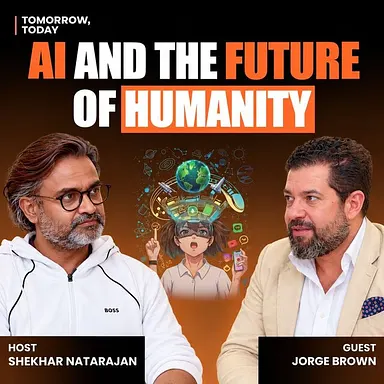
“The 10 Challenges That Will Shape Our Future with Jorge Brown x Shekhar Natarajan” was turned into text by HappyScribe’s speech recognition. Related tool: Zoom transcription.
Ads in this audio differ from the text. Tap the sentence you're hearing to follow along.
Synced: the text now follows the audio.
AI is not the future. AI is right now. It's today. It's got no regulation whatsoever. It's just going wild.
Most of these, like, you know, communication and things that happen, like, in these is a lot of deliberation and no action. There's a lot of policy discussion, but no tangible implementation. The multilateral
organizations The United Nations now count nothing. They don't serve for anything at all in the world. The UN is useless, absolutely.
4 guys could decide the rest of the civilization's existence and how they behave.
It's sending a million drones versus 2 million drones, and, and now the objectives are not military. Now the objectives are civilians.
Welcome to yet another episode of Tomorrow Today with Shekhar Natarajan. It's a great honor, a privilege, and my real, real, real happiness. Like, I'm really like over the moon to be talking to one of my very good friends, a very good human being, a wonderful soul, a futurist, amazing leader, and one who is basically playing many, many hats, like whether it's sustainability, whether it is in government politics, whether it's like, you know, setting the agenda for global leadership, and also now like thinking about the future of where we are headed. I want to introduce you all to my very good friend, Jorge Brown. And once you finish this conversation, you're going to be just as excited about Jorge and what he's doing and the book which is coming out, Just As I Am. I feel like a 3-year-old kid, Orey. Like, thank you for coming here.
Well, thank you so much, Shakhtar. It's a privilege of mine and also having a nice conversation and talk with you. It's always, always a lot of fun.
It's a lot of fun. So we'll do this episode slightly differently because I want you to kind of unpack for us the future initiative, right, like how are we thinking about the future. And let's talk about like the fundamental building blocks of the future like that you have talked about the 10 principles. And then we'll talk about the 10 most important things of how— where the future is headed and I will kind of frame the questions for you. And then you can give me a little bit of elaboration. And then I want you to then go back and basically walk me through your experiences in life and how they fit into these 10 principles. Like, what are your observations and why you feel so confident about it based on your experience? And then we'll, you know, walk back the journey of how do we prepare ourselves and your book, upcoming book, which I'm very excited about.
Fantastic. Well, I mean, basically what we have been doing, I've been doing all my life, is working with different leaders in different sectors, from Mexican politics to global institutions, to sports, to tourism. And in the past few years, we have created the Global Institute for the Future, which basically is my idea to summarize a lot of different experiences in the past and think about what's next, what's coming. Because many of the things that I've identified in my life is that the future used to be something pretty far away, something that, well, in the future we'll see what's going to happen and this is going to happen or not. And in the past 4 to 5 years, basically after, maybe after COVID, It is, the future is more present and more immediate than ever. I've understood, at least in that way, that we are making the future that is going to stay for the next 50 to 60 years in the next 3 to 5 years. So maybe that's the same thing that happened after the Second World War with Bretton Woods, that they created these 5 institutions, and that's the way we've been handling the next 80 to 90 years.
Now we are probably in one of the same, in the same mindsets as well of global institutions are setting the way for the next 100 years with different global players, with different themes, but people in the middle of everything. So in a way to keep it pretty much ordered, we've, or I've tried to identify at least 10 different topics for the next 50 years? What's going to happen in the future? We've identified 10 different topics. Many people did the same thing for the new millennium or for the new century 20 years ago. Many things happened, many things didn't happen. But I think that the future was very far away in the '90s, and now the future is right here. We were talking about, as an anecdote, that— The flying cars. Yeah. Or for example, in the movie Back to the Future, when they went to the future in that movie that we most of us grew up with, the future was 2019. So, and that's 7 years ago. Yeah. Already, that's 7 years ago. Now the way we perceive the future is very, very different. And we have topics that, I mean, of course everyone's talking about them and I do believe it's probably the most important revolution for the next 100 years.
It's going to be artificial intelligence. Artificial intelligence. And I'm not only talking about the technical or the data part of it, which is extremely interesting. You are working on that topic and I think it's unbelievable. But one, the other topic within artificial intelligence is the structure of power that artificial intelligence is setting for the whole society that now we've got 2, 3, 6 companies in the world, probably the Chinese, Anthropic, OpenAI, just to say.
Gemini.
Gemini. It's 4, 6 different companies that are setting the standards for artificial intelligence, but also what were the outcomes of the results? How are they giving you the results? The ethics of those results? What are they teaching you? So that's one of the ones, that's probably one of the most immediate things that it's not the future. AI is not the future. AI is right now. It's today. It's got no regulation whatsoever. It's just going wild.
I used to be that person hunched over my laptop during meetings, frantically taking notes to capture every single word. without really paying attention to what the other person is saying. But the irony was there was so much time spent on screen and very little time engaging and contributing. I'm sure a lot of you guys face that. I realized something had to change, and Granola changed that for me. Granola is an AI-powered notepad that makes your meeting notes useful. It captures what happens in your meetings and turns them into clean, structured notes With decision and action items pulled out and made easy to find. And here's the best part. Granola integrates seamlessly with how you work today. There's no setup, there's no configuration, and there's no friction whatsoever. Think about those typical post-meeting routines. Well, I go through them all the time, and it takes me hours to clean up those messy notes, trying to recollect and piece all of them together, create the action items, and rewriting and making sense. of all of it post facto. And I used to spend quite a bit of time, sometimes many hours, trying to do that. I'm swamped with meetings every day and I cannot simply afford it.
And hence Granola changed my life. What used to take me 2 or 3 hours now gets done in minutes, if not in seconds. And to make it all accessible for you, Granola is your partner. You can try Granola totally free today. Head to granola.ai/today. That's granola.ai/today.
So you're worried about the power asymmetry and basically you're worried about like the ethics of AI.
That's one of the topics, the ethics of AI. Yeah. One of it, which I think most of us that we have young children, we are very worried of. What information that AI is spitting out directly without any guardrails, no guardrails whatsoever, just spitting out information. And what information? There is an interest of the specific kind of information that AI is— we always talk about the Chinese TikTok, for example, no? That here we see people dancing and stuff, and in China it's cultural and whatever. Well, the same thing may happen with that. It's extremely interesting. And not only that, if all the information is going to go through those 4, 6, or even 10 AI developers, the amount of power those people have that we upload all our documents, all our ideas, all of our thoughts, every little thing we want to ask them, if we want to go to supermarket or if we want to make an entrepreneurial decision, We put it through ChatGPT, Gemini, or whatever. That information goes somewhere, and that somewhere has a lot of power, a lot of information. So that creates a techno-oligarchy. It creates— they really do know what we are thinking about every single moment.
They don't even need to listen to us anymore because we are inputting all the information right there in their own systems. So that's one of the first topics that I've seen. And it goes directly towards one of your main concerns as well, that I think it's very, very interesting. How do we curtail the ethics? How do we base it on values, on virtue, and not only on making money, on being efficient? Efficiency has been probably also that value of efficiency is one of the standards of the 20th century. But in the 21st century, that's not the best, the most important value. Probably it's resilience, right? Because things are, the future is so immediate that things are changing so fast that more than efficiency, what we need to be is resilient, open to change, open to different ways. We, the future of work, the future of robotization, automation. Universal. We need to permanently be studying. No, it's, extremely interesting and to give value to things that we have taken for granted maybe in the past. Because if you go to university, I had the opportunity to go to university in the US, in Mexico, did my studies in Europe as well.
But that information, the things they teach you in the best universities in the world, everything is available online. You don't need to go to Harvard or Columbia or or London. You don't need to do that. You go there for a different reason.
To build networks, to like, you know, kind of experience from the people who have like, you know, had all of these professional interactions and capabilities that they have built and competency they have built, and you're trying to interact with them to understand better. Absolutely. That is what the role of education is going to— I think it's going to be a bimodal sort of thing where the physical is going to be more interactive, judgment-related, kind of discussion-based things. But like, you know, you would learn most of the acquired knowledge from the web and for— Absolutely.
And the networking part of it. And the original part of a university as well, which is the whole experience of the university life and becoming a real human in that way. And not only receiving the information as if you were one of the machines or if you were plugged in.
No.
Which is also, I think that it's a very crucial part. It's going to be crucial because that is shaping the way we think as a society and it's an incredible opportunity, but it's also one of the other topics that we've been identifying is how it impacts democracy. The way it impacts democracy, it is very, very, very interesting because the democracy now, everyone has access to information, to misinformation, to over-information, to over-information overload. When the information doesn't mean anything, when you have a million different things coming into, that means so many different things. For example, the future of news. What are the newspapers about? When you look at a newspaper the next day, you're not looking for information because everything that's been printed in that newspaper the day after, You already know about that information. So it needs to cover another different— newspapers need a different role. So does the news anchors at night. You know most of the information. If you actually tune into the nightly news, it's to hear an opinion. You already know about the news. Like today, we know what happened in Venezuela. We want to see the news. We already know what happened.
We want an opinion. Elections, the same thing. There are only 2 different things that make us want to watch TV. And even, I'm talking about even you and I, young people, even more. But the only 2 things you want to watch on TV are an opinion of news because you're interested, but basically sports. You want to see the World Cup, you want to see baseball game, you want to see soccer, football for me, or whatever. But that's very interesting. But All of that behavior that seems disconnected, in my opinion, truly affects the way we conceive democracy in democracy.
So what do you mean by, like, I know that one of your principles is liberal democracy. Like, what do you mean by liberal democracy versus democracy?
Liberal democracy in the way of that, citizens have their own freedom to choose.
Yeah, the free will.
Yes. That's what I mean about, or libertarian, if you want to talk about in American terms, liberal in European terms in a way. Maybe that's a bit of a— but yeah, not this paternalistic view of the state of what democracy should be and how it is curtailed, but an open view of democracy of that it's not only about going to the, every 4 years and casting in your vote. It's about your everyday life and your interactions with the state. And now that state here in the Western world is one way. In the Western world, I mean, from India to the Americas, that you have elections and people matter. In China, you don't. In China, you can actually have a 10-year plan and nobody's going to question that. And it becomes way more efficient, but way less legitimate. in many different ways because citizens are not included in that decision-making process as we are in, not in the West, but from, again, maybe the West plus India plus Australia plus 10 different other countries, the largest democracy in the world and all that.
So are we, so can we hold the thought for a second there, Jorge, because this is a very important thought. So we are, we are, you're not like, you're not like essentially saying that, um, you know, you are, you are basically thinking about liberal democracy as much as the world order. Like whether it's a democracy, whether it's basically like a, uh, uh, a communist kind of view of the world, you know, what you don't want to have, like, you know, wherever free will should be expressed, it should be expressed. Whatever is basically like the rule of the land, like, you know, like, you know, someone like a China or Russia would have, like, you know, we should actually respect that. You're talking about world order and basically maintaining the world order versus like, you know, basic— are you saying that everyone has to be following liberal democracy? You're not saying that, right?
No, I'm not imposing it. That would be a contradiction in terms because that would be imposing something which is not, absolutely.
Exactly. Yeah. So you mean, so when we talk about whether it is libertarianism or basically whether it's communism, you are expressing world order as much as like, you know, what you're saying, like, let's not disturb the world order because that is slightly disturbed today, these days.
Absolutely. But also how technology is changing that world order. For example, and this is another thing which I'm working on pretty much, which is a book I've been wanting to write for the past few years, which is basically called A Guideline for Hating Each Other Better. I need to write a book that we need to— if we're going to— we already hate each other, but we don't know why we hate the other guy in front of us. We only follow the algorithm because we— and we have been in politics have become—
Is that the name of the book?
Yeah, it's called A Guideline for Hating Us Better in Spanish. Yeah, but yeah, because my main thesis there is that we don't even listen to the other side anymore. We hate the other side because it's the other side and it doesn't really matter. What they're saying, even though I agree with that idea, but because the other— So that becomes, in a way, part of my life experience. When I was in Argentina 20 years ago or something, I went to the Congress and I saw congressmen screaming and singing songs like if it was a football pitch. So it's the footballization or the soccerization or the hooliganization of politics that it doesn't really matter. Like, for example, left-wing Just one main topic or many, there's in every single topic we can find these issues. Like the use of burqa, for example. Left-wing politicians should be to forbid wearing burqa to protect women. But because they are so immersed in politically correctness and let people do whatever they want to do, even when they are here in the Western world, then they don't do it. If the right wing proposes we should eliminate the burqa, they vote against it.
But if the left wing does it, the right wing goes against it as well. Now there's a big debate in Spain and in all of Europe. In the UK, it just got approved. In the US, it's only a debate now of forbidding social networks for kids under 16 years old.
Yeah.
Australia already passed that law. That's going to be forbidden for people under 16 to use it. The UK just did it last week. The US is just a conversation. In Spain, it is a conversation. A year and a half ago, the right-wing party made that proposal. It got turned down by the left. 2 months ago, the government, which is left-wing, put the same proposal and the extreme right-wing said it was against freedom of speech. So, I mean—
It's crazy.
It's crazy, but because it doesn't really matter. Yeah. It's like a tribe. Ideology, which is controlled by AI, by the big tech, by the big tech is curtailing the way we are. It is basically—
So you're saying like, irrespective of whether it's right or wrong, the tribe basically represents like a stand which is against the other tribe?
Yes. Tribalization of politics. Absolutely. Yeah, absolutely. And the thing is, we don't have the time because we only need to look at the headlines. We don't have the time as a society or as anyone to actually listen. So, Shakhtar, what do you mean we should forbid the burqa? What do you mean we should forbid the social work for under 16? Well, you know, it is highly addictive. Oh yes, I might have a kid. I'm also concerned about that. But we don't have time for that, for the nuances, for all the different things that we need to talk. And it turns out, I only hate you because I saw a picture with of you wearing the Arsenal shirt instead of the Manchester United shirt. And because it's football. But we're not talking about football. The idea of politics used to be, I elect you so you can get— so you can agree with the other side, not so you can fight with— that's what I'm for as a citizen. I can fight with the other side. You as a politician should agree with the other side, because even if you have 2 parties, like in many Western countries, When 51% votes you, fantastic, you win the election.
But that also means that 49% don't agree with you. And 49% is a lot of people. And in parliamentary democracies like here in Spain, maybe 65% didn't vote you. They only voted 30% or 35% voted you in for those parliaments. So it's more necessary than ever to find the consensus, to find the conversation, But the algorithm and AI and tech are really limiting, in my opinion, the way we do it. How do we, and how are we going to solve that in the future? That's one of the main issues. How do we cross it and get across the aisle, like Americans would say? Here in Europe, it is becoming very, very difficult.
Everywhere, I think.
Everywhere. Yes, that's the other thing which is very interesting. No, here in Spain, things are really— Well, Argentina, the same thing happens in Argentina. In Mexico, same thing. Well, the left wing in France, well, you have Mélenchon in France with the National Party. You have Trump and the Democrats. You got Milei and Cristina. You got right now Colombia, what happened? They're extreme right and extreme left. There is no middle ground. And there is a problem of breaking the system because the whole algorithm has really tensioned it so far away that we can't come back together. Everywhere in the world, 20, 30 years ago, yeah, during elections you can say whatever, but then they convened back to the center after elections. Now everywhere in the world is exactly the same, which I think it's really, really, really dangerous because then the other topics that are now that we need to solve now for the future need a global consensus, like energy transition needs a global consensus because it's maybe one of the most important investments that society as a whole is going to make. And all of them are interconnected. If we don't have an energy transition, there's no way we're going to power your AIs.
There's like no way possible to power all the tech needs that we have, right? So we need to have a global consensus on energy transition. And that means global warming, maybe. That means climate change, yes. That means absolutely. Okay, we also need to understand that we are not dying tomorrow. Like all this, and then stop being a global climate denier. I am not a denier. at all. And that happened with, maybe, I don't know if it happened in the US as well, but here in the rest of the world, if you actually questioned the COVID vaccine, you are a COVID denier. And it's like, no, I'm just saying, I was one of the first people to get the vaccine and now I'm not anti-vax. I did the first one, but I said, well, maybe we should do more research. Maybe.
Because they're putting it into the body.
I already did it in my body, but maybe we should question a bit more of what's happening. Well, there's vaccine. Well, it's not going to let you— you can still get COVID, but you need the vaccine. And just having that conversation became a big problem. And that there are many, as we are going to talk throughout this conversation, all of the topics are interconnected. Social justice, with freedom of speech, with how freedom of speech is under fire, but because, not because of the state, but because of social warriors, right? Or social justice warriors all over the world that what can you say, what you cannot say, if you're canceled, if you're not. That's extremely interesting. But going back to energy, that I think that that's one of the biggest consensus is we are going to need to to get to in the coming future.
And are you also including water in this?
Absolutely. Water, maybe in, for many countries now, it's, they don't see it as a big problem. For Africa, it's probably one of the biggest
problems.
It's the biggest problem they're going to have.
And like, you know, with all the data centers going in and everything, like, you know, going up into the society like that, the rate at which it is going, I think water cooling systems, all of this would become a— present a big challenge. And I think that's where alternate like energy tech is like something which is going to be very important for us. But there's no consensus on this. So like, you know, I think like there should be some consensus to say every data center would use like energy efficient tech. Absolutely. Right, like so that's the best way to do it. And like, you know, that preserves the water and that preserves the community and
And rethink nuclear, for
example.
Yeah. Rethink nuclear. That's very important. If we are or not, I'm not taking a stance, but we need to rethink nuclear.
All the alternatives.
All the alternatives. Of course, we're not going to go back to coal.
Yeah.
Just because it's extremely expensive. And then how do we get everything together? Plus the pollution, plus everything. Yeah. Water, not only to cool down the systems, but just drinking water. Yeah. And all the migration problems. actually happening now in Africa. We don't see it because Africa is far away from us. We are talking about 2, 3, 4 global conflicts. But when you talk about Congo, we talk about— we don't see them. We don't see them. And respectfully, when we see an accident in India, it's hundreds of people in accidents. But because it's so far away from Europe, we don't see it in Spain or in Europe. We have small accidents, which is still tragic. I'm not saying it's done, but the dimensions are so small, but we overreact to those and we don't react at all to other problems in the world. But until we have those problems in our backyard or— Very close to you. And that's what's happening now, which is a big, big, big, big problem. And we have to rethink the problems globally and we need to find global consensus. But there's another problem that comes directly, it's directly attached to that, that multilateral organizations now count nothing.
They don't serve for anything at all in the world. The UN is useless, absolutely.
NATO is gone.
It is NATO, the UN, Those institutions that used to be so world order could come together and that people can understand each other and carry along laws and whatever. Now they don't count for anything. And it's extremely difficult.
Even the composition is all like screwed up. Like, you know, how do you determine like who goes into G20, who goes into G10, G7?
Whatever.
Right? Like, you know, it was constituted very differently when the economies were at a different state. And now like, But like, you're still like using the same G7 framework.
Absolutely.
Right?
Or the Security Council for the UN, which was established in 1947. And it's still those 5 countries that
are— And they don't even have the military capability and strength and the wealth to basically protect the rest of the world. Like, you know, I don't know why they sit on it in the first place. Right? They don't have the— they cannot like— you want to defend your own home. which you cannot, like, but you want to defend the whole world? Like, how does that work?
Absolutely. And who's going to fund that?
Who's going to fund that?
And then other countries in the world, without saying any names, try to make them lose legitimacy. For example, that they voted in Iran to head the Human Rights Council. So it's like, so what value does the Human Rights Council have when Cuba and Iran run that council? It's like, Well, there's no credibility whatsoever. And if you have those decisions made at the World Health Organization, sorry, Human Rights, you do the same thing with global health. You do the same thing that there's no budgets and the budgets are, who gives them the budgets? The pharma companies. So what's the credibility of those companies and of those international organizations? How are we going to— we need more global consensus than ever. And it's when the international organizations have the least amount of legitimacy in the past 60 years. And that is very, very, very dangerous.
Is there like, you know, like I want to get your thought on this.
Yep.
Is there an idea of like privatization of these multilateral organizations? Like, you know, like, because everyone is funding, everyone seems to have a, like, you know, a claim to the party, right? But if you ran it like a business, you said like, you know, like we're going to treat this like a business, like a private sector versus then, you know, would the way they govern, would it be different? Because what I see all these guys doing, I don't know, like, you know, I shouldn't be like talking like that, like, you know, I guess.
Well, we're just making assumptions.
We are making assumptions. But like most of these, like, you know, communication and things that happen like in these, you know, in these organizations and the meetings thereof is a lot of deliberation and no action. There's a lot of policy discussion, but no tangible implementation.
We strongly disagree with what you have done.
Yeah. So what? So how do you basically create this organic capability to be able to not only deliberate, but to decide? Right? And then enact. And then basically, like, you know, have a point of view and like march towards that is a thing that always have, you know, kept me up. Like, you know, because, you know, politics is great, I feel like, you know, politicians are really good. Like, you know, they should work in the best interest of people. But I think they are limited in their abilities. A good public servant doesn't make a good technocrat. It doesn't.
Yep.
Right?
Absolutely right.
So you may be technically savvy, maybe, like you may know a few things, but looking around the corners, like, you know, if you talk about this divide that you see on the left and the right, and the social networks dropped in between to kind of create that wedge, but who actually approved these social networks to do what they're doing in the first place? Or lack of like governance that was actually put in place so that they never had to do that. Like, we never did that, by the way. So we are bearing our own consequences, so to say.
Absolutely. And that's the main— we go back to the first point with ethics and morality in AI. We have the opportunity to do it right now. And not wait until it's inevitable.
Yeah, it's too late. And I think that's essentially what my thinking was. But you have a great point. Most of these multilateral organizations are pretty much dead, actually, to be honest. And what is their role? Like, you know, who decides and how do we reinvent ourselves and what is the world order?
And ideology now, or a certain type of ideology like right-wing, left-wing extremism, it becomes more important than national interests. I know the idea in Europe or in Latin America, which I'm more familiar with, but if If you are a right-wing president in Latin America, then you agree with other right-wing countries instead of working for your national interests. You are working for your ideological interests. Instead of, for example, the Organization of American States, which is like our EU, but for all of the Americas, they don't do anything anymore because they don't even want to get together. If Hugo Chávez was alive, he didn't want to sit next to a right-wing president. Or the same thing happened the other way around. Today, Milei and Asprilla, they want to sit down with Maduro. Like a few months ago, they wouldn't be seen together. Or even with your biggest partner in Argentina, which is Brazil, they wouldn't sit together. Lula and Milei have never had a one-to-one meeting. And it's like, I don't vote you in to make friends with the other guys. I vote you in to defend my national interests. To sit with, I don't care if you don't like him, sit with him.
He's our most important trading partner. So now those multilateral agreements have become minilateral agreements every time, even more like 1-to-1 or 4-to-1 instead of 15 countries or 192 countries like the UN. Now we are going back to mini multilateral agreements instead which are only transactional. They are mainly transactional. And that is what's happening and is happening now. And that's what's going to determine the things in the future, your immediate interests, not your long-term interests. A huge example, maybe, Shekhar, for that is also Brexit. There was an immediate interest for Brexit, but not a long— it's not what's going to happen to the Ukraine in 20 years. I don't care about 20 years. I care about the next election.
Yeah.
And if I can put a wedge in that election and create a cleavage where there was none, I invented that cleavage and I made the most out of that cleavage because social media allowed me to do it. Social networks allowed me to do it. If we don't pause it right now, as we were talking just before we started recording what the Pope just, his encyclical or encyclic, Um, but yeah, he did right now.
Yeah.
To ask those companies to curtail that. Now it is, it is very social networks are very powerful, but AI is social networks on steroids. It's 100 million times more important because, uh, even if we get people like Elon Musk, which he's done amazing stuff, but if we get Neuralink in the future, which probably we will, We don't know when it is going to happen that we're going to have a chip installed somewhere sometime. Who's going to design that chip? Under what ethical values? Under what moral values? How are we going to limit that? And they know, and you guys that are in that, you know about it can go all very, very, very wrong, right?
Yeah. Like, you know, this is the existential problem actually, to be honest. Like, you know, I worry about these scenario. See, I don't worry about— do I think the whole world is bad? No, I think like, you know, but we're entering the phase of technology and capability that a very small set of actors could have a significant impact on like all of the population of the world. Like 4 guys could decide the rest of the civilization's existence and how they behave. And that to me is like power asymmetry like completely like gone wild. Absolutely. So that worries me quite a bit like to your point like we are racing to build technology but like we as humans and cavemen that our origins are we've always liked power, control, and domination. And if that is the thesis of how we evolved, power, control, and domination will always be within us. We're not going to forget this. And that will drive a lot of these problems if uncontrolled, which is ungoverned. And you know, that keeps me up at night. You know, you have a 6-year-old.
Yep.
I have a 6-year-old. I have the same concern. I like, you know, that's essentially why I think like we have chosen different paths, you've chosen the path of like being a futurist and kind of like understanding how leadership should be sort of formed and kind of morphed and created and kind of like pointed. And I said like I'll come at it from the technology perspective, how do we build technology with built-in capabilities that has all of these embedded not as an afterthought. but into the design of the systems itself. Because you cannot like bolt on anything and say, oh, like, let me, let me kind of like save the world. No one is going to do that.
No. And also, I mean, you choose a very wise side because technology is going to be inevitable.
Yeah.
We're not going to, we're not going to be hermits in a cave. I mean, we are living in society and we know technology is coming. So either we shape technology or we shape the mind.
Yeah.
Or we shape both.
Yeah.
We try to shape both to make conscious decisions and not just let technology create this huge divide, which is now more than ever, people which are digitalized and people that are not are going to create 2 different kinds, not only of citizens, but of human beings, basically, of people with access and no access. Based on that one digital access phenomenon, and which I think it's going to be very, very dangerous. And also because now we are having another huge problem. All that access, society in the world is becoming older. People are having less kids or having kids later in life than they used to. And that's only statistics, but that creates a huge problem worldwide. In the West, it's even More important because of the welfare states and how the welfare states are eroding at one of the fastest paces ever. And we still have ideas from 50 years ago or 60 years ago. Like for example, okay, retirement, 65, fantastic. Life expectancy used to be 74, 75. So I'm going to, okay, I gave money all my life, it's fantastic. And I'm going to give you money for 10 years so you can retire and you could be happy.
But now your life expectancy is at 88 or 89 years old. So you're still retiring at 65. So now I don't have to give you money for 10 years. I have to give you money for 20 years. How? There is no mathematical model that's going to help me do that.
Yeah. Unless I print money.
Exactly. So that's inflation and that's even worse. And I'm not saying that people should, but even I talk with my friends all the time, like, people, our parents, when they were 50, they looked 50. And now you see 50-year-olds and they look 35. The way they dress, the way, the lifestyle they have, the sports they do. Like, it's very, very different.
You know, I want you to hold that thought on the longevity. So I'll tell you, like, here's an interesting thing we did. My first episode, was on longevity.
Okay.
And the question was, what would I do if I live up to 300 years? Okay. And so I brought in some intellectuals and they're like, they were all like, you know, I got like so much time, I can go to like Mount Everest, I could paint, I would sing, I would like, you know, think about all that stuff. And so these are the intellectuals talking. Intellectuals like to basically have their own la-la land, right, that they live in. And then like you go to the, like, and we went to the guys on the street and the guys in the slums. Okay. And we asked them the same question. Would you love— would you live up to 300 years? And you know what the answer was to the question? They said like, we don't care about the length of life. We care about the quality of life. Quality of life. Right. And they brought up a lot of issues. They said like, Or do you know geriatric care is going to go up? You know, like social justice system, it's going to like skyrocket the cost. Do you know like basically like, you know, women, 20% of the women, you know, till the end of life expectancy have, you know, Alzheimer's, which is possible, 20% of them, like to the end of life.
Now, how do you deal with social justice with them? You cannot, you know, like what happens to social security, financial systems? How do you think about like, you know, your art? Right? Like, you know, your craft, what do you do? Like, what is your profession? How many, like, how many professions are you going to have in your life? What do you think about marriage? The construct of marriage is like, you know, monogamy a thing? Is it like, is it a contract-based marriage? What about relationships? So the list goes on and on and on of things that we have not considered that we have to solve before we just jump and say, let's live longer.
Absolutely.
I'm not like, I'm not against living longer. Oh my God. Like, you know, I'm not like anti-living longer. living longer. But unconsciously, we've been living longer because the medical progress has actually enabled us to do that, which is a good thing, by the way. But the system around us has actually been, you know, kind of backdated. It's like the same thing I've seen in businesses. In businesses, the operating reality was always like different than the business reality. The business was created in, let's say, in 1950. I bought a truck, I built a warehouse, I did this, And it was like tied to the 1950s type of style of thinking. Now I'm operating in 2000, how will I take like 10,000 SKUs and put it in a like, you know, 5-pound bag? I cannot, right? But I try to and I muscle my way through. And so that's the kind of the context that we don't, you know, we don't understand, right? Like, you know, the business reality is different than the operating reality. That's actually pervasive everywhere in the world, everywhere. Everywhere. And it scares the shit out of me, to be honest.
Absolutely.
You know, because like, you know, everything is going at warp speed. And we as like, you know, as regulators, as economic engine, like, you know, which is businesses and the naivety of like, you know, people in general, and how they perceive these things scares me, scares me literally, like, you know, where are we headed? And I may be sounding like an alarmist, but our history shows I should be an alarmist.
Absolutely. You know what, there's a saying, an optimist is just a misinformed pessimist, right? He didn't have all the information, that's why he's an optimist, right? So in a way, yeah. And I'm not, and going back to sayings, I mean, history teaches us the future. We know exactly what's going to happen and we are seeing it right now. And now with all the access to information, we are seeing it in real time. They're not considering what's happening with legacy structures, legacy mindsets to new realities. You see it all the time with, oh, with big companies, like with travel companies, that that's one of the topics that we work. It's like, well, before you needed 5 people to give you a plane ticket. And now you can do it all automatic on a machine. But what do you do with those 5 employees that they used to do that? Do you fire them? No, because they're in a union and because they're in a union, they have these rights. And I'm not saying they shouldn't have those rights, but those rights forbid you to do that. So there comes this new company such as Ryanair or any other low-fare company that, well— Immediately they are created.
They don't have to carry with those structures. And they compete in a very different way and unfair way in a way, because they have to— those used to be country flag airlines or whatever, and they need to maintain those structures. And if we see it as simple as that in tourism, like in an airline, we can see it in most other industries. I believe that we are still holding from the 19th or the 20th century. There are so many that we don't even know what companies, what they're going to do in In the future, like your company, 20 years ago, not 20 years ago, 15 years ago, nobody would've believed that there was, it would be something that you could think of having. And now it is one of the most cutting-edge companies. So that's also, I mean, what you were talking about longevity, I think it's, and I believe it is more about a quality of life than the amount of years you're gonna live. In 2 weeks, my grandmother is turning 100. So I think that is the most amazing thing. And we're going to go all the families here and celebrate 100 years.
And she's an exception, but she's— because her mind is perfectly well. She just broke her hip maybe 2, 3 years ago. And so it's been mobility problems for the past 2, 3 years, but 96, 98 years, she has been perfect living by her own in Mexico. Amazing. So that's awesome. But other parts of my family haven't had the same luck and they've had Alzheimer's for years or they had heart disease or they had many different things that has limited their lives in so many different ways. And I don't know if we have the tech because that's another thing that this modern world or the future is creating is this asymmetry of access to technology, not to information. You know that it is there. But the access to that technology and the dangers of that technology as well that we don't think of, and you were talking about them. We were talking about CRISPR maybe this morning, the gene editing technology.
Yeah.
CRISPR.
Yeah.
Well, it's fantastic. You have a kid, they can edit the genes so they're not predisposed for melanoma or for lung cancer or for any— that's amazing. That's a great idea. And that's a great discovery. But with that same technology, we can create the Aryan dream. We can create that everyone is 185, blonde, blue-eyed, and speaks German. It's like, no, we don't want that. But that technology allows us to do that now.
And how do you maintain the ethics of this?
How do you do it?
Yeah.
That's a huge problem. Huge problem.
Everywhere. Yeah.
That's a huge problem.
And who gives you the right to do what you want to do? How do you, like, you know, you cannot, like, you know, we want to make sure that it's not free will because you could do the wrong things, but it's also like free will to a certain degree. Like, so like, what's the balance here? Right. So we got to figure that out. And how do you manage all of this? Like, you know, it's like very— it's a very interesting question. One of the things that also came up in the longevity study, which I think you would appreciate, is what people were saying is elderly population will decide for the future of 2 generations to come in this world of like living longer. So let's say I'm like, you know, working up to like 90. Yeah. Because like I'm needed to work up to 90. So I'm sitting there and like deciding on the behalf of like a 20-year-old or a 30-year-old. 2 generations later, I like, you know, they're living with the repercussions of what I decided.
In a world which we will see. Absolutely. So though that's what happened in the 1940s.
Exactly. And that's where we are. Like, you know,
that's where we are right now. And now we need to rethink it again. And we're good because maybe one of the greatest challenges of our time is not being more efficient because now machines are gonna be more efficient than anything. And it's not gonna be more productive because robotization is gonna be way more productive than anything. But as humans, our resilience to be able to permanently adapt to change, right? Yeah. And that brings it to another huge issue of the future, which we are seeing it now. I think we've always seen it, but at least now we recognize it, which is mental health in society, which is a very delicate topic. I mean, you have to be very careful with those things, but there is a huge problem with mental health in all societies now because we live in a world of, first of all, immediacy. Like everything needs to be now. A world with full open access to information. And everyone knows how the rich live now and what they are not getting, what they think they should deserve or what they do deserve. But in— I was telling you, like, in Mexico, it's a very similar country in many different structural ways to India, but we used to have like different— the social divisions were— are still enormous.
But the lower part of society didn't know what they were missing out on.
Now they're aware. Now they do.
And it's why it's not fair. Of course it's not fair. Social justice, it's not fair at all. Maybe it's fair that someone has more money than you. Yes, but not a million times more money than you, which is also the biggest topic now. Is it fair that one person has a trillion dollars? Well, it is a topic to discuss.
There are only 5 countries bigger than them.
Exactly. There's one guy. And if you put the 5 guys together, extremely interesting of how do we conceive ethics and how do we conceive the morality that comes from those ethics, which I am absolutely convinced that it is something that we need to discuss. And we need to discuss now as well, because all the different wars are going on in the world right now. They are not only— they are mainly financial and economic, of course. Yes, they are. But they have an underlying factor of a cultural difference, a completely cultural difference. How did, for example, we are discussing the Middle East, and I don't want to discuss the Middle East, but I do want to discuss Afghanistan or Nigeria or where they treat women in a certain way. And that we don't give, and that for us, it is inconceivable that they don't let women sing.
Hmm.
Let alone the burqa, let alone they don't let them sing or speak in public or Or ablation, the circumcision of women, which is horrible, which is horrible. And that we allow that today when we have access to information that it is happening right now and we don't do anything because there's not a financial incentive for the rest of the world to do something. And that's why maybe multilateral organizations are becoming less and less and less relevant because they have no capacity. enforce and going back. Their problem is they have no enforcement capacity, particularly because if the US, China, Russia, what, the UK and—
Yeah, they're not playing together.
They're not playing together. Why is Germany not in that club? Why is India not in that club? Basically, India is what, the 4th, 6th largest economy in the world?
4th.
With nuclear power, with nuclear everything. Why is India not there?
Yeah, India was invited to G7 as a guest.
As a guest. Mexico was invited to the G20 as a guest. And then it was G7 plus Russia, remember, before the Ukraine war. And then it's why? It's so interesting to understand. And the biggest question, Shakir, probably is not too deep, but a very deep question is, well, G7, G20, UN Security Council, Do they actually matter though? Or does a private club of 10 multi-billionaires, they meet together at the White House, does that matter? Maybe that matters way more than that G7, G20 meeting. Maybe that plane where they—
But should they meet in like, you know, in White House or should they meet like in a world or, you know, a neutral place because they're actually representing the whole world, not just US?
Absolutely. That's a very valid question.
Yeah.
But today, at least now, the US still has the power to limit them. Maybe in 10 years they won't. So maybe do we want at least some public institution, even though it's the US and it's not our government, do we want at least one government to control them, to regulate them? Or are they going to be just— because now, as you just said, Many companies, most of these 5 companies, they have more power than 90% of the, more money than 90% of the countries in the world. 90% of the countries in the world. It's unbelievable. Like this one guy has more money than 30% of the population of the world. Not of the, not of the US, of the world. What? Are you fucking for real? And that's happening now. Still, there are many different things that, as you, as we've seen a month ago that Trump went to an official visit to China. But the important part about that trip was not that Trump was going to China, it's the guys he took on his plane.
Are all like the tech guys.
All the techno oligarchs were there. So then it was important. I mean, why was it important? Because of Trump and the military power, or because those are the people shaping technology and shaping the future of what are we going to think and how are we going to think about anything in the world?
But I don't think like Xi Jinping will actually bring like his technocrats along with him when he's actually making a state visit to the United States.
Maybe.
I don't think he's going to bring the CEO of DeepSeek and Alibaba and others along with him. He will just show up with his people.
Yeah.
So
he's also trying to, he's also trying to make a power move, I guess, as well. of, well, it's
like, it's an interesting world actually, to be honest, you know.
Extremely noble.
Yeah. You know,
and does he understand it or not? Or is it just transactional? It's like, no, no, I just need my companies to earn more money. I don't, yeah, I don't care. Like before, or the EU, every single agreement of the EU commercial agreement had entailed a democracy clause. If you don't have democracy, I don't want to trade with you. I'm not going to lend you money if you don't have them, if you don't put democratic rules in your country. The US has disregarded that part completely, and it's only transactional, commercial, and trade-wise. It is extremely interesting, the world they are building now. And people are noticing, and people are extremely, extremely divided. And the morality, Extremely weird. And you live in California and probably cultural wars in California are the most interesting. They are. That's a good word.
I got like, we got some like big pockets of very small, big pockets of blue surrounded by a lot of red.
Yeah. But very deep blue though. Like extremely deep
blue.
Extremely deep blue, deep blue pockets. That those people have, they use shame, they use to cancel people, to impose their values, which becomes completely, completely unfair in so many different ways. Like now it is impossible to say something that doesn't offend someone, 'cause anything you're gonna say, anything we're gonna say might offend someone. Exactly. But that's part of freedom of speech. I love that part, that freedom of speech is not that I am able to say everything that you're going to agree with. Freedom of speech was made so I can say anything that you're not going to agree with. That's exactly the nature of freedom of speech, that you're not going to agree with it, but I have the right to say it as long as I'm not enticing for violence or doing the— or yeah, but mind-wise, and that comes for research in science. Like, for example, it's impossible to research now certain topics in science because it is politically incorrect. That's unbelievable. Like, it is very, very difficult now to talk with many different, with LGBT people because they have many different ways of, many different interpretations, even within themselves. There's many topics which are off the table.
You cannot even discuss them. And I believe I support absolutely everything as long as you're able to talk about the topics. I think talking and dialogue and debate is the most important, one of the most important tools that we have in the world to solve things and to bring people together. But if we don't have that tool anymore, this is one of those tools, having a podcast, having information freely accessible to everyone. They just, they need to have an interest. So maybe that is one of the things that we need to rediscuss and rethink in the future. How are we going to regulate that? That you might not agree with me. I don't, but maybe that's more important that you don't agree with me. Yeah. Confrontation is so interesting.
Yeah.
Like there was, we were thinking of doing this event later this year again, which I think it's, well, I love it because I created it. But the idea is that, for example, you see World Economic Forum in Davos in Switzerland. Yeah. Amazing. But what they want to go, they come together to find, to merge ideas, to find common solutions, to find everything. So they don't really say any, Did they just go there to make sort of friends? Good friends. Good friends. And when they go, nothing ever happens. Then you have TED, which is amazing, but everyone has their own idea. You said one, great. But what we need is a forum to confront ideas. That's a main idea, to confront directly positive and negative and just have something come out of that. I am absolutely convinced that we need to create those forums where actually people after that debate, you can actually Did you learn something literally or not? Can you make a commitment of what we have discussed today or not? And commitments not in 5 years' time, 10 years' time, like CGI, for example, Clinton Global Initiative. It's like in 100 days, what can you do in 100 days that can be measured?
And that, I think it's unbelievably useful so we can see actual change because people are desperate for immediate action and to see what's different. You voted someone like Milei, and they were, after 100 days, it's, what have you done? Well, it's 100 days and we have had this government for so many years. Give me time. And I can say the same thing for a left-wing government. I'm not talking about Milei. It's like right-wing or left-wing governments, they need immediate actions and immediate repercussions to what's happening. So that's another thing that we need to understand in the future. And also how with technology, if we can reshape the way of decision, the decision-making process. People don't have to decide about everything, by the way, as well. And this has been discussed since Plato. I mean, if you go out on a ship and there is a storm, are you going to vote who's going to take you back to harbor? I'm not. I'm going to have the ship captain sail me back to harbor, right? So there are many things that we need people to be involved in and many things that we don't. And though we don't need to have everyone involved in absolutely everything and give technocrats the place they need to be, where they have to be, so we navigate in the world.
And that those ideas are the same with technocrats as it is with AI. Because there's a huge idea everywhere in the world that can government cabinets and governments per se be run by AI? Many people, including myself, I think that 50 or 60 or 70% of what government does may be run by AI. But then how do we, how do we, how do you program it? Yeah. What ethical values are we going to put right there? That's exactly what you are doing. Precisely if a government is going to be run by AI. But there are so many different things that I don't want anyone to decide. Like if there is a fire and there is more than X amount of hectares burning and there's X amount of like very, very objective data, send the rescue teams immediately. Don't make it a political decision. Just send the rescue teams out there. Extremely interesting. And the rescue teams in the future, also with robotization and with AI and with drones, you're not going to put anyone in danger. You're going to send drones. And that's the other huge change. which is national security. And then probably you know way more than I do.
And now drones and robotization, it is really going to reshape. Oh, this is amazing. Because one of the last points I wanted to talk to you about was how everything's interconnected. So we've been talking about AI, automation, everything. But with robotization, we have a big problem because you have longevity. Fantastic. But then now we don't have any jobs for people. Because now it's going to be done by robots. Who's going to pay for those people? And maybe you don't want them to take— what are they going to be working on if there are no jobs for them? Yeah, robot does it. Are we going to tax robots? Great. Are we going to have a minimum welfare, minimum income for— A
minimum basic income.
A universal basic income. How basic is that basic? Who decides
that?
Who decides that?
How do you know like what my basic income should be? Is it the same for everyone or is it like, you know, different for different people?
Are we communists now or not? Which, and I don't think it's good or not. I'm just saying, if I'm a writer, like you are a thinker.
Am I more valuable than you?
And when you're 90, probably you are. Now, probably the guy that works the fields and he's 40, He's more valuable than he works.
That's your problem. You're living longer.
Exactly. Precisely. But those questions need to be addressed.
Yes.
Yes. Those questions need to be addressed. And for how long are we going to live?
All of this is actually like a system dynamics problem. Like, you know, it's a very common— see, like, let's take a very simple thought, right? Like, I know, like, you know, John Sterman runs this simulation in MIT. And he thinks about sustainability. There are many things where, like, you know, you could impact on sustainability, like, you know, that changes the face of sustainability. But the most important instrument that he has come to realize through lots of simulation, and he's done, like, you know, many places using system dynamics model, was that carbon tax was the best strategy to do it. Okay. So that's the single biggest lever which would actually change the trajectory of how you basically like get to sustainability, like there could be 100 things. Now, you have 10 things that you have listed, right? Now, how are they all interrelated? Because they're all interrelated.
Absolutely.
Right? And how do you basically create a cohesive world and a cohesive decision-making system, and understand the implications of what we're trying to do? Because the possibility of everything, like, you know, working in harmony, is slim to none. Right? So now what are your trade-offs? How do you decide the trade-off? Who decides the trade-off?
It's a very complicated problem. And I don't know, like, you know, one, we have the political appetite, two, we basically, we have the intellectual capability, we can, you know, guys can actually launch a rocket and bring it back onto the ground. Like, you know, I'm fascinated by it. So we do have the intellectual capability if we wanted to solve the problem, but I think like, where are they? What are they focused on? Why are they not focused on these problems?
Like if this is the existential problem, why is like the big tech is not working on these problems versus like working on the problems of like, how do I build more data centers?
Are those problems part of human nature or not? Being— and because, for example, one of the— envy is one, it's part of human nature, right? So why are you the one making the decision of how it's going to be and not me?
Yeah.
And because it's not me, I'm just going to— and it's you, I'm going to try to boycott and I'm going to try to torpedo your idea no matter how good your idea is. But because it's not mine.
Yeah.
And I'm talking person to person, but country to country, company to company.
Individual to individual, community to community, tribe to tribe, nation to nation.
I always say it's the tribalization of politics, but I understand it even more with football, right? I'm a huge Atlético Madrid fan. It's the second club of the city. And when I'm in the stadium, I go to stadium every single match, and they commit a foul and I never see it. Of course, my team did nothing wrong when I'm there. Then I go home and I'm alone and I watch it on TV and I say, Oh my God, he almost broke his leg. But yeah, but I'm gonna— but I'm never gonna admit that in public. I'm never ever gonna admit that in public. But it's a football game. It carries no consequence whatsoever. And I get that. Yeah. But that field, like it could be in rugby, in cricket, or in any single sport. But now in politics, it does carry consequences. It does carry consequences. that even in the US and in Spain, everywhere in the US, there are apps for Democrats to date, that only you're only going to date someone who's a Democrat. So they created an app, a Tinder for Democrats, and they're creating a Tinder for Republicans, for conservatives in Spain, that only if you're a conservative and you vote this party, you can join that dating app.
It's like, interesting. But it is really, really divisive. But it's why here in every single country, because I don't want to say I'm Mexican, we work in Argentina, we work in the US, and I live here in Europe. In every single country, we always say, no, Spain is different. It's exactly the same in every single country right now. The same thing's happening. But the families cannot get together because people think in different ways. And it's in politics, and that is not normal. Family used to be something, and those values, even legacy values we can even call them, are changing so fast. What does it mean to be a family? What's the role of men now? And your real role, your expected role, and what do you actually want for your own life? Not what people expect from you, but what do you want?
Yeah.
And, but there is this different ways of the way you're supposed to be in one way or another, depending on your values, of course. And everything is, all of it is valid, but we are getting divided over everything. There's this German thinker, Ulrich Beck, in the past. I mean, he died 5, 6 years ago. He talked about the zombie concepts, right? That we think of a concept is A table. We think of the concept, 4 legs, wood, that's a table or a chair, whatever. We think of a family, we think of a mom and dad and 2 kids. And in our mind, that's a family. But now in the US, 52% of households are monoparental. And no one in the world is going to tell me that a single mom with 3 kids is not a family. Of course it's a family, but the concept is not—
The same.
It's not the same. It doesn't correspond to my concept.
Because the visual representation. Yeah, like visually, like, you know, the way I envision to the reality is very different.
It's very different. And we are still legislating on the idea and not on the reality. Like, that's a very good example. We're legislating on that idea and not on reality, even though we have access to that information in real time. Like, no one, like, we've never had so much information, but we're still legislating on that different sense. So that's something to think about, Shaktar. Like, what are we— and who are creating those laws? Why are laws not being created with all the different information we have?
Yeah. That's why I'm saying, like, you know, the big tech should be focused on these types of problems. Yeah. I think, like, you know, these are consequential for the civilization. So, so we'll go back to the 10. I will relist the 10. So, like, everyone understands the 10.
Absolutely.
Uh, the first is artificial intelligence and the concentration of power. That was the first one that we said. The second one is the liberal democracy, its erosion and reinvention. The third one, or I would say it's the world order too, right? Absolutely. The third one is energy transition, climate change, and new geopolitics. Like, you know, how is it reshaping the world?
The fourth is end of classical multilateralism and the rise of multipolar trading world post- You know, First World Wars, you know, that we have seen. The 5th problem is migration, human rights, and social cohesion.
The 6th one is social questioning, demographic aging, and social contracts, right?
The 7th is the future of work, automation, and loss of purpose. The 8th is culture wars and freedom of expression. 9th is mental health, loneliness, and community breakdown. And the 10th is the interconnected system of challenges.
And I think I believe that, at least in my mind, those 10 topics are extremely interconnected.
They're all interconnected. They're like, like these are the fundamental problems the world is going to face.
And this is the most fascinating conversation I've had and the most intellectual conversation I've had probably in my whole show, like all the shows put together. It's like, this is a brilliant conversation. So now tell me your book and where do you want to go?
Well, we're working on 2 different books now. The first one is the ability— is on new commerce in the world, how things happening in every single conflict in the world can affect you and your exposure to every single company in the West. We are so interconnected. Multi-commercial agreements are affecting absolutely everything. Like during COVID we saw that Taiwan couldn't ship one single chip, microchip. So cars, we couldn't have no cars anywhere in the world, but that's going to reshape today. Ormus was closed for one week and it completely screwed up all the logistics. I'm not going to talk to you about at all about logistics because if there is an expert, that is you on logistics. But now this interconnection is completely reshaping the world because now we are taking away that dependence we had on China, for example, that almost 90% of ibuprofen in the US before COVID was actually made in China. And between China and India, I think they had 94% of ibuprofen produced in the US. If the US has a headache, only China can take away that headache. It's unbelievable if you think about it that way. And so now they're nearshoring, friendshoring, all the new opportunities that are arising.
What's the role of the different regions? There is no world order now like the UN or the WTO. We are creating new rules, new sets of rules. How is that going to affect your company? How is that going to affect your job? How is that going to affect everything and how you're going to be? Necessarily, necessarily be, you have to be able to adapt to permanent change. That's the only constant that we are gonna do. Change has always happened, but the speed that is happening change right now, I think it's something unseen in history. So, I mean, it, it is, that change is gonna be unbelievable. That book is gonna address how these changes are gonna affect companies everywhere in the world. What are the opportunities? How are we gonna address those opportunities? What is the role of Latin America? What is the role of Europe? What is the role of every single part of the world? One of the things that we find out and that we want to talk about is that we may be finding a very important opportunity to create a golden triangle between Latin America, Europe, and the US, which culturally they are aligned in many different ways.
In Europe, we have a big migration problem, like with different cultures. But Spain has not had that problem because we had Latin American immigration, which is the same culture. And because it's not the same colonialism as in France or as in the UK, it's very different. We speak the same language, same religion, same everything. So it's been very interesting. But commercially, we have not taken advantage of that. Europe is still, I think it's still where people want to come everywhere in the world. The value is the way of life. The quality of life. Maybe we don't earn as much money as they do in the US, but the quality of life in Europe has always been a lot better or perceived as better. What can we take away from Europe? How can we use Latin America and all the resources we have in Latin America? And with the motor house being the US, I think there is a huge opportunity there. We are gonna address that in that book, in that first book. We are doing it together with Juan and with Juan Verde. Juan Verde. that you've had in your show as well, and use that experience from the regulation side, like what can governments do in the world, but also from the company sides and also from the social side.
Because if we don't do those 3 different views, we are missing something and we need to understand what's actually happening. That's the first thing that we are trying to understand, which is one of the topics of the future. It's world order. And commerce. What is happening and how is that going to affect every single one of us in the future? And the second book is my guidelines to hate each other better, right? The title in Spanish is a lot nicer, but it's called Manual para Odiarnos Mejor. It's a guideline to hate each other better. And it's about taking 10 different topics and understand what the left thinks of that, what the right thinks of that, and what the center thinks of that. And how can we find an idea to come together? And the left is not one left or the right's one right. There's 100 lefts, 100 rights, and the center is how can we bring them together? And there are many, many different things. And in many things they think exactly the same thing, but they don't agree on things like, for example, with AI, I think that They agree on many different things, but because it doesn't come from one side or the other, we're so divided that we hate the other.
We just hate him because he's across the aisle. So that's the other book that I think that polarization in the world is our biggest problem right now, is that it doesn't allow us to sit down together at a table and share food and share ideas and find a common ground. It used to be that with family you could do it. Now we are in the sense that Cleavage is even deeper, and even not even families can sit together, not even dating anymore. Because before you said, "No, I'm gonna date," and I don't care if she's one party or the other. Now they're creating that division even more, and it's working, and it's working. And now, for example, we we see it in in international conflicts. If you if if you have everyone in in the world now, not I mean if you go to Twitter. or X, um, everyone with a little flag. I mean, virtue signaling everywhere. Like, if I have a flag with this, or I have this icon with that, I'm saying this, I'm saying that.
I'm communicating this to you. Yeah.
It is unbelievable.
Yeah,
it is unbelievable. So if you don't have anything, then you, you, you're not— you don't have values. I do. My values that I—
But I don't have to put it on the social media.
First of all, I don't have to put it on social media. Second of all, I'm not going to judge you on one single topic.
Yeah.
And we are judging people on one single topic. So those 2 things I want to really discuss here, how this new world order is going to affect trade. Trade affects our economies. Our economies are affected by our companies and our everyday life. So that's going to be very interesting. And the second is, how can we think about the future? And one that brings me back to the beginning, which is How do we rethink the future? The future is not something which is static. The future is always ahead of us. So we can rethink the future every single time. How can we not be afraid of talking about anything? Talking is just talking. How do we get across the aisle? How can we convince the other to be with us? How can we be with the other person as well? And that not everything I think has to be done, that I can also accept other ideas. So there's so many different things, Shakhtar, that I think that in the future we are— we need to determine that it's an amazing opportunity. I always say probably the best time in the world to live was the in-between wars, the 1920s, because everything fell apart.
We have the Great Road War. And after the Great Road War, everything was possible. After the Second World War, people were tired and they created all the structures. It never happened again. And it actually has worked and it worked pretty well. I mean, we've been without it.
A war like for 80 years.
Absolutely.
Yeah.
Now I think we are at another crossroads in human history.
While like your friend, I think like Loretta would say, like the war has happened every year. There was a war in some part of the world every year.
Yep.
Yeah. Whether it's Sudan, whether it's like, you know, Iran, whether it's— every single year there's been a war somewhere or the other.
And but now we have an opportunity to create a new framework.
Yeah.
Or to— or maybe the framework is that we're going to have a war every single year.
Yeah.
And maybe that is the framework. But now wars—
That's the new reality.
That's a new reality. Yeah. But wars are very different now.
Yeah.
If we talk about wars, it's not sending a million people to the fields that are going to— a million people are going to die.
Autonomous weapons.
It's sending a million drones versus 2 million drones. And now the objectives are not military. Now the objectives are civilians. And so that changes the whole perspective of war as well, because you're not going to send— why am I going to spend $150 million on a MiG or an F-25 if I can spend $10,000 in a drone that is going to devastate a whole building? And that's exactly what's happening now. So everything is going to change and we are at a crossroads of defining the rules. If one of the, I think the most important topic or one of the most important topics is putting a stop to free AI with no limits whatsoever to, not to capacity, but to morality and to ethics in what's coming out from AI.
You and I are brothers in that.
Yeah, absolutely. I believe that.
Yeah,
I absolutely believe that. Because I mean, now they have stopped the new version of OpenAI, right?
You know, I like, you know, Vaughan, sorry, Hooray, like, you know, I have this philosophical debate with like so many smart people that I know.
And they're not like, they're not like ill-educated or something like that. They're like very educated people, people like, you know, that I've gone to school with and others. Can you tell me like, you know, the question is very naive, So what are you trying to build again? Like, who's going to buy that? I'm like, if you don't build it, do you know the consequence of like what's going to happen to the world? Like, you should be encouraging me that I should build this damn thing versus actually asking me the financial viability of this.
Well, it's like, I completely agree. But you know what? It's like that movie from the '80s with Kevin Costner, Field of Dreams.
Yeah.
Build it and they will come.
Yeah.
When he built that baseball field in the middle of nowhere. Like, who's going to come here? Why are they going to come here? It makes no sense for you to build that field. And then he builds it no matter what.
And then like people just—
It's— I don't know if it's a good— it's like that parallelism. It's like people need that. Yeah. It's not—
You got to show what good looks like. You know, like, this is what I tell, like the way I, like, you know, talk about what I'm building, it's very simple. And I think like, you know, you would relate to this because you have a 6-year-old, I have a 6-year-old, both were born during COVID right? So, like, you know, when a child is playing, and my son is particularly a little impacted with COVID because, you know, we had this guy and it was just me and my wife. And my wife was also basically secluded, like, you know, she had to isolate herself because she may have had COVID is what people were thinking. She had to isolate herself. So it was me and my son for the first like 2 weeks. And then we brought in a nanny. So the 3 souls he's ever seen was basically me, my wife, and my nanny. And he thought the dog was a toy. Right. And so he grew up and we did not let him go out. Like we didn't go out or we went out, but like, you know, We were super vaccinated or over-vaccinated. And so it was like a cocoon for him.
And then all of a sudden, we took him to— like, he became a little socially awkward, right?
He would like cry when he saw like anyone human. So we said, we got to start like, you know, taking this guy out. And so we would take him to a park. And in the park, there would be some kids who are falling. There are some kids who are playing. You need to know what is falling. And you need to know what is playing. AI doesn't know the difference between falling and playing. It doesn't annotate any of it. It's objective. It's not perceptive. Okay? So you need to know what to see. What are you seeing? I'm seeing my son either falling or playing. I'm focused on falling because that is the thing that I need to be perceptive about. The second thing is disposition of many things I can do in my life, what is that one thing I chose to do to see when my son falls that I actually do the right thing? In this case, I would like run to him and I would give him a hug and let him know that he's just fine. And he would feel just happy about it. So I did not have to take him to a doctor, but if it's like too bad, I have to take him to a doctor.
So there is like a set of actions that you take as a human. Mm-hmm. which primarily is the right thing to do. So you're suppressing all the things that are not right, and you're surfacing the thing which is right by you in that context. Right? The third thing that you do is you cannot be a jerk on Monday, you cannot be cynical on Tuesday, you cannot be laughing on a Wednesday, and you be all compassionate on a Friday. The kid is going to get confused. That's called coherence.
Yeah.
of action, right? You have to be consistent for the same context, the same way when it happens all the time. Well, does AI do all of these things? Absolutely not. So how do you train AI to do all of these things? That's at the heart of how we are thinking about training these models. You know, so it's so simple.
Yes.
And so we make all these problems so complex to solve. And like, you know, the We just forget the fundamentals of how things need to be solved. And that is what, like, you know, is at the heart of, like, what we are trying to do. And I think, like, we need to take similar approaches to all the problems that are out there.
And be human.
Be human. It's very important to be human because, see, the world is polarized because the other population, whichever side it is, thought that this other guy was not listening to them. That's why we got polarized, right? And the last thing we want to do is put a technology and people feel disenfranchised more than what they are today. We're going to like create a more polarized society. And there are going to be more factions of all of these things. And there was— there's going to be an extreme, extreme left. There's going to be an extreme, extreme right. So now you polarize the whole thing even more. Absolutely. So I'm hopeful that that doesn't happen, but I haven't seen actioning which tells me the other way.
Because the immediacy and the immediacy of this society right now, that I need this right here, right now, and everything transactional. What are you going to earn? What's your business plan? What is this? What is that? It's like tiresome in so many different levels. Like, wait, there is more important things than that in the future. Well, being human and have calculated risks, like Jordan Peterson would say with your kid, it's like, let him climb a meter or a meter and a half. And if he falls, it's fine. You're not gonna let him climb 2.5 meters 'cause then he fall, it can be— but the machine doesn't know that. Yeah. You know that as a father. It's like, if you're playing here and you fall down, Yeah, it's fine. Don't worry. You may cry, cry. It's fine. I'm going to be here, but nothing's going to happen to you. But the AI doesn't know that, which is very, very, very strange. But even in the past, for example, and this mindset, which is previous to AI, and this is something maybe to talk about briefly. Mm-hmm. When the EU start— the difference between the NAFTA, the North American Free Trade Agreement, Canada, Mexico, and the US and the EU.
In 1982, the difference between Spain and France was Spain was 4.5 times poorer than France. Spain was poorer than France and Mexico was 3.2 times poorer than the US. So the difference was even, it was less from the US to Mexico than Spain to France. In 1985, Spain joined the EU. Germany and all— Germany, France, the UK, and Italy put a lot of money in. They developed this country, Portugal and Greece. And instead of saying, okay, I'm not going to earn money in 1985, '86, '87, by 1995, they're going to be my new customers. Okay. I created this whole society to make them grow better and become my customers and my partners and my equals. in 10 years. In NAFTA with Mexico, Canada, and the US, it was just about, okay, I signed it in 1992, it came into effect on January 1st, 1994, and it's how much money did I make this year? How much money am I going to make next year? And I didn't even put any clauses for social justice or for social cohesion. It was just about trading. It was not about caring about people. But you see the difference now between Mexico, US, and Canada and what Europe is right now, and that is about thinking about the future and thinking as a human and not thinking just as an accountant.
Yeah. Just as an accountant, which that's the way the AI is thinking right now. The most efficient way of saving resources, energy. How do I get from A to B in the best way? In the most efficient way, not in the best way. What sometimes, what's the most efficient way to have a relationship with someone? Sometimes it's not just going directly. Sometimes it's Sending him a gift. Someone is is doing that, is having your podcast a commentary about someone, and then they hear about it, and that's human. AI would never understand that, that you're doing a million different things outside of just going directly to that person. So yeah, I mean, I completely agree with you, and the work you are doing, I think it's it's people should understand that it's not, and they are, and you are going to find. You've found so many different people that love what you're saying right now. Now,
love has to convert into money for me. They can give me all the love, but like love is not going to like, you know, make the world a better place. I think like, no, I think I see, like, listen, I feel fairly optimistic that there are a lot of good people in the world. We need to just present them the digital mirror to see themselves. to be able to understand what's coming. And then I think like good minds and hearts will prevail. I don't know if it's going to prevail in time or it's going to need a catastrophic failure before it prevails. Time is the judge.
Or if it gets people from 2 very different areas that come together there. Because if not, it's also going to be a bit wider on that side and one not on the other side. Why this? Why that?
Yeah.
It's so, so, so hard, but it's incredible what you're doing. So I admire you a lot for that.
Well, you know, like, it takes a lot of resilience to do because, like, you know, it's not easy. And I wake up some days asking myself, like, you know, is it worth it? And some days I ask myself, like, you know, absolutely it is because, like, I'm not really trying to fight for my son. I'm trying to fight for every kid my son's age and beyond. Which is very important. Like, you know, like, Because I don't want my son to like, you know, grow up around people who are like very sour and despite, like, you know, I think like spiteful and they have like hatred and because he's going to assume those properties.
But that's the difference between just earning money and transcending, transcending, transcending your time to actually make a difference in the world. Making money, Well, it's nice. Yeah, but it's not transcendental.
Yeah.
Transcendental is to shape minds and to shape relationships. And that is something that I believe that that's exactly what you are trying to do. That's something I am trying to do in another way of having people think of the future in a different way, how to think of what's happening in the world. And no doubt what's happening in the world, affects them directly? And what do we want in the future for ourselves, but basically for the next generations? And that's the basic principle of sustainability. What world are we going to leave our next generations? Yes, we can pollute, but how much can we pollute so we don't harm the next generation? That is one of the biggest problems of sustainability. It's not about forbidding everything. No, no, no. We're not forbidding anything. We're just, don't do anything that's going to harm the next generations. And the main part of sustainability, it needs to be that. It needs to be financially sustainable. And so should what the social impact that we are going to have with everyone. So everything comes together in the end to that. What's the next generation going to be like? And are we going to set the rules, like you said, now for the next 60 or 70 years?
Or at least for the next 20 years, and we need some stability. But maybe we're not going to, maybe it's not going to be 60 years, but maybe it's going to be for the next 20 years. But that's going to be good enough. What's the world in 2035 going to be like? What's the world in 2050 going to be like? And not to have those ideas kidnapped by political ideas or political standards or political parties. The 2030 Agenda or the United Nations SDGs have been politically kidnapped by certain parties, and that's why people are against them in many different countries. We need to avoid that because those ideas had a good intention. They were all good intentions. But then if you hijack them, if you kidnap those ideas, then it becomes extremely difficult for people to actually come together and work towards that greater good, which is something you're trying to do.
Yeah. No, this has been a fantastic, fabulous conversation. And, but I had a question for you. Yes. Let's do this here. No, no, we can, no, we can, uh, we can actually, uh, do an important, um, thing. How much does, I'm using my system here. How much does one trillion dollars weigh?
In paper? Or in coins? In
quarters? So in $100 bill, okay, like, so let's say it's $100 bill. So 100 billion grams, which is like 10,000 metric tons. and about like 11,000 US tons. Okay, it's 25 fully loaded like 747s. Okay, uh, uh, one— if it's $1 bill, it's 1 million metric tons. So let's say like, you know, Elon Musk—
So something like—
Yeah, let's say Elon Musk is not going to take, uh, $1 bill, he's going to take like $100 bills. So he has to take How many? 25 fully loaded 747s with that $1 trillion he has to live on Mars. My question for you is, is he going to leave the money behind and go to Mars, or is he going to just like take the money and go to Mars?
Absolutely. Absolutely. No, no, no. He's going to be the richest guy in the graveyard.
Yeah.
In the galaxy, probably. It's going to be never. Yeah, but it is. I really worry about that. With Bill Gates, like 20 years ago, there was— I made this thing that if he dropped a $20 bill, it was more expensive for him to go down and pick that $20 bill than keep walking. He would earn more money just keep walking than stopping for that $20 bill. Elon Musk is probably a $100 bill or whatever. I mean, just out of interests of his money, how much money he's earning a second. And what is that money actually good for?
Let's ask that question. How much does $1 trillion equal in 1 second? $1 trillion in 1 second.
That's extremely It's worrisome. I mean, and I'm all for, I don't want to limit anyone's wealth, but I think that after, I don't know, let's say $1 billion, every dollar you earn after $1 billion gets taxed 80%. You can still earn money. You can still grow your company. You can still do whatever you want, but there has to be a meaning for stuff. And that's another topic that we have discussed all around that, but it's What's the meaning of things? The meaning of AI, the meaning of life, and the meaning of what are we doing with that stuff? It's unbelievable.
So I'm asking, if I have to spend all $1 trillion in one year, right? How much would be, you would be spending? You would have to spend like $1.9 million a minute, $114 million an hour, $2.74 billion a day.
Oh my God.
$83 billion a month.
Think about it. Think about it.
I cannot, I cannot spend that money. Sorry.
I don't need that. And again, and I don't want to talk about pop culture, but I don't remember that movie with Eddie Murphy in the '80s that he had to spend a million dollars in one week or something. And he rented out a hotel. But, and in the end, it didn't really matter. Yeah, because he wanted to be with that girl that he really wanted to know about values, ethics, morality. So how much is enough? How much is too much? And I don't want to be, and I'm not conservative at all, but the idea, but there is something where it's just—
I'll tell you one small thing. And I like, you know, I want everyone to hear this. We're all so enamored with money. And I like, it sounds very cliché. But it is the hardest fact which actually hit me very, like, it was like, I was so disturbed when I had this. Okay. My mom passed away on November 4th, 2025. Okay. And, uh, so I grew up in slums in India. She never made a lot of money and she never wanted to basically have a lot of money in her life. Like whatever money she had, And whatever we were sending her and like, you know, giving to her for like taking care of herself and other things, she would put it in the bank because she had 2 sisters who are super naive and they don't, they haven't, like they're not well-read. They're not as educated, like they can be easily manipulated. So she said, you know what, like all my property and everything that I have goes to them. My jewelry, like whatever we gave as kids to her. Okay. And when she passed away, she wanted a very simple funeral. You know how much it actually costed for the funeral?
How much? ₹40,000. At the time, it was like less than $500. Right? This is like last year. So that is what is value of life. So, and she actually, she had to pawn her wedding ring for ₹30 to send me to school. That's the currency, like that's the multiplier she got in her life. ₹30 to ₹40,000. But she did not take more than ₹40,000, which is less than a freaking iPhone. Yep. You know, so what are the—
what are we running for? What are we fucking valuing?
Exactly. What are we running for? You know, so, so we are all so enamored with all this bullshit.
But in essence, like, you know, like we go to a graveyard, we go, we just go like
that. You know, it's like, that's the harshest reality. It's the harshest reality. And You know, so, um, which is why I feel like, you know, um, we— and I, I don't think this is dissimilar. Like, everyone knows this, by the way. They don't take anything when they die. They say that all the time. But I don't think, like, you know, unless and until it is so close to you and it has happened to you, you don't realize that. And you have to be perceptive to know that too. And if, if, if more of these people realize what it is, I think like the world is going to be a better place because there'll be more giving.
Absolutely.
Than taking.
Absolutely. I mean, there is a, there is a balance right there, right? I mean, it's not like you, it's not carpe diem all the time.
Yeah, I know. I'm not asking everyone to live poor. I'm not like, that's not what I'm suggesting.
Not at all. Absolutely.
Yeah.
And it's not only about living the present immediately, but it's not only about planning in 40 years. So there, there is, There's a balance to it. There's a balance to it. But there is one thing that is what is important. People are important. That's important. That doesn't mean that you don't care about stuff, but you have to understand people are way more important than stuff. Absolutely. Without, I mean, what do you want to do right now? Probably want to go with your 6-year-old kid. I know I want to go with Claudia. I know that. That's the most important part of my day.
We need to—
probably I'm going to put that clip to her when this comes out. But yeah, because the most important thing for me is going back to see my daughter. Absolutely. And it doesn't matter if I had a great day, if I earned a lot of money, if I lost money, she doesn't really care. She wants to see me and when I want to see her and we're going to spend some time and eat an ice cream. And that's a fun part of it.
So Hooray! This has been like a phenomenal conversation. I don't know like how fast the time has moved, but like, I would, I would like, with all honesty, would say, and all sincerity, would say that this is probably the best intellectual conversation I've had in all of the episodes I have actually shot so far. Thank you. It was like, it was like amazing, amazing. There's a lot of like intellectual depth to what you were talking, the realities of what you're presenting, the world we live in. I really loved it. I wish you really all the success. I know both your books are going to be like blockbuster successes because good things happen to good people and you're a good guy.
Well, no, it's been an amazing experience. I want to thank you so much for your time. And hopefully we can do this again, either on this format or what we were discussing, maybe do this on stages with real-life people to make real commitments on change. And I am absolutely convinced that we can do that, not only on discussing the future, but discussing AI ethics, morality, values. I think that is extremely important and that we are going to get that done together with you and I and with other people that I am absolutely convinced that think The same way we do. Very good, absolutely fantastic.
How AI is changing the future and concentrating power• The erosion and reinvention of liberal democracy• The changing global world order and rise of multipolar trade• How energy transition and climate change are reshaping geopolitics• The decline of traditional multilateral institutions• Migration, human rights and social cohesion• Demographic change and the future of social contracts• Automation and the changing future of work• Culture wars and freedom of expression• Mental health, loneliness and the breakdown of community• Why these ten challenges are deeply interconnected• How political polarization is making consensus harder to achieve• The growing influence of algorithms and technology on politics• Why global challenges require global cooperation• The changing relationship between geopolitics, commerce and technology• How decisions made today could shape the future for decades to come#JorgeBrown #ShekharNatarajan #TomorrowToday #AI #ArtificialIntelligence #FutureOfHumanity #AIEthics #AIGovernance #Democracy #Geopolitics #WorldOrder #ClimateChange #FutureOfWork
Subscribe to Tomorrow Today Show by SKN for more transformative global conversations. Hosted by Simplecast, an AdsWizz company. See pcm.adswizz.com for information about our collection and use of personal data for advertising.