
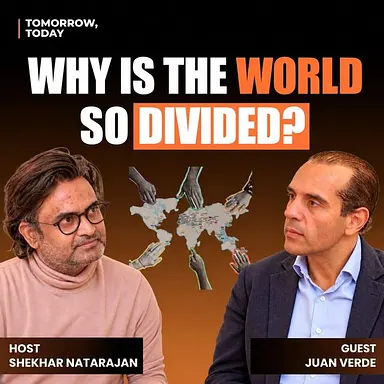
This transcript of “Juan Verde on Politics, Purpose, Leadership, Sustainability and the Future | Shekhar Natarajan” from Tomorrow, Today was made with HappyScribe’s speech-to-text technology. Related: Zoom transcription.
Ads in this audio differ from the text. Tap the sentence you're hearing to follow along.
Synced: the text now follows the audio.
I've come to know that when you give, you get. Yes. So why not give everything you have?
AI is going to be so focused on efficiency, more efficiency and more efficiency. Sometimes you don't know, like, where it is going to dehumanize or strip dignity.
Don't worry about the money. Find a job that you can be passionate about, because if you do that, the money will come.
You almost have to be a centrist to get anything done. You cannot be far right, far left, because nothing gets done.
Surround himself or herself by people that ask Tough questions or are not willing to just say yes to everything.
Welcome to yet another show of Tomorrow Today with Shekhar Natarajan. It's my privilege to have Juan Verde. He's a career diplomat. He's basically, uh, he worked for 3 presidents. Um, uh, he's an amazing soul, sustainability guru, and my idol. Like, I've been searching for you for a while to have this conversation because what you have done was just the right thing at the right time. And how you went about it was so inspiring. It's very difficult to get the world to change and see the future that they've never seen and get them to accept it. So my journey is a very similar one. And I thought everyone's journey is very similar in some way or the other. If they're an entrepreneur or starting a family or doing something that they don't know the future yet.
Right.
And how do we navigate that process? So I thought this conversation is going to be great, like, you know, bringing your perspective, your— the humble beginnings that you had, where— how you grew up into who you became, and how you assisted, like, on the 3 presidents, how you got close to them, the interface that you had, the decisions that you took, the policies that you were able to create. Like, you know, I want to unpack all of that. Okay, so let's get started. One, you basically are a Spaniard and were born in a small island. Right. So tell me, walk me back into those days, who you are as a person, like your mom, your dad, like your upbringing growing up on an island. People only aspire to just get out of the island or they stay up in the island all the time. But somehow you actually transcended all of that.
Yeah. So I'm originally from the Canary Islands, which is part of Spain. It's west of Africa. And I come from a very modest family. I'm one of 6 kids. And my upbringing was actually wonderful, perhaps not from an economic standpoint, but I had a wonderful, wonderful family where both my father and my mother were very entrepreneurial. no formal education, but hardworking people, and taught us values, taught us the importance of hard work, the importance of perseverance, the importance of getting up every time you are hit and you fall down because that's life and that's what you're likely to encounter no matter what you do, no matter what happens. And so, that's my story in terms of my roots and my beginning. And then I left to the United States when I was 15 by myself. How did you do that? Yeah, so that's a great story that I don't tell quite often. So my parents, my mother in particular, is a wonderful soul. And there was an immigrant family that moved to the Canary Islands in the Very early '80s, around 1982 or so. And this was a woman with 4 kids that left Cuba very poor.
I mean, left Cuba for political reasons. Anyways, they get to the Canary Islands with 4 kids and they were trying to integrate into the culture and were going through a very difficult time. My parents helped her in and the kids by helping her get a job, by sometimes feeding the kids and so on. They never thought that somehow we were going to get anything out of it, but the truth of the matter is that that family moved to the United States. And years later, that woman, as a way to thank my parents for everything they had done for her family, invited me to come and live with them.
Oh, wow.
Which allowed me to go to the United States, go to a public school, and get an education. Wow.
So you never know. You never know.
You never know. Just help people and things will work out.
I used to be that person hunched over my laptop during meetings, frantically taking notes to capture every single word without really paying attention to what the other person is saying. But the irony was there was so much time spent on screen and very little time Engaging and contributing. I'm sure a lot of you guys face that. I realized something had to change, and Granola changed that for me. Granola is an AI-powered notepad that makes your meeting notes useful. It captures what happens in your meetings and turns them into clean, structured notes with decision and action items pulled out and made easy to find. And here's the best part. Granola integrates seamlessly with how you work today. There's no setup, there's no configuration, and there's no friction whatsoever. Think about those typical post-meeting routines. Well, I go through them all the time, and it takes me hours to clean up those messy notes, trying to recollect and piece all of them together, create the action items, and rewriting and making sense of all of it post facto. And I used to spend quite a bit of time, sometimes many hours, trying to do that. I'm swamped with meetings every day, and I cannot simply afford it.
And hence, Granola changed my life. What used to take me 2 or 3 hours now gets done in minutes, if not in seconds. And to make it all accessible for you, Granola is your partner. You can try Granola totally free today. Head to granola.ai/today. That's granola.ai/today.
So, uh, I could, I could relate to that story, Juan. Like, you know, um, uh, my, like, I'm from slums in India, the 2nd biggest slum in India.
Oh, wow.
Uh, in Hyderabad. So my father used to deliver telegrams and, uh, my mom used to work for a newspaper company. just like, uh, wrapping all the newspapers that way the delivery boy could actually have a route on next day on a cycle. And, uh, so that's where I grew up. And despite making only like ₹175 a month, my father used to give away everything that he had.
Wow.
And, uh, we'd be like, you know, for us, giving to people was— my mother would say it's just another day. Right? And so when I look back at my life and see how I got to where I got to, it was a series of accidents that I can never explain, series of miracles that happened in my life that I can never explain. And sometimes that gift of giving that you don't expect from unknown people has been that gift in my life. Seems to be very similar.
That's a great story. And I completely agree with the spirit of what your parents were doing. I've come to know that when you give, you get. Yes. So why not give everything you have? Because you'll get a lot more in mysterious ways, accidentally perhaps, or call it something else. I'm not going to get into the spirit trap. Certainly, you may. it pays off. I am 100% convinced of it. And that's why to this day I try to find ways to give back because I do it knowing that that's also good for me.
Very beautiful. So where did you go, uh, in, uh, in, uh, UK, US? Like, did you go to Boston? I, I like, I heard you.
And so that Cuban family had moved to Boston. And so at the age of 15 in 1986, I moved to Boston and then I lived with them and I went to a local public school. But Boston is a wonderful, wonderful place. It's full of universities and an academic environment that is very— it's a great incentive because you're always surrounded by smart people and you want to know and learn. So it was a great experience for me.
I used to be that person hunched over my laptop during meetings, frantically taking notes to capture every single word without really paying attention to what the other person was speaking. But the irony was there was so much time spent on the screen and very little time engaging and contributing. I'm sure a lot of you guys face that. I realized something had to change, and Granola fixed that for me. Granola is an AI-powered notepad that makes your meeting notes useful. It captures what happens in your meetings and turns them into clean, structured notes with decisions and action items pulled out and made easy to find. And here's the best part. Granola integrates seamlessly with how You already work. There's no setup, there's no configuration, and there's no friction. Think about those typical post-meetings routine. Well, I go through one all the time and I try to recollect and I'm trying to clean up the messy notes, trying to piece all of it together, the action items, rewriting things, making sense out of it. And I used to spend quite a bit of time because I'm swamped with all these meetings. If you're spending those 2-3 hours, you'd be shocked.
It would be minutes, if not seconds, to make it accessible for you. You can totally try it free. Head to granola.ai/today. I repeat that, granola.ai/today.
So this Cuban family that actually brought you into America, do you stay in touch with them? And do you Tell me the relationship with them and how it was.
So as you can very well imagine, I consider them to be my family as well, right? And Eloisa, I see her as my mother and the 4 kids as well. Great American dream story. So this woman moves from the Canary Islands to Boston, worked very hard, got them all through college. The 4 kids, the oldest one is now a high-level top official within the Boston Police Department.
Wow.
The second one, Kathy, she works for the Justice Department as a clerk. The third one has his own construction company. And the fourth, I want to make a parenthesis there, Kenya, the youngest one, years later, I went on to work for City Hall. I went on to work for 3 US presidents. And at some point, she decided to apply for a scholarship to go to Washington, DC, and I helped her. And I introduced her to people and I trained her and I mentored her. Today, she's a federal judge in the United States.
Oh my God.
And I can tell you that her mother, Kathy's mother, never thought that by helping me, I was going to be able to help someone else, somebody else, in this case, her daughter. So, it's a wonderful, uh, you know, story about giving.
Giving. Absolutely.
Across generations even.
Yeah, absolutely. So, uh, you, uh, how did you get into politics? How did, like, you know, like when people in Boston and they're going to universities and schools, like, you know, they become like all intellectual and they want to like pursue, you know, if you, if you go to a good school, you end up like going to like, you know, Bain, McKinsey, and top 4 like consulting companies, or you get into finances, or you get into like, you know, stay back in Harvard and basically get like, you know, professorship. That's usually the career path. What took you into social service and helping people? There must be something that happened.
Yeah. Well, I'm already enjoying this conversation because you're asking all the questions that I never get to think about. So it's quite beautiful. So a number of things. Eloísa, this Cuban woman, had a brother. Her brother used to work at City Hall, used to work at the mayor's office. So I got an internship working at City Hall during college. Um, and, uh, I got to see firsthand what a difference you can make at the local level, how you can actually help people. They call you because they have it, you know, they need access to a food, uh, a food program, or they have problems where they need healthcare assistance or a pothole. It doesn't matter what it is, but, but what you did had a direct impact on their lives. Mm-hmm. So when I finished my university, I was very fortunate to have graduated with honors. I was part of the National Honor Society, summa cum laude. And yeah, I started looking for jobs and I got a job at one of the top management consulting firms. I got an offer also at one of the top financial institutions in Boston. And then I got an offer from the place where I was working.
as an intern to actually stay in. The story here is that I'll give you the exact amount because I'll never forget. Now, I had never made money. The top consulting company offered me, at the time, it was a very high salary, which was about $120,000 salary. The second one was $85,000, and the job at City Hall was $16,000. I could hardly make ends meet. And I remember calling my mother and saying, Mom, what do I do? Do I take the money?
Do I take the money? Do I take—
this is what I really want. And she goes, yeah, you know, and she says something to me that I'll never forget. She said, and this might sound today like something easy to understand, but she said to me, don't worry about the money. Find a job that you can be passionate about. Find a job where you're going to get up, you're going to wake up in the morning with a big smile across your face. Because if you do that, the money will come. And at the time, it was a very tough decision, but I'm so glad I did because I got to do things that I would never have been able to do anywhere else. And I was given opportunities, um, and, and the challenges were so great that I think it made me grow professionally.
Very beautiful. So, uh, what was that, you know, like when you, when you give to people, or when you have helped someone and even if they say thanks or they don't, but you've seen them progress, there's a sense of happiness that comes into you. You feel good about yourself that you were able to do something good and your actions meant something to someone. So were there moments like that growing up as an 18-year-old, 25-year-old, 23-year-old, whatever you were at that age? that made you keep thinking that like, hey, like, you know, I feel good about this, you know, like this feels to be my calling.
Yeah.
You know, forget the money, like the money will follow, but like, you know, let me like— so were there moments like that in your life?
Oh, all throughout my life. Oh, absolutely. I mean, as I mentioned, that was my first experience out of college, and it was very rewarding precisely because I felt like I was making a difference in people's lives.
Yes.
Um, at a very personal level. Yeah. Whether somebody called, as I mentioned, just, hey, there's Can you send someone to fix the pothole in front of my house? To, how do I get my kids into college? And we need help in terms of understanding financial aid sources, right? Whatever the case was. But that was just the beginning. I think throughout my life, I always tried to find something that would allow me to give back selfishly because it made me happier, because it made me find purpose. And that allowed me to do my job better. Um, because then you, you end up working long hours, you end up, uh, giving everything you got because it feels so good. And, and the money, the money did follow eventually.
So was there a specific thing that is etched in your memory from those days? Like if you go back and like replay a story in your head.
Yeah.
Is there a story like that in your head?
No, totally. After that, when I went to City Hall, I ended up working for a woman that I greatly admire to this day. Her name is Maura Hannigan. And Maura Hannigan was a city councilor for Ways and Means, which basically meant that she was the first female in the history of the United States— I'm sorry, history of Boston— that had the job of managing the treasure and the budget of the city. And I went to work for her. I'll tell you a quick story. I remember 2 stories from her. One was she asked me to draft a letter for her, and it was a letter basically where she was accepting a board position, right? Fair enough. I mean, I went in. Back then you didn't have computers, or not that many computers, but I went in, I wrote the letter, And, um, I left it, uh, in her desk, uh, on her desk. And, um, the next day I got a note, Post-it note, I'll never forget. Says, is this the best you got? Oh my God. I thought, oh my God, I'm an immigrant. You know, I work harder than most people because I, I'm always, I was always very insecure and my English was not as, as good as everybody else's.
So I went back and, you know, I, I corrected the letter and I looked at it 10 times and then The next day, I left it again on her desk. The next day, I had the same note, is this the best you got? And at that point, I lost it. I remember calling people, asking them to review my letter, to edit it. And I must have spent like 5, 6 hours that night working on the letter, and then I left it. She called me in and she said, is this the best you got? Looking at me in my eyes.
Hmm.
And I said, yes, Maura, this is the best I got, and perhaps this is not the right job for me. I'm clearly not cut out for this. She goes, no, no, no, no, no. Is this the best you got? And I said, yes, it is. And she said, okay, then I'll read it now. Oh my God. Um, I learned the lesson, which is, you know, do the best you can, you know. And if you do that, and then I obviously, I look back and I say, my God, from the first draft, It was so different. This one was who I am. This was excellence. This was well done. So that was a great lesson. And the other lesson I learned from her was that 2 years later, she called me into her office and she said, I think it's time for you to go. And I thought she was firing me and I remember I was crying. And she goes, no, no, no, sit down. I'm not firing you. I just think that you've reached
Your potential.
Your potential. And you are at a level now where I'm not doing you a favor by keeping you here. That would be selfish of me. You need to go somewhere else where you can continue to grow. And she helped me get a job in Washington, D.C.
Wow.
With the trade party. Actually, I went to work first for the Democratic Party and then right after that to the Commerce Department. I look back now and wow, Talk about giving, right? The story here, the moral of the story is that 20 years later, I was having breakfast with her and I realized that she was very successful. She does fundraising, she works on raising funds for nonprofit, and she's also an elected official in Massachusetts. And she shared with me that the success she had had everything to do with everybody she helped along the way. Because when she called people to find— They always work out.
Pick up the phone.
They would do anything for her. And honestly, she never asked me for anything, but to this day, I'm so grateful to her. So again, that's another example of how you get when you give, how you benefit when you help others. So those are the 2 stories that I remember from Mara.
Oh, wow. So I'll tell you my experience. Boy, there are so many similarities, but like with dissimilar characters, you know. Um, so I started writing a book. I had a mentor who, um, uh, you know, used to teach at Georgia Tech. And these were like— Great university. Yeah, these are all professional series courses that they used to run. And industrial engineering like started getting transformed into more supply chain. Like, prior to that, it was all process engineering, and then like the industrial engineering school started focusing on supply chains and logistics and all of that. So there were a lot of professionals who were coming in from other disciplines, and then basically they had to learn the whole profession of supply chain, what it meant. You know, it was getting more scientific versus just like Like, you know, it was sort of an artsy thing. Like, you know, you got to procure, you got to plan. That's how they knew the job to be. So this guy used to teach, and I said, like, you know, my first job I was struggling quite a bit, um, and, uh, I did not want others to struggle. So I said, I'll translate my learnings into a book.
Interesting.
And then I, I wrote a methodology, and, you know, he helped me draft it, and we went to go release this book, uh, at the 50th, um, uh, annual retreat of Richard Muter, Sir Richard Muter and Associates. And, uh, so Sir Richard Muter is one of the founding fathers of industrial engineering. I know he's, he's the only guy who's won Gilbert Award, which is the highest, right, end of, you know, this thing. And he looks at the book and he says like, this is no good. Just like that, straight. Straight, right on there. And he didn't, he didn't, he didn't just do that. He actually like stood up in front of like 1,000 people and said, these guys want me to endorse the book and I'm not going to endorse the book because this is not the purest book. This is not the purest version of the book. It was so embarrassing. Man, talk about a lesson. All my ego was just shattered into 2 seconds. And so, then we go back. Then, I was badly bruised. So, I go next day and sit with him and ask, hey, What do I do? He said, do you have time to come to my house?
And I said, yeah, like for sure. And he lives in Kansas City. And so every other weekend I used to go visit Sir Muther.
Oh, wow.
That's incredible. On a Friday, Saturday, Sunday, and spend all the time with him and understand everything that he knew. Like he actually did about like 2,700 projects. 17 books, uh, a pioneer in, in the field. And every time he would write something and I would write something, he would say, this is not good, let's start over again.
Wow.
It's the same thing, you know, it was like déjà vu when you were
telling me.
That's a wonderful story because also by you writing that book, that was a way for you to give back and to share your knowledge with others that could use that information.
Yeah.
And then the process you're Which is, which is I think even a better story because it shows how he took the time to mentor you. You, exactly. And to make you a better person.
And I spent like literally 7 years doing the back and forth. I used to live in New York. I used to go to Kansas City on a Friday. I used to leave a Monday morning back because I was in Pepsi and I was traveling all over. Uh, all of this on my own dime. So my bank balance used to read like zero. at the end of the month because I— this is all my personal money, like, you know, going and spending. But it was the best university I had in my life, you know. Like, it was like I could learn anything under the roof
with someone like him. Oh my God, it was like incredible. You can't pay for that.
Yeah, yeah, there's no way. Cannot. Never, never in your life. So, um, such a perfectionist. So going back to trade, you know, you get in, you get into commerce. Commerce is a very complicated subject. People peripherally understand it. There's production economy, there's consumption economy, and the world is split between the two. Used to be together, and then the world got divided. You're trying to find the cheapest source. What is the rationale of the commerce? How do you think about policy in commerce? Because people think it's very easy. I know I can just slap a tariff and the world will rebalance. It's not that,
right?
You know, there's a bigger, wider implication to the deeper supply chain roots that like, you know, go into organizations. So can you unpack like how you think like from a regulatory perspective, the trade and the commerce aspect of the government?
Yeah. So as I understand international trade and international commerce is perhaps not as intuitive as other people would see it because I think most people think of international trade or commerce as policy matters, right, that are being written out there in an abstract way. At the end of the day, policy is written by people. Yeah. And people are based or influenced by what they know and who they know and their own— Cocoon. Cocoon, exactly. But what I learned at Commerce early, early on was that Commerce is not that bad done right. And perhaps you can talk about what went wrong when we sent the, you know, for decades we had prosperity and we were finding the cheapest sources and we didn't care where it was or who it was that your supplier was. That didn't matter whether they were using child labor. They just wanted to do better in, you know, in the next quarter.
More efficient.
And like your next quarter had to be better, right?
And like release like a ton of carbon.
A ton of carbon. You didn't care about environmental consequences and so on. But if you unpack that, international trade is good as I see it. Why? Because if your commerce is within your village, yes, you create wealth and prosperity in your village. But when you actually take that across the world, done right, you create wealth for so many other people. You create wealth in your own village, you create wealth in your region because then there's this distribution company that's creating jobs. and is paying taxes. And so you're creating economic activity at every level. And then the person who's doing the transportation makes money, and then the little guy who does the logistics makes money, the importer makes money, the distribution on the other side makes money, and you help other people get products and services that are cheaper, better hopefully, and good. But we went too far. We went too far. So to me, Commerce, it was a way to also provide peace and prosperity. In fact, when you look at— let's talk about Europe. The longest period of peace and economic stability in the last 2,000 years in Europe took place between 1945 and 2022.
after World War II and then after the invasion of Ukraine. Why? I think it had everything to do with the fact that the United States and Europe were each other's largest trade partners. Yeah. The intra-commerce between the United States and Europe was the biggest in the world. We send our products and our goods to United States, United States sent back to us. We Europeans were the largest foreign direct investors in Europe. I'm sorry, in the United States. The United States was the largest foreign direct investor in Europe. And so, we created a codependence on each other that created prosperity. You don't want to fight with someone that you're doing business with if you're both making money and society's better and people are wealthier and there is more money to give back and to do social, make a difference. So, I give that example because I think today it's very easy to just blame commerce. They're the bad guys. Not necessarily. It just means that it has to be done right. So, I'm not sure that what's happening around the world today, which is scary, I mean, we're going through—
Very polarized.
Very polarized. But not only that, I think that you would agree with me when I say that we have gone from a world that was based on a multilateral understanding and approach to a more bilateral, I would even call it transactional and opportunistic diplomacy.
Yeah.
And that's scary because it fragments the world more. But maybe now where we're not just looking for the cheapest producer, we're now looking to diversify. We're going to need someone to do— our supply chain is going to have to be more regional and we will want to produce closer to home. We, if we can and when we can, we want to produce locally and nationally, and we're going to have to diversify our sources. That's not necessarily bad. So yeah, that's where I see it.
Yeah. So the, but it's, it's a, it's a complicated topic, uh, as you said, you know, because there are implications to just like pulling the plug and trying to see like what it is and also looking at a, a product economy versus a service economy. There are two sides of the coin, right? So people don't think about it holistically, like what is going on between systems. So is commerce limiting or should it be more encompassing of all these things? The way we talk about commerce, should it be more like peace, prosperity that you're talking about, economic development, service, product? And then also, how do you think about relationships, diversification, should it like be much broader? Like, do people try to like simplify it so much that basically it like loses its, uh, you know, true sense?
Right. No, precisely. I completely agree with that statement. I think that commerce understood as a way to share and bring prosperity. You do what you do best. I do what I do best, but I'm gonna do it right. I'm not, I'm gonna do it responsibly. I'm gonna do it making sure that I take care of the environment. I'm gonna make sure making I'm only doing it making sure that we both win in this transaction, then it becomes a force of peace and prosperity. There's a company in particular, for example, there's a company in Germany called Schneider. And Schneider for decades used to be one of the largest companies in the world selling electric equipment. So they would sell everything from cables to plugs to the network. electrical networks, right? At some point, they realized that if they understood sustainability as their driving force, that they would actually make more money. So on the old model, they would just import from China and they would just buy and sell products related to the electricity. As an engineer, you know how complex that is. And at some point they said, okay, no, what we're going to do now is reinvent ourselves and we're going to give people Energy management systems.
What does that mean? I'm gonna go to your company and I'm gonna—
Give you the integrated thing.
The integra— I'm gonna integrate everything. But the end result for you is gonna be that you're gonna spend less energy, which is gonna be cheaper for you to produce. So you're now producing more with less energy, which gives you a greater margin to be more profitable. Well, when you did that, you're betting on technology, you're betting on sustainability, you're betting on people. And now everybody wins. The clients are happier because you got— now you now have a solution that helps you be more competitive, and the company is making more money and is creating more jobs and is becoming more prosperous. So perhaps that, that example tells you how commerce can make a difference. It's not just importing.
Yeah.
If you import and do something with it that adds value to society, it's a win-win.
Yeah.
I used to be that person hunched over my laptop during meetings, frantically taking notes to capture every single word without really paying attention to what the other person was speaking. But the irony was there was so much time spent on the screen and very little time engaging and contributing. I'm sure a lot of you guys face that. I realized something had to change, and Granola Fix that for me. Granola is an AI-powered notepad that makes your meeting notes useful. It captures what happens in your meetings and turns them into clean, structured notes with decisions and action items pulled out and made easy to find. And here's the best part— Granola integrates seamlessly with how you already work. There's no setup, There's no configuration and there's no friction. Think about those typical post-meetings routine. Well, I go through one all the time and I try to recollect and I'm trying to clean up the messy notes, trying to piece all of it together, the action items, rewriting things, making sense out of it. And I used to spend quite a bit of time because I'm swamped with all these meetings. If you're spending those 2-3 hours You'd be shocked.
It would be minutes, if not seconds, to make it accessible for you. You can totally try it free. Head to granola.ai/today. I repeat that, granola.ai/today.
So when you got into that role, like, you know, you must have thought that you could change the world, right? And then there are limits to how much you can change the world. Because government can do as much, but there are actors who are also involved beyond the government who need to be also responsible the way actually they behave. And it's led by strategy, by the leaders. And also the friction within the government, the bureaucracy of the government sometimes. So how did you go about it? Sometimes it must be very cruel. Sometimes it's very happy and satisfying that you could make a small difference and you can see the big impact. Um, so walk me through that whole— Wow.
That's, uh, again, this is making me think about questions that I, that I've never had to think about. Um, I mentioned before that when I worked at the local level, I used to be so happy because I would make a call and I would solve someone's problem, right? Someone's pain. You know, I need my kid to have access to food. You know, how do I get help. It's great. You made the— I made the difference. I made that person— I make— I made a difference in that person's life. When you go into policy at the global level, man, you think you can change the world? Well, you can't. You're just like one drop, right? Um, when I worked for the— for President Obama, I was the Deputy Assistant Secretary of Commerce, so my office was in charge of the bilateral trade and economic relationship between the United States, Europe, and Eurasia. And my job was to be an ambassador, if you will. I was in the business of commercial diplomacy. My job was to travel around these countries, meet with people, and solve problems for American companies that were being denied access or they had issues with the local government.
So I learned 2 things. I learned that it was about relationships, So I would go in and meet with the minister and I would explain how this company not having the right permit in time was having a consequence because people were losing jobs back home, but also how that would impact his countries. That was a good thing. So it made a difference. But the bad thing was that there was bureaucracy, there was regulation. there were people that along the way could actually— there's a hierarchy, right? We were talking about this earlier. The minister gave an order, but it would take a year and a half to make it all the way down. And in the meantime, you're desperate, I need to provide results.
And then the antibodies start coming in.
Yeah. And then you have the political implications and then you have the lobbying implications and you have the people implications, what it means to make a difference. So it was humbling to know that it wasn't just you. I mean, that you had to find ways to see it through and then be patient because solutions didn't happen right away.
So I was thinking about this while you were talking. So you almost have to be a centrist to get anything done. You cannot be far right, far left. But nothing gets done. So why is the world moving far right and far left? And why is like, why are the people in the middle missing now?
Yeah. Well, I'll give you my, my own, um, theory. Um, we were talking about how during the '90s and the first decade, uh, of the 21st century, globalization was doing so great. Right. And as I mentioned to you before, everyone was making money. Everyone was making money. We were all doing better. There was stability. economically and so on. But through that, we paid a price. We in Europe and in the United States became very successful at sending our production and industry to China.
China, yeah.
And as a consequence of that, we lost great-paying jobs. It used to be the case just one generation ago that someone who worked at a manufacturing plant in England or Spain could actually send his or her kids to college. They could owned their own home, had a car, took a vacation once a year. Our kids can't do that anymore. Why? Because as we sent production and industry away to China, we made China. But there was a consequence to pay, and that was the middle class suffered tremendously and jobs were lost and prosperity was lost for those people that needed it the most. And that created the right conditions for popular, right and left extreme movements to just blame it on globalization, blame it on the immigrants, blame it on others. It's not your fault. So that has found its way into politics both here and in the United States where someone like Donald Trump can come in, blame everybody else, and then get elected or hear of extreme right movements in Europe, which— Europe. actually concern me greatly. So to me, that's kind of what happened, right? So why is the world more polarized than ever before?
Because you now have people like Donald Trump in the United States, and I won't go into many more details, Le Pen in France, Vox in Spain, the German extreme right and so on, that are creating this lack of stability because it's easier for them to get elected that way if you divide people. So that's scary.
It almost feels colonial.
I'm sorry?
It almost feels colonial and feudalistic.
Yeah. My God, that's a good one because I love history. When I look back at the last 126 years, I see that every time the world became more fragmented, it became more dangerous. It happened before World War I.
Yeah.
Colonialism, you know, it was a way of thinking, understanding the world that was very local and it was very about what's in it for me. So it became fragmented, particularly in Europe. That created the conditions for World War I. Then it happened between World War I and World War II, same thing. United States looked back, they stopped playing in the world arena. Countries, you know, stopped doing alliances or making alliances against others became very fragmented, World War II. The world became very fragmented after World War II until 1989, 1945, 1989, the Cold War. And you had 2 spheres of influence around Moscow and Washington, DC, and countries had to choose who they were going to go with. So again, became very fragmented. And then it happened again after September 11th. And that's kind of where we are now. We're at a point where the world is becoming more fragmented than ever before. We're no longer understanding the role that multilateral entities used to play of setting the guidelines and defining the rules that we all understood to be good for everybody. I don't mean to be pessimistic. No, no, no, no. I'm just setting the stage for what concerns me.
Yeah. I think nature has a way to find balance. is what I feel. So I think like just as the world moves to that place, I think maybe we learn through catastrophic challenges that we have to reset and come back to balance and symbiosis. So, but probably that's what the world needs now. Oh my God.
That's a good one because you're probably right. The world needs a reset, uh, but I worry about that resetting, um, creating conditions for mad people to take over.
Yeah.
Like it, you know, like it happened with Hitler, like it happened with— I'm not the most objective political source, but I think that happened with Donald Trump as well. Yeah. Um, and so on. Um, and it is, it's happening around the world where people are— these, these global and national leaders are, are are rising. And if you think about extreme right, for example, or the extreme left, they both share 3 elements in common. They are protectionist, they are nationalist, and anti-globalization, anti-international, anti-multilateral entities. Those 3 things are scary because what I think the world needs now is all of
those.
Yeah, you need every— the opposite. You need more integration. Exactly. We need to depend warn each other. We need to help each other more. We need to have common goals. What are the global threats, right? To me, AI, nuclear proliferation, um, bioweaponry. Bioweapons, um, uh, even, uh, you know, how all the global terrorism and so forth, what do they all have in common? Nobody can solve any of those problems on your own. You have to promote cooperation around the world. And how do you cooperate if you are fragmented and polarized?
So, so, uh, uh, boy, this is like an interesting one. So if you walk me back, um, to, uh, your time with Gore, um, and also with Obama, right? Like, let's start with Gore first because that's close to my heart, like sustainability. Um, and, uh, your conversations with him and how you interacted, how you got there.
Yeah.
It just walked me through the eye.
Great. Uh, so,
and he would've made a great president, by the
way. Oh, he would've been a great president. Then the world would be very different today. No, no doubt about it in my mind. So after, um, I left commerce, uh, I went to, to Harvard to, uh, to study. I did a master's in public administration. And when I left Harvard, I went into the private sector and I went to work for a management consulting firm. But that coincided also with the Republicans coming into power. So I said, politics is not my call right now because I need to believe in the people that I'm working for. And to me, in order to be a good advisor, you have to be objective and you have to tell people, you have to raise difficult questions. And you have to pose those questions and be uncomfortable to people. You can't do that with someone that you don't share values with. So I went into the private sector and Gore had lost the election in 2000 and he decided to do what he does, what he want, what he was close to his heart. He had been studying climate change for decades. He's got a very scientific mind. And he decided that he was going to tell the world how dangerous climate change was because if you remember before that, this was an issue that was well understood and known within the scientific community.
But what he did, I think— Brought it to the society. He brought it out and into everyone's political and economic agenda. So he reached out and I decided to help. Again, trying to find something that I could be passionate about, not just the business side of things, which is great. And I was making a lot of money, but I wanted to also give back. And so, I helped him set up different chapters of his nonprofit organization, Climate Reality Project, which is— the Climate Reality Project is his nonprofit and basically provides education on the climate threat and the climate issue around the world. And so, I became close to him. And then years later in 2008, Obama decided to run and then I got excited about it. I couldn't hold back.
He represents a lot of you, your values and ethos and other things.
Exactly. That's the point. And so when you do that, when you find someone that you can relate to, because they lead by example and because they are consistent with their values and they take risk and they don't know whether they're going to get there or not, but they want to bring you along with them because you share the same values, then you give everything you got once again. And his message resonated well with me, which was to some extent same as Gore's.
Yeah.
What kind of world do you want to leave behind? What should our legacy be? Should it just be money and making money? There's nothing wrong with making money. Make money, create jobs, do everything you can to create economic activity and help people, but at the same time, do it right. And that's what I believed in. So I decided to join his campaign early on. That's another story I'll tell you because I was actually one of the first 20 employees of the Hillary Clinton campaign. Ah, and not his campaign. Not his campaign.
Oh, they must have been pissed.
Well, see, I went with Hillary Clinton. As you remember, there was a primary.
I'm listening again.
Yeah.
Yeah.
Later I worked for Hillary again, but in— I'm sorry, in '07, I went with Hillary Clinton because I'm a very loyal person. I had worked for Bill Clinton, for Gore. I was close to the family. And so I joined her campaign. But I'll tell you this quick story. I was dating this girl at the time who eventually I married, and she came to me and said, I want to work for the campaign. And I go, oh, great. You should be a volunteer. She goes, no, no, no. I don't want to work for your campaign. I don't want to work for Hillary's campaign. I want to work for Obama. Okay. This was early on. Sit down and let me explain to you why Obama has no chance.
Chance of winning.
I thought I knew it, right? He has no name recognition. He has no money. He has no one from the party supporting. And she said, I don't care. I believe in him. You should listen to him. You should listen to this guy speak. And I was like, oh, you're so naive. Sure enough, he won the primaries. And then I, I joined his, his campaign. Um, and it was great. It was wonderful. It was, it was, it was full of hope and, and all the good things that really make a difference and matter.
Was there a moment like when you thought like he's not gonna win? Like in the sense, like when the primaries were going on and like, you know, they were neck and neck for the most part.
Oh yeah, yeah, yeah. Um, they were neck, neck to neck, uh, until, until they weren't. Yeah. And I was really— I'll tell you, I don't think I've ever said this before, but I was working for Hillary campaign, for the Hillary campaign, but I truly liked and loved Obama and his message. And I think Hillary Clinton would've made a wonderful president, especially when she ran against Trump, because she was so qualified. had done everything. She was a senator and she was Secretary of State and she was an activist and she was a lawyer and she was a First Lady. She had done so many wonderful things and was very well-prepared. And very strong and courageous. And strong. And I always say she was very different to Bill Clinton. She loved books and she loved science and she loved engineering. And after a hard work day of campaigning, Bill Clinton would want to go downstairs and know, in the restaurant and talk to people. She wanted to, you know, go to her room and read a book. Um, she was the right type of person to, to run the— but, but then '07, she wasn't the right candidate.
Obama was, because people were fed up with, with, uh, traditional politicians and traditional parties. They wanted something fresh and new.
Yeah. Like, you know, I literally had tears in my eyes when I, like, when that happened. 'Cause like for every immigrant, like, you know, it's like an inspiration, right? Like, so, um, and I saw him speak like in the 2003 convention, Democratic convention. That's the first time he got on the stage and like, you know, he talked.
Boston.
Boston, yeah. Look,
Kerry's famous speech. We are not Republicans or Democrats, we are Americans.
Great speech. Yeah. Great orator, actually. So now, um, as you, as you think about, uh, the, the evolution from politics into, uh, you know, sustainability, and that becomes your calling, uh, how did you go about navigating that? That's the most interesting thing because it's so far like ahead of like its time. It's misunderstood. People say yes, they're going to do it, but it's performative sometimes. It's not really like what they're saying is what they're doing. So you gotta like go through a lot of different kind of gyrations of trying to figure out how to get this incorporated into the social good, into the company good, into the people good. Tell me, how do you do that? It's such a big change.
Yeah, so to explain that, I need to go back to my own personal story. So I started working with Gore, And then I went on to work. I put my company on hold and I went back to government, then I went to work for Obama during his first term. But then after the first 4 years, I said, okay, I've done my job and I've given back. I need to go back to making money. And I got married and I was having kids and I wanted to go back to the economic side of things. And I thought that I had paid my dues the first term. So when he got reelected, I said, okay, what am I gonna do now? Right? I'll go back to my company, which was a company helping— to this day, we help companies with their investment portfolios and how to navigate through international commerce and how to find markets and so on. But it was more of a traditional consulting company. So then I decided to create a second company, which was more around the issue of sustainability. How do companies integrate sustainability into their strategic core values, into their strategic core business.
In other words, when I explain it is—
Why did you think that business is the place to go and not to people?
Um, I learned it from Al Gore. He was a great mentor. And early on I understood that if you want change, dramatic structural change in society and in the global economy, your message to companies has to be different. It cannot be, do this because it's the right thing to do. Because it's the ethical and moral thing to do. I'm sorry, CEOs are not in the business of doing— only doing the right thing. You have NGOs and you have governments and you have agencies. A CEO will tell you, my first and foremost loyalty has to be to my shareholders and my employees and the market. So my message to them was, okay, but what if there's a way to do both? to do good and do well, to make money and help others, make money and have a direct positive impact. And then you teach them how, right? So I would go to a client and I say, I would say, you know, this is not about energy efficiency. It's not about doing the right thing with the climate. Energy efficiency, it's about you saving money because you're paying less for your energy. By the way, you are in a very energy-consuming industry.
And if you are able to save 20% on your electricity cost, it's gonna allow you to increase your return on investment and your profitability.
Ooh. I love it.
Now all of a sudden they'll say, okay, actually talk to me about this, right? Or when you tell them, well, you know, consumer behavior's changing and people want products that are responsible with the environment. Then you show them the data, right? And the latest data that I, that I, that I came across is basically today, everything else being equal, right? If you show someone, you know,
$5 and $5
and— $5 and $5, same quality, same price, 94% of consumers will always choose the responsible choice. That's amazing because what you're telling them is, yes, it's hard, Because you have to produce and offer at the same price. But if you do, the market is yours because 94% of the consumers are going to go and choose you over the competition. Now, I'm talking to you about business and I'm talking to you about how you remain competitive. Have I got your attention? Mm-hmm. When you do that, things change because then companies, all of a sudden, they're saying they're able to, um, uh, they're able to, to, to coexist? They don't have to choose between saving the planet and doing the responsible thing on the one hand, and on the other, creating jobs, making money, and creating value for your shareholders. What if you're able to do both? Because if your vision is short-term, yeah, you can make a buck here and there, but the world is changing. In a more fragmented world, supply chains are changing, consumer behavior is changing. So what do you want? You wanna make money today? Do you want to make money long-term.
Obama has a great, great quote. He says, sustainability for companies should be quite simple. Do you want to make money and a lot of money during the short-term, or do you want to make a lot of money during the long-term? Then it becomes a clear choice.
Hmm. So, uh, but it's— why is it misunderstood?
It's misunderstood because Sustainability is a very broad term. Okay? You, you go talk to a, a small, uh, the CEO of a small company, a mom-and-pop kind of company, and it's like, ah, what are you talking about? I gotta make ends meet. You know, I don't, I don't care about this sustainability issue that you're talking about. So you gotta translate that.
Into outcomes for them.
Into outcomes for them. Uh, and the same thing happens with people, right? When some I don't know how PG this podcast is, but when some asshole comes and tells you it's not your fault, it's the immigrant's fault, it's not your job, it's those Chinese people that are taking your jobs, then it's easy. If they tell you it's not your fault, it's sustainability, these people have created, have invented the concept of sustainability and climate change is fake. Oh, Really? No, it's not fake. And it is having a direct impact on your ability to be competitive. In the United States, companies are now being told that climate change is fake and we're stopped producing and manufacturing electric cars. And who's winning? China. China's producing now better cars, cheaper cars, better technology, more efficient. And who's buying those cars? The world.
The world is buying them.
And the United States has been left out. Why? Because again, sustainability became this horrible word that had negative—
Connotations.
Connotations and implications. So perhaps I'm simplifying an issue that is very complex, but that's part of the problem. The sustainability is very complex. So if someone comes and tells you and gives you an easy answer to a complex problem, that's easier to accept.
Hmm. See, what I found, uh, one is, um, uh, companies make money despite themselves. Every company I work for, I work for like, you know, 6 large companies, Coke, Pepsi, Walt Disney Company, Walmart, and then, uh, American Eagle Outfitters, right? So, and in between, like, you know, I was in Target too. So all of these companies, my role was very consistent. The business reality was out of sync with operational reality.
Hmm.
Most of these guys were running operations for businesses which are actually probably created in 1960s and 1970s, those operating methods, the same operating methods. They don't change because people hardly want to change. As soon as you want to change, you know that antibodies kick in.
Yeah,
and these are large corporations. And these are large corporations. And basically, like, what happens with all of these companies is, you know, they, they have unresolved deliberations in company. When you get like 5 people sitting in a com— in a, in a, in a meeting, like, you leave a lot of unresolved deliberations.
Yeah.
And there's like a lot of punting which happens. And so companies become lethargic, they create inefficient processes, and my job was to go in and say Oh, I see that there's an efficiency gap that you have. And usually it's a transformative efficiency gap. And when you start doing that, you find that there are more sources of cash that comes in and you're also trying to do it in a very efficient way because now you begin to apply technology, you apply basically intelligence in ways that you've never conceived because those operating realities are very different.
Right.
And so everything I touched in my life was exactly proving that theory. And so, it, like, you know, it's interesting that people don't get it because, like, I think the business leaders who are sitting on the top, they're, like, so devoid from the operating realities of the business.
That has been my reality as well. And I share that vision of yours throughout my career during the last 30 years, having worked for both government and private sector companies and even becoming an advisor to a lot of these large corporations, I share the same realization that you do. What I found is that there's a disconnect between the CEO and the middle management because people are taught to manage upwards and not downwards. I gotta make sure that my boss is happy. I gotta make sure that, you know, I'm not seen as a threat. I gotta make sure. But when you do that, You forget that your job is to manage downward, is to get people to be brave, to make tough decisions, that you have to create the right conditions for them to feel comfortable asking the right questions, right? And raising concerns. The right thresholds. But if you— what happens in these large corporations that are very rigid in their structures is that they then become, um, uh, they, they are They conform. It's easier not to raise those questions. Um, and they still make money because they're so large and because they have this particular positioning within the market, but they're not, they're not lean, they're not dynamic, and they're not entrepreneurial.
Yeah.
That's why companies, you know, I always said smaller companies are more agile, more dynamic, and more entrepreneurial, and they're able to transform according to the market need rapidly. That becomes, I think, when you don't have that, when you're rigid in your structures, like you said, that's the beginning of the end.
Yeah, absolutely is. And I fully agree with you. The thinking of, I see the same thing, the parallels of the sustainability now playing out in the AI world too. There's so much hype about AI, and I fear that basically AI is going to be so focused and really sort of accelerating that behavior of focus on efficiency, more efficiency and more efficiency. Sometimes you don't know where it is going to dehumanize or strip dignity on the other side. And agency too. in many places. So I think I see the same kind of drama playing out, like what happened in the 1980s where we got very greedy pushing all our production out. I think we're going to have the similar kind of problem with AI just being focused on efficiency.
Yeah.
And I think that's bringing the circle back again to the conversation I was having with you is How do you drive the character and the value of the company in alignment with where the intelligence should move?
Great question, because again, when people hire me, they hire me thinking that I'm going to come into the company and that they're going to have access through me or that I'm going to give them great sound business strategy advice. What they get is very different. What they get is someone who's willing to ask difficult questions. And what I always tell them is, you got to bring values to your thinking and decision-making process. And if you don't, you're doomed because of everything we talked about, right? If you're surrounded by people that are yes to everything, what do you want to be? So helping them understand that they can make money with values, it's challenging, but it's the key. So let me give you an example. I'm very optimistic about the future when it comes to sustainability because it's being led by the private sector, not by multilaterals and not even by governments. They're playing a very important role, but this is being led by the private sector. I don't know about you, I don't know any CEOs of any companies in any sector or industry that invest to lose money. They invest to make money. Is it a coincidence that The most innovative, the most profitable, and the largest companies in the world are also the most, more sustainable companies.
The 5 companies that you've worked for are leading the way, every single one of them.
Exactly.
Uh, when it comes to sustainability, they're doing it because it makes business sense. Did you know, and then so we'll talk about AI, what is the largest accelerator of sustainability in the United States right now? AI and data centers. Now, that's not intuitive, right? But what's happening in the United States right now is that private companies are building data centers because they need them to drive AI. And they're saying, ooh, do I rely on fossil fuels? Look at what's happening in the Strait of Hormuz. Look at what's happening, what happened in, in, uh, Germany. When Russia invaded Ukraine, 45% of Germany's electricity came from Russia's natural gas. Natural gas. So in 4 years, they have gone from 45% to 8%. So they had to change. So when they're saying, oh, if I want to have a reliable data center, I have to find clean, autonomous energy that's going to make me more competitive and less dependent on others. And so that's driving sustainability in the United States. That's an example. You go to a company and say, hey, man, You want to do this right? Because let me tell you what's in it for you.
You're going to make more money. You're going to be able to— people will pay you a premium because your system is never going to go down. No matter what happens in the Middle East, no matter what happens anywhere in the world, you're safe. Now they listen to you. So, values, my friend. It comes back to values. Yeah. What are your values? Because your values will drive profits. Are you thinking short-term? Are you thinking long-term? So, what I will tell you as a CEO is Yeah, maybe you're not going to make a 20% margin on everything you're doing. You're going to have to go down to 14%. But you know what? You're guaranteeing your survival long-term. So your choice.
But how do you create the incentive structure where people are not focused on the short-term?
It's not easy. Oh my God, it's not easy. Values. Values.
Is there any role of the government to actually Create long-term value.
There's nothing more powerful, nothing more transformative than government, whether you like it or not, whether your ideology is X or Y. Governments set the rules and do one thing and one thing only, they define incentives. I said, do you want to give your incentives and your tax breaks and your subsidies to fossil fuels or do you want to give it to clean tech? Oh, by the way, clean tech makes a difference. The types of jobs that are created by clean tech don't to China and don't go to other countries. Oh, by the way, the type of employment that you're creating here requires constant training, technology. It is value-added. Oh, by the way, because of that, you're going to, you're going to raise more taxes, which is going to allow you to give back and invest in so many different things that you're not able to do. This is short-term. This is, this is, you're suffering from self-induced myopia. here, and you are expanding your vision if you do this. So, government makes a difference. Government is instrumental and disruptive because you set incentives one way or another.
Fantastic. So, um, when you, when you think about, uh, AI in general, right, like, you know, there's a lot of fear that is going around about job loss, about, like, you know, people, uh, people are really literally scared, like, you know, if it starts hitting closer to home, what happens, you know, like, how is skills going to be redefined, what is the role of a new graduate coming out. So how do you prepare the society for all these discussions? I think we're so caught up in the wars, we're so caught up in, like, all of the political drama that we're not having the right conversations. I worry like, you know, where we are gonna be. Are we gonna create another Trumpian movement because we're gonna have like so many disgruntled people?
Yeah. I don't know. I wish I had an answer to that question, but I, again, posing the right questions, at least get, get us all to just begin to think about what we need to do and what are the conversations we need to be having. So one, I'm the eternal optimist and I think, well, that The best is yet to come. That's why I was so in tune with him. I'm the eternal optimist. Things will work out. I love that quote that says, at the end, it's all going to be okay. And if it's not okay, then it's not the end. I love that because it tells people who I am. We'll be all right. But we need to have those conversations because there's so much at stake and it's so risky. We don't know how this is going to play out. We need to have a global understanding of what AI is and can do and what the impact will be on our society, on our value system, and our economy. If we don't have that conversation now globally, We have everything to lose if we don't. It's that important.
Yeah. So let's get to the rapid fire. I know you gotta run to catch a flight. The most overused word in sustainability?
Sustainability. Again, because it's broad.
Broad.
We need to specify economic sustainability, social sustainability, think long-term.
The company genuinely getting the green economy right.
Company?
Which company?
The one I mentioned before, Schneider. Schneider. I love what they've done. They've reinvented themselves and they're adding more value than ever before while doing the same thing. So they are an example of do good and do well.
Words like DEI and ESG are like almost like, you know, pariah right now. So is it salvageable or is it finished?
It is salvageable, but it has to be redefined. And, and, and has— we have to come up with a new name. So ESG, the concept and the spirit of it, yeah, is here to stay. Yeah, it won't be called ESG anymore. It has to be reinvented.
Reinvented. So what are you going to call it?
I don't know, you know.
And you don't want to tell it because, like, you know, people will start tabooing you again.
I don't know, but it, it is yet to be defined.
Yet to be defined. Yes. Carbon tax or green subsidy, which one works?
It's a tough one because the economist in me wants to say subsidies because they're more effective and you can create change right away, but I'm always against excessive public spending. So, I would say that carbon tax because it provides incentives. You penalize the one that's doing it wrong and you help the one that's doing it right.
John Sterman actually like runs like the simulation in MIT on all of these things. And you're exactly right. Carbon tax actually gets you.
Yeah. Long-term. Long-term.
Long-term.
The short-term is subsidy.
Yeah. Best leader you ever worked for?
Whoa. Surprisingly, I think Bill Clinton and not Obama, although I had a great relationship and a friendship with him and I learned so much and he was a great mentor. What I learned from Clinton was the importance of people, relationships, how you have to ask someone for their vote and that's transactional. And then you go back to governing for everybody and not just for that one person, but don't forget the importance of relationships, of people. So people, people, people, to me, it's about people. So that I learned from Clinton. The
most underrated skill in politics?
Listening. That was an easy one for me. Listening. And listening to everyone, not just the ones that say yes to you.
So if you had to pick one word, like, are you an optimist or a realist?
Oh my God, an optimist. Because reality comes with optimism. I make reality come. I believe if I'm optimistic, if I think that the best is yet to come, I'll find a way. So I'm an optimist by nature.
The country you're most bullish on for the next decade?
Good question. Norway. And I'll tell you very quickly why. Norway has done something that is pragmatic. They are the most, I think, the most sustainable country in the world. They have gone from 2% electric cars to 90% electric cars of new sales in nothing less than a decade. Have made very, very drastic changes in their economy and they're now sustainable by nature. It's in their DNA. But they did it using oil money. So, they export oil and gas, but they don't use it. They send it to the rest of the world and then they use that money to make society not just more sustainable, fair, just, and long-term thinking. So, that ability to be pragmatic, doing the right thing and doing good and doing well and then do it pragmatically, I think it's amazing because it shows the way forward.
Spain or United States for you?
I refuse to choose.
I'll tell
you why. Because the United States— so Spain made me and the United States made who I am.
I
don't know if that makes any sense. My values, my way of understanding the world was developed in the US. But my—
You're an American dream, sorry, like for a lot of people. So that's why I love you. So the thing America does the best,
um, ability to reinvent itself, uh, entrepreneurship, which basically means one thing, resilience. Because to me, resilience is they teach you to fall and you get up and you fall and you get up and you move forward. Europe doesn't necessarily have that. In Europe, we, we think that failure follows you for the rest of your life. You're penalized. The United States is okay if you fall. I love your personal history. You reinvent yourself over and over again. You work for great companies. You don't conform. You go to the next one if the challenge is right. You're willing to reinvent yourself. And every time you've fallen, you've gotten up. That is what the US teaches you. And that is what I don't necessarily see in Europe because Europe has great things too.
Yeah, so what is the best thing about Europe?
Um, quality of life. Understanding that prosperity cannot be for just the few. That's the problem in the United States, you know, that 1%. Um, prosperity has to be spread across society. And so here, even their mentality, the way they understand quality of life, is a determining factor of what you do You don't work, uh, you don't live to work, you work to live.
Grand Canaria in one word?
Um, root. My roots.
Achievement you're, uh, most proud of?
Oh my God, that's an easy one. My kids.
My kids.
Being a father.
The most important thing a leader can do right now?
Surround himself or herself by people that ask tough questions and are not willing to just say yes to everything. You want to hear what's happening from reliable sources. Very
good. That's it. All right. So you've been great. Just on time.
Wonderful.
It was like, thank you for an honor. I enjoyed it. Absolutely. I loved it. Like, it was like, you were so great.
In this episode, Shekhar Natarajan sits down with Juan Verde to explore his journey, leadership lessons, politics, purpose, sustainability, and the future of global society.• Juan Verde’s journey from leaving the Canary Islands for the United States at 15• How an internship at City Hall introduced him to public service and helping people• Choosing a $16,000 public service job over $120,000 and $85,000 corporate offers• The advice from his mother that shaped his approach to work and success• The mentors and experiences that influenced Juan’s leadership journey• His work with Bill Clinton, Al Gore, Barack Obama and Hillary Clinton• Why Juan chose purpose and meaningful work alongside professional success• The connection between globalization, economic opportunity and the decline of the middle class• Why the world is becoming increasingly politically polarized• The rise of far right and far left movements and the decline of the political center• Why global cooperation and stronger international relationships are essential• Sustainability, clean technology and the business case for doing good and doing well• The role of government, business and incentives in creating meaningful change• Artificial intelligence, the future of work and society’s need to prepare for what comes next• Leadership, listening, asking difficult questions and surrounding yourself with the right people
Subscribe to Tomorrow Today Show by SKN for more transformative global conversations. Hosted by Simplecast, an AdsWizz company. See pcm.adswizz.com for information about our collection and use of personal data for advertising.