
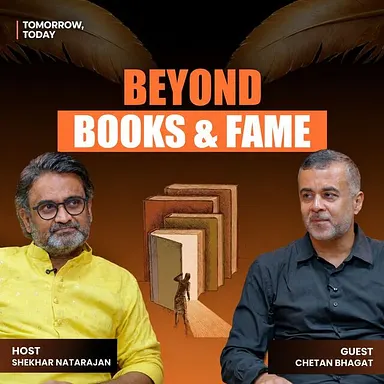
Every line of this episode of Tomorrow, Today was transcribed with HappyScribe technology. See also: Teams AI note taker.
Ads in this audio differ from the text. Tap the sentence you're hearing to follow along.
Synced: the text now follows the audio.
If you have a rat whose tail's on fire, he's gonna run the fastest. But at the end of the day, I was still a rat with a tail on fire.
My origin story should not be the destination story. That was in my head.
I was very lucky to be in somewhat boring times because creativity only comes from boredom.
Colonization is algorithmic expansion.
expansion.
So whatever I think is right and however I think is right is what, like, I'll enforce on you. You want a happy life?
Make some money, make some muscles, and make time for people to relax.
Welcome to yet another show of Tomorrow Today with Shekhar Natrajan. It's my incredible honor to have my next guest. This is our 43rd episode that we are shooting. Chetan Bhagat. He is like a phenomenal writer. someone who's changed the landscape in India when it comes to literacy and how people consume, like, um, books and fiction and storytelling. So, Chetan, I, like, you know, I'm— I've been super excited and I wanted to talk to you for almost like 6 months now. I've been trying to chase down these guys, like, you know, like, how do I talk to Chetan? Because I think you are gonna— this conversation, I feel, is gonna be the most intellectual and most inspiring because you're one, like, you're a creative guy 2, I think like you see the world in a very different way and you see it from different lenses. Um, and you also are the father of 2 kids who basically like, you know, they are living in a different world than the world you inherited. And, uh, so it's gonna be a fun conversation and I want to unpack a lot of things with you. So I got—
Thank you, Shekhar, for having me. And I mean, I've been seeing some of the work you guys are— hearing about the work you guys have been doing, and it's really an inspiration. to see Indians doing so well. They are like at the cutting edge of AI and to angelic AI and like looking at AI with good intentions and stuff like that. It's really good. So yeah, I flew down from Dubai for this and I am very excited to be here.
Yeah, thank you so much. Like, you know, and thanks for making the time because, um, uh, and I got a lot of like interesting thoughts that I want to unpack with you. So, uh, let's think like you. I'm thinking like you for a second. So instead of like starting early days the day you were born and other things. Let's basically, like, you know, fast forward like 12 years when you were a 12-year-old kid and, uh, you are dining with your parents, you know, father being a colonel, my mother like a researcher. Um, like, and were you writing a story at the time? Were you writing a joke at the time at the dinner table? Or like, tell me more about like Chetan Bhagat, 12-year-old.
Okay, so grade 12— I'm sorry, 12-year-old, I must have been in grade I don't know, 7 or 8. I think I was average to above average in class. So there were no signs that I'll do anything major in life. It was all— I mean, mainly thinking about my first crush at that time. And it's that age when you first start noticing girls. Before that, it's like, you know, boys are boys and boys are cool and girls are icky. And then 12 is like, you're like, no, no, no, this is where the interesting thing is. So I think it was that. I don't think the career thing had kicked in yet. One thing though, like storytelling itself wasn't there, but there was this first interest in writing. We were forced to write articles for our school magazine, like for junior kids. And I remember I was also forced, but when I wrote it and saw my name in print, it was a very big deal then because you never saw your name printed anywhere. Today, of course, everywhere, but that printed font You only saw your name handwritten. So to see it in a magazine was amazing.
So that gave the writing bug to me. So I think there were early signs of that. Also, Shekhar, at that time there was no internet. Even TV and all wasn't much in India at that time. Entertainment was very limited. Books and stuff like that. So we would read. And also, I remember occasionally we would see movies. Pre-internet era, pre-proper cable television era. Like, so we would occasionally see movies, me and my younger brother, in a theater. Maybe VHS had just come. And then I remember there would be these boring afternoons where we would just make up film stories and tell each other. Amitabh Bachchan used to be big, so you'd say like, he'll come and he'll hit this guy. I did not know this then, but those were the seeds for me being able to create stories. That's why I always tell people I was very lucky to be in somewhat boring times, because creativity only comes from boredom.
Hmm.
It's like the mud, and a beautiful lotus comes from there. You have to create that boredom, which these days is not there. If I was 12 now and I had an iPad, I don't think I would have done. So while there was no grand plans being made of becoming a writer or anything, I think some of the foundational stuff, whereas an imagination that leads to stories, because in the boring Delhi afternoons, really hot, you can't even go out and play, you would just make up stories. What if Amitabh Bachchan did this in that movie?
Yeah.
Now, these were all imaginary things, but we were creating stories and started writing articles in my school magazine. That was seeing my name in print. So I think some of the desire to write one day was created around this 12-year time.
And so, like, your childhood home, where was it?
We were in Delhi, in West Delhi. It was a tough childhood, maybe not as tough as yours. We were not 8 to a room, but it was rough because there was always a shortage of money somehow. And I thought that's just how people lived. Like, money is— I think that's how most of India lives even today. where money is less. Yes. And life is to be like— life's main purpose is to economize. And that's why Indians are such value-seeking consumers. I still am. I mean, where I don't need to be as much. So I think money was less. My father was very strict.
Colonel?
Yeah, and very expected all of us to be soldiers too. So it's funny now, but it was very stressful. And I remember like not really like feeling very good about myself. I used to be overweight. I used to get yelled at a lot by my father. My father and mother would fight quite a bit. Not the most pleasant of surroundings. But, you know, you can use that sometimes in life to say— it can go either way. You can say, I can't do anything now. I'll just, you know, start drinking or become a You can go take the wrong path because what can I do? I'm the victim of this abusive kind of household or whatever. Or you can say, I need to do something to get the hell out of here. And that's when I said, you know what, if I get through an IIT, like that is the toughest college, maybe I'll have a totally different life, which it was a totally different life after that.
Yeah. So the first book that you remember that broke you open? Like, because everyone has that in their life at some point in time. Mine was the Atlas of the Moon. So, like, you know, I used to— I grew up in slums in India, second biggest in India, second biggest slum after Kharagpur.
Which one?
It's Adagutta.
Okay.
In Secunderabad. And so basically that's where we started our journey. And there used to be like a Secunderabad library, and I used to run and go find books. And the book that fascinated me the most was the Atlas of the Moon क्योंकि वो it was all about like something that I never understood. So that book was actually like the foundational for me for creativity perspective, right? You know, I became a very creative guy in the way I solve problems because of that, thanks to that book. तो आपके इसमें क्या था?
You know, of course while growing up we would read these murder mysteries. There was Hardy Boys and Famous Five and all these things. These were interesting books, but they were not particularly in that way. It never inspired me that I want to write these. I remember when I was a little bit older, I read a book called Catch-22, and it was very quirky and very funny. Joseph Heller. It's a classic, and it is about the irony. And I was like, books can be really fun. That idea of books can be fun came through that book. And then I said, okay, this is what I would love to do someday, to write a book that people are just reading and laughing. And books as entertainment, which I know there's a mixed opinion on it. A lot of people feel books should not be entertaining. Books is Vidya and books are Gyan. But I don't think it would— I think if it's entertaining, it's more likely to be read. And I think it's a good thing when people read. But that book, I think, was something which I read and I said, okay, I could do this.
You know, I could— and then there would be R.K. Narayan stories, Malgudi Days. He would write in a very simple English, and I was like, there is a place for that. Because a lot of authors were like known in India at that time who would write complicated language and very complex take on language. And I was like, okay, that's what you need to be to become a writer. But then you pick up a Malgudi Days and you're like, oh, it's just simple storytelling, and I could take a shot at this. So I think these were some of the books.
Which— so like you, you mentioned about basically writing for your school.
Yeah.
So like, was there a certain reason that you were forced to write for the school?
Well, there was this magazine that my school launched, Army Public School.
Yeah, yeah.
And, uh, there were some pages given to the primary school students. We were in class 5, I remember, and it was actually Hindi. So we had a Hindi teacher, Mrs. Dutta, She came and I think we were just under a lot of— she was under a lot of pressure because there were no articles given by my class. So one day she came and she said, we will not study today. Everybody sit down and write something. And me and my friends thought that's an excuse to just go out to the bathroom.
Yeah.
And they're not studying anyway, so we'll just like chit-chat and roam around and come back. And we went and said, like, she knew our gang. So all 4 of us wanting to go to the bathroom together. So she just pulled our ears and said, you are not going anywhere till you give me that article.
Yeah.
So I sat down and wrote. I think I don't even remember what it was. It's like a little joke or something I made up, some like the shortest possible. And I gave it and then I went out because once you finish the article, you could go out. And then 2 months later, it took a long time at that time. The magazine came 2 months later. I forgot about it. And it was because it was just an anecdote kind of thing. It was like a senior student's article. And in the end, they put like a footnote kind of article was from me. And it said, Chetan Bhagat or whatever, 5th A. And I remember seeing that, like those letters, and I'm like, wow, I'm somebody. Like, it's the first recognition. I would carry that magazine everywhere. Yeah, we have these DTC buses in Delhi, the state transport, and I would carry it with me and then show it to people like, this is me, you know. I mean, I'm not like— don't underestimate me. I'm in class 5, but I'm published. I mean, I write. And from that point on, I gave articles every— like, I think it was a bimonthly— like, no, once in 2 months, you know.
So I would give one article each time, and that just grew and grew. And Even in IIT, I would give a lot of articles. I would write plays, I would write skits. I think by then I had developed the— and I knew that stories is where my heart is. Like, I want to do stories, not just articles, although I like articles, but that was my unique strength. So I would do a lot of plays and skits, and it's kind of the same thing. You're also writing in that. So that's how the force—
You did the thing.
But if she had not forced me that day and she had let me go to the toilet, I would have never discovered this. So it's funny, it's so accidental sometimes. And that's why I tell kids or parents, like, you know, let your child be exposed to things. And like, you never know. I didn't know, the teacher didn't know. You never know what talent lies in your kid and what he will take to or she will take to.
So the teacher, you owe a lot. Like, has she read any of your books?
I don't know. I mean, this is class 5, you know, like, I mean, I don't know if she's still around, but yeah, I do owe a lot. to her because she just— sometimes you need to get your ears pulled to get your journey started, you know.
So, um, your family, talk to me a little bit about your family, your grandparents, where they came from. You know, I'm sure they're from pre-partition times.
Yes, both of them. Yeah, both sides are from— so I obviously wasn't there then, but they both sets came from, um, and save my mother's side, they came from Lahore, I think. And, uh, It's very close by. I mean, Lahore to Amritsar is like a— you could take an auto if the borders were open, 30 minutes, something like that. So they came to Delhi and they lived in tents. And my mother recalls that we would go to school and there would be a lot of relief agencies that come and they would say, all the refugee kids raise their hands, and then they would get something to eat or some clothes or something like that. And she said in my class, like 90% of kids would raise their hands. They were all refugee kids. So, um, yeah, that's, that's the— I mean, you know, when I look at the generational jumps that have been there, like literally being uprooted, kicked out of a country to live in a tent, survive on welfare from there, that was, that was my grandparents. And then My mother, who then went on to do college, became an agricultural scientist in the government.
My father was from the army, similar story there. And then me here today, like sitting with you, a known writer. I mean, it's quite an incredible journey. It happened to some of us. And I think it was the generational wealth and others lost during the partition. They were not particularly wealthy, but there was a home. I mean, there's a home, there's They were like, you know, my grand— like my Nana was a, like, a lecturer. So it was a good job, but not like affluent or not like businesses and things like that. So, but you have to— it's quite something to come back to zero in these times of duress. And it's— we don't talk about that, um, that set of people. Not just my grandparents, but there were millions.
Yeah, absolutely.
And I mean, the whole of West Delhi, which is almost a caricature, and people make fun of them for all the Punjabi mannerisms and all— I mean, I come from that background, but behind them is a huge story of resilience, which again, I don't want to start anything, but the South has not seen.
Yes.
Like, the South never saw that level of strife, and maybe that's why culturally it's very different. You know, there's Like, there's this perception that Punjabis are very aggressive, and maybe we are so because there is a survival instinct, you know.
So is that what propelled your mother? Because in the '70s and '80s and '90s, being in a profession like what she is in was not even considered like—
I think my grandfather was into education, so he wanted his kids to be as educated as they can be. I think the education somewhere down, even now in India, middle class feels education is the only way out. Is that true? Not anymore so much, unfortunately or fortunately, both. It has, uh, yes, for a certain, like, for 1% of people, yes. Because you have, you better be in an A-grade college for it to be a game changer. Like, just like, you know, if you're in an IIT and you do well there, not all IITians get remarkable opportunities, but if you're in an IIT and you do well there, it can be a game changer, and therefore you can say that the education changed it for you. But if you're not in that, like, maybe like the NITs are okay, but if you're— the moment you go a little bit, a few rungs lower, it's not necessarily helping. It's still then the child's own resilience that brings. Similar with other fields, medicine, law, things like that. The elite set, yes, education can make a massive difference. If you crack the UPSC, your life will change. But that's very, very few.
What happens to the rest?
That's the bigger story, right? I mean, then what happens to the 99%? And we are seeing that in India. Like, what happens is that— I don't know if I should say this, you are also an internet or like sort of that kind of entrepreneur— but I think a lot of businesses in India, the internet businesses, you know how you have B2B and B2C and all that? I think it's P2R, it's poor to rich. We have a lot of poor people and we have their labor available at a pittance. And almost more than half of the unicorns, they are basically— I wouldn't say exploiting, but definitely harnessing that.
The poor.
Packet the labor and desperation of the poor and make sure those services are available to the 30 million rich or whatever 3% rich we have or And that is what is happening. So in fact, someone recently— I was in the election panel when the Tamil Nadu elections happened, and then Vijay won there, right? And they said one of the reasons is that Gen Z supported him because the Gen Z was really frustrated. Because in Tamil Nadu, everybody— and I think many states— everybody wants their son to be an engineer. They have to become.
Hyderabad also same.
Same, right? It's the whole—
if you're not an engineer, like, you are good for nothing. Or a doctor.
600,000 engineers are coming every year in Tamil Nadu.
There's not enough jobs.
Firstly, the quality of that engineers and what are those engineering colleges, that's separate. And even if they are, like, how do you create— we have not— we have some manufacturing, but we have not had a boom like we had in China. So there is no way these kids can be— and then the parents have taken loans, sold agricultural land to make them the engineer, and now they don't have jobs. So they become you know, food delivery riders working for Zomato, working for Swiggy, working for all these companies, maybe like delivery parcels. And while I have nothing against— I mean, all jobs are like, have this dignity of labor, but it's not what they set out to be. And the education did not change their life. So that was the question, right? And So they have to find unconventional ways now, like maybe become an entrepreneur, or there are opportunities and you can— the person can come up other ways. But I definitely find there's this inflation of degrees and everybody's issuing engineering degrees now.
Oh, there is also School of Technology and this and that, and like non-conventional, like, you know, educational system.
I mean, look at— I mean, Look at a company like Cognizant.
Service company.
Yeah, good company. Again, I have nothing against Swiggy and Zomato. One could even argue they're at least giving jobs. What is their fault? That's why I don't use the word exploit. They're not exploiting, they're just using a wide pool of hungry people who need to get a job, and they use it, somehow use technology to make like hundreds of thousands of them come together on bikes. And now all these other brands like Snabbit— I don't know if you've heard of Snabbit, right? They just A helper comes to your house, cleans your house for ₹200. What is that? It's poor labor democratized. Being— you can call it democratized, or like just packets, little packets. And you don't have to deal with like human rights or leave and vacation. You don't have to deal with that. Somebody comes, give me the service, out you go. It's also dehumanizing.
Very much.
You could say that. She's going from 7 houses a day to just clean the dishes. You know, so, and I'm saying this to you because I know where you come from, what your philosophy is. This is a very big issue in India.
Absolutely.
And we were a feudal society. We are still a feudal society where if you're rich, it's defined by how many people are serving you. How much labor you avoid in life is how well you're doing, right? So, you know, you get printouts. Today I like Blinkit. and things like that. They're all— what is actually happening? If you didn't have this cheap labor, you can't run these companies in New York. They don't work.
Yeah.
Because you order a DoorDash pizza, it's $50 by the time it reaches you, right? Because of the tips. And so it's a very— it's there, but it's limited. Here it's booming. It's like growing 40% month on month. Why? Because you have an endless pool of these young kids. But will they be happy with this? Will they have careers 20 years later when they are 40, 50? You know, where it's all going to go. It's a very interesting—
Scary times.
Yeah, what will happen? Right now you're young. Okay, I have a bike, I make ₹20,000 a month, I'm good. One day you're like, I never had a family, what do I do? I have a kid, how do I put him to school? Where is my career? And I'm tired, my back is hurting because I— so I think, uh, and the service economy is getting disrupted with AI too.
Like, we'll get to that topic.
Yes, so that is a whole new monster coming up. But this is something which is not discussed enough because it's neatly packed. It's like you don't see the chicken getting slaughtered. It's just served you in your sandwich. So, you know, it's fine.
Yeah.
You don't see. And as a writer, one of my jobs is to have empathy. You have full-time help, you can't help but notice. that they have some issues, they need to go for a marriage, they are sick, their child is sick. With these packets, I don't know who delivered my ice cream. I don't know what his backstory is, but it's happening and I'm enjoying and like being very proud and saying, I just like ordered and I got it in 10 minutes. You guys can't do this in the US.
Look at it.
I mean, my toothpaste came in like 10 minutes. India is so amazing. It's amazing because somebody is doing the labor for you who maybe one can argue deserves better. Yeah, absolutely right. Absolutely.
So I was like, I was trying to sort of think through the implications of what you're talking about.
You tell me, you've lived in a slum. Tell me the back end of this. What is the life of these people? They're probably living in those slums, right?
Many of them are still living there.
No, I mean the people who we who come at our doorstep and give us our avocado toast. And then we say bye. Maybe we give a little tip, which apparently only 1% of people in India give. So if people please tip more. But no, I mean, if I'm getting a platform, why not? But what's their backend? What are they doing? They must be living in those same kind of slums where you grew up.
Absolutely.
And they're tired by the end of the day and they have no life.
And that actually, uh, you know, kind of cascades into their day-to-day— more hatred, more violence. Do they feel that?
I'm actually very curious.
Yeah.
Do they feel that resentment, or do they kind of fait accompli? Because India is a bit like that also.
Well, like, you know, uh, you could take it either ways, to your point, right? Like, you know, either you could resent, like, where you live, or you just want to create escape velocity to get out, right? And, uh, so for me, it was like I had to condition my mind to get out. Create the escape. Because my origin story should not be the destination story. That was in my head. So, and I, you know, I can completely relate with you. And but like, coming to the topic, right, like there was another thing that I'm actually noticing. Like, uh, my next-door neighbor, she's my— she's a darling sister of mine, right? And, uh, so we grew up together, uh, love her to death, um, and she had like a couple of heart attacks. Like, she's young, she's like 47, 48 years old, and basically they had to give her an injection for 1.5 lakh.
Okay.
Like, to control her cholesterol and BP and everything, right? And so I was— we were trying to go pay the amount to one of these, like, multi-specialty hospitals. And I was standing in the queue, and then basically the guy in front of me was sitting there, and the cashier was asking this guy to pay him 60 lakhs for an operation. And when I look at that person who was paying 60 lakhs or willing to pay 60 lakhs, this guy looked like a farmer from another state. And I'm like, I'm just like thinking about like, what is he going to do? He's going to probably— they told him Like, you know, it's one of their loved ones. They're gonna save the loved one. And they basically said, like, you give us 60 lakhs and maybe we'll save that. Like, we'll give you, like, a 90% chance. And this guy is going to sell his life and his, like, property and everything. And he— because they just told the thing that he wanted to hear, we can save the person.
Yeah.
And this guy is in debt forever. While whatever, like, you know, uh, in 1 hour Ambani ji makes like, you know, the rest of the country makes like in 428 years. Yeah, right. So there's this huge disparity.
Inequality is going amazingly K-shaped because, and you know, I see some people and I know they're not being wrong, they say India is in a great phase. Yeah, we are seeing growth and there's so much opportunity. It's been like level.
But who's growing?
But you know, so in from their mirror, it's like that elephant story, whoever touches Whichever side of the elephant. So they are right. Yes, they are right that they are seeing some progress. They do, uh, they are buying a better car every few years. They are seeing growth. They are moving to a better house. Maybe they saw the airport in their city improve. So like, you know, it's good. What the hell are you going on about? But there is this whole, the K-shape, like one is going up and the other side which is not really. So we were talking about Cognizant earlier.
Yeah.
I remember when I was in IIT, I mean, '95, the salaries when we were getting out were like same, 1.5 to 2 lakhs a year. It's still the same.
For sure.
Yeah, it's crazy. We never thought it was a huge salary then. Yes, yes. It was like some 10, 15. It's still the same. Yes. And you, if you get a job in Cognizant, it's a major win today.
Yeah.
15,000-20,000, it's like $200 a month.
Yes.
If you're lucky, which is like, you can work in McDonald's abroad for one shift and get that. 10 hours, $28 an hour in New York City, probably easy. So, but what is amazing is that our country has this sense of acceptance and pretty low Aspiration. There was a while in the '90s when we were growing up, maybe you're, you know, I say, yeah, that aspiration skyrocketed.
Yes.
I don't think we are living in those times. I don't think there is that much aspiration anymore. When we were there, yeah, somehow they've adjusted and said, as long as I get cheap data, I get a lot of free entertaining content to watch cricket, you know, big weddings of rich people, pornography.
Pornography, yes.
I get that magic kingdom in this little phone, and I get like relatively cheap food. Food is cheap in India if you don't care much about hygiene and all. You can eat for ₹50 one meal, ₹60, ₹70, ₹100 a day, ₹200 a day if you want to be a little dessert also. As long as you're eating carbs. Yeah, cheap. So they, in Hindi, they call it sasta data, sasta atta, which means data is cheap and dough, like the flour, is cheap. People are reasonably content, I think. So maybe you and I are the only ones who feel like, oh, there should be more. Because I don't see— that's why I was curious that when you were living in the slum, do people feel that they are suffering? Do they feel that this is life?
There are a few who would basically definitely have the desire to get out, but a lot of people would be content. They would be just happy.
They're happy, they're smiling. They celebrate festivals, they play music and they dance.
Yeah. But, you know, I think now there is a growing sense of resentment coming in. That's why you see all of the shift in how Gen Zs and Gen As and others are behaving.
Because at the end of the day, the content is not real, right? You can't spend your life just watching content and not make anything of your own life. And yeah, and even that is not easy now. Even getting a decent life in a slum in Bombay is not easy.
Yeah. So tell me like one sentence about your mother and one sentence about your father, like how How critical, like what value system did they have for you?
My mother, I think the biggest is she told me to be positive no matter— she was in a bad marriage, uh, she had a lot of responsibility. She had to do a job and raise kids, getting no support, in fact negative support, but she found a way to be happy and to laugh and make light of situations. And generally we have a positive outlook towards life, that it's okay, life is good, people are good. Because in your whole video I saw there's one biggest assumption—
people are generally good—
that humanity is worth saving.
Yeah, don't you think?
Well, this is a discussion. Maybe we are evil people, right? Why should we care, right? I mean, it's, it's a, it's It's a mindset that people are good. People are both, actually. We can discuss what human beings are from my read of my work on human beings, writing about them. But, uh, so she had that and she taught that, and I still believe that. I still believe people are at their core good.
Yeah.
Sometimes hard, like sometimes hard to think, like, is the IRGC in Iran good? But, you know, maybe they are. In some people, they must have families, and when they have a child in their heart, house, and, you know, all they want is a safe life, good life for their family. I don't know, sometimes it's really hard, but, uh, I think people are good.
Generally good.
And that's what my mother taught me. I think my father, I, I, he propelled me in a negative way in the sense that, like, same thing, that I will show him, or I'm— I will get somewhere in life. Sometimes you need that kick. It can— you can turn a kick into a propellant, uh, but it wasn't positive.
Yeah. And like, so, and how did your brother process all of this? He was younger.
Yeah, he was younger. I think they are a little bit shielded. The older sibling gets more of a responsibility when things are unstable. Um, I think pretty similar. And then, yeah, I think so.
And he had his own—
His own journey. He worked in— he's in software sales. So he's worked in companies. He also writes a little bit, but he's worked in Oracle and LinkedIn, and now he works on in another unicorn. Yeah, very pure.
So so like then you had to grind to get into IIT a lot. बताओ. Like a lot.
Dude, like whoever says that it's okay, you know, it's a freaking grind.
Yeah. So how like तो मुझे like I remember when and that day to till like fifty now I'm fifty two till fifty I I've just never stopped grinding.
And then at 50, I said, you know what, I got to stop grinding now. I got to do things that I love doing. If I want to have a 2-hour conversation with you and my heart says this will be good, I'll do it. It's not just about grinding and hustling. So yeah, so the first grind action began at age 15. I always believe my grind is 35 years. So I've paid my dues. Now you do. You make the AI company, you guys contribute to GDP. I want to consume the GDP.
So I remember, like, so there used to be a guy in Hyderabad, very famous guy, his name was Ramaya, and there was another guy called Krishnamurthy. I don't know, like, if you must have heard these names. So what they do is they prep you to get into IIT.
Well, the name like Krishnamurthy sounds like—
Ramaya also. And then they used to wake up the kids at 4 AM in the morning, so you're Actually, like asked.
That's a very South Indian. Yeah.
So, like this is this happens in class eleven and twelve to prepare for IITs.
Okay.
तो चार बजे को उठाओ, बच्चे को भेजो and then basically वो prepare करवाओ and then this this guy Ramaya used to send the kids to Basar which like is the first like Saraswati temple known in Andhra. Like you know like अभी तो फिल्म करना है। So, full elaborate ritual. Full यानि कि आपका आ गया first you got to qualify. So it's like getting into an IIT. And so, for that preparation also, class 8th or 9th or 10th, you prepare to get into Ramayana for 11th and 12th. And then when you get there, that guy's, uh, you know, ask is first go to Basar, go to visit like Saraswati Temple, then come back, and then you can start preparing.
It's interesting, isn't it?
And then the grind.
You're preparing for an exam of science.
Yes.
But you also follow the religion. It's interesting.
Interesting. And so I remember like, and people used to think I was good for nothing because I never got into Ramayana. I never got into like, you know, Krishnamurti. And so like my father gave up, said, कि क्या करना है जो भी करो. Like, you know, I don't care. And I was like lollygagging, like very nice, like formal, informal. फिर उसके बाद में twelfth में like when I wrote, you know, at that time I got like seventeen hundred rank. वो तो like that was like good for nothing rank. Like you get like naval architecture and like metallurgical and all that stuff. But कुछ जाना नहीं था उधर.
I wanted to get today, you know. Now you have many IITs and like 1700 rank and like to get a metallurgical in any proper IIT, it's like dream come true. Yeah, yeah, it's huge.
Like now, like you know, now you need materials and all are back.
If you think about it, yeah.
So वो time पे कुछ हुआ नहीं तो फिर मैं like then I had to grind again for another So tell me your grind. कि कैसा किया तुम आपने?
We didn't have such a developed coaching industry then as it is now.
Brilliant coaching center Agarwal.
We had they were correspondents. Yeah. See, it's always the south. When it comes to studies, you have to give it to the south guy. Give it to the south guy. You're not going to trust the Punjabi tutorial classes.
लेकिन फिर जी आया उसके बाद। I know, I know.
Of course. I mean, I'm also Punjabi. But Brilliant Royals, T. Nagar. I still remember those brown envelopes that would come every month. Like, there's technology that new generation doesn't even know called cyclostyling.
Yes.
Which is like a Xerox but a little different. So we would get those cyclostyled notes, we would do it, and every 2-3 months they would hold a mega session in Delhi. So the professor would come and you could ask doubts or whatever, but largely it was correspondence-based. Every now and then they would give a test. You give the test by hand, put it back in the envelope, send it. Somebody would evaluate it. It was a very manual way of doing it, manual and primitive way of doing it, but it worked. I mean, it kind of worked. Finally, it comes down to the dedication of the student. And that's mainly what I did. There was no internet. There was no celebrity teachers that are there now.
No Physics Wallah, no Mathematics Wallah.
Nothing like that was there, but it was still very tough. It was still very competitive.
Very competitive.
I would take Brilliant. My friend had taken Agarwal's, I remember, and we would exchange notes so I could study. So yeah, I mean, I enjoyed it. I like science a lot. Um, and I, I mean, I wish— you can't do so many careers in one life, but I, I really admire people who, um, follow science. And science is the hotbed of technology, right? Science leads to innovation, patents, which creates technology which is useful to humanity, which creates true change in this world. So I think I wish my country also was more scientific. We generally don't like science so much. Yeah, we feel it's a little inconvenient thing until it's fully developed, packaged into a nice iPhone, then we want that iPhone.
Yeah, but we believe in astrology.
We believe in astrology a lot. This company that— there's a company which is worth Like hundreds of millions of dollars now. Astro talk or something.
Yeah, हाँ तो पूरा उसने Reddit से information निकाला, वही किया उसने। Oh, हाँ। कोरा से information निकाला and then बोला कि राहु यहाँ पे है तो आपको ये हो जाएगा, केतु यहाँ पे है तो ये हो जाएगा and then like you can chat, you can like you know talk to someone and like पैसे बनाए जा रहे हैं, बनाए जा रहे हैं। Yeah. And like and people believe because like they all want to believe that Somehow their time is going to get better because the situation is not getting any better in their lives.
It's a way to legitimately avoid accountability. It's helpful. And I think you and I have had it lucky. We were lucky in life, so maybe it's easy for us to judge. So we feel like if we work hard, we will get the reward. And if we are in a mess, we are in a situation we want to get out of, We will create the escape velocity, we'll do it. What if you have no way out? There is like nothing, there's literally nothing you can do. You are just stuck in that job and that cycle of poverty. The only hope is some stars, astrology, some external force will throw a shine of luck on you, and then slowly you become so dependent on that, that, that becomes your, like, you know, You just give up all agency. I think it's dangerous, but it's crazy how many people believe in all this. Even the richest Indians believe. They have their private astrologers, and all politicians have astrologers.
And they predict, like, you know, whether you'll win elections, whether your movie is going to be successful, which day, which time. Now they're actually predicting when the kid should be born out of the mother's womb also, what time they should come out.
So tell me something, if everybody— if in a maternity ward all the kids are born born at the same time, they have the same future?
No, absolutely not.
So how do they explain that?
I have no freaking clue, right? No freaking clue.
Yeah, so I think it just is, uh, wild that, uh, but no civilization that hasn't believed in science has thrived. It's, it's just history tells you. Yeah, we— the science and technology is what makes people win. And it's happened 1,000 years ago, it's happened in the Renaissance period, it's happened when gunpowder came, and it's happening now. And today, like, AI is that thing which used to be gunpowder or ships or navy or guns or like whatever technology used to be there earlier.
Algorithms are driving it.
Yeah, which like they had it and we didn't have it, and I think they dominate. So we should We should really think about that. We cannot just be like, but we'll study for the science exam like crazy, but we will fundamentally not believe in it. You know, like, we have to do it because that's how we get a rank and get a job.
Yeah.
But, uh, yeah, I mean, kudos to America, man. I mean, they managed to— it's not a perfect system at all, but they make science thrive, and they make capital meet science or tech. So it's not just that they develop technology, the capital meets it, bets on ideas which are so far out in the future, and that's why they dominate the world.
Yeah.
And we can. China is doing it, and they're pretty successful. I think now they have some really good— I don't know when we will get that going on that, because we technically should be. We are supposedly the land of maths and everything.
But somewhere down the line, I think our insecurities and our, like, you know, non-belief in science— I think like that, that I think is the deeper problem as a society. Like, I also remember this, like, you know, in my neighborhood, like, if you don't go to engineering, if you don't become a doctor, like, there's so much stress and there's so much pressure. Like, I've seen—
Those are scientific jobs technically.
Yeah, they hang themselves.
Yes, like, you know, all kinds I saw a visual on Instagram, Kota, you know Kota. So there is a house now on rent, they cover the fan in a mesh, steel mesh, so that you can't hang yourself. All like landlords are doing that before giving it to students.
It's crazy. Absolutely.
I mean, it's wild. Yeah, wild. So what's going on? And it doesn't have to be this way. It doesn't have to be this way, but I think this is the same thing. There's also that whole feudal society and the society where hereditary, like the power structures are like, if you are elders, you cannot be questioned from the very beginning. Again, I'm not denouncing our traditions, but I'm just showing the downside of it. We touch our parents', all elders' feet. Okay, it's a good tradition. Even I encourage my kids to do it. to be honest. But what it also creates is kind of reverence that you are above me, I am below you, I cannot question you. In the class, the teacher is not to be questioned. You better take orders, take instruction. That creates a certain slave-like society, subordinate kind of society. Science by definition means questioning what's going on. Science by definition— let's measure it. Is it really true? You know, is this how it works? Challenging the status quo, that is the science's job. We don't like science because of that, because it upsets our societal order. And, uh, and that's why we are okay with less.
I mean, the thing is, the economy is still growing a little bit because we have a big market and we can import technology, but it's not at potential.
Yes.
People always say India has so much potential. So it's been— they've been saying it for 40 years. Because we don't— it's the societal structure which doesn't— people who are— I'm not saying politicians, but the grown-ups in the family, they don't want to be challenged. So that's why we don't have a boy band. That's why we don't have a Britney Spears or like some kid Taylor Swift, somebody who comes and boom, takes the country over in like 2 seconds. Yeah, from nowhere. From nowhere. Not even the son of an actor or whatever. It doesn't happen because that's not what we encourage as a society. That is not to be done. Don't break the— don't rock the boat. Yeah, you know, and science means rocking the boat. I mean, ideas mean rocking the boat. So I don't know, but like what you're saying, there's some Gen Z discontent. You're seeing signs of that.
Yeah, and Gen A's and Gen Z's, and it has happened in Nepal.
Yeah, I mean, they're still comfortable, you know, Shekhar, life here.
Yeah, yeah.
Parents support you. Yeah, you can live with them till you're 40. Yeah, no problem.
Yeah, and even beyond.
Beyond, just keep— so that's what also the society structure allows you here.
Yeah, it's not like you become docile and you basically like become like risk-averse.
Yeah, so maybe, you know, we will be a land of clerks and assistants for the world, and maybe that's our fate. We should check an astrologer. It's a sad, depressing picture.
Yeah. But yeah.
Yeah, so I mean, what is the difference? You've lived here, you've seen, lived the US. I'm not saying the US is perfect. I mean, there are a lot— I can— we can discuss 20 flaws in the US. Yeah, what is the difference in kids growing up there versus here?
They're much more, uh, free will, and, uh, they're much more, uh, uh, they're able to aspire, and they also see others achieving that, right? Like, so that gives you the inspiration. that I can, I can go beyond. And that is actually recognized and kind of glorified, that like, you know, that like the story of like you coming out of nowhere and becoming something is actually like something like people like talk about.
That's the American dream.
That's the American dream. And everyone has this, like, you know, there are so many, like, you know, take even the guys who are actually in the White House now, like some of the Marco Rubio and his family, he came from like, you know, his His father and mother came from Cuba, and then that fellow is like you know he's a politician, very artful guy. Probably he's going to be the next president of like United States at some point in time in his life. So that is the American dream. Like you can dream like that wild, you know, like White House चला गया हो. Yeah. Barack Obama देखो.
Obama yeah. Yeah.
So like you know you you like you know there are anything is possible. Anything is. So I I was supposed to I'm I'm I'm going to interview her at some point in time. Marine Rosario. And so she came from Mexico as a 5-year-old kid across the border, and she was the Treasury Secretary for George Bush Jr.
Wow.
Imagine.
It's unthinkable.
Yeah, exactly. So like, you know, so that— those stories are really what like inspires the country and the free will. And to your point where capital meets like, you know, inspiration and ambitions. So that's what the country— but like, you know, is it like, is it— can it be better?
What is the downside of that system? Well, what does society lose if we have that? Because we are obviously protecting it here for a reason.
Yeah, I think like what happens in that kind of, uh, system is you place efficiency over everything else. So at some point in time, if you become super efficient, you dehumanize as well. You lose dignity because like now you're Like, you know, you're just a number.
It's just capital.
Capital. So, like, so there is a balance here, right, of what you want to be. So that is where, like, you know, not over-indexing too much. Yeah, that's the threat of AI. If AI basically becomes just focused on optimizing everything, what is the role of human? Yeah, what does human become in that case? Is human basically more mechanical and more systematized? And then are we just—
But it is true that capitalism is to be served. At all costs, yes.
So that becomes a little bit of a contradiction.
That's how it's designed. Yes. And it's that's why they are so good at it. Yes.
So so that creates a very perverse society eventually in the future. Yeah.
Because like like for example, I find it bizarre that it's the richest country in the world. Yeah. But the healthcare system is is so screwed up. It's crazy. Yeah.
तो आप वहाँ जाओगे तो if you like over the counter you can get like an Advil. like, you know, 100 tablets for $5. Okay, now you go to the hospital, they'll administer one pill for $50. If $5, like, 100 packs—
How is that happening?
Because the number of touch points and the regulatory framework which is needed is so immense, and the cost and basically how the system is protected And lobbied against is so big that basically that cost of one medicine is fifty bucks.
Wow, right?
क्योंकि अगर कोई मर गया, then everyone is sued along the way. Oh, like that.
Yeah, and also like I've heard you don't get a doctor's appointment.
Oh my God!
It is.
So like I like you know I had a viral infection and I was like I was struggling and by the time I got the doctor I was already well. I was already on the mend. So, so that is that. So these are, uh, so it's not all perfect. Uh, yeah, so here, like, it's one extreme.
Then, so there is a balance here in the society that we want to strike.
So now come to the IIT. Like, you know, like, you, uh, most of your pictures are very interesting. So tell me, like, you know, is that what happened in IIT too? Like, when you joined?
Yeah, I was, um, very naughty, and I was always a fun-loving kind of guy. I, I got into IIT, and I've always been attracted to friends who are a little absurd and weird. And, um, why is that? I don't know. I mean, I think, like, maybe I am weird and absurd. I, I like Like I told you, my mother taught me how to laugh and look at life in a fun way. And I feel like laughter is important and fun is important, and true authenticity comes from flaws. And IIT is a place where you get these absolute geniuses, absolute geeks. Very few people are actually seeing it as, this is my college life, I should have fun also. Like, people are not that way, most of them. But I made a good set of friends who were like that. They still remain my best friends to date. So yeah, we had a lot of crazy wild adventures. Some of them I put in the book, some I couldn't have.
What are those?
Well, I mean, I did. I mean, but we would do all kinds of things. I mean, some things are not like acceptable anymore. Like there's a lot of ragging at our time, which is completely— and I can see why. I'm not endorsing it, but we had it at that time. There's a ragging scene in the first book. My first scene of 5.21 is the ragging scene. Even the movie, 3 years, first scene is the ragging scene. Yeah, it's not there anymore. I mean, it's because I wrote the book when I did. So yeah, maybe. So those kind of things. We had a very different, old-fashioned way of friendships, which is not very woke right now. When I first saw your thing, actually, of Angelic AI. I was going to ask you, would you consider yourself woke? No, no, no. So you're not saying that?
I'm not saying that.
How is it different?
Well, like, you know, uh, I found that companies make money despite themselves. They're super inefficient, and, uh, but like, uh, the way the companies have structured themselves, uh, is they have created brand, like If you take Coke, it takes only 30 cents to put like Coke in a can, but they sell it for $3. What are they selling you? Like loyalty, reputation, brand.
Brand.
And if you, if you like just open the kimono and look at like how, uh, you know, great they are from an operations perspective, they're not. They're just mediocre. So they create a lot of waste in the system. So if you can take out the waste And that waste could be redistributed out in in a better way, right? It could be reallocated. But we don't use technology to solve those kinds of problems.
Still, still.
Like in in United States, eight hundred and ninety billion dollars of product is thrown into landfill. Like unsold, unsold, new.
Yes.
ये आप पूछोगे कि क्या हो रहा है? तो like when you when you look at it, like when you go to a Gap store or when you go to basically like American Eagle store. They'll have one of each size. लेकिन बंदा वहाँ पे like extra small है ही नहीं, तो लगाया क्यों? नहीं भई वो खाली है, तो भर देते हैं उसको। So people buy excess inventory and the pipeline of production economy and the consumption economy is completely separated.
China to US.
Yeah. तो चालीस दिन boat पे आ रहा है, फिर उसके बाद like supply chain लंबा है, तो वो आ जाता है। Just tell where the landfill is. The desi's are going to like यहाँ भेज रहे हैं ना like काट के So like what is happening is all that landfill is coming back into India. They're cutting it, they're incinerating it, and then they're basically like getting rid of it. So there's so much waste like that.
Okay.
So that I think we can solve very easily. The second problem is like, how do you— like, you know, I tell this cow story quite a bit. The, you know, I never, you know, was Able to drive in India because of where I came from, and United States is the first time I actually started driving in 2004, not even 2001 when I went there. So 2005 में मैं यहाँ पे आया था, and I couldn't drive because I got freaked out. ये साला यहाँ पे like सब लोग like they don't have lane sense and everyone is going, and like and I got into the car and started telling my driver, अब लाइन के अंदर नहीं जा रहे हो, बाहर जा रहे हो। तो वो बोला sir ऐसे चलता है यहाँ पे, right?
There is no lane.
There is no lane sense यहाँ पे तो वो फिर मैंने लाइक मैंने बोला यार यहाँ पे तो मैं आ जाऊँगा तो एक्सीडेंट ही हो जाएगा। तो I always had a driver. What I found is one driver always knew the intent of the other driver. They could communicate. उसने लेफ्ट डाला तो लेफ्ट नहीं है, राइट डाला तो राइट नहीं है, सीधा गया तो नहीं है, वो ब्रेक कर सकता है सिग्नल ये सब होता है। So but when you see a cow on the street, you cannot communicate to the cow on the street.
Yes.
I would think that is that intent sharing problem. All right, so intent sharing is a huge problem in AI.
Hmm.
तो आपका intention पता नहीं रहता। Like when you're talking about like I want to screw someone, it will assume that that someone is not a human and it will give you an answer how to do it.
Okay, right?
So hidden in the intent, the consequence, and the context, and what you think is right and wrong.
That it doesn't know.
That it doesn't know because it's probabilistic. It's like predicting the next word. So it's a very dangerous system if like ungoverned.
Yeah, but then the question comes, who's gonna— are we turning communist then? No, no, no. Is the Politburo governing?
No, no, no, no, no, no. Governance that we were talking about is largely governed by the Western models, and it is based on sort of universal rules. But governance should be very localized. It should be like aware of culture, it should be aware of who you are as a company and an individual, and the ability to tune all of that all the way down.
Let's take an example. I'm very curious, so I'm asking you. There was a controversy on Grok. People took pictures of girls and they just said, Grok, undress her. And for a few days, Grok just did it. Like, it doesn't have any thinking about right, wrong. It said, okay, it's a task, I'll do it. And it was very ultra-realistic, and it was like a little disturbing. I can imagine anybody who saw themselves, perfectly normal people, and then people could do it to kids and all kinds of things. Until— and I think even Elon Musk resisted for a while because his logic was, this is a model, it's the intent, it's not the model's fault.
Yeah.
It's the intent of the person. I'm just making it convenient. You could always do this on Photoshop yourself, spend 4 hours. But my Grok will do it in 4 seconds. And why should we, like, put this guardrail? And then what is the end?
Yeah.
Like, you cannot do this. Then in some country they may say, no, well, you cannot show a girl's face, cover that face. You could— so I'm just saying, how would you navigate this? Explain to me. I, I'm somebody whose freedom of— like, say somebody wants to be freedom of speech, freedom of creation. Uh, it's not the model's fault. It's a creepy guy who's doing this, saying, do this, right? It's not the Grok or whatever ChatGPT was doing it. Why should ChatGPT be responsible for this? And then should the government intervene? Should there be a, like, a little internal committee within these model things? Should Elon Musk, the owner, do it? Or like, how, how do we navigate something like this? Yeah, so And then all issues related like this, there are a lot of issues like that.
Absolutely, yes. So I give the example, the whole idea of angelic intelligence came when I started noticing my son playing in the playground. So he's 6 years old now, but he was born during the height of COVID Very shy kid because like, he doesn't go out anywhere. So So when you watch kids playing in the playground, some kids are falling and some kids are playing. So the current way of, uh, the model structure is it's all objectively aligned. It doesn't know the difference between falling and playing. It will assume everything is same in the vector space.
Okay, some are falling, some are playing.
But you want to see falling because falling is more important than playing. So that, that is a perceptual alignment. Okay, so now you got to train the model to see what is good, but it cannot be so naive it only sees good and doesn't know what is bad because it can manipulate it. Now you need to know what bad is and you need to know what is good, and then you got to train what is all good. That way it gets better. So that was also the learning came from even ChatGPT-2. ChatGPT-2 was like such a cluster crap, right?
Yeah.
So then they said, like, we'll start, like, you know, honing in on the model, and the last 2% we can fine-tune it. That way it'll give you better answers. So it started giving better answers than 2.0. So it's a proven thing that if you perceptually align it, it begins to behave slightly better than what it is. Now, the second problem is I got a range of actions when a kid is falling. I am a very concerned parent. That fellow is the only guy, and I'm a late bloomer. So obviously, like, you know, if he falls, like, you know, whether he's not hurt, I'll run. Okay, so I got a range of action. I got to choose from the range of action what is a good action.
Hmm.
Okay, and my good action is very different than your good action. Who tells you my— your good action is better than mine? It is mine. It is my situation. And then every time that fellow falls that fellow shouldn't get confused that father is going to come or not. I have to be morally consistent all the time, right? I have to behave the same way on a Monday, Tuesday, Wednesday, Thursday, Friday. And that consistency is what is needed. So these 3 things, the model doesn't have any common sense today. It doesn't see what is right. It doesn't know from the range of actions that I got to honeypot all the bad actions and only like surface good actions. And then how do I define what is consistent all the time? And that consistency is what like is deeply human, like हमारा thumbprint जैसा। So if can you create an AI model that does all of this and protects you from all these bright line problems? Like if you go and let's take like you know security models. There's an open source security model built by one of the large companies. It has only 25% efficacy on subcategories, meaning if you put child and sexualization, it will not catch the problem.
It will just surface the problem, like it will just give you anything, any answer you need. 75% of the time you can jailbreak. It will not even like understand. But at the main category level, it will catch. It will say, if you say I want to kill you, it will say, oh no, no, you shouldn't kill, it's bad, constitutional.
Hmm.
Right? But if you said, what does it mean to screw someone? Someone is like not a person for it.
So it'll say, okay, like this is how you screw someone. Like a generic.
Yeah. So that is where like, you know, things can go really bad because like a small thing could cause like a big like ripple effect through. It's like a supply chain, like it's a geodesical kind of thinking. So how do you govern this? Well, there are some basic things that you want to apply. That is like completely non-negotiable. Never create pornography because like, you know, you shouldn't. Sexualization is bad, right? Or, uh, you know, but how does it know?
How does it know it's creating pornography? Supposing someone puts, I would really like to see— I'm trying to buy a gift of a bikini for this girl, I would like to see how it looks on her. Doesn't sound like bad intent.
So basically, that's why you got to catch Not just at the training level but also at the execution level. So from the range of actions, I can keep like deciphering what is your intent.
Oh, really?
Ah, and so there are ways. There are absolutely ways. So this is what we have proven. So we have proven that you could be culturally aware, you could be a good human being, you could perceptually align, and you can be morally consistent all at the same time.
Because what if you say, this is me, this is my picture, I want to try on these swimsuits or whatever.
Yeah.
And can you just tell me which— how I'll— like, it has to have a way to know that, no, no, dude, this is not you. This one is, you know.
Yes.
You are Mr., you know, Mohanlal or whatever. You picked this picture up from Instagram or whatever.
And there are a thousand ways to break it today because, like, you know, we rolled out a software called Switch Hire. Which was like creating digital content, and so we said like no no no nude pictures because it was a photo editing and you know image kind of imaging tool and other things. And when we did that, people started putting in Portuguese that they want to create like pornography. Oh, Portuguese में आप prompt क्यों?
Why would it work?
Because it's Portuguese. It didn't understand, but it understood the Portuguese. The model was not trained to catch Portuguese pornography. Like you know the But it understood Portuguese. Basically, like, if you say like Portuguese words are allowed and English words are not allowed, like pornography, then it will restrict like English words.
Got it.
And then it's like opening all the— so now how do you catch all these combinations? So what you have to do is simulate all of these different personas and scenarios and consequences. And then you've got to keep training the model, refining the model, refining the model. That way it gets better and better and better, sharper and sharper, and there's no drift in the model.
Yeah. What about politics? Again, different, but like you can use the model to say, okay, you know, generate fake news, write an article that this politician did this as if this happened. It'll write fake news. It'll write fake news. for you very nicely, very absolutely well, that these 5 things must have happened. He should have done corruption, he should have done this, then this. Or, or like even just telling it to take judgments— who's better, Republicans are better or Democrats are better, or here BJP is better, Congress is better, all kind of things.
Um, that's one of the risks of AI. What it will do is like the information that you keep feeding, and more bogus information, it will keep learning from its own models and the own, like, the data that is created. Now eventually, like, you're garbage, you know, you're feeding a lot of garbage data and you're going to get like whatever perceptions you want to create in the society. This is where, like, you know, governance is going to be very critical in the future. And, uh, I give kudos to Anthropic because they said like, you know what, like, we're not gonna like be enslaved by the government. We'll do what is right for the civilization as a—
Yeah, even— and that's another thing, like supposing Please use AI to tell me where this guy lives so I can send a bomb to his bedroom.
It shouldn't do.
Or like this guy is in a shopping mall right now.
Yeah.
You can kill him.
Yeah.
But 20 innocent people will die. But this is your only shot.
Yeah. It's the trolley problem. Marne hai, usko marne hai, sab ko marne hai.
That's what they've done it in like Iran and all. Like they just say, okay, I want to get this guy. And the AI says, okay. Right now he's alone, you can. Okay, that's one level. But the next level is he's there, but he's with his kids, but you can take a shot. And not even, shall I do it? And then you press yes and he'll do it. Or maybe it says, I did it.
Yeah, yeah.
So, and you know, so I mean, do you really think this can be governed, or will the owners literally— like, it'll have to be what Mr. Sundar Pichai thinks? about life.
That is what is the biggest risk to the civilization in the future. Like, we have talked about colonization in different ways. Like, colonization was basically like resource grab in the past, or boundary expansion, or identity expansion, right? Now colonization is algorithmic expansion. So whatever I think is right and however I think is right is what, like, I'll enforce on you. If you go and ask Grok um, who's the most athletic guy in the world, it will say like Elon Musk, not LeBron James, right? Because he trained the models and he can change it overnight. And so we've given him the right to do that.
Yeah, and we're using those.
We're using those models. So, so how do we— this is where like I got very disturbed because I have a 6-year-old. Like, oh, like that fellow will become 20-year-old like at some point in time.
What world is he inheriting?
Disinformation, right?
Behaviors. And he says, how should I behave on a date?
Like prescription. But who's—
like, there's no one way, huh? Depending on how you think about dating and women and men, it could give us something. And that's what kids are learning. Yes.
And it could be very bad.
Yeah. I mean, there is— it's a— it's these 5, 6 people.
Yeah.
Who are running these models.
Yeah.
Who are basically the new emperors of the world.
Yeah, which was the video I was trying to create. Like, the video that, like, I shared with you is like, we, we as a society have always struggled for control, power, and dominance.
And this is how it's coming.
And the weaponization just changed. Like, you know, I had like, you know, like spears, then I had bombs, then I had like more like sophisticated nuclear weapons. Now it's AI. And I could weaponize the country, I could weaponize like, you know, anything against the civilization.
Which phone should I buy? Yeah, it is going to tell me the phones I want to sell.
Yes, yes, absolutely.
Subliminally, it's possible, right? Yes, it'll make me— convince me that, yeah, this was the, the best choice. Yeah, whether it's phone or luggage or shoes or whatever.
So yeah, and then it has this like, you know, reinforcement learning capability, which is, uh, which is like incentive-based. And it'll like— it has psychofancy behavior too. Meaning like it will try to please you. It'll never say like you're wrong. Yeah, yeah, it'll never say it's wrong.
I've been—
you've been victim to that?
No, no, I, I like at least someone supports me, ChatGPT. But then I realized it does it for everyone. Yes, it's crazy. And like this, uh, I can't tell you what people are using it for. Like, it's like this non-stop therapist. Yes. And someone literally just told me, I don't need a best friend anymore. Yeah, yeah. So because no best friend gets me like this ChatGPT does.
Yes. So loneliness, like now, like add all the things which are happening in the society. Now you're getting efficient, meaning less opportunity to work. And if you're not skilled to work, then you're going to create more unemployment. More unemployed people sitting with more social systems like these, which amplify their own thoughts and puts them into a lonely behavior, then you're creating a lot of lone wolves that you're going to unleash in the society, a lot of resentment. So that is the dystopian world which could arrive, and I'm not hoping that it arrives.
I think it's already there. Right? I mean, they say it. ChatGPT says, please don't use us. as a therapist.
Yes.
But they are.
Yeah.
I mean, I know a girl and she said like every time she has an argument with her girl best friend, she comes back and says, what should I do? That this is what happened, and at dinner she looked the other way and she looked at me rudely. And then it says that she's being a total whatever bitch or whatever, and like you should totally next time ignore her, and next time you should do this. And like it's Giving you advice, feeding into what she basically wants to listen. Like she's the bitch and I'm the best. So it's like you know we had these Punjabi aunties growing up. They're like this stereotype that their thing is मैं अच्छी हूँ, मैंने बहुत सफर किया life में and everybody else is bad and I am the kind-hearted soul who gets taken advantage of. Now those Punjabi aunties are not talking to each other. It's everybody's become a Punjabi auntie. and talking to ChatGPT and telling it, you are good, the world is horrible, that's mean, they shouldn't have done this, you are so perfect.
Yes.
That itself is bad. That's very bad.
We are proliferating that society even more. So now imagine like '90s, I'm like, and like, you know, 2000s when, you know, you and I were growing up, right? It was a different world altogether. And I wanted to take you back to your journey back again for a second. of like the literary kind of like masterstrokes that you had, right? You, you like, how did that happen? Like, you know, you basically went to work for Goldman Sachs.
Yeah.
And then you worked for Deutsche Bank.
Never thought I'd be a full-time writer or a career writer. I mean, there's an interest in writing, like people have interest in golf. My thing was writing. I thought I'll work in a bank. I wanted money. I grew up with less money. So I said, which is the highest paying job is the investment banking. So I took that. I enjoyed it. I like numbers. I like finance. I think I learned a lot. Deep down behind finance, there is human behavior. Every stock market move, every interest, all these things are like emotions drive this. It's not perfectly rational. Otherwise, the market would not move up and down. I mean, by sentiment, it should just be a perfect— follow the trend last 50 years and move exactly in the same. But it doesn't because— so I found it fascinating, but the interest was always there in writing and people. And I felt like I should have a book. I'll write one book in life. It was just one of those things that I'll keep it in my bookshelf and I'll write it about my times at IIT. When my friends come, I'll say, listen, I wrote this.
Never in the wildest dreams I thought this will be a book and hence a movie which every Indian would have seen multiple times.
3 Idiots.
Yeah, it just, just came to my head. And then to see that, it's a crazy, crazy journey. But those were also amazing times for a writer because I remember in college engineering hostels, my book would be taken up into 6 parts. They would break it. They're all cheap. They don't want to spend money and buy their own book, so they would share it. And there was no internet, no phones, nothing. So that was the era. I was very fortunate. I had like smartphone games in India like 2014-ish, like when properly, and my first book came 2004. So 10 years at least, or even like 12, maybe by 16 was wide adoption of smartphones. I had a very nice attention span of Indians. Yeah, which is why I wanted to get there. Since then, we have been battling. All of us have been battling, and Meta and Google are taking away all the attention and all the revenue from it, whether you like it or not. And, uh, that's what's happening. Fortunately, I saw that trend happening. Whatever money I made, I put it in these stocks, and that's done okay. I mean, you know, if capitalism is the game, might as well play it.
Yeah. Right? Yeah. So, yeah, so, so all your books are inspired by some characters that you know?
Not necessarily, but it could be multiple characters. It could be what I'm observing in society. Two States, definitely from my own life. Five Point Someone, from my own life. But I travel, I do a lot of talks in colleges. Students ask me questions, sometimes they hang out with me. I ask them what are their problems. What is— I mean, it's very different. Dating in small town India is very different from how we perceive what is dating. It's secret, it's hidden, technology has come in. A girl will be locked into her room and saying you're not allowed to go meet boys, but then she has this whole Insta DM exploding, right? So it's very funny and it's very fascinating. So all that I was able to document. So those were not from my life, but those I could like meet people and through by readers only to get a sense of what India is about. And it's this constant tussle of fighting authority, your society which wants you to be conformist, and, uh, and the battle of free will. Like, every individual, human beings want liberty.
Yeah.
Human being was free, but we have a family system which is very positive also, like, because we need family, but that can actually be suffocating. And I think relationships in India are always in the backdrop of that. It's never just boy loves girl, girl loves boy. It's like, what does my mom think? What does my dad think? What does my grandparents think? The whole family gets married to the other family. So, and that's just the way we are, pan-India. Mumbai is different, Delhi is different, but pan-India, go to Raipur or a Guwahati or a Bijnor. It's, it's like that.
So, uh, like when you, when you think about your, uh, the journey of the books that you've written, like you've written quite a few of them, right?
Like 5 fiction, 12 fiction, um, 2 non-fiction, like that.
And so you then after 2016, you've stopped writing or what happened?
No, no, I've written, uh, just the Movies have not happened. Last one was 2017. Yeah. I just got tired of Bollywood. It's very, very draining to work with those people with like lower IQ than you. It's difficult, you know. I mean, you do it too, but it was not creatively— I reached that point where Bollywood was only about getting more fame and the love of strangers. And I think you grow up and you realize that I've had enough. I've won the game. And I don't have to keep on proving. I'm assured, I'm secure, and I should now do things that come from the heart. It's not about writing which will become the most popular. It's about writing what I want to say, and it may mean less people will— but it came from me. That is a true artist. It's not about like what will sell or what will get the most likes or what— that should not— that's not true art. That's still commerce. And so I think I changed after that. And like I said, when I turned 50, that was a very big moment. I felt the finiteness of life. I felt like only a couple of decades left, and I'll keep hustling, and I'll like get an ailment soon because I'm not sleeping enough, I'm not taking care of my health.
And why? And I think it was coming all from a space of not being loved enough by my father, that I had to prove to the world that I'm good enough. So that, you know, like, I'm good enough, I'm good enough, I'm good enough. In that, the hustle came. So if you have a rat whose tail's on fire, he's gonna run the fastest, but— and he's gonna win the race. And I won the race, but at the end of the day, I was still a rat with the tail on fire. So I realized I have to let this fire be doused first. So I started working on that, a lot of inner work. I went to Vipassana, I slowed down the writing, slowed down the events, started taking care of my health, relationships, old friendships. And it's a beautiful new chapter of life which is not connected to fame. And that's why I moved to Dubai. And it's— I'm not like reminded 5 times a day that you are the Chetan Bhagat, or oh my God, what amazing books. I mean, it's It's in the past, it's done. I don't want to be reminded of how— it's fine.
Yeah, I am now. How am I as a human being now? And I think very few people get out of that. I've lived in this city, we are in Mumbai now, and I've seen people, famous people, from very close quarters. It's a drug and they never get out of it.
Hmm.
And they're unhappy and they become miserable human beings, miserable to others. miserable to themselves. Themselves. And that's why, I mean, when you suddenly see Bollywood stars having drugs, I'm like, dude, why do you need drugs? You have money, you have fame, you have beauty. Why do you need this substance? Because there is an emptiness inside. And I didn't want to end up like that. I didn't want to age out to be like— I've seen actors who go to a restaurant, they don't get recognized, they don't enjoy the meal. I didn't want to be that guy. It's okay. I played that game. I won it many times over. And yeah, today, like, having this conversation with you is so stimulating for me, even though I know, like, if we— I don't know, like, made a chat show about sex, it'd probably get more views.
Yes.
Maybe.
Yes.
But this is important. What will AI do? It's— everybody is talking about trillion-dollar investments and the opportunity and Nobody's talking about what it's going to do. Like, it's such a powerful thing.
Yeah.
So to even, like, put a few spoons of, like, for a few drops of water in that direction is— it's a win day for me, you know, rather than getting an applause from an auditorium full of people watching a movie because they are too lazy to read books. That's why people watch movies. They say, when is the movie coming? The book's there, read it. If you can read, your parents spent millions trying to educate you for 15-20 years and you are so lazy that you can't pick up a book. I mean, that's on you, not on me.
But like at age 50, why did that clock change all of a sudden? Rahu-Ketu?
But of course, of course, it's just the— like, just the— it feels like a big number. Um, you know, I've been— I, I went to IIT Delhi where some of the biggest Indian companies today in tech are created by my friends.
Right.
Like, the biggest companies. Some are friends, some are acquaintances, but literally people who are billionaires. And I've interacted with them. I did a— earlier I did a podcast series called Deep Talk where I would just interview founders and entrepreneurs as part of a motivational thing. I found a lot of them were not happy. You are in San Francisco, right?
Yeah.
I'm sure you meet your own fair bunch of rich people. Exits.
Yeah.
No, $300 million, $500 million, billion. And that's all people talk about in San Francisco. Who's raised the money? Who sold the company?
Yes.
That's all San Francisco is. about who signed the film and who's funded the film, and it's all like, it's like that. They're not happy, many of them. In fact, some are miserable. Absolutely, they are miserable, literally negative. They're on antidepressants.
Yeah.
Imagine having a billion. That is what, from childhood, you knew that is the prize. Like, the more money you have, the better. And then you reach there and you're on antidepressants, and the guys living in slums are like, Piling on, man. Like, so I understood this is not the game. The game is not that whoever has the biggest sandpile in the end wins. That is not the game. There is more to life. And this fame, money, they all come in the same category of external validation, and you want to accumulate more and more, but then you realize it creates an emptiness. You need real relationships. You need 5 friends who genuinely care for you. Not like they care for you because you gave them entertainment and they enjoyed it, and tomorrow you give a flop movie and they will turn their backs on you.
Hmm.
That's, that's the love of strangers, which is fleeting and, and, and transitory. So I think I'm very fortunate I had this realization because most famous people don't. They just get caught up in the whirlwind. Most rich people also, they just caught up in the capital thing and capitalism and money and more, and that's it. It gets over, life's gone. So I think I at least have a few decades now, hopefully, if I take care of my health, where I can live with these eyes open and more awareness on what life is all about. So I think it's just— and also my kids went to college, a lot of things changed at 50. So I think you finally, your responsibilities are done. But I think you can have this at any age.
Yes.
I wish I had it earlier. We get a perspective on what life is all about. But you know, if you have not tasted fame, if you have not tasted money, you— maybe it's hard for you to get it.
Yeah.
Maybe I tasted it, I saw it, it was not expected. I was in a bank. I never expected I'll be famous in my life. But I think it's, it's, it's equally brave to walk away from it. Or at least walk away from it a little bit. Yeah. And, and say, you know what, it's okay, it's fine.
No, a lot of people actually struggle with that decision because, like, you know, uh, it's so remarkable that basically, like, um, when you, you and I are talking, we are talking from a different, uh, you know, origin story. But it's like, you know, somehow the destination somehow feels the same, right? Like So, uh, 23 May, like, you know, I just— like, I was the 2nd highest paid guy in American Eagle Outfitters, which is like, you know, the clothing company. And I said, like, you know, screw it, I'm not gonna do it. I just want to go, like, figure out, like, how do I build a better society?
Why?
Because my son looked exactly like my father when he was born. And in that moment, when, like, in 2020, when I, like, when I held him, all I wanted to do is, like, create like the world my father left for me. My father like used to deliver telegrams. He used to make like ₹175 a month.
Mhm.
And even with all that like poverty, like he was a very generous guy. And my mother was equally like, you know, stubborn and courageous and amazing person. She would just give up food for the next, next-door neighbor. And that karma kept coming back to me as like a boomerang that helped me over and over and over through people that I never knew in my life. And so if I did the same thing what my father and mother did in their small, like, you know, microcosm, but I could do it at like a grand scale for my son, and the only way I could do it is with technology, then I have left a better place. So that became my mission. I said screw everything.
What was wrong in that American Outfitters job?
Uh, it was just another job which was 9 to 5. And all you did is basically figure out, like, you know, how to screw the world. I mean, okay, in the sense, like, you know, how do you sell more to someone who already has a lot of stuff? You're selling clothes. How many clothes do you need every day?
That's true, right?
So, but like, you're advertising for more. You're saying like, this jeans looks better on you.
You're lacking something.
Yeah, like, you know, like you're incomplete in your life. Yeah, right. So it's the same with Coke. Like, you know, like drink more Coke, uh, or like, you know, have more rides in Disney, or like, you know, basically like go and like buy more in Walmart, like, you know, because groceries are not going up.
Shopping.
Exactly. So we are giving more to someone who doesn't need it, you know. And the best, the best coach in my life is my wife. The reason why I tell like, you know, that to be true is she was a banker. And like, you know, she never wanted to work because I was always traveling. So उन्होंने बोला कि let me start working because I'm getting bored.
Like let me go try to be like what I am trained for.
So she said, let me go to a bank.
And she started working in a bank.
And within like 7 months she said, like I don't want to do this here.
I said, what? What happened?
She said, like why do I want to give more like credit cards to someone who already has a lot of credit cards? And she left.
She works for private bankers. Her basic job is to make— I mean, I have a friend who is, and he said it like, I'm basically trying to make rich people richer. Like, the guy who already meets me on a golf course, I'm trying to make sure he has more money.
Yeah, and all the ways to skirt the wealth.
Yeah, basically just like somebody who's at $50 million, I'm trying to get him to $100 million.
Yeah, and like how not to pay taxes.
Yeah, just Yeah, I mean, if you look at it that way, yeah, then you do start questioning. But most people don't.
They don't. She walked away and all she does is basically like, you know, she helps kids in desperate need, animals who need like shelter and care, and then she basically loves dancing and doing whatever she wants to do. And she's just like such a liberated person, like she has free will, thought, Like, she's at a different, like, level in her life altogether. And like, I— when I see that all the time right in front of my eyes, then you begin to, like, get inspired by that person in life, you know. Yes. I said, you know what, I want to be the same. Like, you know, I don't want to be like that guy who walks in at 9, clocks out at 5, like, wants to think about, like, the next vacation. Why don't I build something that has more meaning? And that's why I came out.
Incredible. That is—
yeah, okay. So tell me more about, like, um, the—
I guess we have parallels in the sense that we come from humble origins, then we made something out of our lives in the conventional way, what society feels is success, and then we then again took a U-turn and said, let's open one more chapter.
Yeah.
Which I think is rare.
Yeah, I wish more people like had that opportunity.
And maybe people listening to this will resonate. If it's resonating with you, that means there's some voice inside you.
Yes.
And I know you don't get a lot of support.
Yeah.
It's much easier to conform by definition.
Yeah.
Um, if you are exceptional, by definition you are doing things which are an exception, so the society doesn't understand it.
Yeah.
People think you're mad. Yeah, you just had a kid and now you're leaving your job? Yeah, you know, like, have you gone crazy? So, but you know, that's, that's to each their own. And I think people need to realize that just to live an examined life or not, you're driving your own car or you're sitting in a train. I don't know, I don't know which is better.
Or an autonomous car.
Autonomous car. Do autonomous cars need wipers?
I don't know.
I don't know.
I don't know. They have done. Probably they don't. So now let's go to AI and, um, uh, authorship and craft and, and, uh, creativity. What are— what is your thinking on that?
So, you know, the people say a lot like, okay, AI is going to write your books. I wish it did because I've tried. I'll only use it now. I'll say write a Chitranbhat book and निकाल दो। मेरे को धोखा करना नहीं पड़ेगा। Why it's terrible? It sucks at fiction especially. And that's because AI का दिल नहीं टूटा है। AI didn't have a rough childhood. AI did not have that pain points. AI didn't have that thing. And when anybody consumes any work of art or when any artist truly creates art. that's what resonates. When you're listening to a song of heartbreak and you listen, it moves you because it's something— the artist's emotion, you feel the same emotion. That ability has to be there. If I write a book, it works, of course, because simple language, jokes, whatever, but it's somewhere down the line the story is relatable, that, you know, college life or whatever. And I think That is missing in AI because it doesn't have— I don't know what technical words you call it— context, or it doesn't have those experiences, and it doesn't have an emotional terrain. It just doesn't have it. I have an emotional terrain.
Some things matter to me more, some things don't. I went to school for 13 years, but the day that girl rejected me, or the day that girl said, come, let's go to the canteen. I remember that day. It's in terms of data points, it's the same megabytes of data, same time interval, is just a small packet of time. But that became very high relevance because it stirred something in me. So I think that AI models lack right now.
So it's like a DJ. Yeah, like gana suna diya to same, like, ah, which cannot do it.
So that it cannot What it can do, and I do use it for research, it does a phenomenal job. It's just a very fast way to search the internet. Supposing I'm writing an article about, you know, airline crisis in India right now, so oil prices and all that, I can make it quickly tell me, um, you know, how are the airlines doing, what are the implications, compare it to any past crisis. It gives me a nice thing, and then I have to write the article. So it does the prep work very well for me. Then after I write the article, I cannot make it write the article, but when I write the article, I can put it in again and tell it to polish it, like just create, remove the errors, grammar, spelling. It's much faster than that. I use it for a tenancy agreement or things which are like redundant anyway. Like many documents, like I had to do a visa, like Indian passport, you do a Schengen visa, you have to write a cover letter, which is the most useless thing because I want to go, you know I want to go, right?
Oh, you write a nice cover letter to the consular officer, very respectful. So I made her write it, and I wanted a long-term visa and multiple entry. So I said, make sure it's that. I won't tell you which country because, you know, I don't want to get like stopped at the border. Yeah, so, but that chat, GPT Shaker was amazing.
Yeah.
It just made it up. I, I'm an author who wants to visit your beautiful country. I want to see the rivers, I want to see the mountains. I think I'll sit by the cafe, I'll get motivated to write, so I will go every month and this, that. Dude, where are you coming from? I don't know. But, but I put the same letter and I got the visa. So because it was a fundamentally redundant, non-original task. Correct. That it did very well. So it's a very nice assistant, but it's not the primary artist. It comes down to— it doesn't have intent. It doesn't have a moral stance. Those are the things that stand out in any famous art. If you see anything that's movie or painting or song, it always has emotion, moral stance of the artist, which is what gets communicated in whichever medium they're preferring. That is not there right now. I don't know, you are working on actually kind of similar problems. You're not trying to make art, but you're trying to bring these subjective things into AI.
Yeah.
Maybe one day it's possible. Maybe. I'm not ruling it out, but it's difficult. There is no AI bestseller till now. Not one book has become a bestseller written by AI. That's one issue. The second issue is people are interested in people. If you were replaced by an AI bot now and I was replaced by an AI bot, and they're very smart and they'll have a really interesting conversation.
But like you talked about the Punjabi aunties, no?
Yeah, but I am— there's still a human interface, right? You can't have ChatGPT talking to Gemini and you put a stage or a video, nobody will watch it.
Nobody.
Even if an AI book is being written a little bit, the moment it's known it's AI, nobody will read it. Why was the internet created? For people to connect to people. People are interested in people. People are not interested in technology. Technology is a way for people to connect to people, whether it's to buy things, give services, communicate, share things. It's all about people. Human beings crave human connection. No matter what amazing AI you make, no matter how— the moment it gets known that this song was AI, boom, it's gone. Nobody's interested. I want to feel your pain. I want to see how Taylor Swift felt when Kanye insulted her, and then she wrote that song and it was personal comeback.
Wow.
Like, that actually lifted Taylor Swift to the next level. Because you need— it became personal. So that personal element is totally missing. So I don't think AI and art will go very well. But yeah, you put an empty room's photo and say decorate it, it'll put some sofas and show you and all that.
So it's actually like now, like artists are going in, they're creating their avatars, and they're creating movies based on the avatar.
You need a human. You need a human. Yes. You definitely need a human to give that intent, to give that emotion to this. And then this tool may be able to help that human create something which always was there. Photoshop was there, internet was there. It's just more efficient now. But a lot of these things already existed. I could have, uh, you know, used those. So, but without a human touch, it's useless. It's all junk.
But are we not like, uh, like the last 20 years, we are— are we not going in opposite direction where we're becoming more lonelier because technology showed up.
I think art itself is suffering because of attention spans. Take music. You'd be surprised that even the current generation listens to some of the music of our times.
Yeah.
Like, they know Pink Floyd, or they, you know, like some of the earlier songs, Beatles. Beatles is even before me. But like, people know and they listen, uh, because— and even Hindi songs, far more melodious then. It's not just me nostalgia talking. They would take 2 minutes to open the song. Amitabh Bachchan's song in Sharaabi, Inteha Ho Gai Intezaar Ki. For 2 minutes, there's just like an interlude going on, and then the song begins. You can't have that today. You have to have the hook in 3 seconds, otherwise the reel will be—
Gone. Gone.
Gone. Nobody's gonna watch it. So it's making everything commerce. Artists, what they really want to say, is not the criteria. What will sell and what will— so at one hand, it's democratized. Anybody can pick up the phone and become a creator and get more views than a movie, which is very positive. And sometimes that happens. Stand-up comics get millions of views because of this technology today. But it also means that everything is about likes and views, and true pathos, true art is not being created because there's a lot of commercial pressure. Even I, when I create, there is pressure. My publisher wants me to sell, right? If I'm on internet, I, I make a podcast, like, which podcast will get views? So I have reached that stage in life where I can say, you know, I don't want to play that game. I want to, but But in general, I'm seeing that true art is becoming less and commerce is like capitalism. It's the monster that runs the world. Um, 5 companies are 50% of the stock market or something like that, right?
So they are like $4.7 trillion. Amazing, like mind-boggling numbers.
It's mind-boggling. Yeah.
And they're bigger than nations, by the way.
Yeah, yeah, GDP-wise.
GDP-wise.
Yeah. And, uh, We are basically all— we do what they ask us to do.
Yeah.
Can you imagine India? Indians— tell Indians you don't have WhatsApp. My God, there'll be a riot. Like, I'm in solitary confinement.
But like, the guys in China don't. They have WeChat.
Yeah, even in the US they don't use it much, right? Or something. In the US they don't use much. They use iMessage.
iMessage. And like, some, some of them use Telegram.
WhatsApp is nice. Yeah, WhatsApp is good. They really got it. It's the perfect app. Good thing Mark Zuckerberg bought it. Yeah, yeah.
So what is the, uh, what is the, uh, future of offline, like books? And because like, see, I like literally on to the other extreme of what you said, right? Like, can like AI write a book? I had one guy uh, who just walked into my office. He's my, like, you know, uh, general physician's husband. He just walked in and he wrote a book, all Claude, everything generated by Anthropic. And he kept asking a series of questions, and then he created a book. He got it published in 7 days, and then it's available on Amazon. And he walks in very proud and says, this is my book, right? I was like, what?
Like, can I tell you another story?
Even wilder story.
There is a complete There's a company, it tells people, I— you can write a book. AI writes the book, AI does the COVID and Chetan Bhagat will launch it.
Really?
They call me and like a samohik vivaah, I launch 30 books in 2 hours. Nobody's there in the audience, they're just the authors and their family, and they get 30, 30 seconds on stage. I unveil the book, they make a reel, put it on social media. And they are published authors released by Chetan Dhawan.
Wow! And you make money? I get paid.
I mean, in a way, what can I say? I'm encouraging new writers. If they're writing by AI, some, maybe some have written it also, but they offer that service. You don't actually even have to write it. I have even launched books which they came on stage, I opened the book, it was blank pages. They said, I'm yet to write it. But in the eyes of Instagram, they are a published author. So it's a wild, wild world. Yeah, you can do it, but like I said, will it have an impact? Will it actually sell? Not just sell, will it actually serve the purpose of art, which is passing emotions from one to the other? You can write a guidebook using AI, how to, um, I don't know, replace a car's tire, or like how to take care of your car. Like, you'll have various chapters. I mean, I, I can see that happening using AI, but true art is difficult at the moment. Let's just say that at the moment it's really difficult.
So what would you tell, like, aspiring, like, uh, kids? Like, you know, like a 10-year-old who wants to be a 20-year-old 10 years from now?
I would say do hard things, have struggle in life. The world is selling you convenience. all the time. Food, communicate— food can be junk, communication can be on chat, everything is easy mode. Life in easy mode is possible today and it's not illegal, but it will ruin your life. Be very careful of easy pleasures, they will kill you eventually through addictions, through boredom, through mental health issues. So give yourself challenges, worthwhile challenges. I'm not saying remove these things, remove online delivery, remove it, it's a bad thing. Some problems have been solved. Like earlier, people used to wash clothes, now washing machines do it. So maybe you do your shopping and it comes to your doorstep, whatever. Don't use the free time to just scroll Instagram. Use that convenience— like, you've got a lot of your problems solved. Now use the time to build something of your life. keep yourself challenged.
But what are they aspiring to? Because you said—
There's a lot to do still.
In the early conversation, you said most people don't aspire now.
That is a definite issue that when we were growing up, like, if you— I want to be a musician and then I want to learn how to play the flute, but the AI will play the flute better than you ever will, dude. It's crazy then. What will be— I love math. but the AI solves any math problem better than you ever will. Hmm. I love chess, but the AI will play better chess than you ever will. Why will I get better and better at chess? Why will I aim for mastery? Why will I try— you know, like, the whole journey of anything is I will get better at maths, I will get better at music. If you know that, like, this little tablet of mine will do all these things better than I ever can, it becomes difficult to motivate yourself. So that definitely I'm worried about. Just try to find something that challenges you. But for a lot of things, AI is going to put a roadblock there, but for not everything.
What are those things?
Fitness, for example. AI won't make you fit. You still have to go work out, I think. You still have to manage your diet. So that's a good goal to have. I don't think AI can run a business yet. You have to be the visionary, you have to be the CEO, you have to do the hard work, you have to manage people.
But not as many.
Not as many. But, you know, so there is still places too you can prove yourself there. I think relationships, you know, organizing things, being part of networks— AI cannot do all that yet.
Um, how are they making money?
Building things. Like, actually, I know we call them blue-collar work, but like construction is back in work. ChatGPT cannot make a house yet. Yeah. So that— until the robots come, you have a little window.
There are robots actually building like cities now.
Really?
Yeah.
San Francisco is wild, man.
And like everywhere. China, you should go. Like there's a lot of like factories like in and around, like, and also warehouses in and around like Shenzhen where like they are building like humanoids in like crazy numbers.
Yeah, crazy numbers. I would like one.
Yeah, like what would it do in your house?
Firstly, it has to praise me. You know, I don't know, I'll start by making coffee and like just clean the house, those kind of things. It'll be weird though.
But everything you said about like, you know, taking care of your body, uh, like, you know, getting like, you know, low-skilled jobs, they're not going to make you as much money. Like some of them don't even make money. So what am I doing to make money? Yeah, roti kapda makana is important in life.
But it is going towards what Elon Musk has been saying, that there will be a universal basic income. You'll have to.
And who decides that? You?
Angel AI?
No, like, how do you decide what is the universal minimum pay? Like, what is universal to each country?
I mean, yeah, each country according to their affordability. But we are really facing the— see, the white collar under threat with robots. Even blue-collar, all kinds of labor jobs are also under threat because we started that humanity is good assumption. We are those delusional people.
Yes.
Who still think that humanity is good, which, like I said, it's questionable. It's an assumption. It's not reality.
So let's, like, dig into that.
So one of the best shows I've ever seen, and I recommend to everyone if they want to understand what people are about, is a 4-episode series on Netflix called Chimp Empire. It has no human beings in it. It is literally 4 episodes following a chimpanzee colony, and they've given the chimpanzees names. It's fascinating. Chimpanzees rarely exist in the wild now, only in Africa somewhere, and they live like villages. And we and chimpanzees have 99% DNA same. You see how they are, and you realize how we are. They live in communities, they are very tribal. Some things you learn is chimpanzees, and therefore human beings, are capable of extreme cruelty and extreme love. Their own kids, the chimpanzees nurture like kid gloves. The moment another tribe comes and they come to steal their fruit or whatever, they become vicious. They will murder. And to us, it looks like they're all chimpanzees, why are they killing each other? But this is mine and that's theirs.
Yeah, identity.
And yeah, so for here also, when we have like religion wars and like Hindu-Muslim or caste or whatever, or whatever, Iran, US, I'm sure if someone looking at the outside planet say, why are they killing each other, dude? What's wrong with them? But we are wired to be tribal and to be— we are— we find safety in our own kind and the other kind. That's how our wiring is. And human beings, despite 2026 Despite AI, we still behave like this.
Yes.
Right? But we are also capable of extreme kindness and extreme love. This is a contradiction in our behavior. The same human being can be very kind, and the same human can be very insensitive, very cruel. That's how chimpanzees are. That's how we are. So, you know, that's— I'm hoping humanity will be the kindness, and it also goes through phases. What is in vogue these days, and we will come up with a way that we have a better society. Actually, a lot of work is being done, labor is being done, intelligence is being outsourced. Maybe we'll all, you know, hold hands around the campfire and sing songs, and the robots will serve us barbecue. I don't know, it's possible. We don't have to fight, you know, and it becomes a different kind of society. where we focus on helping each other and loving each other and adding those things. And those things become very valuable. Those kind of professions— caregiving, you know, like genuine human emotional caregiving— becomes very valuable. Live events— live events already becoming very, very much in demand now. The same generation which is addicted to their phones, they love live events.
Right?
Even books are— they are— they went down and now they're a little bit of a comeback because people want to read and they realize that reels are not— like, you don't remember any reel, but you remember books you read 10 years back. So I'm hoping— I'm an optimist, and I do think humanity will figure out a way, uh, to, to use this AI in a positive way.
I think So are you, uh, but are you overestimating like our capabilities? Because there is always the threat of the unknown and like, you know, like countries thinking that, you know, the other country is going to get me and hence I need to protect myself and my turf. And like, my turf is like—
See, nuclear bombs came and when they were used also, and it almost felt like this is the end of humanity. This is now, this is it, right? We are so dumb. that we are doing this to each other, and pretty much sooner or later everybody will have this bomb and we'll just bomb the hell out of each other. It still feels like that some days. Yeah, right now. Especially when you see Truth Social, like, dude, like end of a civilization. Okay, what's going on? But humanity learned to kind of moderate, moderate, and realize that this is too much. And, um, it's not perfect, but it's still Like sometimes they can be good deterrents actually. Sometimes nuclear bombs can keep the peace. So similarly, but my fear is things will have to get worse. That's when we learn. We had to have a Hiroshima and Nagasaki to really understand how bad this is. We had to have had a Chernobyl to see it. So we will have disasters in AI, very bad ones. And then we will learn. Right now there was this news, no, one, one agent just deleted the database of the entire company.
The whole company was gone, like the bank records, everybody's accounts gone or something.
Yes.
So something very devastating will happen, and then we will sit and say, dude, wait, because until then it's the wild, wild west right now, I think. So I think that's how it will be.
So is there going to be death of forgetting and cognition?
That is a real concern. Anything the human body or mind doesn't use gets wasted. You lie in bed for 20 days, you won't be able to walk. It's atrophies, everything gets weak. You'll have to be rehabilitated, like that's what happens in hospitals. If you don't use your mind, you won't be able to. I mean, maths is a good example. I remember when I was little, like kids would be very proud, ask me any table, 17 times 13. And like, now, are you kidding me? Where's the calculator, right? So it'll be a much more bigger version of that, whereas you just can't think.
You don't remember phone numbers anymore?
No. I mean, it had become a little bit like that. Like when people go on vacation, long back people were like, I'll go to Paris, I'll discover a cafe. Then it became, no, no, I'll look it up on Google and I'll look at TripAdvisor. Yeah, and the TripAdvisor advisor. And now you don't even do that. You just tell Claude or ChatGPT, I'm going to Paris for 5 days, tell me what to do from morning to evening, and it will tell you, and then you follow it. Is that a good way to be? I don't know. I don't know. It just feels not right. Something doesn't feel right about it. You can say it's outsourced, it's thought of this, you will like this based on all your charts, you will like having wine here, you'll like having easier. But it's just like, you know, this computer is telling me how to spend all my vacation. There's no wonder there's nothing to discover anymore.
So which is a bigger problem, the death of forgetting and cognition, or basically the disaster that is coming through AI?
The disaster is a scenario which may or may not happen. The death of cognition, and that is a big one, especially for India, Because we have not— we are not ahead in this race. We don't have the foundational models, we are not making the robots, we are not getting the capital deployment. We are consumers of AI, we are not creators of AI. And as consumers, as our new generation comes up and they consume this more and more, they will completely lack the ability to do critical thinking and have vision or make judgments And they will do what Elon uncle told them to do.
Yeah, that's 20% of the world's population.
Yeah, and that's India's history has been like that. We have been colonized again and again. There must be a reason, no?
Why is that?
When the Mughals came, we didn't say, okay, we will not let this happen next time, bro. And then the East India Company comes, and then they are there. So it's happening again and again. Because we are not at the cutting edge of science and innovation.
The feudalistic society.
Yeah, we don't, and it's feudal. Feudal societies help the elite and the top people. It helps them a lot, and they have all the power, and then the rest of the people serve them. And that's how it's been here. And funnily enough, people have made their peace with it also. it doesn't survive. Even that doesn't survive. That's not secure because, like you said, human beings inherently have a jostling for power. So the person who has the better technology will come and take away— in this case, they will take away our young generation's agency, attention. They've already taken our kids' attention. How many companies were not built because these boys were watching Instagram Reels? We don't know, right? Yeah, but Google and Meta made money, made a lot of money. Yeah, at whose cost? It's our kids' attention cost. So, but we have to— someone has to look at it this way. Someone has to say, okay, we are not going to be that country anymore, you know.
So, but is one country going to solve the problem, or basically every country has to solve the problem?
No, in that case It's right now to each— I mean, we are too big. We have to have— I mean, we have to— nobody's going to come and save us. We have to actually lean into AI properly and build our own so that we benefit from it also, right? Right now we're only like getting exploited, I feel, and feeling very cool about it. That, you know, I'm so cool, I can use ChatGPT. Yeah, that's— you are the product. I'm so cool, I use Instagram, you know.
Snapchat.
Okay, whatever. Yeah, you got played by those capitalists. And, you know, yeah.
So let's do some rapid-fire questions. Okay. The book you reread when nobody is watching?
Um, Catch-22. Catch-22.
The book of yours your son quote back at you?
My son quote back? They don't, unfortunately. They don't? They haven't read your books? They have, they have read a few books, and now they even read the each book before it comes out, I get their feedback. There was an age cutoff. After— under 15, I said, sorry, it's not appropriate for you.
The first novel you've ever finished as a teenager?
Must have been Oliver Twist. It was in my textbook. Got it.
An Indian writer you wish you wrote like? R.K. Narayan.
Like R.K. Narayan. Yeah, I think.
Yeah.
Malgudi Desh.
Yeah, yeah, you mentioned. Hong Kong in one word?
Hong Kong is exciting, a very exciting place.
Now it is.
Yeah, I haven't been in a while, but like, I've lived there 11 years. It's very, very nice. Very beautiful. Very fun.
The thing you miss about being a banker?
Bonus day. Bonus day. Oh my God, so much money they give you. My God, so much money I made. My God, this is like, whoa, what did I do? And it's like, and then to leave it to become a writer, you know. That because everybody quits after bonus day because you collect it for the year end and then you go and resign. Bonus is so big, it's like, dude, like, I'm leaving this party. But God's grace, it's okay, more came later. Yeah.
The thing you absolutely do not miss?
About banking? The hours.
And otherwise, in general?
My rule in life is to not put an alarm clock. That to me is true luxury, that if you live a life where you wake up naturally, the minimal alarms, like rare. That— and banking, it's not possible. We have morning meetings, and like if you're in Hong Kong and make calls with New York, I don't know. Yeah, that I don't miss.
AI in one word?
It's a— AI in one word, it is transformative. I have to give it that. It is phenomenal. Like, it is just— my God, things you can do with it if you know what you're doing.
Yeah. Instagram in one word?
Thirst trap. You know what a thirst trap is? Yeah. Instagram and I have a very weird relationship. I don't know, it's me. It must be me, but my feed gets corrupted. I have such crap. I can't even mention what all starts coming on my feed. Then I delete the app, and then people start sending me reels and I can't see it. And then people get offended that I didn't see the reel they sent with so much love. So I said, I've deleted Instagram, it's like getting addictive. And then I download again for one day, and then before I know it, I've spent 5 hours on it. So Instagram is damn addictive. My God, it's so addictive. It's crazy. I'm, I'm the most gullible guy for any Such traps. Yes, I mean, you test anything on me and I'll be like addicted.
The 2026 Indian teenager in one word?
Confused. Anxious.
Anusha in one word?
Wife. Or क्या बोलूँ?
The dish your mother made that no restaurant makes.
You know, it's this whole thing that माँ के हाथ का खाना But if women in my house don't cook that much, I know it's politically incorrect thing. Like, I don't know. Everybody says, "I mean, माँ के हाथ का वाना माँ के." I like, okay, but we have a helper. I don't know. Maybe some sandwiches or something. I know I'm supposed to say some really like amazing exotic like dishes.
Some aloo paratha from my mother.
You do get very good aloo parathas from Zomato now. So you know. I didn't get anything.
The last thing that made you laugh out loud?
Well, this conversation, we were laughing quite a bit. Uh, well, I think a lot of like Punjabi aunties make me laugh a lot. They're hilarious, really. I mean, I don't need—
Why is that?
Because like I said, they This whole term, this young people call it dilulu. Like, I think they had it many decades before the term was invented. So their dilulu is that, that they are the best and they are suffering and their bahu is tormenting them. And it's hilarious. They don't see the hypocrisy in it. It's just, yeah, like even with the food, like, and they proceed like, you know. to eat salad with chole bhature. And they feel like as long as you've had one healthy food, it compensates for the unhealthy foods. It cancels it out. That's— I mean, I also felt that for many years. You have to replace it.
Is your next book about a Punjabi auntie?
Well, I've written Two States, is very like that. And I've had other books. One Indian Girl was Punjabi household. I think I've done my share of things.
The thing the 25-year-old would not believe about your life today?
That what an incredible life I've had. I'm extremely grateful. Most people don't— like, oh, this is wrong, that's wrong. But I mean, I've had— I mean, I would not trade my life with anyone, any billionaire, any industries. They have to run factories and do petrochemicals and all all. I don't know how to do any of that. I have to make up stories, and if I feel like it, and if I don't feel like it, I don't. And I got everything. I mean, I, I, I had a profession which paid well, and I left it fully aware that I will not get paid now because I'm a writer. But then I got paid also, and I got to follow my passion, and I have friends, and I have People who love me, and your books are amazing, by the way. And books people like, and my body fat percentage is going down, which I mean is important. So you know, it's it's good. So I never thought if you were to ask me, and I would say this to any twenty something, things will work out. It's okay because at twenty five I would be full of doubt.
क्या होगा लाइफ में पता नहीं क्या Things work out, you know.
Is that not the same thing even for a 50-year-old?
Yeah, I think it's better to live with that attitude. It's that whole positive thinking. It'll work out. Yeah, it may not work out, it may work out, you don't know. But instead of focusing on, oh, what if it doesn't work out, why not focus on what if it does work out? And it's worked out. And I would tell my 25-year-old self to be less anxious, more calm.
Very, very anxious when you're 25?
Yeah, we all are uncertain. What do I want to do in life? What will my life be? Will I be happy? Will I get my goals? You, you reach 50 and you're like, it's okay, it doesn't matter. You don't have to compare yourself with others. Just live your own thing. I think it's, it's nice.
So 3 messages you would want to give to everyone? Chetan Bhagat, one-liners.
Use AI sensibly.
Why is that?
Use your NI along with AI. Use your natural intelligence along with artificial intelligence. Because while people like you are trying, we do not have the guardrails and regulations yet. So it's like having sugar in your house. You may have 4 kilos of sugar in your house right now. It's perfectly legal to go to the kitchen and stuff yourself with that sugar. But you don't do it. Why? Because you know it's bad for you. But you do use sugar for cooking and like whatever. You regulate, you self-regulate. Same with AI. It's there. Vast technology, all the knowledge of the internet is there in your pocket. Use it carefully, sensibly. Do not substitute for things it's not meant to be for. Do not substitute for real connection. Don't use it as a therapist. Talk to a real friend and say, this is what you're facing. The friend can tell you, you're full of bullshit. Stop valuing your self-pity. You know, that AI won't tell you, because then if it starts telling you that, that's another problem. Like, people are getting mental health issues because of that. So, uh, so you don't use it for that. And then sometimes, uh, Look at things differently and see that is it just being a slave to me, like is it just trying to please me and not giving me, and therefore it's not objective.
So in many ways, or like say that, oh, it will do my homework, but maybe you are meant to study and do the damn homework because it's good for you. Just because you have a cheat doesn't mean you should use it. Just because you have sugar doesn't mean you should eat it. So that's, I think I would say, that's one very big message I would say. The second is, like I said, things will work out and just keep living your life to improve yourself every day in every direction. Doesn't have to be career, career, career, money, money. Can be like, am I a better human being? You know, that's equally important.
How do you become a better human?
Well, I mean, In Half Girlfriend, the character was a Bihari boy who doesn't— who struggles with his English. So when I write a character and he is the— it's a first-person narration, so his thoughts are also there. As he learns English, his language improves. But in the beginning of the book, when he first arrives, first day in St. Stephen's College, he thinks in that broken English, he talks in that broken English. So what you're calling spelling error is being authentic to the character. So what can I do? I mean, a lot of people don't understand that. People think like, Chetan is making the spelling error. Well, I have— it's my character. 7 editors sit on my books, 7 proper decades experienced editors at, say, Arupa, or right now HarperCollins. They are world-class editors who look and they know it's their biggest book of the year. They are Very, very careful because it'll get highlighted if there is a genuine error, and it'll not be on me, it'll be on the editor. So they'll get yelled at by their boss. So actually, so we do— it's hard to edit my books because sometimes the mistakes are intentional.
Indians don't speak in an incorrect grammatical order, you know. What's your good name? It's not proper. What is this? That's how it's coming from there. So I have to use that. Now you may say, this is— what kind of English is this? It's the English of the masses. So, um, I'm holding a mirror to society. I'm not writing an English grammar book. And, you know, no English teacher wrote a bestseller. Well, facts. Maybe someone did.
Last question, like, you know, what will make a good human?
I think Empathy, like being kind to others and showing up for the people you love. You have to show up at the cost of something, at the cost of your career, at the cost of your time. Sometimes you just have to— I always say this, you want a happy life, make some money, make some muscles, and make time for people you love. You get these 3 things nailed, you'll get a good life. Fantastic. Yeah.
Chetan, it was like amazing.
Thank you.
Amazing. Like, I enjoyed it so much.
Yes, it was like hours and hours. I, I hope people who like— people do give your comments and all what you thought of our conversation regarding, I don't know, humanity, everything we covered. I don't think any topic we left.
Yes.
From Punjabi aunties to AI.
In this episode, Shekhar Natarajan and Chetan Bhagat discuss:India's growing gig and platform economyThe gap between degrees and meaningful employmentWhy engineering has become such a dominant career aspirationThe challenges faced by young graduates entering the workforceDelivery and household-service platforms and their impact on laborWhether technology is democratizing work or making labor more transactionalThe long-term career prospects of gig workersIndia's large young workforce and its economic potentialThe future of service-sector employmentHow AI could further disrupt the service economyThe difference between having a job and building a sustainable careerWhat India's workforce could look like 20 years from nowThe episode ultimately explores a crucial question:Are we creating sustainable careers for India's young workforce, or simply finding new ways to distribute work?
Subscribe to Tomorrow Today Show by SKN for more transformative global conversations. Hosted by Simplecast, an AdsWizz company. See pcm.adswizz.com for information about our collection and use of personal data for advertising.