
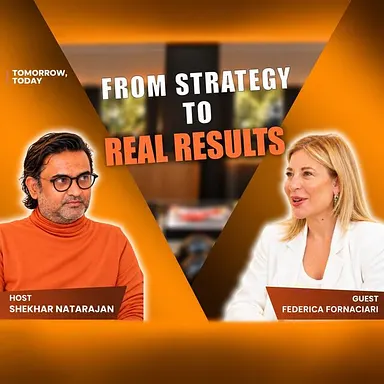
Every line of this episode of Tomorrow, Today was transcribed with HappyScribe technology. See also: audio transcription.
Ads in this audio differ from the text. Tap the sentence you're hearing to follow along.
Synced: the text now follows the audio.
They want to be all strategists. They— it seems they don't see execution. Execution, it's the most important thing.
Yeah. It feels like, uh, transformation is like alcoholism. You, you don't, you don't recognize that you're an alcoholic, or you do, but you never go to rehabilitation.
Transformation is when you are, uh, brave enough to question your beliefs. And this is in a person and in a company.
The consultant would, uh, come take your watch, take your money, and then they, they, they would wear the watch and they'll tell you the time.
Sometimes they hire you just because they need a signature their boards. It's a matter of Pilatus style, wash their hands and say, okay, this is— the gurus said this.
Welcome to yet another episode of Tomorrow Today with Shekhar Natrajan. It's my honor to have the transformation guru, um, Federica Finocchieri.
Yes.
She's been on the Forbes, uh, Top 100 list for 4 times in 3 different categories. She's considered one of the pioneers in basically transformation, and she's uniquely gifted, and she sees human as the most important asset in the technological world that we are gonna enter. With that, I'm gonna actually, I love to get into the conversation because this is like, this is very cool for me because— I lived in that organizational transformation, corporate, uh, change management area for probably 23 years of my 25, uh, professional life. And so there's a lot to unpack. It's gonna be fun.
It is. It is. And it was for all this time. I agree.
Uh,
even if sometimes you wanna cry during those transformation process, but then you smile.
Yes, yes, yes. So, so Federica, let's begin actually from the early days. Like, you know, so obviously you were born in Italy and then, um, uh, you know, you lived in 4 different continents— Europe, Latin America, North America, and then like China, um, or Asia, I would say. Um, and then, uh, you know, the cultural upbringing Like, tell me a little bit more because, you know, I think like, you know, being in 4 different cultures, going through what you did, um, does it really set you apart for being gifted in transformation in the first place? Like,
I think there is a matter, uh, also of luck in life. I think this is one of the quotes about you that I like the most, and it's also mine because, um, in my early stage of life, to be honest, I lived, uh, I always said in a fairy tale, uh, in the sense that I was in the countryside before in the US, then in Italy. Um, you know, everything, uh, I would say was kind of pink, you know, bicycles, um, nice small environment. So I wasn't born a citizen of the world. I was born a citizen of the world because of the mindsets of my parents. They were the first one, you know, being immigrants, living all around the world, uh, putting themselves, um, in very, you know, challenging situations. My parents moved in the US. My mother decided to move back in Italy with him. So the mindset in my house was a lucky one for sure. But, um, so this was maybe the, the seed of the cultural changing and transformation in my life. But that the big change was when I decided to start university. university and start to go in Rome, then to travel around and to accept whatever work that was, you know, a challenge everywhere.
So, uh, I think that was the part where it become to be a sponge for transformation. Um, I call, I said the word sponge is not a case because you are somehow forced, uh, because you don't have options, you are forced to absorb those cultures because if not, you're out. So, I think that's—
What was different about each of those cultures?
Uh, it's huge. And I think it's huge because let me say values, of course, are personal things. So, what I try to find, especially in the personal life, of course, because in work you have to deal with many different things, were similar values, but the way how values are lived or exposed around the world are different.
Mm-hmm.
So, for example, in Latin America, what you, what you see is that the first thing you have to gather and work on, it's trust. If they don't trust you, you will never do business or you will be apart. Uh, in, in Asia is, is different again because Um, they're, they're super quick and they scale. Volume is everything. Uh, and, and actually very different from every side, every, every zone of, of Asia. So, in China, it's more a factor of scalability. In Japan, it's more a matter of, you know, focus on work, completely driven. So, the culture is, is fully there. In the US, uh, then maybe from the business standpoint is the part that represents me the most is my health side. Um, it's, to be driven, but very, you know, assertive, transparent, polite. But, um, you know, you don't go around things, you go straight to the point. While in Europe, I think, and that's my, my other half part, um, it's a whole different story. Europe, it's a mix of a ton of cultures. So it really depends if we're talking about Southern Europe, Northern Europe. UK is definitely more similar to the US.
But if you go to Southern Europe, I always use this metaphor. You will never close a deal through a Zoom call or Teams. You have to meet people. You have in Spain, they say go to copas, means like having a drink. They need to see you not just as a partner, but a person that they would like to deal with or go out with. So, you know, I think trust is a matter, is an important matter everywhere. But there are countries where trust, it's the pillar to close the deal even more than let's say the quality, the credibility, or the standing of the company.
Got it. Got it. Got it. And so, uh, walk me through your journey of your early education and how did you get to where you got to before you got into Bain?
I, uh, my father used to say that my, my wall is full of, you know, not paintings but certificates. So, Let's say that continuing education, it's something super important to me. Um, I'm an economist technically, and it's something that it's part of my DNA. So, um, what I, what I want to say about it is that I think always numbers and the whole macroeconomic system, tectonic shifts, uh, exogenous factor, it's something that I use to check. It's part of my, let's say, um, DNA again. But, but then I moved to marketing. So my Master of Science was in marketing. That's somehow, and in those years, a lot of years ago, this could seem a change, but I think marketing is the best expression of how culture and customers absorb. And on the other hand, the brand should analyze and take care of those changes that are economical and political. So the full transformation, again, we go back there. in society. And then, of course, I made my MBA. At the time, it was in consulting, let's say, was a normal path to do. And it was my first step, let's say, to Latin America, Spanish culture, because it was in Spain.
And then I was, I was in Brazil to do an internship that became longer, etc. And, and then I did other programs in continuing education that, again, I think it's so important. So, um, LSE for Asia Pacific Studies, or, uh, my GMP that in Spain is called Programa de Dirección en IESE, uh, board member courses. Why I say this, I really don't like, let's say, to throw the list, but it's because those things are parts of being a transformational leader. But most of all, that's why I started loving being a teacher. So, I'm a, I'm an adjunct professor since now 12 years. And that's one of my best, let's say, goals and pillars, because staying with the new generation, to me, it's so impactful. And so, let's say it's, it's, it's a new discovery every time, because imagine that for 12 years, you deal with people between 21 and 27. So, I moved from millennials now to Gen Z, and I see them always in the same age changing, and this is so fascinating.
Very cool. Very cool. So, Bain, you know, when you get into this top management consulting companies, like the first thing they teach you is like a framework and how to think. How did it actually prepare you for the journey of transformation? Like, was it a conscious choice that you went into Bain, or was it just, it happened because like, you know, you were in management and then basically that was the path to get into like a professional career, or what really happened?
It's very interesting, let's say, the order of the question, I would say, because it's true that it was a very conscious question, the fact that I wanted to go in consulting and in Bain specifically. My choice was very driven and focused on that one because of the culture, because of their more, let's say, entrepreneurial style compared to others, in my opinion, my humble opinion, of course. But I think I wasn't, you know, aware of the path that I was dealing with. So, it was mostly, you know, that kind of, I think for millennials, especially people who are in our 40s, um, it's very important. The fact of, you know, proof was very important. The fact of proof, you know, that we were studying the right thing and going to the right path. And at that time, I remember we were, uh, you know, finishing Bocconi and the majority of us were ending up in those kinds of consulting or in investment banking. So, that path was kind of written, let's say. But then what I noticed along the journey, that is the amazing part, is that rigor is not just a keyword. It's a pattern, it's a way of seeing things, of analyzing things that consulting gives you.
And every time I think that this is both you know, a gift and somehow a curse. Let me say how, because, um, you, you become someone who sees problems. And that's on one hand beautiful because you can forecast, you can anticipate things. But I won't say you become negative, but it's true that the angle, the corner you're using is the one of the problem. So for the business standpoint, this is amazing because and then it happened in my life, this could be great to help entrepreneurs or become an entrepreneur. But in the personal life, you start, you know, being so cherry-picky and analyzing everything that it's, it's, it's interesting. So I think consulting is the base of transformation because it gives you, uh, the right, uh, the right instruments to, to see in between lines, in details, but still is missing ton of things nowadays, less, but 15 years ago or 17 years ago was, was a bit different.
Got it. Got it. Got it. Got it. Got it. So, uh, why do companies really hire consultants?
And that's the million-dollar question, because I always joke when they ask me, why do you think consultants here are worth it? I think there is the polite question, the polite answer, sorry. And then there is the real question. Uh, the polite one is because they give a real, and it's true, a real overview. And, and the fact that they're not working there, that is the problem itself, gives them the possibility to, to see like an umbrella, like the whole, the full picture. This is very difficult ones who are there because, you know, like the marketer course, the fact of becoming in love with your brand. That's something that doesn't happen to the, to the consultant because it stays apart somehow. But, uh, why I'm saying it's the course at the same time. And, and so the other, the other answer that is, um, sometimes they hire you just because they need a signature in their boards or, you know, they can say this, this is something that McKinsey said or stands for. So it's a matter of Pilates style, wash their hands and say, okay, This is the, the gurus said this. And—
Why do companies do that?
I think it's, it's especially in some countries, to be honest, it's a risk aversion issue or, uh, the fact that they want, they don't want to question themselves or their company. This became to me like a pillar of my studies along the years because they have strong in the company. So they start there, they think that the company makes the best products or the best services. And so, you know, it's difficult to question the company that is this entity, kind of your gods in the business world, but it's even more difficult to question yourself. So it's better if you say, okay, this is such an important— that if you think so, it's, it's It's weird, but to say this is such an important decision that I'll ask them to take it. But oppositely, you as the manager or the CEO, you should be the one in charge. And I think here you touched a great point to me because really this was the seed, the pillar of everything that I started after consulting.
Yeah. So like, you know, a lot of my friends, Um, joke about this, uh, because some of them actually work in consulting and some of them actually, uh, worked in corporate. They would say that a consultant would, uh, come take your watch, take your money, and then they, they, they would wear the watch and they'll tell you the time.
And that's, that's exactly the joke I think that everyone does because, um, I think luckily, again, this changed a little bit along the years, but truly, I remember when we started, when I started, I mean, due diligence, full potential projects, et cetera, were about this, like, okay, I will do your work. I would put myself in kind of a, on a throne and tell you, okay, this is A, this is B, but technically the people in the company are the one who have the, you know, the, the wisdom in that sense. So, I think the combo of the 2 things could be so powerful. And I think with technology nowadays, this is becoming, instead of, I think many people think that this will take things apart. Well, I think this could help to, to unify these things because at the end we have the same base all around us. But before, it's true that the access, for example, of information that consultants had was different sometime of the company. Maybe they had more information about the first-party data, their customers or their sales, but the consultants had the full pictures because of years of maybe industry expertise, et cetera.
So— I
find that a little phony, to be honest, in the sense, the very, like, the very reason the company hired you is because it was sort of what you said, CYA.
Yeah.
And, um, and if you know, if you're trying to do a CYA, the board actually appointed them and now you got the stamp of approval that you are a brand, which is great, that basically is gonna give me the CYA. Now the next brand buys it and then they basically become even more powerful and they collect all these brand names and eventually they have the credibility and they can charge you like, you know, $2 million to do like an 8-week project.
And they can charge you more.
Yeah,
every time. I think that's why I'm saying that technology was democratizing somehow all of this and artificial intelligence now.
Absolutely.
Because let's say the access of information. So technology in the sense of the access of information, now it's not something that's, it's more, let's say, important, impactful, or richer in, in consulting. Everyone has. Right. I think in corporation and consulting, I think they're almost at the same stage. What they're— the difference between them, it's still that consultants have the kind, the pattern, the path. They know the journey about how to use, let's say, the critical thinking and this deep dive in those information. So, we start, you know, the big question of nowadays, it's, I think, one of the main ones that is criteria. And how to use all this information. Because I think the access itself, of course, when we are, um, at the same baseline, so same kind of country, same kind of access, because it's not the same likely in every part of the world. But, um, if we think, let's imagine, uh, US New York consultants and US New York corporation, they have the same access. But if I come from the corporation, I would be maybe the guru of the product or of the, um, you know, retail, whatever it's my role.
The consultants working maybe in retail area have the whole picture again. So, same access to information, same artificial intelligence, but the consultants, hopefully, especially certain age of consultants, the one who were like me in charge of doing macros, analyzing Excels, trying to find the insight, not asking to the artificial intelligence. The insights are now so powerful with artificial intelligence because all the, all the sorry shit you were supposed to do for weeks in order to clean data, et cetera, now it's short. So, you feel lucky because you say, oh my God, you remember when I was taking 3 weeks to do so? Now we can do it in 3 minutes. So, you can really put yourself just there to analyze, to deep dive, to become even crazier in, in, in finding the problems. Um, so, this is again, the, the big deal with, with information and with artificial intelligence. Mm-hmm. Because, um, corporation is saying they could do the same, but the way of working is different. It's not worse. It's just different. I'm not a, I mean, I ended up leaving consulting, but I always said I'm still a consultant inside for the pattern and way of looking things.
Got it. Got it. And we'll get to this AI and the impact of technology because I wanna unpack a lot more in that context, right? Yeah. Because it's critical that we understand Um, is the reasoning the right level of reasoning and other things? And we'll get there, like, you know, we'll, uh, get to that. So now you, you went from being a, a consultant who would come up with strategies and beautiful decks, uh, to, uh, and I don't have, like, I love consultants, by the way. Like, you know, they're—
No worry, you can, you can say bad things about consultants.
No, no, no. I think like they go—
Where do we— are the one always said about us?
No, no, no, they go to Ivy League schools, so like, you know, they ought to be good. Um, uh, just kidding. Uh, no, so, uh, most of them are pretty brilliant and smart because they're, they're trained to actually think in a pattern.
Yeah, it's a kind of Darwin selection, at least years ago was like this. So as you were saying, at least they were on paper, they were brilliant.
Yeah, they're brilliant actually. They're brilliant because they're like, you know, and because they're they're molded in a certain way to think a certain path and like, you know, think in abstracts and other things. So that said, like, you know, like what I often find is basically the strategy person comes and tells like what the strategy is, has no clue how to get it implemented. And there's a huge kind of like gap in between like the concept to the reality and traversing that path, like, you know, that 50,000 feet to like zero, like, you know, boots on ground. That's where like a lot of— and I don't know, like, you know, like, so that actually brings me back to the question again, like, why did you do the CYA when you know that like, you know, it's gonna fail? 90% of these initiatives tend to fail as well. So I want you to kind of like, Tell me like the switch, cuz the switch is like very drastic, right? Like going from,
yeah,
telling people like, you know, uh, the time as you say, uh, to really like making the watch.
Yeah.
Right.
It's, it, it was drastic and I think you used the word that is perfectly describing the, at least former consulting, uh, word. Again, I'm not into it now, but I can say for before, and it's abstract. So, uh, let me say sometimes it's easy, or let's take out sometimes, it's easy to, um, evaluate and to start to do strategies where you're not in the battlefield. And that's something that it's great for consultants because again, they're not there. They don't take the final decision. They're not judged at the end or maybe fired if the decision, it becomes an element or—
Well, wait a minute. Like, I thought, like you said, like, you know, the very reason the board appointed is because they wanted like to make sure like someone told them what to do.
Sometimes, yeah, I think so. I think so. I think so. I mean, it happens in boards that, and this is another huge story that if you think so, board, and this happens also, it is boards instead of communicating are just informed. And the majority of those information are the CYD of consultants. So yes, it's a circular thing and it has a half percent that is a virtuous circle, but the other half percent is definitely not virtuous in my humble opinion.
So who got it wrong? Did, did, did basically the, the dog whisperer got it wrong? The internal guy who was actually talking to the consultant who got it wrong, or the consultant got it wrong?
I, I think the, the wrong part is what you were mentioning before that is fascinating to me. Again, it's part of my studies, it is the execution part. I have this joke when one of the biggest president of a bank in Spain, and we always said, we have to write this article before Christmas. That is why in Spanish is, ¿por qué ejecutivos son llamados ejecutivos? So, why executives are called executives is because you have to execute. So, technically, you should have a strategy that should be part of the believings and belongings of the company, the vision that, by the way, should be signed by the board. That's the role of the board. So taking in consideration all the macroeconomic factors, everything that is happening in the stock markets, if you're listed or not, and maintain the long-term vision. But you as a CEO and your first line, you should think about how these things could become reality in the company, but reality is made by facts. So, processes, execution, results. And as you were saying, and as a consultant, I saw this, it's like an M&A. The majority of things fail in that part. And why they fail?
Because they forget that they have to execute. So, it's like an inverse pyramid where you have decisions. And then you have maybe interns or let's say middle managers, and they put all the responsibility like the manager, the top managers on them for the execution. Why the so-called executives are you, the C-level. So you have to be in charge of strategy, but ensure execution. So, you know, if the consultants is not for sure, let's say challenging and ensuring execution.
How many boards get fired because projects fail? How many boards get fired and how many CEOs get fired if a project fails?
To be honest, from my experience, less than how many should be, very less, because I will make you an example of real life. Uh, in the industry I work with for many years.
Why, why do consultants don't repay the money back?
Because then, and that's why they're risk adverse again, the, the circular thing is because it's the CEO, the CEO is the one, let's say, signing again what the consultant said. And I, I say they don't even read what the consultant said. That's the, the big issue. I think it's in the middle. It is consultants, maybe they do great work. And I'm pretty sure they do, but it's like a first step. Then the C-level should, you know, become a sponge of this and challenge this and say, like a rework and say, okay, great standpoint or great out-of-the-box idea, great analysis. What we can do from this to become from a vision to a real idea, a real strategy, and then an execution. But this doesn't happen. So what happened that the final signature is from the CEO and the boards decide to fire maybe that CEO. Why? Because he didn't do the part he has to do. It is checking what the person that he hired and the board hired made. So yes, it's different because the consultants, and that's the part where I got angry. Yeah.
And I can tell you how angry you are.
No, it's, it's, no, it's that consultants, At the end, they don't have the, you know, the responsibility of the company.
Yeah. So like, the reason why I ask this question, because I always wonder this, like, why are, like, you know, these consulting companies not paid on outcomes?
I think it's changing. I think especially again, through technology becoming more related to sales performance, et cetera. I think the way how they're working, it's switching to, of course, the fixed, let's say, FTs or man-hours fees, but also the results, especially when they challenge the internal work or the agency work, etc. So they have to take results. I think this is fair. It's truly fair because if I say to you, Your company's not doing this well because of this player and your decision, et cetera. Okay, give me a better option, but I wanna see if it works.
Yeah.
So if it works, you will be paid, let's imagine kind of an earnout. If not, you're stuck with the, let's say the, the hours you put into the work.
Um, you know how you would fix it? I thought like, I don't know the answer. I, I don't know. I don't have the perfect answer, but I, while you were talking, like it just like, probably made sense. I would actually pay the consultants on outcomes, and I would also ensure that basically the CEO's career is on the line.
Exactly.
By signing him up.
I agree. So then the map should be the one of the CEO.
Yeah. So both of them are equally accountable. Yeah. The success and the failure. And the board should be also, like you should fire all of them.
I think, and that's a very consultant thing, but I'm a big fan of RACI methods, so responsible, accountable, consulted, and informed. Why? Because all the stakeholders you mentioned should be in that RACI. That's the thing. So, if you, if one of them is outside, again, it's Pilates style, it seems it's out. But at the end, the responsibility, it's on that person. And so, maybe, it will get fired. And that's the thing of the press, for example, they say, oh, we don't know how it got fired. It got fired because he didn't check. He didn't, he wasn't accountable about this. So, um, I think then the other part is that if you execute, you may, you need to make your hands dirty. And that was the big change to me. Mm-hmm. I changed from, um, you know, make strategies very abstract, uh, super analysis, even paralysis sometimes for analysis to, you know, go in the communication field, chaotic, all about things, even visual things, et cetera. And, uh, a very different dynamic and you have to switch and understand that it's your fault. It's something happened. So, uh, that's very, you know,
did you give back to, did you get tempted along in that role to be, Like wearing the strategy hat and also trying to execute yourself?
Um,
were you, were you always in your, like—
I think that the early stage was, was difficult because, um,
you would wanna go do the
strategy. Exactly. Exactly. And, and trust me, let me add this because it's my sociologist part somehow. I do see this in, in the Gen Z. They wanna be all strategists. They, it seems they don't see execution. It seems that execution, that's awful. Um, it's,
it
seems execution, it's a bad thing. Execution, it's the most important thing. Yeah. And the CEO should be accountable for it. So if you want to be a CEO, you should be accountable for execution till your internship level to the C-level. So, um, that's why I'm telling you about this article we want to write. Because in my studies, and this is exactly what happened in the journey in, in the agencies of this chunk, I decide to work on, on other pillars. That is a methodology that I do have in my consulting now. That is, it's called YES with the I, that means input, um, E as execution, and then spreading and scale. So intelligence and impact, of course, are more strategic things, maybe nicer, but those are so fulfilled by believings. And if you wanna execute well, you have to challenge your believings and say, oh, maybe I'm, I'm doing something wrong. Or why the EBITDA is going down? It's not just cause of the markets. Maybe you are doing something wrong or maybe not, but you have to check it. And if you have to implement something, you have to execute. So that's why I always said that this, let's say, journey between impact, execution, and scale or spread.
It's different between startups and companies because in companies you have intelligence and you have spreading curiosity, belongings, et cetera. In, in, while in startups,
scaling,
you have impact and you have more scaling. But look at this, execution is always the same. It's always there. And everyone forget about execution. Mm-hmm. So, that's why I'm a big fan of, along the years, and that was my change in agencies. I always said I was a managing director that in between lines and with myself, I was more a COO. I was really looking to operations inside and outside. So, I think ops are the new journey, are the new answer. And artificial intelligence, the one that will really work as your company, for example, this is a great example. look to operations, to the end-to-end process, because if not, we end up in the same issue that is checking just one little side that usually strategy, even with generative artificial intelligence.
Yeah. So, so WPP, uh, Hawas, right? Like, you know, so, so you were, so you were part of the agency now doing the marketing, um, being in the throes of like where the customers are actually intersecting at a much more closer vicinity. How different is that world from the world of abstraction? Like, is it more stressful? Is it more, is it crazy? Is it like chaotic? Is it like organized? Is it like—
Organized.
What is it? What is it?
Um, so let's say, um, they're similar in the sense of the kind of engagement. So, it
still like feels like consulting.
Exactly. So the structure could, could seem similar.
Because agency.
Exactly. Agency and consulting. It's not, it's not strange that I remember like—
What's the difference between agency and consulting?
I think the big difference is the following. First of all, by your persona. So usually, uh, the consultants are chosen by boards and CEO and/or CEO. So, uh, for the rule that we said, they're taken for granted. What they're saying, it's, let's say, it's like the Bible or whatever we want to call it. So the buyer persona and the delivery is not challenged, the issue we said. While oppositely, the agency usually is chosen by one area that is marketing. Then along the years became also from the digital side, et cetera, but from functional C-levels. So it's like their little garden. So it becomes kind of a part of that department. So there is more engagement and more, more responsibility slash reliability. So this—
is it another form of outsourcing?
It, it, I think it was somehow, especially with media agencies, not really with creative agencies.
What's the difference between media agency and creative agency?
Again, the buyer persona, because creative agency usually talk with the CEO because at the end, think about the communication.
Or the marketing.
Exactly. Communication pyramid. Uh, even if it's just a small, small part at the end, The TV commercial or the big activation is what the CEO sees. So when the creative director goes, it goes to the CEO and say, this will be your new campaign. When the media agency is kind of a financial provider, because at the end it becomes more and more a commodity. This is very sad, but it's becoming this. So, um, they're the buyers.
Mm-hmm.
So usually they talk with the media, media, uh, managers, or they talk with procurement. Itself. Now, nowadays media agencies have a very tech part similar to consulting. So this is elevating them, but there were, there was a period where they were in a blue ocean, very difficult to navigate. So that's the main difference, difference, but still agencies, again, they have the responsibility of the results. So when you do a campaign, then the marketing director come to you and say, oh, the campaign went amazing. And so They applaud you, but if the campaign went bad or the campaign didn't give the right sales results, perform— performance marketing results, et cetera, they come to you and they maybe put a pitch against you. So that's a big difference.
But the content came from them.
Sorry?
The content came from the content director and basically the marketing was just executing. The agency was executing it.
Um, yes, but at the same time, this is very, let's say, um, to date thing. Marketers are becoming more and more creative directors. So they are working with the creative director. It happened to me with one of the best marketers of the country. Uh, we are friends and we made a great campaign for a bank during COVID And this campaign changed completely the vision, what the bank was standing for. So even his personal life, personal branding became higher. more, you know, rewarded in the market. And we were his, let's say, left hand. He was the right hand, we were his left hand. So, it's evidence that the relationship is different, but also because of the consultants, sometimes they see them beyond or up here and the company here, while the agency is same level or a little bit behind. So the communication is different. It's between peers or even sometimes slaves, let me say. So, um, with consultants, it's different. It's, they take for granted what they say, or at least years ago.
Feels like, uh, feels like the king, the general, and the soldier.
Exactly. Exactly. That's the same. It's exactly the same. But again, I think with, with the nowadays with artificial intelligence, et cetera, we're now having to deal with something that touches everyone.
Yeah. Like, you know, like it's, it's, it's, it's like very sad that basically, uh, agency, uh, without technological sort of precision, uh, is just like spraying things in the wind.
It's, I mean, that's, let's say that aura, this, this allure that agency have, it's also their magic somehow. So let's not forget the good part. That is, ideas are truly humans. Ideas come from a feeling. Ideas could make you cry, could make you buy.
But is the content director not creating that?
It's, it's, I would say it's, it's both. It's the content, it's the creative director, but it's also the full— that's the cool thing of agencies, the full package of accounts, of strategists, of analysts, especially with technology.
It's like moviemaking.
Yeah, it's exactly. You have many different roles. So you have a strategist that usually starts to analyze the markets, comes with insights. And then you have the data analyst that said, okay, careful, because, um, in the, in the digital journey, this is happening and this is not happening. So what you were saying, I'll challenge you inside in during the movie making.
Yeah.
And so when it got to the creative director, let's say the recipe is already well packaged. So the creative director can start thinking in an all abstract way. That's true. But the backbone is strong. As for consultants, I could say that it's very difficult and it was very difficult to me to see the difference, for example, between the strategic departments of an agency and consultants because the processes—
Which is where I was wanting to get to because in a movie, right? Like they always say there is sort of like this brotherhood or sisterhood in the movie industry. Like when they're on the set, whether it's an actor, whether it's a scriptwriter, whether it's a technician and the cameraman and the music guy or background score, whatever it is, they're all trying to make that thing beautiful.
Exactly.
Right? So they don't think and assume that I am the king, you are the pauper, and all of that. They worked very cohesively and there is no concept of winning at the pretext of the other and/or basically delegation of authority or renegation of accountability. Exactly. To another party. So I wanna actually get to that point. Does strategy even fricking make sense? Why do you have strategy in the first place? Because all strategy, when you put it on like to test, it doesn't really like scale as much, right? I'm not saying that like, I'm not anti-strategy, but like the way we do strategy.
I agree with you, especially like there is a sentence sometimes when I do conferences or with the students, I even ask to change the name of the course when they told me like, this is the course of digital strategy, or this is a course of marketing strategy. And I always said, Everything and nothing is strategy because the strategy is the pool of all these elements. That is, let's say, strategical thinking plus the execution. So that's the sum of all the elements is the strategy. And as you were saying, that's the big difference in the agency because in the agency accountability, it's for everyone. The account, and it's the name itself, is the one that feel the responsibility of the client. Trust me, you can see accounts like tigers that want to defend the clients. So it seems they're more from the client side than from the agency side. And this is very interesting from a psychological standpoint because you see how strong is the relationship and also how, you know, low is the churn rate. The retention is very high in agencies, especially for accounts because they wanna stay with their clients. They call it their clients.
And then you have all this, let's say, technical elements that are part of the magic because you will have the data analysts, you have the producer that should come there and tell you this is feasible, you can do this, this is not feasible, etc. You have the planners that are really finding insights everywhere. And then it's true, you have the creative director that maybe is the only one that put himself a little bit higher in the sense that is the orchestra. Uh, more than manager, let's say, is the orchestra magician, is the violin in the middle of the, of the concert. But you will never see, that's, that's amazing. And that's something I loved about agencies that made me, you know, change completely my mind and, you know, merge these 2 words, consultancy and agencies. That is, everyone will never point the finger against, for example, the creative director is at the pitch. the client doesn't like the idea because they knew they work all together. It was really like a battle where everyone has a role. I think the fact of consultancy is that both, both things at the end, if you, if you think about the outcome is abstract, but the outcome of the, of the agency at the end ends up in something physical.
Sometimes there are even physical ideas, activations, et cetera. to sell more. The other part, it's, I'm sorry, it's a PowerPoint, it's a document. So, should be taken care and not just for granted from the people in the company to make it happen. So, there is a layer more, you know, and if this layer is skipped, nothing will happen. That's a true truth. So, I feel lucky. And again, we go back to the luck, the luck part that I had my early journey, you know, in that rigor because it helped me to focus. But then I made my hands super dirty into, you know, from analysis to shooting to go with the clients at Cannes Lions and this new— made new discoveries and take responsibilities and take even, you know, not nice moments from, from clients when something was going wrong. It's very difficult that consultants will be, let's say, scream out like, oh, you made this, uh, not in the way I wanted. Nothing happened. With the agency, this is normal.
Got it. Got it. So, um, uh, going to, uh, uh, Hawas, Right, like, so you were the director for digital? Yeah. Yeah, so, um, uh, and you ran this during COVID time?
Yeah.
Right, pandemic. So how was that experience? Like, that must have been a crazy time.
That was crazy from very, um, from a lot of standpoint. Crazy in a positive sense, but crazy. First of all, I was moving from all around the world to Spain. That is my home now, but it's true that I was used to—
So, when did you live in China?
Yeah, I did. I did.
When did you do that?
Uh, in, in Beijing, and then I stayed in Hong Kong.
And what, with a job?
Uh, it was, yeah, it was a project there. So, yes, projects usually in consultants are always more than 5, 6, 8 months. So, you definitely live there. It's not like a little spot. So, um, I was coming from exactly Latin America, China, UK, uh, projects in the US. So, all around. And then in, when I was in WPP, that was before Havas, uh, I was between Milan, London, and in the global board. So, always around and especially managing global pitches. So, again, uh, international, uh, environments. And then I, I, I come here. I come in Spain and, and I, I become managing director for, I would say, the most pioneered company that is Telefónica. So the agency for Telefónica was the biggest in Havas and was international. So Latin America, uh, UK and, um, Spain.
So what, whatever happened to Telefónica?
Uh, like now they're like, it's, I always call, you know, one of the most interesting company, but in the other hand, a bit of ministry because it was a public company, became a private company. So for an economist is interesting, but of course you can imagine that the whole dialogue within such a huge company, in a huge company, it's, uh, it's difficult. So, uh, that, I think that was the moment where I became a real transformational leader. They call me to, let's say, transform, but also save and managing the situation after a pitch.
Of Telefónica?
of Havas for Telefónica. So, there was the agents, the global agency for Telefónica.
How are you going to fix like a bureaucratic organization?
It's difficult, especially because you are technically, you are not a supplier, you are a partner, but you are not in the company. So, the only thing I could do was first of all, listen, listen so much to the client, but also listen so much from my peers in Havas. who worked for Telefónica for years. Some of them were coming from Telefónica. So,
you know, but how, how could you save Telefónica? Because I was, I was talking to the head of HR, Bernie, uh, who was also—
I mean, we were, we were mostly in the, in the communication side, so I couldn't, you know, get in some areas of Telefónica.
Yeah.
But it's true that from our side, managing and dealing with so many people and money, because you know, the media side of Telefónica was huge. It was the biggest advertiser in Spain and one of the biggest worldwide. We had to touch many areas in Telefónica.
No, but their pension liability was crazy.
Yeah, it is. But in that case, we, you know, we couldn't work on that area. The only thing we could do, and I think that was differentiating from other agencies, is that We actually ended the abstract part and we started saying, which are your business problems? That's not typical of an agency, but exactly due to my background, I say, okay, I will manage the agency, but my style is a different thing. I want to hear why the stock is going down, why they have to do RAs and fire people. So they were even somehow shocked by me because they were saying, this is not about media, this is not about communication. And I say, no, this is about communication because the stock value is also based on the perception. It's also based on communication. It's also based on all these elements.
Is it really?
I, I think so. I think so. Especially now that I got back to finance, M&A, et cetera. Let me say that everything in finance has, uh, psychological and communication, um, percentage. Yes. Think about, Um, I always said investor relations are so important and sometimes they don't think how important they are because—
Unless a crisis comes.
Exactly. For a crisis, that's so important because it's also, it's always a matter of speed and of the right word. You have to ensure, but you have to be transparent. You have to reassure, but you have to be bold at the same time. So it's, you need to have lobbyists, that in South Europe it sounds like a word, a bad word, but it's in the Anglo-Saxon world is a normal and very important role. So you need to have lobbyists that have a transformation habit, that are very quick in thinking and executing, that know who to talk with. Mm-hmm. And, and so, you know, that's the part that's a very important part from an agency too, because PR is not just about, you know, the good things or, oh, we made this or we made A, B, and C. No, no, it's also about the stock is down, but we are dealing with maybe thinking about the centenary or the, the foundation of something new in Telefónica, rebranding. I remember the Movistar rebranding. It, it came in a very, uh, important moment for the company, but also a bad moment from a stock standpoint. So it had a different weight.
Even if it was a communication pillar, you know? And this is very difficult.
I feel interested by this conversation because I know of a company and the CEO of a company who was primarily on crisis management. This guy is like a specialist, and then he got fired out of his own company, and then he started another company. That's a different crisis he had like in his own life. But like, that was like, tens of billions of dollars company. And all they did, all the CEOs did was to have someone, if the CEO stepped on the wrong side or did something wrong or something happened to the brand, like, you know, this crisis management team would just kick in and try to just mop up the crap. And they were paid like crazy. It's a retainer. And I was like shocked, like, is that a business, by the way? It is.
I
can tell you that crisis
management is huge business when I was CDO and managing director in VML. Try and ignore that. We had Burson-Marsteller at the time. That is a huge company of PR and crisis. And we had amazing fees from the crisis management. And luckily for the companies, because there were, it was a period where there were crises everywhere. I remember Costa Crociere with the, when there was the ship going down, et cetera. But anyway, um, I'm a big fan of that kind of CEOs. And again, every time I'm a big fan of something, I decide to study on that part. And from that thing, uh, I start working on something that I call the CEO of an oper— as an operating system. The CEO is the mirroring, or should be the mirroring of the company. If you think so, the board is the vision, is the long-term run, but is not the part that, let's say, the, the, the pillar and the, the peak of the pyramid that everyone sees. Who the, the people sees the CEO inside and outside. So is the full operational, again, operational system. And so the CEO as the operational system should be the one that oversee, foresee, and check everything that happened.
And this is typical of crisis management because the best thing of crisis management, crisis management is to anticipate. the crisis. And this is something that, as you were saying, I think it's one of the biggest values that a CEO could have. Or the option 2 should be having someone, a right or left hand, that is not, but is not a secondary character. It's like the better half that is, okay, I'm the operational system, I'm the mirror of the company. So somehow I'm the, in Spanish they would say the poli bueno, like the policeman, the good policeman. I'm the bad policeman. So, I'm the one who will see the problem. And I think there, there's a huge opportunity nowadays for consultants, for what I told you before. They are the ones seeing problems and forecasting, foreseeing something that could happen. So, if you add this kind of spice to consultants, I think they could be very good crisis managers, but what they need It's the execution part because the crisis management is all about foreseeing something and execute.
Is that a business idea for you?
That could be.
That could be it.
Yeah. Many, many people told me about manage— I think I, I managed ton of crises.
Because like, you know, you're a consultant, like, you know, you have operational experience and then like you were in agency and then like, you know, you ran like gig in like media.
Yeah.
So
I think somehow in, in the holding I built, Crisis management is not, I call it one of the labels in the website, but it's true that what we do for clients is actually the merge of what we said during our conversation because we give the strategy because at the end we're all former consultants, CEOs, et cetera. But on the other hand, everything about that strategy as a CEO should be, is driven and is motivated for, to sales or to, you know, narrow and solve a specific problem. And what we guarantee is not just the PowerPoint, but is at the execution plus sales.
Would you get fired if you didn't deliver?
We're not, you know, we're not get fired. But for example, our methodology from an economic standpoint is It's a small retainer and a big success fee. So, if we deliver well, we receive our
success fee. But is it not like counterintuitive? Like, you know, you don't want like crisis to have a big reward.
No, for sure. But at the same time, the reward of a crisis that you manage to be small or you manage—
So, how is the outcome big then?
It's small, let's say.
Yeah, you're right.
It's big if it's the smallest possible, the spreading at least.
But how do you even— I think we'll get off on a tangent on this one. I
could write a model on this. You are giving me lots of ideas.
I modelize everything.
No, I think it's interesting, right? So, how big is big? Because you cannot let it go out of Pandora's box to just say it was this big or it could have been this big because you're just hypothesizing at that point.
I think in our case, you know, it's more, we're not managing the crisis itself. We're managing real issues that could be a crisis, but usually we're not arriving at the point of a crisis. So, you know, sales floor effectiveness that is not working, go-to-market strategy that was made too quick. And then I go to a market and I see that this is not working. So, what happens is they arrive to us. The ones that are more, you know, visionary, they arrive before the crisis. So they say, okay, I wanna go there. Uh, let me, uh, let me—
I got, I got a business model for you.
Sorry?
I got a business model
for you. Oh, great.
So the business model is, uh, crisis management. The job of crisis management is not to have crisis.
Yeah, it is.
So it's like insurance policy. So you would charge them money and you wouldn't, and if something goes wrong, you would have to pay out of your pocket.
Yeah, exactly. It's, it's somehow, I mean, we're not using this as a, as a, let's say economical model, but it's what we do.
Yeah. You have to underwrite the risk. You have to say like, okay, like, you know, I know there's 1 in 1,000 chance that basically this guy is gonna like mess up or this girl is gonna mess up. And if that is the case, and you know, you would have some sort of models to predict that. You could, you could say, okay, this is what I'm gonna charge you for never gonna have a crisis.
Yeah.
And if you have ever a crisis, it's all my fault.
Yeah.
But you better be like sure what you sign up for if it's a billion-dollar company.
Exactly. Exactly. That's why I think it's better to start with tier, tier 2, tier 2 companies. But what you're saying is also something we do a lot with M&A. Yeah.
For
example, because M&A fails so much. for the fact of not seeing the unmatching cultures or unmatching, uh, you know, even small things that we have to analyze before and, you know, alert everyone with our little flag and say, be careful, this company is fitting in terms of numbers, but— So, this is not easy to say because especially during an M&A process, there are 2 feelings. You have the hype because you're happy you found a target, you wanna buy it if you are the buyer. But on the other hand, you are scared, you're stressed, there are due diligences. So again, you become a psychologist. So you need to be an analyst, you need to be a great consultant, you need to be a financial person, a finance person, sorry. But you need to be a psychologist of both sides, the vendor and the buyer.
So tell me the person behind the executive, like, you know, so obviously you've been named 4 times in Forbes 100, 3 different categories. And so that's one side of it, like, you know, so it's sort of, is a validation.
Yeah.
I would discount it a little bit.
I agree.
Because people get validated if they're really good, and that shouldn't drive their purpose in life, I feel. Vision should. That came to me as a realization, like, gosh, like 20 years later. I'm such a slow learner. But what I want to understand from you is the person behind That's,
that's the most beautiful question. And it's something I, I always tell to my, my young students. Uh, I will answer with a little premise. It happens to me that many of them, and somehow you can say, oh, this is such an honor. They come to me, girls especially, and say, I want to be like you. And every time they say this, I feel not an honor. I feel a huge responsibility. Because every time I say, you are talking about what you see and what I do. So that's another thing that I put myself years of study on that part. And I create a model called BBPP. That means personaje, persona, character and person, believing and belonging. Why I'm saying this, because what you're talking about is the character. The character is not a bad thing. It's, it's a systemic thing. It's what you— it allows you to wake up, to be here, to talk, uh, to be resilient, to be consistent. Everyone has a different character, you know, and it's not a case that character has the double, um, meaning, you know, but the character is also what you see outside. But then the persona, so the person behind it, uh, the goal is that will be as, you know, similar as possible of the, of the character, at least in the main values and pillars.
So, I can tell you, first of all, that, for example, in my case, the character and the person in the way, in the attitude, and, um, I don't know, like my, my enthusiasm, et cetera, are the same. Mm-hmm. But yes, it's different. As you're saying, if I should tell you who I am, not what I do, it's not the Forbes, uh, you know, uh, list. It's not, um, titles, et cetera. It's the singer, it's the musician, uh, it's the writer. I do write, and I'm not talking about my research papers or books in academic field. It's the enthusiasm that I have about the book, L'Arte de Quedarse, that will coming in a few weeks that is, you know, about love, about feelings. So, yes, my character, it's, it's there too, because my studies, my learnings are there. But it's also my, my fresh attitude, is my enthusiasm for life. It's all the works that I don't say and I do. I call it my NGO life, not because it's NGO itself, but because, you know, I do it for free. I do it for helping people. I do it for impact. And that's me. That's the person behind it.
It's, it's a person that it's a 13-year-old when it, when it comes to, you know, homemaking and an order that is not of the professional one. It's the mother of a dog, Milan, that I got crazy for it. Every time I said, oh, I would never be crazy for a dog. Well, to me, it's like a kid. It's the partner and business partner. of a fantastic person I have next to me. So, you know, I'm, I'm, sometimes I say I'm like a clown. You see me, I'm a very smiley person, enthusiastic. So I think the 2 things, character and person in my case, and that was my goal, my purpose in life, that one will generate and regenerate the other one and rebalance. the other one when one of the two is too far in the case of the person, the person from me, because maybe I'm too into, um, business or in the other hand to, to take the business part and say, okay, uh, you can relax, you can focus on other things, or you can say no. That is a very difficult thing to me. So, um, you know, I'm, I always said I'm very different things.
I'm very different Tenericas. I have lots of faces. And that's the part I like the most about me because I can cry for a song, I can write songs, and at the same time, I can pass a whole night seeing the IBEX or stocks of finance.
Hmm. Great. So, um, I know like everyone goes through struggle and suffering. Everyone does in this world. So, uh, I think part of what I want to touch on is, uh, that aspect of it. Like, because like, you know, you, you, you make it sound easy, you make it sound Uh, so, um, you're so confident, but, you know, I'm sure like, you know, it's, it's also one of those veils.
It is.
Right? For everyone. So, so how do you deal with that? Like, what, what, like, what's suffering to you in the first place?
Um, I think as getting back to the point of the veil, I think in my case, more than a veil, it's part of my medicine.
You
know, the positivity is not a stressed positivity, but it's something that helped me. I always said I'm definitely more and more grateful of the bad things that happened in my life than from the good things. What bad happened to you? And I happened, and it happened to me to be, you know, to, for example, I do have a lot of faith and to go in the church in my case and really pray. for the bad thing that happened to me. I had to deal with a lot of health issues, physical health issues. I grew up with my mom for many years. And I always said in a very nice and pacific way, you know, I don't feel myself— I do feel myself lucky anyway. For example, my mom wasn't with me for many years because she had such a rare tumor that I had to see her between a mirror. So those things for years, I think, were—
Why, like, not having a father was like a big thing? And like,
like, I had my father with me, but not having mom and knowing that she was supposed to die. Luckily, really, a miracle happened and she's alive and she's with me. But in very important years of my childhood, she was not there. And this is not easy. But for many years, I would negate this. And I was— and this is the veil— I was happy kid, happy young woman, happy woman now.
How do you do that?
I think it's because of faith in a way, for sure. And for my
own
aptitude.
What do you say to yourself when you
are in— I think It's, it's something that I do every day, every night. I look at myself and I, first of all, I'm grateful of every day of what happened, not for the sake, you know, saying life is short. Every day is a gift. Of course it is. But in my case, I'm very grateful also of minor things. So I really try to see the good part because if I start to, to feel and, and think about everything that is unhappy or the suffering I passed through, you know, could be, could be even dangerous because you will see the negative side. And as I told you, it was one of the first things we mentioned. My pattern, let's say, my— I'm programmed as a consultant, as a former student, etc., to see the negatives. So that's something that I want to exploit to use in the positive sense. So use the negative to avoid price crisis, Use the negative to find a new need and do a startup or helping my startups to grow, but not to put me down. So that's why I think I double my energy, you know, and but I'm very, very careful on suffering mine and the other people.
But not all suffering is business opportunity.
I think it's an opportunity, but not all a business. opportunity.
So how do you deal with that? Like, you know, like, you know, if like I were like going through some sort of, uh, a disease or like, you know, loss, or I feel defeated.
Yeah.
Um, you feel like, you know, you're a loser.
Yeah, it happened to me many times and it happens.
Um, what was that specific moment? Why did it happen to you?
Um, I think one of the worst moments was when I was next to a person in a friendship relationship, but this person loved me and I discovered it was such a great person, medical doctor. I mean, it could be whatever, but technically like a very, you know, not just educated, very good soul. But after months, after a long, you know, knowing each other, etc., I discovered he had strong mental issues, but strong in, in like no return way. So of course, I couldn't have any relationship with this person in the, in the loving sense, because it was dangerous for him, could be very dangerous for me. And this is such a personal thing, but I'm not afraid of talking about this, because I think that these are exactly those moments when your life has a twist. And then I decided to help this person anyway, at the point I could, of course.
Why was it dangerous for you?
Because of course, for the kind of, let's say, mania and psychosis it had, could be dangerous, like even physically dangerous.
For you?
Yeah, for me and for other people. So, you know, I had a responsibility.
I wish my mother told that to my brother. My brother has bipolar depression and basically, like, you know, he goes through highs and lows.
Now, in this case, imagine like that was very, let's say, bad at the sense that, for example, being bipolar, it's light, very light compared to what this person had.
Got it.
So
this is schizophrenia.
Yeah, exactly. Exactly. You touch exactly the, in the, in the worst level. So the no return one, no medicine, nothing that could work. So, you know, that's, it comes the faith. part that I say, I want to help this person no matter what, because he's a human being, he's a good soul who didn't have the possibility to discover this before. And now I want to help him. And this was a pre and post, let's say, my life, because I discovered how delicate we are as people.
Did you help him?
Yeah, I did.
How so?
And he'd always told me that I helped him first of all to be alive because bad things could happen at that time.
Is he still alive?
He is, yes. Yes. And of course, it's difficult because you would like to help. But, you know, there are also doctors that tell you, you know, your health could be dangerous, not for you, for him, because of moods and movements. It's a thing of years ago. But I remember it was also in a very important business moment. So, you know, you had to deal with, as you were saying, with very delicate personal things once you are changing jobs or getting into a huge change, deals, etc. But again, I'm grateful of that situation because, for example, all the studies about personaje, persona, so character, person, my book, etc., are all sons of this, of this situation, of my mother staying in bed, of myself dealing sometimes with anxiety about health. I never had anxiety about life stress, et cetera. But when you pass through very bad health issues in your body, so you face death, of course you want to stay healthy. And so whatever little thing you have, you could start being, you know, very worried, et cetera. I Um, so it's very important to, to deal with elements of yourself. And that's why, uh, your question, it's also my question every day, that is dealing, managing, and saving your, your person, not just what the others see, what you see in your mirror.
And I think it's very important to, to have someone next to you or in your, uh, trustful circle. that is mirroring you and showing you, for example, if you are going out of this path, because it's supposed that the people who knows you, they know what's your path.
Yeah.
I'm very disclosing in things. I think that's something that I, when I met, when I deal with my mentees, especially young people, it's something I always said. That is, uh, it's when you look at me, think also about all the dinners that I missed or all the trips with my friends that I missed, all the bad things that I passed through. Don't look just on Forbes, or almost 40s in a few days. Uh, and, and it's true, a big success from a business standpoint. But look what took me there and how I, I deal with this every day. I think that's my— if I have to be proud of something, it's that part, not the, let's say, the, the little stars, the medals in my in my jacket.
Is success for you like being, you know, successful in business or being a good person?
Being a good person. Purpose is everything to me. Got it. Impact people is everything to me. I think you will see my eyes smiling when I, when I help my students, not in the, in the business search or in exams, but when they come to me and they say, oh, Professor, help me because I feel like And I spend hours with them and helping them. That's to me impact.
Mm-hmm.
Or the startups that I help. It's, it's, it has a business side. Yes, but not the business side in terms of rewards of money, et cetera. It has an impact in business maybe, but it's, it has an impact mainly in people's life. That's something that I think it's really, um, a mission that I have. It's something that I, I do like. It fulfills me. If when I go home, the majority of time that I'm grateful, and as I told you, every night I write down what I'm grateful for. It's very, very difficult. It's maybe 1 out of 20 that is a business thing. I could be, you know, proud. I could be happy, content of those things. But the true joy, the truthful joy, the real peace, it's when I see that I impact
people. I have this weird condition, like, you know, I worry about like seeing myself too much out there because, uh, whenever I am, uh, I feel like something bad is gonna happen.
It, it could. It's, I, I understand your feelings. It was, I think it's, I, when I call the course, it has a little, a little, let's say, taste of this because again, I think we are, we are made sometimes to to foresee problems, to foresee real issues. And when you pass through issues, like you could, you could pass through in your, your early stage of life, or could help to me, not in terms of love or luckiness, but in terms of facing death. I think you always have this reminder. And for example, COVID to me was such a thing. When I think about other people, it is how you can Forget how we, how we were, how you can forget, um, that was dangerous. It doesn't mean living with pain or with to be scared all the time, but I think it's important to re— to remind ourselves and to not to forget the bad things. Those things, they, I think that's something I always said, they don't have to leave you scars, but they need to give you feelings. Yeah.
Got it. So, uh, let's talk a little bit about transformation. Uh, so how do you define transformation?
I think transformation is when you are, uh, brave enough to question your beliefs, and this is in a person and in a company transformation. I think real transformations in a company is when people are transforming themselves and themselves in function and receiving from the company. And that's why I think that's the, the twist, the huge twist between believings and belonging to something that is a bigger entity, a feeling, something that you can spread around. That is the culture. So since you are able to question yourself, you are at least in, in, uh, like in potencia, they say here, like a potential. Uh, transformational leader or transformational enabler. Not everyone is a leader, but could be an enabler of transformation, for example, in a company.
Mm-hmm. So if, if transformation is basically having this belief that you gotta change, why do transformations fail then?
I think is exactly for the brave part I told you. You need to be brave to go in a meeting, in a steering committee, or in a regular meeting with your peers and say, you know, I think even we're sure, if we're sure of this working, I'm pretty sure that we at least need to question and to challenge this because maybe in this 6 months, this is not working. So, in this case, it's not the full company transformation, but you are starting transforming something. And you know what? You are not transforming the business. you are transforming the mindset. First of all, yours, because again, you are scaling your courage and you are, you are able to say loud what you think. That's the first step of transforming. Mm-hmm. And why it fails, because companies are not full of brave people. I mean, luckily there are many, but to have a full transformation, you have to have almost everyone on board or who is not on board should not be a stopper or should not be, let's say, a bottleneck in the company. So in that case, you have 2 options. One is to fire. That's in, in the American Anglo-Saxon system is more, let's say, normal.
Um, in South Europe, we're more garantists in that sense. And for law system, it's more difficult to say, okay, the company's going this way, you are in, You move with me. You don't wanna do it, you're out. It, it costs to say this. We're scared to say this. And so again, it's not a virtual cir— virtuous circle because, um, if you have stoppers everywhere, it's difficult to make the machine, you know, rounding and, and, and going.
It feels like, uh, transformation is like alcoholism. You, you don't, you don't recognize that you're an alcoholic. Or you do, but you never go to rehabilitation.
You're completely right. I think that's, that I will quote you and I will steal this. Remember, I think I can in the, in the, in the famous article about why executives are called executives. I think I will quote you like, thanks to Shekhar for this quote. It's true. It's like, let me say, it's like addictions in general. So, um, and that's why I was making you the example of the brand love that marketers have. Like, if you don't recognize, you cannot change. And that's why I'm saying questioning things is the most— is the pillar. If you don't start there, how you can transform? You see, if you don't ask yourself and to the team, do you think what we're doing is correct? Maybe it is. I'm not saying it's not. I'm just saying that if you go with the flow continuously, And, and I think it's even more dangerous to successful company because if you think, if you see successful, you stick with it and say,
okay,
let's go on. And you never stop. Luckily, like many great company for their, um, their way of working, they stop anyway because they want to iterate. You want to make new prototype, but this is typical more of technology, of design company, et cetera. But there are huge, amazing, successful companies, let's say SC&G, etc., that I think sometimes they should stop and say, okay, what we're doing, it's working, but it's successful. But, but doesn't mean that then we have to change. But at least you stop yourself. I, and to use metaphors as you do, I'm like yourself. I use metaphors sometimes even very sharp. I say, This is like going to the therapist as a couple. I always said best couples should go to the therapist exactly when they are okay to talk to each other and crisis management to prevent— I mean, if you go there once the crisis is already super dangerous, I mean, hopefully for them it will go well because the therapist will help, but you are already in the middle of the hole. But if you go once you are okay, when you're super happy, you can start building good habits, you can start building amazing rituals, etc., that maybe are intrinsic, but you don't, you don't know it.
As you're saying, it's like, it's really like an addiction. You're completely right.
So how did like—
I'm a Zoomer. Yeah. So don't think we wine out, but
no, I
realize this. It's okay.
I don't drink. I don't smoke.
No, I'm, I'm, my only, my only little pleasure is a glass of wine sometimes, but few amount, but great wines.
Yeah. No, I don't, I, I don't have aversion to people who actually do that, but like, I, it's like by principle and philosophy in my life. Yeah.
I, I agree with you. I think apart from this, I'm the same. Like, I, good habits are great. I think in my case is, is culture in the sense that, uh, being a sommelier is part of the art, you know? it's, it's pairing, etc. But I agree with you. That's why— that's— let me put into brackets.
But like, in order that you assimilate to a culture, do you need to morph yourself, or do you own your identity?
I, I definitely— I think I'm pretty sure I own my identity. Um,
but why do you—
I'm very proud of this. And, and maybe because I was part of so many cultures, I always said Mm-hmm. In, you know, to have 2 options once you start going abroad, live abroad. One is to stick with yourself and stay in your little hole, maybe work perfectly, but not discovering the world. The other option is to, you know, enter with all the feet, all the body, all the mind in the new culture. And I always said, that's why I have a ton of families. Because in all these places I create, let's say, my own family of friends, of mentors, of trustful people. And, and so that's why I'm saying I own my identity. The thing is that my identity is so polyadric.
Mm-hmm.
And, and gather along the years, all the, um, all the cultures that I, of course, you know, managed to, to deal with. And, and it's something so beautiful. There is a quote from Cesare Pavese, a great writer in the 20th century, and Cesare Pavese was saying— and then Marchionne quoted him in a great conference years ago— saying that the cool but the lucky that we are of traveling, of having trips, of living abroad, To leave the solitude also, to stay alone and understanding how important it is to go out, to put yourself out, to not, not to be scared. And, and so to, to pass through difficult things, it's not easy to put yourself out. It's not easy to, to trust. It's especially if you pass through bad things, it's not easy to do it. But, uh, traveling and discovering the world, it's, it's really a gift. It's a beautiful thing. And let me say, it's a gift in one hand, but also I think it's a matter of what you want to pursue. You have to be brave to do so. And I'm not talking about going one week at Maldives. I'm talking about, you know, living abroad, uh, from scratch with no one, knowing no one.
That's something that I always said to my students when they say, oh, now I wanna go, let's imagine, to London because all my friends are going there. Mm-hmm. there to learn the master's. And that's why I said that should be exactly the reason why you should not go to London. Go somewhere else, discover somewhere else. I think this is priceless.
Very good. So, uh, you, you talk about, uh, human leadership in AI. Um, unpack that for me.
It's, um, first of all, I start from a premise every time I study, write, and, and think about this topic. That is, I'm not one of those persons that say artificial intelligence, it's dangerous, it's risky, et cetera. As everything, it's a tool. It's a tool that, as I mentioned, being a former consultant, could help to do things that we were doing in 5 to 8 weeks in 4 minutes. And this is scalability. Scalability is a great thing. Now, what we have in mind is to be human in the sense of put our criteria at the service of the machine and the machine at the service of our time. Time is one of the most important things we have in life. And if we think so, so it's purely a logical thinking, artificial intelligence should be our biggest ally because all of us, we always complain about, I would love to have more time. Artificial intelligence could give you this, but you should get back something. That is the pure human side of artificial intelligence. It is the right criteria, the reading, the, your time to take in consideration what the machine is giving you back.
Indeed.
What made me suffer every time is that we're for— we are the one forgetting the human side because the first, um, the first defect we have, I was talking with the managing director of McKinsey here and he was telling me exactly the same. He was saying, our analysts have great analysis from, from Claude or whatever. The point is that they don't even read them or they don't even ask the machine, please, can you put all the formulas? Can you help me to check the premises?
Yeah.
I was sure of this premise. Can you help me to, to make a, you know, a prediction or can you link these elements? Because I do things. linked, these elements are linked. And it's perfectly okay that the machine will give you back an answer that is, I'm sorry, your idea was not true because data A, B, and C are, say, the opposite. But the machine is something that should maximize our know-how, should give you— give us more time to maximize. And that's why I started working on something that I told you before. One is the CEO as an operating system. Mm-hmm. because we are an operating system nowadays with the human side and the artificial intelligence. So before was digital technology, now artificial intelligence. Again, I think it's already a commodity. Mm-hmm. Working with startups, for example, every time I say, please don't come with another just AI generative idea, come as orchestra, is this, is coming with something that use artificial intelligence to solve a real need. No matter if it's an end-to-end process, no matter if it's operational systems, I'm a big fan of both. So, I do think we have a big bunch of opportunity there to see results.
So, where, where it comes to human there, it comes in the new journey. I call it the algorithm journey. And the CEO is in the middle of this because the let's say the first part of journey could be not replaced, but could be replacing a big amount by artificial intelligence. So awareness, consideration, because imagine searchability now is artificial intelligence visibility. And this is something that you as a human should fulfill. You should decide that maybe your website should have more use case. more information about the procurement side, about your SLAs, etc., that before you were not putting there. But nowadays the procurement, think about B2B, goes in ChatGPT or Claude and say, tell me already the 3 names that I should call in my tender, in my pitch. It's a different story, especially in B2B sector, because the humans are asking to the machine.
Yeah.
And it's a volunteer thing because they trust the machine. So that's the first step of human and machine that is not versus one or the other, is they're dealing together. But then after this first part of the journey, that was the awareness consideration part, everything that is after conversion, so retaining and re-engaging, etc., it's part of the CEO and the company as an operational system. This is about humans. So I think that the journey we had before is substituted by the algorithm journey, but part of the algorithm journey is human and the weight of the human, it's even more important because you would be more searchable, more visible thanks to those techniques, to those images you will, you will give to the market, your CEO, your board, your vision, your philosophy that goes beyond the machine. So again, this will touch what our hearts, our feelings, our hedonistic sometimes, our impulse buying, etc. So there is a part of marketing where going back to the old kind of marketing that is not performance anymore, is not the full multichannel anymore. It's artificial intelligence influence, not influencer, and few influencers enablers that, in my opinion, the CEO is the flag of this.
Got it. No, I, like, I find basically this whole conversation, generally not ours, but like about human and human-centric AI, it's very perplexing to me. The reason why I say that is when we started talking about angelic intelligence, which is basically what we are building, we had about like 3.4, now maybe it is like 4. billion social media views. So half the world, um, they were all resonating to it. But when you went and tried to sell that to people, there were no buyers. Because, uh, uh, not that I did a bad job like selling, I think I do a pretty good job selling.
I
agree.
Emoji. Emoji. So, I think the idea, it's very psychologically, it is disturbing primarily because when you say like, you know, you want like humans in the center of the process, but when you basically ask the humans to respond to to commit.
Yeah, sometimes you don't have that risk.
They don't commit. So basically, like, so now when things go wrong or things go bad, like, I will say to myself, you know what, like, I gave you guys a chance.
Yeah, yeah, you're right.
And then you had—
That we're going back to the bravery parts. People are risk-averse usually.
Yeah.
Or sometimes that I think it's worse. indifferent.
Yeah.
And, and that's bad because they don't receive, no matter if it's the artificial intelligence or the human part, they, it seems they don't receive, they're not sponge. They're, they don't want to digest all these elements to make a decision, no matter if it's, I will decide to buy or not to buy, I will decide to, to gain or not to gain. Um, but still, I think what artificial intelligence is forcing us to do, maybe not now, but in, in the long run, is that this indifference should should stop at some point because we don't wanna be machines. We are humans. The, the risk, where, where is the risk is what you're saying, that if we are so indifferent, maybe people are okay to let the machine do it. Yeah.
Yeah. But like, you know, I think like they will, uh, I think we, we, uh, we have actually demonstrated that behavior, right? Like, you know, all along, like in, in the sense like social media, I think is the worst thing that happened to the world.
Yeah, I would do.
Like, you know, so, uh, and I think like, you know, AI is like one viral act, you know, kind of accelerant to the whole phenomena, uh, which actually is like very dangerous, to be honest with you. So, um, yeah,
I think every tool, that's the, that's the part why we were saying not just the human, but I would say the ethical part that I'm not using as a light word, ethical in the sense of using for a real reason. using for something good. Good could be business, by the way. I'm not talking as in, in the charity way. I'm just saying that should be an enabler, should be something to be some— to do something good.
Yeah.
To the world, to people, to democracy in the sense of technological democracy, to business for higher margins, higher EBITDA. I, I do think that that would be great. But indifference is the worst enemy when you have such powerful tool.
Yeah, higher EBITDA is also equal to fewer people in jobs.
Yeah, that's true.
So I think that is gonna distort the world too in the future. So like, you know, like I have like a little bit of paradoxical view on some of these topics, not with you, but like generally.
No, I agree with you. And that's the part that I do hate when they use it in a political way. Because that should be completely neutral versus politics.
Yeah.
There is a point that artificial intelligence should enable things but should not create even polarized worlds with less work, less possibility, should give more possibilities. So we should prepare the battlefield to it. So it doesn't mean stop it, but should be— that's why I'm saying the human part or understanding in this algorithm journey where we have more weight. Mm-hmm. So, the, the good thing should be not fewer people, but just more weights in, in people's jobs that maybe will change. So, I think that part, I completely agree with you, should be a social, not phenomenon, a social issue, a social question that I don't care parties, if they're left or right, they should ask themselves. Because again, they will have these issues. And as you were saying, If social media were already big, risky, they create phenomenon like bullying in a way that every time being, being a millennial in the, in the, in the '40s, it's, I remember bullying was nothing compared to now. Like when we were kids, of course there was maybe the bad guy doing something, but not the whole social media risk where people can suicide because they've ruined their, their life.
To me, it's super sad every time I think and I read about this thing. So if social media was already, as you were saying, dangerous, artificial intelligence is like putting more gasoline, more, more petrol on this. But as everything, if you use it correctly, could be amazing, but you need to have criteria and you have to need in, you have in powerful person this willingness.
Yeah.
To make, to make it happen in the positive sense. And that's the risk. That's the risk of everything. It's like doing business with or without artificial intelligence with no ethics. I think that's the thing of having ethics and impact and joyful and being joyful in everything you do. I think this is something that we lack a lot. And I think it's something so powerful of your, not just idea of your purpose in general, because it's a business-driven idea, full, like, and to me as an ops logistic person, I do, you know, I do love that kind of, of, of ideas, but it has the good side of it, let's say.
Yeah.
So I think we should always work on the good side of the business, that it doesn't mean just ESG, CSR. These words are so used in a, um, you know, without meaning sometimes that it's sad.
Yeah. So like, you know, like, yeah, that's the other thing, like, you know, character displayed versus character written on a piece of paper.
Yeah.
So, these are all like, you know, sort of a little bit of dichotomy I face myself with. Like, you know, what people say is not what they do. What people write on their value statement is not what they exhibit. You know, what basically people are supposed to be accountable for, they don't do. When people basically say like, you know, they wanna buy things, Or they love things, but they really don't want to buy it.
Exactly.
You know, it's like, it's just that whole contradictions about humans.
If you think so, advertising is living on this and sever the tension. Oh yeah. These things, dichotomies.
Yeah.
It's what makes advertising living. Yeah. And what, how advertising works with people.
Yeah.
Because we are full of these contradictions and that's why I'm saying I think the best moment is when you have balance. It doesn't mean it's equal between person and character because it means that you have less contradiction. At least you made peace between those areas.
Got it. So, executive education and AI, like, what do you think is the future? Do you need, like, executive education? Like, is it like, I saw that recently MIT, like, you know, released all of its courses online.
Um, I'm in this, I always not very fair in this answer. So it's a, it's, it's bad. It's the best question because I'm a professor. So I am, I'm a bit, let's say between strict and between conservative in that sense. So to me, the answer, the quick one is I do believe in executive education itself, but what does it mean, executive education? That's the thing. Does it mean to go and do 1 or 2-year course in a certain moment of life? Maybe, yes. So the MBA, when it's needed because you want to change or because you do feel you need like big substance book style of something, but executive education could be something more. I'm actually working now with a team of women, for example, to work on, on, on the board's level but with something that is truly impactful, that is not just the legal part, what to do in a board, what stands for a board, that by the way is important. I did those kind of courses. I received a lot from those kind of courses, but something that is about you as a human being. What are your duties? What you should highlight as a woman, as a man, as the merge of the two things, etc.
So So, I think executive education in a holistic way, that again could be conferences, could be going in your maybe alma mater, in your university to listen as an alumni, a lot of things is continuing in executive education. The fact of having, that's why I was joking about myself, like ton of certificates, if you do with the right mindset and because you wanna re— you, you really wanna learn, It makes sense, but just collecting masters, I think it's, it's not that worthy. Plus, if you add this part in the, in the digital artificial intelligence world, it's, it's tricky question because I'm being a person that really believe in the person and the character. I think the one-to-one, uh, the face-to-face conversation has such a deeper. Mm-hmm. understanding. And I do see with my students, maybe for the age of them, because usually, again, I do coach executives, but the one I teach are 21 to 27. So, they love to come in class. They love the fact that they move. They love the fact that I can stop in a point and look at them and ask. With artificial intelligence, and so having an alias or emoji or myself, but in doing by ear, Um, but I, um, AI, sorry.
Um, and, uh, in, in, in a computer, I think it's smart, it's quick, but I don't know if I will call this executive education because the most interesting thing about executive education is hear the executive, is to see his face. If it's getting emotional, if it's getting vulnerable, what one, and while And when it's raising the voice to have a different rhetoric. I think we're not there, and I don't know if we wanna be there with, uh, with, uh, AI.
Mm-hmm. Uh, like, I, I feel like, uh, uh, the, the fundamental provocation that AI can release time so we could spend more time. is such a dangerous argument.
It is. I think it's the most beautiful and it's the most dangerous.
Because, because like, you know, that's a proxy for laziness. And once you basically figured out and cheated once that basically it worked in your favor, then it's like a drug that you keep taking and then you forget, like, you know, you're overdosing on that drug and giving more agency to the opposite system. And then like, you know, eventually you find yourself Like without any cure.
I agree with you. And I got back to the point I told you, that is the point of the time is the most beautiful and the most dangerous at the same time, as I was saying. Why the most beautiful? Because if you have, but that's the point, if you have criteria and if you have, you are at a certain stage of your life when you pass through, again, I take the consultant's life because it's very emblematic in this sense. When you know what does it mean to stay in Excel, so much hours, so much, you know, difficulties. When I remember I was using Access doing those huge formulas, you were praying when you were tackling the— you were pushing the button because you were saying, oh my God, please, the formula should be right, because if not, you were spending maybe a week again with parentheses, brackets, etc. So, if you are there, you will see the real advantage. You will see, you will start saying, okay, I'm not wasting certain amount of time, so I will read this many times. I will prompt and re-prompt. So, I always said I do use Claude. I'm not against Claude, for example, but, and I do spend a lot of time.
That's the thing. To me, a prompt could be 2 days at work because I reiterate. And I start asking and I start to do brainstorming. So, the fact that I'm not wasting the 5 weeks on the data cleaning, that's beautiful. But again, what I'm doing is not laziness, is that I'm using better my time for a better delivery. But why our generation could have this? Because we passed through the other, the other period. So, it's exactly the same with mobile phone. Or with, um, net and social media. I always joke with my students and say, you don't know what does it mean at 16 having a boyfriend and call home and say, hey, this is Fulanita, I would love to talk. And so you should be brave because you know that it's the mother that is answering or the father. You don't know. So think about all these people of younger age. And that's the part where I agree completely with you. With artificial intelligence, they just see, I have more time, I'm sorry, to do nothing or, um, or to do less meaningful things. Hopefully many of them will do meaningful things. I'm not— I'm a positive person.
I do believe a lot of people will find amazing, you know, applications. Yeah, applications or amazing discoveries that Let's think about medicine, et cetera. But yes, the middle, uh, I don't like the word middle class, but let's say the majority of the people, uh, the curve, the part of the curve there, uh, will get into laziness. So that's risky.
Mm-hmm.
That's super risky. And I get why some companies then avoid certain artificial intelligence. It's practical? No. It's smart? No. But it's because they're, they're scared of their people being in, in Claude, put— putting a prompt and not even read the output. Mm-hmm. That's the thing. Because I'm, again, I'm completely okay. Every time I say to my students, I expect from you a presentation that is amazing because now you have the instruments, or I do, I do expect from you a ver— um, a verbal delivery and a rehearsal that is perfect because that's the human part. Because everyone knows that you are using artificial intelligence to, to do the presentation. It's not like years ago that, you know, at this very well-designed presentation, you knew that that group has spent so much hours more to tune everything. Now it's about artificial intelligence. So what I will look more, again, the weights is your delivery, is how you believe in what you're saying, is the Q&A. So, um, unluckily for the new generation, we are coming from another one, and still we are the one hiring, etc.
I think we are being very reckless to the newer generation, to be honest. I'll tell you the reason why. Like, if some people actually try to do good with AI, and but there was no alignment on AI on the other side, then what you would end up causing is Probably more joblessness.
Sure. And polarization.
And polarization, that is one. Oh, by the way, like, a scientist just like found a cure for cancer and you can live up to 300 years. And like, so are you asking me to live jobless for the next 300 years?
No, you're right.
No, it's true.
And the fact that they are reckless is very true. They don't— and they don't care. That's something that scares me.
So I think, so that's why I feel alignment and doing good to the society is like a tandem bike.
I agree. And I think it's the, it should be like the axioma completely. And I, I, I would highlight alignment as the first thing. That's something that I used to, to write a lot about the balance and alignment, because let's go, let, let's go a lot before. So no artificial intelligence, but think about environment, retail environment. Retail environment, when innovation in retail environment fail, when the, the C-level have decisions, but nothing goes then to the, to the store. So, there is this gap. This is the same thing. So, it's just a repetition, but in a different, let's say, uh, situation that is more dangerous because of the scalability. It is Because if I do have a gap between the decision-making and the other people, let's say, no matter the role, it's dangerous because that's reckless. And because in the mean— in everything in the middle could lose the job. And in the case before artificial intelligence could be like, like could lose effectiveness, but still there was an issue. So, um, I agree with you, but in And especially in the point that life and economy and, and society is circular. So we're dealing with same issues.
And that's, that's bad because it means we are not learning just with things that are, of course, quicker, more dangerous because of the, of the effects. So, but I want to be positive and think that people like you or like many of the trustful and meaningful people I know are pushing to do different. But of course, if it's just a big but not as big bunch of people, there is a huge risk.
Yeah. So let's do the rapid fire. Leadership capability AI will never replace.
I think leadership in the sense that I do believe leadership, so believing and belonging, together won't be replaced by AI.
Okay.
But the leadership that are people applying, and luckily could be.
Okay. The leadership capability AI has already improved.
Um, I think if it's used well, as we were saying, time, um, time management, so more, uh, impactful, uh, activities.
You get into time management because you cannot prioritize?
I think time management in the sense that you could focus in more.
Zoom in a bit.
Yeah.
Got it. The CEO who's doing human leadership in the AI era best right now?
Wow. I would say yourself in this moment. And it's not because you're here. I think yourself and I think I think, for example, I do know some founders in artificial intelligence. One company I'm dealing with and I'm investor from, it's called Contents.com. I think the founder, it's the 4th time founder. It's a CEO and it's doing great and it's using artificial intelligence to make processes and end-to-end, right into a wallet garden that it's worthy for the company, not creating issues. So, that's something I really admire, for example.
Great. AI, threat to leaders or opportunity for them?
Should be an opportunity, 100%. Due to the lack of leadership, I think it's a big threat.
Got it. The most overused word in strategy consulting?
Strategy, first, the word itself, I think it's overused and it's incorrect. And the other one is synergies and flexibility. I think I hate them. I will avoid from the vocabulary.
Got it. Bain, McKinsey, or BCG?
Bain, 100%. Not because, I mean, I think it's a matter of, um, of signature in your mind and in your heart. If you're a Bainie, you will be a Bainie all your life. If you're a McKinsey, you'll be, you will be a McKinsey all your life.
The M&A deal of the decade, best or worst?
I think, let me be not just positive, it's such a finger cross to me and my colleagues. I'm working on a great thing that is not about artificial intelligence at all. It's about green, it's about electricity and photovoltaic in offshore boats. And hopefully the M&A, or better to say the seeding, will be in one of the biggest companies that we know that just just been listed, so hopefully it will be a reality. So I hope a new one.
Very good. The, the market you want to work in that you haven't worked yet?
India, 100%. I, I, I knew India just by, as, as I was saying, Maldives style, because of weddings of friends, MBA friends. But I, I never worked there, and I think from my attitude would be a gift to work
Got it. The brand you most admire right now?
Wow. Uh, there are many I would say, but, um, one of the brands I admire the most is the university I went, uh, that is YSE. YSE never lost the purpose. So I think it's not a love brand from the business standpoint, but really has a brand that has a vision behind and it's a strong vision. And I'm proud of my brands because I think of No Brainer, and, and seniors because without any, you know, promotion or working on the awareness, people had the feeling of what that brand stands for.
Yeah. The most common communication mistake boards make?
Um, not communicating and informing. That's what, what we were saying a bit before. I think boards don't communicate. They receive information, they don't study information, and so they lack In communication.
Got it. Personal brand asset or vanity?
No, it's, it's an asset. Uh, you should work. That's the thing. You should work on that asset. It's a duty. Personal branding is a responsibility and a, and a duty. It's like the CEO as a, as an operating system. So if you do just as vanity, you live in the personage, in the character. So that's vanity. But to me, it's definitely an asset.
Got it. The Forbes list you're most proud of?
Oh, the one word, dizzier one. It is the most productive of Spain. So, it's because I do believe I am. So, I don't have any imposter syndrome. I do think I am very productive.
Complete the sentence, most important thing a leader can do in the age of AI.
Question himself.
Well, my friend, it was a fantastic conversation. I really loved it. We covered a lot of ground, like we went in like some interesting directions.
Yeah.
I think there's probably another one I have to do with you to talk to you about other things that you do.
Definitely, the whole M&A world, the finance world, trust me, it's very— there is, in that case, there is a lack, huge lack of women, of psychology, etc. And that's my new chapter that I'm touching. So I will be super happy to do with you, maybe in the US or in India.
Sure, we do. Awesome.
Thank you. It was a pleasure and we laughed a lot too. That's great.
• Federica Fornaciari’s journey across cultures and continents• How cultural differences influence trust and business relationships• Why companies hire management consultants• The gap between strategy and real world execution• Why business transformation initiatives struggle to deliver results• Leadership accountability and the responsibility of CEOs and boards• How artificial intelligence is changing consulting and decision making• The difference between consulting firms and marketing agencies• Why human creativity remains essential in a technology driven world• The importance of operational excellence and execution*• How communication and crisis management influence business performance*• Why leaders must challenge assumptions and take responsibility for outcomes*
Tune in to Tomorrow Today Show by SKN for powerful conversations with global changemakers, visionary leaders and extraordinary minds shaping our future. Hosted by Simplecast, an AdsWizz company. See pcm.adswizz.com for information about our collection and use of personal data for advertising.