
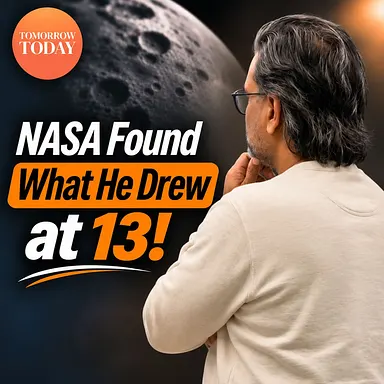
Shekhar Natarajan revisits the life of his younger brother Ashok, whose unusual way of thinking was dismissed as broken during childhood. He describes finding a notebook Ashok filled at age 13 with lunar drawings and orbital calculations, and comparing those pages with NASA's 2019 lunar crater data.
The conversation covers how that discovery shaped Shekhar's work on AI, the guest's argument that creativity goes beyond following rules, and how unconventional thinking might tackle practical problems such as a low-cost water filtration design. Listeners will hear a personal story about perspective, understanding and the value of minds that think differently.
In this episode Shekhar Natarajan, Ashok Natarajan
This episode's transcript, about Ashok Natarajan's notebook and NASA's 2019 lunar crater data, was made with the technology HappyScribe built to transcribe video to text.
Ads in this audio differ from the text. Tap the sentence you're hearing to follow along.
Synced: the text now follows the audio.
My brother's brain saw things that didn't exist yet, and for 40 years I called that a problem. I was 9 years old when I learned that love can destroy the thing it loves most. Secunderabad, India, 1986. One room, candlelight, and a notebook my mother had bound herself with newspaper covers and needle and thread. Inside it was everything. Moon drawings copied with printing press precision. Self-taught mathematics. Dreams I hadn't told anyone. Then the door cloth moved, and Ashok walked in. 13 years old, eyes too bright, like a radio tuned to a frequency no one else could hear.
Can I see? No, Bhaiya! Please, it's everything!
He opened to the moon drawings. And something in him ignited.
These are wrong. There are more craters. Here, and here, and here!
He grabbed a pencil and started scribbling. Coordinates, equations, dictation from somewhere no one else could hear. Huh?
You're ruining it!
My father pulled him away and the brightness switched off. Ashok looked at the pages, and his face collapsed.
I ruined it. I always ruin everything. My brain is broken.
My mother held him. I didn't. I put the notebook in a box and didn't open those pages again for 40 years. San Francisco, present day. My team had hit something we couldn't get past. The AI can learn. It can teach. But it can't create.
The AI follows rules. It can't make the leap. Can't think the way you did when you built Machinist from garbage.
My son Vishnu was watching from the doorway. 6 years old. Quiet in that way he has.
Dad, why don't you just ask Uncle Ashok?
The thing I needed was the thing I'd buried. That night, I went looking for the box, my mother's binding still intact after 42 years. I opened it slowly, page by page, until I reached page 79. Ashok's corrections. The pages I hadn't looked at since I was 9. I looked at them now, with 40 years of education behind my eyes. The scribbles weren't random. They were equations. Orbital mechanics. Gravitational calculations. Written by a 13-year-old boy in a manic episode. I pulled up NASA's 2019 crater discovery data on my screen. Held the notebook beside it. My hands started shaking. Crater for crater. Coordinate for coordinate. Perfect accuracy. 33 years early.
You weren't mad, brother. You were seeing the future.
Then picked up the phone. He answered on the second ring. 51, graying, the kind of calm that comes from medication and time and hard-earned peace.
I'm sitting here with the notebook, page 79, the drawings you added that night. I'm looking at NASA's 2019 data right now, beside your drawings. Coordinate for coordinate, 33 years early. You weren't seeing things. You were predicting.
His face moved through confusion, disbelief, then something that broke wide open.
All my life, people said my brain was broken. Even me. Your brain isn't broken, it's different. And different is exactly what we need. I want to code the way your mind works. I'm calling it Ashok's Sight.
And every time someone has a breakthrough using it, that's your gift at work.
You're saying my brain helps people? Not just helps, transforms. You didn't ruin my drawings. You showed me a different way of thinking, and I'm sorry it took me this long to see it.
Before we hung up, he asked for one thing.
Don't just code me, Shikhar. Remember me. Tell people that a different brain might be exactly what the world is waiting for.
72 hours without leaving the office, writing code, One comment, left for anyone who'd ever read it: The line between madness and genius is hindsight. In real time, they look identical. Then the test: Design a water filtration system. No electricity. $50 budget. Ashok's sight thought for 45 seconds. Charcoal from cooking fires, sand from the riverbed, scavenged bottles layered and gravity-fed, UV from 6 hours of sunlight. Total cost: zero. 10 liters of clean water per hour.
Charcoal from cooking bars, sand from the riverbed. Did we upload that solution? No, it created it.
The AI generated one line that stopped the room. They called him broken. He was just early. The patterns were always there. Now I see them too. And that's when I understood what I'd actually built. Ashok's brain didn't follow the path everyone else followed. It jumped. It connected things that had no visible connection. It saw what was real before reality caught up. The world called that madness. I coded it into the AI. Every time someone uses angelic intelligence to find a solution no one else could see, that's Ashok. His sight... Finally being understood for what it always was. Not madness. Not broken. Just early. Hassan, 16. Syrian refugee. Cracked tablet. A tent. He's just built a clean water system for 5,000 people from scrap and solar and filters he designed himself. Hassan.
Where did you learn this? The AI. A man named Shikhar built it. His brother saw patterns others couldn't. They called him crazy. But his brother's vision became the AI. And the AI taught me.
For Ashok Natarajan, who saw the moon before NASA, this code is your name, spoken a billion times. A text from Ashok. You made my madness meaningful. I love you. I wrote back, you were never broken. You were essential. The world knows now.
Maybe you see something I don't. Maybe one day I'll understand.
What if the mind everyone misunderstood was actually seeing something the world hadn't discovered yet?In this deeply moving story, Shekhar Natarajan revisits the life of his brother, Ashok, whose extraordinary way of thinking was misunderstood from childhood.At just 13 years old, Ashok filled a notebook with mathematical calculations, lunar drawings and coordinates that seemed impossible to comprehend. For decades, those pages remained forgotten.Forty years later, Shekhar rediscovered the notebook and compared Ashok's calculations with NASA's 2019 lunar crater discovery data. What he found changed the way he understood his brother forever.In this episode:The childhood story behind Ashok's extraordinary mindThe notebook that remained unopened for decadesThe surprising connection between his lunar drawings and NASA's 2019 dataHow Ashok's thinking inspired a new approach to AIWhy creativity goes beyond simply following rulesHow unconventional intelligence can help solve real-world challengesThe story of a young refugee creating a clean water solutionA story about perspective, understanding and the possibilities hidden inside minds that think differently.
Tune in to Tomorrow Today Show by SKN for powerful conversations with global changemakers, visionary leaders and extraordinary minds shaping our future. Hosted by Simplecast, an AdsWizz company. See pcm.adswizz.com for information about our collection and use of personal data for advertising.