
This Global News Podcast episode covers a range of international stories from the early hours of 2 November. A Michigan Democrat's surprise endorsement of a Republican Senate candidate, days before the US midterm elections, is discussed alongside the Democrats' chances of taking Congress and the tight Texas Senate race.
Correspondents also report on Carl Bushby's 28-year walk home, Israeli strikes in Gaza, youth-led protests across Europe, a Buddhist ceremony in Bhutan and Kimi Antonelli's Formula 1 title. Listeners will hear how each story is developing and what the reporters expect next.
In this episode Alex Ritson, Pete Ross, Danny Eberhart, Gary O'Donoghue, Joe Inwood, Julia Paul, Richard Forrest, Sarah Smith, Will Grant
This Global News Podcast episode on the US midterms, Carl Bushby's walk home and the Formula 1 title was made with the tool HappyScribe built to transcribe audio to text.
Ads in this audio differ from the text. Tap the sentence you're hearing to follow along.
Synced: the text now follows the audio.
This is the Global News Podcast from the BBC World Service. I'm Alex Ritson, and in the early hours of Monday, the 2nd of November, these are our main stories. A Democratic congresswoman in a key battleground state, Michigan, has endorsed the Republican Party's Senate candidate just days before the midterm elections. We'll hear from our correspondents in swing states. The Italian Kimi Antonelli has become Formula One's youngest-ever world champion at the Mexico Grand Prix.
Also in this podcast.
It's a pretty nice world out there. As a traveller, meeting people face to face.
The British man on the verge of completing an epic 28-year journey around the world to walk home. The U.S. midterms are almost upon us, and the stakes could not be higher. Americans are voting for both houses of Congress, and the results will determine exactly how much power Donald Trump will be able to wield in his final years as president. Mr. Trump has held campaign rallies all over the United States to try to boost support for his Republican Party, but with prices soaring in the U.S., will that be enough to convince voters?
Here's what some voters in the state of North Carolina had to say.
I'm not saying it's the best there is. I mean, he has some childish habits that I don't really care for, but in the end, versus the other choice, he was the person. He was the man, for sure.
Everything's going up. He's going to make America great again, you know? That was his main slogan. Everything was going to come back down. I don't think so.
I don't think it's a referendum on him as much as it is on the general direction of the nation.
I am not happy. I was a Trump supporter, and I am so a wish. I regret. I'm not even I'm not even getting out of it.
I mean, you have to ask yourself the question, am I better off than I was two years ago or four years ago? I am.
So, to find out more about what's happening, I spoke to our North America editor, Sarah Smith, who's in the state of Maine.
Well, Maine is one of these states where you have got a long-served Republican incumbent senator, Susan Collins in this case, who's been here for nearly three decades as a senator, being challenged by a Democrat. And most of the races that look the closest, that we'll be watching the most carefully, are ones where you have a Republican incumbent facing a really serious challenge from a Democrat who are performing particularly well in the opinion polls. Now, they've been wrong before. We don't know for sure that they're correct this year. But they are fairly consistently showing pretty much a surge in support for Democrats across the country, with the result that states that have been reliably Republican for decades, like Texas or Kansas or places like Ohio or Iowa, look as though they could elect Democrats in this cycle.
And what are the issues that are chiming with voters?
The cost of living is top of mind for almost every person I've spoken to. I've been across the country to a number of key states speaking to voters, and they are almost all angry about the cost of living and blaming it directly on Donald Trump and his decision to go to war in Iran. There's not much doubt in anybody's mind who they hold responsible for the fact that prices are going up. Not everybody, though, said that's going to cause them to flip their vote. Some people still plan to back Donald Trump's Republicans, despite their fury about prices.
But that has set an atmosphere electorally, which is one of the reasons why Republican candidates are likely to suffer in these midterm elections, because they're associated with Donald Trump and the decisions he's made that voters don't like. He's been campaigning very hard for his Republican candidates, hoping to inspire those who are still his loyal supporters to come out and vote. But the danger is, of course, when you have an unpopular president, that the more voters see of him, the more it galvanizes people who don't like him to come out and vote against his candidates.
So what outcomes are possible? What are we expecting to happen?
It's very likely that Democrats will take control of the House of Representatives. Because even if there isn't a surge in Democratic support, as currently suggested by the polls, it's very normal for the party of the sitting president to lose seats in a midterm election. And the Democrats don't need to take many to take control of the House of Representatives. If they do that, they can block pieces of legislation that Donald Trump wants to get passed, and they can open investigations into a lot of his more controversial actions and decisions. They could even try and impeach him again, or maybe one of his cabinet secretaries, like perhaps the Defense Secretary Pete Hegseth.
It's much tougher for the Democrats to try and win a majority in the Senate, but it is possible. And if that were to happen, if they controlled both houses of Congress, they could start trying to pass their own legislation. One Democrat Senate candidate I spoke to on the campaign trail told me that one of the things he wants to do first is try to force Donald Trump to end the war in Iran by passing a war powers bill. So it could have a real impact on Donald Trump's last two years in office if he loses control of Congress and he has Democrats working against his agenda.
Because Donald Trump has governed by executive order in many cases. Will he try and do that? Were that to happen?
Yes. Inevitably, he will try and bypass Congress if he no longer has a majority there. And as you say, even when he did have his Republicans controlling both houses, nonetheless, he liked to skip the congressional procedures and simply try and rule by executive order. The problem is that in quite a number of cases, with some of his more controversial ones, like the trade tariffs that he imposed on nations around the world, or his attempt to end the right of people born in the United States to become U.S. citizens, these executive orders have been struck down by the courts.
And often because they say, actually, this was something that should have been done by Congress. It can't be done by the president alone. So it is getting harder and harder for him to ignore Congress just at the point at which he might be about to lose control of it.
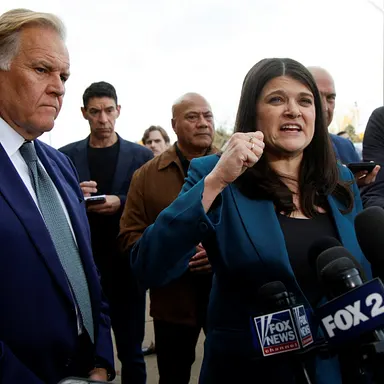
Sarah Smith in Maine. Well, the battle for Michigan took an unexpected turn on Sunday. Democrat Abdul El-Sayeed beat Congresswoman Hailey Stevens in the Democratic Party's Senate primary earlier this year. But now, instead of backing him, she's endorsed the Republican candidate Mike Rogers, and that could be a critical move. President Trump welcomed her decision.
We just had some big news. It came over the sets and just announced about Hailey Stevens endorsing Mike Rogers. That was a big move, I think. Nobody expected that, but it's a smart thing to do.
Mr. Trump went on to say that Hailey Stevens would be welcome to join the Republican Party. So, a remarkable development. Something I put to our North America correspondent, Will Grant, who's in Washington.
Yeah, it really is. It caught a lot of people off guard. The appearance of Hailey Stevens alongside the Republican candidate at church on Sunday really did, you know, throw people into a bit of disarray. There is clearly some personal difference between the two Democrats which has involved this change of heart, but I think in part it's come down to messaging over Israel. Specifically, there was a campaign advert from an outside liberal group, a superback called Rebellion, which blamed Israel for high food prices in the U.S., specifically blaming U.S.
military aid and U.S. aid to Israel. Now, Mr. El-Sayeed has criticized the advert, said he had nothing to do with it. But Congresswoman Stevens said, "I don't belong in Abdul's campaign." She posted that in a video to X and said that people of the state, it was not who we are, hate is not who we are, and that they were not getting who they were out of their Democratic nominee right now. So it's been seen as a real betrayal by many in her camp, including her own chief of staff who resigned.
How much of a problem is this for Abdul El-Sayeed? Has he said anything?
Well, clearly at this stage, he's not going to welcome that kind of press and that kind of attention. But I mean, you know, he said that he simply isn't focused in Congresswoman Stevens, that he's focused instead on the race, on the needs of people in the state of Michigan, less interested in the politics of it all than the policies of it all, is how he put it. And interestingly, his campaign has confirmed to our U.S. partner, CBS News, they've managed to raise over $1.2 million since Congresswoman Stevens publicly backed Mike Rogers.
You mentioned Gaza as one of the drivers for this, but also his religion.
Yeah. I mean, you know, we heard Donald Trump there welcoming the move from Hailey Stevens, saying it was brave and so on. But within that same breath, he also repeated this sort of anti-Muslim attack on Mr. Sayeed, calling him a jihadist, that he's part of the Muslim Brotherhood, of course, completely unfounded claims. But I do think that has fed in as well to the relationship between Hailey Stevens. She sees him as having been anti-Semitic, you know, leveling these sorts of accusations at his campaign, something he has consistently, of course, denied.
But he, you know, is trying to become the first Muslim senator in U.S. history and has come up against repeated attacks over religion.
Will Grant in Washington. The last time a Democrat won an election in Texas was nearly 40 years ago, so you'd think it would be an easy win for the Republicans. But apparently not. The race between Republican Ken Paxton and Democrat James Tallarico is reportedly too close to call. A defeat for Republicans there would trigger a lot of soul-searching within the party. Our chief North America correspondent, Gary O'Donoghue, is in Austin.
Donald Trump won Texas in the general election, the presidential election, two years ago by 14 points. The Republican candidate for Senator Ken Paxton should be out ahead, out of sight in this race. Nevertheless, it's neck and neck, too close to call between him and James Tallarico, the Democrat. One other thing of note here, they've spent something like $570 million on advertising alone in this race. It makes it the most expensive non-presidential race in American history.
Now, a word of caution. Democrats haven't won here in nearly 40 years in the Senate. This place has a lot of Republicans in it. If they do manage it, it'll be a major upset. And what's more, Donald Trump has nationalized this race, so it'll be huge judgment on his record.
Gary O'Donoghue. 28 years ago this month, a former British paratrooper, Carl Bushby, set out from the deep south of Chilean Patagonia with one thing in mind: to walk back to his mum's house in the English port city of Hull without using any form of transport. No mean feat, as South America barely joins the North American landmass at the Darien Gap, and North America is separated by the Bering Strait from Asia.
But on Monday, Carl, who also had to cross the English Channel, will complete his journey. Our reporter, Danny Eberhart, met him just months into his journey in Argentine Patagonia. Nearly half a lifetime later, for both Carl and him, he tracked him down on one of the final legs of his journey in a village in rural Cambridgeshire in eastern England.
Carl, we're sitting here in a café. The last time I saw you was 1999. This small pinprick of a figure emerging out of the distance on the Route Aquarienta in Patagonia. We thought, we've got to stop. Who is this crazy dude with his beast-like cart that he's pulling? Tell me what it was like in Patagonia. Oh, Patagonia was pretty rough. I mean, there were some hard days there. Because, again, old dirt track and everything. So pulling the machine that I had, which was really built for the road, yeah, he was struggling.
And that was just a very large, expanse of nothing in Patagonia. In the good old days, you know, before social media and before the digital world and using paper maps and stuff back then. At the time, Carl had no sponsorship. On occasion, he had to find discarded food on the roadside or forage from farms. Only years later did proper sponsorships kick in, although those were disrupted, including by a global financial crisis. There were countless other disruptions, too, forcing Carl to break his journey.
A planned 12-year trip became 28. Some people say this is a modern-day equivalent of the Odyssey. In the Odyssey, you know, people face Cyclops, they face witches, all sorts of other monsters, the Lystragonians. What were your Lystragonians then? It was governments, for sure. There were things like the FARC guerrillas in the Darien Gap. Governments, you know, the Russian government gave us a hard time. They wanted to put me in jail for five years. And China almost banned me, but again, they let me continue.
There's geographical challenges. There is the bureaucratic challenges of dealing with all that, the politics of those borders and things, which you wouldn't get away with today. I mean, you know, that's when we were all friends. Now we're not. So we couldn't pull that off today. As well as the Darien Gap, the physical challenges included him and a fellow adventurer becoming the first people in recorded history to cross the Bering Strait from Alaska to Russia on foot. An extremely perilous undertaking across shifting sea ice. Many years later, Carl, with a fellow adventurer, Angela Maxwell, and two young Azerbaijani swimmers, became the first people to swim across the Caspian Sea, going from Kazakhstan to Azerbaijan, as walking round the sea through Russia or Iran wasn't an option.
And recently, he swam across the channel between France and England after the Channel Tunnel denied him permission to walk through its service tunnel. Despite the difficulties and dangers he's faced, one of the beauties has been the people he's met along the way. Yeah, absolutely. I mean, there's just no two ways about it. Right from the get-go, right from the first days in Patagonia, just overwhelming generosity and kindness from locals. Every country, every culture. And I have to say, I've met 99.999% of the very best of humanity.
And it's just across the board. And every now and then, I think we need to be reminded of that, you know? It's a pretty nice world out there. As a traveler, meeting people face-to-face, for sure. Carl's story now is one that itself has traveled the world. The famous German director, Werner Herzog, is doing a documentary on him. On Monday, he'll see his mum for the first time in 10 years. Then he'll be embedded in a media scrum. But after that, what next for a man who spent half his lifetime completing one sole mission?
How do you deal with the end of something like this, which is half your life when Carl has to, he's going to have an identity crisis? Because the Carl Bushby, everyone knows, he's going to just disappear. I have to reinvent myself and all that weird stuff. I mean, I think the idea is it's get another passion, find another mission, and get busy. Get busy quick. My other passion is science, literacy, and science engagement. So that's hopefully what I'll spend the rest of my life focused on.
Carl Bushby speaking to the BBC's Danny Eberhart. Still to come in this podcast. We hear about the Mindfulness City in the Himalayan kingdom of Bhutan. This is the Global News Podcast.
At least eight people have been killed by Israeli airstrikes in Gaza, including a four-year-old child and five police officers. That's according to the Hamas-run Health Ministry. The strikes were carried out despite the year-old ceasefire agreement. The Israeli military said it had attacked what it described as military operatives. Amitley's correspondent, Hugo Beschegger, sent this report from Jerusalem.
Outside the Shifa Hospital in Gaza City, a crowd gathered to pray. On the ground, two body bags and a tiny body of a child wrapped in a white towel. Officials say an Israeli missile hit a group of civilians who were next to a school. To the south, in Khan Younis, the Interior Ministry said a drone attack targeted a group of police officers as they were carrying out their duties. It called it a massacre. It named the five men killed, whose ages ranged from 23 to 53.
The Israeli military confirmed it carried out two attacks on what it described as military operatives. It has provided no further information or any evidence. A ceasefire in Gaza came into force in October of last year, but Israel's attacks have continued almost every day. Since then, more than 1,500 people have been killed, according to Gaza officials. Israel says it is targeting Hamas, saying the group is trying to rebuild its military capabilities.
Hugo Beschegger. In recent weeks, large-scale, often youth-led protests over issues such as the rising cost of living or underfunded public services have broken out across Europe. France, Italy, Portugal, and Albania have all seen demonstrations, and some of them turned violent. Now, the demonstrations have spread to Germany. Tens of thousands of people participated, demanding action on issues affecting young people, from the cost of living to spending on education.
But on the sidelines, masked rioters looted shops in Frankfurt, and clashes broke out in Berlin, Cologne, and Hamburg. And in France, the authorities have launched an attempted murder investigation after petrol bombs were thrown at security forces during similar protests in Paris. Pete Ross heard more from our World News correspondent, Joe Inwood.
There were some really extraordinary scenes in a number of German cities, in Cologne, in Hamburg, in Berlin, and Frankfurt, where I think they've been the most dramatic scenes of mostly young people rioting, looting, serious clashes with police, the police deploying water cannon. In Frankfurt, a number of shops were broken into. And this has happened across a number of cities. It's not the sort of thing you normally see in protests in Germany, and so it's been met with real shock in the country. We should say this came as part of a much, much larger protest movement organized by a group called Gen Z Will Sort It, a kind of a youth movement.
The vast majority of the protests and the protesters were peaceful. Most of them were calling for understandable demands around public services, about opportunities for young people, about housing, about education. And it seems, though, that there was a minority, a significant minority, an impactful minority, certainly, which has taken those protests and turned them into something much more violent.
No, there have been protests across Europe in several countries. Perhaps most significantly are some of the largest protests in France in the last couple of weekends. What's the latest from there?
Yeah, France was where this really started. Student-led protests, again, talking about what they saw as the kind of crumbling schools, the state of educational funding. When you listen to the people that are leading the protests, whether they're in Germany, in Switzerland, Portugal, or Albania, they often cite this French student movement. France is the place, though, where this really sort of kicked off. And for the last three weekends, we've seen really significant protests on the street. Two weekends ago, they were far and away the biggest, the most consequential, and the most violent. Last weekend, not quite so bad.
And this weekend, there were real warnings. There was going to be more violence on the streets. And once again, there was. The French police say they arrested about 770 people yesterday. And they've also launched an attempted murder investigation after Molotov cocktails, petrol bombs were thrown at the police. And again, some of the footage is really extraordinary, shocking, of police running with their legs on fire. Some of them have been badly injured, second-degree burns. Again, it's really worth pointing out that this is a minority of people doing this, but it's a minority that is shaping how these protests are being seen.
These protests are not coordinated, but there are themes that tie them together. They're often youth-led. They're on similar issues like the rising cost of living. Do we see this spreading further? There doesn't seem to be any sign of this stopping. Where does this go?
Yeah, as you say, it's not one group that's doing this across these countries, but there does seem to be a sort of domino effect of these protests. They all cite the French and their other movements. They do have connecting themes, threads that run throughout them. But it's interesting that in different countries, there are different other motivating factors. So in Germany, it's concerns around military service or conscription. In Portugal, it's about housing. Where they go, it's very difficult to see, but there's nothing being said at the moment that suggests that the underlying problems, the root causes that they're talking about, are being dealt with and going to go away.
And so it's difficult to see, especially in a time when European governments have really, really difficult fiscal situations. They haven't got money to throw at these problems. Quite how they deal with these. And the protesters have given no indication that they're going to give up their cause.
Joe Inwood. Now to the tiny Himalayan kingdom of Bhutan. The sound of Buddhist chanting marks a special event in which thousands of volunteers, some from around the world, have gathered to build 108 Buddhist structures in 24 hours. The event is being held to bless a new so-called Mindfulness City in the country's southern plains called Gelafu.
It's hoped the city, which will have a new international airport and business district, will help stem the exodus of young Bhutanese who are leaving for what they see as better opportunities abroad. The government says the Gelafu Mindfulness City will operate to Buddhist and Bhutanese principles, working in harmony with the environment and incorporating the spirit of compassion and peace. Our reporter, Julia Paul, is there and told us more about the launch event and the new city.
It is absolutely enormous. I mean, Bhutan is a very tiny country, just a population of around 700,000. So 125,000 people had registered to take part. So that's already a percentage of the population. But in addition to that, you've had senior Buddhist monastics from around the Buddhist world. You've had Bhutanese diaspora returning, families for the day out. It started in the early hours of the morning, and you had this incredible scene of these people sitting with electric lanterns, but they had drone shots, and it was absolutely amazing.
A lot of people, after the king gave his speech, have sort of decided to get out of the sun and have a break. People have poured in really from all across the country. So, you know, we saw that. Roads blocked, flights sold out, you know, not a hotel room to be seen. I certainly think the Buddhist world has sat up and taken notice of this. I mean, a lot of the Buddhist world has been invited. And the significance of the stupas, these 108 structures that have been built today, is that they contain very important Buddhist relics or texts.
And so these monastics who've come from across the Buddhist world, you know, Malaysia, Thailand, a whole variety of places, have brought Buddhist relics with them. These 108 buildings or 108 monuments were made from prefabricated steel, and the volunteers who built them have been practicing for a couple of months. So I don't think Bhutan was ever going to let it not, you know, was never going to not meet that 24-hour thing. And I think it's going to be about a decade before this entire area is developed in the way that they want to develop it.
The idea of the Mindfulness City is that you are going to still work with the environment. For example, they're preserving conservation routes, you know, routes for wild elephants to go through. They're trying to keep the tree cover as much as possible. And it's true that when you're actually up on the bank where the stupas have been built, looking down over the plain, although still a lot has to be developed, it's actually quite hard to see the buildings. But having said all of that, the legal structure of this area is distinct from the rest of Bhutan. And I think it's quite difficult to sort of actually envisage what a Mindfulness City would look like as well.
It's certainly a question that we've all been asking again and again. And I guess we're sort of trying to envisage a kind of Dubai, but with mindfulness. You know, it's hard to kind of envisage how you have an international airport and a hub. And even though they do want to open the country up, I think these principles are still very important.
Julia Paul in Gelafu, the new Mindfulness City in Bhutan. At the Mexican Grand Prix, 20-year-old Kimi Antonelli has become the youngest champion in the history of Formula 1. The Mercedes driver finished the race in third place, behind Red Bull's Max Verstappen and Ferrari's Lewis Hamilton. Antonelli is also the first Italian champion in more than 70 years. He was so overcome with emotion that he cried on the team radio as he crossed the finish line, saying it's a day he will remember forever.
The BBC's Richard Forrest, a longtime Formula 1 fan, told me more about the sport's new champion.
He's been on Mercedes books for 15 years, since a young boy karting, and he's been paid for for his career when he was talent spotted years and years ago, and he's been brought up through the ranks of Formula 1. And he joined the actual Mercedes Formula 1 team last year, stepping into the big shoes of Lewis Hamilton, who had decided to go off to pass his new at Ferrari. So he had big shoes to fill.
Last year, it was what people would say was a character testing year. Kimi Antonelli showed some promise, but he had some accidents as well. But this year, he's absolutely shone. He's won nine races. He's been leading the championship for pretty much most of the year. And it was almost a matter of time of when, not if, he was going to win the world championship.
Just tell us how big a deal this is. For people who don't fully understand Formula 1, this is just enormous, isn't it?
Yes, it is enormous. I think because of his young age, and he has captured the imagination of this. There's a new audience that's now watching Formula 1. You know, the days of petrol heads, the people like me that have watched it for years and years and years. The American owners of Formula 1, they're called Liberty Media. They took it over a few years ago. They've expanded it to lots of different countries. And I think one of the key things they did was they brought Netflix in. And there's this documentary series that's called Drive to Survive that started a few years ago, which gave people the look behind the curtain of Formula 1.
It made you realize the personalities of the drivers underneath the helmet. And I think because there's this new generation of younger people watching these young stars, so many of these drivers now are under the age of 25, it's revolutionized the sport. And I think Kimi Antonelli captures the imagination of the young people.
He's with Mercedes, a team with an incredible track record. How much of it is down to the car, and how much of it is down to the driver?
Interestingly, there were new regulations this year, so it was a completely new car. And maybe this year's car has suited his driving style. He's been up against his teammate, George Russell, who's no slouch. But Kimi Antonelli, he's just made the car work. And I think sometimes in Formula 1, there's a lot of luck involved, and sometimes you just know it's going to be a particular person's year. This year, almost the writing was on the wall that Kimi Antonelli was going to be the champion this year.
The BBC's Richard Forrest. And that's all from us for now. If you want to get in touch, you can email us at globalpodcast@bbc.co.uk. You can also find us on X at BBC World Service. Use the hashtag globalnewspod. And don't forget our sibling podcast, The Global Story, which goes in depth and beyond the headlines on one big story.
This edition of The Global News Podcast was mixed by Rose Enwyn Dorrell and produced by Daniel Mann. The editor is Karen Martin. I'm Alex Ritson. Until next time, goodbye.
A shock endorsement in Michigan just days before the US midterm elections has been welcomed by President Trump. Democratic Congresswoman Haley Stevens backed Republican, Mike Rogers, rather than her own party's candidate, Abdul El- Sayed. Also: Hamas says at least eight people have been killed during Israeli air strikes on Gaza. Thousands participate in demonstrations in Germany over the cost of living and spending on education. Buddhists in Bhutan gather to build 108 structures in 24 hours in order to bless a "mindfulness" city. We hear from Karl Bushby, the British former paratrooper who is finally home after 28 years. And 20-year old Kimi Antonelli becomes the youngest champion in the history of Formula One at the Mexico Grand Prix.
The Global News Podcast brings you the breaking news you need to hear, as it happens. Listen for the latest headlines and current affairs from around the world. Politics, economics, climate, business, technology, health – we cover it all with expert analysis and insight.
Get the news that matters, delivered twice a day on weekdays and daily at weekends, plus special bonus episodes reacting to urgent breaking stories. Follow or subscribe now and never miss a moment.
Get in touch: globalpodcast@bbc.co.uk
Photo: US Representative Haley Stevens speaks with the media next to Republican US Senate candidate Mike Rogers who she endorsed, after attending church in Michigan.
Credit: RUTERS/Rebecca Cook