
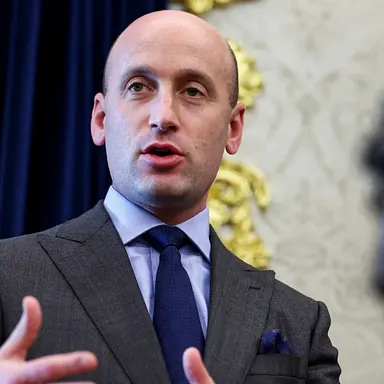
This Global News Podcast episode covers President Trump's appointment of hardliner Stephen Miller as White House chief of staff after Republicans lost ground in the midterm elections, with Democrats and some Republicans criticising the move. It also reports on the impeachment and house arrest of Paraguay's president, Santiago Peña, over a banking crisis, the court appearance of Thomas Markle on child abuse material charges, which he denies, a mass wedding in Gaza, and a new film by Guy Nattiv.
Listeners also hear a study suggesting ancient Siberian nomads smoked cannabis.
In this episode Charles Haviland, David Willis, Garry O'Donohue, Gino Caspari, Will Grant
The transcript of this episode on Stephen Miller's appointment and the Paraguay crisis was made with the tool HappyScribe built to transcribe audio to text.
Ads in this audio differ from the text. Tap the sentence you're hearing to follow along.
Synced: the text now follows the audio.
This is the Global News Podcast from the BBC World Service. I'm Charles Haviland, and in the early hours of Saturday, 7 November, these are our main stories: President Trump replaces his chief of staff days after Republicans lost control of both chambers of Congress in the midterm elections, and Paraguayans celebrate as President Santiago Peña is impeached and arrested. Also in this podcast: the Oscar-winning Israeli filmmaker Guy Native speaks to the BBC.
I'm heartbroken about what I left behind, because I don't recognize the country that I left, and I'm horrified by what's happening.
And we have a special report on a mass wedding in Gaza. We start in Washington, where the fallout from the midterm elections—so disastrous for Donald Trump's Republicans—is gathering momentum. On Friday, President Trump announced a new White House chief of staff, replacing Susie Wiles with Stephen Miller, a pugnacious Trump supporter and architect of his administration's sweeping and often violent immigration crackdown.
Stephen Miller will be the new chief of staff, and Susie's going to go over to the political operation. I think Susie's done a very good job, great job. Stephen's been with me from the beginning. He gets it very good politically, and he's a very good man. He'll do a great job, great manager.
The appointment was condemned by Democrats. Hakeem Jeffries, the likely next House speaker, called Stephen Miller "a dangerous xenophobe and reckless extremist." The League of United Latin American Citizens said Mr. Miller had led the attack on two constitutional guarantees, habeas corpus and birthright citizenship, adding that his elevation "disgraces the office of the presidency." Even some Republicans criticized the appointment, including the Nebraska congressman Don Bacon.
I think it's a big mistake by the president. Unfortunately, with Stephen Miller, I don't know of a single Democrat that will work with him, frankly. And I think many Republicans do not hold him in high regard. And why is that? Many Republicans like me talked to Mr. Miller and others on his team saying, "Hey, you've taken us from one extreme, where 12,000 people are crossing a day, violent people are entering our neighborhoods, to now you're deporting people that were at one point legal, and the legal status is removed. You're deporting people who have been here 10 years, 20 years, who are working, they have American families, they own homes."
And most Americans think that's gone too far. I think most Americans want something in the middle, not the one extreme of Biden or the other extreme of Stephen Miller.
Don Bacon. I asked our chief North America correspondent, Garry O'Donohue, if the shake-up was surprising.
It was a little bit of a surprise. I mean, last month, Donald Trump was asked about Susie Wiles and her future, and he said there was zero chance of her moving on, and she's moved on. But there had been some murmurs about her. And I think, certainly, the sources that have spoken to our American partner, CBS, made it very clear that the disastrous, the catastrophic midterm results for the Republicans on Tuesday may have been the thing that made the president this afternoon say, "Sometimes you have to make some moves."
It appeared she offered her resignation in reaction to him actually being furious. Do we know whether this was the case?
We're not sure about what happened. I'm sure eventually the kind of tick-tock of behind the scenes will emerge. But she did resign, but it looked like she was going to be pushed if she didn't. And of course, as you said, Stephen Miller, her deputy, has been bumped up. Now, that is a very significant signal to the country, to the rest of the world, that the president is not planning on changing course in any big way, because Stephen Miller has been with the president since the very beginning of the project 10 years ago. He's very much a hardliner on things like immigration. He designed the whole immigration strategy.
And of course, immigration is one of the things which was rejected outright, particularly by Hispanic voters and others, during these midterm elections, the way immigration policy was being enforced. So that's going to be an interesting signal for everyone to interpret. And also, it's worth noting that some Democrats have already reacted to this news. One senior Democrat said that Stephen Miller had blood on his hands because of the immigration policy. Another one said he was the Darth Vader of the country. So if Donald Trump was hoping that he might be able to do deals with Democrats who now control Congress in terms of legislation and things like that, that may have got a bit harder with Stephen Miller as chief of staff.
So, Garry, not so much a matter of President Trump being chastened, more the gloves are off.
I think that's right. I think Stephen Miller posted on Twitter that it was time to use all of our soul, as he put it, to support the president and to fight for this magnificent republic, as he described it. So there's certainly a pugilistic sound coming out of him and out of the president after those midterm results. And the president not seemingly prepared to change course. We know that the morning after the midterms parable, he was talking about the ballroom. Yesterday, he was signing an executive order to preserve the Oval Office with all its gold leaf, et cetera.
I will say this: he had four chiefs of staff during his first term. This is his second. Chiefs of staff do change in administrations. And if you're going to do it, this is as logical time to do it as any.
Garry O'Donohue in Washington. Shares in tech firms have recovered slightly in the United States after sharp falls on Thursday, which saw companies including Nvidia, SpaceX, and Tesla lose trillions of dollars in value. The losses were triggered by concerns that the electoral success of the Democrats would slow the development of artificial intelligence. More details from our business correspondent, Theo Leggett.
After a frenzied 24 hours, global stock markets appear to be pausing for breath. The main European markets spent the day in negative territory, but their losses were relatively small. Yet the impact of the recent sell-off is still being felt. Nervousness among investors about the AI boom and whether some tech companies will ever be able to justify their huge valuations by making enough money have been growing for some time. The Democratic Party's victory in the U.S. midterm elections this week raised the specter of increased regulation of data centers, which could curb the industry's growth.
Some experts believe the AI gold rush has created an unsustainable market bubble, which is now at risk of bursting and leaving investors nursing big losses. But according to Tudor Brown, who co-founded the British-based tech firm ARM Holdings, those concerns are being overplayed.
These stocks have run up massively on the pretext of infinite AI growth and data centers and whatever. And so when you get this Democratic set of winds, which is collectively being taken as going to put pressure on data centers, suddenly there's a bit of a panic. But if you stand back, it's not as catastrophic as you might think.
Mr. Brown points out that many tech firms are still reporting strong earnings, and he believes the industry is easily strong enough to weather a period of market turbulence. But at the very least, this week's events suggest investors no longer regard putting money into AI as a surefire bet.
Theo Leggett reporting. Paraguay's president, Santiago Peña, has been impeached, removed from office over his handling of a banking crisis. This is the moment protesters outside the Senate heard the decision. Santiago Peña, a close ally of Donald Trump, had attempted to resign of his own volition, but the impeachment means he's been stripped of the immunity granted to former presidents in Paraguay. And just minutes after the vote, he was placed under house arrest.
Vice President Pedro Allana has already been sworn in as the country's new leader, promising not to abandon the millions of people who've lost access to their savings after the collapse of a digital bank with which Mr. Peña has ties. Our Latin America correspondent, Will Grant, spoke to my colleague, Helena Humphrey.
A real late-night political drama in Asuncion to have the president basically go from impeachment process to arrested shortly thereafter has been shocking for many Paraguayans. He was impeached, including by members of his own party, the Colorado Party. The Senate turned against him. There was a sort of initial rebellion turned party-wide. This is the most established political party in the country. And once they had decided that they were going to charge him with misconduct, then it followed through to the arrest.
He is now in his home, where he is in police custody. There are protesters outside his home, and police have established a security cordon. So it's quite a tense moment.
A tense moment, complicated backstory. Just run us through how we got here.
Well, this bank is called the Ueno Bank, and he was a shareholder in it and used essentially his political influence to make sure that the national bank, the central bank of Paraguay, intervened. He had already placed cronies and so on in political positions to take control of the bank. So there's a huge series of questions about his conduct. And as I say, with people on the streets, Paraguay is a poor nation. It's been doing well in terms of poverty reduction in recent years.
But when you've got 60 percent of the adult population with their funds in that bank and they can't access them, obviously, there could be blowbacks there, particularly when we're talking about some 20 percent of the population still makes just about five, five-and-a-half dollars a day.
Yes. Talk more about that then and what this means for the country, because you have a former president impeached, now these latest developments, and many, many people right now very concerned about their saved-up funds.
Yes. So you have people on the streets. There's tear gas. There's been water cannon used against them. It's reminding me a little bit of Christmas 2001 in Argentina, when there was a similar run on the banks and a series of political crises that went with that. I think we went through about three presidents in five months. So not only do you have the situation where good-faith depositors can't access their funds, you have a political crisis, and of course, the economic crisis that goes with that. And the Argentine example, it took many, many years to pull out of it.
Will Grant speaking to Helena Humphrey. Now to the world of film. And this week, "The Liberation" opened in U.S. cinemas. Build as a psychological thriller, it's a movie rooted in the trauma of the Holocaust. It comes from Oscar-winning Guy Native, an Israeli-born filmmaker who is the grandson of Holocaust survivors. Tom Brook has been to meet him.
One of the largest Holocaust memorials in the world can be found here in Berlin. It's a powerful reminder of the orchestrated slaughter of some six million Jewish people during World War II. It's had a major impact on filmmakers around the world, including Israeli-born, Los Angeles-based director Guy Native, whose grandmother experienced the horrors of the Holocaust firsthand in Poland.
Where were you?
I lost track of time. I met this woman, a client.
Native's latest film, "The Liberation," which opens for an Oscar-qualifying run in U.S. cinemas this week, is inspired by his grandmother's story. We meet her as Rita Cooper, an assistant bank manager in New Jersey in the 1980s, a troubled woman very expertly played by Carrie Coon, who gives up her family life to join an all-female cult.
Mom's crying again. Mom's depressed.
It's a compelling, intense, unsettling, and dramatic story.
Come back in the house.
I saw a face. You will never touch me again.
We learn that Rita Cooper's trauma stems from Nazi-occupied Poland during World War II, where much of her family perished. That unresolved historical trauma may explain perhaps why she seeks spiritual solace in a cult. Guy Native gave me more details on the story.
She's hunted by her past, and she embarked on a new life for her that hopefully will save her from her agony and from her mental state that is deteriorating.
Director Guy Native has built up an impressive body of work.
Snakes are many predators.
He won an Oscar for his short film "Skin" in 2019, which looks at how racism and bigotry can be passed from one generation to another. As the grandson of Holocaust survivors, he believes the Holocaust has really shaped his filmmaking.
It's affected me tremendously.
You rescued these boys.
In 2023, Guy Native directed Dame Helen Mirren in his film "Golda," in which he plays Israeli Prime Minister Golda Meir at the time of the 1973 Yom Kippur War. Native has been a vocal critic of the current Israeli Prime Minister, Benjamin Netanyahu. He believes there are parallels in his film "Golda" with the Israeli leadership today, which he sees as having arrogance or hubris.
I'm heartbroken about what I left behind because I don't recognize the country that I left, and I'm horrified by what's happening.
Right now, in the filmmaking community, there are a lot of kind of strong voices which have been very critical of Israeli actions in Gaza and the occupied West Bank. When you're in Los Angeles, do you sometimes feel a bit like a social pariah?
I'm very clear about what's happening. Art is our weapon. I'm trying to find those bridges. But this one is a very personal film to me about my grandmother. It's a not-political film.
But "The Liberation" is resonating politically because, with a story rooted in historical trauma, it feeds into topical heated political debates around issues such as slavery reparations and the regional conflicts in the Middle East. So in that respect, Guy Native can be seen as a filmmaker trying to tackle some of the more challenging issues of our times. Tom Brook with that report. Still to come in this podcast.
It's only so many times as an archaeologist that you get to drug test a person that's been dead for almost 3,000 years.
We're a group of nomadic people from Siberia smoking cannabis nearly 3,000 years ago. You're listening to the Global News Podcast. Thomas Markle, the estranged father of Prince Harry's wife, Meghan, has appeared in court in Florida, his current home state, charged with possessing child sexual abuse material. The 82-year-old was arrested on Friday after the U.S.
FBI searched two storage units in California. He has previously denied allegations of wrongdoing. I asked our correspondent in Los Angeles, David Willis, what exactly Thomas Markle was being accused of.
Thomas Markle and Charles are accused. He's facing one charge of possessing child sexual imagery. And this relates to material that was found in two storage units that he has rented here in Los Angeles for nearly two decades, actually. FBI agents seized from those storage units a total of 48 items, 78 items, I should say, we're told, which are alleged to include slides, negatives, and books containing suspected child abuse images and its alleged sexually explicit photographs of Thomas Markle himself with naked underage girls.
Now, it's not unusual in cases like this for a single charge to be laid early on and then a superseding indictment brought later with additional charges. And today, Thomas Markle appeared in court in Tampa, Florida, in a wheelchair, handcuffed and flanked by U.S. marshals. He didn't enter a plea. And he was told by the judge that his arrest related to materials found in those storage units.
Briefly, what was decided about the conditions of his release?
Well, the judge ruled that Thomas Markle will be subjected to electronic tagging and home detention when he returns to the assisted living facility that has been his home near Tampa since he returned to the United States from the Philippines. He's been ordered to undergo a mental health or a psychiatric evaluation. He is, after all, 82 and thought to be suffering from dementia. He's to have no contact with either the alleged victims in this case or any minors, and his travel is restricted to the central Florida area, where he currently resides, and Southern California, where these charges relate to.
He has denied previously any wrongdoing, and he's called the allegations against him sick lies.
Again, briefly, David, this has become quite a complicated investigation because it spans more than one country, doesn't it?
It has. This has become a multinational criminal investigation. Thomas Markle lived for a while in Mexico, and the authorities there are thought to be investigating materials that have been uncovered there. And in the Philippines last month, officials displayed items that they seized from a property belonging to Thomas Markle, which are also alleged to have contained child abuse images. Now, if he's found guilty here in the United States, Thomas Markle could face up to 20 years in prison.
David Willis in Los Angeles. Qatar's Prime Minister, Sheikh Mohammed bin Abdul Rahman Al Thani, has warned that any further military escalation in the Middle East will simply make finding a solution more difficult. He was speaking at the Oxford Union on the same day as the Emir of Qatar urged President Trump to continue with diplomacy rather than conduct more military strikes against Iran. Our chief international correspondent, Lise Doucet, attended the Oxford Union event.
Sheikh Mohammed said Qatari mediators made five trips to Iran in the past week alone to try to avert another military escalation. Some meetings, he said, had lasted as long as 15 to 20 hours. He didn't go into detail about a process he described as challenging. And he cautioned there would never be a perfect peace deal, and we should not wait for that moment. But he still believed a final deal was possible on Iran's nuclear program, freedom of navigation through the Strait of Hormuz, and regional security.
Qatar, like several countries in the region, came under repeated retaliatory attacks by Iran during hostilities over the past eight months. No country, he emphasized, could afford another escalation. His comments came in the midst of conflicting signals from President Trump over whether he will stick with diplomacy or order another round of military strikes. Sheikh Mohammed said they were working with people in the U.S. administration who were trying to find ways to de-escalate.
He said there were wise voices and those who, as he put it, had different opinions.
Lise Doucet. Now, were the Scythians, a nomadic people that roamed the vast grasslands of Northern Asia nearly 3,000 years ago, fond of smoking cannabis? Quite possibly, yes, is the conclusion of a new paper in the journal Scientific American. Researchers have been analyzing the contents of a Scythian tomb in Southern Siberia for several years. Now they've found what they say is evidence that those buried inside had somehow ingested the drug. Dott. Gino Caspari is the lead author of the paper and an archaeologist at the Max Planck Institute of Geoanthropology in Germany.
We excavated a tomb since 2017 in Southern Siberia, a monumental burial mound of about 140 meters in diameter. When we approached the central burials, there were several individuals there, and we found these tiny little black dots throughout the burial. And these turned out to be seeds of cannabis. And then just a few hours later, we found preserved human hair, which is incredibly rare. And so, of course, we knew what to do next because it's only so many times as an archaeologist that you get to drug test a person that's been dead for almost 3,000 years.
We did find active compounds, cannabinoids that stem from cannabis. When you consume cannabis, part of these active compounds get built into your tissue. We can't tell whether that was through inhalation or through ingestion, but we know it's there in human soft tissue.
There have been some who've cast doubt on the hair evidence, saying that it's scientifically weak and that there wasn't enough evidence. Was it pretty clear-cut to you?
It was pretty clear-cut to us. It's either in or on the hair. Even if it's on the hair, that means that the cannabis compounds were at some point airborne, which means somebody has actually burnt it. That indicates still psychoactive use because the burning was very likely intentional.
I mean, how did it get there? It's a cold place.
It seems to have been a wild form that naturally had elevated levels of THC. Even today, we actually have serious amounts of cannabis growing not too far away from this tomb. So the cannabis lives in the area even today.
I mean, what might it have been used for?
Given that it was found in a burial context, of course, some of the interpretation goes towards the sort of ritual embedding of this. We do have also potentially a sinister way of speculating about this because we have a lot of horse sacrifices and human sacrifices. Preparing your humans for sacrifice might be beneficial if they're somewhat sedated before something bad happens to them. We can't really prove that, but that is some speculation based on the archaeological context that we find.
Dott. Gino Caspari speaking to James Menendez. 250 Palestinian couples are beginning married life after one of the largest mass ceremonies to date in war-torn Gaza. As our Middle East correspondent, Yolande Nel, reports, the celebration on Friday marked a rare moment of hope after three years of death and devastation.
The lingam stands erected by the sea in Gaza City. 500 mainly young Gazans are hoping for a new start in life.
Hello, it's Mohammed Goueda.
Mohammed Goueda is 30 and had thought that he'd be unable to marry 24-year-old Aya Musa because weddings have become so unaffordable.
I met my fiancée four months ago. When I saw her, I at that time, I didn't need to get married because of the current circumstances here in Gaza that prevent most of the people get married because of, of course, of the skyrocketing prices and money that most of people need to spend to get married. But when I saw her at that time, I started deciding, okay, why I'm not getting married with this girl. I need to know her more.
This big celebration was funded by an Emirati charity with makeup, bouquets, suits, and embroidered white dresses all included. Each couple gets a tent, food, and $3,000 to help them start married life. It means the world to Aya and Mohammed.
To be honest, when I heard my name to be one of these people here in this wedding, my feeling at that time was unforgettable.
Both Mohammed and his new wife have been displaced by the war. They've seen Jabalia, where they come from, and most of Gaza flattened and lost loved ones. Despite last year's ceasefire deal, there's near-daily Israeli bombardment as Israel says it continues to target Hamas. It's not easy to be hopeful.
In Brazil, I don't live a normal life. I feel that I have multiple psychological diseases because of the current situation. The stress and tension and fear that we live in is abnormal. At the same time, we are so happy, and we would like to thank all of the organizers for this wedding. Of course, we have a lot of fears towards tomorrow and what we are going to do. Every day, we hope that the next day comes and we are safe. We are here in Gaza, normal people.
Just we need to live a normal and peaceful life.
The event's very different from traditional individual Palestinian weddings, but this mass celebration, including songs, speeches, and dubka dancing with families waving Palestinian and Emirati flags, has spread some happiness. Bride Tazahil Abu Mutar says she's passed a milestone.
This is a moment of immense joy for me, truly the joy of a lifetime, one that is simply beyond words. Life goes on. We want to live our lives and not stop.
These newlyweds face a tough start, with winter storms in the coming days expected to cause flooding and make living conditions even harsher. But for now, the very act of getting married feels like a show of resilience.
That report from Yolande Nel. And that's all from us for now. If you want to get in touch, you can email us at globalpodcast@bbc.co.uk. You can also find us on X at BBC World Service. Use the hashtag globalnewspod. And don't forget our sister podcast, The Global Story, which goes in-depth and beyond the headlines on one big story. This edition of The Global News Podcast was mixed by Lee Wilson, and the producer was Emma Joseph.
The editor is Karen Martin. I'm Charles Haviland. Until next time, goodbye.
Donald Trump names the immigration hardliner, Stephen Miller, as the new White House chief of staff after the Republican Party's historic losses in the US midterm elections. Mr Miller's appointment to one of the most powerful positions in Washington has been criticised by Democrats and some Republicans. Also: Paraguay's president, Santiago Peña, is impeached and placed under house arrest. Thomas Markle - the estranged father of Prince Harry's wife, Meghan - appears in court over child sex abuse material; he denies wrongdoing. More than 200 Palestinian couples are married at a mass ceremony in war-torn Gaza. The American-Israeli filmmaker Guy Nattiv speaks to the BBC about his new movie, The Liberation. And were ancient Siberian nomads smoking cannabis?
The Global News Podcast brings you the breaking news you need to hear, as it happens. Listen for the latest headlines and current affairs from around the world. Politics, economics, climate, business, technology, health – we cover it all with expert analysis and insight.
Get the news that matters, delivered twice a day on weekdays and daily at weekends, plus special bonus episodes reacting to urgent breaking stories. Follow or subscribe now and never miss a moment.
Get in touch: globalpodcast@bbc.co.uk
Photo: Stephen Miller, the newly-appointed White House chief of staff, speaking on 20th October in the Oval Office.
Credit: Reuters