
This episode of the Global News Podcast looks at the Democratic victories in the US midterm elections, which gave the party control of both the Senate and the House. It covers voter frustration over the cost of living and the Iran war, the Republican losses in several states, and the debate over what the result means for President Trump's remaining two years and his veto power.
Reporters also discuss Abdullah Al-Sayed's win in Michigan, Iran's leadership reaction, Israel's coalition talks and Ukraine's award to Melania Trump. Listeners will hear competing analyses of what the vote signals for the 2028 presidential race.
In this episode Valerie Sanderson, Garry O'Donohue, Gia Goll, Jeremy Bowen, Neda Taufik, Noamie Iqbal, Vitalii Shevchenko, Yolande Nael
This episode's transcript on the Democratic midterm victory was made with HappyScribe technology, the same technology behind Zoom AI notes.
Ads in this audio differ from the text. Tap the sentence you're hearing to follow along.
Synced: the text now follows the audio.
This is the Global News Podcast from the BBC World Service. I'm Miami Jones, and at 15:00 GMT on Wednesday, the 4th of November, these are our main stories. The Democrats take the Senate and the House after a thumping victory in the U.S. midterms. Donald Trump responds as his Republican Party suffers sweeping losses across the country. We look at what this means for America and for the war in Iran. Also on this podcast.
They were targeting and attacking the very idea of America. They hate the idea of an America big enough for anyone who looks a little different, or prays a little different, or whose family comes from a different part of the world.
Abdullah Al-Sayed wins Michigan to become the first Muslim U.S. senator. In Israel, talks begin to decide who gets a chance to form a new government. And President Zelenskyy offers a prestigious Ukrainian award to millennial Trump. The political map of the U.S. has been torn up in a dramatic night of success for the Democrats, who've won control of the Senate and House of Representatives. In a stunning rebuke to President Trump midway through his second term, voters delivered what the U.S.
media is calling a "blue tsunami" across the country, with some states even electing a Democratic senator for the first time in around three decades. The Democrats have secured a string of victories in Republican strongholds. The new Senate is likely to be led by Senator Chuck Schumer of New York. He says the country is changing.
Republicans had a choice of following Trump over the cliff, even though Trump policies made American families' pain much worse. We never wavered. We listened to the American people, what they wanted. We talked to them. We sat down in their kitchens and their living rooms and said, "What should we do?" And they told us, and we listened. And the American people reduced the red brick wall to a pile of bricks. And as a result, there is now a generational remake of the Senate map that is going to change America now and on into the future.
Donald Trump wasn't on the ballot, but he told people to vote as if he were. So how has he reacted to the Republicans' defeat in their strongholds? He spoke to Fox News.
People agree with what I'm doing on Iran, but they really probably weren't willing to do the short-term consequence of paying more for gasoline. And that, you know, I understand that. That's, it's like, I don't agree with it. And I would say to people, you know, it's a short-term problem, but for long-term gain. But, you know, is that too bad?
Despite this landslide, President Trump still retains the power to veto bills from Congress that don't have a two-thirds majority. He was also asked about working with a Democratic House and Senate.
They'll send over things that are insane, and I'll veto them. And after a couple of months of vetos, they'll call and they'll say, "How do we get this stuff done?" And we'll work together. You know, I have a lot of friends that are Democrats, believe it or not. I've already spoken to some of them. I've had four calls from meaningful Democrats. But I have the power of veto, and the power of veto is, you know, it's impervious.
The astonishing victory for the Democrats was underestimated by the pollsters. So what was behind it? Was it a dislike for President Trump? Valerie Sanderson asked our correspondent, Noamie Iqbal, what she sees as the biggest reason the tide turned against Republicans in this election.
I think it's hard to look at it as being totally against Trump, because he still has a lot of support. I think the big reason voters rejected him is the cost of living. People have been feeling poorer. They're blaming President Trump. So if you look at inflation, the cost of groceries, everyday essentials, his tariffs, they have added to concerns about rising prices. The Iran war, I think, has played a huge role in this, a war that he is trapped in. And that has added to concerns about rising prices, petrol prices, for example.
And I think, generally speaking, it's this sense that rather than being America first, which was just concentrating on what's happening inside the U.S., he's been involved in foreign conflicts, in these other sort of potential battles, rather than dealing with people's everyday problems. If you look at where he's lost power, places that were reliably Republican as well, I think that his world has entirely changed now.
Well, you say his world has changed. So what does it mean for him going forward? Because he still has this crucial veto, doesn't he?
He does. And his political world has changed because he's weaker. But he's not powerless, of course. He's still the U.S. president. I think for him now, and he has talked about being Mr. Veto, that he will, you know, veto a lot of things, which he can. And I think his remaining two years in office is going to be very, very difficult for him, because Democrats can now do all sorts of things. They can block legislation, they can investigate him, and in fact, they're threatening to do that. He still has influence in terms of foreign policy. That's what's really interesting. And he is in that twilight zone now, his last two years, where he'll be legacy building.
I think the bigger thing for him will be, is he still influential? There's a difference between being powerful and being influential. And we see Barack Obama, for example, on the campaign trail with Abdullah Al-Sayed, who won in Michigan. He's not the president, but he's still influential. So it's going to be very interesting to see if Republicans start moving away from President Trump, who will still want to be influential, by the way. I don't think lame duck is something that anyone would necessarily associate Donald Trump with, even though he is in his lame duck era. He will still want to have a say over who the next leader is of the Republican Party.
Well, let's think of leaders of the Democratic Party. You mentioned Abdullah Al-Sayed won a stunning victory in Michigan. I mean, looking forward, is he one of the key people to watch for the Democrats in 2028?
He won Michigan. And Michigan is a swing state. You could argue if you win Michigan, then you could win a presidency. I think there are lots of other names that come to mind first. Keep an eye on Jon Ossoff in Georgia. James Tallarico, amazingly, that victory he pulled off in Texas. He could be talked about. Pete Buttigieg. I think there's still those other names like Gavin Newsom as well, the California governor. We're still doing the midterms, but already, I think in the next day or two, everyone will be talking about 2028. It'll be very interesting to see what happens to the Republican Party moving forward, because this is brutal for them.
Keep an eye on those Republicans who are very MAGA-aligned, who are slowly going to move away from Donald Trump. I think MAGA will still exist in some way, and Donald Trump will still want it to exist. But right now, after these midterm elections, it looks like Trump and everything he represents could be a toxic brand.
Noamie Iqbal. Now, Democrats won in Republican states that weren't competitive even a year ago: South Carolina, Maine, Ohio, and Kansas. In several of these races, Trump had chosen the Republican candidate himself. Texas was one of those, and one of the biggest rejections of all: James Tallarico winning a Senate seat for the Democrats for the first time in almost 40 years. The 37-year-old wasn't even born the last time that happened. It was, he said, a David and Goliath moment.
We just sent a message to every billionaire megadonor, every trillionaire megadonor, every corrupt defender of this broken political system. In this state, in this country, power belongs to the people.
Our North America correspondent, Garry O'Donohue, was there as the result became clear.
It's happened. Democrats have taken back Texas. What do you think?
That's great.
Happy?
Yeah.
You could do it.
Thrilled by this.
I think this is a great day for Texans who finally have their voices heard after years of having outside interests decide what we get to think and do out here.
So are you doing in Texas, huh?
Yes. I am just so amazed by this. This is going to be, like, real change here.
Yeah?
Yeah, I feel that.
I think it's fantastic. I didn't think this day would happen again. I'm from Texas. I remember when Ann Richards won governor. The fact that a Democrat hasn't.
Motivieren auch wirklich ihre Strategie abzugehen.
I don't know, because I didn't know what this was going to be like. We were all hoping, we were ever hopeful, but you never know.
How are you going to celebrate?
I'm going to celebrate with my friends and just right here, like this.
Another cocktail?
USA, USA. I'm sober, but that's okay. I'm still going to celebrate. What do you think? What about you? What about what? You're excited? Excited, yes. You got both of them. We got both of them. Oh my God, we're taking Texas back. I cannot believe this at all. This is amazing. Never in my lifetime has Texas been blue. We're blue, baby, we're blue.
There's a lot of disbelief here tonight. They didn't quite dare believe that they could win a Senate seat. They definitely didn't dare believe they could win the governor's as well. They're going to be partying here for a long time yet.
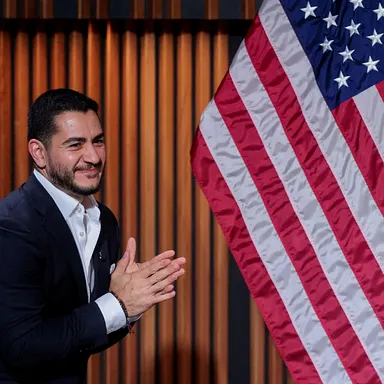
Let's hear more now on what may turn out to be one of the most eye-catching Democratic wins of the night. In Michigan, Abdullah Al-Sayed has won, holding the Senate seat for the Democrats, despite a fierce campaign against him. The progressive left politician beat Republican Mike Rogers to become the first Muslim U.S. senator. Taking the stage in front of supporters to claim victory, he called the Republican campaign against him ugly and divisive.
They weren't targeting me. They were targeting and attacking you. They were targeting and attacking the very idea of America. See, they hate the idea of an America big enough for anyone who looks a little different, or prays a little different, or whose family comes from a different part of the world. That includes me, but it also includes anyone and everyone who doesn't look like them, pray like them, love like them, or isn't rich like them.
It's a moment that could shape the future of the Democratic Party. Our correspondent, Neda Taufik, is in Michigan.
Abdullah Al-Sayed in the Democratic primary was unapologetically a critic of Israel. He ran to the left of his party on things like universal, you know, health care, and having foreign aid spent here in the United States instead of out in wars overseas. And he won that primary narrowly. But Republicans after that thought that it was their best chance to pick up a Democratic seat in the Senate. They thought they could attack him.
And what we saw was what Abdullah Al-Sayed said on stage today. He called it one of the ugliest campaigns in our lifetime. And what we saw was anti-Muslim rhetoric used against him, the President of the United States over and over, attacking him falsely as a jihadist, spreading this conspiracy theory that he wants to spread Islamic law in America. You know, I spoke to a progressive strategist who is here tonight, Adam Green, and he said that this likely makes the water run warmer for someone like Alexandria Ocasio-Cortez to run for President in 2028.
He says that progressives no longer can be told that they can't win. So this has certainly kind of excited progressives. They feel that their candidates, when they stick to messaging like affordability, that it resonates with people. When they talk about, you know, corporations not being able to spend in politics, that resonates with people. And when they talk about, you know, having more funding going to schooling and health care, that that is also a winning message.
Now, centrists would argue that, you know, moderates don't want government in people's lives as much. And that has been this kind of tug and pull in the Democratic Party where they should go. And we haven't really seen a consistent message from the party. Of course, that's what primaries are for ahead of the 2028 presidential election. Those different candidates and their ideas will have to play out. But progressives now are going to say Michigan is a swing state. We had a win there, and this is a message that we can take to the rest of the country.
Neda Taufik. Still to come in this podcast.
They see it as a victory for Iran. And even one of the revolutionary commanders said Donald Trump lost the Senate to Iran.
What does Donald Trump's midterms defeat mean for the war in Iran? This is the Global News Podcast. The election in America has been eagerly watched around the world. But what would the consequences be for President Trump's foreign policy? The BBC's international editor, Jeremy Bowen, explained whether this can be seen as voters showing their disapproval of the Iran war and how the result is likely to affect President Trump's policy towards Tehran.
Well, I think they've said no to high fuel prices rather than no to war necessarily. I mean, that is a massive question right now, because there were loads of signs that the Americans were certainly preparing for the option of returning to major combat operations, probably with the Israelis, after the midterms were over. You know, Trump, in his musings in the various interviews that he's done, has not ruled that out. He says it's really up to Iran. So the thing is, is that an American president has a lot of latitude in what he does abroad.
I think right now it would be foolhardy to try and guess at exactly what he will do. I suppose one option is to say, well, the American people have shown that they are concerned about the effect of the war on fuel prices. Therefore, let's not have any more war, and maybe we'll try and calm fuel prices. Or he might reason, well, the damage has been done, I'm going to go ahead with it anyway.
Jeremy Bowen. But how are the results from the U.S. midterms being seen in Iran? Iran's supreme leader says he doesn't expect U.S. policy to change. Gia Goll from our Persian service told Valerie Sanderson what else we've been hearing from the leadership in Tehran.
If you look at the newspaper close to revolutionary guard, they see it as a victory for Iran. And even one of the revolutionary commanders said that it was a referendum on Donald Trump's war against Iran. And also, they call it Donald Trump lost the Senate to Iran. And the supreme leader of Iran, in a message today, he said those people who think U.S. policy toward Iran will change by shifting the partisanship in the U.S., they are greatly mistaken.
And only being strong deter the United States. Mohammad Baqer Qalibov, the Speaker of the Parliament and one of the chief negotiators, he said whether it was a conscious or living cost, Americans said no to war, and we support this. And obviously, we have different messages coming out. Many in Iran, they were openly on state media, they were talking about prolonging the negotiation and disrupting oil flow in the Strait of Hormuz in hopes of rising the price in the United States.
It might affect the midterm election, and that's certainly Iran see that through that lens. And don't forget, today is the 47th anniversary of the seize of the U.S. embassy in Tehran. At the time, also, by taking U.S. diplomats hostages and holding them for 444 days, in fact, they cost Democrats at the time the presidency.
That was Jimmy Carter, wasn't it?
Jimmy Carter lost it to Ronald Reagan. They released the Iranian hostages exactly hours after the inauguration of Ronald Reagan. So many people are actually comparing two together. They said Iran has affected the U.S. election this time again.
Well, President Trump says it's up to Iran what happens next, although some have warned of renewed military action with U.S. military forces in force in the region. I mean, what do you think Tehran is likely to do?
I think Iranians are extremely nervous about the situation. Particularly in the past few weeks, we have witnessed the U.S. have deployed more military hardware. Two aircraft carriers are on the way. In fact, soon, in mid-November, there will be three aircraft carriers. And also, we are hearing that U.S. fuel tanker aircraft are being deployed to Israel. And there are all signs they might be resuming the attacks against Iran. But in the same time, the messages we are hearing from Tehran are defiant.
And they said if the U.S. attacks Iran, they will respond with a force never seen before. And we saw this in the Iran's supreme leader's message today again.
Gia Goll from BBC Persian. The U.S. midterms have also been watched closely in Israel at a time of major political uncertainty. In elections just over a week ago, neither Prime Minister Benjamin Netanyahu's coalition nor Gaddis and Quad's opposition bloc were able to secure the majority needed to lead the country. Now talks have begun to decide who will get the first chance to form a new coalition government. Our Middle East correspondent in Jerusalem, Yolande Nael, has been speaking to Valerie Sanderson.
The head of the Central Election Committee, who's a Supreme Court judge, presented the election results officially to President Isaac Herzog. And he spoke at the ceremony and said that casting doubts on the election results poses a real danger to democracy in Israel. And he reiterated that if suspicions of election fraud were proven, the extent of the fraud wouldn't be enough to impact the election results. And that is really a reference to ongoing investigations into allegations of voter fraud. They've been made by the Prime Minister's Likud party, by his coalition partners too.
And they're arguing that really that the publication of the election results should have been held up. Now, Israel's Attorney General has rejected a demand by the head of the Shin Bet, the Domestic Security Service, who's an appointee of the Prime Minister, to interrogate four Arab political leaders, saying there's been no evidence that has been presented of wrongdoing. And anyway, handing over now the election results clears the way for President Herzog to start his meetings with party leaders. That'll happen today and Thursday.
And he'll ask them who they recommend for Prime Minister. Then he has a week to ask one of the party leaders to try to form a new coalition government.
And what about the Arab-led parties who secured a record number of seats?
So they're really in the spotlight because of the unprecedented turnout that there's been in the Arab communities. Of course, Arab or Palestinian citizens of Israel make up just over a fifth of the population. And they have secured 19 seats out of a total of 120 in the Knesset, in the Parliament. That means, you know, they are a powerful force. They could potentially break what is, in effect, a political deadlock because you neither have Prime Minister Benjamin Netanyahu, his bloc, nor the opposition bloc, the so-called Change bloc led by Gadi Eisencott, the former Israeli military chief, with enough seats to form a governing coalition as it stands.
But the real question is whether, you know, Jewish political leaders in Israel are ready to accept the Arab parties as legitimate parties and partners in governing the country.
So will they not be part of a coalition, do you think?
Well, it's still not totally clear, but certainly what the joint Arab list has said is it could provide a safety net propping up a minority government with a kind of voting deal. The United Arab list is still insisting it would like to sit inside the government. And during the election campaign, very effectively for the Israeli public, Benjamin Netanyahu and his coalition partners painted like the idea of any such collaboration is creating a dangerous government, almost an existential threat for Israel. And the problem is that almost all of the parties in the Change bloc of Gadi Eisencott, except for the Democrats headed by Yair Golan, have also been ruling out the possibility of sitting in government with the Arab parties.
Yolande Nael. President Zelensky has rewarded Melania Trump for her role in brokering a ceasefire in the Russian-occupied city of Oleshky. The U.S. First Lady has been given the highest award for women in Ukraine, the Order of Princess Olga. The five-day truce, which ended on Monday, enabled the evacuation of hundreds of Ukrainians from Oleshky, who'd been living in dire humanitarian conditions under Russian control. Valerie Sanderson asked our Russia editor at BBC Monitoring, Vitalii Shevchenko, what we know about the role Melania Trump played.
We are not exactly certain what Melania Trump has achieved, but the fact is that President Zelensky is really, really keen to highlight America's role in helping evacuate hundreds of people in this town called Oleshky, which is occupied by Russia. And what he did earlier today by awarding this order illustrates the chasm that exists between the official rhetoric that we hear from Kyiv and how Donald Trump is viewed by commentators in Ukraine.
President Zelensky, every time he mentions the United States, he thanks Donald Trump profusely, even though the American president has made it so, so much more difficult for Ukraine to defend itself against the Russian aggression. If we look at commentators, one blogger said this morning, well, it doesn't really cost us anything awarding medals and orders to the Americans. We might as well give an order of bravery to Donald Trump because it just pleases them.
And the hope that exists in Kyiv is that by pleasing Donald Trump, by flattering Donald Trump, they're hoping to secure continued intelligence sharing from Americans and also more supplies of anti-ballistic missile interceptors, which are made in the United States.
But what do you think President Zelensky will be making of President Trump losing control of Congress?
I suspect, even though President Zelensky hasn't really said anything so far, I suspect President Zelensky will share the, you know, the huge sigh of relief that we've been hearing from commentators in social media in Ukraine, one of whom said, "Freedom has won in America."
Vitalii Shevchenko. And that's all from us for now. If you want to get in touch, you can email us at globalpodcast@bbc.co.uk. And you can also watch our episodes in full. Just search for the Global News Podcast on YouTube. This edition was mixed by Louis Griffin and the producers were Charles Sanctuary and Alfie Abershin. The editor is Karen Martin. I'm Mighty Jones. Until next time, goodbye.
Democrats have stormed to success in the US midterm elections, capitalising on voter anger about the Iran war, the economy and threats to democracy under Donald Trump. Both the Senate and the House have been flipped by a wide margin. Senate seats turned from Republican to Democrat in Texas, Ohio, Iowa, Kansas and Maine, as well as North and South Carolina. Many of the seats had been held by Republicans for decades. In a first reaction, Iran's supreme leader said he doesn't expect US policy to change, although his chief negotiator earlier said the results showed Americans didn't want war. Also; Israel's president has begun consultations with party leaders on who can form a government after last week's inconclusive vote, and President Zelensky has given Ukraine's highest civilian award for women to the American first lady, Melania Trump, for a ceasefire which she's credited with brokering in the Russian-occupied city of Oleshky.
The Global News Podcast brings you the breaking news you need to hear, as it happens. Listen for the latest headlines and current affairs from around the world. Politics, economics, climate, business, technology, health – we cover it all with expert analysis and insight.
Get the news that matters, delivered twice a day on weekdays and daily at weekends, plus special bonus episodes reacting to urgent breaking stories. Follow or subscribe now and never miss a moment.
Get in touch: globalpodcast@bbc.co.uk
Photo: Democratic US Senate candidate Abdul El-Sayed walks onto the stage after his victory in the US midterm elections in Detroit, Michigan
Credit: Reuters/Brian Snyder