
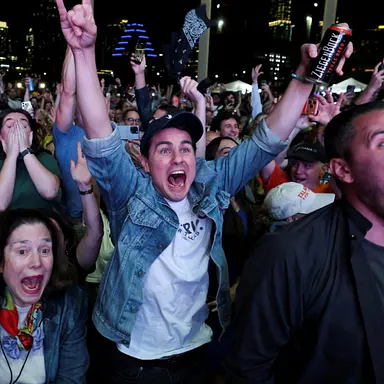
This episode of the Global News Podcast looks at the US midterm elections, in which Democrats were projected to win control of the House of Representatives and flip several Senate seats. It covers Democratic gains in North Carolina, Georgia and New Hampshire, and the upset in Texas, where the Democrats were projected to win a Senate seat.
Sarah Smith explains how Democratic-led committees could investigate and block parts of President Trump's agenda in his final two years. A Republican county official and an Iowa farmer share their views on the results, the economy and tariffs.
Listeners will hear how cost of living concerns and foreign policy issues in Iran and Ukraine shaped the vote.
In this episode Alex Ritson, James Kumarasamy, Carl Nasman, Daniel Bush, Elyse Doucet, Gary O'Donohue, Owen Strickland, Ryan Marquard, Sarah Smith
The transcript of this episode on Democrats' midterm gains and the Texas Senate upset was made with the technology behind HappyScribe's AI note taker.
Ads in this audio differ from the text. Tap the sentence you're hearing to follow along.
Synced: the text now follows the audio.
On midterm election day in the United States, this is the Global News Podcast from the BBC World Service. I'm Alex Ritson, and in the early hours of Wednesday, the 4th of November, we're focusing on just one story: those U.S. elections. The Democrats are projected to win a majority in the U.S. House of Representatives, taking control from the Republicans. It's also thought they'll win the race for the Senate. Senior Democrat figures are not holding back.
In sweeping and decisive victories. The American people have rebuked the depravity, corruption, and incompetence of the failed, lame-duck President Donald J. Trump.
Democrats have flipped Senate seats in both North and South Carolina. Donald Trump appears to be taking the night's results badly, with very angry social media posts coming from the White House. Also in this podcast: for the first time, an openly gay man has been elected to the U.S. Senate.
I am so grateful for everyone in this room and beyond who made this win possible. I want to thank the guy next to me, my amazing husband, Van. And look, tonight, win, lose, or draw, I'm the luckiest guy.
Results are still coming in. This podcast is the best summary of what we know so far. As we record this, early results from the midterm elections in the United States suggest the Democrats are outperforming expectations: all 435 seats in the U.S. House of Representatives were up for grabs, as well as about a third of the 100 seats in the Senate. News outlets were reporting that the Democrats would regain control of the House of Representatives.
Polls suggested that voters were frustrated with the cost of living, the high price of health care, and the war in Iran. In the first significant victory of the night for the Democrats, Roy Cooper managed to flip a Senate seat in North Carolina from the Republicans. The Democrats had not won there for nearly 20 years. Roy Cooper ran a campaign under the banner "Make stuff cost less." He was understandably happy when addressing his supporters.
Tonight, guys, we told Washington loud and clear that North Carolinians will always matter more than the billionaires and the insiders. Tonight, we showed the country that when everyday people come together, we can make change. Tonight, we let everyone know that we are just getting started. But, guys, tonight the campaign ends, but tomorrow the work of governing begins.
Our Washington correspondent, Daniel Bush, has this assessment of why Mr. Cooper won in the former red state.
In North Carolina, we had a situation where Roy Cooper was a very widely known figure, right? He was the outgoing, term-limited governor who was well-liked by Democrats, some independents as well. Waltley was an important Republican operative at the national level, but not very well-known among voters. And what Waltley and President Trump tried to do in North Carolina, as they tried to do around the country, was paint the Democratic candidate as an extreme socialist. But Roy Cooper is not that. And the same way that, you know, Trump failed to do that with Biden in 2020, that simply didn't work in a state where voters understood that the governor had a more centrist reputation and more centrist record.
And it's just important, I think, to take a step back here for a split second and just to think about the history of North Carolina. It is a Republican state. It has only voted for a Democrat at the presidential level once since 1980. The retiring Republican senator only won by two points, but he had a more comfortable victory in the past. It's a state that has not elected a Democratic senator since 2008. So this is, you know, a sea change of sorts in that state, at least at the Senate level. And as you noted, Osmond, it's the first pickup for Democrats, and they'll need a couple others, but this is a race that they had earmarked for a long time as a potential victory.
Daniel Bush. In another key Senate race, John Ossoff, the only Democrat senator running for reelection, won the ballot in Georgia.
Thank you. I love you, too. I love you, too. And listen, in sweeping and decisive victories, the American people have rebuked the depravity, corruption, and incompetence of the failed, lame-duck President Donald J. Trump.
And if at times these last two years, amidst the ceaseless onslaught of brutality and indecency, you doubted whether our Republic would survive, let tonight's results give you courage that the first light of dawn is on the horizon. Together, we've affirmed that our task is not just to contain one president's wickedness, but to heal the brokenness beneath.
He defeated Republican challenger Mike Collins. John Ossoff is widely seen as a potential presidential candidate in 2028. Our correspondent, Carl Nasman, was at the campaign's Results Watch party.
I think that there was a sense among Democrats in this state that they might have been dreaming a little bit too big with the way that some of the polls were shaping up for them. But it turns out, right now, I mean, this is more success than their wildest dreams could ever imagine. John Ossoff with a commanding projected victory here, and now the projection for the Democratic gubernatorial candidate, Keisha Lance Bottoms, to become really a history-maker here, not only in Georgia but across the country. She is Georgia's first Black governor, Georgia's first female governor.
In fact, she's the first Black woman to be elected to any statewide office in this state's history. She's also the first female Black governor of any U.S. state. So it gives you a sense of kind of the weight of history there on that race. But again, John Ossoff, somebody who, and we can hear in his words, many consider him to be a potential presidential candidate in that 2028 race coming up. But what he had to do first, of course, was win reelection here. He did that handily. And I think that many would say that he was probably one of the reasons why the Democrats did have so much success, it seems, in this state in this election.
He got a lot of excitement going on the campaign trail. It really is remarkable to see a state like Georgia and have so many of these races turning blue tonight. And this is in what many would consider to be a pretty Republican state here.
Carl Nasman. Chris Pappas is projected by our U.S. partner, CBS, to win New Hampshire and has already given a victory speech. If confirmed, he'll be the U.S.'s first openly gay man to become a senator.
New Hampshire is now headed to Washington to get our state and our country on the right track for the future. And so I am so grateful for everyone in this room and beyond who made this win possible. I want to thank the guy next to me, my amazing husband, Van. How about it?
All right, the wrong person was on the ballot, apparently. But he's always been by my side. And look, tonight, win, lose, or draw, I'm the luckiest guy because I'm married to a woman that I love.
Chris Pappas. The Democrats are projected to win the House of Representatives by a significant majority. Speaking to James Kumarasamy, our North America editor, Sarah Smith, outlines the implications for Donald Trump's last two years in office.
They will take control of all sorts of committees, which can then launch investigations into decisions Donald Trump has made in office, like, say, launching the war in Iran. They can also investigate, and they've said they want to, money he and his family have been making since he reentered the White House. They could try to impeach him again for a third time. They might decide that's not worth it. But they could very well investigate and potentially impeach Cabinet secretaries, like, for instance, the Defense Secretary, Pete Hegseth.
So this could take up a huge amount of Donald Trump's time and energy dealing with these kind of investigations, while at the same time, they will be able to block a lot of legislation that he wants to get passed. So this is not just taking the temperature of where the country is after two years of Donald Trump in the White House. It's also setting limits on what he'll be able to do for the last two years.
What about the political heat, then, Sarah? There was a statement earlier from the White House on background saying the White House mood is defiant. And it ended I didn't mention this end comment, but it is possibly a sign of things to come. And it was, regardless of how today plays out, President Trump's resolve to stop the radical left is only going to become stronger. Buckle up. What do you make of that?
Gosh, yes, that's fighting talk from Donald Trump. But, you know, in the face of what he might call the radical left, winning victories at the expense of his Republicans, there are special circumstances in some places where Donald Trump backed particular Republican candidates who were maybe not the strongest. And Democrats have done really well in a lot of places of recruiting particularly talented and appealing candidates. So that's one of the reasons why they will have been winning. But what we are beginning to see now is a movement across the country that cannot be read as anything other than a message that voters are unhappy with Donald Trump, principally around the cost of living, that they blame him directly for increasing their cost of living.
And remember, he got back into the White House on a promise to improve the economy because voters were upset with the inflation they'd seen under Joe Biden's tenure. So people are particularly disappointed with him in that regard. There are some very left-wing candidates standing in these elections and some of the Senate races, and we haven't seen how they have fared yet. But I suspect Donald Trump is talking in general about the Democrats who've been defeating his candidates. And we will just need to see what he can do to fight against a majority in the House of Representatives.
Our North America editor, Sarah Smith. And there have been some very angry social media posts coming from Donald Trump in the White House. Some are actually quite rude. This one, though, appears to sum up the president's feelings on the matter. I wasn't on the ballot, and if I was, we would have won in a landslide. But he has added that he is absolutely willing to accept the election results. Still to come in this podcast: analysis of the Democrats' historic Senate win in Texas, the first time they've had a seat there in more than three decades.
This is the Global News Podcast. So what appears to have gone against President Trump's Republican Party? A survey of voters suggests that the economy, high inflation, and the difficulty of affording even basic goods seems to have motivated many. Ryan Marquard, Vice President of the Iowa Farmers Union and a farmer himself, identified President Trump's tariffs as a particular problem.
It's the death by a thousand cuts. It's the tariff policy and the current representatives of the state supporting the president in his tariff policies. Then you step back and you look at the war, and you look at the not just diesel prices, but, like, also the price of fertilizer directly impacted there. And you think about everything that we bring on and off this farm. Diesel is part of all of that. So we don't know what those costs are going to be.
How much have you been impacted by that? Can you spell that out for us? I mean, when you say that it's a lot, what does that feel like?
Sure. We're probably looking at at least $8,000 to $9,000 just right now. We're not even done with harvest yet, so we don't really full know what that's going to look like when the dust settles.
Can I ask you something, Ryan? This is James Kumarasamy. I remember soon after Donald Trump won his first election in 2016, I spoke to quite a few farmers across the Midwest in other states, like Wisconsin, for example. And they said, look, we accept the pain of the tariffs. We think for the long term, it's actually going to be good for us. Has that changed within the farming community?
I don't think there's been any particular benefit that's really proven itself in terms of tariff policy at this point. And it's not just, like, having tariffs. It's the radical oscillations between they're on, they're off, and then having the policy made via, well, a tweet or on Truth Social, basically. Like, just how unpredictable it is makes it really hard to plan, makes it really hard to have trade relationships, and it makes it really hard to keep prices stable.
Ryan, you've mentioned a couple of policies that have disappointed you that you've seen from this Trump administration. Whether you're talking about tariffs or you say the war in Iran and its effects on diesel prices. I'm curious about the sort of converse part of that equation, which is, have you received, like, an affirmative message from Democrats that makes you feel like they will be the better party when it comes to the farming community?
That's a fair question. You know, some candidates in the state have provided a vision for what is possible out there. Those aren't probably I hate to say this probably not our federal candidates per se, but more of our local candidates that have done that. So I would say that there may be a deficit there in terms of providing a vision for what's possible in the future.
Farmer Ryan Marquard speaking to James Kumarasamy and Asma Khalid. So how will the U.S. midterm elections affect U.S. foreign policy, particularly the wars in Iran and Ukraine? Our chief international correspondent, Elyse Doucet.
Right now, the focus is on opening the Strait of Hormuz, which, of course, was open before this war was unleashed on February the 28th. And it is the closure of that strait that is having such a huge impact and that you've been discussing about how prices are so high. In 1992, it was James Carville, the strategist, who said, well, what are elections about? It's the economy, stupid, when Bill Clinton was running. And this might be one of those rare times when the Iran crisis, a foreign policy crisis, is a cost of living crisis in the United States.
And that is what the negotiations are about now. Yes, President Trump is insisting that we can't just discuss the strait. We have to also discuss nuclear issues. Iran has been saying, let's open the strait first, lift some of our sanctions, unfreeze some of our assets, and then we will discuss the nuclear issue. But quite frankly, I was in Geneva on February the 26th. That's where they were discussing the nuclear issue before this war began.
Interesting, Elyse. And yes, the raging Cajun, James Carville, he's still there, seems still popping up with his wisdom on the screen. I wonder about another war, the war in Ukraine as well.
I think, however, President Trump, however good or bad the Republicans do in this poll, there is a sense for President Putin, who's watching on, for Prime Minister Netanyahu of Israel, who's watching on, that they have this two-year window. There's been lots of reports circulating that President Putin could try to test the NATO alliance's Article 5, that an attack on one is an attack on all, because he suspects, and many in NATO suspect, that President Trump will not join any attack against President Putin.
So he may try to take advantage in these last two years. Prime Minister Netanyahu of Israel was absolutely specific on this. In the run-up to his election, the elections there on October the 27th, he said, we have two years with President Trump to finish what he called the mission. And President Trump also spoke about getting the job done in Iran. So I think that is something that we have to keep an eye on after these elections. However, the Americans vote that these two foreign policy crises, Iran and Ukraine, could start taking a turn.
Our chief international correspondent, Elyse Doucet, speaking to James Kumarasamy. We've heard a lot in this podcast about the joy of the Democrats after what appears to be a massive win in the midterms. Let's now get a Republican reaction. Owen Strickland is a party official in Nash County in the state of North Carolina, the first state to flip to the Democrats. He spoke to James Kumarasamy.
We are obviously in the midst of a bit of a wave. We have worked very hard during this cycle to pull this out, you know, as well as I do, historic levels of voting. And, you know, we have a history that says that the party out of power tends to pick up during midterms. So we are obviously disappointed. We have worked very hard here in Nash County to make sure our candidates are successful.
But you don't always win what you really work hard for. So we're going to rededicate ourselves. We're very sad, obviously. We would love to have a Republican sweep, but you don't always get what you want.
What about the role of the president? He was very much front and center in these last few weeks of the campaign. I'm not sure whether he came to I suspect not to North Carolina because it really had been in the Democratic column for some time. But he did. He did come, did he? Your thoughts on him and his role in all of this?
You will never hear this party chairman for a county badmouth our president. However, obviously, there were drags on these particular races, the economy being one of them. Some choices that were made at the highest levels were probably not beneficial. The gas prices and things of that nature. And we all have character flaws. And, you know, each one of us has to have that cross to bear. And our president tends to say a lot of things that upset a lot of Democrats.
I think you heard Mr. Ossoff say in his statement, you know, it's obvious what the Democrats are planning just by his statement. And unfortunately, Roy Cooper is going to fall right into that. They're going to go after this president. And that is what we've been concerned about all along. And we will continue to be concerned about it. And all it's going to do is reinforce our need to take back over in two years.
North Carolina Republican Owen Strickland. Before we end this podcast, we go to what's perhaps the biggest upset of these elections. The state of Texas, which has been dominated by the Republicans for decades, has turned blue. James Tallarico is the first Democrat to be elected to the Senate there since 1988. His victory has helped his party, according to U.S. media outlets, to secure the Senate. The new senator's fellow party member, Gina Inohosa, will become the state's governor.
Our chief North America correspondent, Gary O'Donohue, is in Austin and told James Kumarasamy more.
There was a lot of hope that Tallarico would do it here. People saw him up in the polls marginally. They were very hopeful. They saw a lead build. But none of them really believed that the governor, the incumbent governor, Greg Abbott, would be toppled, that he was a fundraising machine, that he had won big last time. He was, well, last three times, in fact. But it does look now like they are going to do this double in Texas. And they have waited for this for a very, very long time.
And I was just up among the crowd. We've just come slightly away from the crowd. And they were just going mad. They were necking cocktails. They were jumping up and down. They were hugging one another. They just couldn't believe it. I spoke to one guy a moment earlier, and he said, I'm so excited. It's bleeding out of me.
Gosh. Yes, it has been the nearly state, hasn't it, for the Democrats for so long. I guess it's, you know, it's pinch-me time for many of them.
Yeah. I mean, there was a bit of bewilderment when I was talking. I even remember when they were yelling. They had been waiting for a long time. You know, they haven't had a governor, a Democratic governor, here since Anne Richards at the beginning of the 1990s. And they haven't had a Democratic senator since Lloyd Benson was elected in '88.
Gary O'Donohue. And that's all from us for now. If you want to get in touch, you can email us at globalpodcast@bbc.co.uk. You can also find us on X at BBC World Service. Use the hashtag #GlobalNewsPod. And we'll have a fuller picture of the results from the U.S. midterms in the next edition of the Global News Podcast. This edition was mixed by Chris Cazares, and the producer was Adrienne White.
The editor is Karen Martin. I'm Alex Ritson. Until next time, goodbye.
The Democratic Party inflicted a huge upset on the Republicans in the US midterm elections. In the Senate race in Texas, the Democrat James Talarico is projected to beat the Republican Ken Paxton. He'll join Democratic Senators from South and North Carolina, and Ohio, who've flipped seats in a change that will see the Republicans lose control of the Senate. The Democrats are already expected to win a majority in the House of Representatives - a victory which will have a major impact on President Trump's ability to govern. Writing on social media, the president said that if he'd been on the ballot, the Republicans would have won 'in a landslide'.
The Global News Podcast brings you the breaking news you need to hear, as it happens. Listen for the latest headlines and current affairs from around the world. Politics, economics, climate, business, technology, health – we cover it all with expert analysis and insight.
Get the news that matters, delivered twice a day on weekdays and daily at weekends, plus special bonus episodes reacting to urgent breaking stories. Follow or subscribe now and never miss a moment.
Get in touch: globalpodcast@bbc.co.uk
Photo: Supporters react after media outlets projected Democratic US Senate candidate and Texas State Representative James Talarico's victory in the US midterm elections in Austin, Texas, US, November 3, 2026.
Credit: Reuters