
This Global News Podcast episode covers violent protests in France over living costs, anti-government unrest in Albania, and emotional reunions in Ukraine for evacuees from occupied Oleshky. It examines Andy Burnham's openness to a formal apology for Britain's role in the transatlantic slave trade, which he pairs with a rejection of financial reparations, and includes voices from the debate.
Other segments feature Jimmy Wales on Wikipedia's 25th anniversary and the threat AI poses to its model, a dengue and measles crisis in Bangladesh, a UN employee's death in Yemen, e-bike jousting in London, and a British Library exhibition on Agatha Christie.
In this episode Alex Ritson, Anbarasan Etirajian, Bert Samuels, James Pritchard, Jimmy Wales, Sophie de France, Trisha Ngobani
This Global News Podcast episode on French protests and the Wikipedia anniversary was made with the same technology HappyScribe uses for Zoom transcription.
Ads in this audio differ from the text. Tap the sentence you're hearing to follow along.
Synced: the text now follows the audio.
This is the Global News Podcast from the BBC World Service. I'm Alex Ritson, and in the early hours of Sunday, the 1st of November, these are our main stories: police clash with protesters in France for the third weekend in a row, after largely peaceful demonstrations about the cost of living and public services; masked protesters throw firebombs and paving stones at police in the Albanian capital, Tirana; after a deadly measles outbreak, Bangladesh faces another healthcare crisis, this time dengue fever.
Also in this podcast: the UN demands an investigation into the death of one of its employees being held by the Houthis in Yemen; and.
Ladies and gentlemen, you're in distinguished company. Moreover, you're in dangerous company.
A new exhibition in London dedicated to the queen of crime, Agatha Christie. We start in France, where protests have turned violent for the third weekend in a row. The Interior Ministry said that more than 500 people were arrested. Police used tear gas and water cannon to try to disperse rioters, who threw paving stones and petrol bombs at officers. Some demonstrators wore Halloween costumes. A curfew is in place in parts of Paris, from where James Waterhouse reports.
A now familiar crescendo to demonstrations the authorities were especially hoping to avoid. It ended, as ever, with a confrontation the police eventually won.
They've already deployed tear gas, which burns the nostrils and stings the eyes straight away, and it's effectively forcing people back.
Over fears there'd be a repeat of widespread riots, those protesting in Paris about their country's direction were forced into an area away from the centre.
I think it's important to protest, argues Titoine. The state is becoming more authoritarian. Just the fact we are protesting here, on the outskirts, they are keeping us away, he says.
A month and a half into these rallies, the numbers of those taken to the streets might be waning, but they are still significant. And the costumes aren't the only theme. This is a political alienation felt by most of the young activists. What used to be student protests over the state of colleges has spread.
Inflation is going up. Salaries are not going up. The world is burning, basically.
On the student point, this week the government hasn't made small concessions: billions of euros for schools, smaller classrooms, a reform of the French equivalent of the admission system. That's something.
Yes, that's something, but I think it's coming too late. I mean, the people are already too mad.
The problem for ministers is that this movement has snowballed. It's almost no longer about specifics, but a political overhaul. And the direction of that change, well, that is what tens of thousands of people are trying to influence.
Because in six months' time, there is a presidential election, and rivals are either looking to capitalize on the crowds or the disorder.
James Waterhouse. There were similar protests in other European countries on Saturday, which were led by young people. Some of them clashed with police in Germany, where shops were looted in the city of Frankfurt. But organizers of a youth movement said that more than 100,000 people took part in peaceful protests in 34 cities, calling for better education, lower living costs, and no compulsory military service. The lack of opportunities for young people has also been a growing concern in Albania.
And in the latest anti-government demonstrations in the capital, Tirana, masked protesters threw firebombs and paving stones at police. Saturday's protest began peacefully outside the Education Ministry, but the situation turned violent after dozens of youths attacked security forces and set fire to rubbish bins. Police responded with water cannon. Journalist Alice Taylor told the BBC what prompted these protests.
It was the proposal, or rather the beginning of, works on a project linked to Trump's son-in-law, Jared Kushner, in the south of the country. The development of a large mega luxury resort on an island and part of the coast, which people objected to. But this mushroomed into a much wider movement, a call for not just the resignation of the prime minister, but the entire political class, from the two main ruling parties, sweeping changes to electoral laws, to various laws regarding foreign investment, protection of national areas, and a transitional government followed by fresh elections in six months' time.
The youth have joined this in recent weeks. They want changes to the education system, and they want to be heard, they want to be listened to, but they also want a political reset. They want to see themselves represented in Parliament, not the same two parties that have been there. The prime minister has been adamant that, you know, he wants to have dialogue with people, but he's not prepared to resign.
Alice Taylor in Tirana. Emotional reunions took place on Saturday in northern Ukraine, where evacuees from the Russian-occupied town of Oleshky were greeted by friends and family. Hundreds of people arrived in buses and ambulances from Belarus, having traveled via Crimea and Russia since leaving the Ukrainian town. Ukraine's President Zelenskyy has thanked the U.S. First Lady, Melania Trump, for her role in brokering the local ceasefire that allowed the evacuations.
Our correspondent, Dan Johnson, sent this report.
Those are the screams of teenage sisters, Dasha and Anya, reunited with their father after three years apart. Mykhailo was stuck in Oleshky under Russian occupation, and they feared they'd never see him again. Their mother, Zhana, clasps his face, stroking his forehead again and again.
Can you just tell me how it feels to have your dad back?
I don't have any words to say what we feel.
What's it like to see him?
Very good.
Mykhailo told me the Russians are monsters, and conditions got worse every day. Olga and Vyacheslav stayed together and stayed in Oleshky, surviving by cooking plants.
In a word, it was horror, she says.
We came back from hell, Vyacheslav adds. That's a short word, says Olya, but it contains all the horror, everything.
This entire initiative has been extraordinary. A ceasefire negotiated by Melania Trump that came as a surprise but has been respected and has delivered these people, finally, to safety. It's given hope that maybe it can be repeated. It may even help bring wider peace. But there is also concern about the way Russia will try to claim credit for all this.
Russian forces surrounded Oleshky, ruling its skies with drones and blocking its roads with mines. The terrified population went without water and power and with food running out. The man who eventually led them to safety told me he hopes to save more lives like this.
It was a historical new format. Was it difficult to go? It was difficult, absolutely. You can imagine my own feeling, how you can trust, like, 100 percent.
Can this happen again?
We will see.
This most unlikely truce has made a real impact, but by Monday, the fighting will restart. And despite the relief of reaching the freedom of Ukraine, they haven't escaped Russia's war.
Dan Johnson in Ukraine. Andy Burnham has gone further than any previous British prime minister by saying he is open to calls for the state to formally apologize for its role in the transatlantic slave trade. It comes as King Charles is in Antigua on the latest leg of his Caribbean tour, and to open the 2026 Commonwealth heads of government meeting. A month ago, officials were saying that there would be no apology. This latest U-turn reopens an issue that Buckingham Palace had taken a lot of care to step very carefully around.
Bert Samuels is the deputy chair of the Jamaican National Reparations Commission. He spoke to the BBC about the upcoming summit and the king's Caribbean trip.
He's walking in a crime scene. So at this Commonwealth conference, there is no common wealth. There is no wealth that is common amongst us. It's abject poverty. And these are issues that we want to be resolved. And a simple "we regret what happened" is not sufficient. King Charles cannot walk into the Caribbean and think that he'll be greeted by young children waving flags. We have nothing to celebrate. We have a lot to mourn for what has happened to our country and our people.
Bert Samuels. The head of the summit, Andy Burnham, said he wanted to offer a structured dialogue with those affected, but ruled out considering financial reparations. Here's our political correspondent, Billy Kenber.
The UK's longstanding position has been that it won't apologize or pay reparations for what the king has called the darkest days of colonial-era slavery. But Andy Burnham has now opened the possibility of going further than his predecessors and offering a formal apology for Britain's historical role in slavery. The chancellor, John Healy, told the BBC that this won't mean agreeing to demands for financial compensation.
We are open to a discussion about an apology. He feels that that's the right thing, but he doesn't believe that reparations are the right approach. And considering a formal apology doesn't mean accepting that British people now should accept the financial liability for any part in things that happened hundreds of years ago in which they had no role.
Britain, like some other European nations, has faced pressure to make amends for its central role in the transatlantic slave trade. The Labour MP, Bel Ribeiro Addy, who chairs the all-party parliamentary group for African Reparations, said reparatory justice wasn't just about financial reparations, but should include a broader range of measures, such as education programs and debt relief.
The fact that we talk about it in financial terms, I think, is actually just to stop the debate. Because you can refuse a check, but you can't essentially refuse the truth. And you can't essentially refuse the idea that we have to go about fixing these things that we got wrong. My worry is the focus on financial reparations. And I think that is deeply problematic and has not quite listened to what people have said.
Mr. Burnham will be hoping that setting out his position on this contentious issue might ensure he's given a more welcoming reception at the Commonwealth leaders' summit than Sir Keir Starmer received two years ago.
Adobe Trisha Ngobani is an award-winning Nigerian novelist and journalist based in London. She was aware from childhood that she had slave traders in her family history. And she says she is not ashamed of that. She's just had an article published in The Times and spoke to Erne Bennett-Jones about this latest announcement by the British prime minister.
I'm highlighting an aspect of the conversation that is missing. People seem to forget that Britain today is not made up entirely of the white people of 1751. Britain today includes people from those countries that were historical victims of Britain's crimes. It includes Nigerians, Ghanaians, people from the Caribbean who all carry British passports today. So if Britain is apologizing, are all these people apologizing to themselves? Whether it's African suppliers of slaves or Africans who are part of Britain today and who are partakers of the good things Britain has to offer, and therefore the crimes that Britain committed in the past as well.
That acknowledgement is missing. The same way the acknowledgement of the African role in the slave trade is missing in the conversations. And I'm just saying, can we have a fuller conversation? Otherwise, everything else sounds disingenuous.
You have this extraordinary history where you know your great-grandfather was a slaver. There's a former BBC correspondent, actually, who also discovered she had slavers in her history. And she and some relatives got together and made personal reparations. Can you reflect on how that BBC correspondent reflected on this and you do?
Even by the customs of my people, the Igbo people, I have no right to apologize on behalf of my family. My culture doesn't give me that right. And then in my Times article, I referred to a New Yorker article I had written in 2018, which was the first time I went public with my family's story. I described how my family had had some sort of an atonement ceremony. My father felt that we had offended the god. Because at the time these things were happening, our culture sanctioned slavery. They were not committing any crimes. The view all men are created equal and slavery is bad came with Christianity.
The fact that I can atone for something my great-grandfather did, it's arrogant.
I mean, when you say, "How far should you go?" I mean, there are leaders in the Caribbean who are saying, you know, several billion pounds.
If Britain is going to pay those trillions, the check will not come from beneath King Charles' mattress. African taxpayers in the UK, the bus drivers will pay. The Caribbean teachers will pay. See, like, how much can you pay to atone? So if Britain pays the trillions, do we suddenly draw a line under the conversation about slavery and not refer to it again? Nobody points fingers, nobody says anybody should be ashamed. Is that the guarantee we have when a number is put on it?
Adobe Trisha Ngobani speaking to Erne Bennett-Jones. When it comes to Halloween costumes, vampires, zombies, and witches are familiar sights. Medieval knights, less so. And rarer still are knights who hire electric bikes and challenge each other to a joust in a public park. Hundreds of people in East London watched two men do just that after footage of their first showdown attracted millions of views online.
Ella Bicknell picks up the story.
An ancient tradition with a modern twist. An estimated 5,000 people descended on London fields to watch Jack Cardin and Cameron Carnegie Brown duel on their electric steeds. The accidental social media success of their first joust inspired the pair to stage a charity rematch. Both were dressed in full suits of armor, helmets, chainmail, and capes. They even decorated their bikes in heraldic colors to match their lances.
Cameron, a cosplayer who goes by the name Camthalomew I, won the contest. But he says that's not what matters.
Hearing the crowd roar was phenomenal, honestly. So, so good. Yeah. I love wearing armor. I love medieval stuff. And I was just like, "Yeah, let's do it. Why not?" And yeah, we put it together very, very quickly. And we just did it.
Despite safety warnings from the e-bike operator Lime, the pair secured police approval for the gathering. But they hadn't anticipated quite so many people turning up.
I cannot imagine any other event like this ever existing. I'll be honest, we didn't even know what was going on until the last minute. Bonkers. Bonkers.
It was about as expected from a joust, and they did a great job. I think I'm very, very proud of everyone.
People want imagination. It allows us to be engaged with our inner kid. Also, it's Halloween. What a better time to do it.
And the event has won approval from the professionals too. Andy Dean of Britain's Royal Armouries team says cycling jousting is a legitimate sport and ideal for anyone who can't afford a horse.
Ella Bicknell. Still to come in this podcast.
When the queen died in this case, I actually mean Dolly Parton, we got millions of people who came because they really wanted to read the whole story and history and all of that. And you're not going to get that from a quick question-and-answer session with an AI model.
Wikipedia celebrates its 25th birthday. This is the Global News Podcast. To Bangladesh, where experts are sounding alarm bells over an unusually bad outbreak of dengue fever. Recorded infections have reached the highest monthly total this year, with 173 people dying from the disease in October alone. It couldn't come at a worse time.
Bangladesh is also battling the world's worst measles outbreak. Ankur Desai spoke to our South Asia expert, Anbarasan Etirajian.
The Bangladeshi health system is struggling to cope with these two outbreaks. First, let us look at the dengue one. And what the doctors are saying is that in many hospitals, people are coming in large numbers and they're not able to manage. They can't find beds. People are staying in verandas and in the side corridors because of lack of space. Now, the reason why it is spreading, first of all, people get it through Aedes mosquitoes. And many people come to the hospital very late. The people think they get the fever.
Maybe it is a normal flu-like symptom, so they can hold on for a few days instead of going to the hospital. But then it gets worse. So what the doctors are saying is that if you get fever, come as soon as possible. The second thing is repeat infections. People who get it, like, two years or three years ago or even six months ago, they get it again. So that makes the situation worse because they are very susceptible. If you already had dengue, it is likely that you can get it. And that's when it becomes very deadly.
That's why people are struggling. And people are also talking about, you know, this is the monsoon season. They have to remove all the puddles, water puddles, where the mosquitoes breed. And they have to go for these anti-mosquito activities, like, you know, using smoke and then various medicines where you can spray all over the place. And also, the monsoon pattern has changed a bit. That is also giving a reason for, you know, high breeding of mosquitoes. Yeah. And there's also been a contribution of added measles. So in terms of the pressure and the strains on the resources of the authorities, tell me a bit about that.
The hospital system is already facing a problem with the dengue and then the measles. The measles could have been avoided because it is normally transmitted through human to human when I talk, when you sneeze. But what happened was in 24-25, when the government was going through country was going through a political turmoil, then they missed out on the number of people who could be vaccinated, basically babies. So the children were not vaccinated up to the numbers. And that's why you have the resurgence of measles. Now, more than 1,200 people have died, most of them children under the age of five.
But now they have vaccinated 20 million children. And UNICEF and other international agencies, they are working to provide more vaccine. And the government hopes that at least by the end of this year, they can bring the situation under control.
Anbarasan Etirajian. The United Nations has condemned the death of one of its employees who was being held by the Houthis in Yemen and has demanded an independent investigation. It said Mohammed Al-Shami had been arbitrarily held by the Iran-backed group since June 2024. Our Global Affairs reporter, Mimi Swaby, has more details.
The UN High Commissioner for Human Rights, Volker Türk, said no explanation had been given for what he called a heartbreaking loss. Mr. Al-Shami worked for the UN Human Rights Office in Yemen. His family says he died more than a month ago, but relatives had only recently been informed. Yemen's information minister has also condemned his death, citing the mysterious circumstances surrounding it. There are currently at least 70 UN personnel being held by the Houthis. Mr. Türk has expressed serious concern over their safety and well-being and called for their release.
He said the detention of employees significantly undermines the organization's ability to help Yemen's population amid a severe humanitarian and human rights crisis. Roughly 80% of Yemen's population are in need of humanitarian aid and protection. The UN has a substantial presence in the country. It's represented by 21 agencies, funds, and specialized programs. Yemen slid back into war this summer after four years of relative calm. The Iran-backed Houthis are fighting the Yemeni government, which is backed by a Saudi-led coalition.
Mimi Swaby. Wikipedia is celebrating 25 years since it was founded. The free online encyclopedia is written and edited by a vast army of interested volunteers. Anyone can contribute to its content, including you or me. It's been hugely successful. But is AI encroaching on Wikipedia? And can it continue in its current form? Jonny Diamond asked Wikipedia's co-founder, Jimmy Wales.
We are seeing some decline in traffic. We think it's mainly the short answers. So people ask a quick answer from Google. And that's actually what's eating into Google's advertising revenue, from what I read today. I thought that was kind of interesting. But the long-read stuff, like, people really still come to Wikipedia when they really want to learn about something. I mean, I give you an example. When the queen died in this case, I actually mean Dolly Parton, we got millions of people who came because they really wanted to read the whole story and the history and all of that. And you're not going to get that from a quick question-and-answer session with an AI model.
Can you see a world where AI severely disrupts the model that you have at the moment? You see the undermining of all kinds of different industries through AI. Yours may well not be immune.
Certainly, it's not hard to imagine that as AI improves and gets better, that it could do a better job of not hallucinating and so on and so forth, and that will be a competitor in some sense. But what's funny about us is we are a community of nerds, and we write an encyclopedia as our hobby, and we just enjoy doing it. And then we look around the world, and we're like, "Oh, wow, look, people seem to like what we're doing. That's great." But that's not why we do it in the first place. And certainly, we are talking to a lot of the AI companies to say, like, "Look, the only reason your AI is pretty good is because it's read all of Wikipedia."
And so you want to be really careful not to undermine us because without that human layer of judgment and taste and thoughtfulness, the AIs are just going to be forced to train on, I don't know, X. And it's going to be pretty angry and stupid if that's what it's training on. And so we really do think preserving quality human knowledge and that includes, by the way, quality journalism, academic work, books, novels, all this kind of stuff is really, really important. And it's important as well for the AI companies. If they undermine the very thing that they're feeding on, that's going to be a big problem.
Do you get the sense that the AI companies that you speak to are listening?
Yeah, some more than others. But certainly, I think people are aware. I mean, there's a lot of talk in the industry about what they call model collapse, where if AI only trains on the output of AI, it can quite easily spiral into nonsense. And, you know, you really do need something somewhere, a human's pretty good, that can actually look at the facts of reality and say, "No, actually, we need to ground this in some ground truth." You know, a journalist who was there on the scene and saw the thing, a Wikipedian who read all the papers and made a judgment, that kind of thing is still very, very important.
Wikipedia's Jimmy Wales talking to Jonny Diamond. Who? Why? When? How? Where? And which? Those are the building blocks of the classic crime novel as itemized in one of Agatha Christie's notebooks. It's on show at the British Library's new exhibition about the Queen of Crime, which has just opened in London. It was a formula that undoubtedly worked. Her murder mystery books featuring Miss Marple and the Belgian detective Hercule Poirot have sold over 2 billion copies.
Jonathan Fenton Fisher went to the British Library to take a look at the show.
Ladies and gentlemen, you're in distinguished company. Moreover, you're in dangerous company.
People often ask me, "What made me take up writing?" You see, I put it all down to the fact that I never had any education.
No education and writing at a time when being a female author was as hard as ever. Yet, Agatha Christie defied the odds. She went on to become the best-selling novelist of all time. This major new exhibition at the British Library looks back on an extraordinary life and legacy. It recreates scenes from her life and those books, including an archaeological dig from the time she spent in Iraq. And it's there where I meet my first victim.
The murderer is with us. And every one of you is a suspect.
And who are you?
I'm Sophie de France. I'm curator for Romance Collections here at the British Library. And I was also project curator on this exhibition on Agatha Christie. Here we are in a section that we call the dig. People tend to imagine her in England writing from her cottage, but she actually spent a good part of her life in the Middle East working on these archaeological digs. So she used that in many of her novels. For instance, Murder in Mesopotamia, where you can find an object that you can see in the exhibition, which is a wonderful dagger.
She used it in her novel. And she did that a lot with the object that surrounded her.
Another of the exhibition's recreated locations, train carriages from probably Christie's most famous book, Murder on the Orient Express.
We have a wonderful letter that she wrote to her husband at the beginning of the 1930s when she was traveling on her own on the Orient Express. And she actually got stuck on the Orient Express. There were floodings, then turned into a snowstorm. And she started observing the people around her in the dining car.
Some are conspicuous by choice. Some are insignificant by nature. Others are incognito by right. On the Orient Express. How well?
She wrote that wonderful letter to her husband, starting with the words, "Oh, my darling, what a journey." And she describes the people who are actually the character that you then discover in her novel, Murder on the Orient Express. So it's wonderful how she used what she observed to put it in her novels.
And there is someone else at this exhibition with a rather special family connection.
I am James Pritchard, Agatha Christie's great-grandson. She was self-educated. I'm not quite sure why her siblings were deemed worthy of an education, including her sister. And she taught herself everything and didn't do too badly, did it?
Will you please raise your glasses? And the toast is to Mrs. Agatha Christie, commander of the corps of the British Empire.
By 1962, Agatha Christie's fame was already set in stone. Her novels had sold in their millions, translated into dozens of languages. Her West End play, The Mouse Trap, had been on stage at that point for 10 years. Today, with over 30,000 performances, it is the world's longest-running play. That report from Jonathan Fenton Fisher and the exhibition Agatha Christie.
A world of mystery continues at the British Library here in London until next June. And that's all from us for now. If you want to get in touch, you can email us at globalpodcast@bbc.co.uk. This edition of the Global News Podcast was mixed by Pat Sissons, and the producer was Emma Joseph. The editor is Karen Martin. I'm Alex Ritson. Until next time, goodbye.
The French interior ministry says that more than 500 people were arrested during riots across the country. Paving stones and petrol bombs were thrown at the police after trouble broke out following mainly peaceful demonstrations about falling living standards. Also: anti-government protests have broken out again in Albania where water canon was used to try to disperse protestors. Emotions run high in Ukraine where people evacuated from the Russian-occupied town of Oleshky were reunited with friends and family they haven't seen for more than four years. Andy Burnham goes further than any previous British prime minister by saying he is "open" to calls for the UK to formally apologise for its role in the transatlantic slave trade, but he rules out financial reparations. Wikipedia's co-founder, Jimmy Wales, speaks to the BBC on the 25th anniversary of the free online encyclopaedia. And the medieval knights on electric bikes jousting in a park in London after footage of their first showdown attracted millions of views online.
The Global News Podcast brings you the breaking news you need to hear, as it happens. Listen for the latest headlines and current affairs from around the world. Politics, economics, climate, business, technology, health – we cover it all with expert analysis and insight.
Get the news that matters, delivered twice a day on weekdays and daily at weekends, plus special bonus episodes reacting to urgent breaking stories. Follow or subscribe now and never miss a moment.
Get in touch: globalpodcast@bbc.co.uk
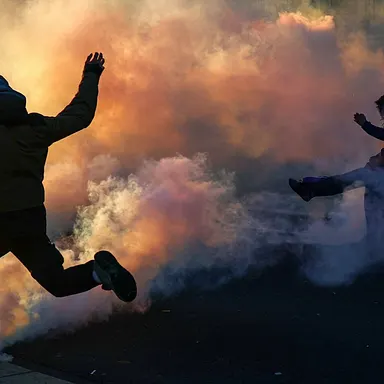
Photo 1: Protesters kick back tear gas canisters, during a demonstration against the cost of living and rising fuel prices, in Paris, France, October 31, 2026.
Credit: REUTERS/Pedro Nunes
Photo 2: A protester holds a firework during a demonstration over the cost of living and rising fuel prices, in Paris, France, October 31, 2026.
Credit: REUTERS/Pedro Nunes