
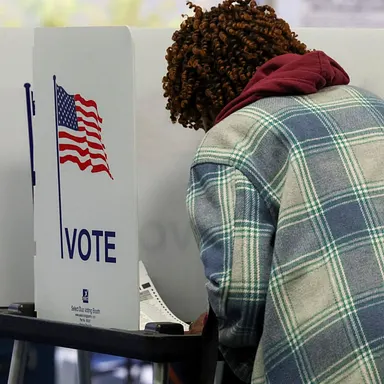
This episode of the Global News Podcast looks ahead to the US midterm elections, in which voters decide whether the Republican Party keeps control of Congress. Correspondents report from key races in Michigan, Georgia, Texas, Maine, Alaska and Ohio, where tight contests and rising living costs, health insurance prices and immigration enforcement shape the debate.
The programme also covers bomb threats that diverted flights across Europe, the death of a Tenerife footballer after an on-field collision, King Charles's remarks on the slave trade, garment factory closures in Bangladesh, North Korea's denial of the Binance cyberattack, and the Collins Word of the Year.
In this episode Mya-Nee Jones, Chris Mason, Jae Kwon, Jane Dougall, Mia Sabir, Paul Moss, Stephanie Prentiss
This episode's transcript on the US midterm elections was made with the same technology behind HappyScribe's AI notetaker.
Ads in this audio differ from the text. Tap the sentence you're hearing to follow along.
Synced: the text now follows the audio.
This is the Global News Podcast from the BBC World Service. I'm Mya-Nee Jones, and at 15:00 GMT, Tuesday the 3rd of November, these are our main stories: decision time for millions of Americans now casting their votes in the U.S. midterm elections. Bomb threats to flights across Europe force unplanned landings; we'll get the latest. And tribute to a 30-year-old Spanish footballer who died in a clash with a goalkeeper during a Second Division match in Tenerife.
Also in this podcast.
That shameful chapter of history is one that fills my heart with horror and my soul with the most profound personal sorrow.
King Charles expresses sorrow for the transatlantic slave trade at an event where Caribbean nations want slavery reparations on the table. As we record this podcast, millions of Americans are heading out to vote in the U.S. midterm elections. It's a pivotal moment that will shape the final two years of Donald Trump's America. His Republican Party currently controls both the Senate and House of Representatives, but could lose both to Democrats.
Our correspondent, Shaima Khalil, has this assessment.
Donald Trump's name is not on the ballot, but this election will shape the rest of his presidency. These are the midterms, halfway through a president's four-year term. Americans are choosing members of Congress, the House of Representatives, or the lower chamber, and the Senate, the upper house. Republicans currently control both. Losing either would make it harder for President Trump to deliver his plans. It would also give Democrats greater powers to investigate his administration. Mr. Trump heads into this vote with his approval rating nearing its lowest level, according to the latest polling.
But in his final campaign speech, the president remained defiant.
If the people that voted for me and voted in the last election, where we had such a great victory, if they go out and vote, just a good portion of them, we will win in a landslide.
In Michigan's heated Senate race, Democrat Abdullah Syed could become America's first Muslim senator. He's faced inflammatory attacks from President Trump over his faith, but his pitch is affordability.
Shouldn't be this hard to afford a second bag of groceries. Shouldn't be this hard to pay your rent. Shouldn't be this hard to fill up your tank. And it shouldn't be this hard to see a doctor in the richest, most powerful country in the world. All right, here we go.
Syed is up against Republican Mike Rogers, a former FBI agent and congressman backed by Donald Trump.
Are you all ready to work and to win?
In Georgia, Democrat John Ossoff is defending his Senate seat. His Republican challenger, Mike Collins, has this urgent appeal for his supporters.
This race is close. All the races are close. I need your help. I need to make sure that you go vote and take people with you to the polls to vote as well.
Even traditionally Republican Texas is fiercely contested. Democrat James Talarico is challenging Republican Ken Paxton, who has warned supporters their stronghold could slip away. Here in Alaska, the incumbent Republican Senator Dan Sullivan faces Democrat Mary Polttola and another candidate with almost the exact same name, prompting accusations of an attempt to confuse voters.
All eyes will be on those close and contentious races across the country. But some results won't come in for days or even weeks, like here in Alaska. The race here could tip the balance of power in Washington, but it will be a long wait to find out.
Millions have already voted early. Now America decides whether to back the president or put a brake on his ambitions, a choice that will be felt far beyond the country's borders.
That was Shaima Khalil. Now, Donald Trump beat Joe Biden in 2024 on the promise he would make life more affordable for ordinary Americans. It's still the main concern among voters. Food and fuel prices have soared in part due to the president's aggressive tariffs and a popular war with Iran. Our correspondent, Carl Nasman, reports from the swing state of Georgia.
This is Georgia's largest safety net hospital, which cares for patients whether or not they can afford health insurance. And one of the worries for some this election is that they might end up here. That's because the price of health insurance has been soaring, especially for low-income Georgians on subsidized plans known as Obamacare. Those prices per month have gone up about 26 percent over the past year. That's forced around 400,000 Georgians to drop their Obamacare plans altogether. This has been a big topic on the campaign trail here.
The Democratic senator, John Ossoff, his Republican challenger, Mike Collins, they've been sparring over Republican cuts to Obamacare. And the Democrats say that restoring that funding would be one of the first things that they do if they regain control of Congress.
That was Carl Nasman. Rising costs are also felt by businesses. It leaves Republican candidates with a dilemma of whether or not to distance themselves from the policies of Donald Trump. Our correspondent, Helena Humphrey, reports from the state of Maine.
Logging is big business here in the woods of Maine. It's also a business that's got more expensive due to President Trump's tariffs, as well as the soaring price of diesel. The question is whether voters will punish the Republican incumbent senator, Susan Collins. She says that she is against tariffs, and she presents herself as a more moderate Republican. Now, her Democratic challenger, Troy Jackson, well, he's a fifth-generation logger himself, and the race is tight.
Democrats are hoping that they can win this seat and ultimately take control of Congress in Washington.
Helena Humphrey. The Democrats are also expected to challenge for several previously nailed-on Republican seats, including Texas, Alaska, Iowa, Kansas, and Ohio. Although polling data has historically proved unreliable in predicting U.S. elections, our correspondent, Tom Bateman, sent this report from one of those states, Ohio, which has been at the center of another one of Donald Trump's key promises: cracking down on immigration.
Ohio is on the front line in President Trump's mass deportation drive. And this neighborhood in Columbus has been one of the areas targeted by immigration agents, or ICE, as I've been reporting through this midterm election campaign. Now, President Trump's immigration policy helped him win the presidential election in 2024. But in this midterm race, things are very different. In fact, the issue of immigration has dropped down the list of voter priorities. That is in part because those who wanted fewer unauthorized border crossings are pretty much satisfied with what President Trump has done.
But here, inside the U.S., the removals policy has led to quite a lot of anger and opposition, even among some moderate Republicans. Nevertheless, none of that has stopped Donald Trump hailing the policy on the campaign trail, while Democrats think that it's enough to help them flip this state of Ohio.
And that was Tom Bateman. And we'll be back with the latest results and what it could mean for America in the next edition of the Global News Podcast. Next to a breaking story that several different flights have landed at airports around Europe after all being targeted by suspected bomb threats. It comes a day after a flight from London made an emergency landing in Budapest, also following a bomb threat. I'm joined now in the studio by our global affairs reporter, Paul Moss. Paul, what do we know so far?
This is a story that's been developing throughout Tuesday. It started when we were told that two flights heading for Warsaw were the subject of bomb threats. One of them continued to its destination at the city's main Chopin airport. The other was diverted to the smaller Warsaw airport, Modlin. Now, when they were searched, neither was found to have any suspect explosives or anything like that on board. But Modlin airport actually had to be closed for a while. Then we started hearing about more flights being diverted because of bomb threats.
There was a flight into Bulgaria's Sofia airport. There was a flight that had to be diverted to Murcia in Spain. Then we were told that a second flight to Sofia had been the subject of a bomb threat. And then finally, and perhaps most dramatically, it turned out that two flights coming to Rome, one from Dublin, one from Lisbon, had both been the subject of a tip-off that there might be something suspicious on board. And at this point, the Italian Air Force was scrambled. Jets escorted one of those flights into Rome. I should say again, neither of these flights had anything suspicious on board.
But clearly, this has caused a lot of disruption.
And it seems highly suspicious that so many flights would have been disrupted in the space of 24 hours. Do we know if they're connected?
No, I mean, you say that, yes, you're absolutely right, because there was the flight you mentioned yesterday or Monday, and there was actually another flight on Sunday that was diverted as a result of a bomb threat, that one that was supposed to be going from Tel Aviv to Vienna. Yeah, to suggest this was a coincidence would be stretching it. But how they're connected is hard to say. I mean, yes, of course, there could be some coordination involved. But I should say that this kind of thing does inspire copycats. People can hear that a bomb threat's been made and that that's caused all sorts of disruption, and then they decide to do the same.
But, you know, in the end, whether they were connected because of some coordination, whether it was just random people following each other, the effect is the same, which is to leave people, I think, feeling rather vulnerable, you know, realizing how easy it is for normal life to be disrupted.
And, of course, it comes after we've seen supermarket fridges in various European countries being hit by cyberattacks. It seems like quite a high moment for these kinds of threats.
It does. I mean, and in some ways, it might sound silly to sort of compare explosives threats, explosive threats on airplanes to a few fridges getting overheated. But in fact, the fridges hacking has been taken very seriously indeed. The Italian intelligence service had an emergency meeting. We're told that the European Commission of the European Union had two emergency meetings immediately afterwards. That's because of the suspicion that, well, if people can hack into supermarket fridges across the continent, what else can they hack into?
And as you suggest, this all just plays into the sense people have that normal life is very vulnerable. I mean, I was thinking earlier of the word terrorism. Now, that word is often contested, argued about, perhaps overused. But terrorism doesn't really have to be about people being killed in dramatic ways. The clue's in the name, terror. It's about people feeling scared. It's about making people feel how easily their lives can be changed by random, perhaps unseen actors, perhaps states, perhaps organized crime, perhaps random people acting individually.
The effect is the same for people to feel rather worried about how their normal life can proceed.
Thanks, Paul. That was Paul Moss. Now to Spain, where Real Madrid staff and players have held a minute silence at training in memory of Tenerife striker Jesus de Miguel, who died at the age of 30 a day after a collision during a match on Monday. The striker had a cardiac arrest following a clash with a goalkeeper during a Spanish second division game in the Canary Islands. Our sports correspondent, Jane Dougall, told us more.
This was a tragic incident. Tenerife and FC Andorra were drawing 2-all, seven minutes into stoppage time in the second division, when the Andorra keeper, Jesus Owono, ran towards the center circle to clear a long ball, but his knee appeared to collide with the Tenerife striker, Jesus de Miguel. The striker was motionless on the pitch immediately afterwards. Medical staff ran on. They treated him for five minutes before he was taken by ambulance to hospital. Understandably, players from both teams were visibly distressed, with some of de Miguel's teammates in tears.
The referee instantly showed Owono a straight red and then abandoned the match. Spanish media reported that the 30-year-old suffered a cardiac arrest in the ambulance and was resuscitated by paramedics on the way to hospital. On Monday, de Miguel's condition was described as stable but serious. However, his health deteriorated on Tuesday morning, and the Spaniard died at 8:00 a.m. local time.
I mean, he was only 30 years old. Tell us about him. A lot of people have been commenting on his death, haven't they, including Kalim Mbappe.
Yes, 30 years old. He was born in Madrid. He started his career at Leganés in 2015. And then he joined Tenerife on a three-year deal just last year. He has a daughter, Carla de Miguel Fernández, who was born last year also. So it really is a dreadful situation to have happened. His death was confirmed in a statement from FC Tenerife. It reads, "Heartbroken, with a lump in our throats, and unable to believe this is true, Tenerife announces the tragic death of Jesus de Miguel. There are no words of comfort.
There is absolutely nothing that can lessen this overwhelming sadness." Andorra, Tenerife's opponents, said, "With broken hearts and devastated, we want to send our most sincere condolences to the family." And former Barcelona defender Gerard Piqué, who co-owns Andorra, also said that he was sorry with all of his soul. As you mentioned, the Real Madrid and France striker Kalim Mbappé wrote on his social media, "Much sadness. There are no words." Now, all of Tuesday's Spanish Cup fixtures have been postponed by the Spanish Football Federation.
And also, there is expected to be a minute's silence before the Champions League matches later on tonight.
And, Jane, this raises issues, doesn't it, about safety in the game, however rare an event like this is?
Yes, I mean, a lot of the rules protecting players are focused on concussions and head injuries. There are concussion substitutes and strict removal from play guidelines to help protect players who have suffered head impacts. But instance where players collapse or die during a match or training session, they generally fall into two main categories. The first and the most prevalent is cardiac arrests. For example, an undiagnosed heart condition like Mark Vivien Fooye, who died on the pitch in 2003 whilst playing for Cameroon, or physical trauma and collisions, for example, collisions with goalkeepers, opposing players, or hard perimeter walls, because they can cause blunt trauma, internal hemorrhaging, or cardiac arrest.
The BBC's Jane Dougall there. Still to come in this podcast, is it toxic or has it come full circle? We look at the Collins Word of the Year, which is.
Mugging is like when you think you're better than someone else.
Oh, OK. This is the Global News Podcast. The British Prime Minister, Andy Burnham, has joined King Charles at the formal opening of the Commonwealth Heads of Government meeting in the Caribbean, where talks will start about the U.K. issuing a formal apology for the slave trade. Although it would be for Britain's Prime Minister to make an apology, King Charles expressed his personal regret.
Our history inspires us, can appall us, yet it can always teach us. We cannot change the actions of those who came before us. We can, however, learn from the past. The transatlantic trade and enslaved persons still cast a shadow over these islands and other members of our Commonwealth. As I've said before, that shameful chapter of history is one that fills my heart with horror and my soul with the most profound personal sorrow.
Our senior royal correspondent, Daniela Ralph, is following this visit and sent this report starting at the Government House Museum, the official residence of Antigua and Barbuda's governor.
The history of slavery on this island has featured across the king's engagements. And we'll do so again in his speech to Commonwealth leaders today. A government house once a symbol of colonial oppression, he told the museum. The king saw the shackles worn by enslaved people, the conch shells used to communicate. There was a familiar face joining the king, too. The actor, Idris Elba, was with him at a heritage site. He's a supporter of the king's charity work with young people.
I will be showing you how to do cassava bread we call bambula.
As the king and queen learned more about the culture of these islands, Buckingham Palace issued a statement on the king's role as leader of the Commonwealth. It's his job to inspire and bring people together, the palace said. It's not his role to make policy. That's the job of the prime minister, who the king met here for the first time, since Andy Burnham said he was open to an apology for the U.K.'s role in the slave trade.
Daniela Ralph there. Caribbean leaders have called for Britain to pay financial compensation for its involvement in the slave trade. For more on what we can expect, here's our political editor, Chris Mason, who is also in Antiguae.
There's a sense in government that when the Commonwealth last got together a couple of years ago in Samoa in the South Pacific, I was there to report on that one as well, there was a sense that from a British perspective it was a bit of a mess because there'd been a hope that there wouldn't be a conversation about reparations, financial compensation for the transatlantic slave trade. But plenty of Commonwealth countries wanted to talk about it. And it was all a bit messy. This time, the prime minister's tried to get ahead of that by talking about the government being willing to formally apologize for slavery in time, not yet, but perhaps within a year or so, and to start a conversation, too, about things that can help Commonwealth countries right now, not least debt.
Because of interest rates, the amount of debt interest plenty of countries are paying is spiraling. What can be done to try and restructure that debt?
That was our political editor, Chris Mason. In Bangladesh, after several days of protests which turned violent, hundreds of garment factories in the capital, Dhaka, have been forced to close. Workers who make garments for top Western brands and generate billions of dollars for the Bangladeshi economy have been demanding that their salaries more than double to around $240 a month. Nupur is a garment worker taking part in the protests.
Everything is becoming more expensive in our country, including daily essentials like house rent, electricity, and gas bills. Government employees receive automatic salary increments, but we have to go door to door to demand a raise. Our salaries should increase automatically, too. While our salaries remain unchanged, house rents keep rising. If we fail to pay our rent within the first week of the month, our landlords threaten to evict us.
Our bureau chief in Dhaka, Mia Sabir, told us more.
The garment factory owners, they said they had to close the garment factories. At one point, it was more than 500 factories. From what we know now, like some of the factories have reopened, but still hundreds of factories are still shut down. And some protests are still happening.
And remind us what the protests are about, what the workers want.
So workers' demand is wage hike. For example, currently, the minimum wage for garment workers is about $100 a month. So they are demanding double the amount, more than double, $240 a month. According to the regulations, every three years, there should be a wage board which will reconsider the wages. But this time, the garment workers are saying the commodity prices have risen so much. I've spoken to the garment workers, and they have talked about how it is very difficult for them to survive with $100 a month as wages.
In recent months, the inflation has been very high. It's about 8%, 9%, and it's projected to go over 10%. Also, at the same time, there has been some energy crisis in the country. The price of fuel, the price of electricity have gone up quite substantially. And that's why they said they're on the streets.
And we're talking about a lot of workers, aren't we? We're talking about millions of workers.
Yes, the garment industry in Bangladesh is really big. More than 80% of the total export of Bangladesh is from the garment industries. Also, a lot of women workers work in the garment industry. This has a big implication on overall economy as well.
The government has implemented a new pay review board looking at wages. When is that going to rule on this? And is it going to be effective, do you think, to change this?
So right after the protests started, after the protesters splashed with the police, they actually formed this wage board or pay review board, which have the government officials and also some garment worker leaders and other independent experts as well. So last time, it took about two months to submit a proposal to the government. But the workers are demanding that it may take too long. They want it to happen as soon as possible.
Mia Sabir. The world's largest cryptocurrency exchange, Binance, was hit by the largest cyber attack of its kind last week. A record-breaking $6.3 billion was stolen. Now North Korea has denied being behind it. Kim Yo-jong, the powerful sister of the ruler Kim Jong-un, described allegations made by the FBI as, quote, "a grave political provocation." Our Seoul correspondent, Jae Kwon, told us more.
We heard this morning from the North Korean leader's sister, Kim Yo-jong, and she is the de facto spokesperson for the North Korean regime. And what she says in her statement is considered the official stance of North Korea. And in that statement, she said that the accusation that the U.S., you know, the FBI had leveled against North Korea is a grave political provocation and simply a sinister attempt to damage the image of North Korea. And that's a verbatim quote.
And then she said that, you know, it actually might be the Americans who are behind this attack. She said that you just have to look at who is going to benefit from this hack. And seeing how Americans said that they're going to seize any stolen asset, it doesn't take much imagination to see who had stolen it. Now, of course, this accusation goes completely against what the FBI had said and as well as other security experts have said, who said that, you know, this theft, it seems to have originated from North Korean hackers because it seems to have the same signatures, seems to have the same accounts that were used in previous hacks.
Last year, you know, they accused North Korea of stealing $1.5 billion from another cryptocurrency exchange, Bybit, at that time. And they're saying that all the signs are here to really point at Pyongyang.
And what about Binance itself? I mean, has it recovered? Is it allowing people to withdraw money?
Well, immediately in the aftermath, they have frozen all transactions. They have now resumed the transaction. And what we've seen is a bit of a bank run equivalent of cryptocurrency exchange. We heard that more than $3 billion worth of cryptocurrency was withdrawn from Binance. And then Binance also has been repeatedly trying to calm the market, telling them that, you know, every loss will be compensated, will be replaced. And they have been putting away, you know, 10% of their profit for exactly this purpose.
And, you know, they are trying to claw back what has been lost. But, you know, it's always a very difficult task to do that. I mean, the hackers know exactly what they're doing. They take these stolen assets, and they make it very difficult to track it by simply mixing with all the other kind of clean money.
And before we go towards the end of every year, different dictionaries announced their Word of the Year. Dictionary.com went first for 2026 with "Maxing." And now the publishing house Collins has announced theirs. And Stephanie Prentiss announced the news to Valerie Sanderson.
So, Valerie, we're dealing with a slang noun here, and it is mugging. So Collins is defining mugging as the act of outshining or outperforming someone or something. So.
No cats.
Sadly, no cats is fine. But if you walked in this morning and I said, "Valerie, you're mugging everyone in here," it means you look the best. It adds, though, that it can.
I'm in for that.
Exactly. We need to start doing that. It adds, it can make someone look inferior by comparison. So it's in terms of their appearance, their confidence, their status. It derives from an acronym, AMOG, so Alpha Male of the Group. And that's worth mentioning. It did originate in bodybuilding culture. It had connotations with the manosphere, with toxic online culture. But in 2026, it's seen this rapid mainstream adoption, so a 210% increase in usage. It is used now more broadly in a playful way by Gen Z and Gen Alpha.
And is this different mugging to maxing?
Different, but bedfellows. So maxing, short for maximizing, doing something to the fullest or optimizing it as much as possible. Like mugging, once seen as a bit toxic, now mainstream. So looks maxing, looking as good as you can, like you this morning. Sleep maxing, trying to get the best possible sleep.
And does anyone older than Gen Z or Alpha I mean, you do, but does anyone else know what these words mean?
It is a very good question. So we sent a Gen Z reporter out to ask a few people.
No, that's a ridiculous word.
Oh, wait, hold on. Is it mugging the way they do, like, the draw line thing kind of thing?
That's really close. That's mewing.
Oh, mewing.
But mugging is like when you think you're better than someone else.
Oh, okay.
I am mugging at I don't even know.
So from the chats we've had in the office today and from those people on the street, research would suggest no, not everyone knows what mugging means.
And how do these words compare to last year's choices indeed from many years ago?
Well, from the words we've had so far, so maxing, mugging, in their current form, they do seem a bit more optimistic. So last year, for example, we had rage baiting. I'm sure you know what that is. It's basically annoying people on purpose. We had.
A lot of that in the office, in this office.
We all like a bit of that. We had parasocial. So it's an older word, but in this context, it's having a one-sided relationship online, maybe with a chatbot, a celebrity. We had slop, that low-quality content we see. So given this is meant to capture the zeitgeist, maxing and mugging could be seen as more positive. It's self-improvement, it's ambition, it's a greater sense of agency.
What's your favorite word, quickly?
In the entire world?
Of these words.
I'm going to go with bixy, that didn't get picked, actually, Val.
Which is?
That is a hairstyle that's between a bob and a pixie cut.
And that was the newsroom, Stephanie Prentiss talking to Valerie Sanderson. And if you have a favorite word, traditional or slang, send them in to us at globalpodcast@bbc.co.uk. That's all from us for now. If you want to get in touch, you can email us. Once again, it's globalpodcast@bbc.co.uk. You can also watch our episodes in full. Just search for the Global News Podcast on YouTube. This edition was mixed by Holly Smith, and the producer was Charles Sanctuary.
The editor is Karen Martin. I'm Mya Ni Jones. Until next time, bye-bye.
US voters decide whether Donald Trump keeps control of Congress in the midterm elections. The Democrats are predicted to win back control of the House, and possibly the Senate, although many key contests are within the margin of error.
Also: several flights land at airports around Europe after all being targeted by suspected bomb threats; Tenerife footballer, Jesus de Miguel, dies after on-field collision; King Charles calls the slave trade a "shameful chapter" in Britain's history; hundreds of garment factories in Bangladesh are forced to close after several days of violent protests; North Korea denies role in the massive theft of cryptocurrency in a major cyberattack on Binance; and the new word of the year for 2026.
The Global News Podcast brings you the breaking news you need to hear, as it happens. Listen for the latest headlines and current affairs from around the world. Politics, economics, climate, business, technology, health – we cover it all with expert analysis and insight.
Get the news that matters, delivered twice a day on weekdays and daily at weekends, plus special bonus episodes reacting to urgent breaking stories. Follow or subscribe now and never miss a moment.
Get in touch: globalpodcast@bbc.co.uk
Image: Voters fill out their ballots to vote in the midterm election on Election Day in Detroit, Michigan, USA, 03 November 2026
Credit: EPA/Shutterstock