
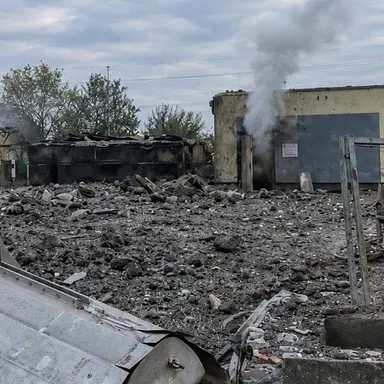
This episode of the Global News Podcast covers a Russian attack on a school in Ukraine's Zaporizhzhia region that was being used as an aid distribution centre, which Ukraine says killed at least 26 people, and the US midterm campaign's final day, with the Senate races seen as especially close. It also reports on a Dutch couple's decision to die together through duo-euthanasia, Snapchat's settlement of a lawsuit alleging its app was designed to be addictive, and a Channel 4 game show that turned out to be a hoax meant to highlight gambling harms.
Listeners will hear each story in turn.
In this episode Alex Ritson, Ione Wells, Palav Ghosh, Paul Moss, Samira Hussain, Vitali Shevchenko
This Global News Podcast episode on the Zaporizhzhia school strike was made with the technology behind HappyScribe's AI note taker.
Ads in this audio differ from the text. Tap the sentence you're hearing to follow along.
Synced: the text now follows the audio.
This BBC Podcast is supported by ads outside the UK.
This is the Global News Podcast from the BBC World Service. I'm Alex Ritson, and in the early hours of Tuesday, the 3rd of November, these are our main stories. More than two dozen Ukrainians are killed in a Russian attack on a school being used as an aid centre in the Zaporizhzhia region. Campaigning draws to a close in the United States ahead of midterm elections that will shape the final two years of the Trump presidency. Snapchat's parent company settles a multi-million dollar lawsuit over allegations its app was designed to be addictive.
Also in this podcast: the couple who decided on duo euthanasia, and.
It affected me enormously, financially. I was in serious amounts of debt, but also my mental health. I suffered from anxiety and depression as a result.
The million-pound TV game show that wasn't quite what it appeared to be.
We begin in Ukraine, where a local ceasefire in the southern town of Oleshky gave some hope that it could be repeated elsewhere, a hope that's been quickly dispelled. In Zaporizhzhia, Ukraine says Russia has repeatedly bombed a school that was being used as an aid distribution centre, killing at least 26 people. President Zelenskyy said that after an initial strike, nine more bombs hit a shelter where people were taking cover. He said the Russians must have known what the building was being used for.
The attack came just hours after the local ceasefire in Oleshky ended. So, was the bombing of an aid centre intentional? A question for Vitali Shevchenko, chief analyst at BBC Monitoring.
Given the alleged number of bombs used by Russia, it's hard to see how this could not have been deliberate. Officials in Ukraine say that this school in a village called Komyshuvakha, which is just outside of Zaporizhzhia, it was hit repeatedly by at least nine glide bombs, each of them weighing 3,000 kilograms.
And to put this into context, a spokesman for Donetsk police, which is a region, the most dangerous region in Ukraine, probably, he told me that the most awful thing he'd ever seen in his life was the aftermath of an attack involving a bomb that weighed half that much, 1.5 tonnes. So here, we're talking about nine bombs weighing three tonnes.
The devastation is immense. Now, when we're talking about a school, we're talking about the actual building, because this village is so close to the front line, it wasn't actually being used as a school. It was used as an aid distribution centre. There was a shelter, you know, what Ukrainians call a point of resilience.
Not a military target, the point. But the thing is, when you have more than one bomb, people come in to help, and then they get hit too.
And that is how at least two rescuers were killed, because they rushed to the scene and then another attack happened. And also, four police officers died as well. At the moment of speaking, the search and rescue operation continues. More people are believed to be buried under the rubble. Ukrainian police are saying that their efforts to find any survivors are hampered by continuing Russian drone attacks targeting the site.
This all comes, of course, after the local ceasefire, the one that involved the negotiation skills of Melania Trump, ended in Oleshky.
It was so tempting to see the Oleshky ceasefire as a glimmer of hope. But the reality is that as there was no fighting in and around Oleshky, Russia killed dozens of Ukrainians elsewhere, which suggests very strongly that it's as determined to crush Ukraine as ever. And there are various possible reasons why Russia agreed to hold fire in Oleshky, such as it was afraid to upset Donald Trump because Melania Trump was involved.
Other people said that Russia used the ceasefire to resupply its troops in the Kherson region. But the bottom line is, there's nothing, absolutely nothing, to suggest that the Oleshky ceasefire would lead to better cooperation or just Russia and Ukraine talking to resolve their differences, at least over humanitarian issues.
Vitali Shevchenko. Now to the midterm elections in the United States. Donald Trump isn't on any ballot paper, but he's previously said, "Pretend I'm on the ticket." And many people view these elections as a referendum on Mr. Trump's second term as U.S. president. Speaking in Washington on the eve of the poll, he said that the country would be in great peril if his Republican Party lost badly to the Democrats.
As you know, this is the last day before the midterm elections, the most important midterm, I believe, in our lifetime. The Democrat Party has nominated the most extreme and dangerous slate of candidates in American history. These are the most dangerous candidates ever put up.
Mr. Trump was speaking in front of the newly reopened Lincoln Memorial Reflecting Pool, which underwent a somewhat chaotic $16 million renovation programme at his behest. He spent much of his speech justifying the makeover, which, like his huge White House ballroom building project, has proven to be unpopular with many voters. The president sees these schemes as a way of cementing his vision of America's greatness. But voters are more focused on rising costs, such as petrol prices and the effect the war with Iran has had on their standard of living.
In the U.S. Congress, all 435 seats in the House of Representatives are up for grabs in the midterms, while 35 of the 100 seats in the Senate will be contested. The Republicans currently control both chambers. I got more on the mood in the Republican camp from our correspondent in Washington, Ione Wells.
In that speech from President Trump, he said that if people turn out to vote, then the Republicans would win with a landslide. But I think the reality is that most in the Republican camp feel that that is not true. He, indeed, himself used that speech to essentially roll the pitch a bit for some significant Republican losses, saying that people often don't vote for the incumbents in a midterm election. And I think there's a number of factors behind this. The main issue, clearly, in this election that all voters have been talking about is affordability, the rising cost of living, particularly the price of gas since the war in Iran.
Donald Trump himself referenced this in rallies over the weekend, saying that people were screaming to him about eggs, a reference there to how just everyday groceries as well have become more expensive for people. Then there's also a backlash that the Republicans have been facing in some states, in particular over the manner in which it has conducted some of its anti-immigration policies, particularly some of its more aggressive ICE raids, which in some parts of the country, including in places like Texas and Florida, previously pretty solid red Republican areas, has put off some within particularly the Hispanic communities in those areas too.
So there is, I think, a growing expectation with the Republican Party that they are going to have significant losses after Tuesday's election.
What would be a good night for the Republicans and for the Democrats?
Well, I think given that expectation and given what the polls have been suggesting, although, of course, we should always caveat this that polls can be wrong. They can underbake Republican voters particularly. I think a good night for the Republicans would be if they managed to maintain control of the Senate. I think it is pretty baked in in many Republicans' expectations that they could lose control of the House of Representatives. But if they manage to hold on to the Senate, that would be seen, I think, as a successful night for them. Certainly for the Democrats, they are hoping to take both houses of Congress.
And they feel that it's within reach, given what the polling has been suggesting, particularly in some of these key states where the race is looking incredibly close in some of those Senate races, and also particularly close in some states which previously were such Republican strongholds, places like Texas or Kansas, where the Democrats now feel that they have a real shot. I think another state that we'll all be watching very closely is Michigan. That is one that is currently held by the Democrats in the Senate. And I think a good night for the Republicans would be if they managed to take that seat, because that would make it harder for the Democrats to reach the threshold to take control of the Senate.
Ione, a major issue in these elections, of course, is the war with Iran. And we've had, over the course of the last couple of hours, reports of limited strikes on Iran's Qashim Island, which is the largest island in the Strait of Hormuz. Can you tell us more?
Yeah, that's right. We've seen these reports that the U.S. has carried out what U.S. media are describing as defensive strikes on Qashim Island. It seems that there have been some sort of tit-for-tat strikes in that area. Qashim Island is a very strategic point in the mouth of the Strait of Hormuz. It's the site of a naval base and also some missile sites. And this has come as there has been growing speculation about whether there could be further escalations in the U.S.'s war with Iran, potentially immediately after the midterm elections.
Ione Wells. As we've just heard, the race for the control of the U.S. Senate is particularly tight. So which states are the ones to watch out for? Alaska, Texas, Michigan, Kansas, Ohio, and Maine. And then there's Iowa, where President Trump was on the final weekend of his campaign rallies. Such is its importance. It's a close race between the Republican Ashley Hinson, a former television news host, and the Democrat Josh Turek, who won gold medals in basketball at two Paralympic Games.
Our correspondent, Samira Hussain, is in Iowa.
The cost of living is certainly a massive issue for voters here in this state. And specifically, I'm in Dubuque, Iowa, at a food pantry. And of course, people here have been discussing the cost of living and just how much more expensive groceries are. You know, the director of the food pantry here talked about how she has seen an increase of 20 percent in the last year of people coming here. And for many of them, it is, in fact, first-time clients, you know, being forced here because they can't make ends meet.
And especially for seniors, where they're on fixed incomes, any kind of increase to the price of gasoline, to the price of energy bills, to the price of food, has a real huge impact on those that are living on a fixed income.
And, Samira, those impacts are magnified as well when you look at the farming community in Iowa, in other states nearby like Kansas and so on, farmers facing all of the challenges you've described, plus extra issues around the markets they can sell into, farm machinery, diesel.
It's a huge issue. You know, you might see the cost of living here in a very immediate kind of way. And for farmers, it is on a much larger scale. So I was actually at a farm just outside of Dubuque, about half an hour away from here, and I was speaking with two farmers. And they both grow some corn and soybean, but their big moneymaker is really cattle. And one farmer was talking about President Trump's decision to allow imports of beef from Argentina and just how much of an impact that had on his bottom line.
That has him quite angry. And he's certainly looking to see some kind of change in government. We happen to be on the farm of his cousin, who also raises cattle. And he says that, look, I have always been a conservative. That is, you know, the way that I have voted. But he really was not happy with the tone of this election. And for him, the big issue was the size of America's national debt. And he lamented the fact that no one on the campaign trail, be it Republican or Democrat, are talking about just how much debt the United States is carrying.
Remember, that's a sensitive issue for farmers. For farmers, they need to balance their books all the time. And so the idea that their country is carrying on with this enormous amount of debt has them very concerned.
Samira Hussain speaking to Catriona Perry. Still to come in this podcast, we look at a region of space called the Zepto-verse.
We're knocking on the door of this Zepto-verse, this tiny, tiny world. We haven't explored it yet, but we're kind of on the threshold. So what we need now is more data. And that will allow us to actually enter this world for real and start to see what we might find there.
This is the Global News Podcast. Last year, nearly 10,500 people died from euthanasia in the Netherlands. Euthanasia is only legal if a request is voluntary and a person's suffering, physical or psychological, is assessed by doctors as unbearable with no prospect of improvement. In 2024, the BBC's Linda Pressley met a couple who decided to choose dual euthanasia when a person receives a lethal injection at the same time as a loved one.
Jan was 70 and in continual physical pain. His wife, Else, was 71 and had been diagnosed with dementia. After their deaths, Linda has returned to the Netherlands to meet with the couple's only son, Bas.
It was three days before they died by lethal injection that Jan and Else recorded an interview with me in their camper van in the north of the Netherlands.
My life is completed. I don't want no pain anymore.
Yeah, there is no other solution for this.
Else qualified for euthanasia because she was assessed by doctors as suffering unbearably due to her fear of how her Alzheimer's would progress. Jan was eligible because of his ongoing chronic pain. Their son, Bas, recently listened again to his parents in that edition of Assignment on the BBC World Service.
Hearing them on the documentary, it was so surprising again how convinced they were of their decisions. Imagine, you're sitting there, and three days later, you're going to a place where you will die. They sound so relaxed.
That was my impression too. But at the same time, it seemed to me this adventurous couple could have easily continued living as they were. And I asked them about that in 2024. Is there at all a feeling that you might be doing this just too early?
I don't know. I don't know. I don't know.
What do you say, Else?
No, no, no, no, no, no. I cannot see it.
Perhaps we die too early. That could be. But I have lived my life.
Right. And how do you feel about it, Else?
The same.
That is weird.
That is bad.
That one, right? I cannot go beyond that.
When Else talked about not going beyond that, she means her Alzheimer's getting worse, so she'd be deemed incapable of making decisions for herself, especially about deciding she wanted to die. In the Netherlands, it's very rare for doctors to approve euthanasia for people with advanced dementia. At her clinic in the Erasmus Medical Centre in Rotterdam, Dr. Rosemarie van Bruckem, a geriatrician and ethicist, spends a lot of time talking to her dementia patients about the timing of their euthanasia requests.
Now is too soon. But maybe next month is too late. So how do I decide at what point I need to start this process to see if I meet the criteria, to see if I can get euthanasia? And if I wait too long, might I have missed the window? So there is a debate and kind of a fear that people will apply for euthanasia sooner than they actually want to. And we don't want people to request euthanasia too soon.
It should be, and it should remain, the ultimate solution because life is no longer worth living and there are no other options to better that life.
Bas has been reflecting on the experience of losing both his parents in the same moment. It's been an arduous journey of grief for him. Now, nearly two and a half years on, does he think Jan and Else went too soon?
I think they could have stretched it for another year for sure. But the whole thing is that I mean, for my dad, he was sitting there already for what I he was in this situation for 10, 15 years. And so he could have stretched it probably for another few years. For my mom, looking at the progression of dementia, probably she could have extended for another year. I think so, yeah. But then I think a year waiting for another year, then she got into trouble not being capable to make the decisions.
And if that had been the case, Else may not have qualified for euthanasia at all.
That's report from Linda Pressley. Snapchat's parent company has settled a multi-million dollar lawsuit over allegations its app was designed to be addictive. The case was brought by two teenagers who claimed the app had caused them serious mental health problems, anxiety, and eating disorders. It also named Meta, YouTube, and TikTok as defendants, but they had already reached a settlement. The case is the second of its kind in Los Angeles State Court, where lawsuits have already been filed over the alleged harms to children and teenagers caused by social media companies.
Our Global Affairs reporter, Paul Moss, told my colleague, Oliver Conway, about this latest case.
It focused on the suggestion that Snapchat is deliberately designed to be addictive for users, particularly on a couple of features: infinite scrolling, which I think a lot of our listeners will know is this feature where it's not like when you look at a newspaper article, for example, online, or an entry in a reference book where you come to the end. It's the information just keeps coming. And there have been some interesting psychological studies on this. Perhaps counterintuitively, it seems that the brain gets more of a hit searching through things than actually reading the information. Similarly, autoplay, where videos just keep starting and then they continue going.
The suggestion was, well, yeah, this is what happens if instead of going out, meeting people, talking to friends, and feeling the wind in your face, you just sit there scrolling on and on and on with an app.
And this is just part of the increased scrutiny on the tech industry over its impact on mental health and particularly younger people.
Yeah. In fact, these same plaintiffs had also brought a similar case against YouTube, TikTok, and Meta, the company which owns Facebook. All of them had settled. Snapchat was holding out, but it too has joined in and said, okay, we're settled. They said they were doing this for business reasons. But yes, this is part of an ongoing war, you might say, waging against the perceived dangers of big tech. And it's happening in two ways. We're having seen things like what we've just seen in Los Angeles, where it's going through the courts. For example, other people have sued social media platforms saying the images their children saw there caused them to self-harm or even take their own lives.
But we're also seeing the countries bringing in legislation. One obvious example is Australia, which has banned social media use for the under 16. All of this coming in the wake of psychologists arguing that, look, smartphones are harmful, that they are behind the dramatic rise in young people's mental health problems they allege. In the end, you're going to have an awful lot of people coming on this program in the next few years to give you the latest stage of this ongoing battle between people and big tech.
Paul Moss. Researchers looking into the nature of the universe at CERN, a laboratory on the border between France and Switzerland, have detected signals from the smallest distances ever probed, 100 billion times smaller than an atom. They come from a subatomic region of space that scientists call the Zepto-verse. The result is important because it could help researchers learn more about a mysterious substance called dark matter, which makes up most of the matter in the universe.
The work was led by scientists based in Cambridge here in England, but because of cuts in planned funding, British scientists may not be able to participate in the next phase of this promising new area of research. Here's our science correspondent, Palav Ghosh, with more details.
Scientists believe that galaxies, stars, and planets have an invisible cosmic web connecting them, material they call dark matter, the scaffolding on which our reality is built. Dr. Harry Cliff of the University of Cambridge has detected signals at the Large Hadron Collider particle accelerator that could bring this mysterious substance into view. The signals come from a region of subatomic space called the Zepto-verse.
We're knocking on the door of this Zepto-verse, this tiny, tiny world. We haven't explored it yet, but we're kind of on the threshold. So what we need now is more data. And that will allow us to actually enter this world for real and start to see what we might find there.
If we were to shrink down to the size of atoms, we'd not be at the Zepto-verse yet, not even close. We need to be 100 billion times smaller to a region physicists call the Zepto-verse. Dark matter is thought to interact with our world at this scale.
Arguably, this is where particle physics began.
Dr. Cliff works at the lab where the electron was discovered 130 years ago.
This is the tube that J.J. Thomson used to discover the electron, the first inkling that atoms had substructure. And really, Cambridge and the UK is where the whole discipline of particle physics began in the early 20th century.
The problem is that the UK's science agency has pulled out of funding the upgrade. That could mean that Harry and many other British scientists may not be able to continue working on the next phase of the project.
This is an area of science where the UK is genuinely world-leading. I mean, many of the biggest breakthroughs in fundamental science have come out of the UK. And it seems like a kind of mad decision to be damaging a sector that's genuinely so important and successful.
Dr. Cliff's colleague, Dr. Mary Richardson-Slipper, is starting off her career as a physics researcher at CERN's LHCb experiment. It's got off to a flying start with the Zepto-verse discovery, but she doesn't think she has a future in the UK because of the cuts.
I am looking at jobs abroad because that seems to be where there are more opportunities at the moment. And many of my friends have already moved abroad, continuing their work in fundamental physics. I want to continue working on LHCb, and it might be the best move for me to go somewhere else to do that.
It's a shame.
Yes.
The body that made the cut said it continued to support research at CERN as one of the second largest funders, and it had many exciting research projects to choose from, and not all of them could be funded.
Palav Ghosh. On Sunday night, TV viewers in Britain tuned in to what was supposed to be a new game show. Contestants on the million-pound shot bet their own money on general knowledge questions with the chance of winning up to £1 million, about $1.3 million. But as the newsroom's Richard Hamilton reports, the Channel 4 show was not quite what it seemed.
Tonight, filmed in front of a live studio audience, three players get a shot at a life-changing amount of cash. But they're going to have to put their money where their mouth is because for the very first time in game show history, they are playing with their own money.
It all started off with the usual props, drama, and razzmatazz of TV quiz shows. But half an hour into the million-pound shot, one of the contestants, Reese, collapsed on the floor, fighting back tears after losing £6,000. The show seemed to descend into chaos. An audience member protested about the ethics of the game, and the broadcast appeared to cut out. On social media, some viewers were confused and others condemned it.
But the presenter later reemerged to tell viewers they'd been watching a hoax. It was a piece of theater to highlight the dangers of gambling. The character of the contestant, Reese, was based on Patrick Foster, who ended up hundreds of thousands of pounds in debt and even considered taking his own life.
Gambling for me started at university as a bit of fun. What started with a two-pound bet ended up with me, 13 years later, not really going a day without placing a bet. It affected me enormously financially. I was in serious amounts of debt from credit cards, loans, payday loans, individuals, but also my mental health. I suffered from anxiety, depression as a result, wasted so much time, so many opportunities.
And it was towards the end, a matter of life and death.
This game is all about balls. These balls.
In the second half of the program, a psychologist explains that the golden betting balls used in the show operate in the same way that poker chips do in a casino, giving gamblers the impression they're not playing with real money. A campaigner for gambling reform added that half of addicts say they've been lured back into their compulsive behavior by being offered a free bet. In response, the UK's Betting and Gambling Council said the country has one of the most tightly regulated markets in the world, and operators are required to stop marketing to customers where strong signs of harm are identified.
Richard Hamilton. And that's all from us for now. If you want to get in touch, you can email us at globalpodcast@bbc.co.uk. You can also find us on X at BBC World Service. Use the hashtag globalnewspod. And don't forget our sibling podcast, The Global Story, which goes in-depth and beyond the headlines on one big story. This edition of The Global News Podcast was mixed by Graham White.
The editor is Karen Martin. I'm Alex Ritson, and until next time, goodbye.
Für mich?
Für mich.
Für mich.
Für dich da. Die Vierberger Skischaukel Schladming mit Hauser Keibling, Planai, Hochwurzen und Reiteralm in Schladming-Dachstein. Sichere dir jetzt mit dem Online-Frühbucherbonus attraktive Rabatte auf deinen Skipass. Schnell buchen und Geld sparen. Schladming-Dachstein, live dabei in Ski Amadee. Begrenztes reduziertes Ticketkontingent.
President Zelensky described as utterly horrific a Russian attack in the southern Ukrainian region of Zaporizhzhia that killed at least 26 people. He said the first air strike was on a school building which was being used as an aid distribution centre. It was followed by nine more bombs targeting a shelter where people were taking cover. Among those killed in the second attack were police and rescue workers who had gone to help. Also: final campaigning has been taking place in the United States on the eve of the midterm elections, which President Trump has described as the most important "in our lifetime". We hear from a man in the Netherlands whose parents opted for duo-euthanasia, where a person receives a lethal injection at the same time as a loved one. Snapchat settles a multi-million-dollar lawsuit following claims that its app was designed to be addictive. And the million-pound game show on British television that wasn't quite what it appeared to be.
The Global News Podcast brings you the breaking news you need to hear, as it happens. Listen for the latest headlines and current affairs from around the world. Politics, economics, climate, business, technology, health – we cover it all with expert analysis and insight.
Get the news that matters, delivered twice a day on weekdays and daily at weekends, plus special bonus episodes reacting to urgent breaking stories. Follow or subscribe now and never miss a moment.
Get in touch: globalpodcast@bbc.co.uk
Photo: General view of a compound of a local school where a Russian air strike hit an underground shelter, which was used as a humanitarian aid hub in the frontline town of Komyshuvakha, in Zaporizhzhia region, Ukraine, November 2, 2026.
Credit: Press service of the State Emergency Service of Ukraine in Zaporizhzhia region.