
This episode of The Happy Pod covers five uplifting stories. It opens with a global trial of a personalised skin cancer vaccine, which researchers say cut the risk of melanoma patients dying or relapsing by 42 percent, although long-term survival is still unknown.
Other segments follow a Nigerian singer who discovered decades later that his 1984 album had found a worldwide audience, a neighbourhood that rallied around an autistic boy's Halloween wish, and the UK Brain Bank that supports Parkinson's research. The episode also visits a Nairobi ballet school and an English care home where teenagers and older residents make art together.
In this episode Helena Burke, Aristide Kamla, Becky Jones, Dorothy Gordon, Neelam McGrath, Steve Manyete
This episode's transcript on the personalised cancer vaccine was made with HappyScribe technology, the same kind behind Google Meet meeting notes.
Ads in this audio differ from the text. Tap the sentence you're hearing to follow along.
Synced: the text now follows the audio.
This is The Happy Pod from the BBC World Service. I'm Helena Burke, and in this edition: the new cancer vaccine showing major promise after an extensive trial on melanoma patients.
That number is phenomenal. We did not expect it to be that high. We knew it would be important and significant, but this is phenomenal.
The singer, who became a global celebrity three decades after giving up on his dreams.
I said, "Can I see your computer or your laptop?" He brought it. As soon as I typed in my name, you can't believe how come my pictures are all over the world and I don't know. I broke down.
How a group of neighbors in the United States rallied together to fulfill one young boy's dream. The Brain Bank giving hope to Parkinson's patients, and the Ballet School offering a brighter future for children living in one of the poorest parts of the world. Impressive, compelling, and truly remarkable. These are just some of the ways scientists have described the results of a global trial of a personalised cancer vaccine. The trial involved skin cancer patients who had already had their tumour removed through surgery.
The injection reduced the risk of patients dying or the cancer returning by more than 40%. The trial spanned more than 25 countries and was led by Professor Georgina Long of the Melanoma Institute, Australia. She spoke to the Australian Broadcasting Corporation about the results.
We've shown that in people who've never had treatment before for their melanoma, where it's been resected, where they're at high risk of it coming back and causing their death, adding the two drugs together rather than one decreases their risk of recurrence or death by 42%. That number is phenomenal. We did not expect it to be that high. So that's we knew it would be important and significant, but this is phenomenal. What it means, though, for the cancer field is for the first time ever, we have shown that we can give the immune system a fingerprint, a specific code, a personalised vaccine for which the immune system can then fight against.
That's never been done before in this way.
But how does this so-called melanoma vaccine actually work? The BBC's medical editor, Fergus Walsh, is here to explain.
In this trial, more than 1,100 patients, all of them got an established immunotherapy drug, and then two-thirds of them were given this personalised vaccine. Now, they took a sample of the patient's tumour, and then they got the genetic fingerprint, looking at the specific unique mutations in their cancer. And then, using the same mRNA technology that's found in many COVID jabs, they then trained the immune system to recognise that genetic fingerprint and then train it to seek out and destroy those lingering cancer cells.
This is really exciting. I've been following this trial now for over three years. And the reason why it's so important is it's proof of principle that a personalised treatment vaccine can be effective. Now, that's really extraordinary. It heralds potentially a new era in cancer treatment. Now, there are some caveats here. Firstly, we don't know about long-term survival. And secondly, this is going to be really expensive. You imagine doing a personalised drug for every patient.
I think it's likely to get a licence next year, probably first of all in the US, but then in Europe and perhaps in the UK. Obviously, for patients, this is potentially remarkable. These are all patients who had melanoma, the most aggressive form of skin cancer, and buying them more time with their family in good health, although the jab does come with potential side effects. Well, you know, they would say you can't put a price on that.
Fergus Walsh, imagine finding out you're a world-famous singer and you didn't even know it. Well, that's exactly what happened to the Nigerian artist Steve Manyete. Steve was heartbroken when his debut album flopped in 1984. But more than three decades later, the world has suddenly discovered his music, and he's now known as the King of Boogie. Tommy Dixon travelled to Nigeria to meet this unexpected celebrity.
On a street in Itigbine, a neighbourhood in Lagos' mainland, there's a large grey-roofed house that stands much taller than the rest. It's owned by artist and musician Steve Manyete, who invited us into his home and studio.
So I know, Steve, they call you the King of Boogie. Where did that name come from?
Well, it came from one of the BBC writers who said, "This is the Holy Grail of music by Steve Manyete, now the King of Boogie."
It's a type of recognition not many people get to experience in their lifetime. And for Steve, it's something that's been a long time coming. When his experimental electronic funk album Only You was released in 1984, nobody raised an eyebrow. And for over three decades, heartbroken Steve and his work were seemingly forgotten. And that was the case, until a new generation of pop icons like Frank Ocean, Kei Xonada, and many more brought Steve's music back into the limelight and restored the King to his throne.
Do you remember some of their early records that inspired you?
Yeah. T.P., Teddy Pendergras. That was beautiful, lovely music. And James Brown. James Brown was the boss.
What was it about show business that appealed to you?
Exciting songs. Songs that can bring people together. And I was a very good dancer.
So straight away, from a very, very early age, people knew that you had a talent for entertainment.
My schoolmates, yeah. Because if they could pay to get me to sing, that shows there is something locking. And when I sing the song, everybody will be so happy and, you know.
After an unsuccessful attempt to get in a record deal in London, Steve found luck with EMI Records in Nigeria. And in 1984, he released his debut album, Only You. Only You was bold and experimental for its time. Although it was a risk, Steve was hopeful the music would find its audience. Unfortunately, things didn't pan out that way.
So 1984, your album Only You comes out, and it doesn't perform the way that you would have hoped.
That's right.
And you decided, you know, you're done with music. What were you going to do?
I had to get a job. I needed to put food on the table and pay my bills. I was working in a bakery, and I left there. I worked with technical doing duplicates video machines. I was diagnosed with high blood pressure, overweight. Life is very interesting. It can throw you in any direction. How long do I have to continue doing this?
I've had enough. One day, I went to visit my brother, who I was just chatting.
What year was this?
2017 to 2018. I went to Reading to see him. He's got three kids. The second son looked at me and said, "Uncle, uncle, uncle, I saw you on the net. You're a big star." I said, "Get out of here. What are you talking about?" He said, "I'm not joking. I saw your music. It was being played by Frank Ocean."
The R&B superstar was playing your music, Steve.
Yeah, live on LA Festival. That was the beginning of the explosion.
How did your nephews know about your music?
They were going through the internet, and they saw Steve Manyete. They said, "Oh, daddy, is that Uncle Steve?" I said, "Yeah, yeah, he played music one time. He has left it." "Really?" He said, "Star." So the day I visited the house, "Uncle, I didn't know you were a musician." I said, "Oh, I've forgotten about that. What do you know about music?" And he said, "Oh, no, no, no.
Uncle, I'm serious." I said, "Can I see your computer or your laptop?" He brought it. Bam, bam. As soon as I typed in my name, you can't believe, for three hours.
We've just seen so many different entries.
People were writing my name on their legs.
People are touching your name.
They made tattoos of Only You.
Wow.
All over the world, talking. How come my pictures are all over the world and I don't know? I broke down.
The fragments of his dreams, buried for decades, rose to the surface suddenly and left Steve reeling. How could he have been a star all along and not known? Well, it turns out a London label called Soundwave Records had discovered his music while creating a compilation album of Nigeria's '80s pop and disco. While Steve had moved on and was keeping a low profile in London, Soundwave had been looking for him. And on New Year's Day in 2019, they finally made contact.
When all hope was lost, victory fell on me. I thank God for my life at the moment. I'm able to do what I want now. So I'm back in the music industry. For the next 10 years, I'm going to shake the world.
Tommy Dixon speaking to Steve Manyete. And you can listen to Steve's full interview with Outlook by searching "Nigeria's Forgotten King of Boogie" on the BBC website. This weekend, millions of children around the world will be trick-or-treating for Halloween. But earlier this year, residents of a town in the southern United States got a visit from a trick-or-treater who was several months early. That visitor was Soren, a young autistic boy who loves ringing doorbells. Soren's mother then hatched a plan to let him ring as many doorbells as he wanted, and the response from her neighbours blew her away.
Steve Hartman from the BBC's US partner station CBS has the story.
Residents of this otherwise normal neighbourhood in Huntsville, Alabama, say they saw the strangest sight.
He was dressed up like a banana.
A banana?
Yeah, he was a banana.
And he's walking up.
And I open the door, and he's standing there with his little bag.
He just likes ringing doorbells. I don't know why. He likes being nosy.
Leah Farrow says her son, Soren, is autistic, and although doorbells have always been his passion, unfortunately, you can't exactly take your kid out ding-dong-ditching. Which is why Halloween, that one time of year when you can just go up and push random doorbells, is by far Soren's favourite holiday. And it's why, for his birthday, his mom posted this note on Facebook. "I was wondering if anyone would be open to letting Soren trick-or-treat at their house.
I would happily provide candy." She was hoping for maybe five replies, but instead, they kept coming.
One after the other.
In the end, almost 100 neighbours said yes.
And you knew none of these people?
Yeah, no, I don't. These aren't my friends, you know? I mean, now they are. Yeah.
Can you ring the doorbell?
So, for his 11th birthday, Soren went door to door to door and door again.
Hi.
Until that Halloween basket runeth over.
There you go.
And what's most interesting is that no one took Leah up on her offer to supply the candy.
Oh, more than candy, he got Doritos and Play-Doh and Lego sets. I was a little overwhelmed by the kindness because I'm like, how can I ever repay this?
But the neighbours say repayment is hardly necessary.
You don't often get the opportunity to directly help someone you don't really know.
To see that smile on that little boy's face was miraculous.
Joy, made possible by a neighbourhood with real curb. Appeal.
Steve Hartman in Alabama. Coming up in this podcast, how one man's determination helped save the threatened African Manatee.
Not only is it impacting the Manatee, but also the local community because the plants interfere with the fishing activities.
Here in the UK, a charity is encouraging people to donate their brains to help find treatments and eventually a cure for Parkinson's disease. Researchers who work on the scheme, known as the Brain Bank, send the tissue all over the world to be studied. The Happy Pod's Holly Gibbs spoke to Becky Jones from Parkinson's UK about it, and also to Neelam McGrath, whose mother, Dee, donated her brain to the scheme.
The Parkinson's UK Brain Bank is funded by Parkinson's UK, and it's a place where people can choose to pledge their brains to go towards helping us understand Parkinson's. There are over 1,600 brains in the Brain Bank at the moment, which is phenomenal. 1,600 people who have selflessly given us their ultimate resource when it comes to understanding Parkinson's better, to helping us unlock what's happening in the brain and using that to develop better treatments and hopefully one day a cure for the condition.
And it's not just people with Parkinson's, is it, who can donate their brain?
No, absolutely not. So the Parkinson's UK Brain Bank accepts tissue from also people who have lived without a diagnosis of Parkinson's. And this is really, really important because we need to understand what's happening in the condition. And to do that, we need to be able to compare it to people who don't have the condition. So sometimes it's really helpful to be able to compare members of the same family so we can look at whether there are any genetic changes or lifestyle things like that that might be linked to what we're seeing in the brain and understand that full picture.
How huge would finding a cure for Parkinson's be?
I can't even begin to tell you how huge finding a cure for Parkinson's would be. It's unlikely to be just one silver bullet, one-size-fits-all cure. But the more that we're understanding about Parkinson's, the more we can start to put together a picture that will help us, first of all, find better treatments. We still don't have any treatments that can slow or stop progression of Parkinson's. But there are more treatments in that final phase of testing, of clinical testing, than there ever have been that will have the potential to slow or stop Parkinson's.
So I think that we're in a really hopeful time for Parkinson's research, but we definitely need to keep building on this momentum. But I think it's a really hopeful time for Parkinson's research, and that's only really thanks to people like Neelam and your family who are giving their time and their effort and so much more.
Well, that brings me nicely on to Neelam. How do you feel knowing that your mum is helping people who were in a similar situation to her?
Hugely proud, Holly. Just so, so proud. When she was diagnosed, she started talking about the Brain Bank pretty swiftly. And it's interesting that Becky says that, you know, it's a family thing. I don't think I had a choice, right? She absolutely knew what she wanted, and she was very she knew her mind. She was very clear right from the beginning. And her legacy, she was really clear about that. I got a lovely letter after her donation saying, outlining four different strands of neuro research that her brain will contribute to.
And I thought, God, that's an incredible legacy. It's not just Parkinson's, it's MS and, you know, other things. So yeah, just hugely proud.
Becky Jones and Neelam McGrath speaking to Holly Gibbs. To Kenya now, where a dance school is giving hope to children in Nairobi's largest slum. The Caibera Ballet School has been operating for more than a decade, offering not just dance classes, but also academic support and help with school applications and scholarships. The BBC's Caroline Jotham visited the community and met the young dancers perfecting their pirouettes while pursuing dreams beyond the stage.
About five kilometres southwest of Nairobi city centre lies one of Africa's largest slums, Kibera. For thousands who live here, immediate challenges vary from sanitation to formal utility connections. But this is also home to a thriving dance school, one that 15-year-old Lydia has been attending for close to 10 years now.
On Saturdays, we used to go for tuition. So after tuition, I carry my bag and my sister on my back. So we come for ballet. Then in the evening, I go back. I bathe her.
Yes, ballet, classical ballet, where tutus and pirouettes seem worlds away from the bustle of everyday life in Kibera.
Why don't you make the steps?
Lydia's childhood has been full of uncertainty. But for her and hundreds of other children living here in Kibera, ballet has remained a constant.
Ballets was a place for me to, like, feel at home. After a stressful day of school, of work at home, I come for ballet, I express myself, I find friends, we play together.
Give me a point. Two, three, four, and down. Two, three, go. Now, plié. Two.
Under the guidance of teacher Mike Wamaya, dozens of children come here each week to learn far more than steps and techniques.
We use ballet because it has a lot of body-training components in it. So basically, ballet from a beginning age teaches children body presence, teaches children body placement, teaches children body awareness. So those three components are so key when it comes to growth.
One of teacher Mike's first students was Flavian. She's now in her final year of medical school at the University of Nairobi.
If you met me in 2008 and told me that Flavian, you will become a doctor in 2026, I wouldn't even believe you because the background was, wow, messy. There are no lights. You're trying to study. You cannot study because now people are drinking. I don't know. I think also the issue of poverty and maybe you're using alcohol to escape. It wasn't easy, honestly. It wasn't.
Today, Flavian reflects on her ballet journey while watching Mike's class perform on their biggest stage yet at the Kenya National Theatre.
Honestly, watching these kids perform just takes me back. I'm seeing dreams, honestly, because I know if they're going to dance and be ambitious and be passionate about and also be serious with their studies, me, I'm seeing doctors, I'm seeing engineers in the future, and I'm also seeing great ballerinas.
I see myself chasing my dreams and being a ballerina who is a cardiologist and also is a helpful person to the society and people who aren't able to, like, help themselves.
That report from Caroline Jotham in Nairobi. What do today's teenagers have in common with people in their 70s, 80s, and 90s? Probably more than you might think. Elderly residents at a care home in England have been paired up with teenagers to work on creative projects together. The partnership aims to bridge generations and build meaningful friendships. Jane McCubbin went to an art class to meet them.
My name is Dorothy Gordon.
How old are you, Dorothy?
21.
At well into her 90s, Dorothy Gordon is the undisputed star of a new art class in Essex on the south coast of England.
Is she your turn anyway, Dorothy?
Once every term, teenage students from Belfair's Academy now swap their classroom for Beaulie Court Care Home.
At the end, you need to sign this as well, by the way.
They arrive with sketchbooks, paints, and ideas, and what follows is about so much more than art.
What's Dorothy like? Oh, she's peaking. So funny. The first time we came here, we got an impression and it was good.
This is Holly, who's 15.
We had to come back, Leah. Yeah, we were like, we're going to sit with Dorothy. She's claimed.
And for Dorothy, who was one of six siblings but never blessed with her own children, these sessions feel like a blessing.
You enjoy being with the kids.
I love them. I've come from a big family. I think all children are beautiful, lovely.
But you should come on a Friday. And when we leave, we're skipping, we're on cloud time. I absolutely love it.
This is art teacher Janine Lilliker.
There's just so many characters here.
Dorothy.
Yeah. She tells all the student stories of when she was younger. Are you a bad influence? No. But yeah, they've learnt quite a lot from her. I call them life skills. Personal development is what we call it.
The impact on residents has been just as significant.
Kindness and friendship and just pure joy.
Abby Haysmith is from Beaulie Court.
And there is just something that that connection between the older and younger generation, they have something special. Why that is, I don't know why, but it exists and we're happy to facilitate it.
Beautiful art is being created here, but that is less important than the connections that are being made.
It's up to you. You can have more branches if you want. They walk out of here 10 foot taller, really happy with themselves. And actually, some of our students we've brought, they're usually really shy. And actually, I've seen them flourish. I've seen a different side to them as well.
It's such a nice thing to do. And I get out of school, so.
This is Grace, who's painting with 91-year-old Amy.
So lovely to see her. Just bring me back to school. They're so natural. They've got good teachers, obviously.
Obviously. Obviously.
Psychologists call it generativity, the instinct to pass something on to the next generation, a desire to share what you've learned and leave something of yourself behind.
What advice would you give teenagers today?
Today, look after one another.
71-year-old Jennifer Spencer has the best advice of all.
Just be nice people. Just be nice people. Just be kind to one another. Yeah, that's right. That's it. Kindness goes a long way. That's all we need, isn't it, really?
Jane McCubbin with that report. We end this episode in Cameroon with news of a major win for the African manatee. If you're not familiar with it, it's a large and secretive aquatic mammal that mainly eats plants and looks something like a slow, portly dolphin. Back in 2024, the BBC spoke to the Cameroonian conservationist Dr. Aristide Kamla about his efforts to protect the species in Lake Ossa. At the time, the lake was battling an invasion of Giant's salvinia, an aggressive aquatic weed.
Conservationist Aristide Kamla has made it his life goal to conserve the African manatee.
This weed is actually choking the favourite plant species of manatee called Echinocloa, and it's also preventing the African manatee from breathing normally because they are mammals. They have to surface. And imagine this plant is forming a carpet on top of the surface. And not only is it impacting the manatee, but also the local community. That has been very impacted because the plants interfere with the fishing activities. It has created an economic crisis there.
Fast forward two years, and Dr. Kamla is back with some great news. His team at the African Marine Conservation Organisation have removed almost all of the invasive plant from the lake. And there's more reason to celebrate. Sightings of the elusive African manatee are becoming more and more common. Nkechi Abona from the BBC's Focus on Africa podcast spoke to Dr. Kamla about how a hungry insect helps solve the problem.
We use what we call biological control, using a tiny little insect called Salvinia weevel that fits specifically on Salvinia. And this insect was able to clear out all the Salvinia in the lake.
And why is this manatee species very important, especially in the ecosystem?
The African manatee play an important role in the food chain. For fishermen, it helps fertilising the water. And if the water is well fertilised, it means more fish.
A lot of times, you know, critics argue that researchers or research is conducted in communities without the involvement of the locals. So what role would you say local communities play in protecting Lake Ossa and ensuring the progress you've made is sustained?
It's the fishermen who taught me how to observe a manatee, how to determine, you know, areas where they have been to, where they have eaten. And since then, it's inspired me even to build a citizen science app called SIREN that allows fishermen to report opportunistic sightings of wildlife around their environment. And today, we have a database of over 40,000 observations. That has helped to do some advocacy for the protection of four marine mammal species in Cameroon and also to build a catalogue of shark and rays comprising of 46 species that include even species that were thought to have gone extinct.
So working with community is key.
Cameroonian conservationist Dr. Aristide Kamla speaking to Nkechi Abona. And that's all from the Happy Pod for now. We'd love to hear from you. As ever, the address is globalpodcast@bbc.co.uk. This edition was produced by Chantal Hartle and Holly Gibbs. The editor is Karen Martin. And I'm Helena Burke. Until next time, goodbye.
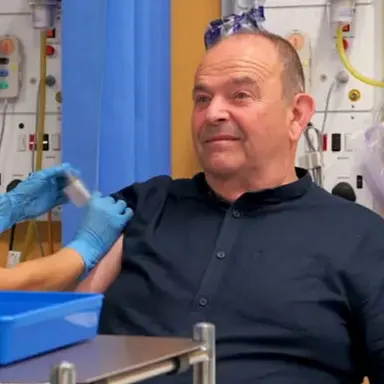
A new personalised skin cancer vaccine has been found to reduce the risk of patients dying or their cancer returning by 42%. As part of a global two-year clinical trial, more than 1,000 patients who had already had their tumours removed were given a widely used immunotherapy drug. Around two-thirds were then given the experimental vaccine, which was developed using cells from their own tumours. Researchers say the results could mark a turning point in cancer treatment.
Also: How a man achieved his goal of becoming a world-famous singer without even knowing it. The neighbours who rallied together to fulfil an autistic boy's dream. The "brain bank" giving hope to Parkinson's patients. A ballet school offering a brighter future for children living in one of the poorest parts of the world. And how one conservationist's determination helped save the threatened African manatee.
Our weekly collection of inspiring, uplifting and happy news from around the world.
(Photo: A man receives a personalised vaccine as part of a global cancer treatment trial. Credit: Addenbrooke's Hospital)
Presenter: Helena Burke
Music: Iona Hampson