
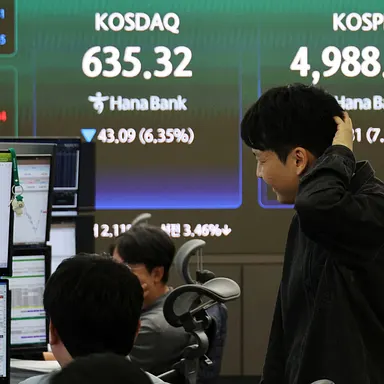
This Global News Podcast episode covers a run of major stories from 6 November. It opens with tech shares tumbling across Asia and the US after the Democrat midterm victory, with analysts debating whether fears of AI regulation and an overheated investment boom are behind the sell-off.
Other segments cover the conviction and 200-year sentence of a Kenyan doomsday cult leader, the banking collapse and impeachment push in Paraguay, bomb threats disrupting European flights, and California governor Gavin Newsom's move to commute death sentences. Listeners also hear about the Pope's Latin America trip after cancer surgery.
In this episode Ankur Desai, Anne-Marie Schubert, Frank Gardner, Jake Kwon, Katie Watson, Mimi Swaby, Sarah Rainsford, Theo Leggett, Thomas Mukwana
This Global News Podcast episode on AI-driven market losses, Kenyan cult sentencing and Paraguay's crisis was made with the technology behind HappyScribe's tools for creating transcripts of your meetings.
Ads in this audio differ from the text. Tap the sentence you're hearing to follow along.
Synced: the text now follows the audio.
This BBC Podcast is supported by ads outside the UK.
Sometimes we all need an extra helping hand, especially with a tricky business problem you've been putting off. Claude is the AI for just that: it's the collaborator that understands your entire workflow and thinks with you, not for you. And Claude isn't just for quick questions; hand it a whole task, like turning a folder of scattered notes into a report, and it does the work and hands back something finished that you can open and edit. Claude can now draft a doc or deck right in front of you, and Claude Design now lives right inside Claude.
Describe the website or prototype you're picturing, attach your design system, and it comes back in your own design language, ready to edit, right on the canvas. It works with your files and the tools you already use, like Gmail and Slack, and whether you're debugging code at midnight, building a financial model, or strategizing your next business move, Claude extends your thinking to tackle the problems that matter. For problems worth solving, get started with Claude at claude.ai/solve, that's claude.ai/solve, and check out Claude Pro, which includes access to all of the features mentioned in today's episode.
claude.ai/solve. Zscaler is the cybersecurity platform for the AI era. When businesses innovate, security should provide the right foundations, unlocking potential and securing speed. Zscaler, proud global cybersecurity partner of the Aston Martin Aramco Formula 1 team. Learn more at zscaler.com.
This is the Global News Podcast from the BBC World Service. Hi, I'm Ankur Desai, and at 15 GMT on Friday, 6 November, these are our main stories. Global stock markets plummet over fears of a slowdown in the development of AI following the U.S. midterm election results. The leader of a doomsday cult in Kenya is sentenced to 200 years in prison after being found guilty of murdering more than 190 people. And another wave of bomb threats disrupts passenger flights in Europe.
Several newsrooms in Ireland have also been evacuated. Also, in this podcast, anger in Paraguay, as nearly half the population loses access to its bank accounts.
As far as I'm concerned, the criminal case must continue, because a thief like this cannot go unpunished. He disappointed us. He robbed working people.
The president there faces an impeachment hearing, and three weeks after cancer surgery, the Pope heads for South America. Let's start with the news that tech shares around the world have tanked amid concerns of a slowdown in AI development. It comes after a sweeping Democrat victory in the U.S. midterm elections. The tech-heavy Nasdaq Index lost an estimated $2.5 trillion in one day. But how much of this is down to U.S.
politics? Our business correspondent, Theo Leggett, explains.
This may well have been sparked off by the results in the midterms, and as we know, a number of Democratic candidates campaigned on more restrictions for data centers and that kind of thing. So there's a fear of more regulation. But I think this is a symptom of something wider that's been growing for weeks, if not months, which is that the exuberance over AI, which has been going on since 2022, the sort of gold rush that everybody's plowing money into AI, and more people are plowing money in because they've got fear of missing out, a bit of FOMO, that's been going on for years.
And now there are signs that there's a hang-on moment coming in, which is data centers are unpopular, they may face further restrictions. We've also had warnings from researchers in some cases that AI represents an existential threat to humanity. Now, there's a long debate over how real those risks are, but there's an idea that AI needs to be more heavily regulated, a bit more caution. And there's also wider concern about whether the investments that are going into AI, which are huge according to Goldman Sachs, $1.8 trillion committed, whether they'll ever yield the profits that they're supposed to.
And when people buy shares, they're buying shares on the basis that the companies they buy into will be making profits, or that the capital value of the company, the share price of the company, will go up. Now, if there isn't confidence that all that's going to happen, people take their money and then put it elsewhere. And in addition to that, you have people who play the markets, who are looking at the results in the midterms, who are saying, we think the market's going to fall. They short sell shares, they make money on a falling market, and that helps to produce further falls.
So we've got all of this coming together, and it's triggered by the midterms, but it's also about something much wider.
Markets in Asia have been particularly badly affected. Japan's Nikkei Index and South Korea's KOSPI both closed down 6% on Friday. Stocks in Taiwan had their worst week for 25 years. I asked our correspondent in Seoul, Jake Kwon, why these markets have been hit so hard.
It's partly because of all the successes that we've seen from the AI chip makers here in East Asia. One of the first and early beneficiaries of the AI boom are companies like SK Hynix, Samsung Electronics in South Korea, and Kioxia in Japan, and TSMC in Taiwan. These are the chip makers whose memory chips are the critical component in the AI data centers, and they've been really flying off the shelf. They could really ask their buyers any price.
SK Hynix, a few days ago, have told the investors that for the next five years, all their production is already sold out. And these AI data centers, there was a rosy kind of future that American companies were saying they'll be just kind of building them at a very quick rate. But the fear now is that, you know, is the AI race over? And if these AI data centers stop getting built because of all the regulations from Democrats, will this kill the demand, and will this stop the prosperity of the East Asian market?
What could the consequences be then for a country like South Korea, for example?
Look, South Korea, Taiwan have been having some really unprecedented growth thanks to this AI boom. It is hard to overstate just how important Samsung Electronics and SK Hynix has become to the South Korean economy. The two companies combined, their value comprises about half of the entire stock market here in South Korea. And that's why even the companies that have nothing to do with tech or AI, their value was dragged down today. And the question is, if these companies can no longer sell at the rate they have been, it's going to bring some kind of recession to the entire economy of South Korea.
But, you know, I also have to point out that the analysts here, few of them believe that the AI race is over, and that if AI data centers do not get built at the current spot, perhaps it will get built somewhere else, whether that's in the U.S. or outside. And we really need to see exactly what kind of regulations that the Democrats bring in to see if today's panic sell is justified.
Jake Kwon in Seoul. We go to Kenya now, where a court has sentenced the self-proclaimed pastor, Paul Mackenzie, to 200 years in prison for the murders of more than 190 people, all but one children. Mackenzie ordered members of his cult to starve their children to death so they could meet Jesus. He was found guilty last month by a Mombasa High Court alongside 27 accomplices. More than 400 people died in the Shakahola Forest Massacre. Lady Justice Diana Rachel Kavetze-Mochache announced the sentence.
Convict one, Paul Denge Mackenzie, 100 years imprisonment for each of the 193 counts of murder by starvation, one count involving an adult victim, and 182 counts involving child victims to run concurrently with one another. B, 100 years imprisonment for each of the eight counts of murder by direct homicide involving child victims to run concurrently with one another, making an aggregate sentence of 200 years imprisonment for convict Mackenzie.
Our Nairobi correspondent, Thomas Mukwana, has been following the story.
The families of the victims were asking for Pastor Paul Mackenzie to not be let out of prison, because he's been in prison since 2023 March. And that's because one father who lost six children said that Pastor Paul Mackenzie is a danger to the public. And from the judge and how the judge was speaking in court today, it seemed like she agreed, because she said that Pastor Paul Mackenzie has shown no remorse. That's because all those 191 people who died, 190 of them being children, despite all that, Pastor Paul Mackenzie still claimed no responsibility, even though he's the one who went into that forest and fast and led all those people in there.
He still claimed that he wasn't responsible. And the judge said that that's because Pastor Paul Mackenzie somehow believed that he was divine and that all these dreams and visions he had were divinely sent to him.
And a lot of people are asking the question, why did he not receive the death penalty?
That's because the death penalty is unconstitutional in Kenya. The highest court of the land, the Supreme Court, said that it's unconstitutional because it restricts someone's right to life. And the last time someone was ever hanged in Kenya was in 1987 in a completely unrelated case. But this is a landmark ruling, because the man is in his early 50s. Paul Mackenzie is 52 years old. If he's convicted to stay in prison for 200 years, there's no way he's leaving prison before he's died. So this is effectively a death sentence.
And on top of that, he's still facing terrorism charges in Kenyan courts and also crimes against children, among others. This is a man who showed defiance before today's sentencing. He said that he wasn't responsible, that people made independent decisions, but 190 children dying, the judge said that was cruelty that was premeditated and that no mercy would be shown to him. So according to the judge and many people, a life sentence was the best that anyone could get out of this trial.
Thomas, what was Paul Mackenzie's reaction to the verdict and the sentencing today? What was his demeanor like?
He has, throughout this sentencing, I remember when the verdict was given, he was very angry, and he even said to journalists that he would appeal this decision. It still strikes me like he's a very defiant man. It's very difficult to think of him as a man who's sympathetic or remorseful. Well, he at least acknowledged that his doctrine led to so many deaths, but he still claimed absolutely no responsibility. And his son, Dan Mackenzie, we spoke to him when we went down to Malindi.
He told us that he thinks his dad is a mass murderer and that he shouldn't be let out, and that he even was abused under him and forced to pray and physically abused for not sticking to the doctrine. So this trial feels like to many families, it's finally some form of closure, but 400 people dead and just hands of bodies given to families. So many families still haven't gotten the remains of their loved ones. This feels like something.
And just very briefly, finally, Thomas, do we know much about the 27 accomplices?
All those men and women were people who held different roles in Mackenzie's hierarchy. They're men who dug those graves, concealed them, some by planting plants on top of graves. And some of those people ran kitchens, which strictly only fed men who were carrying out these killings and burials. So they're all men who lived with Paul Mackenzie and were around him 24/7 as he ran this murderer's cult.
Thomas Mukwana reporting from Nairobi. Next to Paraguay, where protests have been raging through the night. It's a country of just 6.5 million people, and nearly half of them now cannot access their savings after one of the country's main banks collapsed. Paraguay's president, Santiago Beña, has business links to the Bueno Bank. He attempted to resign over the scandal, but has now been facing an impeachment hearing. One protester said he must face justice.
I believe his resignation should never be accepted. It's a complete act of cowardice. As far as I'm concerned, the criminal case must continue. The impeachment process must go ahead, because a thief like this cannot go unpunished. He disappointed us. He robbed working people.
I spoke to our Global Affairs reporter, Mimi Swaby, about the extraordinary developments over the past week.
It all centers around Bueno Bank and Santiago Beña's ties to it. The bank essentially collapsed earlier this week after a severe capital shortage. It's gone into solvency proceedings and essentially left 3 million people unable to access their accounts. People are extremely angry, and this is because they are blaming or largely blaming the president. This has led Congress to try and impeach him. Lawmakers voted unanimously on Thursday to launch an impeachment proceedings, moving it to the Senate.
And then that caused Mr. Beña to try and resign. However, that resignation has been put on hold, essentially. It's not been accepted by Paraguay's Congress because they want to use political power to essentially bring him to justice through this impeachment measure. But they accuse him of misconduct, conflict of interest, and essentially a cover-up linked to Bueno's failure. Until last year, he had shareholders in the group that controlled that bank. It's a very murky picture, and this bank was quite a new platform.
It had 60% of the adult population of Paraguay's money in it. So it had a huge presence in the country, and its downfall happened incredibly quickly. Accounts were essentially frozen in the middle of the night earlier this week, and people were left stranded, unable to access any money, and fearing for the future.
Yes, I guess a big question then, what about people's moneys, their savings? How were they able to access them or regain them?
As part of Mr. Beña's attempted resignation video, which he posted on social media, he said, firstly, he apologized to all Paraguayans, saying, if I've caused any issues, I'm sorry if that was never my intention. But then he said his priority now was the peace of mind of individuals who'd put their money in the financial system, the very financial system, the Bueno Bank, which has caused his downfall. He has said that it's his main priority to get their money back, essentially. In an attempt to try and ease people's minds, he requested the resignation of the central bank president and set a five-day limit for return of funds.
Neither of those measures have proved sufficient, and people are still incredibly angry.
Our Global Affairs reporter, Mimi Swaby. Still to come in this podcast.
Executing 737 people in California, we will have executed roughly 30 people that are innocent. I don't know about you. I can't sign my name to that.
The governor of California has said he will commute all death sentences, sparing the lives of over 500 inmates.
Sometimes we all need an extra helping hand, especially with a tricky business problem you've been putting off. Claude is the AI for just that. It's the collaborator that understands your entire workflow and thinks with you, not for you. And Claude isn't just for quick questions. Hand it a whole task like turning a folder of scattered notes into a report, and it does the work and hands back something finished that you can open and edit. Claude can now draft a doc or deck right in front of you, and Claude Design now lives right inside Claude.
Describe the website or prototype you're picturing, attach your design system, and it comes back in your own design language, ready to edit right on the canvas. It works with your files and the tools you already use, like Gmail and Slack. And whether you're debugging code at midnight, building a financial model, or strategizing your next business move, Claude extends your thinking to tackle the problems that matter. For problems worth solving, get started with Claude at claude.ai/solve. That's claude.ai/solve.
And check out Claude Pro, which includes access to all of the features mentioned in today's episode. claude.ai/solve.
Zscaler is the cybersecurity platform for the AI era. When businesses innovate, security should provide the right foundations, unlocking potential and securing speed. Zscaler, proud global cybersecurity partner of the Aston Martin and Ramco Formula One team. Learn more at zscaler.com.
Support comes from Wise, the smart way to manage the currencies you need around the world. Your life is global. Your money should be too. Some providers promise no fees on overseas transfers. Don't be fooled. Extra costs often hide in bloated exchange rates. Choose Wise. You can send, spend, and receive money in over 40 currencies. Count on the exchange rate that you'd usually see on Google. That's how millions save billions on hidden fees. Be smart. Get Wise. Visit wise.com.
T's and C's apply.
This advertisement feature is paid and presented by GoTurkiye. This is what most people come to Antalya for: beach, sun, and not much else. And that's fine. But head inland just a little and you can experience a different kind of Antalya. At Köprülü Canyon National Park, one of Türkiye's most accessible places for adventure sports and personal favorite spot of local guide Berfin Özçelik.
You can spend your whole day here. First, you should go to the canyon to do a rough thing. But there is so much more than that.
Yes, it's not just adrenaline that's to be found in these hills. High above the river, the pillars of Adam Rocks surround the ruins of Selge, an ancient city that's been here far longer than the rafting routes.
Selge is like a gem waiting to be discovered.
So it's not exactly what you expected from a day in Antalya, but that's exactly the point. Plan your next detour at goturkiye.com today.
This is the Global News Podcast. Now to the news that another wave of bomb threats has disrupted passenger flights in Europe. In addition, several newsrooms in Ireland, including the national broadcaster, were evacuated, also following bomb threats. Spain's foreign minister has said the continent appears to be facing hybrid aggression and a form of psychological warfare. In all of the threats, no explosives have been found. Our security correspondent, Frank Gardner, told me more.
There are now getting close to three dozen of these planes that have had to be diverted and escorted because of these hoax bomb threats. It's immensely disruptive. Couple that with the threats to media organizations in Ireland and elsewhere, which the Irish government say are connected to the bomb threats. So clearly, this is a coordinated program of disruption. Who is behind it? That's the big question. So there were two emails sent, one to the authorities in Rome's Fiumicino Airport, another to the authorities at Sofia Airport in Bulgaria, claiming to be from fighters of the male state.
I think that's a red herring. So there's a far-right, ultra-right group in Russia so extreme that they were banned by a Moscow court in 2021 with a similar name. Their leader has been tracked down, and he said, look, this is not me. It's nothing to do with us. We haven't been active for years. So I think it's somebody hiding behind that. I think there is a circumstantial tsunami of evidence, but only circumstantial, pointing to Russia, because the only people who've been able to get bombs onboard planes in Europe in the last few years have been Russian proxies.
But that is not enough to say that this was Moscow, because you've got to follow the evidence. And so far, nothing has publicly come to light, nothing I'm aware of, saying we followed the trail and we know exactly who sent these emails and they were sponsored, say, by the GRU, Russian military intelligence. If anybody's got to that point yet, they're certainly not making it public.
And finally, Frank, this is, I guess, showing how easy it is to cause disruption and how widespread it is.
This is whoever's doing it, it's asymmetric activity at its most effective, because you're right, it's a very low risk to the perpetrator. They probably can't be traced. Even if they can, there will be different sort of layers that have got to be got through. And if it is Russia, then probably they're perfectly safe in Russia or in Belarus. It could be a non-state criminal group for some bizarre reason. Very hard to find them. And yet, as you say, maximum effect, maximum disruption.
Look at how expensive this is. Not to mention terrifying for the people on board. Nearly all these planes had people on board in the final few minutes of the descent, where there's nothing you can do about it. If you get the threat before the plane takes off, you can do something about it. The checks and controls are pretty the screening's pretty thorough these days. It's not easy to get a bomb onboard a plane, but it has been done recently in Eastern Europe.
Our security correspondent, Frank Gardner. A 90-year-old woman who was shot during Australia's Bondi Beach attack last December has died in a Sydney hospital. Eva Geller was one of dozens who were seriously injured when two gunmen opened fire at a Jewish event. 15 people were killed. A gun buyback scheme began this week, launched in response to the Bondi attack. Licensed gun owners in the state of New South Wales can surrender firearms in exchange for money. Our Australia correspondent, Katie Watson, reports from Sydney.
Australia's Prime Minister, Anthony Albanese, said he was saddened by Eva Geller's death. Almost a year on, he said, the devastation of that awful day continues to cause pain for families. Rabbi Aaron Moss said the 90-year-old who escaped the Holocaust as a child had been in and out of hospital since the shooting due to significant leg injuries. The attack last December was Australia's worst mass shooting in almost three decades. It led to sweeping gun law reforms and a crackdown on hate speech. One of the gunmen was killed by police at the scene. His son, Naveed Akram, was arrested and charged with 15 counts of murder, 40 charges of attempted murder, and one count of committing a terrorist act.
New South Wales police haven't given any detail on possible further charges as a result of Geller's death. They say they're awaiting further advice and are working with the coroner's office.
Katie Watson in Sydney. To the United States now, where the governor of California, Gavin Newsom, has commuted death sentences for all those facing execution by the state, allowing them to serve life in prison without the possibility of parole.
I moved forward just moments ago with an executive order advancing a moratorium on the death penalty in California. Executing 737 people in California, we will have executed roughly 30 people that are innocent. I don't know about you. I can't sign my name to that. I can't be party to that. I wouldn't be able to sleep at night.
The move will impact the lives of more than 500 inmates in the state, which has the largest number of people on death row in the US. The American Civil Liberties Union praised Mr. Newsom's decision, calling it a historic step towards ending the death penalty in California and across the country. However, others oppose the move, including Anne-Marie Schubert. She was a leading prosecutor for more than three decades and is now the CEO of the Criminal Justice Legal Foundation.
We're talking about the worst of the worst killers here in California. We're talking about serial killers, child killers, mass shooters, people that kill police officers, people with horrific records. And so for victims, I run a victims' rights organization which is designed to stand up for crime victims. This was a devastating blow to them. In California, we have a very robust process. Juries make decisions, judges impose sentences. And ultimately, California voters have decided time and time again that this is an appropriate sentence in the most unique set of circumstances.
And so the governor has made a decision on his own with the swipe of a pen to override the will of juries, judges, and the will of the voters. California's adopted this law as recently as 2016. So even though we haven't had an execution, the law remains on the books. And if the voters wanted to change that, we could have that healthy debate about the policy, the death penalty. But this is far different. This is one person who's decided on his own that he will override decisions made by these juries and judges and the voters.
And so that is what is perhaps the most disheartening. We don't believe it's lawful. We are intending to challenge it.
Anne-Marie Schubert. It's quite a big week for the Pope. On Wednesday, he hosted musician Bob Dylan at the Vatican. Now he embarks on a tour of Latin America just three weeks after having lung cancer surgery. He's heading to Uruguay and Argentina, as well as Peru, where he was a priest for many years. Sarah Rainsford told us more from Vatican City.
It's just over three weeks since we were here on the square here at St. Peter's, talking about the fact that the Pope had made this pretty shocking announcement that doctors had discovered a tumor on his lung and that he was going to have surgery. And so less than a month later, he's heading off on what is a pretty grueling trip. It's 12 days almost in total. It's going to see him covering thousands of miles, taking very long-haul flights. He's just taken off heading for Uruguay first and foremost. And it is going to take him from the Amazon to the Andes.
It's a very complex trip. But it's interesting that, in fact, when the Pope first fell ill, it was made clear by the Vatican and by lots of people close to him that he really wanted to be able to make this trip, not least because it includes a visit to Peru, where the Pope, when he was known as Robert Provost, as a priest, spent many, many years. In fact, he has Peruvian citizenship, even though he was born as well in the United States. So it is very important to him personally. And it's also an important trip, of course, for the Church, the first Pope to visit some of those countries for four decades.
So it is a much-anticipated homecoming is how the Vatican's described it as a return to his roots. He's talked about Peru with great affection ever since he became Pope. In fact, he mentioned his previous diocese just after he was elected. He talked about it from here on the balcony at St. Peter. So it's really important to him personally. But again, I think it's also this whole trip important for the Vatican to show that the Pope is fit and well and working again after that surgery for lung cancer.
Sarah Rainsford reporting from Vatican City. Now, in yesterday's episode, we reported on an Italian chef who was fired for refusing to add pineapple to pizzas at the restaurant where he worked. We've always loved hearing from our listeners. And I mentioned that if you have any thoughts on pineapples on pizza, do get in touch. And you did. We received this email from Laura in Canada. Voiced by a producer, it gave the team a nice little chuckle.
I was amused and confused at why a person was fired over pineapple on pizza. I'll admit, I don't understand the hate and I'm baffled it has reached such heights as to be newsworthy. If you don't like a food, you don't have to eat it. Pineapple on pizza might not be Italian, but at one point, neither were tomatoes, both from South America. Don't yuck someone else's yum. But if you insist on yucking pineapple on pizza, may I introduce you to a Swedish take?
Banana chicken curry pizza. There are worse things in life. Eat what you like, pray however you care to, love whoever you want.
So who would have thought pineapple on pizza could cause such a stir? Do you have any other offbeat topics that grind your gears? Well, we'd love to hear about them. We just love hearing from you in general. So do get in touch and we'll read them out. Or if it's a voice note, we'll play that out too. Email us at globalpodcast@bbc.co.uk. And that's all from us for now. If you want to get in touch, you can email us at globalpodcast@bbc.co.uk. You can also now watch our episodes in full.
Just search for the Global News Podcast on YouTube. This edition was mixed by Jack Wilfon, and the producers were Helena Burke and Alfie Habisham. The editor is Karen Martin, and I'm Uncle Design. Until next time, goodbye.
Sometimes we all need an extra helping hand, especially with a tricky business problem you've been putting off. Claude is the AI for just that. It's the collaborator that understands your entire workflow and thinks with you, not for you. And Claude isn't just for quick questions. Hand it a whole task like turning a folder of scattered notes into a report, and it does the work and hands back something finished that you can open and edit. Claude can now draft a doc or deck right in front of you. And Claude Design now lives right inside Claude.
Describe the website or prototype you're picturing, attach your design system, and it comes back in your own design language, ready to edit right on the canvas. It works with your files and the tools you already use, like Gmail and Slack. And whether you're debugging code at midnight, building a financial model, or strategizing your next business move, Claude extends your thinking to tackle the problems that matter. For problems worth solving, get started with Claude at claude.ai/solve. That's claude.ai/solve.
And check out Claude Pro, which includes access to all of the features mentioned in today's episode. claude.ai/solve.
Investors dump tech shares over fears of slowdown in AI development following the sweeping Democrat victory in the US midterm elections. Markets in Asia suffer sharp losses. Japan’s Nikkei index and South Korea’s Kospi closed 6% down on Friday.
Also: the leader of a doomsday cult in Kenya is sentenced to 200 years in prison after being found guilty of murdering more than 190 people; Paraguay's president faces impeachment after a banking scandal puts the country in crisis; another wave of bomb threats disrupts passenger flights in Europe; Gavin Newsom spares 500 prisoners from the death sentence in California; and the Pope heads to Latin America three weeks after lung cancer surgery.
The Global News Podcast brings you the breaking news you need to hear, as it happens. Listen for the latest headlines and current affairs from around the world. Politics, economics, climate, business, technology, health – we cover it all with expert analysis and insight.
Get the news that matters, delivered twice a day on weekdays and daily at weekends, plus special bonus episodes reacting to urgent breaking stories. Follow or subscribe now and never miss a moment.
Get in touch: globalpodcast@bbc.co.uk
Photo: Currency dealers talk in front of an electronic board displaying the Korea Composite Stock Price Index (KOSPI) in Seoul, South Korea.
Credit: REUTERS/Kim Hong-Ji