
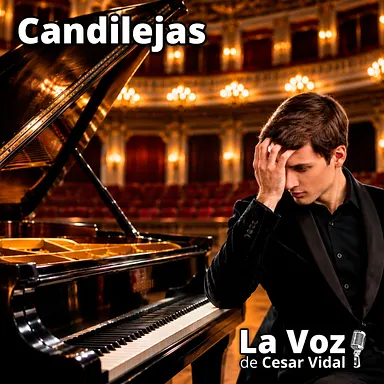
En esta entrevista de La Voz de César Vidal, el pianista bielorruso Uladzislau Khandohi, de 25 años, repasa su trayectoria desde la infancia en una familia de músicos. Habla de sus primeros premios internacionales a los diez años, de su primer álbum grabado a los quince y de su traslado de Minsk a Moscú y después a Madrid, donde estudia con Stanislav Ioudenitch.
Según explica, la emoción debe primar sobre la virtuosidad técnica, y menciona a Rachmaninov, Prokofiev y Chopin como sus compositores favoritos. También habla de las largas jornadas de práctica, del público de cada país y de sus aficiones, como el fútbol y el ajedrez.
En este episodio César Vidal, Uladzislau Khandohi
La transcripción de este episodio sobre el pianista bielorruso Uladzislau Khandohi se realizó con la tecnología del AI note taker de HappyScribe.
Los anuncios de este audio no coinciden con el texto. Toca la frase que estás escuchando para seguirla.
Sincronizado: el texto sigue ahora el audio.
"Candilejas, teatro y espectáculo", con César Vidal.
We're back, and we're back for one of our very special interviews of Friday night. You know that we always invite very special people. This special people sometimes is known worldwide. It's a person who won an Oscar in Hollywood, who is a very famous ballerina in every theater in the world, and sometimes it's not a worldwide-known person. It's a person very well-known in his country.
And in these cases, we want people who are from Mexico knows, people who are from Peru, or who are from Spain, or who are from the Dominican Republic, that they can know each other. Persons who are very well-known in their countries but not outside their countries. And also, we invite people that even they are not very well-known in their countries, in their own countries, but they are very well-known in this town, this region, and we want they be known worldwide.
The person that we have tonight is a very young person. I think that it's almost a scandal how young he is, but he's a real genius. I have the opportunity of listening to his interpretations, and he's a real prodigy. He's a real top in classical music, in piano. And this is very interesting.
It's a person that today we're going to interview, but also we're going to have the opportunity of listening to some of his pieces, some of his plays. His name is Uladzislau Khandohi. And, well, Uladzislau, welcome.
Hello, and thank you very much for introducing me so well. And I'm happy to be in this interview, in this podcast. Yes, thank you very much.
I have the impression that you are very, very young. How old are you?
You know what? I would say that I'm not so young. I'm 25 years old. I mean, it's still young, of course, but, you know, I feel myself already in the soul very old, especially when I play music written by composers, you know, which is very sometimes dark and very, very, how to say, deep musically. So I feel that I'm older than my age, but yes.
I don't know, but Vladislav, had any person in the family dedicated, related to music, or is he the first in the family dealing with this kind of activity?
No. Actually, I started playing the piano because when I was young, my brother played the piano as well. And he started in the musical school in Minsk, in Belarus. And I really liked how he played, and I repeated some melodies. I tried, of course, to repeat some melodies when I was, like, 6, 5. And my parents noticed that. They are also musicians. They're dulcimer players.
It's like our national instrument in Belarus, with strings and, like, you play with sticks on it. And my mom works in the orchestra. My dad teaches in the musical school. So yes, they took me to the musical school when I was 7. And I would say that from the beginning, I didn't like it so much. And I didn't practice, of course, a lot. But of course, with the age, you understand what is this.
And, yeah, so I really love music, and I really like to be a musician.
And when have you begun studying piano?
I began studying piano when I was 7, when I entered the musical school in Minsk. Yes.
Well, this is very soon. And did you enjoy it, or this was a kind of obligation?
You know, when people are young, they always want to be with their friends. They want to play football on the street. They don't want to work. And of course, I also didn't want to do all of these things. But my parents, of course, told me, "You need to practice. You need to do this. You need to do this." But I wanted just to play football, of course. And I wanted even to become a footballer, you know? But of course, I told you, with the age, you understand why the music is, I would say, much more important, and it improves the person much better than the football.
And, yeah, so.
And when did you like, for the first time, music? So that you were talking, "Well, of course, I prefer to play football." This is very logical in a boy being 7 years old. But when did you pass from the discipline, the obedience to parents, to really enjoy this kind of music? At 8, 9 years, when?
I think I always liked music. The thing that I didn't want to work.
Yeah.
That's what I would say. But the music, I loved all the time, I think. That's why I started playing the piano. But, you know, I understood when my parents took me to the piano and they said, "Oh, you need to practice scales. You need to practice passages. You need to practice this." And I wanted everything from, like, to be perfect immediately, you know? But it doesn't work like this. Of course, you need to spend a lot of time. And, but, you know, I liked music always. I just, as a kid, I didn't want to spend much time on the piano.
If I'm not wrong, you received your first major decision at the age of 10. How did you feel when you were only 10 years old and you received the Grand Prix at the Menselevskaya Open City Competition for Young Pianist in Mogilev?
How was this?
How was this experience?
Yeah, but when you're young, you even don't realize how important is this. So I just won the competition, and it was okay for me. And I began to play football maybe the one week after, you know, again. And I went to the school with my friends again. And of course, I practiced the piano. It was not, like, the most important thing for me to win the competition, you know? Of course, I think, as people say sometimes, and I try to believe in this that I'm talented.
And that's why I think I won the competitions when I was young and when I was a prodigy. And people were saying that I will have a big future. So that's why I was winning the competitions also when I was young. But I didn't pay so much attention to this.
After this, you became a laureate of the Svyridov competition for young performers in Saint Petersburg. How was this experience?
I remember, actually, when I was young, and at this time, I think I was 11 or 10, I don't remember, I actually became sick during the competition. And I remember it was quite hard for me. I had the big temperature, and my parents were quite worried if to participate in the competition or not to participate. But I decided to play when I was 11. So I just, yeah, and I played, actually, even better than if I would not be sick, I think.
And yes, I won the competition.
I think that, well, it's very precocious, your career, because when you were maybe 12, 13 years old, you won the first prize at the Astana Piano Passion International Festival and Competition in Kazakhstan and at the International Nutcracker Competition in Moscow. I should like to know what is exactly this International Nutcracker Competition. This is a kind of competition around the ballet of Tchaikovsky, or it has not any kind of relation?
No, it doesn't have any relation with Tchaikovsky. It has relation with music, of course, because it's actually a very important competition. And I think that was, that were two life-changing competitions for me, like the Astana Piano Passion and the Nutcracker, because Astana Piano Passion, that was one of the most important competitions for young pianists created by Denis Matseuev. And Matseuev is, I don't know if you know who is Matseuev. Matseuev is one of the greatest pianists in Russia.
And he's, I think, the most famous pianist in Russia. And he created a competition in Astana in Kazakhstan for young pianists from, and it's international competition. And when I was 12, that was the first kind of very serious competition for me. And there were many very, very talented pianists there. And I played for the first time, I think, with the orchestra in a competition in the final round.
And I won this competition, and Matseuev noticed me. And half a year after, I participated in the Nutcracker Competition, which is the television competition, which is broadcasted, like, in all Russia, and everybody watches this competition. It's between pianists. It also exists between violin and, I mean, the string players and the wind players.
But of course, I participated in a pianist's section. And I won this competition, and I won the prize, the audience prize. And yes, after this, Matseuev and other people noticed me, and I kind of became, became a part of their family. And I traveled a lot with the concerts in Russia, especially in Belarus, of course. And, yeah, that's why I grown my, how to say, famous thing.
Yeah. By the way, Vlad, in 2016, you are in Salt Lake City in USA, but I think that it's very important that this release your debut solo album by the label Melodiya. Well, you were then maybe 15 years old?
I think 14, 15. Yeah, I think 15. Yeah.
Well, how did you feel when you have in your hands this solo album?
At 14 years old, to have solo album, it's quite a very important thing, I think. And I don't know what to say, actually, because, you know, I was young, and I recorded my repertoire when I was young. And of course, I was not so aware of my abilities. And I recorded the album. Of course, it was very good for 15 years old. And I recorded, like, everything perfect. Even now, I don't know how I played so perfect technically.
But, you know, like, in terms of musicality and soul, I think I would do it much better now, of course. And, no, but for this age, it was very, very important for me and for concert career to have at 14 years old already a CD album. It's very good. And also on very famous label like Melodiy. It was very famous in the Soviet Union also. Great pianists recorded there, like Richter, for example.
So, yeah, it was very important.
Well, I think that probably people who is listening right now are very interested in listening to you and listening to you playing piano so that if you, if you permit me this, we're going to listen where one of the pieces that you have taped. I'm talking about the piano sonata number 8, the Andante Soñando de Prokofiev. So that we're going to listen your interpretation of Prokofiev, and we keep talking about your career.
Well, this was the interpretation of Khandogi, of Vladislav Khandogi, of this piano sonata number 8, Andante Soñando of Prokofiev. Vlad, how do you choose different pieces to play?
It's also a difficult question. I mean, it's not difficult, I would say, because I usually try to play the music that I really love. And then, as Rubinstein said, you need to play the music that is singing inside your heart. So I think this is the main term why I choose some pieces to play. And of course, I discuss with my teachers if I prepare for some competition or I prepare to play in concerts or in some concert, because some organizers of the concerts ask for a different repertoire.
And of course, you need to, to prepare this. And of course, because of that, you need to have quite a wide range of repertoire, because it's very important for concert career, because in two days, they can ask you to play Saurdar Rahmaninov. In five days, they can ask you to play first Tchaikovsky Concerto, then they can ask you to play something else. And that's why it's, you need to have in your hands a lot of things.
And, for example, in a competition, it's more important, for example, the difficulty of the piece to show how birtosu you are. For example?
Of course. You know, on the very high level, in the very high level competitions, usually people all play very birtosu, and they have very good technique. It's like the obvious thing. Even you don't need to think about this. For example, on my level now, I don't think about technique because it's already I have this. I'm thinking more about the sense of music, about the color of sound, about the interpretation.
And that's the most important thing in music, I think, because the music is, first of all, to create emotions and to produce it and to make people feel something, to cry or to be sad, to be, I don't know, funny even, or to be, it's different. It depends which pieces you play. So, but this is the most important, yes.
And from a personal view, which is your preferred composer or your preferred composers?
I have several ones, but I think in my top three, if I can say like these are Rahmaninov for Prokofiev, I would say, and Chopin. So these are my.
I can understand.
I can understand this in a piano player, this not least. List also, but, you know, for me, list is not as deep as these composers. And I mean, it's also, of course, he has many wonderful things and, of course, very deep things. And he was a very religious guy also, of course. But the thing that I told you, his music doesn't sing in my heart like other composers that I named.
So.
I can understand it. I can understand it well. Vlad, when you were, I think, 18, maybe 19 years old, you leave Belarus and you go to Moscow. It's how, how did you feel being only 19, 18 years old and leaving behind you, your home, your family to progress in this musical career?
I was actually 16 when I moved to Moscow.
16?
Yeah. Yes, I was 16 when I moved to Moscow to study. But, you know, I was studying before in Minsk, in Republic College in Minsk. I had very good teacher there from sixth grade from the school. So I studied with her, like, for four years, I think, maybe even more, maybe five. And the thing that I thought that in Minsk and Belarus, there are not so many opportunities to play in the concerts and many opportunities to grow up as a musician and as an artist.
So that was obvious that I need something more wide, and I needed to go somewhere to study with a great professor and to have opportunities to participate in the biggest competitions and to become a famous pianist and to be a great musician at the same time. So I decided to move to Moscow, even though my teacher in Belarus didn't like it so much. She thought that it's not good that I need to be with her.
But I think that was a very good solution for me that I went to Moscow.
You are 20 years old, more or less, and you win first prizes at competitions in Ferrol, Spain, and Sanremo, Italy, as well as at the La Palma d'Oro International Piano Competition. So that you are traveling a lot, I think, watching this. And have you seen many differences between different publics? It's different the Spanish, the Italian, the American public?
I think actually the public is different in every country. Yes, it, of course, depends on mentality in the country and the people, because they have different cultures. Of course, people are different because this public, of course, is different. But usually to the concerts, to the classical concerts, public come prepared, you know, that they know what to expect from the concert. And that's why I think usually people on the concert are very, how to say, they are friends with you, and they just try to enjoy the music that you play.
So this is the equal thing for all countries. But I would say actually when I was in United States, the public was like, you even play some small thing or something not very, how to say, very impressive.
Prolonged.
Yeah. And impressive. It's like they shout bravo. They're like standing up, sending ovation. And it's like they like you so much. But I told you, it can be everywhere. It depends just who comes to the concert, young generation or old generation, you know. So it depends.
Well, Vlad, we're going to make a stop, and we're going to listen to you playing the Mazurka 13 by Chopin, one of your preferred composers. And after Chopin, we keep talking.
Well, this was the Mazurka number 13 of Chopin played by our guest tonight. And while I have seen that in 2022, 2023, you have received different prizes, well, in Ljubljana, in Sydney, et cetera, et cetera. And in 2023, you go to Spain at the Reina Sofía School of Music in Madrid.
Why have you chosen Madrid to keep growing in your musical training?
First of all, it's because of the teacher, of course, because I usually try to find the person who understands me and who I feel comfortable to work with. So the teacher with who I study until now, it's Stanislav Yudenich. He's a great musician, and he's a great teacher. And I'm very happy that I study with him in Madrid. And because of him, I basically moved to Madrid.
And now I'm very happy about this decision because I really love the city. I really love the people in Spain. And I, of course, I love the school and, of course, my teacher and his assistant as well, Vadim Gladkov. So it's very, it's a very, very good decision, and I'm very, very happy with it.
How do you feel in Spain? It's very different not Belarus, I think, of Russia. But how do you feel in Spain, in the middle of this Spanish society?
It's definitely much different, I would say, because especially because of the weather, I think. Because the weather here is always, almost always sunny. The people are always sunny, I would say, also very friendly. And I really like it because, you know, even in October, November, I mean, in autumn in Moscow is very cold already, and there is snow. I mean, I also like it sometimes, but I like Madrid also because of, also because of this, because it's not too cold and very good weather.
And I told you the atmosphere here is great and the food is great. Everything is great. So I can understand it. I was living in Madrid before my exile to US, so that I can understand you perfectly. By the way, during the last two, three years, you had been gathering a lot of prizes. I'm thinking in 2024, the second prize at the Maria Casals International Piano Competition in Barcelona.
Two in 2024, the first prize at the MIMAS Piano Competition in Italy, the Dinu Lipati International Piano Competition in Craiova, Romania, et cetera, et cetera, et cetera. And even the second prize at the Vigo Piano Competition. And well, I think this is a list that we cannot finish. And of course, in some way, you are beginning your list of prizes right now because you are a very young people.
But what have you done not that you should like to do? More competitions, more CDs featuring your performance. What would you like to get in the future that you have got not yet? You know, I mean, in terms of music, I mean, what I didn't get, maybe I would like to perform in some piano halls in the cities that I didn't perform, like, for example, in Carnegie Hall in New York or something in Concertgebouw, like something like this.
But, you know, I have a lot of concerts now. I have won numerous competitions that are very important. But I think actually I would like to perform even more and to share my music even more with people that I do now. But this comes with the time also because I'm still young and I'm planning to record another CD now. And yes, and to perform in some more competitions, even though I won, like, one month ago, I was in Rubinstein Competition in Israel, which is like one of the most important competitions for pianists in the world.
And I won there the second prize. So it's like very, very important thing. And yeah, but I don't know. I think I will just, I would like to grow up as a musician even further than I am now.
And Mr. Khandoghi has any kind of private life? I don't know if you play football still or if you play chess or you go to movies or do you have any kind of life apart of music or everything in your life is playing piano, studying piano, reviewing the music?
Yes, of course, I try to have my private life. Of course, for example, I have a girlfriend who is also a pianist and I have, I sometimes play football, of course, not like I played when I was 10, not every day, but maybe one time in two months, three months, I try just to keep in shape myself because, you know, on my level, when I prepare for competitions and I play a lot of concerts, I practice every day. Like even before the Rubinstein Competition, I was practicing like every day for 10 hours or something like this.
And it's like very exhausting and it's not very good for health. And also my posture when I play on the piano, I don't know if you saw this, it's not very healthy because I'm not sitting straight like 90% of the people who play the piano and I'm kind of different because of this. But it's, yeah, so I try to keep myself in shape to do some exercises. And I also like to play chess very much and I'm quite good in this actually. And yeah, I try to read books also when I have time and I try to watch some movies if I, but usually, you know, I'm doing this when I'm in the airplane because this is one of the moments when I have free time.
Well, I congratulate you if you have some free time anyway, because I'm sure that you need it. And well, Vladislav, it has been a real pleasure to chat with you during this time. I think that it will be a real pleasure also for the people who is listening to us because I think that really you are a genius. I think that we can use this.
It's not right. It's not right, I would say.
I think so. I think so. And this is very, very clear to me. And I think they're going, they have enjoyed also your music because your interpretation are really magisterial interpretation. This is so, so that I wish you many successes in the future. I wish you that, well, you be totally happy in this kind of work because the art is a real gift.
And it's a real gift not only to the person who is playing piano, who is writing books, who is painting pictures, but also to other people who enjoy with this kind of work. I think this is a kind of divine gift. And it's a kind of divine gift to the person who has received it and to the person who enjoyed because this person has received this gift. My best wishes to your future success.
Thank you for your kind words. Thank you.
And well, I think that we're going to see each other in the future. At least I'm going to listen to your interpretation in the future. And to the people who has been listening to us, well, we hope that you have enjoyed. We hope that you have a good time during tonight's program. And we hope that we're going to meet together again next Monday at the same place, at the same hour.
Till then, we say farewell with a sadder farewell, you know. God bless you. Que Dios los bendiga.
El programa La Voz es una producción de Artorius Incorporated y al amparo del derecho a la libertad de expresión. No se hace responsable de las opiniones vertidas en el curso del mismo.
César Vidal interviews pianist Uladzislau Khandohi.
https://cesarvidal.tv/programs/interview-with-uladzislau-khandohi-the-piano-prodigy-who-conquered-the-world-as-a-child-11-13-26?category_id=273321
In this new episode of "Candilejas," César Vidal sits down with Uladzislau Khandohi, an extraordinary 25-year-old Belarusian pianist who, despite his youth, has emerged as one of the most promising talents in international classical music, thanks to his virtuosity, artistic sensitivity, and an impressive career filled with prestigious awards.
During the interview, Khandohi looks back on his earliest experiences with music, his childhood in a family of musicians, and the discipline that led him to win prestigious international competitions from the age of ten. From his first triumphs in Belarus, Russia, and Kazakhstan to his successes in competitions in Spain, Italy, Australia, and Israel, the pianist shares the experiences that have shaped his career, including the release of his first album when he was still a teenager.
The conversation also explores his move to Moscow to further his musical education and his subsequent arrival in Madrid, where he continues his studies at the Reina Sofía School of Music under the guidance of renowned professor Stanislav Ioudenitch. Khandohi reflects on the differences between audiences around the world, his favorite composers — Rachmaninoff, Prokofiev, and Chopin — and his personal philosophy of musical interpretation, in which emotion and the ability to move listeners should always take precedence over mere technical virtuosity.
The young artist also reveals his professional ambitions, the sacrifices required by an international career, and glimpses of his personal life, from his love of soccer and chess to the exhausting practice sessions that can last up to ten hours a day.
An interview that offers a fascinating glimpse into both the musician and the man, featuring two magnificent piano performances: the "Andante sognando" movement from Sergei Prokofiev's Piano Sonata No. 8 and Frédéric Chopin's Mazurka No. 13. An exceptional opportunity to discover a remarkable talent destined to make his mark on the world's great classical music stages.