
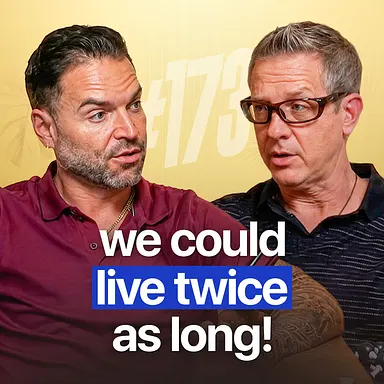
Every line of this episode of The Dylan Gemelli Podcast was transcribed with HappyScribe technology. See also: audio to text.
Ads in this audio differ from the text. Tap the sentence you're hearing to follow along.
Synced: the text now follows the audio.
Nobody in the audience woke up, looked at their car, and thought, I wonder what part of my car battery I should be consuming on a daily basis for my health. You do not have to prove that a supplement is safe before you bring it to market. I found a peer-reviewed published research paper that showed that 50% of the supplements that are on the market don't have in them what they say they have in them. If you improve sleep, you will improve mental, physical, and emotional well-being. When I started taking this product on a regular basis in 2018, I went for 18 months without a single severe headache. My business coach, the way he puts it is for 50 years he needed an alarm clock. When he started taking this, he wakes up before the alarm clock. And he's a business coach. He's got late night mixers, late night dinners. None of that matters. The best way to take these is to just turn them upside down and squeeze them. So cheers, man.
Cheers, brother.
Here's an interesting question. How much do you actually know about the way your everyday habits are supporting how you age? We hear so much about longevity right now. Sleep, Protein, strength training, nutrition— all of these things matter. But there's another layer that doesn't get nearly as much attention as it should. What's happening inside your cells? Your mitochondria produce the cellular energy that your body relies upon every day. And mitochondrial dysfunction, that's considered a central hallmark of aging. And that's why I've been so interested in the work Timeline does with Mitopure. Mitopure is their pure and patented form of urolithin A. It supports mitochondrial function and cellular renewal by activating mitophagy, your body's natural process for clearing out damaged mitochondria. But rather than just tell you about it, Timeline wants you to think about your own longevity habits. So they've created a longevity quiz that takes just a few minutes, and it looks at some of the everyday habits that can support healthy aging. And the best part? If you complete the quiz, Timeline will send you a free sample of Mitopure gummies. So take the quiz, Learn a little bit more about how you're supporting the way you age and try MitoPeer for yourself.
Go to timeline.com/jameli to take the longevity quiz and get your free gummies. That's timeline.com/jameli. All right, everybody, welcome back to the Dylan Gemelli Podcast. So, my guest is a good friend of mine. I actually met— it's been about a year and a half, so it's been too long for you to come on my show. But I am so happy that you're here. The more that I have talked with you and since I've met you, watched you grow and I've grown, I think the timing is actually quite better now from where it would've been before for multitudes of reasons. But what I love about my guests is I've watched your persistence and effort, right? Hmm. I feel like that you are one of those guys that's just like so likable, but I see the drive and I see that you kind of have my kind of, Don't take no for an answer. We're just going to make this roll. And that's one of the things I really love about you on top of what you do and what you found, because I think you have something quite special and everybody loves what they do or what they have to offer.
But there's something a little bit different about yours, and that's what I want to get into today. So, my guest today, he's the author of Live Longer and Better. There you go. As you can see, and he is the host of a really strong podcast I was on quite a while ago, and it's called Live Beyond the Norms. But, what he's really known for is his company, MyVitalC. And, he manufactures a Nobel Prize-winning molecule. And, we're going to talk about that. We're going to talk about the science. We're going to talk about every single aspect of what he does. So, welcome my friend, Chris Burrus.
Dylan, my friend, thank you so much for having me. Thank you for that great intro. I know that you like doing things like I like doing them, which is geeking out about science and biohacking. human optimization. So, this is just going to be a blast.
Well, I turned the do not disturb on because I don't want people interrupting our conversation.
I like it.
You know, like I said, I like the way you work and I like your energy because a lot of people, and you know this because we were talking about this off camera, a lot of people in our sphere have a different energy about them. And sometimes I think they're overmedicated on supplements or thoughts or extremism. And I respect the hell out of trying to go as many different directions as we can to try to find things of different value or different ways to take care of ourselves. But I love your energy. I love the way that it's always vibrant. It's a good energy. I— you can't tell if you're happy, sad, whatever. That's the way it should be. You should be carrying that with you. So let's talk about what you do here. I just want to get right into it because there's a lot to talk about.
Yeah.
You know, people have products and things that they sell or do, but yours is quite different. There's a lot to it. There's a lot of information to it. So, look, first of all, what is MyVitalC?
Yeah. So, MyVitalC is really a brand that we spun up as we decided to bring this molecule ESS-60, and we'll talk about it, to market. And, it's interesting, as you were just about to ask this question, my thoughts were on You know, if you had asked me 8 years ago if I would be in this spot, right? If I would be being interviewed by Dylan Gemelli, if I would have written a book, Live Longer and Better, if I've done a longevity summit, I had the opportunity to interview like Dave Asprey, Ben Greenfield, Dr. Steven Gundry, and 53 other people. You know, 8 years ago, I would've said no. Like, I just don't know where I was as a carbon nanomaterial scientist to where I am now. I just— I didn't— there was no way for me to see that path. And so, it's been a really cool adventure and it's based entirely on this molecule. So, this is the ESS-60 molecule. Yeah. It was discovered in 1985 at Rice University. That's in Houston where we're based. And, the 3 scientists who discovered it won the Nobel Prize for the discovery of this molecule. And, they won it in 1996.
So, discovered in '85, Nobel Prize in '96. It's kind of a short 11 years from discovery to being awarded the Nobel Prize, my lab started manufacturing it in 1991, a full 5 years before the Nobel Prize was granted. Listen, and I think you know this, I'm not a very braggadocious person.
No.
But this is as much as I'll get. It is not unreasonable to suggest that the fact that my lab— and that's actually my business partner and Robert and I— that our lab was delivering commercial quantities of carbon nanomaterials to research institutions around the world And they were able to get their hands on it and play with it and do experiments with it. It's part of the reason, at least of the timing, that they won their Nobel Prize. So we are the oldest and longest manufacturer and distributor of this molecule on the planet, again, manufacturing and distributing it since 1991.
So you played a little bit of role in them getting that Peace Prize?
I think, I think timing maybe, right? Because if there weren't manufacturers delivering these commercial quantities, then the scientists wouldn't be able to actually get their hands on 'em, do experiments, and then, you know, know how amazing this molecule. By the way, this molecule is amazing. The way I describe it is it performs as well or better than the current best material in almost every application. So, it makes better inks, better batteries, better tires, better photocells. And this is often like, I go on podcasts and this is often where people get nervous 'cause they're like, you said inks, batteries, tires, probably nobody in the audience— woke up, looked at their car, and thought, I wonder what part of my car battery I should be consuming on a daily basis for my health. And actually, the story gets a little bit worse first. So, one of the shapes on the exterior of this ESS-60 molecule— and by the way, if you're just listening, the molecule looks like a soccer ball. Yeah. Where the lines on the soccer ball represent the bonds between the carbon atoms. You have this spherical molecule of 60 carbon atoms.
Are those pentagons?
So, you got pentagons and hexagons. Yeah. Okay. And so, the pentagons, same shape as the benzene ring, right? Now, benzene is ubiquitous in our society. And, if you want any evidence of that, kind of glance around the room, anything that's plastic, the base molecule is the benzene ring. So, it's ubiquitous in modern society. We don't have modern society without it. But, when benzene is on its own, it's known to be toxic and known to be carcinogenic. So, that shape, not the formula, but that shape exists 20 times on the exterior of this soccer ball-shaped molecule. And so, they thought it would be toxic. Mm-hmm. So, they put it in a toxicity study. In that toxicity study, there were 3 groups of rats, and these are Wistar rats. One group was given water, a control group. One group was given olive oil, a semi-control group. And then, the other one was given olive oil with the ESS-60 molecule in it. Instead of being toxic, the test subjects that they gave it to, again, Wistar rats, lived 90% longer than the control group.
Really?
That's the single longest longevity experimental result on mammals in history. Peer-reviewed published research. Very proud to share my lab provided the material and my lab is mentioned in that, in that original study. So not only are we the oldest and longest manufacturer and distributor of the molecule on the planet, we were actually mentioned in the original study that kind of converted this from being an industrial molecule and getting into the kind of health and wellness space.
Okay. It's going to be grill time in a minute.
Yeah.
Okay. Because I have— I got cross-examination up the ass for you. But first, let's go back to where you kind of started out because you mentioned what you were doing before you discovered this and where you were at. Because, you know, it'd be nice to know the background of who's talking about something in depth like this and this intricate. So, just a little bit on your background because I got a lot of questions.
So, usually what people are looking for, and you've had enough interviews, so many of them and probably in the range of 90% are some sort of pain-to-passion story. Yeah, of course. And I don't have that. And I'm kind of— part of me is a little envious, right? Because it's a powerful story to have this pain-to-passion. Another part of me is very happy because I don't have the pain part of the pain-to-passion story. That's a good thing. So, I mean, at the end of the day, what really brought me here or brings me here is a picture of a Lamborghini Countach, a poster of it on my wall as a 14-year-old boy. So, this is candy apple red Lamborghini. Oh, man. The door, the gullwing doors are open. I can smell the leather. I wanted this car, right? Had no idea how you get one. Happened to find in Motor Trend magazine, by the way, I kind of did some research for the book. And, I couldn't remember, like, how did I figure out this, what I'm about to share? Because today, you would go on, like, how do I own a supercar? And you would probably find, like, 15 dudes who are renting a supercar telling you what you need to do to get a supercar.
Back then, I think I found, like, a Motor Trend or a Motorhead magazine of some kind. And it said that if you want one supercar, then you become a neurosurgeon. If you want more than one, you become an entrepreneur. Now, I'm a 14-year-old kid. Like, what's the path you think I chose? It was entrepreneurship, right? Mm-hmm. I'm not even sure I knew exactly what an entrepreneur was at the time. It was just like, this is the path to get 2 of these supercars, right? And so, I knew this. And when it came time to go to college, like in my family, so my dad was in the Air Force and we moved every 2 years. So, that's a very kind of interesting piece of my background. I think it helps me connect with people every 2 years. The only people I knew on the planet were my mom, my dad, and my brother, and then had to make new friends really quickly. And when I graduated from high school, in my family, it was understood you were going to college, but we didn't do any prep. So, like right now, my wife, who's over there listening, we have 16-year-old boy-girl twins.
They're juniors and we're talking about college now. That didn't happen at my house, right? It was understood I was going. But when I graduated as a, you know, as a senior from high school, my dad got his second civilian job in Houston, Texas, and I didn't have any plans. So, we flew down, I applied to the University of Houston, and I got in. Now, if you're going to be an entrepreneur, what should you study?
Business.
Right? Business, or some people might suggest entrepreneurship. Yeah. Right? But when I was researching the book, when I graduated from high school, there weren't any entrepreneurship programs in the country. There was actually only one class on entrepreneurship in the country at the time. What year was that? So, that was in '87.
Okay.
Graduated from high school in '87. So, today, there's entrepreneurship programs everywhere, but I don't think I would do that because my thought process was, I'm good in math, I'm good in science. What's the fastest way to the highest salary? So then, I would have money to invest in a business, right? I knew enough about entrepreneurship. You need money to invest in the business, right? And, a couple things went wrong with that, right? So, first off, engineering is a tough course of study. Yes, it didn't take me 4 years, it took me 6 years. I did also get a minor in computer science and a minor in math. And, the other thing that went wrong with the plan is I actually started the company that is now this company before I got out of college. Wow. And, the way that happened, so remember, this molecule was discovered at Rice University in Houston. University of Houston is obviously in Houston. My business partner was working at the Texas Center for Superconductivity, which is an organization housed on the University of Houston campus. Mm-hmm. And, he was separating this molecule. So, when you manufacture this molecule, it actually comes with a couple of friends, right?
We'll call it friends. So, there's 60 carbon atoms, there's 70 carbon atoms, there's 76 carbon atoms, a whole bunch of fullerenes is what they're called. And, they're actually named after a guy named Buckminster Fuller, who was responsible for bringing the geodesic dome to prominence, that dome at the EPCOT Center. Yeah. So, he's the one who brought it to prominence. So, they're kind of in homage to him, they call these fullerene. So, my business partner Robert was separating at the chromatography lab at the Texas Center for Superconductivity this molecule. And, one day, his professor, Dr. Paul Chu— now, I'll share, Dr. Paul Chu is very famous, but you've never heard of him. because he's very famous in superconductivity world. Outside of that, nobody knows him. In fact, the building that my business partner Robert was working in, Texas Center for Superconductivity, we called it Chu's Castle because it was built because of Dr. Paul Chu's fame. So, Dr. Paul Chu comes in one day and he says, hey, you're a bunch of young kids. This molecule's selling for $6,000 a gram. You should go start a business making this. And so, my business partner Robert, was from an entrepreneurial background.
I joke that he did a back— you know, there's always a back of the napkin calculation. Yeah. I joke that it had one line, $6,000 a gram. There's nothing else. And then he was off and running. Now, it turns out, first off, everyone who's listening to this, everyone has been exposed to this because it's a naturally occurring molecule. And I'll offer up as evidence, if you take the soot from a candle flame, Right, so you might put a cold steel plate over a candle flame, you'll get this deep dark soot. That deep dark soot has parts per million or parts per billion of the ESS60 molecule in it. So, everybody's been exposed to this molecule. Mm-hmm. But, in order to make quantities that are worth putting in a supplement or to use in inks, batteries, tires, or photocells, you actually have to manufacture it. And, in order to manufacture it, you have to vaporize graphite. Now, graphite, it turns out, is one of the hardest materials on the planet to vaporize. You actually need local temperatures of the sun in order to vaporize graphite. Wow. In a chamber that has no oxygen and is at a slight vacuum.
So, really challenging engineering things going on here. My business partner, Robert, and I were friends. I'm studying mechanical engineering and boom, like we just— I started helping with the design. It still is today the most efficient way to manufacture the fullerenes in general, right? So, we did that, sold our first product in 1991. They win the Nobel Prize in 1996, which was, you know, we just thought we were in this great place. And, you know, this was going to get— this is the path to get the Lamborghini. This is a lot longer, right? Don't have one yet, but it's a lot longer because the molecule was for industrial purposes, performs really well, but it's expensive.
Right.
And the problem with it being expensive is you can't put it into particular applications. So, you know, you can imagine vaporizing graphite at the temperature of the sun makes it very expensive. We knew early on that there would be only 2 scenarios where this would actually take off. One of them would be like, hey, if you just need a little bit of it and it has an outsized impact relative to its cost, and the supplement would be an example, then that would be a way that this would kind of come to market. The other is from like the Defense Department's perspective. If, and it doesn't, but if this could, if this molecule could make airplanes invisible, like, like the cost doesn't matter anymore, right? Sure, sure. So, what really ultimately happened was that study where the rats lived 90% longer than the control group, and that totally changed our trajectory. And, and really kind of fascinating things, you know, some of this story really will sound like, hey, Chris and Robert wish they were smarter and did things sooner. But, but yeah, so that's, I think that gets you of the history. And then now, there's interesting stuff about biohackers that we could talk about.
So, did you end up graduating with a business degree or was it engineering?
No, engineering, minor in computer science and math.
Okay.
Yeah.
That's hardcore because engineering is very, very tough. I am very well aware of what goes into that. Okay. So, when it comes to this, you cited the study about the rats. We got 90% longer life So, when we're talking about application, non-human, you're talking about all these other things that would scare somebody when they're hearing that and going, well, what that— why am I taking this? Was the benefit that you're seeing in these other applications extending battery life, extending life of these different things that you're saying that it was used for? What exactly was the application in that sense? And then, when did you figure out it was good for humans?
Yeah. A couple things about this molecule. It is pretty spectacular. I mean, there is a reason they won the Nobel Prize. And, actually, I kind of have a crescendo here. But, first, that molecule, this molecule has 6-fold symmetry. So, there's 6 planes across this molecule about which it's symmetric. And, one of the things that means, it's incredibly resilient. Right. So, you can actually fire this molecule at a plate of steel at 15,000 miles an hour, most molecules will just shred apart. This one, I kind of— I like the drama of the picture of it compressing, right, and bouncing right back off. Right. That's how resilient it is. The molecule is superconducting. The molecule is big enough for any atom on the periodic chart to fit inside of it. So, that's physically trapped inside of it, not ionically bonded or covalently bonded to the exterior, but physically trapped inside of it. In fact, there's a new symbol in chemistry because of this molecule, and it's the— maybe that's how you know you're going to win a Nobel Prize, like if you add a new symbol to the language of chemistry. So, you have C60, lanthanum at C60, which means lanthanum, a lanthanum atom physically trapped on the interior of.
Now, you want to have some kind of— early on, there were some kind of health ramifications. And one of them is this ball fits in one of the receptors of the AIDS virus and then stops it from reproducing. Wow. Because it blocks that receptor. Right. So this is, you know, way back in the '90s, this is when AIDS was at its peak. So antiviral, at least as it relates to AIDS, is absolutely on the table. So here's spectacular. Like, this is because you can get any atom on the interior of it. And because, you know, most of organic chemistry is based on— it's based on carbon, but based on the benzene ring. And with— you call that wet chemistry. Almost all the wet chemistry. So this ability to add proteins, remove proteins, add strands, whatever works on this molecule. Mm-hmm. So imagine you got a now a 3D version of benzene and you've got this, you know, all of the, the science, the chemistry that you've been working on for these decades still works. So, they thought, hey, what if we could put a radioactive atom inside of it, attach something so that this will attach to a cancer cell, and then deliver a radioactive payload directly to a cancer cell?
Now, this is absolutely in the realm of possibility, incredibly expensive. It'll probably never happen because— Yeah. It's called an endohedral fullerene. You actually have to manufacture the fullerenes, which is vaporizing the graphite rods, in the presence of that radioactive material so that it ends up— some of them end up getting trapped inside of it. So, it really is spectacular and it's been amazing to work with it from the beginning. Now, biohackers might be a little bit more interesting, but this has been amazing.
I love it. I love it. Okay. So, when did you get to the point or understanding that there was some sort of human benefit here?
So, you're going to love this story. So, this study where the rats live 90% longer comes out in mid-2012. In mid-2013, we start getting phone calls from this crazy wacky group of people called biohackers.
Real quick, how do you take this? How would you give this? What's the difference in giving it to somebody or using it for machinery or different objects before you go into that? I'm sorry, I thought it was a good thing to know before you go any further.
Interesting question. There is actually an industrial application that this is still moving forward with. Uh-huh. And that is organic solar cells. Oh, okay. So, you can actually make up solar cells that you can roll up with this molecule. So, we're— and we're still the distributor to scientists around the world who are using this in organic solar cells. And basically, you just bring it in, you do that wet chemistry. So, you attach the things that you want on it, and then you basically, you print it on a plastic sheet, and now it turns into a solar cell in the case of the solar cells. So, it really is just the same way you work with any other type of chemical is how they end up putting this in different applications.
Okay. Alright. Keep going then on how the—
Yes. So, these crazy wacky group of people, and I can say affectionately crazy wacky biohackers because I am now a biohacker. And, they called us and said, hey, that study where the rats lived 90% longer, how much of that should I be taking? Now, you have to think Robert and I, conservative carbon nanomaterial scientists, What we heard was, hey, that stuff that you put into inks, batteries— well, you sell to scientists around the world to put into inks, batteries, tires, and photocells. How much of that stuff should we be consuming? And you can imagine our answer was zero, right? We actually added not for human consumption to our labeling in mid-2013. Okay. So, so think about that. From 1991, when we start manufacturing all the way to mid-2013, we don't have to have not for human consumption on the labeling. We finally added it in mid-2013, and that created this really interesting situation where we were getting 2 to 3 phone calls per week. And, those calls sounded something like this. Joe would call me and Joe would say, hey, Chris, my knee pain is gone. And, I would say, Joe, you mean the knee pain of your rat because it literally says not for human consumption on the labeling, right?
And then, Joe would go, hey, if my rat weighs £275 and does HIIT training on Wednesdays and Fridays, should my rat take an extra serving before. And, and so we knew what was going on.
I've had those— I'm laughing because I had the same conversations with people using peptides and SARMs in 2010 and '11 from research chemical companies that most people didn't know existed.
Right.
So I'm laughing because I shared the same conversations until I told people how absurd it was and just say whatever the hell you need to say to me.
Yeah. You know? Yeah.
The FDA is not going to come knocking down your door for taking this shit.
But anyway, go ahead. Yeah, right. Yeah. The seller needs to be careful about what they're saying, but the receiver, not necessarily. Yeah. So, it was clear in the literature that this is safe, right? Right. I mean, if anything's ever true about a toxicity study, because remember, that study was supposed to be a toxicity study. All of the water rats are dead, right? So, the control rats are dead. All of the toxic rats are still alive. Like, the stuff's not toxic. Like, we just know that. So, we were allowing this to continue, but we kept really every quarter we got together and was like, do we want to get into the supplement market? And I think it's generous to say that the supplement market is challenged. Is that, is that, is that appropriately—
That might be the generous statement of the year.
So, so we're, we're carbon nanomaterial scientists. We're selling to research institutions around the world. Sure. The thought of selling a supplement, we just, it just didn't land well with us. Every quarter we're getting together, we're still getting these calls about Joe's Rat, right? And every, every quarter we're like, do we want to get in the supplement industry? And we just kept saying no until 2018. And in fact, in that time frame, I found a peer-reviewed published research paper that showed that 50% of the supplements that are on the market don't have in them what they say they have in them. Oh, yeah. Right. So the researchers just purchased supplements off the market and they don't have in them what they say they have in them. So, again, that was just reinforcement. We don't want to get into this industry. Finally, at the end of 2017, a guy with a big YouTube following, that's how everything changes these days, right? Starts talking about all the benefits he was getting taking the product on a daily basis. Our phone went from ringing 2 to 3 times a week to 10 times a day. Wow. So, in that quarterly meeting, we're like, well, maybe we should have been smarter.
Like, this is a bigger opportunity than we realized. And we also looked back at that paper, that research paper where 50% of the supplements on the market don't have in them what they say they have in them. We're the oldest and longest manufacturer and distributor of the molecule on the planet. We've got the lab that can deliver the exacting standards. That type of thing is going to happen in this industry. Oh, yeah. We really should get in the industry. And, we actually asked ourselves 2 key questions. The first question is a moral question. Are we comfortable selling it? So, I take it, my wife takes it, everybody on our team back in Houston takes it, By the way, not a requirement to work. You don't clock in and somebody makes sure that you take your shot. Really, the team back in Houston, like anyone, they have access to the research. And probably more valuable is they have access to the testimonials that are coming in, right? We run our customer service right there in Houston. And so, a lot of testimonials, kind of in the supplement space, you can't share a lot of stuff, but they can hear it, right?
Yeah. So, everybody on our team takes it. And then, the next is the legal. You've got the FTC, you've got the FDA, you got to cross the T's, you got to dot the I's. We're doing that. And so, at the beginning of 2018, we started bringing this product to market. And my role shifted from— well, I'm still the chief scientist of a carbon nanomaterial manufacturing business. Now, I'm also the chief scientist of a health and wellness supplement company, which has been— when I described earlier, like 8 years ago, I wouldn't have pictured myself here. Well, that's what's happened in the 8 years. That's wild.
Okay, so the rat study gets conducted, and why all of a sudden did they decide to do this study? It was just to see if it was toxic, but why? What was the premise of, we want to see what this does potentially to humans and test it on animals first? Why?
So think about this. If this stuff— and it is amazing— better ink, better tires, better photocells, right? Don't take into the equation the engineering challenge of it's very expensive. Yeah. But the fundamental premise is man will be working with a lot of this because it makes better inks, better types of inks. And if man is working with it, you don't want some sort of asbestos-like situation down the road. So you do these toxicity studies. I see what you mean.
Yeah. Okay. So that makes sense. If somebody's around it all the time, we got to make sure it's not going to have potential harm on them being around it and near it.
100%. Okay. I got you. And I love to give so much credit. So this study was out of the University of Paris. And the researchers continued. So, as I mentioned, like, if anything's ever true, when all the water rats are dead and all the quote unquote toxic rats are still alive, at that point, it's not toxic. And their study was done. They continued to do the animal husbandry to keep these rats alive for another 2 and a half years. Wow. Right. And then they were down to 2 rats. One of them passed and then they euthanized the— like, we need to publish. Like, this is 2 and a half years after we know the results of our toxicity study. And so, they euthanized the last one and they finally published their results in mid-2012.
So, you have this in your possession through all these studies and everything. You see the studies, you get the calls. You were selling it though to businesses and corporations, and then all of a sudden when that happens, you have to label it as not for human consumption because you know people are going to start trying to buy it to use it on themselves. And then what happens is somebody on YouTube puts the video out that bought it from you and just used it and just start talking about it.
Yep.
Okay. Because obviously you have no control over who does what with when they get it. I mean, it's like selling laundry detergent and somebody eats it, right? Yeah. That's not your problem.
Well, it's like selling peptides for research. Exactly the same thing.
Yeah.
Yeah. Somebody chooses to research it on themselves. It is what it is.
Yeah.
So this person makes the video, it goes insane. You start getting all the calls. And then it's like, okay, we're going to figure out how to put this into a supplement. How— I know this, but let's tell the audience because I know what goes into this more than probably anybody. How stringent and how difficult was it to be able to sell this legally for humans?
So, so, well, it's, it's actually kind of disappointing. Really? Right. Really? So, so remember, in this shift now, it's my role to figure out what does the FDA require? What does the FTC require? And I was going through the FDA website, like, you know, what does it take to bring a supplement to market? And I found what I'm about to describe to you. And I took a screenshot of it because I was like, there's no way this is true. Like, I just, I just want this, like, so that I can point back to it and like, look, it was there. You do not have to prove that a supplement is safe before you bring it to market. Mm-hmm. And I'm sure most people are not thinking that that's the case, right? Yeah. And if you think about it, it makes sense, right? So let's say we decide we're going to both create a D and E supplement, right? You do 90% vitamin D, 10% vitamin E. I do the reverse, 90% vitamin E, 10% vitamin D. We have 2 supplements, right? There's an infinite number of supplements out there. There is no way the FDA has the budget, the time.
These things would— the products would never come to market. It is your responsibility. to report any serious adverse effects to the FDA, right? Like, that is your responsibility. And this sounds really scary, by the way. We haven't, we haven't reported any, any because there have been no serious side effects with our product. But it sounds scary. So like, if someday something serious did happen, you might think, well, why would the supplement companies report it? Well, just reporting one thing doesn't mean you get shut down, right? Mm-hmm. Because at some point as this product grows and more people are using it, somebody is going to take it. They're going to walk on the street and get hit by a bus and they're going to blame MyVitalC, right? Like, that's— that is going to happen. And so, the FDA is aware of that. Like, there are individual situations, but you are responsible for reporting it so that if there's an accumulation of some ongoing problem, systemic problem, then they know that they can dig in and understand it better.
Do you have, or is it even possible for the audience so they understand the difference between something that has no certifications or something that's NSF certified or produced in an FDA-regulated facility. Is that even possible with this? And if so, how do you go about doing it?
Yeah. So we're— we are manufactured in good manufacturing practice, right? Like, that's what you want to look for on a supplement. NSF is related to sports, right? We don't think we would have any problems. It's literally 2 natural ingredients, olive oil and carbon. Right. So, so I don't think any sports organizations are looking for carbon. In fact, I'm I'm reasonably confident they're not looking for any carbon.
You wouldn't think.
Yeah, you wouldn't think. So, yeah, you can manufacture it in a high-quality supplement manufacturing. You want to be looking for good manufacturing practices. But, I'll tell you, there are supplements kind of in the space that are manufactured at a good manufacturing facility that don't even have the molecule in it.
Yeah.
Right? So, it really is a good manufacturing, good practices. By the way, even before we got the certification, we were already following all the standards. And one of the big standards is, hey, if somebody does get sick, right? You know, there have been different medications that have had like Listeria in Blue Bell or whatever, right? You need to be able to track and pull everything back. We were already doing that, right? Because that's just the right thing to do. Mm-hmm. Like, you don't just send product out and like this batch, like, who got this batch? Oh, I don't know. No, you need to know. So, we knew that early on and then we went through the process of getting certified to be GMP, which is good manufacturing practices. So, yeah, you can actually make it at a high quality, but then there's different stages, right? So, our facility couldn't manufacture a medication, right? And even when you get into like SPF, because we've been looking at that for our cosmetics, that changes the dynamics because now it's an OTC over-the-counter. Yeah. Right? So, there's different levels. But yeah, you can have the right certifications and do the right thing.
When you started to sell this as a supplement, how many others followed suit and if anybody was trying to do it before you?
Yeah, no, there were people who were ahead of us. Were there? And in fact, the first company to really bring this molecule on the market, we ended up buying that company. Oh, okay. Yeah, he actually wanted to go play in a gold mine and it was kind of a fun story. So, he's like, do you guys want to buy it? And we're like, yeah, maybe. but we definitely want to visit the gold mine. Because I'd never— we, like, my partner, business partner Robert and I had never been to a gold mine. So, we got to go out to California and visit his gold mine and we ended up buying that. It's the very first brand that really just said, you know, he didn't— he wasn't a carbon nanomaterial scientist, right? Yeah. So, he didn't have the hang-up that we had. He just looked at the literature and he's like, this stuff is safe. And, kind of funny story, before he hit go on his website, He downed 2 bottles of this. He's like, I've got to be able to consume a whole lot of it and have confidence. I love his integrity, right? I'm sure it's a lot of oil.
I'm sure that— I
was going to say, that's a lot.
Dave Asprey calls it disaster pants. I'm sure he experienced disaster pants after that. But, yeah. So, we ended up buying that. There are people in the space who— we tested 22 of the products in the space. All of them were woefully low except for one. And of course, ours. And there are some like, like that don't have any at all. It's just, it's just crazy. I don't—
you think that's a production problem or just a ripoff problem?
Man, I'm, I'm pretty altruistic, right? So I think these people— well, some of it's they're just marketing and it's deceptive marketing. Yeah. And maybe it's not a— like one of the groups has a lot of products on the market, like they have a really big selection. And so So maybe it doesn't make— it's called Supercharged C60, which doesn't have C60 in it. Like, it just doesn't have C60.
Well, I'm going to use someone as an example that's a friend of mine. So like, if you know Katherine Arnston, she's got the Clorophyll 3. Yeah, she's awesome. Well, she goes through a pretty rigorous process to make sure hers— because there's a million different people that sell it. But then she'll explain to you why what she does and why her product costs more because of what she goes through to do it. And she's got— I mean, she's got a damn good explanation. Yeah. So that's what I'm wondering, if there's something that you do that's so different that they may not be doing, or I'm sure you would know better than anybody else.
Here's, here's a key thing. So let's take the people who don't have the molecule in their product off the table. Yeah, right. Again, one of them I think believes he has the molecule in it and has convinced himself that he has the molecule in it. And I have done a very simple test. He does not have the molecule in it, period. End of story. So let's take those people off the, off the table. when the first experiment was published, right? So, this is out of the University of Paris. The original mixing took 2 weeks, right? So, I often joke if I were to wake up today and decide I wanted to make, you know, get my Lamborghini with a supplement, which is not how it happened, but like, let's just say I did, I probably wouldn't choose this one. Yeah. Right? Because vaporizing graphite at the temperature of the sun, that doesn't seem like— I think I could probably get some vitamin C that doesn't require the temperature of the sun or something unique, right? right? In addition to that, once you vaporize it, you end up with a soot. It's called fullerenic soot. That fullerenic soot is 90% carbon junk and 10% fullerenes.
And, I mentioned 60, 70, 76, and on up. So, you have to separate all that carbon junk from that 10%. Mm-hmm. Once you do that, And basically, the way you do that's pretty simple. Imagine if you had sugar and sand together, and you wanted to separate them, you would pour water in it, the sugar would dissolve in the water, you would filter it, and the sand would stay on top of the filter, and the sugar would go through the filter in the water, right? Because it's dissolved. And then, you would boil off the water. So, we do that similar process with the solvent. We boil off the solvent the same way we boil off the water. But now, you have a material that is mostly this molecule. Yeah. but still some of the 70 and 76. You want to separate those. There haven't been any toxicity— well, we've done that. We have actually done some toxicity studies on them and they're, they're clean, but they're, they're not enough yet, and nobody else has done them. So, you want to isolate down to this particular molecule. That takes a chromatography process. Then, you've got to boil off that solvent.
That chromatography process takes solvent. You got to separate them, kind of like a urinalysis. Yeah. You get all the peaks. So, same thing. So, you grab that fraction, you boil off that solvent, you further process it. So now, you have your black powder, right? So, if you had— wouldn't surprise you, it's a black powder, it's carbon, right? And, if you were to hold a pile of it, it's like sugar crystals or salt crystals, they're just black. Turns out you can consume that. I mean, in our mind, as long as it's ESS-60, but you would just excrete it because it's not water-soluble.
Okay.
Right? So then, by dissolving in olive oil, You break down those crystals to the individual molecule, and now it's basically infinitely more bioavailable.
Okay, because I was going to go there next, was why does it have to be in olive oil? And you have coconut oil too? Yes.
Yeah, MCT and avocado oil.
Oh, you do those? Yes. Okay.
So in the original study, they used just olive oil and they used an Erlenmeyer flask, right? That's the kind of triangular flask, right? And, they mixed it for 2 weeks. So, as we were scaling up, right? So now, we're in 100-liter vessels, that's what we're mixing in. We noticed because we have the HPLC, because we have the scientific expertise with this molecule, that it was taking longer to reach saturation for all of the oil to carry as much of the ESS-60 as possible. Sure. 3 weeks now. Again, another reason I wouldn't choose this supplement because we are literally mixing it in vats for 3 weeks. Right? And, when you mix it in vats, you're not just mixing it a little, you've got a propeller in there, it has this vortex. So, we're pumping in nitrogen gas, so you're not folding in oxygen. Sure. It's in dark, just all of these challenges. If I don't have an HPLC and if I'm just a guy off the street, I read that original study, oh, you got to mix it for 2 weeks. I take my big vessel and I mix it for 2 weeks and I don't have the right concentration.
I think that's what's going on. It's still not good because they're like, you should be doing testing on the back end. Yeah, I— we absolutely believe and do third-party testing, but I think it's more valuable to also have in-house testing because if I want to test the saturation of a particular batch at a particular time, I just take a sample and I go run it, right? Yeah, yeah, of course. I don't have to pay $150. I don't have to shut down the processing and wait for that result to come back. No, I just do it in my lab. I have the answer in 15 to 20 minutes. Um, and so I think that's really important, actually potentially more important. And then yes, do third-party testing.
Man, that is a stringent process. Stringent. So how on earth— we go back to the study again— how the hell did they know that, that you needed to put it in olive oil?
So, uh, great point. point, it was well understood that it was not water soluble. Okay. Right? So, to just give it is like, I don't know, almost giving somebody sand. Okay. Like, sand is just not good. Like, it's going to not be pleasant at any point, but it's just going to go through you, right? It's not going to get into your system. Right. And so, they knew that. So, they knew they needed to dissolve it in something. And, people will often ask why olive oil. And, I kind of joke, Well, it was in France. They probably had some olive oil on the counter and they're like, let's use this stuff, right? And so they ended up using olive. It turns out— so we do have an olive oil product, we have an avocado product, and we have an MCT product. We always recommend the olive oil product for 2 reasons. The first is we are a science-based organization and almost all the research is in olive oil.
Okay.
The next is you get a higher concentration of the ESS-60 molecule in olive oil versus the other oils. So about 0.8 milligrams per milliliter. So, I put 1 liter in olive oil, 0.6 in avocado oil, and then 0.3 in MCT oil.
I got you. But people want the benefit of the MCT as well, right?
Yeah. No, I think— so, my current routine is I put a teaspoon and a half. So, our typical serving is a teaspoon of the olive oil. I put a teaspoon and a half of the MCT. By the way, this is just super cool. Probably most of your audience has seen kind of fresh MCT. It's a clear liquid basically. You take this deep dark powder and you put it in MCT and it turns a beautiful purple color.
Wow.
Right? It's just how the physics works, the light physics. So, I put a teaspoon and a half of that. It's kind of a Bulletproof Coffee thing, but I get rid of the ghee. I actually don't like the taste that much and I don't want those calories. So, I put the MCT in. While that's blending, I take a teaspoon and a half of the olive oil.
Okay.
But, people don't have to do that. You can play around with your— I'm sure I'll give you an example of a guy who typically triples the serving and had a dramatic impact on his running. Okay.
Yeah. Alright. So, we start to look at the benefits here. And, my wife loves the skin cream, so we'll talk about that after we talk about the supplement because I'm curious as to how that works skin-wise. Yeah. Because I'm a skin snob too myself, so I would love to get into that. But right here, and I was talking about this off camera, so sleep, you have sleep and energy at the same time, longevity, exercise recovery, and total recovery, which is the hangover effect, right?
Yeah. Well, we got to be careful. This is party recovery.
Oh yeah, party recovery.
By the way, did you know that hangover is an FDA-regulated word?
Really?
And you're like, what? We did it to ourselves. Like, how could this possibly be FDA-regulated? I'm going to say 2 words and you're going to be like, oh yeah, that makes Makes sense. Alcohol poisoning.
Ah, okay.
Whether you poison yourself or not, if it's poisoning, then it's an FDA issue.
I gotcha. Interesting. Okay, that makes sense. All right. Well, how do we get all those benefits in one bottle?
It's crazy, right? It's one of the challenges, right? So, just with all transparency, the best marketing strategy we have at this point, thank you for having me on your podcast, is because I can tell the whole story, right? Because normally, if you say, hey, I've got this oil, and it'll give you focus and energy during the day and better sleep at night, you're like, yeah, I've heard of that oil. It's called snake oil. Yeah. Right? That's exactly what it is. And so, it is a marketing challenge and it really does need kind of this in-depth explanation. I'll tell you what, I'll get to your answer to your question, like how do we think this is working? How can it do all of those things is born out what do we think it's doing in the body, right? So, so imagine in 2018, now we're bringing a supplement to market. Yeah. And now the chief scientist got to figure out the FDA, got to figure out the FTC, has to figure out like why, why are there any benefits, right? Why did Joe's rat knee pain go away? And, and the first place we landed, because our most consistent testimonial is people take it in the morning, they report mental focus and energy during the day and then better sleep that night.
If you— 2 key things here, right? First, if you improve sleep, you will improve mental, physical, and emotional well-being. Everything. Right? Like, it's everything.
Yeah.
Next, that's really important there is taking it in the morning. Are you aware— and you do some pretty cutting-edge stuff— stuff that you can take in the morning and positively impact sleep? Certainly exercise. If you exercise in the morning, get some sun exposure, right? Get your circadian rhythm. I was actually on a call with an need them the other day. She mentioned a peptide that I hadn't heard of and haven't played with that you could take in the morning and positively impact sleep at night. And maybe you know which one that is.
Probably DSIP or epitalon, one or the other she's probably talking about.
Potentially. And so, I was like, okay, that's literally the only thing I've heard. Something as cutting-edge as a peptide prior to this molecule.
You're going to be hard-pressed to find anything.
So, that's great. And I think we've got a good explanation for why it's improving sleep and why you're getting focus and energy. But, the next thing that I focused on is, okay, these rats live 90% longer. What's up with that? That's the single longest longevity experimental result on mammals in history. And so, I looked at the medical community about what they think about aging, and they don't all agree. That's how science works. But, in general, it's an oxidation and an inflammation process.
Right.
So, as an antioxidant, there's an ad hoc study on the web showing us to be 172 times more powerful than vitamin C. There's peer-reviewed published research showing this to be 125 times more powerful than vitamin C. So I live in Texas, so we like to put a big old checkmark next to antioxidant. Now, with inflammation, and I know you know this, you have to be super careful about how you talk about inflammation. Oh, yeah. And why is that? It's because the FDA equates conversations of inflammation with the diseases of inflammation, which are are also the diseases of aging. So arthritis, cardiovascular disease, cancers, Alzheimer's. And so if I come on your podcast and I say, hey, we address inflammation, what the FDA hears is I'm claiming I cure cancer, cure— we are not, right? There is so much research and frankly, really expensive research that needs to go into this in order to be able to make those types of claims. But the FDA will allow us to say that we address inflammation, at least as it relates to exercise-induced inflammation. Sure. So, everybody's tough workout, walked longer than normal, you felt that inflammation in your body the next day.
Yeah, we were able to say that we addressed that. So, I don't know if that's a half a checkmark. It's not a big old checkmark. It's up to you. Some sort of checkmark. And, that's solid, right? That makes sense, but I like to dig deeper what's actually causing those. And, what we've really landed on is the BOSS Theory. I'm going to get a little geeky and then I'm going to have an absolutely fun analogy that includes Mardi Gras. So, this is kind of fun. Okay. So, it's called the BOSS theory, stands for Buffering Oxidative Stress System. What gives credibility to this theory is that there is peer-reviewed published research showing this ESS-60 molecule gets into the mitochondria. There is also from way back in the '90s when they discovered it, they knew this molecule could hold up to to 6 negatively charged particles on the exterior of the cage. So, here's what that looks like. Refresher for you and many out there, mitochondria is the powerhouse of every cell. There's between 50 and 5,000 mitochondria in every cell in your body, except for your blood cells, typically have zero, and your brain and neurons have 2 million.
It's amazing how much energy our nervous system uses relative to our other systems, right? Mitochondria powerhouse, like any powerhouse, power source we're familiar with, There is a negative byproduct.
Absolutely.
Right. You, you think about your car going down the road, there's exhaust. You think about a power plant, there's a smokestack with smoke. In the case of mitochondria, it's reactive oxygen species. Now, the way I like to picture these is they're like little bumper cars. If they're left to their own devices, they run around your body and everything they smack into, they cause oxidative stress, oxidative damage, ultimately inflammaging, right? That confluence of inflammation and aging. And, that sounds bad and it is bad, but so many biological systems in our body, there is a way to manage that. And, that is the internal antioxidants glutathione and melatonin. So, in a healthy mitochondria, it's producing reactive oxygen species. They're being bonded with glutathione and melatonin. But, what happens when you stress mitochondria? That begs the question, how do you stress mitochondria? I point out if you're alive in modern society, you have stressed mitochondria. Oh, yeah. And, actually, if you intend on staying alive longer, Or you should be working out and you have stressed mitochondria, right? So, when you have stressed mitochondria, it starts producing more reactive oxygen species than can be managed internally. And, that's when if they're left to their own devices, they run around and they cause all that damage.
That's where the ESS60 molecule comes in. Remember, peer-reviewed published research, it's in there. We believe it's holding onto up to 6 of those negatively charged particles on the exterior of the cage so they can't run around like bumper cars and do damage. And then, when that mitochondria can replenish the glutathione, them, replenish the melatonin, then it can grab those reactive oxygen species and manage them without it. Now, here's the fun analogy. So, I don't know if you agree, but I feel like all biological analogies should start with Mardi Gras. Explain.
Well, and I'll tell you what I think.
A lot of, a lot of biology happens at Mardi Gras. So why not?
I don't argue with that.
So, it's the end of Mardi Gras and you have these drunk reactive oxygen species on Bourbon Street, like running around causing, causing that stress, right? Spray painting the walls, smashing windows. And, you have the New Orleans Police Department, the glutathione and the melatonin coming onto Bourbon Street, handcuffing themselves to those reactive oxygen species and getting them off of Bourbon Street. That's so true. But, what does the New Orleans Police Department do when they get overwhelmed? They take those drunk reactive oxygen species and they put them in a paddy wagon. They attach them to the exterior of the ESS60 molecule so they can't run around and do any damage. And then, when the New Orleans Police Department can replenish the glutathione, replenish the melatonin, then they can handcuff themselves to those reactive oxygen species and get them off of Bourbon Street. So, that's why we say that the ESS60 molecule is the boss buffering oxidative stress system. And, the real summary we think is we believe we're reducing the negative impact of stressed mitochondria. Yeah, yeah. And, if you're reducing the negative impact of stressed mitochondria, Then, you should have systemic benefits and you should have what we have, which are head-to-toe testimonials.
I love it. So, I agree with the synopsis now because I understand. I spent enough times not at Mardi Gras but on Bourbon Street partying to see enough people handcuffed to the little horses on the side of the road where they're getting out of line sitting there waiting.
They're attached to an ESS-60. They are. You're never going to forget that if you get back to New Orleans.
Inflammation, direct effect to mitochondria, direct effect to aging, right? So we're in theory helping with the inflammation, which is then helping the mitochondria, which is then adding to the aging, right? We're going to live longer. So if we— let's just say we're going to look at a blood panel, somebody that's been using this for 3 to 6 months, they're eating well, taking care of themselves, because I always want to throw that in because everybody thinks if you can— you take all this, eat like shit, don't work out, and it's just going to magically work.
Nope.
We need to put a disclaimer on anything that you do or take. You need to put in the work with it.
Yes, absolutely.
Okay, so let's just assume, yes, somebody's doing all the right things. We take their blood panel. What should we technically expect to see improvements on? Like high-sensitivity C-reactive protein, I'm sure, right? It'd be one. We're going to look at that. Are we going to see liver values, cholesterol? What are some of the things we're going to see?
So I'm gonna, I'm gonna map this out a different way because it, it, it gets to talk about the clinical trials. Yeah, I'm sorry, real— they're real-world trials. We're working to get clinical data so that we can actually publish it, right? To run a full-on double-blind placebo-controlled, that is so expensive. Oh, yeah. But we can get good data and that's, that's what we're going to do. So it really kind of the foundationally is people will ask, what, what might my experience on the product be? And there are direct parallels. We think of it like a 3-month experience. There are direct parallels with that most consistent testimonial of people taking it in the morning, reporting mental focus and energy during the day, and then better sleep that night. So, month 1 is focus and energy. Now, I really land here because we got some product to an influencer. She took the product in the morning, sent in her video that evening, and in the video, she pointed out that she didn't finish her cup of coffee. Now, I don't know if you're a coffee drinker. I am. I'm sure a lot of your audience is a coffee drinker.
I used to be a 2 to 3 cup of coffee per day person. I'm now 1 cup. And it's a big deal if you notice that you didn't finish your cup of coffee, right? She had the focus and energy. She didn't need the cup of coffee. There is another thing. It's well documented. If you replace saturated fats with a healthy oil like olive oil, you will have weight loss benefits. Yeah. But that does require that replacement. So it's not just— again, you got to do some work. So that's month 1, focus and energy. Month 2 is deep sleep. Now, I believe that deep sleep is happening in month 1. It's actually supporting the focus and energy, but everybody gets a little bit more or less sleep every day, right? So, I mean, you're a bio— like, you've tried things and it can get really hard, especially sleep, because even though it has improved, you're still getting a little bit better sleep, right? Yeah. So, there's a lot of noise and it happens at about month 2 that people start to recognize like, oh, yeah, it is consistently better. My business coach, the way he puts it is for 50 years he needed an alarm clock.
When he started taking this, he wakes up before the alarm clock.
Okay. Right. That's good.
And he's a business coach. He's got late-night mixers, late-night dinners. None of that matters except if he doesn't get the product for about 10 days, he starts to need the alarm clock again, which coincides with the literature. This clears your system in about 10 days. Right. So some nice parallels there. And then finally, on month 3, if you think about reducing the negative impact of stressed mitochondria, these systemic benefits, we have such powerful testimonials that we can't really talk about them unless we do trials. And so, here's the trials we're doing. I've already started a severe and frequent headache trial. I can tell you my testimonial, my wife's testimonial, some powerful testimonials of some podcasts I've been on where they just, you know, they were debilitating. I'm a super geeky guy. I have a spreadsheet back to 2014 and I was tracking my 4 to 5 severe headaches. We're talking the kind of headache— I have to be careful with my words here. So, the kind of headache I went to a cold, dark, quiet room for hours, right? Yeah, yeah. So, 4 to 5 per year. When I started taking this product on a regular basis in 2018, I went for 18 months without a single severe headache.
I should have had 6 or 7 by that point. and painfully, I went off the product to join our sleep study, and that's when I got my first severe headache. Yeah. My wife, same similar story. She used to get 9+ severe headaches. She had a medication, and I remember the number 9 because they would only give her 9. Any headache over 9, she just had to suffer through. Yeah. And when it took me, you know how your spouse is sometimes, it's hard to convince them that you might know what you're talking about. Yeah. Yeah. I think in my case, especially if it's new. Yeah. You used to sell these to scientists and now you want me to take this? But I did finally convince her and she went down to 1 or 2 a month or every other month. Right. And then we have just more powerful ones. So those are the— by the way, not making claims here. I'm describing to you why we're doing this study. So that's the frequent and severe headaches. The next one, you mentioned it, hs-CRP. Yeah. So we had this doctor, Dr. Young, came up to our booth at A4M, American Academy of Anti-Aging, their longevity fest in Vegas.
We'll have a booth there again. So, if anybody wants, make sure to come by the booth. Dr. Young came up and he said this, and then I actually said, Dr. Young, I have to record this because this is so powerful. So, I know what he said. He said, Chris, I don't care if you're male, female, pre-surgery, post-surgery, cardiovascular disease, cancer, otherwise healthy, your product is reducing hs-CRP from— his example was 9 to 0.9 in 4 to 8 weeks. Wow. He said, additionally, we're seeing 20% to 60% improvements in sleep and HRV, right? Heart rate—
I was just going to bring that up.
Heart rate variability. I mean, if you just sleep better, your heart rate variability is going to get better. And, he finished it with this. He said, we just think your product is something we should keep in the break room for our employees, right? So, we're doing that. But also, last year, there's a published study on HSCRP in beagles. reducing with this molecule, reducing their hs-CRP. Nice. So, we're confident of this, and that's one of the studies. The next one is sleep because it's our most consistent testimonial. We've actually done 2 ad hoc small cohort studies. The most important piece of those studies is 100% of the participants reported improvements in sleep when they were taking the product. So, we want a more formalized version again so we have the right data and can publish And then, uh, and then finally, you know, Queenie, her favorite is the product, right? It's a 2-parter. We'll talk about it at some point. It's got a peptide, it's got our ESS-60 molecule. One's water-soluble, one's oil-soluble. We could have shoved them together with emulsifier. We kind of decided to keep them separate. Um, and so you mix them, you activate them in your hand real time, which is kind of cool.
Uh, so we're doing a wrinkle and age spot study because of the testimonials from that.
It's amazing, man. Yeah, man. When I— anytime I've been doing blood panels for 15-some-odd years, the first thing I go to always, and most people don't unless they know, is this HSCRP. Yeah. That tells me— that gives me like that baseline I need that it's—
if I see that's off, then I know there's probably a lot of other things, or that's a contributing factor to if somebody's got like a bad cardiac IQ panel or something, for example. Yeah. So, that's amazing, man. I am really, really, really thrilled to learn about this because I— when I first got introduced to you and your product and I saw it and I said, MyVitalC, it sounds like a vitamin C product.
Yeah.
That's what I thought. Yeah. Because I hadn't even met you and I didn't know. And now understanding this, now you set a high bar, my friend, because I'm going to put this to the test myself.
Yes.
Because, you know, we tried it before, but I didn't stay on it consistently. When you gave it to us, I had enough I took it. Queenie loved the skin and she said she slept better. But, I get bombarded with things and I just never kept taking it. But now that I understand and I've sat with you, I'm going to go back and forth with you.
Yeah.
And, we're going to talk.
Please.
Because I, like you, like to get into the weeds a lot deeper. So, we'll get into that. Thanks for the scientific breakdown but still making it palatable so everybody can understand. Oh, because it's— I want to know what you're, you know, what you want to know, but I want to convey it so people can get it. So, I think we'll have some side conversations so I can get a little deeper in there. But man, I can't believe how quick the time went, honestly, because I mean, it's— we're already over time. And dude, phenomenal.
Are you ready? Well, yeah, that's why I have my hand on it.
I'm ready for shot time.
So, what this is, just so everybody— we're about to do a shot of this. Um, I don't— have you used these little ampules before?
I have, but Right. You know, when we first got them.
So, it's a high-quality extra virgin olive oil with as much of the ESS-60 molecules as we can get to dissolve in it. It will leave a peppery flavor at the back. It catches me off guard every now and then. I'm like, oh yeah, it's a little peppery, which means it's a high-quality extra virgin olive oil. Um, and the best way to take these is to just turn them upside down and squeeze them. So, cheers, man.
Cheers, brother. Mm, damn good.
Yeah.
Can you sprinkle that on food or anything?
Okay, so the short answer is yes. I would suggest you should be prepared to lick the plate because it will be the most expensive olive oil you have ever used.
I was gonna say that that would taste good on some, some salmon or some fish or something sprinkled on there. It tastes damn good.
Yeah.
Okay, so where can everybody check out your work because I want them to listen to your podcast too, not just your products, but then also where can they get your products?
So, the podcast Live Beyond the Norms, you can find it at www.livebeyondthenorms.com. On social media, you can find me at My Vital C. The C is for carbon in this case, right? So, My Vital C on, on all the socials. I'm constantly putting out content. And then we made a URL for your audience. Okay. Right. I'm not going to come here and not By the way, there's a 40% discount. Like, you cannot find this on the website. Okay. So, you just go to myvitalc.com/dylangiamelli. And, let me walk you through what you're going to find there. So, I mentioned I did that Longevity Summit, interviewed Dave Asprey, Ben Greenfield, Dr. Steven Gundry. And, I asked all of them to give— and when I interviewed you, 2 to 3 tips, protocols, shortcuts. I compiled all of those into 18 biohacking tips from the experts. Okay. For your email, and it's free. Just need your email and your name, and we'll get that to you. So, take advantage of that. There is a $30 coupon, right? So, you got to go to the page in order to get the coupon code, and it's only good on the products on those pages.
So, it's a further discount over what's already there. As you scroll down, you'll see the olive oil product, and we've got a pack of 2, a pack of 3, and a pack of 6. The thought— and there's a 40% discount on the pack of 6. The thought process there was Because it's a 3-month experience, right? So, maybe you buy 6 and you keep 3 for yourself and share 3 for somebody who needs that 3-month experience. Mm-hmm. I always joke, or you could be selfish like me. I would keep all 6, right? There is also a link to get it on subscription. You save a couple more dollars if you go on subscription. The 2 are delivered every 2 months, 3 every 3 months, 6 every 6 months. You can cancel at any time. And I love to brag about our customer service department. They have 1,000 5-star reviews on Google. They are not trained to talk you out of canceling your subscription, they're trained to help you. Just most people stay on subscription. Scroll down a little bit further. We have the bottle and it's called our Inside Out set. So, it's the bottle and the Reduo set, the 2-part set that your wife likes so much.
Same deal, $236. Take advantage of the subscription. And then finally, at the bottom of the page, this— I'm really proud of this. So, Live Longer and Better, the book, it's about my journey, my entrepreneurial journey. You'll read a little bit about a Lamborghini. that hopefully I'll get someday, and the history of the molecule and some of kind of the early, early learnings about longevity. It's available at Amazon for $19.95. At this link, you can also get it for $19.95. For $10 extra, I'll autograph it for you. 100% of that $10 fee goes to Operation Underground Railroad.
Awesome
operation. You may remember the movie The Sound of Freedom. Yeah. Amazing movie. Horrible topic. Child exploitation. It's about Operation Underground Railroad. They're doing a great job getting child exploitation off of our planet. Should have never been here. So, 100% of that signature fee goes to Operation Underground Railroad.
Excellent, man. Amazing. Well, I appreciate you coming.
And also, by the way, these are great for travel. So, I'm going to be taking those with me since I travel all the time. So, thank you, Chris, for not just coming here but for the work, the insight, because I, you know, we're friends, but I didn't know a lot of this. And just— it made me think even more of you than I already did because of the work you've done and the amount of time and effort you've put in and the hustle that you have. So, I love it. I really do.
I appreciate it a lot, man. So, thanks for coming.
Well, Dylan, thank you for inviting me, for hosting me. Really appreciate it. Glad to spend some quality time with you.
All right, man. All right, everybody. That wraps up another one. Stay tuned for plenty more to come. Dylan Gemelli and Chris Burrus signing off.
I've spent years learning about health, longevity, supplements, and ways to optimize the human body.
And one thing I've learned is that there's always something new to discover. But there's also a lot of misinformation out there, especially when it comes to supplements and products promising to improve our health.
That's why I believe it's so important to understand the science behind what we're putting into our bodies, rather than simply trusting what's written on a label.
And that's what made this conversation with my good friend Chris Burres so interesting.
Chris is a carbon nanomaterial scientist, entrepreneur, author of Live Longer and Better, and co-founder of MyVitalC. His company has been manufacturing C60, a molecule whose discovery contributed to a Nobel Prize in Chemistry, since 1991.
During our conversation, Chris walked me through the history of this molecule, the science behind its potential benefits, and why he believes it could play a role in supporting energy, sleep, recovery, and healthy aging.
We also got into something that I think deserves much more attention: how little most people actually know about the supplements they're taking, how those products are manufactured, and whether they contain what the label claims.
I hope this conversation encourages you to ask more questions, do your own research, and make better-informed decisions about your health.
Enjoy the episode, God bless, and I'll see you in the next one!
Get $30 OFF your first MyVitalC order!
Use code GEMELLI at checkout.
https://www.myvitalc.com/pages/dylangemelli/?ref=dylangemelli
Follow Chris Burres:
https://www.instagram.com/chrisburres
https://www.linkedin.com/in/chrisburres
Follow MyVitalC:
https://www.instagram.com/myvitalc
https://www.facebook.com/myvitalc
https://www.tiktok.com/@myvitalc
https://www.youtube.com/@MyVitalC/videos
Chapters:
(00:00) Intro
(00:50) Timeline
(04:57) What Is C60?
(07:20) From Batteries to Longevity
(08:49) The Rat Longevity Study
(13:46) Building the Business
(18:30) The Science Behind C60
(22:15) The Biohacking Discovery
(25:42) Problems With Supplements
(33:16) Manufacturing and Safety
(35:19) Testing Supplement Quality
(38:05) How C60 Is Manufactured
(42:34) Why Olive Oil?
(44:46) Sleep, Energy, and Recovery
(47:49) Oxidative Stress and Aging
(49:45) The Mitochondrial Connection
(53:57) Can C60 Slow Aging?
(54:49) Human Research and Trials
(57:11) Headache Experience
(59:02) Inflammation and Blood Markers
(1:02:27) Trying C60 Together
(1:06:36) Final Thoughts
—--------------------------------------------------------------------------
TODAY'S EPISODE IS SPONSORED BY Timeline
Get your FREE Mitopure Gummies Sample Here:
timeline.com/gemelli
—--------------------------------------------------------------------------
Get KYZATREX: FDA-approved oral testosterone capsule:
http://www.getkyzatrex.com/dylangemelli
—--------------------------------------------------------------------------
Get the Apollo Neuro for $99 OFF!! Use Code GEMELLI!
https://apolloneuro.com/gemelli
—--------------------------------------------------------------------------
TRULY Increase Your NAD LEVELS with WONDERFEEL NMN:
https://getwonderfeel.com/?utm_source=DylanGemelli&utm_medium=podcast
—--------------------------------------------------------------------------
Where to find Dylan?
◼ Follow Dylan on Instagram - https://www.instagram.com/dylangemelli/
◼ Visit Dylan’s website - https://dylangemelli.com/
◼ The Dylan Gemelli Podcast Youtube Channel - https://www.youtube.com/@thedylangemellipodcast
◼ Spotify - https://open.spotify.com/show/3In4QlJj4IvHqq0eduKj7m
◼Apple Podcast - https://podcasts.apple.com/hr/podcast/the-dylan-gemelli-podcast/id1780873400