
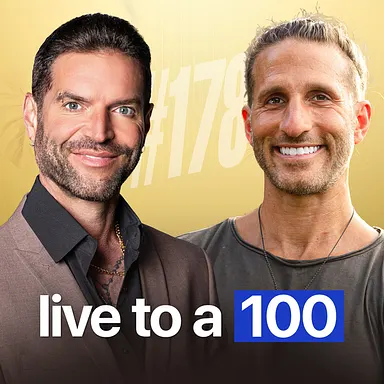
Dylan Gemelli sits down with Salim Najjar, a former CEO and human performance educator known as the HRV guy, to explore how chronic stress may contribute to inflammation and unhealthy aging. The conversation covers what heart rate variability is, why he considers it a useful guide to recovery rather than a score to maximize, and how habits such as first-thing phone use, morning caffeine, poor sleep and overtraining may affect the nervous system.
They also discuss hormetic stress, the role of emotional suppression and past trauma, the mindset of elite athletes, and the limits of medication, wearables and vagus nerve stimulation. Listeners will hear Najjar's personal views on listening to the body, which many of his claims are presented as his own perspective rather than established science.
In this episode Dylan Gemelli, Salim Najjar
This episode's transcript on Salim Najjar's views on stress and HRV was made with HappyScribe's free AI note taker technology, the same tool used to transcribe audio to text.
Ads in this audio differ from the text. Tap the sentence you're hearing to follow along.
Synced: the text now follows the audio.
Science has proven that we all age, get disease like all the autoimmune stuff you mentioned, the mental health, and eventually die from cellular inflammation. Period. End of story. Unless you die in an accident, the underlying cause of your mortality can be traced back to cellular inflammation.
I always say the best teachers have often made the most mistakes. They don't make them twice. But oftentimes the best teachers are the ones that have gone through the most.
The best biohacking technology we have is our body. Our body is the guru. God is inside of us. And my humbling story My body slapped me silly so many different ways until it was finally like, are you gonna listen? Nope. Are you gonna listen? Nope. Are you gonna— okay. And now I'm in a daily act of devotion to listening to my body. I was giving a workshop, um, in Okinawa. And so we were doing a longevity retreat out there and we'd get up in the morning and we'd go and we'd see these 100+ Japanese gathering in community on the beach and half of them would be smoking cigarettes. And my New York judgmental mind that thinks that's a cancer stick is like, how can they be doing that and living over 100? Science has also proven what the number one lead cause of cellular inflammation is.
Here's an interesting question. How much do you actually know about the way your everyday habits are supporting how you age? We hear so much about longevity right now. Sleep, protein, strength training, nutrition. All of these things matter. But there's another layer that doesn't get nearly as much attention as it should. What's happening inside your cells? Your mitochondria produce the cellular energy that your body relies upon every day. And mitochondrial dysfunction That's considered a central hallmark of aging, and that's why I've been so interested in the work Timeline does with Mitopure. Mitopure is their pure and patented form of urolithin A. It supports mitochondrial function and cellular renewal by activating mitophagy, your body's natural process for clearing out damaged mitochondria. But rather than just tell you about it, Timeline wants you to think about your own longevity habits. So they've created a longevity quiz that takes just a few minutes And it looks at some of the everyday habits that can support healthy aging. And the best part, if you complete the quiz, Timeline will send you a free sample of MitoPure gummies. So take the quiz, learn a little bit more about how you're supporting the way you age, and try MitoPure for yourself.
Go to timeline.com/jameli to take the longevity quiz and get your free gummies. That's timeline.com/jameli. All right, everybody. Welcome back to the Dylan Gemelli Podcast. So, this is a landmark edition for me, and I'm really grateful that my guest today is the first one here because this is the brand-new Dylan Gemelli Podcast studio, my own. Hmm. My podcast studio informed me that they would be closing doors, and instead of panicking and instead of getting upset, I immediately realized that when one door shuts, a bigger and better one opens for a special purpose. And so, this is a massive, massive blessing. It's a big day for me. And, I'm really thankful that you're here to share it with me, my friend. So, my guest today is known as the HRV guy. However, there is so much more to him than simply being an educator on HRV. Mm-hmm. And, I've gotten to know him. I met him at Dave Asprey's conference this year was when we met, and we've been coordinating We've been trying to coordinate this for, well, what, 6 months? 6 months. Yeah. God's timing is God's timing, my friend, and it worked out perfectly because you're here.
Yep.
And so, he's a former CEO himself. He spent years studying human performance, wisdom, traditions with teachers around the world, and he's built the Art of the Heart. And that was a framework that he has taught to hundreds of leaders worldwide. And that's what I'm so excited to talk to him about today. HRV is imperative. It is so vital to our overall health. We all know that, but he has so much more to offer. And so, we're going to get into everything that he works on and that he does. So, the HRV guy, my friends, welcome Saleem Nahar.
Najjar. Najjar. Everybody, the double H's get people. Yeah. Dylan, it's such a pleasure and truly an honor to be the first guest in this new chapter. And I love how you said when one door closes, another opens. It's that reframe that is so important for Your HRV, for your nervous system, and just for how you view the world. So, kudos to you for that attitude. It's no surprise you have the success that you have because with an attitude like that, it just comes.
I appreciate it. Now, I've had the pleasure of talking to you in private, which I do with all of my guests, but I felt a little bit different and deeper connection with you on that call. And for multitudes of reasons, it was Such a really good combination of thoughts that you had on what you discuss. I know that your strength is HRV, and I want to talk to everybody about what exactly that is and why it's important. But I want to talk to you about you, because as much as I care about your teaching and what you have to offer, I care more about the person giving it and teaching it and what you've gone through. And I'm not sitting here like most people, let's get your backstory. I'm sure you've given that 1,000 times. I want to know internally where this came from, where this avenue for you opened up. What was the point where you said, okay, I've got to start helping people with their nervous systems. I've got to start helping people correct different aspects of their life that are really degrading their health?
Yeah, such a beautiful question. And I think for me, you know, I've come to find, and I think we talked about this, the cosmic joke of this universe, of this simulation of what we call life is that the thing that we are most passionate about giving to the world is the thing we need the most. Mm-hmm. So I am sitting here talking about HRV, and really, I like to say nervous system sovereignty. I am very intentional with that word sovereignty because we hear so much of the time people talk about nervous system regulation. I think it is super important to have a regulated nervous system, and it is becoming so trendy in the world of health and wellness, which is imperative. I do not believe we came here as humans to be regulated all the time. And if we're regulated all the time, we actually can't increase the capacity and resilience of our nervous system to go handle more stress or to go have a bigger impact on the world. So what I've come to find in my journey is more important is agency or sovereignty over our internal state so that we can consciously choose how we respond to this ever-changing chaos around us versus automatically responding like most of the world is out there doing from our limbic brain, from our past stories, experiences, traumas in life.
And so for me, someone who has a very neurodivergent, sympathetic-activated mind, I have gotten my brain mapped, I have done neurofeedback, and everybody is always like, I have never seen a mind this on. It is a very, very active mind. If I am not sitting here talking about it all the time, sharing it with clients, teaching, expressing it, then I forget. First and foremost, the reason I do what I do is because I need it more than anybody else. And it's a constant reminder to bring that agency, to bring that sovereignty to this activated mind so that it's in the driver's seat maybe 1% of the time for business and being laughed at the other 99% of the time when it's stuck in its old story, its old pattern, its old belief.
You know, I always say that the best teachers have often made the most mistakes. They don't make them twice, right? And so, but oftentimes, the best teachers are the ones that have gone through the most, that have dealt with the most that they've had to overcome, persevere, endure, you name it. And those are the ones that they just seem to come out with more to offer because it's hit them so hard. Would you say that that correlates to what you mean?
100%. And I think it's because they're embodied, right? And it's gnosis with a G, meaning like you have actually gone through and you viscerally, your body understands and knows that fire you went through. And only from that place, I believe, that you could actually share and talk about it without any charge around an old program, an old story, an old belief.
Mm-hmm.
Right? So that's, for me, why I do what I do. And it's such an honor to have the opportunity to share on platforms like this. And really, my then next intention after doing it for myself is sharing the story so that maybe my story offers a change in perspective in relationship to someone else's story so that they can start to— my underlying intention is to have people listen to their body.
Yes.
Because at the end of the day, the best biohacking technology, and I know you're very into that space, I was extremely and still am into that space, but the best biohacking technology we have is our body. Our body is the guru. God is inside of us. It is literally, it knows everything if we just listen.
That's right.
Right? And for me and my very active mind, it was very hard for me to, in fact, I didn't listen. I didn't listen for so much of my life. And my humbling story, my body slapped me silly so many different ways until it was finally like, are you going to listen? Nope. Are you going to listen? Nope. Are you going to? Okay. And now I'm in a daily act of devotion to listening to my body.
You know, that is one of the most difficult things I've realized is to listen. You know, and I heard this on a sermon and it said, You're constantly praying, you're constantly talking, but when you have a conversation with your wife or a friend, do you talk the whole time and never listen? So how do you not listen to God back when He's trying to talk to you? And then that requires stillness, and that requires an ability to block out outside noise, which is not easy. My transition is, how big of an effect is an inability to sit in silence causing havoc in people's nervous system.
Oh my God. It's, in my opinion, one of the biggest. And unfortunately, we have so many cards stacked against us in this modern day and age to not listen because everything's trying to take our attention. Phones, everything is trying to pull our attention outside here in this world, in this life versus actually internally to the best technology like we talked about, listening.
So, and I'm going back in time here and you would know far better than I would. And I'm making, I'm admittedly making an assumption here, But if you go back in time, you don't hear a lot of discussion about mental health struggles. And that's not to say people weren't stressed or people didn't have problems. That's not what I'm indicating at all. But what I am saying is, is there's a strong correlation between all of the things that you mentioned, the technologies, the distractions, and how that coincides with people struggling with mental health. Now, would you say that people that are able to decompress, that are able to rest, that are able to sit in silence have a far greater likelihood of not having nervous system dysregulation or mental health
1,000%. And science has proven this, right? And that's how I actually got into the act of listening. I didn't come in from the act of the Eastern philosophies or— I got into it because I was so obsessed with longevity and biohacking that I was doing my own research in that world, right? And I took that curious, very activated mind, and I steered it to understand life, wellness, longevity. And I came across this fundamental equation that science has proven. Science has proven that we all age, get disease, like all the autoimmune stuff you mentioned, the mental health, and eventually die from cellular inflammation.
Yes.
Period. End of story. Unless you die in an accident, the underlying cause of your mortality can be traced back to cellular inflammation. Science has also proven what the number one lead cause of cellular inflammation is: chronic stress. Yeah. Prolonged sympathetic activation that we call chronic stress, which means not sitting in stillness and being too much up in here. Mm-hmm. Right? And so when I realized that, and then I realized from reading Dr. Joe Dispenza's book, Becoming Supernatural, that this biomarker HRV is relating to stress and the health of your nervous system and its ability to shift between that sympathetic stressful activated state and a parasympathetic relaxed state, I was like, why would I care about any other biomarker or anything else? Let me focus on this one biomarker. And that's really where my journey inward to listen started?
I spent 15 years, and I talk about this a lot, really focusing on how do I make the ultimate athlete, the ultimate driving force to where every single hormone's in line, perfect diets, you know, everything. And I'm not saying that's not important. That is very important. It has been there.
Yep.
A large control of everything. But when I started to understand neuroscience and I really got involved into the mind, It really hit home to me when I had my own nervous system worked on and was trying to figure out why is it that I'm doing all these things right and I feel like shit and I can't figure this out. And, once I was able to lock into, okay, you're never ever in a parasympathetic state at all, your whole life revolves around fight or flight, everything that you do, then I was able to find more within me If we're looking at a person that has biomarkers that I'm fixing, hormones, the whole nine, and I'm not able to fix them thoroughly and I can't figure out why, would it be a good indication that there's probably a high level of stress that's controlling that and not allowing me to get over that hump?
I would almost guarantee it, Dylan. I would almost guarantee it. And, my belief is that the nervous system is the underlying root. of all biomarkers. Everything that we're seeing in the material and in the physical is a manifestation from the nervous system and the emotional. And I say the body always whispers, and it starts to whisper through these biomarkers and other things until you don't listen enough, and then it actually starts to scream. And cancer or autoimmune or whatever comes from not listening.
So does stress actually kill?
Oh, chronic stress. And that's the biggest— because stress is actually your best friend if you learn to dance and listen to it. And it's not about not being stressed. Like I said, we need to be dysregulated to increase the capacity, but it's staying in that prolonged stress state. Yeah. And my mind needed to understand why is chronic stress the lead cause of cellular inflammation? What is actually happening physiologically? And I think you and your listeners will love this because in order to understand that, we need to actually have a foundational understanding of the autonomic nervous system, which we're never really taught much in school. Yeah.
No.
And it's crazy because this electrical system governs 90% of all of your voluntary and involuntary functions, meaning your breath, your heart, your digestion, your reproduction are all unconsciously happening in the background via this incredibly intricate system, which operates in 2 primary states, the sympathetic fight or flight and the parasympathetic rest and digest state, right? And let's look at the sympathetic fight or flight side to understand how chronic stress leads to cellular inflammation. And we need to look at evolution because human evolution does not make— evolution doesn't make mistakes. And for most of human evolution, we were living in a jungle and we didn't have the luxury of a roof over our heads, running water, shelter, right? And we had real life or death threats like a tiger or the weather.
Yeah.
And so our brilliant bodies developed this autonomic response to support us surviving. So what happens when the mind perceives a threat? Your amygdala fires and sends signals to all of those vital organs that the nervous system is governing. Your eyes dilate to let in more light. Your saliva production slows down, which you may not think is a big deal, but I know you know all nutrient absorption comes in through our mouth. But the most important thing to understand is all of the vital oxygenated blood in our body that's normally flowing to our visceral organs, meaning our lungs, our digestion, our reproduction, gets diverted to our hands and our legs to run, fight, or freeze, which is brilliant if a tiger is chasing you, which would happen for maybe an hour at tops, and then we drop back into a parasympathetic state. Fast forward to today, we wake up from our deepest parasympathetic state of sleep, delta, right? We look at our phone, we read an email, we get in an argument, and we stay in a mind-made stressful state for 8, 10, 12 hours a day until we go back to sleep. Mm-hmm. Doing that day over day, week over week, month over month, what's happening?
All of that oxygen oxygenated blood that's supposed to be flowing to the visceral organs, which maintain homeostasis in our body. Those organs know how to heal themselves if they are properly equipped to. They don't have that oxygenated blood going. So over time, they cannot keep up the homeostasis and cellular inflammation begins. Mm-hmm. And the beginning of all disease and everything happens, right? And so when I understood that, I was like, wow, it's super important for me to be aware of if I'm in a stress state, And then have the agency and sovereignty to consciously drop out of it, even if it's just for a minute, so that oxygenated blood can go back to the organs so that they could do what they need to do.
Would you say that it's fair for me to say that you've dealt with thousands of people over the years, clients, people you've interacted with, that you've talked to, people at events? Was that fair? Is that a fair assessment?
Yep.
So when you're looking at all of these people, I'm 100% sure that they're talking to you about problems they have and different aspects of their health that are off. Are you observing that most— let's say, let's just throw a number, 90% of the people have some sort of sleep disruption or they're not sleeping long enough? Is that fair?
That's definitely a core thing, especially with a lot of people that I work with, because it's usually the Type A high-performing people. And they have this saying that I had, there's plenty of time to sleep when you die. Sleep is not a priority for them, right? And when you're sleeping, you're in your deepest parasympathetic state of delta, when your brain is oscillating between 0.5 and 4 hertz. and the nervous system is getting a total reset, right? And sleep has not been gotten rid of by evolution. And evolution, again, doesn't make mistakes. So if you're not prioritizing and honoring your sleep, it's going to be very hard for your body to maintain that homeostasis, your nervous system health to improve, and your HRV to improve.
I will get biblical. So if God had to rest on the 7th day and he doesn't actually need to rest, he's showing us and actually quite demanding that we rest. a day per week. And I was the same way. Oh, I'll sleep when I die, or, oh, I'm all gas, no brakes. And all of that does is run you into the ground. It makes you less productive, and it proves nothing to anybody. You know what I stopped doing recently that has really helped my sleep is some mornings I would wake up to have to go to the bathroom, right? And then, when I'd come back to bed, instead of just going to sleep, I'd, oh, just let me make sure there's nothing on my phone. Mm. And every single time, I would never be able to fall back asleep. Or if I did, it would be one of those 30-minute fallback. And it's a multitude of things causing yourself unneeded stress on something that can wait. I'm assuming looking at the blue light.
1,000%. And you're just activating that sympathetic because you looked at your phone, right? And the phones— Arthur Brooks, I'm going to take this from him, incredible researcher. Are you familiar with him? Oh, yeah. Oh, yeah. And actually, at Asprey's conference, I mean, we met. He gave an incredible talk. He talks about how our brains have become so broke and exponentially keep breaking since 2004, the launch of the iPhone, right? And he goes into all the details and he's been researching forever, but he said, good news, you could fix it really quickly with 3 simple things. First, no phone time during these hours when you first wake up for at least a half hour at, or ideally an hour. Second, before you go to sleep. for at least a half hour to an hour. And third, when you're eating, because we evolved eating looking into people's eyes, which releases oxytocin and is healthy for the brain and the neural networks. The second you look at the phone, you're breaking all of that. So, if you wake up and look at your phone, you're totally throwing off the whole chemistry and neuroscience behind your mind, and it's going to be very hard to get back into that delta state of sleeping.
Yeah,
yeah.
See, my problem is, is when I'll wake up, I want to read some scripture in the morning and stuff, and I look at my phone. So, I'm going to buy the books now instead that correlate with the day's reading and do it that way. But I have strategically now prioritized this and went from 5 to 6 hours for, I don't know, 20 years to now 7 to 8. And you know what else has helped me? And you comment on this, too. I switched to one of those Helix mattresses. And I'm not saying it's the mattress. I'm saying it's the— And again, I'm also not saying it's the massage part of it. I'm saying it's the vibration that I hear from the massage part of it. That is soothing, that I think is putting me to sleep.
1,000%. Yeah. That's why white noise and so many other things support the body. Yeah.
Yeah. There's something about that pattern of noise and vibration that does it. I'm not getting a great massage. Let's not get it twisted here. But I swear to you, it's so calming on the mind and that stillness. I started turning notifications off in the morning and I'm not turning them on until all my prayers are done, all my getting ready, and my— it takes me at least an hour. Yeah. Every morning to even consider turning them on. And I think that that's made me more productive and less stressed.
1,000%. And that's the best way to start the day. Best way. I don't actually turn my phone off airplane mode until after my morning practice, which is anywhere from 1 to 2 hours. I'm not even looking or worried about anything. Yeah.
If your cortisol is already kind of high in the morning when you wake up, which we know it is, will looking at your phone increase it even further?
1,000%.
Okay. So, you're just creating a problem as soon as you wake up. So, no caffeine first thing in the morning, no phones, nothing stressful, just kind of peace.
Yes.
And even if you're late, try to just, you know what?
Give yourself at least 15 minutes if you can, 30 minutes ideally. Yeah.
What is the problem with caffeine too early in the morning? How does that set you up for failure for the rest of the day?
Well, like you said, your cortisol intentionally spikes when you wake up to wake you up. Like, our bodies evolved doing that. So jacking it with more cortisol for your adrenal glands, you're gonna get fatigue and you're gonna see that later on in the day, the crash from that, right? So the best thing to do when you wake up is hydrate the body because when you're sleeping, you go dehydrated. I mean, breathing takes up the water, all the things. So to really hydrate with proper electrolytes in the morning before you take that caffeine.
That's what I do every morning is I have like a couple powders and electrolytes, creatine, like the things in the morning. And that's the first thing every morning and I don't hit the, the coffee for about 2 to 2.5 hours, as normally.
So beautiful.
Yeah.
Yeah.
I know too many people that they think they need it right in the morning. You know what I've learned is that I don't care one ounce about the caffeine in the coffee. It's the taste and like the enjoyment from the drink.
Yep.
The caffeine does nothing.
Yep.
It really doesn't. I think people think that it does, so they become reliant on something that they create in their mind.
Well, yeah. And then, the problem is caffeine, when you get So, you get so used to it, you need more caffeine to get that high and whatnot. So, you keep building a tolerance for it, and now you're jacking up your adrenal glands so much in the morning. Yeah.
Okay. So, let's shift to HRV. Now, this is one of those buzzwords or letter phrases.
It's about time.
Well, people like to talk about it, but I really question if they even know what it is.
No, not many people do. They look at it like other biomarkers.
Yes. Well, even when I started learning about it, you know, I thought, Oh, I have a low number, that's good. And then quickly realized, oh no, that's not good. Will you talk about what it is?
Yep.
Just break it down simplistic, and then we'll get into more science about what it is and then why it's such an important marker on your overall health and perhaps your longevity.
Yeah. So, HRV stands for heart rate variability, and it's measuring the gap or the variance Between each of your heartbeats, that space between the heartbeat. And what that space is indicating is how your nervous system is perceiving its ever-changing environment. So essentially, your relationship to your stress and a direct reflection of the health of your autonomic nervous system and its agility to shift between the sympathetic fight-or-flight state into a parasympathetic rest-and-digest state. Yeah. Right? And so again, back to that equation of cellular inflammation is the root cause of all aging, disease, and death, and chronic stress is the lead cause of cellular inflammation. If you care about longevity at all, then this is, in my opinion, the most important biomarker to be aware of to support not keeping you in that chronic stress state. Now, the higher the gap or the wider the variance between each heartbeat indicates a more malleable and resilient nervous system, that could handle the ever-changing environment versus a lower HRV or less of a gap indicates a more rigid nervous system. And that which is rigid eventually breaks. But that comes with a massive caveat because science has been researching HRV for decades, even though we are only now becoming more aware of it in mainstream.
And they have yet to publish a range for this biomarker because they have proven it is so unique to the individual. And just like there's no 2 fingerprints in the world that are the same, There are no 2 heartbeats in the world that are the same. So comparing your score to someone else or thinking you have a low score and need to be above 100 is actually, ironically, keeping the score low. Because if it is measuring how we perceive our reality, how do we perceive our reality? Through our senses, through our touch, through our taste, through our nose, through our eyes, through our ears, but most of all, through our thoughts.
Mm-hmm.
Through our relationship to our environment. That is what actually materializes it. So if you're telling your body and nervous system, I have a low score, I need to have a higher score, what are you doing? You're ironically keeping it lower. Right? Mm-hmm. And so then people go, okay, well then what do we do with this biomarker if we're not comparing it to anything? I like to think of it as a language. It's the language of your nervous system communicating what's resonant and dissonant between each of those gaps in your heartbeat. And when you think of a language, you don't think English is better than Spanish is better than French. The intent of a language is for an ecosystem within a community to communicate.
Hmm.
The entire intent of your HRV score is solely for your body and nervous system to communicate only with you. So the best thing you can do is listen and compare your score to what I call your HRV baseline. I define HRV baseline as your average score over the last 30 days. That's a good snapshot of the overall health of your nervous system and whatever you've been putting it So let's say your baseline is 40 and you wake up and your morning HRV score is 20. That's not a bad thing. It's data. It's your nervous system saying whatever you did the day before is more of a load than it's been used to the last 30 days. The best thing you can do is listen to it, honor it, nourish it, do something more leisurely for your body versus doing what we're so programmed to do in the optimizing world. Push harder, train harder, stay up later, right? Mm-hmm. And when you listen over time, you'll see the baseline increase. And science has proven as we age, HRV declines. They've proven that because we're obviously susceptible to so much more stress and our nervous system takes so much more.
So if you maintain your baseline and/or get it to go up, I think you're winning the game of life.
Okay. So factoring all of that in, I just had a thought.
Yeah.
I like to do these once in a while if it, if it makes sense. I don't like to just do rapid fire just to do it. I think that sucks. I don't like to go in with plans and things. I want to name some things.
Yep.
And you tell me on a scale of 1 to 5, 5 being the highest, 1 being it's not that important, what these effects would be on our HRV.
Oh, this is going to be fun.
Yeah, because this just dawned on me because I had so many different things I wanted to ask you, like, well, how does this affect it? How does this affect it? So, let's rapid-fire.
Yeah.
Okay. First. Diet.
Yeah. 5. So anything you ask me, I am going to say 5, because every single thing, including what you watch, what you listen to, who you are with, your environment, every single thing plays an impact on your HRV, which is changing over 40, 50, 60 times a minute, because your heart beats 40, 50, 60 times a minute. Mm-hmm. So it is extremely variable. Right? And, that's why looking at a real-time number isn't going to do you much good. And actually, all the wearables like Apple, Oura, Whoop, they don't give you your real-time HRV, they're giving you your average nightly HRV.
Sure.
Which I believe is a good barometer of the overall health of your nervous system and whatever you put it through the day before because you're flatlined, there's no external stimulus, you're sleeping, right? And so, that's why looking at your baseline and comparing it to your morning score In my opinion, is the best way to utilize and learn from this biomarker. And I call it a compass pointing you towards what's most resonant with your body. So for someone like me who is so analytical, who was so much in my mind, who was not listening to my body, I committed to listening to this biomarker, which actually just showed me how to listen to my body.
And that's what I'm wondering with some of these things that I'm thinking is, does our genetics play a certain role, like with the foods, for example, and certain genetical factors that could indicate yes or no with their HRV?
So how I would flip that to you is it's certain foods for me, based on my genetics, my conditioning, my ancestors, will have a different impact on my body than your foods.
Right.
So your HRV will change. And if you listen, just because, you know, keto was really good for me, it may not be really good for you. And that's why I don't think there's one right diet.
Uh-oh.
If you think of one right thing for every human being on earth, then you're, you're crazy. It may be most resonant for you. And so that's why I like— now there is certain pillars like clean, whole food, sleep, sunlight, all those things, 100% good for every human. Yeah. Right? But that the framework that you mentioned, Art of the Heart, stands for awareness, regulation, transformation. That's what ART stands for. And this is a 3-act spiral that isn't a ladder we climb once and we made it to the top and we're regulated forever. and we've won the game of life. That's not— I've tried. That's not how life works. It's rather a daily act of devotion towards listening to your nervous system, towards listening to your body. Mm-hmm. So if— let's just look at the diet, for example. You try a diet, bring awareness to how that diet is impacting you, impacting your body, and HRV will actually be a direct reflection of that. You could see how your HRV is trending versus your baseline and play and experiment and see what diet best resonates with your body. And when you do that, show up with the awareness and regulation, over time the transformation occurs.
And so we could easily be looking at meal timing too, not just nutrients.
Oh, 1,000%. And the order of the macros that you eat and all those things. Yeah.
So glad you said that.
Yes. So, so, so important. And how long you eat before you sleep, such an important thing. All those things play a factor, but for every person it is different, right? Some people, their bodies actually, although it's very rare, like need to eat late for whatever the reason is, right? So that's why That's why I say use this biomarker to see what is most resonant when it comes to diet and actually anything in your life.
And, I would say, and you correct me if I'm wrong, that if you are eating foods that are causing a longer-term like glucose and blood sugar spike, chances are they're going to affect your HRV if you are doing that one day or night before.
1,000%.
Okay.
1,000%.
It's going to cause several types of interference.
100%. Yes. 100%.
And stressful too, because those foods, I think people don't realize that those cause mental stress because they kind of, depending on what you're eating, but you start eating too many fried processed foods, things that are made, well, you know how.
Oh, I know it very well, man. You know what I'm getting at. I know it very well. And the reason is because, again, I just look everything through the lens of evolution.
Yeah.
We were not doing that for 99% of our— so, it is causing, to your point, a stress on the body because it doesn't know how to process it. And I don't believe anything is good or bad. I don't use those labels because if it's here, it's here for a reason, right? But it just may be dissonant for your body, which, in my opinion, processed foods, excess sugar, stuff like that is very dissonant to our bodies because we don't know how to process it. That's not how they evolved, right? And so that's why we're seeing a surplus in the mental health pandemic, in all of these diseases. Big reason is because evolution did not have us living like this and eating like this.
Right. Okay. So, instead of going 1 through 5, since they're all going to be 5, here's what I'm going to do.
Sorry.
No, no, no, no, no. Because that made it a better question now. Good. Because I'm going to take certain things and I'm going to have you explain to me how it affects the HRV. Okay. And since we know they're all going to be 5, so let's talk about training, cardiovascular training, strength training. How and why will that affect our HRV? What type of effect will that— because I'm going to ask you this because I'm a heavy cardio trainer. Yep. And before I understood what it was, I was saying to myself, well, don't I want consistent beating and patterns here? And, you know, doesn't it make more sense for my heart to be more consistent, not be all over the place? So talk to me about why it's important, you know, in terms of our heart rhythm and beat and what kind of effect and the importance that that can have on our HRV.
Yeah, totally. And I think first, just to like clarify your thing on you thought it would be more important to have consistent, having like a lower heart rate, meaning like let's say 40 beats per minute Um, means that there will be— doesn't mean that there will be less variation between the gaps, right? Because HRV and heart rate don't necessarily correlate. Because you could have 40 beats per minute and have less gaps, right, between each heartbeat, even though in general, the lower the heart rate, meaning there's going to be wider gaps between each of those things, right? Mm-hmm. So that's why it's super important to realize. But in terms of your question, training, super important for your cardiovascular health and for HRV. And what it will do and how you actually train it better is the recovery, right? Like HIIT training is so good, but when you HIIT train or do something intense, your HRV the next day will likely be lower.
Yeah.
Which is expected. But if you properly recover, then your baseline will start to go up because you're literally— I call it hormetic stress, which is one of my pathways in that. Yeah.
Yeah.
You are training the capacity and resilience of your heart, of your nervous system, to handle that stress. But if you do not take the time to properly recover, how's it gonna build that resilience?
Right.
Right? The analogy I give to hormetic stress, are you familiar with hormetic stress?
Yes, I am. But I was gonna ask you to get into that.
Yeah, yeah. So hormetic stress is the phenomenon of intentionally eliciting a stress on your body, right? Like HIIT training. And then consciously dropping out of it. The analogy I give is weight training, right?
Yeah.
If you go to the gym to lift your bicep, you're lifting more weight than the bicep muscle can handle. Tearing, actually, the fibers in your bicep. What do you do the next day?
You're supposed to rest.
You're supposed to rest so the following day you can go lift more weight.
Yes.
That's hormetic stress, and that is what you can do with your nervous system.
Okay, because when I always teach people that lift body parts too close together, and I tell them you're tearing, tearing, tearing, but you're not allowing those muscle fibers to rebuild— yes, we want to tear them, but you got to give them the opportunity to rebuild. So if you You train your bicep every 24 hours, it's never going to grow.
Nope.
Never has a chance to fix itself and recover.
Nope.
So, same advice.
Same exact thing for the nervous system. Yeah. You nailed it. Yeah.
Tear it down to rebuild, but let it rebuild.
Let it rebuild.
Here's one that I really want to get into with you. And look, just say for what it is, which I'm sure you will, because there's a— I believe there's a spot for everything, but I believe this is very, very, very misused and abused. used. When we're looking at people that are on different types of mental health, which we could group into different categories of medications, which I believe are like statins where everybody's just so quick to put you on without trying to really get to the core or fix it. The root cause. Yes. Without doing it. Those to me are like last resorts.
Yep.
They shouldn't be A fix.
Candy. Yeah.
Let's just, you know, for what it is. What kind of an effect can those have on an HRV, on stress, if they're really not fixing the problem?
Well, yeah, so I'm so glad you brought this up. What you're doing is actually putting a Band-Aid on the problem. So yes, maybe you're covering up what the reaction and surface level is, but the underlying root, which is, in my opinion, a stuck emotion, which we'll get into, is not being felt. And so, yes, you're covering it, but now it's getting bigger and bigger and bigger until it explodes via whatever disease. And then you're going to need more of the statins or the things to keep covering it, and you're not actually getting to the root of the problem, right? And so, it's going to drastically impact your HRV because your body is pushing to get this thing to move and you're not actually doing anything about it.
See, it reminds me of— I compare it to a cortisone shot.
Yep.
Is similar to what it is.
100%.
Band-Aid a wound and you're actually making it worse.
Totally, totally. And, there is a place for those things and that's the beauty of modern medicine is you have the ability when used right and when needed to stop, for example, my dislocated— if I did not have surgery, I would be handicapped my entire life. Sure. So, there are places for it, but to your point, it should not be the first thing you throw at it. And if you're going to utilize it, at least get to the core of why it's there in the first place, which unfortunately most people don't do.
And that's one of the things I'll compare it to because I've been studying and coaching hormones forever. And I always worked with bodybuilders and people that were using steroids and abusing different kinds of performance-enhancing drugs, and they immediately just want to go put on TRT. My first reply is always, give me a little bit to analyze here. Let me see if there's something causing this that we can fix first. And, you know, some guys, they're just— whether it's from abuse or whether it's from older age or whatever, they're not fixable. But there's a lot of guys that are.
Oh, yeah.
You know, and at least try.
Totally.
And I don't like throwing things that are being put out there to make money, if we're being honest,
It's a lot of that
nowadays. And not really putting the care of the individual first.
Yep.
It sucks.
Yeah.
And I think it's setting most people back and really ruining nervous systems and causing this permanent reliance upon something that's not helping.
Totally.
What would you say then are some of the things when you have somebody that comes in that has, you know, a lot of stress, a lot of inability to stay focused, what are some of the things that you teach them or put them through?
Yeah. Yeah. It's, it's kind of a methodical process that goes through that ART framework. And I say my 5 pathways for HRV growth and nervous system sovereignty within that framework where we dissect each of the pathways based on that unique individual and have them weave that framework of awareness, regulation, and transformation. And I end up being an accountability partner to share with them what may be most resonant and what tool or modality or technology or diet or whatever practice that could help them in their journey. Because again, we are all so unique.
Hmm.
And what works for me may have an opposite impact on you or the person I'm working with. And I have a very curious mind and an engineering background. So I love to learn and understand how things work. And so I've traveled the world, studied, you know, way deep in the biohacking like you've been. I went east and all the spiritual wisdoms and studied with masters and went to sacred sites. And so I have a Rolodex of tools, modalities, practices, breathwork, all the things. And I will listen to see whatever the case is and what they're working with and present a potential practice or tool that they go and experiment with and see how their HRV is impacted, see how they feel. To me, the most important thing is how you feel.
Okay. This will be fun. So, you know, there's a lot of people out there that like to throw comments out questioning people's credentials. I get it all the time. A lot of people I bring on here get it all the time. And my argument back is, I know what they teach in medical school. I have enough very dear close friends, doctors that tell me that I interview. I've been in plenty of schoolrooms. I've taken courses all over the world. I've understudied. I've done everything that you can think of doing. And I also know what it takes to To stay wise, that you have to continuously and consistently study, learn, and see with your own eyes. Observe.
Gnosis.
Absolutely. And if you're not in the trenches and you're not around it and seeing it, I don't care what a study says. I don't care about all this bullshit that people can manipulate and do. I care about what I see and what I encounter day in and day out. How many universities specialize in teaching people about HRV? How many people with psychology degrees have a real intrinsic learning and focus of how the nervous system works, how to regulate it? How much of this actually goes on when you're in a classroom setting in most universities?
Yeah, none. Right. None. I gave my first lecture to 200 first-year pharmacy students. And it was so— I got so much joy from seeing how engaged they were because they had never even thought of the nervous system like this, right? And actually, the dean and the faculty were there, a part of it, and they were so surprised with how engaged and curious the kids were that they actually want to bring in their curriculum stuff like this, which makes me so happy. That is an underlying intention that I shared with you, to get this to the youth because of what you just said. Mm-hmm. To change the system that we are in, which is so programmed, in my opinion, on capitalism and for profit versus actually listening and supporting healing of people's bodies.
And that's the thing that sucks to me is, you know, you and I have both talked to how many functional practitioners, holistic doctors, people that were regular doctors that went out on their own because they couldn't stand what was going on behind the scenes. But it's this catch-22 because Multiple things. One is it becomes more expensive to go see a specialist because the insurance isn't there. Yeah. 2, the mainstream will program you to say that they're crazy or that they're conspirators or that they teach and preach things that are harmful and dangerous when they're actually working. And so, how does somebody like you get around that? How do you show your credential? How do you prove your validity in what you're doing? How do you do that?
Yeah. I am still in the listening and learning of it, Dylan. I just actually recorded a podcast a little earlier, and I shared. They are like, what is your intention? What is your mission? My intention, first and foremost, is I do this for me because, again, I need to remember all the time to bring in the sovereignty. Yes. I need to speak about it all the time so I remember. But then second is to share the story to hopefully support other people in remembering. So it's— I— the whole— my whole growth has been referral-based by working with people and then them saying, actually, this is what happened and this is how I felt when working with him. And I am just trusting in God, in the universe to open up the doors like how we met to allow me to go share on bigger platforms. And I, I'm battling consistently because maybe we'll get into the story of bankruptcy and all the things like the mind that wants the, the numbers and the validity and to like see all the thing and realizing actually, no, like, don't forget. Even if I impact one person, I'm doing what I need to do.
That's it.
Right? Just one person, one step at a time, and make sure I am embodying and listening to the thing that I'm sharing, which I feel like in this day and age and with social media, so many people walk a walk but don't necessarily talk the talk, but don't necessarily walk the walk, right?
It happens all the time.
And so authenticity, I think, in this age of AI and all the things is one of the best assets that we can have. That is why I am always grateful to find other mirrors who are doing that in their own way. I think we are all here to just share our unique story, and our story will resonate with who it needs to resonate with. It will be dissonant and be, in my opinion, a medicine to people who it is not. But so much of my personal journey has been being okay with not being resonant with everybody and not getting that validation, because at the end of the day, I believe everything is just a reflection of of whatever's inside of us. Yeah.
I do this where I, when I teach people and talk to people, a practice that I say is say it out loud. And say it out loud and see how it sounds. Like really sit alone without anybody else around you encouraging you, badgering you, putting stuff into your head. And then you ask yourself, how does this sound? So, here's one of the examples I use, and this will make you laugh. During COVID time. Ooh. Say this out loud because I used to say it out loud. And I'd say, now, now, you, you just tell me. And I don't like to be combative and argumentative. I don't want to do that anymore. But I did it at a restaurant when we were in Florida one time. I said it to the, the host. I said, say this to me out loud and make this make sense to me. COVID stops when you are eating. And she kind of looked at me. I said, because you're telling me right now that I have to sit here with the mask on. And if I get up from my table, that when I walk to the bathroom, I got to put it back back on, but COVID stops moving when we're eating our food.
Somehow, some way, or the curfews that we have, somehow, some way, it gets worse after 9 o'clock. Say this shit out loud. So, if you say things out loud, and I'm saying this to make a point, when you're teaching something and somebody's arguing back with you, say it out loud. Hmm. Just say it out loud, and you tell me how it sounds and how insane some of these things that they put into your head sounds, because anymore, The people that are in control of media and everything, they slap you in the face. They insult you with the shit that they're saying. And most of the stuff you can go look up yourself.
And you're seeing what people want you to see, not what's actually out there. And what you're saying in the say it out loud is actually this art framework. It's say it out loud and bring awareness to what you're saying, bring awareness to the story that's playing, and then listen to actually how it makes you feel, if it's resonant with you, how crazy it sounds, like COVID stops when you take off your mask. Like, and, and so, it's a beautiful practice that essentially is weaving in the framework. Yeah, I'd love it.
So, I want to relate this then to the nervous system.
Yeah.
Because this is one of the things that I had to do. When, when I met you, Sean Drake was giving a speech.
Yep.
And he's like a brother to me, and he's the one that put me through soul surgery, is what he calls it. And that was the ultimate for me, like restoration of my nervous system. So, and maybe we can diagnose me here and you tell me what you see from this. So, when I got out of prison, my whole goal in life was to make amends for what I did wrong and figure out how I'm going to fix all the people I let down, all of the people that invested time and money and effort into me. But how was I going to fix myself too from stopping and being so selfish and so pro-Dylan and all about what Dylan wants and how am I going to find myself in what I was meant to do? Because it clearly wasn't what I was doing. And until I really became a God-first individual, I wasn't able to do that. But even becoming God-first and finding more peace and resonance in my soul, I still was having trouble being compassionate when I wanted to be and couldn't understand why. Why am I still impatient? and so quick to kind of be snappy and still have mental brain fog.
Now, a lot of that was from struggling with eating patterns and eating disorder, but then I fixed that, and it was like, okay, I feel better. I have more clarity, but why am I still not there? And then, you know, came Gabriella, my cat, which showed me like love, but I still was like only with her, right? Even to where my wife is acting like you would want your wife to act, always interested in you no matter what. There's no loss of anything over the years. So, what is it? Well, when I met with Sean, that's when we got to the core of my problems and so many things that I thought were gone that I didn't think about. Like, I never thought about them that were causing this problem.
Yeah.
That were deep, so far down there, I couldn't find it. I wouldn't have ever even looked or— and some of it was coming out as we were talking. And I told him, I said, brother, like, I haven't ever thought about this shit. How good are we at hiding stuff? Like, how good are we? How good can we get at that?
Yeah. The mind is incredible at doing that. And you need to have compassion with the mind and the nervous system because it's actually just trying to protect you. So how a nervous system works, first off, a nervous system's sole job, safety, right? That's all it ever wants, safety. It's programmed to keep us safe and alive, right? And it's binary, meaning it's like an on-off switch. If the mind perceives a threat, even if it's not a real, but if it reminds it of something that's happened in the past, all your blood flows to your limbic brain. You have no access to your prefrontal cortex, which is where all your memory, intuition, knowledge, this version of you is. And so that's why you can look back at something, be like, I can't believe I said that again. I can't believe I did that again. I can't believe I acted like that again.
Yeah.
So you need to have compassion with yourself. because that is your nervous system trying to protect you. The analogy I give, hospitals in Florida have a fail-safe button where if you hit it, metal shades come down on all the glass windows to protect everybody from a hurricane or tornado. Brilliant program put in place to save people. Would you agree?
Yes.
What happens if a shooter is in that building and someone hits that button?
Not so good.
Not so brilliant a program, but it was birthed from a brilliant place. That is how our nervous systems work. work. So we have all these stuck emotions from past experiences, from past lives, from our ancestors that are in— that are embedded in our body that we are constantly projecting out to what we are perceiving as stress around us. Because if you were to map out the body, anytime you have an external trigger or stress or a challenge, beneath what you're seeing, there's always an emotion or multiple emotions associated with this trigger. And directly connected to the emotion An emotion is a physical sensation that is stuck in the body. If you peel the onion one layer deeper, an emotion on a quantum level is just a scalar wave of energy. It is frequency.
Mm-hmm.
There is no such thing as a good or bad emotion. As humans, we are meant to feel every emotion on the spectrum: joy, anger, grief, love. Feel it for about 90 seconds until the wave moves through us. However, we as humans, we love stories. We love to hold on, or more often than not, in our formative years between the ages of 2 and 7, when our baseline brainwave state is theta, meaning we are a sponge and hypnotic and susceptible to everything around us. Right? And we don't have a prefrontal cortex developed to discern reality ourselves. We accept it as is. The nervous system doesn't know how to process a caregiver yelling or traumatic experience. So it freezes in that emotion that's supposed to move through you. I like to think of it as forming a glacier in the fascia in our skin. And so there's an incredible book, The Body Keeps Score. Don't know if you've read it. Mhmm. Incredible book that talks about how we are grownups living in this adult meat suit with an Akashic record of all of our stuck frozen emotions projecting it out on everybody around us. Right? And so the analogy I give for that, like, stage fright is one of the most well-documented fears in humans.
I had massive stage fright for a long time. And anytime I'd about to get on stage or speak in public, I get this knot in my stomach. Right? And I used to think the knot came because I'm on the stage. My truth in reality is I co-created putting myself on that stage so that I could feel what my mind is labeling as an uncomfortable knot, which is really just an emotion around my self-worth, around being seen, around being validated. And it wasn't until I'd sit with, and I say train to be an emotional athlete and feel this stuck sensation before it happens in what we call waking life, That, that glacier starts to melt. When the glacier melts, you have more blood flowing to your prefrontal cortex, which means you have more agency and sovereignty to choose how you want to respond in the situation versus doing what's been programmed for your safety from your limbic brain.
Okay. Let's say we have an individual who's like super stoic, like just, I don't know, hard as nails, man. Like they're just not super emotional. Is that something to do with a trauma or something with their nervous system, or what is the cause of that?
Oh, yeah. I mean, that was me for a long time, and that's so much to do with your conditioning, your upbringing. Males specifically are taught, don't cry, don't be like a girl, don't be— like, there's so much programming around not feeling, and we as humans came here to feel.
Yeah, yeah.
And we're not taught how to feel. And the basis of my work when I'm working with people ends up being somatic. Meaning feeling the sensations in your body because that's actually what's creating this world around us. And that's why I think stress is your best friend because if someone triggers you, that's actually pointing you to a sensation that's stuck in your body.
Mm-hmm.
Right? That's why I intentionally call this the educational simulation because I have a very competitive mind. I love to gamify things and I look at especially the triggers or challenges education that's pointing me towards something I need to feel.
All of this correlates throughout the Bible, but people don't understand when they read it because they take it so literal.
Well, yeah, and people have been changing and projecting their things in every religion. All religions, though, you're absolutely right, point to the core thing, and that's what Christ consciousness is. Be thy lamp.
Yeah.
Be thy light, right? Like
Like, if everything that's taught in there, if you realize, if you look at them as ways of life as opposed to rules and dictatorship and what they're not, and that's taken me a long time to understand and comprehend. And actually, like, when you become so Christ-first, then you have this pull in your heart. It's different. It's hard to explain unless you experience it. But what I can tell you is that his yoke is easy and his burden is light means that the stuff he gives you to do is quite easy because you want to do it. But my point in saying that is, is when you start to read and understand the things that he stressed, don't hold this against, forgive, love, all of these things. Well, when you hold those things in—
You're holding on to the emotion. It's the same. You're literally saying what I just said.
Yes. You're creating all of the problems you just described. Every single thing that you laid out comes from that.
Yep. You're holding on to the story. You're holding on to the emotion instead of doing all it ever wants. Which is to just feel it, forgive it, let it go on.
Yep. When I was able to do that and start doing that, every single thing got easy. Well, easier. Nothing's ever— I don't want to— I don't ever want to make anything sound easy because then people become hopeless, and that's the last thing I want. It becomes a hell of a lot easier. Things just start to— they make more sense. Life makes more sense when you don't hold on to things, especially grudges, when you forgive people, when you love people, when you're easy to move on. When you don't make judgments or assessments based on one thing somebody says. I don't give a shit about anybody putting me into like a group because of my beliefs because my beliefs are my beliefs. That doesn't put me to belong to anybody but God, right? And when you are able to do that and stop worrying about petty shit and start worrying about the important stuff, everything becomes easy, man.
It just unfolds magically. Yeah. Like you really, you can't even make up the synchronicities and the things that happen. Yeah.
It just becomes so much easier. So, you and I were talking, and this is one of those things that I love to talk about because I'm such an avid sports fan. But one of the things that hit me hard recently when I was saying it out loud was talking about mentality and how it works in performance. And I always brought up Kobe Bryant because I, I said nobody calls it the Mamba athlete, they call it the Mamba mentality.
Oh, I'm so happy you brought him up.
Yes.
Yeah.
And Tiger Woods in his prime was downright scary. He, he actually elicited the fear of God into his opponents that they just choked. Even if he wasn't doing his best, they couldn't do it. Michael Jordan, every single time in the clutch, you could He wanted the ball. And I'm going to bring this up to you on my end. You know how you're talking about speaking? I get amped to speak. There's no like, oh my gosh, I'm nervous, I'm fearful. Like, I can't wait. I'm counting days. I'm counting minutes. Like, I've got myself to that to where I want to do it so bad. What is the— what is it that somebody has? It's like the clutch gene. Where does that come from and how do they get that? And how does it does it correlate into what they're doing?
Yeah, man. And, and the nervous system— I love this question. So the, the clutch gene can be trained. Yeah, it actually can be trained. And it's essentially, um, increasing the capacity of your nervous system. It's that hormetic stress we talked about. Because what's the difference between Kobe Bryant, my favorite player, Kobe Bryant at the Game 7 free throw with the game on the line, versus another athlete who's taken maybe as many if not more free throws than Kobe Bryant? It's all their mentality. Kobe or Michael Jordan or Tiger Woods or you in speaking in those situations, you don't look at it as a stressful thing. You're actually excited to be there versus someone else who looks at it as a stressful thing. Then what's happening internally, physiologically? If you are stressed in that situation, all your blood is flowing to your limbic brain and you don't have access to your prefrontal cortex, which is where, if you're an athlete, your muscle memory is. If you're a speaker, your intuition, your knowledge, all your wisdom is, right? And so if you approach that free throw or that boardroom or that stage in a regulated parasympathetic state, alpha state, when your brain is oscillating between 8 and 14 hertz, it's the flow state, right?
That's what they call it. Then you have all the access to everything you already know versus if your mentality is, oh my God, this is a big moment. And if I miss, I'm going to be this and all that. all your blood's flowing to your limbic brain, which is your autonomic response based on a past prior story, event, belief, right? And you want to, especially in those moments, have all your blood flowing here because that's where all the practice, all the wisdom, all the knowledge is. And so, that's why I was sharing that like in a sporting agency approached me because they're like, we've noticed in every one of our Hall of Fame athletes insanely higher HRVs than our regular athletes. Why? Yeah. And I explained this to him because HRV, again, is a correlation of your agility to shift between the sympathetic versus the parasympathetic, right? And so if you train that mentality, not just the physical, but more importantly, and that's what Michael Jordan, Tiger Woods, Kobe Bryant did, the mental capacity to not perceive it as a stressful situation, to actually learn to enjoy it. And if you have a relationship of joy, which you clearly do in speaking this passion, then all the blood's flowing here and you are present and you're a clear channel to share your gifts and your stories.
And that's the training part of it. So, you know, like, again, I was like the most avid athlete and trainer and everything, and I've worked on training my body every which way freaking possible. Never really spent the time training my mind. And when I started to do that now, and mine's mostly through prayer, but some of it's just now it's starting to be like, like a little bit of quiet, and then it— my body and my mind reverts me and my heart back to prayer. But I think even quiet in a sauna, uh, in, in the night, away from everything, like, these are ways to train our minds, right? And our nervous system. Is it— what would your— some of your other options be on how we train our minds?
Yeah, I, I specifically say I, I myself, and I try working with people to train to be an emotional athlete. To me, being an emotional athlete, and that is what I think Kobe Bryant was, that is what I think Michael Jordan was, Tiger Woods, is the best kind of athlete you can be because the reality is science has very much proven all of this is vibration and energy that we are co-creating with where we put our attention on it. If you could train your emotional well-being, your emotional state, if you could get emotionally regulated, you have full agency over what this simulation and what ends up happening Right? And so, there are so many different ways to do it. And you mentioned stillness, you mentioned breathwork, meditation. There's not one way for one person. Some people, it's dancing. Some people, it's singing. Some people, it's washing dishes. But whatever, that's where you weave that framework. And that's what I work with people, the awareness regulation transformation, to see what supports training your mind to get to those states.
I was kind of shocked because I'm a high-level endurance athlete and I got put on that that Panoë machine, and it measured my breath, too, on top of everything else. And I was under the impression, oh, I mean, I can run all day and my endurance is through the chart, and my breath scores were horrible. And I started to do the breathwork, and not only did I get much more capacity in terms of my physical side, but mentally, I'm telling you, man, one of the most soothing and probably one of the best things I've done for mental stability, like when I'm stressed or just calming and getting me prepared for the day.
100%, man. And breath is the cheapest, freest, most accessible tool that's been used for all of our evolution that I think we take so much for granted. Yeah, yeah.
So, I want to wind down with a couple thoughts. And I'm not trying to get you to show partiality. We're not sponsored by anything here, but I do want to discuss some wearable technologies and If you don't want to— I'm not saying badmouth anything or anything like that. I'm just looking for your opinion basically for people. I don't work with any of these. I've worked with Dr. Dave Rabin on vagus nerve stimulators. He's my guy. But, even at that point, there's good and bad in all of these. First thing I would like to ask you is on the wearable side, what would you say are the best ways to track HRV and maybe your nervous system?
Yeah. So, this answer, is always for me the one you will most consistently use.
Okay.
Because Oura, Apple Watch, Whoop, Garmin, all of them, right? They're all within 3 to 5% accuracy, but it's not the accuracy that matters because again, they're not even taking your real time. It's the consistency. So it's basically use the same one, Eight Sleep, whatever it is, to get your baseline and then listen to what your daily score is compared to your baseline.
Do you think they're safe? Like with EMF and stuff, do you ever see any problems?
That's a whole nother rabbit hole. And EMF is definitely part of our reality. And again, I don't believe in good or bad. It's here, and you need to see how your body is impacted by it and listen to it. But it's definitely a relevant thing for sure.
Look, I'm— like, again, I'm not a conspirator. I have personally always had to be very temporal in how I wear those. My body does not react well. And as soon as I stop, then the symptoms I have go away every time.
I hear you, man.
I mean, and I've done pretty much all of them. And I had some really bad experiences with the watch, especially now I have to wear it super tight because of the tattoos. I had my pinky swell up really bad, wrist pain. I went to the emergency room because we freaked out. As soon as I stopped wearing it, everything went away.
Everything went away. Yeah. No, and again, it has different impact on different people. So, that's why you need to just listen to what the best way is for you.
Yeah. Same with the rings, everything. I've had waking up with heart palpitations, funny feelings, strange, odd things that went away as soon as I stopped wearing them. So I say that to just tell people to just listen to your body. And those things are good pieces of data. It doesn't mean you should wear them every day or need to.
Totally. Totally. And the thing I'll say in general, like, we're talking so much about HRV, and you also don't even need HRV to listen to your body, right? And like, I'm actually not even measuring my HRV in this current moment as that HRV guy because I've gotten to a place where I'm just listening. And I'll put it on to see my baseline, see how I'm doing every once in a while. But it is a tool to support listening, but you should always go with how you feel.
Yeah.
The most important thing. So, if you're wearing it and something happens, don't wear it anymore.
Yeah. Well, and you could drive yourself crazy with data.
Oh, I have.
Yeah. You can throw yourself into that wrong state of nervous system. Last one on devices.
Yep.
There's a lot of vagus nerve stimulators now and people talking about it more than they ever have because there's a way to make money on it, basically. And that's not to say that there's people out there because I know people for sure Dr. Dave created his with great intention.
Yep.
So, I don't want to say that. But just like anything else, when people see a way or a buzzword, they're going to try to make money off of it. Do you have any opinion on how those work? And if so, is there one that you think maybe does a better job than another or that you would stay away from it or what is your thoughts there?
Yeah. So, I believe it's a beautiful technology that can support drastically shifting states and stimulating the vagus nerve to drop you in a parasympathetic state, which is so important on anybody's health journey. And similar to how we talked about the medications and the statins, if you do not get to the underlying cause of why you are sympathetically activated and just keep numbing and numbing, even though it's a healthy way to drop out, then you're building up that emotion without actually feeling it, and it's going to explode one day. So utilize it as an ally, but then actually bring curiosity to why you even needed to use it and sit and feel that so that you can move past it and not become dependent on it. That's my take on them big time.
So they're not— are they dangerous? Do people get like hooked on them?
I would say I'd put them in the same bucket as any other medication, drug, anything. Like, although I shouldn't say that. I think they're a lot healthier than medications and drugs. And I think as long as your intention to use is, I'm going to drop myself and get regulated, and then I'm going to go actually find out why I was even activated in the first place.
I would say the purpose of those is to just kind of get right or figure out if this is helping me. And now it's helped me. But, you know, people, we fundamentally—
Quick fixes.
Well, and we think that if something works, that we need it forever.
Man. And in a day and age where we're so privileged to be inundated with these technologies, data, AI, everything at our fingertips, it's amazing. It's overwhelming. And just because it works for someone else does not mean it works for you. That's why, to me, the ultimate guru is your body, right? And so experiment with all the things, but listen to your body, how it's being impacted by it, and get to the underlying cause of why that thing even happened. So use a vagus stimulator when you're triggered, because again, if you're triggered, it's very hard to access here and feel. Get out of it and then be like, why did I get so stressed? What caused this? Let me sit now that I am calm, thanks to this vagus stimulator,
and
feel into the thing that caused it.
I think that people too, it's, it's that, that thing where they convince themselves that it's working or doing something and it may not be, and it's like a crutch.
You get addicted to things you think are good for you. I am, yeah, so guilty of that, my friend, for so many things.
You know, when I had suffered like anxiety attacks pretty bad, and a lot of this was due to smoking pot that would cause it, I would take a Xanax And think that I was okay right when I took it, which is not even humanly possible. But I would, like, you just, you got that sense of really, oh my gosh, I took it, I'm okay now. And it's like, dude, no, you're just having a panic attack and you did something that you think is making you okay that takes like 30 to 40 minutes to even work, even when you chew it. But we do that to ourselves and we, that placebo effect that we create, you know?
Yep.
Yeah. Well, I think people do that with wearables, too.
I mean, we do it with everything because all of this is, in my opinion, like we are creating, co-creating our reality. And the most important thing is your relationship to it, right? I think an important analogy to give just to really allow people to understand how much your relationship and the joy you get in what you do matters almost over anything else, right? I was giving a workshop in Okinawa, the largest Blue Zone in the world, right?
My stepson lived there.
amazing. You've been?
I haven't. Queenie went. My wife went to see him when he was in the Air Force there.
Yep, yep. Because we have a base there. Such a beautiful place. And it has the densest population of centenarians, people who live over 100.
So
we were doing a longevity retreat out there, and we'd get up in the morning and we'd go and we'd see these 100-plus Japanese gathering in community on the beach, and half of them would be smoking cigarettes. And my New York judgmental mind that thinks that's a cancer stick is like, I was like, how can they be doing that and living over 100? Then I brought curiosity and contemplated that, and I was like, wow, their relationship to the cigarette is very different than mine. Not only theirs, their parents, their parents' parents, their parents' parents. It is one of community and gathering.
Hmm.
Because of that, their bodies are processing this chemical and the smoke and all totally different than ours. Now, by no means am I saying, go smoke cigarettes. That is not what I am saying at all. But I'm sharing that to show how much your relationship with what you do matters more than whatever anybody else actually tells you about it.
That's right. Yes, yes, and yes. Now, I will close with this. For me personally, the answers have been found for all of these years of wondering why something's wrong through prayer first and then calm, rest, and silence. And the silence, I'm still working on. It's not easy. But gratitude, when you're in silence, giving thanks and practicing these types of behaviors and wanting to do them, I'm sorry but not sorry. For me, that's the medication. That's the answer. That's the way we were designed to live. And that's helped me to become the most regulated that I could possibly be.
Man, that's so beautiful. And gratitude is one of the most powerful transmuters of your mental state because you can't be in gratitude and in fear or in gratitude and in anger. And so, it's such a beautiful, beautiful practice, man.
Yeah. I love it. So, where can we find you online and what are you offering course-wise and everything so people can come and see what you're doing? And do you take clients? Like, how does it work to work with you?
Yeah. So, easily available online, social media, thathrvguy, thathrvguy.com. That's my social media handle. Online, I offer an $88 course that really goes deep into my framework, into the pathways. It has my favorite, I call it the HRV reset, which is a somatic practice that supports training to be an emotional athlete and actually feeling that stuck emotion before you enter your arena or before you enter your boardroom, right? So all that's in the course, very simple. I have a higher offering that's the course plus an hour one-on-one with me. And then I have my deepest offering online, which is a mastermind where I take 12 people at a time through a 6-week, very deep intimate process to really listen to what I call the core wound or master program that you shared so vulnerably, beautifully before that most of us are running around projecting on everything and everyone around us, but we're even unaware of it, right?
Yeah.
So, that's the mastermind. And then I do very intimate one-on-one coaching. I don't see more than 4 clients at a time because it's very deep daily accountability work that I have available. And then, I'm out there all the time speaking, giving workshops, doing different retreats all around the world. Yeah.
I love it, man. I love it. Well, I am so glad that you came here. It was a pleasure and I learned a great deal and I feel a hell of a lot better. And you are soothing to the soul, my friend.
Thank you, man. Right back at you. And I'd love to leave your audience with 2 of my favorite tools that have supported my journey of nervous system sovereignty that we touched on a little bit. And the first is curiosity. And I know you are a deeply curious person, and you mentioned that. And really just bring curiosity to everything in your life, especially the things that trigger or challenge you the most, and ask, why? And what are you feeling inside? And just be curious. It is such a powerful, powerful tool. And then with the curiosity, levity. Bring the lightness, bring the laughter. Don't take it so seriously. And those 2 tools, when you combine them, especially in challenging times, man, can really support how you move through it, could support your internal state, how your nervous system is perceiving everything, and really just allow you to, how you said, more easefully move through the challenge.
I love it. I love it. Thank you, my friend. I appreciate it.
So happy to be the first in this beautiful, beautiful studio, and I'm excited for this next chapter in your career.
Thank you, my friend. I'm sure we're going to be doing quite a bit more here, and you'll be back again, I'm sure.
Oh, it would be an honor.
All right, everybody, that wraps up another one. Thank you for this first day in the studio, and I know that you will enjoy this. Take it to heart, listen to everything that Salim discussed, and stay tuned for plenty more to come. Dylan Gemelli signing off.
What if the stress you're trying to eliminate is actually what your body needs to become stronger?
Despite focusing on nutrition, hormones, and exercise, I still struggled with stress, mental clarity, and feeling constantly stuck in fight-or-flight mode.
That's why I was excited to sit down with Salim Najjar.
Salim is a former CEO and human performance educator who specializes in heart rate variability (HRV), nervous system health, and stress resilience.
During our conversation, we explored why chronic stress may contribute to inflammation and unhealthy aging, what HRV can reveal about your body's ability to recover, and why constantly trying to eliminate stress might not be the answer.
We also discussed how everyday habits like checking your phone first thing in the morning, drinking caffeine, poor sleep, and overtraining can affect your nervous system. Salim shared his perspective on unresolved emotional trauma, mental health medications, wearable health trackers, and how elite athletes like Kobe Bryant and Michael Jordan developed the ability to perform under pressure.
I hope this conversation helps you rethink your relationship with stress, better understand your nervous system, and find ways to improve both your physical and mental well-being.
Enjoy the episode, God bless, and I'll see you in the next one!
Chapters:
(00:00) Intro
(01:05) Timeline
(08:38) Your Body Is the Best Biohacking Technology
(09:50) Silence Matters
(11:28) Chronic Stress, Inflammation & Aging
(14:15) Stress Can Be Your Best Friend
(17:25) Sleep and Nervous System Recovery
(19:25) How Phones Affect Stress and Sleep
(22:06) Morning Caffeine and Cortisol
(23:41) What Is HRV?
(25:30) Understanding Your HRV Score
(30:00) Diet, Genetics, and HRV
(33:35) Exercise, Recovery, and Resilience
(36:17) Mental Health Medication
(39:25) How to Improve Nervous System Health
(40:52) Problems With Modern Healthcare
(47:34) My Personal Healing Journey
(49:45) How Trauma Affects the Nervous System
(53:37) Emotional Suppression and Childhood Conditioning
(57:04) The Mindset of Elite Athletes
(1:01:05) How to Train Your Mind
(1:03:02) Wearable Devices and HRV Tracking
(1:06:00) Vagus Nerve Stimulation
(1:09:36) The Okinawa Longevity Paradox
(1:10:58) Prayer, Gratitude, and Stillness
(1:11:49) How to Work With Salim
(1:13:25) Final Thoughts
Free HRV Quiz and Guide: https://thathrvguy.com/hrv-quiz?utm_source=podcast&utm_medium=podcast&utm_campaign=dylan-gemelli-podcast-2026
Website: https://thathrvguy.com
Instagram: https://www.instagram.com/thathrvguy
YouTube: https://www.youtube.com/@thatHRVguy
TikTok: https://www.tiktok.com/@thathrvguy
LinkedIn: https://www.linkedin.com/in/salimnajjar/
Facebook: https://www.facebook.com/salimm.najjar
X: https://x.com/thatHRVguy
Disclaimer: This episode shares personal experiences and the guest's perspectives, including health claims that have not been clinically established. It is intended for informational purposes and does not replace professional medical advice.
—--------------------------------------------------------------------------
TODAY'S EPISODE IS SPONSORED BY Timeline
Get your FREE Mitopure Gummies Sample Here:
timeline.com/gemelli
—--------------------------------------------------------------------------
Get KYZATREX: FDA-approved oral testosterone capsule:
http://www.getkyzatrex.com/dylangemelli
—--------------------------------------------------------------------------
Get the Apollo Neuro for $99 OFF!! Use Code GEMELLI!
https://apolloneuro.com/gemelli
—--------------------------------------------------------------------------
TRULY Increase Your NAD LEVELS with WONDERFEEL NMN:
https://getwonderfeel.com/?utm_source=DylanGemelli&utm_medium=podcast
—--------------------------------------------------------------------------
Where to find Dylan?
◼ Follow Dylan on Instagram - https://www.instagram.com/dylangemelli/
◼ Visit Dylan’s website - https://dylangemelli.com/
◼ The Dylan Gemelli Podcast Youtube Channel - https://www.youtube.com/@thedylangemellipodcast
◼ Spotify - https://open.spotify.com/show/3In4QlJj4IvHqq0eduKj7m
◼Apple Podcast - https://podcasts.apple.com/hr/podcast/the-dylan-gemelli-podcast/id1780873400