
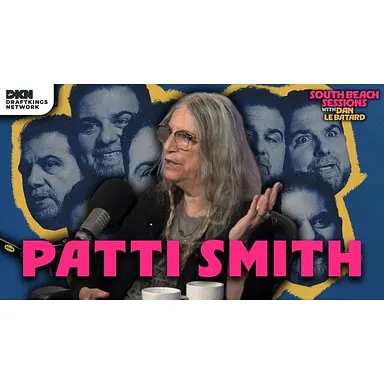
“South Beach Sessions - Patti Smith” was turned into text by HappyScribe’s speech recognition. Related tool: Teams AI note taker.
Ads in this audio differ from the text. Tap the sentence you're hearing to follow along.
Synced: the text now follows the audio.
You're listening to DraftKings Network.
Look, between getting up early for the show, watching hockey late at night, and everything else going on, I'm trying to do a better job of taking care of myself, but I'm not trying to take a whole bunch of different supplements every morning. That's why I started using IM8. IM8 Daily Ultimate Essentials combines 16 supplements and 90 ingredients supporting 9 major organ systems into one drink. drink. It was co-founded by David Beckham and developed by leading doctors and researchers. I just got my package and started working it into my morning routine, and that lemon orange flavor is my favorite. That is delicious. So far, I like how simple it is. One drink, and I'm not dealing with a cabinet full of bottles. And I'm looking forward to sticking with it. Go to im8health.com/DAN right now and use code DAN for a free welcome kit. That's 5 free travel sachets plus 10% off your order. That's code DAN at im8health.com. These statements have not been evaluated by the Food and Drug Administration. This product is not intended to diagnose, treat, cure, or prevent any disease.
We're gonna go through so many rough things in life, and the best thing is to find the other end of the pain or the, the physical pain or the emotional pain. And the other end is gratitude.
Hello, Patti Smith.
Hello. Happy to be here. Thanks for having me.
What a delight. Okay, if you're not familiar, let me take you through some of the history here. It's not just Rock and Roll Hall of Famer. She's a punk icon. She's a rock goddess. She's an author. She's a photographer. She's an artist. performer, poet, dancer, dreamer, a fountain of creativity and freedom. Which of those identifiers do you most identify with? I could use several more. National Book Award winner as well.
Worker. That's my favorite. If it was a tombstone, I would have Patti Smith, worker, because that's what I'd like to do. All of these things, all of these things are, you know, take discipline, take diligence and hard work. And I like to work. And everything I do pretty much stems from poetry. So I guess if I had to choose one vocation, I'd say writer. That is the one that most identifies me to myself.
Such an economy of words though. Tombstone, just worker. Patti Smith, worker.
Yep. Mother, you could say mother too.
You like the grind? Like, of all of the arts, poetry is the one that speaks to you the most?
Well, it did when I was younger, but now I've written so much prose, and I think now at this time in my life, poetry is really infused in my prose. I don't write that many poems anymore, but, you know, going from being a young poet, performing poetry, evolving with some music and improvisation into a rock and roll band, It all stemmed from poetry. But now I really love writing prose, and that's the lion's share of my efforts go into prose.
I have 1,000 different questions for you, but let's go somewhat into the deep end right off the top. Sure. The Dalai Lama is holding your hand and he says, it's not your fault. Yes. What was that in terms of learning about forgiveness?
Well, it was very moving for me. And I mean, it stemmed from, of course, being very young. I had to do a report at school. I think I was like 11 or 12. And we had to choose a country. And it was a year-long report. So we had to cut out newspaper items about our country. Most people took like France, Japan, whatever You know, it could be Germany, Holland. And I chose Tibet because I was learning about it. And my teacher didn't even think it was a real country. She thought it was a mythological country. And I showed her on the globe, there it is. It's a real country. And this was in the '50s. And it was still called Tibet. And she said, There's not going to be anything in the news about Tibet. So, well, everyone was— they would laugh at me. Every week we brought our scrapbooks in. Mine was empty. And I started praying because I was quite the prayer as a child, a young kid. And I would pray that something would happen in Tibet so it would be in the newspapers because I was going to fail. And also everyone was laughing at me.
And then one morning, my father— I woke up and he said, your country is in the newspaper. And I looked and it was the front page and it was China had invaded Tibet. It was terrible. They invaded. The Dalai Lama had escaped. And it was in the news for days. So of course, you can imagine I had the most exciting scrapbook of news and everyone was amazed that, you know, my obscure little country was now dominating the news in 1959. And, but then I was following it and seeing all the trials and tribulations. The Dalai Lama escaped. He was finally found weeks later. He was on the COVID of Time. Very exciting. Yet I felt terrible because being a, you know, child who believed in prayer, I thought it was partially my fault that they were invaded because I had prayed so much that something would happen. But I didn't explicitly say that something good would happen. And for years, I felt, you know, as I became an adult, I knew I didn't cause it. But this little bit of guilt in my being stayed with me. And then in the '90s, when I wound up meeting His Holiness and then working with him, I told him this little story.
And when I finished it, he was whisked away. And so I didn't know what he thought about it. So I thought, well, I got to tell the Dalai Lama that I followed him when I was young. He was only a teenager then. So later, We wound up in the same elevator to do something with the press corps. And this was in Berlin. We were doing a peace conference. And he didn't say anything. And then as he was exiting the elevator, he took my hand and he said, he looked right in my eyes and he said, it was not your fault. And then he was gone. It was not your fault. It was just like— I was exonerated and I felt like my 12-year-old being, like, just free.
That is not the answer I was expecting at all.
Oh, I'm sorry. That was a long answer.
No, no, no. It's not because it was long. It's just I didn't realize that it was specific to invading of Tibet was not your fault, as opposed to the general forgiveness and wisdom and spiritual understanding of, man, your life would be a lot better if you walked around thinking things weren't your fault.
Yeah. And it was— but no, it was very, very specific. But he's a wonderful man. I mean, I've done a lot of work. I've observed him. I learned a lot just by observing him. Just for instance, how to treat people. Sometimes he'd have to do these meet and greets with hundreds of people. And I saw that he can only spend 1 second or a few seconds with each person. He looked at them. He didn't— it was like, okay, next. He gave them— if it was 3 seconds or 5 minutes, there was contact. There was human contact. And I've learned something from that. Because sometimes, you know, like I'll be walking down the street and different people will come up to you. They're always complimentary. But sometimes you're in a hurry or you're tired. And once that— I learned that if nothing else. I don't have a lot of time, but I can just at least say, what is your name? My name is Sally. Nice to meet you, Sally. I really gleaned that from him. Just human contact. Recognizing there's a human being across from you.
Do you get used to in any way being treated by others like a goddess?
Oh no. Not like that. I would never. I mean, believe me, I'd be the most ragtag goddess. If there was a place that laid all the goddesses, they would go, somebody do something with her, please. I would be like the bag lady of the goddesses. I mean, I am very— I'm always grateful that people are interested in my work. I feel uncomfortable being called like an icon or something like that. But I realize people are just being nice. But the thing that really touches me the most is young people. I mean, I'm not bragging. It's simply true. At least once a day, I'll be walking down the streets in New York or any city. Some kid— the airport coming into Miami, a boy comes up to me, a young boy about 16, has Just Kids in his backpack. And he takes it out and I signed it for him. And he said how much the book meant to him. That means as much to me, I think, as perhaps the book meant to him because it just— there's no greater endorsement than a young person who says your work has made some positive influence on them.
And that's just the greatest.
I hate to tell you, it's what makes you an icon.
Thanks.
I mean, it's sort of by definition sort of how that stuff works, but you don't feel like a pioneer? What's the discomfort in it? Because you're just about the work?
Because I'm so focused on just doing good work. And often I'm right in the middle of something I'm struggling with. Because it's always a struggle. And like right now, I'm finishing another book. And It's just also, I've always been like that. When Robert and I were young, Robert always wanted to be— he knew he was a great artist. Even when he was young, he had a strong sense of self. But he had ambitions. He wanted to be rich and famous, which I thought was funny. I was like actually too conceited to want to be rich and famous. I wanted to be great. I wanted to write a book as great as Pinocchio. Or, you know, just that's always been my goal, to do something new, to astonish people, and just to do good work that I think is good. And that's— it's not that I feel uncomfortable with compliments and stuff. It's just that it's not what I'm seeking. But if somebody says, I'd rather someone say, I really liked your book. I like the writing in your book. That I feel more comfortable than if they say, I'm a goddess, or something, especially if I hadn't had coffee and didn't brush my hair.
It's always a struggle? Always?
Working? No, I mean, one has rides. It's like sometimes you feel like a genius. I have a daily practice. I get up, even today, I got I get up early. I have my coffee. I have a notebook. Write hopefully from 7:30, 8:00 to 11:00.
Still always by hand?
Yeah, always by hand. And then I write. And sometimes I'll be on a roll. I'll have a morning where I feel like a genius or I feel so good because I've solved a problem in the plot. Or I found a beautiful way to articulate something about my father or whatever it is. I'm successful. And yeah, then I feel really good. But the struggle, I don't— sorry, I don't mind the struggle because I understand it's part of the package.
Do you have a theory on why it is and how it is you connect across generations?
Well, I mean, in my writing, I'm not sure because sometimes I feel like my writing is obscure. Or when I'm writing, especially poetry, I'm not really thinking about who I'm writing for. But when I'm performing, I understand that. Because when I'm performing, My main goal is to connect with the people and for them to feel like they went through something and came out positive and thinking about their own self-evolution. And I know that as a performer, I can do a good job. And I think the reason I have so many young people— I'll look and it's like a bunch of young, crazy kids holding up Just Kids or yelling my name or something. And then there's people of my generation. And I think it's because I'm just talking to them. I don't walk on a stage like I'm a rock star. I walk on a stage hopefully as a friend who has this position.
So you get the National Book Award for Just Kids. Did you feel like you wrote Pinocchio?
No. I mean, that book really, that was Robert This is a little piece of irony too. Hours before Robert died, I had just had a baby. I couldn't go to where he was. I had only seen him a few days before.
For the uninitiated, Robert is your greatest— Robert Mapplethorpe. Your artistic muse.
Yes. I always call him the artist of my life. And He was dying of AIDS. And we said our goodbyes, but he lived for, you know, a few more days. And I talked to him on the phone hours before he died. And I just— at that point, we had no more hope that he was going to live. So I just said to him, what can I do? Because we were collaborators. What can I do to further magnify your name? Or what task can I do for you? And he had a few smaller things. And then he said, will you write our story? And I never imagined he would ask me to do that. And I wasn't a nonfiction writer. And I said, are you sure? And he said, no one else can do it. Because we were young, we were poor. Nobody knew what we were going through. No one saw Robert's early evolution. And it took me years to write that book. Years. And my goal when I was writing it was to do it for Robert because it was a vow. I wasn't thinking about how people would, who would like it, who would be inspired by it.
It was for him.
It was for him. And I had a task of writing a book that he would love, but that would be well written. Robert was not a reader. So I tried to make it a little more cinematic. And when I finished it finally, I was so happy that I had accomplished my vow. I didn't even think, you know, I didn't know if it would be a little cult book or if anyone would like it. But I was just so happy that I did what he asked. And that darn Robert, who wanted me to be rich and famous too, even though I didn't care, to this day, that is the most popular thing, far exceeding my records, far exceeding any record sale, anything. Just Kids is my— and the book that made me the most prosperous, which he would of loved. So it's an irony that I always told him, oh, I don't care about that. And that book did that. And when I won the National Book Award— I'm just sorry. I never dreamed that. I worked in a bookstore for like 7 years. Every year the National Book Awards, the books would arrive. And back in those days in the '60s and early '70s, you had to gift wrap hundreds of them because people back then would come into the store and just buy all the National Book Award winners, and they always wanted them gift wrapped.
So I always wondered, what would it be like to get a National Book Award? I thought, oh my gosh, that must be amazing. And I experienced it.
Put us next to you when you get that news. And did you feel Robert there?
Well,
Did you feel Robert there when you got the award?
Oh, absolutely. I mean, you had to go to— I was nominated. There were 5 books. But just being nominated was amazing. And it was like a dinner. And when they called my name, I actually, you know, I felt, you know, I feel like you're like getting an Oscar or something. And yes, absolutely. I felt him. I felt him throughout the whole process of writing it. In fact, it took so long, sometimes I would hear him in my ear going, Patty, what's taking you so long? Because he always drew my name out like that. And I would go, I know, I'm doing the best I can.
The way you write about death, it is both profound and so very simple. When you say something like, mourning is not the end of love, it is its proof. You lost so many people that you care about dearly before they were 45 years old, what have you learned about grief?
Well, one thing I've learned is that it never goes away. And I always— a lot of people ask me about grief, and I always tell them this idea that time heals all wounds, that's not good counsel. It doesn't really. Wounds, the wound of grief never is healed. You just learn how to negotiate it. And you learn how to negotiate it so you can still feel the joy of having that person in your life. And— but you also are going to be suddenly hit with waves of sorrow again. I can go months or even a year or two with being fine. And then all of a sudden, one night, the idea that my husband is gone, that I'm not going to see Fred physically again, seems unbearable and almost seems impossible. But I've learned to ride through those nights or ride through those afternoons. And I always use the— it's like the metaphor of the captain. You have your ship, you're the captain. Often the seas are smooth, but then all of a sudden you get hit with a storm. You don't give up. You don't say, oh, this is too horrible. You negotiate it until you get back on safe waters.
And so you walk with it. And I think the most healthiest thing is to walk with it with joy because it's just like life. You go through life and sometimes you might have a sickness or some people get cancer. They have to go through all of the things to heal them and make, you know, so they can keep living. We're going to go through so many rough things in life. And the best thing is to find the other end of the pain or the physical pain or the emotional pain. And the other end is gratitude. And even I think Bread of Angels is more about gratitude than anything else. I didn't think of it that way when I started writing it. I just wanted to at first write a book about childhood, really. And then it kept going and evolving. And I found that the continual theme is gratitude. Gratitude. If I have a painful night thinking of my brother or my mother, sometimes I miss my mother. I'm almost 80 years old. And sometimes I just want to have one more cup of coffee with her. And you just, you know, after I take a deep breath or even cry, I think about— I'll start smiling thinking about all the afternoons and the mornings and picturing her with her cigarette and telling stories about the '40s.
And so we have to hold on to joy.
Explained that way, if you could press a button and get rid of the pain and the storms, would you? Because Because without those, I don't know that the love gets kept alive and you have the reminders of the gratitude unless you're reminded at all times that the pain is that the love is still alive. The love still— that person still exists for you in your heart.
What a great question. I mean, that's a— and you know what? I mean, no, I wouldn't want to. I think we need to feel these. It's like the seasons. If you're brought up with seasons, people say, oh, wouldn't you like it if there wasn't winter and there wasn't summer? I mean, we need to experience shifts and challenges. I think sometimes the sorrow we feel is a magnification of our love. And also the tears that we shed Are very cleansing. So that— what an interesting— sorry, that was— and beautifully said. Thank you. But I just accept always when I— since I've been a— since I was a child, I was such a sickly child. I had to overcome many illnesses. And I just— would I want to go through life without my illnesses? I learned something from each illness. I learned something from each loss. And so who I am today is a product of any kind of emotional suffering, physical suffering I've had. And I'm just glad to be here with all of the different experiences that I've had.
Well, that allows you to be grateful, right? And grateful might as well be a synonym for joy.
And it's, yeah, and it's, you know, gratitude comes from getting sometimes just getting through it. Like, so grateful that I got through the pandemic flu of 1958, that I got through tuberculosis, or, you know, that I got through the loss of my husband and brother. So gratitude, when it— it's like it's gift. It's sort of like the balm for the wound of suffering. Because you, you're, it, it's a, you're, when you're washed with gratitude, when it goes through you, it's, it's very strengthening as well as a good feeling.
Look, between getting up early for the show, watching hockey late at night and everything else going on, I'm trying to do a better job of taking care of myself, but I'm not trying to take a whole bunch of different supplements every morning. That's why I started using IM8. IM8 Daily Ultimate Essentials combines 16 supplements and 90 ingredients supporting 9 major organ systems into one drink. It was co-founded by David Beckham and developed by leading doctors and researchers. I just got my package and started working it into my morning routine, and that lemon orange flavor is my favorite. That is delicious. And so far, I like how simple it is. One drink and I'm not dealing with a cabinet full of bottles, and I'm looking forward to sticking with it. Go to iam8health.com/DAN right now and use code DAN for a free welcome kit. That's 5 free travel sachets plus 10% off your order. That's code DAN at im8health.com/DAN. Code DAN at im8health.com/DAN. These statements have not been evaluated by the Food and Drug Administration. This product is not intended to diagnose, treat, cure, or prevent any disease.
I'm the kind of guy that spends a lot of time preparing for the show. Over the weekend, I gather a lot of stats on the college football and NFL weekends to come in prepared. I work on my bad jokes. I work on songs. I don't want to also spend time standing in front of my closet trying to figure out what I'm going to wear every single day. And that's why all of my Quince staples have become a really important piece of my wardrobe. My Quince sweater is ridiculously soft. It's comfortable. It looks put together. Quince makes its sweaters with 100% Mongolian cashmere starting at just $60. They also offer premium down jackets, classic wool outerwear for when the temperature drops, Or here in Miami when our, you know, studio air conditioning becomes a bit aggressive. You guys can hear it in the background. I know you can. I've edited the audio. Everything is priced 50 to 80% less than similar brands because Quince works directly with ethical factories and cuts out the middlemen. It's high-quality stuff. All of these are my favorite pieces of my wardrobe. I use Quince and you should too. Find your next fall favorites at Quince.
Download the Quince app for app exclusive offers, or go to quince.com. Get free shipping on your order and 365-day returns. Now available in Canada and the UK too. And when Quince asks where you heard about them, let them know it was South Beach Sessions. It's the best way to support the show.
Your relationship with your husband, uh, is it not exaggeration in Bread of Angels when you say, for 14 years we were never apart except when I was having the children and I was whisked away to
Well, he was right there. I mean, he was like in the— I had all of my labor mostly at home. Long labor. Like, I think 14 hours with my son and longer with my daughter. And we always went at the last minute. And then I stayed overnight. And no, it's no exaggeration because we left public life, both of us, We wanted to build a life of just doing our work and evolving as human beings. He had been through a very difficult childhood being a rock star at a very young age, a political rock star with the FBI hounding him. And he had been through so much. I think he really wanted to Just have a quiet life. And I mean, we had lots— we had our own turmoil. Believe me, we could create turmoil in our quiet life. But yeah, it's not an exaggeration. If I wanted to see my parents, we drove everywhere. We didn't even fly many places. We'd pack up the car and drive from Detroit to South Jersey, and he'd stay there with me. Or we'd plan we want to go somewhere and we always, you know, went together. When the kids were born, we took them everywhere.
And so yeah, we were, we had, even though we only had 16 years together, 14 as a married couple, we were, we spent it all together. I mean, they were years of quality and years of getting to know all the cells of one another. But we also had our own time. And sometimes, you know, we had started as round-the-clock people. Fred always called it, we had a life, a clock with no hands. That was our life. And we always were on different schedules. When we had the kids, I had to be on a very straight schedule. But I allowed— he could move around the clock if he felt like sitting up all night working on music and I had to retire early. And that's how our life changed. But it wasn't a bad thing. It was just we had to shift certain ways of living.
When you say that you knew all of each other's selves, I was a bit surprised given your level of profundity and the depth of your general feeling that you were saying he was a troubled man whose troubles I wasn't able to actually penetrate.
Well, there were certain areas, yes, that he was a very, very private man. I just mean we worked in tandem all the time. But you're right. You're right in saying that. You know, we had strong instincts about each other and what each other needed and the space each other needed. But Fred had gone through I went through a childhood of illness and various struggles, but his struggles were different. And he had a very complicated relationship with his father. He was brought up when, you know, he didn't finish high school. He had to face the draft. He was against the war in Vietnam. You know, like a lot of kids then, some went, some went to college, And some got out of the draft forever, whether it was drugs or whatever. But he had to live with that. His very best friend was killed in Vietnam in a helicopter crash, I think. And he suffered guilt and pain about that all the time. A part of him felt like he should have gone. even though he didn't believe in the war. Because a lot of his buddies went and they were either wounded or lost or his best friend killed.
And every year— and this is, again, the beauty and complexity of Fred. Very stoic man. But every year in Detroit, maybe it was national, but they would read all of the names of the boys that were killed in Vietnam, 50,000 of them. Or maybe in each city, there would be the people that died who were from, say, the Detroit area, which there were a lot. And he would sit there, whether it took hours, and not leave until his friend his name was called. And then we always gave him privacy, and he would weep for him. So after Fred died, I went to Washington, DC and found his friend's name on the monument that was built in Washington, DC and made a rubbing of his friend's name.
You wrote beautifully about The doing of his eulogy, which you didn't think that you could do, and you were told by the people who loved you that it would come to you, that it would— How did it come to you?
Well, I mean, it's sad but funny. Fred always, when we were driving around, we'd be listening to the radio. And when Louis Armstrong was singing Wonderful World, which truthfully, I didn't really like the song that much. I appreciated him, but I wasn't even a big Louis Armstrong fan. And every time this song would come on— sorry about me, I have some allergies— about my raspy voice.
That voice has done some work over the years.
Yeah. He would say, Tricia, it's your song. And I would He would like— it was like pushing a little button. I would go, it's not my song. I don't even like that song. Why are you saying that's my song? You know, I'd say, my song is Mermaid Turn the Tides, 1985 by Jimi Hendrix. That's my song. He goes, no, this is your song. Always annoyed me. So when Fred died, my brother God bless him, was driving me to the Mariner Church where we were doing memorial for Fred. And I said, I can't do it, Toddy. I can't get up in front of these people. I can't do it. I just felt incapable of doing that. He said, you'll do it. And he said, the words will come. And I said, we're halfway to the church. There's nothing. So my brother put on the radio. And what song do you think came on? Wonderful World by— with Louis Armstrong singing Wonderful World. And I went, oh no, it's that song. I said, do you know Fred always said to me, Tricia, this is your song. And we would fight about it. And I said to Tati, why do you think he said this was my song?
And Tati said, well, that's easy. And I said, why? And he said, because you're an incurable optimist. I said, really? I mean, I never thought of myself that way. He said, yeah, since we were children, you were always the optimistic one. You were always the one that was going to find the good thing about what was happening or the bright side of things. And so I knew this song. So I just decided to Sing the song for him. And I even had a little coda and I sang it. And I said, Fred, you always said this was my song. Now it's your darn song. And so, but it was sort of magical. But it had its humor. And Fred loved to laugh. I mean, Fred was the kind of guy that we would have like movie night. And we'd go to like the King Video Store and get videos. And because there weren't many movie houses or things to go to. And for Fred, a good night, if it was like a Fred night, like if it was my night, I would be French Lieutenant's Woman and, you know, Mozart's Childhood or something. But it was a Fred night.
A typical Fred night would be Das Boot, And Spinal Tap. So there you have it. It's like, it's the most dark, depressing, you know, long, drawn-out, you know, thing about men trapped in a submarine. And, you know, just a terrible story. And then Spinal Tap, which would make him like laugh all night long.
Did a lot of people call you Tricia?
No, only my mother and Fred. Which annoyed me in a good way. No, he always called me Tricia. I don't know why. Maybe he heard my mother call me Tricia. But no one ever called me Tricia but my mother.
As a child, you've mentioned a couple of times here, you would disappear a lot. Were you always choosing your own path?
My poor mother. Yeah. As soon as my mother said her last Good sleep was, you know, it was before my first birthday. It was Christmas or Christmas Eve in the kitchen in Chicago in the little rooming house we were living in. And it was my first Christmas. It was going to be my birthday, which is December 30th. And I was shy of my first birthday. And my mother and her friend were having coffee. And I was sitting on the floor playing. And then all of a sudden, I got up and walked across the kitchen. And they were like, when did she learn that? And my mother said that was her last peaceful day because if I could escape, I would. If she, you know, had— especially after she had my sister, she would be pushing one child and holding my hand and then distracted, and I'd be off. And then she would spend most of the time in a department store trying to find me. So yeah, I was always— taking off was— that could be on the t-shirt, my baby t-shirt, because I was always taking off.
What was happening there? Because it ended up being a lifelong thing where you are always choosing your own way.
Curiosity and just wanting to see new things. And I always wanted to travel. I came from an environment in the '50s where people in America— no one traveled. They had already just experienced World War II. None of the fathers that came home from the war wanted to travel. None of our fathers wanted to travel. The mothers, you know, the women wound up with, you know, a few kids, not much money. So travel wasn't even in the books. But for me, as soon as I saw that there were other countries, you know, Reading about the war my father fought against the Japanese, I would see pictures of Japan, pagodas and things like that. I wanted to see them. I wanted to see the Taj Mahal. I wanted to go to Morocco. I wanted to see these things because we lived in a very rural area with very little culture. It was a cool place to be. But really music provided our culture. But I just always wanted to see the world.
Oh, so you know from very early on though that music is calling you to go do more, be more, see more.
I didn't know that really. I mean, I grew up in time as rock and roll was evolving. So I saw from 5 or 6, rock and roll evolving and surrounding me. But I never dreamed— I depended on it. We all depended on it for dancing, for communication. And then discovering jazz, Coltrane and Roland Kirk and all the great jazz masters. But still in all, I never imagined that It would be music and the pursuit of creating through music that would give me my ticket to the world. And it did.
What are the details worth remembering about being a street performer in Paris in 1967?
Well, I can tell you, it was just— it was a fiddler. I sang. A fellow that played acoustic guitar. And my sister Linda had the hat. to go around. And I would say the most memorable thing happened when Leslie Caron, the beautiful French actress, walked by and put 20 francs in the hat. 20 francs back then was probably— it might have been about $5, which was a lot of money back then, 1969. Enough for us all to get a really great meal. And That was quite a moment. Years later, I met her at some function, and I don't think she remembered, but I got the opportunity to thank her.
How about being hungry? Hunger being an actual thing when you were living in New York, still trying to make it, right?
Well, hunger was always a challenge for me. I mean, when I was a kid, If my dad was on strike or the money was low, you know, provisions were low. And we did have some really rough times, you know, where we were eating maybe bread with butter or bread with Karo syrup or whatever was available. And I had such a high metabolism rate. I was a really skinny kid, but I could outeat anyone. I could eat a vat of mashed potatoes. And it was always sort of a— it was always a challenge for me. I'm not saying that I was starving. Like, I understand famine and things. I'm not comparing myself. I'm just saying it was a challenge because I was always hungry and always using— eating up— my metabolism ate up everything. And then when Robert and I were together, we had so little money. We would go a day or two at the most without eating. And it was a huge challenge for me. Robert did much better with that challenge than I did. But I wasn't angry. I didn't feel sorry for myself. I was just hungry. You know, I was never sorry about the path that I chose because the freedom going from a rural area of South Jersey and having a very strong dominant mother, going to New York City, working in a bookstore, being able to write and do whatever I wanted, and all the people on the streets and all the culture.
Even if you couldn't afford to— I remember to I walked past Carnegie Hall and Nina Simone was there or something like that. I didn't have the money to go, but just that it was happening around me was so exciting. And so, you know, it's something you had to endure, but I wasn't sorry when I started making enough money to always make sure I had a good meal.
Well, do you remember the feeling of, I'm not hungry anymore? Like, when roughly in your life would you have vanquished that feeling?
Well, in the, like, 1975, when we started touring and we would have, you know, we didn't make a whole bunch of money. I was still living in the East Village. When we did Horses, I was living in a 6th floor walk-up in the East Village. But I had money in my pocket. That's the difference. I still, I can show you. Yeah. I never go anywhere without money in my pocket. Even just to give to people if they need it. Because that was a big thing. I grew up, there were no credit cards. And if you didn't have money, you didn't eat. And you never had it. And that's why there's stories where you'd be— everyone scrounging for change, looking under every sofa, looking inside the little slats, going through all your pockets for a quarter. And I still feel amazed that I always have money in my pocket. And that's the difference. If I have money in my pocket, I know we're in the world of credit cards, but still I feel more secure when I have, you know, $20, $30 in my pocket.
I'm the kind of guy that spends a lot of time preparing for the show. Over the weekend, I gather a lot of stats on the college football and NFL weekends to come in prepared. I work on my bad jokes. I work on songs. I don't want to also spend time standing in front of my closet trying to figure out what I'm gonna wear every single day. And that's why all of my Quince staples have become a really important piece of my wardrobe. My Quince sweater is ridiculously soft. It's comfortable. It looks put together. Quince makes its sweaters with 100% Mongolian cashmere starting at just $60. They also offer premium down jackets, classic wool outerwear for when the temperature drops, or here in Miami when our, you know, studio air conditioning becomes a bit aggressive. You guys can hear it in the background, I know you can. I've edited the audio. Everything is priced 50 to 80% less than similar brands because Quince works directly with ethical factories and cuts out the middlemen. It's high-quality stuff. All of these are my favorite pieces in my wardrobe. I use Quince and you should too. Find your next fall favorites at Quince.
Download the Quince app for app-exclusive offers, or go to quince.com. Get free shipping on your order and 365-day returns. Now available in Canada and the UK too. And when Quince asks where you heard about them, let them know it was South Beach Sessions. It's the best way to support the show.
Uh, Rolling Stone magazine named you one of the top 50 artists of all time. I think Horses has ended up on a lot of top 100 albums of all time.
Yeah, it keeps going up, actually.
It was your debut album though. So that's got to be an interesting kind of pressure to do your most popular work first and then try and chase that.
Well, it was critically popular, but it's never even gone gold. I've never had a gold record. It was— but I'm not intimidated by things like that. That record was, it's really the culmination of the evolution of poetry into music because Redondo Beach was a poem. Jesus Died for Somebody's Sins But Not Mine opened a poem I wrote at 20. And so Horses A lot of it is poetry or improvisation that evolved and it became a record. But it's like anything. I'm proud of Just Kids. It's my most popular book. But I'm always— I'm a worker. I'm always looking toward the next thing, a new thing. So I'm not intimidated by my own work. I never feel the pressure that I have to top it or anything. That's journalists and record companies. You know, when I had a— because The Night, you know, was a— well, it was a hit song. It wasn't a giant hit song, but it was the biggest I had had in that time period. I didn't feel like I had to top that. I understood it wasn't even— it was a collaboration with Bruce Springsteen. I didn't have the capabilities of writing a song like that on my own.
I'm not— I don't have that kind of skill. I have other skills. That song shows our skills. Bruce arranged it. He had the chorus. I could never write a chorus like that.
Well, you don't even call yourself a musician, right? You call yourself a performer more than a musician.
Yes, absolutely. And a song— I mean, I've written A lot of songs on my own. I've written all the Lyric Star songs. But I don't think music. And I could have never written Because the Night. I couldn't have written a chorus like that. But I did write the verses. And I think the verses are strong. And they're verses that Bruce wouldn't have written. So we both have, you know, everyone has their abilities. I like our pop artists. You know, people think, you know, even when I was young, they would say, well, you're supposed to be punk rock and you like pop music. I like things that are good. You know, I don't care. You know, and I like people that work hard. Our, like, look at, you know, Rosalía, or I love her, or Dua Lipa, or any of our pop artists. They work really hard. Really hard. Whether it's doing their videos or learning their dance routines or working on their singing range. I mean, these are people that put— that's the lion's share of their efforts. Musicians, the lion's share of their efforts go in the construction of music, whether it's more mathematical or improvisational or lyrical.
I don't think like that. I'm really a writer. And I think it's almost an insult to musicians to call me a musician. I haven't paid the dues to be called a musician, but I have paid them to be called a performer or to be called a writer.
Let me ask the question a different way then. Whether it comes to Just Kids or Horses, your most popularly acclaimed things, do you believe you've done a lot of work better than what is viewed as the most popular by others, that gives you more fulfillment because you think it's better? It just didn't have that—
Well, I think there's better writing, or let's not say better, more evolved writing in Bread of Angels. But they're different kinds of books. That book, I understand why Just Kids is popular. It was written from a youthful point of view. I didn't write Just Kids from a mature point of view. I wrote most of it going back into that world and what our world was. We met at 20. The book ends when— I mean, our story ends like when we're about almost 30 or 30 years old. What happened in that decade? What happened in that decade in New York City? How did we evolve culturally in that decade? And so, you know, Bread of Angels is an entirely different book. written by a person who's experienced a lot of things since the timeframe in Just Kids. Since that book, I met the love of my life. I was married. I was widowed. I had children. I've evolved as a As a writer, I've studied so much. I just feel that if I didn't feel like I couldn't keep evolving or doing— I don't like to say this one's better than this one. I'd like to say that my writing has evolved.
And the writing I needed to do for Just Kids, the skill I had, was proper for that book. But the skill that I have to write Bread of Angels surpasses those skills.
Because you're more evolved. You've lived more. You've lived a big life. I have some questions about Bread of Angels. What finished second place for the title of the book?
What was it? What was that? I had one. Oh, I had so— I don't know which. I mean, originally it was called It was going to be called The White Dress because it was going to be focused on— there's 4 white dresses that appear in the book, all given to me by a man who has died, whether my husband, my brother, Robert. But then it took me so long to write Bread of Angels that a couple of other books, one was called The White Dress. And somebody wrote a book, The White Dresses. So I had to have another title. Then I thought Dancing Barefoot. But then some guy took that and wrote some unauthorized biography of me. So he stole my title. Which was a bit annoying. I was going to call it Dancing Barefoot, which would have been appropriate because the COVID picture was the image that was used for the single of Dancing Barefoot. But he stole it, so I had to find something else.
And why did you settle on that as the title?
Well, I started rereading it to look to find something that spoke to me. And there's a little passage in the book where I'm talking about how— was actually a boy when I was a teenager— did an act of kindness toward me. And it was like a few different small acts of kindness. One was when I was 12, a boy tied my bootlace and he was like the coolest boy ever. And then the other coolest boy ever did something else nice for me. And so they were, I called them unpremeditated acts of kindness. And that's— it said, I think it says, these unpremeditated acts of kindness, they are the bread of angels. It was just a line I wrote that I had forgotten I wrote it. And then I thought that that's nice because by the time I finished the book, it wasn't so much about the history of 4 dresses. It was, as I said, more of a book about
You stopped writing it for a couple of years because you received the fairly seismic news that your father is not your biological father at 70 years old. That information gets to you and changes you how?
Well, I mean, as a writer, which is the less emotional, but for me was deeply crucial, I adored my father. He wasn't like the most exemplary father. He was often disinterested in our things. But as a person, he was so beautiful, so interesting. And just his mind was so beautiful that I really modeled myself after him. And there was a point that I had thought to dedicate this book to my father. and write more about him. But then the book shifted a bit. But still, I was early on in the book, and this was my consciousness. And then when I had this news, I realized that I didn't know how to— well, let me just say, I wanted this book to— the other title was going to be Truth. Because I wanted the book, everything in it, to be just as Just Kids is, truthful. And to stay in the truth. Don't exaggerate. Don't speculate. Keep everything. Make certain that everything is truthful. And then I thought, what do I do with this material? Do I write about it? Do I keep it to myself? And there was also nobody knew this. I didn't know what to do with it.
I didn't know what was the right thing to do. So I had to table the book while I thought about it. And then I wrote a different thing. But I needed that time because I felt like I had to rewrite the whole book. For a little while, I thought I did. I thought I was going to have to rewrite the whole top of it. And then I finally figured out a way to do it that seemed appropriate. But it was— that was difficult. Emotionally, yes. I mean, I adored my father. I cried a little, but only narcissistically because I wanted to, you know, I admired him so much. But I didn't resemble my father at all physically. I didn't resemble his relatives. I didn't resemble his mother. I was a little different looking than my siblings. There was always a strange schism about that, how I was different. Wasn't bad. I wasn't less loved. But there was always something.
Made it no less shocking though, right, to learn at 70 years old.
Well, what was shocking about it, I never— I've heard a million of my mother's stories. It could have, you know, different soldiers or this person she had a crush on or different this particular person was never mentioned. Ever. There's no story. There's no hint. There isn't anything you could go back and go, wait a minute, she said this about this guy. And also to find out that I had now, at least blood-wise, 50% Jewish heritage. And, you know, being— which is fine with me. I mean, I was as child, the Diary of Anne Frank was my Bible. I was born right after World War II. I knew the suffering of the people. But in the past 20 years, I've also been working toward Palestinian rights, and I've been very focused on Palestine. So it was a very, you know, where there were all these things that I had to put into place. But that was a big surprise. But really, after I figured out how to present him in the book, and again, how do you present him? Gratitude. This is the man who fathered me. I am the way that I am and here on the planet because he fathered me.
And so of course, being a person who loves being here and loves my life, I went right to gratitude quickly. I was even grateful to my mother because I felt, you know, she must have— there was no DNA test or anything back then. My father, who raised me, would never I mean, he was a very philosophic man. He would never hold it against anybody. He wasn't like that. He was a very curious man. He would have probably been very interested to find this out. But my mother must have known because I really resemble my father. When I was young, I really resembled him. But I believe she kept it to herself for 2 reasons. One, my biological father died young. He lived very close to us. She must have seen the obituary. But more important than that, she knew I adored my father. She knew I preferred my father over her, which is true. Not necessarily now, but when I was younger. I think she was just protecting me.
Do you have any idea if your biological father, who arrives as a ghost with no details, if he knew that he was the father?
I wouldn't know that. I have no idea. He didn't have children. I don't know. He died in 1965. He was only 50, I think. I don't know anything because there was never any discussion. So And there aren't a whole lot of— there's no real trail anywhere. But you know, I'm happy to know what I know. I also know enough about him that I finally figured out where all my arrogance swagger comes from because it was said that he was a gunner in World War II. He was brave. But it was also said that he was quite handsome. very popular with the ladies and had a bit of a swagger. So I thought, ah, that's where my sort of my— because my family isn't like that. I'm like probably the most arrogant one in the family. So where did that come from?
But the dreamer comes from the man who raised you, correct?
Absolutely. Absolutely. And also it's just part of who I am. And my mother wasn't a big dreamer, but my mother Loved romance, fairy tales, and was also the wonderful world kind of person. She was always the one who would find some positive thing in any situation.
What is your relationship with actual dreams? One of your books came to you in a dream a decade earlier, correct?
Yes. That book, Bread of Angels, came to me in a dream. I dreamed that— sorry. I had no thought of writing another memoir. It was so laborious doing Just Kids. I didn't want to have to write another piece of nonfiction, which requires so much responsibility. And I dreamed that a messenger came and brought me this beautiful white book. And it was a package. I opened a beautiful white book with a white ribbon. And I opened it up and there was a beautiful Irving Penn— leave it to me, I have Irving Penn taking the photographs in my book— Irving Penn photograph of my wedding dress. my old Victorian wedding dress. And there were 4 dresses in this book. That's the only pictures. And I looked and it was my book. I had written it. It was, you know, The Four White Dresses. And I was amazed. I thought, oh, I wrote this? It was so beautiful. And then I woke up. And I woke up with my hands still extended As if I was holding it. And it was just so amazing. I could almost feel the weight of the book in my hands. And I tried to avoid it.
But, you know, it's like you get like Jonah. You're dogged with something like, you must do this. And you're like, I don't want to do that. And then finally, I just thought it was fated that I should write it.
Does it look like it looked Well, it
didn't have a— it had no cover. It was just white. But I decided to use that picture because Robert took the photo shoot for Wave. And I wanted doves because I had written a song called Frederick about my future husband and had doves in it. So Robert got somebody with trained doves And we took the picture in the same room. That's the exact same room where the COVID of Horses was taken. Same room, same wall. And the COVID of Wave, I'm holding a dove, a white dove. We finished the shoot, and he had taken pictures of the band. They left. And then I asked if he would take one more picture. And I said, I want a picture that has a sense of surrendering to love. I didn't even want it for anything. I just wanted him to take the picture because I knew I was going to leave public life. No one knew but me. I knew that it would be soon. And this would, I thought, be my last album. So he told me— I just stood against the wall and he told me what to do. And Raise my hands. And he took one picture.
This is how great Robert was. I mean, I do photo shoots now. People take 9,000 pictures. One time a guy— Robert took 12 pictures to get the COVID of Horses. The 8th one, he said, I got it. And there was no computer to show what he had done. I said, how do you know? And he said, I just know. It's the one with the magic. And he was right. And he took that picture. It was the only one. And because it was taken at a time when I was very much in love, where I had a huge decision to make in life, a very pivotal decision, I thought that it was a nice— that it illustrated a certain state of mind of the book.
I've got 1,000 questions and we don't have enough time here for 1,000 questions. So I'm going to bang through some of these a little more quickly. How close did you come to becoming the lead singer of Blue Oyster Cult?
Well, I was asked by Sandy Pearlman. I auditioned. I think if I would have— yeah, they all liked the idea. But I knew it wasn't right for me. And so it was about as close as I wanted it to be. But they had a good— they got a really good singer and who was— would have been more appropriate. I wasn't the appropriate one. But the fact that Sandy Pearlman, I mean, this is like in 1971 or something. Or yeah, it was 1971 or early '72, had that kind of vision is amazing. Because I said, I can't front a rock and roll band. I didn't even know how to use a microphone. But so I can only say it had to do with how much I wanted it.
Performing at the Vatican a couple of times, anything particularly memorable from those experiences?
Well, the most memorable, of course, you're doing something for a cause. The money from these events went to for orphanages. Pope Francis oversaw orphanages in South America, which the present Pope Leo was working at these orphanages in Peru. But that was a good thing. But meeting Pope Francis, he was really like, Like a happy saint. He's like a saint that didn't need to be martyred or anything. He just had this countenance about him and a childlike aspect. So that was wonderful. But even more wonderful is I got to take my daughter, Jessie, so she could meet him too.
Why did you turn down $500,000 from a pharmaceutical company?
It was to use people of the power For a big advertising campaign. I was working with Ralph Nader at the time. I knew some of the evils of these pharmaceutical companies. And it just wasn't appropriate use of the song. That's not what the song is about. It was a time when I had no money too. I mean, it was a really challenging time. But I couldn't do that. And we're so strong as a family. My son and daughter understood that that was so much money that we could certainly use that kind of money because we didn't have it. And that a certain amount of money they would have because they have Fred's publishing. And they both said no. They both said, no, this isn't right. So it was a mutual, you know, I always talk to them when anything that has to do with Fred, we talk about it. And we all agreed that it wasn't the proper use of the song. I'd sooner give it, you know, to, you know, a woman's labor movement or something free than get money for it in an inappropriate way.
I'm going to ask you some fill-in-the-blank questions here, but what is or what has been your relationship with drugs over the years?
Respectful. I mean, I very, you know, I just, for a little, excuse me, for a little period, I like puffing. I can't smoke deeply because I have a bronchial situation, but I like puffing on pot. And I felt like I was in Morocco and I liked writing poetry or playing clarinet with pot. I don't— would, you know, when I was with Sam Shepard, I would have, you know, some tequilas. I had a— like, I would— I could count on one hand my drug experiences. I understood what they were. And I can remember each one of them because there was only a few of them. I think I wrote about all of them in the book. I— my mother fought so hard to keep me alive when I was young. I couldn't— I wasn't going to dabble with stuff like that. Also, I grew up at a time when I saw a lot of people that I really liked die of drugs at a very young age. So I would say that my relationship was minimal and respectful.
So fill in the blank on these. My favorite cover to do is blank.
Oh my gosh, that's so hard. It changes all the time. Right now, it's like 2 of them.
You can name them both. I'll give you— but I'm going to make this tighter because you're not— I'm not gonna allow you 2 for the other answers. This one you're allowed 2 for.
Well, though, I love doing After the Gold Rush by Neil Young. And right now, probably that would be number one. But right now, I'm doing Man with a Long Black Coat by Bob Dylan. I love doing it. But if I had to pick one, I would pick After the Gold Rush.
The compliment I've gotten that I feel is better than calling me shamanistic is blank.
It was William Burroughs that said that. My father told me when I wrote this little book called Wool Gathering, because my father didn't really like rock and roll. He was proud of my efforts and things, but when he read this book, Woolgathering, he said, Patricia, you're a good writer. And that will always stay with me.
The most awed I've ever been collaborating with someone is blank.
Wow. What would that be? I'm not easily awed. What would that be? That's an interesting— oh, I know. I got to improvise poetry. I forget. I think it was in Italy. I was called on the stage. I went to see Ornette Coleman, and he called me on the stage. And they were like, improvise. And I improvised poetry. Quite a long poem. And it was great. So that was— I felt like really privileged to do that.
What keeps you up at night?
What?
What keeps you up at night?
My imagination.
Most honored you've been to receive any kind of award?
I think it was my— I received the Commandeur of the Arts from the French Republic. And I've received other things since then. I'm really lucky. I don't know how it happened, but I've received some great awards. But, you know, William Burroughs had gotten a Commandeur and Susan Sontag. And they both told me that one day I would get one. But I thought, why? And then when I received one from the French Republic, I was quite I was quite thrilled.
Something you can eat way too much of?
Pizza.
A scent you associate with childhood?
Well, there is a couple of them, but they're not necessarily good scents. I don't have a great sense of smell, so I'm trying to go through them.
But do they have to be good scents? I wasn't looking for those.
Well, I'll tell you. When I grew up in South Jersey, we moved there, I guess, when we were 8, and we moved near a pig farm. And in the summer, for the first time, on a really hot windy day, we got a waft of like, of that, and it was quite strong.
So pig shit is what you're talking about there. Something you do that consistently annoys the people who love you?
Oh, pronounce things wrong.
What do you regard as your greatest weakness?
I'm a bad listener.
One person you really need to meet?
Hmm. Who do I need to meet? I've met a lot of really great people. Who do I need to meet?
The answer can be no one.
I'm just— I don't know. I've been so lucky. I've just gotten Chance to meet so many great people. I mean, it's really hard for me. I mean, I just spent time with Pope Leo. And after meeting him, I just feel like my meeting great people quotient has been fulfilled for a while.
All right. Let me ask you in a different way then. If you really had to impress a stranger about someone that you have met or been around, or you're not awed easily, but you really had to impress a stranger with a name, I've done this with this person. What would you throw at it to cocktail party?
Oh my gosh. I don't— you're really funny. Who would I do that was— I'm sorry. I'm just really thinking about this.
I'm allowing you to really think. It doesn't have to be— I did say rapid fire, but it doesn't have to be rapid fire. You giving thought to stuff is unsurprising. Plus, it doesn't seem like this is the way that you live, sort of tabulating these things, ranking them. No.
And it's just no, because truthfully, I'm so lucky. I mean, in the past even months, because I do a lot of things where you're raising money for certain things or good things or charity or something. And in the past, I got to speak with Jane Fonda and sit on the couch and talk with Robert De Niro. Or I have different people that have done— I mean, not just people we admire, but who are doing really good things or trying to do good things for our country, for women, for children. But I just I don't know how to answer that. I'm sorry.
That's okay. We'll move on to the last question. The most moved you can recall being during a performance is blank.
Oh my gosh, because that happens so much. Well, I can choose one. I don't know how many years ago, Maybe 10 years ago or so. We were doing, maybe it was a Horses tour. And we had to do a concert in a massive field that was used to train horses in Poland. And it was not easy to get to. You had to, you know, it was like you had to take this plane and then this car and get on this train. And we finally got there. And you look at this big field and there's a stage. It was, I don't know, 20,000, 30,000 kids, young people. I mean, almost to the person, young people under 30, many of them under 20, filled with young people, first of all, which is the most amazing thing and the greatest privilege. But even more beautiful, it really almost incapacitated me, was that they knew the words to every song. These are young people. And I was in Poland and on a field where they train horses. And I would start a song, Dancing Barefoot, and they knew all the words. I was like crying through half of them.
They sometimes— it was like an Adele concert. You know, I would just have to stop for a minute and let them fill in the blanks. And it just, it moved me that so many young people had come, you know, to see what we do or to experience a concert with us. And— Yeah, I'll never forget that.
That's why you're an icon. You better accept it. You gotta accept it. That doesn't happen to just anybody. It only happens to the icons.
No, no, but it doesn't happen to everybody that they're playing in a field in Poland for 20,000 young people.
Bread of Angels. She goes through her life and she tells the truth and has been doing it all of her life. Lovely to spend this time with you.
It was so nice to talk to you. It was awesome.
It wasn't as nice for you as it was for me. Thank you for the time.
Thanks.
Look, between getting up early for the show, watching hockey late at night, and everything else going on, I'm trying to do a better job of taking care of myself, but I'm not trying to take a whole bunch of different supplements every morning. That's why I started using IM8. IM8 Daily Ultimate Essentials combines 16 supplements and 90 ingredients supporting 9 major organ systems into one drink. It was co-founded by David Beckham and developed by leading doctors and researchers. I just got my package and started working it into my morning routine, and that lemon orange flavor is my favorite. That is delicious. And so far, I like how simple it is. One drink and I'm not dealing with a cabinet full of bottles, and I'm looking forward to sticking with it. Go to iam8health.com/DAN right now and use code DAN for a free welcome kit. That's 5 free travel sachets plus 10% off your order. That's code DAN at im8health.com/DAN. Code DAN at im8health.com/DAN. These statements have not been evaluated by the Food and Drug Administration. This product is not intended to diagnose, treat, cure, or prevent any disease.
Patti Smith is an icon, a wordsmith, a dreamer. But she would never call herself a musician.
Patti joins Dan on South Beach Sessions, explaining why she has always seen herself as a performer, first. She speaks about her upbringing, her ability to wander as a child, and the powerful presence of writing in her life. Patti also touches on her inspirations and evolution as an artist... and how the presence (and absence) of those inspiring people drives her forward. Of course, there are also her stories about meeting the Pope, her most moving performance, and what it means to her for her work to touch people across generations around the world. Patti's latest bestseller, "Bread of Angels: A Memoir", is now available in paperback, hardcover, eBook, audio, and wherever you get your books.
Learn more about your ad choices. Visit podcastchoices.com/adchoices