
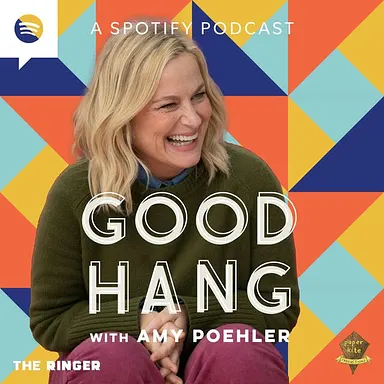
Recorded before a live audience in Chicago, this Good Hang episode features Amy Poehler in conversation with singer-songwriter Alanis Morissette, with fan Kelly Kroyer joining earlier to share her experience of growing up with Morissette's music. The conversation moves from Morissette's early start in music and the making of Jagged Little Pill at nineteen to how she thinks about fame, anger as a signal of boundaries, and the idea of wholeness.
Listeners also hear her views on meditation, which she says can be risky for people in the middle of trauma, plus lighter stories about sketch comedy, John Ritter, and her holiday album.
In this episode Amy Poehler, Alanis Morissette, Kelly Kroyer
This Good Hang live taping with Alanis Morissette in Chicago was made with HappyScribe's transcription service.
Ads in this audio differ from the text. Tap the sentence you're hearing to follow along.
Synced: the text now follows the audio.
Willkommen zu einem Moment nur für dich und zu allem, was du liebst, bei Douglas. Finde einen Duft, der dich nicht mehr loslässt. Pflege, die aus Alltag ein Ritual macht. Farben, mit denen du dich neu entdeckst. Alles für dich. Alles zum Singles Day am 11. November. Douglas. Welcome to beautiful.
Hello, Chicago! Hello, everyone. This is Amy Poehler. Welcome to the Vic. We are so excited that you're here, and thank you so much for coming. Just a quick announcement, now would be a great time to silence your cell phones. Or put it on vibrate and shove it down your pants. Are you guys ready for a great show? Thank you so much. Welcome to Good Hang Live Chicago. And as we get started, I want to introduce our musical guest for the evening. Give it up for Amy Miles, everybody! Amy Miles!
So here it is. This is the theme of Good Hang. We're so excited to play it for you. And I know that it was a rumor that this was— that it was Amy singing the theme song, which I'm flattered. I love it. But no. It's this one. Are you ready? Oh my God. Here we go. All right. Oh, this is audience participation. Okay. Quickly. So I'm gonna teach you guys a really hard thing to do. Are you ready? You're going to clap, like, 16 times really fast, okay? It's gonna— we're gonna practice it once. Are we ready? We go 1, 2, 3, clap. Okay. Well, I don't know if that was 16. It sounded right. You just clap until it gets weird. Are you ready? 1, 2, 3, clap! Nice! Low consequences and low offenses, bend my arm, break a bone. Coming back to city in late summer, everybody, everybody, everybody's gone.
Everybody, everybody, everybody's gone. Everybody, everybody, everybody's gone. Everybody, everybody, everybody's gone. Everybody's gone. Woohoo! Go in for the hug, go out with a bang. What's up? What do you say? All I ever wanted was a What do you say? It starts tonight. What do you say?
Party, you broke my heart. When I see you, I turn and go home.
Woo-hoo! Go in for the love, go out with the fame. What's up? What do you say? All I ever wanted was a It was a really good hang. Get up! What do you say? I have a word, it was a really good hang.
People of Chicago, are you ready for your host? Yeah! Here comes the finest Amy in town tonight, Miss Amy Poehler!
Hi! Hey! Hello! Amy Miles! Chris Anderson! This episode is brought to you by PayPal. Shine at gift giving this year by planning ahead. Shop your favorite online stores with PayPal this holiday. Like Sephora for gift sets, Target for toys and electronics, and TikTok Shop for fashion, apparel, and gadgets. Check out with the flexibility to pay now or pay later, and split your payments with Pay in 4 with no interest, no late fees. Shop now with PayPal. Pay in 4 subject to approval. Learn more at paypal.com/payin4. PayPal Inc., NMLS 910457.
Hello,
Chicago! It's really nice to be back. 2 PM show, baby. Can you believe it? Isn't it great? Thank you. Isn't it great? You're welcome. We'll be done before 4. You still have some sun. You get to get in your pajamas by 6. You could watch a show tonight. You could do 2 things, 2 cultural things in one day. It's incredible. Hello, Chicago. You know, it's so nice to be back. We are here because you made it happen. We reached out to our Good Hang fans and asked, where should we go? And you said Chicago, and we could not be happier. This is the best city in the world. Indeed. And Chicago is where I started my comedy career. Well, I didn't get paid for it, but I did do it here. And I worked at a bunch of restaurants in Chicago. I started working at a place called Carlucci's. Does anyone remember Carlucci's? Yeah. A lot of cocaine at Carlucci's. Not in the food! Not in the food. Chicago, we love you. And by the way, congratulations on a beautiful day. Right? You, as we know, this time of year it can go either way.
It's the winter is coming, as they say in Game of Thrones. And we love this time of year where you guys are running in shorts and you're just trying to get that sun for as long as you can until you get stuck in the dark closet of Chicago winter. never to see the sun again. But congrats on global warming for you guys, 'cause that is better. But did anybody here write in to get us to Chicago? Like, did anybody— Thank you. Thank you for doing that. We got a lot of responses. I should know the number. And Chicago won. And it does not surprise me because this city is incredible and it supports its artists. And I'll say that this city is a city that you can learn in, you can perform in, you can feel supported in, and everyone I love comes from Chicago. So thank you, Chicago, for what you have given me, and thank you for being here. We really appreciate it. We'd also like to thank PayPal. PayPal, thank you, PayPal. Thank you, PayPal. Presented by PayPal. Thank you very much. And thank you to Spotify and everybody who helped get this show up and running.
So, you know, I never know how to reveal who our guest is. And sometimes it's, you know, in this case, I think it was revealed online a little bit, but is there anybody here who doesn't know who our guest is? Exciting. Very exciting. Well, um, you know, we always invite somebody on the podcast to talk well behind our guest's back, to give stories or a point of view, and we ask friends, sometimes we ask family members, sometimes we ask fans. And so we thought because today is a day where we're celebrating the good Hang fans, we could also celebrate fans in general. And so our first guest today is a fan of our guest, and they're gonna talk well behind their back because they love her. And then we're gonna bring out our guest. But you know, I don't like to tease. I don't think it's nice. So you should know that joining me later on stage this afternoon is Alanis Morissette. Hi, everybody. Cannot wait to talk to Alanis and cannot wait to get into it. But before we do that, we're gonna check in with someone, a Chicago native. I've never met this person.
I'm very excited she's joining us. She was recently in marketing but is now a stay-at-home mom, and she's born and raised in Chicago. She counts herself as a huge Alanis Morissette fan, and I hope a somewhat middling Good Hang fan. Hi. Let's bring up Kelly Kroyer from Chicago. Kelly, are you here? Woo-hoo-hoo! This episode is brought to you by Subaru. There's something about being on the road that has a way of leading to those unexpectedly memorable little moments. And in the all-new 2026 Subaru Hybrid, it's like the destination isn't even important. It's the drive, baby. And let me tell you, I'm in that car And I feel like a million bucks. Quiet ride, comfortable. Love my Subaru. Can't get enough. With up to 581 miles in the Subaru Forester Hybrid and even more, 597 in the Crosstrek Hybrid, you can go further between stops and stay in the moment longer. Visit subaru.com/hybrid to learn more. The Subaru Forester Hybrid and Crosstrek Hybrid. Love goes the extra mile. Hi, nice to meet you. Have a seat. Kelly's here, everybody. Kelly's here. Hi, Kelly from Chicago. Hello. Are you nervous?
Just a tiny bit.
Okay, no, no reason to be nervous. Everyone, this is Kelly.
Hi, everyone.
Kelly, you You are an Alanis Morissette fan.
I am, I am.
Okay, well, let's get into how much you love her, but before we do that, let's talk about you.
Okay.
Where in Chicago are you from?
I was born and raised in Chicago. We're actually on the North Side. So if you flew into O'Hare Airport, I am right in that neck of the woods.
What can we do about the ride from O'Hare into—
Fair question. Half of the reasons why I left corporate America, 'cause of that ride into the city.
It is brutal.
It is, it is.
What can we— I guess we could live near O'Hare.
That would help. Yeah, yeah, I take the train a lot, so I depended on the CTA a lot.
And how long does it take you? Let's get into traffic.
Yeah, it's about 45 minutes door-to-door.
Well, that's not that much shorter than the drive.
You get to, you know, work on some stuff. You don't have to, like, concentrate on driving and all that stuff.
But we here at Good Hang love global warming. So that's not gonna work. So you're a Chicago girl.
Yes.
Excuse me, woman.
Woman.
And what do your parents do? Like, what were you like as a— because we're— you're a little younger than me. You're in your 40s? I'm
42.
Okay. So what was it like growing up in Chicago in the '80s?
It was wonderful. Both of my parents were actually Chicago police officers. So—
Both? Both?
Yes, both of them were. Yes. Yeah.
That's cool.
I couldn't sneak out anywhere.
You know, you don't hear a family where both are police officers.
Yeah, it was incredible. They had some great stories.
Oh, yeah.
I was sheltered a little bit because of those stories, but it was fantastic.
Were you allowed to date?
I was. My dad wasn't really thrilled with it, but I was much later.
Did you— were you ever at a party that was broken up by one of your parents? No.
Oh my gosh, no. But that would have been a great story if I was. No. I was a very like G-rated kid. I really didn't go to a lot of parties.
Yeah, I know. It's okay. You don't want to peak too early.
Yeah, there. Yep.
You don't want to peak too early. And did you ever think about going into law enforcement?
Everyone asks me that. No, absolutely not.
Yeah.
I steered clear of that. My parents weren't too thrilled, but they're like, you find your career.
They wanted you to go in?
They wanted me, yeah. They thought I was— I mean, my mom actually had 2 careers. She was a flight attendant before that, left that, and became a cop. And it was— Wow. Yeah, and she loved it. And they wanted me to do it and follow suit. So I did not.
Is there any flight attendants in the audience? They're flying. Oh. I get it. But why I ask is that being a flight attendant and being a police officer are closer—
2 totally different things.
I was gonna say closer than ever.
This is true, Val. This is very true.
Closer than ever.
This is true. This is very, very true.
Did you get your party on in college?
I did. I went to a community college beforehand where I got all that out of my system before I transferred over.
Yeah, because would you guys agree that if you don't get it out in high school, then it comes out in college?
I think so. I think so.
And did they— did your parents break up any college parties? No, no, no, no, no.
I would have loved to hear those stories.
And so what did you do when you left school?
Um, I actually walked up and down a street called River Road by O'Hare Airport to get a job at a front desk because my parents weren't going to allow me to sort of just not have one. And I started my now 22-year career in hotel hospitality, so I kind of just accidentally stuck with it.
Oh wow, 22 years in hotels. I'm sure you've been asked this question, uh, but never in front of an audience.
This is a first.
What was one of the more specific or strange requests you had in hospitality from a person in a hotel?
Ah, there's so many. I don't even know where to start.
Okay, say 5.
We had a guest one time that just hated our beds, but wouldn't stay anywhere else. And then they insisted on putting a board under the bed to make it harder. Okay. Even though the purpose of sleeping is to be comfy and not uncomfortable. So we found we had to get engineering up there, remove the whole mattress, put the board under the mattress for this man and—
Did he pay extra?
I can't remember, but he should have.
I bet he did. I hope he had a board fee.
Yeah, we— there should be. There's amenity fees for everything now, so—
Yeah, yeah, yeah, yeah. That's interesting. He couldn't stay anywhere else, but he didn't like the bed.
Yeah. Yep.
And it was a man. Interesting. Just interesting to me. So, Kelly, how would you describe your musical taste?
You know, I didn't really discover music until I discovered Alanis early on, and she's kind of— her style of music made me sort of expand a little bit more. I heard this angry woman on the radio one day in, like, 1998, and I was like, I want to know more about her and hear more about her. And she really is my style, is just You know, get all those words out. Tell us how you feel.
Yes. I want to talk to— thank you for bringing that up, because I want to talk about even the word angry, because it's an interesting word, right? Like, there's— yes. Like, there was this feeling when we first heard her that we were being spoken for, and we were being spoken for by somebody who really knew how to use her words.
Yeah, absolutely. Yeah.
And it was thrilling. It was thrilling.
Yes. Yes, yes.
Do you remember, were you, how old were you then? Was it '98?
I just remember it was like freshman year of high school. I was like '98, and I didn't know anything about anything. And I heard her music, and it sort of just guided me through the last next 4 years, really.
Really? Yeah. Her record did that?
Yeah, yeah. You know, Uninvited was really my favorite song at the time, and it was just—
Yes.
It helped me through a lot of stuff, so yeah.
Yeah. What did it, you know, I feel like music can do that. Articulate something that you can't figure out at the, you know, without certainly feeling like you have to get too personal. What was it connecting to you feelings-wise in that, in that stage of your life?
I'm an only child, so I felt kind of very alone a lot, as most only children I think do. And I think it was sort of just like, I felt like somebody was holding my hand for the first time when after I heard her music and like, you got this, kind of giving me a pep talk through the music. So.
Yes. So true.
Yeah.
Well said. Well said, Kelly. Do you play any music, or do you—
I am— I don't play any.
Do you sing?
I do not.
Do you sing secretly?
I do very well in my shower. Very, very well in my shower.
Do you sing along with Alanis's music?
I definitely do.
Right? Yeah.
How can you not?
I agree. It feels like this very, like, an incantation that we're all supposed to join in on. And I, you know, another thing that I do want to talk to her about is the idea of, like, finding your voice and the power of a voice. Did you ever see her perform?
I did about 15 years ago when she came into town in Rovinia, and I got tickets last minute, and I scrounged my way all the way up to the front, and I just didn't leave. And I loved it every moment.
Oh, you were at the front?
Yeah.
Were you afraid you were gonna get squished?
No. Well, the front had some seating, and I was on lawn, but I found my way right up to that corner where I could just It's fine in my pocket. And, uh, even if I did get swooshed, I wouldn't have cared.
And do you remember who she was? Was there an opener? I couldn't remember.
I can't remember most of yesterday.
I know, I can't either. I really can't. Was it a festival?
There was an opener, or I think she was the main act for sure, and there might have been a really nice opener. I just don't remember who it was.
And Ravinia is like an outdoor—
Yeah, it's an outdoor venue, um, up north. It's beautiful. I'm sure a lot of people here know about it. Um, you could bring your picnic up with you and just sit on the lawn and enjoy whatever show's happening there. It's amazing.
And how far is that from O'Hare?
A little too far.
During traffic time, how long will it take?
A long time.
And the last thing I wanted to ask you about Alanis, as we talk well behind her back, is what, what do you think is the thing that we still— like, she's continuing to make vital, interesting, curious stuff many years after Jagged Little Pill. She's— she has won 1,000 awards. She has done Broadway. She has— she has— she has spoken, uh, in the— in— she does like incredible, um, speeches about the idea of wholeness. Yeah. She is the mother of 3. She is like— she feels like a person in the world as well as this big Yeah. What do you think it is about her that draws us to her as an artist?
God, that's a great question. I mean, truly, I lean a lot on the fact that she's a mom and she gets it, and she can share that time, it seems like, with her family and all these wonderful things she's doing with her music and her, like, any philanthropy that she does. She's finding the way to do it and showing us that it's possible, but also making her family probably the first priority.
Okay, so we always ask our guests who come in to speak about our guests to give me a question to ask them. Do you have a question that you think I should ask Alanis today?
I sure do. So my question is, is there a song that you wrote early in your career that you understand differently now? Not because the lyrics changed, but because you did. And what does that song mean to you now?
Wow. Kelly Kroyer, everybody. Give it up for Kelly Kroyer! Thank you. Wow! Kelly, you're hired! Okay, so let's get started with our podcast guest today. She has stolen our hearts since the minute we met her, and she always tells the truth. A true badass, grown-ass woman. Give it up for Alanis Morissette, everybody. Hi. Hi. Should we just stare at each other? Welcome to Chicago. Thank you for coming here. Thank you for having me. Oh my God. All right. They said it was live and I said yes. Absolute thrill. You know, I, I've gotten to know you from your work, and I've gotten to hear you speak about your work, and I just want to say, so thrilled to have you here because I know that you are a person that shows up and likes to get into the deep end, which is like—
nosmalltalk.com.
What are your favorite movies?
Bridesmaids.
But, but you're, you know, I've listened to you speak about so many things and you have this ability, I think, to synthesize really complex information in a way that makes— welcomes us in.
Nice.
And I really appreciate that.
Thanks for saying it.
You do it in your work, you do it in your life. And so what is the best thing about being the age you are now?
Everything.
Yeah.
I highly recommend getting older. Yeah. Well, menopause is just magic.
Yeah.
It's just every stone.
Yeah.
Everything. Identity, service, value systems, relationships. Who is God? How to, how to talk to these parts, these billions of parts in here. Yeah. Be responsible for what this is. And not make it everyone else's problem.
Yeah. 2 minutes in, who is God? Alanis Morissette. I love it. I love it so much. Hi, Amy. I'm so with you. I mean, I— I love it because you're absolutely right, because the dismantling is the last part, like the letting go of all the armor, all the stuff that you— we've all added on. The shedding of that, I think, is the interesting part.
Yeah. I mean, if we're in the context of patriarchy, which we were and still are, everything's through the male gaze. The hormones we have in, in this body is the procreative imperative. Put a baby in me, I'm gonna tolerate everything. Then you get closer to menopause and progesterone, all the hormones are at zero. So you're all this sort of scaffolding of cotton balls and cozy tolerance, they go away.
Yes.
And what they used to do, there's a book called Shock to You Women, they used to go up to women In the day for the town hall meetings, they would seek out the women who were PMSing. Hmm. Because they would be the ones to lead the town hall meetings and tell the city what they needed to do.
They were like, I'm gonna tell you the truth.
Who are we getting on the seat? Oh, those 3 women.
Wow. What's your relationship to Chicago? I'm sure you've toured here many times, spent time here. Do you have an impression of Chicago?
It's, it's been called the sister city of my hometown in Ottawa, Canada. Very funny people.
Very funny.
Some of the funniest people I know are from Chicago.
Yeah.
Diversity, you said earlier, I live.
I want to talk to you about your relationship to comedy because you are a secret goofball. You're a goofball.
Yes.
You love comedy.
Yes, I will do anything for a laugh.
Yeah. And you call— you know, you come from Canada, so Canadians are really proud of their comedy.
Are they?
You don't think so?
Yeah.
You grew up— I mean, you— I mean, we have this in common is we both did sketch comedy when we were young. You did sketch comedy. You were in a Canadian show. You were in You Can't Do That on Television. For people who don't remember that show, didn't see it, how would you explain what it was? What was that show like?
It was a show written for adults, but it was for kids. There was a lot of innuendo and just a group of people that I entered into this fray, and they'd already had years of knowing each other. So I was the new girl in school.
How did you get the job?
I auditioned. It was a call. There were hundreds of kids, and I did the audition. Do
you remember what you did for the audition? I
read a scene or two, I think, with Alistair Gillis and Adam. And they said immediately, halfway through my audition, they said, you're too tall. You can get out of here. Too tall? You're too tall. You can get out of here. Got out of there. And then they came running out of the building and chased me and said, we don't care that you're too tall, get back in here. Cute. Auditions are awesome.
Yeah. Honestly, I don't think I've ever gotten a job from an audition. And it's interesting you say you're too tall because I remember someone saying, oh, I wish you were taller.
To you?
To my face as I auditioned.
Oh, so we both have a similar trauma. Yes.
A height trauma. It is wild. Back then, people would say right in front of you, oh, if only, if only you were different.
That would— that was my experience on dates. But only all of them.
What were you watching as a kid? Like, what was the kind of comedy that was on in your house?
Three's Company.
Oh my God. Let's talk about Three's Company.
Every episode I've seen 19 times. And when I first moved to LA,
John Ritter.
Sitting right next to me at an exercise place. I was on the bike and he got on and I—
John Ritter.
My blood went all the way down to my feet and I didn't say hi. And then years later, I was at Starbucks at a movie theater and he walked right up to me and he goes, Alanis! And I was like, oh my God. And then he said, coffee? And I said, yeah, let's go for coffee. So we just had coffee and just loved on each other verbally the whole time. And I heart, heart, heart, heart, heart, heartbroken.
Yeah. What a loss. He— what a talent, John Ritter.
What a person.
What a person. I've heard just— I've never had the pleasure to meet him. And what an amazing talent. And what a weird show that was.
What a cool show.
Way before its time. Totally. It was. It was strange. It was a farce, and everyone was just—
Just— Going for it. Yes, they couldn't stop.
But when you were doing comedy, doing like on TV, as a little kid, and then you start writing songs. And— or, or had you always been writing? You, like, you first— you wrote your first song, I think, when you were 8 or 9 or something?
Yeah.
Um, what was— what was— where was the music introduced in your house? Where did you first kind of learn to write or make music?
Um, when I was younger, it was very multitudinous. So it was comedy and then drawing. I can't draw to save my life, but I still drew. Um, music, dancing. It was Everything. And then music, I was always writing songs and I sent a tape, a cassette tape to a friend of our family. His name is Lindsey Morgan. He's passed away since, but he heard it. And when I went to visit him next, our family went to visit him, he had a track ready. And my brothers had told me I couldn't sing my way out of a paper bag, which they're wont to do. Yeah, that's a brother's job. It's kind of their job to do. Yeah. And so I said, who's going to sing it? And he said, you are. And then I did. And that was the beginning of much love.
Wow. And you started writing songs and, in fact, started your own label at 11.
Yeah.
What are your kids doing?
Hence the therapy.
You spoke about it a little bit, but I love the reason why you did. Why did you?
Yeah. At that time, nobody was signing children. Now my joke is that they crawl up the vagina into the uterus to get the signature real quick. Now they don't care. Then they did. So I thought, well, I still want to share this music. So we started a record label when I was 10 or 11.
Do you feel like even then you had a sense of I mean, I don't want to ascribe this to you if it's not true, but it feels like you had a sense of how to navigate things that were much more mature than you were at the time.
It's like being a cockroach.
Okay, say more.
It's like just staying the course. I remember my manager of Many years at the time said, Alanis, the only way you're gonna get through this is if you stay on the train track but just look down one step at a time. And that helped.
That's good advice.
But I mean, the temperament I have is like a scared, tiny, shaky poodle, but my outward-facing situation is often a black stallion, so they're at odds a lot.
Ooh, whoa, that's so cool.
Until you're inside that body. Yeah, yeah, yeah. It's very cool.
I know what you mean though. I often— I can relate to this idea that you're like, if you only knew the kind of circus music playing inside my head.
Exactly. You have the overexcitable cognition.
Yes.
Amy.
What's it called?
Well, they say it's overexcitable cognition, but I just say it's excitable cognition. The brain— and people often misdiagnose themselves. They'll say, I have ADHD, and they may well.
Yeah.
But often it is just a lot of activity, and that is how you were born.
Yes. And then the idea that how you present is different than how you are feeling is like the lifelong lesson that someone may seem one way, but they are feeling a different way. I know I am saying it is so pedantic. You are doing the whole complex. I know, but it is this lesson we learn over and over again, over and over with ourselves and each other, which is, The way they seemed is not the way they felt.
Right. Or they felt both plus 17 other things. That's right. But the one that was picked up on was maybe the lowest hanging fruit in terms of accepting that part of a human. Yeah.
You know, you put out 2 records before Jagged Little Pill and they are really well received and you have this moment Where you decide to make this record with Glen Ballard and you're 21.
19.
Wow. Even younger. You're 19. You're making this monster hit. And I just want to pause for a second to say, not to bring my, my own story in here, but I'd like to because we're in Chicago. At the same time, I just want to say I'm here in Chicago. I'm in my early 20s. I'm meeting these people and performing, doing comedy and sketch comedy with people who will go on to influence the next 20 years of my life.
Right.
And you're, you're, you're making this record that will be— it will completely change the trajectory of your life. And I imagine, much like I was, you're just making stuff and feeling creative and not really even understanding what success could mean or look like or—
Or even how to define it.
Or how to define it.
How does a woman define success today? Amy?
A 2 PM show. Shall we bandy? A 2 PM show. For me, a 2 PM show and getting to talk to Alanis Morissette. But I guess my question was like, when you look back at Jagged Little Pill, which now, you know, so many years later, how do you look at it now? It's almost like a— it's like a child.
It's like a friend.
Yeah.
Yeah. I see songs as snapshots of moments, uh, and there was something about— I'll usually write about 25 songs for a record and then pick 12-ish, but they feel like chapters captured very semi-casually. The process is not casual. It may look effortless, but it's effort, very full. Yeah. But yeah, they're chapters of time. So that chapter of time, I felt like the feminist movement, the humanist movement was happening. I'm the one that when someone says, who wants to volunteer for— and I don't even know what they're going to ask, and my hand is already up. I just want to do it. So I think the wave of feminism was happening with or without Any of us really. And I just volunteered to get on the top of the wave. And then I was there and I was being credited for things that may or may not have been appropriate to credit me for. But what I was happy to do was be at the epicenter of it. And I was happy to be on the front and get my head chopped off.
So badass. 1995, you know, that was when it was— when the record came out, '95. So you work on it. You turn 21, you're in your right, you really were suddenly like put— like you were in the front lines. There was a lot projected on you.
Are you— you knew that? Or are you just thinking about that?
It's actually a really good question. I,
you know, I see it then.
Great question. And I'm the interviewer here. So I think I could. I think what I felt at the time is I felt very seen by your music, very drawn to it. And I also realized that people were deciding how you were feeling about what you were singing about without your permission or consent.
Yeah, well, that's fame. Fame is a giant screen upon which people project all their beautiful stuff to define themselves in accordance. To you. And sometimes it's an accurate perception. Mm-hmm. Often it's an inaccurate perception. Sometimes it's a misguided one or an incomplete one. But that became an exercise almost to the point where I'd, I'd hear and I'd avoid it at all costs. And I still don't really read any perceptions of me. But if I would read something, the first question I would ask is, if it triggered me, it meant it was some shadow that I needed to look at.
Yeah.
If it didn't trigger me, it meant it was a projection of a kind, or it felt accurate. Like, oh, I felt seen there for 10 seconds. That's cool. So it became like a psychological exercise, the press itself.
Yes. But that— you're a young person handling that and handling the also like not wanting to forget to have fun, that things are successful and fun.
You know, that, that the touring nomadic community thing helps. So a lot of people would see footage of me and say, All we saw was you laughing. I was like, oh my gosh, being on tour with my bandmates is the most fun thing in the world.
Yeah.
Yeah.
I mean, when, when I read, or maybe I heard you speak about this, which I loved, another, again, example of, of, um, the lone wolf, the sheep. I forget what it was. The lone wolf.
Poodle.
The poodle. Yes. Holding steady at an age where it was hard. I think it's hard to do. Where you wanted You Oughta Know to be the first single, and a lot of people didn't.
Yeah, they thought it was a little harsh to receive anger from a woman, and I thought, well, that's actually the note to start on.
Yeah.
And then we go from there.
Why is it— why did you think it was the note to start on?
I love anger so much.
Okay, great. I wanna talk about it. Okay, I wanna talk about it. Okay. I learned about emotions from Inside Out. Up until that point, I didn't know. No, I'm just kidding. You were like, what am I
feeling, Mommy?
Yes. But anger is so juicy. Delicious. Is it your— of all those, you know, is it the easiest for you to access?
It's always right there. And I think what happened was anger gets such a bad rep.
Agreed.
Because when we hear anger, we think destructive acting out. We think guns, knives, murder, death, you know, destruction. That's the acting out of anger. That's not what I'm talking about. I'm talking about anger itself, the beautiful current that courses through you when it's appropriate. There's been a boundary transgressed. Don't— you can't touch my stuff. You can't tell me what I'm feeling. You can't tell me what I'm thinking. And you cannot touch my body without permission. And when those 4— Fuck yeah. Any of those 4 are transgressed, A little bit of rage.
Yeah.
And that anger is an indication that there's been a transgression. All my social activist community, we're all raging. But of course we are. We know things. And when we know things as a collective, that anger is a propulsion to make effect, show up, change, support, shift focus away from this patriarchal house of cards nightmare and turn it toward what we know is possible.
So well said. So well said. So well said. Yay. I mean, I felt like I'm Here to Remind You of the Mess You Left When You Went Away will go down in history as, you know, a beautiful witch's lament. It's just divine feminine power at its finest, which is I'm not going to let you forget because I'm here to remind you. Like, beautifully said, sung. And we all sing that still, and we all like to scream it. And it is a feeling of relief. It's release. It's release.
It moves the current. I feel like we're imploders or exploders. I was an imploder because Fight, flight, freeze, collapse, befriend, or appease. I have the appeasement survival strategy.
When I found out about fawn, I was like, hi girl.
I was like, there's one more F? There's one more F? Yes. Oh, by the way, I'm particularly upset about the fact that fawn is the one that gets the bad rap. People are like, clingy, needy. I'm like, it's of the 5 survival strategies, it's the only one that's relational. It's the only one that reaches for connection.
Okay. But because you're so smart and good at emotions and thinking, do you feel— do you feel like you're able to— and I'm gonna ask this to you, and I want us all to think about it here in the audience too— with, like, with, with, with our, like, with wisdom, with getting a little bit better— for those listening, Alanis is coming over to fill my cup. Oh, in more ways than one. Thank you. So Canadian of you.
You gotta water your women.
Oh my God, this is straight vodka.
Amy, that was on the down low.
Um, but you, but you, but, but because you're so articulate in this world, you, you, you work hard to try to figure that out. You pay attention. Do you feel sometimes like, um, there is a— how should I put it? A grace you have to give yourself and others when you're sensing exactly what you just said. We all have these styles of talking and coping.
Holding it together.
Yeah. And we all come in with our ways in which I like— I know for me, like, obviously comedy is a way to like just bypass.
Oh, it's the best.
It's the frickin' best. I mean, if you have a feeling, make a joke. I'm nervous. And then the feeling goes away. And sometimes you can sing the feeling, and then you don't have it. Yeah.
So can we do a song together on the next record?
So what do you do? It's hard to— it's like, I see dead people. Like, you can see it well, and that's hard.
But I'm not always monitoring psychologically. That would be exhausting.
Okay, I guess that's what I'm asking.
I'm actually— my first place is, can I laugh with this person? That's number one.
Yeah.
And if I throw the ball and it hits the drapes, I'm really sad because there's no repartee or bandying.
Yes.
Because I actually think of all the billions of the intelligences that there are, and I love speaking about them— comedy. I know people say music sometimes, but I think comedy is number one.
I kind of do too. I'm sorry. I do too. No, sorry. Okay, I didn't want to be braggy, but—
Can Amy be braggy for a second?
I think that there's some— it's so— I know it feels like my biggest way of connection.
It's love. Yeah.
And it is such a love language. If someone loves to joke, God, I love it so much.
That's pure joy.
It really is. It feels— I mean, and I assume it feels that way when you're on stage and when you're performing and singing where you're looking over at someone and you're playing and you're like, look at us. It must feel that way.
It's rapture. That's the word I keep using.
It makes me think about one of your old bandmates who I, I just would love to hear you talk about, which is Taylor Hawkins.
Yeah. Can
you talk a little bit about him and where you guys met?
I auditioned. I think I was 20 and I auditioned tons of people and he came in and he was just instant. soul brother. And then how he played was so reverent and respectful, but also wildly bombastic and uniquely him. And so we just became a mutually supportive championing force, you know, up until just before he died. All I, all I received from Taylor was regalings of kindness and mirroring and validation and just upliftment and menchie, menchie,
Oh, so great. Yeah, yeah. I mean, you were also like on tour. There were a lot of people that you met in different stages of their careers. Like, you were with Radiohead. Did you tour with Radiohead?
Well, I wrote all their songs.
Yeah, that's true.
Yeah, they played, they played before me in whatever year that was, and I was obsessed.
But, you know, you've described yourself a little bit here too as much more introverted than people would assume. And I know that's a flat term, but— and then you have this extrovert. I mean, you really have to be like up on stage. You have to rock and just move and sing. And when you do that, do you let— what do you do to get there, I guess, is the question when you're like, oh God, I got to go out there.
I always tell my kids it's a combo between profound humility. So I'm always just praying and thanking and combined with confidence and full ham.
Yeah.
So they both show up.
Yeah.
And it is a deep bow and then it's a submitting.
Yeah.
I feel like I just submit to it and it takes me.
It's such a good way to put it because nobody really knows what's embarrassing until we tell them.
Tell me more about that.
Well, I'm really into embarrassment as an idea.
Like on purpose?
Yeah.
Like slapstick stuff or what are we talking about?
Well, I think that like comedy and music, you both have to— you just have to commit.
You have to strong and wrong.
What's that mean?
Just strong and wrong.
Strong and wrong. Yeah.
Like just if you're going to embarrass yourself, go big.
You can't go halfway.
No.
And I'm sure everyone here feels that feeling of when you see someone up on stage. It doesn't even have to be on— it doesn't have to be in a giant stadium. It can just be at your workplace when they're giving a presentation and your mirror neurons, when they are nervous, it's the worst. It is the worst feeling in the world.
I'm always nervous.
Really?
No. People ask me like, how do I deal with my nerves? I want to do what you do. And I'm like, oh, you don't. They are with you for life. You can't— I can't change my temperament. I would love Yeah. To just pull this out.
Yeah.
Let it take a bath.
Can you talk about wholeness?
Yeah.
And it's not wellness.
No, wellness. I think the wellness movement was well-intended, but that leaves out all the other parts, you know, the so-called shadow, darker, challenging parts. And I love humanity so much. I mean, I hate humanity too, don't worry. But I love humans.
I do too.
What Enneagram number are you again?
Oh my God, thank you. Guys, I want you to know that I didn't bring it up. Okay? I didn't ask.
Are you an 8?
I'm an 8.
8. What's your wing?
My wing? I'm 8 wing 9.
Oh.
The bear. So I tend to—
So you lead?
I lead, but I like to collaborate. I'm not a monster.
Well, you're a 9. You're a 9. No, you're a— No, you're not a monster. My daughter's an 8.
I love 8s.
8s lead the world.
Yeah, baby. I don't mean to be rude, but there's no number I would rather be than 8. No way.
Born to be an 8.
Love 8. Okay, what are you?
I'm a 4 with a 5 wing.
Shocker.
And everyone thought I was a 3 wing because 3 is more sort of associated with public, but no.
Achievement. But you're a 5. Yeah, that makes sense. I'm a 5.
I like to watch and think and observe and—
Yeah.
Sit in it.
Yeah. And wholeness is—
Oh yeah, so back to wholeness.
How do we work on our wholeness while still not trying too hard to improve?
Well, the thing about wholeness is— Because
I have a sense—
You're asking for a buddy?
I'm asking for all women because I feel like there is a tendency or an expectation or a self, like, put-upon pressure, yeah, that we have to keep getting better at things where I would like us to stop. But that's patriarchy. Yeah, I'd like us to stop.
Okay.
Right now? We're good. Like, we should wait for everybody to catch up and we should stop improving.
And
then everyone can catch up.
So I think the movement toward better wellness is this way. Wholeness is coming home. Totally different direction. There's nothing to add. You don't need to be fixed. It's just remembering who you are and being in environments where people will reflect you accurately enough, just enough that you're there. And for those of us who are raised by narcissism and don't actually have a sense of self, it is not for the weak of heart, this journey of becoming a whole person.
It's not. It's a whole lifelong journey.
It really is. And it's juicy and it's so vulnerable.
Yeah.
But it's awesome, and it's awesome as we gather. It's the gathering that makes it great for me.
Can I ask you about meditation?
Sure.
Just by show of hands, how many people here meditate? Okay, Chicago, we gotta work on that.
Meditation is overrated.
Oh my God, hot take, hold on.
It actually—
Say more.
Well, for those of us who are in the midst of trauma or a traumatic experience that we're perhaps on the verge of beginning to heal, meditating is actually quite dangerous because you're left alone with all these protective voices who are attempting to protect you, God bless, but they could be really mean. Yeah. So for some people, it's actually, uh, Peter Levine calls it, um, Something like anxiety or, um, meditation-induced anxiety. So what could happen— not for everybody, sometimes meditation is bliss for some— but for some people, meditating puts you straight in the middle of the pain with no necess— not, not necessarily a developed resource, a person you can hold or something you can imagine. So then I wouldn't actually recommend meditating at all.
Yeah.
Yeah. But for others of us, it's It's a fun invitation and it's so much going on in here.
I loved what you've talked about, like your inner critic. We all have it. And the idea that it shows— how it shows up and when it shows up. And I related because you just said our protective voices. And I find sometimes, like, I call them my bodyguards. But when my bodyguards show up, they mean well. They mean well, but they really keep me from connection.
I know.
But they're so great. They're big, burly— They're the genius. And they are like, don't do that. Don't be lame. Don't be a loser.
Don't say hi.
Don't say hi. Yes. Don't say you're afraid. Get out of here. Like, they get me in the car fast. And I'm like, thank you so much, you guys. They're all guys, sorry.
But they are all guys.
They are all guys. And then I get in the car and I'm like, I'm really lame. I should have seen it. I don't have any friends. I'm scared, I love it. Do you do that where you think about parts of your brain as people?
They're all— there's thousands in here.
Yeah.
And yeah, I just have to be responsible to them and listen and as often as I can heed, you know, there's some action they often ask for me to take. Often it's just, slow down, Morissette, slow down. Or I'll say, you know, what do you need from me? What action can I take on your behalf? What wisdom do you have for me? What am I not seeing here? And often they'll Tell me. And then that's that.
That's—
and then there's often about 12 parts trying to get my attention. So I interact with them like I would with my kids, which is I want to hear all of you just one at a time. The rest of you sit next to me.
Yeah.
And then I'm just going to talk with this one and maybe these 2. It doesn't take long. I can do it at a stoplight in 13 seconds. Yeah.
I sometimes picture my parts. And again, this is very Inside Out, but I picture the parts in my head at around a table. Yeah. And this kind of table. This kind of table.
What part am I playing today? Wow. Because they can be externalized.
I feel, I feel very like you're a lot of fun.
That's not the first word people say when they talk about me. Really? I mean, my friends.
I, I'm having a lot of fun.
I am too. Yeah. Okay, good.
Yeah, yeah, yeah. So you're fun.
That's why I'm here.
Um, you're playing the fun part. And I like when I look at the table and I'm like, oh, somebody has been seated at the head of the table for a long time, and they need— maybe need a little rest. They
don't want to drive.
Yeah. And that person often is my, like, Tony Soprano ego.
Yeah, I've seen her. Oopsie. Yeah.
Yeah,
that was out loud, right? No, I love her though. I love that part.
I mean, that part is incredible. I know. Forget about it. And then in like a kind of completely different version of things, you're releasing a holiday album.
Yes.
Well, first of all, why did you want to make a Christmas album?
Every year for a few years, we just— we would just do one song just to kind of get inside the whole experience. I never cared about Christmas. And then my son was born Christmas morning, and now I really care. Oh, Jesus is born.
Yeah. Does he— is he okay sharing a birthday with Jesus?
He is. He's very okay.
Pretty big person to share a birthday with.
Yes. It's his birthday and Christmas.
Yeah.
Why was I talking about— It doesn't matter.
Birth. Oh, no. Because we're talking about— so you would do a song every once in a while. Oh, yeah.
Yeah. So I would do a song every year, and then this year it just became, shall we finish it? Shall we make it whole? And the answer was, hell yes.
Awesome.
Yes.
And so you have really great collaborators. Brandi Carlile.
I mean—
Let's talk about Brandi. Let's talk about her for a second. For the next 2 minutes. Also, you guys were just on stage. I just saw footage of you on my phone. Which is where I get all my news.
Your bad news. But this one was good news.
Yep. And I saw you two on stage just recently, and she's been covering your music a lot, and you guys have been performing together. What's it like to work with her? She's incredible.
Yeah, she's the greatest person in the world.
Yeah.
I mean—
And you both, I would say, have these voices that feel like they're— I don't know, they just feel really otherworldly. And I like to ask singers this: when did you feel like you knew you were good at singing? Like, when did you— like, singing is so, uh, like any skill, it just— you're always kind of changing and working on it. But there has to be a point of view that knows, I'm a good singer.
Yeah.
When did you know that?
I think when I was entering into these talent competitions as a young creature, and I Winning, whatever winning means. But I won. And I remember thinking, oh, maybe my brothers were wrong.
Isn't it funny that when you're young and someone says, hey, you're good at that, it's just like—
I was in church and singing very loudly, and a woman tapped my shoulder and I turned around and she said, you have a lovely voice, sweetheart.
Yeah. I think Brandi Carlile told a very similar story, that it was in church that she got like positive feedback that made her feel like, I can do this.
Yeah. Anything, anything exaltative and gospel, anything that is just God-loving, I'm in singing-wise because it's rapture. It's the same.
Yeah. You were also so incredible at the recent Daisy Chain Fields with Olivia Rodrigo.
I love you.
So great. She's so incredible.
I know.
It must feel really good to be, like, around those young women who really have it together and are talented and smart. What was that experience like?
Amazing. Standing across from her is just— anytime I see Olivia, I just think everything's gonna be okay.
She's really, really doing it right.
Yeah.
And in your Christmas album, you have Steve Martin playing banjo.
Because I had to. Because I knew he was so good. He's so good. And I remember promising myself at, you know, 22 that one day me, Steve Martin, and a banjo are going to happen. Anyway, yeah, no, I'm so thrilled. I just can't stop smiling. Yeah.
And Martin Short also on the record?
So he and I are both obsessed with Judy Garland. Who isn't? So he said, what about the Merry Christmas tune? And so now I have this thought that there's a funny music video with Judy, and, and so my wish is to frame by frame with Marty— I'm dying.
Oh my God, recreate. Is there anyone funnier than Marty Short? He's so funny. Again, Canada.
Oh yeah.
You guys, you have heavy hitters. When did you meet Steve and Marty? Did you meet them before you worked with them on this record? Like, was it back in the day? Did you—
Marty and I did a Shakespeare thing with a bunch of people, which was hilarious and I instantly loved. And then Steve Martin, I ran into him on a grassy field somewhere and I ran up to him and I said, hi, I'm a Lennox person. He's like, oh, hi. And then we all— so same happened with Annie Lennox. I live for Annie Lennox.
Oh, same.
And I just thought, oh, this is my moment. We're at the Brit Awards. I'm going to hang out with her. We're going to— she's going to bounce me on the yoga ball. I was so excited. And she— we walked up to each other and I was like, Annie! She was like, Alanis, nice to meet you. Lovely work you're doing, and walked off. Yeah. The intimacy I thought was possible. The club, Amy. The club. The fame club. I thought I would just be kumbaya-ing.
Do you feel like maybe she just had to go to the bathroom?
I know, but like, bring me with you.
Bring me with you. I can pee between you. Yeah, I'll stand outside.
I have done way worse.
Yeah. Maybe that's what freaked her out, is she was like, I have to go, and you were like, do you have to go to the bathroom? I'll go with you.
I mean, I have to pee.
Yeah.
We can chat between—
Yeah. I know what you mean. At SNL, the best part of the job are the heroes that come through the hallway, but boy.
But then your heart is broke.
And also just, you realize just people are regular people, and people, like, have to go to the bathroom and stuff. I know. It's so weird.
It's so not okay that they do that.
Yeah. Yeah. You get shy?
I don't know if the word shy is real.
Whoa. What the fuck? Okay.
Because—
no, I get it.
I don't want to fucking know.
I get it and I love it.
Shy is just pausing to check if the person is
Interesting. Oh, we got some claps from some people in the back who seem very shy.
Who've had just about enough.
Well, someone who was kind of shy and then really rose to the occasion is our guest earlier, Kelly Kroyer. And Kelly, thank you so much. And she asked me a question to ask you, which I think is a beautiful one. I'm gonna ask it to you now, which is, is there a song you wrote years ago that you understand completely differently now? Not because the lyrics have changed, but because you did.
Oh, I think Not the Doctor, because when I wrote it, it was very much like, hey, you know what, you take care of your stuff and we'll talk. Having been in very long committed relationships now, I know that ideally in my mind, we are actively participating in each other's healing. So some of those lyrics I think, oh, Alanis.
Okay. I've got a little lightning round if you're ready.
Oh, I'm scared.
Let's hydrate. Favorite song you've heard recently, something you're humming, listening to, or singing?
I went back in time, Keane, Hamburg Song.
Keane, Hamburg Song. I don't think I know that. Amazing. And then—
Nothing better than a feminine man or a masculine woman.
Indeed. Well said. Well said. A musician or music or a song that your kids turned you on to?
Steve Lacy.
Yeah. What's the most Canadian thing about you, Alanis?
The fact that I have had a really hard time learning how to monologue when no one's asking. So in Canada, I don't know if the whole country's doing this, but I wouldn't speak unless someone asked me something.
Right.
I wouldn't just of my own volition just speak into a room. Now that's partly patriarchy and narcissism and Canada, but I moved to America, moved to LA, and I didn't speak for 6 months. I was waiting for someone to ask a question. Yeah. One muscle I had to cultivate, which I'm really glad I did because it's allowing me to speak with you right now, was just speak when no one asks. That was hard.
Yeah.
But now I know how to do it.
I used to often be on conference calls and we would be getting ready to be done and I would just say, just one more thing before we go. I just want to talk. Okay?
Those are my favorite Zooms. Yeah.
And what is your order at Tim Hortons?
The Munchkins? The sugary and the chocolate. I mean, they're both so high nutrient.
Delicious.
Yeah.
You've run a marathon, more than one. A few, yeah. My question is, running, why?
It's hard. I mean, exactly why. I did it for charity because it was no way I was gonna be able to train without doing it for charity. So some NEDA, National Eating Disorder Association. I did it as a way of saying, this is an instrument, this is not just an ornament. And then, you know, marathon running. Wow. I won't be doing it again.
What did you— what was the thing— what is the thing that you really are proud of about that? Obviously doing it and training, but what was in the experience of doing it, what was the most kind of surprising and satisfying part of it?
I would say mile 20 to the finish each time, and just the weeping after. I would just go into cold, cold water and just sob. It's part of the over-functioning thing. It sounds so fun. It sounds terrible.
Every single person that talks to me about running, it just sounds worse and worse.
But yet you're still intrigued. No, I'm not. You're done.
Oh my God, no.
It's quite beautiful. Actually, I love running, but I won't be doing much more of it now.
Joan Jett. You performed with her? You were on tour with her? Yeah, we toured together. What was that like?
It's the greatest.
Yeah.
I can't even believe sometimes the joy I get from being around masters. And whether it's musical or comedic or producerial or directors, I just feel like I can't swing a dirty sock without hitting masters around me.
Joan is cool.
Joan is the greatest. She's—
She was definitely one of the many I've met so many artists when I was growing up, and, you know, and honestly, you were one too, where the minute you see them, you're like, oh, where did they come— where— who is that? And Joan definitely has that too. She just arrived and was like, I'm your favorite now.
Thank you. She imposed herself into our souls.
And Alanis, you did that too.
Oh, thanks, Amy. I just love the idea of picking women who will be around me when Armageddon hits, which is like yesterday. I just feel like Joan would be in that gaggle.
Yeah. Yeah, she'd be tough.
She'd be like grabbing the wood.
Yeah, definitely.
Lighting fires.
A lot of people don't know you're a twin.
Yeah.
What's the twinniest thing about you?
I think just the straight telepathy.
Do you have it?
Oh yeah.
So can you give us an example of that?
We would be— my twin and I would be camping on some island in Canada and There'd be a few people around, fire crackling, and we would have an entire conversation that was quiet. And then once in a while I would finish it with a verbal like, yeah. And everyone else would be like, what? And Wade, my twin, would go— so very— we talk all the time and I know I have a sense of what's up with him and he knows what's up with me. And a lot of comedy though.
Yeah.
So this is the number one for us.
Yeah. Yeah, a lot of laughter. What do you think he's doing right now? And then we can cross-check it.
He's in the bathroom.
That would be a really funny bit for, like, a psychic to be like, okay, I'm with your brother. He's— right now he's pooping. Can you contact him? We spend so much time in the bathroom. Of course, there must be a time when someone's pooping. That's just a guess. Come on. Oh, God. Okay. And your hair. Right? Congratulations on it. It's incredible.
It's the 5th Beatle.
It is its own— your hair It got in your way. It covered you. It— Thank God. You know, it also, like, it spoke for you. It was this— it was really such a part of when we were first seeing you. Yeah. What do you— what do you— what's your relationship with your hair? Like, it's— your hair is so powerful.
Oh, lovely. I love it. It's a security blanket, for sure. Because when, when on stage, as the light— yeah, it's slightly ceaseless, which is not great. So I can hide, hide, hide, hide. Lots of hiding anywhere. Hair is great for hiding. And then it also does the job of femme for me because I like to dress like a 14-year-old boy.
Yeah.
So I'm like, you do the femme stuff, and it does. And that's— Yes.
And have you— did you shave your head once?
I came like close. I had to. It's a rite of passage to—
No, you know, this is only for people who have good hair.
We're not shaving our hair tomorrow, Amy?
No, I'm just— if you have fantastic hair, you can just be like, I'll shave it, it'll come back. But for those of us that are hanging on by a thread—
You're shaving nothing. I am extra haring.
And do you air dry it?
I have never used a—
what do you call those?
I mean, other people have used it on me.
Okay.
But I, I can't.
So when you get out of the shower— and sorry, but this is what the people want to know. We're going to wrap this up. But am I wrong? When Alanis gets out of the shower, how are you combing through your hair? Do you even comb through it?
Yeah, I have to.
Okay.
Yeah, I have to.
We're using a nice brush.
Oh, we're using a super overpriced brush.
Yeah. Great. Just— that was super overpriced. For anything. Yeah, of course. Well, you know what? Because we— I mean, we work hard. But everybody works hard. Then you use the pri— hold on. Let's get back to your hair.
We have access, Amy. We have access. Okay.
We get through the brush, then we put a product in it?
No.
No. Incredible.
I'm very—
God. And the hair privilege is unbelievable.
Yeah. I'm sorry.
It really is. It's incredible.
Will you edit this whole thing out? Yeah. I don't know what to say.
Yeah. Incredible. Yeah. And okay. And with this, as we wrap up—
Because we landed on the most important thing.
We landed on the most important. Well, I don't know that. I mean, I actually think, and you know that, like, hair is political and it is So interesting.
Yeah.
And it is— you speak of it, but it did feel at that time like it was a security blanket for you.
Oh yeah, it was life-saving.
Yeah, still
is.
And it's so cool.
Is it? Yeah.
Yeah, hair's
cool. Yeah, but then when we're dead on the deathbed, it's not gonna matter so much.
Why did you have to bring that up?
Because I'm Alanis and I'm a 4 with a 5 wing, goddamn it. Death, despair, destruction. I love you. Everything's going to be okay.
Oh my God, Alanis, I love you. Okay. And we'll end this way. What's making you laugh these days?
You right now.
Oh my God. What do you go to to laugh, to have fun? Where do you go for release and relief?
Patty Guggenheim.
Same one.
I mean, you know this one. Uh, collaboration— I'm gonna start crying. Like, it's the greatest thing in the world. The 1+ 1= 14, and you're just laughing the entire time you're writing, even when it's harrowing. And maybe laughing harder when it's harrowing. It's just the sweetest relationship. It's the unsung relationships, or the friendships and the collaborative Profound intimacy. Yeah, it's an unsung relationship that I live for.
Yeah, that's a really nice thing about getting older, and also that your friends know you really well and they still like you.
Oh my God, and they love you maybe more.
They maybe love you more.
That's weird. It's like, wait, you know me really well and you still like me? That's awesome.
Well, I don't— I don't know if I know you really well, but not yet. I really like you.
Oh, I like you too.
And, um, I knew I would. And I, I'm just so grateful that you came and did this. And that— I'm grateful for your work. I'm grateful for the way you speak about your life and your work. And I'm just so thankful that you came to Chicago to do this show. Thank you so much for being here. Thank you. Alanis Morissette, everybody. Alanis Morissette! Executive producers for this show are Bill Simmons, Jenna Weiss-Berman, and me, Amy Poehler. The show is produced by The Ringer and Paperkite. For The Ringer, production by Jack Wilson, Kat Spillane, Kaya McMullen, Aleah Zaneras, Bridget Gearlings, Paige Garbarini, Belle Roman, and Drew Van Steinbergen. For Paperkite, production by Sam Green, Joel Lovell, and Jenna Weiss-Berman. Original music by Amy Miles.
I lie on the one who wants a really good hate.
Alanis Morissette is a shaky poodle on the inside and a black stallion on the outside. Amy hangs with the iconic singer-songwriter for a live taping of Good Hang and talks about fangirling over John Ritter, why meditation is overrated, and having good hair privilege.
Host: Amy Poehler
Guests: Kelly Kroyer and Alanis Morissette
Executive Producers: Bill Simmons, Amy Poehler, and Jenna Weiss-Berman
For Paper Kite Productions: Executive producer Jenna Weiss-Berman, coordinator Sam Green, and supervising producer Joel Lovell
For The Ringer: Supervising producers Juliet Litman, Sean Fennessey, and Mallory Rubin; video producers Jack Wilson, Belle Roman, and Aleya Zenieris; lighting director Caroline Jannace; audio producer Kaya McMullen; social producer Bridget Geerlings; video editor Drew van Steenbergen; and bookers Kat Spillane and Paige Garbarini
Original Music: Amy Miles
Live Show Production By: Elizabeth Fierman, Helen Eichner, Tessa Herrick, Aleya Zenieris, Nick Kosut, Curtis Matzke, Jonathan Lopez, Nick Hasson, and Justine Bursoni
Brought to you by PayPal. Learn more at https://paypal.com/payin4
This episode is brought to you by Subaru. Love goes the extra mile in the Subaru Crosstrek Hybrid and Subaru Forester Hybrid. Visit https://subaru.com/hybrid to learn more.
Learn more about your ad choices. Visit podcastchoices.com/adchoices