
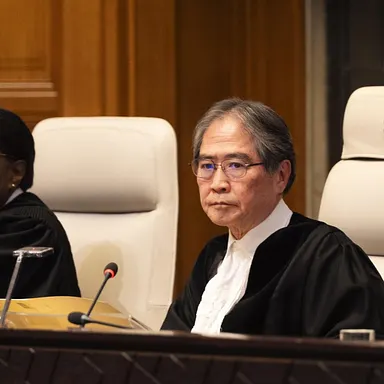
This episode of the Global News Podcast covers the International Court of Justice's ruling that Myanmar committed genocide against its Rohingya Muslim minority, the first such finding against a state by the court. Correspondents explain how the judges weighed evidence of intent, what the ruling could mean for reparations and future cases, and what eyewitnesses saw in Wakhan State.
The episode also covers a summit of the leaders of China, the United States and Russia in Shenzhen, the International Energy Agency's report on energy shocks and rising cooling demand, emergency stockpiling in Finland and elsewhere, South Korea's exam-day internet cuts, and hippo bones found in Saudi Arabia's Empty Quarter.
In this episode Alex Ritson, Ruth Alexander, Anna Holligan, Frantz van Boeckham, Jonathan Head, Justin Rowlatt, Pete Ross, Sarah Schiffling, Stephen McDonnell
The transcript of this episode on Myanmar's genocide ruling was made with the technology HappyScribe built to turn videos into text.
Ads in this audio differ from the text. Tap the sentence you're hearing to follow along.
Synced: the text now follows the audio.
This BBC Podcast is supported by ads outside the UK.
This is the Global News Podcast from the BBC World Service. I'm Alex Ritson, and at 15:00 GMT on Thursday, the 19th of November, these are our main stories. The International Court of Justice finds Myanmar guilty of genocide against its Rohingya Muslim minority; it's the first such ruling against a state by the court. The presidents of China, the United States, and Russia stress the importance of stable energy flows, UN reform, and the prevention of nuclear proliferation at their trilateral summit, the first ever.
And the International Energy Agency says that more energy is now used on cooling than on heating. Also in this podcast: internet access around exam halls in South Korea is cut amid fears of cheating, and we look at the evidence of hippos in a Green Arabia.
We found residues of plant material, but also of some of the animals that they've been hunting, stuck to their stone tools.
We begin with a landmark ruling delivered by the International Court of Justice, the United Nations' highest court.
The court, one, by 9 votes to 6, finds that the Republic of the Union of Myanmar has committed genocide against a Rohingya group in northern Wakhan State, in violation of its obligations under the Convention on the Prevention and Punishment of the Crime of Genocide.
That was the president of the ICJ, Judge Iwasawa Yuji, delivering the verdict that Myanmar has committed genocide against its Rohingya minority, marking the first time a state has been found responsible for genocide at the court. A huge moment of justice for the Rohingya people, and a ruling that could have implications for future genocide cases. A decade ago, the Burmese army was accused of carrying out human rights abuses against the Rohingya people, a Muslim minority who have never been recognized as citizens in their home in Myanmar.
Seven years ago, Gambia brought the case of genocide against Myanmar to the ICJ. The court had to find not only that terrible acts had been committed, but that there was intent to destroy a protected group. The judge stated that this was what the Myanmar government set out to do.
The court is of the view that the only reasonable inference that can explain Myanmar's actions is an intention to destroy, namely, the Rohingya population in northern Wakhan State. The court is fully convinced that Myanmar committed acts falling under Article 2(a), (b), and (d) of the Genocide Convention, with an intent to destroy a substantial part of the Rohingya population of Myanmar.
For more on the verdict, I spoke to our correspondent Anna Holligan in The Hague, where the ICJ is based.
This is an absolutely historic moment, and it was unequivocal in its ruling. I'm standing just outside the Peace Palace now, home to the International Court of Justice. Already we've seen some Rohingya refugees coming out, tears in their eyes, hugging. But just to talk you through how the judges arrived at this conclusion: it's notoriously difficult to prove intent. And what they did, they had to be sure that the clearance operations in 2017 in Wakhan State weren't just legitimate clearance operations, but also had genocidal intent.
What they did to arrive at that conclusion was look at all of the evidence presented in court, including by the Gambia, which brought this case under the 1948 Genocide Convention, and said, well, if we look at, for example, the brutal, violent rapes, the killing of babies, the burning down of villages, those are not designed as part of legitimate military operations. There was genocidal intent behind those actions by Myanmar's military. All of that lent the judges to decide that, in fact, Myanmar was guilty of genocide.
They also ordered a number of reparations. They said that Myanmar needs to report back to the court within two years to say what it's doing as a result of this. It's a very thick ruling. Three hours it took the judge to read through a summary, which lends itself, it highlights just how complex and complicated this case has been. But of course it's being watched around the world because the jurisdiction is being shaped now. And this was about the level of evidence required in order to find that there is genocidal intent.
That has been established in this case, so it will inevitably be used in other cases here, in front of the ICJ, for example, the allegations of genociding Gaza, which Israel denies.
You say, Anna, that you've spoken to representatives of the Rohingya who say they hope that this judgment will eventually mean that they can go home. Just how realistic is that, though? Because have we had a reaction from Myanmar? They're presumably not going to agree with this judgment.
Just inside the Peace Palace, we are expecting to hear from representatives from the Gambia. I will be speaking to people from the Rohingya community again. When I spoke to them earlier, they were saying, this isn't just about us, this is about humanity, and this is about our children and what expectations our children can have for the future. The ruling from the ICJ, it's a piece of paper. This court doesn't have any enforcement powers, it doesn't have any police force. It relies on states to carry out its findings and its recommendations.
So it could be that this will now result in a security council referral. It could be that countries decide that they need to work together to ensure the findings of this court are turned into a reality on the ground for the Rohingya people.
Anna Holligan. The International Court of Justice considered a large body of evidence before reaching its conclusions, including media reports about the Burmese army's action against the Rohingya in Myanmar's Wakhan State. Material collected by the BBC's Southeast Asia correspondent Jonathan Head formed part of the prosecution's case. After the verdict, he gave an account of what he had witnessed.
Well, I went on a visit, actually organized by the states, into Wakhan State about 10 days after the military operation began. There was almost no access. There never had been. And although we were controlled, we got incredibly shocking views of village after village that have been burnt down. We saw villages actually being burnt down, with a security force standing by, by local Wakhan Buddhists who, of course, were hostiles to the Rohingyas. It was just so shocking what we saw, the levels of destruction and the sort of the purging of the Rohingya population.
They had just vanished. They had just been pushed over the border. And I was in Cox's Bazar as well, seeing families as they came over, meeting families from the very villages that I'd seen being burnt down. It was an extraordinary experience. And the scale of it was so big, and it seemed so systematic. At the time, we toyed with, what can we call this? In my reporting, I called it ethnic cleansing. There were debates about whether this amounts to genocide, and those debates have continued right up to the present day. The International Court of Justice, which does have this very high bar for ruling on genocide, has now ruled that way, and it is an incredible verdict.
And I think for the Rohingya people in particular, not just the verdict itself, which they will see as validation, recognition of their suffering, but all the details that the court accepted, the fact that 10,000 people were killed, they said that all the evidence backed that. The fact that the Rohingya are a recognized group, something the Myanmar state has refused to recognize. Their suffering has been recognized in detail by this verdict. And I think that will give them a great deal of satisfaction. Although realistically, we had all these calls by the judges for reparations. I think reparations, or the possibility of them going back to Myanmar, that's a much, much more difficult challenge and will not happen quickly.
Jonathan Head. The much-anticipated face-to-face talks between President Trump, Xi Jinping of China, and Russia's Vladimir Putin have been held on the sidelines of the APEC regional summit in the Chinese city of Shenzhen. Never before have leaders from the three countries met together at the same time. They've issued what they've described as a joint declaration on peace. Among the key talking points were plans to increase the production of refined petroleum products and to ensure the stable flow of global energy supplies.
The joint statement also included a commitment to dialogue on reducing nuclear risks and UN reform. At the start of the much-trailed meeting, where the cameras were allowed in to see the three leaders sitting around a large oval table, Xi Jinping called for the three nations to work together to safeguard world peace and stability.
The world today is no longer a collection of isolated islands. I often say that humanity lives in the same global village, where everyone rises and falls together and shares a common future. In this global village, major powers bear a special responsibility. Positive interaction among major powers is not an optional choice, but an imperative.
Donald Trump said the historic meeting was a chance for world leaders to begin a new chapter of diplomacy.
No problems were ever solved under the old school refusing to talk about them, so no peace was ever forged by declining opportunities for engagement and speech. Together we are choosing a different course.
Speaking after the meeting, Vladimir Putin said the war in Ukraine had been mentioned in the discussions. He reiterated his position that Russia was not to blame for the conflict and wanted to pursue a peaceful resolution.
We did not start the war. We never started a war. We discussed these problematic issues, and we are ready to continue working on that in due order. Of course, there are compromises. They have been suggested by the American side. We agreed with these compromises the way they were proposed by the Americans.
For his assessment of the meeting, I spoke to our China correspondent Stephen McDonnell in Shenzhen.
The way these meetings work is that there's a part that's open to the press at the beginning, and then they go in behind closed doors. So we've got that beginning bit, and we've got a bit of a readout from what they say they spoke about behind closed doors. Let's have a little look at their statements at the beginning. Interestingly, you have Xi Jinping saying to these two leaders, who have both recently attacked other countries, when major powers promote harmony, you get world peace. When major powers clash, you get world chaos.
Now, he didn't say that he's accusing them of doing that, but it's interesting that he would use that turn of phrase in front of both of them. One other interesting thing is that Donald Trump spoke about nuclear disarmament and the problem of nuclear proliferation. Now, there was something in that Xi Jinping wouldn't want to speak about this because China is building up its nuclear arsenal in an attempt to catch up to Russia and the U.S. But instead of kind of pooh-poohing this idea or saying, you've got to let us catch up, Xi Jinping said, and I'll just read it out to you, nuclear weapons are a sword of Damocles hanging over humanity.
They should be comprehensively banned and completely destroyed. So, I mean, they're just words, and it doesn't mean that he's about to dismantle China's nuclear arsenal. As I say, they're building it up at the moment. But some people will at least welcome those words from Xi Jinping as a step in the right direction.
Yeah, this event is really good for China's image, isn't it? And particularly that of Xi Jinping.
Yeah. Just hosting APEC was always going to be good for them, especially in this city. This is a gleaming young city full of high-tech robots, electric vehicles. This is the sharp end, the best of the Chinese economy. It's a young city, average age, people in their 30s in this city. And to host all these world leaders to be saying, we're the promoters of stability, we're the promoters of free trade, we're bringing people together, would-be enemies together.
Yeah, you're absolutely right. It's been great for China's image, that's for sure.
Is anything more tangible, though, going to come out of this?
You know, they've got a statement which is just coming out, sort of promoting peace and cooperation, and it will be for others to debate how substantial that is. I guess it all just depends whether you're a glass half full or a glass half empty type of person. I don't think it's a major breakthrough or anything like that, but maybe people didn't expect that. And for China, even the status quo is pretty good. And for Donald Trump, it's great given that he was hammered in the midterms and he can be here sort of treading the world stage, I guess.
So I think that'll be something for people to debate, how much you can measure the success of this gathering. But some people will say, well, at least if you've got these world leaders talking to one another, well, they're not planning to attack one another. At least that's a good thing.
Stephen McDonnell. Still to come in this podcast.
God forbid if there's a big storm, we lose power, a small emergency, a large emergency, I want to make sure that my family have what they need.
We look at the food preppers stocking up for all eventualities. This is the Global News Podcast. The International Energy Agency, which advises governments on energy policy, has highlighted the catastrophic effects of the war in Iran on energy prices. As part of its annual report, it says the war has caused the biggest ever shock to supplies. Those higher prices are forcing countries to move more quickly towards renewable energy.
The report also says that more energy is now used on cooling than on heating. So, a highly symbolic moment, something I put to our climate editor, Justin Rowlatt, at the COP31 climate conference in Turkey.
Isn't it? Yeah, absolutely. So it's a response in part, obviously, to rising temperatures, but also reflects rising incomes in developing countries where most of the demand for cooling is. So it's really striking that we now see the cooling overtaking heating as a really dramatic change and reflects, you know, something fundamental about the world economy, but also, of course, about climate change. And it comes, as you say, Alex, against the background of this huge energy shock that the Iran war has delivered. Now, the International Energy Agency itself was founded in the wake of the first big oil shock back in 1973.
And they're saying this is the biggest in history. And these shocks aren't new. I mean, we had a shock just a few years back with the Ukraine war created an energy shock, but they're saying this is by far the biggest. And there are some really quite dramatic statistics there. They say it's removed 2.8 billion barrels of oil and 60 billion cubic meters of gas from global supplies. So interestingly, as you hinted, it's got this contrary effect that actually it's encouraging countries to move towards electrification. They're becoming worried about energy security. Most countries are importers rather than exporters of fossil fuels, worried about those imports being stable enough to deliver the energy their populations needs, and therefore switching towards electrification quicker than they would have done had we not seen the spike in prices as a result of this energy shock.
And actually, interestingly, they're saying, look, the longer the kind of geopolitical instability lasts, the more that we'll see, the quicker acceleration we'll see towards electrification, which should drive down emissions because using electricity to, for example, power cars is simply more efficient than using fossil fuels, using internal combustion engines.
Yeah, there was an interesting line picked up by the Financial Times from this. The IEA is saying energy markets can manage without the Strait of Hormuz.
Look, we have seen really dramatic price increases in oil and gas, but we haven't seen the kind of shock to the world economy that we had back in, for example, just to take one example, 1973, as I say, when the IEA was founded, when, you know, there were queues at petrol pumps all around the world. There was this huge, you know, crisis of confidence in the world economy, the sudden realization of how dependent the world was on supplies of energy from, you know, if you were in Europe or America, you would have said unstable regimes that can change their policies on exports when the, basically the Arab nations got together and said, you know, we are going to have essentially a cartel.
We're going to limit the supplies and set prices ourselves. And that was a big shock to the world. This time around, it's actually been much more muted. There were questions right at the beginning of whether we'd see a kind of catastrophic hit to the world economy. We have seen a hit, but it hasn't been catastrophic. Very interesting, and shows the resilience as the world transitions away from fossil fuels and has more diverse energy supplies, the fact that we can cope with a significant reduction in energy resources through the Straits of Hormuz.
Justin, you're at the COP31 meeting. Many people would say that the climate crisis is actually the biggest story currently facing humanity. You've been to many of these events. Is anything going to come out of this one that actually helps deal with the problem of climate change?
Well, to be honest, you know, the idea that nothing's going to come of this, you know, I would challenge that as a concept anyway. The fact that the countries of the world are coming together, excluding America, which has pulled out of the system, the fact that the countries are coming together to talk about the issue of climate itself is in itself a very positive move. But you're absolutely right that, you know, we've had years, 31 of these conferences. Obviously, we still have a huge climate problem. Clearly, the conferences themselves haven't solved it. And yes, we're going over the same issues. There's a discussion about whether fossil fuels, the transition away from fossil fuels, should even appear in the final agreement, which obviously sounds extraordinary when you're talking about tackling climate change.
And there's a discussion about finance. There've been these grand commitments to finance both for adaptation, so adapting countries in the developing world to the climate change that's coming, but also about helping them pay for the transition to fossil fuels. And we haven't got decisions on that. So we are looking in this one for people, the developed world essentially to deliver on the promises they have already made, Alex.
Justin Rowlatt. Now, here's a question. How long would your household stores last if you couldn't get to the shops or there was some major disruption to supply chains? Last month, the UK government issued advice suggesting people stockpile at least three days' worth of emergency food and water. The guidelines are relatively new, and it's been big news in Britain. But how is prepping for disasters viewed in other countries around the world? And what kind of emergencies should we be preparing for?
Ruth Alexander has been finding out.
Dan in the U.S. and Amanda in England have been talking to me about why they first started stockpiling.
COVID had a little bit to do with it, you know, seeing everybody run to the stores all at once to try to get everything that they didn't have. And I would like to not repeat that. And then becoming a father was really, really important. God forbid if there's a big storm, we lose power, a small emergency, a large emergency, I want to make sure that my family have what they need.
I started around the time of Brexit because there was some talk about there being supply issues.
And if people don't remember, that was the UK exiting the European Union.
Yes. Then Brexit came and went, and we didn't really have that many supply issues until COVID happened. Then I was really happy to have my Brexit covered, but I did discover that some of the things in there had gone off. So that made me have a bit more awareness of rotating things and keeping an eye on the best before dates.
So both, talk me through what are in your stores.
We have the things that we normally eat on a day-to-day basis, like lentils and pasta. And then if you go down into the basement, it's just the same stuff and just more of it.
Amanda, how about you?
I've got a big-ish cupboard under the stairs, and I've just started to use that as an extension to the larder, really. So, you know, tins and packets of things that we normally have.
How much water do you both keep?
We have about 120 gallons. I think it's.
That's a lot.
One gallon is 3.7 liters. We have more water than we need. You also want to take into consideration that you use water to cook food, right?
Amanda in the UK and Dan in the U.S., but what exactly are they preparing for? I've been speaking to Sarah Schiffling, an assistant professor in supply chain management and social responsibility at Hanken School of Economics in Helsinki, Finland, a country where being prepared for an emergency is almost a way of life.
I'm in the basement, and it looks like any other block of flats from the '60s, you might imagine. This takes you to a feature of Finnish homes, the air raid shelter.
The Finnish government recommends that everyone who's able keeps enough food, water, and other essentials to last at least 72 hours in an emergency.
Personally, I find it reassuring. I've used my emergency supplies when I broke my foot and was like, going for shopping is really difficult. Even going downstairs and picking up an online delivery is a huge thing for me right now.
As a supply chain expert, what kind of threats could impact the food supply?
So recently we've seen the freezers being unfrozen, so hacking attacks. But then also, if we're looking into a further transport chain, we've seen a lot of disruptions, whether that is geopolitically, major shipping lanes being blocked repeatedly over the last couple of years. And of course, a big winter storm can already disrupt the stuff coming in. And a lot of, especially fresh fruit, is distributed on very short time scales. We have seen all the heat waves this summer across large parts of Europe that affected agricultural output.
But I think the personal preparedness, those 72 hours, is really just for these short-term disruptions.
You live and breathe this stuff for your job. How do you stop it from stressing you out?
Think about how much more is actually being asked. If we're thinking 72 hours, a lot of families do a weekly big shop anyways. So it's half of that that you're being asked. So it's a little bit of effort, absolutely. It's also a bit of money, storage space. But in the end, it does enable you to have a bit more independence and have your own choices count for what happens in an emergency.
These exams are a very big deal, Alex. They're held on the third Thursday of November, and they're the culmination of a student's high school career. The exams cover a whole raft of subjects. Students are required to be under exam conditions for a grueling eight-hour period across the day. And in my time in Korea, I remember the country so important or at least so much that it's at stake comes to a virtual standstill. Huge traffic jams as worried parents try to get their students, you know, their kids to exam halls on time.
To mitigate, government offices, businesses, the stock market even opens an hour later to try and free up some of that traffic flow. If traffic jams do develop, I remember teams of volunteer motorcyclists by the side of the road ready to whisk students to the exam hall to make sure they get there on time. I don't know about parents listening that have or parents of high school students and how they would feel about plonking their teenager on the back of a motorcycle to be whisked at high speed to an exam hall, but that's another issue.
Air traffic is even affected. Airplane takeoffs and landings are suspended for a 25-minute period as an English listening exam takes place. So that gives you a sense of just how big a deal they are in Korea in that day. Traditionally, concerns over cheating around because it's a kind of multiple-choice exam paper, whether someone might get a hold of that exam paper and proliferate it out to people. Now though, with the rise of AI and things like smart glasses, that's where the real concern is.
So what rules are being enforced this time?
Well, all sorts of things that you would, you know, perhaps expect. Don't take a smartphone in there. They're banned. But other things like if you've got big buttons on your shirt, don't wear that shirt because they're concerned there might be a tiny spy camera in there. There was also an emergency alert sent out at two points, the kind that you would get on your cell phone if there's a security alert, the kind of thing that's quite common in South Korea given where it is and the neighborhood that it has. That happened twice. So real concerns there today.
Pete Ross. Herds of hippos roaming the vast deserts of Saudi Arabia. It's hard to imagine, but 125,000 years ago, that's exactly what was happening. Scientists have discovered hippo bones in what is now one of the driest places on Earth. Back then, this area, now evocatively called the Empty Quarter, was lush with greenery and a lake. And the suggestion is that ancient humans may have hunted hippos with poisoned spear tips. Anne Soi spoke to one of the researchers, Professor Frantz van Boeckham at King Abdullah University of Science and Technology in Jeddah, Saudi Arabia.
Arabia is being considered as possibly one of the migration routes of the hominids out of Africa. And so understanding if there were living conditions that would allow hominids to migrate through this part of the world would really help to get a much better idea of how that migration story unfolded. So that's why it's really insightful. And particularly these hippos show that it's been very wet. There must have been lots of grass around, so savanna-type landscape.
Since hippos live in daytime in the water, and at night they go out grazing.
And how did you determine that these hippos may have been hunted with poisoned spear tips?
Yeah, the amazing thing of the site was that we found this integration of the bones, not only of hippos, but also of large buffaloes, camels, oryx, and they were associated with stone tools. And some of these tools, as you might know, they are made on site. And the archaeologists were able to refit the bits and pieces into the original stone. So it shows that people were actually on site working, making the tools.
And then we found residues of plant material, but also of some of the animals that they've been hunting stuck to these stone tools.
And you also found humans may have been living alongside the animals.
Well, the fact that you have the stone tools is, of course, the evidence for the presence of humans. We did not find any bones of humans. That would be, of course, a very prized find, but the fact that the stone tools are there is proof enough.
So are you working with a possibility that you may find some human remains, perhaps?
That, of course, is always the prize we would like to go for, but it will require much more work. But now we have found this good evidence. There might be indeed a chance that we could find them at some point.
So you have found evidence of, you know, life as would have been very different from the way it is today in the Empty Quarter. Any idea why it changed?
Well, yes, we have the ice ages, as you know. And so with the ice ages, the climate changes. And so that also affected this part of the world. So when the ice caps melt, then the climate in this part of the world improves, and they get these green phases. So we talk here about Green Arabia.
Green Arabia. And, you know, how does this inform where we go from here in terms of the kind of knowledge that you've gathered so far?
What this does is it gives us a much better idea of how the past climate changes, how they affected here this part of the world. And so it sets the scene for research. It's the paleoenvironment. It's the animals, but it's also the plants. And then as part of that, the humans. So it is the reconstruction of the ecological system.
Professor Frantz van Boeckham speaking to Anne Soi. And that's all from us for now. If you want to get in touch, you can email us at globalpodcast@bbc.co.uk. You can also now watch our episodes. Just search for The Global News Podcast on YouTube. This edition was mixed by Russell Newlove. The editor is Karen Martin. I'm Alex Ritson, until next time, goodbye.
The International Court of Justice finds Myanmar guilty of genocide against its Rohingya Muslim minority. It's the first such ruling against a state by the court. The ICJ rejected Myanmar’s argument that it had responded to insurgent attacks.
Also: the presidents of China, the US and Russia stress the importance of stable energy flows, UN reform and the prevention of nuclear proliferation at a trilateral summit, internet access is cut in South Korean exam halls, amid fears of cheating. And a remarkable discovery reveals that 125,000 years ago hippos roamed what is now the vast Arabian Desert.
The Global News Podcast brings you the breaking news you need to hear, as it happens. Listen for the latest headlines and current affairs from around the world. Politics, economics, climate, business, technology, health – we cover it all with expert analysis and insight.
Get the news that matters, delivered twice a day on weekdays and daily at weekends, plus special bonus episodes reacting to urgent breaking stories. Follow or subscribe now and never miss a moment.
Get in touch: globalpodcast@bbc.co.uk
Photo: International Court of Justice (ICJ) President, Iwasawa Yuji, presides over a public session during the reading of the court's judgment in the genocide case brought by The Gambia against Myanmar at the Peace Palace in The Hague, Netherlands.
Credit: Jeroen Jumelet, EPA/Shutterstock