
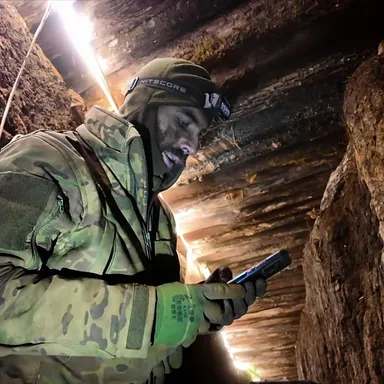
This episode of the Global News Podcast reports from inside Ukraine's old Soviet-era gas pipelines, where Ukrainian troops are fighting Russian forces underground and retaking territory in the Kharkiv region. The show also covers President Trump's opposition to global AI regulation ahead of the APEC summit in Shenzhen, Anthropic's planned record stock market listing and the debate over an AI bubble, the US defence secretary's military deal with Venezuela, Hakeem Jeffries's nomination as House Speaker, Brazilian footage of uncontacted Awa people, a drug study on Alzheimer's, and a record Van Gogh sale.
Listeners get context on each story and hear expert views on what the developments could mean.
In this episode Oliver Conway, Chantal Hartel, Dan Shetty, Helena Humphrey, Jonathan Beal, Nicholas O'Donnell, Samira Hussain, Sara Schenker, Simon Jack, Stephen McDonald, Tara Spires-Jones, Will Grant
This episode's transcript on Ukraine's underground war was made with HappyScribe technology, the same technology behind Teams AI note taker.
Ads in this audio differ from the text. Tap the sentence you're hearing to follow along.
Synced: the text now follows the audio.
This is the Global News Podcast from the BBC World Service. Hello, I'm Oliver Conway, and this edition is published in the early hours of Thursday, the 19th of November. Ukraine takes its battle with Russia underground using old Soviet pipes to recapture territory. We'll have a special report. President Trump talks AI ahead of his meeting with Xi Jinping and Vladimir Putin. And the U.S. announces a military partnership with Venezuela less than a year after American forces seized the country's leader.
Also in the podcast: Anthropic defies fears of an AI bubble with the world's biggest stock market listing set to raise more than $80 billion. And.
We only have two drugs approved in the world right now that can slow the progression of Alzheimer's disease. So this is potentially a very significant step forward.
How a Viagra-type drug could help slow Alzheimer's. Over the past four and a half years, Ukrainian forces have fought the Russian invaders in the air, at sea, and on the ground. But now the battle has gone subterranean in old Soviet-era gas pipelines which crisscross Ukraine. Russia started making use of them first, but in the Kharkiv region, Ukrainian troops are fighting back and have been retaking territory. Our defense correspondent, Jonathan Beal, has witnessed the underground war.
Well, you've just arrived. But the gas pipe and the first thing you notice is the air is putrid. It is fetthy. Just stink of gas. And the entrance of the tube, it is tiny, just over a meter diameter. And that's where Ukrainians have been living and fighting for weeks at a time.
We're moving along on this little trolley that's been specially built. They've also been using these gas pipes to transport troops to frontline positions above ground because it is much safer.
They call it the Kupiansk Metro, like an ausdere fairground ride without the funnel.
This is the end of our destination, thankfully. It goes on for hundreds and hundreds of kilometers. And of course, they're still Russians. But the other end.
At a break in the pipeline, a group of soldiers wait in a tunnel to be transported from their frontline positions. Vovachka, his face engrained with dirt, has been fighting above ground for the past three weeks. He expresses relief at being back in the pipe.
It's more comfortable in the pipe because drones don't fly here, neither do artillery shells or glide bombs. It's safer here.
Musicians been living underground for three months. He says, we're standing in the dugout directly under the line of contact. But he adds, it's safer here. Inside the pipe, there's been close quarter combat. With nowhere to hide. Ukrainian troops engaging with Russians who were the first to occupy it. And breaking down their barricades, some booby-trapped or piled with the bodies of dead Russian soldiers.
Kurt's unit was tasked with clearing the pipe.
We were all firing. We were pushing them back. But yes, there were bodies. I even had to sleep right next to them.
Back on the surface, Ukraine's HARTIA corps keeps a watchful eye on what's happening above and below ground.
So there's a big map on the table here, and then a big screen showing where all these pipes go.
Zanuda, who helped plan this operation, believes underground warfare is now the only way to advance.
Ground operations are virtually impossible. This will continue with other units involved. Everyone understands that. For now, the only way to fight is underground.
It's taken Ukraine several months to clear 15 kilometers of the pipeline. It's helped them regain lost territory and been a boost for morale. But there's still no end to this war in sight. Still no light at the end of this tunnel.
Jonathan Beal reporting from Ukraine. As we record this podcast, Donald Trump is about to hold talks with Xi Jinping and Vladimir Putin in the Chinese city of Shenzhen. Ahead of the three-way meeting between the U.S., Russian, and Chinese leaders, President Trump spoke to delegates at the APEC summit about artificial intelligence, or as he calls it, superintelligence.
It is unleashing extraordinary prosperity and growth for people all around the globe. So we do not want to do anything to destroy the tremendous potential of this technology. It's superintelligence. That's what it is. It's superintelligence. But we have to watch it. We have to be careful. We have to cherish it. It's almost completely good, but it's got some bad elements. So we have to be very careful in managing those bad elements. So we oppose any form of globalist regulation or anything to control or stifle SI.
Well, SI, or AI as almost everyone else calls it, is the subject of fierce competition between the U.S. and China. Not helped by the Nvidia scandal and allegations of chips being illegally funneled to China by an alleged spy. Our correspondent, Stephen McDonald, is in Shenzhen.
When you consider the comments from Donald Trump this morning and what the Chinese government has said, they are very different, their positions on AI. So Donald Trump got up at that opening session of the summit and said that his government wouldn't support what he described as some globalist restrictions on the development of AI. Well, Xi Jinping, his government say they do want multilateral guardrails put in. It all depends on the jargon of how you describe it.
Xi Jinping thinks there needs to be cooperation because while AI, sure, it should be developed. I mean, China has got these AI companies that are absolutely booming at the moment. But the Chinese government has also warned of the dangers of it. And he's not as confident as Donald Trump seems to be, who said it this morning that it was mostly good and only a little bit bad. Well, this is definitely something that they could talk about when Xi Jinping and Donald Trump meet face to face in the coming hours.
Stephen McDonald, and we'll keep you updated on the outcome of that three-way summit in the next edition of the Global News Podcast. Less than a year after the U.S. seized President Nicolás Maduro of Venezuela in a daring raid, the two nations, previously bitter enemies, have signed a military agreement. The Trump administration says it wants to deepen defense cooperation with Venezuela and reinforce border security. The deal was announced by the U.S. Defense Secretary, Pete Hegseth, on a surprise visit to Caracas. Speaking at the presidential palace in the Venezuelan capital, he had this message for so-called narco-terrorists.
You will no longer export your crime and your misery to America, to Venezuela, or any other country in the region. You will no longer terrorize the Venezuelan people or spur mass migration events that threaten our people, our cities, and our sovereignty. And you will no longer harbor foreign terrorists. Your choice is simple. Either you submit and turn yourselves in, or face the deadly consequences of U.S. and Venezuelan combined military might.
I asked our Central America correspondent, Will Grant, what this U.S.-Venezuela agreement might mean in practice.
The interim president in Venezuela, Delcy Rodríguez, of course, former President Maduro's replacement, praised what she called political maturity between these old enemies. The ability now for Caracas and Washington to work together on things like this. She said the agreement with the Pentagon would, as she put it, strengthen the capacity of the National Bolivarian Armed Forces. She specified operational equipment, new technologies, and reading between the lines when she said it was about confronting common threats.
I read that as intelligence sharing, particularly on the issue of transnational drug organizations which will be operating in the border region between Venezuela and Colombia. I think that's pretty likely.
Who is in charge in Venezuela at the moment? Is it that interim government led by Delcy Rodríguez, or more the United States?
Well, if you ask government officials in Caracas, they sort of bristle at the idea that it's anybody other than themselves, the idea that they are mere puppets of Washington would anger them. But the truth of the matter is we know that there is an outsized role in the direction that Venezuela is taking for the U.S. Secretary of State, Marco Rubio. He is intimately involved in all the key decision-making. And we saw just a matter of weeks ago this massive oil deal reached between Washington and Venezuela, which gave such favorable terms to the U.S.
over the control of some 65 billion barrels' worth of Venezuelan crude. So it's safe to say that Washington, the Trump administration specifically, has such a huge input now on the direction that Venezuela is headed.
Talking of Washington, Pete Hegseth has just survived an impeachment attempt there, which included accusations over the raid on Venezuela. What do you make of the timing of his visit?
I mean, it's no coincidence, really. I mean, it comes as he's under heat at home over what's happening in terms of the U.S. war on Iran. As you say, he just avoided impeachment over that. And this is, if you like, the site of his greatest victory in 2026. It's constantly heralded by him and by President Trump as a sort of clean, surgical, direct military raid that had no casualties on the American side, that did exactly what it set out to do in a matter of minutes, that of removing Nicolás Maduro from power on the 3rd of January.
So that he's sort of taking a victory lap, and that's how he kicks off his regional tour, is no surprise. He, of course, and the Pentagon would say, no, that this is about building relationships with Caracas and the rest of the region, and that it just so happens that they've started in Caracas because it's such an important partner now. But I don't think the timing is a coincidence by any means.
Will Grant. It might have been a rocky few weeks for tech investors, but that hasn't stopped Anthropic making the world's biggest ever stock market debut. The Claude creator is set to raise $80 billion in its initial public offering, or IPO, breaking a record set by SpaceX earlier this year. Our New York Business correspondent, Samira Hussain, reports from Wall Street.
This is where the AI revolution will be measured in dollars and cents. Billions are being raised by the makers of Claude AI chatbot, giving it a valuation in the trillions. And there are really a lot of investors that want to get a piece of that revolution.
This is actually my first time investing in, like, an IPO.
Dan Shetty, retail investor, AI superfan, and aspiring Anthropic shareholder.
Yeah, I'm taking money out of my own savings account, more than, like, $12,000.
He compares this IPO to public utilities, like electricity or water.
If you think AI is inevitable, if you think AI is going to be a core part of society, this is that AI. Anthropic is the frontier AI lab in the AI era.
Anthropic is the first major AI-only company to go public, and it comes at a time when investor confidence in AI has been shaken. And then there are the warnings by founder and CEO Dario Amodei. Artificial intelligence could pose catastrophic or existential risks to humanity.
If we build in the right way, I think the probability of something bad happening is very low. If we build in the wrong way, the probability of something bad happening is very high.
So far, the Trump administration has resisted calls to step in and implement guardrails. So the AI boom continues, with Anthropic raising huge amounts of capital despite not ever turning a profit. Investments in AI have been fueling America's economy. One of the reasons Anthropic's IPO is so consequential, as it may give us a clue as to whether the boom can continue.
Samira Hussain in New York, but what does it all mean for the wider AI industry? Here's our business editor, Simon Jack.
They are not only selling the shares to the public, they're also selling a $26 billion chunk to a group of investors, including the likes of Google, Amazon, et cetera, which is one of the things that people have raised their eyebrows at, which is that there's quite a lot of circular ownership and funding. One company owns a bit of the other, one's renting from another. They're all kind of, you know, in bed together. The biggest question about the AI so-called bubble that some people think it is, is the pot of gold at the end of the AI rainbow, what you and I and companies are prepared to pay for this AI product.
Is that enough to justify the trillions being spent on building out the infrastructure for this? I expect this IPO to be an absolute, you know, feeding frenzy, but it will not quell the doubts that some people have about, do I want it in my backyard? Am I prepared to pay for it? Is there an existential threat to humanity? What about what is it going to do to jobs? What does that do to the tax taken and my ability to pay my mortgage? All sorts of incredibly fundamental questions about this technology, which I don't think tomorrow, for all its furory, will solve.
Our business editor, Simon Jack. And still to come on this podcast.
The moment of no return. And $165 million. The work is sold. Thank you very much indeed. Congratulations. Thank you very much indeed.
A Van Gogh painting is sold for a record fee despite controversy ahead of the auction.
You're listening to the Global News Podcast. Hakeem Jeffries is set to become the first African-American speaker of the U.S. House of Representatives after securing the nomination of the Democratic Party in the wake of its victory in the midterm elections. He is expected to formally take up the post once the new Congress is sworn in on Sunday, the 3rd of January, at which point he will be second in line to the presidency, behind Vice President J.D. Vance. Hakeem Jeffries said being nominated was an honor and a privilege.
Our job is to fight MAGA extremism, not each other, to fight MAGA extremism, and to get big things done for the American people. And that is what we are going to accomplish together beginning on January 3rd.
Well, Helena Humphrey in Washington told us about the significance of his nomination.
Well, I will say that this nomination was largely expected because, of course, we had that blue wave in the midterm elections, didn't we? So it became clear that there was a job opening and there was no Democratic challenger that emerged. And Hakeem Jeffries is currently the House minority leader, so all eyes were suddenly on him. But that's not to say that this is not historic because the U.S. House of Representatives has had a speaker for 237 years, but now, finally, after all those years, it looks like they will have someone of African-American origin.
And that is something that Hakeem Jeffries did reference today in his comments. He had previously said that there'd been pressure on him for four years. People had been looking at him. They'd been wondering, could he potentially be, you know, a person to serve as speaker of the House? And he'd said previously, failure wasn't an option.
Now, he succeeded Nancy Pelosi as leader of the Democrats in the House four years ago. She was a pretty formidable leader. He's had some criticism. Is the party wholly behind him?
On the whole, yes, it is, because you've got that strong number of Democrats in the House of Representatives. What we did see in this secret ballot, so this is a ballot which is indicative of the way that the Democrats will vote when this comes to the House floor on the 3rd of January, is that we saw a number of holdouts. These are freshmen Congresspeople, so people who will be coming in new in the new year. And they weren't necessarily happy with some of his party positions when it comes to things like U.S. arms to Israel. They wanted commitments that that would be taken up.
And we also heard from one more conservative member of the Democratic caucus, Representative Henry Cuellar of Texas, and he said, look, the Democratic Party is not going to let what he called a small group dictate where we're going to stand at. So I think what this does show, I would say, is that, you know, there is an inner tug and a struggle in the Democratic Party right now.
Yeah, the party has its largest majority in years in Congress, both at the House and the Senate. But the Democrats will need to deliver to avoid suffering losses in two years' time. How hard will that be for Hakeem Jeffries?
That is exactly the point. I think this is going to be one of the biggest challenges of what is a very powerful job. And when I say it's a powerful position, it comes after the Vice President in terms of the line of succession. So he has to look at Trump's agenda, come up with the Democratic response, of course, along with the rest of the party. And he's got to get that balancing act right, ensuring that there are those investigations opened when it comes to the Trump administration, if that's what's called for. But at the same time, making sure that people do feel a change in their lives, particularly when it comes to the cost of living, because, of course, we all know that Democrats have got their eye rather keenly on the White House for 2028, and they want to keep those independents on board and also any of those swayable Republicans.
Helena Humphrey in Washington. Some remarkable, if slightly shaky, footage has emerged from Brazil, showing about 20 indigenous men and boys emerging from their self-imposed isolation deep in the Amazon rainforest. Some of them could be seen holding out their arms, appearing to ask for food. And that's causing alarm among activists. Sara Schenker from the campaign group Survival International spoke to Tim Franks about the footage.
A group of uncontacted indigenous Awa people in the northeastern Brazilian Amazon came out of the forest and made contact with people at a government control post nearby in the Araribóia indigenous territory. And this is a territory which is home to two different indigenous peoples, the uncontacted Awa, who are people who reject all contact with outsiders and depend completely on their forest for their survival. They're nomadic hunter-gatherers. And the indigenous Guajajara people, who live in settled villages and do have contact with outsiders.
These two peoples have coexisted in this territory for a very long time, but it's the first time in recent history that the uncontacted Awa have come out of this forest in this way, and it is extremely concerning. Some of the moments you can see an indigenous Guajajara person handing some yams to the uncontacted Awa, who had asked for these yams. It could be that the Awa were coming out to seek food because the territory has been deforested, and it's harder and harder for the Awa to find game to hunt in certain areas of the territory, especially after the droughts and the forest fires of recent times.
So some of the Guajajara are saying that that could be the reason. But again, this has not been confirmed.
But you did say, look, this is come what may. This is very concerning. Why?
Yeah. Well, the immediate concern is the health and survival of these particular people who have come out of the forest, bearing in mind that there are almost definitely other uncontacted Awa people in the territory. There may well be three or four groups of them who haven't made contact, but the ones, roughly 20 people who have made contact this week, the immediate concern is that they could catch a cold or a flu or COVID or anything else. There are over 196 uncontacted indigenous groups and peoples around the world in 10 countries.
And time and again, we see, after first contact, the risks of disease transmission is extremely high. So that's the immediate concern. And there's also, of course, the much wider concern in terms of the land protection. And this indigenous territory, Araribóia, if you look on Google Earth, you'll see, I mean, it's really incredible to see. It's an island of green, completely surrounded by deforestation in one of the most deforested parts of the Brazilian Amazon.
Sara Schenker from Survival International. A Viagra-like drug has been found to reduce the rate of cognitive decline in people with Alzheimer's disease. In a small trial of patients from 13 countries, the tablet, known as AR1001, slowed decline by 31% without any other treatment. The findings were presented at a conference in the U.S. city of Boston. Professor Tara Spires-Jones is a dementia expert at the University of Edinburgh.
We only have two drugs approved in the world right now that can slow the progression of Alzheimer's disease, and they both act through removing one of the toxic proteins. So any new drug would be amazing. The caveat is this is just past its phase three trial, which is sort of the last step before a drug can be approved for use, but it hasn't gone through the full peer-review scrutiny and it hasn't gone through the regulators yet. So it's not approved yet, but it's designed to boost blood flow, which is one of the risk factors we know for Alzheimer's disease. A lot of things that affect your vascular health also increase your risk for Alzheimer's.
And we think that's because they, at least in part, reduce the blood flow to the brain. So this drug is acting to boost the blood flow by relaxing your blood vessels. But it also probably has direct effects on the brain cells. At least in model systems, this kind of drug can promote pathways in brain cells that promote learning and memory. And they do that by changing the way the cells work, but just a little bit. It's a subtle effect, and this has only been shown directly in animal models, but it's possible that both the increased blood flow and that boost of the remaining brain cells are both contributing to this effect.
But it's important to note that this is not making people better. Like all the drugs we have at the minute, it doesn't improve your function, but it makes you get worse more slowly, which is still progress. Why that only happens when people weren't taking any of the currently approved Alzheimer's treatments, I don't know. There were only about 300 people in each subgroup. So, you know, 300 people who got the drug and didn't have another Alzheimer's drug, 300 people who had another Alzheimer's drug, and about 600 in the placebo group, right? So it's still relatively small numbers of people for a big trial like this.
I think we'll just need to get more data to fully understand that.
Neurologist Tara Spires-Jones. Van Gogh oil paintings are usually worth anywhere from a few million to $100 million, but one of his masterpieces has just sold at auction for more than $190 million in New York, a record price for the 19th-century Dutch artist. Until a few days ago, though, it wasn't certain the sale would go ahead because of a dispute over its ownership, as Chantal Hartel reports.
Chestnut trees in blossom, or Châtaignier en fleurs, was one of Van Gogh's final paintings before his death in 1890. It contrasts a deep blue sky with the blossoms of tall chestnut trees in a village just outside of Paris where the painter spent the last few months of his life. On Wednesday night, a three-minute bidding battle for the artwork at Sotheby's pushed the price far past Van Gogh's previous record of $117 million.
Unseen in public for more than 60 years, this is one of the most exceptional post-impressionist paintings to ever come to auction. $165 million. Here it is. It's in the room at $165 million. The moment of no return. At $165 million. The work is sold. Thank you very much indeed. Congratulations. Thank you very much indeed.
With fees, the total sale price for the painting was $190.4 million. Few details have been released about the buyer, described by the auction house as a private collector in Asia. Sotheby's will undoubtedly be feeling relieved. Last week, representatives of a Jewish family who owned the painting before the Second World War had opposed the sale at auction. They'd argued that their ancestor, the German publisher Samuel Fischer, had been forced to part with it in 1936 because of Nazi persecution.
Sotheby's said its own extensive research had not established that the painting was sold under duress. It's understood that an agreement was reached with the current owners and Samuel Fischer's heirs. Nicholas O'Donnell, an expert in art and cultural property law, said the dispute highlights the difficulties in dealing with Nazi-era restitution cases.
One of the checks that the auction houses do is to review databases like the Art Loss Register or the Lost Art Database in Germany so they catch any existing claims and can deal with them as soon as possible. It was somewhat surprising to me that the claimants say they didn't know anything about the sale until, I think, November 7th, which put it in a very compressed timeframe because there are often further research points that have to be pursued. I was certainly worried over the weekend that that might derail the whole process because there wasn't enough time. So I'm happy it was able to come to sale tonight.
This was not only a record price for a Van Gogh painting, but the second highest price paid for any work of art ever sold at Sotheby's. Retaining that top spot, Gustav Klimt's portrait of Elizabeth Lederer, which sold for $236 million in 2025.
Chantal Hartel. And that is all from us for now. If you want to get in touch, you can email us at globalpodcast@bbc.co.uk. This edition was mixed by Mark Pickett and produced by Siobhán Leahy and Chantal Hartel, our editors Karen Martin. I'm Oliver Conway. Until next time, goodbye.
We go inside the old Soviet-era gas pipeline where Ukraine is fighting an underground war with Russia. The BBC is the first international broadcaster to enter the tunnels where this subterranean battle is taking place. Also: the AI giant Anthropic is set to raise more than 80 billion dollars in its initial public offering, breaking a record set by SpaceX. President Trump pushes back against global regulation of ''Super Intelligence'' - or AI - at the APEC summit in Shenzhen ahead of his meeting with Xi Jinping and Vladimir Putin. The US defence secretary Pete Hegseth signs a military cooperation deal with America's former foe Venezuela. Democrats in the US House of Representatives nominate Hakeem Jeffries as first African American Speaker. A new study suggests a pill that mimics Viagra can slow cognitive decline in people with Alzheimer’s disease by almost a third. Rare footage from Brazil shows about 20 Indigenous men and boys emerging from their self-imposed isolation deep in the Amazon rainforest. And a painting by Vincent Van Gogh sells at auction in New York for over 190 million dollars - a record for work by the artist.
The Global News Podcast brings you the breaking news you need to hear, as it happens. Listen for the latest headlines and current affairs from around the world. Politics, economics, climate, business, technology, health – we cover it all with expert analysis and insight.
Get the news that matters, delivered twice a day on weekdays and daily at weekends, plus special bonus episodes reacting to urgent breaking stories. Follow or subscribe now and never miss a moment.
Get in touch: globalpodcast@bbc.co.uk
Photo: A member of Ukraine's 13th Khartiia Operational Brigade in an old Soviet gas pipeline in the Kharkiv region
Credit: Moose Campbell, BBC