
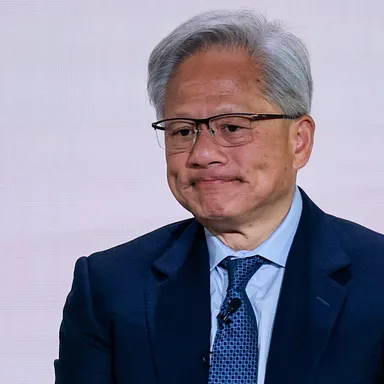
This episode of the Global News Podcast covers Nvidia's refusal to reinstate Jensen Huang as chief executive after a scandal over an alleged affair with a Chinese spy, along with a reported SEC investigation and record quarterly revenue. It looks at President Trump's summit in Shenzhen and what China hopes to gain from it, the US losing its measles-free status, researchers using drones to collect humpback whale blow for genetic studies, a fatal settler shooting in the West Bank, Neanderthal-linked genetic variants and schizophrenia risk, a hidden Georgia O'Keeffe painting sold at auction, and Voyager 1 nearing one light day from Earth.
Listeners will hear correspondents and experts explain each story and the competing views around it.
In this episode Oliver Conway, Adeen Omani, Dominic Hughes, Esther Lovett, Laura Bicker, Lily Jamali, Nikki Fox, Paul Offit, Pontus Skoglund
This episode on a disgraced chief executive's failed comeback was made with the same technology behind HappyScribe's AI tool that takes meeting notes.
Ads in this audio differ from the text. Tap the sentence you're hearing to follow along.
Synced: the text now follows the audio.
This is the Global News Podcast from the BBC World Service. Hello, I'm Oliver Conway. This edition is published in the early hours of Wednesday, the 18th of November. Nvidia rules out any return for its disgraced former CEO Jensen Huang, as the scandal threatens to overshadow President Trump's trip to China. The U.S. has officially lost its measles-free status with its largest outbreak in more than three decades, and an elderly Palestinian woman has been shot dead by Israeli settlers in the occupied West Bank.
Also in this podcast, what researchers are learning about humpback whales from their snot.
From the blow samples, we can get information on individual-level health, genetic diversity, or measuring levels of inbreeding in the population.
And.
It's about taking humanity on a journey through the solar system and beyond, and just showing us what those distant worlds look like.
Nearly half a century after its launch, Voyager 1 approaches a cosmic milestone. Less than a week after he resigned, Jensen Huang has failed in a very public attempt to get his job back as boss of Nvidia. On Tuesday, he issued a statement all but pleading to be reinstated as CEO, saying there was a clamor for his return and he would be honored to do so. President Trump, himself an investor in Nvidia, had even given his blessing.
But hours later, the firm ruled it out. Here's Nvidia Chairman Harvey Jones.
Jensen Huang voluntarily resigned his positions as president, CEO, and board member. The Nvidia board unanimously accepted his resignation and does not intend to reinstate Jensen as CEO.
Mr. Huang founded Nvidia more than three decades ago, turning it into the world's first $5 trillion company. He was forced to resign following reports of an affair with an alleged Chinese spy and two Nvidia employees. The AI chipmaker is now reportedly being investigated by the U.S. Securities and Exchange Commission, and Mr. Huang has agreed to answer questions in the U.S. Congress after the threat of a subpoena. The Democratic House leader, Hakeem Jeffries, was asked about Mr. Huang's possible return.
Should he be allowed to come back by the board?
No. That's ultimately a decision that the board will make. But given the significant concerns that exist relative to the potentially adverse implications of what has happened at Nvidia in terms of our national security and having the highest rungs of American technology potentially being diverted to the Chinese Communist Party in ways that put Americans potentially at risk, that's all unacceptable.
Despite the scandal, the firm has announced record third-quarter revenue. I asked our North America technology correspondent, Lily Jamali, why Mr. Huang thought he might have a chance of a comeback.
There were these tech leaders, including Elon Musk, who were actively campaigning for him to be reinstated by the board. There was this petition that went around over the weekend that has now garnered something like 200,000 signatures. Some of those signatures have not been verified, we should be clear. But this decision to put out a statement today asking basically to be brought back if the board found it acceptable was a surprise. And I think when you hear the chairman of the board on an earnings call, first of all, that's very unusual.
When you hear him just hours later saying, "We're not intending to bring him back," that sends a very clear message.
Yes. He was talking about the record third-quarter revenue, which, of course, came before the scandal erupted. Will Nvidia be able to keep doing such good business without Huang?
Well, certainly the interim CEO of Nvidia, Colette Kress, who has been the longtime chief financial officer at the company, wants investors to think that that is the case. So they had record revenue, which doubled in the quarter to $115 billion. As for where sales go from here, again, trying to project confidence, they boosted their forecast. And I heard a lot of phrases that certainly invoked stability, things like, "It's business as usual. We've got this. The roadmap is intact."
All of that phrasing very clearly trying to make clear that they have things under control during what's been a very tumultuous time.
Now, Jensen Huang is set to testify in Congress at the start of December. What can we expect?
Well, I think the big question is, what did Mr. Huang know about the company's interactions with China, with this company, MegaSpeed, where Alice Wong, the alleged Chinese spy, was an officer for a good while? Really, what the question is, is how did these Chinese companies allegedly access Nvidia computing power to train their AI models? Was Mr. Huang aware of that? You heard Hakeem Jeffries, possibly the next House speaker, raising national security concerns.
And so in Congress at the start of December, they're going to hear from him. These committees that are devoted to national security will get to interview Mr. Huang behind closed doors.
And while Nvidia is facing all these questions, it's looking to hire a new boss. If it's not going to be Jensen Huang, who's it going to be?
Yes. Well, I mean, certainly Colette Kress is a possibility. She's been the CFO, the chief financial officer there for 13 years. We heard her on the call yet again today. She is a very familiar voice to investors and analysts. She's on those calls every three months. But we also heard from Scott Bessent, the Treasury Secretary here in the U.S. over the weekend, saying that given all the baggage that now exists surrounding this company with respect to these national security questions, that it's really time for them to look outside the company. There's been talk of the CEO of ARM perhaps coming on board, and there are probably a lot of other external candidates that the company is considering right now.
Lily Jamali in Silicon Valley. Well, the scandal could make President Trump's trip to China a little awkward amid allegations that billions of dollars' worth of Nvidia's AI chips were funneled to Chinese firms. Mr. Trump is due to meet the Chinese and Russian presidents in the Chinese city of Shenzhen on Thursday. But what will China be hoping to get out of Mr. Trump's visit? I asked our correspondent, Laura Bicker, in Shenzhen.
I think there are two key things. First, there's trade, and the second is technology. Let's start on trade. When it comes to China's domestic wars, it has real issues because people here are not buying the goods that China would like them to buy. And therefore, China is far more reliant on selling goods right around the world, on exports, than it has been in the past. So Donald Trump's trade tariffs put all of that in jeopardy. Now, remember, if you go back to last summer, where those tariffs soared above 100 percent, trade between the two superpowers came almost to a standstill.
That ended in a trade truce that has been extended to January 2027. However, the U.S. wants more from China, more access for U.S. companies here in China, and they want to ensure that China's grip on those rare earth minerals that are needed to make everything from mobile phones to Bluetooth speakers to military weapons, that those minerals keep flowing to the United States. From China's point of view, what they're looking for is access to those high-end Nvidia chips.
That's where the Nvidia spy scandal starts to complicate matters because China not only do they say that this is a smear against the country, they will fear that this scandal will lead to further restrictions on those U.S. chips.
Now, President Trump arrives in China weakened by the Republican defeat in the midterm elections. Will China think it has the upper hand now?
Definitely. I think when it comes to power, when it comes to prestige, that is something that President Xi will try to exude when he steps onto the world stage. So not only is he meeting Donald Trump, he's bringing together Donald Trump and Vladimir Putin in one forum. From his perspective, he'll think, "Look, I am the only leader currently not at war." All this year, you've had President Xi projecting this stable global leader, not just here within China, but also abroad.
So when it comes to this meeting, you can expect a little bit more of that. And remember, China does have that leverage. It does have all of that chokehold on rare earth metals. What the U.S. has seen over the last couple of years is that when it tries to force China into a certain position, China fights back. So it is in both countries' interest to try to come to some agreement. However, I think President Xi will indeed feel he has the upper hand.
This is their third meeting this year. There'll be another one before the end of 2026. Do we know how Xi Jinping views Donald Trump?
I think it's one of those ones where you look at the body language. President Xi looks at Donald Trump and sees the flattery and sees someone that he can work with. Part of the problem that China is having now, especially after the Nvidia spy scandal, is it sees two sides to Washington's China approach. First, it sees the Donald Trump approach, that perhaps pragmatically they can try to get along even though Donald Trump's put those tariffs on and even though in some way Donald Trump is seen as tough on China, there are ways that President Xi can work with him.
However, I think they'll be looking past Donald Trump now, especially after the midterms. They will be worrying about what they're hearing in Washington about restrictions on U.S. chips and what they see as China hawks in Congress perhaps getting together, urging Donald Trump to become tougher on China. They believe he's a little too soft. So I think they'll be looking down the line at that and wondering how they're going to handle it. So even though you might see a lot of flattery and we are expecting a high-level delegation to meet President Trump at the airport, I think although this will be quite a big summit in those terms for China showing off what it can in Shenzhen and welcoming Donald Trump with open arms, when it comes to after the midterms, definitely China will be looking past Donald Trump now.
Laura Bicker in Southern China. For the first time in more than a quarter of a century, the United States has lost its measles-free status as outbreaks of the highly contagious disease continue to spread. It's a major setback for public health and raises concerns over declining vaccination rates. Dr. Paul Offit is director of the Vaccine Education Center at the Children's Hospital of Philadelphia.
I think that not only did we largely eliminate measles by the year 2000, I think we eliminated the memory of measles. People don't remember how sick or dead that virus can make you. And that in combination with the fact of just a flood of misinformation on the internet that scares you about vaccines, not the least of which has been proffered by our current Secretary of Health and Human Services, Robert F. Kennedy Jr. So we have a policymaker now in charge who largely has been ignoring this outbreak. And I think that's part of the problem.
Charlotte Gallagher heard more about the loss of the measles-free status from our Global Health correspondent, Dominic Hughes.
It is very, very significant. This decision comes after a real surge in cases in the United States. We know that there have been around at least 7,700 new cases since 2025. That might well be an underestimate, actually, as not all of them are thought to be identified or recorded accurately. There have also been 13 deaths in that time. And the problem is that, of course, measles is not just a potentially fatal disease, but it can have very, very serious complications.
It can lead to deafness, it can lead to blindness, it can lead to seizures, it can lead to neurological harm as well.
A lot of people will be thinking, well, the Trump administration has a health secretary, Robert Kennedy Jr., who's skeptical towards vaccines. I think that's fair to say. How well have he contributed to this?
Yes. I mean, there are a couple of things going on at the same time, I think, here. One, there's been a real collapse in trust in vaccines following the COVID pandemic. That has really hit the uptake of the childhood vaccination program in the United States. But that's been combined with the really well-known vaccine skepticism of the health secretary, Robert F. Kennedy Jr. And those two things, I think, have really hit the uptake of that childhood vaccine. We know that the World Health Organization recommends 95 percent of vaccine cover to achieve what they call herd immunity.
The Center for Disease Control and Prevention in the United States said earlier this year it was at 92 percent in kindergarten children. But that really masks the huge variety across the United States. In some areas, rates were drastically lower at just 20 percent. So there is a big, big effort that's needed for public health officials to try and, A, restore trust in the vaccination program, and then, B, to persuade their populations that they need to get their children vaccinated.
How do you think they can reverse all this misinformation that's out there about vaccines?
It's a real challenge for public health officials. And, of course, it's not just in the United States. We've seen other countries like Bolivia and Mexico today also lost their measles elimination. The UK lost its status in January of this year. So it is an issue that affects many, many countries, and it's a real challenge for public health officials who have to try and rebuild that trust. And they do that through talking to people and spreading knowledge.
Dominic Hughes. Humpback whales are one of the planet's most impressive sights, and they sound pretty interesting too. Well, hearing that, imagine trying to collect the snot coming out of their blowholes. Well, that is what researchers have done using drones to try to find out more about the huge creatures. The project was led by marine biologist Adeen Omani from St.
Andrews University in Scotland. She spoke to Paul Henley.
It's an interesting process, really. I mean, you fly a little small drone with these sterile Petri dishes, literally Velcro'd to the drone body. And you see the live video feed of what the drone sees on the controller. And really, it's about timing it well, positioning the drone just behind the blowhole so that when that humpback whale comes up and exhales, I can fly the drone through those mucusy droplets covering the Petri dishes in what, like you said, is whale snot.
It's a brilliantly non-invasive technique. But what is the point of it? What is it telling you?
Well, the blowholes a number of different secrets. We're, of course, most interested in sequencing the whale's own DNA, so that genetic sequence that holds a lot of important information. And as you said, the blow sampling is a non-invasive, non-stressful way of getting those genetic sequences for these whales. And that gives us information now that we're able to get these whole genomes from the blow samples.
We can get information on individual-level health, but also the population-level health in terms of things like genetic diversity or measuring levels of inbreeding in the population.
Right. Because humpback whales were once close to extinction. There are a lot more of them around now. But you weren't clear before when you saw whales in groups how they were related. Were they cousins? Were they brothers, sisters? Now you know more.
That's exactly right. So we're collecting these blow samples from humpbacks that forage in the northern parts of British Columbia and Canada. And through our long-term research collaborations with the Kitkat First Nation, we've been able to document these long-term social bonds between pairs of humpback whales, much longer than ever before recorded for this species globally. And that led us to ask those questions. Well, if we have these long-term, very stable social bonds, what actually is the genetic relationship underneath these pairs?
And that's where the blow sampling comes in. So really, first and foremost, we set out to figure out how much whale DNA can we get from a blow sample? Can we get a reliable whole genome from the blow sample? And that's what this study has been able to show through resampling the same whale a number of times. We've demonstrated that the blow-derived genome stays the same, as we would hope and as we would expect. But also, we were lucky enough to be able to compare blow sample genomes with the more traditional biopsy.
Adeen Omani. And still to come in this podcast.
She was very wary of people that used to come and admire it in her flat whilst they were there playing cards. So she hid it in the back of her wardrobe.
The multi-million-dollar artwork found under a pile of clothes.
You're listening to the Global News Podcast. Israeli satellite attacks on Palestinians in the occupied West Bank have spiraled this year, even as illegal Israeli settlements and satellite outposts have expanded. In the latest reported incident, a Palestinian woman in her 70s has been shot dead outside her home by armed settlers in Jericho. Our Middle East correspondent, Lucy Williamson, sent this report.
This was the last sound Fada Al-Fahidat heard: settler gunfire outside her house in a quiet farming suburb of Jericho. The 72-year-old ran out to find her son with her daughter-in-law, Naama.
My children were standing by this door, saying, "Grandma is dead. Grandma is dead." A single bullet entered from here and exited from here. It destroyed her brain. We tried to gather the injured people and move them away from the settler, but he kept firing, firing, firing.
Today, dozens of women crammed into her house at the end of a dusty path as Fada's body was carried out for burial, past children playing beside the fresh bullet holes in the gate across the road. Palestinian health officials say 10 people, including Fada's son, were also injured by live ammunition last night. Fired, locals say, by an Israeli settler who began harassing them after settlers took over nearby Palestinian houses two weeks ago.
We'll just go up and drive up.
A few hundred meters down the road, Israeli flags fly over several homes. I ask a Jewish settler standing at the entrance why he's here.
And it's Israel, but this is Palestinian. It's part of Greater Israel, he tells me. This is Palestinian land.
Before asking us not to film. The settler's presence here, illegal under international law, is backed by Israel's far-right finance minister, Betsalel Smotrich.
Who visited them today.
"I came to strengthen the pioneer families," he said, after what he called an attempted lynching by riotous Palestinian terrorists last night. A military official said an Israeli civilian fired at Palestinians after being hit in a ramming attack, adding that three Israelis were wounded and a police investigation opened. Fada's family said her son had driven into an empty settler vehicle in shock after seeing his mother shot dead.
But these disputed narratives don't conceal the broader fact that settler expansion has fueled a sharp rise in settler violence and that Fada is just the latest Palestinian protected by international law and killed by Israeli weapons.
Lucy Williamson in the occupied West Bank. They may have died out a long time ago, but it seems Neanderthals can affect the health of humans today thanks to fragments of DNA they passed on. Genetic variants inherited from our distant relatives were previously found to have influenced how people responded to COVID infections. Now, researchers have discovered another variant that has an unusually powerful effect on the brain, reducing the risk of schizophrenia. Evan Davis heard more from Pontus Skoglund from the Francis Crick Institute.
This is a variant, a change in the DNA letter code, actually a removal, a deletion of four letters. It's involved in the size of this occipital lobe at the back of the brain. And people with this variant that's quite rare today have a smaller part of this region. And now, researchers found that this comes from Neanderthal. It was found in all the Neanderthal genomes available to date, and it likely entered our ancestry about 50,000 years ago. In a way, it shouldn't be surprising that there are variants that have some biological role that come from Neanderthals.
About 2 percent of all of our variants in many people today come from Neanderthals. But this one is, of course, particularly interesting because it ties into this longstanding big question: when and how did the brains of people today evolve?
Okay. Give me some other examples. Have we managed to correlate other attributes of human life to Neanderthal inherited genetic mutations and genes?
Yeah, of course. Found by the same authors, actually, including Svante Pääbo, was that the main risk factor of COVID-19 or severe COVID-19 also came from Neanderthals. So this immunity angle is something that's been found before as well. And Neanderthal genetics in people today seem to play a biological role in many things. And they find that it has a really strong connection with this part of the brain, and it reduces the risk of schizophrenia. But overall, Neanderthal ancestry doesn't seem to have a directional effect on schizophrenia.
It's a condition with many different markers involved. There's no particular link like that known. And they also note that this variant specifically has also no change in people's cognition or cognitive ability.
Geneticist Pontus Skoglund. Hidden away behind coats in a cupboard in a New York apartment, a classic painting by the celebrated American artist Georgia O'Keeffe went unseen for decades. But the image of rolling hills in New Mexico has now been unwrapped and sold at auction for $4.8 million. The woman who owned the work died recently in her late 90s. The painting was found by her niece. Art critic and broadcaster Esther Lovett told Tim Franks more about it.
Can you imagine, Tim? You go and clear out an elderly relative's flat after she passes away. And behind all the coats and boxes, you find more than cobwebs. You find this extraordinary Georgia O'Keeffe painting of her beloved mountains, where she found solace and peace and respite. It's only 10 by 24 inches, so it's not huge, but this is a mighty big find. It's the first of a series of three. The second one is in the Metropolitan Museum of Art in New York, and the third one has been in a private collection at the Rockefellers, we believe.
So this is an extraordinary find.
Tell me how it ended up there.
So the woman, a spinster, never married, was a very good card player, apparently. Used to love playing bridge. And she was given this painting by her mother when she graduated as a student. And she had it hanging up in her New York apartment, but she was very wary of people that used to come and admire it in her flat whilst they were there playing cards. So she hid it in the back of her wardrobe, behind her clothes.
And nobody knew it was there until it was found. And it's one of her most stylistic abstract art paintings, using her typical glorious palette of browns and greens and blues for a very dramatic sky. It's authenticated. It's signed by Georgia O'Keeffe with her usual signature, which was a star and then the initials O and K.
Art critic Estelle Lovett. The spacecraft Voyager 1 is fast approaching a cosmic milestone. Later today, it'll have reached a distance of one light day away from Earth. That's about 26 billion kilometers. The mission is currently in its 49th year.
Five, four, three, two, one. MDS, do we have ignition? We have a liftoff.
The whole program is in on time. Vehicle response is normal.
BBC bus hold. It's looking good. Tank pressures look good.
Okay, MDS. Mission program was in on time. Vehicle response was normal also.
That was Voyager 1 beginning its journey back in 1977. Its sibling, Voyager 2, was launched the same year. It will reach the light day milestone in 2035. The objective of the Voyager program was set out in a short film ahead of the launch, as heard in the archives of NASA's Jet Propulsion Laboratory.
Jupiter and Saturn, these giant planets and the moons surrounding them, will be looked at close-up by two 1,800-pound spacecraft loaded with cameras and scientific instruments. A mission that allows scientists to go back in time and sample the conditions from which the sun and the planets, including the Earth, are believed to have formed. Called Voyagers, the two 12-foot-high NASA spacecraft are being prepared for launch, one in late August, the other in early September. A dish antenna, 12 feet across, will send back scientific and engineering information and receive commands from Earth.
The nuclear-powered Voyagers will carry 11 scientific experiments, including television cameras, electron telescope systems to study cosmic rays, and radio receivers to investigate radio signals coming from the huge planets.
But half a century on, how are the Voyager spacecraft able to keep operating? And how much longer can they go on for? Nikki Fox is NASA's associate administrator.
The Voyager team did something they call the Big Bang Maneuver, powered off some of the more power-hungry systems and protected the instruments with maybe some lower-level heaters just to preserve some of the power. And so that has increased the longevity of what we can do with the mission for at least another couple of years. It's very, very cold where they are in interstellar space. You've got a couple of heaters. You're trying to send back data. And so a lot of it is just power management, powering things on and off just to really try and preserve the life.
It's not that Voyager's ever going to stop. Even when we can no longer communicate with Voyager, the spacecraft itself will still continue on its journey into interstellar space. Also think of just the incredible thoughtfulness that was put into the Voyager mission with the Golden Record, the sort of message of peace from the children of the Earth and all of the things that are on there. Maybe it will encounter something, and they'll see our Golden Record.
NASA's Nikki Fox. And that's all from us for now. If you want to get in touch, you can email us at globalpodcast@bbc.co.uk. This edition was mixed by Holly Smith and produced by Nikki Varrico. Our editor's Karen Martin. I'm Oliver Conway. Until next time, goodbye.
Jensen Huang fails in his bid to be re-hired as CEO of Nvidia after a scandal over his affair with an alleged Chinese spy. The US Securities and Exchange Commission is reportedly investigating whether the company misled investors. Nvidia has meanwhile reported a doubling of revenues during his last quarter in charge.
Also: President Donald Trump is attending a regional economic summit in China, a day ahead of a historic meeting with his Chinese counterpart, Xi Jinping, and the Russian leader, Vladimir Putin, in the city of Shenzhen. The US has lost its measles-free status and infections are continuing to spread. Researchers have been learning more about humpback whales by using drones to collect their snot. We have a report from the West Bank after a 72-year-old Palestinian woman was shot dead by armed settlers in Jericho. New research has found that genes inherited from Neanderthals can reduce the risk of schizophrenia. A Georgia O'Keefe painting that was hidden in a cupboard for years has sold at auction for 4.8 million dollars. And the spacecraft Voyager 1 will clock up a milestone - reaching a distance of one light day from earth.
The Global News Podcast brings you the breaking news you need to hear, as it happens. Listen for the latest headlines and current affairs from around the world. Politics, economics, climate, business, technology, health – we cover it all with expert analysis and insight.
Get the news that matters, delivered twice a day on weekdays and daily at weekends, plus special bonus episodes reacting to urgent breaking stories. Follow or subscribe now and never miss a moment.
Get in touch: globalpodcast@bbc.co.uk
Photo: Jensen Huang looks on during National Design Studio's launch event for America.gov, a new AI-powered government website, at the Mellon Auditorium in Washington, DC, US, September 29, 2026.
Credit: REUTERS/Kylie Cooper