
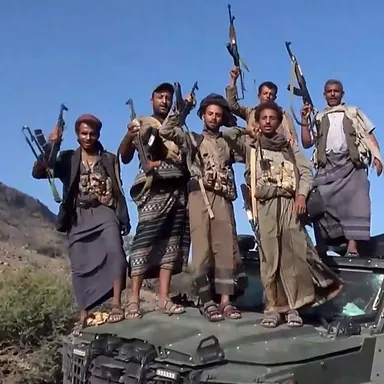
This episode of the Global News Podcast covers several stories from the past day. Government forces in Yemen have pulled back from an area overlooking the Bab el-Mandeb Strait, leaving it to the Iran-backed Houthis, and Yemen expert Iona Craig explains the pressure this puts on Saudi Arabia.
Other reports cover the death of drug trafficker Miguel Ángel Félix Gallardo, a state of emergency in Guatemala after gang violence, a WHO study on teenagers' low physical activity, a Taliban cricket ban in Kandahar, and Prince Harry's visit to Ukraine. Listeners also hear from a Canadian ultrarunner and a London typewriter poet.
In this episode Andrew Peach, Claudia Hammond, Iona Craig, Olivia Dodd, Philippa Roxby, Rachel Schwartz, Stephanie Case, Suzanne Bonamici
The transcript of this Yemen episode was made with the technology behind HappyScribe's AI note taker for Teams.
Ads in this audio differ from the text. Tap the sentence you're hearing to follow along.
Synced: the text now follows the audio.
This is the Global News Podcast from the BBC World Service. I'm Andrew Peach, and in the early hours of Monday, the 16th of November, these are our main stories. A major boost for the Iranian-backed Houthis in Yemen as government forces pull out of an area overlooking the Bab el-Mandeb Strait. One of Mexico's most notorious drug lords of the 1980s has died in detention. And a state of emergency in the east of Guatemala amid a surge in gang violence.
Also in this podcast, Britain's Prince Harry spends time with veterans on a surprise visit to Ukraine. And.
The whole environment, as beautiful as it is, is really there kind of attacking all of your senses. And so one little mistake could lead to a pretty big problem very quickly.
First woman to complete one of the world's most grueling challenges. Let's start in Yemen, where government forces say they're pulling out of an area that overlooks the Bab el-Mandeb Strait, leaving it in the hands of the Iranian-backed Houthis. Now, in the newsroom, we've been looking at dramatic footage showing government forces appearing to come under sustained attack before they pulled out.
The Bab el-Mandeb Strait is the gateway to the Red Sea and a potential choke point for international shipping, like the Strait of Hormuz in the Gulf. Now, both are threatened either by Iran or by its allies. Yemen expert Iona Craig has been talking to my colleague James Menendez.
They pushed out these southern forces before when they swept down onto the Red Sea coast in September, but now they have once again got the upper hand. They've got the potential now for further leverage over Saudi Arabia. And really, the question is now whether they will threaten the de facto capital of the internationally recognized government in Aden. But it also really speaks to what we knew already, which is the lack of unity in the internationally recognized government forces, the anti-Houthi forces, and what a lot of the forces that are now withdrawing are complaining about, which is a lack of unity in any kind of central military command.
And that really speaks to all of the divided fighting groups that are on the ground on the anti-Houthi side, which makes it extremely challenging to take on the Houthis, particularly in the mountainous areas. The anti-Houthi forces are now describing this as a tactical redeployment, but it is really a withdrawal and having to give up the Bab el-Mandeb now to the Houthis.
How embarrassing is it for Saudi Arabia, which backs those government forces? I mean, it has very sophisticated air power, and yet it seems they can't take on the Houthis.
This is the problem. You know, it doesn't matter really how much firepower you have in the air if you haven't got the ground troops that can follow up on that. The Saudis are now in a real bind, to be honest with you. Their options are: do they try and negotiate now with the Houthis and try and freeze these front lines now that southern forces have withdrawn? When the Houthis have got the upper hand, they have the Bab el-Mandeb as leverage. Or do they wait, but that runs the risk of the Houthis being in an even stronger position in a month's time when they're at the gate of Aden.
So the Saudis are in a really uncomfortable position right now, and it could get worse for them.
Is there any appetite in Saudi Arabia for negotiations?
Well, the trouble is at the moment very little, because the Houthis can maximize their demands. We know that includes them wanting Saudi Arabia to pay for civil servants' salaries, which runs into the tens of billions. Also, they effectively would be doing it now whilst putting a gun to Saudi Arabia's head, whilst they're firing ballistic missiles into Saudi Arabia.
And that was Iona Craig. One of the world's most notorious drug lords, Miguel Ángel Félix Gallardo, has died at the age of 80. He's widely considered to be one of the biggest drug smugglers in history, and his infamy was up there with the likes of Pablo Escobar and El Chapo. In the 1980s, Félix Gallardo created and managed the first great drug corporation in Mexico that dealt primarily in cocaine distribution rather than production. He was captured in 1989. This report from Helena Burke.
Drugs are menacing our society. They're killing our children. Last year alone, over 10,000 drug criminals were convicted, and nearly $250 million of their assets were seized by the Drug Enforcement Administration.
That's U.S. President Ronald Reagan back in 1986, when Félix Gallardo's power as a drug boss was at its peak. But the man who would become known as the Mexican Godfather actually began his career on the opposite side of the law.
He became a state judicial police officer and eventually became the bodyguard to the governor of the state of Sinaloa at the time.
Michael Vehill was one of the top agents of the U.S. Drug Enforcement Agency in the 1980s.
And it was through this governor that he started to meet a lot of very high-ranking politicians and officials from Mexico that would help protect him and give him guidance in terms of his drug trafficking activities.
Before the '80s, Mexican cartels primarily grew marijuana and smuggled it over the border into the U.S., while cocaine was the domain of Colombian drug lords. But Gallardo was highly ambitious and saw a new opportunity, forming a partnership with Colombian groups, particularly Pablo Escobar's Medellín Cartel. They combined production in the Andes with Mexican transportation across the U.S. border.
When Félix Gallardo was the head of the Guadalajara Cartel, he controlled drug trafficking throughout Mexico, and he controlled all of the routes along the 2,000-mile U.S.-Mexico border.
At its peak, the Guadalajara Cartel controlled entire police networks and governorships in Mexico. Michael Vehill spent years in the country tracking their crimes.
Miguel Félix Gallardo would take lives without any provocation, and without his associates knowing about it. He had sons of his associates killed. He had family members killed.
This violence came to a head in 1985 when the Guadalajara Cartel tortured and murdered a U.S. drug enforcement agent. Four years later, Gallardo was captured, spending the rest of his life in prison. In 2018, his rise and fall were portrayed on screen in the Netflix series Narcos.
Todos los narcotraficantes de este país trabajan para mí. En seis meses voy a ser dueño de los colombianos.
Gallardo died in hospital after suffering from health issues for several years. From the breakup of his organization, the Sinaloa Cartel emerged, which remains Mexico's most powerful drug cartel to this day.
Helena Burke reporting. The authorities in Guatemala have declared a 30-day state of emergency in two areas in the east of the country. It comes amid a surge in drug gang violence in the wake of the assassination of a congressman and several police officers. The killing of Julio Portillo comes a month after the former prosecutor and anti-corruption lawyer, Juan Francisco Salzano Foppa, was shot in the capital in one of the most significant political killings for decades. Last week, the U.S. designated two Guatemalan clans as terrorist organizations.
Rachel Schwartz is an expert on Guatemala at the School of International Studies at the University of Oklahoma.
These two very high-profile killings are happening in the lead-up to what is most certainly going to be a tumultuous and highly contested electoral season that is on the horizon in Guatemala. And so there's a sense that both of these assassinations, whether explicitly intended to or not, are creating a tremendous amount of political stability in the country during the last year of the current president, Bernardo Arévalos. We do not have accused perpetrators in either of the cases at the moment, but there has been an attempt since Bernardo Arévalo came to power at the beginning of 2024 to undermine his ability to carry out the basic functions of government.
And I think, you know, when you look at this in the context of the upcoming election, the first round will be in June 2027, what we see, I think, is perhaps an attempt to discredit more moderate or leftist political options that are sort of in the mold of the current president and allow a populist, authoritarian, tough-on-crime figure to gain attraction by creating an increasing sense of insecurity in the country.
Guatemala's political party system is one in which political parties don't have clear policy platforms oftentimes. These are political parties that are for sale to the highest bidder. And among those different bidders are drug trafficking organizations that do seek to collude with or co-opt these groups in order to ensure that their illicit profit streams are allowed to continue unimpeded. It is a state in which you do see in certain pockets collusion between organized criminal groups, local political officials, and sometimes local security forces, local bureaucrats, as well as national-level legislators as well.
But I do think that there are also pockets of the Guatemalan state that are staffed with highly professional, competent individuals who are trying to continue to do their job and uphold the rule of law under extremely difficult circumstances.
Rachel Schwartz from the University of Oklahoma. New research provides worrying findings about the fitness levels of teenagers worldwide. The study, conducted in 140 countries, monitored exercise trends among adolescents from 2010 to 2025. One in four reported having zero active days per week in 2025. On average, adolescents reported being active for 2.7 days a week, with the World Health Organization pointing out that in the past 15 years, there's been almost no progress in getting teenagers moving.
Claudia Hammond talked about the findings with our health reporter, Philippa Roxby.
They found things that they said were quite shocking and alarming about the lack of physical activity by teenagers. So one in four teenagers, as you said, said they did not do any activity at any point during the week. Now, activity at this point, we need to define activity. It means 60 minutes of exercise, moderate to vigorous exercise, so anything from brisk walking and cycling to full-blown running and playing sport. So an hour of that.
In a way, that's quite a lot, isn't it? Because you could have someone who, I don't know, I run three times a week for half an hour, but I also do cycling and walk lots of places and things. And I don't know if that would necessarily count, even though that seems like quite a lot.
That's true. Yes, it is quite a high tally. And if it doesn't add up to an hour every day, it wouldn't necessarily count. But this is the recommended guidance from the WHO for teenagers because they want them to benefit early from getting into a routine of lots of exercise and lots of activity, which will benefit them later in life too.
I guess it all depends on how fast you have to walk. Lots of us walk a lot.
Yeah. I mean, you have to be out of breath, ideally, I think is what they'd like for an hour.
What about girls and boys? Was there a difference there?
There was quite a big gender gap. So it's quite well known that teenage girls tend to fall off the amount of activity they do as they get older into the teenage years. So boys had an average of three active days per week. So for girls, it was closer to two. And actually, 28% of girls in this study said they weren't active at all during the week. So that's quite alarming.
Were there differences between countries?
Yes, huge differences between countries. For example, the most active countries were Finland, Canada, and Serbia, where about 28% of teenagers said they were active every single day. And the least active countries were Cambodia, Jordan, Madagascar, and quite a few others where the levels were a whole lot lower. And of course, there will be regional differences within countries. Sometimes it's difficult to lump all countries together, but Western countries, European countries, Southeast Asian countries tended to have higher activity levels.
And I guess people could be getting exercise in other ways in some countries.
Yes, that's true. I mean, there are lots of countries which didn't provide data in this study. So, for example, sub-Saharan countries. And so it's difficult to work out exactly how much activity is taking place there. And of course, activity can take place in different ways. For example, within the house, if teenage girls are doing chores, working outside, then that would count as activity. It just might not show up in this report.
And overall, though, this does seem to suggest that the interventions that have been tried over the past 15 years haven't been working as well as hoped.
Yeah, that's something the WHO says. Clearly, these interventions aren't working. What everybody is doing now isn't having the required effect. It's also been suggested that the digital world we live in is also having an impact, teenagers spending a lot more time on screens and not getting out outside. But clearly, there needs to be efforts to rethink how to make teenagers, encourage them to be more active, give them those opportunities, because that will have an impact on obesity levels as well, which are rising sharply among this age group too.
Philippa Roxby reporting. And still to come in this podcast.
If I just sat there on the bench, didn't make eye contact with anybody, but just typed away, and I had a little sign that said Poetry for Strangers, I captured people's attention.
We meet the typewriter poet whose office is a park in London. This is the Global News Podcast. Now to Afghanistan, and this is a sound that people in Kandahar may no longer be able to hear. It's commentary of a cricket match in Afghanistan, but the Taliban government has now banned radio stations in Kandahar from broadcasting cricket-related content.
The sport is hugely popular in Afghanistan. Our global affairs reporter, Ambassador Ethir Rajan, spoke to my colleague, Keith Adams.
Does this commentary sound like the South American football commentary?
It does. It's got some of that excitement to it.
Exactly. So there's a lot of passion, a lot of action, because the youngsters in Kandahar, they have nothing else to do because television is banned. So there is a television, but only audio. And this is the home of the Taliban leader, Haipatullah Khunzada, who is ultra-conservative, and he has been issuing quite a few decrees like this one. The youth in Kandahar, they've been hooked onto these cricket commentaries for the past few years. And that is why probably the correspondents there say they want to stop, because probably this is a form of entertainment.
They want the youngsters to move away and do something more constructive. But cricket has been a very popular game in Afghanistan. You know, it is one of the few full Test-playing nations, and it has done really well in some of the World Cups and One-Day Internationals, giving a big challenge to many of the established countries like India. So the radio stations were told on Saturday, no more cricket commentary and not even scores. So it is coming at a time when these youngsters were listening to cricket commentary. Now the Taliban says, you can't do it, but they didn't give any official explanation.
You're making it sound like a sort of generational thing. So young people are in the thrall of cricket and they're passionate about it, and that threatens the Taliban in some way because they don't want them to sort of be worshiping this false idol, as it were.
No, they've been going step by step. First, they banned any soaps and operas in television because women were shown sleeveless. So that is one of the reasons. And then they completely took off all the television pictures. And then they banned music. Then they burnt musical instruments. So the youth, for them, the only option is to listen to radio. And then cricket is a popular game. And that is one of the reasons why the youth were getting attracted to listening to commentary. But now the conservative leader, he thought that the youth were going probably in the wrong direction because there is no other way to explain why he banned the cricket commentary.
But that is many of the decrees are given without explanation, or some of them are regarded as un-Islamic. And this has come as a huge shock for the youth there in Kandahar province. Of course, this is only in Kandahar province, not in the rest of the country yet.
Ambassador Ethir Rajan reporting. Britain's Prince Harry has been on a surprise trip to Ukraine to meet injured war veterans who are competing in his Invictus Games. The Duke of Sussex spent two days at events for veterans with a press blackout for security reasons until he left the country, which continues to face attacks from Russia. He praised Ukrainians for their resilience and told the veterans they were role models. Our royal correspondent, Sean Cochland, has been traveling with the Duke.
Prince Harry received an enthusiastic reception on a surprise visit to Ukraine this weekend. He was in Lviv, showing support for the country's growing number of disabled veterans, including those who are taking part in his Invictus Games.
You can see by the reaction how much sport and how much this community means to them. So I'm just really proud that Invictus is able to facilitate this recovery and rehabilitation for them. But ultimately, it's the recognition of every single one of these guys is the most important thing. And look, it's harder to get into Ukraine and visit as many places as I'd like to.
He spoke of his belief that Ukraine would not be defeated in a way that was much more direct than an official royal visit.
What you are doing here is going to set your country up for success. You're going to win the war, and then you are going to be set up for success where lessons of the past have been learned.
It's been a war of changing technology that also includes advances in medical science to help so many badly injured casualties.
And now that you're in Superhumans, do you have prosthetics?
Prince Harry went to the Superhuman Centre near Lviv, where cutting-edge experimental techniques are being invented. Mikhailo Damaskin was so badly injured that he was never expected to walk again. But he says a spinal cord stimulator was implanted in his back, which allows him to walk. But he says he has to be plugged in and recharged every 12 hours, which is difficult during power cuts. And Prince Harry sat at the bedside of Konstantin Vyasenko, who was airlifted by drone from the battlefront in a rescue that had been the first of its kind.
He had been alone for more than 200 days and had stayed at his position despite losing both his feet and having carried out an amputation on himself. Ukraine now has more than 150,000 injured veterans. And Prince Harry's visit, bringing his Invictus Games as a message of resilience, was well received as a symbol of solidarity.
Sean Cochland reporting. As the COP 31 UN climate summit enters its second week in Turkey, the absence of an official American representation has raised some eyebrows. In fact, Washington is skipping the talks entirely after Donald Trump's decision to withdraw the US from the Paris Agreement, which seeks to limit global warming. There is a delegation of lawmakers from the Democratic Party at this summit in Antalya seeking to reassure the international community that America hasn't abandoned the fight against climate change.
One of those attending is the Democratic Congresswoman, Suzanne Bonamici. Rob Young asked her what kind of reception they've had.
We have been enthusiastically welcomed, and the discussions we've been having with everyone here have been very positive. Realistic about the work ahead, but very positive.
What, though, as American lawmakers, can you really offer those nations that want the US to take tougher action on carbon emissions, on climate change, when you may control, as you will in January, both houses of Congress, but won't be able to enact any legislation because Donald Trump will still be president?
I'm more optimistic than that because these are issues that people care about across the country and across the world. And this election wasn't even close. And the people sent an overwhelming message that they want change, and they want their costs to go down. And renewable energy can save people money in their budgets. It can help with our transition if we get a lot more good jobs. And that's going to help the country and the climate. We will work hard and pass legislation in the House and Senate.
We'll see what will happen with the president, but my guess is that on a lot of these ideas that are really good ideas that will help people, he might let them go into law.
Give us a sense of some of the measures that you think he might not veto.
There are ways that we can grow the economy through good jobs if we message this as a way that is going to help people across the country and reduce carbon emissions. We'll see. Because he is in office still, it does not mean that we're going to stop the important work to be done here at COP. And then when we get back to Congress, we are going to continue to fight because these are real issues. When we see across the country more extreme weather events, we see rising temperatures, it's a health issue as well. We'll fight and hope that we can get some of this legislation through and send a message that we are here to act on behalf of the American people and to address the increase in temperature and the increase in carbon pollution.
So because we have this president still in office does not mean that we will not keep working to address the climate crisis.
Do you get the sense when you're speaking to people from other countries at the climate change talks you're at in Turkey that the rest of the world is moving on without the United States?
In some ways, but the United States absolutely should be a leader here. It's been unfortunate because this is the fourth COP I've attended, and it's the first one where the United States is not a party. And that is detrimental to us as a country. We should be a leader. And so I'm hopeful that the next time we come back, we will actually be back in the Paris Climate Accord and use our US leadership. Even in the last several years, we've seen such an increase in extreme weather events. And that affects everybody, whether they're Democrat or Republican or not with a party.
There's too much at stake for us to just give up and say we're not going to work on these issues because Donald Trump is still president. We refuse to do that.
Organizers call it the ultimate test of human endurance at the bottom of the world. And maybe that explains why only a handful of people attempt the Antarctic Ice Ultra Marathon, a pretty brutal nonstop 160-kilometer annual race, which very few manage to finish. But the Canadian ultrarunner Stephanie Case has made history by becoming the first woman to complete the challenge, battling temperatures as low as minus 35 Celsius with severe winds along the way. She finished in 17 and a half hours.
Here's a taste of her journey from the start to an emotional finish.
Three, two, one. Let's go.
It feels pretty good to kind of have women on the map here. Let's go get some food.
Chantal Hartle spoke to Stephanie and asked how she felt after this remarkable achievement.
My body is feeling a bit rough, but every day it's getting a little bit better. But my heart is completely full, and I'm just ecstatic to be back home with my daughter. I might have just been to this extraordinary place setting a world record, but the best moment for me was just snuggling up with her, and I got to show her the photos of the penguins.
I mean, they call this the ultimate test of human endurance, and it looks quite brutal. Just tell me what it was like.
I knew it was going to be tough. I mean, it's Antarctica, but I didn't know exactly what conditions I would be facing or how my body was going to react. So it was funny. I had someone along with me doing some filmmaking of the event, and this is a guy who is in his mid-20s, and he's a pretty tough guy. And even he said afterwards, "That was a lot harder than I thought it was going to be." And I think that was an understatement.
The whole environment, as beautiful as it is, is really there kind of attacking all of your senses. And so one little mistake could lead to a pretty big problem very quickly. And that was hanging over my head for the entire race. The race was 38 loops of 4.2 kilometers. And so it really wasn't until I was on that final loop that I started to think, "Hell yeah, I might actually be doing this." And when I crossed the finish line, it hit me like a ton of bricks. I think everything that was in my head, not just in those 38 loops, but in the months of training and prep leading up to this all kind of came out.
And what I didn't realize at the time was that my two-year-old daughter, Pepper, was at home watching me finish on the live stream, which I think if I knew, I would have just completely broken down even more. And you are the first woman to have completed this race too. Before, there was just a blank in the history books, and now you've cemented your place.
Yeah, it feels pretty good. There was a photo of a penguin next to the women's 100-mile record beforehand on the website. So now I'm quite happy to say that there will be a photo of a human beside it. But it's not because women aren't capable of doing this distance. It's just because of the underrepresentation we have generally of women in trail and ultra running events. It's getting a lot better, but when the distance increases, and then you add on the extreme elements of a place like Antarctica, we just aren't seeing as many women there.
And that's because of all sorts of factors, but the burden of childcare still falls overwhelmingly to women. There are financial barriers. There's all sorts of social-cultural barriers. So I thought it was really important that I go out there and make sure that women are on the map because the more that we see women out doing these things, I think it helps to widen the space for women to be able to take that step in their own backyard.
The Canadian ultrarunner Stephanie Case. Now, later this week, Anthropic, the developer of the Claude chatbot, will start trading on Wall Street. It's thought the offering could raise as much as $64.4 billion. That would be the second largest IPO in history. One woman who's trying to take us back to a time before anxieties about AI and tech is writer, actor, and poet, Olivia Dodd. She's gained a following on social media for her work on a typewriter. You'll often find her on a London Park bench where people approach her and ask for a poem.
Here's a flavor of the requests she gets.
What can I write for you about?
It's okay if you feel a little lost, if you need a little time to heal from stuff.
What can I write about for you?
I feel like I'm simultaneously ahead and behind at the same time. There are a lot of people in my life who, as much as they try to kind of understand and get what I'm doing, they don't.
And when she came to our studios with her typewriter, she composed a poem inspired by the news.
How do we find enchantment in this fleeting world where speed overtakes the quiet respite of the mind? Where we become reliant on flashing lights and tempting screens when the vast landscape within offers answers existing only in dreams, only in the data our heart collects.
Olivia Dodd is going to publish a book next year about her life as a typewriter poet, as she's been telling Julie Warwicker.
I'm American, but obviously the British are known to be a bit reserved, a bit cold, right? But I found that if I just sat there on the bench, didn't make eye contact with anybody, but just typed away, and I had a little sign that said Poetry for Strangers, I captured people's attention. And slowly but surely, people come over and say, "What on earth are you doing? Why is there a typewriter in the park?" And so I'd explain, I'd say, "Well, do you want a poem? Can I write you something?" And it's beautiful. I think poetry is a permission slip to be vulnerable and to speak about our feelings and our emotions.
The minute I tell people, "I'm going to write you a poem," you can see in their eyes they go to a place of memories or they go to a deeper place.
But you're asking quite a lot of yourself in that, aren't you? Because somebody might throw you well, you have no idea what they're going to throw you by way of a theme. And almost immediately, you have to turn that into a poem.
Yes. My brain loves the challenge. I find the minute someone speaks to me, I will see certain images or colors or ideas while they're speaking to me. And so the poem comes quite quickly. And then it's just a stream of consciousness while I'm writing. As a writer, it's been a beautiful act of trust of just saying to yourself, "Nope, the first words that come into my head are the right ones. And those are going on the paper. I'm not going to overthink it. I'm not going to say, 'Oh, how could I make this better? Or could I make this clever?
Or could I make this rhyme?'" No. The reactions range. It's beautiful, though. I find when I read someone a poem, it usually does have quite a visceral emotional reaction. There's either tears or a lot of laughter or a lot of deep breathing. I've had people email me or message me kind of a year after a poem sometimes saying, "Oh, this happened in my life, and now this line in the poem makes sense." Or I keep your poem folded up in my wallet, and I look at it when I need a bit of reassurance.
Olivia Dodd with Julie Warwicker. And that's all from us for now. If you'd like to get in touch, do drop us an email, globalpodcast@bbc.co.uk. This edition of the Global News Podcast was mixed by Nick Randall. The producer was Emma Joseph. The editor is Karen Martin. I'm Andrew Peach. Thanks for listening. And until next time, goodbye.
Yemen's Saudi-backed government has been redeploying its forces to protect its temporary capital, Aden, after advances by the Houthi movement which is backed by Iran. They've withdrawn from an area overlooking the strategic Bab al-Mandeb Strait at the entrance to the Red Sea. It signalled the end of a six-week counter offensive to retake coastal territory from the Houthis, whose control over the Yemeni side of the Strait has further constrained Middle East oil exports. Also: the architect of Mexico's cocaine trade Miguel Ángel Félix Gallardo dies at the age of 80. Guatemala declares 30-day state of emergency amid drug trafficking violence in the eastern districts of Zacapa and Izabal. WHO research published in Lancet Global Health finds one in four teenagers worldwide has not been physically active for at least 60 minutes on any day in the previous week. Taliban authorities ban cricket on Kandahar radio. Prince Harry praises war veterans on surprise visit to Ukraine. Canadian Stephanie Case becomes the first woman to complete the Antarctic Ice Ultra Marathon. And how London-based typewriter poet Olivia Dodd connects with strangers.
The Global News Podcast brings you the breaking news you need to hear, as it happens. Listen for the latest headlines and current affairs from around the world. Politics, economics, climate, business, technology, health – we cover it all with expert analysis and insight.
Get the news that matters, delivered twice a day on weekdays and daily at weekends, plus special bonus episodes reacting to urgent breaking stories. Follow or subscribe now and never miss a moment.
Get in touch: globalpodcast@bbc.co.uk
Photo: Houthi fighters standing on a damaged truck during what the media center described as an offensive against Saudi-backed Yemeni forces in Taiz province, Yemen.
Credit: HOUTHI MILITARY MEDIA CENTER/HANDOUT/EPA/Shutterstock