
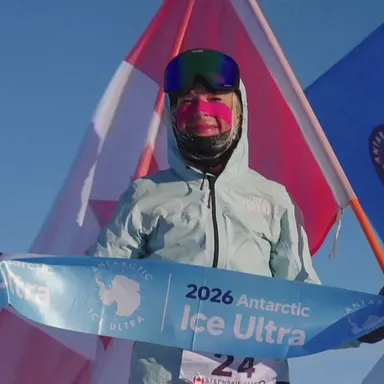
This episode of the Happy Pod from the BBC World Service covers Canadian ultra-runner Stephanie Case, who became the first woman to complete the 160-kilometre Antarctic Ice Ultra, and what the race demanded in sub-zero conditions on a looping course. She also reflects on motherhood and the barriers women face in ultra running.
Other segments follow a young Sudanese boy who received a message from footballer Vinícius Júnior, a UK drama group creating sound-based theatre for blind and partially sighted performers, a Singaporean entrepreneur whose chopstick robotics kits reach schools worldwide, a chimpanzee in Florida fed by drone during floods, and African athletes at the Youth Olympic Games in Senegal.
In this episode Chantal Hartle, Claire Graham, Nkechi Obonha, Chong Nging Kai, Helen Kennedy, Rosemary Owankwa, Sarah Poyer, Scarlett Balta, Stephanie Case, Tre Rugamba Gateja
This Happy Pod episode on Stephanie Case's Antarctic ultramarathon record was made with the technology behind HappyScribe's subtitle generator.
Ads in this audio differ from the text. Tap the sentence you're hearing to follow along.
Synced: the text now follows the audio.
This is the Happy Pod from the BBC World Service. I'm Chantal Hartle, and in this edition, what's it like being the first woman to complete an ultra marathon in Antarctica?
I might have just been to this extraordinary place setting a world record, but the best moment for me was to be back home with my daughter, and I got to show her the photos of the penguins.
The young Sudanese amputee who's been spurred on by a message from his football hero.
It was like seeing a new child. He had this confidence, he had this happiness that radiated from him. It was amazing to see him flourish.
We meet the actors using sound to bring theatre to life for visually impaired people.
It's lovely to meet new people who are visually impaired or blind, and that's been really, really good. I didn't even imagine that I could have improvised the way I did.
The Singaporean making robotics more appealing to children worldwide using chopsticks.
I've had kids in Singapore come up to me and say, "Hey, you're that stick-um guy. One day I want to be like you and solve problems." I think that's really cool.
Plus the chimpanzee that had his own drone delivery service of bananas. Organizers of the Antarctic Ice Ultra Marathon call it the ultimate test of human endurance at the bottom of the world. Only a handful of people attempt this extraordinary nonstop 160-kilometer race each year, and even fewer finish. But the Canadian ultra runner Stephanie Case has become the first woman ever to complete the challenge, battling temperatures as low as minus 35 Celsius and severe winds along the way.
She finished the course in 17 and a half hours. Here's a taste of her journey from the start to an emotional finish.
I'm feeling nervous. I'm feeling nervous. It's cool.
Three, two, one. Let's go.
That's amazing. It feels pretty good to kind of have women on the map here. Let's go get some food.
While after some food and a much-needed sleep, I caught up with Stephanie to see how she was feeling about her historic achievement.
My body is feeling a bit rough, but every day it's getting a little bit better. But my heart is completely full, and I'm just ecstatic to be back home with my daughter. I might have just been to this extraordinary place setting a world record, but the best moment for me was just snuggling up with her, and I got to show her the photos of the penguins.
I mean, they call this the ultimate test of human endurance, and from what I've seen, it really it looks quite brutal. Just tell me what it was like.
I just wasn't sure what to expect before I went. I knew it was going to be tough. I mean, it's Antarctica, but I didn't know exactly what conditions I would be facing or how my body was going to react. So it was funny. I had someone along with me doing some filmmaking of the event, and, you know, this is a guy who is in his mid-20s, and he's a pretty tough guy. And even he said afterwards, "You know, that was a lot harder than I thought it was going to be."
And I think that was an understatement. The whole environment, as beautiful as it is, is really there kind of attacking all of your senses. And so one little mistake could lead to a pretty big problem very quickly. And that was hanging over my head for the entire race. The race was 38 loops of 4.2 kilometers, and so it really wasn't until I was on that final loop that I started to think, "Hell yeah, I might actually be doing this." And when I crossed the finish line, it hit me like a ton of bricks.
I think everything that was in my head, not just in those 38 loops but in the months of training and prep leading up to this, all kind of came out. And what I didn't realize at the time was that my two-year-old daughter, Pepper, was at home watching me finish on the livestream, which I think if I knew, I would have just completely broken down even more.
That must be such a special moment that she's going to be able to watch, you know, when she's older, and to see her mom have this huge accomplishment. And you are the first woman to have completed this race too, before there was just a blank in the history books, and now you've cemented your place.
Yeah, it feels pretty good. There was a photo of a penguin next to the women's 100-mile record beforehand on the website, so now I'm quite happy to say that there will be a photo of a human beside it. But it's not because women aren't capable of doing this distance. It's just because of the underrepresentation we have generally of women in trail and ultra running events. It's getting a lot better, but when the distance increases, and then you add on the extreme elements of a place like Antarctica, we just aren't seeing as many women there.
And that's because of all sorts of factors, but one of them, you know, the burden of childcare still falls overwhelmingly to women. There are financial barriers. There's all sorts of social-cultural barriers. And so I thought it was really important that I go out there and make sure that women are on the map, because the more that we see women out doing these things, I think it helps to widen the space for women to be able to take that step in their own backyard.
A couple of practical questions. I know that people have been really interested about, with the Antarctic Ice Ultra Race bathroom, how did you cope not being able to just go when you needed to?
It was actually a huge stress of mine, particularly after having a baby. You know, any mother I think will relate that sometimes when you have to go to the bathroom, you have to go to the bathroom. And unlike any other trail or ultra event where you can just pop into the woods, that was not an option in Antarctica. They take biosecurity very seriously, thank goodness. You really need to leave as little of a trace as possible. All of the waste from the toilets, even at this research base in Antarctica, gets flown out to Cape Town on the plane with you.
Wow.
So, yeah. So going to the bathroom was an extra logistical hurdle. There was a little kind of container at about 2 km out in the course, so you really had to time yourself well and then get in and out as quickly as possible. And when you're wearing all of those layers and you're conscious that, you know, your hand being out of your gloves for 5 seconds or your pants being down for 10 seconds can really cost you about 20 minutes in time to warm up again, it was a pretty big thing to have to work into the race plan.
Ultra marathon runner and now record holder Stephanie Case. Last year, while reporting in Sudan, a BBC team met Zahir, a young boy who had lost both his legs in a drone strike. Football was where he found joy, and he continued to play with his friends on his knees. His story touched so many viewers, and after a fundraising campaign, Zahir was able to have specialist treatment in Egypt, including being fitted with two prosthetic legs. And recently, the same team of journalists caught up with him again in Cairo, with a surprise message from his favorite footballer, Real Madrid's Vinicius Junior.
Zahir, marhaba. I know how difficult the last few months must have been for you. I really hope you will make good use of your new prosthetic legs, that you return to playing football, and that you find happiness. You deserve it. Stay strong. Send my love to your mom, who will be able to help you a lot, and to all your friends. We are together in this.
BBC producer Scarlett Balta was among the team following Zahir's progress, and she told us what it was like meeting him in 2025.
At the time, we could tell he was very special. You know, he was very shy and reserved. You know, he was this very little boy in a very big wheelchair. Instantly, I think we felt a very strong connection with him and, you know, wanted to find out more about him and what he'd been through. The thing that really brought him to life was going and playing football with his friends. You know, seeing him and his determination as he was kind of running on his knees, kicking the ball with his knees. He was very withdrawn, you know, yes-no answers, very shy.
But, you know, the minute you spoke about football, Real Madrid, he was in his element. This boy had a very big impact on our lives, and going to revisit him felt like a huge privilege. But, you know, also, you know, he's 13 now. It was like seeing a new child. He had this confidence. He had this sort of happiness that radiated from him. It was amazing to see him flourish in a completely new environment and trying out new activities like bowling. He also went horse riding.
It's been really special. My editor, when we, you know, wanted to do this follow-up, when we heard that Zahir was having this treatment and getting these prosthetic legs, he was like, "We have to go and see him. We have to go and see him. But we have to get a message from Vinicius." And I just looked at him and I thought, "Have you lost your mind? This is one of the biggest footballers in the world, you know, a superstar." And I just thought, "He's gone mad." And then I thought, "You know what? I'll just give it a go." It was a lot of emails, a lot of calls, but one of his agents did actually reply and, you know, watch the video.
And I think for Zahir, it was super exciting, but also very, very overwhelming. One of the things that the family said was that they couldn't believe the response that the report had got, you know, the amount of people who wanted to help Zahir, the amount of people who his story resonated with. And then to have one of the biggest footballers in the world engage with your story and respond to it and talk to you directly, I think that was a huge, huge moment for not just Zahir, but for the community and his family.
Scarlett Balta. Now to a workshop helping blind and partially sighted people in the UK create theatre using sound rather than visual effects to tell their story. The group in Northern Ireland are developing a comedy involving a jilted bride on her wedding day, which will eventually be performed for a live audience who will all be blindfolded. For some of the participants, it's a return to drama after decades away from the stage, but for others, it's an opportunity to discover abilities that they never knew they had and also to make new friends.
Claire Graham has been along to rehearsals.
Hello. Where's the bride? Where's the bride? Who's the bride?
Oh, me.
Oh. Oh, okay. Oh, well, we can work with that.
It's the morning of Nola's wedding, and things aren't going to plan. But this room is filled with props, from gravel in trays to jugs of water.
Go. You'll have to bring it up.
These characters are played by those with sight loss.
I'm Helen Kennedy, and I love dram, but a lot of the clubs don't want me in the group because they're afraid I'll fall off the stage. So because my whole life is sightless and it's all sound-based, this is just perfect for me.
This is all about using signs to tell stories on stage. Sightless Cinema was founded by Ciarán Taylor 12 years ago.
So Sightless Cinema is cinema without any pictures, and it's created by people who are blind and visually impaired. So the idea is bringing together theatre devising techniques and sound and radio drama techniques. And today we're doing a Foley workshop, making live Foley sound effects, bringing those together to create stories in sound, which we present then in surround sound in theatres and in cinemas where blind and sighted can enjoy the experience together without any audio description, you know?
So it's a shared experience.
Hello, photographer.
Oh, hi.
Gareth, tell me, why did you decide to get involved in this group?
Well, I love meeting different people, and I also am very fond of drama, and I love experimenting with different sounds as well.
How important is it to make sure that people who have got sight loss are engaged with the arts?
Well, I think it's very important because, as I've said, you know, performing arts, should it be singing or dancing or drama, it's a way of expressing yourself. And we can express ourselves, you know, in many different ways.
Oh, lovely to see you.
Oh, Dorsi, lovely to meet you. What have you made of this group?
It's been great fun. I had no idea what we were coming into, but it's lovely. I've met new people who are visually impaired or blind, and that's been really, really good. We've made friendships. I didn't even imagine that I could have improvised the way I did. That was really, really good fun.
While the cast have traveled here today. All the hard work will pay off when they perform at Queen's University, and the audience will be blindfolded.
Good. Yeah, and just more gently then, yeah, just more thinking.
Finally, when are you taking this on tour?
Well, I'm picking West End. That's the start of it. Coming up in the Happy Pod.
It was more unity, and I feel like that's for the greater good. It really impacted my life. I made new friends.
African athletes reflect on the success of the Youth Olympic Games in Senegal. You're listening to the Happy Pod from the BBC World Service. From a young age, Chong Nging Kai from Singapore was fascinated by invention, building his own contraptions at home. He went on to create a social enterprise, Stickham, which provides schoolchildren with affordable robotics kits made from chopsticks. Those kits are now used by 45,000 students across 500 schools worldwide.
And Kai's success has been recognised by the organisation One Young World, which highlights the achievements of entrepreneurs under the age of 35. He told me where it all began for him.
I've always been a builder. I was building all kinds of things. I would even sell them to my classmates at the time. I remember my first so-called venture was selling hand-drawn Pokémon cards to schoolmates for like a dollar. When I was about 10 years old, my dad brought me to this organisation called Engineering Good, which is basically a charity that takes young people, engineers, tinkerers, they like to build things, and they will pair them with people with disabilities. This is where, at a very young age, I kind of realised that, oh, technology can be used for good and actually can be used to build useful things.
When did you realise that this passion of yours was something that you could actually scale up and turn it into the business that you now have today?
After I finished secondary school, I started working as a robotics trainer. Although it was really fun and very, very profitable, I started to realise that it was very limited to families that had money to afford these classes. And I thought, you know what? I think I have the skills to come up with my own creation. I can make it much cheaper, much more accessible, and most importantly, much more engaging and entertaining for kids all around the world.
I know that chopsticks is a key component of these kits, but there's more to it than that, isn't it? Just talk me through what's in these kits and what it looks like.
We always joke that, you know, you can build anything with chopsticks. Stickham kits comprise mainly of 3D-printed geometric connectors. So you can just imagine a bunch of different shapes, different colours. It comes with chopsticks of different lengths, so you can build different things. You can cut them down, size them up. You can build really tall towers, catapults, all kinds of contraptions. We also have a very, very simple plug-and-play electronics board, which means that you can actually build functional robots out of chopsticks. So instead of building just a robot that drives around, we would actually encourage them, hey, we have someone who is missing an arm, and he needs an assistive device to help him open a door or drink soup from a bowl.
If we're able to give kids more and more opportunities to solve real-world problems, then hopefully, when they grow up, they will become a better problem solver.
This is spread to many different countries, hasn't it? This is not just something that is now in Singapore. It's actually.
Yeah, it is.
You're distributing kits around the world.
Yeah. So we're currently in 22 countries, mostly in Southeast Asia, but we have the occasional school in like Canada, Pakistan. I actually just came back from Pakistan. We went to a very remote part of Pakistan called the Hunza Valley, where these schools really have no, very, very little technology. But it was really fun because we've sent Stickham to all kinds of places, and we always get the same response. The kids, within one hour, they're building all kinds of crazy things. The classroom is noisy and messy. We have places like village schools in Uganda.
We have floating water schools, schools that are literally built on stilts in Sabah, Malaysia. All kinds of schools are able to utilise our hardware and software.
Kai, you have spoken previously about having ADHD and how you've seen that as part of your ability to be able to create better things. Just talk to me a little bit about that.
Yeah. So I think there's a common misconception about ADHD that it's a so-called like disability. I think ADHD really is a superpower, especially when you start to understand how it works. I was very, very lucky that at a very young age, my parents were very supportive of me and my condition. And as I started the company, I think the creativity really, really showed. The ability to see different angles and, you know, keep asking questions, why are we doing it this way? Why are we doing it that way? This has really allowed us as a company to push the boundaries of what's possible.
And that has been recognised now. One Young World is just the latest award that you've won, Entrepreneur of the Year. Many other awards. You were recognised by Forbes as well.
Yeah.
What does it mean to have this sort of global recognition for the work that you're doing?
I think it's important because I can guarantee that there is a young person out there who maybe has ADHD or maybe doesn't feel like they don't really fit in academically. And being able to spotlight that, hey, there are people out there that might be similar to me and were able to achieve really cool things and solve real problems and make an impact on the world, I think is really cool. I've had kids in Singapore come up to me and say, hey, you're that Stickham guy. One day I want to be like you and solve problems. I think that's really cool.
Now to Florida, where a chimpanzee at an ape sanctuary had a special delivery of bananas and other goodies airlifted by drone. You may have seen a video of the 38-year-old chimp, Caleb, munching a banana from a bag dropped next to him. It's had millions of views. He'd gone to an outdoor area that had become cut off by floodwater, prompting staff to get creative to deliver him his food. Sarah Poyer from the sanctuary told us what happened.
We had quite a significant amount of flooding that I've never seen before. Thankfully, all of our chimp buildings were raised high enough that flooding did not affect the buildings, but the surrounding area was very much underwater. Now, this was the only island where the area that connects, we call it the land bridge, that connects the building to the island. This is the only building that had some significant flooding in that area. And Caleb was the only one out on the island, so he's in a group of 21 chimps.
He was the only one out there, so we were not sure if he could make it back indoors because we weren't sure how deep that water was. So just to be extra safe, we decided to send him his meal via drone. So he got his meals dropped to him. He got some warm blankets dropped to him. And not too long after that, one of his family members, Manny, saw that he was getting some goodies out there and did actually go way through the water to get out onto the island with Caleb. So you'll see a video of him sitting with his blanket next to Manny and Manny's grooming him because Manny wanted to see what goodies he could get too.
So that showed us that he was not stranded out there. He just didn't want to go through the water to get to the building. And then later that next day, he actually did go through the water to get to the buildings. So we don't use drones very often. If we have any concern at all, we'll launch the drone, or if it's gone a certain amount of time where they haven't come in to get fluids or a meal, we'll go out to them. It has a great camera on it, so we're able to get a really good view of them. We can even get their respiratory rate. We can see their gum colour.
We'll watch them to see what they eat, and that really gives us a better assessment of their health and if we need to do anything more significant or we just need to wait for them to feel better and to come indoors. So it's really just a way that we can closer observe them in an area that we normally can't see them very well.
Sarah Poyer. Well, to end this edition, let's reflect on the history-making Youth Olympic Games in Senegal that concluded on Friday. Nearly 3,000 young athletes from more than 200 countries competed across a wide range of sports in the first ever Olympic event on African soil. African athletes picked up a record number of Youth Olympic medals. Focus on Africa's Nkechi Obonha has been speaking to some of the competitors.
Young athletes have showed up with so much energy and technique at the Games, and there have been so many global firsts for Africa. One is Nigeria as the first nation to have 100-meter champions in both male and female categories.
We are good. We are good sprinters. We know how to condition ourselves to stay where we are. And it's a history for Nigeria, for us to be able to win the two Youth Olympics and the one hosted in Africa too.
That is 17-year-old Rosemary Owankwa, Nigerian gold champion who ran 100 metres in 11.16 seconds. Let's hear more from her and 17-year-old Tre Rugamba Gateja, who represented Uganda in the Rugby Games. I asked both of them how they got into sports, starting with Rosemary.
I started 2023. I just used to see people run and I just like it. It was my hobby then, so I just like running.
And for Trey, when did you start and what's your sport?
I play rugby. I play the type of rugby called sevens. What really made me start playing rugby? I started my first year in high school. What made me start was my coach and the second person was my best friend at school. Because rugby is really a sport for big people, and he was the only small person who used to play, and that motivated me to start playing.
For you, Trey, you've made it now to the Olympics, the first on the African soil. What did it take for you to get there?
For the smaller part, it was hard work, but the bigger part, I believe, is God. Because I didn't work the hardest, and I'm not the only person that worked. I believe so. So prayer. That's what got me to where I am today. And I have a lot of support from my family, especially my mum and my friends and my whole school.
It's the same thing.
Really?
And also believing in myself, trusting my coach.
Yeah, that's true.
And trusting the process.
How did you feel after you were selected to represent Nigeria, Rosemary?
I feel great. It's not my first time though, but I'm so happy to be selected for the Olympic team.
And for you, Trey, I mean, you're representing Uganda at the first Olympics on the continent. What was that like?
It felt like such an honour. It felt very good. Maybe one of the best feelings that I've ever felt in my life. I will always remember this memory. It's like the biggest responsibility I've ever been given in my life.
And what has been your biggest lesson playing against the different teams, Rosemary?
It was a very good experience for me because I get to compete with other athletes who train differently, who do different things from what I do. And it was a big difference, and it was a big experience for me, and I'm grateful for that.
And you made the 100-meter title in 11.16 seconds. Tell me about when you hit that finish line. What was that moment for you?
It was a crazy moment, and I couldn't believe it because I was speechless. I was just saying, God. I was so grateful to God for what he has done.
What dreams do you have for the future regarding the sport of rugby, Trey?
One of the biggest dreams I have is to give faith and give hope to the young people in Uganda that rugby can actually go so far. Rugby can be a source of family. It doesn't always have to be about the money. It can just be for the greater good. My dream is just for the younger people in rugby to actually enjoy it and actually to love it and have bigger opportunities. That would be my dream. What I really liked in Senegal is that despite what country you're from, it was more of family. It was more of unity. And I feel like that's for the greater good.
It really impacted my life. I made new friends. It was a big impact into my life and my social network.
And that's all from the Happy Pod for now. If you want to send us an email, the address is globalpodcast@bbc.co.uk. This edition was mixed by Charmony Ashton Griffiths. The editor is Karen Martin. I'm Chantelle Hartle. Until next time, goodbye.
Before taking on Antarctica's 160 kilometre ultramarathon, Stephanie Case said she wanted to show her daughter what mothers can achieve even in the toughest places on Earth. The Canadian ultra-runner has now made history, becoming the first woman to complete the race. Case says she wanted to prove that ''motherhood isn't the finish line''.
Also: we catch up with a young Sudanese boy who received a surprise message from his favourite footballer, the Real Madrid player Vinícius Júnior. We visit a drama workshop where actors use sound to create theatre for blind and visually impaired people. How robotic kits with chopsticks are inspiring children around the world. The African athletes who have made history at the Youth Olympic Games in Senegal. Plus the chimpanzee in Florida that had his own drone delivery service of bananas.
(Photo: Stephanie Case pictured after completing the Antarctic Ice Ultra 2026. Credit: Reuters)
Presenter: Chantal Hartle.
Music composed by Iona Hampson