
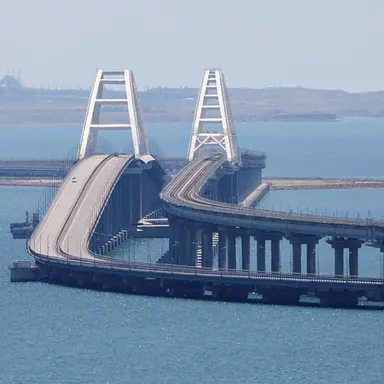
This Global News Podcast episode covers a fast-moving round of world stories. Ukrainian drone attacks reportedly hit the Kerch Bridge linking Russia to occupied Crimea, while Western countries urge Israel to speed up aid to Gaza before winter.
The Indonesian president apologises for haze from forest fires, and experts explain how an early weakening of the polar vortex could bring colder winter weather. The programme also looks at Brexit reassessment, a possible return for Nvidia's Jensen Huang, the push to regulate killer robots, and the controversy over moving the Shakespeare Institute to Birmingham.
Listeners get concise context from correspondents and experts.
In this episode Janet Jaleel, Archana Shukla, Georgia Hines, Jonathan Head, Liz Bentley, Michael Dobson, Rob Watson, Sarah Rainsford, Stuart Russell, Yolande Nel
This transcript of the Kerch Bridge drone attack episode was made with the technology behind HappyScribe's AI note taker.
Ads in this audio differ from the text. Tap the sentence you're hearing to follow along.
Synced: the text now follows the audio.
This is the Global News Podcast from the BBC World Service. I'm Janet Jaleel, and at 15:00 GMT on Monday, the 16th of November, these are our main stories. Moscow says Ukraine has launched what appears to be its biggest drone attack so far, including hitting a symbolically important bridge linking Crimea to Russia. After this month's heavy flooding in Gaza, Western countries call on Israel to stop blocking humanitarian aid before winter fully sets in.
Days after Nvidia's chief executive, Jensen Huang, resigned over an affair with a suspected Chinese spy, reports say that he may be trying to make a comeback. Also in this podcast.
To be or not to be, that is the question. Well, that is nobler in the mind to suffer the slings and arrows of outrageous fortune.
To be or not to be in Birmingham, the row over a decision to move the Shakespeare Institute out of its historic home in Stratford-upon-Avon. As targets go, the Kerch Bridge is highly symbolic. It links Russia and the Ukrainian peninsula of Crimea and is the longest bridge in Europe. Crimea has been occupied by Russian forces since 2014, so the Kerch Bridge has been repeatedly targeted by Ukraine.
Its latest attack caused big tailbacks, but the Kremlin spokesman, Dmitry Peskov, played down the impact of the attack on the bridge.
That was a massive drone attack. Our air defense systems are still continuing to operate very effectively. The assessment of the minor damage to the bridge is currently ongoing. Traffic on the bridge is continuing.
Russia said Ukraine also fired more than 1,000 drones overnight. At the same time, there have been reports of further Russian strikes on cities in eastern Ukraine, and blackouts were reported in the port of Odesa after power plants were hit. Our correspondent in Kyiv, Sarah Rainsford, told me more about the attack on the bridge.
The reports are coming from Russia and from the Russian-backed authorities in Crimea at this point. They have reported some damage to the Kerch Bridge, the bridge that links the Crimean peninsula to the Russian mainland. Now, initially the report came from the local authorities there, talking about a tailback, the bridge apparently being closed. The Kremlin spokesman, Dmitry Peskov, has since said that the damage was minor. He said it was being evaluated and that the bridge was operational. The Ukrainian security services were asked them to comment on that. They haven't commented, but certainly it does come in the midst of what seems to have been a large-scale attack on Russia with multiple drones from here in Ukraine overnight.
Russia is saying it's a record number of drones. Ukraine isn't confirming that. But as you said, certainly the Crimean Bridge has been targeted in the past. It seems from reports on the ground this time, this could have been an intercepted drone that fell on the bridge rather than a direct hit, but it would have been a symbolic target if it were hit.
And Sarah, you talked about these drones being fired from Ukraine onto Russia. What were the targets? And does the concern about restrictions on Starshield, a satellite communications system, do those concerns appear to have gone now that Ukraine is able to fire so many drones?
Yeah, the restrictions on the Starlink, the Starshield system, don't affect Ukraine's long-range strikes. Ukraine calls them long-range sanctions, but these are the long-range drone strikes reaching deep into Russia, which it has been carrying out for several months now against particularly targets within the energy sector, so targeting oil refineries and production facilities inside Russia. Those strikes have continued, and they haven't apparently been affected in any way by the restrictions. The restrictions affect Ukraine's ability to intercept Russian jet-powered drones coming in this direction, and also its kind of shorter-range strikes around the front line.
So those restrictions still appear to be in place. Certainly President Zelensky has referred to them several times. He's urged the Americans to lift those restrictions and to allow Ukraine to defend itself fully. So that appears to still be the case. But yeah, those long-range attacks into Russia do appear to continue and appear to be hitting a number of targets there.
Negotiations have restarted, but there's little sign of progress.
Yeah, I think it's important to say that, of course, the missile strikes, the ballistic missile attacks, and also the drone attacks from Russia into Ukraine have continued and have also escalated. Overnight, we had multiple air raids. There have been civilians killed in Zaporizhzhia and in Dnipro in the east of this country. There has been an attack on an energy infrastructure in Odesa. There's widespread blackouts there and across the country. So the aerial war is escalating even as those negotiations have begun again.
Sarah Rainsford in Kyiv. The situation in Gaza, where most of the population is displaced, was already dire even before a heavy storm earlier this month caused flooding and a landslide inundating thousands of tents. Much of the Palestinian territory remains in ruins after Israel's war with Hamas. But despite this, Israel is still blocking many aid deliveries to Gaza. Now, in a joint statement, the UK, Australia, Canada, and Italy have called on Israel to allow rapid and unimpeded humanitarian access.
We've voiced up part of the statement released by those countries' foreign ministers.
150,000 tents and other vital supplies are being held at the border and prevented from entering Gaza. This situation is entirely reversible, and there is still time to act before the winter fully sets in.
Our Middle East correspondent, Yolande Nel, told me more about this warning from Western countries.
This is coming, of course, at a time when most people in the Gaza Strip are still living in temporary shelters where there are these dire living conditions, and it's extremely overcrowded. We've had warning after warning from UN officials. There was one last week about an acute rise in respiratory illnesses because of the situation in Gaza. And just over a week ago, there was that first really severe storm of the winter season that brought heavy flooding into Gaza.
So the purpose of this statement coming right now is really to try to get Israel to act. What they want to see is all of the crossings for goods open so that winter supplies can be rushed into Gaza. And they want Israel also to ease some of the restrictions it imposes on what it calls dual-use items. These are basically items that Israel sees could have a military purpose as well as a civilian one. And that applies to lots of humanitarian goods, things like tents and tarpaulins and ropes, solar panels, other things like parts for desalination plants.
This is something that UN officials have frequently been complaining about.
And this is just the latest call for Israel to allow in more aid supplies into Gaza. Even the US-led Board of Peace, which rarely criticizes the Israeli authorities, has said that more needs to be done to help the people of Gaza. What's the Israeli response been?
You're right. So there was a statement from the European Union like this on Saturday. And a week ago, the Board of Peace put out a statement describing Israel's response to the situation as being insufficient. What we've had from Israel, really, they have said that blame has to go to Hamas, calling it responsible for the devastating situation in Gaza, the humanitarian crisis, because it carried out those deadly attacks on Israel more than three years ago.
The Israeli body which controls the crossings into Gaza has been saying that it works with the Board of Peace and with the UN. It's been working with them on a winter plan, and it has put out a statement saying that it's allowed in 90,000 new tents recently and more than 8,500 trucks loaded up with winter supplies. But there was an investigation by the Israeli newspaper Haaretz last week that found that if you look at what Israel pledged as part of the ceasefire and the US-led peace plan just over a year ago, well, it was saying that really since then, only 18,000 trucks that were supposed to go in each month since March, an average has gone in which is less than half of that.
Yolande Nel in Jerusalem. The Indonesian president, Prabowo Subianto, has apologized to neighboring nations for the thick haze caused by massive forest fires in his country. He was speaking at the start of an ASEAN regional summit in the Philippines. The El Niño, weather pattern this year, has caused exceptionally hot and dry weather in Indonesia, making the fires worse than usual. Our Southeast Asia correspondent, Jonathan Head, is at the summit in Manila.
Earlier this year, President Prabowo suggested that countries criticizing the toxic haze caused by forest fires were insulting Indonesia. Now he appears to have had a change of heart, just as he's about to meet other Southeast Asian leaders in person at their annual summit in Manila. He said he apologized for the haze on behalf of his government and people, and that Indonesia had done its best to prevent and contain the fires. The El Niño phenomenon this year has made them much worse, as it has before in 2015 and in 1997.
Previous Indonesian leaders have also apologized and promised to do more, but little has changed. Huge areas of once-forested land have been cleared for palm oil plantations. Big companies say they no longer use fire to do this, but for many smallholders, burning is the only affordable way to cultivate crops. The thick peat underlying Indonesia's great forests has dried out over decades of this kind of development, and when it ignites, it can burn underground for months, emitting vast quantities of smoke and carbon dioxide.
Critics point out that President Prabowo has actually slashed the budgets of government agencies charged with preventing the fires and promoted the expansion of cash crops in once-forested areas.
Jonathan Head in Manila. Well, after years in which extreme weather events have become increasingly common, this week another threat has been reported. The Arctic Polar Vortex, the ring of strong winds that normally keep extremely cold air trapped over the North Pole, is weakening unusually early this year, according to meteorologists. This means parts of the Northern Hemisphere could suffer colder winters than usual. Professor Liz Bentley is chair of the Royal Meteorological Society.
She spoke to my colleague, Nick Robinson, about the polar vortex.
It's a strong westerly flow of air in the stratosphere, which is about 15 kilometers above our heads, so way above even the atmosphere where our weather is. And it flows westerly direction, circular. It's a vortex. But the key thing is it holds the cold air at the North Pole. So it keeps that air there, and it's only when it starts to disrupt, which it is doing at the moment, that we see that cold air penetrating down to lower latitudes.
And so that could mean, could it appear it have cold weather, or is it by definition unpredictable?
So it means it increases the likelihood of getting colder weather across North America, across Europe, into parts of Asia as well. The key is where that cold air is going to come, and that becomes the challenge, I think, when forecasting. What's interesting about this particular event, though, is it's quite remarkable because it's the earliest that we have recorded this disruption in the polar vortex. So it's two and a half weeks earlier than other events that we've had recorded over the last 70 years or so.
And do we have theories about why that's happened?
Yeah, there's a lot of discussion at the moment in the science community. So you mentioned the El Niño, a warming phase in the eastern tropical Pacific, just off the coast of Peru. That's super strong at the moment, and that could be actually causing this disruption earlier than we would normally see. But the jury's out on that. There's a lot of discussion of what might be causing this polar vortex to disrupt this early in the season.
And when you look ahead now, what weather patterns could it mean? I accept you're saying it's about probabilities rather than certainties, but what should we be looking for?
Yeah, so as I mentioned, this system sits in the stratosphere. It now has to penetrate down through to lower levels, and that takes a couple of weeks. So it gives us an idea of what the weather might be like two or three weeks in advance. And usually it means we get high pressure forming. So it disrupts the jet stream, and it allows the high pressure systems to form. And it really depends where they sit as to whether we're going to get cold Arctic blast of air or whether it's just going to bring kind of dry, settled conditions. And that's probably the more concern to meteorologists at the moment is if we get this high pressure sitting over the UK, persistent high pressure for a few weeks, it'll mean no rainfall, which under the drought conditions that we still have across most of the UK is something we really don't want.
Professor Liz Bentley. Still to come in this podcast.
From a technological point of view, it's not difficult to create a weapon that can find human targets and track them and kill them. It's actually much easier than building a self-driving car.
Can countries around the world stop the rise of lethal autonomous weapons or so-called killer robots?
This is the Global News Podcast. A decade after the momentous Brexit vote that led to Britain leaving the European Union, the British Prime Minister is expected to compare the Brexit agreement to the emperor's new clothes. In a major speech, Andy Burnham will argue that the UK has lost more than it's gained as a result of leaving the EU. This comes ahead of a summit in Brussels this week where he will sign agreements with the EU covering food exports and youth mobility. The British Foreign Secretary, Ed Miliband, said his country's relationship with the EU needed to change.
The status quo is not good enough. It hasn't delivered positive economic change for our country, which is what my constituents and many others voted for. It's delivered the opposite. It's delivered negative economic change. It's made our economy weaker. It's made people poorer. And we are about changing that because that is the fundamental and biggest issue that our country faces, the cost of living crisis.
I asked our political correspondent, Rob Watson, what he made of this shift.
This is clearly a hugely important moment in British politics. I would argue the most important since the vote to leave because we had a series of prime ministers who essentially had a no-merger about Brexit. But Andy Burnham is changing all that, saying, no, we need to talk about it. It hasn't worked. And essentially, Jeanette, he's making the case that really Brexit should be treated just like any other policy, right? That it's not something set in stone. There's nothing kind of holy about it, even though there was a referendum. And in his view, as a policy, it has failed and it needs reexamining.
But that is a hugely important place to be in British politics.
But he's reopening an acrimonious debate which went on for years before, with critics saying that Britain will be a rule-taker, not a rule-maker.
Yes, I mean, you've got sort of two kinds of criticism. I mean, one is those who are still believers in Brexit and who want to protect their reputations, make the argument that even if perhaps the voters haven't thought that Brexit is much of a success, it could be made a success. And the others who worry about opening up this debate are not necessarily people who think Brexit is a good idea, but people who just are very worried about opening those, reopening those old divisions. And that is a concern within the governing Labour Party.
And could we see the UK rejoining the EU?
After everything that's happened in these last 10 years, Jeanette, you wouldn't rule anything out. I mean, what's really interesting is that the polls suggest that an absolute clear majority of the British people think that Brexit was a mistake, that leaving has been bad for Britain. They agree with the government. But when you go further into the polling and look at issues that might come up with rejoining, that is, for example, back to freedom of movement, the UK having to pay membership fees, then it all becomes more complicated. But what's important here is that that, I mean, you might say an extraordinary, almost weird silence about the biggest event since 1945, that silence is now over.
And that is hugely significant.
Rob Watson, could Jensen Huang be thinking about trying to make a comeback as chief executive of the multi-trillion-dollar company Nvidia? That's what the Financial Times newspaper is reporting, just days after the 63-year-old was forced to resign over affairs with a suspected Chinese spy and a subordinate. Elon Musk is said to be among those backing his return. This comes as an investigation is now underway into Jensen Huang's conduct. For more on this, I spoke to our business correspondent, Archana Shukla.
There is a lot of support being drawn up for Huang. There are online petitions that are being signed called Stand with Jensen, where people want, especially the employees and investors, want him to come back. Whether he's considering a comeback or not is yet to be verified. The BBC has not been able to independently verify that. But then there is definitely a lot of support. A lot of people in the tech industry want Jensen to come back to Nvidia because he's been the person driving force behind the global AI boom, and he's the person who made Nvidia the company that it is today.
Where are these reports that his allies are assembling a war room of Silicon Valley executives? Why would they be backing him when the investigation has barely started?
Jensen Huang really has been a person that many in the industry call the godfather of AI. So he really draws a lot of respect in the tech world, even from his competing companies, CEOs, and rivals. And there is a lot of support. Many of them are now saying that he was moved out of the company before any of the allegations have been established, and that was wrong, and that he should be brought in while the investigation, an independent investigation, is ongoing. He's also the face of the AI boom, also called the Central Bank of AI because he's been funding, personally also funding with equity investments into many small AI firms.
And investors feel a lot of it depends on Jensen Huang being in the tech industry right now.
But this whole affair has cast a spotlight on the way he's run Nvidia, and there's been a lot of criticism of the way he's run it, not least from the US Treasury Secretary, Scott Bessent, who says he should be replaced by someone from outside the company.
It definitely has. The US government, in fact, now wants a probe into how Nvidia has been doing its business ties. And the US Treasury Secretary, in fact, publicly questioning if Nvidia actually knew that some of its advanced chips were being diverted to China. Now, that raises a very big question mark that the US government is raising on the company. Again, we know how Nvidia was being run. It was run by the single leader. It had a flat management structure. The fact that they got a chairman after he left is very telling of how one person was kind of leading.
And these are a lot of things that the US government now wants to probe.
Archana Shukla. Government's a meeting to discuss the future of so-called killer robots, artificial intelligence-enabled weapon systems that can independently search for, identify, select, and attack targets without direct human intervention or approval. At the gathering in Geneva, the International Committee of the Red Cross is calling for new international rules to govern the use of these weapons. Georgia Hines is a legal advisor with the ICRC.
This is something we've been calling for since at least 2021, the new international law to set prohibitions on certain types of autonomous weapons and restrictions on others. We really need states this week to seize this opportunity to act. It's easier to act preventatively rather than to try to roll back practices or weapons once they've proliferated.
Professor Stuart Russell is a world-renowned British computer scientist and pioneer in artificial intelligence. He made a film nearly a decade ago called Slaughterbots. It imagined a world in which tiny AI-powered drones could identify individuals and kill them without any human intervention. He gave us his assessment about the weapons that exist today.
From a technological point of view, it's not difficult to create a weapon that can find human targets and track them and kill them. It's actually much easier than building a self-driving car, for example, which has to be literally millions of times more reliable than an autonomous weapon does. And so, yes, in the Ukraine, there is a move towards full autonomy. So the pilots are basically switching to autonomous mode a few miles from the enemy, and then the weapons are finding particular targets and killing them.
So, yes, we are in the Slaughterbots era now. The issue there is what do people actually want to do? And if they want to terrorize, if they want to wipe out an ethnic group, then autonomous weapons are ideal because you can press a button, you can launch a million weapons, and you can kill a million people with them. So it's kind of like having hydrogen bombs, except much, much cheaper, much easier to use. And we don't sell hydrogen bombs in supermarkets for a good reason.
It's not an ethical issue, right? It's just common sense. But we are going to be selling in the equivalent of supermarkets unless we have a binding treaty to prevent the manufacturer of these weapons.
Professor Stuart Russell. Now, when we think about British drama and the city of Birmingham, usually this comes to mind.
That is God. And that of the peking blind is.
While I was away fighting, remember when I learned something quick as, you start your enemy's wound.
That's the trailer from the hit period crime drama Peking Blinders. When we think of Birmingham, we don't usually think of this.
To be or not to be, that is the question. Well, that is nobler in the mind to suffer the slings and arrows of outrageous fortune, or to take arms against a sea of troubles and by opposing end of them.
Shakespeare's famous soliloquy in the play Hamlet. Millions of people visit Stratford on Avon, where he was born, to celebrate his life and work. It's also home to the Shakespeare Institute, a center which is part of the University of Birmingham and dedicated to studying the Bard's works. Now, in a decision that has outraged some academics, the institute is being relocated to Birmingham. Professor Michael Dobson is the director of the Shakespeare Institute.
I'm very unhappy about this, and I'm rather skeptical about these announcements, saying that it's a great step forward for Shakespeare studies to take your Shakespeare department out of Shakespeare's hometown. It's as if the only university in the world that did Islamic studies and had a specialist unit in Mecca said it was going to show its commitment to the future of Islamic studies by taking it out of Mecca. Every other university in the country, pretty much, has very good Shakespeare experts.
Birmingham, for 75 years, has been the only university in the world to be teaching Shakespeare and studying Shakespeare in Shakespeare's hometown. Stratford has been the place where people have come to dream of Shakespeare since the 18th century. It's the sort of focus for the world's love of Shakespeare now. Sooner or later, anybody interested in Shakespeare comes to Stratford. And that's been of huge advantage to the institute because prominent theatre makers, prominent scholars, they come through Stratford, they want to come to the institute.
And I don't think the institute will succeed in recruiting more students in Birmingham. In fact, I think it will lose students it has already. Imagine if you're a doctoral student, you've just moved your entire life to Stratford upon Avon to spend three years writing a research thesis about things that are in our unique 60,000-volume specialist research library, and you're suddenly told the institute is moving to rooms we haven't even seen in Birmingham and that the library will be vanishing into cardboard boxes.
Professor Michael Dobson. And that's all from us for now. If you want to get in touch, you can email us at globalpodcast@bbc.co.uk. This edition was mixed by Sydney Dundon. The producers were Arian Kochi and Ira Khan. The editor is Karen Martin. I'm Jeanette Jolille. Until next time, goodbye.
The Russian defence ministry says a record number of drones were fired from Ukraine overnight and more than 1300 were brought down by its air defences. An oil refinery in the Krasnodar region was targeted and there was damage to the Kerch Bridge which links Russia to occupied Crimea. Western countries call on Israel to allow rapid humanitarian access to Gaza. The Indonesian president apologises to neighbouring countries for the thick haze caused by massive forest fires in his country. The director of the Shakespeare Institute threatens to resign if plans to move the centre from Stratford-upon-Avon to Birmingham go ahead. And could co-founder Jensen Huang make a swift return to the US technology giant, Nvidia?
The Global News Podcast brings you the breaking news you need to hear, as it happens. Listen for the latest headlines and current affairs from around the world. Politics, economics, climate, business, technology, health – we cover it all with expert analysis and insight.
Get the news that matters, delivered twice a day on weekdays and daily at weekends, plus special bonus episodes reacting to urgent breaking stories. Follow or subscribe now and never miss a moment.
Get in touch: globalpodcast@bbc.co.uk
Photo: A view shows the Crimean Bridge as seen from the city of Kerch, Crimea
Credit: REUTERS/Alexey Pavlishak/File Photo