
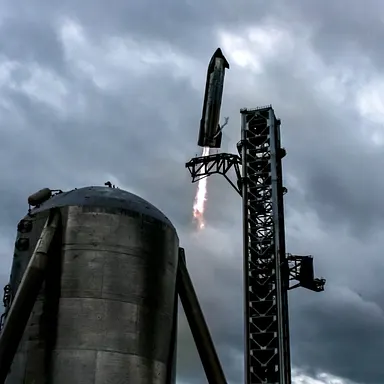
This episode of the Global News Podcast covers several major stories. SpaceX's Starship rocket was caught mid-air by mechanical arms as it returned from orbit, a first for an upper section that could cut the cost of space travel.
The show also looks at US proposals linking Ukraine's NATO membership to ceding Donbas territory, the historic election of Mississippi's first Black senator in 145 years, and the debate in Germany over the fire-damaged Eagle's Nest. Listeners will also hear about the difficulty of spotting deepfakes, the fate of a lonely gorilla named Jojo, and the first Eurovision Asia contest.
In this episode Ankur Desai, Bart Wimmer, Brandon Drennan, Brian Baglow, Dave Jones, Katja Hoyer, Laura Kress, Palab Gosh, Richard J. Evans, Sander van der Linden, Sarah Rainsford, Scott Cohen
This episode's transcript on the SpaceX Starship catch was made with HappyScribe technology, the same technology HappyScribe uses for Zoom transcription.
Ads in this audio differ from the text. Tap the sentence you're hearing to follow along.
Synced: the text now follows the audio.
This is the Global News Podcast from the BBC World Service. Hello, I'm Ankur Desai, and in the early hours of Sunday, the 15th of November, these are our main stories. SpaceX successfully carries out the first-ever capture of its reusable Starship rocket on its return to Earth, paving the way for less expensive space travel. President Zelensky says American negotiators have suggested the idea of Ukraine joining NATO in exchange for giving up territory to Russia. And the first Black senator for 145 years in the southern U.S.
state of Mississippi speaks to the BBC. Also, in this podcast, how Germany is grappling with the future of one of the most famous surviving landmarks of the Nazi era. And.
To the naked eye, you know, seeing is no longer believing. So you need specialized software to look for traces of artificial intelligence.
Why it's harder than ever to spot deepfake images on the net. We begin in Boca Chica, Texas, where SpaceX staff watch their Starship rocket return from space to their Starbase launchpad.
Look at her.
What?
Baby, she's back.
Unbelievable. We ran outside, we ran back inside. I still can't believe what we just saw. That was insane. That was wild. Picture perfect, almost exactly like the video that we watched earlier, but in real life.
SpaceX made history by catching the upper parts of a rocket in mechanical arms known as chopsticks when it returned home from orbit, and that could have wide-ranging implications for the industry. The lower half of a rocket has been caught like that before, but this is the first time that the top half has been successfully grabbed. The ambition is to be able to fly in the future with the same parts of Starship so that it can travel repeatedly and drastically reduce costs. Our science correspondent, Palab Gosh, was watching the action.
It was a scene from a science fiction film. We see rockets come from outer space in "Star Trek" and so forth, and they just gracefully land. Right now, in the 21st century, we don't have reusable rockets, but that is about to change because what we saw was a rocket go up on Friday night, orbit the Earth for 22 hours, and then come back hurtling into the Earth's atmosphere many times the speed of sound, and then slow itself down by putting itself into a horizontal position.
And then, as it approached the ground, there was a sonic boom, and then it fired its engines to put itself into the normal upright position. And we're used to seeing rockets go up very quickly, but the Starship was just hovering there and very precisely, very gently made its way to the launch tower where it was greeted by two open mechanical arms, which gently closed as if it was embracing the rocket that had come from space. It really is the stuff of science fiction. And of course, the SpaceX crowd went mad, cheering like there was no tomorrow.
But as well as being an incredible engineering feat, this does pave the way for a new low-cost generation of space travel.
And just briefly on what you're saying, how the chopsticks opened up and how the rocket was caught. Why attempt something as complicated as that rather than landing it on the ground or on water, for example?
Generally, when rockets go up, they come down and to boost a section, it's just a capsule that parachutes in the sea or on land. The rocket is completely gone. Now, that is a huge waste of money. So what SpaceX is doing is to try and develop a fully reusable system where both the boosters and the rocket can be caught, refurbished, and put together in the space of one or two days and getting ready to take the next payload up. And that's exactly what NASA will need if there's going to be a permanent base on the Moon.
It'll be up to the firm to show that it can do this again, again, and again, after which it'll have to show that it can refuel its rocket in space. It's moved at blistering pace to have this first reusable top section of SpaceX, but it's got to continue at blistering pace if astronauts are going to be landing on the Moon at the beginning of 2028.
You mentioned the Moon. There could be possible Mars objectives as well. What next for SpaceX?
The Moon landing is the most high-profile of its objectives, but SpaceX's plans are not just to get to the Moon. It wants to send cargo to the Moon and huge numbers of even more Starlink satellites around Earth orbit, and as you say, eventually go to Mars. So all of this does seem very hard to achieve, but so was catching a rocket from space, and they've done that. So let's keep our minds open and see what else they can do.
Our science correspondent, Palab Gosh. President Zelensky says the U.S. has, for the first time, floated the idea of Ukraine joining NATO, the security alliance that stretches from Europe to North America. In return, Ukraine would cede control of the rest of the eastern Donbas region to Russia. Moscow currently controls most of the Donbas, but Mr. Zelensky has consistently said that Ukraine is unwilling to give up sovereign territory. For its part, Russia has said another NATO member on its border is unacceptable.
Until now, the current U.S. administration has also ruled out Ukraine joining NATO. There has been no comment from the White House about Saturday's statement from Mr. Zelensky. The BBC's Sarah Rainsford has reported from Ukraine over many years and has recently returned to Kyiv. From the Ukrainian capital, she told James Kumrasamy how he might interpret the American land for NATO membership proposal.
It seems like the Americans basically are really keen to do a deal, and I think the negotiations are very difficult, and I think they're reaching for everything that they could possibly find to thrash out some kind of compromise because right now there doesn't appear to be any flexibility by the Russians, and Ukraine is also sticking to its very firm position. So I think in that context, it appears that the Americans at some point said, would you hand over parts of the Donbas if NATO membership was on the table? And then after that, there was discussion about other forms of security guarantees, a kind of NATO-like kind of option.
Mr. Zelensky is saying that that means that this debate is back on the table, that it's back on the agenda. It remains to be seen how this goes forward because I think Ukraine itself knows that joining NATO is pretty unrealistic, that there are many members of NATO itself who don't want that to happen. But most importantly, I guess at this point, Russia is very, very fiercely opposed to it, and it in fact is one of the reasons it launched this war on Ukraine in the first place.
Is giving up part of the Donbas something that President Zelensky might go for now? I mean, that's something that has always seemed to be a bit of a red line for the Ukrainians.
I think that's right. And I think part of how we might understand these comments, it does seem like the U.S. negotiators were trying to explore where the red lines now lie. President Zelensky has said previously, in recent days, that the American side appears to believe that if Ukraine simply hands over the rest of the Donbas, then that will mean peace in Ukraine and Ukraine will be safe in the future. Now, Kyiv doesn't believe that. People here believe that Russia's ambitions are greater and that they need greater protection for the future against another invasion.
So if you look at the opinion polls, the majority of people don't want, at this point, to cede territory in the Donbas in exchange for security guarantees. But I think if the question was, do you give up some land in return for full membership of NATO, then that might be a question that people would be prepared to consider. And I think the problem is that really NATO membership isn't on the table, and anything less than that is still a difficult thing to sell to Ukrainians as a prize, if you like, for giving up huge swathes of their territory.
You're a frequent visitor to Ukraine. You've been back several times since the full-scale invasion began. What's your sense of the mood at the moment? What changes have you noticed since you were last there?
I've only been back a couple of days, but even in the last couple of months since I was here, things are feeling pretty depressed. Kyiv itself has been under pretty heavy attack, particularly in September. Quite a lot of people have left the city already. The power cuts are extensive. The Russian attacks on the power plants started much earlier this year. You know, the kind of life that had gone on here in Kyiv, despite everything, actually looks a bit different now, and people do seem more gloomy. They're really bracing for a really tough winter.
Sarah Rainsford reporting. Democrat Scott Cohen made history when he became Mississippi's first Black senator since the late 1800s, and his triumph in the U.S. midterm elections has been celebrated on both sides of the track. Black voters were behind Scott Cohen all the way and wholeheartedly believed he could win the vote. But convincing white voters that he could do a better job of looking after their interests than anyone else is what really made a difference. It was a result that few saw coming and even fewer thought was possible.
The BBC's Brandon Drennan went to Columbus, Mississippi, to meet Scott Cohen and started by asking him why this traditionally Republican state has turned blue now.
I think it's a combination of factors. Mississippi has made a lot of progress. I think I had the right values, and I had a vision that was bigger than our past. It talked about the fact that Mississippi matters. We've got to have a senator that focuses on making sure every Mississippian's life is better.
Almost everywhere we went, including in your own victory speech, Medgar Evers' name was mentioned. I want to know how you view this moment within the scope of the arc of racial equality in Mississippi.
Well, it truly is a testament to his sacrifice, right? You know, he served our country in Normandy, came back to Mississippi, wanted to vote, and wouldn't let them vote. And instead of accepting that, he went to work, just like he did when he served our country, and he was murdered as a result of that. I wanted to acknowledge his role in making this possible. His imagination that in Mississippi we could have a state where an African American could be elected to the United States Senate. His sacrifice continued the progress that made that possible.
It's January 2027. Democrats are in control of both the House and the Senate. How do they use that power? How do you plan to prioritize people's interests in lowering the cost of living?
I would say first, we've got to get low tariffs. They've been terrible for farmers because they require free trade to sell a lot of their products, right? It's been terrible for small businesses because it's been too chaotic. You know, our constitution wasn't set up for, you know, the president to say, I'm upset with Canada because the prime minister did a commercial, I don't like it, so I'm going to increase tariffs. That's not a good economic policy. And so we got to get that power back because we need checks and balances, and low tariffs get low costs. I would also say that the war in Iran has driven up costs, and you know, the president promised no more endless wars.
He understood very clearly why wars in the Middle East are very easy to get in, but really hard to get out of. So we need to find a process to get out of that safely, but quickly.
How do you think you and Democrats will be able to deliver on the many campaign promises made with Trump in the White House, who's verbalized his willingness to use his veto power?
Yeah, here's the thing. What Democrats have to understand is it can't be about us. We're going to have a bunch of Medicaid cuts next year. There's a lot of Republicans on Medicaid. So we got to make sure the president knows he's hurting his own voters. If the Republican leaders don't put pressure on him to make sure folks have affordable and accessible health care, they thought '26 was a bad election, '28 is going to be a wipeout. We're going to put the voters at the center of the conversation, and if people know that we're fighting for them and the president is fighting against them, we're going to be okay.
Mississippi Senator Scott Cohen talking to Brandon Drennan. Now, for more than a decade, millions of gamers have been eagerly awaiting the latest version of one of the world's most popular video game franchises, Grand Theft Auto. So long has been the wait that it's become one of the internet's biggest running jokes that everything you can think of, the pandemic, AI, even flying cars, arrived before GTA 6. Now, with its launch just days away, the wait is almost over.
And in this version, the game, which has been frequently criticized for its violent misogyny, has its first major female protagonist. Our technology reporter, Laura Kress, explores why the game created nearly 30 years ago in the Scottish city of Dundee is still so huge.
I'm here for Lucia Caminos. Hey.
Hey. After a 13-year wait, Grand Theft Auto is back. For nearly 30 years, the series has let players explore open worlds, break the law, and cause chaos. The last game, GTA 5, made a billion dollars in just three days. And with over a decade to wait, excitement for GTA 6 is at fever pitch. So how did a game about stealing cars become a global cultural phenomenon?
Grand Theft Auto started in Dundee, created by a small studio called DMA Design, the company that would later go on to become Rockstar North.
Now, all the people in here are working on what DMA hopes will be its new blockbuster. It's a game called Grand Theft Auto.
Back in 1996, the BBC's own Rory Caplan-Jones went to visit DMA as it was about to release the very first GTA.
And Dave here is one of the software designers who's been trying to put it together. Dave, just explain the point of the game.
Well, it's a mission-based driving game where you're basically driving around the city, stealing cars, running over pedestrians.
That simple idea has continued to shape the series to this day. So I brought some of those creators back together again at Aboteh Uni's Games Lab to reflect on the ideas that set GTA on its remarkable path. Here's GTA co-creator Dave Jones.
As DMA, we always wanted to do something different, like what we can't just do a normal racing game. What is the unique spin we could put on it? And I think just getting out of the car, just all of a sudden you had this interesting mix of gaming coming together.
Was there a moment where you felt, this could actually be quite big?
It was a bit of a slow burn this game. GTA was more of a you had to play it to get it.
And but for the whole of the year that GTA came out, it just kept going and selling.
Brian Baglow was the original GTA publicist and writer.
We reckoned it was the word of mouth. You know, the people who had played it going, oh my God, have you played this game?
It's become a cultural reference point beyond gaming, and I wonder why you both think that might have been.
The demographic it reached was just massive. And when it reaches that massive demographic and everybody has potentially played it, they then just start to reference it. You know, I've seen movies going, oh, don't go all GTA on me, you know?
Is there a feature that you're proud of either working on or creating?
Oh, the world building and trying to introduce the missions and trying to sort of give you a sense that the entire city was reacting to you. You still see it in the United Auto games to this day. It's the business names, it's the radio stations, it's the lyrics, it's the DJs. Every part of that is making you believe that this environment you're in is a big cohesive whole.
Heads above your heads now.
It's so exciting. It's like watching the rest of the world fall in love with the game.
Yeah.
Over the last 29 years has been just joyful.
The anticipation for GTA 6 goes beyond nostalgia. It's about a series that has consistently pushed the boundaries of what games can do.
Laura Kress reporting. Still to come in this podcast.
When you aren't around, he remains alone in the forest. But as soon as you arrive, he emerges from the woods and comes close to you. This clearly shows that he feels lonely. You can see it in his eyes and in his behavior.
The search for a companion for Jojo, a critically endangered gorilla in Gabon.
This is the Global News Podcast. To Germany now, where the country is grappling with a difficult question: how to deal with one of the most famous surviving landmarks of the Nazi era. Last month, fire severely damaged the mountaintop chalet known as the Eagle's Nest, built as a retreat for Adolf Hitler and his inner circle. The Bavarian government has appointed a panel of experts to draw up what it calls a historically responsible plan for the site's future. But historians of the Nazi period are divided over whether it should be preserved at all.
Helena Berg has the details.
Back in 1938, the Nazis completed construction of a luxurious building perched on a ridge high in the German Alps. Kehlsteinhaus, or the Eagle's Nest as it's known in English, was built as a diplomatic reception house for Adolf Hitler. The Nazi leader used the area as a backdrop for several propaganda films, portraying him as a lover of animals and nature. The footage was later released to the British public in 1947, two years after the end of the Second World War.
These pictures are nine years old. They were found buried in a German orchard. They were taken by Nazi Heinrich Hoffmann. And here is the man whose hidden private life they show: Adolf Hitler, born Schicklgruber. Hoffmann loved to present his master as a family man, quiet and assuming.
For the past seven decades, the Eagle's Nest has operated as a tourist attraction with a restaurant and beer garden. It's mostly drawn in those interested in Germany's history, but it's also become something of a pilgrimage site for neo-Nazis. Katja Hoyer is a German historian at King's College London.
A lot of the buildings associated with the Nazi regime were indeed blown up or destroyed, and so the ones that remain have almost ironically kind of got added kudos amongst people who seek out that legacy and want to be near it. And that's something that you find in all sorts of places. For instance, Austria is still struggling with what to do with Hitler's birthplace. People flock to that building to sometimes put candles or reeds.
Late last month, the Eagle's Nest was gutted by a fire in a suspected arson attack. Police have not commented on a possible motive, but a 33-year-old man with a history of mental illness has been detained. Opinion is now deeply divided over what to do with the destroyed site. The local tourism board believes it should be restored. Bart Wimmer is the chairman of the board.
I believe it's very important to preserve the culture of remembrance that we have up there, since it's a place that played a major role during the Third Reich. I also personally believe that we need to come to terms with the events of yesterday in some way, and perhaps also shed light on them. And of course, we must also restore the site to working order in a responsible manner as a tourist attraction.
Others, like the historian Richard J. Evans, believe the fire has created an opportunity to allow the Eagle's Nest to fade into history.
Well, it wasn't in fact terribly important. The decisions, big decisions were not made there. Occasional foreign dignitaries have shown up there. It's been torched now. It's been destroyed. I think they should just clear away the rubble and leave the mountain as it should be in its natural state. That's happened with quite a few other Nazi sites, with the famous notorious bunker in Berlin, for example. And I think that is what should happen to it and certainly should not be reconstructed. If you rebuilt it as it was originally, you would romanticize it, rather like the name Eagle's Nest romanticizes it.
Germany and Austria have long struggled to deal with the fraught legacy of sites connected to the Nazi era. With the recent rise of the far right in Germany, that debate has become even more prominent. Katja Hoyer says it's a difficult balancing act, deciding how to remember the past without glorifying it.
That's often a kind of public debate that you see unfold in Germany. The idea that buildings mean legacy, that they mean memory, is very, very prominent in Germany, a country that has sort of prided itself on its memory culture. So I think not putting anything there would seem odd, but equally rebuilding something exactly as was also seems a little bit odd because you're kind of recreating the structures and the ideology of the time in a way too.
German historian Katja Hoyer ending that report by Helena Berg. A leading US academic who specializes in detecting digitally manipulated images, such as deepfakes, has warned that they're becoming ever harder to spot. Sander van der Linden is professor of social psychology at the University of Cambridge. Caroline Wyatt asked him how sophisticated deepfakes had become.
If you look at the research that's been done, where they give people a bunch of real videos, a bunch of deepfakes, you basically see that even at mediocre quality deepfakes, people don't do much better than chance. So maybe, you know, 55% compared to 50/50. So we're not very good at it to begin with. And if you look at the rapid technological progression of deepfakes, I think the situation is much worse now. It's becoming increasingly hard for people to discern what's authentic from inauthentic. What they use nowadays is they build the whole video from the ground up.
Every pixel is created by AI, and it looks super realistic, and it becomes almost impossible to discern with the naked eye.
And how confident are you that you would know the difference looking at a deepfake?
Not very confident. A couple of years ago, and we do this in our research group, we would go through deepfakes and we'd do a little quiz, and we'd get probably the majority of them right. But now I think, you know, a significant part of our group would be duped, including myself. A lot of the experts have said that's becoming harder and harder for them to identify what's real and what's fake. And I think the difference is if one part of it is faked, the audio and the video don't sync up, or there's twinkling around the eyes or the hair looks weird. But now, because they build every pixel from the ground up, it looks hyper-realistic.
Everything's moving in unison. There's almost no cues anymore that tell you that something might be a deepfake. So to the naked eye, seeing is no longer believing. So you need specialized software to look for traces of artificial intelligence.
What does this do to our trust in what we see or what we hear online?
One of the unfortunate negative consequences has been that people have lost trust in what is true and what's fake. And to some extent, you know, we've talked about the problem of misinformation, disinformation, but we're dealing with a new problem now, which is what is authentic and what is inauthentic. It's estimated that over half of all activity on the internet is already artificial. And so when people feel like, you know, they don't know anymore what's real and what's not, that creates cynicism, distrust, apathy, and that's not good for the democratic process.
What can we do to protect ourselves from deepfake extortion, so our own voices or images being faked online for nefarious purposes?
Always try to find independent corroborating evidence. I looked at an AI video, yeah, a bear on a highway rescuing a mother bear rescuing its cub. So I thought, oh, that's cute. And then later I found out it was totally created by AI. I found that out because I looked for the news story, and there wasn't any news story. Nobody had reported on it. And so this is just a video that went viral on the internet that's clearly AI. So I would say try to find independent corroborating evidence for what you see online, because even though it looks real, if it's a deepfake, nobody else will be reporting on it.
Sander van der Linden speaking to Caroline Wyatt. Gorillas are one of our closest relatives in the animal kingdom, and just like us, they crave companionship. Jojo the gorilla spent most of his life living alone in a tiny cage at a private zoo after being taken from the wild as an infant. He's now settled into a sanctuary in Gabon in West Africa, and experts are hoping to find him a friend, as Victoria Gill reports.
He's a critically endangered Western Lowland gorilla rescued more than 10 years ago from life in a tiny cage in a private zoo. He now lives in this large forested enclosure at Lekedi Sanctuary in Gabon. But Jojo has lived almost his whole life alone. The conservation team here wants to find him a companion.
I would say that he definitely feels lonely. It's evident in him. When you aren't around, he remains alone in the forest. But as soon as you arrive, he emerges from the woods and comes close to you. This clearly shows that he feels lonely. You can see it in his eyes and in his behavior.
Gorillas evolved to live in close-knit groups, sitting, eating, and sleeping together. And scientists say a gorilla companion would not only mean social connection, but for Jojo, it could help him to recover from severe trauma. He was snatched from his family group as an infant. His mother was killed by poachers, and he's been alone since.
I would say he's probably the most extreme case of social isolation that I've ever seen. His emotion regulation and road to recovery psychologically is going to be complex because he should have spent the first 14 to 18 years embedded in a highly complex, you know, family unit.
Thermal cameras are revolutionizing scientists' understanding of mental well-being, and in this case, loneliness in great apes. They provide a color-coded measure of stress because in primates, including humans and gorillas, when we're calm, our blood flow is even and our facial features look warm. Stress changes that, moving blood and heat to the eyes and ears to look and listen out for danger. That leaves a stressed ape with a measurably cold nose. That's a normal response, but in chronic harmful stress, it can show up as a chronically cold nose, something Professor Forrester has noticed in Jojo.
Their brain circuitry is very similar to ours, and it would be tragic for us not to afford them the same kinds of emotional complexity and depth that we have.
Researchers hope studies of Jojo will help them to better understand emotions and psychological recovery in non-human apes. But they think the key to Jojo's recovery would be having a friend.
It would be good for him to have a companion because being alone, you understand, is like being cut off from the world. It's like being in prison.
Finding him a friend won't be straightforward. Decisions about where captive gorillas are moved to are made by experts based on genetics, health, and animals' personalities. But with these new insights and with a very careful introduction, there is hope that Jojo, perhaps the loneliest gorilla in the world, can finally have a companion.
That report by Victoria Gill. A 19-year-old singer from the Philippines has won the first Eurovision Asia competition in Bangkok. Carmel's performance of "Sobra, Sobra," described as a women's empowerment anthem, was a favorite with the juries and the public. Artists from 11 countries took to the stage performing a mix of heartfelt ballads, Bangladeshi beatboxing, and a slick K-pop number. Our Southeast Asia correspondent, Jonathan Head, was at the show in Bangkok.
<spk:31> Jubilant scenes in an arena filled with Eurovision enthusiasts as the winner of the first-ever Eurovision Asia contest was announced, and it was a crowd-pleaser. The young Filipina singer Carmel with a power pop ballad celebrating the strength of Filipino women. <spk:32> The idea of expanding this staple of European popular culture into a region holding half the world's population has been mooted for the past 20 years, but until now, it had never taken off.
This event has had its share of problems, from a last-minute budget cut which prevented experienced Eurovision technicians from traveling to Thailand, to haphazard publicity which left it still largely unknown in this country. Many in the audience had traveled from overseas for the final. But in the end, the Thai organizers pulled off a spectacular stage set for the singers, who all gave dazzling performances, which they'd worked on through the past week to get them up to the Eurovision standard. They hope this strong start will provide enough momentum to repeat the contest here next year and to expand the number of countries contesting it beyond the 11 who took part this time.
Part of SpaceX's Starship rocket was caught as it descended back to Earth in Texas. It's the first time the upper section of a reusable rocket has ever been captured. Mechanical arms carried out a "chopstick" manoeuvre to catch the spacecraft. The breakthrough could dramatically cut the cost of space travel and marks a major step towards making Starship suitable for human spaceflight.
Also: Ukraine's president says the US has, for the first time, floated the idea of Ukraine joining NATO in exchange for ceding control of the Donbas region to Russia. We hear from the first black senator of the US state of Mississippi in 145 years. A fierce debate is brewing in Germany over the future of Hitler's Eagle's Nest after the building was destroyed by fire. A leading specialist in detecting digitally manipulated images warns that deepfakes are becoming almost impossible to spot. And a Philippine teenager has won the first-ever Eurovision Asia competition.
The Global News Podcast brings you the breaking news you need to hear, as it happens. Listen for the latest headlines and current affairs from around the world. Politics, economics, climate, business, technology, health – we cover it all with expert analysis and insight.
Get the news that matters, delivered twice a day on weekdays and daily at weekends, plus special bonus episodes reacting to urgent breaking stories. Follow or subscribe now and never miss a moment.
Get in touch: globalpodcast@bbc.co.uk
Photo: SpaceX Starship 42 returns from orbit to the launch pad on the 15th test flight from the SpaceX launch complex in Starbase, Texas, US, November 14, 2026.
Credit: REUTERS/Steve Nesius