
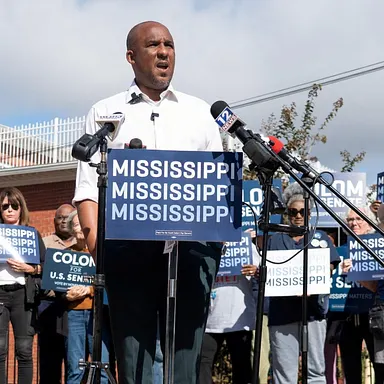
This episode of the Global News Podcast covers Democrat Scott Colom's win in the Mississippi Senate race, which makes him the state's first Democratic senator in decades and the first Black senator from the state since Reconstruction. Listeners hear how a surge in turnout among Black and young voters, and a campaign some voters described as lackluster, shaped the result.
The episode also looks at reports that Nvidia's board may oust CEO Jensen Huang over alleged affairs, the Pope's welcome in Peru, a US Treasury Secretary's move to a military base over reported Iranian threats, Kenya's preparations for El Niño floods, and a manhunt in Argentina after an Italian former militant escaped house arrest.
In this episode Alex Ritson, Bramo Simiu, Brandon Drainen, Derek Johnson, Ione Wells, Jose Carlos Cueta, Mimi Swaby, Shimak Halil, Stephen McDonald, Steve Rosenberg, Susan Gibbs, Thomas Mukhwana
This Global News Podcast episode on Scott Colom's historic Mississippi Senate win was made with HappyScribe's technology built to transcribe Teams meetings.
Ads in this audio differ from the text. Tap the sentence you're hearing to follow along.
Synced: the text now follows the audio.
This BBC Podcast is supported by ads outside the UK.
Welcome to the Haunted Library. Join me, Colin Morgan, as I read "Frankenstein" by Mary Shelley, a story of science and ambition, loneliness and longing, and what it truly means to be human. Listen to the Haunted Library wherever you get your podcasts, or find us on YouTube.
This is the Global News Podcast from the BBC World Service. I'm Alex Ritson, and in the early hours of Thursday, the 12th of November, these are our main stories. Democrat Scott Colom wins the Mississippi Senate race, making him the state's first Black senator since 1874. What's next for Nvidia as shares plunge and the board meets, amid allegations of CEO Jensen Huang having a second extramarital affair, celebrations as Pope Leo lands in Peru, and escaping extradition by abseiling from a fifth-floor apartment, the elderly Marxist kidnapper on the run in Argentina.
Also in this podcast.
Kwani na amani? Hata saa ingine mimi sikuli.
I am restless. I don't even eat sometimes because my heart races when I think about it.
The family's in Kenya living in fear because of predictions that climate phenomenon El Niño will bring extreme weather in the coming months. More than a week after the blue wave of the U.S. midterm elections, the Mississippi Senate race has gone to the Democrats. Democrat Scott Colom beats Cindy Hyde-Smith in a deeply conservative state that has elected Republicans for decades. His supporters have been celebrating at street parties around the state.
We hope that Scott gets to Washington and makes the right necessary choices on behalf of the people. He has listened to the people. The people have voted to push him on to make those necessary decisions.
I am here to celebrate being on the right side of history. I am here because we are so excited about actually seeing that our vote matters. And I'm here to celebrate my parents and my grandparents. I am not one generation out of the cotton field. Both of my parents picked cotton.
Derek Johnson, president and CEO of the National Association for the Advancement of Coloured People, gave us his reaction.
We've witnessed over the last election cycle, several election cycles, the African American vote share has been increasing. But this election year was even more energized because you had a young candidate who was innovative and creative. He spoke to people's issues.
Only a few thousand votes separated him from his opponent, which delayed the result. The BBC's Brandon Drainen is in Jackson, Mississippi's state capital.
So this is the first Black senator from Mississippi in over 140 years. And there were so many different elements that played a part. The first is that this midterm election, we saw sort of a national wave against the Republican Party. There was a large turnout from the state's Black voters. And Mississippi has a very large Black population, roughly 40 percent of residents in the state are Black, the largest in the country. And so from those that we talked to, there was a big effort this year to mobilise and energise Black voters and young voters to come out and participate.
And although we don't have figures on the exact number of Black Mississippi voters that participated, we do know that of those that did vote, 91 percent of them supported Democrats and Colom, which was a shift further to the left from a group which historically votes Democratic anyways. There was also some criticism about Cindy Hyde-Smith, the Republican incumbent, who Colom was competing against. Many that we spoke to, including Republicans that voted to her, described her having somewhat of a lackluster campaign for reelection.
They said they didn't see her very much on the campaign trail. Then that just created a recipe for a historic win for Democrats.
Scott Colom really does have the weight of history on his shoulders.
Being the first Black U.S. senator elected to the seat in 140 years, a lot has happened between those two things. The last Black senator that was elected in the state happened during a period called Reconstruction, once slavery ended and laws in the U.S. changed to allow Black people to vote. A large number in Mississippi voted that first senator into office. Seeing that success, the rules here and nationally quickly changed to make it harder for Black voters to participate. A man named Medgar Evers was a civil rights activist in the 1960s.
He was shot and killed in part for his efforts to register and boost Black voters in the state. So in the victory speeches that people gave here today, they mentioned him. And this being a huge step forward in this long history to be able to have this kind of success in a state that had a history of fighting back against racial equality so hard.
And briefly, this is going to change national politics, isn't it?
Many are saying that this victory here in the least likely of places is going to be inspirational and contagious and encourage young voters, voters of colour, to come out in larger numbers feeling that they can make a difference. And typically, we know that younger voters and voters of colour support the Democratic Party. So we really could see the politics of the South change based off this monumentous event here.
Brandon Drainen in Jackson, Mississippi. Let's stay in America and the future of the chipmaker Nvidia, as the FBI is investigating whether its CEO, Jensen Huang, had an affair with a suspected Chinese spy. Stock's tanked further amid reports he had a second affair with a colleague. And U.S. media say the board of the company, ranked the second most valuable in the world, is meeting to decide whether to replace him. I heard more from our North America correspondent, Shimak Halil.
We do understand that from reporting by the BBC's news partner, CBS News, and as you mentioned, Alex, the Wall Street Journal reporting that the board is meeting, preparing to decide on Jensen Huang's future, potentially ousting him, and that the Trump administration is aware of those plans. We don't have any announcement yet, but this would be an extraordinary moment for the man who's become synonymous with Nvidia, the company that he has led for more than three decades. And as you say, this follows the reporting about his relationship with Alex Huang, reporting that U.S.
intelligence officials believe she's been working for China's intelligence services, something that China denies. But now there's been a second alleged affair. News broke by The New York Times reporting that Huang, Jensen Huang, had a relationship allegedly with a senior executive who directly reports to him, which then adds questions about an ongoing investigation by Nvidia that have to do with workplace and the way that, you know, he's conducted himself, potential conflicts of interest. And so this puts more pressure on the company, on the board, to come up with answers, not just for the investors, but to be honest, for the whole industry about what will happen with Jensen Huang.
Yeah, this is one of the most valuable companies in America, in the world. It's a crisis.
It is a crisis. And with this widespread reporting, for example, you saw the shares plummet because of reporting of potentially the ousting of Jensen Huang, because he really is the rock star of the AI world. Ordinary people wouldn't necessarily know how powerful he is, how involved he is in their everyday life, the way that they use AI or their savings, to be honest, in the company's stocks. But they do know the man with the leather jacket who rubs shoulders with world leaders. And Jensen Huang is an enormous figure in technology.
He's involved in running the business, shaping the strategy of this company, maintaining relationships with major customers. And this kind of influence really reaches beyond the business. It reaches into Washington, into Beijing, where he has met key political leaders. But it also reaches within the markets, companies that spend huge sums of money building AI systems depending on Nvidia's chips. All of this is going to be a ripple effect into what happens to him, because in those long decades, he has been the central figure of Nvidia.
And what happens to him affects not only the company, but frankly, the whole of the industry.
Yeah. Can the company survive without him? Could the company survive without him?
I think it will have to do a lot of damage control, a lot of reassurances, because if he goes, investors will want quick answers. There may be confidential plans, but I think it has to answer the question of who will be in charge, how much will change. I think Nvidia's engineers, its technology, its expertise would still be there, but replacing someone with Huang's influence is going to be the bigger test for the industry and the company, of course.
Shimak Halil. There are reports that the woman at the centre of the scandal, the alleged spy, Alice Huang, is now in China. For more, here's our China correspondent, Stephen McDonald.
Well, we're getting this from Bloomberg. Actually, they're the ones who've been reporting that Alice Huang is now living in Beijing. And of course, this is going to lead to all sorts of speculation, not the least of which will be those who say, "See, because of services rendered to the country, she's now being looked after and kept secret in the capital." But even if it's true, and I should stress this is only one media outlet reporting this, it doesn't prove well, certainly it doesn't prove that she's like a full-time agent.
I could put it if I could put it to that way. I mean, there are these other photos being circulated here on social media. And people will be familiar with WeChat overseas. This is everybody in China uses WeChat. It's a social media platform, very popular, one of the most popular here in China. On her account, she seems to have put photos of herself and Jensen Huang. She's not trying to hide it. Now, if you were a professional agent and he was your target, would you be posting photos on social media of yourself and your target?
Unless it's some sort of 4D chess that I don't understand. So there is a lot of debate about the extent to which, you know, she really was collecting intelligence. Now, that said, it could just be that she was passing on a bit of information. Who knows? There's there are all possibilities along the sliding scale of what information she could still have passed on to Beijing from an awful lot down to almost nothing.
Stephen McDonald in Beijing. President Trump's negotiators, Steve Witkoff and Jared Kushner, are expected to travel to Moscow today for talks with Vladimir Putin about the war in Ukraine. Discussions on Wednesday in Abu Dhabi between Russia, Ukraine, and the U.S. ended without agreement, but the Americans said they saw some openings. Here's our Russia editor, Steve Rosenberg in Moscow.
The U.S. envoys have said that one of their main aims is to convince Vladimir Putin that Ukraine talks should be broadened to include representatives of Europe. Now, that is something that Moscow has been opposed to. The Kremlin accuses Europe of prolonging the war through its support for Ukraine. And it also accuses European leaders of not being serious about peace. And yet, while the Russians say things like that, they continue to wage war on Ukraine, and they continue to cause a lot of problems for the whole peace process.
Now, the head of the Russian delegation in Abu Dhabi, Vladimir Medinsky, he was asked today whether he was satisfied with how the talks had gone. He said that he will only be satisfied, quote, "when we're victorious and sign a peace deal on our terms." That does not sound like negotiation. It sounds like Moscow still pushing for Kyiv's capitulation. But perhaps more than this, I think for Vladimir Putin, these talks are about trying to reshape or rewire the security architecture of Europe to benefit Moscow.
I often. Here, pro-Kremlin commentators and Russian officials harking back to 1945, to when the big three, Stalin, Churchill, and Roosevelt, got together to try to redraw post-World War II Europe. And I get the impression that Vladimir Putin wants to be part of something similar right now. And by the way, next week, Vladimir Putin may sit down with Donald Trump and Xi Jinping for their own meeting in China. A new big three. That meeting probably won't reshape the world, but it might give Vladimir Putin what he wants, putting him centre stage.
Steve Rosenberg in Moscow. A 74-year-old former militant wanted in Italy over a kidnapping almost five decades ago has escaped from house arrest in Argentina by hacking his ankle monitor and absailing from a fifth-floor balcony using a harness. A manhunt is now underway for Leonardo Bertolazzi, once a member of Italy's radical Marxist group, the Red Brigades. Our global affairs correspondent, Mimi Swaby, told me more about the escape.
He's being held in an apartment in central Buenos Aires on house arrest, allegedly waiting very imminent pending extradition back to Italy. His escape was phenomenal. It's really caught the attention of national and international media. He was in his room, locked in his room, but managed to somehow absail out of the balcony down fifth floors using a harness. And he'd prized open his ankle monitor and somehow tampered with it to make it continue transmitting body temperature measurements, even after he'd prized open and had long fled.
Officials became then suspicious when they realised that this monitor, his ankle monitor, had been stationary for a long time, so hence went in and found that his ankle monitor was open on the floor. Interestingly, local media was saying, due to his bomb-making skills of the past, police came with explosive experts because they were worried that he'd rigged it to detonate. He hadn't done that, but him tampering with it to continue those temperature measurements, as well as stopping the alarm from going off once it'd been opened, did give him sufficient time to escape into Argentina with no trace.
Yeah. It's like something out of a movie. And he is still on the run.
He is. There is now a nationwide manhunt after him. Like I said, Italian media said that his extradition was imminent, so maybe there's some pressure and time pressure with his escape. But all forces and kind of tools from Argentina's government have been used or are being used to try and find this essentially a fugitive in the country now.
And what's the reaction to this extraordinary escape been?
There's been a lot of reaction. It's really brought up lots of questions as well. Interestingly, he was first arrested in 2002 trying to cross into Argentina from Chile using a false passport. But he was actually given refugee status in 2004. He was freely living in Argentina until only two years ago when the current right-wing president, Javier Milei, came into power. So there's a lot of controversy and confusion over his life in general. But now the reaction really has been disbelief, firstly, him absailing out of his balcony, down these floors into what seemingly is now the unknown.
There is no trace or kind of indication where he might be heading or where he is. And then secondly, lots of questions of why was he on house arrest? If he was such a skilled former kind of far-left militant, why was he not in prison? Why was he on house arrest? And lots of questions surrounding sufficient looking after of him or maintaining his house arrest as well.
Mimi Swaby. Still to come in this podcast.
In Newport News, Virginia, America crowns the new queen of its merchant marine. She's the 51,000-ton SS United States, the nation's largest and fastest luxury ship.
The once record-breaking ship that's coming out of retirement to break another one as the largest vessel to be turned into a reef.
Welcome to the Haunted Library. Join me, Colin Morgan, as I read Frankenstein by Mary Shelley, a story of science and ambition, loneliness and longing, and what it truly means to be human. Listen to the Haunted Library wherever you get your podcasts or find us on YouTube.
This is the Global News Podcast. Pope Leo has told Peru's president, Keiko Fujimori, that people deserve to live without fear of rising crime, on a visit during the final leg of his Latin American tour. He also urged Peru's leaders to face painful chapters of the past with justice and sensitivity. The president's father, Alberto Fujimori, waged a brutal war against Maoist rebels in the 1990s. Pope Leo worked as a missionary and bishop for more than 20 years in Peru, which he described as his homeland.
And he's been warmly received by his adopted nation, with many gathering on the streets. Our correspondent, Jose Carlos Cueta, is in Lima.
Oh, well, it's a very celebration environment, an atmosphere. He's in the centre of Lima. The access to the main square, where the Pope must be delivering a speech and making public appearances, are totally saturated. People want to be close to him. People want to feel him close. They consider him one of their own. It's worth remembering that Pope Leo, apart from having the American nationality, also has the Peruvian nationality. And he worked here many years, and he did complete most of his pastoral mission, especially that one that some experts say that really helped him to get to the Pepe sea.
And this has been the whole South America tour, a pretty packed schedule for someone who only came out of lung cancer surgery three weeks ago.
Yes, exactly. There were doubts just after he was diagnosed whether he was able to complete the trip. And that put a lot of people anxious about whether he was going to make it, because there was a lot of expectation. People here in Peru, I was here when he was elected, and they were really excited and already talking about probable visit of the Pope, the Peruvian Pope, as they call him here. So I guess it was very uncertain for many people here. But I think now that people are relieved, excited about seeing him, and relieved that he seems and he's showing a good health and definitely enough energy as to be completing this very demanding trip.
Tell me what he's going to be doing during his visit to Peru.
Well, he will be visiting other cities like Pucallpa, for example, in the Amazon, Cusco in the south. The most special one is due to start on Friday in Chiclayo, which was the city where he was a bishop, and in the region where he completed most of his pastoral mission in Peru, you know, working very close with migrants, working very close to people affected by weather issues such as El Niño in 2017. And it's a region where he's respected and remembered with a lot of sympathy by Peruvians there.
Jose Carlos Cueta in Lima, Peru. The U.S. Treasury Secretary, Scott Bessent, has relocated from his home in Washington, DC, to an unnamed military base. Sources have suggested to the BBC's U.S. partner, CBS, that this is because of unspecified threats from Tehran. Iran's former leader, Ali Khamenei, was killed at the beginning of the U.S. and Israeli war on Iran. Here's Ione Wells in Washington.
Sources familiar with the situation have said that Scott Bessent, the Treasury Secretary, has moved from his home here in Washington, DC, in a neighbourhood called Georgetown, which is where quite a lot of politicians and ambassadors live, to a secure military base, which they say is due to threats from Iran. Now, they haven't given any details or specifics about what these threats are, how severe they are, when they started. But he isn't the only U.S. official to be moved to a military base. He also will join, for example, the Secretary of State, Marco Rubio, the Defence Secretary, Pete Hegseth, but also Stephen Miller, the White House's new chief of staff, who all live on an undisclosed military base for their security.
Now, one thing that sources familiar with the situation said was that this was in part due to concerns after the newspaper, The Wall Street Journal, had published a photograph of Scott Bessent's home, which they say led to additional security concerns because they feared that his home could be geolocated. Although, curiously, this was actually an article that was published back in January 2025, so more than well, nearly two years ago. And yet, this is a move that's only just been taken now. So it's not clear if something fresh has prompted this change of decision.
But one thing that the Treasury have been pretty clear about is that this decision to move and these alleged threats towards him won't change their policy when it comes to Iran and their sanctions program, their blockade, which are designed to put financial pressure on Iran.
Ione Wells in Washington. Scientists predict that the naturally occurring climate phenomenon, El Niño, could bring more extreme weather to many parts of the world in the coming months. In Africa, one place braced for its impact is Kenya. More than 60 people died in floods earlier this year. And with the rainy season about to begin, forecasters have warned of the risks of more floods and landslides. Thomas Mukhwana reports from Nairobi.
I'm in Kibera. It's the biggest flood in Kenya and the biggest one in Africa. Thousands of people live here. Many of them live beside a river that cuts through this flood. Inside that river now, I see men and women, and they're digging out trash from the river. A few metres from the river, 62-year-old Agnes Chikoli lives with her family in a tiny house they've called home for 20 years.
She tells me when the river flooded in March, their home was filled with water. It's a very small house with two seats and a bed at the corner. It's barely big enough to fit more than that. And she lives here with her husband and a grandchild of hers. She tells me that the water fills up in this house so much, it floods, that it reaches half the length of the walls. And when that happens, they have to make a hole through the wall so the water passes through, and then they can pass everything through that hole as they escape to save their lives.
Agnes Chikoli's sister, Beatrice, was among those who died in those floods. She was electrocuted in her home.
I am restless. I don't even eat sometimes because my heart races when I think about it.
Agnes fears that this time, it will be her.
I'm afraid it will kill me. These houses aren't made of stone. They can fall on us or the water can drown us.
They've been advised by the local administration to evacuate, but she has nowhere to go. Kenya's Meteorological Department is warning that parts of the region off the Indian Ocean are at high risk of flooding. I'm in South Sea, in Nairobi County. This is one of the boroughs in Nairobi where floods are a problem. And I can see many men wearing reflector jackets and some wearing overalls. Some of them are county officials trying to unclog the drainage system here.
And the man who's overseeing these activities is the Disaster Management Chief Officer of Nairobi County, Bramo Simiu.
Our moderate projections is that about 5,000 households or about 20,000 people may be at risk. But our worst-case scenario, looking at such areas as well as the low-income settlements, we're estimating that up to about 20,000 households are at risk.
Around the world, people wonder what El Niño might do. For people here and millions of Kenyans across the country, the fears of its impact are real.
Thomas Mukhwana. And let's end this podcast with a trip to 1951.
In Newport News, Virginia, America crowns the new queen of its merchant marine. She's the 51,000-ton SS United States, the nation's largest and fastest luxury ship.
The launch of the SS United States in Newport News, Virginia. It carried famous passengers, including Marilyn Monroe and Walt Disney, and was once seen as the height of luxury, as well as being the fastest ocean liner in the world. The ship's heyday may have passed, but it is about to have a new life. At 300 metres long, it has been sunk or scuttled off the coast of Florida and converted into an artificial reef. Susan Gibbs is the president of the SS United States Conservancy, an organisation dedicated to remembering the vessel.
She also happens to be the granddaughter of the ship's designer, William Francis Gibbs. The BBC's Evan Davis spoke to her just before she set sail to see the ship go down.
The SS United States was the world's safest, fastest, most powerful ocean liner. She smashed the transatlantic speed record in 1952 on her maiden voyage using only two-thirds of her power. And then she vanquished the Queen Mary, in fact, a British liner. But back then, of course, ocean liners were more than just ships. They were symbols of national prestige and sort of the space shuttles of their day. And she was invincible.
Yeah. What happened to her career as a cruise liner?
She had 17 years of service, and ultimately, travel trends changed and jet aircraft took over, and her costs were high. And so she was pulled from service in 1969.
Talk us through why it's been decided to sink her.
Sure. The SS United States Conservancy tried for over a decade to keep her afloat, to convert her into something like the Queen Mary in Long Beach, California, a permanently moored hotel, event space, museum. But it turned the financial, political, and legal constraints were huge. We came so close to pulling it off in New York, but ultimately, we're unable to. And then the ship was evicted from her Philadelphia pier.
So we desperately did not want to scrap her. And so reefing her became what we thought a much more dignified alternative. And so she will be sunk and continue to create and sustain life, although in a different place.
Yeah, right.
Below the waves.
Below the waves.
It will become the world's largest artificial reef.
Okay.
So she's breaking another record.
Look, so your grandfather, William, he was the designer of the ship. Do you think he'd be reasonably happy that you found a sort of, as you say, a dignified and constructive, record-breaking final resting place for the SS United States?
I am hoping that that is the case. And I think there is something powerful and poignant about her returning to sea in this way. And so I'm imagining that he has come to peace with this.
Yeah. What are you up to today then, Susan? You're going out there. You're watching it go down.
Yes. I'm boarding a charter boat, and we are heading out to sea. And we'll be within a security perimeter. And I will bring a box of tissues, and I will bid farewell.
Susan Gibbs speaking to Evan Davis. And that's all from us for now. If you want to get in touch, you can email us at globalpodcast@bbc.co.uk. You can also find us on X at BBC World Service. Use the hashtag globalnewspod. This edition of the Global News Podcast was mixed by Nikki Bruff, and the editor was Charles Sanctuary. The editor is Karen Martin.
I'm Alex Ritson. Until next time, goodbye. Welcome to The Haunted Library. Join me, Colin Morgan, as I read "Frankenstein" by Mary Shelley, a story of science and ambition, loneliness and longing, and what it truly means to be human.
Listen to The Haunted Library wherever you get your podcasts or find us on YouTube.
Democrat Scott Colom has won the Mississippi senate race in a shock midterms victory. He will become the state's first Democratic senator in four decades. Exit polls showed Mr Colom benefitted from surging support among black and young voters.
Also: Nvidia considers ousting CEO Jensen Huang after his admitted affair with a suspected Chinese spy. A warm welcome for the Pope on his homecoming to Peru. The US Treasure Secretary, Scott Besset, relocates from his home to an unnamed military base after reports of unspecified “threats” from Tehran. Kenya prepares for the extreme weather and flooding expected from El Niño. And the manhunt for the Italian man who escaped house arrest in Argentina by abseiling off his balcony.
The Global News Podcast brings you the breaking news you need to hear, as it happens. Listen for the latest headlines and current affairs from around the world. Politics, economics, climate, business, technology, health – we cover it all with expert analysis and insight.
Get the news that matters, delivered twice a day on weekdays and daily at weekends, plus special bonus episodes reacting to urgent breaking stories. Follow or subscribe now and never miss a moment.
Get in touch: globalpodcast@bbc.co.uk
Photo: Democrat Scott Colom speaks to the media in Jackson, Mississippi, US November 4, 2026
Credit: Reuters