
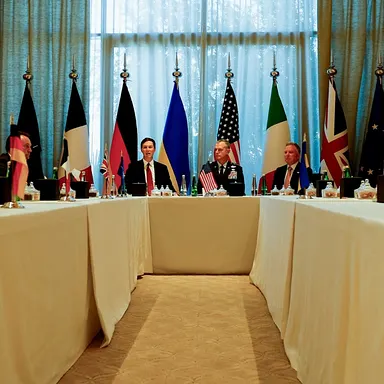
Russia and Ukraine have agreed a large prisoner exchange after two days of US-mediated talks in Abu Dhabi, the first diplomatic contact in nine months, though major differences remain over territory and a ceasefire. The episode also covers Spain's first general strike in 14 years, driven by housing costs and the rising cost of living, and the UN climate summit where many major leaders are absent.
Reporting from Gaza describes deadly flooding in tent camps and criticism of the emergency response. Sports and feature segments look at Manchester United's manager, a Sudanese boy receiving prosthetic legs, and the boom in board games.
In this episode Oliver Conway, Abdujalil Abdurrasulov, Andy Swiss, Ayaad Amawi, Esmé Stallard, Mustafa Marouf, Nick Beake, Will Bain
This transcript of the Russia-Ukraine prisoner swap episode was made with the same technology HappyScribe uses for Zoom meeting notes.
Ads in this audio differ from the text. Tap the sentence you're hearing to follow along.
Synced: the text now follows the audio.
This is the Global News Podcast from the BBC World Service. Hello, I'm Oliver Conway, and we're recording this at 15:00 hours GMT on Wednesday, the 11th of November. Ukraine, Russia, peace talks end with a deal on a huge prisoner swap, but are we any closer to a ceasefire? Workers in Spain hold their first general strike in 14 years. And the UN chief says climate change is outrunning efforts to contain it at a summit that many world leaders are skipping.
Also in this podcast, a desperate plea for help as flooding hits Gaza.
I wish the world could see the tragedy we are living. Medical treatments are no longer available.
For months, Russia and Ukraine have been relentlessly hitting each other with missiles and drones. Many civilians have been killed, particularly in Ukraine, and Russia's oil infrastructure has been badly damaged. But after nine months with no diplomatic contact, the two sides have just concluded two days of talks in Abu Dhabi, agreeing a large-scale prisoner swap. The US envoy there, Jared Kushner, said despite a lack of trust overall, some progress had been made.
The issues that were covered in these discussions were post-war security. How do we make sure that once this war ends, it doesn't start again? That's very important for Ukraine. They need to go through their security guarantees, which we actually made quite good progress on understanding. How do we do deconfliction? How do we monitor the ceasefire? The territorial issues will be the hardest, but we do believe that as we discuss these other issues, we'll find a pathway to settle them all at the same time. We had very good interactions and discussions with our European partners: the EU, NATO, the United Kingdom, Italy, Germany, and France.
So that will be with the goal is to turn this into a multilateral format.
Mr. Kushner and President Trump's other envoy, Steve Witkoff, will now meet Vladimir Putin in Moscow before going on to Dublin to see Volodymyr Zelensky. The Ukrainian president, who is visiting Denmark, said Ukraine had to be involved in any settlement.
The Russians have to sit across from our representatives and have to listen to Ukraine and to talk to us as equals about what comes next. They wanted to decide Ukraine's future without us, without Ukrainian people. But they failed, and today they have to talk to us about the future.
Our correspondent, Abdujalil Abdurrasulov, is following developments from the Ukrainian capital, Kyiv, and told me first about the prisoner swap.
They're saying that it will be one of the largest, if not the largest, prisoner exchange. And yesterday, President Zelensky was mentioning the figures of 1,000 prisoners of war, or perhaps even 1,500 prisoners of war, that will be swapped in this exchange. So certainly this is a big achievement for Ukraine because they already stated that this very fact alone makes a big progress because they're saying it means that this meeting in Abu Dhabi was already worth doing it, and they would continue having more meetings in the future if it means that they can arrange similar swaps in the future.
Now, Jared Kushner was sounding reasonably optimistic given the circumstances. Has any progress towards ending the conflict actually been achieved?
Well, the Ukrainian side is saying that the negotiations were very tough, but they also mentioned the very fact that Americans offered to discuss this so-called security architecture that will involve not just Ukraine but Europe as a whole. This format helped them to open a dialogue with the Russian side. And the Americans are saying that it's important for both Russia and Ukraine to understand what the security arrangements will look like once the war is over, and only then they can tackle this issue of territory. That's the most contentious issue in these negotiations.
And so far, there is an agreement on that, but we haven't seen any signs that both Moscow and Kyiv, their positions are getting closer when it comes to the issue of territory.
One of the issues that Jared Kushner raised was European involvement. The Russians seem to have sent mixed signals. Do we think Europe will have a role to play here?
Well, in Abu Dhabi, there was a meeting, a separate meeting from the trilateral meeting, which involved the representatives of Europe, US, and Ukraine. And during that meeting, they discussed the security architecture. The Russian officials came out after the talks and they said that they don't see any role for Europe. In fact, they claimed that the European countries are involved in what they called collective deception, and they said that the European countries only fuel this conflict. And therefore, they oppose the idea that the European side will be involved in the peace process.
However, when they talk about this security architecture for Europe, it means that the European countries are supposed to be involved. And the US has already stated that they would like to have the next step of this process to expand and include more countries and have a multilateral level of the negotiations, which means that European representatives will certainly be involved in the process in one way or another.
Abdujalil Abdurrasulov in Kyiv. Less than three weeks before Spain holds a general election, workers have gone on strike. It's the first general strike for more than a decade. Spain's largest union says 20 people were injured when police fired tear gas and charged at striking workers in Madrid. Rising discontent over a lack of affordable housing in Spain came to a head in September, when an 87-year-old woman was evicted from an apartment she'd lived in for 70 years.
She died just weeks later. Anger over her story added to the public's frustration over stagnant wages and the rising cost of living.
Sometimes authorities need to feel pressure from the citizens so that they do something. If we don't take radical measures, such as a general strike, the authorities will continue doing things the way they see fit.
I see this with hope. There are lots of people mobilizing. Many people, like me, have reached their limit, and I hope we will see some changes.
Our Europe correspondent, Nick Beaks, sent this update from the streets of the Spanish capital.
This is the center of Madrid where thousands of people have gathered as part of this nationwide general strike. The anger here mainly is over housing. People saying they don't have enough money to pay for their rent, but quite often, more than half of their monthly salary goes on housing. But then they've got other bills to pay as well: food and fuel. So what they're saying is that the government must do a lot more to help people. The government says it's trying to pass new legislation, but it's been blocked by the Congress.
Spain goes to the polls in just over two weeks' time. All the opinion polling is suggesting that the center-right and far-right parties will be in coalition. So for now, this is good-natured, but the anger is real, and some of these scenes are replicated across the country today with lots of people not working. For now, it's hard to assess the impact of this strike, but despite the driving rain here in Madrid today, these people have come to the streets and they say they're staying here.
Nick Beak in Spain. The last three years were the hottest on record, and 2026 is likely to see more of the same, prompting a warning from the outgoing UN Secretary General, Antonio Guterres, that the climate crisis is, quote, "outrunning us." He was speaking at the COP31 climate conference in Turkey.
The last four years were the hottest ever, and fossil fuel interests keep making a killing while killing our planet. Climate disasters are pounding lives, livelihoods, and economies across the globe, and this is the path to mutually assured destruction.
However, many heads of state were not there to hear the warning. The Brazilian president and European Commission chief are attending, but among G7 leaders, only the British Prime Minister, Andy Burnham, is going. China has sent its vice president and more than 1,000 delegates, but the US doesn't have an official delegation for the second year running. I asked our climate and science reporter, Esmé Stallard, if it matters that so many world leaders are absent.
I think it's more about optics. It's really important for the UN, for the world's press to be there, for voters to be watching the conference, and obviously having leaders there encourages that to happen. In their absence, what it is suggesting to the world is the climate change issue isn't as important. The other reason the UN will also want world leaders there is we often see really major commitments to investments from countries when their leaders are there because it kind of bolsters the credibility of their government during that trip. And of course, some of the really difficult issues, it can help having those leaders there because it can really grease the wheels of the most difficult elements.
So as an example, as you mentioned, the Vice President of China is there, and EU's Ursula von der Leyen. They're kind of butting heads at the moment over the EU's carbon tax, which is adding an additional cost to Chinese goods. So having them both in the room could hopefully make some progress on that issue. Having said that, there are negotiating teams from almost every country present at this COP, and they will have direct lines to their government who will be guiding them on what they think their position should be during the negotiations.
Does the US position on global warming under President Trump, does that create an opportunity for big emitters like China, who are also, of course, big renewable energy suppliers?
I think that's certainly one thing to take away from it. Of course, many of the countries would prefer US to be there, you know, where they are one of the world's biggest emitters. But having said that, China is going full throttle ahead with its renewable energy investment. But it's not just China. You know, over the weekend, we had new data from the International Energy Agency, which said we're expecting 60% growth in renewable energy capacity over the next six years. And for the first time, most of that growth will be coming from developing countries outside of China. China is one of the biggest exporters of solar panels, wind turbines, renewable energy products.
So they will be capitalizing on that investment in developing countries. The US's failure to commit to the climate change agenda could see them economically potentially missing out. Although having said that, there is going to be state representation from the likes of Governor Gavin Newsom from California, which are huge economies in and of themselves, and they could well be making deals with medium-sized countries at this COP.
Our climate and science reporter, Esmé Stallard. Still to come in this podcast.
I know how difficult the last few months must have been for you. I really hope you will make good use of your new prosthetic legs, that you return to playing football, and that you find happiness.
The young footballer who lost his legs in Sudan's war gets a message from his hero. You're listening to the Global News Podcast. Winter rains have brought fresh misery to thousands of displaced Palestinians in Gaza. Over the weekend, a powerful storm flooded around 70,000 tents in just 12 hours. At least five people were killed when a sand embankment collapsed onto shelters.
The US-backed Board of Peace, overseeing President Trump's Gaza peace plan, has called on Israel to allow in all necessary aid, saying the current response is not enough. Israel says tens of thousands of tents and winter supplies have got in, but reconstruction can only begin once Hamas disarms. Mustafa Marouf sent us a voice note describing the suffering in Gaza.
The winter night were growling, children, women, and men sleeped out in the open, exposed to the bitter cold. What worries me most is my deep concern for children, women, the elderly, and the sick. I wish the world could see the tragedy we are living through and we have lost access to medicines and medical treatments are no longer available.
Mustafa Marouf, it's not just displaced families affected. Humanitarian workers are also struggling to deal with the consequences of the flooding. Ayaad Amawi, who works with Doctors Against Genocide, says his home in Nasserat Camp was surrounded by sewage water.
Most of our remaining roads and open spaces flooded by the rainwater. This is not a conventional weather emergency. It's facing a compound cascading catastrophe crisis, especially when the rainwater mixed with sewage water under the population pressure over the remaining infrastructure in the 30 percentage of Gaza, which we live. It's a shrinked area without any ability for the municipal services to absorb this flood and storms.
And really, we have witnessed thousands and thousands of flooded tents, affected peoples. According to the UN agency assessment, we have more than 106,000 affected family directly from the flooding. This is a small rain amount that fall over the Gaza, cause this catastrophe. We have fears the upcoming storm entering soon. We have more than 100,000 children suffer from malnutrition, and also with the reduction of the amount of aids entering Gaza, according to the many agency announcement, we really will witness infectious disease and reduction in the amount of food for these children.
And with the next storm, I think we will lose our next generation by this situation. We hold our hope many, many times for the promises from all of the political sides around the world to stop this brutality and to grant the permission for the trucks and the UN agency to work freely without restrictions, to take their responsibility. We have more than 2.5 million people still living in the shrinked area without any opportunity to grant them a new hope to save lives.
So the situation here in Gaza is really compound cascading crisis linked to each other.
Ayaad Amawi. Manchester United, maybe one of the most popular football clubs in the world, but they currently sit in the relegation zone of the Premier League with just one win all season. Manager Michael Carrick is expected to lose his job this week, and the BBC understands talks have already started with a potential successor, Mauricio Pochettino, who's currently in charge of the US national team. I asked our sports correspondent, Andy Swiss, when Michael Carrick might leave.
He's edging ever closer to that exit. As you say, Michael Carrick's position has been under pressure for some weeks now, really. United have had their worst start to a season for some 40 years. Now, what is happening today is that United's Chief Executive, Omar Berarda, and their Director of Football, Jason Wilcox, have gone to Monaco to meet with the club's co-owner, Sir Jim Ratcliffe. And we are expecting that they will recommend that Michael Carrick should be sacked. A lot of people, frankly, thought he might be sacked at the end of last month after United were thrashed by Bournemouth, but the United hierarchy decided to give him a bit of time to turn things around.
That hasn't happened, though, despite a pretty remarkable comeback at the weekend when they drew 4-all with Aston Villa. United are now down in 18th place in the Premier League, which is just one point off the bottom, and the expectation is that Carrick will now pay the price.
Is it all down to him, though? What do the fans make of it?
Well, what's been interesting over the last few weeks is that despite United's terrible start to the season, the fans have largely stuck behind Michael Carrick. In fact, he's been applauded from the field, and that reflects the fact that a lot of fans think the problems run far deeper than just the manager. If Carrick is sacked, United will be looking for their eighth permanent manager in just 13 years since the great Sir Alex Ferguson retired, which doesn't reflect brilliantly on the club's hierarchy. And at recent matches, we've seen banners protesting against the club's majority owners, the Glazer family.
A lot of fans feel they simply haven't invested enough in players, and that when they have invested in players, they haven't done it particularly well. Over the summer, for example, the club didn't strengthen their defense, and United's defense has been terrible recently. They've conceded 15 goals over the last five games. That said, Carrick's tactics have been questioned by his own captain, Bruno Fernandes, who Carrick then dropped for the next match. And as ever in football, it is the manager who ultimately carries the can.
Mauricio Pochettino, of course, has experience as a manager in the Premier League. If he goes to Manchester United, can he turn it around?
Yeah, I mean, Mauricio Pochettino is the red-hot favorite now to be the next manager. In fact, United have already opened talks with him, which might seem a little bit strange, bearing in mind they haven't actually sacked Michael Carrick yet. Certainly not a great sign for Michael Carrick's future, you have to say. Pochettino, as you say, is currently the manager of the USA men's national team. He guided them to the last 16 at the World Cup this summer. He's enjoyed success at Tottenham, who he took to the Champions League final in 2019, and since then, he's had stints at Paris Saint-Germain and Chelsea. Now, United have been chasing Pochettino for some time.
In fact, they've spoken to him about their managerial position on three previous occasions when they sacked their managers, as far back as 2019, in fact. He is hugely experienced, and he's certainly impressed during his time with Tottenham in the Premier League. He's used to dealing with big names, big egos, but turning around United after what has happened after the last decade or so is going to be a huge task.
BBC Sports correspondent, Andy Swiss. Last year, while reporting from Sudan, our correspondent, Nawal Al-Maqafi, met a young boy who lost both his legs in a drone strike. Zaher, who loved football, resorted to playing on his knees. One viewer who saw his story decided to mount a fundraising campaign for specialist surgery. Since then, Zaher has been through months of treatment in the Egyptian capital, Cairo. And that was where Nawal caught up with him with a surprise message from his favorite footballer.
Beneath the call to prayer, four boys play football on a pitch scarred by war. One of them, Zaher, runs on his knees. He lost both legs in a drone strike, but not his love for football. I asked him who his favorite team is, Real Madrid, and his favorite player, Vinicius. What's your dream for the future?
I just wish I could have some prosthetic legs. It's been a year since that conversation. Now we're traveling to meet Zaher again, but this time he's in Cairo.
So we are on our way to see Zaher, and I'm so excited. When we met him in Sudan, he had a huge impact on me and on the team, and obviously on everyone who watched the piece. It's one of those stories that just really stayed with you, and so much has happened since then.
In the foyer of Zaher's building, we're met by Dina.
How are you?
I'm really well. How are you?
A Sudanese lawyer based in London.
I'm so excited to go see Zaher.
She was one of many touched by his story.
First time I saw the report, I cried. It's not lost on people that since the war began, there hasn't been enough attention or aid towards Sudan.
She raised thousands of pounds so Zaher could have reconstructive surgery and prosthetic legs fitted.
He's so determined, and he wants to put the injury past him as much as he can. And now his outlook is very much that there's nothing he can't do.
Come and see Zaher.
We head upstairs to reunite with Zaher.
Hello.
Hello.
Hello. Zaher, how are you?
Zaher is standing tall on brand new prosthetic legs.
Look at you standing. Oh, my God, you look so good.
Nearly as tall as me, he smiles from ear to ear. His mother, Habiba, is by his side. She tells me how much this experience has meant to her and her son. It's a wonderful experience. I felt the whole world was standing with us. It was like a team, and everyone was supporting us and cheering for us. I was so happy. His story touched so many.
We sent it to his hero, the Real Madrid and Brazilian footballer, Vinicius Junior, who sent a personal message of support.
Can we turn off the lights, please?
I know how difficult the last few months must have been for you. I really hope you will make good use of your new prosthetic legs, that you return to playing football, and that you find happiness. You deserve it. Stay strong. Send my love to your mom, who will be able to help you a lot, and to all your friends. We are together in this.
I ask a shell-shocked Zaher how he's feeling.
I am happy. I think Zaher is a bit overwhelmed.
Once the immediate shock has passed, we visit a local bowling alley.
Go, Zaher. Go, Zaher.
I ask Zaher what it was like to hear from his favorite footballer.
I want to say, I love you. I love you, and once again, I love you, and I hope my message reaches you. Thank you.
Zaher has completed his treatment for now, and his time in Cairo is coming to an end. He's flourished here. He's been learning English. We practice colors on a boat ride on the Nile.
Blue, yes. Axbal. Green. Asphal. Yellow.
Zaher, Cairo has been a place of healing, of rediscovering the childhood he lost.
Orange.
Yet further upstream, Sudan beckons. Soon he must return, where the war that changed his life continues to devastate so many others.
Nawal Al-Maqafi reporting from Egypt. Finally. There are less than 50 sleeps to Christmas, and many parents and grandparents may be planning a trip to the toy shop. New figures suggest it's been a bumper year here in the UK for toy sales, with traditional board games driving much of that growth. So what's the appeal? I asked our business presenter, Will Bain.
It's the fact that we are living in such a digital age, it appears, that's driving people back to the traditional. So this is a company called Circana. They work around the world. They work with point of sale, so looking at how many of these toys have been sold by stores, but also doing a survey kind of alongside it. And yes, as you say, the UK figures up very significantly for physical toys this year, but actually, they've been seeing those trends in the US, in Europe, in Asia, all of this year. And a lot of the sort of anecdotal stuff they're getting from the surveys is parents wanting to have that time away from screens and having time together as a family around a table, playing something like a board game or some cards.
So that's the appeal, bringing families together, not relying on screens so much.
Exactly. I mean, we should say big video game release coming next week in Grand Theft Auto, one from Zelda and Nintendo this week. So we're seeing lots of sales of those too, but just interesting that it's things like Lego, it's building bricks, and those board games, and in particular within the board game sector, Mattel, one of the big manufacturers, saying that sales of Uno cards, for example, sure, lots of people around the world, really one of the big drivers of their return to profitability this year again. So it seems like, yeah, we want to get kind of old-fashioned, sit around the table, have loads of good arguments over who's going to get what on Monopoly and all that kind of stuff.
Of course, Uno, a classic game, but there are many, many board games now, lots of different varieties.
Incredible the explosion of them. And the board game's kind of specific numbers, I was just having a dig out before we chatted, those up a 10% this year as well, and a big surge really since the pandemic. So 2020, we're all locked up at home trying to work out what we're going to do and not get cabin fever. Well, we go to the game's cupboard and dig out some old favorites, perhaps dust them off, and then go, you know what? Actually, this is quite fun, and we can have a bit of a conversation and something a bit competitive, and I'll try something else. And so, as you say, huge range of them, lots of independent ones that have exploded, some of them extremely complicated and extremely expensive, but some of them as cheap as a couple of dollars and a pack of cards.
Because that's the other thing that Circana found, that a lot of this is sort of 5 to 15 dollars the spending here going on as well. So actually, you know, we know people are tightening their belts around the world, and actually, this is a cheaper way to still kind of have fun.
And what other toys are proving popular? You mentioned Lego, but.
There are some extraordinary ones. So kid alts, if people have heard this phrase before, so this is adults who are buying perhaps Lego kits, very fancy ones, you know, hundreds of dollars' worth of your redoing the Hogwarts Castle from Harry Potter, for example, but also some very interactive kind of kids' toys on here as well. There is a tiger that seems to grow and roar. Apparently, that is a big hit for this Christmas. It's called Fur Real. That's number one on their list, but then, yeah, like you say, Juplo for those younger kids, Lego, and collectibles too, so stickers, playing cards, things like that. Obviously cheaper, but big booms around brands like Pokémon and stuff like that too.
So yeah, a wide range. I'll be getting you the Fur Real tiger as a guest for Christmas, Ollie.
Our business presenter, Will Bain. And that is all from us for now. This edition was mixed by Mark Pickett and produced by Richard Hamilton. Our editor is Karen Martin. I'm Oliver Conway. Until next time, goodbye.
Russia and Ukraine agree to a large prisoner exchange during trilateral talks mediated by the US, but significant differences remain to achieve a peace deal. Kyiv says a ceasefire must come before any discussions on territory, while Moscow demands Ukrainian forces withdraw from parts of eastern Ukraine. The US envoys Steve Witkoff and Jared Kushner are to travel to Moscow on Thursday to meet Russia's Vladimir Putin, before debriefing Ukraine's President Zelensky during his visit to Dublin.
Also: widespread disruption hits Spain during the country's first general strike in 14 years, prompted by housing shortages and the high cost of living. Will the UN's climate summit make much impact when the world's biggest emitters have declined to join? Deadly floods sweep through Gaza's tent cities, sparking criticism against Israel over an insufficient emergency response. As Manchester United manager Michael Carrick looks set to lose his job, the club begins talks with USA men's coach Mauricio Pochettino. A Sudanese boy who was injured in a drone strike gets prosthetic legs and a greeting from his favourite football player, Real Madrid star Vinícius Jr. And why board games have become so popular again.
The Global News Podcast brings you the breaking news you need to hear, as it happens. Listen for the latest headlines and current affairs from around the world. Politics, economics, climate, business, technology, health – we cover it all with expert analysis and insight.
Get the news that matters, delivered twice a day on weekdays and daily at weekends, plus special bonus episodes reacting to urgent breaking stories. Follow or subscribe now and never miss a moment.
Get in touch: globalpodcast@bbc.co.uk
Photo: Delegates including US officials, led by United States Special Envoy Steve Witkoff and Jared Kushner, US President Donald Trump's son-in-law, members of the Russian delegation, led by Vladimir Medinsky, an aide to Russia's President Vladimir Putin, and members of the Ukrainian delegation, led by Head of Ukraine's Foreign Intelligence Service Rustem Umerov, attend the UAE-hosted trilateral talks between the United States, Russian and Ukrainian delegations, in Abu Dhabi, United Arab Emirates, November 10, 2026. REUTERS/Rula Rouhana