
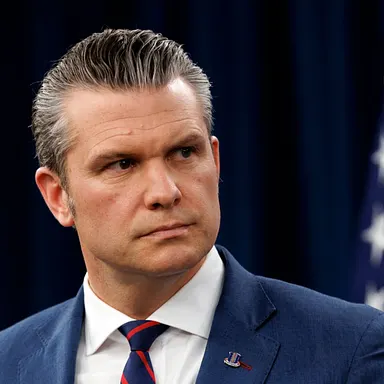
This Global News Podcast episode covers the week's main stories, starting with President Trump's backing for Defense Secretary Pete Hegseth as Republican Congressman Thomas Massie pushes articles of impeachment over the war in Iran. It also reports on France's accusation that Iran was behind a cyberattack that disrupted supermarket fridges and freezers, the sentencing of former comedian Russell Brand, and an FBI probe into claims about Nvidia's chief executive.
Listeners will hear about the rebuilding of the Libyan city of Derna after a deadly flood, a temporary second moon around Earth, and the Booker Prize awarded to M. John Harrison.
In this episode Alex Ritson, Burnt de Boozman, Helen Rumblow, Jennifer Millard, Katharine Norris-Trent, Lily Djemali, Rajya Krishnamurthy
This Global News Podcast episode on Hegseth's impeachment fight was made with the same technology HappyScribe uses for its Google Meet note taker.
Ads in this audio differ from the text. Tap the sentence you're hearing to follow along.
Synced: the text now follows the audio.
This BBC Podcast is supported by ads outside the UK.
It was the first dinosaur ever to be scientifically named.
And he came up with an animal that was about 40 feet long.
A profound discovery that led to paleontology as we know it today.
Impossible monsters, these giant, weird reptilian creatures. This was like a thunderbolt.
Join me, Misha Glenny, and my three guests for In Our Time on this episode: Megalosaurus. Listen on bbc.com or wherever you get your podcasts.
This is the Global News Podcast from the BBC World Service. I'm Alex Ritson, and in the early hours of Tuesday, November the 10th, these are our main stories: President Trump has backed his Defense Secretary in the face of impeachment articles brought by a Republican senator; France has blamed Iran for cyberattacks that heated up hundreds of supermarket fridges and freezers last month. Also in this podcast: Donald Trump says the FBI is looking into claims that the boss of the chipmaker Nvidia had an affair with a suspected Chinese agent, and.
The evidence presented in this case showed Brandt to be a manipulative sexual predator, using his growing fame and power to create situations in which he could pursue women sexually, regardless of what they wanted.
The British celebrity Russell Brandt is jailed for 10.5 years for rape and sexual assault. Also, how many moons are there above the Earth? Not just the one you're thinking of, apparently. We begin in the United States, where President Trump has said he will stand by his Defense Secretary Pete Hegseth if he's impeached. Mr. Hegseth has been coming under mounting pressure over his conduct of the war in Iran since last week's midterm elections, in which Mr.
Trump's Republican Party suffered heavy defeats. The plot to oust Mr. Hegseth was formally started on Monday by Republican Congressman Thomas Massie. He said the Defense Secretary should be held to account.
Peter Hegseth, by such conduct, has demonstrated that he will remain a threat to the Constitution if allowed to remain in office, and has acted in a manner grossly incompatible with his duties and the rule of law. Peter Brian Hegseth thus warrants impeachment and trial.
Our White House reporter Burnt de Boozman told me more about why Congressman Massie and his supporters are planning to try to impeach Pete Hegseth.
In one way, it's no surprise Thomas Massie has been a long-time critic of President Trump for a number of reasons, including the war in Iran and the handling of the Epstein case. And he had signaled his intention to do this quite some time ago, and he's on his way out of Congress. But in his view, and those of the people that support him, Secretary Hegseth essentially violated the Constitution by the conduct of the war in Iran, which went on for months without any sort of congressional approval.
There's a few other items in there. I think one of the most notable is they've accused Secretary Hegseth of extrajudicial killings as a result of the strikes on boats alleged to be trafficking drugs in the Caribbean and the Eastern Pacific. There's very little chance that this is successful, given that the Republicans at this moment still have a majority in the House and Senate. And of course, this was something that will change in January. But Mr. Massie has said very clearly that even if it doesn't succeed, what he wants to do is pressure the Trump administration through this whole impeachment process into firing Pete Hegseth of his own accord, for being essentially holding him responsible for much of what's gone on in this administration with regards to the Department of Defense.
So is it going to work? Will President Trump stand by him in the long term?
Well, at least for the moment, President Trump has come out quite strongly in his defense. I was at the White House this evening when President Trump came, and he said, in his view, Secretary Hegseth has done an excellent job at the Pentagon. He said recruitment numbers are up, for example. He praised the conduct of the military operation that toppled Nicolás Maduro in Venezuela and of the war in Iran. And we've heard similar from other administration officials today, including Secretary of State Marco Rubio.
But at the same time, the public is very wary of this war in Iran, and it really came to haunt Republicans in the midterm elections last week. So I think there will be many Republicans that would implore President Trump to kind of allow Hegseth to become kind of a sacrificial lamb for this war, which he helped push in the White House and which ultimately was politically disastrous for Republicans.
Yeah, and President Trump has been speaking about Iran.
He has been speaking about Iran. Unlike just a week ago, President Trump at the moment seems to think that there's very little possibility of a return to armed conflict. Just today, he had a meeting at the White House with the Qatari Prime Minister, and he seems to think the negotiated settlement is perhaps just around the corner. But at the same time, he said that U.S. forces are ready to go if necessary.
Burnt de Boozman in Washington. French officials say they believe Iran was behind a cyberattack in October that raised the temperature in commercial fridges and freezers across France, forcing businesses to throw away millions of dollars' worth of food. The French government has accused Iran's Revolutionary Guard of orchestrating the attack. Sean Noel Barrow is the Minister for Europe and Foreign Affairs.
We have, of course, at the very least, summoned the Iranian ambassador to France to protest this extremely serious act in the strongest possible terms. We will impose sanctions at the European level against all those responsible for this attack, and we will take all other proportionate and necessary measures, public or private, to respond to this attack and deter those who might wish to repeat it. I would add, to the matter is now before the courts. They will make their own decisions accordingly.
Katharine Norris-Trent is a correspondent from the international news channel France 24. She told the BBC's Evan Davis more about France's accusations against Iran.
The French Foreign Minister, Jean-Noël Barrow, has said that this was an attack of an unprecedented scale and level of aggression, and saying that France will take sanctions at a European level against those behind this attack, which he says is Iran, and specifically the Specialist Cyber Warfare Division under it, the Revolutionary Guard's control. And France has summoned the Iranian ambassador this Monday. So this all coordinated with the judicial authorities as well.
They clearly feel they've reached the evidential level to move forward on this. The Paris Public Prosecutor has launched a judicial investigation into this cyberattack unit of the Revolutionary Guard and has issued international arrest warrants against its head and two of its deputies.
Oh, okay. And have they offered up evidence? I mean, it sounds like they're pretty sure. This isn't, we suspect, we think there might be and we'll start investigating. This sounds like they really think they're onto it.
Yeah, they're using pretty definite language. So we don't know the details. What the Paris Prosecutor said in her quite brief statement said that they had identified several factors which allowed them to state this with such certainty, such as the use of Farsi and the use of IP addresses, which they eventually managed to trace back to two addresses in Iran. So I think that's why they're so certain. And Le Figaro newspaper broke the report before it came out officially, and they had a source saying that French intelligence agencies had identified the Iranian role clearly.
So they're clearly feeling a level of certainty around this.
Have we any comment from Iran yet, out of interest?
We haven't had any reaction from Iran. We don't know what came out of that meeting, of course, with the Iranian ambassador in Paris. This all came out after that meeting took place, and we haven't heard any response from Tehran as such.
Katharine Norris-Trent from France 24. Former British comedian and actor Russell Brandt is beginning a prison sentence of 10.5 years for raping one woman and sexually assaulting three others between 2004 and 2009. The judge at court in London said Brandt was a sexual predator who displayed staggering arrogance and used his status to protect himself. In a victim impact statement, one of the women said she'd been in shock and turmoil for years.
Our correspondent Helena Wilkinson was in court.
When Russell Brandt was handed his substantial 10.5-year sentence for rape and sexual assaults, he stood in the big glass dock and looked ahead at the judge. He showed no emotion. In his sentencing remarks, Mr. Justice Bennathan told Brandt he was a "sexual predator who had told a series of lies."
All those women had to face being confronted and being told they'd lied or twisted the truth and/or they'd agreed to your sexual demands. That was all done because of you, on your instructions.
Before sentencing, the court heard victim impact statements from the four women who Brandt had attacked. Their statements have been voiced by producers. This came from the woman raped by Brandt 17 years ago.
Even now, I feel that I am living with the trauma of what happened. It is something I carry with me every day, and it often feels never-ending. Because of who he was and the influence he held, I did not feel confident speaking openly about what had happened. I did not know who I could trust or confide in. I felt that if I reported him, I would not be believed. His fame, wealth, and influence created a power imbalance which made me feel powerless.
One of the women said it was difficult to see Brandt in the public eye after he'd sexually assaulted her.
For many years, as his star was rising, it was impossible to escape seeing him all over the media, being celebrated for his disgusting behavior against women, like it was all a joke. There were many times I felt visibly sick at the sight of him, parading around thinking he could get away with it all.
David Roberts, a senior prosecutor from the Crown Prosecution Service, spoke outside court.
The evidence presented in this case showed Brandt to be a manipulative sexual predator, using his growing fame and power to create situations in which he could pursue women sexually, regardless of what they wanted, with a complete disregard for the impact of his actions.
Detective Superintendent Andy Furfee, who led the police investigation, said he hoped that the outcome would provide some measure of closure for the women and allow them to continue building their lives. A van believed to be carrying Brandt left Southern Crown Court. Photographs taken through one of the windows captured a picture of a crucifix and a suit jacket.
Helena Wilkinson. So how significant is this verdict? Helen Rumblow is a journalist from The Times who has written about the case.
I think it's absolutely profound, and that's because I don't think it's just about Russell Brandt. I think what this case became was very symbolic. It was the Crown versus absolutely decades, centuries, if not millennia, of old-fashioned and archaic attitudes to women in sexual assault cases, and not just in the courtroom where we saw these very kind of extremely old-fashioned defense being used against these female witnesses, but also in the case of consent.
This very modern era of consent was being tried against something, again, deeply, deeply old-fashioned. And to get convictions showed that we are at the start of a kind of future era.
Times journalist Helen Rumblow. Still to come in this podcast.
You talk glibly about your life being changed, but it's weird when it happens. I feel like a proper writer at last, totally lacking in confidence.
The author who's become the oldest-ever winner of the prestigious Booker Prize.
It was the first dinosaur ever to be scientifically named.
And he came up with an animal that was about 40 feet long.
A profound discovery that led to paleontology as we know it today.
Impossible monsters, these giant, weird reptilian creatures. This was like a thunderbolt.
Join me, Misha Glenny, and my three guests for In Our Time on this episode of Megalosaurus. Listen on bbc.com or wherever you get your podcasts.
This is the Global News Podcast. The tech giant Nvidia has been coming under intense scrutiny a day after it emerged that its chief executive, Jensen Huang, might have compromised U.S. security through his romantic involvement with a woman suspected of being a Chinese spy. The company's shares have fallen sharply since it announced it was investigating its CEO's relationship with Alice Wang. She was managing director of a Singapore-based company which is suspected of routing Nvidia chips to China.
President Trump has said the FBI is investigating. Rajya Krishnamurthy is a Democratic congressman who sits on the House Intelligence Committee. He's pushing for legislation to block the export of Nvidia chips to China and has raised concerns about the Trump administration's reaction to the situation.
We have to continue our investigation, not only from Congress, but obviously finish the executive branch and the intelligence community's investigation. Jensen Huang has access to not only Nvidia's trade secrets, he's also influential in our export control policy. I'm extremely concerned about Donald Trump's blasé attitude toward this situation, even as his national security adviser and others are sounding the alarm about Jensen Huang.
So could these congressional committees have an impact on Nvidia and Jensen Huang? North America Technology correspondent Lily Djemali is in Santa Clara, where the company has its headquarters.
They could. And what's interesting is there's been so much focus on Democrats taking control in January after last week's election, in which they won majorities in both houses of Congress. But even right now, as the Republicans continue to actually control key committees, those Republicans are asking for Jensen Huang to come to Washington and testify next week behind closed doors at some key committees that are in charge of overseeing U.S. national security. I spoke to Nvidia about this today.
At this point, they are declining to comment as to whether Mr. Wang will show up in Washington on the 18th.
And all this despite support from Donald Trump.
That's right. Mr. Trump was asked about Mr. Wang again today. He has said not only that he thinks of Mr. Wang as being an honorable man who was, quote, "suffering greatly." He also revealed that he has spoken to Mr. Wang by phone. Mr. Wang apparently told the president that he had no idea that this woman, Alice Wang, head of this Singapore-based data center firm, was an intelligence concern. And Mr. Trump, for now, says he believes him.
And there is real concern that some of Nvidia's most secret, most powerful AI chips could have made their way into the hands of China.
That's right. So Ms. Wang heads this company called Megaspeed. They have been probed in the past for diverting these very in-demand, sophisticated AI chips made by Nvidia into China. Nvidia told me last night those allegations have been debunked. They've said that before. Nevertheless, this remains a shock because clearly this was still a concern to intelligence agencies here in the United States. And today, we saw markets react to this.
So Nvidia shares tumbled today. They were down at one point as much as 8% on a day when a lot of other tech stocks were actually doing quite well, including the top competitor to Nvidia, AMD, which happens to be run by a distant cousin of Jensen Huang's. They ended up settling around 4 to 5 percent lower on the day.
Briefly, if the chips did make it into the hands of a competitor, would they be possible, easy to copy?
You know, to be blunt, this is something that I think Silicon Valley has long wrestled with because China does have a reputation for taking valuable intellectual property and replicating it. So it's certainly possible that they did, and possibly with the help of this woman that is believed to be an intelligence asset.
Lily Djemali. It's just over three years since Storm Daniel triggered the worst flood disaster in the world this century in the Libyan city of Derna. At least 4,000 people lost their lives. But now the city has been reborn with reconstruction led by the authoritarian Haftar family that rules the east of the country. The BBC's Tim Hewell has been to Derna and has been speaking to some of those affected.
This is, you can see, this is all impact for the flood. The water reached level of 4 or 5 meters. We go upstairs to the roof, and we're forced to swim. I know to swim, but you know children with one year and four years old, they can't.
In the pitch black all power was lost of an autumn night three years ago, Issao Nasser Ibzayl lost his wife, mother Ingour, and all his seven children as floodwater engulfed their home in Derna. Today, the house is an empty shell. Apart from children's possessions, he can't bear to part with. Derna's mental anguish is still raw. But physically, the city's been reborn. The authorities haven't fully restored Issao Nasser's house yet because he's also got an apartment in an undamaged area of the city.
But most people whose only home was destroyed have already been rehoused. It's a whole mini-city that's been built here on the edge of the sea. There's row after row of identical, gleaming white housing blocks. There's a football field here with artificial grass. There's a library and a hospital. All the work's been planned and paid for by a reconstruction fund with a budget of $2 billion, headed by Belgasem Haftar, a son of the military strongman who rules eastern Libya.
Claudia Gazzini of the International Crisis Group think tank, a Libya expert who visited Derna recently, is impressed by what's been achieved.
Considering that it has only been three years since the disaster, it's quite remarkable.
But the fund doesn't publish its accounts. And Claudia Gazzini thinks that as well as helping people, the rapid rebuilding served a political purpose, coming just a few years after Belgasem's father, Marshal Khalifa Haftar, defeated Islamists who had run Derna with considerable local support.
The Haftar authorities wanted to win people's hearts in Derna, but they also used Derna as a showcase for what they were pitching to the rest of Libya. What started as a Derna reconstruction project then turned into a Libya reconstruction project.
Man of the people, humble and kind, they sing over this video of Belgasem Haftar opening a rebuilt sports club in Derna. Libya's split between a pro-Haftar administration in the east and a rival one in the west. In Derna, though, they've got many satisfied customers, including flood survivor Abdul Wahab Damdoum, who's just been given a new apartment by the state.
Hamamy.
Two bathrooms.
Cucina.
More balcony.
Three bedrooms.
Sala.
Living room.
Two living rooms.
Yeah, two living room, yeah.
For a family of only four people. When you saw this for the first time, how did you feel?
I thank engineer Belgasem because Allah sent this kind of person who picked up the city from a disaster.
Tim Hewell reporting, and you can hear more from him about the reconstruction of Derna on Assignment on the documentary podcast. A moon is any natural celestial body that moves in a stable orbit around a larger planetary body. And while most of the planets in our solar system have multiple moons, Earth just has the one that we refer to as the moon. But now astronomers have made the shocking announcement that we've actually got another moon that's fallen into our planet's gravitational pool, but it's a lot smaller than the one we're used to at only about a meter in diameter.
Dr. Jennifer Millard is an astronomer at Cardiff University in Wales and told us more.
So it was discovered on the night of the 19th to the 20th of August by a Hungarian asteroid hunter, Christian Szaszneki. But at first, we didn't actually know if it was an asteroid or whether it was a bit of space junk. It took another two months of observations to figure out if it was perhaps the upper body of a rocket stage or if it was indeed an asteroid. But we've confirmed it is an asteroid, and we do have temporarily for a few months a second moon. So it's called a mini-moon, an asteroid.
It's a small body that is truly in orbit around our planet for a little while. So this could be weeks, it could be months, it could be a few years. And in the case of this one, we expect it to disappear by January. Whereas a quasi-moon is something that's orbiting the sun on a trajectory that's really similar to our planet. And so from our perspective, it kind of looks like it's going around us, but it isn't really. It's just a bit of a coincidence. Whereas this mini-moon for a few months has been captured by our gravity.
And this is really on the smaller size of asteroids that we find in the near-Earth environment because there are, we think, millions of asteroids out there, you know, around our planet. The solar system's really big. You see those posters of, you know, oh, there's the sun and there's all the planets, and there's not a lot going on in between. And they are not true. But our catalog is only about 43,000 of these. And most of these we're talking are either dozens or hundreds of meters or even bigger in size. So to have one of these small objects discovered and tracked and we can monitor it and try and understand it is so important for us to really understand what our neighborhood is like and just how busy it is out there and how many things are hitting our planet and what could be a risk for us.
Astronomer Dr. Jennifer Millard. Oxford University has handed over the remains of 39 people who were taken during Britain's colonial role of India. They were originally from the Naga community in Nagaland, which is a mountainous state in northeastern India. A delegation from there was in Oxford for a ceremony to mark the return. More from our global affairs correspondent, Anbarasan Etorajian.
The Oxford Museum has more than 6,000 objects representing Naga culture, the largest collection in the world. The Naga remains were added between 1910 and 1940, mostly collected by two colonial administrators who were anthropologists. One of the Naga tribal leaders called the handing over of the remains, mainly skulls, a historic occasion and said they would be put to respectful rest. There are plans to bury them under a joint memorial in a park back home.
The Naga people once practiced head hunting, severing the heads of enemies as trophies. But they also kept the heads of their own chiefs at the center of villages. The Pitrivers Museum, founded in the 19th century, has handed back human remains to other indigenous groups from Australia, New Zealand, and the United States.
Anbarasan Etorajian. The winner of this year's Booker Prize has been announced with 81-year-old M. John Harrison lifting the literary accolade for his dystopian novel, The End of Everything, set years after an obscure global crisis. He's the oldest recipient of the prestigious award, which honors the best novel written in the English language. The winner gets a $67,000 prize and a huge boost in profile and, usually, sales.
Ellie Price was at the ceremony in London.
The End of Everything by M. John Harrison. <spk:31> M. John Harrison, who has been writing for six decades, is now the oldest Booker Prize winner, aged 81. He said it was worth the wait. You talk glibly about your life being changed, but it's weird when it happens. I feel like a proper writer at last, totally lacking in confidence. <spk:31> The End of Everything is, on the surface, about two characters living on a near-future post-apocalyptic Kent coast following an undefined catastrophe and a mysterious invasion.
<spk:32> The protagonist and indeed the reader don't know exactly what this catastrophe is and why it's happened. But then the judges said there was a twinge of optimism as well. Is that fair? Yeah. It wasn't intended. I got about two-thirds of the way through, and I suddenly realized that I'd got an ending that would transform itself as easily into faint hope, as it were. <spk:31> The chair of the judging panel, Dame Mary Beard, said the judges' decision that it should win was unanimous. <spk:33> People, I'm afraid, will say, "He's 81.
This is a lifetime achievement award." No, it's not. It's for this one brilliant, eye-opening, gobsmacking book.
High praise from Dame Mary Beard ending that report by Ellie Price. And that's all from us for now. If you want to get in touch, you can email us at globalpodcast@bbc.co.uk. You can also find us on X at BBC World Service. Use the hashtag #GlobalNewsPod. And don't forget our sibling podcast, The Global Story, which goes in-depth and beyond the headlines on one big story.
This edition of The Global News Podcast was mixed by Chris Kazaras, and the producer was Marianne Straughn. The editor is Karen Martin. I'm Alex Ritson. Until next time, goodbye. <spk:34> It was the first dinosaur ever to be scientifically named. <spk:35> And he came up with an animal that was about 40 foot long. <spk:34> A profound discovery that led to paleontology as we know it today.
<spk:36> Impossible monsters, these giant, weird reptilian creatures. This was like a thunderbolt. <spk:34> Join me, Misha Glenny, and my three guests for In Our Time on this episode, Megalosaurus. Listen on bbc.com or wherever you get your podcasts.
President Trump has said the resumption of US strikes against Iran is "quite unlikely and unnecessary". He expressed support for his defence secretary, Pete Hegseth, after a Republican Congressman, Thomas Massie, introduced articles of impeachment against him for waging war in Iran and elsewhere without Congressional approval. Also: President Trump says the FBI is investigating claims that Jensen Huang, the boss of the US tech giant Nvidia, had an affair with a suspected Chinese agent. He said he'd spoken to Mr Huang - who'd told him he had no idea that the woman was a spy. France has accused Iran of being behind cyberattacks last month that heated up supermarket fridges and freezers, spoiling millions of dollars' worth of food. The former British comedian and actor, Russell Brand is beginning a prison sentence of ten-and-a-half years for raping one woman and sexually assaulting three others between 2004 and 2009. We have a special report from the Libyan city of Derna, which has been rebuilt after Storm Daniel triggered the worst flood disaster in the world this century. Astronomers say the Earth has another temporary moon that's fallen into our planet's gravitational pull. And the author M John Harrison is awarded the prestigious Booker Prize for his dystopian novel, The End of Everything.
The Global News Podcast brings you the breaking news you need to hear, as it happens. Listen for the latest headlines and current affairs from around the world. Politics, economics, climate, business, technology, health – we cover it all with expert analysis and insight.
Get the news that matters, delivered twice a day on weekdays and daily at weekends, plus special bonus episodes reacting to urgent breaking stories. Follow or subscribe now and never miss a moment.
Get in touch: globalpodcast@bbc.co.uk
Photo: US Defence Secretary Pete Hegseth speaking at the Pentagon in March.
Credit: EPA/Shutterstock