
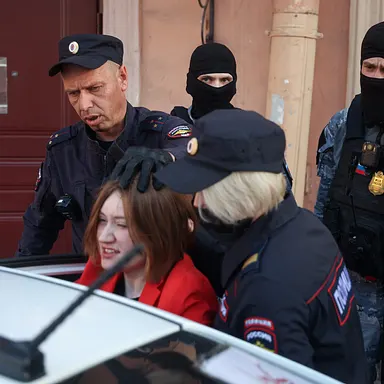
This episode of The Global Story examines why Russians who opposed the war in Ukraine, or feared being called up to fight, and who sought refuge in the West are now being deported back to Russia. BBC journalist Will Vernon, who previously reported from Russia, describes deportees he has interviewed, including a woman called Katya and a former conscript named Artyom Vovchenka, who say they faced interrogation and prison after their return.
The conversation looks at whether the rise in removals from the United States reflects closer ties with Moscow or a wider immigration crackdown, and what the trend means for Russians seeking protection in Europe.
In this episode Asma Khalid, Tristan Redman, Will Vernon
This episode's transcript on Russian asylum seekers deported from the US was made with the technology HappyScribe uses to transcribe video to text.
Ads in this audio differ from the text. Tap the sentence you're hearing to follow along.
Synced: the text now follows the audio.
Hi there, it's Asma Khalid from The Global Story Podcast here at the BBC. As some of you all may know, we are a show that dives deep every weekday on one big story that looks at where the world and America meet. This week we took a closer look at the issue of Russian deportees—dissidents and refugees who fled Russia after the start of the war in Ukraine—came to the United States and other countries in the West, and they are now being sent back to Russia. Why have governments changed their stances, and what happens to these dissidents when they return to Russia?
That is what my co-host, Tristan Redman, dives into in this episode. Take a listen; we hope you all enjoy it. And a reminder that if you want to hear more from us, you can subscribe to The Global Story as a podcast. All right, now on to today's show.
It starts with a journey.
The plane that landed in Moscow's Domodedovo Airport in December last year looked like any other, really, but it was in fact a special flight organized by the U.S. government.
One of the people on board was a woman we're calling Katya.
It was unbelievably frightening. My knees were shaking with fear.
Katya is not her real name. We're protecting her identity, and we've changed her voice.
Katya thought that she would, after being interrogated, that they would arrest her, formally and open, and a criminal case against her, and simply lock her up.
I was very afraid they would simply bundle me off somewhere. You start to think, that's it, this is the end.
Katya had been an opposition activist in Russia. She'd left the country at the outbreak of the war with Ukraine, in the hope of claiming asylum in the United States. And here she was, a few years later, on a plane back to Russia.
When she got off the plane and entered the terminal building, she was greeted by a long line of FSB, Russian Security Services officers.
Katya isn't the only person who found themselves being deported back to Russia after requesting asylum in the West. Since Russia launched its full-scale invasion of Ukraine in 2022, thousands of Russians have fled the country. Many hoped the West would offer them protection, but now some are finding themselves sent back, potentially into the hands of the very authorities they were trying to escape. From the BBC, I'm Tristan Redman in London, and today on The Global Story: why are Russian asylum seekers being deported from the United States, and what does it tell us about the West's willingness to protect those who oppose Vladimir Putin?
My name's Will Vernon. I'm a senior journalist, and I was previously based in Russia, Ukraine, Poland, and the U.S.
Well, Will, you've been looking into the story of Katya and other people like her who've been deported back to Russia from the United States and other countries. How did you first hear about this story?
Well, I was based in Russia for the BBC. I left in 2023, so about a year and a half after the full-scale invasion. And over the years, with my colleagues, I've worked on countless stories about the opposition movement and protests, and Alexei Navalny, the opposition leader who died in a jail two years ago. And I still talk to a lot of my contacts. And a few months ago, one political activist got in contact with me and told me about the case of a man, a Russian man, who was involved in opposition politics in Russia.
He received summons, so call-up papers, requiring him to be mobilized, go to the military enlistment office, and then be sent to the war in Ukraine. Now, this man fled Russia and sought asylum in a European country, and his asylum claim was rejected. And in the official rejection letter, which I saw, this official had written that they were rejecting this man's claim because prison conditions in Russia had improved.
Now, prison conditions in Russia have not improved. They have got progressively worse over the last few years. So I started looking into how many Russians were having their asylum claims rejected, how many were being deported back to Russia straight into the hands of Russian security services. And I saw this really worrying trend. I thought, I've got to look into this further.
Okay, so you decide you have to look into this. Where does the story then start for you, Will?
When the full-scale invasion of Ukraine happened in February 2022, that was really the first stage of emigration from Russia.
People leaving.
People leaving, yeah. So there were a number of reasons why people were leaving. The main one was because of the political crackdown. But a lot of people, I think, saw that sooner or later, there would be some sort of mobilization, call-up, some sort of enhanced conscription for ordinary Russians. I spoke to a number of my friends and colleagues at that time who said, sooner or later, we're all going to be drafted. But just in terms of the political repression, I mean, many activists, journalists, and just ordinary Russians who were against the war fled.
And many Western countries welcomed them. There were multiple public statements by leading Western officials and politicians at that time. If you don't want to fight in this war, come here, you're welcome, we'll protect you. And the thinking was that one less soldier for Russia's army is one less person to pull the trigger, right? I spoke to one guy, a deserter from the Russian army called Artyom Vovchenka. He is from a small town in southern Russia, from a pretty ordinary family with quite humble beginnings.
In 2019, he was conscripted into the Russian army. So this is pre-full-scale invasion.
I didn't even know there was conscription at that point.
So there's always been conscription in Russia. Now, conscripts are largely not sent to the front line in Ukraine, but all young people in Russia must go through some sort of military training. So Artyom, like many, many others, was drafted into the army in 2019. Now he says that in 2021, so again, this is before the full-scale invasion, he was tricked into signing a contract to become a proper professional soldier in the army.
Then in 2022, when the full-scale invasion happened, he was opposed to that war and made it clear that he was opposed. And came under a lot of pressure from his senior officers, and they planned to deploy him to Ukraine to fight in the war. And for Artyom, this was something completely beyond the pale, unacceptable, that he absolutely would not do. So he made the incredibly difficult decision to leave Russia.
How do you go about doing that?
Well, just before his deployment to Ukraine, he was allowed a brief period of leave to go home and see his family. And during that leave, he took transport out of Russia via another country that it was easy to cross into from Russia, and made his way to Mexico and crossed the U.S. southern border into the U.S.
Okay, so Artyom represents somebody who was fleeing military service, almost as a conscientious objector, the way you describe him. But what about the people who are leaving the country for political reasons, people who feel that they are being targeted by a political crackdown after the start of the war?
Yeah, and there were many, many of those people. Hundreds of thousands of Russians left the country in 2022. Now, many of them fleeing persecution, there was a huge rise in internal repression inside Russia. And for many people, it just became unbearable to stay in a country where any expression of opposition to the authorities, criticism of the war, could result in a long prison sentence.
How much can you tell us about Katya, who we heard about at the beginning?
So Katya was involved in opposition politics, in a now-banned opposition movement inside Russia. And she made the decision to leave and travel to the U.S. because she felt that remaining in Russia as someone who was against the war and against the Kremlin and had been involved in an opposition movement, which was now banned as extremist, it was now illegal to show any support for that opposition movement.
Or if you ever had showed any support for that opposition movement in the past, even if it wasn't banned at the time, then that became illegal, punishable by long spells in prison. So she just felt that it was, she couldn't stay in Russia any longer.
Okay, well, what did Artyom and Katya tell the U.S. authorities when they were detained and had to present their case for staying in the country? Like, what was their case for not going back to Russia?
So in the case of Artyom Vovchenka, he provided evidence, which I've seen, to the U.S. authorities that he had been a Russian soldier. They tried to deploy him to the war in Ukraine that he had refused. And he also provided evidence that a criminal investigation had been opened against him for desertion. Because desertion is a criminal offense in Russia, like it is in many other countries.
He provided evidence that this investigation was open against him and that he was a wanted man. Despite that, the U.S. authorities still rejected his request.
What about Katya?
Katya also provided me with copies of the evidence that she'd submitted to the U.S. government. She showed them photographs, documents that confirmed that she was involved in opposition politics in her hometown in Russia, that she'd been present at protests, that she'd been arrested by Russian police at some of those political protests. And just that is enough to give you a very long prison sentence in Russia.
What happens next? Like, is the Biden administration at the time, as it was, happy to greet them into the country?
Yes, and this is the real key moment in the story when everything changed for those Russians seeking protection, fleeing war and persecution. Because under President Joe Biden, there was a relatively liberal immigration policy in the U.S. So when Donald Trump returned to the White House, he launched this wide-ranging crackdown, didn't he, on immigration. That meant that suddenly thousands of Russians were at risk of deportation, Russians who had crossed the border and claimed asylum.
And many have been deported. And just looking at the data, we can see the removals of Russians from the U.S. rose from 222 in 2023 to more than 1,200 in 2025. Now, we asked the U.S. Department of Homeland Security about Artyom and about Katya and about other deportees that we spoke to, and they said this: all illegal aliens receive due process. If a judge finds an illegal alien has no right to be in this country, they said, we're going to remove them.
Has the U.S. government said why they're doing that? Is it part of a kind of the overarching desire to appear harsh on immigration issues, or is there something Russia-specific that's going on?
There's no evidence to suggest that there's some sort of deal between Moscow and Washington to return these people back to Russia. Now, there are theories, right, that the reason that the U.S. government ensures that these people are sent all the way back to Russia is to create a deterrent, right? That if people understand that they will be deported back to the FSB, back into really serious peril, then they perhaps might not attempt to come to the U.S.
and claim asylum. But as I say, that's a theory, speculation, we don't know. What we do know is that there doesn't seem to be any sort of official kind of agreement between Moscow and Washington that, oh, you send these guys back to me and I'll do this for you. There's no evidence of that.
Well, which brings us back to Katya, who we left being interrogated by the FSB in Moscow airport. What happened to her next?
Well, she and many of the other deportees on board were taken into a special part of the airport terminal building that was closed off to other passengers. And there, one by one, they were interrogated by the security service officers for many hours in some cases.
They questioned me for a very long time, about two hours. They mocked me, made fun of me.
They asked her all kinds of personal questions about her life, about why she left Russia, about why she went to the U.S. and claimed asylum there, and about her political activity in Russia.
At one point, they found incriminating information on my phone. Their faces changed in a second. But they released us.
But she said the police continued to harass her.
After I returned home, the police came and questioned me again. Because of the nervous stress, my hair had started falling out. Whenever I see a police car, I feel terrified and start thinking, what if they're coming for me?
She's certain that her mobile phone is being monitored. She says it keeps on doing very strange things.
I feel as if I'm in a cage, like in a zoo.
She lives in fear in her hometown. But she's still in Russia, and that's why we have to protect her identity.
How typical is Katya's experience being left in this kind of limbo? It's almost like a limbo under surveillance, it sounds like. But how typical is that?
Well, there's no typical scenario. It really depends on people's circumstances. So some of those who are deported are wanted, wanted in inverted commas, criminals. So they're arrested and they're put on trial. Others are just interrogated, or there might be subsequently a criminal investigation opened against them. Some have been sent to the front line in Ukraine to fight. Katya said that every single male deportee on her flight was given summons, right, military papers.
But there have been some really shocking stories of people who have been deported and returned. One activist, a guy called Leonid Melikhin, he was an anti-war activist. He was deported from the U.S. back to Russia last year. He had posted photographs of Vladimir Putin on social media with the message, "Putin, murderer, fascist, usurper." Now, after he was deported, he was arrested in the airport and charged with justifying terrorism, which is an incredibly serious charge in Russia.
And just a couple of weeks ago, he was sentenced to six years in prison in a penal colony.
And what's happened to Artyom after he arrived back in Russia?
So Artyom, when he arrived in Moscow, he was taken into interrogation like everyone else. And as soon as the FSB realized that he was wanted and he had a criminal investigation open against him, he was detained and handed over to the military police. He was then taken to a military police detention facility near Moscow. And he said that as well as him, there were many people there, many soldiers or former soldiers who'd been accused of crimes like desertion or other crimes.
And he told me that faced with the prospect of being handed back over to the Russian security services, he was prepared to die. He said, "My only thought was thinking about how I can die without any pain."
Well, is the United States the only country that is deporting people back to Russia like this?
Well, we're also seeing this in several EU countries, countries that are top destinations for fleeing Russians, like Germany and Finland. They've also, we looked at the official data from those countries too, and there's also been a really significant rise in the number of Russians that they are deporting.
What's driving that?
The reason for that, it's similar to the U.S. So in Europe in recent years, there's been this huge surge in support for right-wing populist parties. And a lot of that support is related to immigration. So as a result, you've seen countries like Germany also taking a much tougher line against migrants. And that means that, again, Russian asylum seekers are just being swept up in that crackdown.
I mean, Germany is not yet governed. It may soon be, but it is not currently governed by a populist party. It's governed by a centrist party. Are you saying the centrist party in Germany is preemptively cracking down on immigration?
That's exactly what they're doing. So Chancellor Merz has said he understands the concerns of ordinary Germans in terms of the high numbers of migrants that have been allowed into the country. And he's going to take a tougher line, right? But I was talking to one campaigner, Andrei Pivovarov.
Our decision is to go to countries not in the European Union.
Now he's part of the exiled anti-war committee. It's a kind of collection of Russian politicians in exile who oppose the war in Ukraine. And he told me that they've actually changed their advice to dissidents and people trying to flee Russia.
It's now risky. We understand that the mentality and the political situation in the European Union changed. So in this.
Don't go to the EU, they say, it's no longer safe.
So that position has changed for you?
Yes.
Okay, so if that's the situation in the European Union and the United States, you're not guaranteed asylum as a Russian fleeing Russia, the recruitment situation in Russia itself is only going to get worse, the evidence suggests. The Russian military is struggling to find enough soldiers to fight in Ukraine. There have been rumors of a general mobilization, which Vladimir Putin was forced to deny back in September. He said it's complete nonsense. It's an information attack on Russia.
But what if such a mobilization did happen? Would there be a new wave of departures? And where could they actually go?
There would absolutely be a new wave, a huge new wave of mobilization, almost certainly larger than the last one in September 2022, as you said, when hundreds of thousands of Russians left the country. One organization I was speaking to called ARC. They help Russians trying to flee the country, including deserters from the army. They told me that in August, they had 10 times as many requests for help from Russians trying to flee than just a few months before.
Is that because of an anticipation that there might be a larger mobilization?
Exactly. You know, as you were saying, things aren't going well for Russia on the battlefield. Losses are high. And as a result of that, there have been all sorts of rumors, as you say, denied by the Kremlin, that President Putin could announce a new wave of mobilization.
Okay, well, this situation between the United States and Russia is evolving pretty fast right now. Last week, Steve Witkoff described Vladimir Putin as a, quote, "humanitarian." Does that mean that we can expect this situation for people deported back to Russia to improve or change or get worse? What do we expect from that?
It's difficult to say. We know that there are those in the White House, and there are certainly those in the Kremlin who would like very much indeed for there to be better relations between Washington and Moscow. But I think this issue of Russians being deported back to Russia from the U.S., I think it will only amplify the voices of people who say that Donald Trump is too close to Vladimir Putin, people who call Donald Trump the best friend of dictators around the world, all of which the White House, of course, vehemently denies.
Well, Katya, whose story we started with, you've described her being in a kind of state of limbo somewhere in Russia, somewhere you're not able to say. But what about Artyom? What happened to him?
So Artyom had a few health problems at the time. And so he required treatment and the military police basically transporting him between the detention facility and a health clinic. And he has one thing on his mind, and that's escape. Escape for a second time from the country. And he says that he spotted an opportunity to escape. In the confusion of transporting people back and forth between these two facilities, he manages to slip away.
He gets a taxi to a town, and from there he manages a very convoluted route through Russia, reach Belarus, right, which is Russia's neighbor.
And Ally.
And Ally. There's no hard border between Russia and Belarus, so citizens can go back and forth without any checks. So he's taking all kinds of precautions in terms of his phone, in terms of his passport, to ensure that no one's going to tail him, find him, catch him, take him back to detention. He reaches Belarus and books himself a flight to another country outside the region and spends a very nerve-wracking few minutes crossing the border, expecting any minute one of those border guards to turn around, sound the alarm, and arrest him, bundle him off somewhere to some Belarusian border guard detention facility.
It doesn't happen. He's allowed to board the flight and leave the country. He's now in another country outside Russia. We can't say where he is, obviously, for his own safety. I mean, he's an incredibly remarkable young man. He's very religious. He's very humble. He's very angry, though. В Штатах я 100% разочаровался.
He's angry at his treatment in the U.S. He says that he should have been allowed to leave freely and apply for asylum in another country that would have investigated his case properly.
Instead of being violently bundled back onto the flight back to Russia.
Extrapolating from Artyom's anger at the United States for having deported him once, how do people in Russia view the West and the United States having heard stories like Katya's and Artyom's? Do they see Europe and the United States as a haven still, or not so much anymore?
I think when Russians hear stories like Artyom's and Katya's and others, they feel incredibly disillusioned by the West. Many Russians have felt disappointed by the West's approach to Russia for many years. And now, where we're in a situation where repression in Russia is intensifying at an incredibly alarming rate, where the situation for anyone who is critical or has ever been even slightly critical of the war or of the government is so dire, and at the same time, you've got rising numbers of Russians being deported back to Russia, and then they see now almost what they see as a refusal from Western countries to help ordinary Russians who are opposed to the Kremlin, I think they feel betrayed, frankly, by Western countries.
Well, Vernon, thank you so much for telling us these stories.
Thanks very much for having me.
That was Will Vernon, a senior producer here at the BBC. Let us know what you thought about this episode, or if you have any thoughts and ideas for future episodes, you can share them with us at theglobalstory@bbc.com. We'd love to hear from you. And before we go, a quick heads up. The U.S. midterm elections are upon us, and our very own Asma Khalid will be right in the thick of it. As many of you know, Asma spent years covering U.S. politics before joining us here at The Global Story, and this week she'll be putting that experience to work as one of the BBC World Service's co-anchors for our live radio coverage of the midterms.
She'll be bringing you the latest results, analysis, and reaction throughout election night. So if you're planning to stay up on Tuesday to follow along, join Asma and the team on BBC World Service radio or at bbc.com. And that's it from us for today from The Global Story. Today's episode was produced by Kat Farnsworth and Aaron Keller. It was edited by Martine Powers and mixed by Travis Evans. Our studio manager was Hannah Montgomery. Our digital producer is Sam Gruai.
Our senior news editor is China Collins, and I'm Tristan Redman. See you again tomorrow. We'll be back then. Cheerio.
After Russia invaded Ukraine in 2022, many Russians who opposed the war – or feared being sent to fight in it – fled the country. In much of the West, they were welcomed as courageous dissidents. But four years on, the number of Russians being forcibly returned from the US to Russia is rising. Is the tougher stance on Russian asylum seekers evidence of the Trump administration seeking closer ties with Moscow? Or is it part of a wider immigration crackdown, driven by domestic politics? In this episode, Tristan Redman speaks to the BBC’s Will Vernon about the Russian refugees he has met who face persecution if they are forced to return home. The Global Story brings clarity to politics, business and foreign policy in a time of connection and disruption. For more episodes, just search 'The Global Story' wherever you get your BBC Podcasts.