
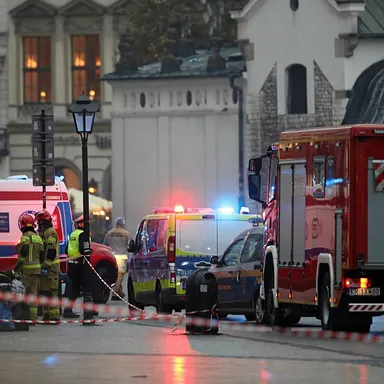
This episode of the Global News Podcast covers a shooting in Kraków that killed six people and prompted two days of mourning in Poland, with authorities investigating whether the attacker was influenced by far-right ideologies. It also looks at Israeli President Isaac Herzog inviting opposition leader Gadi Eisenkot to try to form a government after an inconclusive election, and at flooding in Gaza that has left displaced families living in tents.
Further segments cover charges against Paraguay's former president over a banking scandal, Dana White's reported White House job offer, debate over super socks for runners, and a Boston airport voice contest.
In this episode Will Chalke, Angela Perry, Ashish Sharma, Camilla Koronska, Carl Naspin, Dana White, Harry Bamforth, Hugo Bashaga, Jasmina Cunha, Javier Díaz Jiménez, Madna Mies, Mark Boron, Toby Fricker
This episode of the Global News Podcast, covering the Kraków shooting and Israel's coalition talks, was made with the same technology behind HappyScribe's subtitle generator.
Ads in this audio differ from the text. Tap the sentence you're hearing to follow along.
Synced: the text now follows the audio.
This BBC Podcast is supported by ads outside the UK.
Welcome to the Haunted Library. Join me, Colin Morgan, as I read "Frankenstein" by Mary Shelley, a story of science and ambition, loneliness and longing, and what it truly means to be human. Listen to the Haunted Library wherever you get your podcasts, or find us on YouTube.
This is the Global News Podcast from the BBC World Service. I'm Will Chalke, and in the early hours of Sunday, the 8th of November, these are our main stories. Two days of mourning are declared in Poland following the killing of six people in the city of Kraków by a gunman who opened fire in the main square. Israel's president invites Gadi Eisencop, the main rival of Prime Minister Benjamin Netanyahu, to try and form a government after last week's inconclusive election. And heavy rains in Gaza cause flooding for tens of thousands of misplaced residents living in a desperate condition in tents.
Also in this podcast, the former president of Paraguay is charged in connection with the banking scandal that led to his impeachment, and why thousands entered a competition to find the most distinctly Boston accent.
Packed a cat in Havid Yad. My mother met my father on the Chiles River.
Poland is holding two days of mourning after six people were killed and 15 injured in a shooting in the city of Kraków. The attack happened in the middle of the afternoon in the main market square. The gunman drove a car into the square, which is pedestrianized, and started shooting at random. He was quickly confronted by the police and is now in hospital. Police Commander Mark Boron spoke about the victims.
There are 16 people injured, including two police officers and the perpetrator himself. 11 of those are Polish citizens, 5 are citizens of foreign countries. There are 6 fatalities, 4 women and 2 men, 3 Polish persons, 1 citizen of Great Britain. Two persons are not dead; persons are not yet identified.
So what do we know about the attacker? He is, we're told, a 25-year-old Polish national. He was wearing military-style clothing and using military weapons, but the authorities say he wasn't a soldier. The Polish Interior Minister is Marcin Kiełecki.
Intensive investigative work is underway. We will probably be able to give you more details in the coming hours about the causes of this massacre. As I said, everything points to him having been fascinated by far-right ideologies. This will also be investigated.
But the shooting wasn't the end. Hours later, another shocking discovery. At a news conference, Poland's Prime Minister Donald Tusk said police had discovered three bodies thought to be family members while searching the suspect's home 200 kilometers away. Madna Mies from BBC Polish is in Kraków. She spoke to us from near the central square.
I was just speaking to the police. The square is cordoned off. They are unable to say when it's going to reopen. The square is one of the main tourist attractions here in Kraków. It's always full of people, full of tourists, full of locals. Right now it's empty, with very heavy police presence. There are forensics still working in the square. Tourists and the locals were told to avoid the area. We were told that the car was being searched for possible explosives. The shooter was driving.
He drove into the square and then from the square down one of the roads that also I walked that road a couple of hours earlier. It was full of people. And they apprehended him not far from the square. And there was, from what we were told, there was an exchange of fire between a policeman and the shooter.
So that is the situation from the scene, with details of the investigation. Here is the BBC's Camilla Koronska.
I think it's fair to say that until now the country has really experienced very few of such incidents. It's partly because Poland has a really stringent gun ownership law. We've heard from the Prime Minister, and we've heard from other authorities as well on the matter, but they were basically urging us not to speculate. Of course, if you go online, you will see that people are speculating whether this was a terrorist attack or whether the perpetrator had some mental health issues. But authorities are clear on that. They advise not to speculate.
But what they said is that it's very likely that this person was inspired or influenced by the far-right ideologies. This is definitely one of the angles that they're now looking into. And also, I think it's also worth to tell, Premier Donald Tusk, he referred to this as an act of terrorism. But of course, the investigation is still carried and being underway. So it's too early for us to say whether there was definitely a terrorist attack. But I think one thing that is really, really clear from this is that the perpetrator acted in a way that would suggest that he wanted to kill the most people possible just because the sheer number of ammunition that he was carrying with him at the time, it was quite significant.
That was Camilla Koronska. Israel's election last month was closely followed around the world, but ended in a deadlock, with no bloc securing a majority. Now, though, a possible way through. Israel's President, Isaac Herzog, has invited Prime Minister Benjamin Netanyahu's main rival, Gadi Eisencop, to form a government. Just how likely is it, though, that the opposition leader will succeed? I asked our correspondent Hugo Bashaga, who's in Jerusalem.
This announcement puts him one step closer to ousting Benjamin Netanyahu, who is obviously Israel's longest-serving Prime Minister. But it is going to be extremely complicated for him. He and some of his allies have rejected forming a coalition with Arab-led parties that have emerged as possible kingmakers in this process because of the success they had in the election. Any kind of deal with them would be unprecedented, extremely controversial. You know, it is opposed by Mr. Eisencop himself and by some of his allies.
One possibility would be the formation of a minority government, which would have support of those parties. But in the past, minority governments in Israel had proved to be extremely unstable. And another possibility would be of a deal with ultra-Orthodox parties that have been traditionally supporting Benjamin Netanyahu. This would also be extremely difficult because of differences in policies, particularly over military conscription. And I think it would be very difficult to digest for some of Mr. Eisencop's supporters because this would be seen as a betrayal of the pledges and the promises that were made during the campaign.
Assuming that he is able to overcome those hurdles, what would a Gadi Eisencop government mean for Israel internally, but also on the international stage?
Mr. Eisencop is a former Army chief. He ran on a platform of change, presenting himself as the only leader capable of defeating and ousting Benjamin Netanyahu. I think you would probably see the removal of some of the most controversial extremist members of the government. In Israel and also outside Israel, this would be seen as an opportunity to reset some of the most controversial policies that have been implemented by the Prime Minister.
Benjamin Netanyahu has a lot riding on this. Potential corruption charges and maybe jail if he leaves office.
He's fighting for his political survival. There is this long-running corruption trial, accusations of corruption he denies. And there is the possibility that if he indeed leaves office and loses the protection that the office gives him, that he could end up in jail. So he's obviously trying to avoid that. There was a message today saying that there should be the creation of a unity government, kind of suggesting the possibility of making some kind of deal with Gadi Eisencop, which is something that is very unlikely because of the differences between the two leaders.
What is the timescale we're looking at here for a resolution? Is it weeks, months?
There's now up to six weeks for Mr. Eisencop to try to form a coalition. If that fails, then another candidate, likely to be Mr. Netanyahu, so don't write him off, he can be given the opportunity to form a government. And if no one succeeds, another election will be held. I think there is a feeling in Israel to try to avoid another election. But don't forget that in the most recent election cycle, there were five elections between 2019 and 2022 before finally there was a government in place.
Hugo Bashaga there in Jerusalem. Well, meanwhile, in Gaza, an already bleak situation for displaced people whose homes were destroyed by the Israeli bombing campaign is getting bleaker. Torrential rain has flooded tens of thousands of tents. Residents use pots and pans to clear water from their flooded tents, with some saying they were left completely without shelter. Gadi is one of the few people to live in an actual apartment in what remains of Gaza City after years of Israeli bombardment. He described what it's been like.
Today, it was raining for a limited time, like it was only for two to three hours. But the result of that rain was shocking. Most of the streets were filled with water. Like, I'm not talking about one to two centimeters, but I'm talking about homes being like submerged in water and tents, everything that you can see. And the problem is that that water is not clean also because it's mixed with the sewage water. It was a nightmare. It was a mess, like early morning of today. The problem is that, like space-wise, we live in 30 percent of it.
So you can imagine how condensed we are. Most of the homes are destroyed, and the water would stay between those tents. Like, I can't describe it. It's a mess.
Toby Fricker is a spokesman for UNICEF, and he goes in and out of Gaza. He's been speaking to Owen Bennett-Jones about conditions for the vast majority of people who have been made homeless by the conflict and now live in tents.
One of our colleagues actually met Nasreen, who's a mother of three girls. Her husband was killed before. She's there living with three daughters. Early this morning, her tent, water just came rushing through the tent, is what she said. The tent came down. They tried to save some of their belongings. I mean, let's not forget that. These are people who have had to whose homes have been destroyed, and all their belongings are also in the tents. And they're trying to save the clothes, the food that they had there. She was able to move to her sister's tent, which was on slightly higher ground where they're staying now. And they managed to salvage their own one.
And now they're going to try and do whatever they can to sort of restore that. But the situation for the families of Nasreen's is horrific. Pretty much everyone's in the same situation. You have more than two million people in Gaza, half of whom are children, and most of whom are living in displacement camps in tents. Some are living in damaged, destroyed buildings, which is also dangerous in its own way. So everyone has massive needs. And UNICEF and other partners have been working beforehand around the clock to try and provide what we can, but it's nowhere near enough.
It's what I've seen of the pictures of Gaza. There'll be virtually no one whose home is intact.
Absolutely not. I mean, more than 80 percent of the structures in Gaza, whether that's homes or water facilities and others, have been damaged or destroyed. I mean, the destruction is immense. So these are families, children trying to cope with whatever they have, whatever they could salvage from their homes. And now the next threat to young lives is the floods, is the rain and the cold.
Right. So you're there from the UN trying to help. Who else is trying to help?
UNICEF, UN agencies are on the ground. We're trying to help, trying to provide tents, tarpaulins, other essential supplies like basic hygiene kits, working with a range of NGO partners on the ground and others. But these are emergency measures. And what we should be doing is really restoring infrastructure, getting classrooms back up built. So just one example, which is a huge issue, particularly given the rains now, is the Sheikh Ridwan Pond, which is a stormwater basin which basically holds water to stop flooding in the area in part of Gaza City. Now it's, of course, filling up rapidly.
We can't pump it out quick enough because we don't have the equipment to do that. And we've been working to get that equipment in, but it hasn't yet been enabled. So that's a massive risk because that water is actually contaminated with sewage. And if it floods, then the communities around, particularly children, are at huge public health risk.
And when you ask for heavy diggers and whatever to be brought in, and the Israelis say no, what's the reason they say no?
Well, the objection with some of the supplies is that it would go to other use for weaponry or other use. Of course, it's not. We very closely monitor how supplies are brought in. We then get them to where they're needed most urgently to provide essential services and support for children and families who need it most.
Toby Fricker there speaking to the BBC's Owen Bennett-Jones. Now, Spain is holding a general election later this month, but the mood amongst some voters isn't overly optimistic. For a month, protesters, mainly young people, have been camping in the center of the capital, Madrid, fed up with the rising number of evictions brought on by rental increases and the cost of living. Meanwhile, teachers have been on strike, angry at cuts in public education. Ashish Sharma has been gauging feeling amongst the country's young people.
There is a joke going around here in Madrid that the sports retail company Decathlon has done more for housing in one month than the Spanish government has in eight years in charge through supplying hundreds of tents that I see before me here in Puerta del Sol, one of the city's largest open squares. Protesters set up camp a month ago and raged at the eviction of an 87-year-old pensioner called Mary Garman, who subsequently died in hospital. Most of the people that have occupied this square are young, but all of them feel marginalized in the face of rental increases and a higher cost of living.
So how do they view the upcoming elections?
We have like a dichotomy between the far right and the far, far right. And then there's the left parties that are too busy fighting with each other.
As young people working, what is it that you want?
Public health care, public education, to increase wages. Everything around us is becoming really expensive. Our wages are still really, really, really low.
Even highly skilled professionals are struggling to make ends meet.
My name is Marcos, and basically I'm a web developer. I'm 25 years old. You can have a salary of 1,600 and rent can be 1,000. So that means I only have 600. It's unsustainable. We are not very optimistic. For example, we proposed some solutions for the housing prices and the housing problem, and still the government didn't come up with something that we were happy with. That's why we are pessimistic.
Spain's economy is predicted to be the fastest growing within the eurozone in 2026. Yet a failure to deal with the housing crisis and the cost of living, according to Javier Díaz Jiménez, professor of economy at the ESA Business School, has led to disillusionment and protest within the country.
Today in Spain, the most frequent salary is the minimum salary, minimum wage, which is 1,500 euros. And the price of housing in the big cities where many people want to live is just astronomic. So that's a very bad combination. That said, what do the political parties offer? The left-wing parties that have been in government for the last eight years, nothing. I mean, they have offered this. They have offered what we have. They have failed to pass a budget for four years. What is the Conservative Party going to do, which will have extreme right-wing parties in it? You know what they're going to do?
Very little as well. This is not about we're going to cut taxes and then some wonderful flower is going to bloom. No, there's no miracle to fix this economy. You can dream anything you want, but make sure that it pays 3,000 euros a month or more or better, okay? With all the disruption that we're seeing, it's really hard to educate our young people for the new technologies when we are pretty much clueless of what those new technologies are going to be.
I'm walking alongside a huge demonstration that's being held by teachers protesting against the cuts in education. The problems that Spain faces are simply not going to be resolved on the basis of just one election result. It is, in fact, the beginning of everything.
That report was by Ashish Sharma. Right, still to come in this podcast, a super sock that's supposed to make you better at running.
I do believe in running coming forward, and I understand the new technology, but I know my first reaction is that I think we're going too far at this point.
Welcome to the Haunted Library. Join me, Colin Morgan, as I read "Frankenstein" by Mary Shelley, a story of science and ambition, loneliness and longing, and what it truly means to be human. Listen to the Haunted Library wherever you get your podcasts or find us on YouTube. Yeah, as you can hear, it's proved divisive.
This is the Global News Podcast. Now, the ultimate fighting championship boss, Dana White, has given his first reaction to the BBC after President Trump appeared to offer him the job of the next White House press secretary. In a post on social media, Mr. Trump described his longtime friend as a violent fighter and warrior. Now, you might remember the previous press secretary, Katie Zachariah, only lasted five days in the role after controversy over her qualifications. Dana White is actually currently in London for a boxing match, so the BBC managed to track him down.
Here's what he had to say to us.
I'm flying to Washington, DC right now.
And you do a lot. How do you believe you could balance what you do at the moment alongside that?
Yeah. Yeah, I got a lot of jobs already.
Yeah. Can you tell us about some of the conversations you've had with him about that?
No. I'm going to meet with him. We have a meeting on Monday, so I'm sure I'll have more to talk about after that.
Our Washington correspondent, Carl Naspin, is covering the story.
There were some questions about how real this job offer from President Trump actually was. And it does seem to be real. He didn't rule this out there in that press conference. And this all began with President Trump's posting on Truth Social saying, "Hey, Dana, please take this job." We've reached out to the White House for a comment. We haven't heard back there. But Dana White and President Trump, they go back a long time. They've been strong friends. We know that Dana White helped to stage this big cage match, this fight on the White House lawn to honor President Trump's 80th birthday and also in honor of America's 250th birthday.
And this was something that UFC paid $60 million to stage there on the White House. So I think that this offer from the president, if it is real, could start to raise some questions around insider deals, around corruption. These were big issues for voters in that midterm election that we just saw. And I think overall, Dana White is a businessman. We heard him say he's a busy man, but he also knows that this is one of the toughest jobs in Washington. And it's unclear if Dana White or really anybody would be eager to jump in there, face those questions, especially after Republicans had such a wipeout in the midterm elections.
Carl Naspin there. It's been a spectacular fall from grace for Paraguay's president, Santiago Peña. In the last few days, he's gone from running the country to being impeached, arrested, and now charged over his alleged role in a banking scandal. He denies any wrongdoing. A judge has ordered Mr. Peña to be held in pretrial detention in a military facility. The crisis involving Ueno Bank has left more than half of the country's population without access to their accounts.
Jasmina Cunha is a journalist based in the capital, Asunción.
What prosecutors are saying is that he used his position as president to influence public institutions so that Ueno Bank could receive millions of public funds, despite his own financial ties to the bank's holding company. There's also Carlos Carvalho, who's the former president of the central bank, and he's facing two charges as well as a charge of producing false official documents. Peña was a shareholder in the group that was behind Ueno Bank, and Carvalho had been president of Ueno's financial company before Peña put him as the leader of the central bank, which is the institution responsible for supervising the bank.
And during Peña and Carvalho's administration, the bank saw an exponential rise. The collapse of the bank left nearly 3 million people: workers, pensioners, families, and small businesses who just suddenly couldn't access their own money, and many of them kept their life savings in this institution. The central bank has begun reimbursing insured deposits, but the uncertainty hasn't disappeared. We need to talk about the public money. Ueno, the bank, was holding enormous amounts of funds belonging to state institutions, including pension funds.
And we don't know yet if there will be a mechanism to recover that money.
Jasmina Cunha in Asunción. Right, let's go back to April and the London Marathon.
An historic performance. 1:59:30. Absolutely incredible. I've never seen anything like that. What a finish that you would say is unbelievable, but we've just seen it.
The moment the Kenyan long-distance runner, Sebastian Sarre, won it in record-breaking time. But there was drama. Some said it was because he was wearing super shoes. Some people were very up in arms about it. Lightweight running shoes incorporating carbon fiber plates and thick foam soles. Well, the drama continues because now super socks have been developed. They are foot stiffening socks that prevent the foot flattening under pressure. And it's claimed they can improve your running efficiency by 2%.
So are these a legitimate way of enhancing sporting performance? Katie Razzle spoke to Harry Bamforth, a runner and reporter at Daily Mail Sport, and asked what he made of the super socks.
I can't lie, as you're asking me that question, I'm kind of chuckling to myself a little bit. I do believe in running coming forward, and I understand the new technology, but I know my first reaction is that I think we're going too far at this point.
Is it that these socks are against the spirit of the sport? Is that what you think about it?
Apart from the highest level. I just think running has always been marketed. When I got back into it when I was 20, it's always been like a free thing. So I just had a pair of running shoes, and I started running. And that has always been the spirit of running. It's free, but it's not free anymore. We have all the super shoes and things, which I think are amazing.
Have you tried the super shoes?
Yeah, I wore Sebastian Sarre's Pro Evo 3s after he broke the marathon. I got to review them. It was one of the coolest things I've done, I think. I do think that they actually do work. I will say that.
Well, you felt you were running faster.
And my colleague of mine from the Times, I just wanted to beat his 5K time, and so I was going to do that. And then I just felt so good, I ended up trying to go for a PB.
So basically, you cheated. Is that what you're admitting live on air?
I didn't get a PB, so that doesn't count as cheating. My PB was in bog standard shoes when I was 16. Didn't have any of the carbon things back then. I think there is a place for these shoes. There's a place for these socks. There's a place for everything that's being marketed. It depends on where you are in your running journey. Like for the people that want these socks, people that want the super shoes, they should be the best of the best. They're the elites that are going at each other. But if you're looking at that and going, "Oh, is this what I need to become the next kind of level in my running journey?" And you're a good, like, say, three-and-a-half-hour marathon runner, which is an exceptional time, you do not need to be going and getting those socks.
There's still got to be affordability in this. There is a place for these expensive things, and I understand it. And I am also one of the people that wears carbon-plated shoes, the Garmin watches, and I love doing that. But it's the socks thing just how far can we go before it just gets a bit outrageous?
I am endlessly stuck on week six of Couch to 5K. I'm the third time of doing it. Isn't that pathetic? Anyway, perhaps I need those socks or shoes.
Don't do it. Don't do it.
Harry Bamforth from the Daily Mail there speaking to Katie Razzle. Yeah, someone who runs in shoes that I've had for, no joke, more than a decade. I'm not sure super socks are for me. The Boston accent is one of the most recognizable in the United States, and people from the city are fiercely proud of it too. So when a search began for a new, distinctly Boston voice to greet arrivals at Boston Logan International Airport, more than 6,000 hopefuls put themselves forward. This report from Helena Burke.
No, do not pursue. Stay in the car.
I just want a house and a big, important job.
She's a doctor.
He's remarkable.
And you're stupid.
The Boston accent is one of the most widely imitated and sometimes mocked accents in film and television. Its distinctive non-rhotic sound means speakers often drop the letter R in words.
Park the car in Harvard Yard. My mother met my father on the Charles River.
Angela Perry is the founder of the talent agency Boston Casting. She says the accent is an important part of the city's culture.
We just tell it like it is, and filmmakers love it. And they come here to get those characters. They think that it's all blue-collar people with just working-class jobs. Nobody goes to college. We're stupid. People do believe that when they hear the Boston accent, and that's wrong.
In September, Boston Logan International Airport launched its Voice of Logan contest, searching for a new person to voice the loudspeaker announcements. What followed was a fierce battle of the Bostonians, with over 6,000 people responding to the casting call. The winner has just been announced.
Welcome to Boston Logan International Airport, front door to the capital of hot, hustle, and hometown pride.
43-year-old Christopher Denisi from Northwest Boston will now be the first voiced passengers here when they land at Boston Logan Airport.
Whether you're grabbing a lobster roll by the harbor, heading out to Gloucester for a little salt air, or paying your respects to the Green Monster like it's a sacred landmark because it is, we're wicked glad you're here.
The news has been widely welcomed by Bostonians, with many wanting the city's distinct accent to be celebrated and preserved. As the world becomes more connected and globalized, many regional accents are beginning to disappear. It's something Angela Perry knows all too well.
My son doesn't have a Boston accent. He's 26. The people move around now. People come from other places. People don't stay in their same neighborhoods their whole lives. So the Boston accent is kind of going away, which is very sad.
Angela Perry from Boston Casting ending that report by Helena Burke. That's all from us for now. If you want to get in touch, we've got an email address. It's globalpodcast@bbc.co.uk. This edition of the Global News Podcast was mixed by Chris Oblakwa, and the producer was Emma Joseph. The editor is Karen Martin. I'm Will Chalk. Until next time, goodbye.
Welcome to the Haunted Library. Join me, Colin Morgan, as I read Frankenstein by Mary Shelley, a story of science and ambition, loneliness and longing, and what it truly means to be human. Listen to the Haunted Library wherever you get your podcasts or find us on YouTube.
Poland has begun two days of mourning after a gunman opened fire on the main square in the city of Krakow, killing six and injuring 15 others; three more bodies were found at the suspect's home. The authorities say he used military weapons and is thought to have been inspired by far-right ideologies. Also: Israel's president invites Gadi Eisenkot, the main rival of Prime Minister Benjamin Netanyahu, to try to form a government after last week’s inconclusive election. Heavy rains in Gaza cause flooding for tens of thousands of misplaced residents living in desperate conditions in tents. The former president of Paraguay is charged in connection with the banking scandal that led to his impeachment. The Ultimate Fighting Championship boss, Dana White, tells us he is meeting President Trump on Monday after he was apparently offered the job of White House Press Secretary. The super sock that's supposed to improve running but has proved divisive. And why thousands entered a competition to find the most "distinctly Boston" accent.
The Global News Podcast brings you the breaking news you need to hear, as it happens. Listen for the latest headlines and current affairs from around the world. Politics, economics, climate, business, technology, health – we cover it all with expert analysis and insight.
Get the news that matters, delivered twice a day on weekdays and daily at weekends, plus special bonus episodes reacting to urgent breaking stories. Follow or subscribe now and never miss a moment.
Get in touch: globalpodcast@bbc.co.uk
Photo: Emergency personal near the site of the shooting in the main market square in Krakow
Credit: Reuters / Agencja Wyborcza.pl