
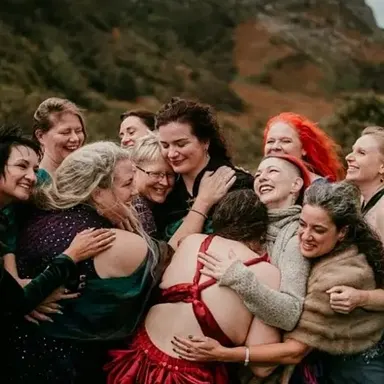
This episode of the Happy Pod covers three stories. Bridget Tavani, whose relationship ended before her planned wedding, invited strangers online to Northern Ireland to celebrate a non-wedding, and she describes how the trip turned heartbreak into new friendships.
Diana Virgovicova explains how she taught herself quantum chemistry to develop sunlight-activated materials for treating contaminated water. The programme also visits Fair Isle, the UK's most remote inhabited island, where one family has swapped life in Redcar for island community life, and reports on a Lagos cat cafe and Washington's annual High Heel Race.
In this episode Holly Gibbs, Amy Dawson, Bridget Tavani, Diana Virgovicova, Eileen Thompson, Janae Pettit, Kate Kruger, Katie Phoenix, Omatayo Daniel
This Happy Pod episode on Bridget's non-wedding in Northern Ireland was made with the technology HappyScribe uses to transcribe video to text.
Ads in this audio differ from the text. Tap the sentence you're hearing to follow along.
Synced: the text now follows the audio.
This BBC Podcast is supported by ads outside the UK.
Konto präsentiert: Die Geschichte einer Zahl.
325 Rechnungen verwalte ich jeden Monat. Eine ist noch nicht verbucht, bei der nächsten fehlt die Freigabe. Was für mich zählt, ist die Zahl auf der Rechnung, nicht wer sie wann eingereicht hat. Das ist Zeit, die ich lieber in Wachstum investieren würde.
Mit Konto bis zu 7 Stunden im Monat sparen, Rechnungen zentral verwalten, freigeben, automatisch abgleichen, und alles direkt mit der Steuerberatung teilen. Für einen einfachen Monatsabschluss: Konto, Geschäftskonto, Cashflow-Management, Buchhaltung.
This is the Happy Pod from the BBC World Service. I'm Holly Gibbs, and in this edition: the strangers that rallied together to help one woman through her heartbreak.
I think that the big, big message here is that there is community if you want to find it, there are people if you want to find them, and sometimes it just takes getting a little uncomfortable and vulnerable and putting yourself out there.
Also on this podcast: the cancer survivor trying to clean up the world's water supplies.
Really, no matter where you come from or, you know, how old you are, you can make a difference, and you should first start looking at your community and something that, you know, makes you unique.
Plus the family who moved to the UK's most remote island.
We weren't living the life that we wanted to, and coming here we're just cut all that out, and it's just back to what really matters, and that is family time.
And.
We've had people come to this space, and then a lot of misconceptions have been debunked just by interacting with the cats in our café.
One man's mission to help Nigeria become cat lovers. Bridget Tavani was due to get married 2 years ago. Soon after getting engaged, her fiancé suffered a medical episode, and the wedding was postponed until October of this year. Her relationship fell apart in that time, and Bridget, who was originally from the US, was left heartbroken. That was until she decided to celebrate the wedding that never happened.
Turning to the internet for help, Bridget and 11 strangers traveled to Northern Ireland to have a party of their own. What started as a story of heartbreak has turned into one of new friendships. The BBC's Matt Foxx has been speaking to Bridget, and also to Janae Pettit, one of the strangers who went on the trip.
He proposed in 2023, we had our date for 2024, and then a month and a half after he proposed, he had a big medical episode and wound up in a coma, and that kind of started this big unraveling over the next, like, 8 months of trying to get him better, trying to get him healthy, get into a new routine, and he just kept on having recurrences, and then in May of 2024 was, like, the big one where I went into the hospital after. He didn't know my name, didn't recognize me, like, all of that stuff.
He thought it was 2016. He and I met in 2017, and then, yeah, obviously at the time I was like, we're going to make this work, we're going to figure it out, and I asked the photographer for any guidance on what to do, and he's like, I'll give you a 2-year extension. Like, get him healthy, we're going to get you here. Everybody was very much, like, we're going to get you here, it's going to be fine. We ended up getting a 2-year extension to October 14 of 2026, which at the time felt so far away.
And then, obviously, a year or so went on and the relationship kind of disintegrated.
I was just kind of left, like, reeling so naturally. I stopped thinking about a wedding or any of that, which is why I didn't really give it a second thought until the photographer emailed me earlier this year and was like, hey, what's the plan? How's everything going?
And what was it like getting that email? Were you, like, a little bit retraumatized, or were you like, oh God, this is an opportunity?
I was actually up in Sligo with the woman who was on the trip. She kind of, like, got the wheels turning about how to make this all happen because she was like, I'll totally come back here in October, like, get a group of friends together, let's go. And yeah, we were hiking Knocknoray, and she, we were like, I remember distinctly, we were coming down the backside, and she was like, put it on your anonymous threads account, like, people will come. And I was just like, okay, sure. So a few weeks later, I put it on my anonymous threads account, and I think that that's, like, I forget about that sometimes.
I literally, when these women signed up for this trip, they didn't know my name, they didn't know what I looked like, they didn't know anything about me. So they literally just, like, signed up. It was like, you know, when you buy a house without going inside, but at least with those, you, like, get a picture of the outside. They didn't even get a picture of the outside.
A wing in a prayer.
Yeah. Well, and all the, like, stranger danger we had learned growing up was just, like, out the window. We were like, what? Women hanging out? Let's do it.
Because the post kind of took wings. A lot of people responded, didn't they?
Yeah. Got, like, hundreds of comments. Like, it was, like, something like 700 comments, and my DMs stopped working because so many people were messaging me about it.
And what was it that made you guys want to send the message and support Bridget?
My husband and I have been married for 16, almost 17 years next month, and he regularly gets overwhelmed by my birthday because he wants to do so much, and then he ends up doing nothing because he overthinks it. So I always have a miserable birthday. So when I saw Bridget's post, I was like, I'm just going to do something for myself. I'm turning 40. Like, I'm going to go into middle age and just, like, have a great time. And then I was like, it's not really even for myself. I want to go and, like, meet these women, support this, you know, non-bride. I want to do something outside of myself, I guess, so that I don't just wallow, I guess, if that makes sense.
I'm really glad I did because we all got so much out of it.
And the actual non-wedding day, was that for you, Bridget, quite difficult, or was it cathartic?
I definitely thought it was going to be more difficult. There were certainly aspects of it that were hard. Like, right off the bat, I was like, okay, this is a reframing day. I have opportunities to, instead of going and skipping the place because that's where something would have happened, I'm going to go to this place and this is going to be the kickoff to an amazing new memory, and now I'll want to return to this place. I was, like, faced with multiple opportunities in the day to, like, butt up against something that had mentally made me uncomfortable leading up to it, I guess.
And, I mean, I was just so supported. Like, I can't even, like, there was such a level of uplift. Like, I could turn anywhere and, like, get a hug if I needed it. It was just, everybody was there for everybody that day. And Rob, too, our photographer, did an incredible job. Like, I think one of my favorite moments was, like, one of those old friary sites, and there's, like, the long alleyway, and he was like, all right, everybody is going to get their chance, and you're going to just walk straight at me. Everybody's going to, everybody else is going to stand behind me and just cheer for the woman that's getting her moment on the camera.
So it became this, like, one at a time, like, all walking, cheering, like, screaming for each other, and it was just super uplifting, and, yeah, that was, like, the whole day felt like that. And I think it kind of distracted me from some of the processing.
What do you hope someone reading this or someone seeing it, what do you hope they feel, like, inspired, or maybe to take a chance to put themselves out there a bit?
Yeah. I mean, I think coming from, from me as the woman who's always felt like I've had a difficult time connecting with other women, you can reach out to the group of people that you have and know, or you can reach out to the internet, and, like, it, I, this is kind of an anomaly, but I think that the big, big message here is that there is community if you want to find it. There are people if you want to find them. And sometimes it just takes getting a little uncomfortable and vulnerable and putting yourself out there. We had women in this group who were in their 60s, like, and they are just experiencing a group of women like this for their first time.
So, like, it could take a long time, but it's out there, and it's, you just have to keep trying.
Bridget Tavani and Janae Pettit speaking to Matt Foxx. A 25-year-old woman from Slovakia is on a mission to get 1 million people access to safe water by 2030. Diana Verga-Vicua was diagnosed with ovarian cancer as a teenager, a disease which she believes was linked to the use of agricultural pesticides in her town. After she realized contaminated water was a global problem, she taught herself quantum chemistry to find a way to clean it up.
Diana has since set up her own company and has already treated more than 3 billion liters of river water. I've been speaking to her about how her journey started.
I grew up in a small village in Slovakia, surrounded by farms, and when I was 14 years old, I was diagnosed with ovarian cancer, which was linked to the agricultural activity that was happening around the village where I grew up. Basically, I saw the pesticides being sprayed on the fields around me, and that got me asking questions, like, what could have caused this? And after my diagnosis, I begged my mom to show me the world, and we went backpacking in India for over a month.
And in India, I had the chance to speak to many women on trains, and there I learned that many women were getting sick because of living close to polluted water, and so that got me really thinking that this is a global problem. And so when I came back to Slovakia, I started looking more into this, and the goal for me was to use technology and new science to find a solution. I contacted a professor at the local university. While I was in high school, I would go to do this research, and I learned about this new, new science called quantum chemistry.
And what's special about quantum chemistry is that we actually look into materials and things that are happening around us at a completely fundamental level. So we look into what are the molecules that create these materials, what's happening within the material that makes the material react in this way. And so I learned about these materials called photocatalysts. And so what photocatalysts are are materials that can destroy some of the most complex contaminants in water, and they get activated by sunlight or visible light, and that was my goal, to discover visible light-activated photocatalysts.
And so I decided to design my own sunlight-activated photocatalyst. So my first molecule was designed when I was 17 years old. I started this company about 3 years ago. It's called X-Atoms, and we have discovered 88 new materials, so 88 new photocatalysts that are sunlight-activated.
What do you hope people listening to your story take away from this? Because you have taken something that is awful and turned it into a mission to make sure nobody else suffers in the way you did.
I think what people should take from this is that, really, no matter where you come from or, you know, how old you are, you can make a difference, and you should first start looking at your community and something that, you know, makes you unique.
Was there a moment in all of your research where you realized you were onto something that could help lots of people?
I think it was the moment when I won the award from the Princess Victoria of Sweden. That was a big moment for me because it was an international recognition, but for the first time in my life, I won this award, and that felt like a validation for a high school girl that I was onto something and people recognized it.
And my final question is a personal one. How do you feel knowing that you are helping other women in a similar situation to what you were in?
I would say that's the most favorite part of my job is when women or girls come up to me or send me a message and say that you inspired me to do this, you inspired me to use my voice, and that happens quite a lot. And so I feel, it feels amazing. I think that when I was young, I would have loved to have someone to look up to and share their story, and that's why I share my story every single day, to make sure that whoever is going through this can take inspiration and can turn that suffering into something big.
Diana Verga-Vicua. Here in the UK, one family have opted for a completely different life after moving to the UK's most remote inhabited island. The island is halfway between Orkney and Shetland and has a population of around 60 people. The BBC's Cameron Angus Mackay has been to meet them.
Hey, Sis. Hey, you? Come on.
Katie Phoenix is a part-time crofter outside every morning feeding the animals.
He does love a little head scratch with his breakfast. I am someone who wears a lot of different hats. I look after my sheep, I look after my hens, I bake bread every morning, but I'm also working in the early years provision in the school, being a pirate or doing sandplaying. You could be lots of things in Fair Isle.
The former schoolteacher's new life in Fair Isle is a world away from her family's previous home in Redcar, North Yorkshire.
We were waking up and going to work as the kids were waking up, and we were coming back as my mum was feeding them and putting them to bed. We weren't living the life that we wanted to, and coming here was just, cut all that out, and it's just back to what really matters, and that is family time.
Whenever you tell anybody you're an electrician, the first thing they say is, oh, I've got something that I need you to do, and you're never short of a job or two.
That's Katie's partner, Josh. He's in high demand as a self-employed electrician because Fair Isle has its own energy system using renewables to power the community. The family moved to the island in July.
It feels like I've been in my whole life. Some people, it literally feels like they are my family, and we've never even been away, sort of thing. So yeah, it's nice, and I'd definitely say that community life is the best life, I'd say.
Katie and Josh's children, Teddy and Hetty, are two of the five pupils at the local school.
You do a lot with the community. Lots of things together.
We brought dogs and cats and chickens, and we're thinking about getting a sheepdog.
Katie and Josh applied for the house and crofts after spotting the opportunity advertised by island owners, the National Trust for Scotland.
I think because the process was so rigorous and there was so many applicants, the fact that we were chosen, we knew that there was a reason, and if we were the perfect pick for them, then we thought that we would fit in well.
And now another house and crofts are available, with applications open to more people.
You have an amazing community which is really sociable. You're safe. You're instantly part of a family. If you join in and you want to help and do things, you will instantly get that back times 10.
Eileen Thompson, chair of the Fair Isle Committee.
Most people have multiple jobs. Administration jobs, part-time jobs online or here. A lot of voluntary work as well.
Eileen says everyone has a role to play.
We always look for people in trades. That's something that we're quite short of. Plumbers, for example, at the moment. Creative people. We have a huge wealth of inspiration, really, for creative work here. So I think I'm saying you need to be a jack of all trades, really. A bit of everything is what you need to do, and it's that balance of you need to be independent and happy in your own space and doing things for yourself, but you also need to be able to work in the community because that's also part of it.
Katie and Josh hope to welcome another family into the community.
There's five kids in the school, one in the ELC, there's an infant, and we also have two teenagers, and it would just be really nice to have a few more pals. Teddy's keen for a football team.
And after a long engagement, they're planning an island wedding.
The church is literally next door. Why not? Winter's long. It gives us quite a while to plan. We could maybe do next summer. This is our life now, and we just feel really lucky. Come on. Are you coming out? See, we've got 10 hens. Come on. If I let you out, you can all come out. Are you coming out? Look at them sit there.
Katie Phoenix, ending that report by Cameron Angus Mackay. Coming up on the Happy Pod.
It's like riding a bike. Once you know how to threaten some heels, you can run just as fast.
We're in Washington, DC. No, not for the midterms, but for the annual High Heel Race. You're listening to the Happy Pod. A wind phone is a phone that has never rung, but might have made thousands of calls. It was a concept that was started in Japan by a man called Itaru Sazaki for his personal grief, but after a tsunami devastated his community in 2011, the disconnected phone became a space to leave messages for loved ones lost in the disaster.
Now there are more than 500 across the world, often bringing people comfort and hope in times of loss. Madeline Lake takes up this report.
Hey, Mum. The birds are singing again today. I can't believe how loud it is here.
Across the world, they've become tools for grief. In homes, hospitals, and unique locations all over the world. I went to visit a cemetery in London to meet Kate Kruger, where she set one up using her parents' old rotary phone.
So I read an article online about 2 years ago about wind phones and was completely entranced by the idea. It was the first time I'd heard of anything similar. So after losing Mum and Dad, I've been thinking a lot about grief and I've been reading about grief phones, and lots of things came together in life. Death isn't the end of the relationship with your person. It's the beginning of a new relationship. I said, what's that?
Vivienne Santala works at the cemetery and says that the phone has had a huge impact on her.
I've had a lot of loss, and I've had a lot of conversations.
Who have you called with it before?
So I called my Dad. I've been back a couple of times to talk to my Mum.
And how does it make you feel when you use it?
It makes me feel that they can hear me. It really, really does. There's almost a 2 or 3-second pause at the end. I can almost hear her saying, "Love you too, Viv."
Amy Dawson has spent more than half a decade mapping wind phones across the world in honor of her daughter, Emily.
After Emily passed away, I needed to keep being her Mum and finding a way to connect with her if I was going to survive that, and wind phones was the way I did that. I created a map that's international that helps people locate wind phones, helps people learn about wind phones. I can continue my relationship with Emily, and I feel like she works on this with me, and she would be answering the phone in heaven because that's how she was. She'd be the person up in heaven when someone made a phone call and said, "Hey, your Mum's on the phone," like an operator.
But people go and use wind phones when they're going through a divorce, when they're estranged from a child. So grief is in so many different areas of our life. It's not just when someone dies, and wind phones are used for all types of grief.
Glenys is opening the first wind phone in Spain, and she goes by many job titles, including funeral auntie, guiding people through some of the hardest moments of their lives.
We approached a beautiful woods. It belongs to the local government. They're the guardians of this space, and we just thought, oh, wouldn't it be great to have a wind phone here so that people would be going through the woods and they'd come across this phone. So when we inquired, they thought that we were nuts, like, what? You're going to stick a phone on a tree? We're not here saying we can take away your grief with a phone. No, that's not the idea around the wind phone. The wind phone is a tool, and it's a beautiful tool.
Have you used a wind phone before as well?
I don't use the phone because I haven't got one here, but I use my own internal wind phone. I spend hours talking to my parents, asking for things, and even managing to create arguments with them because I asked them if I could win the lottery because I had an idea for a project. I could hear my Welsh father saying, "Oh yes, well, I think we ought to help her," and my Jamaican mother saying, "No, she should learn the meaning of money." Still haven't won it. Still haven't won it because I think my Mum puts her foot down and my Dad just goes along with it.
Oh, it was fun. It really was.
The way that wind phones are being used is constantly changing too. Some festivals across the UK are introducing traveling wind phones, allowing moments of joy to be shared and bringing discussions of grief along with it because in the end, it's all about connection.
Love you, Mum. Chat later.
That was Madeline Lake reporting. To Lagos next, and one man's mission to change the locals' opinions about cats. In Nigeria, there are mixed reactions when it comes to cats. Some believe they are associated with bad luck and witchcraft, whereas for others, they are pets to love and live with. Omatayo Daniel, also known as Jason the Cat Guy, opened the city's first cat cafe. He's been speaking to my colleague in Kechia Oggbona.
We have about 12 resident cats at the cat cafe presently.
The way you call them residents sounds like it's an orphanage home.
I think maybe most cats I've had in my space is this 16. I've had 16 cats in my space before.
Do people ever come into the cafe frightened of the cats? And have you seen anyone's attitude change?
A lot. A lot. A lot. I feel like that's one of the beauty of, you know, still building in the pet space, especially in the cat space, because when most people come to the space, there's always this they're open-minded, first of all, because you're ready at a cat cafe. So it's like you want to know what these creatures look like. You want to experience what they are like as well. So you're open-minded about coming to the space. So when you come in, they let you know that, oh, this is my first time with a cat. I'm really afraid. Some of them are very calm. Some of them are very collected. Some of them will shout and say, "Hey, please be careful, though. Don't let this cat jump on me." And the next few minutes, because you book per session, right?
It's an hour session. The next few minutes, we introduce kittens first because kittens are very calm and they're less frightening. The next few minutes, they're already, you know, rubbing the cat's body, you know, playing with the cats, and then they hear things like, "Why was I ever afraid of cats in the first place then?" Like, why? And that's the realization most people usually have when they come to our space, and that's the beautiful thing. So I mean, we've had people come to the space and then a lot of misconceptions have been debunked just by interacting with the cats in our cafe.
And speaking of misconceptions being debunked, what do you hope this cafe would achieve on the long run?
So the new approach we've been taking so far is trying to integrate cats in your usual activities, right? So what we've transitioned with the cat cafe community is trying to even make people know that your regular activities, cats can be present, you know? So we've been doing that, and by doing that, you know, it's usually softer. It's more you're not really getting reactions because people are really just doing their fun activities. They're not so agitated when they see people. They don't jump at you. They don't run at you. So you see them doing their things and, you know, that place, that terrain, that your activity you're doing just makes you just know that cats can also exist there.
I think that's what we want to build the community as well. We want people to know that with all your activities, with all the major, major things happening in your life, you can have a cat present and still do your thing. Just get it and not have to be frightened or scared because cats are pretty much independent creatures at the end of the day.
That was Omatayo Daniel, aka Jason the Cat Guy. There's been a lot of news out of Washington, DC, this week, but we're bringing you a race of a different kind. The annual High Heel Race has recently taken part there, and the Happy Pod's Riley Farrell has been along to meet some of this year's participants.
Washington, DC, is the political heart of the US, but tonight, the city has swapped power suits for latex, wigs, and most importantly, high heels.
It's like riding a bike. Once you know how to threaten some heels, you can run just as fast.
That's Leo, one of thousands of people who have turned up to this year's 17th Street High Heel Race. The lighthearted competition is in its 39th year. It's one of Washington, DC's largest LGBT events. It welcomes everyone to come and celebrate Halloween. It was initially started in 1986 by a local bar, but the official organizer is now the office of the DC mayor. As the name suggests, those who wish to take part have to run a race in high heels of their choice.
I'm an athlete. I'm ready to run. I'm ready to go. I'm here to have fun.
Andrew is competing for the first time.
Right now, I'm wearing about, like, 3-inch heels with a little skinny strap on them with my white socks that go as high as possible.
And for people like Kenya, the High Heel Race highlights the importance of community.
I'm not a Washingtonian, but I've been here a long time. I've been here for 26 years, so I've been to almost every race.
Can you describe, is every year different?
Definitely grown and become a staple DC event.
I was wondering, for someone who has never been to DC, never been to the heels race, could you just describe what's going on?
Everyone's just really out here just entertaining each other, just having some community. You know, the weather is beautiful today.
Spirits are high.
Yes.
What would you say is the point of the heels race?
Celebration, have a good time, laugh at ourselves, all because, you know, no one that runs that high heel race is good at running high heels. So it's like it's fun, right? It's our last good, fun time we're going to have.
What does this race mean to you personally?
And I keep on saying the word community because community is so important right now, especially LGBT community. Just thinking about what we're going through, what we're experiencing, what we're feeling nationally, it's just great to have these, like, pockets of fun where we can gather and no one really cares.
Have you ever participated in the race?
No, no, no one wants to see me running, especially in heels.
40 years on, the heels may be high, but spirits seem even higher. That was Riley Farrell reporting in comfy shoes, we hope. And that's all from the Happy Pod for now. We'd love to hear from you. As ever, the address is globalpodcast@bbc.co.uk. The editor of this edition is Karen Martin.
I'm Holly Gibbs. Until next time, goodbye.
When Bridget's relationship fell apart, she turned to the internet with a proposal: come to Northern Ireland and celebrate the wedding that never happened. What followed was a story that has resonated worldwide as 11 strangers answered the call and helped transform loss and heartbreak into an unforgettable week of connection, companionship and adventure.
Also on this podcast; meet the 25-year-old who is on a mission to give one million people access to safe water by 2030. Diana Virgovicova was diagnosed with ovarian cancer as a teenager -- a disease which she believes was linked to the use of agricultural pesticides in her town. After she realised contaminated water was a global problem, she taught herself quantum chemistry to find a way to clean up water.
Also, the family living on the UK's most remote inhabited island and we go to Washington DC's annual High Heel Race.
Picture: Eleven strangers from across the world travelled to Northern Ireland to celebrate Bridget's 'non-wedding'. Credit: Rob Dight / Epic Love Photography
Our weekly collection of inspiring, uplifting and happy news from around the world.
Presenter: Holly Gibbs. Music composed by Iona Hampson