
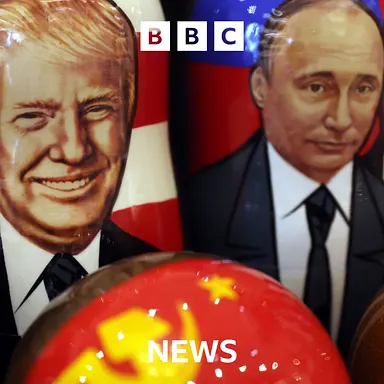
This special Global News Podcast episode previews the first-ever meeting of Donald Trump, Vladimir Putin and Xi Jinping in Shenzhen. Presenter Celia Hatton talks with BBC analysts about what each leader hopes to gain, from Trump's legacy ambitions and Putin's push for a bigger role on the world stage to Xi's wish to appear as a unifying host.
The discussion covers nuclear disarmament, the war in Ukraine, the conflict with Iran and the Nvidia chip scandal, which one guest suggests may be left off the agenda. Listeners will hear competing views on whether the talks will produce concrete decisions or mainly symbolism.
In this episode Celia Hatton, Anthony Zurcher, Vitali Shevchenko
This Global News Podcast episode on the Trump, Putin and Xi Shenzhen summit was made with the technology behind HappyScribe's AI meeting note taker.
Ads in this audio differ from the text. Tap the sentence you're hearing to follow along.
Synced: the text now follows the audio.
Hello, I'm Celia Hattan, and this is a special edition of the Global News Podcast. An unprecedented gathering of three leaders from the world's three biggest nuclear powers: Xi Jinping, Donald Trump, and Vladimir Putin. These three have never met together before, and it's been seven years since their paths even crossed in the same location. And since then, a lot has happened. Two of those leaders, from the U.S. and Russia, have entered into damaging and costly wars. The third, Xi Jinping, is facing his own domestic challenges.
So what will they talk about when they meet in the glittering Chinese city of Shenzhen?
Well, we're going to be talking about denuclearization. We'll talk about Iran. We have Iran in very good shape, but we'll talk about Iran a little bit. We'll talk about my favorite subject, Ukraine. Ukraine's losing. Ukraine, Russia's losing 25,000 soldiers a month. So we'll be talking about that. We'll all be talking about economics and trade.
That's the U.S. President, Donald Trump. The Chinese Foreign Ministry spokesperson is Mao Niang.
This will be the first face-to-face meeting in history among the heads of state of China, Russia, and the U.S. They will exchange views in depth on safeguarding world peace and promoting strategic stability in major power relations, which is of groundbreaking significance.
And Yuri Yushchakov is an aide to the Russian President.
Everyone will undoubtedly be following the meeting with heightened attention. Most are glad that this meeting is taking place. Some are not very pleased. But this meeting is needed now. At present, active work is underway on the substantive content of the meeting. Will we reach an understanding? I would like to hope so.
But will any big decisions come out of Shenzhen, or is it all about symbolism, a way for the leaders of China, the U.S., and Russia to give themselves a boost and a distraction from their problems at home? I'll be joined by our experts on Russia and the U.S. to explore all these points. Stay with us. Well, a lot to discuss. And joining me are two amazing guests. We have Vitali Shevchenko, he's BBC Monetary's chief analyst. And you're also a Russia and Ukraine expert.
I am. Hello.
Hello. Nice for you to be here. And of course, we have Anthony Zirker, who is with us in the United States. He's our North America correspondent. Great to have you with us, Anthony.
Great to be here, Celia. And you have reported from Beijing for quite some time and are now the BBC China analyst.
That's right. And it's so good for us all to bring our expertise to the table. Well, let's get to it with a quick opening question for us all. What's the significance of this trilateral meeting? Vitali, I'll kick it off with you.
Well, first of all, it's never happened before. It's something we have never seen before. And I think that gives it a lot of significance, whether or not any ambitions, hopes, and dreams that each of those three leaders have, whether they'll be fulfilled, is quite a different matter. But tell you what, I'm sure they have a lot of hopes riding on this meeting.
Everybody's going to be watching this meeting really closely, aren't they, in places around the world. Anthony, what do you think? What's the significance of this meeting?
Yeah, you know, Vitali said it hasn't happened before. There have been some comparisons to another big meeting that happened after World War II in Yalta with Stalin and Roosevelt and Churchill. And I think, at least from an American perspective, from a Donald Trump perspective, he may view this as something on an equal par, the world leaders getting together, the most powerful nations getting together to settle the biggest issues that face the world. So I think Donald Trump is going to enjoy the stage, and I think he is optimistic that something will come from it.
Well, Yalta, I'm sure that Vladimir Putin also has visions of a Yalta 2.0. But there's a key difference. Back in 1945, it was three victorious nations that sat down to basically discuss what happens next, how we divide the world between us. And while Vladimir Putin may want to get involved in these conversations, his country is by no means victorious.
In fact, it's really struggling in Ukraine. It's bogged down in Ukraine, where this war has been going on for four and a half years instead of, what, a couple of days, as I'm sure he had hoped. So from that point of view, I'm not sure he qualifies as a leader of this enormous victorious superpower.
I think I'm going to be watching to see if what comes out of this meeting, really. Is it going to be some kind of vague communiqué promising world peace, which is what I think Xi Jinping wants? He doesn't want to be coming down hard on any major global issue. Or is there going to be some actual leeway? Is there going to be some movement when it comes to Iran or something on nuclear disarmament, which is not what China wants? So I think the Chinese side, Xi Jinping is really going to be pushing to maintain Xi Jinping's good relations around the world with places like Africa, South America, and burgeoning relationships with Europe.
Or is he going to kind of really align himself with two sometimes unpopular, relatively unpopular other world leaders like Donald Trump and Vladimir Putin? Speaking of Putin, Vitali, I wanted to focus in with you on how this summit came about, because some of the reporting I've seen is that it was really Vladimir Putin's idea.
Possibly. What surprises me in a way is how little the Russians are talking about it. I was expecting, you know, a degree of triumphalism in Russian media. Here we are sitting down at the table with the big boys. We are back in the global international arena. I'm not sure that's happening. It's happening on Thursday. And that's it.
Anthony, what have you been hearing? What's the mood music leading into this summit? And what's the attitude?
Well, you know, it's interesting, Vitali, talking about this being Vladimir Putin's idea. It was Donald Trump who announced that this was a possibility based on a phone conversation, according to a Wall Street Journal report that he had with Vladimir Putin. But it seems like it is Donald Trump who is heralding this the most, talking it up the most. And I think part of that is because Donald Trump likes this idea of world leaders being on the same stage and likes kind of having these old-school type of great power meetings.
You remember his political views were formed in the '70s and '80s when there were these massive summits between the United States and the then Soviet Union. And I think he feels that is what American presidents do. They have these big meetings, and they make big decisions that lead to tangible results. Now, whether the United States gets anything like that out of this, I think that is very much an open question. Although when we hear about what Donald Trump wants out of this, originally it seemed like Russia wanted to talk about Ukraine in particular.
Donald Trump keeps bringing up nuclear armament and nuclear proliferation. That seems to be something that he would like to have as a deliverable from this, even though there doesn't seem to be a whole lot of interest from the other parties to advance that. But again, it goes back to you think about these big disarmament meetings between the United States and the Soviet Union in the '80s. I think that is this picture that Donald Trump has in his mind. And that is the way, even if there's not a tangible result, that's the way he wants the American public to look at it.
The great American president once again standing on the stage, holding his own, going toe to toe with world leaders.
Anthony and Vitali, let's take a minute now to take a look at each leader, at what their objectives are, and also what they're dealing with personally and internationally as they head into this big meeting. Anthony, maybe we should start with Donald Trump. He's gone through quite a bruising election season. What's on his mind? What's he having to deal with as he heads to Shenzhen?
I think part of what he wants to do is show that he's still relevant, that he still has power, that these midterm election results that took place just last week, where Democrats had massive wins that Republicans lost control of both the House of Representatives and the U.S. Senate. And there's going to be all this new oversight and Democrats in Congress trying to exert themselves on foreign policy issues. That when push comes to shove, it's still Donald Trump who is the one calling the shots. As many American presidents in their second term facing what's called the lame duck final two years of their time in office, they look to foreign policy as a way of establishing their legacy and making a lasting mark.
I think that's what Donald Trump wants to do here too. Even since he came back to the White House two years ago, he's been focused on having a legacy, having some sort of a lasting accomplishment, whether it's building triumphal arches in Washington, D.C., or renovating the White House, or doing other projects, whether it's renaming bodies of water. All of that seems to be Donald Trump keeping in mind how history is going to view him. So this is another chance, I think, for him to make a mark in history and have that signature moment that might be talked about after he's gone from office.
What do you think success how do you think he would view this meeting as a success? What would really have to happen for him to come out smiling?
Well, there are the big things that he wants to have done. He wants to end the Ukraine war. He campaigned on that two and a half years ago, saying it was going to be very easy. And time and time again, he brings up the fact that he was surprised how hard it has ended up being, that he didn't think it was going to drag on this long, and that this is just a testament to how much Vladimir Putin and Volodymyr Zelensky hate each other. I think, obviously, the Iran war also still looms over Donald Trump. And to find some sort of resolution to that, or at least some sort of pledge of cooperation from Russia and China or an agreement that they don't get involved in the conflict, I think that would be a goal for him.
And then the nuclear proliferation angle of this, which Donald Trump, as I mentioned, seems to be also focused on. It's hard to imagine what kind of deliverable he could get from that. But if there's some sort of a statement of principle, some sort of a goal to limit a nuclear arms race, maybe that would be something that he would like to take out of it.
Okay. Vitali, let's turn to you and Vladimir Putin. It's almost like this feels almost like the beginning of some kind of dinner party murder mystery, you know, where each one of the guests arrive with their own kind of baggage and their own backstory. So let's get into Vladimir Putin's backstory going into this.
And his baggage.
Yeah.
I think for him, the very fact that this meeting is going ahead is success enough. That fact enough is going to make him smile, a really, really big smile. It's an excellent photo-op for somebody who's been so desperate to come back out from the cold and end years of isolation, which the West tried to impose on him following the start of the full-scale invasion of Ukraine. But on a bigger scale, his ambition is quite simply to undo the Soviet Union's defeat in the Cold War.
And I'm sure he has visions of sitting down with Xi Jinping and Donald Trump and carving the world up in spheres of influence. But that's probably slightly far-fetched at the moment. More realistically and more based on specific statements we've heard from Russia recently, he quite simply wants NATO to pull back to where it was during the Cold War and therefore recreate this Soviet sphere of influence, which, A, included the Soviet Union, and B, it had a lot of influence on Eastern Europe.
Countries like Poland, the Czech Republic, Slovakia, Hungary, the Baltic states, the Balkan states, he wants them to leave NATO. Of course, it's an absurd demand, but it indicates the level of his extreme ambition and extreme expansionism. And I will be hugely surprised if it doesn't get some sort of mention in China.
You know, Vitali, I was traveling with Anthony Blinken back in 2022 for that big meeting between the Russians and the Americans in Geneva just a few weeks before they launched the invasion of Ukraine. And I had the feeling like the Russians were enjoying that moment. As you say, they were enjoying just being on the world stage and having these kind of high-stakes negotiations in Geneva, where so many had happened before between the U.S. and the Soviets. So you have the Russians who like this big stage. You have the Americans and Donald Trump who seems to like this big stage.
I'm actually kind of curious, Celia, whether Xi Jinping and the Chinese are at all nervous about this, because this might threaten their perception, their attempt to style themselves as the independent negotiator kind of above these sorts of conflicts.
I think you're right. I mean, the reporting that I heard behind the scenes leading up to this big summit, the APEC summit, a financial summit that Xi Jinping is hosting in Shenzhen, was that he wasn't really particularly interested in having this trilateral meeting because he is nervous and his inner circle are nervous about Xi Jinping kind of breaking away from China's political identity as a developing country. China has worked really hard to forge links with different parts of the world, forge very strong trading ties with Africa, for example, and South America.
And I think there was a certain amount of risk, I think, for Xi Jinping to appear with Donald Trump and Vladimir Putin. However, I think that Xi Jinping has really come around to this. And in all of the Chinese state media editorials that I've been reading, a lot of the messaging is that this is really a moment for Xi Jinping. And they do not use this term. I will use this lingo, is that it will make Xi Jinping seem like the adult in the room.
He's going to appear probably, I would assume, in the middle because he's the host with Donald Trump on one side, Vladimir Putin on the other. And these are two men on either side of him who were embroiled in very difficult wars. They've made big strategic errors, one with the war in Ukraine, one with the war in Iran. And in contrast, he's going to be seen as the one who's kind of the great unifier. The Chinese messaging around this is that Xi Jinping wants to talk about world peace and strategic stability. And I think by welcoming people around the world to pay attention to Shenzhen, which is China's third largest city, a city of 18 million.
It's the fastest growing city in the world, according to China. You know, in the '80s, it was a fishing village. It's now this modern, glittering city. They've even released an official theme song for the APEC conference. And so I think he's going to be showing off China as taking the right path, that the Chinese way is really the right way, this kind of long-term planning that the Chinese Communist Party has done.
And so I think that even though there was, I think, certainly some reluctance at first to be hosting this three-way talk, I think actually Xi Jinping, just by appearing in the first 10 seconds with these two other leaders at his side, I think as long as there's no kind of real concession throughout those talks or some really negative leaks coming out of it, I think Xi Jinping is probably going to come out looking pretty good.
I was in Alaska in August last year for the summit between Trump and Putin. And I was struck by how overexcited Donald Trump seemed to be to physically meet Vladimir Putin. He was beaming. He literally applauded him. There was this red carpet. And it was so, so obvious that Donald Trump seems to be quite simply infatuated with Vladimir Putin.
And Vladimir Putin, you know, being his usual self, he kept his emotions closer to his chest. But I think he will be equally as excited to meet those people as well, but with a slightly different purpose. I'm sure he will enjoy trying to play them, to play his little rhetorical and logical and illogical games with them. So for him, it's a bit of a game. He never shied away from a bit of tussle and confrontation.
It's going to be fascinating to see that moment when they first appear together and we get that first shot. Well, we've already touched on the fact that the United States and China in particular are strategic rivals economically and diplomatically. But let's focus for a moment on that rivalry that's on display when it comes to the world of technology. And the scandal surrounding the U.S. chip maker Nvidia is a really good example of that. Our Asia Digital reporter, Tessa Wong, has been tracking every moment of the story surrounding Nvidia.
And she told me why Nvidia is such a big deal and why the world's superpowers are fighting over its products.
So Nvidia is, as you know, one of the most important companies in the world right now. It's making all these advanced semiconductor chips that are really powering the AI boom that the U.S. and China are locked in a race in. They're both locked in a race for AI supremacy. For now, Nvidia is being seen as the market leader in producing this kind of computing power, right, that both countries just want to get their hands on it. You know, their latest Blackwell chips are said to be the most powerful yet that the world has seen. So there's been a lot of scrutiny on where these chips are going around the world.
You know, Nvidia and Jensen Huang have said that they're sticking to the laws, that obeying export restrictions. But, you know, there's been a lot of reports in the past year that point to, you know, otherwise, there have been reports that Nvidia customers, particularly in Southeast Asia, where we've really seen a big boom in data centers and in the global chip trade. There's been some reports that some of the data centers have been getting Nvidia chips, placing them in the data centers in Southeast Asia, and then giving backdoor access to Chinese companies.
Now, that could be either allowing them to rent the computing power in these other countries or maybe even re-exporting the chips to China. Now, nothing's been proven yet, but there's been a lot of scrutiny over these data centers in the past year. And it's all kind of really come into the spotlight now with this scandal that's enveloped Nvidia and Jensen Huang.
So a lot of accusations, a lot of scrutiny, as you say. What's China's response to this?
So China has firmly denied that it is doing any kind of circumvention of the U.S. export bans. It said that it has respected that ban. It has also firmly denied any allegations that it has sent its spy to infiltrate Nvidia. It has rejected all allegations that it's been conducting this kind of espionage activity. I'm just going to read from the statement here. They said that their scientific and technological progress is driven by their own innovation, basically saying they don't need to resort to these sort of things to achieve their own innovation.
And they've called on the U.S. to stop fabricating so-called espionage narratives to find pretexts for imposing technological blockades.
That was Tessa Wong in Singapore. So, Anthony, such a massive story. And yet I've seen some reporting that Trump officials are saying that Nvidia won't be discussed when Donald Trump and Xi Jinping meet. Why do you think that is?
Yeah, it is interesting. And Donald Trump kind of hinted at that as well before departing the White House for his trip to Asia, that he didn't want to offend the Chinese with new restrictions on chips. He didn't want to bring up Nvidia. And I think the feeling is that this is a loaded topic and that this is something that might disrupt those talks. Obviously, AI and creating some sort of guardrails and some sort of information sharing between the two nations is going to be discussed.
But this is such a sticky, delicate topic that maybe the Americans feel it's better just to not focus on that. You know, Donald Trump, when pressed about Chinese spying and the possibility that Chinese could be spying on U.S. technology companies like Nvidia, he almost dismissed it. He said, well, we do the same thing to them. Everyone's kind of jostling and trying these different tactics to try to get the upper hand. So it is funny that he doesn't seem to have taken great offense at this and seems to much prefer leaving it on the sidelines.
It's really interesting. It seems very odd to me that the Americans don't really want to address this. It really seems like the elephant in the room if it doesn't come up at all, even in closed-door discussions. You know, it reminds me of a moment in 2017 when we learned just before Xi Jinping came to power, when he was still vice premier, that basically the Chinese authorities had gone through and had either killed or imprisoned 18 to 20 U.S. spies operating in China.
They basically wiped out the whole American spying network by the CIA inside China around 2010, 2012. And it really took away the Americans' ability to spy on what was going on inside China. So it's really interesting that Donald Trump is portraying it, that we just spy on each other when it doesn't really operate always that way. One country sometimes has an upper hand.
Right. And when you dig deeper into this, you see divisions within his own administration. China hardliners like Scott Bessent, the Treasury Secretary, on one side, and Howard Lutnick, the Commerce Secretary, on the other, who has been very, very kind of open to allowing chip movement and less keen on regulating or restricting chip exports. So Donald Trump, sometimes he likes to float above these sorts of divisions and let them play out, let his subordinates fight over policy. But when the stakes are this high, as you say, it is very unusual for Donald Trump not to view this as a threat and not to respond in a way that reflects that.
All right, well, let's get on to some of the issues that we think the leaders will discuss. And we did touch on this a little bit, but nuclear disarmament is something that Donald Trump and his circle have mentioned. Anthony, just to stay with you for a moment, why do you think Donald Trump is so hot on this issue?
Well, I think it's because nuclear disarmament was a big issue in the '70s and '80s, all of the high-level talks between the United States and the Soviet Union. So he thinks back on that and views that as the sort of thing that world leaders who are standing astride the global stage, what they talk about. I don't think, you know, I don't hear here in the United States or the halls of Congress and among policymakers that this is a huge issue for them compared to the technology issues that we discussed with artificial intelligence and the war in Iran and the war in Ukraine.
This doesn't seem like the most pressing issue. But I think for Donald Trump, it is his view that this is what presidents do. And so he's going to stand there. And he does have a fear of nuclear war. He does have concerns about that. And he brings it up pretty regularly. But this is an issue that he seems willing personally to push to the front of the stage because of his own personal feelings about it.
I know that Xi Jinping is really reluctant to speak about this. China's Foreign Ministry has said repeatedly that China will not negotiate on nuclear disarmament until other countries bring their arsenals down in size. That's because China only has around 600 nuclear warheads in comparison to, Vitali, do you know how many Russia has?
I think it's in the thousands, 5,000 something.
Yeah. And Anthony, is it around the same for the U.S.? I think the U.S. is a bit more, maybe.
I think maybe a bit more, but I don't have the exact number.
Yeah, yeah, in the thousands. So China really doesn't want to discuss this topic. What about Vladimir Putin?
Well, forgive the pun, but it's a huge Trump card for Russia. He's not going to give it up just like that that easily. When it comes to the nuclear relationship between Russia and China, it has been reported, not confirmed, but reported, that it was China—well, you called Xi Jinping the adult in the room—it was China that clamped down really strongly on any talk coming from Russia of using nuclear weapons against Ukraine.
Apparently, reportedly, China said, no, no, no, you cannot do that. And, well, it's probably one big reason why Russia sort of toned down its nuclear rhetoric and hasn't used nuclear weapons against Ukraine. But it's true that just having those weapons is a massive, massive leverage.
Anthony, I want to go to you for this next point on the possible agenda, and that's the war in Iran. What do you think that Donald Trump is hoping for when he sits down with the other two leaders?
I think probably the main thing he's hoping is that China and Russia stay as far removed from this as possible. He doesn't want to see any sort of support for Iran from either nation. He doesn't want to see military support, of course, but also economic support. China has, in the past, been a big purchaser of Iranian energy exports. And he would like to see China not be involved in that whatsoever, whether that's the case or not.
There are conflicting reports about how much China is getting and how much support China is giving to Iran. But I think he would like to, one, take this off the table, but make sure he gets assurances from all sides that they do not prop up the Iranian regime, because the strategy right now on the American side is to continue this military blockade and hopefully just squeeze out the Iranian regime until finally it relents and makes concessions in negotiations that are not the result of military actions, but economic ones.
I mean, I think it's difficult because I think, you know, reports vary, of course, but I've seen reports that China is still buying large amounts of Iranian oil. In fact, in some ways, they're really benefiting from the wars in Ukraine and in Iran because they're able to get cheaper oil and gas from Russia, and they're also buying cheap oil from Iran. I think when it comes to China and the outcome that Xi Jinping would like to see the most, I think, frankly, he'd be happiest if we just saw a great visual picture of him standing in the middle at the start of the summit, looking like the consummate host and world leader.
And then there was kind of a vague communiqué released at the very end with a promise of hoping for world peace and strategic stability, which are those two buzzwords that we keep hearing through from the Chinese state media. And then we basically didn't get any leaks at the end of it. There was pretty much no reporting afterwards, no questions for journalists or reporters. I think that would be his dream, really.
I remember last time that Ned Putin and Trump in Alaska, there was this really, really puzzling news conference afterwards. It was totally, totally unclear what they discussed, what they agreed. It was so vague. Then months later, Moscow started talking about the spirit of Anchorage and how apparently it meant that Trump had promised to pressure Ukraine into giving up the eastern Donbas region.
Now, this time around, I think we're safe in saying that Russia is getting a lot of help from both China and the United States when it comes to the war against Ukraine. Even though China has been really careful not to get involved, it's the biggest buyer of Russia's hydrocarbons. It's reached record levels, more than 10 billion euros a month. Now, where do you think that money is going?
A lot of it is going to be spent on the war against Ukraine. Also, technology. If you open up the Russian drone, there's so much Chinese technology inside of it. When it comes to America's role, ever since Donald Trump's reelection, so much pressure has been applied by him and his administration against Ukraine rather than Russia. So it can be argued that Russia is doing really well in terms of enlisting Chinese and American assistance for its war against Ukraine.
The big question that the Kremlin will be asking now, what if you bring those two partners together, China and the United States, maybe we'll start getting even more help? That is something that will be playing on Vladimir Putin's mind.
Well, we're almost ready to wrap this up. But before we go, how about all three of us weigh in on what we're going to be watching for when these three men meet, or what our audience should be watching for when these three men meet? Anthony, why don't we start with you first?
We've seen Donald Trump and Xi Jinping interact in the past, most recently here in D.C., but also when they met in Korea. That's kind of a known quantity. The wild card is Donald Trump and Vladimir Putin, I think. And Vitali, you can talk more about Putin's side of this. But Donald Trump, as Vitali mentioned, is constantly differential to Putin on the world stage. We saw that when both of us were in Anchorage covering that summit. We saw it in Helsinki during the meetings there, where Donald Trump actually sided with Vladimir Putin against his own intelligence service when talking about whether Russia had meddled and tried to affect the 2016 presidential election.
So the body language between those two leaders, what Donald Trump either concedes tacitly or implicitly to Vladimir Putin, I think that'll tell us a lot about the next two years of Trump's presidency and how he wants to relate to Russia and what the ultimate outcome is with Ukraine, the Ukraine war. Because we were talking about who might have the most to lose in this three-person summit. Well, really, the people who will have the most possibly to lose are the Ukrainians because they're not at the table.
And like the European allies before Trump went to Anchorage, were worrying about what Donald Trump might concede there. I think there is the same kind of concerns with this meeting coming up in the next day.
It's interesting you mentioned body language, Anthony, because that's what I'm going to be watching for when I see those first images of the summit. I want to know, is Xi Jinping going to allow himself to break into a smile? Because we see that very rarely, only when he's happiest. In fact, only when he's usually meeting with Vladimir Putin do we get to see him actually kind of smile and relax a bit. It's often said that there's a bromance between the two of them. I'm also going to be watching for the fashion, strangely, because I want to know, is he going to be wearing a Western suit like the other two men, I would assume?
Or is he going to be in a Chinese-style Mao suit, kind of really putting forward that idea that the Chinese way is best? So those are two little things I'll be watching for, but they're indicative of a lot of other things that could be going on behind the scenes and the mindset going into this summit for Xi Jinping. And Vitali, what do you think?
Well, my expectations are really, really low. I think it's about breaking the ice and possibly paving the way for further discussions and further meetings. You know, I've been watching Putin for 25 years, and I think I can be wrong, but I think I can predict that he is hardly likely to deviate from his usual restrained ex-KGB officer demeanor. He will probably call Xi Jinping my good old friend once again.
He will probably be sort of friendly towards Donald Trump as well. But I will be hugely surprised if we see anything more than that.
All right, well, thank you so much to my two guests, Vitali Shevchenko.
Thank you very much. It was a pleasure.
And Anthony Zerker.
My pleasure.
That's all for this special episode of the Global News Podcast on the upcoming trilateral meeting in China. Follow along with future episodes of the podcast, where we'll be bringing you the latest news from Shenzhen, and we'll be able to see how the meeting unfolds. Thanks to my guests, Tessa Wong in Singapore, Anthony Zerker in the U.S., and Vitali Shevchenko with me in the studio. This edition was mixed by Alison Purcell Davies, and the producer was Siobhán Lehy. The editor is Karen Martin. I'm Celia Hattan. Until next time, goodbye.
This special episode of the Global News Podcast brings together our China specialist, our North America correspondent, and our Russia and Ukraine analyst, to discuss an unprecedented summit taking place this week.
The US President Donald Trump, Russian President Vladimir Putin and Chinese President Xi Jinping are due to meet in Shenzhen, China, for their first-ever trilateral talks. President Trump has said the agenda will include denuclearisation, the war with Iran, and the war in Ukraine. So what could emerge from this meeting? Some analysts are hopeful that China could exert some influence on Tehran, and act as a mediator between Moscow and Kyiv. But Ukrainian President Volodymyr Zelensky has said he's worried that the three leaders could try to reshape the international order as they see fit, without consulting smaller countries. Trump, Putin and Xi are also expected to talk about the economy and AI, particularly after Jensen Huang was ousted as CEO of Nvidia, following allegations that he had an affair with a suspected Chinese spy. But will any big decisions come out of the talks in Shenzhen? Or is this about symbolism: a way for the leaders of China, the US and Russia to give themselves a boost and a distraction from their problems at home?
The Global News Podcast brings you the breaking news you need to hear, as it happens. Listen for the latest headlines and current affairs from around the world. Politics, economics, climate, business, technology, health – we cover it all with expert analysis and insight.
Get the news that matters, delivered twice a day on weekdays and daily at weekends, plus special bonus episodes reacting to urgent breaking stories. Follow or subscribe now and never miss a moment.
Get in touch: globalpodcast@bbc.co.uk
Photo: Traditional Russian wooden Matryoshka dolls depicting US President Donald J. Trump (L), Russian President Vladimir Putin (C) and Chinese President Xi Jinping (R) are displayed at a gift shop in Moscow, Russia, 16 November 2026
Credit: EPA/Shutterstock