
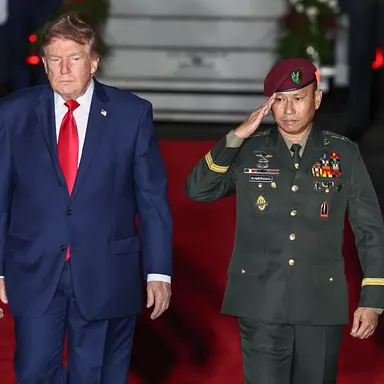
This Global News Podcast episode covers US President Donald Trump's first stop on his Asian trip, where he met the leaders of Japan, India and Australia in Manila as part of the Quad grouping. Other segments look at Shenzhen's technology boom alongside the hardship faced by its workers, Russian and Ukrainian strikes on bridges in Kyiv and Crimea, UK sanctions on Israeli companies building settlements, drone attacks in Sudan, a Turkish media raid, the BBC's new education programme in Nigeria, a truth commission on the Yazidi genocide, and the Leonid meteor shower.
Listeners will hear analysts' views on how much substance the summits may produce.
In this episode Alex Ritson, Barbara Pletascher, Hilken Borren, Jonathan Head, Meghan Argo, Natya Nazaruzov, Oleksandr Merezhko, Sara Rainsford, Yolande Nel, Özgür Çakmakçı
This Global News Podcast transcript on Trump's Manila visit and the Quad was made with the technology behind HappyScribe's Teams AI note taker.
Ads in this audio differ from the text. Tap the sentence you're hearing to follow along.
Synced: the text now follows the audio.
This is the Global News Podcast from the BBC World Service. I'm Alex Ritson, and at 15:00 hours GMT on Tuesday, the 17th of November, these are our main stories. After the bruising U.S. midterm elections, Donald Trump is in the Philippines for the start of meetings with world leaders. Key bridges in Russian-occupied Crimea and Ukraine's capital, Kyiv, are damaged in strike and counter-strike. Turkish police raid an opposition-supporting TV station and appoint new management.
Also in this podcast: how the BBC is helping to solve Nigeria's education crisis.
I had to stop going to school because it is tradition here that once a girl is married, her education ends. I like reciting the English alphabet when I'm doing my chores. It reminds me of when I used to go to school.
And, weather permitting, the Leonid Meteor Show is coming to a sky near you. But first, President Trump is in the Philippines on the first leg of an Asian trip that will later take him to China. His visit comes on the last day of the annual summit of Southeast Asian leaders. He received the red carpet treatment in Manila after his arrival on Air Force One, before leaving for his hotel in a helicopter. His appearance at the ASEAN meeting is being seen as a show of commitment to a region that the U.S.
regards as a strategic counterweight to China. But Mr. Trump's trade tariffs and the war against Iran have caused significant disruption in the Philippines and other countries in the region. And it's the president's first overseas visit since the crushing defeat his Republican Party suffered in the U.S. midterm elections. Later this week, he'll hold a trilateral meeting with the Chinese leader, Xi Jinping, together with Russia's Vladimir Putin. Shortly after his arrival in Manila, President Trump held talks with the leaders of Japan, India, and Australia as part of the so-called Quad.
Our countries are the four corners of a free, open, stable, and prosperous Indo-Pacific. We have outstanding relationships and coordinate closely on matters of regional security, economic security, and diplomacy. And we talk quite often. The three countries that we deal with, we talk a lot when they have a problem, when they have difficulty, when they want to tell me something. My phone is always open, and the Oval Office is always open to you, and you know that.
We heard more from our Southeast Asia correspondent, Jonathan Head, who's in Manila.
I think he's putting on a show. Many of us thought he wouldn't come here because there wasn't anything of substance, enough of substance. But Asians are very good at laying out the red carpet, at making him feel important. He's coming from these bruising midterm elections. He's quite embattled back at home. The countries meeting here in Manila have a lot of grievances against President Trump. His war in Iran has really messed up their economies. His tariffs are a constant chaos, basically. They don't know where they stand with those. But he'll dominate the headlines.
And I think for him, that at least will put on a show of his importance before he arrives in Shenzhen, where he will, of course, be on Xi Jinping's home territory, you know, an equal partner in having, of course, that crucial meeting with Vladimir Putin. So we don't expect much of substance to come out. There are a lot of meetings he's having, and people are going to go to him. All the ASEAN leaders are going for a dinner with him there. It's a kind of ASEAN-U.S. summit, and there will be a lot of bilaterals and claims of breakthroughs on trade. But substance, we can't see it.
The meetings will be very short indeed. Things like trade, those arrangements are just not settled. They're still nowhere near having final trade agreements, really, with any of the countries in this region. And the efforts that the U.S. wants to make on this visit to get Southeast Asian countries in particular locked into its own AI and tech ecosystem, the so-called Pax Silica, again, countries here will not want to be forced to choose between the U.S. and China. And of course, they're going to be very aware that President Trump is only two years left of his presidency and significantly weakened after those midterm election results.
Jonathan Head in Manila. And we'll have a bonus edition of the Global News Podcast in the coming hours with more on the talks in the southern Chinese city of Shenzhen involving President Trump and the Chinese and Russian leaders. Shenzhen, where the meeting of the three leaders will take place, is known as the city of dreams, where drones deliver your lunch and robots serve you coffee. It's become the technology hub of China. And yet, there's another side to the city leaders will not get to see, which highlights the challenges facing President Xi's China.
Our China correspondent, Laura Bicker, has this report.
This is me having a casual conversation with a robot serving me coffee. I'm in what feels like a laboratory for the future with young AI engineer Huang Shihua. He's trying to make robot brains smarter.
Young people like us, full of dreams and enthusiasm, flocked to Shenzhen. Together, we created a miracle.
The miracle engineers like Huang are chasing is central to President Xi Jinping's bold vision for China, which is competing with the U.S. for tech supremacy.
I believe that in a decade, robots will be able to better serve humanity by taking on dangerous or highly repetitive tasks.
And yet, there's another side to this flashy coastal city that world leaders gathering here this week will not get to see. Ms. Liu used to run a small electronics firm. Now in her 50s, she and a team of Chinese aunties carry takeaway meals to desks in one of Shenzhen's largest office towers.
The delivery drivers want to save time. If they go up to the 60th floor here to send one delivery, they can only complete a few orders during lunchbreak hours. But if they outsource the packages to us, they can earn more money. The market they spend now, they are earning half or even one-third of what they used to make.
Ms. Liu only makes a few pence per delivery. She's one of 200 million Chinese people now dependent on what's called the gig economy, with no pension or Social Security. As night falls in the city's industrial heart, the streets become an open-air canteen with sizzling skewers and cheap, spicy hot pot. Sitting on plastic chairs drinking beer, we meet a group of construction workers from Sichuan.
They, like tens of thousands of others, traveled from poorer provinces, believing one simple promise: work hard, build a better life. People like 50-year-old Mr. Wu.
Since COVID, the economy has been in decline. Our income has dropped by at least a third.
Households across China have become cautious about spending after a property crash. Companies are also cutting prices to compete for business, and they hire far fewer workers.
Everyone feels life is hard. Lots of factories have relocated, and lots of workers lost their jobs.
The fear is that the technology being built right here in this city could add to these growing pressures.
The high-tech industry is affecting the traditional economy. I still hope machines won't replace us all, but there will still be work requiring human labor.
Lights, dance to music across the city's glistening skyline at night. This former fishing village is a remarkable vision of what China could become. But as Beijing races to embrace a technological future, there's a question lingering among workers like Mr. Wu: where do they fit in?
Laura Bicker. In what has been described as the battle of the bridges, Russia and Ukraine launched overnight attacks targeting each other's important transport infrastructure. Russian missiles hit Kyiv's northern and southern bridges spanning the Dnipro River, while Ukraine appears to have caused extensive damage to the Kerch Bridge that connects Russia to occupied Crimea. Some of Kyiv's above-ground subway services were also damaged, and civilians were told to go to defense shelters.
Oleksandr Merezhko is the chair of Ukraine's Foreign Affairs Committee.
For us, these are two biggest bridges, the southern and northern bridges, which play a crucial role in terms of communication because many people, for example, live on the left bank of Kyiv, and they travel. They use the bridge, for example, Southern Bridge, to go to work on the right bank, which is like a business center. And Putin is trying to completely halt this kind of movement and to paralyze the economy of Kyiv.
Putin's goal is to make Kyiv uninhabitable. For him, it's a symbol of defiance.
Our correspondent in Kyiv, Sara Rainsford, gave me more details about the scale of damage on the bridges.
Well, I'm actually standing on the northern bridge now across the river Dnieper. That was just the sound of a fire engine racing past. But otherwise, this bridge is closed completely to traffic. It's normally extremely busy, of course. It's one of the main arteries across the river, the vast river here. But today, it's very, very quiet. We're just walking towards the damage. I understand there's a hole, at least a hole, that's what it was described as, in the tarmac up ahead of us, but we haven't seen it yet. Certainly, this bridge and the southern bridge have both been closed by the Russian strikes overnight.
The other bridge has a metro train line across it, and that has been suspended throughout the morning. So I think we can conclude that the damage is pretty extensive. We're being told officially that it's being evaluated at the moment. In Crimea, we've seen pictures. We've seen pictures of the Kerch Bridge, and the damage there does look really extensive. It looks like a whole section of that bridge has basically been smashed and crumbled into the sea below. So that for Ukraine is a very symbolic target. It's the bridge that Vladimir Putin had built after the illegal annexation of Crimea, and it's something that the Ukrainians have been trying to hit for a very long time.
These bridges in Kyiv are absolutely vital to daily life, aren't they?
Well, they are. And today, instead of cars coming across here, what you have is people walking. We've seen people walking across from one bank to the other because it's basically the only way to get quickly across the river. Talking to them, one woman actually lives close to the bridge. She saw the explosion last night. She said she used to live near a power plant in Kyiv. She moved here thinking it would be safer, and in fact, now the bridge is a target. But she was fairly resigned. She said, "Look, we're getting used to this." I spoke to another man who said that the Russians seem to be trying to affect civilian life as much as possible.
They want people to get angry with the government and to come out onto the streets against him, against the government. But he said that's not happening. In fact, people are just more resolved to go on defending their country. That was his view.
Yeah, because President Zelensky has described the talks with the U.S. and European officials as difficult.
Yeah. I mean, I think that's probably an understatement. They haven't actually progressed at all. So there was that meeting in Abu Dhabi. There were talks, but they weren't talks about how to bring peace. They were talks about what happens if and when there ever is peace. So I think, you know, it's quite clear that this is very difficult. The diplomatic process does go on, but in the meantime, the aerial wars are clearly escalating. So lots and lots of aerial attacks in the last few days.
Sara Rainsford in Kyiv. Drones, which have become a weapon of choice in the Ukraine war, are also spreading death and destruction in Sudan. The UN's Human Rights Office says that drones cause nearly three-quarters of all the verified civilian deaths in this year in the war there. It also said that drones have become a defining feature of the conflict between the National Army and the Paramilitary Rapid Support Forces, or RSF. Our Africa correspondent, Barbara Pletascher, reports.
The UN said it's the Sudanese people who are paying the price of an increase in drone warfare. Its Human Rights Office reported 2,230 confirmed civilian deaths this year, nearly three-quarters of them the result of drone attacks. The full figure of civilian casualties is likely to be much higher, it said. The High Commissioner for Human Rights, Volker Türk, condemned what he called a brazen disregard for the laws of war, with both parties relying on drones capable of striking targets hundreds of kilometers away. The Sudanese military was blamed for several mass casualty strikes last month, while the RSF has been accused of targeting civilian infrastructure such as power facilities and fuel stations, with a devastating impact on essential services.
Barbara Pletascher. Still to come in this podcast, a truth commission is to investigate the Yazidi genocide in Syria and Iraq more than a decade ago.
We want someone to look for the missing. We still have 2,500 missing Yazidis. We want the exhumation of the mass graves. We want the reconstruction of Sinjar, the homeland of the Yazidis. And then we want more prosecutions.
This is the Global News Podcast. For months, there have been escalating tensions between Israel and a coalition of 12 European countries, including Britain and Canada, over Israel's policy of continuing to build Jewish settlements in areas of the occupied West Bank, which the international community views as part of a future Palestinian state. The Europeans are particularly worried about Israeli plans to build 3,400 new housing units in an area between the West Bank and Jerusalem, known as E1.
Today, the British government announced sanctions on eight Israeli companies involved in the building of new settlements, as well as an Israeli activist group which has attempted to block aid from getting into Gaza. Our Middle East correspondent, Yolande Nel, in Jerusalem has more details.
Back in September, that's when the UK announced that it was going to ban imports on settlement goods. It also said that it was going to be expanding its global sanctions regime, basically giving it new powers to sanction companies that profit from Israeli settlements in the occupied West Bank, which are illegal under international law. And today, we have the list of the first eight companies that are going to be sanctioned as a result of this, and they include those that are involved in planning settlement homes, in the construction of settlement homes, giving supplies for those, and also marketing settlement properties.
And they are going to be now subject to asset freezes in the UK. Directors of these companies will be disqualified from working in the UK. This does seem to have a largely symbolic effect, but, you know, it does not go at the moment into anything around financing, which could have much more far-reaching implications. But nevertheless, the timing here is really key because it was, of course, Israel's announcement that it was going to go ahead with construction in this very sensitive so-called E1 settlement, a corridor extending from the occupied east of Jerusalem into the West Bank.
And, you know, this is an area where it's seen that settlement expansion there will really block hopes of a future Palestinian state dividing the north from the south of the West Bank. And so the UK and other countries have all been expressing their opposition to that. And just this week, it is expected that an Israeli Land Authority committee is going to sit and look at the tenders that have come in for the first tranche of housing, more than 1,200 homes expected to be built in that E1 area.
Yolande Nel in Jerusalem. Rights groups in Turkey have condemned a police raid on a pro-opposition TV station in Istanbul. They say it's the latest attempt to silence any voices seen as being critical of the government of President Recep Tayyip Erdoğan. In a statement on its website, Sohescu TV said police had carried out searches and arrested senior staff. Özgür Çakmakçı is the director of Sohescu TV.
The reason for the decision is the government's authoritarianism. As the government becomes more authoritarian and imposes more pressure, it narrows the spaces of the media. It narrowed until there was no room left anymore and finally moved to a blackout. We are the first victims of that.
Sohescu is the latest news outlet placed under the control of government-appointed trustees. Hilken Borren from BBC Turkish in Istanbul told me more about the Tuesday morning raid.
The police searched the building, and they were searching for documents allegedly linking the Sohescu media group and its owner to the deceased cleric Fethullah Gürhan's movement. A colleague who's working in Sohescu TV told me that they learned about the raid as they were getting prepared to go to work. Initially, they were not allowed inside. They were told by the government-appointed trustees that they wouldn't go on air in the morning, and instead, a prerecorded health program was broadcast rather than the usual news bulletin. Eventually, journalists were allowed inside the studio, and they went live at 12:00 p.m.
Turkey time. Now, we don't know what shape their broadcast will take from now on or and whether or not they'll be able to maintain this characteristic editorial edge and focus on domestic political coverage that they used to have.
What reason have the authorities officially given for the raid?
The prosecutor's office has issued a statement. They linked the raid and the takeover of the television and the website of Sohescu to a case about its owner, Burak Akbay. They allege that Akbay and the Sohescu media group had ties with the Gülenists, which are labeled as a terrorist organization by Ankara. But the group's lawyer, Ersan Barkın, rejected the alleged crimes and said that they were not associated with the Gülenists movement.
This is far from the first pro-opposition media outlet that has been targeted by the authorities. Where does this leave independent media in Turkey?
Just last month, another pro-opposition news channel called Halk TV was similarly raided and taken over by government trustees. Similarly, its owner was accused of financial fraud. And it used to have these political discussion segments that would heavily criticize the government. Now it is airing prerecorded programs about history, culture, for the most part. Other media outlets have also been either taken over, censored, banned, or otherwise restricted in Turkey. And these came as part of a wider crackdown targeting LGBTQ associations and the civil society.
How do Turkish people feel about this?
The Turkish people have been showing up in front of these news outlets before, but they've also been angry at opposition politicians demanding more action from policymakers and decision-makers rather than just calling for these mass protests all the time.
Hilken Borren in Istanbul. Nigeria is facing an education crisis. Around a quarter of children are not in school. The government has told the BBC that education is its number one priority. But for many, especially in the north of the country, poverty, violence, and the threat of abduction have kept them away from the classroom. Today, the BBC World Service launches the latest series of its education program called DARS. It's in Hausa, the main language spoken in northern Nigeria.
DARS is broadcast on radio and shared digitally in countries where children struggle to access school. Our reporter, Madina Maishanu, has been to a displacement camp in northwestern Nigeria to meet some of these children.
I is for ink.
I is for ink.
J is for job.
J is for job.
Xavier Odric Eyre leans against a classroom window, watching the lesson inside.
M is for monkey.
Nearly 50 children are crowded behind desks, learning the English alphabet. Rukayeh can't stay and listen for long. After bandits killed her father, she's had to grow up fast. Her schooling stopped. Now, as the eldest, she's forced to provide for her siblings.
I cannot go to school because I have to go and beg on the street so we get food to eat. It pains me to see other children studying and going to school while I cannot.
Around 5,000 people live in small buildings and huts here in this displacement camp in the northern district of Sokoto. Most have fled their villages in northern Nigeria, where attacks on schools and mass abductions have become commonplace.
We came to this camp because bandits attacked our village. The bandits killed my father. I miss my father. I wish I could see him again.
The International Organization for Migration says banditry and kidnapping has caused more than 670,000 people to be living in displacement in north-central and northwestern Nigeria. Nigeria's Minister of State for Education told the BBC that her government is doing everything possible to combat banditry. Teacher Kamilu Suleiman Jakada sees firsthand that banditry and kidnapping are just two of the issues keeping children out of his classroom.
We sometimes go to the parents to try and persuade them to allow the children to go to school. But they say to me, if they send the children to school, what will they then eat? It is the children that are the breadwinners.
The realities of these young girls in this camp are the reality of millions of girls in many parts of Nigeria and the world. Bright young girls who have so much ambition and passion to get an education, but due to poverty and insecurity, they might not be able to achieve these goals. The legal age for marriage in Nigeria is 18, but it's common in some areas for child marriage to happen from the onset of puberty.
Sometimes I write on the ground to practice and see if I'm still writing correctly.
Hadiza was married at 13.
I had to stop going to school because it is tradition here that once a girl is married, her education ends. I like reciting the English alphabet when I'm doing my chores. It reminds me of when I used to go to school. I really loved going to school.
According to the latest figures given by UNESCO in 2024, around one in four children and adolescents in Nigeria are estimated to be out of school. In response to the situation, the BBC World Service is launching a Hausa edition of its educational program, DARS, on radio and social media. For children like Rukayeh and Hadiza, it gives them a chance to learn without being in a classroom.
My biggest dream is to help my fellow women when I'm older. I want to be a doctor because women understand women's health issues better.
She dreams of an education not just for herself, but for all the girls in her camp.
Madina Maishanu. Almost 12 years ago, fighters of the Islamic State group took over much of northern and western Iraq in a lightning offensive. When they captured the regions inhabited by the Yazidi minority, genocide ensued. There were massacres, mass rape, and enslavement. Today, in Berlin, a distinguished panel of international judicial figures and human rights activists is conducting a truth commission into the Yazidi genocide. Its aim is to seek justice for the thousands of women and girls enslaved nearly a decade ago.
One of those giving testimony is the lawyer Natya Nazaruzov, who is herself ethnically Yazidi, although she was brought up in France. She talked to Rob Young.
I have been working on this issue for a decade now, and so far we were able to secure only 15 convictions in six different countries, mostly European. And most of these cases have been against female ISIS members because they are the only ones allowed to return. So the justice we have been seeing is very gendered, and the men are mostly excluded. Two trials against European men that took place in France and Belgium were in their absence.
And then two other Iraqi ISIS male members were prosecuted in Germany, but that was because they happened to be on European soil, so they were arrested. But otherwise, it was mostly against ISIS female members.
Okay. And so where are the men who are mainly responsible for these crimes?
These men are in different situations. Some of them were killed during the battles that, you know, allowed to liberate territories in Syria and in Iraq. Others are held in prison in Syria, but also in Iraq. And the ones in Syria were also earlier this year transferred to Iraq. Around 5,700 ISIS members were transferred. And then some others, unfortunately, we don't know where they are. They escaped. They also profited from the situation in Syria when things were unstable to escape.
So they are at large, and we are very concerned about the fact that they might come here in Europe and potentially commit attacks.
Those thousands of men who are in Iraq, though, they are detained, are they? In prison?
The ones in Iraq are currently detained in prisons. They are being investigated, but only for terrorism, because to this date, Iraq still hasn't passed a legislation that would allow investigations and prosecutions for genocide, crimes against humanity, and war crimes. So the current investigations, from our perspective, just show one part of the story and do not focus on what happened to minorities like Yazidis, Christian, and others.
And tell us about this truth commission, which is taking place in Berlin today. What do you hope it could achieve?
I think the commission here in Berlin is a way to bring attention again to the Yazidi cause and to really highlight the gaps and what needs to happen. So the outcome will be a report, but the most important will be then for states to follow the recommendations of the report. What we need is a state or a group of states to take leadership over this issue and really help us in our demands. And these demands haven't changed over the past 12 years. We want, you know, someone to look for the missing. We still have 2,500 missing Yazidis, mainly women and children.
We want the exhumation of the mass graves. We still have dozens of mass graves in Sinjar that haven't been uncovered. We want the reconstruction of Sinjar, the homeland of the Yazidis, which is still to this date, you know, mostly destroyed. And then we want more prosecutions. I mean, 15 cases in six countries when we know that ISIS members came from over 100 countries, and thousands of them were there and committed crimes against thousands of victims is really not enough.
Natya Nazaruzov, a Yazidi lawyer, speaking to Rob Young. Now there'll be a treat in the skies on Tuesday night. The Leonid meteor shower, which should be visible until the end of the month, will be at its peak in the coming hours. The meteor shower will be visible throughout the world, but sky watchers in the northern hemisphere will get the best vantage point. The astrophysicist Dr. Meghan Argo explains what causes this particular celestial phenomenon.
Well, what we're actually seeing is essentially the dust, the debris left over from when comets pass through the solar system. And comets are effectively giant dirty snowballs. So if you imagine building a snowball in the winter down the street, so you pick up all the dirt from the road, they're a bit like that, but there's more dirt than you would get off the road inside these things. And they can be several kilometers across. The comet that made this particular meteor shower, the Leonids, is quite small by comet standards. It's only, we think, a couple of kilometers in diameter. And as these things come to the inner solar system, come towards the sun, just like a snowman does when the sun comes up in the morning, it starts to melt, and it leaves behind this trail of dust and debris that it's collected inside itself.
It leaves some of that debris behind. And when the Earth passes through one of those streams of debris, those little particles of dust and rock that may be only a millimeter or so in size fly through our atmosphere, get superheated as they pass through the atmosphere at many tens of kilometers per second, and burn up. And that's what we see as meteors. You don't need any equipment, no need for a telescope or even binoculars. The best way to observe it is to, well, the best way is a sun lounger, a sleeping bag, a woolly hat, and a thermos of coffee. That's the best way to observe it. Just lie there and watch the sky overhead. And even if you don't see many meteors, we're not expecting a really strong peak for this one tonight.
If you want a strong peak, I'd wait for the Geminids in mid-December. That one's, at the moment, a better prospect for this year, certainly. But yeah, if you wait until the moon's gone down. And just enjoy the sky if it's clear and if it's not raining as it is where I am right now.
Dr. Meghan Argo. And that's all from us for now. If you want to get in touch, you can email us at globalpodcast@bbc.co.uk. This edition was mixed by Alison Purcell-Davies and the producers were Muzaffar Shakir and Oliver Burlaw. The editor is Karen Martin. I'm Alex Ritson, and until next time, goodbye.
In Manila the US president meets leaders of Japan, India and Australia - a grouping known as the Quad. He will head to China on Wednesday.
Also: Ukrainian airstrikes cause extensive damage to bridge connecting occupied Crimea to Russia. UK announces sanctions on eight Israeli companies involved in building Jewish settlements in the occupied West Bank. BBC World Service launches latest series of its education programme, for girls in Nigeria who cannot go to school. Panel of international judges conducts truth commission into Yazidi genocide in Iraq. And how to watch the Leonid meteor shower - one of the more prolific annual meteor streams - as it reaches its peak.
The Global News Podcast brings you the breaking news you need to hear, as it happens. Listen for the latest headlines and current affairs from around the world. Politics, economics, climate, business, technology, health – we cover it all with expert analysis and insight.
Get the news that matters, delivered twice a day on weekdays and daily at weekends, plus special bonus episodes reacting to urgent breaking stories. Follow or subscribe now and never miss a moment.
Get in touch: globalpodcast@bbc.co.uk
Photo: US President Donald Trump walks over a red carpet after disembarking Air Force One in Manila.
Credit: Eloisa Lopez, EPA/Shutterstock