
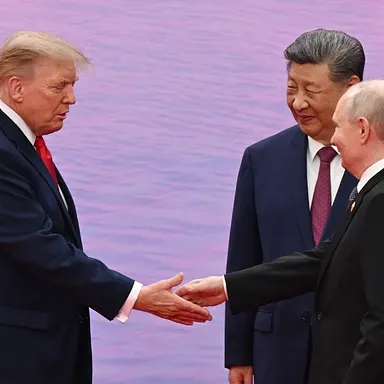
This Global News Podcast episode covers US President Donald Trump's arrival in Shenzhen for the APEC summit, where he was greeted by China's Xi Jinping and met Russia's Vladimir Putin ahead of a planned three-way meeting. Correspondents assess what the leaders might discuss, from Ukraine and Iran to climate, and one correspondent doubts any breakthrough will emerge.
The episode also reports that Democrats won Alaska's final Senate seat, examines the launch of Grand Theft Auto 6 and the high stakes for the industry, and describes a march in Haiti supporting Salvadoran troops fighting gangs. Listeners also hear a former South Sudanese child refugee describe overcrowded schools in eastern Chad.
In this episode Alex Ritson, Gail Malwell, Laura Bicker, Laura Caress, Liz Ruskin, Melinda Farrell, Mimi Swaby, Neda Tofiq, Stephen McDonnell, Steve Rosenberg
This episode on the Trump-Xi-Putin summit and GTA 6 was made with the same technology behind HappyScribe's AI meeting note taker.
Ads in this audio differ from the text. Tap the sentence you're hearing to follow along.
Synced: the text now follows the audio.
This is the Global News Podcast from the BBC World Service. I'm Alex Ritson, and at 15:00 GMT on Wednesday, the 18th of November, these are our main stories. President Trump is greeted by Xi Jinping on his red carpet arrival in China, and goes on to shake hands with Vladimir Putin ahead of their three-way meeting on Thursday. Nearly three weeks after the U.S. midterm elections, the Democrats have finally won the last Senate seat yet to be declared in Alaska, and, after 13 years waiting, Grand Theft Auto 6 is finally being rolled out to gamers around the world.
Also in this podcast.
The bandages have all been ripped off, and Australian cricket is just bleeding all over the place in a very public and distressing way for everyone involved.
Sandpaper Gate: the scandal that refuses to go away for Cricket Australia. We begin in China, where Donald Trump has arrived and waiting to greet him in a carefully choreographed moment with his Chinese counterpart, Xi Jinping. It's thought to be the first time the Chinese president has greeted a foreign leader at the airport, and it mirrors Mr. Trump when he welcomed Mr. Xi off the plane in Washington earlier this year.
And then, in the city of Shenzhen, another much-photographed handshake, this time between the U.S. president and the Russian leader Vladimir Putin ahead of a gala dinner at the APEC Summit. This year's event will be dominated by Thursday's historic trilateral meeting between the leaders of America, China, and Russia. President Xi and Mr. Putin have already had their own meeting, and our China correspondent Stephen McDonnell told me what they might have talked about.
When these meetings happen on the sidelines of APEC or anywhere, they have a little five-minute discussion, and it's just sort of pleasantries. And then other discussions happen behind closed doors, and they give us a readout. Now, one thing that's interesting, according to that readout, is that Xi Jinping and Vladimir Putin did discuss the war in Ukraine, did discuss the situation on the Korean Peninsula. When it comes to the war in Ukraine, China, of course, is accused of indirectly supporting Vladimir Putin's invasion of Ukraine, not only by propping up the war economy, but by supplying these so-called dual-use technologies.
Imagine parts that could be used for a civilian aircraft, oh, and guess what, also fighter aircraft, that type of thing. So maybe Vladimir Putin wants to make sure that this stuff keeps coming in, especially when his country is facing all of these sanctions.
So when all three of them are in the room together, is there anything concrete that actually could come out of this meeting?
If you just look at all the big subjects, how can they possibly agree on something like Taiwan's security? How can they possibly agree on the situation in Ukraine or Iran, for that matter? I mean, Iran is a really big sticking point. You look at the war there that Donald Trump and the Israeli government launched on Iran. Well, both Russia and China have not only not taken part in Donald Trump's war, they've maintained strong economic links with Iran. Now, I can't see what Donald Trump can say to those two that's going to end that.
On the other hand, what Xi Jinping might say to Donald Trump is, well, how about stopping that war, stopping all of the instability that it's creating? So I think the best that you'd hope for is just some nice words or something like that. I mean, look, I may be proven wrong. Let's imagine they come out with some breakthrough agreement, and I'm going to have egg oil over my face, but I can't imagine there's going to be some huge change coming from it.
These are the three most powerful men in the world. A lot of people who are listening, watching this, would say that the biggest issue in the world today is the climate emergency. Is it on the agenda at all?
They may talk about it, but I don't know how you could make any leeway there, given Donald Trump's denial on that front. As a comparison, Xi Jinping and his government not only say that man-made climate change is real, but the Chinese economy is rigged now towards fighting climate in terms of providing wind turbines, electric vehicles, solar panels, et cetera. So, you know, great, Xi Jinping would be happy to talk about that. He's got a really good news story on that front.
But how do you convince Donald Trump to be part of that when he's just basically in denial about man-made climate change? And you've sort of just got Russia in the middle there of the two of them. So I can't see there being any breakthrough there. And it is, you know, a real pity. A lot of people would be shaking their heads and thinking, imagine what those three leaders could achieve if they could agree to really do something about fixing global warming.
Stephen McDonnell. And later in this podcast, we'll be hearing from our Beijing, Moscow, and Washington correspondents to discuss the historic meeting. Nearly three weeks after the U.S. midterm elections, the Democrats have finally won the last Senate seat from the Republicans that was still to be declared: Alaska. Mary Palatola defeated the incumbent Dan Sullivan. The race in Alaska attracted much media attention and scrutiny after a third candidate, also named Dan Sullivan, was put on the ballot.
An FBI investigation into the candidacy is continuing. In a video address, Mary Palatola thanked voters.
Alaskans have voted for change, and I'm so honored to be your next U.S. senator. Together, we're going to put an end to the era of self-serving politicians lining their own pockets at your expense, and together, we're going to put Alaska first.
Liz Ruskin of Alaska Public Media spoke to Justin Webb about the winning candidate.
She is the first Indigenous Alaskan in the Senate, just like she was the first Indigenous Alaskan in the U.S. House. She is from a small hub city in western Alaska, a very rural part of the state. She's a fish advocate. And she adds another Democrat to the Democratic majority in the Senate, and that is important to the rest of the country, as well as Alaska, and it's why other people have poured millions and millions of dollars into this race.
She adds another Democrat. Does she add another Democrat on the moderate wing or not? Is it not that easy to say?
Oh, she, in the House, she was very much a moderate. She was in favor of oil development and gun ownership. She campaigned this year on the same themes that national Democrats took up: affordability and against corruption. She has this theme, fish family freedom. Other Americans find it sort of amusing, but in Alaska, fish is serious business.
And it brings the number of Senate seats for the Democrats up to 56, but a fight already starting about who is going to be the leader of them all. And I suppose the big question, the big political question, the national political question now, is whether the Democrats can get going in the Senate and actually make a difference and do it soon.
Yeah, that is the big question. She says that she's ready to do that, and she still has to put a staff together, but she doesn't take office until January 3, so she has a bit of time.
Liz Ruskin. Next to what is arguably the world's most popular gaming franchise, Grand Theft Auto. The release of the latest title, GTA 6, has been more than 13 years in the making, with development costs in the region of a billion dollars. The release is so huge that internet providers have increased capacity to cope. The game launches at midnight around the world, local time, meaning gamers in New Zealand became the first to play, including this very excited man.
Oh my God, it's happening! Oh my God, it looks amazing. It looks amazing. Bro, the graphics are insane. How good is that soundtrack?
But will it live up to the hype? That's the question I put to our technology reporter, Laura Caress.
I think it's really the closest thing gaming has to a global cultural event. People who don't even play games know what this is. This is gaming's Super Bowl. Every major brand under the sun is getting involved with this launch. And it's no surprise why, really, when we look at the previous game, GTA 5, that made a billion dollars in just three days since its launch. And it's estimated this game's already done that, just in pre-orders alone. So as you say, people are booking off annual leave to play this game as soon as it launches.
It's been a long, long road. And Rockstar, the developers, they're just renowned for creating these beautifully immersive worlds. So people are wondering, with all this time and all this money, what can they bring us?
And there is a lot hinging on the success of this release.
Very much so. People are estimating this is the most expensive game ever made. They're estimating about a billion dollars has been put into this game. So that's a huge, huge amount. And otherwise, developers outside of this, some have faced studio closures. There's redundancies. There's rising production costs. Spending in gaming is still going up and up, but making blockbuster games, it's become incredibly expensive and risky. So there is a hope this could boost investor confidence. It could be a bit of a shot in the arm for the games industry. But obviously, one huge success, it's not going to solve the problems facing all these smaller studios.
Because this game is controversial, isn't it? I mean, at its heart, it's about stealing cars and killing people.
That's true. It's interesting because from the original games, the publishers actually quoted this controversy, and that was how it got a lot of its word of mouth and got people playing it. It's almost a victim of that own success. I mean, we have to acknowledge it's an 18-rated game. It's an adult game. So there is going to be violence in this, and it is something that people always go back to. But it's interesting that, yes, this was initially a controversial game. It's contingent in that manner. But I think a lot of people are just interested to see what it can do with that now, especially we've got this lead female character now, Lucia, who we heard there at the beginning.
What can Rockstar do with that? Can they make a slightly less one-dimensional female character than we've seen before and make her fully formed? I think people are really interested to see, have they grown up a bit since 13 years ago? What can they do with this franchise now?
Laura Caress. Thousands of Haitians marched in the capital, Port-au-Prince, on Tuesday in support of troops from El Salvador who've been confronting criminal gangs that control much of the capital. Some carried placards thanking the Salvadoran president, Nayib Bukele. Gang, warfare, and political chaos have long plagued Haiti, whose last elected president was assassinated five years ago. Our global affairs reporter, Mimi Swaby, told me more about the welcome the march has got.
They've been received extremely well, with thousands of Haitians marching and celebrating their presence in the capital, Port-au-Prince, on Tuesday. And this was the same day that Haiti formalized a cooperation agreement with El Salvador, basically meaning their presence will continue. They previously said, or originally came to Haiti in response to four Salvadoran airmen and aviation technicians who have gone missing. They were ambushed by a gang at the end of last October. And in response, El Salvador's president, Nayib Bukele, had a very large deployment, more than 2,000 troops, with the primary reason for them being there to rescue and find these missing nationals.
However, it is very obvious that they are far more prepared in size and military capability for more than just finding these four men. Bukele's forceful crackdown, a very successful crackdown on gangs at home, has given him a lot of public support. And Haitians are hoping that that knowledge and that success can happen to them as well. But it's come at a time where Haiti is experiencing a huge increase in violence. Just the first 10 months of this year alone, more than 4,500 people were killed and 2,000 injured due to gang violence.
And there's also been a surge in kidnappings, increasingly targeting children, police officers, and government officials. So the deployment, although it was sparked or initiated by these four missing nationals, has been very welcomely received and is seemingly going to be there for a while in the midst of chaos. It really is a beacon of hope for many Haitians.
Yeah, because this deployment from El Salvador is in addition to other deployments.
There are numerous armed forces operating in Haiti, with uncertain and very unclear levels of coordination and cooperation. You have the Haitian police and armed forces. You have this UN-backed multinational gang suppression force that has recently started being deployed. It's not in its full capacity just yet. They're hoping it will be in early New Year. You have foreign mercenaries also operating in the country and now Salvadoran troops. And it's in this crowded landscape that there are concerns by many people that although this increased offensive with drones and also military power may be a short-term fix and a moment of hope for Haiti, it's not going to be a long-term solution and, in fact, make the country more unstable going forward.
Mimi Swaby. Still to come in this podcast.
In some of the cars that we found, there are 500 people sitting on the ground, shoulder to shoulder. They don't even have, you know, the space to ride. And they don't even have the books to ride on.
Former refugee from South Sudan trying to help children who have fled the war in neighboring Sudan. This is the Global News Podcast. It's the cricketing scandal that refuses to go away. Cameron Bancroft, the Australian player at the center of the infamous sandpaper gate affair, has now said that the whole team was aware of a plot to change the way the ball's trajectory went using the abrasive material.
In 2018, Bancroft, Captain Steve Smith, and Vice Captain David Warner were suspended after the plot was uncovered. Bancroft's remarks will put more pressure on Australia's current captain, Pat Cummins, who denies knowing about it. The Australian cricket board says it's established a new forum for individuals to give their version of events. Melinda Farrell is an Australian cricket writer and journalist.
Everything has moved so quickly today. We had the Cricket Australia CEO, Todd Greenberg, and a name that might be familiar to many people, the interim chair, David Boone, come out and announce this forum. That in itself was big news, this idea that they would get players together, there would be no recriminations or extra sanctions. It would be a safe environment with an independent arbitrator to clear the air. And it was all an attempt to stop what has subsequently happened.
And that is Cameron Bancroft basically detonating the whole story all over again by coming out with a 4,000-word piece in the West Australian. Apart from a few tests in 2019, he's never played Test cricket again. Most notably, he did come out and suggest in 2021 in an interview with The Guardian that it was self-explanatory that the bowlers knew about his tampering of the ball with sandpaper. So there's clearly a lot of hurt, and he feels a lot of grievances about what has happened.
And so too does David Warner, who's been pretty vocal about that. Steve Smith has remained quiet through all of this so far, but there'll be intense speculation about whether or not he might speak up. The actual bans themselves, I think most people would agree, were over the top. They weren't imposed by the international body that governs the game. It was Cricket Australia's own investigation. It was over within three days, that investigation. We now know they didn't speak to all the players.
We don't know if they spoke to all the staff. The investigation itself appears looking back to have not been fit for purpose. And the whole situation has just been left to fester and fester. And now the bandages have all been ripped off, and Australian cricket is just bleeding all over the place in a very public and distressing way for everyone involved.
Melinda Farrell. At the beginning of the year, we heard the stories of John Quay and Gail Malwell, two former child refugees from South Sudan who walked the entire length of the UK to draw attention to the war in Sudan. Almost a million people from Sudan have crossed the border into Chad since civil war broke out there in 2023. John and Gail walked around 1,450 kilometers in 33 days, enduring some of the coldest weather of the year, raising more than $130,000 for displaced Sudanese children in Chad.
A few weeks ago, Gail went to eastern Chad to understand their educational needs. My colleague, James Coppnell, asked him about the conditions he found there.
When we arrived in those camps in eastern Chad, what we were met with is no active education. There was no enrollment. There was nothing. We collected data and information from the locals, from educators, and all the people involved, including parents. And what we found out is that there is actually no active funding for the schools there. That led to the teachers going on strike, and some of them just, you know, would rather go and do manual jobs to feed their families. And the schools themselves are not about teachers.
There are no benches on the school. Children sit on the floor like a dirt floor. And they don't have school materials. There are no books. They don't even have uniforms. So these are not schools, clearly. They're just like learning places where you just go and sit and maybe learn something.
And maybe not, right?
And maybe not. And one of the reasons is here. In each of the class, an upper edge, there are 200.
200.
200 is a lot. The standard should be 60 or 70. And this is a classroom that is five by five meters. And in some of the class that we found, there are 500 people sitting on the ground, shoulder to shoulder. They don't even have, you know, the space to write. And they don't even have the books to write on. There was this one school called Al Nada that we went to during the last days of our visit to a camp called Ridham. There are about 4,000 people in this school with only eight classes. So if you divide those, it means technically one class has 500 students.
And then they have to divide the school into two shifts, morning shift and evening shift, so that they can accommodate these classes.
So that sounds to me like families are desperate for their kids to be at school, for children to learn. The children probably really want to learn.
Yes.
But they're in almost the worst possible conditions in which to learn. So that's a whole generation of these kids, these refugees from a devastating conflict in Sudan who now face a new threat to their future, to their well-being.
Yeah. And that's exactly what I found. I don't even consider the sanitation condition there. The sanitary condition is completely horrible. The toilets are piled up with feces, and it's crazy. There are no running waters as well. The school's environment is open. So even cars and motorcycles just pass through the school environment during the active education days. That can cause a lot of things. You know, the environment is not child-friendly. And anyone can do anything to these children provided that they are in a vulnerable position where there's no protection.
The entire situation in the camp, from socioeconomics, from job opportunities or employment opportunities for people, there is none. It's all void. Some of the responsible NGOs there, because of lack of international funding and so they would force the community or urge them at least to help in funding these schools. And from the look of things, a community that is destitute, that lives in impoverishment, cannot in any way even afford a school uniform for their children or even a textbook or even a notebook.
How can they, you know, afford to fund a school to keep it functioning? It's crazy.
So it strikes me that the money you have raised, and perhaps you will raise more, might help to rebuild some classrooms or put some kids in a better situation. But the scale of the problem you're talking about there is going to need something much bigger than that. Is that right?
Yes. So the scale is what shocked me is the amount of the work that is needed to be done. And the fact that nobody thought, like, I'm talking about the big international organization that could have taken the responsibility to remedy that. And of course, it would be challenging for myself, although I have the hope that can be solved with the right resources and the right people in place. So the amount of the resources that I have, we made an assessment and we say, okay, there are these schools that are in one place, like it's like a center of intermediate, secondary, and primary schools.
So now the program, the next program, which would happen in January, hopefully, is to go and dignify and improve these schools that are together and provide a student with the uniforms, proper sanitary facilities, fence for the security of the children as well, provide other learning materials as much as possible as we can. We cannot do it alone. We need so many people out there who are philanthropies, who would want to support the children of Sudan in a way. And this is the only way to support the children of Sudan, is to give them a bright future through education.
And that is one of the reasons that motivates me to strongly do something about that.
Gail Malwell. Let's return now to the big meeting in China that will take place on Thursday at the APEC Summit between Donald Trump, Vladimir Putin, and Xi Jinping. So what can we expect? We brought together our Russia editor, Steve Rosenberg, our China correspondent, Laura Bicker, and our North America correspondent, Neda Tofiq. We began with Steve and what this meeting will mean for Vladimir Putin.
In 2022, after the full-scale invasion of Ukraine, he was an international pariah. Fast forward to today, and he's about to sit down with the leaders of two great powers. And he will use that to try to show that attempts to isolate him have failed.
President Xi obviously gets to be this diplomatic pariah, the prestige of bringing together Russia's Vladimir Putin and Donald Trump on one stage. And it's when they stand, all three of them together, President Xi is the only leader not at war. And he believes he is a predictable, stable global power in this relationship. So what do you think Donald Trump will get out of it?
Well, I think the first thing he gets out of this is a boost in optics. I mean, especially after those crushing losses of the midterm elections, he's loving that he gets to hold this historic trilateral. And he loves to be seen making so-called deals. In fact, we've heard him say time and again during these engagements already how much he values his personal relationships with leaders. And we know he's warmly embraced President Xi and President Putin.
So come on, Steve. What are they going to talk about?
They'll probably talk about Iran maybe a little bit, global security, global peace. And keep in mind, we've got Vladimir Putin there who sent his troops into Ukraine. I don't know how much substance is going to come out of this. A lot of symbolism, though. That picture of the three leaders around the table, I'm sure that the Russians are going to push that. And in a sense, I think what Vladimir Putin wants to do with this meeting is send a holiday postcard to the whole international community and sign it, not wish you were here, but look, I'm here.
In terms of President Xi, I think there are many things he doesn't actually want to talk about. When it comes to arms control, which is what the US is pushing, he doesn't want to talk about how many nuclear weapons China has. And he keeps saying, well, the United States and Russia, they've got 5,000 nuclear warheads. Here in China, we've only got 600. Why do we need to be bound by any rules? He also doesn't really want to talk about Donald Trump's favorite subject, as he put it, what he got on the plane, Ukraine. And that is because China is in this delicate diplomatic position.
It has tried to keep the fact that it is neutral in this war and put that message forward. But it's not entirely neutral if, for instance, it's propping up Russia's economy or sending components Russia can use in its war. It doesn't want that conversation without Europe in the room either, given its delicate relationship with Europe. So many things that China doesn't want to talk about. I wonder what they will want to talk about. Certainly, perhaps trade with Donald Trump.
Yeah. President Trump will certainly have trade in mind when he speaks with President Xi. You know, US officials have specifically said they are going to raise the fact that they aren't getting rare earth minerals at the pace and at the level they'd like to be receiving them. And that's a key reason they only extended the trade truce between the two countries to early next year.
Neda Tofiq, and you also heard from Steve Rosenberg and Laura Bicker. And that's all from us for now. If you want to get in touch, you can email us at globalpodcast@bbc.co.uk. You can also now watch our episodes. Just search for The Global News Podcast on YouTube. This edition was mixed by Tom Bartlett. And the producer was Richard Hamilton. The editor is Karen Martin. I'm Alex Ritson.
Until next time, goodbye.
President Trump was greeted by President Xi Jinping at the airport as he arrived in Shenzhen for a summit of Asia-Pacific leaders, which will culminate in a closely-watched meeting on Thursday between the pair and the Russian president. In a highly choreographed moment, Trump and Xi shook hands on the tarmac. Later the US leader met Mr Putin ahead of a gala dinner.
Also: Thousands of people in Haiti have marched in the capital in support of troops from El Salvador, who've been deployed to confront the island's powerful criminal gangs. The Democrats have taken Alaska from the Republicans in the final senate race of the US midterms, nearly three weeks after election day. We hear from a former child refugee from South Sudan, who has walked the entire length of the UK to draw attention to the war in Sudan. And - after more than 13 years, GTA 6 - the latest instalment of the multi billion dollar video game franchise is released amid huge fanfare and expectation.
The Global News Podcast brings you the breaking news you need to hear, as it happens. Listen for the latest headlines and current affairs from around the world. Politics, economics, climate, business, technology, health – we cover it all with expert analysis and insight.
Get the news that matters, delivered twice a day on weekdays and daily at weekends, plus special bonus episodes reacting to urgent breaking stories. Follow or subscribe now and never miss a moment.
Get in touch: globalpodcast@bbc.co.uk
Photo: US President Donald Trump (L), China's President Xi Jinping (C), and Russian President Vladimir Putin (R) welcome each other at the 33rd Asia-Pacific Economic Cooperation (APEC) Economic Leaders' Meeting welcome banquet at the Shenzhen International Communication Centre in Shenzhen, Guangdong province, China.
Credit: EPA/Shutterstock