
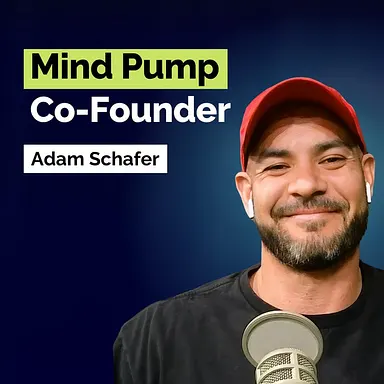
This episode features Adam Schafer, co-founder of the fitness podcast Mind Pump, describing how a difficult childhood shaped his resilience and his approach to business. He traces his early jobs, from mowing lawns to managing trainers at a large gym, and explains why he and his partners gave away more than 240 podcast episodes before selling a digital fitness program.
The conversation covers building partnerships with co-founders, why he believes a small loyal audience can outperform millions of followers, and how the company approached sponsorships. Listeners will hear his views on value, vulnerability and authentic marketing, along with his advice on fitness for busy entrepreneurs.
In this episode Hala Taha, Adam Schafer
This episode on how Adam Schafer built Mind Pump without millions of followers was made with the technology behind HappyScribe, which converts video to text.
Ads in this audio differ from the text. Tap the sentence you're hearing to follow along.
Synced: the text now follows the audio.
Today's episode is sponsored in part by Northwest Registered Agent, Whatnot, Mod, and AG1. Northwest Registered Agent gives you the tools and guidance to build a complete business identity. Start using free resources at northwestregisteredagent.com/yapfree. Whatnot helps sellers grow through live shopping, community, and real-time connections with buyers. Search Whatnot, W-H-A-T-N-O-T, in in the App Store, download, and you can start selling right away. Mod connects qualifying patients with licensed medical providers for modafinil to support sustained energy, focus, and alertness throughout the day. Visit mod.com for a free consultation and get 10% off your first order plus free shipping with promo code PROFITING. See their website for important safety information. AG1 Next Gen supports your nutritional foundation with vitamins, minerals, pre- and probiotics, and superfoods. Go to drinkag1.com/profiting and get a free immune support bundle with your first subscription order. As always, you can find all of our incredible deals in the show notes or at youngandprofiting.com/deals.
I've watched both my parents be hauled off by the cops many times, but I thank them and I love them for the drama and the adversity that we went through, because I really do believe it is what laid the foundation for the skills that I built
Adam Schaefer, co-founder of Mind Pump Media and one of the co-hosts of the popular Mind Pump podcast. Extraordinary entrepreneur. He had a really traumatic childhood, but he didn't stay the victim.
Ain't nobody gonna work as hard as I'm gonna work at getting good at it or figuring it out. And that's a superpower. Entrepreneurship is hard and it's a lot of failure and you get beat up. When someone makes a decision to buy, it really comes down to 2 things: value and price. Go prove to your audience first that you have something valuable enough that they'll listen.
Mind Pump has multiple 8-figure businesses. How did you guys start Mind Pump?
It's kind of wild because—
What's going on, Young and Profiters? How do you get people excited to buy before you've ever offered them anything? Adam Schaefer and his Mind Pump co-founders spent more than a year giving away valuable content Before ever selling to their audience. By the time they sold to their audience, they'd built up a community that genuinely wanted to support them. And that's just one part of Adam's incredible story. In this YAP Classic, we're bringing both parts of my conversation with Adam together into one episode, from building a loyal audience to overcoming adversity and learning just how much genuine connection matters when you're building something that you want to last. So YAP fam, if you want customers who believe in what you're doing, keep on listening and let's get right into my conversation with Adam Schaefer. Adam, welcome to Young and Profiting Podcast.
Thank you. I'm excited to be here.
I'm so excited for this conversation. I can't wait to pick your brain about fitness, about business. And when I was studying for this interview, I found out that you've been an entrepreneur for a really long time. You started a lawn mowing business before you could even drive.
Yeah.
And so I wanna know, where did this entrepreneurial spirit come from and why have you always been young and profiting?
I don't think it's a very sexy story because it was more out of, uh, you know, necessity. Um, I grew up in, in a home, I'm the oldest of 5, and, uh, we, we weren't, uh, my, my parents weren't very financially successful. Uh, we struggled, we moved around a lot. I lived in, uh, 9 different homes growing up, and that was because many times we couldn't afford to live in that house or we're being evicted. And so, if I wanted something as a kid, um, I had to go get it. And so it wasn't like I grew up with like this fire to, oh, I wanna build a business when I get older. It was like, hey, if I want those new sneakers that all my friends have, or the, the new Starter jacket, you know, dating myself a bit there, like that was really cool. Like I better go find a way to make money and do that. And so being, uh, 15 years old, uh, one of the things I could do was, uh, mow a lawn. You know, I was been mowing my lawn for a very long time. I know there was people that needed it.
And the town I grew up in, Uh, there was definitely one side of the tracks, which is where I lived. And then there was like the rich people that lived on the other side of the tracks and where the golf course was. And so, uh, my buddy and I, when we were, you know, 15 years old, uh, had our parents drop us off in the rich neighborhood and we made little flyers, uh, that, uh, said A&J Lawn Mowing. And we went door to door just knocking on people's door and asking 'em if they wanted their, their lawns mowed. And it turned into not only mowing lawns, but we ended up being like, uh, little handymen for anybody and ever. I mean, I did staining. painting. And I mean, you put fence posts up. I mean, whatever they were willing— work were willing to give me, I was willing to take it. And so it started off, uh, with that. And, uh, you know, back then the idea of A&J Lawn Mowing Service was so, uh, I would be in the front of the Yellow Pages, which I never even got to. But that was the thought process of what are we gonna name this business?
Um, and it was, uh, it was mildly successful. I mean, for my age and what I was doing, Uh, it was perfect. It, uh, I, I, I worked the weekends. It gave me enough money in my pocket to, you know, keep up with my friends that had wealthier parents and that could buy the sneakers and the stuff. And so, mm-hmm, that's really how it started for me. Um, the next like venture or job that I did was working in a dairy. So I was a bovine mammary extraction technician, which is a fancy term for I milked cows. And, but I got to work for a couple. that had built this business from the ground up and really got to peer into what I think is like a, a lot of real entrepreneurship. Mm-hmm. And, uh, not the sexy side, the side that is hard work and no vacations and 7 days a week, twice a day, you have to milk cows. And I got to know the family really well after 4 years of working there. And I actually was turned off by entrepreneurship once I found how little they made and how difficult Oh.
It was for them to have success. They would be considered successful cuz they built their livelihood. They had a home and a family and fed their family, but they struggled and they, uh, worked really, really hard. And so that kind of turned me off a little bit about entrepreneurs. Like, man, this is gonna be really easy. And it's not, uh, it's not, uh, one of those things where you just start a business and you make a lot of money. And that's actually kind of how I, I was going to school for kinesiology and I moved to San Jose to go finish my degree, moved in with my grandmother. And I walked across the street to go get a gym membership. And they saw that I was studying for kinesiology, kind of offered me a job on the spot. I was like, no, I'm not looking for a job. I'm actually coming over here just to finish school. They said, oh, well, you can work part-time and you can actually go through our school and we can teach you and educate you. And took a part-time job as a personal trainer and actually started to fall in love with entrepreneurship again, because even though I worked for a company, Building your business as a personal trainer is very much so like building your own business.
Now, I had the beautiful luxury of a mega company that paid for advertising and marketing and kept the lead traffic and stuff like that coming through. And so it made building my business easier than it would've been by myself. But that was the real, the first real taste of leadership and building a business I think that I ever really had. And that's what gave me the skills, I'd say, that I started to put into play later on in life, was going to work for that company. And they did a really good job of, I mean, at, at that time, 24 Hour Fitness was a multi-billion dollar company, largest health and fitness business in the world at the time. And they had all this data and analytics. Like, and so I worked up the, my way up as a trainer within a short period of time into management. And so by 21 years old, I was managing a team of 20 trainers that were all more educated, more experienced, and older than I was. And so I was kind of thrusted into this leadership role, uh, running this business, uh, at a very young age, not really knowing what I'm doing, uh, but passionate about it, loved it, and had a lot of tools from the company.
We had all these daily production reports that came in, so I could— I, I learned about, you know, lead generation and conversion and closing and all the things that, uh, you know, really help you develop things that you, as skills that you need to build a successful business.
Mm-hmm.
And so I really attribute a lot of my success today off of this, the school of hard knocks of working for a company like that. I was, mm-hmm, I was really blessed.
Yeah. I love your story because first of all, I've realized that a lot of the most successful entrepreneurs are like you. You've been working since you were a young age. I was the same. I had a job since I was 13 years old. And so by the time I was in my 20s getting my first real job, I had so much more experience. experience than some of the other people. And I was able to like shine because I had sales skills from working at the mall. And, you know, even if my intentions for working was just like you to just have cool clothes like everybody else, um, you learned so many skills doing that. I do wanna kind of go back to your childhood a bit. Mm-hmm. And dig into it because I know that you had a lot of adversity. Mm-hmm. And I know that you had a lot of setbacks. And other people may have stayed a victim for a very long time, but somehow you were able to kind of heal through a lot of the things that you went through, or maybe you didn't and you poured yourself into work. But I wanna hear about it.
Tell us if you feel comfortable, some of the things that happened in your childhood and then how you were able to not just be a victim for the rest of your life.
I love how you set the table there. Um, I'm definitely not somebody who, uh, announces like this is what I went through. 'Cause I, I'm, I don't believe in being a victim and feeling that way. Right. You may feel that way, but that goes nowhere if I, if I focus on that. And I do think that that has a lot to do with the success of me as an adult was the childhood adversity. So my father, when I was 7 years old, committed suicide. My mom then remarried into an abusive relationship, and then we obviously struggled financially also. So, That was a typical day in my house, was I've watched both my parents be hauled off by the cops many times. I was the oldest, so I was in the middle of a lot of that fighting and went through that a lot growing up. Now, I look back now and feel blessed because of all that, and I don't— I wouldn't change a thing about my childhood, as crazy as that sounds. Yeah. Because I really do believe it is what laid the foundation for the skills that I built later on in life.
And the main one of those being that entrepreneurship is hard and it's a lot of failure and you get beat up. And what I felt was my— and I didn't know this was my superpower until I started to get older and then was reflecting on like, what is it that I'm— why am I doing better than a lot of these, my peers? I think it was the resiliency. that I had from all the adversity as a kid just gave me that. And, and the way I think I looked at it when I was 20 and I hit a, a hardship or a challenge, it was like, this is nothing compared to what I dealt as a 9-year-old and a 10-year-old, 12-year-old in my home. My home felt way scarier. Mm-hmm. And more difficult getting through that. So I, I really think it's what gave me the skills and the practice of adversity and working through it. 'Cause when you're a kid and you live in that home, you don't have a lot of options. It's not like if you work in a bad job or you, you do something you don't like as an adult, you, ah, eff it.
I don't wanna do this anymore. Mm-hmm. I move on, go somewhere else, man. You, you, I didn't choose the family that I was born into. And until you're 18 years old, you don't got a lot of options as, as a kid. And so you had, I had to learn to work through it and deal with it. And it was no good staying home and crying and feeling sorry for myself. That definitely was not. going to help me anywhere in life. And I think and learned that quickly as a kid. And so that same attitude, I think I carried over into adulthood. So when, you know, I'm trying to build my business as a personal trainer and people are telling me no after no after no, and it's, it's hard. And like, you have a deal you think you're gonna get through and then it doesn't go through. And you're working a client at 5 in the morning and another one at noon and then another one at 8 o'clock at night. And you're there all day just to make 3 hours worth of income. Those were all like, hard things, but it didn't feel hard for me.
It, it, it felt that life is hard. I think, I think I had accepted that life is difficult and it presents all these different challenges and hey, if it didn't kill me, I can get up tomorrow and do it again and figure a better way out. And so I think I was just built different. Mm-hmm. Um, and I think, and I think that really served me in business because as you know, I mean, 80% of people fail. And even the ones that are successful only make it a few years and then they fail. And then even fewer make it to like the big leagues and making millions of dollars. And so the, the win percentage and the chance of me doing well was very, very slim. But I felt that way from the start as a kid. And, uh, yeah, I think I had a chip on my shoulder that, uh, and I, and I was so excited as an adult to actually have control.
Mm-hmm. I
think when I was a kid at going through those things, the, probably the thing that was the most traumatizing or challenging was that I was in this situation that I couldn't control, that I didn't have a— I woke up and went to school and did my thing every single day in a home that I had to be in.
Yeah.
In fact, I didn't even know how much I wasn't in control until I ran away when I was 17 years old. And I ran away when I was 17 years old because my grandmother bought a car from me. to help me get to my job that I used to go to at 4:00 in the morning before school. And I was grounded for something. I think I was late to coming home from a curfew or something one time, and my parents grounded me and they took my wheels. They took the car, the family car that I had, away from me. And my grandmother was pissed. My grandma, I cannot believe your parents did that. And that's your job, and that's so irresponsible to do that to you. And of course, as a young teenage boy, like, yeah, right, Grandma. Right. And so I asked her, I said, hey, I have, I've saved a little bit of money. Will you come down and, and co-sign for a car for me to help me get to and from work? So it's my car and my parents can't take it from me and I can go to my own job.
Grandma said, yeah, absolutely. She came down and she bought a car for me. And I came home with that car later on that day. And my parents looked at me and said, nah, you can't have that. You, uh, it's not, it's not fair to your siblings, even though none of them were driving yet. Um, you can't, you can't have that car either. You leave and you keep your car, or you give your car back and you stay at this home. And as a cocky 17-year-old, I said, okay, pack my bags, I'll go live in my car. And because that is a better situation— I thought it was a better situation, right? Um, they called the cops on me and, uh, had me arrested. And I realized that when I'm under 18, I pretty much have no rights, uh, at all. And I remember the cop basically lecturing me and I'm crying and telling him, but I bought this and I paid for these things. And he says, son, until you are 18 years old, none of that shit is yours. In fact, your parents could light it on fire and there's not a damn thing that you can do about it.
And that just hit me like a ton of bricks. Like, oh my God, I have no rights. So I think when I got older and I actually had the power to control the situations I was in, it just— I don't know, nothing felt that hard to me. Even the hardest of things that I went through in business. It's like no one's screaming and yelling and cops and tears. I mean, none of that was happening. It was like, yeah, sure, it's hard. I got to work longer, or I got to get up earlier, or I got to go through 20 nos before I get one yes. But I think that I was just built different because of my childhood adversity. And of course, in my early teens and even early 20s, I probably harbored some animosity and resentment towards my parents. As I got older and more mature, I realized, wow, they gave me a superpower they didn't even realize they did by putting me through all that shit. And so my relationship with them today is incredible. I mean, I thank them and I love them for the drama and the adversity that we went through.
And my biggest fear as a father today, I have a young son who's 5 years old, is that he won't have as much adversity as you. So I talk to my wife all the time about, we've got to manufacture adversity in his life. It was so important to my development. I don't want My son to have it so easy, he doesn't build these great characteristics about him and he doesn't build that armor. Mm-hmm. We've gotta find a way. And so as a father today, that I fear not having enough adversity for my son because I think it was so important to my development and as a leader and as an entrepreneur.
Yeah. Yeah. Fam, you know, October hits different. The season shifts and suddenly when your alarm goes off in the morning, your body's like, absolutely not. But when you have the business and a million decisions waiting for you, You cannot start the day already feeling behind, and that's why AG1 has earned a real spot in my morning routine. AG1 Next Gen is a daily foundational nutrition drink with 75+ ingredients including vitamins, minerals, prebiotics, probiotics, and superfoods. AG1 Next Gen is backed by 4 separate gold standard clinical trials, and key nutrient levels improved within 3 months of consistent use. Plus, it's formulated to support immune defense. Which is really important this time of year. Yeah, fam, if you wanna start your mornings off right, go to drinkag1.com/profiting and for a limited time, get a free immune support bundle including a bottle of omega-3 fish oil and a bottle of vitamin D3 K2 with your first subscription order of AG1 Next Gen or AG1 Pro. That's drinkag1.com/profiting. Drinkag1.com/profiting. Hey, young improfiters. You know, hiring reminds me a little bit of dating. You can get a lot of potential candidates, but you still might not find your right match.
And when I'm hiring at YAP Media, I don't have time to just hope the right person sees our job posts. And Indeed Sponsored Jobs helps me get in front of the right people. Sponsored Jobs boost your job posts in the search results so you can reach the people who actually help your business thrive. Plus, you only pay for results. Spend less time searching and more time actually interviewing candidates who check all of your boxes. Less stress, less time, more results. When you need the right person to cut through the chaos, this is a job for Indeed Sponsored Jobs. And listeners of this show will get a $75 Sponsored Job credit to help give your job the premium status it deserves at indeed.com/podcast. Just go to indeed.com/podcast right now and support our show by Saying you heard about Indeed on this podcast, Young and Profiting. That's indeed.com/podcast. Terms and conditions apply. Need the right hire fast? Then this is a job for Indeed Sponsored Jobs. What's up, YAP fam? You guys know we love reading on this show, so I'm always excited when I find a book I genuinely think is worth sharing. Life at the Speed of Play.
Launch Products People Love by Mark Pincus is one of those books. Mark is a legendary Silicon Valley entrepreneur and investor, and this fast-paced 170-page book is his playbook for testing ideas quickly, navigating uncertainty, and figuring out what's actually worth pursuing. One of my favorite concepts is what he calls the abyss, those moments when you feel stuck or unsure of what's next. Instead of fearing uncertainty, He shows you how to use it as a tool for discovery. Right now, Mark is doing a buy one, get one offer for YAP listeners. Go to getmarksbook.com/yap, buy one copy for $32, and get a second copy free. So you can keep one for yourself and give the second to a friend, future co-founder, or someone who needs a little push. Something that I just wanna stick on here and kind of call out is that we are the stories that we tell about ourselves. Right? Another person might have been like, you know what? I'm weaker because of all this stuff that happens to me. I have a disadvantage. But you decide to kind of reframe your past and then put a, a positive spin on it. Hey, all this stuff did happen to me.
I'm honest about it. I'm not denying the fact that all this stuff happened to me, but here's my like positive twist on it. And that's the story that you told yourself, which allowed you to just like move forward towards like a positive future. And I think that's really important for anyone tuning in. Like if something bad happened to you, Mm-hmm. Try not to just tell the story in a way that keeps you weak. Try to figure out, okay, what about this is actually positive? And how do I tell this story not only to myself, but when I tell this story to other people, how do I say this in a way that doesn't position myself as a victim and kind of sets me up for the future?
100%. Whether you think you can or can't, you're probably right.
Yeah. So another thing about your childhood is that you did have one positive influence, and that was sports. So how did sports help you when so many parts of your childhood were kind of upside down? What did sports do for you?
The funny part is there's a, a little bit of parallel there too. Mm-hmm. What, what I loved about sports so much as far as what it taught me is because I wasn't very good, like, or at least I wasn't naturally really good, but what I quickly found out Uh, just like the work and the adversity thing. And I think the childhood thing played into me actually being pretty good in sports. Mm-hmm. I wouldn't think I, I don't think I was great. I definitely don't think I was gifted. But I quickly found too, uh, most people quit. Most people give up. Most people aren't gonna get up at 4 o'clock in the morning and train and practice. And most people are get told they're not good or they have to ride the bench and then they just give like, and I was the opposite. I had this attitude of, I can, I will, I'll figure it out.
Mm-hmm.
And, uh, I had to, I had to scratch and claw for every playing time minute that I wanted to, which I was that guy in practice that the rest of the teammates couldn't stand because I was running at full speed, everything I had, every single time I was on the court to prove to the coaches that I belonged or that I should play more. And, you know, and I did, I got to play, I got to play quite a bit. Now, I wasn't the star player ever. Maybe when I was really young, I was pretty good in soccer. But I, I don't think I ever felt like I was this great athlete. I loved competition. I loved sports, both watching them and playing them. And so I wanted to, and that's where all my friends, all the, the kids that I wanted to hang out with and be friends, they all put, they were all athletes. They all played sports. And I, I wanted to have friends. I wanted all those things. And so, hey, I've, if I wanted to fit in in school, when you're younger, fitting in in the, the sport group means you gotta play.
You gotta be, and you gotta play all right. You gotta be pretty good at it. And I was just willing to do the things that nobody else was willing to do.
Hmm.
I was willing to work harder and get back up. And so it varies, very similar. Those same skill sets, uh, served me there. And I think again, back to the adversity at home, um, you know, having a hard practice, uh, or failing, uh, didn't seem like it was that scary or that bad. It was hard. Mm-hmm. Um, but it didn't, it didn't deter me. It was just like, okay, this is, I'm gonna have to work harder. I'm not gonna, I'm gonna have to shoot more times. I'm gonna have to get up earlier. I have to work more days. I have to make more sacrifices in my life than the average kid that could probably play video games all day, pick up the ball and just go play, and he was better than everybody. I wasn't that kid. I had to put the work in. And so I really think that was another thing as a child, again, not knowing it when you're going through it. I, I think just, uh, I think at that time it's more survival for me, right? I'm not— Mm-hmm. I wish I could say that I was that wise that I, the way I'm articulating it right now, I knew.
And so I was just, no, I didn't. I was, I was just trying to survive. I just wanted to have, I just wanted to have friends. I just wanted to be good at what I did. And the stuff that I think I cried lied about and I had a really hard time with at home was way scarier and way different than these obstacles that I was being presented in work and in sports. And so, yeah, I just, I leaned into that. And then I think as I started to get later in my teens and obviously into adulthood, I started to recognize that that was my superpower, was that, okay, I have this level to me that most people don't want to go. And even though I'm not as talented, I'm not as smart, I can lean into that, and that's what I'm going to do. And so it, it started to slowly build this confidence in me that, oh, okay, like, yeah, this is gonna be hard, but ain't nobody gonna work as hard as I'm gonna work at getting good at it or figuring it out. And that's a superpower, and I'm gonna lean into that.
And so sports absolutely gave the same, same skills or developed that same skill for me.
Now, You just mentioned confidence, but I know that it took you a while to like fully feel confident, even when you were a personal trainer and doing well and, you know, fit and everything like that. You still had insecurities from your childhood. What do you think eventually got you over that hump where you were like fully confident?
Ah, you know, that's a good question because I was even confident when I was young, like fully confident where I did, I always, I didn't have the same level of confidence. I think, uh, I think. insecurities were presented in different ways, right? So there's always been things like, I was insecure because I wasn't as smart as everybody else. I was a little insecure because I wasn't as an athlete. But quickly I learned that if I put the extra work in, that I could be as good as anybody else if I were to do that. So I had physical insecurities probably the longest. So I was very skinny growing up. Like, you could see my rib cage, so skinny. And I'm tall and I get taller and lanky. And so And I got teased like a lot of kids did in school. Again, none of that really— that didn't hit me hard. Not like how some kids, that can be traumatic for them. Again, the stuff that I went through, that was way harder. So getting teased and a little bit of— I went through— people bullied me. I went through all that stuff, but I still didn't think that was that big of a deal.
But it did cause a little bit of insecurity.
Mm-hmm.
And it did drive me to fitness. It was just like, okay, again, I can solve this. I can figure this out. I'm skinny. People are making fun of me for that. Okay, well, what can I do? Oh, I can go to the gym and start lifting weights and build muscle. Oh, wow. This is really hard. Takes a long time. That's okay. That's my superpower. Leaning into that. It took a while before I think I started to build the confidence about what I looked like. I think that probably of all the things that I was insecure about as a kid, that one probably hung around the longest, which, by the way, has probably what fed a lot of the success in the business that we're currently in right now. My co-hosts, uh, they openly talk about this too.
Hmm.
Right? We're very authentic and transparent and, um, and we, we lead with those things, right? So when we built the podcast, a lot of the conversations, we, we didn't share from a place of authority, like, you know, we're telling you what to do. It was more like a sharing from, hey, I too know what it's like to be insecure about our body. And it drove a lot of the behaviors. And the mistakes that I made in my 20s, and here's what I've learned through that process, and I'm still learning through that process. So we really presented our information on the podcast from that, even though I had, we, mm-hmm, we all had the national certs and education and experience to say to people, hey, you should do this, don't do that.
Mm-hmm.
We didn't lead with that. We led with vulnerability. Yeah. And, um, this is where we struggle. This is where we were weak. This is how I'm working on those things. Um, I don't know. I don't even know if, if I think we even did that strategically.
Yeah.
I think it would, I think it kind of organically happened and we, that's just kind of who all of us are character-wise. I think we learned that as personal trainers. And so, um, but that, that conversation of being vulnerable with people, it really serves you as a personal trainer. Like if you, if you work with people and we've been doing this for over 2 decades where I work with people one-on-one and most people that hire you as a personal trainer, are very insecure about their bodies. They're 40, £50 overweight, or they're skinny, or whatever it is. But most of them are insecure about how they look, and that's what initially drove them to try and fix that in the gym and then ultimately hire you. And then here you are, this fit, young, buff trainer. That just makes them shell up even more. And so over trial and error, I realized, man, I have to be very vulnerable with these people and humanize myself. Because they think, even though I don't think I'm some super— I'm a superhuman or what, they think of you like that, or they see you like that. And they'll hold in a lot of this personal stuff and a lot of the stuff that's going on inside them, which you need to learn how to solve as a good trainer.
And if I wasn't going to get that out of them, I too needed to be vulnerable. They needed to see that I too have struggled and have insecurities and didn't have it easy. And so I think I learned that skill as a person, as developing my skills as a personal trainer. And I think you hear that in the podcast when we communicate to the masses, because that was how we talked to our clients, was we had to learn to— and I do think that this is what hurts even some of the smartest trainers that are out there on social media and on podcasts, is when you come off as this authority where you know all and you're so smart and touting study after study to prove to people how much you know, you don't make that connection with those people. And if you want behavioral change to happen in a client, you've got to make a connection with them. And that becomes more important than how many studies you can regurgitate. And we learn that as personal trainers. And so I think that part of me, I'm always looking for my insecurities. I'm always looking for my vulnerability.
not only to share and help, but also that's how I work through it. So working through it is being okay, confident in talking about these things that I too, I'm weak in and, and together trying to solve that and coming from that perspective. And so, mm-hmm, I mean, I don't think I've solved every insecurity, but the body one was probably the last one. And, uh, and again, that's probably what the communicating of that on the show is probably what has resonated with a lot of people.
Yeah. I love that you've tied that into kind of the sales experience that you gained as a trainer. And we had another, uh, fitness expert turned entrepreneur, Alex Hormozi, on the show. Mm-hmm. And it reminds me a lot of what he was telling me, how he learned about, you know, value, uh, creation and making sure that you're speaking in outcomes to sell your fitness clients. He learned about having to understand their challenges and their objections, and he learned about offering discounts and bundles and, and offer development. So he learned so much. and then became this like incredible entrepreneur. I'd love to hear some of your experiences. Mm-hmm. In terms of like sales, uh, even leadership and what you learned as a trainer that you've now brought into entrepreneurship.
Sure, sure. So one of my, one of the fa— I wish I were, I wish I could recall who gave me this piece of knowledge so I could credit them, but it was a long time ago. Um, we were in like a sales training thing, um, and someone told me that When someone makes a decision to buy, it really comes down to 2 things, always value and price. I don't care. Uh, everyone will have excuses. Oh, I can't afford it, or I'm vacant, all these, but that's all noise. Mm-hmm. It really comes down to how much they value that thing and what the price is in relation to that thing. And that resonated so much with me because I, I began looking at every deal that I didn't close or every client that didn't re-sign as I didn't provide enough value. They, they decided that I wasn't worth that investment to them, and that falls on me. It's not because something came up financially or no. If I was so valuable, they would find a way to pay for it. And that was, that had been confirmed. Me too. I had watched clients take a HELOC out on their home just so they could pay for their personal training with me.
Like, we, when you, if, when you figure that piece out, Again, reframing this every time I went into any sort of sales deal of Adam, it always comes down to 2 things, value and price. They didn't buy. Okay. I'm not even gonna listen to their excuse. It goes, it falls back on me that I didn't provide enough value. And it, it's literally how we built this was when we came out, like none of us had any sort of media experience. So none of us were like, oh, we're gonna be so great at podcasting and talking on YouTube. Like I, I was terrified of all that stuff. It's definitely outta character for me. It's not something I wanted to do. Uh, I don't think it's natural at all. I still to this day can't stand making YouTube videos even after doing it for over a decade. Don't like it. But what I do know is that my, or what my goal is, is to provide value. And so that's all I think about whenever we're creating content or whenever we're helping people is value, value, value. And if they don't become customers, I didn't find a way to provide enough value to that.
Now that becomes, uh, a little more unique when you're talking about you're communicating to a million people and like, how do you give them all value? Well, that's, you know, that's learning how to speak to each platform and, and content creation for your exact demographic or your target that you're going for. And there's, there's a, there's a little bit of a learning curve to that too. But it really comes down to, uh, providing value. Mm-hmm. And, and, and, and practicing that. And then always looking back at yourself first. I mean, just like the other stuff that we talked about, people are so quick to point the finger. at the other people, right? The victim, like, oh, well, they can't afford it. Oh, they're not the right customer. Oh, it's like, no, we— none of us ever look at that like that. Like, if something is not working in the business where we're not being successful, it's like, what are we doing? What are we not doing to give that customer enough value that they, they don't even hesitate to spend that? And that's how we— that's when we started the podcast. We actually had the product ready to sell.
So Maps Fitness products is the foundation of what scaled and built this business originally. Mm-hmm. That's what brought us into the millions of dollars was the digital programs that we sell online. And we had that before the podcast even started, but we agreed not to sell it until people were begging for something from us.
Mm-hmm.
We didn't want to go in and already try and monetize. It was like, let's go first. Since we're not media guys, let's go first prove that we can provide so much value on this podcast that it organically grows. We didn't want to spend any money on advertising. We weren't trying to do all the Instagram social media hacks. It was like, lean into the value thing. Let's go put out something that is so valuable that people are willing to share it. And listen, if I can't prove that before I'm even trying to sell anything, I would be a fool to try and sell something first.
This
is what I give advice to coaches and trainers that are trying duplicate what we've done. It's like you're already trying to think about the product or the thing you wanna sell. You haven't even proven that people want to hear what you want to give them for free.
Mm-hmm.
Go prove to your audience first that you have something valuable enough that they'll listen or, and/or share with other people. Go solve that equation before you figure out your price point of your product or your thing you wanna sell and allow them to dictate what product or what service you come up with. But that's the first, that's the first problem in this equation that you need to solve is, can I provide enough value to a specific audience that they're gonna listen?
Mm-hmm.
And, and what's beautiful in this day and age is that the, the, the entry to, or the, the level of entry or, uh, money to come into, uh, podcasting, YouTube, Instagram is so low that anybody can do it. And so, and it's so nice that you don't have to invest all this money to try. what you believe to be valuable, go do it and keep practicing it until they do that. Then once you start to prove that, okay, now you potentially have a business on your hand. And so what we waited for was over a year. We had done over 240 episodes already of podcast episodes, which is a lot. And I don't know how many hundreds of YouTube videos we'd already created by that time with the product just sitting there. And we kept telling each other, like, don't— we're not going to sell. We're not going to sell until we feel like we have to or we need to or people are begging for it. And I remember the day. like yesterday we came into the studio. This was our very first studio we were in, this little tiny 400-square-foot room that we were renting, not making any money.
We're all still working full-time in other jobs. We're hustling this on the side. We believe in it. And, uh, the guys all come in and everybody had, uh, a, like, a story to tell about somebody reaching out to them. So I think Sal was just like, dude, I got 2 DMs of people that are trying to just give me money. They're like, what can I buy from you? Because you guys have helped me so much. I'm like, oh, that's crazy. I got an email, someone asking me about Patreon. Patreon, and do we have it? Because they want to give us money and support our cause. I don't even know what Patreon is. Justin, same thing. So all of us were starting to get bombarded with people just trying to give us money. We had already given them so much free valuable content that we were already starting to create this loyal fan base of people that are going like, man, I took your advice and it changed my life and I lost all this weight and it helped my marriage. It was like this stuff was starting to pour in. And then we all looked at each other and said, okay, I think it's time.
I think it's time now to present to everybody that we have this digital fitness program to help them out. And it didn't sell thousands right away. We sold probably a couple hundred, which was really good for us. And then we were doing nothing before.
Mm-hmm.
And the thing that I think that resonated or that stuck with me the most was that a good portion of those people bought it and said things like, I'm already following another program, but I just wanted to support what you guys are doing.
Mm-hmm.
Or, I don't even need it, but I'm gonna, I, I, I've been wanting to give you guys, like, that was like half of the people were just, wow. They weren't buying it because they thought, you know, I think we're incredible program writers. I think that's part of our expertise. But it, what I realized was the, the power of community, building a relationship, staying authentic, all those things really all came to full circle for me with, and to see that in the digital world was a really powerful moment. Like, oh wow. Like that is more important than even the product that you're going to deliver is can you build a relationship with your audience and your potential customers that is so powerful that they, the value is here. So anything that you drop in there price-wise, They're, they were gonna buy. And, uh, that is really what set the tone because we made so many business mistakes and didn't know what we were doing in media for so long. We, we stumbled to all that success, but what we did know, because we'd been building businesses, all of us our whole lives, was, hey, we had value price thing.
That was it. That was kind of like our North Star was keep putting out stuff until it's so valuable that people are willing to spend X amount of dollars with us. And that was, that was the beginning. That was the beginning of the rocket ship. And then. Um, it hasn't stopped for 10 years. So it's been, it's been a ride.
What's up, YAP fam? You guys know we love reading on this show, so I'm always excited when I find a book I genuinely think is worth sharing. Life at the Speed of Play: Launch Products People Love by Mark Pincus is one of those books. Mark is a legendary Silicon Valley entrepreneur and investor, and this fast-paced 170-page book is his playbook for testing ideas quickly, navigating uncertainty, and figuring out what's actually worth pursuing. One of my favorite concepts is what he calls the abyss— those moments when you feel stuck or unsure of what's next. Instead of fearing uncertainty, he shows you how to use it as a tool for discovery. Right now, Mark is doing a buy-one-get-one offer for YAP listeners. Go to getmarksbook.com/yap, buy one copy for $32, and get a second copy free. So you can keep one for yourself and give the second to a friend, future co-founder, or someone who needs a little push. Hello, young and profitters. If you're running a business, getting website traffic is only half the battle. The real key to profiting is turning those visitors into paying customers. And I know checkout friction can quietly kill your sales.
That's why I always say serious entrepreneurs build on Shopify. Shopify is a commerce platform that helps you launch and run an online store without needing to be super technical. You can build your storefront, manage your business, and make it easy for people to buy. And here's the major advantage: Shopify Checkout with Shop Pay converts up to 36% higher than the competition. With Black Friday coming up, now's the time to get your store ready and simplify your checkout experience. If you're ready to launch your business before Black Friday, Go to shopify.com/profiting to start your free trial. That's shopify.com/profiting. Go to shopify.com/profiting today to hear your first— What's up, YAP fam? If you're building a personal brand, you already know how hard it is to stay consistent with content when you're also trying to actually run your business. I love creating content, but realistically, I'm not trying to sit in front of the camera every single day. I need time to work on my business. But the problem is consistency matters. The more people see your face and hear your voice, the more familiar you become. That's why HeyGen has been such a great tool for me.
You can record just 15 seconds of footage, create an AI avatar of yourself, and use it to make videos on demand. So instead of constantly filming from scratch, you can create more content, stay visible, and keep showing up without making your entire life be about generating content. And you guys know I'm always looking for tools that give entrepreneurs more leverage. HeyGen is definitely one of those tools. 30 million people already use it, from solo founders to 85% of the Fortune 100. Your first 3 videos are free at heygen.com/profiting. That's H-E-Y-G-E-N.com/profiting. Heygen.com/profiting. It makes me feel excited just hearing about it, you know? And I, and I feel like you guys approached it in such a smart way. The fact that you just gave and gave value, and it's the law of reciprocity, right? You give and you give and you give and people feel like they owe you.
Yep.
And to your point, people wanted to buy it even though they didn't need it. And the other thing is that the more value you give and the longer you wait, like I did the same thing. I'm like one of the top influencers on LinkedIn and I waited like Like 3 years before I ever put out a course. And I just wanted to help people because I had no intention of even putting out a course. But eventually so many people ask you, and then you can make a bigger ask where other people put out a $30 course. I got to put out a $2,000 course that people bought because they were clamoring for it. I didn't have to do much promotion. I put out a post and everybody bought. I put out some DMs, everybody bought. But then as time goes on, you need to get more creative with your lead gens and, you know, pulling in new audience members and warming them up. So I definitely wanna talk to you about how you get customers now. But before we do that, what's the origin story like? First of all, how did you guys start Mind Pump?
How did you meet your co-hosts?
It's kind of wild because, uh, the 4 of us collectively didn't know each other. So Justin, okay, was, uh, a kid that I hired out of, straight outta college. Um, this was when I told you I was managing trainers at the gym, 24 Hour Fitness. I hired him fresh outta college, out of his kinesiology degree to work for me as a personal trainer. And what, what, what's unique about our relationship was we're so different. He, he represents a really important time in leadership for me when I was still at that time in my career looking for more me's trying. I, I thought the, the, the key would be, man, if I could just find 10 more of me, mm-hmm, we're gonna be hella successful. And so I was on, on this mission to find that. And he was like, nah. He was nothing like me. We were so different. He's very introverted, his style of training, his way he communicates. But boy, we paired really well and he was really successful as being a pro. And it really opened my eyes to, oh, maybe this is not what I want. Maybe I don't want to look for me.
Maybe I need to look for people that fill the gaps and has strengths where my weaknesses are. Right? And so we're very different that way. So he quickly became my right-hand man, my assistant, and he was for several years. And then he went off to do other things, but we always remained in contact. We became good friends. And so, and he would always come knocking at my door every few years trying to get me to do something with him. He's, oh, Adam, I'm building this thing, I'm building this app, or I'm doing this business. Come work with me. And I was always busy doing something myself. And then it finally, this, this opportunity presented itself for us to develop this fitness app together. And I was kind of the, the finances behind it. He was the, the brains and the one who was coordinating like all the designer app developer and all that stuff. And so we began kind of like actually intentionally working together to build this app. So we're kind of doing that on the side, communicating while we're all doing our own businesses. Sal is a personal trainer, has his own studio, and Doug, our producer, is a client of his.
And they're— so he's training him. So at the same time, Justin and I— and now mind you, we don't all know each other at this time. We just— this is what we're doing in our lives at that time. And Sal and I, we have a lot of mutual friends. And because we came from the same company, we all worked. But 24 Fitness was huge, right? Thousands and thousands of employees. So we had never met each other, but we had a lot of friends that would always talk to us, mutual friends that— which we didn't find this out till later, by the way. This was something that we found out after we got connected, was we had these friends that would be like, man, you got to meet Sal. Have you ever met Sal? You and him would You guys got to meet each other. You guys got to meet each other. You're great. You're great. And he would hear the same thing about me. And this was for years before, not knowing it. Now, we are both top performers at 24 Hour Fitness. So I seen his name, right? So in his rank, because you get ranked and you get trophies.
And so if you were like a top producer, you won all the Hawaii trips and you'd done stuff like that. And so I'd seen him in passing and knew of his name on the production report, but we never even had said hi to each other, so we didn't know each other. And him and Doug, his client, start working on a digital product. They start working on MAPS Fitness products, which is our product I was telling you that we already had. The reason why we already had it was they built it before we even met. And Doug has a background in— he used to sell insurance and he was getting into digital marketing as kind of a hobby, not like he was professional in it whatsoever. It was like a hobby. He was interested in the space. So he had the equipment and he had gone to some of the seminars and he had done stuff like that and he kept telling Sal like, man, you, you were made for this. You like, you should, you should think about making a digital product. And Sal was like, okay, well, I mean, if you lead the way, cuz Sal's like me, we can barely turn our computer on.
So he is like, I, I, I'm good at communicating health and fitness, but I don't know anything about the, the digital marketing side at all. And Doug's like, well, that's, I, I can do that. I'll do that for you. So they had built that together or were working on it. Justin and I are kind of working on this app. Sal and I have these mutual friends who are always talking about it. Sal finishes his digital product, and because so many people had told him about me and like my business acumen, he's like, you know what? And we had like passed each other on Facebook one time. We had just added each other on Facebook and we were following each other. He slides into my DMs and is like, hey, blah, blah, blah, blah, kind of reintroduces who he is. I'm like, yeah, I know who you are. And he's just like, you know, I wanted to show you something. I've heard so much about you and your business acumen. I, I wanna know what you think about this. this product, this thing. And he sends me over kind of the sizzle reel to this digital product they make.
And it was interesting cuz at that time we're building this app up and I know that Justin and I are about to finish this fitness app and I don't have anybody to sell it to. I'm not, I don't, I don't have Instagram. I don't, I mean, I have Facebook, but it's like family, friends. I'm not doing anything on it, right? I'm not actively building a social media platform. And, but I realize that I'm gonna have to move in that, in that direction at some point. He sends that over to me and I'm like, oh, let's meet. I'd like to talk to you. And I'm big, one of the things I know we haven't talked about, but if I were to hang my hat on one of the most important things in being successful for me, it's been relationships. So I'm the guy, my wife still teases me to this day where no matter how busy I am, I'll take a cup of coffee with somebody for a meeting for a potential new relationship. And I mean, I waste a lot of hours doing that, a lot, you know, but every once in a while it ends up being a, a mass.
And so it was kind of one of those situations. I was busy doing this stuff like that, but saw what he was doing, interested. I'd heard enough people talk about how crazy. I'm like, I, I need to meet with this guy and let's just see. No, no expectations of what we're gonna do. And we all, and he says, hey, can I bring my, my, uh, my buddy Doug? And I'm like, sure. I wanted to bring my buddy Justin. We'll all get together.
Aw.
So we all just first time meet each other. We get into my living room. And we like didn't shut up for like 4 hours. And it was like lots of passion and energy and talking about what we think is wrong with the space and where we think this whole digital media thing is going. This is like 12 years ago, right? So we're talking about YouTube and Instagram and, and the podcast space and like all these things that we're paying attention to and we're curious about. And we're all these brick and mortar business guys. And, but we're, we're curious about where social media is going and where the future of health and fit— health and fitness is. And it was like, I don't know, like almost 4 hours of nonstop talking. My wife, who was my girlfriend at the time, Katrina, was in the kitchen and I didn't even know this, but she actually hit record and recorded a lot of the, the conversation.
That's cool.
And after we were all done basically meeting each other and realizing, oh, we all really liked each other, she goes, that was an incredible conversation to listen to. And I was like, really? Um, she's like, oh my God, that was so interesting. And man, that was so good. And so we ended up meeting a second time and the second time we met, Doug was the one who piped in and said like, hey, why don't we put this on a podcast? Let's, let's, the stuff that we're talking about together, why don't we just put it out there and see if somebody wants to listen to it? The rest of us have no idea what that looks like. I'm like, do we have to get like a, a radio sponsor or like, how does that work? Like none of it. And Doug's like, no, it's really easy. Like we can record it in our home. We could put it out there, cost us virtually nothing to do it. And all of us were like, okay, let's go do it. Let's go put this out there. And let— and again, this is— it was— it started on the foundation of if my, my wife or my girlfriend or my wife or my girlfriend at the time, my wife now was like, oh, it was so incredibly awesome.
We love the dynamic of the conversation. We know we had a lot of good information to provide people. One of the things we all agreed upon at that time, and not— no disrespect to any of the OG trainers or fitness people that were blowing up back on social media, but we really felt like the most popular people on social media at that time really got there for not necessarily the right reasons. Mm-hmm. And what I mean by that, they were some of the, they were just first adopters. They were really attractive. They did a lot of the before and after and look how sexy I look type of stuff. Mm-hmm. And, or they were just cool, or they really understood algorithms and how to hack. And so a lot of the, these, these young kids were making millions of dollars already, uh, on YouTube and Instagram. And we were going like, listen, I may not be as good looking or as talented as some of these kids that are at the top of the fitness space, but I definitely know the information I have to provide is way better. Yeah. 'Cause I used to think like that too when I was 24, but I've learned over decades of training people, like, that's not the best way to communicate that.
I've already— I've learned that already through being in the trenches for so long. And we all agreed that, oh yeah, I can't believe this person and that person is doing so. It's like, man, that's not right. They should be saying this and say, hey, let's go put on a podcast. If we really believe that, we really believe we're that smart and we have that much better information, we have that much more value to give than these people that are making millions of dollars, let's go prove it. And that was literally how we started. It was, let's put this podcast together. Let's go give all this information that we believe is better information than the top people in fitness were at that time and just give it for free and prove that's as good and as valuable as we say it is. And that was the first litmus test to, do we have a business?
Mm-hmm.
We didn't overcomplicate whose role is what, what's the partnership look like, what's the financial split, what we're gonna sell yet. None of that. It was, we really believe the information we had to give to people was better than what was out there. And so let's go prove that first. And then we started recording the podcast and our strategy, the only strategy we had that time was, Kind of going back to my childhood, this is what I love about Justin and Sal. This is probably the thing that, and even Doug, we all have in common. We all kind of have that attitude of we will outwork the next guy. Just, we will just bury somebody in work ethic. And we don't, none of us are cocky and think we're the most talented at anything, but we do believe that's a superpower that we all have. So that was a very important thing that connected all of us. And so that was the strategy was like, Like, let's just drop podcasts every day. Let's just put out so much and just keep reinventing ourselves as it comes back. Oh, only 10 people listen. What do they like about that?
Oh, wow, this one did. Got 20 people listening. What are we doing? What do we do different than that? And then unpacking it and going, okay, they want more of this, or what are we doing? And then reading the comments and not getting offended by all the negative stuff that you're going to attract when you first start, and instead going like, and listening. Like, wow, a lot of people, uh, think this is a terrible idea. So why are we continuing to do it? Let's shift this way. And so that was like really the impetus of the, the podcast was just the 4 of us getting together, having belief that we had more valuable information to give, and then starting with the business plan of let's go prove it. Let's go see if we can give so much free valuable content that it grows.
Mm-hmm.
And I think when we knew that, was— I don't remember how many episodes deep we were, but it was for sure in the first 8 weeks. Because in the first 8 weeks of podcasting, you have an opportunity to fall in what's called the new and noteworthy category. The first 8 weeks.
Mm-hmm.
And in the first 8 weeks, you are only competing against other people that are in their first 8 weeks. And it gives you an opportunity on iTunes to get populated right there on the front screen if you can just— and we also saw that as a huge advantage. Doug had read this. He knew that going into it. We're like, okay, Hey, let's go. We're like, we're only comp— we're not competing against the Joe Rogan who's been there forever. Yeah. We're competing against other people that are starting right now. And we believed in ourselves and our work ethic and what we had to give was like, let's go do that. And I remember when we reached, you know, number 1 in new and noteworthy and we were there for several weeks of the first 8 weeks. And that really catapulted the first initial wave.
Mm-hmm.
Of, of people that paired with what I was doing at Orangetheory, which is a whole nother side story we can get into sometime, is like, like, I was out there on the ground getting, building community in person.
Mm-hmm.
Because I, that was what I was like, I know I can control that. I didn't know if I could control the new and noteworthy thing and get popular on social media.
Yeah.
But I knew I was good at what I did and I could build community in person. And if I could just get a few hundred people in my community in person, I would have a, a couple hundred listeners that would listen to my podcast and then maybe we could, we grow from there. So I was kind of simultaneously— Mm-hmm. also doing that. And so I think the combination of we were actually doing okay on the podcast and got ranked in New and Noteworthy combined with what I was doing in person with community really gave us the first foundation of the first few hundred or thousand listeners.
Mm-hmm.
And then it was, it's, it just snowballed.
What's up, YAP fam? You guys know we love reading on this show, so I'm always excited when I find a book I genuinely think is worth sharing. Life at the Speed of Play: Launch Products People Love by Mark Pincus is one of those books. Mark is a legendary Silicon Valley entrepreneur and investor, and this fast-paced 170-page book is his playbook for testing ideas quickly, navigating uncertainty, and figuring out what's actually worth pursuing. One of my favorite concepts is what he calls the abyss, those moments when you feel stuck or unsure of what's next. Instead of fearing uncertainty, he shows you how to use it as a tool for discovery. Right now, Mark is doing a buy one, get one offer for YAP listeners. Go to getmarksbook.com/yap, buy one copy for $32, and get a second copy free so you can keep one for yourself and give the second to a friend, future co-founder, or someone who needs a little push. Hello, young and profiteers. If you're running a business, getting website traffic is only half the battle. The real key to profiting is turning those visitors into paying customers. And I know checkout friction can quietly kill your sales.
That's why I always say serious entrepreneurs build on Shopify. Shopify is a commerce platform that helps you launch and run an online store without needing to be super technical. You can build your storefront, manage your business, and make it easy for people to buy. And here's the major advantage. Shopify Checkout with Shop Pay converts up to 36% higher than the competition. With Black Friday coming up, now's the time to get your store ready and simplify your checkout experience. If you're ready to launch your business before Black Friday, go to shopify.com/profiting to start your free trial. That's shopify.com/profiting. Go to shopify.com/profiting today to hear your first— I have a couple follow-up questions to this. Mm-hmm. That like, you got my mind spinning here. Uh, the first one is about friendship and entrepreneurship.
Mm-hmm.
So I started as an entrepreneur, uh, now I have a business that's about to hit 8 figures next year. I, I run YAP Media. It's a social agency. I have a podcast network. It's the number one business podcast network. When I first started my business, I was 100% owner and it was great. I had a team, but it gets gets lonely. And now you just met one of my business partners, Jason. He's got 20% of the business and he's my best friend. And it is so much more fun. And like, just work is so much more fun. It's so much better to like have somebody to lean on. And so what is your advice to people who are kind of like holding their equity to their belt and, uh, you know, just, you know, not, they don't have a partner. Like what's your, what's your perspective on that?
Yeah, this is an interesting conversation because, uh, I would tell you that my advice normally is to people is don't get a partnership.
Don't do it.
And I think a lot of that is because I recognize how blessed I am to have met 3 other guys that align so much with each other. It's, it's, it's probably the most interesting thing about this. I mean, we haven't got into all the things that we, that we've built, but we've got multiple 7, 8-figure businesses. Mm-hmm. We invest in real estate together. We own 15 homes together, even partnership.
Wow.
We have angel investing together. We have a stock portfolio together. We're— we, and we are evenly split on everything. We do things. Sal wrote a book. He was published by Hachette and wrote a book. I made royalties from that book. I didn't spend a single minute doing anything to do that book. Uh, but I make, I make royalties. I do business coaching for people on the side on my own time at home with that. I I give that portion to my— it goes right into the pot. We have just agreed that everything we build and we do together is an equal 4-way split, no matter what time and effort each guy puts into. And that is freaking very, very unique and very special. And I'm very blessed that we have that. A lot of that has to do with ego. And this is the other thing that probably connects us really well. We all have that kind of work ethic thing. And the other thing is that we all met each other at a place in our life where we had the opportunity to all be leaders and to work with teams long enough to know the power of team over the individual.
And we all are so competitive that we want to win more than any of us care about any sort of individual accolades or who gets the credit or who gets more money or a split that way. And ultimately, we knew if we positioned ourselves that way in the business like that, that we would have abundance everywhere. And everybody in the business makes way more money than I think they ever dreamed or thought they would make. And so it's easy now, right?
Yeah.
At this point, it's like the revenue has got to places where everybody's so comfortable and stuff like that. It's actually not that big of a deal. But early on, that was really unique and special. to have 4 guys like that. And I think it's different. So we talk about it a lot that it's marriage. I honestly think that, I think my marriage is easier than my business partnership. I think being in a business, because you love that person, right? You love that person. You're attracted to that person. You sleep together every day. Like you chose that person to do life with. Like, so I actually think marriage is easier than business partnerships. I think business partnerships are like, a lot of people get into 'em because they see like, oh, you're talented in this. I'm talented in that. that, um, we would make a good team. Let's go build this business. But it's like being married. So you better have, you better be on the same page in a lot more than just, oh, you have that skill, I have this skill, and that makes a good,
yeah,
a good business idea. I know you need to court people if you're gonna, if you're gonna go into business with someone, you need to court them as if you were going to marry them. Because it gets, I think, arguably more ugly when you get hundreds of thousands or millions of dollars involved. and you have this split, I mean, that, that really puts an added pressure to the relationship. Aside from you got to work with them, you have to steer a, you know, a company or companies towards these core values. Do all of your core values align? Does your ideologies align? Like, these things all really matter in partnership. And so that's the only way I ever recommend it to someone is if you feel like you've really vetted the person you're potentially going to go partnership, like you were going to marry them and you could be okay with living with them for the rest of your life. I just think that's so important. And I think we are such a— we're such a bad example of, I think, for individual partners. I mean, name me another company where you know that, where there's an even 25 split in all aspects of all investments of all businesses.
We're like an anomaly. So I never give people that advice of like, oh, Try and find 3 other dudes that you're into. Like, that's probably, I mean, this is like, we all, we believe that there's something greater going on besides us, that we weren't in control of this. It was very serendipitous the way it all played out. Yeah. And so the advice I normally give is that, uh, do not underestimate, um, the, the, the, the stress and the challenge of partnership. And so if you're going to do a partnership, you need to vet that person as if you were going to be marrying that person, because you are, you, you, you're marrying them in business. And let me tell you, we have all-out fights. In fact, we just had one 2 days ago. And I should read the text to you. What I said back to the guys, because there was 2 different things that we got into in the same morning. It wasn't even 10:00, and we had already fought each other. We were yelling at each other back and forth. And I sent a text later on that night. Oh, here we go.
I was just reflecting on today and how much I love you guys. From the jump, getting frustrated at Doug to fighting with Sal over copy on a landing page makes me chuckle out loud. There's no one else in the world I'd rather fight with. It's very special we can do that in a day and never break stride in our mission. Pretty fucking cool. And that is like, we have this ability to, I mean, get into it, like really get into it, but it's never— ego's never involved. It's never, I'm fighting with Sal because I want to be more right. Mm-hmm. I believe with all of my heart, this is the right direction for the business. And if he's fighting with me, it's not ego for him either. He believes this is the right direction for the business, and it's ultimately not about us. And that is the, that's the secret sauce to that dynamic of being able to fight like that where it's healthy, is it's not about ego. It's not about being more. I don't care about being more right. I care about what's best for the business. And if I'm passionate about it and I believe I'm right, I'm gonna fight through that.
And we encourage that. We encourage that with our team too.
Mm-hmm.
Like, listen, uh, just 'cause I'm the boss, if you think I'm wrong about something that we should do and you passionately feel that, you better speak up. You better step to me. You better argue with me and bring your best argument. And I want you to do that because that's where the best stuff comes out. And then whatever we decide on and agree on, we all decide. So if Sal and I are getting into about the copy and I, we're both passionate, we're right, and we decide, okay, Okay, we're gonna try your way and we'll see. I'm not sitting back now measuring, oh, was it bad? And mine was more— see, I told you I was— no, it's now my idea. If we decide to go with your idea, I no longer look at it as my idea. It's our idea. We're all— and I'm all bought in, and I'm going to do everything I can to make sure you're right or we're right in that situation, because ultimately it's about winning as a team, and that's what we care about. That's special. It's so special to find one other person that's like that, much less 3 other people that are like that.
And we have that in this team where— and nobody, none of us too. I think it's unique when you get into this space where media and kind of the attention and fame comes. None of us want that. One of the things that we were all very reluctant, resistant to the fame part of this. Like, none of us are thirsty for that. None of us want that. And so it's kind of neat that nobody wants to be the guy. Nobody cares to say like, I did this or blah, blah, blah. Yeah. Or want to be in the front of everything like that. We both are all like, ah, do you want to do it? I don't want to do it. You do it. We have that kind of attitude with the limelight too. And I think that's so important. Like, nobody is thirsty for the attention from anybody at all. It's ultimately about the business winning. And if you are the right guy or girl for the job in that situation, I don't care where you rank in superiority or whatever. It's like, you are the right guy or girl for the job. Go do it.
Go get it done. Go make it happen.
Mm-hmm.
And so that's, that's special. That's unique. I don't think it happens to a, a, a lot of people. And so I think most people are probably better off building a business themself and, and having like kind of full control of relationships and partnership with that. Mm-hmm. But if you do, it's a very special thing cuz then now you have 4 of us that became another superpower is that—
Exactly.
We can divide and conquer. But it took a while to learn that too though, because early on, uh, you know, we were so tight, we were all so close and there wasn't a lot going on when we were only had a few thousand listeners. We had one product. So it was like every, every decision in the business was all 4 of us talking, you know, everything we did. And I, I, I think it was about year 3 when we were really starting to like catch our stride and, and revenue was really cranking by that time. Uh, we started to realize, what are we doing? Why are we trust each other like family, uh, by this time? Uh, and we're making decisions together and it is literally hurting us.
Mm-hmm.
You know, what we thought might've been our superpower in the past where you have 4 great minds collectively, you know, arguing over ideas, then we decide and go. Now it was slowing us down.
Hmm.
Now it was getting to a point where it was blocking the business. We had too many things going on that we need to let go of stuff. And so that probably presented a, a, probably a year transition of challenge for us was, okay, now that we've got to this place where we're all married together, we all like each other, we all see, oh, the benefits of all 4 of us arguing and debating. Okay, that's great. But now how's it also hurting us? Oh, shit. It's slowing us down when we need to make decisions. And speed is very important, I think, in business, right? Yeah. To go test your ideas. And if we have to meet every time we want to try something or do something in a business this big, Like, this is, this is killing us. And so it took about a year to like everyone kind of fall into, uh, their actual— in fact, by that time we still hadn't decided our positions. Like we had never sat down and had a formal meeting of, Adam, you're gonna be the CEO. Sal, you're gonna be the CMO.
Mm-hmm.
Justin, you're gonna be the CTO. Like that didn't happen until like year 4. And we had already, I mean, we're, we're cranking in the millions of dollars and we don't even have a structure.
A vision.
Yeah, we don't even have a structure to who's in what position, but I really didn't think it was that necessary until we had so many different revenue streams and departments and building a staff underneath us. Then it presented itself and we realized that it was a bit of growing pains for about a year, and then everybody kind of naturally fell into these positions. And because we have that solid foundation, the relationship marriage part, like, nobody— and I think this is so important in a marriage. Like, if your marriage is not gonna last very long, if you are constantly measuring what you bring to the table to what they bring to the table and the time you spent on a thing compared to that, like that marriage ain't going nowhere. If you're, if you and your wife are arguing over who did more of what, uh, that's a quick recipe for that relationship ending. And the same thing goes in business.
Yeah.
So I can't sit there and go like, I worked 7 days this week and I didn't get any breaks, this, that. And Justin, all you did was that one day you like, Like, nobody, nobody even measures that. It's like, you're the best at that. You like doing that. Lean into that. Go handle that. Like, you like doing that. You're the best at that. Go handle that. Oh, that stuff you're terrible at? Don't even worry about it. I got it. Like, that's how everything kind of unfolded and the positions that everybody is. We, we fell into the things that were our strengths and we doubled down on it. And the things that we recognized that were weaknesses in each other, we, we let go of those things.
Mm-hmm. So your example of partnerships, like you just said, very unusual. You don't really recommend it. You feel like it was just like a magical Serendipitous thing. I'll give a quick example to the listeners of how I found my business partners, right? So I have one girl, Kate, who has 10%. Jason has 20%. Kate started as an intern when I first started my company. She was basically a volunteer who worked for free for a couple years, and then she was by far, like, for her age especially, she was just such a rockstar. Mm-hmm. And it was so obvious that she was special. Right? And I, she got to work for me and basically became a mini me. So she ended up getting 10% of the business as one of my business partners. Jason was an acquihire. He had his own production company. I couldn't focus on production anymore, so I brought him in. He turned the whole team around. He ended up, he was already entrepreneurial. He was an entrepreneur. And after like 2 years of working together, I then decided to put him on a vesting agreement. Right? So it's not just like, like boom.
Oh, I met you at a coffee shop. Wanna do a 50/50 split? Like, you know, it's not that you've gotta really get to know somebody and decide like, do I wanna work with this person maybe forever until I retire?
You courted them, you courted them for 2 years before you even considered doing that. I mean, exactly. That to me, that's so important. Like if, that's why it's like, it's not fair for me to tell people don't do it, but I think a lot of people think it's gonna be easier.
Mm-hmm.
I think the, the, the fear, cuz it's scary, right? Most people fail and so nobody wants to fail and nobody fail all by themself. And so I think most people make the decision of a partnership out of this fear of failing by themselves. And then so they just search for somebody, oh, this person could bring— it's like, that's the wrong reason to do it. Um, I, I think that's what you gotta be very careful of. Um, but I'm, I think that's a great strategy. I mean, we've done that now where, because there's so many different businesses and revenue streams, we've had people that just like that have been, uh, started off as an intern Work their way up to a position, work their way up to a leadership position, now get 10% of a revenue stream. Like, mm-hmm. So you've had, we've had people in the business where we've brought in kind of an equity split or a rev split on some things because they've earned that right to be, you know, more than just an employee. And we really want to do that for most people. But I think that looking for that right out the gates, I think that's the mistake that most people make.
Yeah. With when it comes to like partnerships. So totally agree. Yeah.
I wanna talk about marketing and your marketing message, because I know that one of the ways that you differentiate in the fitness industry is by telling the truth, right? At least how you started. Mm-hmm. So talk to us about how intentional you are about your marketing messaging and how you think about the way that you communicate with your audience and the things that you tell them.
Yeah, I think that, uh, we were so intentional about it that I think it was 9 years ago when I bought the trademark. Mark, Stay Authentic, um, for our clothing line. Uh, what we saw when we got in this space was how fake a lot of it was. Mm-hmm. It's gotten better, but it still is. I'm sure you know, like how many, how many people are fake successful, fake fit, fake. It's just so much of that. And we quickly saw it right away and we're like, man, this, this may be working for these people right now, but eventually they're gonna be found out. Eventually the customer will get smarter. And eventually the messaging will be about authenticity, about being yourself, and that will be the only way to win. So much that we decided to go out and trademark Stay Authentic because we believe that that wasn't a buzz term when we trademarked that almost 10 years ago. It was— we believe that that was the direction that— and you hear that now everywhere. Anybody who's successful like yourself in here that communicate things that are important, I've heard you say it on your show multiple times too.
Authenticity is so, so important to the brand. And so that, that's what we led with. We really did that from the very beginning. And you know, it, it was a slower game because it's not as sexy, it's not as cool, it's not as trendy. It doesn't go viral, but it, it's, it's authentic. It's real. And I think that there's a big mistake in the social media game that people make that, again, we were lucky that we did brick and mortar first. And I use the analogy of if I had just started my brick and mortar gym and I turned the lights on, it's day one. and, uh, 5 customers, well, potential customers walked in, how would I treat them and how would I be, what would I be like and what would I do? Oh man. First 5 people paid attention to my business. Like I'm over there greeting them and talking to them and excited as, I mean, I found out all about the, the, I, I'm making those 5 people my best friends because I got all the time in the world. I got no customers. These are the only 5 potential customers I have.
And so it's wild to me cuz that's like, that's like rules of business. Mm-hmm. Like any good business person 20, 30 years ago would say, of course. Of course you would do that. Well, then why do so many people treat it differently on social media? Why are they looking for so much, so many eyeballs? They want to go viral and have a million people paying attention to them, but then they don't even respond to the one comment, or they don't DM and talk to the people. It's like, so, so I think the strategy that people were doing early on to get famous and get attention was, was a terrible strategy for a long-term business. And there was kind of this it's a false perception of what reality is for them. Meaning they had a million followers. And if you've got a million eyeballs on you, I guess you could start a t-shirt line and by default you can make a few hundred thousand dollars initially just because you got a million eyeballs. But that's not a really successful business. It's just because you have that many and by default, half a percent of them bought something from them.
It's like, that's not— And we weren't looking for that and we knew that and we didn't want to get into that game. We were I don't want to try and compete with all these people doing that. Let's go help 5 people. Let's go change 5 lives. And this is, again, something that we were taught in building a trainer business, right? Was I realized how powerful— now, granted, it's great to get leads. It's great to get all these potential customers looking at you or coming into your gym or things like that. But nothing was more powerful than changing that one life. life. I changed that one life. And that lady, you know, 20 years later is still talking about me. And I still get people that find me from her 20 years ago because I changed her life. Like, holy, the ROI on that is crazy.
Mm-hmm.
How many people has she turned on to me and what I do because I put so much in it? And so we approached even the social media game the same way, was let's, let's not try and overcomplicate this and try and go viral and figure out what all the trendy stuff was, let's go change 5 lives. Let's go find our people that need our help and just really focus. Because none of us knew what the hell we were doing in the marketing space of social media. We didn't know, but we knew that about business.
Yeah.
We knew the power and the value of that. And we just looked at it as like, well, this is cool that we're in this place where this ability to do it for free and people could find us online, that's a really powerful, unique tool. But let's not overcomplicate it with and measure it by, uh, how many followers we have. Is this business successful? And we were a multimillion dollar business before Instagram even hit 50,000 followers.
Wow.
I mean, and so I tell this to people all the time, you do not need hundreds of thousands, definitely not millions of people looking at you on Instagram or YouTube or whatever. You don't. What you need to do is go find your 1,000 loyal customers.
Mm-hmm.
And I forget what book book that is or who wrote that. It's a great read. Um, it talks about—
It's Seth Godin.
Yes. Thank you. Uh, your Thousand Tribe or whatever, right? Yeah. So once you, you're, and so that was, it was like, we're on this mission. Uh, let's go find 1,000 people that we can. And I, I think that's such a, it's such a good number because I really did think I felt right around 1,000 loyal customers. It was like the business was rocking and rolling. Mm-hmm. I mean, it was just, cuz at that time, once you reach that point where you've changed 1,000, you've got 1,000 people out there marketing and advertising for you. And let's say, Obviously not all 1,000 people are out there walking with signs saying, listen to my input. Of course not. But there's enough of them at all times always doing that, that they are constantly talking to a family or a friend. And that lead is so much more valuable than any paid lead you could ever potentially get in this game. Totally. And I've spent tens of thousands, probably hundreds of thousands of dollars now in all the different ways that we can advertise on Google and Facebook and Instagram. time. And we've always ran these campaigns. And then at the end of the day, we come back to organic traffic.
Yep.
Because those, those clients, those customers are so much better than the lead that I paid all this money to get them to convert right away, who don't have a relationship with me, don't know who I am, but because they got hit with this ad or whatever, they converted. Like, those actually end up being the worst customers. They're, they're the most difficult to, to deal with. A lot of times if you have any sort of refunds or cancels, it's coming from those people. They complain the most. Like they are the hardest customer and it costs me so much to get them versus if I put out a good piece of content with the intent of helping somebody for free and giving them something super valuable that I learned over my decades of training clients, if I can impact them with one piece of content that goes out and helps like 5 people, those 5 people that I help for free on that Instagram post or that YouTube clip or that podcast episode, Those 5 potential leads, oh my God, those people are so much more valuable than the 1,000 people I just added on Instagram because I paid for some posts to go, you know, to be pushed out there to a bunch.
And I just don't think a lot of people realize that. I don't think they, they think that the game is, is volume and it's like, no. Yep. And in fact, I actually think that that sometimes can convolute what you're doing really well because you might be getting all this attention. And so you get this idea like, oh, we're doing really good, but it's like you're not even attracting your true customers. You're just getting eyeballs and random people, and that just causes more headaches and confusion. So you have the people that are— you might be doing the right things in your business because you're so focused on attention, you're getting steered in these wrong directions because you have a bunch of random lookie-loos who don't even know who you are. Oh, that sucks, or I don't like that, or why don't you do more of this? And then you start— We had to be careful of this. I remember early on, And like not allowing that noise to steer our mission. Like we know what the goal is, we know what the mission is. Like, of course there's gonna be some haters or some people who don't know us that are gonna hop in there, are just gonna make some comment about us.
Like you can't let that deter your, your mission. And so I do think that that's the, the problem with a lot of entrepreneurs that are trying to build on these social platforms is they get so hung up in the, the race to followers game. And it's like, no, you can build million, a million dollar plus business off of 1,000 people. Yeah. You do not need tens of thousands or hundreds of thousands to build a very— and, and those people, the lifetime value of those customers, like, and so that's kind of like even how we've scaled this business and with all these arms, what we look at is our best customers. And then we ask ourselves, what do those, you know, 10,000 people have in common? What are the, what are other things that we can serve them, that community? Because we've already, we've already won them over on the value we've already provided them, I bet you there's something in common with those 10,000 people. And what are we not doing to provide that? Because they're already bought into us and, and what we're doing. If I can now find a way to service the most common thing those 10,000 people have to service them, I've got another business.
Yep.
And so that's kind of how we've continued to stack the business is looking at our customers. And, and we started that way even when there was just a handful of them, of what are these, what do these pe— these 5 people have in common? that we can give to them and then build and letting that steer the direction of the company. And even though we had that one program and that was initially how we monetized, every program thereafter and every revenue stream thereafter has really been steered by the consumer.
Mm-hmm.
As it, it's never been, and I always tell people that are trying to build a business, like, it's important that you, you love your ideas because it's important to be passionate about your ideas, but don't marry them.
Mm-hmm.
And be okay with, with pivoting. And I do think that that is some of the, the most common traits of really, really successful people is their, their speed and their ability to pivot and to not hold on to a bad idea or a bad direction because that's what they wanted to do. It's like, okay, I think this is what everybody wants. Lemme go put it out there and test it. It's like, oh shit, nobody cares about that. It's like, okay, how quick can I let go of that and move in the direction that I think they all want? Like, that's a, that's an important skillset. And really most of all the revenue streams after the very first product have been steered that way of us listening to our already customers and finding how can we continue to add value.
Mm-hmm.
And serve them and allow the, let, allow the business to come to us like that.
Oh my gosh. You just dropped so many gems. Uh, there's a couple things that I wanna add to this. Uh, so I interviewed Gary Vee in person, Mel Robbins in person.
Mm-hmm.
And those are 2 extremely, extremely successful people and they are of the same mindset of Speak to one person.
Yes.
Right? They're not only kind to their following and wanna provide value and like that's their main concern is like providing value and helping people live better lives. Even in person, they're shaking the videographer's hand. They're thanking everybody. They're kind. The most successful people that I've met are kind. Mm-hmm. And they wanna help other people. They didn't get to where they are by being an asshole to everyone, right? They actually wanna help people. And you can see that in all their content. content and everything that they do. So I feel like it's so smart that you were like, let's just focus on 5 people. So you were able to sort of niche down who the perfect client would be for you.
Mm-hmm.
And then you listen to them. What do they want? What do they want from you? How can I add more value, grow the LTV, the lifetime value of this customer so they buy a course and then maybe they do something more expensive and then they tell their friends. And it's this like flywheel effect that you've basically created with your audience. So I think that's just so smart. So super cool. My question for you is, you've got this podcast, you've got social, you guys have an incredible email list. I heard you say that your podcast and email subscribers are way more valuable than your social followers.
Oh, by far.
Why is that?
We could, we can, we could shut off, we can, when we, we tested this back when Sal got kicked off, so this was about 2 years ago, or right, it was right in the, the heart, like right in the thick of the COVID stuff that was going on. And Sal sometimes can can, can say stuff politically. And, and at that time, that was a very dangerous thing to do on social media. And he, he has the I don't give a shit attitude, and so do all of us who are like, go for it, say what you want to say. Yeah. And, uh, he was removed. So he was kicked off of Facebook, or Facebook and Instagram, uh, multiple times. And, uh, we had our, our best revenue run at that time. And so we didn't, we didn't feel an ounce of that. And he had, he had the biggest Instagram page. He had the most engagement, so he had the most powerful, uh, Instagram out of all of us at that time. And he was completely removed off of it for 6 months, 8 months, something like that.
Hmm.
And, uh, you know, we scale, we continued to scale during that entire time. And so it was, it really made us realize that these assets, um, you know, are, are, are good and are powerful and a tool, but they're not necessary for us, uh, because we, we had a very strong foundation from the podcast, from the email list, from building these customers, this whole conversation you and I have been having. Once you— if you truly change the lives of 1,000 people like that, they'll follow you. They'll find you. They will. You could shut down all platforms. And I believe that from us right now, we could turn everything off, go to some other random platform no one's ever heard of, and maybe not everybody, but a good portion of people, they will find us. I mean, we just did the You know, the Spotify Wrappeds. Yep. That come out and like that just came out. I love when those come out cuz it gives me, I get to peer into some more insight that I don't get to see.
Mm-hmm.
And, and I love data numbers like that. And for 40,000, over 40,000 people, we were the number one thing they listened to all year in, on, on Spotify. And that's just Spotify. That's, and that's our small, one of our smallest platforms. Yeah. We are significantly bigger on iTunes and about the same in, in the, the podcast on YouTube. And so to think that 40,000 people for an entire year listen to Mind Pump more than anything else in their ears is crazy to think that. And I confidently believe that. So at least 40,000 of those people would find us no matter where we're at. And 40,000 people listen to me every single day is more than enough people to build a livelihood for all of us here, right?
Yeah.
Yeah. Social, I think, is, is a, is a great tool, um, to have and a complement, another way to connect with your audience, another way to tell your story, kind of like a little bit of a business card too. Like, so it has, it has its place and it's valuable, but we don't place a lot of value on a single thing. And this was again intentful, right? Like, we, we always agreed that we wanted it, we wanted to own our audience. Like, we didn't want to— because I had never heard horror stories of people that I knew that were making really big money on Facebook or Snapchat that. And then all of a sudden the algorithm changed and they were losing tens of thousands of dollars like overnight. And we knew that early on. So we were always like, listen, we have to find ways to connect to our people on so many different platforms and build a relationship so well that it didn't matter if these platforms got weird or shut down or like that. Like you, we wanted control. And so we were mindful of that early. And so we built it, although I will admit that I was naive And for the first 2 years did not build an email list.
I, I say this is the biggest regret.
Mm-hmm.
Or mistake that Mind Pump ever made, and I'm responsible for this. I actually thought, uh, and this was a learning curve for me, I thought that social media replaced email marketing. I really was. I thought that that was what we were seeing happening. I couldn't have been further from the truth. What I have realized over all these years of doing this now is that they're just, they're different. They're different. They're different monsters and they're, and every medium is that way too. So for the people that are entrepreneurs that are listening, listening, it's very, very clear that I have a Spotify audience, I have a YouTube audience, I have an Instagram audience, I have an email audience. Now, there is definitely a crossover on all these platforms. There's a problem. And I would, if I had to put a number on it, I'd say 5 or 10% of these people maybe cross over all platforms. But for the most part, most people stick to the platform they consume all their content on, and that's, they would consider themselves a YouTube person or an Instagram person. And so So it's important to learn your voice on each platform and know how you communicate on email is a little bit different than how you communicate on the podcast.
I remember when we first learned this mistake when we started the YouTube channel, we'd already been doing pretty well with the podcast and we weren't on YouTube yet because we kind of thought, who the hell wants to watch 3 idiots talk in a chair, fitness for an hour and a half? So we were like, that's ridiculous. We won't do that. But we did go, well, we are personal trainers and so we can give out exercise videos. So let's, let's that and that add value, right? How do we add value to our listeners already? Yeah. Let's teach them visually, like exercises. That's a, a good way to bolster the business. Agreed. Okay. We all did. Well, this worked for the podcast, so let's do this on the YouTube channel. So if you go back on our YouTube channel, you'll see how we used to start every YouTube, uh, episode on the, on the exercise channel. And it was literally the 3 of us. us making jokes and talking all silly and goofy and being ourselves. And Doug would swoop in with a camera and like the first, I don't know, 2 minutes of the YouTube video of which is supposed to be exercise tutorial videos was us, you know, joshing each other and having fun and teasing and kind of like talking, you know, telling a story.
And then we would get into the exercise demo and we just thought because that was the formula for the podcast that, okay, it'll work on YouTube. And it like, it kept falling on its face and people were commenting like crazy. This is stupid. Who are these idiots? I don't get to the exercise. Tell us how to do this. And we kind of ignored that for a while, and it, it took a while before we realized like, oh, wait a second. And, and it, it was funny cuz when I look back, it was so obvious, right? It's like, how do I use YouTube if I wanna learn how to, you know, bake a cake and I YouTube that recipe? Do I want the person to be talking 5 minutes about jokes in their personal life before they get to it? I'm gonna skip and I'm gonna go right to the, yeah, give me the, the guy or the girl that gets right to the recipe and teaches me. That's why I searched for this. Yeah. What are these idiots doing talking? And why do I need all 3 of 'em? Like, I mean, looking back, I go like, oh, of course.
But we didn't know that. And I didn't know that until we, we tried that and we realized like, oh, okay. Wow. These platforms are really different and everybody uses it in different ways. And so learning how to take your overall arching mission and voice and, and shape it into whatever medium that you are using, how we write long form content like white papers is so different to how we do short-form emails, is so different to how we do 1-minute reels, is so different to how we do hour-and-a-half-long podcasts. And it took a while to kind of really figure out how we change those, but yet stay, um, on brand, authentic to who we are, and continue to communicate the message that we're trying to do. But understanding that on each platform we're speaking from a, a different voice. But to this day, the email marketing, which I thought was dead, is responsible for about 40% of MAPS Fitness Products revenue every single month. Yeah. Which is hundreds of thousands of dollars every single month that I thought was dead. And so, uh, we, we were a little bit behind when we, when we started, uh, actually capturing emails.
Yeah. I love email so much. I'm like obsessed with writing newsletters and I just feel like it's such a great tool. I think it has like 30 times more ROI than social media.
So, so much more.
I think that you're You're smart. Just a, a comment. I relate to, uh, you know, audio being so much different to YouTube because YouTube, every video is sort of like its own thing. Like it could go off by itself. People can find a random video. And so they're not your fans. Yeah. And so they're a lot meaner in the comments. Whereas like my reviews on my podcast, everybody loves it. Oh, Hala changed my life. I love her so much. On YouTube it's like, do you hear your own voice? You have the worst voice. They're like, stop wearing so much lip gloss. I'm like, these are not my fans.
Like, no. YouTube. is I tell people, before you get into YouTube, you better have some thick skin because it's a bunch of teenage boys on there. That's like 80% of the platform is a bunch of teenage mean-ass boys sitting at home in their basement with their mom just trying to talk shit and troll people. So I tell people, before you get on YouTube, you better have thick skin because it is just like you. We had, like, I mean, if I want to get emotional and feel really good about what we're doing, I'll go on and I'll read iTunes reviews.
Exactly. Apple reviews.
Oh yeah. We have thousands of reviews. reviews that will bring a tear to your eye, the stuff that people say about us. And I mean, it's literally like 99.99% 5-star. I mean, that's like how awesome the podcast reviews are. So I used to go on there all the time when I want to feel good about myself, like, oh, I'll read those reviews for the day. YouTube, complete opposite. Like, if I want to ruin my day and be upset, all I got to do is go to the latest YouTube video and just read comments, because rarely ever are those comments even close to what the comments we get. So it is true, you have to learn learn the mediums and how people use 'em and understand what the game you're kind of playing with those people. And so, and you can't let it bother you. You really have to be okay with like, that's just the nature of the beast is, you know, I'm communicating this to people that aren't necessarily the people that I've, I've, I've put a lot of work into building value with. These are people that literally just randomly found me today, have no idea who I am.
They don't know my character. They don't know where, where I come from. They don't know any of that stuff. And they're just gonna say shit to say shit. So you gotta be careful if you let those things
get Totally. So as we're talking about all this and you're saying, you know, we gotta figure out how we sound like on Instagram versus email versus YouTube versus podcasts. As an entrepreneur nowadays, you really gotta be online. Like you really can't do it, especially if you're an online entrepreneur, right? You've gotta have some sort of personal brand, some sort of presence. We're also running companies. If somebody's overwhelmed, where do they start? What advice do you have for them?
Great, great, great question. And I love to answer this question because, uh, I do think that it can be overwhelming at first. Like, oh my God, everyone's telling me— Gary Vee has a good saying too, of like looking at it like real estate assets and you just want to start, you want to acquire all these things and allow it to organically grow over time. And, but like, it could still be like daunting of like, where do I start? What do I do? What the advice that I give is most people, hopefully, especially if you're in entrepreneurship, know this about yourself enough to know that what you like doing the most, Meaning like, so I can't put 3 sentences together grammatically. I just am the worst of all of us. So I do not touch copy. I do not write emails. Like I would be the worst for that. So being an e— like I would be a horrible person to write our emails. I would be a horrible person to write our 5,000-word documents that we give out for free. Like I can't, that would be a terri— and if I was doing this all by myself, that's not the first place I would, I would do go to.
And eventually what I'd probably do is build the other businesses up and then hire somebody who has that skillset better than me.
Mm-hmm.
So I tell people to lean into what you like doing best or what you know that you do best. And so you might not know what you do best yet, but probably that's gonna be where you like, where you like. So if you, if you do really well with talking for an hour and a half and you have a lot to say and you have a lot of experience on that, I think podcasting is really good. But podcasting will kill you if you're relatively new. You don't have a lot of information, you don't articulate real well, you can't storytell. Well, if you can't do those things, then like podcasting is a surefire way for you to, to, to tank right away. Mm-hmm. Uh, maybe you're really good at like very poignant things. One minute I can, I can give, drop some knowledge on somebody in one minute or give them a tip that's super value. Oh, then maybe like Instagram Reels or TikTok is a really good place for you to start. Maybe you're somebody who's like really good with like a camera and you understand lighting and you take really aesthetically pleasing pictures. And you know, you can write witty captions and you're really good at like, you know, tying like something that's fun and informative, like together.
And you can write an Instagram caption. Maybe Instagram is the place that you lean into, right? So, uh, maybe you're really good about talking one-on-one to a camera vlog style, uh, on YouTube. And so you do like vlogging on YouTube. Um, but I would, my recommendation is, is decide what that is for you, whether you, you've, you try it all out and kind of figure out, oh, this is what I'm better at. Or you already know that about yourself. Like I obviously knew. I'm not the person to write. I didn't need to go try that. It was just like that. I'm not good. That's not a strength. Let's lean, let's go somewhere else. So my advice is to lean into the thing that you feel most comfortable with, because every one of those mediums, like I said before, is like a different business for us. Yeah. So you can be successful at whatever it is that you have to offer on any one of those mediums, and you're most likely to be successful on the one that you like doing and that you're good at. And so instead of like spreading yourself thin, and trying to do a little bit of all of it and kind of being like a jack of all trades instead of an ace of one.
Like literally hone in on the one or two things that you communicate best on and really double and triple down on figuring that out. Because I think you could build a sustainable business on one platform, although I think there's tremendous value in being on all of them. Stay in your lane first, get really good at it. And then if you are like me, you learn to outsource and you outsource that, or you learn those other platforms over time, and you'll learn a lot just by growing a community on one of 'em first. So that's typically what I, I recommend to people.
Mm-hmm. Such good advice. Okay, so last question on business. Um, I know that there's a lot of creator entrepreneurs out there right now. This is the world that we live in. So a lot of entrepreneurs also have a large following, which means that they're probably getting brands approaching them for sponsorships. Yeah.
Love this where you're going.
So would love to understand if you guys are taking sponsorships. And how you go about thinking about the brand partnerships that you go with.
I love that we, we got here because one of the things I'm most proud of that we did was I think we really disrupted the advertising space on podcasts. So 10 years ago when we came in this, this is relatively new. No big brands are advertising on podcasts yet, and very few people realize what a powerful medium it is. So the companies are pretty sparse, although in the fitness space there was a lot of supplement companies and a lot of these companies were there. They were figuring this out early on. And what was really good was that we were so protective of the brand and our branding and our voice that we didn't want to convolute it with other brands and other people's voice and direction and vision. So we agreed that we may never take advertising. advertising. So we said that early on. We said, you know what, we can build a successful business and we don't need to take on advertising sponsorship money from any. And obviously when we hit New and Noteworthy and we were getting out there, we were getting approached right away. And of course there's a temptation when you're making no money and someone says, I'll give you $1,000 to do a commercial on your show every day or whatever like that.
Would you take it? Like, oh wow, $1,000. We're making no money. That's money. Like, let's do it. It's recurring. But we agreed, no way. Like, this is not— and we did that for several years. So we were getting actually kind of bombarded By a lot of companies. I mean, it's not like Nike was coming up to us and these brands that we'd be like, I mean, if that would've happened, I'm sure we would've been over the moon, but that ain't happening. If you're just building your business and you're just getting started, those huge companies are not, uh, going after the small entrepreneur that's getting their first 1,000 listeners. What you're getting is a lot of other startup companies, a lot of other supplement companies, small brands that know that they could probably offer you a couple hundred bucks. 'Cause to you that's a lot of money 'cause you're just getting started. And so it's appealing. And it's great for them because if they can spend a couple hundred bucks to get 1,000 or a few thousand people to hear about their brand, it's great ROI for them. So it is very selfish on their end.
It's completely motivated by that. It's a numbers game. Plus at that time, I, so I was here before people realized how powerful podcasting was, and I've been here after the, the, the companies were really taking advantage of a lot of the podcasting. And I actually, luckily I had enough of a, a business acumen to recognize that right away. Wait, wait, wait a second. You're gonna pay me just based off of listens the same? So let me get this straight. You have 3 guys have a marketing sales background. We pride ourselves on being really good at that. We've built an incredibly community. Our community might be small, might only be 5,000 people right now, but you're gonna pay me the exact same amount of money as this other just random person who might not have a relationship, might not have any sales skills, the same, just based off of CPM. Just off of downloads? That's how you decide how much you're like, no way. No way. I know how valuable even my 5 customers are because those 5 customers, they'll go buy anything I tell them to because I've already built that relationship with them. And for the audience, let me tell you how important and powerful this is.
We have a lot of brands that we work with that work with someone like Joe Rogan. And Joe Rogan obviously is way bigger than us. We are their number one advertising partner over Joe Rogan. And that's not because we're anywhere close to as big as he is, but it's because the relationship that we have built with our community, those 40,000 people that have listened to us more than anything else on their podcast, those are like real customers. They buy almost anything that we recommend. And so we were very careful to protect that. We didn't want to just to, just to make a couple extra bucks here or there. We didn't want to take advantage of that. So, and we actually told that story on the podcast while we were growing. So if you go back far enough, you can hear me share on the podcast, oh yeah, this company tried to get us to sponsor them. And we would talk about it on the show and we'd tell 'em, no way, we're not gonna send our people that way. And this and that. And oh, you're just another supplement company doing this. And we vetted them and they're— and we would like openly talk about potentially taking on advertisers and saying no to people.
Mm-hmm. For a very long time. So the, the, the small audience that got to hear that, and then the ones that were coming on could hear it for a long— and then when we started to take partnerships on, they weren't people that were reaching out to us. I began to go after companies that I was interested in.
Hmm.
If it was a product or a clothing line or something that I liked, I used, the guys all love, I'm like, you know what? Let me reach out to them. They, they don't know who we are. We're not big enough for them to be on their radar, but let me get on the phone with them. And so I would reach out to these companies. And the, the initial conversation would be like, oh, who are you? What do you do? And I'd have to sell them on how, how big our audience is, even though it was still pretty small at that time, and what we do and our mission. And most people would be, oh, okay. That we, we'd, we'd hit it off relationship-wise. And then it'd come down to money. Like, wait, we're not, I don't know if we're gonna pay you guys that much. We don't know what the ROI on that is. And so if it was a brand that I believed in, that I liked, that I wanted a partnership, one of the ways that I would lead with them is to say, hey, listen, this is my commitment to you. I like your brand so much.
I don't want just an advertising deal with you guys. I want to build a partnership and a relationship. So we don't do advertising affiliate type deals. We build partnerships and relationships. And this is how much I'm committed to that with you. So we have the podcast, which is our biggest medium where we get probably the best ROI. And also, this is how much I think our commercials are worth. And if you do not make that money back, I will guarantee you to get it. Because what I'll do is I'll use my email list, I'll use my Instagram, I'll use Facebook. Look, I'll use all my other platforms to make good on that deal. And they were like, really? I said, yeah. So it's zero risk for you. You spend $5,000 with me, I will guarantee you $5,000 back. I think the podcast will do it, but if the podcast doesn't, you communicate with my team weekly. I have a person on point who does this every Monday. You talk to her, you let her know if we're underperforming on numbers, then our job will be then to make sure that we bring those up using our other social media platforms.
So we never sold any other medium. We only sold the podcast. And then I would agree to them that I will deliver on our ROI. We built a reputation around that. And then before long, we were the podcast that everybody was like, go work with Mind Pump because you're guaranteed not to lose. And so then I had people banging down my door asking to advertise. And so then I got to be very picky and choosy with the brands that aligned, that I love, that I wanted to work with. And it was less about the exact dollar amount. It was more about building that relationship with brands that align with us and that our customers, we thought, like. And so at first, what do we do the first year? $60,000 or something in advertising, something like that. It'll do over $5 million in advertising now.
Amazing.
And, but it started as this small revenue stream that we didn't need, that we said, hey, let's go build it this way. And, and I didn't see anybody else making promises like that in the space. And the, the conversations I had were awesome. They would go, oh my God. Like, nobody is doing that. You guys are going to guarantee? I said, yeah, I'm going to guarantee you, because my goal is to present you a price that I'm pretty confident that we can deliver on the podcast. And my goal is to not use— because I don't want to convolute my message on social media. Yeah. So if you go through my social media, you won't see any brands, you won't see any promotion. I don't do any of that stuff, especially on my personal page. None of that stuff happens because I don't want to do that. But I care enough about the relationship that if I needed to bring that brand up to show them to make good on a deal like that, then I would. And so now when you fast forward, what is it, 7 years or so later when we started, I, I go into 2025.
By August of this year, we have all advertising locked out completely for 2025. Yeah. Contract signed. There's no, there's no opt-out, there's no negotiation, there's no minimum marks, there's no nothing. It's, this is what it costs, this is where the spots are, you're paid for the year, and then we deliver. And so we've built that reputation with brands that it's cool now. It was work at the beginning. It was a lot of work to build those relationships, to find those companies, to prove that to them. But now we have a reputation. We have a reputation in the space that you wanna work with us. And so now it's cool. Like I had a last year, um, I don't know if you're familiar with the brand Chili or Ooler. They're the sleep bed pads or whatever.
Mm-hmm. Mm-hmm.
That business went under last year. We were partners with them for like 2 or 3 years. working with that company. And we found out, we didn't know that their business was going under. The way we found out was through their competitor. Eight Sleep.
Mm-hmm.
Had been wanting to work with us for so long, had been watching the market, knew that that company was going under before we knew they were going under. They were still under contract with us and still paying their bills. So we didn't, we weren't the wiser, but they were about to go under. They reach out to us and say, hey, they're gonna, they're not gonna be able to continue sponsorship next year. We know how long of a waitlist you guys have. We want in on next year. We're willing to put money down right now to guarantee that we can advertise with you guys, uh, because we know that you're not gonna be able to sponsor them. We're a better product. We'll send you— let us send you a couple mattresses right now so you can try the product ahead of time. That's the type of relationship building that we've done with partners, and that's how bad people want to work with the company. But it wasn't built overnight. It was built over years of building relationships and, uh, and being very careful and meticulous about about who we work with, uh, as a, as a sponsorship and a partnership, uh, on the show.
And it, and if you chase the, the little bit of initial money you might get, it could really tarnish a brand and a relationship that you have with your customers. Whereas now, because our, and we took our audience along with that journey, they know, like, if we, if we, if there's a new company we're working with and we drop it, like, people go run and buy it before they even think twice about it. They don't vet, they know that we did all that vetting.
Yeah. Yep.
And they know we wouldn't represent them, uh, if they weren't a brand that's awesome or that, that aligns with our community. And so that's really served us, uh, today. And, and now it's one of the most powerful revenue streams that, uh, that we have that we didn't intend on having.
I love to hear about this because this is what I do for a living. I, I own a podcast network, so I represent like Jenna Kutcher and Amy Porterfield and John Lee Dumas and all these top business podcasts, and I get them sponsorships. And so it's just so cool to hear from like somebody who's been in the game for even longer than me and it has like pioneered. We're doing, we, we have a lot of similarities in terms of like how we sell, the fact that you were including other channels to guarantee and all that cool stuff. So for me, that was awesome to just hear somebody like you share all that insight. So thank you so much.
Mm-hmm.
Before we go, one question about fitness. We didn't talk about fitness at all cuz you have so much business acumen. You're the business guy of Mind Pump. What is one piece of fitness advice that you could give to entrepreneurs specifically?
I think in gen— this, and this goes for entrepreneurs and just people in general when it comes to working out and fitness, is that we overcomplicate it because there's so much noise in what's the best exercise program, what's the best diet, what's the best this. And it's like, honestly, if you lift weights 2 hours to 3 hours tops a week, uh, that's it. Strength train. Focus on the big lifts— squat, deadlift, bench, overhead press. That by itself. And approach working out like a skill, not a punishment. You don't go into your workout trying to get a crazy sweat. You're not trying to chase being super sore. Go in, practice those movements, get good at them, get strong, and slowly do that. Just— and consistency matters more than anything else.
Mm-hmm.
That's the first thing related to like what to do exercise-wise. Don't overcomplicate it. Focus on those things. Exercise is not a form of punishment. The biggest mistake people make is overapplying intensity and volume. It takes very little to elicit that, to elicit that change and to get the body adapting to wanna build muscle and then feed it properly with making sure you hit your protein intake. That's the simple advice. Why you want to do this as an entrepreneur, and I'm continue— I, I'm reminded of this every time I fall off the wagon or I'm on an off streak. of, say, 30 days where I might not have lifted or something like that because I'm busy. And I tell myself this same excuse, like, oh my God, I'm so busy, I can't get to my morning workout, or, oh, I don't have time at this time. I got all this going, this and that. It is wild how much more time you get when you work out. You're a better husband, you're a better wife, you're a better business partner, you're a better entrepreneur. You have more energy, you have more stamina. You sleep better, you're sharper, you have more cognitive fun— I mean, you are just better when you are a healthier version of yourself.
So if you really care about being very successful in entrepreneurship, and you— which the skill sets are speed, stamina, like your acumen, your cognitive function— like these things all matter when you want to be successful. The healthier, stronger version of you is better on all those attributes. All of them. They all come up. And you even get more time in the day. I know that sounds weird. Like, wait, how does that make sense? You're telling me that I work out for an hour and I get more? Yes, because it's wild what happens. And why that is, is because every minute of your day is slightly more productive than it would be if you're not working out. And those minutes in the day over the entire day add up way more than the 50 minutes that you committed to that workout. And so do it. Your future successful entrepreneurial self will thank you because you've made time to do that and you will get the time back and you'll get the return on investment tenfold being a healthier, stronger version of yourself.
So good, Adam. This has been an incredible conversation. I really, really enjoyed it. I usually don't go almost 2 hours with my guests. This has been a long time. Thank you for your time. It's been an hour and 45 minutes, but it's been awesome. You are like so knowledgeable, just so impressed with you. I end my show with 2 questions. We can be, be quick with them. What is one actionable thing my young and profiters can do today to become more profitable tomorrow?
Ooh, to become more profitable. Here's what I'm gonna lean into, and that, cuz it didn't hit me till I was 26, uh, and that was the pursuit of daily growth. I didn't come from a big family of reading and, uh, I didn't think of that as something, as something that would return on my investment. But holy crap, is that, and I know that, uh, Alex Hormozi, right, says this a lot too. Talks about like, I love the way he talks about when someone asks him, him how to invest $10,000 when that would, you know, how do I do this? I'm 20 years old, I have $10,000. And he's like, reinvest in yourself. Yeah. Go grow your skill sets in the marketplace because nothing is going to give you a greater return on your investment than improving who you are. Get better, get growing, and hold yourself accountable to that on a daily, on a daily, like go ask yourself at the end of every day, what did I learn today? How did I get better at my craft? How did I become a better person? What did I read and learn? And if you are— you're stringing days together where you don't have an answer to that, that's your first thing to go do right now, is don't let a day go by that you're not growing and learning and improving yourself, because that shit starts to compound.
And when you look back 5 years later, and boy, will you be so much more valuable in the marketplace 5 years later of doing that every single day than if you just kind of haphazardly go about
Yeah. So true. And what is your secret to profiting in life? This can go beyond business, beyond finance, can go beyond what we even talked about today.
Mm-hmm. Lean. So the single best piece of advice that was ever given to me changed my life. Um, I'll tell you the short version of it, but I, I had just finished crushing goal at my gym, uh, 110% of goal. The boss came in. I was proud of myself. I was excited. I thought he was coming in to tell me how great I was. was. And he came in and he picked me apart, told me all the things I was doing wrong, and it broke my heart inside. But that's not who I am. What did I do? Work harder. So I was in the back just working on all these things, getting my paperwork work, being better of all the things that he said. And later on, who became a best friend of mine, who was the manager at that time, comes back and he sees me on the desk working on stuff. He goes, what the fuck are you doing? And he wipes everything off the table. And I looked at him, boss came in, he told me I'm not doing this. He says, Adam, listen, you're in the position that you're in at this young of an age for a reason.
Okay? Stop focusing on the things that you're not good at. Focus on what you're good at and be fucking great. And that just hit me like a ton of bricks. And it's just like, he's like, go, go be great at what you're at. And so I tell people, like, don't get hung up on your weaknesses and the things you're not so good at. Lean into the things that you love and that you're good at and become an expert and become great at those things that will serve you so much
Such a good story. Adam, where can everybody learn more about you and everything that you do?
Uh, look up Mind Pump. I love to send people to mindpumpfree.com because that's a lot of where all of our free resources are. You can find the show on any platform out there. Don't buy anything from me. Go listen to all the free valuable content I have first, and then hopefully you become a listener too.
Amazing. Adam, you are welcome back whenever you'd like. Thank you so much for joining us on Young and Profiting Podcast.
Thank you, Hala.
Adam Schafer turned childhood adversity into a business superpower. Despite growing up in poverty, he went on to co-found Mind Pump, a fitness podcast that became a multimillion-dollar business. Instead of chasing viral fame, Adam and his partners published over 240 free podcast episodes before selling their first digital fitness program, building such a loyal audience that customers began asking how they could support the company. In this episode, Adam shares how his difficult upbringing shaped his approach to entrepreneurship, how to build successful business partnerships, and how he scaled Mind Pump without relying on millions of followers.
In this episode, Hala and Adam will discuss:
(00:00) Introduction
(00:00) Starting a Business Out of Necessity
(06:30) Turning Childhood Adversity Into Resilience
(15:27) How Sports Shaped His Growth Mindset
(19:29) How Vulnerability Builds Customer Trust
(25:04) Why Customer Value Comes Before Sales
(34:44) Mind Pump’s Origin Story
(47:20) Navigating High-Stakes Business Partnerships
(1:02:10) The Power of Authentic Marketing
(1:13:46) Why Email and Podcasts Beat Social Media Followers
(1:23:35) Choosing the Right Content Platform
(1:27:34) How Mind Pump Built a $5M Advertising Business
(1:38:23) Fitness Advice for Busy Entrepreneurs
Adam Schafer is an entrepreneur, fitness expert, and co-founder of Mind Pump, a multimillion-dollar fitness media business known for its podcast and digital training programs. Before launching Mind Pump, he worked as a personal trainer and managed some of the largest fitness clubs in the San Francisco Bay Area. He has earned eight national fitness certifications and a professional bodybuilding card.
Sponsored By:
Indeed - Get a $75 sponsored job credit to boost your job's visibility at Indeed.com/profiting
Shopify - Start your $1/month trial at Shopify.com/profiting.
Northwest Registered Agent - Get a complete business identity with Northwest. Visit northwestregisteredagent.com/YAPFree and start using free resources to build something amazing.
HeyGen - Create AI avatar videos without constantly being behind the camera. Get your first three videos free at HeyGen.com/profiting.
Life at the Speed of Play - Learn how to test ideas quickly and identify the ones worth pursuing with Mark Pincus’s book. Get two books for the price of one at getmarksbook.com/yap.
Whatnot - Grow your business through live shopping, community, and real-time connections with buyers. Search Whatnot, W H A T N O T, in the App Store and start selling today.
MOD - Connect with licensed medical providers for modafinil to support sustained energy, focus, and alertness. Visit MOD.com for a free consultation and get 10% off your first order plus free shipping with code PROFITING. See the website for important safety information.
AG1 Next Gen - Support your nutritional foundation with vitamins, minerals, prebiotics, probiotics, and superfoods. Get a free Immune Support Bundle with your first subscription order at DrinkAG1.com/PROFITING.
Resources Mentioned:
Mind Pump’s Website: mindpumpmedia.com/
Active Deals - youngandprofiting.com/deals
Key YAP Links
Reviews - ratethispodcast.com/yap
YouTube - youtube.com/c/YoungandProfiting
Newsletter - youngandprofiting.co/newsletter
LinkedIn - linkedin.com/in/htaha
Instagram - instagram.com/yapwithhala
Social + Podcast Services: yapmedia.com
Transcripts - youngandprofiting.com/episodes-new
LinkedIn Creator Club - Skool.com/linkedin-creator-club
Entrepreneurship, Entrepreneurship Podcast, Business, Business Podcast, Self Improvement, Self-Improvement, Personal Development, Starting a Business, Strategy, Investing, Sales, Selling, Psychology, Productivity, Entrepreneurs, AI, Artificial Intelligence, Technology, Marketing, Negotiation, Money, Finance, Side Hustle, Startup, Mental Health, Career, Leadership, Mindset, Health, Growth Mindset, Passive Income, Online Business, Solopreneur, Networking