
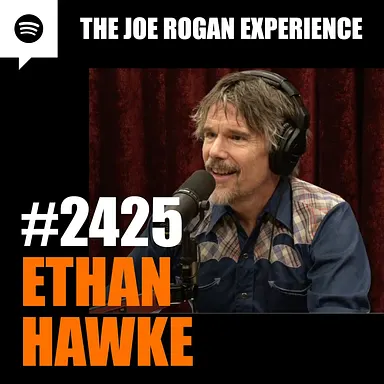
Actor Ethan Hawke joins Joe Rogan to trace his path from a childhood stage role in New Jersey to a 1984 Hollywood film and the Dead Poets Society audition that reshaped his life. The conversation covers the risks of becoming famous at a young age, the influence of his mother and mentors, and how actors draw on other lives to build characters.
They also discuss acting as a kind of hypnotic immersion, working with a wolf on White Fang, and the pressures of online criticism. Hawke argues that performing means accepting nerves and keeping a beginner's mindset, while Rogan reflects on confidence, fear, and staying present.
In this episode Joe Rogan, Ethan Hawke
This Joe Rogan Experience episode with Ethan Hawke on child stardom and acting was transcribed with HappyScribe technology, the same kind that powers Google Meet transcription.
Ads in this audio differ from the text. Tap the sentence you're hearing to follow along.
Synced: the text now follows the audio.
Joe Rogan Podcast, check it out.
The Joe Rogan Experience.
Train by day, Joe Rogan Podcast by night, all day.
Ethan Hawke in this journal.
Nice to meet you.
Great to meet you, man. It's weird when you see someone in so many fucking movies and then you meet him in real life. You're like, okay, just a regular person. Right there.
Yeah, staring me in the face.
You just took a leak.
Yeah.
Um, dude, you've been in some fucking banger movies, man. It's like, you've had an incredible career.
Yeah.
Pull that sucker, uh, pull it.
Yeah, pull it towards me.
Yeah, just.
All right, very good. Yeah, it's been a long strange trip.
It's been a wild one, huh?
Yeah.
When did you start acting? How old are you?
All right. So, I'm like 12 years old. I don't have a winter sport. My mother doesn't know what to do with me. And, uh, my next door neighbor, he lived like four houses down, he took an acting class at the Paul Robeson Center of Performing Arts. And so my mother signed me up so that I could get picked up by his mom, you know, taken to acting class in the winter, and get dropped off, you know, and be at home. And I went there and this head of a local theater company came by to teach an improv seminar, kind of thing.
I mean, I'm 12 years old, right? And afterwards, in the parking lot, he said, um, "Hey, you want to be in a play?" I said, "What do you mean?" He says, "I got a part of a guy who's a knight. You get to have a sword." And I said, "Well, I have any lines?" He said, "You'll have one line." I said, "All right, cool." And I asked my mom and she said, "Do I have to pay?" You know? And I said, "I don't think so. I think they're going to pay me." So I went and I did this play, and it was George Bernard Shaw's St. John at the McCarter Theater in New Jersey. And.
That was a real play.
Yeah, it was a proper play.
Wow.
And it was an incredible experience, to be honest with you, because my parents hated their jobs. You know, they would go to work and their life happened on the periphery of their employment. You know, my mom would take the train to New York, and so she wouldn't get home until 7:30 or something. She would leave at dawn. And, um, she was just miserable at work, I mean. And, um, I went to this rehearsal and everyone was having they were talking about whether or not God existed.
They were talking about what they believed in. They would dress up in these crazy outfits. And then we did the play and they got a standing ovation. And it was, uh, it was so much fun. And it was the first time I saw, I was like, "You could do this for a living?" Uh, you know, a lot of the actors aren't people you've heard of or anything like that, but they were real actors and they loved their job. And the rehearsal room was still kind of thrilling watching them figure out where people should stand and when what was important and what was the scene about and what was the theme of the play and how could this scene fit in with the larger context.
And, um, and I just decided that's what I wanted to do. And a lot of kids want to act, so that doesn't mean very much. But I, through this other friend of mine, I started hearing about open casting calls in New York. And I asked my mom if I could go on some of these big auditions. And again, she said, "Is it going to cost me any money?" She said, "If I paid for my own train fare, I could go to these auditions." So I took some Polaroids and, uh, went on a few of these big auditions and I got one of them.
And it was for this big in 1984. It was a $30 million movie directed by the guy who'd just done Gremlins, right? Joe Dante. And I thought I was a made man. I mean, it was just, it was, it was absolutely incredible to be sucked out of suburban America and brought to LA. My first scene partner was River Phoenix. And all of a sudden.
Whoa.
I'm in LA. And, you know, my mom couldn't quit her job or anything. So my mom had a really turbulent relationship with her mother. But her mother, her mother and she didn't really know each other. And so her mother said she'd be my guardian. And my mom designed this as a way to maybe have a family healing. But my grandmother was, um, a piece of work. And, uh, we lived together in Koreatown. That's what they called it. And, um, it was wild.
And she, I remember we drove into Paramount Studios. You know, you can picture it, the image from The Godfather, and you had the big gates. And my grandmother had always wanted to be a movie star.
Wow.
You know, and she had, she was from here. She's from Austin, Texas. Well, really Fort Worth. But, you know, she would talk about going to see Gone with the Wind at the Paramount here in Austin, you know? And she would, she would watch Gone with the Wind, you know, three times a week. Uh, and she had dreamed of being a movie star. And I remember we were in a big van driving me to set the first day. And we went through the gates of Paramount opening up and she was smoking an Eve cigarette in the van, of course, it was 1984. And she's just like, "My first time in Hollywood as a fucking guardian."
You know?
Whoa.
And, uh, and so the whole child actor thing is, was a trip. And I finished the movie and there's a lot of drama, um, involved in that if I was to complete that story. But I finished it. The movie was a big turkey.
How old were you at the time?
14.
Wow.
River and I were both 14. We.
You know, but see, we look so young in that picture, right? But you got to understand, you know, when you're that age, you think you're dying to be 18, dying to be 16. We went off, River and I stole a pack of Camel cigarettes because we both wanted to be like James Dean. And, um, uh, and we had a, we had a lot of fun. Um, that's the truth. But the movie came out and I remember River and I going to the bathroom at the premiere. And, um, we'd grown a lot from the time we shot the movie to the time it came out.
And nobody in the bathroom really recognized us. And they were all talking about what a turkey the movie was, how terrible it was. And I remember just looking in the eyes of like, it wasn't the narrative we thought. You know, we'd bought into the dream that, you know, we were going to be whatever teen icon we were thinking of at the time. And, um, and it died a quick and salty death, my dream. And I went back to high school and put away my dream of being an actor. It seemed like it was this isolated, uh, almost like Choose Your Own Adventure book or something, uh, where I got to see what Hollywood was like, but then have it denied.
And it kind of like putting your hand on a flame. It was not a good feeling when it was over. And then, you know, four years or so went by and I graduated high school and I was off at college and I heard about these auditions for a movie called Dead Poets Society. And I hated college. I was miserable. And I thought, I'll take the bus in and I'll go on one of these open casting calls again. And, and if I get the part, I'll this is what I decided.
If I get the part, I'll, I'll do that. And if I don't get the part, I'll join the Merchant Marines and be like Jack London. That was my fantasy at the time. I remember, I remember calling my sister and saying, "All right, there's seven parts." This is how dumb I was. I was like, "There's seven parts. If I don't get one of those, I must suck." You know? So which is not true at all. But I ended up getting one of them. And, um, and I dropped out of college and the success of Dead Poets Society sent me, you know, it was like a trajectory of it shot me down a different course of water than I was on before.
That's probably a much better path than the first film being successful and you become a child star.
I cannot tell you how grateful I am for that first experience. First of all, if for no other reason than in the success of Dead Poets Society, I didn't take it seriously at all. I didn't even realize that the movie was successful until a couple of years later because I had so braced myself for failure. You know.
This episode is sponsored by BetterHelp, an online psychological counseling service. We all have something we regret. Maybe it's something small, like making plans with a friend you haven't seen in a long time, then having to back out at the last minute. But should you really feel guilty about that? Explore thought patterns like those and how they're affecting you with BetterHelp's psychological counseling. They match you with a qualified German counselor, plus everything's completely online and flexible to what you need. Take a closer look at your own expectations and recurring thoughts.
BetterHelp makes it easy to find the support that fits your needs. 90% of German members continue working with their counselor after their first session as of May 2026. Our listeners receive 10% off their first month at betterhelp.com/jre. That's betterhelp.com/jre. This episode is brought to you by Squarespace. If you're thinking about building a website, you should try Squarespace. I know because I use it.
That's right. JoeRogan.com is powered by Squarespace. It has all the features that you need to create a standout website, like an AI-enhanced website builder, SEO optimization tools, and seamless checkouts with mobile pay links. Head to squarespace.com/rogan for a free trial. And when you are ready to launch, use the offer code ROGAN to save 10% off your first purchase of a website or domain.
Willkommen zu einem Moment nur für dich und zu allem, was du liebst bei Douglas. Finde einen Duft, der dich nicht mehr loslässt. Pflege, die aus Alltag ein Ritual macht. Farben, mit denen du dich neu entdeckst. Alles für dich am Singles Day. Jetzt 20% auf viele Artikel. Douglas, welcome to beautiful.
Perception of failure anyway? Because of the first experience?
Yeah, because everybody's saying, "Oh, the movie's so great." I'm like, "Yeah, they said this last time. It doesn't mean anything." You know? And, um, so it kind of taught me at a really young age about to ask yourself why you're doing something. You know, like, are you doing it for the result of what happens? Are you doing it to do it? And I by coming back to acting a few years later, I was just fully braced for it not to go well and it was still going to be worth it. And, and so I think I it gave me a slight bit of ballast to handle the success of Dead Poets.
You went into it for the enjoyment of doing it rather than thinking you were going to be a star.
I just had no expectations. I was certain I wasn't going to be a star. I was positive of it. I saw it as a way to make some money and maybe learn about writing and learn about film and a way to get out of college. Now, what happened is when I got there, I met all these other young men who were in love with acting. And that I started watching movies with them and talking about movies with them and seeing the light in their eyes. And we'd go to set and there was Robin Williams. You know, we had Peter Weir who had just directed Witness, one of my favorite movies of all time at that point.
And he was a master. I mean, he was not a, um, lightweight human being. He was a heavyweight human being. And he would lead rehearsals and he would talk about acting and performance in a way that I hadn't, well, you know, I heard people talk about it that way when we were doing St. John, when I was doing the, like, he talked about it like we were making art and like we were on a mission beyond success or failure. And it was, it, it was an invitation to a lifestyle, a life commitment.
And what I didn't realize at the time, that's what that movie's about too.
Mm.
You know, so the movie itself is a guided meditation on Carpe Diem, right? It's, it's a meditation on gather ye rosebuds while ye may. I sound my barbaric yawp over the rooftops of the world. You know, this is the kind of stuff that I was getting, uh, inundated with in rehearsal. Uh, and so that was, I didn't, I wouldn't have told you that on the day I wrapped Dead Poets Society that my life had changed. But looking back, it had.
It had planted the seeds.
Yeah.
I was thinking, I've never met a person who became famous at 14 who came out of it okay. I'm of yet to. I heard Jodie Foster School. Never met anybody that became famous very young.
I read every interview she does for exactly that reason. Um, I have, it's, it's so difficult. I tell parents all the time, like, children acting is a wonderful thing. Put them in the school play. It's so good for them. Get them singing lessons. It's so good for them. Sing in the church choir. It's so good for them. Um, but to be a professional actor at a young age is, um, this, it, it's dangerous in extremely insidious ways that are very, very hard to perceive when it's happening.
That's a great way to put it. Yeah. It's, it, I think it completely impedes your developmental process. And the way I, I liken it to is like concrete. When you make concrete, there's a bunch of very specific ingredients. You put them with very specific mixture. Like you have to have this amount of water, that amount of sand, this amount of rocks, all the, if it's off, it's never fixed. You can't add water after it's cured. It's done. It's fucked forever.
This is bad concrete now. And this is what happens to a lot of young human beings that become famous, whether it's through acting or singing or.
Yeah. And it's not just fame. That analogy works for all walks of life, really. You know, if you have a really, uh, something really traumatic happens in childhood, it's very hard to recover. It's a tremendous amount of work to recover. And I agree with you. Like, I think celebrity is like, it's like a tiny drop of mercury or it's poison. It's poison for your brain. Now, if you're mature, you can handle it. And if you get it in slow, like I got it in slow increments.
Dead Poets Society happened that I had a little taste of fame, but I wasn't, nobody knew my name. I was.
You'd go to restaurants.
Yeah. I was that kid from Dead Poets Society. Oh, look at him. Yeah. Ba, ba, ba. And I got it in slow. I got to develop what do you, what do you call it? When you, you get a little bit of poison, uh, like a.
Resistance.
Yeah. Resistance to it. Um, and it, it, it came so slowly for me. I even think about people. I remember The Weeknd Pretty Woman came out two days before no one had ever heard of Julia Roberts, two days afterwards. She's the most famous woman in America. I think that's a huge thing to absorb. I wouldn't wish that on anyone. Um, and I know that my personality couldn't have handled it. Um, I've, I've worked hard to handle it as poorly or well as I have, you know?
Yeah. It's, I think you going back to school and living a normal life for, you know, five, six years or whatever it was before you left college. That's, I just think that's critical. That's the developmental process of the normal maturation of a person when they go through adolescence, teenage years, into college, young adult, then you can kind of handle things. And then maybe you're also fortunate that, like you said, Dead Poets Society, not, you know, you didn't get too huge from it.
You just got some, some juice. A little bit of juice.
A little bit of confidence.
Yeah.
That wasn't that, you know, it's like.
Something's happening.
Something's happening. But then I had the years after that that, you know, I have to give some a shout out to my mom who was just so devastated that I dropped out of college. I mean, she just couldn't stop crying about it, you know? Um, and it filled me with a desire to show her that I was taking responsibility for my own education, which is what I said I would do. And so I started a theater company and I, I worked really hard at a lot of different things, writing and reading and thinking and mostly with this theater company where I met a lot of young people who were interested in what I was doing, but we weren't paid any money and we worked our asses off and we built sets and we, you know, it was fun.
I don't want to lie. We had a great time. But it was a college experience that I gave myself through this theater company. And that changed me because I met a lot of people who were really excellent at what I do that weren't making a lot of money. I met a lot of people who loved it as much as I do, who weren't getting their picture taken, who weren't being told they were special. I knew how gifted they were. I could understand. I had a little bit of balance and a little bit of humility to go along with the superficial elements of, of my chosen field.
Mm. Mm. Do you ever think about, like, what would have happened if that guy didn't invite you to do that play when you were 12? It's kind of crazy how there's these pivotal moments in your life.
You know, he just died. Nichol Jackson was his name. And he was, he was a great theater director. I mean, the, I don't know if you feel this way. I, I don't know what I have the sense often, and I know this just sounds really dopey to say, but I sometimes have a sense of a guardian angel of some kind of why did this guy talk to me in the parking lot and why was he such a kind, decent human being? Um, throughout my life, I have had opportunities presented to me and I had enough intuition and enough, uh, intelligence maybe to follow it.
But I do think about, I think about it all the time. Uh, all the ways that are imperceptible in the Tuesday and Wednesday and Thursday that they happen, but where your life is kind of guided.
Mm-hmm.
Um, and it doesn't really feel by your own doing.
Yeah. I know it sounds wacky to say, but I believe it too. I mean, I don't publicly profess it as the definite reason why everything happens, but there's a bunch of, I think most people that have gotten anywhere in life, there's moments in their life like, how did that happen? Like, what, why did this feel like it was a, a destined path? Like, why, why was I compelled to try this? What was the, what was the thought behind that? And why, am I being guided? Is there, is fate real?
I wonder how other people feel, but I do think one of the keys, I think that probably everybody has a path that is there for them. And the trick about knowing yourself, the value in taking time to, like, be still with yourself and listen to yourself, you know, that there's an expression, the voice of our spirit is extremely gentle. Uh, and it's, it's difficult to hear it.
It's quiet.
Yeah.
But if you can hear it, that thing, intuition, that thing, the path, idea of a guardian angel, whatever, you can see what's happening around you if you're in touch with yourself. And if you're not in touch with yourself, you keep tripping on the same, you're not seeing the angles and the roads that might be available to you. So I do think that part of the trick is taking time to, to actually get to know yourself so that you can see the light when it appears.
Because I bet you everybody has it.
I bet they do too. I bet there's also a real factor in recognizing the misery of your mother's life, what she was doing, where she didn't take these chances. She didn't, she had responsibility. She was.
Yeah. But can I tell you something funny about that?
Yeah. This time of the year when life ramps up and demands more of your energy, more work, more plans with family and friends and holiday travel, all while it's getting darker and colder out, you can let it all drain your juice or you can get out ahead of it with AG1. AG1 is a daily health drink that can help you stay one scoop ahead of all the energy drains coming your way this season because the superfoods and B vitamins in every scoop of AG1 support steady energy production without the crash.
In fact, just shaking up one scoop of AG1 in water covers your multivitamin, your pre and probiotics, antioxidants, superfoods, and more. It's one simple step to start your day ahead of anything that might come your way. And that's why I partnered with them for years. And when you need energy support, AG1 delivers with superfoods and with B vitamins that help convert nutrients into energy for vigor and vitality. Subscribe today to get this clinically back formula in the flavor of your choice, tropical, citrus, berry, or original to help you stay one scoop ahead.
AG1 has a special offer today. If you head to drinkag1.com/jogan, you'll get the welcome kit, a morning person hat, a bottle of vitamin D3 K2, and an AG1 flavor sampler for free with your first subscription. That's over $100 in free gifts. Just head over to drinkag1.com/jogan or visit the link in the description to get started.
So she was 18 when I was born, right?
Mm.
So that's, that's tough. You don't really have a childhood, right?
Right.
And, but in her mid-40s, she took it. She joined the Peace Corps in her mid-40s after I, you know, once I was okay and it was right around the time my oldest Maya was born.
Are you a single child?
Yeah. Yeah. Yeah. And I think I was a big part of her on her brain a lot, worrying. It was a big, is this kid going to be all right? Is this kid going to be all right? It makes a lot of noise in your head, you know?
Sure.
And, um, and I was all right. And she looked around and I remember her saying that, you know, if, if an accident happened today, when they do happen and I died, I would be extremely disappointed in myself. She was probably, I don't know, 46 or something when she said this, younger than I am now. And, um, and she said, "I don't want to be disappointed in my life." So she joined the Peace Corps, which she wasn't all that impressed with, but they sent her to, uh, Romania.
And she fell in love with Romania and she fell in love with, um, the people there. And she got obsessed with the racism against the gypsy culture, um, the Roma culture, I'm supposed to call it. Um, and it reminded her a lot of growing up here in the '60s, um, and the racism she saw as a young girl. And she just decided to do something about it. She spent 25 years there and she got thousands of kids into school who wouldn't have gone to school. She just recently retired back to Fort Worth.
And it's, she's a different woman than the woman I grew up with, um, which is, I think, a remarkable story. I, I loved both the women, the woman, the woman now and the woman I grew up with. I, I don't want to paint some portrait that she was miserable. She had so much, she just was miserable at work.
Right.
You know, she was not a miserable person to be with.
Right.
The opposite. Um, and she kept that fire in herself alive enough to when the window presented itself, she took it and she took it hard. I mean, she disappeared for a quarter of a century to Romania. It was a young woman born in Fort Worth, right? And that's a wild thing to do. And she made a huge impact. And I'm extremely proud of her and proud of the work that she's done. And so is everybody who knows her. Um, and, and now she's in Fort Worth doing her thing and has a different sense of herself because she followed her own intuition and her own path.
It just, she had to deal with the responsibility of raising a child for a long time.
Yeah. Yeah.
Yeah. Well, that, that develops a different kind of character too. You know, the, the character of a woman trying to raise a child and also a boy, you know? I, I have all daughters.
You do?
Yeah.
I have three daughters and one boy. Yeah.
Yeah. All my friends who have boys are like, "Dude, it is so much harder." It's just that you just, you're trying to keep them from burning the house down.
Yeah. It was a pain.
Of course.
That was a huge pain.
Of course. And if you're a single child, you know, but I, she must have gotten some inspiration from your path, from your choices.
I wonder.
The fact that you went for it.
You'd have to ask her. I think she had in her own way went for it because everybody told her not to have a baby and she wanted to and she didn't want to run with the pack. Now, she didn't, I don't think when you're 18, you don't understand the ramifications of the decision of having a child.
Right.
You know, how, you know, permanent, you know, I remember she told me when Maya was born, "Well, congratulations. You know, you now have something to worry about the rest of your life." You know?
Yeah. I think it's a gift though. It's, I mean, I, I certainly think it changes you as a human being. And in my case, the most positive ways possible. Um, I could imagine being a single mother though, it's a much more difficult position to be in.
And there's a lot of pressure on women, you know?
Sure.
You know, if, if, if you work, you're a bad mother. If you're just a stay-at-home mom, you're not a good, strong woman.
Right.
You know, I mean, they're damned if they do, they're damned if they don't. That's the position they get put in.
Yeah. Yeah. Absolutely. Yeah. It's, it, all those experiences when as an actor, I mean, one of the more fascinating things to me about watching people is how they can assume different identities. Like, and, and how critical is it to have had so many different people in your life and different life experiences to draw from, to try to understand things through their eyes. If you're a regular person running through, if you're a stock broker, you're running through the world thinking like a stock broker.
You're not, you're not thinking, "What would it be like to be a janitor?" Like, what is it like to be this guy who's trying to raise a family and he's got a, a drug dealer in his neighborhood that's causing problems and your life is this constant state of drama. Like you're drawing from all these different experiences. So having had like not, I mean, I wouldn't say it's your life was complicated, but it sounds like you have a really good mom, but complicated, like, and not necessarily that stable in that way.
You're young and you're, you know, you're trying this thing out and you're going off to Hollywood and then you're coming back and going to college. Like having all these different bizarre interactions with people and life experiences, how much do you draw upon that when you're trying to like create a character?
Well, that's a really big question. Um.
It is.
Well, I so I have to break it into parts.
It started getting bigger as I was asking you.
Yeah. Yeah. Because it's kind of two parts, but the, the first part about drawing on a character is touching on my favorite aspect of my life and my job. Most people, if you're an actuary, you're an actuary. You think in numbers, you think in this, this is, and it's your job. You have to.
Yeah.
You know, you, I have, um, I got to play World War II vet. I got taken out to basic training. I got to read World War II veterans' journals over and over again. I got to wear the clothes they wore. Um, I was working on that movie for a few months, reading all kinds of books, watching documentaries about that. Then that movie's over. Moving on. Now I'm going to get cast as a LA cop. Going to do ride arounds through Los Angeles, uh, in the backseat of a cop car, right when the crash unit thing was happening.
And, um, and I'm thinking like a cop. And I'm not, it's not, it's even, it's, it's different than being a journalist and writing about it. I'm really trying to imagine being them. And I'm not looking at it from a judgmental point of view. I don't have an agenda about whether they're a good person or a bad person or whether this army sergeant should have made that decision or that one. I'm thinking, "Why did he make it? Why did he make it? Why did he do that?"
Yeah.
Right? I play a jazz musician, a drug addict, right? I'm not sitting there judging him, "Oh, what a bad person." You know, I'm thinking, "Why'd he do it?" You know, it's, it's a painkiller. Why is he taking it? Where does this music come from? Why is it so important to him? Why does he practice 12 hours a day? What, what is that about? You know, you, all these, um, characters are these invitations to, A, expand your own sense of what it, what identity means.
Like what is, who is Joe Rogan, right? And who Joe Rogan is with his mom is a little different than he's watching the Super Bowl with his best friends. Who Joe Rogan is at 40 is different than he is at 20. We, we have inside of us so many aspects to ourselves. You know, when you're, we're in, in love, you, you change. When you see your child for the first time, you change your, your, your biology, your chemicals start to shift a little bit. If you're in a violent situation, you know, the, your molecular structure alters a little bit and you start to realize that that's not you and that's not you and that's not you.
They're all you. And, and that's what performing is like. And you start to, um, see society and see yourself and see a, a continuity that is really kind of exciting. I've had, if you don't get ruined by, oh, breaking your arm, patting yourself in the back or something like that. I've met a bunch of older actors who've lived really interesting lives that I've learned. It's like I, I once had dinner with Vanessa Redgrave, this old English actress.
She, she'd spent her life doing Shakespeare and Chekhov and Beckett and Tennessee Williams. She'd spent her life with some of the greatest minds of the last 50 years. And she carries that with her. Um, she's powerfully intelligent, powerfully humble woman. And it's, it's like being next to somebody you really admire, you know, a master craftsman. It doesn't matter what the craft is when they, when you take it to a high level, it has a lot to teach you.
So anyway, that was a multi-part question. The other thing that part of your question is, how did I stay balanced? And a lot of it had to do with my father who, um, has, he doesn't care about celebrity. He doesn't particularly think it's very interesting and, um, not in a judgmental way. He really cares about integrity and whether you're a good person and whether you tell the truth. And it doesn't, it's not interesting to him how much money you make. Um, that's not where his value system is placed on whether he's naturally suspicious of people who want too much attention, naturally suspicious of that in me, which was good for me.
That's a good suspicion.
It's a healthy suspicion.
Yeah.
He had, was very realistic about the chances I had of making a profession out of this. That's not a bad thing. You know, everybody says, "It's so great to tell people to follow your dreams." And it is important to follow your dreams, but it's also important to be realistic and have a plan and take care of yourself. And, and, um, when you say you're going to do something, to do it, to show up when you're asked, to tell the truth, all these things that, so whenever things would start to go well, I had this person in my life that's very important to me who doesn't place a value on anything superficial.
And when we talked about why it's so hard to meet young people in this profession who make it, what starts to happen regardless of how good or not good your parents are or something, your circle can get infiltrated with a lot of people trying to make money off you. And, um, and that's dangerous because they don't care about you.
Yeah. That is an issue. There, there's an issue of people trying to get you to take work that you really shouldn't take just because they're going to get a percentage of it.
Or it's going to be good for you in the next three years, but they don't have your long-term.
Right.
You know, what is going to be good for the 65-year-old version of you?
Right.
You know, is this, like you said, yeah, if I could have, if I could have decided my life, Explorers would have been a huge hit. It would have been ET big. And you know what? I wouldn't be here on this talk show today. You know, so I don't want to be in charge of my whole life in that way. You know.
Maybe you would, but it would be different. You'd be coming out of rehab.
Oh, for sure. I'd be a Charlie Sheen story. Yeah. Dude, I'd be on Marriage 18.
Who, by the way, was a fantastic guy to talk to.
I bet he was. Yeah. I listened to it. It was fantastic.
Wonderful guy. Like a sweetheart of a guy. A guy who went through the exact opposite of what I'm saying is good for you.
If you survive.
Yeah.
Anything is a learning tool.
Right.
Right. I mean, some of you, you must have this. Some of the wisest people I know have been through the 12-step program.
Yes.
And so addiction and misery can be an unbelievable teacher if you can, if you pull yourself out of it.
If you survive.
If you survive. It's not, um, I wouldn't wish it for my children. It's not a dare I want them to take. Oh, hey, one path to wisdom.
Terrible.
Yeah. Yeah. Yeah. Yeah. Yeah. A lot of my friends died from it, but a couple of them are really wise from it. They read a book. Okay. It's a, I remember, it's funny even as you say that. I remember when I was about 24, um, starting to get successful, I met my friend Richard Linklater. Um, and we were hanging out in New York and we met this really cool guy we really admired. Fancy pants writer, really badass, you know, you kind of just, and we were smoking cigarettes, well, Rick wasn't of course, but we were shooting pool and this guy said to me, you know what?
You're almost interesting. He said to me, you know, what you got to do is you go, got to go down to Mexico and disappear for a couple of years, you know, live life a little bit, then you'll be somebody. And the guy finally one the night we were walking home with Rick and Rick said, "Let me tell you what you don't need to do. Why don't you read some William Burroughs? That might be a good idea. Read some Hunter S. Thompson. Skip the addiction path.
Yeah.
You know.
You don't have to go to Mexico.
You don't have to, you don't have to do it. You know, you don't need to, that's, that's not the path to wisdom.
Right.
You know, it has worked for a handful of people, but most of us, you know, I keep coming back in this conversation to Jodie Foster how much I'm, I read her interviews because I admire, because I know what she survived.
Right.
But, but she's wicked smart.
Yes.
You know, you don't want to, you don't want to place your bet that you're as smart as she is.
Yeah. She's smart and also wise. That's the odd thing of someone who was in like, how old was she in Taxi Driver?
12, 14.
Crazy.
I know.
Crazy. And it's a very bizarre movie for a young child to be sexualized in, in this very weird psychotic movie.
But what she took from it was this great mentor in Martin Scorsese. And she kind of understood she was making art. That's where the wisdom comes in. She's just naturally, precociously wise that way that she didn't get hung up on the, the.
Fame.
The CD aspects, the sexuality aspects of it. She got hung up on, who's this guy Martin Scorsese? What is he doing? What is this movie saying? How could I be a part of that? You know, and that's how I think she survived. But I, I don't know the woman, so I shouldn't speak.
Yeah. I don't know her either, but I do admire her when I hear her talk.
Yeah, me too.
And that's why I always bring her up as the lone example that I've ever come across of someone who's been through childhood stardom that seems to be like very well and put together.
Yeah. And she's still really good at her job.
Yeah.
I know.
Right. Right.
You know, it's like, that, that to me.
She didn't become a caricature.
That to me is really exciting. You know, see, if you're me, you're like, I, I, I look at Jeff Bridges a lot too. So like when Dead Poets Society came out, I went, I remember I went in this long talk with myself. I was like, it was like sunrise and I'd been up all night and it was New York and I was about 19 or something. And I was just thinking about who had gone through this that I actually admire when I look at them and I admire. And, um, Jeff Bridges had starred in The Last Picture Show, which was one of my favorite movies, and he was amazing in it.
And he just slowly got better and better and better and better. And I was like, all right, so it can be done. You know, this, you know, he's got an amazing wife. He's really super into Buddhism. I started getting like, what, what is it? He's really into photography. Like he takes, I mean, I don't, I don't know him either, right? So I'm just, I'm just, I'm talking like a fan here. It's not, I don't know these people, but I, I watched him from afar. I was like, okay, this race can be won.
And, um, and I've always thought, I remember I was so happy he won the Academy Award for True Grit, I guess it was. And, and I was like, damn, what a long, slow burn he had. And he just keeps getting better and more interesting. He comes out with these weird little books I love and I read them. And he, he, he.
He writes books?
Yeah. He has this book with his, like, he has a mentor in Buddhism and they kind of wrote a book together about the Dao of the Dude or something, something like that. But it's actually, you know, I don't know if you've read the Dao of Willie. I love all these kind of, uh, to the left versions of, sometimes I find it hard to read the, I want to read what Willie thinks about the Dhammapada more than I want to read the Dhammapada myself.
Yeah.
Yeah, there it is. Yeah. The Dude and the Zen Master. It's a great book, by the way. He has a, a mantra in it that I just love, which is, uh, row, row, row your boat gently down the stream. Merrily, merrily, merrily, life is but a dream. And he talks about how valuable that song has been to him. I'm probably misquoting, but it, it meant a lot to me. And it's just like one step at a time, one step at a time. Keep, keep a smile on your face. You know, don't forget it's all a dream. You know, it's like, it's a great mantra.
It is. And it's, it's always great to have someone who has gone through it all and has come out fascinating, interesting, and wise. So you go, oh, it can be, it can be done.
Yeah. Did you ever meet Chris Christofferson?
No.
He was cool.
Yeah.
Yeah. I, well, I, I, my secret fantasy is, is your job. You know, I, I, I wrote a profile on Chris, um, I don't know, 15 years ago now for Rolling Stone magazine. And I, I made a documentary about Paul Newman and Joanne Woodward. And I just finished a documentary about Merle Haggard. And, um, I really enjoy studying other people. And, um, but Chris, you know, his, his life story is, you know, know it all. I mean, he was in the military and then he gave up everything and became a songwriter.
And it, it, it's kind of like, imagine if, you know, the equivalent is like the point of height of his career, it's like imagining, um, uh, if Brad Pitt had also written a number one single for Amy Winehouse and. You know what I mean? I mean, I mean, you know, he wrote me and Bobby McGee for Janis Joplin.
He did?
Yeah. Oh, oh, yeah.
Wow.
And he was, you know, a helicopter pilot and he wrote songs for Johnny Cash and he was acting in Sam Peckinpah movies.
He was in Blade.
Yeah. He was in Blade. Um, but he was a, uh, real, he's a Rhodes scholar and a boxer. You would like this guy. He would be right up your alley. A real free thinker and, um, didn't trap himself in any way of thinking and, um, really fought for individual rights. And, uh, he was a great, great guy. I got to interview him and he, he actually starred in my first movie I directed too. So I got to know him a little bit.
What was that?
It's a movie called Chelsea Walls. I don't necessarily recommend you watch it. You can if you want to. I learned a lot making it. I, I, I like it a lot, but, uh, I was learning, you know, I was learning a lot, but Chris, Chris was in it and he was amazing.
Yeah. Having known people like that is so beneficial in your life that they, they're not just like inspirational. It's like a mental fuel, a type of, a type of nutrient almost. It's like having a person that you know exists, that's been through something, has come out amazing and it, and is so not tied down to any one specific identity, has varied interests, pursues them all with passion.
Having mentors.
Yes.
It's like, you know, how are you going to be a samurai if you don't know a samurai?
Right.
You know, and you got to see the way they tie their shoes. You got to see the way they make dinner. You don't just got to see the fancy sword play. That stuff is hard earned. And, and so I'm not scared of that. You know, you don't, you don't have to hero worship people. You don't have to turn them into deities. They're human beings. But when you get to experience and see that people like, oh, um, you don't have to lie. I knew a guy once who didn't lie, you know, uh, you don't have to back down when somebody says that.
I watched a person not back. You can be a good parent. You can have your parent, your children say, I love my dad. It's not going to come easy, but it can be done. And, and so I like heroes. I have no, I, I like, I also like seeing older people, you know, there's not, not the fixation on the 23-year-old James Dean, you know, but a fixation on, you know, the 72-year-old Chris Christofferson, you know, um, you know, pick whoever yours are.
There's, you know, Muhammad Ali. I mean, there's so many amazing people that you can say like, wow, life was not always a picnic for them. How did they handle it? Um, and then you cannot be, you know, too upset when life's not a picnic for you. You can just ask yourself, how did you handle it?
Yeah. And I, I don't think there's anything wrong with really appreciating people. That concern of hero worship is legitimate because I think there are some people that will take a person and change who they are and make them not just extraordinary, but not even human.
Yeah, that's a mistake.
It is a mistake, but it doesn't mean you can't love and deeply appreciate who they actually are, flaws and all, because that's what we all are. And when someone is extraordinary and they have gone through so much or they have expressed so much and they do resonate with you so much, that's a valuable person and you should treat them like they're a valuable person. It's not necessarily hero worship. It's just appreciation.
Yeah. Like I'll tell you, I don't know why it just flashed through my brain and, uh, when I was making this film, Chelsea Walls, you have to understand like digital video, it just came out, this movie, The Celebration, this Danish film, amazing movie. Thomas Vinterberg directed it. And it just kind of changed the rules. The camera was cheap. Like movies were always so expensive to make. And now you could just, and I was like, all right, I want, I made this movie for a hundred thousand dollars in a 2000. And I was like, all right, we're just going to play with this new camera. And I talked Chris Christofferson into being it. He was my hero.
And he came, he agreed to do it. I couldn't believe it. You know, he shows up on the set and I had this elaborate shot I had planned. I'd found this apartment that was amazing. I hope this isn't boring, but I think it's a funny story. So it's my first day with Chris and I'm really trying to impress him. Like I've, I've ripped this shot off from this French film I've seen. It's amazing. You're going to come into the, you're going to, he, his character orders a bottle of whiskey and the guy delivers a bottle of whiskey to the room. And in my idea, from this apartment, you could walk from the living room into the bedroom and from the bedroom to the bathroom and then out of the bathroom into the kitchen and then the kitchen opened back up into the living room.
It was one of those New York City square apartments in the Chelsea Hotel, right? And I showed him this path I wanted him to take and he was going to turn on the lights in this room and he was going to put on a cowboy hat while he's talking on the phone. He's going to look in the mirror and point a thing and he's going to walk in the bathroom and flick that light on and then slam the mirror shut and then walk out and then sit down in the kitchen right where he was, pop open the whiskey and pour himself a glass right as he says the last line of the monologue. And he looks at me and he goes, are you an alcoholic?
And I was like, uh, no, no, not really. No. He goes, I'm an alcoholic. I said, oh, okay. His character's name was Buddy. He goes, Bud's an alcoholic. Like, yeah. He goes, so you mean to tell me I ordered a bottle of whiskey? I'm about to fall off the wagon and I don't open the fucker until I walk through this room, turn on a light, try on a cowboy hat, flip on a light, slam a mirror, and then sit down? I was like, well, I, I think it would be a great shot.
And he's like, Ethan, there is no way in hell that I can remember all those lines and do all that that you're asking me. It'll, that shot will never work. So what I think is Bud's an alcoholic and he's going to get his bottle, he's going to open it and I'm going to sit down, say my monologue and drink my whiskey. Okay, great. Let's do that.
There's also the terror of someone you deeply admire not liking your idea.
Yeah. Which is your, your, your whole body just shrivels up. You know, you know, you know, you didn't see the Godard film. I don't give a shit about the Godard film. There's no way I'm going to remember those lines. But then to, to finish it, I'll say when he wrapped the movie, uh, he was getting, he, you know, said his goodbyes and everything. He was getting in the elevator to leave and I ran out and I said to him, I said, hey, listen, you know, you've given so much to this whole project and I know that, but you know, this whole crew's working for free, right?
And could I beg you, would you come in and sing one song for us just like, just for the crew, for, for me? Is there any way you'd do that? And he said, yeah, you got a guitar. And I said, I do, I do. So he sat down and he proceeded to tell this elaborate story that I'm sure he's told a thousand times, but it was such a gift to the room. He sat and told a story about how he met Janis Joplin in the elevator of this very building. And we, and she fucked me about four minutes later.
And I, I played her this song and he's playing, you know, busted flat and baton rouge.
Oh, wow.
Waiting for a train. I was feeling about his fate, right? And the whole crew, everybody's crying, everybody's so happy. I mean, he was just, he was that giving, um, you know, to, to everybody and understood what it would mean to this group of young artists, you know? And so, but he wasn't perfect. You know, he was a real dude with real issues and, you know, um, and I loved him.
Yeah. He was, I mean, you think about what he did and all the different songs that he performed and movies he was in and different things that he did. That's an extraordinary life.
Yeah. I'll stop in one second, but for some of you, yeah, I think you'll love this. Apparently the legend Johnny Cash used to say that, you know, that song Sunday morning coming down, I woke up Sunday morning with no way to hold my head that didn't hurt and the beer I had for breakfast wasn't bad. So I had one more for dessert. Great song. Okay. So Johnny Cash had a number one single out of this song. And Johnny Cash would tell the story how, um, Chris was flying helicopters offshore oil and he landed in Johnny Cash's front yard with a beer in one hand and the song in the other on his helicopter and said, damn it, you got to listen to my song.
And I listened to it and went straight to number one. That's the story that, you know, Cash would tell. And I asked Chris about it and he said, have you ever flown a such and such chopper? And I said, I said, no, I haven't. He goes, there ain't no way in hell you can fly that thing with beer in one hand and a cassette in the other. He said, that story, I don't know where he came up with that story. He's just trying to help out my career and make a legend out of me too. But, but no, no, I just, I sent it to him via airmail, you know.
For a person that watches movies, I've done a small amount of acting, but I'm not good at it. For a person who watches movies, there's a thing that happens like a hypnosis when someone is a really good actor where they become that person. And even though I know it's Ethan Hawke, I know it's fill in the blank, Daniel Day-Lewis, I know, I know who it is, but it's not them at this moment. They're so good that they've convinced me that they're this other person.
What is that? Because there are moments where I see a good actor and I say, I don't believe them. I don't, I think they're phoning it in. They're saying it the right way, but there's just something in the air. There's a missing connection. And it is the key to a great movie. The key to a great movie is everybody has to be in that fucking weird zone. That weird zone where you become a different person.
You used the essential word in your first sentence, which is hypnosis. I mean, I've spent my life studying what you just talked about. And, um, when you're acting with Denzel Washington, the power and strength and completeness of his imagination is hypnotizing. And it's an invitation to join him. And a great film is a collective imaginative experience.
When you watch The Godfather, you're not fucking thinking about Al Pacino or James Caan, or you think about Michael and Sonny and Tom and, you know, Vito. I remember I watched The Godfather and I felt like I'd see those guys at the Nick game tomorrow. That's how, that's how much, you're not thinking about the music, you're not thinking about the shots, you know, it's all one thing. All these disparate elements turn into one fist. You cannot do it alone, right? But the best people I've worked with, it's like the easiest example to show it, like for anybody, when you go to a concert, every now and then it happens, the performer hypnotizes you and you disappear.
Yeah.
You, you're, you're inside those songs.
Yeah.
You know, you, you're not talking about those songs. You're not looking at them. You're not listening. You are inside the song. You're inside a dream. And bad acting for me is glib. Bad acting is commenting on the song. Bad acting is slightly, the feeling you're talking about is when somebody's slightly outside of it. It's very, very hard to do. And a lot of people, um, study it and work on it. And voice and speech is a huge, I mean, this stuff is very, it's, it's way more interesting to me than it would be to our audience here today.
But it's like all these elements of what creates hypnosis. If I, if you were, if we're talking about the violin, there are ways to practice the violin. And I'm not going to make somebody a virtuoso, but I can, if I'm an expert violin, help you be better. And I think the same is true for acting. Acting is an art form. It's beautiful. Um, it's some weird collage of where performance and writing and all these elements, music, all, it's all a part of it.
And when it's happening, it's all effortless. And there's a lot of work you can do to inch it to being easier and to inch your scene partner into being easier and the ways that they can help you and there's ways that they can ruin it. They can break the dream. Um, but when it's good, it is like diving into a dream. And it's a feeling that I got for the first time when I was 18 years old, um, acting in Dead Poets Society. And it is a feeling. It was, it was seconds long.
I mean, it was not much, but a feeling of disappearing. And, and that's the irony I always feel about acting is that, you know, people think about actors and they see these pictures and the red carpet or something, they think that's what acting is, you know? What it really is, it's a life of, it's completely antithetical to that of trying to disappear. It, it feels like the celebration of the self, the celebration of the personality. But when you're doing a scene with Philip Seymour Hoffman, you know, um, it's not Phil that's talking to you, you know, it's, it's, it's like, you know, in the cartoon when the, when the eyes go all squirrely.
Mm-hmm.
And like.
Yeah.
And, and then, and then, and then all of a sudden I'm not me. And if I've done my work right, all of a sudden I'm saying what's coming out of my mouth is what I prepared. What, what's coming out of my pocket is what I prepared. The way I'm moving is what I'm prepared. 'Cause, and I'm not thinking about it. It's like watching the great athlete. When a great athlete is, makes a behind the back pass to the guy at the perfect second, he's not thinking, oh, I've got a cool idea.
Right.
I'm going to throw it behind my back and I'll catch him right as he's in stride. It, it's years of practice that have let them know that I know where he is. 'Cause where else would he be?
Right.
You, you know, and things that are at first difficult become easy. Um, and then you can even get better from there and get better from there. But that's the difference. People talk about, you know, I love Daniel Day-Lewis too. I think he's kind of the high watermark of my trade. And, you know, you hear these stories about what he does and people say, well, is that what you're supposed to do? And the thing about when people say method acting is they really don't fundamentally understand what the method is.
The method is, uh, an invitation to find out for yourself what will unlock your imagination. And that might be going hungry for two weeks. That might be sleeping in a jail cell. It might be reading 25 books about it. It might be wearing a weird headpiece. It's, it's not a rule. It's about how to unlock what's in here and bring it forward. That's what the greats do.
And find that zone.
This episode is brought to you by Uber Eats. Every football season, the same thing happens. The game somehow makes everyone really hungry. Quarterback scrambles, clearly assigned. It's time for breakfast burritos. Turnovers, suddenly dessert at 2:00 p.m. doesn't sound so crazy. And wing formations, well, those can only mean Buffalo wings as if they're ever not in play. Even the goal posts start looking suspiciously like French fries. It's almost like football is sending the message to eat more food. The good news, Uber Eats makes those cravings easy to satisfy with game day deals all season long, from wings and pizza to chips and drinks, even last minute grocery runs.
You'll find savings on all your favorites delivered straight to your door. Order now on Uber Eats.
And when you're watching a movie, it does the exact same feeling. Like I'm there with you. Whatever you're experiencing when you are in that zone and you really are that person, I, I am not just saying, oh, he really is that person. I'm with you. I'm with you in the moment. I feel your anxiety. The scene in the, goddamn, I forget the name of it. The film you did with Julia Roberts, the dystopian end of civilization movie.
Oh, yeah. Exactly. Now that you said it, it went out of my head too.
It's a great movie. All the Teslas crash.
Yeah. With Mahershala Ali and I.
Leave the world behind.
Leave the world behind. Thank you.
Thank you.
That's embarrassing for me. I'm supposed to know. But when, when you said you couldn't remember it, then all of a sudden it went out of my mind.
It's less embarrassing for me now that you didn't remember it. 'Cause I was like, shit, I got to remember the name. The, the scene where you go up to the guy's house and he pulls a gun on you.
Yeah.
I'm right there with you. I'm like, oh shit. It was a great scene.
It was a Kevin Bacon Young.
Phenomenal performance because I fucking believed you. I believed him. I believed you. I believed it was happening. And I was like, oh shit. It was, oh shit. Like it wasn't like, oh, these guys are acting.
That scene is exactly what I'm talking about.
Yeah.
Because that's Mahershala Ali, Kevin Bacon, and myself in a very well-written scene. And those two guys are so easy to act with. They are so, they are, it is so easy to disappear with them. We did that scene over and over and over again, 15,000 different ways and blah, blah, blah. And it was always, I always loved it. Um, and, you know, I did, I had a temper tantrum that day, um, on set, but I, because your body, you're, you're, you're, you're winding your body up in such a way that it's like a, emotional currency or something.
You, you, you have this thing you're going to spend, but you have, your body doesn't know it's fake. And if you do it right, you trick your body into believing that I'm begging for my child's life. I'm not acting. I'm begging Kevin Bacon for my child's life. And he's going to decide whether or not my child gets to live. Right? And if, if you can get that, that going, shit starts to happen to you, right? Things you don't plan. And, and if Kevin is good, which he is, if Mahershala is good, then they're doing the same thing, right?
He's, if he gives me this thing that I need, he's putting his wife at risk. He's not going to do it. I don't care about your kid, you know? And then Mahershala's got his character in his head. And then, then all of a sudden people are actually behaving. They're not reciting lines. They're not, it's like I did one of my earlier movies with a wolf, right? It was best acting teacher I ever had, this wolf, because it was this movie called White Fang, right? Little Disney kids' movie, right? But it was a great teacher 'cause I had to do these scenes with this half, half-breed wolf.
And if I'm, if you're the wolf, right, and we're doing a scene together and what I'm really thinking about is the camera, you know, the wolf turns around and looks at the camera.
Mm.
You know, you, you know, when you meet somebody and you know they're self-conscious, right? You know, why she's, why she's so tense? You don't, you just, we're nonverbal. We can communicate with each other. Animals pick up on it instantly. If I'm actually talking to the dog, the wolf, if I'm actually in, if I'm present with this animal, the animal interacts with me, you know?
Mm.
And, um.
Especially a wolf.
Especially a wolf, man.
Yeah.
Damn thing bit me. Bit me that day.
Did it really?
Yeah.
Hard?
Yeah.
Why'd it bite you?
All right. This is one of the best days of filming in my life. No kidding.
All right.
Which is that amazing animal trainer, Clint Rao was his name. And we wanted to, it was a scene where I'm getting the wolf to trust me and, uh, and it's going to eat out of my hand for the first time. And so Clint had this amazing idea. It's like, what if you could see from, even from that shot how far, that's a long lens, that thing. They put me on a little tiny island where two, you know, like some two rivers fork. And so there's a little island of land right there. And so we put, see this wolf surrounded by water, right?
And, and I, this is flame. This isn't the, the animal that I knew really well. Um, but we're, the way to get it to look like it is we have to not know each other. And I spent all day out there with this wolf. And whenever the camera started thinking I might have a chance of getting to pet him, they would start rolling. And I'd just talk to the wolf and I'd walk around and play and I just had to try to be real with him. And he started to like me. I was, okay, it's not boring. And this is, I'm, I'm getting close 'cause he's starting to like me.
We've been playing a lot. And he comes over and okay, you'll see, he, he, you'll see him bite me if you want. Um, but, uh, amazing, amazing animal. But the point I'm trying to say is I, we, I sat out there for 11 hours with this starving wolf, right? Trying to get him to eat. Um, ready, ready. And ouch. Okay.
That wasn't that bad.
It wasn't that bad. Well, it bled, Joe.
Did it really?
Yeah.
Sharp teeth. But it didn't look like he was trying to hurt you.
No, no, he wasn't. He wasn't. That's what I mean.
Right.
He, he wasn't. He was, um, and so, and by the end of the day, check this out, man. I mean, it was one of the most incredible experiences of my life. I know it's a corny kids' movie or whatever, but, but, um.
But it's a real wolf and he doesn't know he's acting.
Yeah. And he doesn't know he's acting.
Yeah.
Right? And so I got to be real. And, um, I mean, I wept when that dog died, you know? Um, 'cause, and I think about that scene if, when I'm doing anything, you know, about being present.
Right. And that's a.
If I'm trying to get the shot, the dog is not going to eat out of my hand. If I actually want to say, hey, yo, you can trust me.
Right.
You know, I'd have to give up for hours, you know, and just sit there and we didn't have a phone. I'd just sit there and whittle or something and walk over there, toss rocks for a little bit until he got, you know, it was, it was such a fascinating experience.
Wow. Well, that's, yeah, you can't act. Right?
And you never can.
You never can.
You never can.
You never can.
You never can.
Yeah.
And one of the things about, you know, there's a handful, Lori Metcalf comes to the line, Denzel Washington, Sally Hawkins, Laura Linney, there's a handful. I mean, I could, a bunch of them, Philip Seymour Hoffman, there's a lot of great actors I've worked with in my life. And what's so wonderful about them is if you start acting, what are you doing? Just, just, just kind of, kind of sense, why, whatever.
Yeah.
Something smells weird.
Right.
Phil was the best at it. 'Cause it wasn't, it wouldn't just be about you. Phil was amazing. You'd sit down to do a scene with him and he'd be running it and stuff. And he just, what is it? Something smells bad. What is it? Is it you? Is it me? I don't know, man. Is the cup, is the cup wrong? Maybe should I be sitting over there? What smells wrong? Something's fake. What is it? What's fake? Paste it up. Let's try pasting it up.
Nah, it's not it. It's still bad. All right. Let me, let me try this. And then boom, the next day he'd scream at you or something. And everything would shift and it, you know, the smell would change in the room.
Yeah.
And it was like he, it's like, we're just shaking out what is self-conscious. Something is self-conscious here. Somebody's posing. Is it me? Is it you? Is it the fucking prop? Is the table wrong? I don't, I don't believe this scene. And what it means is when you're watching the movie, you, the paying audience aren't going to be able to disappear. Something, you know, haven't, haven't you ever seen, you see a movie sometime and you're like, why is she wearing that red jacket? Who thought that was a good idea? And, and all you're thinking about is a red jacket. It's just wrong. I don't know why it's wrong, but everybody knows it.
It's like getting the wrong note.
I don't necessarily notice with clothes because I'm not very clothes conscious, but I do notice what you're saying about self-consciousness and I don't understand what it is. It's like this untouchable, unweighable, unmeasurable element that just exists. And we know it. We know it's real.
Don't you, don't you feel it in here?
Yeah.
When somebody's being phony with you?
Oh yeah. Oh.
Somebody has a big agenda about what they want to accomplish on your show or something like that.
Oh, for sure. Especially political people or people that have some sort of a controversial technology that really probably should be regulated.
I think what we're going to be able to do is amazing things for humanity.
And they get that tone in their voice. That, that Charlie Brown voice.
Well, there's just an air of bullshit. And I don't know what that is. And I, I, I, it's, but it exists in acting. It certainly exists in comedy too. I always say that when I watch a great comic on stage, they, they take me on a ride. Like I let them think for me. I'm sitting down, think for me. You're thinking for me. And when someone's thinking for you, it's just like you're, you're, you're free to explore their mind. And it's, if they're self-conscious, you'll feel it. Like I see someone tense, like I have a club and, uh, a comedy club in town.
And when, um, new people, uh, audition there, perform there, you fucking feel the nerves. You feel the nerves. And I'm always like, just give them a few minutes. Let them shake it out. Just let them shake that out. It's so hard when so much is on the line to not be self-conscious, to be present. But you're smart to give them space. That's always what I feel. Just give me space. Give me space. Give me space to be bad.
Yeah.
I need, I need space to be bad. And it's kind of like in basketball, you got to touch the ball. Let me touch the ball. Let me, let me make, let me.
Well, we've all been bad, so it doesn't mean he can't be good. When I see someone on stage and they're, they're, they're self-conscious and clunky, I'm like, this is a process. This is not, this is not like a rocket that when you screw in the last rivets, you're ready to light the fuse.
I love watching an actor I admire be bad. I, I love it. I love it. 'Cause it's, it's not, it's, it's not a science.
Right.
It's not a science. Sometimes you got to take a shot and sometimes you miss.
Well, and sometimes you're going through a divorce or you got a fucking drug problem or.
Or the director's an asshole.
Yeah.
Or the, you know, or they changed the script the other day or, or you hate the DP.
Producer's a douchebag.
And, but what I was, I always tell my kids who are really interested in my profession or any young actor is like, I call that permission to fail. Is I don't, I don't give anybody my, I don't have permission to fail. You know, you, I don't care if you don't like the first aid. I don't care if you don't like this, this cannot give them that, uh, ability. I still fail. I'm not saying that, but I, I don't want to seed it.
Mm-hmm.
You know, it's.
Yeah.
Then, and, um, but that takes time. I, I spent the first 15 years of my career saying I didn't do a good job 'cause that guy was a jerk or I didn't do a good job 'cause they changed the script or I didn't do a good job 'cause of this, that, and the other thing. And then you see people, like back to our hero thing, you know, then you see people are really good and they don't, they don't, Robert De Niro doesn't give somebody the ability to screw up his workday. They don't have that power.
Mm.
He, he takes responsibility for that power.
Is that a learned thing or is it, you could certainly learn some of it from watching other people, but is that just an experience thing?
I think it's the, it's the right manifestation of confidence, right? Young people have to fake confidence. They just have to. When you watch a young person in your club, they got to fake it. They, of course, they're going to have to go burn through their nerves. They're going to have to. But once you have experience, you can have real confidence 'cause you've fought this battle before. I know I have a certain, if I'm overwhelmed with, if my nervous system is at war with myself, I have a certain process.
I can, I've, I've walked these woods before, you know, I, I, I know why I'm lost and I know what I need to do. Um, and it doesn't mean I'll always work through it, but it, I'm much more likely to than I was 20 years ago.
Yeah. Um, it's knowing that it's this process when you watch younger people do it. Do you ever, like, are you ever working with a young person and it's not clicking somehow and you, you, you're trying to figure out how to help them? Like, is there a thing you can say to them? Is there, can you just do it by example only?
Well, example's the best. The best teacher's example. Um, unasked for advice is never heard from. The problem with young people is they don't often ask for advice.
Right.
They think they're trying so hard to pretend like they know everything that they feel like to ask advice is.
I kind of feel like that's a generalization though, because I do know a lot of young people that do ask advice.
All right. Well, one of the my, my thing is I can't, I cannot believe the amount of young people show up on set with their phone.
Oh yeah.
And when, what you were saying about hypnosis, let me tell you what's a destroyer of collective imagination.
Yeah.
Is, is our phones.
I was reading an article today and I think it was Psychology Today about, um, a study that they've done, um, recently on the impact of social media on cognitive function for children and that it's just fucking nuking their brain.
How old are your kids?
I have a 15-year-old and a 17-year-old and a 28-year-old.
So what is your, like, 'cause my wife and I go through this all the, they want, it's so bad. And you, as a parent, you want them to be happy and all their friends have Instagram. I know it destroys my brain. How could it not hurt theirs? I find my own powers of concentration are suffering. I'll be reading a book, which I used to do all the time, and every 10 pages I take a break to look at my phone. What's happening? Why am I doing this?
Right.
You, you know, what, what, so, but they want it so bad.
Yeah.
And I want them to be, how do you handle that?
I do not put restrictions on my children's use of social media, but we do have discussions about it because I think it is an inexorable part of modern society. And I think there is a social ostracization that comes from eliminating social media, telling your kid they can't have a phone. I see it in other kids. I don't think that's the solution.
My daughter is loving you right now. She is just like, see, 'cause she says, let me be, teach me to be responsible for it myself.
Yes.
Help me do that.
That's what I believe.
And, and, you know, when we were thinking about what restrictions we were going to do, we went on this walk with this really good friend of mine, Richard Linklatter is an amazing person. And they tried to, my daughters hit him up of what he thinks. He said, I don't know. All I know is that the most important thing is to be your own best friend and that this is a slight obstacle to it. That boredom, boredom and sitting still with yourself is a membrane you kind of have to pass through.
And if you can make best friends with yourself, then your best friend is always with you. And so, uh, that's been my solution too is to say, all right, let's all, there aren't limitations, but let's all sit down and look at, I'll, I'll show you how much I looked at it. How much did you look at it? How we doing? Do you feel, is it helping? Is it hurting? 'Cause what you're a thousand percent right about is it's part of the social structure of their lives.
Yeah.
And to isolate them from it is to, has, has, you can't pretend that doesn't have negative side effects.
Well, one of my children, well, both of my children, my young children are very disciplined. And one of them just opted out, just decided she's not going to get on social media anymore. And she got this app, and this is, nobody forced her to do this. She got this app that locks you out and it shows you how many days you've been off of Instagram. So to sort of incentivize you, you know, to stay off of it. You know, the last time she checked, she had been off like 99 days or something like that. No Instagram, no nothing. Um, but it is addictive.
And, but there's a lot of things in life that are addictive. And so the, the question is like, how addictive is it? Like what, what is calling you to get nothing? 'Cause that's what you get. You get nothing. You get these like tiny dopamine hits, like staring at something for a few seconds. Like that's provocative or that's crazy. Like why is he saying that? Or why is that happening? Oh my God, they're going to die. You know, like what? I, I have this terrible text thread between me and my friend Tom Segura where we send each other the absolute worst things that we find online every day.
Like every day it's guy got run over by a train, car accidents, gunshots, South American assassinations. It's just all every day. It's just all the worst things you could possibly find on the internet. There's no good in that. You know, we do that to fuck with each other 'cause it's kind of funny 'cause he's a comedian too. And we just fuck with each other. It's just like silly, like, oh boy, like he sends me things and I send him things. But for the most part, I get nothing. It's mostly nothing. Occasionally I, I say it's like as a, I, I make this excuse like as a comic, oh, I need to be up on the zeitgeist.
I need to be paying attention to what people are paying attention to. But you kind of get it anyway. You kind of get it anyway just through life. And it's better that way because then you only get the real significant things. You don't get the, the, you don't have to sift through everything. It's like you have, um, you have a filter. Society acts as your filter to get you the most pertinent information. Um, but I think leading by example with kids is the best way with everything. My kids are both very disciplined. They get a lot of things done and they work really hard, which I'm very proud of.
They're also really nice, which I'm also very proud of. I think that's like.
It's the hardest fucking thing to do is just be nice, to be a kind person. Um, the worst thing for kindness is social media. Children in particular, uh, are so fucking mean to each other on social media. They're so mean to each other in comments and they talk about how one of their friends is getting bullied and this person is doing this and they're leaving comments on this and from a rival high school and this and that and it's like, but I also think that that process of understanding that this, there is this bizarre social interaction that's not real, that is a, a part of life and that you have to develop a resilience to this.
Getting tough is important. Like I think one of the, one of the things kids are experiencing now is what I experienced with the first blush of celebrity. I mean, you want to talk about negative comments, try being an actor. Everybody's got an opinion about you, what a fake you are, what a phony you are. This is sucks about you. You're, this is dumb. This is what you're like. Um, you know, it's, I have lost unbelievable, ridiculous amount of hours to my mother will send me a really nice review of something, something positive about me, right?
I'll look at it and my brain goes, what are the comments? Nasty. I mean, just the nastiest things. And you can't believe that some, but I don't want to, you know, give it too much time, but I actually think it really makes you stronger to realize, of course, people don't like you.
Over time, it will make you stronger.
It's fine. They don't like you. Guess what? Half the people, every party you went to didn't like you. Okay. But they're also not thinking very much about you. They're thinking about themselves. And you start to realize that this is just people talking at the barbershop. People have been gossiping their whole, throughout the history of mankind. Now you can read it if you want, but it's, it has no, um, venom in it. It, it, it's not real.
Right.
And the sooner you learn that other people's opinions don't have to affect you, I, I think the better off you are. So in that way, eh, it'll, it hurt me. I've seen it happen to actors on, especially if you're doing stage. I'm sure with comics, it's, it's when you're doing a play and you have to do it every night and you start reading a lot of bad things that people say about you.
Mm.
It is, it is demolishing to your confidence. You, you know, I mean, I, I, I had this actor friend of mine, we shared dressing room and one day he came in and he was great in the show and he came in and just his whole energy was dark. I was like, you already, I went down the rabbit hole last night. I just read what people are saying about me on the internet and everybody thinks I'm terrible in this play. And I'm like, they don't like your character. You know, like they're, people are not so brilliant.
You know, there's, there's no geniuses out there chiming in on what a jerk you are at three in the morning.
Right.
Okay. He's, he's a, he's, he's, you don't have to take it seriously. But, you know, he, it took him weeks to get his mojo back 'cause every he would step out on stage just imagining this chorus of hate.
I had the exact same conversation last night with a famous comedian friend of mine.
Really?
I won't say his name, but he went down a Reddit rabbit hole the other night.
I don't do it anymore. I don't do it.
He goes, I fucked up and I went down this rabbit hole.
Don't do it. Don't do it. No good comes from it.
And he was like, they fuck and hate me. I go, no, no, no. They hate themselves. They hate everything. There's no, like Michael Jordan's not leaving Reddit comments. You know what I'm saying? Like these aren't winners. These are fucking people that are not doing what they want to be doing. And they want to hate on everybody that's out there, that's out there in the public eye. And some of it is valid. You know, the really, the scary hate is when you get hate like from Quentin Tarantino where he's going off on that guy from.
Oh, yeah.
Like.
But you know, that's a great lesson. I, I, it is actually, there's a great lesson that, you know what? I don't think Paul Dano ever knew that so many people loved him.
Right.
He was just out of nowhere. Yeah.
Right, right.
Out of nowhere. Paul Dano's just going about his life. He's got to wake up one morning and find out this director's just went off on him and saying this hateful things. But anybody that knows Quentin knows he just talks, talks, talks, talks, talks, talks, right? Anybody that knows Paul knows he's a great world-class human being. And, you know, and all this love for Paul's coming out. And it's a great lesson in that, that you don't have to worry about the negativity that people send your way. You don't have to worry about it at all.
Even from one of the greatest actors or one of the greatest directors of all time.
Yeah. Yeah. It's okay. And guess what? Every, you know, I'm positive, positive. There are great directors that think I suck. I'm positive. Quentin at least says the, you know, he just says whatever comes into his mind. I'm, I remember once I met, I met some director, I won't say his name, at a bar. It was just his dive bar in New York. He said, he's a really famous big shot director. He's sitting there and he'd just seen my most recent movie. He's like, you know, you were pretty good in that one.
And in the comment was the subtitle underneath it was, I have hated you for 27 years. That's, it was so clear, you know?
And hip noses came through.
Yeah. I mean, it was so clear. I was like, wow. Wow. Well, no wonder you've never offered me a movie. And directors have opinions, right? They have super strong opinions. What do they have a strong opinions about? Acting, right? And, you know, he's talking about the movie he would have directed. Okay. That's, he's not talking about Paul Dano. He's talking about something else. He's like you said about the thing, they're talking about themselves. Obviously, whenever anybody says something hateful, they're talking about themselves.
A hundred percent.
That's not, that's who they're talking. And, and, um, and the, the punchline to this whole thing is, you know, I, I, I've worked with Paul a couple different times and I love the guy and I'm so happy for him. I mean, every, every other, every other comment, everywhere is somebody saying something great about Paul Dano.
Yeah. The majority, the vast majority of comments were really positive about him. And I went and rewatched the scene because of it. And he was fucking great in it.
Oh, he's a great actor.
He played the, a great, like that guy.
It's not up for debate. It's, you know, it's not up for debate. I'm sure if you were alone drinking with Steven Spielberg, he'd shock you with some opinion. He, you know, he hates Orson Welles or something like that. You know what I mean? I mean, I mean, we wouldn't be a good director if he wasn't opinionated.
Of course.
You know, it doesn't mean he's the truth.
Of course. It's just, um, the opening up your vulnerability to the masses and in the most trivial and flippant ways of commenting, which is like leaving a comment on a YouTube video or something like that. It's just not wise. It's not, it's not good, especially if you actually let it get into your psyche and you take it in as real, because we are designed to recognize threats, danger, the negativity, because it's important.
Like that's, sorry to cut you off, but that, that's the truth. The reason why it hurts me when it comes is exactly what you, I'm worried they're going to take my career away. I love what I do. If I do a big movie and I really work hard and the New York Times or the LA Times says that he sucks, I don't really care about that critic's opinion.
Yeah.
I care is, is this going to stop me from doing what I love? 'Cause I know it's fragile. I know that there are a million talented people, right? I, I, I, I know that. I know that I'm lucky. I know that I'm fortunate. So it is scary. It is a threat, right? I mean, but it is, but you gotta, you gotta get tough. I'm sorry I cut you off and I didn't really have a good point.
No, no, no. It's, it's fine.
But you, you know what I mean?
Yeah, you do. And I mean, I don't want to be cruel, but I would also, this is how I feel. Critics in particular, I do not think they want to be critics. And I feel like most people who become critics become critics because they don't have anything to contribute. They're not great writers. They, or they never developed the ability to be a great writer or they never pursued it or whatever it is. They don't, they're not great actors. They're not, they're just criticizing, criticizing, like criticizing from Quentin Tarantino is a very different thing than a criticism that comes from a person that's just a critic.
And I remember I had this, there was this moment when a Fear Factor came out. Like Fear Factor is a fucking completely idiotic show. It's just, that's all it is, is just escapism. It's chaos. People doing stupid shit for money. This is crazy. This is nuts. Oh my God, are they really going to do this? Ah, and maybe you get something out of the end. Like that guy pulled it out or she did it. She didn't want to do face.
She went to the snakes.
She, yeah, but it's really usually like the end thing is like something physical, but, um, Fear Factor came out right after 9/11. That's when it came out. And one of the criticisms was, do you really think America needs to be facing fear after we just experienced September 11th terrorist attack? And, uh, I got this question in an interview and, you know, my, my perspective on Fear Factor in the beginning was, I'm only doing this 'cause I think it's going to get canceled. I'm like, I'll get some material out of this.
I'm like, they're going to sick dogs on people and make meat animal dicks. I'm in. I'm like, this is going to, this is going to get canceled in like fucking three weeks and I'm going to have a bit on how fucking stupid this show was. And it wound up doing like 168 episodes. It was ridiculous. And I said, and I got upset in this interview, I go, that's a, this is ridiculous. Like we were, they were questioning me whether or not America needs to be scared after 9/11. I'm like, it's not fucking scary. And I'm like, what are you talking, you're, you're making something into something it's not just so that you can write an article.
Like this is nonsense. And I go, that kind of criticism is the type of criticism from a person where I'm not interested in your opinion. I don't think you're a particularly unique thinker and you're saying something that's nonsense. It's nonsense. It's a stupid show. I'll tell you it's a stupid show and it's my fucking show. I don't care. It's just entertainment. That's all it is. And I think the people that write this are writing this in that way because you don't have anything to contribute. And I met that person at a party.
There was one of those, uh, you know, they have like if you're on a television show, they have those NBC things where you go and it's like there's all these different reporters and all the actors from all the shows are there. And the guy was like, you know, I got to tell you, that really pissed me off. I go, why? Because it's accurate. I go, what pissed you off? I go, you say horrible, hurtful things about all these different people and the course of their career is dependent upon your opinions in a, in a, to a certain extent. You could shape other people's narratives about who this actor is, about who this person is.
And you just do it because you don't have anything else to contribute. And so when I said you don't have anything else to contribute, that hurt your feelings. That's why it pissed you off. It didn't piss you off 'cause it wasn't accurate. And we had this like weird moment, you know, where he was like taken into consideration what I was saying. And he was like, okay. And I go, I'm not a bad guy. I don't think you're a bad guy, but you have to realize there's weight to your words. And I realized there's weight to my words. That's why I lashed out like that. I think this is stupid. I'll tell you this show's stupid.
It's a stupid show. We're not making fucking Shakespeare in the park, bro. We're, we're making people like line up, cough and fill with rats. It's retarded, but it's okay. It's okay to have dumb shit. It's okay to have burgers. It's okay to have, you know, filet mignon at a fine restaurant. Like.
Absolutely.
All these things are okay. Like, but call it what it is. If you want to say it's a dumb show, I'm right there with you. But if you want to say like this is bad for America because America just got attacked by, and it's called Fear Factor. Like, shut up. Just shut up. And I just think he didn't like the fact that I was.
That you were criticizing him?
Yeah.
Yeah. Well.
I was willing to do what he does to him without fear because I had already checked out of acting. I did five years on news radio and I decided I'm done acting. I was like, I don't want to do this anymore. I only did it for money in the first place. I never wanted to be an actor. The only reason why I ever got on a, I, I got on a sitcom with zero acting experience. Zero. I mean, I had none.
How did it go?
I did, I did MTV Half Hour Comedy Hour, um, which was this comedy show that used to be on MTV. I did like a 10 minute set and I got a development deal. I was like, what? Like all of a sudden they gave me money. I was poor my whole life. And then all of a sudden I had $150,000. I'm like, this is crazy. I have money. Like it was nuts. And my manager actually thought I had a gambling problem 'cause I was spending so much money. And he was like, what are you spending money on? I'm like, eating lobster every night. I was so dumb. I thought it was just going to run out and then I'd go back to being poor again. But all of a sudden I'm on this show and I'm acting and, uh, I realized at the end of five years, I, it was a wonderful job with an amazing, incredible group of talented people, but I don't want to do it again.
It's not my thing. I don't like it. So when Fear Factor came out, I'm like, ooh, this is a way to make a lot of money without doing anything that's acting. Okay, I'll do it. And so dealing with these people that I'd seen the impact of their words on all the people that I worked with, like we used to, we used to sit around, you know, you, you have the table reads and then people would start reading Variety and they'd start reading The Hollywood Reporter and all these different things and, and they would all be super bummed out. And I, and I would call it the devil's rag. So I'd go there, oh, you guys are reading the devil's rag again?
I go, fucking throw that away. It was like the early versions of don't read the comments. I go, you guys are reading the devil's rag. Don't fucking read that. 'Cause then they would be all bummed out. Like, oh, they think we suck. Like, no, they, they suck. We're trying to make a good sitcom. Let's just try harder. The best way to not make a good sitcom is to read shitty things about you.
Definitely. That's for sure.
You're going to go in and be really bummed out. And this constant process of dealing with other people's opinions and especially negative opinions from people that you don't really like in the first place. They're not happy people. It is, it's such a, it's such a poison for your mind.
Well, and that's why we're talking about the same thing with the internet is figuring out a way to give it no space in your mind. 'Cause you know, people are going to do what they're going to do and they're, you're not in charge of them. That's what I, I feel like the, when you absorb too much of that hate and take it on yourself, you're forgetting that somebody writes something hateful about somebody else, whether it's Quentin or whether it's this person or that person or whatever, most people hear it and think, wow, I wonder why he said that.
What's wrong with him? They don't think something. So when a lot of times I might take really personally something that somebody hateful writes about me, but it's not like the world believes it.
Right.
The world has people, Michael Jordan, who's not writing comments might come across that and think, God, that writer's an asshole. That's what he's, he's not thinking you're an asshole or I, you know.
Right.
If you're not saying something substantive, other people have a brain in their head and they know it. And so you can just ignore, I, I feel you can just ignore it. I've never gained anything except perhaps the value of a thick skin from all that.
The value of a thick skin is important though. And there's some, there's some value to, to being hurt, to taking it in and, and then realize it's dangerous to take it in.
And you must know, like with your show, I imagine, I don't really understand really how this works, but there's people who finance it and distribute it. There's people you have to work with and they all have opinions. And like I'm doing this show right now, The Lowdown with FX, right? It's the first time I've ever done a television show and I'm having a great experience with it, but you have to figure out you're working with a lot of different people. You got FX has got their opinions about how the show is and they're going to distribute it on Hulu and they're owned by Disney and everybody.
And you have to learn how to take criticism, go, all right. And also how to stand up for yourself when you know what you know your aim is true and you have to be humble enough to tell the difference. 'Cause anybody who thinks they're always right is an asshole.
Right.
Right? So sometimes you need their help.
Yes.
And, and you have things to be taught. And sometimes you have to stand up for yourself and say, this is the kind of art I want to make and I'm living and dying on this. But actually what you're saying actually could help me do what I'm doing. And knowing it's the same thing with directors. If you can't, when you were talking about advice for young people, the, the first thing that popped in my head is something, uh, uh, one of my first directors said to me, which was, he said, what I, I was, I was 21.
I was doing my first, I was making my Broadway debut and this director said, what have you done? And I said, well, I, I, I did Explorers, you know, when I was a kid and I did this movie, Dead Poets Society, and I acted in this, uh, school play. I played Tom in Glass Menagerie my senior year. And, you know, and this director looked at me and said, so you've done nothing. And I was, I took offense at that, you know? I said, I have done some things. And he said, I need you to say, I've done nothing.
I need you to say, I don't know. And if you can say, I don't know, I can teach you. And if you can't say, I don't know, then I really can't teach you. And it was my 21-year-old ego, like was just buckling. You know, I do know what I do. I'm doing, I do know what I'm doing. And, and, and he said, you've never been on Broadway before. You've never done Chekhov before. You, and you can't say, I don't know what I'm doing. You know?
I said, I can't say that. I don't know what I'm doing. See, it's not that hard. You know? 'Cause if you can say that, I remember this like the first time going out surfing once, like my, somebody's trying to teach me how to surf and I was like 16. I kept saying, I know how to do it. I know how to, no, I know how to do it. I didn't know how to do it, but I couldn't, my ego couldn't buck. And if you can get to that Zen Tabula Rasa's no place, the beginner's mind. Yeah.
See, now at 55, I always say, I don't know what I'm doing. It's so easy for me to say it.
Yeah.
You know? It is so easy. You know, one lifetime is not enough to know what you're doing. There's so many more rooms. There's so many more layers, you know? And so that's the, the advice I have for young people starting is to be humble. And I mean, because you've done a handful of things doesn't mean you know what you're doing. And even though I might have even had some success, I didn't know why it was successful.
Right.
You know? That's a great, the beginner's mind is a, a, a great point to start because even if you're really good at something, like say you're a good piano player and you want to learn how to play tennis, you, you, you start from a beginner's mind. You have to. And if you go into that tennis lesson going, do you know how fucking good I am at piano? Like, don't talk to me like that. Like, no, you don't know how to play tennis. Let me show you how to play tennis. Like everyone is a beginner at a thing they don't know. And to take on as many things as you don't know as possible to keep that beginner's mind is actually immensely beneficial for your ego, for your objectivity, for everything.
For everything. But see, with somebody like you who's had a lot of transitions in your life about different career paths and different things that you're, that's always forcing you into a beginner's mind. And that's, I think I've done the same thing to myself, you know, like what keeps me excited is like, all right, God, I don't know. I'm going to write a graphic novel. I'm going to work with this guy, Greg Ruth. He's a brilliant illustrator. I'm going to make a graphic novel. Now, I've never done that before. I have no idea how a graphic novel works. I know I've loved them my whole life, but I've never made one. Greg has, right?
We work together. He teaches Sterling Harjo with the show The Lowdown. Boom. I've never done a show. He made Reservation Dogs. He's done this. I don't know this landscape. And I love that feeling 'cause I don't lose all the value of the things I do know about. It's all there for me. It's all there for me. I don't have to announce it over everybody. It's not going anywhere.
Yeah.
But if I can orient myself into learning, I'm, I like making these documentaries 'cause I don't, I'm not a professional documentarian. But what's weird about it is if I do that and I get in this real kind of open space and then I come back to acting, that beginner's mind channel is open.
Yeah.
And I'm available to learn something from somebody else that maybe I might. 'Cause one of the things I thought when I was young is I thought there was a right way to be an actor and I was obsessed with somebody doing it wrong. This director is a fucking moron and he's ruining my work. You know? And then slowly I really realized it's so obvious there isn't a right way to make art. There are successful ways and unsuccessful ways, but I wanted everybody to be Peter Weir.
That's what I wanted. Peter Weir had made Dead Poets Society and that's what rehearsal is supposed to be like. That's what the set is supposed to be like. That's your, that's how you're supposed to talk to other people. I didn't know I, my mentor was a card-carrying awesome human being and I was having unrealistic expectations about other people on their path. They haven't, they haven't done all that Peter's done. They don't know it all. And I just, it would anger me that they weren't, you know, and, and then if you can get in a kind of a, a more open mind, then you can really listen to people and, and absorb where they're at in their journey.
And you're not going to change them, you know? You're not, this idea that, you know, especially in a film shoot, three men, you're not going to change the way they think. You know, you got to try to do your thing, lead by example.
Yeah.
You, you, you know, and, and try to let them not negatively impact you, but maybe you can be open and learn something from them.
And then that whole beginner's mindset is just immensely beneficial. Like you were saying, how you carry it over to your acting. I, I would recommend that with anybody who does anything. Find another thing that you're not good at at all and get into that because that will help you with the thing that you're good at.
And haven't you ever noticed, like I took, it's, it happens so often that it's funny. Like I take my son out to teach him how to shoot, right? First ski thing, you just blast it right out of the air. Second one, blast it right out of the air, right? You know, you teach somebody to shoot a bow or something. First thing they fly, hits the target, then they don't hit the target again. You know, you, you, you're bought, you start thinking too much.
Right.
You know, you hear, I hear, I don't know anything about golf, but I hear the same thing that's true with golf. Young people are often great actors. It's adolescence in life that makes it harder to get back to that childlike place. You know?
Yeah.
And so I, I think I've even been talking to my wife a lot about I want to start trying to take piano lessons just to do something I've never done. 'Cause I know, I know it rattles my brain.
Yes.
And makes my brain see things differently.
Take a new language on, learn how to play chess, do something. Yeah. It's, it's hugely beneficial to be a beginner. I think a person that only does one thing, there's something very valuable in that too. But do one thing, immerse yourself in that one thing and do it the best you can.
It's true. It's true.
You know, the, the, the, um, the term kaizen, it's a Japanese term for, um, refining something over and over and over and over again for decades until you absolutely have it perfected.
And I, I believe in that entirely, but I also believe that to master a craft, you have to apprentice three or four that it's, it's good for like I, I'm an actor and I'm going to die an actor and this is what I'm going to do. And I, and I have met older actors who are amazing, who I know I'm not as good as. And it kind of thrills me. It, it, it, it, it thrills me how, how to, there's little nuances of conversation that I don't quite understand yet, but I know that they do and I know that they're right and I want to understand more deeply.
And I, I just feel that I don't know. I lost my train of thought about that. I don't know. I just totally, my computer just shut down. I forgot what I was talking about.
It's okay. It's, I think more people need, I, I think the problem is when you're really good at something, you find identity in it.
Oh, oh, that's what I was, I was saying is like, I, I know I want to excel at this one craft, but I know that when I direct something, when I write something, if I make a graphic novel, a documentary, I'm, I'm learning about things that are adjacent to my specialty. And by doing that, when I go, when I go to set and I'm talking to a writer, I know how hard he worked on the script.
Yes.
I'm not going to willy-nilly change his lines 'cause I'm not in the mood or I don't like the way my hair looks or something like that. I'm not going to do that. I, I have respect for what he did. And because I have that respect, I can offer him my thoughts and we can probably get involved in a really mutually beneficial conversation because I've directed. I don't look at some director and think, well, what, like I did when I was younger, he's stopping me. I'm thinking, I know this guy sweat this. I know this guy picked this location for a reason.
I know this guy has a tenuous relationship with a cinematographer. I know the producers are breathing down his neck. I know he's got a lot of headaches. I'm going to help him and I'm going to try to find an app. You know what I mean?
Yeah.
And so, so these ancillary, I, I do want to have a specialty, but I do think learning the piano might help me be a better actor. Like I don't know why. I don't, I don't know the logic behind it.
I think in particular in acting, that would be true because acting is you becoming someone else who's in life. And life involves a lot of different aspects. There's a lot of different things that go on in a human being's mind. The more you can introduce to your mind, the more that would help you become a variety of different people that you're performing as.
See, I mean, wouldn't it be phenomenal? It'd be very weird, but like, so you and I have been talking and I would venture to say we're doing pretty well. Three quarters of the time we're completely immersed in what we're talking about. And then my brain, why my computer shut down is I start thinking about this actor that I love, Richard Easton. And I start thinking about how I'm still not as good as he is and people, he's not even famous, right? And then I, I couldn't remember what I was going to say.
Yeah.
Right? And you're talking to me about your kids or something and you're, there's no way your mind doesn't drift to something going on in your life. And, and mine does too, right? And, and, and so that's what real life is like. And the actor's job is to figure out the text and have the text be so clear and in there that then you can figure out all the other wavelengths. You know, when you're watching somebody great, there's all these other wavelengths that are happening. They have nothing, they, it's not that they have nothing to do with the script, but it's like, it, it's like the difference between a sketch and an oil painting.
You know, the script is kind of a beautiful sketch and the actor's job, director's job, production designer's job, we're turning that into an oil painting. And, and so anyway, I'm, I'm just saying, wouldn't it, if I could put a subtitle under everything we're really thinking while we're talking.
Right.
How different would it be and how much more would I learn about you if I knew what, you know, what your guy's relationship is really like? Does he get on your nerves? Do you hate it? You know, that he wears a black cap? Do you wish he wear the red one? Uh, does, do you know, you know, I, you know, you know what I'm saying? Like I do so much about when I'm in your space, so much I don't know about what's going on today and what you guys are doing later today or how you cut the show or what's important to you about the show or.
Well, I forget about things I'm talking about all the time because I'm trying to lock into the other person's brain. And sometimes I forget what I want to say because I'm trying to like, I'm trying to think like you. I'm trying to like completely be in the moment and think like you. That's what I try to do. When I'm doing, when I'm having a conversation with a person, I try to be as completely locked in as possible. So much so that sometimes I forget people's names that I know really well. I forget all kinds of things.
That's cool.
Because I'm not thinking about anything else other than the, what that person's thinking and saying and trying to like decipher it and trying to like, trying to like, you know, guide the conversation in some sort of an interesting way. But I, I, I, I forget all kinds of things. I, I'll forget important people's phone numbers, birthdays. I, I don't remember anything. Like so many times I'll, I'll ask Jamie a question like, who is that fucking what, what is this fucking name? And then I, I, I can't believe I can't remember.
It's because I'm not there. I'm lost in what this person is saying. So I'm, I, I have to like sit down and open up my files and go, oh, there's all the information again, but I'm not there. So I can't do that. So I got to go, let me go back to my desk and I'll open up my files and now I have my information. But when I'm talking to you, I'm not at my desk.
That's what it's like for me to, to have a great role. My brain disappears.
Yeah.
Into that other psyche. And I can kind of do some of the normal stuff of life, drive my kids to school and do some things, but this part of me is floating over here imagining, was this the right way to, how should I wear the jacket? Oh, would he drive a car? What kind of car would he drive? Is that the right car? Is that the right, like, you know, and just my imagination when it's really cooking, um, takes me away. But my favorite things about it is I don't think about my phone.
I don't think about the emails I didn't return. I didn't think about whether I forgot so-and-so's birthday. For this period of time, this job is so important to me that I'm willing to say nothing else matters. But I, but doing as good as I can in this moment. Obviously, it's going to matter again when I leave the dressing room and when, when I, when I do this, obviously I'm trying to be a good adult and father and husband and citizen and all that stuff, but it gives me a space where everything else can disappear.
Yeah.
Everything else.
Yeah.
And that's what's, what's so fun about a big, a big ensemble movie. Like I don't, people may like the movie or not like the movie, but I did this remake of Magnificent Seven, right? And when you have a big cast and everybody's in period costume, you know, and everybody's on their horse and your jacket's from 1876 and their shirt is from, you know, from the Civil War or something like that. And it's all real and there's these old taverns built and there's dogs on the set and horses peeing and you, you know what I mean?
It's, it all is so real and you, my life is gone.
Yes.
And I'm just goodnight robe a show.
Yeah.
And, you know, and I got to worry about how many bullets I have left in my thing and, you know, and it's, it, you're, it's a, it's a, back to hypnosis and it's a wonderful relaxation. And that's the strange thing about it is it's like, you know, when you're a kid and you first look at the stars or the ocean or something and it, you feel powerfully your own insignificance and your intellectual brain would think that that would feel bad. Oh, you're in, if somebody told you, hey, you're insignificant, that feels bad. But when you look at the stars, it feels great.
Yeah.
And it's, it's the same feeling of like, why would disappearing feel so good? I, I did, um, when I was young, I did this play with Steve Zahn, great actor. Have you had Steve on your show?
No.
Oh, he's a genius. And he's so funny. And we were doing a play together and, um, and I would say to him, tonight's show went really good. Did you think, did you think it went well? And he'd go, yeah, I thought it went really well. And then the next night I'd come back, ah, tonight sucked. Didn't it suck? He goes, oh, I thought it went really well, you know? And you always think it goes really well. He goes, I never remember. And the truth is he's so zen, he's so in the moment.
What you're talking about when you do comedy or when you do your interviews, he is so in, he's so present that he honestly doesn't remember. And that's the trick. 'Cause he doesn't have this huge opinion.
Yeah.
'Cause the opinion gets in your way all the time.
Yes. It really can. Yeah. And I think the ultimate in the moment for a person that doesn't have a craft or a thing is staring at the stars 'cause you realize you are a part of everything and you are in this infinite soup of existence that all of your troubles and your, it seems so insignificant in comparison to the vastness of what's in front of you.
And that lets your shoulders lighten.
Yeah.
And then you can handle what you can handle.
I've talked about this before, but I'll, I'll tell you, um, when I was, uh, younger, when my oldest daughter was, I think she was only like five or six, we went to the Keck Observatory in Hawaii and, um, uh, I don't know if you ever been there. It's on the Big Island. But, uh, they told us it's like an hour and a half drive. They told us when you're driving up there, um, go your, you know, you're going to go to the top and hopefully there won't be any clouds. So you get a clear vision of the sky. So as we're driving up, there's all these fucking clouds.
I'm like, oh, this sucks. It's going to suck. We're driving all this, we're not going to see any stars. We drive through the clouds 'cause it's really high and you get up to the top and you're above the clouds. And we got out of the car and my fucking jaw dropped. It was nuts. It was the craziest image. And I, I've been there three times since, never recreated it. There's always been cloud cover that's higher up. I just caught it the first time I went there at the absolute perfect thing. It changed my life. It changed my perspective on the universe itself because it felt like I was, it felt psychedelic.
It felt like I was in a spaceship, like a convertible spaceship. And I was looking through the windshield and we were flying through the cosmos and there was an impossible amount of stars in the sky. There wasn't a spot in the sky that wasn't filled with stars. The Milky Way was clear as day. It was fucking bananas. That's what it looked like.
You didn't feel like you were on a spaceship. You are on one.
No, you're on a spaceship.
And you realized it.
Yeah.
Yeah. Look at that. That's it.
That's, well, that's what it kind of looks like, but it was actually even more profound than that. But that is the Keck Observatory.
You know, when I was telling you about White Fang, my experience with the, so I was out there, so this is 1989, right? I'm in Haines, Alaska. It's about a hundred miles north of Juneau. There's no internet. Um, the mail comes once a week on Monday. If it's bad weather, the mail doesn't come till the next week, right? I'm there for six months. Um, I'm 19 years old. There's nobody to talk to. I mean, there's no co-star.
Were you the only 19-year-old there?
Listen, the guy who was the production, you know, the, the production manager or whatever, he was hyper AA, right? And there's one bar in town and he told the manager if I was seen in there, he would shut it down. There was nowhere else to go.
What a dick.
I, I was like, I don't, I told the guy, I said, look, I'm not going to drink. I got to, like the stuntmen are hanging in there. All the other actors are hanging out in there. And I had nothing to do 'cause I couldn't go in the one fricking bar, right? And, and for the first three months I was there, it was always dark, right? And then the second three months it was always light. And it was just, but anyway, the point is I went on this long walk and I saw the Aurora Borealis by myself, you know, and I'd see it night after night.
I just see the sky rippling. And it was like what you're talking about. It was like, it, it actually made me laugh.
Wow.
Do you, you know, it just seemed, it was funny. It was like the cosmos was teasing you going, oh, you think all this is real?
Yeah.
I was like, I do, I do think it matters whether White Fang is a good movie. And then I just giggle, you know, and I was like, oh, you have no idea what's going on. And it was, it was some, like you're taught, something you don't unsee.
Yes.
You know, I still have over my desk, I have a little postcard from Haines, Alaska, and it still comes to me in my dreams all the time. I'm back there.
Wow. I think we're being robbed of that because of cities. Light pollution has robbed us of what I think all of our ancestors always inherently observed. When nighttime came around, everybody realized, well, you're, you're a part of the infinite cosmos and there's magic to the universe, which is why there were so many people, you know, hundreds, if not thousands of years ago that had these whimsical tales and these ideas of the importance of life and existence when they're in the most brutal moments of history.
They're in the most brutal moments of, of life, life or death, hunter-gatherers, warring tribes, but yet at night you're presented with this impossible majesty of the cosmos above your head every night. Now today we have fucking social media. This is your sun. This is your star. You're staring at a stupid fucking screen. And when you look up, you just see nothing but blackness because there's all these city skyscrapers.
So what's new with your iPhone?
Exactly. It's blinded out the one thing that is like one of the most important, humiliating, humbling, like grounding experiences, peering at the cosmos.
Isn't it weird? It's so hard to be in a bad mood when you're looking at the stars.
Right.
It's so hard to be in a bad mood when you're riding a bicycle and you feel the wind and you're, I mean, it's, it's just, it's funny. It's such a simple little thing, a stupid little invention, this bicycle. But you get in, you ride around. It's very hard to stay in a bad mood if you spend two hours on a bicycle.
Yeah.
Uh, and there's so many things like that that we rob ourselves of.
Mm-hmm.
You know, I, I don't know, even like I find when I'm in nature, exercise, when I run outside and I'm running through the trees and I see a hawk and I see the wind blowing through and I pass a farm with sheep and I, it's like I come back from a long run, hi, and I feel like I like myself.
Yeah.
You know, and in, in the city, I go to the gym and I got on one thing, highlights of all my sports teams that I love and they're blinking up and down. And then I got the world is ending on all the news channels blinking up and down. And I got guys who are in better shape than me walking by and girls who are super hot walking by that I'm trying not to look at and be a good person. And, and I walk out of the damn gym and I hate myself.
Uh.
You know what I mean? I mean, I, I got some exercise, but it wasn't, I long for the country and I long, but anyway.
It's certainly a different experience.
Yeah.
Doing it outside is.
Was that too much information?
No, that's us. That's me. That's everybody. And, you know, and the, the thing is, like the gym wants to keep you occupied 'cause then you'll, you'll show up more often. It won't be incredibly boring if you go to a dank dungeon of a gym with nothing on the walls other than a small mirror that's covered with other people's spit, you know?
I think that's why we all liked in Rocky when he like goes and goes out into the barn.
Especially Rocky IV.
That's the one I'm thinking of. That's the one I'm thinking of when the barn is freezing out and it's just him and the log.
Yeah. It's hilarious. Yeah. Well, we like the idea. And, and, and I was going to bring that up earlier when you were talking about immersing yourself in a role and preparing for a thing is one of the more romantic things to me about fighting when, when I know that like when, like this past weekend, there was a big UFC when a fighter goes into a camp, they go off somewhere, they leave their family behind often for like two months at a time and they just completely immerse themselves in preparation for this one thing that's going to happen.
And every little thing that distracts you robs you away from the potential of that one possible majestic performance, that one career-defining performance, which they're all chasing after. And for a championship-level fighter, it's like the immense pressure and then this thing, this you call it romantic 'cause it is kind of romantic, this romantic task.
Oh, it's dedication to excellence.
Yes.
It's, it's, it's.
Full dedication.
Full, complete dedication. The way that you're even talking about trying to do your interviews or trying to do your comedy, you're trying to be insight, but to have something so, I mean, I envy that when I read about fighters and the dedication, I really kind of long for that experience.
Yeah.
That, that idea of going away. And I think there's something about, I've always, I don't know if you think this, but I've, whenever I pass by a monastery, um, a convent or something, these people who are dedicated to their spiritual calling so completely that they've isolated out all the noise of life.
Yes.
I find, I'm like, I'm really glad they exist. I'm glad, in the same way I feel about fighters, I feel like, I mean, with fighters, I really envy it 'cause I, we all would like to test ourselves. How, how much could I dedicate myself? How could I, could I go to the next level? How far could I go? And, and I think that, um, oh, just singularity of focus, it feels really good. And there is something, I think I, I love stories about fighters and for just that, just in the, in the fact that it all rests on these X amount of minutes.
Yeah. And chaos and just.
What was it like?
Was it like watching?
Fighting?
Oh, fighting? Terrifying. Yeah.
Did you ever, would you ever get to a place of, I just wanted to, would you ever get to the place where you're walking into the ring and you weren't afraid?
No. If I did, I didn't perform well. There was a few times I was overconfident and I didn't perform well 'cause I, I tricked myself into not being scared. So because I wasn't scared, 'cause I didn't like being nervous, so I tricked myself into thinking, I'm so good, I don't have to be nervous. And then I'd fought so many times. Like the problem is complacency. So if I probably, when I was competing, I probably had somewhere in the neighborhood of a hundred fights in martial arts. And so I did nothing but that from age 15 to 21, just traveling around the country.
And there was times where I did it so much that I was not nervous. And then I would go there and I wouldn't fight well. And then I would go, why is I, why do I missed opportunities? Even if I won, I was like hypercritical. Even if I won, I just didn't like, I got hit when I shouldn't have got hit. Like something was off. I didn't perform that well. And I realized somewhere along the line, I think right around, I was like probably 19 or 20 when I really started to figure it out. I was like, oh, you have to be scared. That thing that you're, you don't like, that's critical. It's critical to your performance 'cause it keeps you on edge.
You have to be nervous. You have to be. Mike Tyson talked about it. There's a fantastic video of Mike Tyson, um, from his documentary where he's talking about his mindset leading to him getting into the ring. And that, you know, he, he talks about, see if you can find that, Jamie. It's fucking excellent because this was Mike Tyson when he was Mike Tyson, when he was the most terrifying heavyweight boxer that ever walked the face of the earth. There was a period of time over like two or three years where I don't think anybody has ever come close to Mike Tyson.
Yeah. I know that's true.
He was just supreme. He was so good and so different than anybody before him, but it was also his mindset. He's a great scholar of history. You know, I had a fantastic conversation with him about Genghis Khan. And when we started talking about it, he knew Genghis Khan's real name. His real name was Temujin. He knew his history.
He's such an interesting person. I loved to watch all his interviews.
He knew that Genghis Khan's mother had been kidnapped by, uh, on her wedding day, been kidnapped by a rival man and taken away and impregnated. And the man that she was supposed to marry, she never saw again. And then that Genghis Khan was born with a blood clot in his hand. He was holding onto a blood clot as he, as he was a young boy. And it was like a sign that he was going to be a great conqueror and a warrior. But listen, listen to this. I'm not, I have supreme confidence, but I'm scared to death.
I'm totally afraid. I'm afraid of everything. I'm afraid of losing. I'm afraid of being humiliated. The closer I get to the ring, the more confident I get. Closer, the more confidence I get. All during my training, I've been afraid of this man. But the closer I get to the ring, I'm more confident. Once I'm in the ring, I'm a god. No one could beat me. That's an abbreviated version of it. It's different in the, in the film. It's like a little bit more drawn out. Somebody edited that down for Instagram, but it's this thing where you would think, how could that guy be afraid?
How is he afraid? He's Mike Tyson. And this was Mike Tyson in his prime. But you have to be afraid. You've got to be nervous. If you're not nervous, you're not going to perform well.
Well, it makes me think about earlier in our conversation when I was talking about, oh, you know, when I think about when I was young and I'd be really nervous and pretending I wasn't nervous, and that was the problem. And that now I said to you, I still experience it. I just know what to do.
Yeah.
You remember like that when we were talking like that?
Yeah.
What I was, what I know what to do is not to pretend that I'm not nervous.
Right.
That's, it's as simple as that. When, when he's saying I'm afraid, that's very powerful. It's kind of the same, a different spin on what I'm saying about it. It's okay to say, I don't know.
Yeah.
You know, I am afraid. And there's, there's a great Sarah Bernhardt story about this young actress comes up to Sarah Bernhardt. She's this great actress from the previous, you know, a long time ago, but this, before she, Sarah Bernhardt was about to go on stage, this young actress asked her to sign her program. Sarah Bernhardt took it and her hands were shaking. And this young actress said, "Why are your hands shaking?" And Sarah was, "I'm nervous." She, and the young person said, "I'm never nervous when I act."
Sarah Bernhardt was just, "When you know what you're doing, you will be." And, and.
That's great.
And, and it's a part of like what you're talking about with your fighting, knowing that there's nothing wrong with anxiety and with nerves. They can be your friend. They are there. They are here to warn you, prepare you, make you train a little harder, make you think a little sharper.
Yeah.
Treating it like I'm embarrassed, I'm ashamed of being nervous. You know, Bill Russell apparently would like be sick to his stomach before every game. This is the most winning basketball player in history. He was still, and that's why he won so much.
Right.
You, you know, you have to care.
You have to care.
You have to care. And then strangely, what that Tyson clip gets at, if you can say that, the closer you get to game moment, now you're not pretending and you realize, oh, for me, it's, it's just a scene. It's just a play. It's just an, I can handle. This is, you remember that, uh, Jaguar Paul and Apocalypto when he has that moment, he's running through the woods and he's so afraid and he realizes this is my forest. You know, he's like, I don't have, I don't have to be afraid in my forest.
You know, I'll fight these guys. I don't, I'm going to stop running. It's a great moment in that movie.
Yeah.
And, and I feel that way when before I'm doing something, um, this last movie I did, Blue Moon, really, really challenging part, I had so much confidence when we were talking about making the movie that all of a sudden it was greenlit and so, but like when I flew to the location and I saw the set and I was like, oh, it was the weekend before we started. I got so nervous. I got sick. You know, I woke up in the middle of the night just in pools of sweat and, and my body was just like going, Ethan, this is going to, are you ready?
Are you ready?
Yeah.
You, you know, and I would wake up, I would have to get up so early to go to work. I'd wake up an hour and a half before I was supposed like, I got to go over these lines again. I got to go over this. How is this character walking? What is he doing? What is he saying? Is it, is this part ready? Is this thing ready? Do they know what they're doing on that shot? Is the cigars ready? All the things, what are the things that are going to be the screw today up? I got to, how much can I see the day?
Yeah.
So that none of these things that might screw it up are going to screw it up. And so I kind of know what he means when it comes to, you've passed through the fire. So when it comes to fighting, well, he's either going to lose, win or lose, it's going to be okay. But, you know, there's something powerful that anxiety can be a great friend.
His mentor, Costa Mato, who was also a hypnotist.
Hypnotist.
Yes. He was a psychologist.
That I did not know.
Yeah. He's a completely fascinating guy. He started hypnotizing Mike when he was 13. Um, one of the things that he told Mike, he said, "Fear is like a fire. It can cook your food or it can burn your house down."
Yeah.
It depends on how you control it.
I feel the same way about money. I feel the same way about ego.
Yeah.
I feel it, it can be the fuel of a healthy life, but it has to be, um, gardened.
Has to be managed.
Has to be managed really well. And it's sadly daily.
Yeah. Daily.
You know, it's not like you, I, sure, we're both old enough to know. It's not like you have some breakthrough when you're 33. I've had breakthroughs. I feel like, oh, I get it. I get it. I get it.
And then the next day, I get it.
It's gone. You know, and it happens to you over and over again. And, and I, that's life, I think.
Yes, that is life. Yeah. And that's, that's great for young people to hear because they think that there's going to come a point in time where they made it, where there's no fear. And I'm telling, I'm here to tell you, you don't want that. You don't want it. It's never going to come. And even if it did come, you don't want it. It's, it'll rob you of the exciting part of life.
You ever hear that Jim Carrey bit always makes you laugh? He's like, he wins the Golden Globe and he goes to bed at night. He goes like, gosh, I'm a Golden Globe winner. What if I could be a two-time Golden Globe winner? What if I could be a three, you know, the brain.
Yeah, yeah, yeah.
Brain always wants more.
Always.
It's just, it can't stop.
That's why billionaires still work.
Yeah.
Yeah.
Yeah. Why are they so miserable?
Because it's just chasing numbers. Chasing numbers.
One of the thing about in the rooms that I've been in with a lot of money compared to the rooms I've been in where there isn't a lot of money, if you compare the laughter.
Right. Yeah.
It's no contest.
Well, there's so much pressure involved in that kind of world.
So why would you want a house with no laughter? You know.
I don't think they have options at that point. I think they're so locked into what they do.
And it's, it gets so competitive.
Yeah.
They get, I've seen guys like that who get so happy about a deal gone right. You know, that's what it's fascinating to me. I mean, it's like, I, I, wow, I didn't, I didn't, but well, 'cause, 'cause the inverse is true. If that makes you so happy.
Mm-hmm.
What happens if you lose that.
Right.
Million bucks or whatever, 20 million.
And it makes you happy for a brief amount of time. 'Cause the reaction is.
Second.
Once you're wealthy, everything else is. My friend Brian said something to me a long time ago. He goes, oh, the only amount of money you want is where you can go to a restaurant and not worry what the bill costs. Everything else is bullshit.
Well, I, I liken it to what happens if you get an offender bender. You know, I don't want to get an offender bender and have a lot of trouble.
Right.
Like I want that to be taken care of.
Right.
Like you don't, you don't want to not be able to pay your rent 'cause you got an offender bender. You don't want your kid not to get their meds 'cause you got an offender bender. You know, like, like.
Right.
You need to have room, a little, a little padding to like, I've never, there's no expen, uh, vacation. An expensive vacation with my kids is not better than any vacation with my kids.
Right. Right, right, right.
You know, a romance, same thing.
Yeah.
I don't, you know, you can spend a fortune on a romantic weekend. It's not as great as it is to get stuck in a car when it's a blizzard out.
Right.
And you listen to a great record and she looks beautiful and says something funny and you both laugh. That's, you, you can't buy that.
Right.
And, and, and, but there's this feeling like you could.
Well, our society puts so much emphasis on ultimate success. Like who's the richest man in the world? Well, do you think the richest man in the world is happier than the 30th richest man in the world? They're all rich as fuck. Like everything is available to them. It's all nonsense after that, after a certain point. Like what are you doing? Why are you still working? Why are you still chasing zeros and ones? Like what is the point?
What are you chasing?
Me?
Yeah.
I don't, I don't think I'm chasing anything. I, I try not to be. I just enjoy what I do. I try to.
That's, I don't relate to it because that's, that's what led me to that question. It's like, I'm like, what am I chasing? You know what I'm chasing? What I said earlier, like I, um, the last thing I shot, we had a couple moments of grace, you know, just where like I can tell the crew's losing their lunch and everybody's so happy with the take that we got and it's kind of moving and oh, it was perfect. And the light came through the window at the right time. And then Peter Dinklage said this hysterical thing and he wasn't supposed to say it, but it worked out perfect 'cause then the other actress, then she responded in that way and then my hat fell off and everybody's and it's just, it's high and I drive home and I want to tell everybody and I can't wait for the world to see it.
You know, I am chasing that. Like, could that happen again?
Yeah.
You know, but it's not something I control. It's not something, um, that it's a feeling I'm chasing.
But it's a tangible thing. It's not status or money. It's you're, you're chasing, you're doing, you know, for lack of a better word, art, you know, and art has a sort of a pretentious air to it. A lot of people, you know, there's, there's certain words that have been sort of co-opted, but the art of creation, the art of doing something.
You would never, you would never. I mean, I know you're exactly right. I mean, it happens to me all the time and it bothers me that what, what people think is pretentious and what people, if I said to you, you know, I really want to make a hundred million dollars, nobody says I'm pretentious.
Right.
Right.
Right.
If I say, you know, I really would like to make something, I'd like to make something beautiful that really moves people. What a pretentious ass.
Right, right.
Why is it? What I was going to say was, well, you go first.
It's sincerity. It's sincerity because some people say that and they don't mean it. And that's most of the people that say that.
I know that's true. What I was going to say is like, if you're, you say 15, 14, your daughter, your youngest.
15.
Yeah. If, if you came home today and she had made this crazy collage and it was combining pictures of our friends from high school and this beautiful watercolor that she did around it and she sprinkled glue on it and dropped sparkles on it and put it in a weird wood frame that her mother had given her that she liked. And she said, "Isn't it beautiful, Dad?" You would, would you ever say that's pretentious?
Of course not.
Of course not.
Yeah.
But the goal, what I've, when somebody says the word art to me, I don't hear pretentious. I hear the solar system.
Yeah.
I hear like human creativity inside of us, man. It is inside me and it's inside you. And when I see a great movie or when I hear Jimi Hendrix rip a killer solo.
Yeah.
I, then my whole body vibrates of, oh, hey, we're alive.
Yes.
You know, when Johnny Cash comes out with a sound you've never heard before, when it's a great rap song, you're like, I got to hear that again.
Yeah.
I feel my heartbeat with that. That's art. It's not pretentious. It's, it's, it's real. And, and so I, I feel that way very strongly. And that makes me want to go to set and that makes me not care whether the movie makes a billion dollars and makes two cents. There's a great, one of the great old English actor, Paul Schofield. I, I, I'm going to destroy this quote, but it was in his obituary and he, he was in this great movie when I was a kid, Man for All Seasons, and he was in Redford's Quiz Show and he was a great English actor.
And when he died in his obituary, there was an interview with him. He said, "You were performing King Lear at your local church at the end. Why weren't you doing it on the West End?" You know, 'cause you were, you were healthy enough. They were asking, "Why are you doing?" He was doing a play at a local church near him. He said, "I really like walking to work." And I realized that I really have always only performed for whoever it was is that made me. And I can do that anywhere. I can do it on Broadway.
I can do it in a Robert Redford movie, and I can do it in my local theater. It's the same action, and it's taken me a lifetime to realize that it doesn't. I just love to do it. And he's like, "And I'd like to walk to work, so I'm not going to West End." And, and I thought, I love this guy.
Yeah. Well, that is real purity. Yeah. When you're, you're not chasing any prestige. You're, you're only doing it for the thing.
And I bet there are people that he loved there.
Of course.
Other people you're doing it for.
Yeah. Yeah. Of course. Yeah. And it's probably more purity to it, knowing that it's not going to be reviewed in the New York Times. It's like you're, you're doing something that you're only doing it for the love of it.
And if you want to be, if you want to play pro ball, you know, there's certain things, you know, if you're, you know, the Augie the great, um, he used to coach for UT baseball. Um, his great thing that he'd say that why he didn't coach the Yankees or the Red Sox 'cause he won five NCAA championships. See, the problem is with pro ball, the object of the game is to win. And in college sports, my job is to develop young men.
And if I do that right, we will win. But it's, I like the priority. And I feel like if the priority is my own development, you know.
Yes.
Then in more times than not, something good will happen. If my priority is to win, make cash, be a big shot, blah, blah, blah.
Right.
I've, I've kind of lost why you should play the game.
Yeah.
You know?
A hundred percent.
And, and the trick for me is, well, I do want to be a professional actor. I like, I like being relevant. I like making relevant art. I like talking to people and communicating with people. So you have to figure out that balance of like, all right, this is how I pay my bills. This is, you know, what facilitates all my whole life. So I have to be a little attentive to the professional part of my brain and not let it diminish the kid in me.
Yeah.
You know, and to keep them both in some kind of balance.
Yes.
And that's for me been my adult life.
The, the term developing men or developing people, developing young people. My, uh, martial arts instructor when I was a young boy, he, uh, there was like a pamphlet that they had released explaining what the classes were all about. And in it, one of the quotes that always stuck with me forever is, "Martial arts are a vehicle for developing your human potential."
So is acting.
Yeah. So is anything. So is playing chess.
Yeah.
So is playing music.
So is carpentry if you do it right.
Everything.
Everything.
Yeah. Miyamoto Musashi, the famous samurai, had a great quote. Once you understand the way broadly, you can see it in all things. Yeah. I carry that around.
Zen and the art of motorcycle maintenance. That's the same idea.
Yeah. Yeah. There's, it's the, the real, the, the real beauty of it all is concentrating on the development of the, the thing. And in that thing, you will grow as a human.
And that's the thing where we're talking about boxing or fighting or acting or whatever, that the thing about the a hundred percent focus is it, it, it's kind of by shedding everything, there's a discipline to that about seeing all the little details. I find, for example, in acting, they always talk about this, um, is he a good listener? Like one of the things, like, are you responding naturally like a human being? Can you listen? And in the art of teaching myself about acting, about how to be present with my scene partner, I've learned how to be present with you, with my kids, when I'm at a baseball game with my friends.
Right, right.
It actually, it's like, it's meaning I'm taking the same idea that if you train to do a fight well and you really feel what excellence at that level is like, you can feel it in other things.
Yeah.
It can, it can translate. You, you know what sloppy thinking is. If you've been relaxed while you're doing something hard, you know what it's like when you're tense 'cause you're not having that feeling that you had in that fight where you were really great. That's the same with my, I, I've done performances where it goes up all by itself and it's an amazing feeling. And a lot of work and preparation has to go into that feeling of disappearing. But now I know when it's not happening. And it doesn't mean I can make it happen, but at least an awareness that it's not happening is a great starting place to go, why is it not happening?
Right. Something smells.
Something smells. Like Phillip said.
Yeah.
Yeah.
I wanted to talk to you about, 'cause Jamie brought this up yesterday, uh, Denzel Washington, when you're doing training day, like so much apparently Jamie was saying of the dialogue that you guys had was completely improvised by Denzel.
He, he is, uh, an astonishing, I mean, it's like, yes, the short answer to your question is it was, we would be doing ride arounds, you know, in the back of these cop cars, watching these arrests or talking to some of these people who really lived the life that we were doing. And they would say something really funny, you know, and I would just see Denzel would like glance at me and I realize, oh shit, that just went in the computer, you know?
And then it would come out, you know, in a scene two months later, that line that that guy said exactly, it would come out. Um, it was a great script. I don't want to, David Ayer wrote the script. It's a phenomenal script. I mean, when I read that script, I, I wanted that part so badly. Uh, Denzel's one of my favorite actors. He is probably my favorite actor. Um, I think, you know, Malcolm X and Raging Bull are two towering, maybe Nicholson and one Flew the Cuckoo's Nest, like live as like the three great performances of, of my lifetime.
Um, and, but his, he's always listening, always listening, talking, asking, thinking, curious, um, so present, so commanding. Um, and if you take responsibility for your own work, you can, you can have a great experience. And if you don't, he'll, he'll run you over.
Like I, I heard like King Kong ain't got shit on me. That was all just completely improvised.
So it's like towards the last day of the shoot and, um, I had been, when people say improvised, they think, oh, just some magic, lightning bolt happened. It's months of work. It was improvised. He's just supposed to yell, "Fuck you," or something as I'm walking away. And this monologue flew out of his mouth. You know, y'all going to be playing for the Pelican Bay All-Stars. This is my neighborhood. You all just live here. King Kong ain't got nothing on me.
Just all this stuff was, and it was, it was the last day shooting or third to last day or something. And it was all his prep. Just he's just, this is, here's, here's a line that didn't make the movie. Here's another line that didn't make the movie. Here's another thing I wanted to say. Here's another thing. And he just started throwing them all out there. And I, I shit you not, man. I'm, the shots, I'm, it's on me. I'm walking out of the, you know, walking away from me, screaming all this stuff. And that's when I say I'm chasing a feeling. Like that's one of the, I mean, to just be there that day, you know, to watch a, you know, a great, somebody's working on a different level than everybody else, you know?
Yeah.
He's, he, you know, he makes all of us look like we're mastering checkers, you know, and, and he's, and to, but to be there and be part of the magic. And I knew where I, I'd, I'd heard him audition some of those lines other places, you know, we'd run lines together and he'd try this other thing. He was, he was amazing. Amazing. That's what I mean about the power of his imagination. He was Alonzo. And anything that he would pick up or hear would go into the computer. And then it would, he would look for the ways that he could help the script.
Look, look for ways, you know, he wasn't, uh, you know, he wasn't putting selfishly tearing the sail up to make it about him. He was always looking to, to help. I even remember he came to the set the day I have the scene that he's not in, um, with the, the Cholo gang, you know, and they're, we're playing cards and, you know, you read your shit pushed in that scene, you know, where they put me in the bathtub. And, um, Denzel came to set and he watched the scene and he was like, "Damn." I'm like, "What?" He said, "This is going to be the best scene in the movie and I'm not in it.
Hate this scene." It was funny. He walked away. It was, but it was very gracious. I mean, he was all in that movie, you know?
Yeah. That's awesome. That's awesome. Ethan, thank you very much, man. This is a really fun conversation. I really enjoyed it.
I'm really glad you had me.
Thank you. And thank you for all the movies, man.
I enjoyed the shit I did.
If you can't tell, it's been my pleasure.
Thank you.
It's been mine as well. Thank you. Bye, everybody.
Ethan Hawke is an actor, filmmaker, and author. He recently starred in the film “Blue Moon,” available on major streaming platforms and in select theaters, and the FX series “The Lowdown,” available for streaming on HULU.https://bluemoonfilm.com/home/www.fxnetworks.com/shows/the-lowdownhttps://linktr.ee/ethanhawke
Perplexity: Download the app or ask Perplexity anything at https://pplx.ai/rogan.
Get a free welcome kit with your first subscription of AG1 at https://drinkag1.com/joerogan
Get Gameday Deals all season long only on Uber Eats. Order Now.
Learn more about your ad choices. Visit podcastchoices.com/adchoices