
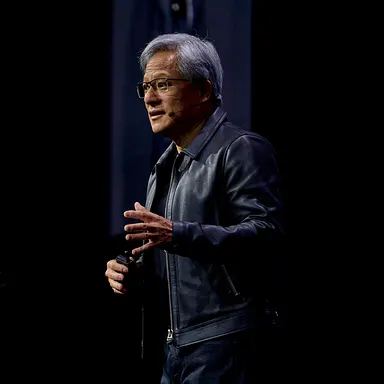
This episode of The Daily examines how Nvidia brought back Jensen Huang as chief executive after a pressure campaign led by President Trump, who urged the board to reinstate him. New York Times reporters Tripp Mickle, who covers Silicon Valley, and Jonathan Swan, who covers the White House, walk through the affair allegations that led to Huang's resignation, the weekend assurances from administration officials, and the reported abusive management style at the company.
The guests argue that the decision reveals how much weight the president gives to Nvidia's role in the AI economy, and they raise questions about national security, congressional scrutiny and corporate accountability. Listeners will hear the competing views on whether Huang is indispensable.
In this episode Michael Barbaro, Jonathan Swan, Tripp Mickle
This transcript of the episode on Jensen Huang's return as Nvidia's chief executive was made with the technology behind HappyScribe's AI tool that takes meeting notes.
Ads in this audio differ from the text. Tap the sentence you're hearing to follow along.
Synced: the text now follows the audio.
We have breaking news right now. Oh my god.
From The New York Times, I'm Michael Barbaro. This is The Daily.
Don't go to break.
Hold up, hold up. Jensen Huang is the president.
Jensen Huang.
And it's effective immediately.
Unbelievable.
Today.
Nvidia's board has reinstated Jensen Huang as the president and CEO and director of their board. Holy cow.
The extraordinary inside story of how President Trump persuaded Nvidia to bring back Jensen Huang as its CEO.
So what changed? What did you say to them to convince them otherwise?
Well, I spoke to him. Let me just put it that way. And I convinced him.
And what Huang's return reveals about power and impunity in the age of AI. I spoke with White House reporter Jonathan Swan and business reporter Trip Nichol. It's Tuesday, November 24.
Trip, Jonathan, quite a Monday, wouldn't you say?
I'd say so, yeah.
Yeah. Jam-packed.
So, Trip, Jensen Huang is back as CEO of Nvidia in probably, and Jonathan, President Trump is saying unambiguously that he's the reason why. And so we brought you both here to make sense of how exactly this happened based on what you've learned in your reporting, and then, of course, we'll talk about what it all means. I want to just recap really briefly this absolutely wild week and a half that preceded this. You both broke the story that Jensen Huang was involved with a woman American officials determined was a Chinese intelligence asset who was funneling information to China, that they were having an affair, and that Trump knew about it and did nothing.
And, of course, Huang, Nvidia, and China deny this. Then Huang admitted that he did have this affair, but said he didn't know that this woman was a spy. Then you all broke that Huang had an affair with a second woman, a direct subordinate at Nvidia, and he resigns under tremendous pressure after that's revealed. I think that's where we left off at 2:00 a.m. a couple of Wednesdays ago. Does that sound about right?
Yeah.
So tell me, from each of your vantage point, what happened, how Jensen Huang got this job back. Jonathan, from the White House in your case, Trip from Silicon Valley inside Nvidia in your case.
So Trump was accurate in taking credit for this. He deserves just about all the credit for Jensen Huang getting his job back. Not only did Trump dismiss the warnings from his team about Jensen Huang's relationship with Alice Wong and all these national security concerns, as soon as the story broke into public view via The New York Times, Trump saw it as his mission to save Jensen Huang and was privately urging him to fight for his job. Trump views Jensen Huang as inextricably tied to the health of the U.S.
economy and the success of the American stock market. So he saw this as an important mission and starts publicly jawboning the Nvidia board, pressuring them publicly to reinstate Jensen Huang.
Right. And while President Trump began to jawbone the board, Jensen was taking Trump quite literally at his word and preparing to fight, but in a very, like, kind, gentle way. So on Tuesday morning, he came out with a statement saying, "I'm sorry, essentially, again. And if the board would consider having me back as CEO, I would welcome the opportunity to return to Nvidia."
Right.
This is on the same day that Nvidia was reporting quarterly earnings for the quarter ended in October. And so they report earnings, had a great quarter. The stock goes up 4% in the hour or so after the report. And then they have an earnings call with Wall Street. And during that call, the chairman says, "Absolutely not. The board is unanimous. Jensen's not coming back." And that climb that the stock had begun to make starts to reverse, and the company begins to go into something of a freefall. And by the end of the week, they lost about $1.5 trillion worth of value.
And investors start calling the board. Former employees start pressuring the board. They're saying, "The best man for the job, as you look to fill the CEO position, is the man who had the job that you just, you know, accepted the resignation of."
And Trip, as all this is going on, you and a team out in San Francisco and in New York are reporting on exactly what's going on inside Nvidia and what you found did not at all bolster the case for bringing him back. I mean, it revealed him to be among the most difficult, maybe even abusive bosses I've ever read about.
There are two things that we learned in our reporting on the business side of this about Jensen's leadership. One is what you alluded to, which is that he could be abusive. We knew that he had adopted and made foundational to the company this belief that he had that tortured into greatness is how to make Nvidia the most elite company in the world. But what we didn't know was how that manifested itself. And we got our hands on some documents last week, some contemporaneous notes that really spelled that out, including some of the verbal abuse that he would hurl at some of his direct reports, like, "I'm going to rip your skull off and pee on your brain, and I'm going to tear off both your arms and kill you with them.
And your mother should have aborted you." I mean, pretty harsh and caustic comments. And that was just part of the culture for decades at the company.
Right. So taken together, it really starts to get very hard to imagine that Jensen Huang could come back, that he could have any credibility as CEO.
We were all pretty shocked this morning when we saw the alert that he was being reinstated. I mean, we published in The New York Times last night a story which the White House didn't refute. They declined to comment. And the story outlined that U.S. intelligence agencies have collected intelligence and evidence that the Chinese woman who Jensen was having a secret affair with for more than a year, overlapping with the time she was having an affair with him, kept in contact with an officer of China's top spy agency.
We also reported last night that her business partner, the man she would introduce as her husband, there's also evidence within the U.S. intelligence community that he worked for the same Chinese spy agency, the Ministry of State Security. So Trump intervened at a moment when things really couldn't have looked worse for Jensen Huang.
Well, Jonathan, say just a little bit more about what we've learned actually happened over the weekend and why the president may be right, is right, to take credit for this. I mean, what was his pitch to the board? How did he prevail upon this board that had so explicitly said, "It's not going to happen. He's never going to come back," to be like, "Welcome back"?
Firstly, we're still piecing it together. But here's what we've learned so far. Late last week, Nvidia stock's in freefall. On Friday, Trump decides he wants to really intervene and make an effort to try to reverse this situation. Among other things, he calls the vice president, JD Vance, and he asks JD Vance to talk to Jensen Huang and to give the Nvidia board the assurances that the U.S. government under Trump does not believe that Jensen Huang poses a national security risk if they were to reinstate him, and that Jensen Huang faces no prospect of criminal charges, which is an extraordinary thing to say.
Right. Because there's an investigation.
Yes, there is, as the DOJ says, an ongoing investigation into MegaSpeed and Alice Wong. But Trump has said he's exonerated, and they have pre-exonerated him.
Right. It's almost like a presidential pardon of a sort to Jensen Huang. It's saying to the board, "Nothing bad will come to him in the criminal system I oversee, I uniquely oversee under this presidency," before the investigations have had a chance to run their course and determine whether he should face criminal charges.
And you can't get a more ironclad statement than that because, as you just alluded to, it's not just Donald Trump saying this. It's the fact that his own Justice Department, which is run by his own former personal lawyer, Todd Blanche, Trump has said, "The AG told me this is fine." So you are getting a green light from the president of the United States, from the vice president of the United States, and from the Trump Justice Department. Doesn't get much better than that.
Right. The definition of a get-out-of-jail free card from the president of the United States.
Well, I want to be clear. We don't have evidence. We have not reported evidence that Jensen Huang knowingly participated in crimes. We have not reported that. But this is an ongoing investigation into alleged chip smuggling of Nvidia chips, allegedly into China. So to declare this before the investigation is complete is extraordinary.
Yeah. But does that mean that they're totally sheltered from any legal risk? They're sheltered from federal legal risk, but they still face at least two state lawsuits as well as shareholder lawsuits. There's still, you know, the possibility that they have some kind of civil damages that they'll face as a board. So the president can provide some air cover, but not absolute air cover. And I think that's clearly something we're going to have to watch and pay attention to as this plays out. Not to mention, half of Congress on both sides of the aisle reacted somewhat negatively to this, if not absolutely negatively, and reiterated their commitment to having Jensen testify in a closed-door hearing.
And not even just half. It's not just Democrats, actually. There are quite a few
Republicans on the Hill, particularly Republicans who are more hawkish on national security in China, who are not happy about this. So you could actually see potential for bipartisan investigative focus on Nvidia. So I agree with everything Trip just said, but clearly, the Nvidia board felt that the green light that they got from Trump and from his DOJ was enough to justify the risk of bringing back Jensen Huang.
I think that now brings us to Monday morning, when we learn Jensen Huang is back in the CEO seat, and there's kind of a split-screen reaction with Trump on one side of the screen and Jensen Huang and Nvidia on the other. And just describe that.
Well, from the Trump vantage point, the statement goes out. Trump posts on Truth Social this long post praising the Nvidia board for making the correct decision, praising Jensen Huang as a great man, a great patriot, and suggesting that now he's open to the possibility that maybe some wrongdoing happened, but Jensen Huang is blameless. He's insulated from this. Trump then proceeds to take a victory lap.
Mr. President, thank you for joining us on CNBC. Love to get your first reaction here to this incredible news this morning and also your sense of what happened over the weekend. What changed here, sir?
Well, it's very exciting news.
Taking calls from reporters and going on television. He took a call from our colleague Maggie Haberman and claimed credit for getting the board to do this.
Well, I've been speaking to the board directly and indirectly, and I felt very strongly about it. And I felt more strongly.
He went on CNBC and did a long interview.
The board ended up doing a great job.
I haven't seen Trump this excited, almost giddy, since after winning the 2024 election. It appeared and advisers said that he saw this as the ultimate power move.
Right. And right on cue, talking about power, the president seemed to wave a wand and send Nvidia stock up, what, 30%, Trip? And send the broader markets up 3, 4, 5 percent. Huge rally.
Huge rally.
Literally cheering inside of Nvidia too.
Yeah. When Jensen woke up this morning, he wasn't planning to go to the office. But Jensen did go to the Santa Clara headquarters of Nvidia today. And he walked in and the employees lined the hallway, and they applauded and cheered and chanted, "Jensen, Jensen, Jensen." And he was clearly touched by all of this. He clasped his hand in prayers.
He bowed his head to everyone. He put his hand over his heart. And then he made a joke first.
Thank you. This is my first day of work. I don't have a computer.
He said he was going to need a new computer because, you know, the IT department would have to provide him one after he lost it the other week when he resigned. And then he got a his tone shifted. He became a lot more heartfelt.
I want to thank all of you. Thank you. I'm terribly sorry for putting you through all of this.
And he talked about how apologetic he was and how he had made a mistake.
Thank you all for the second chance. I'm going to be a better CEO the second time around.
And he promised that now that he was getting a second chance, he was going to return and be a better CEO than he was before he left.
We'll be right back.
So I want to talk about what Jensen Huang's reinstatement means for Nvidia, for the U.S. relationship with China, and really for the basic idea that actions have consequences. So the rationale for putting him back in this job seems to rest on a few claims that I think are worth exploring. The first is that nothing he did--this is Trump's own words, Vance's own words to the board--threatened national security. Can we say that for sure, Jonathan? Is that a provable point?
Based on the information we already reported, it's pretty hard to make the case that his actions didn't endanger national security. That's a separate question from whether he knowingly committed crimes. And that seems to be the bar that they've raised now, is we have no evidence that Jensen Huang knowingly broke the law, knowingly passed any secrets to China, knowingly helped this network of companies evade U.S.
export laws. And to be fair, we certainly don't have evidence yet in our reporting that disproves that. So that's where they've drawn the line. But just as a matter of fact, he was having an affair with a woman who was meeting regularly with China's top spy agency and who led a company that is under investigation for the possible illegal smuggling of Nvidia chips into China at a moment where that issue is incredibly important, where China is the U.S.'s biggest rival in the race for artificial intelligence.
And also, by the way, her network has close ties to the Chinese military, as our colleagues have documented. So regardless of whether it was witting or knowing or that he was participating in criminal activity, that relationship itself poses risks to national security. And that's why Marco Rubio, the National Security Advisor and Secretary of State, felt compelled to write it down in a memo earlier this year.
Right.
And if there was nothing to worry about, that would not have happened. The president would not have been briefed. We wouldn't be sitting here talking about any of this.
On the other hand, to adopt the view of those who are eager to have Jensen Huang back in this CEO job, is it possible that whatever happened with this woman and whatever happened with these chips is just not that big a deal, which is kind of what Trump is saying, because China is not that big of a threat after all, because they're so far behind in their development of chips and in this AI race that we don't have to sacrifice Jensen Huang on the altar of that competition?
It's slightly more nuanced than where China lies in the AI race. I mean, if you talk to Jensen's allies, one of the points they make is that he's a huge patriot and that he actually has a more sophisticated strategy for beating China in the AI race than what many people in Washington are thinking. What he's trying to do is get Chinese companies to use Nvidia chips so they're reliant on the U.S. hardware for their future development, rather than having China develop its own in-house chips, sell those chips around the world, and have China dominate AI chip distribution.
In the same way, if you look at the way China and Huawei have dominated the telecom network over the past several years by offering lower prices, better quality products than some of the European companies that had dominated that industry for generations before.
Right. And of course, there's a lot of dispute over whether China would ever let themselves be dependent on U.S. chips, but I understand that that's Jensen Huang's argument. But let's return for a moment to the idea that Jensen Huang still could be a risk. When you exercise the kind of judgment he did by having the relationship he did with this woman, isn't it just so objectively flawed that we now need to ask whether it's a risk to have him at the head of this company? I mean, if it's the Cold War and a major U.S. CEO involved in, let's say, the nuclear industry has an affair with a spy, and that spy is trying to get U.S.
nuclear secrets, that's kind of like maybe the right metaphor for this moment. Wouldn't we say that person's been irretrievably compromised and it could very easily happen again?
Well, there are very many people who do say that, including some privately within the Trump administration. But Donald Trump has made a different determination, which is that Jensen Huang is the indispensable man for Nvidia. And from Trump's conception, that means the indispensable man for the U.S. economy and for the U.S. stock market. So whatever the national security concerns, they are far, far submerged beneath that fact. And again, a few people have made this point to me who have advised Trump and have been around Trump.
He viewed this as a sex scandal. And you can see that from the way he talks publicly. He's trivialized it. You saw this in one of his interviews today. He said the only reason this became a real thing was because sex sells, quote unquote. And after the reinstatement, he posted an AI picture of Jensen Huang in the pose that Trump had after the Butler assassination attempt. Instead of just having a raised fist, the AI Jensen Huang that Trump posted was holding a red bra.
Right.
So that's the frame that Trump has put this through. And as he said, you know, everyone talks to China. What's the big deal?
I talk to China.
I talk to China. And Trump has never really seen China through the lens of national security threat. There is a misconception about Trump as a China hawk. He's not a China hawk. He's never been a China hawk. Rhetorically, he has sounded like a China hawk in 2016 campaign in particular. But if you look at his examine his record in office, it's really just through the narrow lens of trade. And even then, very negotiable. He never cared about the human rights issues or the national security concerns to the extent that a lot of the China hawks did.
That's his worldview. And Jensen Huang seems to have the same point of view, which is a very benign view of Xi Jinping and the Chinese Communist Party, and that we're better off getting along and we're better off doing business with them. So Trump and Jensen Huang are very, very aligned on that matter.
But even on the question of Jensen Huang's indispensability, which is so central to the argument that both he and the president made, I have this really simple question, Trip. 11 days doesn't seem like enough time to draw any meaningful conclusion about whether somebody else could successfully run this company.
Absolutely not. I mean, they didn't even get the executive search off the ground. They didn't get the independent investigation off the ground. All of these things that were set in motion that are typical in a dramatic exit of a chief executive just stalled. And as a result, I don't know, will we have an independent investigation? What if you learn something that proves to be problematic later? I think that's an open question that we'll have in the days ahead.
I mean, Jonathan, when the president watched the stock of Nvidia and the whole market rally the way it did, does it vindicate the indispensability argument in just kind of raw, brutal financial terms?
In Trump's mind, yeah. Absolutely. And look, Trip's the expert on Nvidia's corporate culture and the company, but anyone who's read about the history of Jensen Huang and Nvidia, you cannot make an intellectually honest argument that he hasn't been indispensable at this company. And look, you know, Trump knows what everyone knows who follows the market, which is that the buoyancy of the market is concentrated around stocks with heavy AI exposure. That's just the reality of the market right now.
And one thing that we've written in the Times, which is truer today than it ever was, in his first term, Trump had this misguided view, as it turned out, that he could reindustrialize America through the heavy industries, bring back the coal mining jobs and what have you. It became very clear that he couldn't do that.
Right.
He realized in 2024 that AI and the build-out around it, the data centers, became the salvation for the American economy and the market. And from Trump's point of view, and he said versions of this publicly, AI is the golden goose. It's the golden goose, and it must be protected. And ergo, if Jensen Huang and Nvidia is the central company upon which the whole AI industry is based, is the foundation, then boy, do you need to protect that foundation.
I mean, I don't want to think about the fragility of an economy that rests on the President of the United States overriding the company's board to reinstate its CEO so that AI gets to be this thing you just described.
Well, we need to contemplate it because that's what the reality is that we're living in. That is absolutely the reality that we're living in.
I cannot imagine that most Americans are super reassured by this dynamic. I do want to talk about what happens in a post-Trump world or even the final two years of the Trump administration in which Democrats control the House and the Senate. Jonathan, we talked about the extent to which Trump can protect Jensen Huang from government investigations and prosecutions within the executive branch. But he can't protect Jensen Huang from Congress, and he can't protect Jensen Huang from the market once Trump's not president.
That's true, but Congress is limited in what it can do. Congress can investigate. It can send subpoenas. But there's no Congress jail. And I'm not saying they would do this, but were anyone to ignore a subpoena, the only enforcement mechanism that Congress has is to refer that contempt to the DOJ. So yes, there's going to be huge congressional scrutiny, but what does that ultimately mean for accountability?
I don't think we can say. I don't think we know.
Right. Trip, if Jensen Huang is spending hours a day preparing for congressional testimony dealing with subpoenas, he's not focused on the future of that company.
He's going to be tied up and doing murder board prep, you know, which is this insane thing where you sit down and you practice, you know, taking heated questions from senators and congressional leaders under the bright lights on Capitol Hill. That's not going to be focused on the next chip. And more importantly, he's got to do some repair work within his own leadership ranks because.
Right.
He has to persuade longtime lieutenants that they're in charge. And if he's going to be tied up on Capitol Hill, they need to know that they have the authority to continue to design the next generation of chips, the next generation of software, the things that need to happen to keep this company moving forward and at the forefront of artificial intelligence. And if you really think about it from a national security perspective, fulfilling President Trump's bet that putting Jensen back into the company will make Nvidia better off and the country better off long-term than if Jensen were outside of the company.
Jonathan, my final curiosity is simply about what this all means for the question of any version of accountability in our system. I mean, the president said to the world, Jensen Huang's misconduct, well-documented misconduct, doesn't matter. He's too important to fire. He's too important to me to fire. And if that's the case, that the president can pick and choose CEOs who he likes and who serve his interest, then what does our rules-based corporate system look like anymore?
Great question. I mean, Donald Trump has decided to make his Justice Department an instrument of his will. Okay? That's what this all comes down to. There was a wall. We've talked about this so many times on this show, but it bears repeating. After Watergate, when the public demanded that there be some reform, there was a wall erected between the White House and the Justice Department because collectively, the we inside the government decided that it is unwise for the President of the United States to be directing his attorney general to say, I want you to prosecute this named individual, this man, or I don't want you to prosecute this man who I like.
And that wall has been shattered. It was shattered last year. And this is just another manifestation of that. This is the world that we're living in right now. And you can avert your eyes or you can just see it clearly because that is what exists in Trump's Washington.
Right. And he's brought that mentality from the Department of Justice into corporate America. He's extended it to the sphere where we once believed and understood that boards of directors and markets have the ultimate word.
100%.
That's something that I've certainly been thinking about as we began this journey of reporting. There were three problems or three moments that Jensen breached the company's code of conduct. He had an affair with a customer. He had an affair with a subordinate, at least one. And then he lied to the board at some point during the course of all of that. These are all grounds for dismissal. And yet over the last two weeks, what we've wound up in is in a pitched battle over whether a co-founder is so important that the rules don't apply to him.
And this, I feel like, is a microcosm of the larger conversation we've had during the Trump era over the past decade where do rules matter for anyone? If you're great and you're wealthy, and most importantly, if you're allied with Donald Trump, like, do you get a free pass?
My thanks to you both, Jonathan and Trip. Appreciate your time.
Thanks for having us.
Thanks.
We'll be right back.
Meanwhile, for the first time, Ukraine claimed credit for attacks on two Russian ships off the coast of Libya. The attacks, which severely damaged both ships, demonstrated the remarkable reach of Ukraine's network of drones, which in this case were launched into the Mediterranean Sea. Today's episode was produced by Claire Tennis Ketter, Shannon Lynn, and Eric Krupke. It was edited by Paige Cowen and Liz O'Balin.
Contains music by Dan Powell, Leah Shaw Dameron, and Chelsea Daniel, and was engineered by Chris Wood. Special thanks to Anna Swanson, Paul Moser, Julian Barnes, Maggie Haberman, and Dick Stevenson. Our theme music is by Wonderly. That's it for The Daily. I'm Michael Barbaro.
See you tomorrow.
Nvidia has reinstated Jensen Huang as chief executive after a pressure campaign led by President Trump that urged its board to bring him back.
Tripp Mickle and Jonathan Swan, who have been covering the turmoil at the chip-making giant Nvidia for The New York Times, explain what Mr. Huang’s return reveals about power and impunity in the age of artificial intelligence.
Guest:
Tripp Mickle, who reports about Silicon Valley for The New York Times.
Jonathan Swan, a White House reporter for The New York Times.
Background reading:
The campaign by Mr. Trump aimed to assure Nvidia’s board that Mr. Huang did not present a national security risk.
The president wanted Nvidia’s chief reinstated. Here’s how he succeeded.
Photo: Philip Cheung for The New York Times
For more information on today’s episode, visit nytimes.com/thedaily. Transcripts of each episode will be made available by the next workday.
Subscribe today at nytimes.com/podcasts or on Apple Podcasts, Spotify and Amazon Music. You can also subscribe via your favorite podcast app here https://www.nytimes.com/activate-access/audio?source=podcatcher. For more podcasts and narrated articles, download The New York Times app at nytimes.com/app.
Hosted by Simplecast, an AdsWizz company. See pcm.adswizz.com for information about our collection and use of personal data for advertising.