
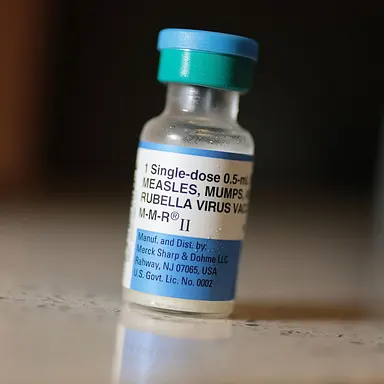
Teddy Rosenbluth, a health reporter for The New York Times, explains how the United States lost its measles elimination status after the virus spread without interruption for more than a year. He traces the spread from a Mennonite community in West Texas to outbreaks across many states, and describes how declining vaccination rates let outbreaks ignite far from insular groups.
The conversation covers the risks of measles for adults, pregnant women and babies, the lasting damage it can do to the immune system, strained hospitals, and what would be needed to regain elimination status, including Canada's example.
In this episode Natalie Kitroeff, Teddy Rosenbluth
This transcript of the episode on measles losing its elimination status was made with HappyScribe technology, the same kind behind Teams meeting notes.
Ads in this audio differ from the text. Tap the sentence you're hearing to follow along.
Synced: the text now follows the audio.
From The New York Times, I'm Natalie Kitrowev. This is The Daily. Last week, the United States lost its measles elimination status, meaning measles is now officially endemic again. It was a historic setback for American health and a marker of the deep distrust of vaccines across the country. Today, my colleague Teddy Rosenbluth explains how this happened and what it would take to beat the virus back.
It's Monday, November 23rd. Teddy, welcome back to The Daily.
Good to be back.
So the last time that we had you on the show was when we, as a country, were contending with this massive measles outbreak in West Texas. And back then, which is about a year and a half ago, it was bad, but it was relatively contained to this one community of Mennonites. But you told us that the worry was that it would spread, and it seems as though that has, in fact, happened at scale.
Yes, and I think it was so much worse than even the most pessimistic epidemiologists I talked to thought it would be. So essentially, since the Texas outbreak, this virus has hopped all over the country. We've seen hundreds of hospitalizations, we've seen thousands of cases, and it has essentially spread for so long that now the U.S. is in the position where we have lost this coveted elimination status.
Okay, and this is maybe obvious, but what exactly does it mean to have elimination status, and how significant is it that we lost it?
Yeah, it's actually not obvious. It's like a pretty wonky public health definition. It essentially means that there's not continuous spread of measles in the country for more than 12 months. So we've had outbreaks of measles in the past, but, you know, those were linked to, you know, importations from international travelers, and it just means that measles isn't endemic in the U.S. It's not spreading around.
Got it.
And actually, what a lot of people don't realize is just how hard it was to get elimination status in the first place. It took 40 years after we got the measles vaccine. It took tons of money. It took buy-in from multiple different presidential administrations. And we were actually, like, one of the first wealthy countries in the world to do this, and we kind of set the example of what was possible. And so losing that is not just sad because of what it means for the health of our country, but it's also just embarrassing, frankly.
And what are the experts that you're talking to, and I assume you're talking to many, saying about that?
Yeah, I think they're sort of echoing that sentiment. I mean, one went so far as to say that it's a stain on our reputation.
Wow.
You know, a lot of the measles experts I spoke to, their career has now been bookended by sort of this really hopeful moment of, you know, we eliminated measles, maybe we can even eradicate it globally. And to have this backslide is not only embarrassing, but also sad for the people who spent many decades of their career getting this virus under control.
All right, so how did we get to this point where now measles outbreaks are kind of all over? Tell me the story of the spread.
Yeah, so, I mean, the last time we talked, we had this big outbreak in Texas. It was infecting hundreds of people, and there was sort of a muted response from federal health officials. You would expect them to be coming in and saying, you know, vaccinations are important, here's our plan for boosting vaccination rates in this area. And what we saw was not that at all. Initially, Robert F. Kennedy Jr., our health secretary, was talking about treatments for measles. There is no treatment. You know, he talked about cod liver oil being a potential treatment.
He sort of underplayed the seriousness of measles outbreaks, which, of course, he has in the past, long before becoming health secretary. And essentially what we saw after that was the virus just exploded.
Measles cases are bubbling up again and wreaking havoc on the school year.
It started popping up in all of these states around the country. It was even hard for me to keep track of at some points.
This all started in a small Mennonite community about an hour and a half away from us in Gaines County, Texas.
What we saw in Texas was it was this big sort of insular religious group, Mennonite community.
Public health officials say a Gaines County woman who later tested positive traveled more than 400 miles to San Marcos in San Antonio.
And we've also seen that in other parts of the country. So in Pennsylvania.
California has now recorded more than 1,500 cases across 46 counties, with 305 hospitalizations.
There was a huge outbreak, still is a huge outbreak, in Lancaster, which is an Amish and Mennonite community.
A Montour County resident has died from measles, marking the county's first death during Pennsylvania's ongoing outbreak.
We've seen this in South Carolina. It was sort of this big outbreak in a pretty insular Slavic community.
Federal health data show it's the largest U.S. measles outbreak in more than 30 years.
And the majority of the cases are children.
So we're seeing a lot of these communities that have historically had very low vaccination rates suddenly having these massive outbreaks all over the country.
Now, even though this community is hard to get to, it's not hard for the virus to get out.
Utah health officials say it's traveling farther than you may think.
But we've also seen a different version of this, which is perhaps more alarming or more unique, where it has spread out of these groups because the vaccination rate in the general public is not high enough to keep it contained to these insular groups.
Health officials say there is no longer an isolated outbreak, and it has now reached the point of community spread.
Already, the country has recorded over 5,400 cases this year. That's more than double last year's total.
And almost every state in the U.S. ended up reporting some level of measles cases.
And can I ask what might sound like a naive question, Teddy, which is, how does measles actually spread from insular community to insular community, just given that these communities, by definition, aren't interacting a ton with a bunch of outsiders?
Yeah, it's a really good question, and it's actually kind of where declining vaccination rates come into play here. So measles is the most contagious known virus. It is extremely contagious. It spreads through droplets, like how, you know, we think about the flu spreading, but it is also airborne. So what that means is it can linger in the air for two hours. And how this used to work, and I'll give an example from 2019, was we had this really big measles outbreak in New York City, actually, in a Hasidic Jewish population, and this is one of these insular groups that has low vaccination rates.
The virus spread through the community, but the rest of the community surrounding them was so well vaccinated that it sort of burned itself out.
Right.
Acted as a firewall, if you will. Now what we're seeing is that there are these big insular groups that have big outbreaks, but, you know, there are other people living in Lancaster, Pennsylvania. And, you know, maybe the vaccination rates are below the 95 percent needed for herd immunity. So maybe they come into contact with this insular group, you know, they're traveling to somewhere else, they come into contact with someone else from a different insular group, and suddenly another outbreak has ignited halfway across the country.
Meaning, basically, that there are way more unvaccinated people who aren't in these insular communities and are contracting measles and spreading it far and wide.
Exactly. And this is exactly why you need herd immunity, is to, you know, prevent these groups from igniting into a massive outbreak.
And what about vaccinated people? Like, do we know if any of them are getting it?
Based on the data that we have, we know it's a very low percentage. You know, two doses of the MMR vaccine are 97 percent effective. That bears out in the data. I think, like, 2 percent of cases this year have been in unvaccinated people.
Basically, people who were vaccinated decades ago are still protected now.
Yes. I mean, I think a lot of people get concerned because they've had this experience with COVID where, you know, the virus is evolving every year and learning to evade the vaccine that we've developed. And measles is not like that. It has not evaded the vaccine that first became approved in the 1960s, and it's sort of this virus that has prioritized transmissibility over evading the immune system. So people who have been vaccinated, it is still the case that you are protected against the virus, and this is not something that you have to be as worried about.
So you're kind of describing a situation where we have a kind of perfect vaccine that now not enough people are getting, which brings us to the present moment. What does this world look like where measles is now rampant and continuing to spread and we have this vaccination problem?
Yeah, so in the last one and a half years, we've seen more than 7,000 cases, which is not those are not numbers that we have seen since, like, the early 1990s, which is a decade before we got elimination status in the first place.
Rough.
Yeah. We've seen 11 deaths. Many of those have been babies who are too young to get the MMR vaccine. We're seeing disruptions to schools. Kids are having to stay home and quarantine. And part of what is so significant here is that we're seeing a new version of endemic measles in the U.S. You know, before the vaccine, almost all Americans got measles as a kid.
Right.
Which means it was really not common for adults to have this virus.
Because once you get it as a child, you eventually develop immunity to it, so you don't get it as an adult.
Exactly. But now what we're seeing is we're in this world where adults are getting measles often. I mean, it's a big share of the cases that we've seen. And this is creating just a whole new host of concerns that doctors and public health officials have told me they've never had to deal with before.
We'll be right back.
So we're entering this reality that we've never really been in, where this disease is being contracted not just by young people, but by unvaccinated adults on a wide scale. You said, Teddy, that this was raising new concerns. What are they?
Yeah, I think we don't know that much about what measles looks like in adults. You know, we just haven't had the time to sort of do the studies that would tell us these things, like what are the most common complications in adulthood, who within this group are at most risk. You know, one big question we have is how this will affect pregnant women. And this is something that we're really starting to see at scale for the first time. You know, we know that pregnant women are at higher risk of severe measles complications.
I think they're 10 times as likely to die from measles, actually.
Oh, no.
We know it can increase the likelihood of miscarriages, but we're also starting to see this phenomenon called congenital measles, and that's essentially babies who are born with the virus because their mothers had the virus during pregnancy. And we don't necessarily know the long-term repercussions of that. You know, we know it probably puts babies at a much higher risk of this really devastating neurological condition that's often fatal. But this is really still at the edge of our knowledge about the virus.
What else are public health officials worried about?
So there's a lot that they're worried about, but one thing that I've heard a lot about is this concern about the effect on the immune system. So even after someone survives a measles infection, what the virus does is it sort of wipes away your immune system's memory of other viruses and pathogens. So you're in this vulnerable state for months or potentially years after that measles infection, where, you know, your immune system is kind of caught flat-footed in responding to all of these things that you should presumably already know how to respond to.
And this is what's called quote-unquote "immune amnesia," and it's something that everybody gets. It's not just a small portion of people infected. So, I mean, we might see effects where patients land in the hospital after a measles infection for something entirely unrelated, a different virus.
So the impact of measles infections just lasts way beyond the moment of actual sickness.
Yes. And there's even a very rare complication called subacute sclerosing panencephalitis, SSPE, that can actually rear its head up to 10 years after the initial infection. And it is degenerative, and it can, you know, send people into comas and is ultimately fatal almost all of the time.
How equipped are doctors and other healthcare workers to take this on? Like, presumably, a lot of these people have never actually ever seen a single case of measles before.
Yeah. I mean, the health systems are really having to relearn how to deal with this virus. You know, how do we make sure that a patient isn't coming to the emergency room and infecting a bunch of people? How do we transport a patient with measles in the hospital without putting other people at risk? So they're having to dust off all these protocols from the '80s and '90s to figure out how to deal with this. I actually had a I was scheduling an appointment, a dermatology appointment last week, and they were already asking if I had any symptoms of measles, which I thought was so interesting.
Whoa, no way.
Yeah. These things are already happening. And the other piece of this that is uncharted territory for treating measles is, you know, like you said, many of these doctors have not seen a case of measles before. And furthermore, maybe they haven't even learned about measles in medical school. A lot of our data about treating severe measles comes from the '50s and '60s, which isn't necessarily relevant now.
What can the federal government do about this situation, and what are they actually doing? What's the administration doing?
Yeah, so actually, a lot of the response to these outbreaks happen at the state and local public health level. So we might see states beef up their wastewater testing so we can identify cases of measles before people are coming to emergency rooms or urgent care clinics. They can strengthen their contact tracing, you know, that sort of stuff at the local level. The federal government can help with those efforts. They can invest. So we've already seen the federal government send $100 million to, you know, help state and local health departments respond to these outbreaks.
But really, the most helpful thing they can do, and what experts say they expect the federal government to do, is really strong, clear messaging about the importance of vaccines, debunking misinformation, that sort of thing.
And where do we stand on that? I mean, obviously, the Health Secretary, RFK, has been an outspoken skeptic of vaccines. How is the messaging going right now?
So I think since Texas, the measles resurgence has just become a bigger political liability. And we have seen him change his tune a little bit. You know, he's come out and said that the measles vaccine is the best way to protect yourself against an infection. But at the same time, the experts I've spoken to have said that many of his actions as Health Secretary have sort of undermined that message. So one example of this is he launched an inquiry into the safety of childhood vaccines, which we know have been used safely for decades and decades.
So I think it's difficult to say that this is clear messaging. I think a lot of experts would probably say it's muddled at best.
And I presume that muddled messaging makes it a lot harder to reverse this wholesale, to get back to elimination status as a country.
Yeah, I mean, absolutely. I think we have a really good example of what it takes to regain elimination status in Canada. They lost their status last year after they had a really big outbreak in a Mennonite community, and they've invested a lot into boosting the vaccination rates there. They have stood up vaccine clinics in those areas, and they have a really big public education campaign to sort of debunk misinformation about the MMR vaccine and measles infections.
And so Canada hasn't officially regained their elimination status, but they are on track because they have successfully stopped measles spreading in their country. And I've talked to a lot of experts about this, and they said that investing this much in this kind of effort to debunk vaccine misinformation is just not something that they can imagine this administration doing.
I mean, so basically, you're describing this world in which measles just keeps spreading until what? I mean, what could change the course of this?
Yeah, I think there are two schools of thought on this. There are sort of the eternal optimist public health people who think that maybe if we crack down on exemptions from school vaccination requirements, we could get this back under control. But there's another more pessimistic group of people who think that, you know, maybe we're just going to have to see the sickness and death that comes with these outbreaks until people are reminded of why vaccines are so important in the first place.
Well, okay, on that, on vaccines, I know you said that the vaccine is highly effective, but you also said that a small share of the vaccinated population can still contract measles, something like 2%, I think you said. And so I guess I'm wondering, for those of us who are vaccinated against measles, should we be worried?
It's a great question, and I've probably gotten hundreds of emails asking the same thing. At a very high level, if you're vaccinated, you're probably fine. There haven't been new official guidelines that have come out on this telling people to go get an extra dose or anything like that. But when I've talked to doctors, they've said that there are, you know, a few groups who might want to talk to their doctor about potentially getting another shot. So that's people who were born before 1968 but after 1957, which I know is like a sort of niche little slice.
You know it if it's you, yeah.
Right. It's possible this group got sort of a less effective version of the vaccine that's no longer available. And then there's another group, people vaccinated between 1968 and 1989, and this is a group who likely only got one dose of the MMR vaccine. So that doesn't mean you have to necessarily race out to get vaccinated, but you might want to take a closer look at your risk. So do you live in an active outbreak zone? Do you have an underlying condition that would make measles especially dangerous for you?
Like, in those cases, you might want to talk to your doctor about getting another dose. But mainly, this is an issue that the unvaccinated really have to be most concerned about. You know, we're entering a much riskier era for this group of people. That could be kids whose parents have opted them out of the vaccines. That could be babies who are too young to get the vaccine. This new era that we're entering is really, unfortunately, the worst for people who are the most vulnerable in our society.
Like, that's where we've seen the majority of cases. And as long as we don't regain elimination status, this virus will just continue to spread and spread. And those babies and kids, unfortunately, will be the ones who bear that cost.
Well, Teddy, thanks so much for joining us.
Thanks for having me.
On Friday, health officials in Virginia reported that a young child had died after testing positive for measles, bringing the total number of fatalities linked to the virus across the country to 12. We'll be right back.
Here's what else you need to know today. Democrats have won the largest House majority in three decades, securing at least 258 seats in the chamber. They reached that milestone on Sunday with a win in North Carolina when Chuck Hubbard, a Democrat and a former newspaper reporter, beat Representative Virginia Fox, an 11-term Republican. The race was officially called after a recount had been completed. Neither party has won so many seats in a national election since 1992, when Democrats clinched 258 as Bill Clinton took the presidency.
And climate talks at the UN broke down on Sunday over tensions between some nations seeking to wind down the fossil fuel era and others aiming to keep it going. The EU and many smaller countries vulnerable to climate disasters rejected a proposed agreement because they said it stripped out protections and favored countries that export oil, gas, and coal. A group of oil producers, including Saudi Arabia and Russia, had blocked any mention of fossil fuels in the agreement.
It was the first time the climate talks have stalled over a final agreement since 2009, and it was seen as a sign that the UN process may not be up to the task of confronting an overheated planet. Today's episode was produced by Alex Stern, Adrienne Hirst, and Eric Krupke. It was edited by Devin Taylor with help from Paige Cowett. Contains music by Diane Wong, Alicia Baiyitoub, and Dan Pal, and was engineered by Alyssa Mossley.
Our theme music is by Wonderly. Special thanks to Apurva Mondaveli. That's it for "The Daily." I'm Natalie Kittroff. See you tomorrow.
Last week, the United States lost its measles elimination status, which means measles is officially endemic. It was an extraordinary setback for American health and a marker of the deep distrust of vaccines across the country.
Teddy Rosenbluth, a health reporter for The New York Times, explains how this happened and what it would take to beat the virus again.
Guest: Teddy Rosenbluth, a health reporter for The New York Times.
Background reading:
The United States lost its measles elimination status after the virus spread uninterrupted for more than a year.
How the measles virus erases immunity to other diseases.
It may take years for the country to regain elimination status. What happens next?
Photo: Joe Raedle/Getty Images
For more information on today’s episode, visit nytimes.com/thedaily. Transcripts of each episode will be made available by the next workday.
For more information on today’s episode, visit nytimes.com/thedaily. Transcripts of each episode will be made available by the next workday.
Subscribe today at nytimes.com/podcasts or on Apple Podcasts, Spotify and Amazon Music. You can also subscribe via your favorite podcast app here https://www.nytimes.com/activate-access/audio?source=podcatcher. For more podcasts and narrated articles, download The New York Times app at nytimes.com/app.
Hosted by Simplecast, an AdsWizz company. See pcm.adswizz.com for information about our collection and use of personal data for advertising.