
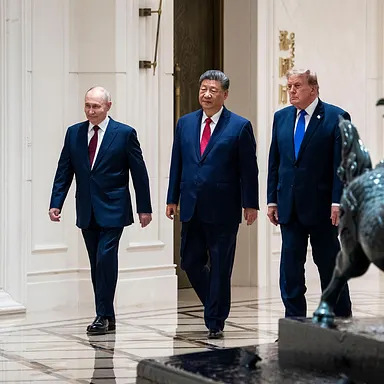
The Daily's host Natalie Kittroff speaks with David Sanger, the New York Times White House and national security correspondent, about the summit in Shenzhen between Trump, Xi and Putin. Sanger, who was reporting from China, says the meeting produced little concrete progress on war or nuclear arms, and that artificial intelligence was largely absent from the agenda.
The conversation then turns to the chip race between the United States and China, the divided Trump administration over export controls, and a loophole that allowed advanced chips to reach China through data centers in Southeast Asia. Listeners will hear the competing arguments over dependency and access, and why Sanger sees this moment as a possible turning point.
In this episode Natalie Kittroff, David E. Sanger
This episode's transcript on David Sanger's analysis of the US-China AI chip race was made with HappyScribe's human and AI transcription.
Ads in this audio differ from the text. Tap the sentence you're hearing to follow along.
Synced: the text now follows the audio.
From The New York Times, I'm Natalie Kittroff. This is The Daily. On Thursday, for the first time ever, the leaders of the United States, China, and Russia met all together, face to face. It was a historic meeting, but when it was over, very little history seemed to have been made. No wars were ended, no nuclear treaties were struck, and the issue sucking up all the oxygen right now, the AI arms race, barely registered on the agenda.
Today, my colleague David Sanger explains what the world's three superpowers got out of the summit and what they left on the table. It's Friday, November 20th. David, we are catching you hours after this big trilateral summit has wrapped.
You've been covering the meeting from China. It's nighttime over there now, right?
Yes. It's evening in Shenzhen. I hadn't been here since 2008, so the city now looks more like Miami, with big towers. They've got a robot center downtown where humanoid robots are bringing coffee and ice cream cones to people who are going to the APEC summit.
What? Are you in the future? Are you joining us from the future?
This is actually the first daily episode I've ever joined you from the future, yeah.
Okay, well, from the future, what can you tell us about what happened at the summit? How was it? What's your lead?
Well, what we can tell you is what we've observed, because we have not had a single briefing by this White House the entire time. The first thing is, the president has gone out of his way to be deferential to the two authoritarian leaders who he most admires, Xi Jinping and Vladimir Putin. He saw them both briefly during the photo ops at the beginning of the APEC summit.
That's the Asia-Pacific Economic Cooperation Annual Summit, and you all saw photographs of him smiling and shaking hands with the two of them. He met with each of them individually, but of course, the high point of it was the moment where he met both Xi and Putin together in what was truly a historic first. We've never seen an American president meet simultaneously with the leaders of the two big nuclear superpower adversaries.
I mean, what was it like? How did they behave? Just describe that for a minute.
Well, first of all, we weren't there. They did this at a remote villa some distance from Shenzhen. They let in very few reporters, so we were watching it on a live video feed for just a few minutes at the beginning.
I'm very pleased to hold with President Putin and President Trump in Shenzhen the China-Russia-U.S. Summit.
They were seated at a large round table so that there was no sense of hierarchy.
We will be having discussions on the theme of upholding world peace and promoting strategic stability in major country relations.
Xi Jinping was in the middle as the host. President Trump was on his left. Putin was on his right.
It is our task to preserve and strengthen the system of international law.
But they began to talk in front of the cameras from what were clearly prepared remarks.
No peace was ever forged by declining opportunities for engagement and speech. Together, we are choosing a different course a historic summit offers.
And then the cameras were escorted out, as they frequently are during summit meetings, and so we don't know what happened in between. We do know that it lasted about an hour and 20 minutes or so, but the only content that we could derive was from what they talked about at the beginning. And interestingly, it was only President Trump of the three of them who sort of walked through an agenda of the things he wanted to discuss.
Yeah, talk to me about that agenda. Like, what do we even know about why these three leaders even agreed to this meeting in the first place, and then what did they want to discuss once they were there?
Well, interestingly, Natalie, they all seemed to go into it with a somewhat different agenda.
Hmm.
President Trump from the start said he wanted to talk about what he variously called disarmament or denuclearization, and I think what most of us would call arms control. Putin said he wanted to talk about Ukraine going into it, and Xi Jinping, who initially seemed to be reluctant to engage in the meeting at all, seemed to warm to the idea that he was going to be the convener and the organizer of this discussion that would put a Russian president and an American speaking to each other on his soil.
And ultimately, I think what they all concluded was that there was some advantage in having the imagery of the three largest nuclear superpowers, each adversaries in their own way, sitting around discussing the future of the world, much as in that famous photograph you saw Churchill and Roosevelt and Stalin sitting around at Yalta in 1945, just before the end of World War II, discussing how to carve up the world.
Now, this was no Yalta. Yalta lasted eight days. This lasted a little more than an hour. But it does tell you that they cared to be seen as the most powerful leaders on Earth.
Okay, so in this kind of strange meeting, where none of the three leaders come to it with the same agenda, they all get this image out of it, reinforcing that they are the most dominant countries and perhaps leaders on Earth. Is there anything concrete that results from it, from this little more than an hour summit?
Well, Natalie, we have to start by saying it's very soon after the meeting happened. We're talking just, you know, a couple of hours after it ended. We may yet hear that they had set their aides off to have follow-up discussions in some areas that they began conversation, but it's hard to imagine, given the breadth of the agendas they were discussing, that they made a whole lot of progress in a bit more than an hour's time.
But what was most interesting, Natalie, is, you know, sometimes you learn more from what isn't on the agenda than what is. And what wasn't on the agenda here was the issue many of us have been discussing, particularly in the United States and China, for the better part of the year, which is, how do you control artificial intelligence? What kind of regulation might you put on it? What are your fears about the national security implications of AI?
And interestingly, none of the three leaders had put that on the agenda.
You're saying that wasn't even a topic of discussion going into this. No one said they were going to address it.
No one said that that was going to be on their agenda. Now, maybe they did once they sat down, but we had no indication that was part of the plan.
I mean, that feels genuinely surprising that going into this big meeting, this major topic of discussion isn't even on the agenda. Like, why wouldn't it be?
Well, it struck me as strange as well, Natalie. And, you know, they are all discussing some real-world issues. There's nothing wrong with these countries getting together and discussing regional wars, Ukraine, the war in the Gulf, and nothing unusual about discussing arms control. But there was a sort of 20th-century feel a little bit to this, and a moment that we're all consumed with the entry of a 21st-century disruption in AI.
And I can't think of anything more urgent for the most powerful nations on Earth to discuss than how they might control this new, somewhat mysterious, and somewhat uncontrollable technology.
All right, well, after the break, you and I, David, will talk about AI. We'll be right back.
Okay, so you've said, David, that the thing clearly hanging over this trilateral meeting was AI. And everyone is thinking about AI for a lot of reasons, but it seems like the most salient thing, given just who was in that room, is the fact that Jensen Huang, the former CEO of Nvidia, just resigned after admitting that he had a relationship with a woman that U.S. intelligence believes was a Chinese spy. I mean, one thing just to note is the awkwardness of that fact, that you have one leader who was presumably directing a spycraft operation that was just exposed, sitting next to the other leader who knew that spycraft operation was happening, but, according to Times reporting, chose to take no action in response to it.
I mean, that is really an extraordinary set of circumstances. Oh, and by the way, there's a third guy there who was a literal spy.
Right. Certainly trained as a former spy, a KGB agent, but many believe he's never escaped that role. So I would argue, Natalie, that strange as this may seem to our listeners, it probably isn't as strange in the U.S.-China context. It's hard to imagine a time when there wasn't some kind of espionage operation between the United States and China.
Right.
That was happening in the background while the leaders were pretending that they were having perfectly normal diplomatic discussions in the foreground. Now, the president said that he did make a passing reference to Jensen Huang and what a tragedy it was that he had to leave Nvidia in the course of his dinner conversation when he was sitting next to President Xi on Wednesday night.
Oh, really?
That's the only time that we know about that President Trump says that he took this up.
And do we know what Xi said in response to that passing comment?
We don't know that Xi said anything in response to it.
Hmm. Obviously, I mean, the real stakes of all of this, the spying included, is this arms race that the U.S. and China have been locked into for years now. It sounds like this meeting did not give us really clear information on that. But what do we know about how Huang being out at Nvidia impacts who's up and down in that race?
Well, you know, there's so many different levels to that question, Natalie. So let's pick them apart. First, the Chinese must be somewhat happy that Jensen Huang is gone from Nvidia because Nvidia was running circles around Chinese manufacturers. They have designed the most powerful chips on Earth, and to do that, they have mastered what I think it's fair to say is the hardest engineering problem that human beings have almost ever confronted, which is the design of the modern advanced processing chip.
And people believe that Nvidia and Jensen Huang were somewhat inseparable and that without his driving force, the company may not be what it was.
Okay, so it's possible that having what may turn out to have been a one-of-a-kind CEO out is potentially a positive development for China. But on the other hand, we've talked about this many times on the show, Huang was a really crucial force for China for pushing to keep AI chips flowing to the country and getting them access to compute.
That's absolutely right. And what this scandal has done is exposed this huge rift in the administration that we all knew about but turns out to have been a more bitter policy debate than we could have possibly imagined.
Explain that.
Yeah, that's the rift that you have seen between the group that sided with Jensen Huang in the argument that the best way to compete with China was to make them dependent on the American tech stack, right, that collection of technologies, hardware and software, that the United States right now dominates the market for, and that the only way to do that was to keep selling your chips to the Chinese.
And then there's the other argument, which is, no, the only way to maintain a lead is to maintain a lead, and therefore to ban China from buying advanced chips. And the theory of that is that without the kind of computing capability that the United States now enjoys, China would not be able to catch up with developing competing frontier models.
Right. Just to summarize these two different views, the Jensen Huang side is the idea that to deter China from creating their own chips, which would compete with our homegrown industry, we sell them ours. We make them dependent on us. The other side is, no, we need to prevent them from having access to this technology so they don't just copy it and develop AI models that might be just as good as ours very quickly. And until recently, under Trump, Jensen's side was the one that was winning out.
That's right. Jensen Huang, as he got to know President Trump, persuaded him to lift export controls to China on those chips, export controls that had been put in place during the Biden administration. And it wasn't just President Trump. Many of his advisors took that position. Certainly, Howard Lutnick, the commerce secretary, did. But in the wake of Mr. Huang's implosion, and certainly with the discovery that Alice Huang, this woman with whom he had this relationship and who was alleged to be a Chinese agent and may have been pushing this position as well, you have actually seen the other side of this argument inside the administration, led by Scott Bessent, the Treasury Secretary, begin to prevail.
And you are hearing discussion about restoring export controls on a number of these different chips and already about closing the loophole on one rule that has allowed the chips to be shipped to Southeast Asia.
Yeah, let's just pause here so that you can explain, David, what you mean by loophole in this case. What was the loophole that was allowing China to access chips?
So the loophole was this, that you couldn't ship the chips directly to China, but you could ship them to companies that were using them to build data centers in Singapore, particularly in Malaysia, where the Chinese were financing the building of these data centers, running very high-speed lines down to Singapore and Malaysia, and using those centers to conduct their AI work basically remotely.
And through these centers, they had access to many of the most cutting-edge chips and thus the most advanced computing capability.
Right. We've covered this on the show, the idea that these third-party countries are giving China access to these chips, to this compute, even if they weren't in Chinese territory. And you said that the U.S. had moved to close that loophole recently. Just say how.
Well, interestingly, just as the president was getting ready to pack up and come to the Philippines and then to China, the administration issued a revised rule that they'd argued about for months that would begin to close that loophole and prevent the shipment of the chips to remote computing systems that would be owned, financed, operated by a select number of countries, including China, that could be significant adversaries.
And so is your sense that there has been a real hardening within the Trump administration that is bad for China, that could hurt China potentially losing access to some of these data centers?
So there's no question that this will set them back, Natalie. But the fact of the matter is that the Chinese are determined to go solve this problem. And that was, in many ways, the flaw in Jensen Huang's argument here about dependency on the tech stack, because there is no way that Xi Jinping was going to allow China to become dependent on the United States for the manufacture of the most critical advanced semiconductors for the most important technology of modern times.
Right.
He simply was not going to put himself in the position where the U.S. could turn on or off that flow.
Just to pull back on one aspect of this for a second, David. I know you said these chips are extremely complex, but can I ask why on Earth China, which is this manufacturing juggernaut, which is famous for being an industrial powerhouse, has not yet figured out how to make the most advanced chips, given how critically important they are and how good China generally is at this kind of thing?
Natalie, this is one of the most fascinating mysteries. They have mastered battery technology beyond what we could ever do. They're building electric cars faster, cheaper, and in some cases, nicer than some that we've got in the United States. But chips are different. They are, as we've discussed before, the most complex engineering problem that exists in the world, particularly how to go manufacture them. And to do it, you require all kinds of specialty equipment, lasers, lenses, $100 million machines.
And most of them are made either in the Netherlands or in Japan. And during the Biden administration, there were agreements reached with the Netherlands to limit the shipment of these machines to China. And the Chinese have had enormous difficulty producing the machines themselves. Obviously, they're trying.
But if we're to assume that this is, in some sense, inevitable, that China will catch up eventually because Xi has set this out as a goal, what are the risks of that, of China catching up to the U.S., and not just on chips, but on AI models too?
Well, Natalie, as with any new and complex technology, there are multiple layers of risk. So we've all discussed the most severe of those, right, that whoever it is who controls the most advanced models has a unique tool for hacking into other systems. And we've seen the risks of that in recent times. The discovery of flaws in our electric grid, in our nuclear power plants, in our water systems, in the development of bioweapons, right, where it could become possible for states or terror organizations to go do it.
So that's one level of risk.
Right.
But there's another level of risk here, which is that even if you're not out at the far edge of this technology, that the country that actually dominates the market for integrating AI into the products we use every day has a hold over U.S. society. Remember, Natalie, you know, we spent most of this conversation just discussing the hardware.
Yeah.
The chips. But that's only part of the race. The most advanced chips allow you to make the most advanced models. But the Chinese are already taking a little bit of a different approach. Instead of using these giant closed models, they're using smaller, less technically sophisticated, open-source, open-weight models that you can get and amend in any way you want to build for your own specific purposes.
Because what the Chinese are trying to do is integrate the technology as quickly as they can in all of the other products that they sell us, whether that's washing machines and refrigerators, though I've never quite figured out what I do with my AI-enabled refrigerator, maybe if it told me to eat less or something like that. But the fact of the matter is, we're worried about dependency on China. We're worried about kill switches that are in the hands of companies or states that we don't control.
And that problem becomes all the more complicated when AI capabilities are built into everything.
What are you thinking about when you assess this moment that we're in right now? The meeting itself, as you have said, was both historic and, in some sense, didn't actually yield all that much. But it does seem fair to say that we may look back on the time that we're in right now as a turning point in what you've described as a real new arms race with China.
You know, I think we will look at this as a turning point. And you know, Natalie, in, like, more than 40 years I've been at The Times, I've usually focused on what's happened when we have integrated new technologies with geopolitical power. And we haven't seen a technology that has both come with the speed of AI and has the ubiquitous nature of AI. And so one of the reasons that the meeting here in Shenzhen was a little disappointing was that it was a reminder that politics always moves much more slowly than the technological curve.
And you really had a sense here that the leaders who were dealing with these questions were kind of still stuck in the measures of power of a previous age. Instead of looking ahead to where AI could well redefine what makes a powerful country. And at the end of the day, it may not be the country with the largest nuclear arsenal. It may be the country that has figured out how to use AI most to its geopolitical advantage.
In a sense, you're saying we may look back on this as a giant missed opportunity.
I think we may well.
Well, David, thank you so much for making the time, as always.
Great to be with you, Natalie.
Flying home from Shenzhen, President Trump told NBC that he did speak with Xi Jinping about AI on the trip and that they both agreed that having some minimal guardrails on superintelligent AI systems would be a good thing. Asked what those minimal guardrails could be, Trump said that they, quote, "didn't get into definitions." We'll be right back.
Here's what else you need to know today. Anthropic made a triumphant debut on the stock market on Thursday, instantly joining the ranks of the world's most valuable companies. It closed its first day of trading at $97 a share, valuing the company at about $1.7 trillion. The surge eased investor worries about the stability of the AI industry, and it minted a whole new class of ultra-wealthy Americans.
Each of Anthropic's seven founders is now worth about $25 billion. And the top cybersecurity official at the White House is leaving the administration after a series of technical outages across major U.S. companies and federal agencies. The official, Sean Cancross, was responsible for drafting the nation's cyber strategy and for coordinating among agencies on cybersecurity. Officials have said that the tech problems over the past week, which disrupted email services and banking transactions and temporarily grounded all commercial air traffic, were not caused by cyberattacks, but the lack of clear explanation for them has left many Americans on edge.
Today's episode was produced by Michael Simon Johnson, Caitlin O'Keeffe, and Carlos Prieto. It was edited by Annie Minoff with help from Paige Cowett, contains music by Dan Powell and Marion Lozano, and was engineered by Alyssa Moxley. Our theme music is by Wonderly. That's it for The Daily. I'm Natalie Kittroff. See you on Sunday.
On Thursday, the leaders of the United States, China and Russia met for a summit that produced no breakthroughs on war or nuclear arms and left the A.I. race largely unspoken.
David Sanger, White House and national security correspondent for The New York Times, examines the competition over advanced computer chips that is at the heart of U.S.-China tensions, and what Washington’s shifting restrictions could mean for China’s ambitions and the balance of power over the next decade.
Guest: David E. Sanger, the White House and national security correspondent for The New York Times.
Background reading:
At the summit, President Trump flaunted his camaraderie with Presidents Xi and Putin but had little to show for it.
The meeting gave Mr. Putin the win he craved: equal stature with superpowers.
Photo: Doug Mills/The New York Times
For more information on today’s episode, visit nytimes.com/thedaily. Transcripts of each episode will be made available by the next workday.
For more information on today’s episode, visit nytimes.com/thedaily. Transcripts of each episode will be made available by the next workday.
Subscribe today at nytimes.com/podcasts or on Apple Podcasts, Spotify and Amazon Music. You can also subscribe via your favorite podcast app here https://www.nytimes.com/activate-access/audio?source=podcatcher. For more podcasts and narrated articles, download The New York Times app at nytimes.com/app.
Hosted by Simplecast, an AdsWizz company. See pcm.adswizz.com for information about our collection and use of personal data for advertising.