
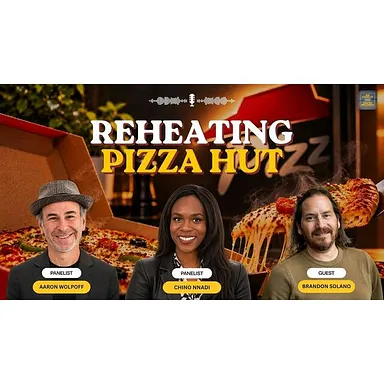
This episode of We Fixed It, You're Welcome examines the sale of most of Pizza Hut to investors for roughly $1.5 billion and asks whether the new owners can revive the chain. Hosts Chino Nnadi and Aaron Wolpoff speak with Brandon Solano, a former Domino's and Wendy's marketing executive who now runs RAVE Restaurant Group.
The discussion compares Pizza Hut with Domino's, Papa John's and Little Caesars, covering third-party delivery, the shift from dine-in to delivery-and-carryout stores, franchisee pressure and the frozen dough question. Listeners will hear the panel's proposed fix, which includes flagship dine-in locations with retro décor and live stages, and how the guest argues a turnaround depends on the product itself.
In this episode Aaron Wolpoff, Chino Nnadi, Brandon Solano
This episode about Pizza Hut's turnaround was made with HappyScribe technology, the tool built to transcribe audio to text.
Ads in this audio differ from the text. Tap the sentence you're hearing to follow along.
Synced: the text now follows the audio.
Welcome to We Fixed It. You're welcome. The show where we take over companies, you come along for the ride, and we try to put them back better than we found them.
Pizza. We all love it. We have it delivered, we pick it up at the counter, we chow down at restaurants, and we argue whether pineapple is an acceptable topping. Personally, I'm just happy whenever pizza's on the menu. But for some of America's biggest pizza chains, things have gotten a little crusty. Domino's growth has slowed, Papa John's is struggling, and Pizza Hut has just been sold. Yes, Pizza Hut, the red roof and everything under it. An American institution that was started for $600 has been offloaded to private equity for approximately $1.5 billion, which is a lot of dough. That means Pizza Hut has new owners and a fresh chance to get things right. But the pizza category itself is struggling and sales were on the decline long before this acquisition. So what should the new owners do? What would we do? How do we make Pizza Hut hot again and turn this whole thing around? That's what we're here to fix. Fortunately, we've got someone with us who really knows his pizza. Brandon Solano is CEO of Rave Restaurant Group, and before that, he was involved with Domino's legendary turnaround. He served as CMO at Papa Murphy's.
Now he oversees Pizza Inn and Pie Five and helped bring Pizza Inn back into growth mode. And there's got to be some non-pizza experience in there too, right? Brandon, tell us more about you and welcome to our show.
Yeah, well, thanks so much for having me on, Aaron. Great to be here with Chino. I grew up in Flint, Michigan, so tough market. Interestingly, I don't think you know this, I was a waiter at Pizza Hut in Flint, Michigan, kind of my first year in college right at Dorton Atherton. So shout out to all my Flintstones out there. I went to grad school at Notre Dame and then went into packaged goods, so Procter& Gamble, but I really kind of was drawn back to pizza and the restaurant space. 2008, I joined Domino's Pizza, and at the time, Pizza Hut was really taking it to Domino's. Pizza Hut was about to take share leadership in delivery, which was just Domino's bread and butter. So I launched the turnaround, the new and inspired pizza in 2010 with a whole lot of help, and we actually captured share leadership, became the number 1 pizza chain in America, making Pizza Hut number 2 at the time. I do have some non-pizza experience. I served as chief marketing officer for Wendy's. Value's important in pizza. And at Wendy's, we launched the 4 for $4 deal, which was just really a watershed in QSR hamburger.
And in fact, I feel like I've saved lives. I have men in their 30s come up to me and say, I was starving in my 20s, and then the 4 for $4 came along and you saved me. So Jody Conrad, Liz Garrity over at Wendy's were just, you know, huge part of that team. And then I've been here at Rave 7 years. Actually, yesterday was my 7th anniversary, so I'm now beginning my 8th year. And, you know, I started right before COVID and we've got 2 brands, Pizza Inn and Pie Five. And Pizza Inn is a buffet brand. So I'm, you know, rookie CEO running a buffet concept during COVID What could go wrong, right? It was, you know, It was tough, but we're public, we're listed on the NASDAQ under the ticker RAVE, and we've had 5 years on Pizza Inn of same-store sales growth, which is really rare in pizza. 5 straight years of growing comp sales is tough. And we've got 5 years of unit count growth. We got a lot of folks, Pizza Hut included, closing a lot of stores. So for 5 straight years, we've grown our unit count after 24 years of declines in unit count.
So pretty good turnaround story here on Pizza Inn, and it's been an awful lot of fun.
That sounds awesome. Thanks, Brandon. We're really So glad to have you here. You got to know this about us too, about Chino and me. We always get hungry on these food-themed episodes, but you know, we're going to use that as motivation. We're coming, we're coming in hungry. We're fired up. We're ready to take this on. Uh, now before we get into it, we got to talk about how one of America's biggest pizza brands was tossed to a new buyer. Because that doesn't happen all day long. Um, I don't know how many remember this, but back in the days when we took things a little slower as a society. Pizza Hut used to be a dine-in experience. You didn't just race in and out, you hung out. Families went for dinner, kids devoured personal pan pizzas, Little League teams celebrated their victories, and that red roof made memories. But pizza changed. Delivery became a bigger business. Brands started differentiating themselves. Domino's, like you said, leaned into technology, speed, and convenience. Little Caesars took the value-based approach— pizza, pizza for pretty cheap. Pizza Hut struggled to keep up. So fast forward to 7 consecutive quarters, not months, quarters of declining same-store sales.
It was time to do something. So its owner, Yum Brands, also known for KFC and Taco Bell, sold the business to Long Range Capital, including everything outside of mainland China, which was a whole separate deal, for roughly $1.5 billion. So a good deal, right? If you get the chance to buy an iconic American brand, And you got the means to do it, you take it, right? But here's the thing, the new owners just bought into an overall slow category. Along with Pizza Hut's struggles, Domino's U.S. comparable sales grew just 0.3% in the 3rd quarter of 2026, and that's down from 5.2% a year earlier. Papa John's North American comparable sales fell 8.3% in the 2nd quarter. So is the whole mass market pizza industry getting stale or did the new have something up their sleeve because that was a big buy. There's a lot at stake here. Let's get into it and I'm gonna start with this. Brandon, was Pizza Hut a good investment?
I think Pizza Hut was sold at a very good price. So I feel like Yum let that business go for a pretty good price. I think at that price it's hard to say no to. I think that answer will come in time on whether Long Range and their team are able to turn it around and produce. It's a big investment for Long Range. They're I mean, they're a very good-sized PE, but this is a big investment for them. It's their first foray into the restaurant industry, so there's a lot of risk for them. They've got to get the team right and they've got to get the strategy right. But I think Pizza Hut's an iconic brand. I think there's tremendous upside. That's one of the things that I like to do, Aaron. I like to find something that's broken and fix it because there's so much upside to doing that. So You know, if it was bought at the right price, if they can, you know, turn it around and, you know, produce some value with it, I think it could be a very good investment for them.
And they're not the only ones. We've seen a trend of iconic brands getting offloaded to private money and mixed results. Like there's casualties and some take it and run with it. But you brought up the interesting point that they don't buy, from what you're saying, they don't come from, they're not restaurateurs, they're money people.
Yeah, but you know, they've got Eduardo Luz. I know Eduardo, he's in as their interim CEO. I think it's interesting they haven't named a CEO yet, right? This deal was announced, which was a shock, by the way, Yum getting rid of Pizza Hut. It was, you know, one of the founding brands of Yum. That was a watershed. But it was announced in July, it closed in September, and here we are late October, they still haven't named a permanent CEO. But Eduardo's a smart guy, very capable, you know, great experience at Chang's and Panera. And, you know, they've got somebody who knows restaurants, you know, kind of leading it at least on an interim basis for now.
Yeah, you would think, isn't that part of the day one mandate is you walk in, here's our new team, here's the people. I mean, you know, you talk about all that all day long, but why, why, why the gap in leadership? What do you think?
I think it has a lot to do with, you know, when you're doing acquiring, there's a lot of legal things that happen behind the scenes where you're not necessarily able to share right away. And I think that, you know, now I feel like by the end, you know, by 2027, if they don't have a CEO name, then I would worry, but it's still only been about a month. And so I'm hoping that right now, they first will need to figure out kind of what they're going to do next. And so I'd love to dive into, because Pizza Hut is an iconic brand. I remember as a kid, like, you know, the Pizza Hut song you would sing in school, you know, the Pizza Hut pizza. I won't hurt our listeners to hear my voice singing. And I remember going to like trips, like class trips to Pizza Hut, like after a soccer tournament and things like that. And so You know, I'm really curious to get your perspective, Brandon, because the way people eat pizza has changed, right? It's, it's, it, we talked about it moving to delivery and, you know, in a post-COVID world where, you know, Uber Eats is really in and, you know, people are going to restaurants less and less.
I wanna talk about what are some of the things, so they don't have a CEO yet, but if we were to give them like a, here's a cheat sheet. a playbook, as you would, uh, to help them survive in today's market, knowing that Pizza Inn for you has been so successful, um, what are some of the things you would tell them in getting, jumping back kind of into the pizza game?
Yeah, well, I think time is of the essence. I mean, you know, we've got some big brands, really scale brands that are struggling, right? You've got, you know, Papa John's closing lots of stores. You've got Wendy's largest franchisee, uh, you know, in bankruptcy right now, closing stores, you know, Pizza Hut's closing a lot of stores. And, you know, I think they need to get that leadership team named and, and, you know, get a strategy together and get on with it because, you know, they don't have the luxury of time. But, you know, in terms of, you know, kind of what's wrong with the pizza category, I think, you know, there's been under-innovation in a lot of ways. I love the new Domino's, by the way. Domino's just came out with that. Kate Trumbull over there is the CMO. She's, she's super sharp. So I think, you know, that's an innovation. We haven't seen anything like that in, in a while out of pizza. But they really got crushed with the third-party delivery, the DoorDash and Uber Eats. I mean, I grew up in the Detroit market, so you could order, if you wanted delivery, you get pizza and you can get Chinese or you can get Middle Eastern actually in the Detroit market, which was beautiful.
But now you can get anything you want. And so the competition in delivery exploded where pizza really was the mainstay of delivery and it's really hurt the concepts that have relied on delivery. Domino's has outperformed everybody obviously. people still want to dine in. I mean, Pizza Inn is 85% dine-in. It's an all-day buffet and people want to get together with their families and it's easy for kids. You don't have to wait for the waiter, the waitress. You just go in, grab a plate, and start eating. So there's definitely a space for dine-in, but delivery as a segment is super challenged. And that's a segment that Pizza Hut over the last 20 years has leaned into. They used to all be Red Roofs, Then they went to this, this delivery carryout model, Delco. Now they're about 50/50. They're a little more Delco than, than Red Roof. They never really agreed on a strategy is what, what is our store format? Now they're kind of, you know, half and half. Um, but the delivery, the delivery piece is really challenged.
Aaron, I am curious too, because, you know, as you said, Brendan, like I'm in Toronto, I have any cuisine you could think of and we've always had that. But it's, yeah, like back in the day you would order a pizza. Now you had, you have anything at your fingertips. So, you know, I think if we look at Domino's where they've kind of taken the edge in leading kind of the market on the pizza delivery side is they created their own ecosystem and built a product where it was like, you know, if you went on the Domino's app, you got like $5 off. So I remember, you know, all my friends were at Toronto Island and we were trying to order a pizza. Everything was closed and, you know, Collectively, we were able to save like $20 on a pizza, on multiple pizzas. And that's what we went with because at the time we were broke students. And so, um, I think, you know, bringing that ecosystem in-house would be a really smart idea for Pizza Hut. But how do you brand that, Aaron? Like, how, uh, how do you re— like, how do you rework and rebrand the iconic, like, Pizza Hut where we're, we're, they're known for their You know, dine-in experience?
How do we get that to move to a different ecosystem?
I mean, that is the question, right? You're taking something about their legacy, the dine-in experience that hasn't been associated with the brand for decades. And that's what people are still holding on to. I heard they're retesting the dine-in concept. Brendan, you might know more about that. But to do that, you need a, you need a draw, right? The food's got to be either incredible, or you want to sit around and savor it. Or you, you have a brewery, you know, those, these pizza microbrew concepts that, that are tested elsewhere or, or, or successful elsewhere. Or you can, you know, back in the day you had an arcade. Um, now people have more Arcade Pluses on their phones. So is that a draw? I don't know. Um, today's episode is brought to you by Whatnot. If you have a business or you're thinking about starting one, you need to know about Whatnot. It's a live shopping platform where purchases happen in real time. I recently shopped on Whatnot with a clothing brand called Born Primitive. And they didn't just make a sale, they actually gave me an experience. I felt like I was face-to-face with the sellers, and they were engaged, energetic, and sales were happening fast.
I ended up buying a casual jacket, discovering a new brand, and getting a great deal too. Now that's me as a buyer. As a seller, you're not just putting products on your website and hoping people come to you. You don't even need your own website. You're connecting directly with customers, getting real-time feedback, and seeing what sells. It's not just jackets either. You'll find everything from fashion and electronics to collectibles, beauty, and more. So take a shopping trip on Whatnot and see what catches your attention. And if you've got something to sell, why not start selling for free? Search Whatnot, W-H-A-T-N-O-T, in the App Store, download, and start selling right away. Today's episode is brought to you by Scribe. These days, companies are all about optimization. People, processes, technology. If it can be optimized, it should be, because that's what makes companies better. That's why Scribe created Scribe Optimize. Most companies know how work is supposed to get done, but how does it actually happen? Optimize has answers. It uses AI to automatically map workflows across your approved business apps, even as work moves between systems. Goodbye team interviews and months of process mapping. Its live dashboard shows how work gets done and where time is spent.
From real workflow data, you get recommendations on what to fix or automate with ROI projections you can use to make the case. And privacy is built in. Optimize only captures the apps your admin approves, and Scribe can also automatically redact sensitive data. Look, I've spent years helping companies solve problems and visibility is key. Without it, you're guessing. Having seen Optimize in action, I'm impressed by the clarity it provides. No wonder Scribe is trusted by 94% of the Fortune 500. If you have the opportunity to fix something about your company and there's a specialized intelligence platform waiting for you, I suggest you try it for yourself. See Optimize in action at scribe.how/fixedit and mention We Fixed It for a 30-day risk-free trial. That's scribe.how/fixedit. Or you do a buffet, which is smart because then, you know, you can't take a buffet in a box to the same degree. You're there for the experience and you're there to go back and spend time. That's part of the draw. So does Pizza Hut have any of those going for them besides maybe some regional testing of the sit-down concept? I don't think they've chosen a direction yet. Tell me if I'm wrong.
No, and they haven't in 20 years, Aaron. You know that, hey, we're Red Roof, we're, you know, Delco. It's interesting, their logo is this iconic Red Roofs, which are disappearing. They're closing them every year. They've got now more Delcos than Red Roofs, and that's still their logo. What happens when there's no Red Roof left? But what you're talking about is this nostalgia play. They've gone back to the Tiffany lamps in the dining room, which was there when I was a waiter in Flint, Michigan in 1989. That was the interior. And there's a play for nostalgia. People really yearn for a simpler time when there wasn't all the kind of madness of the modern world. But that's being led by franchisees, which I think is interesting. It wasn't Pizza Hut corporate saying, hey, we've got an idea. We want to go test this nostalgia retro dine-in experience. These are franchisees who are dying, right? I mean, they are desperate. Sales are down. The average Pizza Hut their unit volumes are half of a Domino's. I mean, the unit economics on that, you know, you've got to pay rent and all these fixed costs. You know, they're really struggling.
The franchisees are. So when that happens and you don't have thought leadership coming from, you know, the franchisor, the franchisees start making up their own stuff. And, you know, I'm not here to be down on franchisee ideas. There's a lot of great ones that are in the history books across all brands. And by the way, All of us are smarter than some of us or one of us. Okay. But corporate really needs to lead. They need to lead the thinking. And when corporate doesn't have the answers, franchisees start, you know, kind of coming up with their own things. And sometimes they're good and sometimes they're bad, but largely they're untested. Corporate typically has a testing protocol for ideas. Franchisees just start going with it. And I know from, you know, being in the, in the business when it's not going well, you know, when sales are down and profits are down and a franchisee comes up with a, with what we think is a bad idea. it's harder to resist, right? Because we don't have any ideas and, you know, we don't want to tell, you know, this franchisee no to their idea. And so sometimes you go with, you know, marginal ideas.
And I'm not saying that the retro idea is a marginal idea. I have no idea. I haven't tested it. I know that at Pizza Inn, we lean into nostalgia. The brand started in 1958. We did a reimage of our stores and we've got— this is our— this is our— this is the Noggin logo of our mascot, JoJo. And he started back in the '60s and we've got all the different iterations in our store. We've got some nostalgia and bring some of that in, but there's got to be more than that for consumers. That only gets so far. You've got to have great product, great service, great value. If you're really going to give somebody what— this is the standard I use for ideas. Is it a compelling reason to switch? Okay. The world is not underserved in pizza stores, right? You throw a rock, you'll hit 4 from your house. The question is, what's the compelling reason to switch? In a flat category, it's a share fight. And you've got to have that reason or you're just— it's activity, not impact.
For sure. And when you talk about the delivery services and you cut out a third-party partner, then your margins get squeezed on that side. When you talk about the real estate and keeping up with the in-store and going back to a dining concept, then you've got the footprint issue and you've got the rising labor costs to staff a bigger environment and make it more of an immersive experience. So in a way, they're getting squeezed on all sides.
Well, there's a lot of CapEx on those big red roofs too. Yeah. I mean, it makes sense in a lot of ways, in a lot of worlds when dine-in's dying and you've got this giant building that has a lot of CapEx for maintenance. to say, hey, we're gonna go, you know, go put in a bunch of Delcos. I think if they hadn't done the Delco strategy, they'd have a lot fewer stores than they do today because some of those Red Roofs were closing anyway. So, you know, it's really, it is a tough strategic problem for, you know, whoever's gonna lead the Pizza Hut brand.
Explain the Delco for our listeners.
Yeah, delivery carryout. It's a, it's kind of like a Domino's or a Papa John's. It's, you know, 1,200 to 1,500 square feet, typically in line in a strip center. And, you know, they just do delivery and carryout. There's no dine-in experience to it. It's not the freestanding iconic red roof building that you're used to at a Pizza Hut.
I can tell you the last time I went in, it was that you walk in, you, there's no, no frills. There's, uh, there's the, the harsh lighting. Um, you wait at a counter, you're, you're seen when you're seen, and then you get out and, you know, you eat your pizza in the parking lot. That's about it. But But, uh, I don't know if that's typical or just, you know, the store I happened to be.
No, it's totally typical. I mean, it's a terrible experience. You know, when I was at Domino's, you know, I was doing, uh, innovation. I was VP of innovation and we launched a bunch of stuff and it worked. And then they didn't want any more innovation. Like, ah, we don't need it. You know, innovation's risky. Sales are really good. And I got bored and, you know, uh, I asked to work on a, a new project saying, hey, let's reimagine the Domino's stores. And we came up with what's called Pizza Theater. So it used to look like a bank. I mean, you go into a Pizza Hut Delco today, you know, it looks like a bank teller, a little window that's very austere in there. It's just not a good experience. Domino's turned the— we turned the store on the side for Pizza Theater where you could see your pizza being made, kind of opened up, kind of open kitchen concept, put in a few tables. So it's not really dine-in, but instead of eating it in your car, you could eat it, you know, in the Domino's if you wanted to. And that was a huge hit, you know, as we reimaged stores.
You know, sales in the Reimage stores went up, um, and we really exposed people to, you know, the, the beauty of making a pizza. And, you know, the Pizza Hut Delcos don't have that right now. Those are really, you know, not a good experience in my opinion.
We, you know, one thing that we always talk about on the podcast is the experience, and that is really what people take away, right? That's what sets Domino's versus Pizza Hut and everything else in between. And I think What?
Today's episode is brought to you by Gusto. And Melissa, real talk, what do you know about Gusto?
I actually know a lot about Gusto and the many satisfied customers that run on it.
Give me the fixer's take.
Everything at Gusto revolves around one thing, the small business owner, and payroll is front and center. Don't mess with people's pay, period.
I hear you. I run people and talent functions, and I help companies build processes that support their teams. Here's what I see. Having the right tools is essential.
Gusto makes it easy. It's all-in-one, remote-friendly, and incredibly easy to use. So you can pay, hire, onboard, and support your team from anywhere. Automatic tax filings, direct deposits, unlimited runs, benefits, one monthly price, no hidden fees.
With the heavy lifting covered, people, teams, and business owners can focus on what matters most, supporting their people and growing their business.
Try it, gusto.com/fixedit, and get 3 months free when you run your first payroll.
That's 3 months free payroll at gusto.com/fixedit. One more time, gusto.com/fixedit.
Today's episode is brought to you by Scribe. These days, companies are all about optimization. People, processes, technology. If it can be optimized, it should be, because that's what makes companies better. That's why Scribe created Scribe Optimize. Most companies know how work is supposed to get done, but how does it actually happen? Optimize has answers. It uses AI to automatically map workflows across your approved business apps, even as work moves between systems. Goodbye team interviews and months of process mapping. Its live dashboard shows how work gets done and where time is spent. From real workflow data, you get recommendations on what to fix or automate with ROI projections you can use to make the case. And privacy is built in. Optimize only captures the apps your admin approves, and Scribe can also automatically redact sensitive data. Look, I've spent years helping companies solve problems, and visibility is key. Without it, you're guessing. Having seen Optimize in action, I'm impressed by the clarity it provides. No wonder Scribe is trusted by 94% of the Fortune 500. If you have the opportunity to fix something about your company, And there's a specialized intelligence platform waiting for you. I suggest you try it for yourself.
See Optimize in action at scribe.how/fixedit and mention We Fixed It for a 30-day risk-free trial. That's scribe.how/fixedit.
You know, Pizza Hut needs to do is kind of, you know, we talk about this like lack of strategy and kind of that leadership. It's like you need to figure out who you're gonna be. If you're gonna be a telco and you're, you're that's what you're gonna do. First of all, pretty stale bank environment, you know, can we reimagine that? But to be able to talk about what that looks like, you need to have a strategy around that. When we talk about dining, right, I do think that people are craving a place to dine. It doesn't need to be every single corner there's a Pizza Hut where you're, you know, you're able to get to. Maybe there's one or two in a city. And, you know, again, I love the idea too of You know, that experience. And, you know, there's a ton of, like, I'm in Toronto again, so many pizza making and pasta making courses, right? Like, why don't you bring people in for an experience and like, you know, yes, play on some of the nostalgia, but you need to, you, we can't just lean on that as you were saying, Brandon.
I think finding a way and a reason for people to be there, maybe that is, hey, we're your one-stop shop for, you know, a kid's party or like a really quick like work event and you can, you know, make pizzas and you bring people back into that Pizza Hut nostalgia and bring, you know, just a warmer experience, I think will help with the brand. And again, we don't need 100 stores. You need 1 or 2. And, you know, of course then lean into your Delcos where it's just, okay, it's in and out, but maybe it is making that a little warmer, opening up what that looks like so that people can see it, you know. Borrowing some ideas from Brandon, but not every idea. Pay Brandon if you need to do that. Uh, but you know, I just think that at the bottom line, we continue to go back to like the experience right now at Pizza Hut is not aligning to, you know, what we used to know of as a brand. And they need to like repivot and figure out what that messaging is. Uh,
it's okay to be a commodity if that's what it calls for. You know, me hungry, their food, go get. You know, if, if they're the only game in town, and then there's pizza on the corner, you go get the pizza and you like it. And it's Pizza Hut. But that's— they bring, you know, when they're getting eclipsed by others, and then the category itself is just that people are having a hard— brands are having a hard time finding their way through it. It's time to make a move. Now, one thing I want to ask about, for sure, is, you know, when I, when I talk with companies and brands, usually it's not— there's something there, like something's working, just other things aren't working. So you get rid of the stuff that isn't. And you focus on the truth, and then you carry that forward. But let's rewind to the Domino's turnaround, because that's, you know, read the history books or the recent history. That was a legendary move for a brand. And I give you and everyone involved the utmost credit for it. For a brand to hold themselves up to the light in public and say, we've done, I mean, this is not my words, but we've done practically everything wrong, right?
We all know it. You know it. You told us to a painful degree, and here's what we're going to do about it. So, and I'm not, I, you know, and I want to build it back up to whether we're in that situation now, but tell us what that was like, because that's just such a monumental case of owning the moment. And it's like I said, it's a legendary one for the textbooks.
Yeah, I'll tell you what, it was scary as hell. So I wasn't worried, you know, I mean, we couldn't test it, Aaron. That's not something you could test market. You know, we're going to redo it because everybody, the word would get out and all that sort of thing. So it was go or no-go. So there was no net, you know, we're operating without a net. And if it didn't work, I wasn't worried that I'd get fired. I was sure I'd get fired. I was worried I'd never work again. You know, we come out and say, hey, our pizza sucks. And, you know, we made it better and that falls flat. And, you know, we crater Domino's. I mean, I get fired. Who's going to hire me? Hey, you know, I could wreck your business just like I just wrecked Domino's business. You know, hire me. It was, you know, there were careers on the line, but it really started, you know, I came from Procter& Gamble, you know, product improvement, you know, clean sock, dirty sock, you know, whiter whites, that sort of thing. I didn't have restaurant experience. And, you know, I was, as a consumer, I knew Domino's Pizza wasn't very good.
You know, everybody knew it except, you know, you know, a lot of the leadership at Domino's. So I came in and said, hey, we got a product problem. And they said, no, we don't. Franchisees aren't making it right. And I said, well, let me prove that. So we went and I had my chefs in the test kitchen make our product spec. We tested it against Pizza Hut and Papa John's, and we finished 3rd of 3. We were dead last. And then on a perceptual basis, we were tied for 6th in pizza quality with Chuck E. Cheese. And Chuck E. Cheese is great when you're 9 years old and having a birthday party, take nothing away. I think they've, by the way, done a good job and have improved their product over time. But at the time, that that was not a compliment. And so, you know, I got the green light to fix it. I reported to Patrick Doyle at the time, and then, you know, they hired Russell Weiner to be chief marketing officer. I reported to him, great guy. And, you know, I got Patrick and Russell on board and we had a great agency, Crispin Porter Bogusky, with that insane ad.
They put me in it. You know, I was famous for a minute. Maybe now I'll be famous again, Aaron, because of, you know, you're like the number one podcast on the planet. But, you know, we went forward with this without We tested the heck out of it conceptually and product concept fit, all the research that you could do, but we couldn't know till the day we pulled the trigger on it. And there were people internally who said, I'm proud of the pizza. I've been here a long time. You're new. What do you know? And they wouldn't show up to my team meetings. So I go get Patrick Doyle and he was the president at the time and later became CEO. And I get him to come to my team meetings and then everybody would show up and they'd all be cooperative. But Patrick is now the chairman of Restaurant Brands Incorporated. They own, well, Tim Hortons. They own Timmy's up there in Canada for you, Chino. Love some Timbits. But Patrick's doing a great job over there at Burger King. And interestingly, Tom Curtis, who's the president of Burger King, he was on my team for a while while I was there.
They're— Burger King's tearing it up right now. They're taking it to McDonald's and Wendy's and they're running the Domino's playbook. You know, hey, we improved the Whopper. Hey, now we improved the nuggets. And, you know, they're, they're having a really good time doing that. So product matters. You know, you've got to have great product. Honesty and transparency matter to consumers. They got to trust you. It's, you know, you talked about being a commodity. You got to, you know, do more than, hey, we sell pizza. You know, what's the compelling reason to switch?
100%. And you actually, you know, you brought up something interesting when you talk about Domino's. And then again, I'm a Wendy's lover. I'm not a McDonald's girl, I'm a Wendy's girl. And it's first and foremost a product, right? So yes, Pizza Hut, is your pizza actually good anymore? It used to be incredible. I remember, again, people going to Pizza Hut because of how good the pizza actually was. So is that standard still the same? Obviously in today's market, like that looks different. Like, do you need to pay a little bit more? And, you know, does that mean that the pizza's gonna cost more? Like, you know, you need to figure that out and, you know, the logistics around that. But the other thing too that we have to talk about is we talk about brand awareness is the social side, right? Wendy's social brand is in, I think probably when I think of the first brand that actually jumped into like cultural conversations, I think of Wendy's and I still think of Wendy's and that's like from over the last 10 years, Wendy's still dominates. Where is Pizza Hut in kind of this conversation? They're nowhere.
You check TikTok, Instagram, all the places, I don't see Pizza Hut as well. And so, you know, you have this legacy brand that you're not hearing about, and there's a whole new crop and a new generation of folks that have no real clue of this nostalgia. And I think we also need to have some brand recognition there. On the social side, because, you know, you can make the best pizza in the world, but if nobody knows about you in today's market, they're still gonna pick the person that's the loudest in the room. So I think on top of making sure that the actual pizza is good, there's the like branding side that I feel like they need to be pulling up, uh, especially right now.
Well, when I, what I guess we're gonna see is new, try our new this, and here's our new store concept and But I don't think, I mean, like I said, the Domino's case study, we'll call it, was once in a lifetime. I don't think we're going to see, let's own our faults in public. You know, they just paid over a billion dollars for this company, this asset. They're probably not going to trash it. I'm guessing, you know, they're probably going to build on it. But are they going to do things to fundamentally change the perception or Re-earn the loyalty and the preference and all those things. I think they're going to do it by, I hate to say it, but by shiny objects, by saying new concept and try our new pizza stuffed whatever. And, or maybe we'll go for it. We like new things, but I don't know. I don't know this is a fundamental scratch and rebuild moment. I would doubt it. I think they're just, they want to hit the ground running and And then increase same-store sales by X percent.
I don't think that will work though, unfortunately, in today's market, right? Like, there's so many new— you know, Wendy's has a new— their little nuggets I just had that are, you know, that they're glazed that are new. And, you know, there's so many brands throwing new things at you. So again, you're still lost in the sauce, so to say, because There's other brands doing the same thing, but I think leaning in and kind of, again, pulling from the playbook of Domino's, right? And, and owning to your faults and saying, hey, remember us? The old-timey brand that you used to go to as a kid? And, you know.
Today's episode is brought to you by Whatnot. If you have a business or you're thinking about starting one, you need to know about Whatnot. It's a live shopping platform where purchases happen in real time. I recently shopped on Whatnot with a clothing brand called Born Primitive. And they didn't just make a sale; they actually gave me an experience. I felt like I was face-to-face with the sellers, and they were engaged, energetic, and sales were happening fast. I ended up buying a casual jacket, discovering a new brand, and getting a great deal too. Now that's me as a buyer. As a seller, you're not just putting products on your website and hoping people come to you. You don't even need your own website. You're connecting directly with customers, getting real-time feedback, and seeing what sells. It's not just jackets either. You'll find everything from fashion and electronics to collectibles, beauty, and more. So take a shopping trip on Whatnot and see what catches your attention. And if you've got something to sell, why not start selling for free? Search Whatnot, W-H-A-T-N-O-T, in the App Store, download, and start selling right away. Today's episode is brought to you by Scribe.
These days, companies are all about optimization. People, processes, technology. If it can be optimized, it should be, because that's what makes companies better. That's why Scribe created Scribe Optimize. Most companies know how work is supposed to get done, but how does it actually happen? Optimize has answers. It uses AI to automatically map workflows across your approved business apps, even as work moves between systems. Goodbye team interviews and months of process mapping. Its live dashboard shows how work gets done and where time is spent. From real workflow data, you get recommendations on what to fix or automate, with ROI projections you can use to make the case. And privacy is built in. Optimize only captures the apps your admin approves, and Scribe can also automatically redact sensitive data. Look, I've spent years helping companies solve problems, and visibility is key. Without it, you're guessing. Having seen Optimize in action, I'm impressed by the clarity it provides. No wonder Scribe is trusted by 94% of the Fortune 500. If you have the opportunity to fix something about your company and there's a specialized intelligence platform waiting for you, I suggest you try it for yourself. See Optimize in action at scribe.how/fixedit and mention We Fixed It for a 30-day risk-free trial.
That's scribe.how/fixedit.
Jumping from that, because that would be different. And you're right, Brandon, like you didn't really have an opportunity to test this. They don't have that much time, but they need to do something that's different. If you're just gonna throw, you know, this is something new. And again, with that, you'll also need to throw, here are some deals. It's kind of like how Uber, you know, kind of took stock. Like you, you know, gave things essentially for free in the beginning so that people would you know, get hooked to your product in, you know, lack of a better analogy there, but they're gonna need to do a little bit of that too. And that's really tricky in today's market where the cost of living and the price of food is just so much higher. So how do you do that? You know, bring new things with no leadership and then not have a story that's not everybody else's story. Like you need to be able to stand out. And I think That's the only way Pizza Hut is going to really move and win for the future.
I agree with you, Chino. I don't think, you know, there's going to be the new innovation, you know, is going to save Pizza Hut. You know, their, their issues are much, much deeper than, you know, hey, we just, you know, our last LTO, limited time offer, you know, didn't hit. You know, a couple of years ago they did hot honey, which was a trend. They're typically late. I think, you know, it's, it's Yum culture. I think they've got probably 15 layers of bureaucracy to get anything approved. You know, very risk-averse place. So, you know, the long-range folks are going to have to come in and shake up, you know, the corporateness of that. But it's got to be core product. I mean, you know, Pizza Hut talks about being the OG of pizza. You know, let me let you guys in on a dirty little secret. Pizza Hut uses frozen dough. They don't make dough. Okay? So, you know, Pizza Inn, Pie Five, we make dough in-house every day. Okay. Little Caesars is actually making dough. Okay. And by the way, they're growing like crazy. They're going to, they're going to pass Pizza Hut. Pizza Hut's going to be the number 3 pizza chain here before long if, you know, things don't change.
So it can be done. You know, like we don't have the scale, right? We've got, you know, a couple hundred stores, but, you know, Pizza Hut could do it. But Domino's uses a commissary system. They make dough in a factory and it's fresh. So they say fresh dough, but it's not made in-house. It's made, you know, 3 zip codes away. Papa John's does the same thing. You know, if Pizza Hut really wants to change the core, then you gotta change the core.
Yeah. Just throwing hot honey or sriracha or dill pickle or whatever the industry dictates is the new hot thing. Yeah.
Yeah. I mean, and it's okay. We did a, you know, dill pickle chicken pizza and it was fine. It did great for an LTO and, you know, whatever. But it doesn't change the course of your business when you've got, you know, as significant problems as they have. And right now they're dealing because that's what's easy to do. You can do it quick. You put out a deal, you do some financial analysis, shoot a spot, put it on air. But you have very fickle customers at that point. If somebody else has a better deal, they'll go there. And Domino's has scale and cost advantage where they're able to do better deals. I mean, you saw, Aaron, they're up what, 30 basis points in same-store sales? you know, tickets down, like margins are down for franchisees. You know, it's really probably not sustainable, but right now they're dealing like crazy. Domino's is, and picking up share. You know, Pizza Hut can step into that and, you know, they're still not gonna capture the number of transactions they need to get them out of the position they're in. They really need to rework the core product.
Yeah. So what's their lane? Do they go into the freshness of ingredients? Because that's an entire process change and shift, right? Do they go into the sit-down dining experience? I mean, we've all seen the memes of this used to be a Pizza Hut and now it's a tire shop. So there is nostalgia there, but it's also faded glory and they'd have to win back that perception that we're a dine-in experiential type of environment. Do they go into speed and faster delivery than everyone? I think, you know, we keep saying they gotta make a move, What do they lean into without being a seismic recalibration of the entire company? Because like I said, new investors, I'm not saying they're tapped out, but they probably just shelled out a bunch. They probably want to do something with what they have before they keep digging and digging into a turnaround-type situation. So what is it? We won't get into our fix quite yet, but let's start to think about which lane is their lane. What can they own right now?
Well, I think speed is not a good place to be. Domino's is efficient as hell. I mean, those guys are so good at this. They're technology is great. You know, they practice that, you know, they, when I was there, they would give you your 30-second pin, Aaron, if you could make a pizza in 30 seconds, you know, I don't think I ever did it. I don't think I ever got my pin. But, you know, they're not going to win there. Plus, you know, Domino's had the 30-minute guarantee, right? There were lawsuits. You know, there's always accidents, by the way, when you run 5,000 US restaurants and you got, you know, 30,000 drivers on the road every night, you know, bad things happen. That's the law of large numbers. They're not going to do speed, right? They can't do it. And I think the store format question they failed to answer for 20 years, they probably spend a lot of energy and time, are we dine-in or are we carryout Delco? You're both, right? Stop the argument. Let's go focus on something else. You can't be either or. They're neither fish nor fowl. They're going to have to prioritize one.
Hey, we're going to prioritize our media and advertising. We do this, right? I've You know, 15% of my business is carryout. So that's easy, by the way. We're primarily a buffet, and then secondarily we'll have some carryout offers to try and compete with those guys. But, you know, now they're 50/50. They're gonna have to say, hey, we're either dine-in or, you know, we're delivery carryout. Pick one as a primary. And they have to support the other side too. They've got responsibility to all their franchisees.
I agree. And I think if we were to look at it from those 2 lanes, It's pretty clear because again, Pizza Hut locations have closed down. So I don't think leaning on and opening up 100 new stores is gonna help. There's so much, that's a logistical nightmare. I think if they can lean into, you know, delivery carryout for, you know, 70% of their business and then say, you know, again, maybe it's only 2 stores in a city depending on how big the city is. You know, a little bit more here, you know, plus or minus one. But I think that's the move. And in these stores, it's how do we lean into the experience? How do we bring people back? Like, what is the LTOs that you're offering, which are great, right? Can you create an experience? Can you create a pizza making? Do you offer, you know, is there arcade things that it's enticing people to actually come in and kind of reestablishing reestablishing people's relationship with the location and whether that, you know, again, I don't think they have the most time to do a bunch of, you know, research on all of this and a lot of the L&D, but I do think it's important for them to try something versus sitting and doing nothing.
And maybe, you know, in a few test markets, they try different things and figure out kind of what sticks. So. You know, whether it's arcades, whether it's pizza making shops, whether it's, you know, a place to kind of gather and it becomes like a third space. Maybe people can like, you know, during lunchtime, you know, do their work and like also get a pizza. I don't know, but they need to do something on the experience side when we look at dine-in.
I agree. I agree. And I agree it's time to fix it. Um, one thing they're probably not going to do or should not do is go the bottom, bottom tier economy route. Because then they've cut into their already— like, franchisees are not going to like that. They've cut into their already diminishing margins and all those things. So to try to go underneath something like a Little Caesars, which by the way, doesn't cost what a Little Caesars used to cost. They've gone— It's not $5 anymore. Not $5. Subway's not $5 for a footlong. Like, we've all gotten over that. But should they undercut Little Caesars as a long-range strategy? Probably not. So, um, all right. I like what you're saying. I like everything I'm hearing. There's a mandate to reown the customer. Like we've, the experience has been maybe takeout, maybe, but a lot of the experience has shifted to delivery and third-party delivery. And if it's delivered to you by a Grubhub type of thing, you're further and further removed from the brand. It's more of a commodity, really hard to create preference off of a commodity. You go with the discount, you know, whoever's got the coupon or Wherever you ordered from last, you know, recency, whatever.
So you have to find a way to reestablish your own customers. Let's think like the investors. What are we going to do without piling a bunch of, you know, a bunch more capital influx into this thing to turn it? Let's work with what we have. What can we do? I, I, you know, I'm with you. Brandon, tell us what you think when we get to you, but I like the idea of these limited, not pop-ups exactly, but We'll call 'em like flagship locations or dine-in experiences. I like the retro theming. I would go Stranger Things, '80s it out, make it a time capsule. Just something where you just totally get swept away and get thrown back to another era. Besides like '50s diners, who does that? Like, that'd be pretty cool. I'd be into that. What else can we do that's cheap if we're going to own a store, you know, a restaurant with a sizable footprint? Here's what I'm going to do. I'm going to go the Chuck E. Cheese route and I'm going to make it, but I'm going to go Chuck E. Cheese for families and adults, grownups, and I'm going to have a stage in there and I'm going to have it be open to local talent and there's going to be people that come in and do, you know, Guitar, bass, nothing that's going to rock you out of your seats, you know, where you can't enjoy your business call in the corner.
But there's college students, there's local performers, there's people of all levels of skill and talent. We're going to make that publicly available to know when there's different performers happening. And you come in, you have an experience when you want it. There's off hours too. And, uh, you're encouraged to sit around. And then next time you pass one of the, one of the standalone kiosk-sized stores, you just, you maybe say, oh, I had such a great time at Pizza Hut. And I connect that with my pizza experience. Um, why don't I stop here too? And we're going to do that. That's my take. Please feel free to add on to it. Um, but start with those store experiences and build out from there. Uh, and make your dough fresh. Let's, you know, do it quietly because if you announce now our dough is fresh, um, people are gonna say, wait a minute, what happened all those years ago that what was I eating? Um, but you know, over time, say we've, you know, recommitment to fresh ingredients and all those things can be part of the story. So that's where I'm going. Um, that's my fix.
Chino, tell me if we fixed it and feel free to pile onto that too.
I think we've given them a good roadmap. Um, they got a lot of work to do. I do love the idea of creating an experience, whether it's a comedy show A third space, which people are craving now, just something where it entices people to go into these dine-ins. They need to lean into the delivery, carryout 100%, make that a better experience. We should not feel like we're walking into a bank. Make that more personable as part of like the longer overarching brand. And also to add to what you're saying, Aaron, your brand voice, like we need to hear about Pizza Hut. You need to get out there. You need to be where Wendy's is, you know, commenting on a cultural moment. So too should Pizza Hut. And, you know, you need to bring newer generations back into it because nostalgia works, but that's only a small kind of population. The growth is really the next generation. And so if you can't touch into, tap into that market, you're screwed. So make sure you do that.
Thanks, Gina. Yeah, I go with that. I, you know, I'm thinking these lo-fi experiences. They happen to be social friendly and you get those, all of a sudden you get those, the UGC brands love UGC, user-generated content. OMG, can't believe I'm at a Pizza Hut right now. Check this out. And the world gets to see that's, you know, that could ignite. I'm going to stand behind it. So, and we're not going to, we're not stepping on your buffet concept, Brandon. We're going a different way. So if we said investors, You know, let's, here's what you purchased. Here's what we're going to do about it. Do you think we fixed it?
I think it's a big fix. You know, I think the stage is interesting. I might take that and use it myself, Aaron. I hope you haven't copyrighted that idea. But I think, you know, the product is, you know, the people reason, the reason people are going to Pizza Hut or, you know, ostensibly would be for pizza. And if the pizza's not good, you're going to continue to have problems. Hey, the music's great. you know, the pizza wasn't that great, you're not going to get the pickup at the Delcos, you know, like you were hoping. So, you know, I think, you know, another thing I didn't mention is, you know, everybody in the industry except for Little Caesars uses frozen cheese. And so, you know, I think we're saying, hey, you can't do a Domino's and say, hey, we used to be bad and now we're good. But you could say, hey, this is what we have to say about our product. You know, Chino was talking about, you know, social media and, you know, what do you have to say? Right now they don't have enough to say, you know, they've gotta create a story and, you know, product is central, but it's gotta, can't just be about the product.
It's gotta be about how the product fits into consumers' lives. And I think the stage is an interesting, you know, part of that. I like it.
Okay, so we'll take that. And, you know, it helps substantiate the price point or maybe even a premium price point when you have that experience and you connect it to the value add and the stack on of like, I, okay, well I was entertained while I ate, so that has that intangible dollar value and you add it to your, you know, and, but maybe it's got a halo effect. Maybe you see those, you know, the, like I said, the kiosk-sized stores and you say, I had, you know, I like Pizza Hut again. Let's stop here. Well, we gotta make a move. That's the move that I'm going with. If you do it, Brandon, we'll come out and see you.
Awesome. I'll put you on stage.
Oh, please do. Well, that's gonna box up this episode of We Fixed It. You're welcome. We came in hungry. It fueled us. It motivated us. We got through it. I think we served up a pretty solid plan for Pizza Hut. At least it's a direction. At least it's something to try. Thank you, Chino. Special thanks to Brandon Solano for bringing the heat and the expertise today. Brandon, where can our listeners follow you and find out what you're doing at Rave?
Yeah, so we're listed on the NASDAQ, um, pizzaend.com. piefive.com. I'm on LinkedIn if you want to reach out.
Thanks, Brandon. And thanks to you, our viewers, our listeners, our Fixaholics. If you want to pile on your own fix for Pizza Hut, send it our way at wefixeditpod.com. Just like your favorite pizza place, we deliver new episodes fresh to you every Tuesday. So don't forget to like, rate, and subscribe to our show. And also like pizza, our show is meant to be shared. So if there's someone in your life who should be listening and isn't, Be sure to let them know. There's plenty to go around. Grab yourself a pizza, check out our archives at wefixeditpod.com, and we will see you next time. We hope you enjoyed this episode of We Fixed It, You're Welcome. We go into every episode somewhat cold, and nothing we say should be construed as legal advice, financial advice, or anything that would get us in trouble. All trademarks, IP, and brand elements remain property of their respective owners.
The majority of Pizza Hut was just sold to investors for roughly $1.5 billion. Hot deal, right? Not exactly. The pizza category has cooled off, and one of America's most iconic brands is struggling to keep up. Can its new owners turn things around, or do we need to fix it for them?
Join Chino Nnadi and Aaron Wolpoff with guest Brandon Solano, former VP at Domino's Pizza, CMO of Papa Murphy's and Wendy's, and current CEO of RAVE Restaurant Group, to dig into why Yum! Brands sold Pizza Hut to LongRange Capital.
Stacking Pizza Hut up against Domino's, Papa John's, Little Caesars and Pizza Inn, the panel tackles third-party delivery, dine-in versus takeout, franchisee challenges and Domino's legendary turnaround, which happened during Brandon's tenure. They also question whether yet another limited-time offer can bring customers back, or whether the real fix starts with the product itself, right down to the freshness of the dough.
The conversation lands on a turnaround plan: a handful of flagship dine-in restaurants with retro vibes and live stages for local talent, warmer delivery-and-carryout locations, a bigger personality on social media, and a quiet recommitment to fresh ingredients. Did we actually fix Pizza Hut, or is it just another half-baked idea?
Panelists:
Chino Nnadi – https://www.linkedin.com/in/chino-talentstrategist/
Guest
Brandon Solano – https://www.linkedin.com/in/brandon-solano-48459392/
Aaron Wolpoff – https://www.linkedin.com/in/marketingaaron/
Connect With the Show
Subscribe for more deep dives where we fix big business problems with fresh perspectives.
• Website – www.wefixeditpod.com
• Follow us on:
Instagram – https://www.instagram.com/wefixeditpod
LinkedIn – https://www.linkedin.com/company/wefixeditpod
YouTube – https://www.youtube.com/@WeFixedItPod
If you liked this episode, don't forget to subscribe, leave a review, and share it with your friends! Keep listening to find out how we fix companies and put them back better than we found them.
Disclaimer
A quick disclaimer. We are going into this somewhat cold and nothing we say should be construed as legal advice, financial advice or anything that would get us in trouble. These are our views and opinions. We're here to ask the kinds of questions everyone's thinking, have an engaging conversation and maybe come to some conclusions that we feel are worth exploring.
By the end, if we fixed it, you're welcome. All trademarks, IP and brand elements discussed are property of their respective owners.