
This transcript of “Nepo Babies, Inc.” from We Fixed It, You're Welcome was made with HappyScribe’s speech-to-text technology. Related: Google Meet note taker.
Ads in this audio differ from the text. Tap the sentence you're hearing to follow along.
Synced: the text now follows the audio.
Welcome to We Fixed It, You're Welcome, the show where we take over companies, you come along for the ride, and we try to put them back better than we found them.
What if I told you there's a group of entrepreneurs who can raise millions of dollars just by walking in the room? They have immediate access to investors, powerful connections, and last names that command attention. Welcome to the wonderful world of nepo babies in business. Now that's a loaded term, nepo baby, and we're not here to knock anyone's success. If you can make it to the top of your industry and stay there, you're clearly doing something right. So let's look at this differently. If you grew up with powerful parents and you had a front row seat to what it takes, maybe you're uniquely suited to do it for yourself. Because when you look at the companies launched by next generation business royalty, there are a lot of winners out there and people who have worked hard to earn their own place. Clearly, they're not all kids playing CEO with their parents' credit cards. But they're also born with a leg up. So are there certain rules they should play by to help level the playing field? Otherwise, if you're a bootstrap founder with a similar idea and you don't have a famous last name, how in the world are you supposed to compete?
That's what we're here to fix. Melissa, I don't come from a family dynasty. I don't think you or Chino do either. So help us figure this out.
Well, let's be honest. Nepo baby is usually where nuance goes to die. We either roll our eyes and assume someone got handed a company, or we pretend doesn't matter, and it does. It just doesn't tell the whole story. Because here's what most people miss. Founders never start from zero. Most already know an entrepreneur, a friend, a mentor, a former boss. The famous families just start with a louder, better-connected version of that same head start. And lately, we've watched that play out in public. 3 examples. The first example is Fia, an AI shopping assistant that helps you compare products and hunt down better prices before you buy. Co-founded by Phoebe Gates. Yes, that's Bill Gates' daughter and Sofia Kiani. They just raised $35 million and more than a million people use it. That's real traction. But you have to ask, how much of that is the product and how much is the name? Second example is Rhode, Hailey Baldwin Bieber's skincare line, the glossy, minimal, clean girl look she made famous. In a single year, it sold over $200 million worth of product. And this year, e.l.f. Beauty agreed to buy it for as much as $1 billion.
You can debate the advantage. You cannot call that just fame. And the third example is Skydance, David Ellison's film and media company built with backing from his father, Oracle co-founder Larry Ellison, one of the richest men alive. And just last week, David closed the takeover of Warner Bros. Discovery, That's not a startup story. That's a dynasty move. 3 surnames, 3 very different businesses. One uncomfortable question. Because the nepo baby advantage isn't just money, it's the removal of doubt. Investors, journalists, early hires, everyone starts with fewer reasons to say no. But a famous last name can't answer your support tickets, fix your fulfillment, or make the unit economics work. So the real question isn't, can nepo babies build companies? Some clearly can't. It's this: when the surname gets you the meeting, the press, and the first check, how do you tell whether the business is actually good? So let's get into it. Chino, you have built your company without a famous last name. I think it's famous, but I like your famous first name. Honest answer. Would it have helped you or changed what you felt you had to prove?
Oh, absolutely. Like, I wish I can come back in another life as a nepo baby. Let's be real. There is such an advantage to that. You know, again, the access, right? Like coming in at a different vantage point than other people. You're often going into a private school where there's connections and, you know, most of the people around you are like lawyers and, in the entertainment world and, you know, there's just such a different level of access that you have than most, right? And so, I think if I had a famous last name, Like Cappuccino would be much bigger, right? If I had a, you know, a rapper dad who would, you know, if Drake was my dad and said, hey, like, Like Cappuccino on a song, I'm telling you, the SEO would go crazy on that, which is just bringing eyeballs alone. But, Here's the thing, like the last name is great, right? You can have a last name from something or you can have it from nothing. But as you said, Melissa, it's not going to be the one that's doing the fulfillment. It's not the customer service, it's not the product at the end of the day.
And I think what's really interesting with nepo babies, and we see it with a lot of like celebrities, I have to talk about the Kardashians for a second where, you know, in the beginning of their fame, and I'm, I'm a Kardashian fan, so I will say that, uh, you know, full stop. But not every business venture they had landed, right? Just by throwing a name on it didn't mean that it was gonna make it a success. But when you look at something like a Skims or Kylie Jenner Lip Kit, those brands, and again, their name got them kind of the recognition, but the reason they stayed was because of the products that they actually had. And I think as a nepo baby, it's even harder for you because there is a bit of that skepticism of like, Well, is this actually a good product? Is this gonna last? Is this gonna be, you know, just a blip in time where you had this, you know, product or this company for a second? Or like Rhode, and we look at Hailey Bieber, Baldwin, Baldwin Bieber, where, you know, Rhode has become a household name. She's now the creative director of e.l.f., which is a huge cosmetic brand even prior to her, I think, even being born.
So, It's that lasting impact that nepo babies, I feel it's actually a little harder for them to keep it because there's more skepticism given the name. But it's all about the branding really at the beginning. And so Aaron, I gotta ask, like, you know, having that last name as a brand, how does that give these nepo babies a leg up?
Yeah, brand recognition. That's instant credibility. You know, you hand someone a business card and they say, what? It changes their perception of you immediately. And most of the time you get the benefit of the doubt you wouldn't have had otherwise. And we see it play out where it's not us making this up. We see second, third generations get handed huge checks and they get to go do what they want. And a lot of times they run into the same financial trouble that other investors might run into, but they have bailouts. They have nearly unlimited resources at their disposal. And I think maybe that's one of the ways that they have a advantage is other investors might hit a wall and get tapped out. They're far from tapped out. They just have to ask someone else. But they have that, that, you know, like they have that brand recognition, they have that star power, that magnetism. Maybe they are earning, they're in the process of earning on their own. But before they've done that, they, they get to walk into a room and say, here's, you know, do you know who I am? And people say, oh yeah, we do.
But we can, let's categorize this a few different ways in our discussion because There's the succession type of, we'll call it nepo baby, but you know, the lineage, the family dynasties, the hand down from one generation to another. There is the, like the David Ellison that follows in a parent's footsteps and becomes someone in the same field in their own right, someone notable in that field. Then there's someone like Stella McCartney that doesn't do what their famous parents did, but does something with the name and with the access and what the— everything that she grew up with and nurtured her own talents and things like that and went into fashion and was highly— was and is highly successful there. And then we can also talk about people that have pushed back or rejected their legacy or done something that's purely altruistic. So they're using their name and their platform, but they're not doing it for
I think one of the things that's interesting from a marketing perspective, and I know, Erin, you could speak to this more highly, um, but Chino kind of got there, is fame drives that initial recognition and maybe even the initial acquisition of whatever product or services they might be selling. Um, but what happens after that fades, right? And so it kind of gets to, as, um, a business strategist and an operator, I've always said to my teams, our job is to deliver on the promises of said company. So whatever the company's mission is or whatever, we are here to deliver on those promises. And if you can't deliver, you're not gonna have customers coming back. And I think that's the thing about these nepo babies in their situation is that some of them have created Hailey Bieber have created really sustainable businesses and have, have done very, very well. But it isn't because just because of her name, it was actually because she created a product that people came back to buy time and time again. And so really, like from a marketing perspective, once that excitement goes away, Aaron, what would your suggestion as a strategist in marketing and a CMO be to these companies?
Yeah, it's almost like having a succession plan. Like, you just, you know, does this company work without this founder? Does this company work if this founder gets into trouble and their name gets tarnished? Does this company work if this founder goes personally bankrupt and runs out of resources? Those are all things you have to be thinking about as a contingency. You know, is there a buyer for this company if it's not self-sustainable anymore? So those are some of the things I would be thinking about is how indelibly Linked, right? Interchangeable are the founder and the company. Because you see founder-led brands and celebrity-led brands and, you know, second-generation-led brands that are, like you said, the product stands up. It's a superior product. People like it for a reason. It's not just the name, but they got people to pay attention and try the product in the first place because of who they are. So if Hailey Bieber goes on and launches a 6th or a 7th or an 8th company, then people are gonna say, you got a track record now, we like you. But the first time out, it's, you know, we have to agree there's name recognition and star power and appeal there that other people who have a compelling product or a similar product or maybe even a better product didn't have.
Yeah, I think it's about your network and connections as well. I think that's really important. I think one of the things that you say is that like, Acquiring doesn't mean you're retaining, right? So I think that the buzz and the excitement around celebrity or famous last name is great, but really it doesn't stop mattering that you actually create something that people want, right? And how you do that, I mean, yeah, they get a head start and it matters. It does matter because not everybody has the means Um, Gino, you might talk to this, of having the money to hire the best talent to help you, right? To the, the strategist to help you, you know? And so you have to kind of strap boot it, bootstrap it, sorry, uh, yourself and figure it out. Um, but I do think that there's, you know, as in all businesses, at the end of the day, the results and the metrics will tell you what's really going on. And those returns, like unhappy customers, the feedback you receive, as well as those returning customers or the people that don't stop or don't come back unless they have a discount code or something like that, that does tell you something about whether or not they've really created something that's memorable and something worth buying.
Yeah, I think you hit it, Melissa. Today's episode is brought to you by Scribe. These days, companies are all about optimization. People, processes, technology. If it can be optimized, it should be, because that's what makes companies better. That's why Scribe created Scribe Optimize. Most companies know how work is supposed to get done, but how does it actually happen? Optimize has answers. It uses AI to automatically map workflows across your approved business apps, even as work moves between systems. Goodbye team interviews and months of process mapping. Its live dashboard shows how work gets done and where time is spent. From real workflow data, you get recommendations on what to fix or automate with ROI projections you can use to make the case. And privacy is built in. Optimize only captures the apps your admin approves, and Scribe can also automatically redact sensitive data. Look, I've spent years helping companies solve problems, and visibility is key. Without it, you're guessing. Having seen Optimize in action, I'm impressed by the clarity it provides. No wonder Scribe is trusted by 94% of the Fortune 500. If you have the opportunity to fix something about your company and there's a specialized intelligence platform waiting for you, I suggest you try it for yourself.
See Optimize in action at scribe.how/fixedit and mention We Fixed It for a 30-day risk-free trial. That's scribe.how/fixedit. Today's episode is brought to you by Quince. My favorite new button-down shirt's from Quince, and I've gotta tell you, it's sharp. The material feels great, and it fits exactly the way you hope a shirt will fit, which for some reason is harder to find than it should be. But not at Quince. They've got everyday essentials figured out, and they do it in style. The prices are 50 to 80% less than similar brands, so you can't go wrong. And their materials are ethically sourced, so you can feel good shopping there for a lot of reasons. And they don't just elevate your wardrobe. You can shop Quince for your kitchen. They've got furniture that matches my aesthetic. There's a lot to discover. Whether you're bundling up for winter with a cashmere sweater, redesigning your home, or some of everything, I recommend checking them out. Find the fall pieces you'll reach for most at Quince. Download the Quince app for app-exclusive offers or go to quince.com. Get free shipping on your order and 365-day returns. Now available in Canada and the UK too.
And when Quince asks where you heard about them, let them know it was We Fixed It. You're welcome. It's the best way to support the show. Market's going to prove it out pretty quick. And it's not the '60s, you know, where it's like someone's kid is walking around wearing a suit and it's like, oh, look who's, you know, so cute. Look who thinks they can do business. It's like, we're going to find out with these meteoric rises or crash and burns. within a year to 3 years whether it works, whether this person has staying power. So yes, they got into the door, but more power to them if they can figure it out and stick around. That's the hard part.
Well, and there's so much stress when you start your own company. And Chino, you can talk to this too, but like the fact that they don't necessarily have the stress of not having a parachute. to help them land, even if it's not successful, they still can walk away, right? That I feel like is the big difference of like the driven entrepreneur who has this niche product or service and they don't have those connections and they don't have that. They're, you know, working all hours trying to get their best friend to help them, you know, on the weekends to get this thing going and putting their life savings into it, that's a whole different game and scenario. So, you know, in that comparison, it is an almost unfair advantage because that lessens the stress that somebody has to go through. I mean, Sheena, you must have gone through a lot of stress when you launched yourself.
Well, and it's interesting too, and I want to go back to Rhode as a good example. And again, you know, to quote Justin Bieber's My Baby, the song, you know, that's my baby, she's iconic. iPhone case, lip gloss on it. You know, Hailey Bieber did something revolutionary. She put a lip gloss on the back of an iPhone case and that was kind of like the big sell. You know, it might've felt like a gimmick, a marketing gimmick, but it is what brought them the brand recognition and it's what made Rhode so successful. But I think if we peel back the layer and talk about kind of the inception of any company and, you know, whether or not you have a nest egg to rely on, which a lot of people like myself didn't have. The other, you know, we talk about investment, but with Rhode, you know, she is one of the co-founders, but there was Lauren and Michael Ratner who were the founding partners and the chief brand officers and board members. And I think, again, to become a co-founder doesn't necessarily mean that Hailey Bieber started this from scratch, from nothing. There were actually 2 founders ahead of that who said, hey, we have this really cool project.
We would love to gain some celebrity recognition, get some brand recognition through someone's name. Hailey Bieber at the time, who still is like the it girl, who had, you know, who, you know, shared and they have a bunch of agents in the background. Like we do our own at, you know, We Fixed It Pod where, you know, there are people working in the background to get us the visibility and through that connection, whether it was her manager or however that connection happened, they brought Hailey on board to Rhode. So I think also that is the other piece too, is it's not that Hailey started Rhode from scratch. She actually had someone bring her in at the inception. And again, as someone with that brand recognition and name, it's the same as going out and looking for investment, right? A lot more people will give you more money knowing that you have a backing, that you have that brand recognition. The same way some people will add you onto their founding team knowing that you have that brand recognition. So I think again, when we talk about a leg up, that's a huge thing for nepo babies and it doesn't necessarily mean that they're the ones starting it.
And I think that is a bit of a fallacy where, you know, they created this. It's the same thing with Elon. Elon did not at all build Tesla from scratch. He bought it, you know, and I think that is something that people Realized, but of course the messaging and marketing is, oh, this is Hailey Bieber's company, which it is. It absolutely is. And she has had a huge hand in their success. But the background, because they don't have the name recognition, but there's been Lauren and Michael Ratner in the background also there alongside her. And I think as a nepo baby, you're able to get in those rooms a lot faster. and quicker than others because of that brand recognition alone. And you know, if I look at it from like an ad agency perspective, Erin, Melissa, even thinking about too, like your internship days, right? And we talk about equity and things like that. You know, we talk about Stella McCartney, she's Paul McCartney's daughter. Obviously, you know, you have a huge nest egg, you have a huge, your dad's a Beatle, you know, what's bigger than that? There's really not much. And, you know, she's able to take an unpaid internship because she knows, well, you know, daddy and mommy are paying for my, you know, gorgeous Manhattan apartment.
I don't know if she's living in Manhattan, but, you know, they're able to afford kind of the necessities in a more luxurious fashion versus someone, you know, who would wanna be a fashion designer moving to New York, which is arguably one of the most expensive cities in the world, you know, you likely have to work on top of that. So it pulls you away from the actual work that you need. And so again, we talk about kind of that privilege that the equity is a lot different there. And again, not knocking it. If it was me, I would take every chance I can get. Uh, but for some of us, we just got to do it ourselves. And that, that's also okay.
Yeah, for sure. And I would love to have a wrapper for a dad too. To go back to what you're saying, Chino, I, That Stella McCartney example, I, you know, she put her, she did the fashion school thing. She worked, my understanding, worked really hard, became an expert in her field. That, but the other side of it makes it sound, it makes it sound more cynical when you've got a company or the formation of a company and you want to drum up interest and you say, we need a name, you know, who should we pick? And it's not that Hailey Bieber doesn't care about you know, beauty or fashion or anything adjacent to that. Um, but it sounds a little bit more cynical and, uh, and, uh, premeditated to say, um, there's a formula. Uh, we've got this company, we had everything but the face, you know, who do we go out and buy? Uh, essentially, right? Um, so it, that's, it just come, it makes me think a little bit more cynically about not necessarily that situation, but. Some of these situations.
You need to, you need to be cynical with that too, because that is actually what's happening a lot of the time. It's like, you know, they're the face of it. And again, I go back to the Kardashians, and I know right now Khloe Kardashian and her business partner, um, who founded Good American are having a bit of controversy right now because, um, you know, everybody thinks this is Khloe who, who started this from scratch, which again, she had a great idea, but it was actually her business partner who brought her in and like, you know, really catapulted on the Kardashian name. And like almost all of these celebrity brands do that to some degree, right? It's not them that's, you know, doing the legwork, doing the market research. They're building teams around that. Again, will they be successful? Do they have the lasting power? That's on the product. So again, Good American has withstood this test of time. In the denim industry, it's become its own brand, but I don't think if it wasn't for the Kardashians having their name behind that, it would be as successful as it is. And so yes, we can be cynical, but at the same time, would that brand be as great?
Would it have the money for the R&D to try new things, to put a lipstick on an iPhone case? Probably not if you didn't have that. So I think they go hand in hand. So There's
a— Today's episode is brought to you by Scribe. These days, companies are all about optimization. People, processes, technology. If it can be optimized, it should be, because that's what makes companies better. That's why Scribe created Scribe Optimize. Most companies know how work is supposed to get done, but how does it actually happen? Optimize has answers. It uses AI to automatically map workflows across your approved business apps Even as work moves between systems. Goodbye team interviews and months of process mapping. Its live dashboard shows how work gets done and where time is spent. From real workflow data, you get recommendations on what to fix or automate with ROI projections you can use to make the case. And privacy is built in. Optimize only captures the apps your admin approves, and Scribe can also automatically redact sensitive data. Look, I've spent years helping companies solve problems, and visibility is key. Without it, you're guessing. Having seen Optimize in action, I'm impressed by the clarity it provides. No wonder Scribe is trusted by 94% of the Fortune 500. If you have the opportunity to fix something about your company and there's a specialized intelligence platform waiting for you, I suggest you try it for yourself.
See Optimize in action at scribe.how/fixedit. And mention We Fixed It for a 30-day risk-free trial. That's s-e-r-i-b-e.h-o-w/fixedit. Today's episode is brought to you by Whatnot. I recently started shopping on Whatnot, and I'm telling you, it's fun. Even though I ordered from different sellers, everything shipped really fast. I was practically waiting at the door to see what I scored. One thing was a watch, and I keep getting compliments on it. I wouldn't have even known it existed if I hadn't discovered it on Whatnot. Plus, I got a great deal. And if you're buying on Whatnot, you'll be having a good time too. If you're like me, you'll be discovering products, interacting with actual people, and finding things you love without paying full retail prices. If you've got something to sell, you should check it out too. Now, when I walk into shops, I find myself thinking they could be selling on Whatnot. They would be connecting directly with buyers, showing off their products, and building a community of customers who keep coming back. And you can too. I'd absolutely recommend checking it out, whether you're shopping or selling. And speaking of selling, search Whatnot, W-H-A-T-N-O-T, in the App Store, download, and you can start selling right away.
Hate to be cynical,
right? I think the advantage of having the surname helps a good business win versus it can also make a weak business Look pretty good, right? So that's the, that's the thing is that it is still an advantage. And one of the things, Tina, that you've said that really struck me is a real clean test about the business is really to strip the story. So strip it down and really look at the cohorts. So who else is involved? Involved because that is really that network that's kind of keeping the business. moving forward and really is defining, you know, probably the long-term strategy. And yes, the name behind it helps give you that push, helps you with the marketing side, helps you kind of get out, you know, with a bang. But at the end of the day, it's those cohorts, you know, those business partners that are probably really driving some of the strategy and some of the other things as well. I'm not saying that Hailey is not doing that. I'm just saying that I think that there is definitely a very thoughtful process behind that. I think that everybody would say that Kris Jenner is like the momager of the century.
I mean, what she has done with the name for her daughters and son is very, very impressive. But I think also finding the right products that fit each of their personalities and each of the things that they want to do. You know, so Kendall has 818 Tequila, you know, Kylie has the makeup, Kim has SKIMS, and she has other things going on. She also has her own investment firm into startups, right? So she's using her monies for other things, for other businesses that is not necessarily with her name attached to it. It's just that she's got her own private equity fund. So it's really, I think, impressive that she's done that. But again, I think that when you think about any sort of business, you have to be really mindful of the talent and the partners you go into business with. I really think that that's one of the big things that, Chino, you brought up is really, like I said, stripping it down and really understanding who all those partners are because that may give you a better feeling of security in the long-term success of a business, right? Knowing that they have the right people on board really will do that.
And I think that a famous name doesn't necessarily mean that it's going to work. I mean, a really interesting story, this is not a nepo baby story, so to speak, but it's an interesting story about famous names backing a business is the Theranos story, right? So when you looked at Theranos, and of course Elizabeth Holmes, she's got her own issue. We got her own issues with that. But the fact that she built this board of directors that were like Henry Kissinger, like all these amazingly famous people, And yet, where were the scientists? Where were the people that really, you know, what she was producing? It was like they got excited about this idea, right? Yet, and I actually interviewed with them. Thank God I didn't take that job. And I think that that's one of those things where you can get really skewed by like the fame. side of it and think, oh, you know, if Henry Kissinger is on board, must be a great product. Wait, he, what does he know about, you know, uh, one blood droplet, you know, diagnosing all of these diseases, right? Of course he didn't.
Yeah. But how much more complicated does it get when that board of directors is also my uncle and my dad's golf buddy?
Yes,
exactly.
So nepo babies is like a family network, right? It has to do with name, blood, to your point. Um, whereas in all other businesses, it's your network. You know, I've been at companies where, yeah, the ski friend is now my new boss. They, they just like, where did that guy come from? Right. You know what I mean? Or that woman, you know? Uh, so. I think that that's not necessarily, you know, so it's kind of an interesting thing that we're like focused on nepo babies and how like unfair that advantage is. But at the same time, in a lot of different businesses it is.
But I wanna go back actually to what your earlier point, Melissa, was about, you know, the lasting power and kind of stripping things down on like how, where and how your product can be successful. And I wanna go back to the Kardashians. Sorry listeners, if you hate the Kardashians, you know, we're talking about them 'cause they're like a very good example. But you know, they had so many products before this. We talk about Kris Jenner, right? They've been around for like 25-ish years. So they've been able to, again, Kris Jenner has been able to figure out that formula of like, who makes sense? Who should be in the room? Who are the people we're looking for? And it's created essentially a playbook for other celebrities on how to be successful. And I think again, without the Kardashians, I don't think there would be a Bieber and a Rhode because, you know, really started with Kylie Jenner and, you know, similar teams there. And it's those same managers speaking to each other and like, again, who was on that ski trip? Or, hey, I know someone's creating this company and they're looking for a face. And, you know, that's how these conversations started.
But You know, for every great product, a lot of celebrities, if you actually go back into their timeline, you scroll deep enough into their Instagrams, there's been so many things that they've promoted that just have fallen flat. You heard about it for one day, maybe a month, and then the company's gone under. So, there is a formula for that, and I think it is figuring out who's around the table. You know, Theranos, like, you know, they figured that out really well.
I also think you just brought up a You brought up a great example. So the Kardashians are a great example of this. It's also finding an authentic connection to the actual product. So if you think about the successful products they've had, they've launched a lot of things that haven't been successful. Robert had the socks. I don't know if that's very successful or not. But think about, like, for example, Um, what's the oldest one? The one that did Lemmy. Courtney. Okay. So she's a health freak, health nut, right? So she's doing those supplements, Lemmies, right? And so that is so on brand for her. It is her like that. No one would question that she's not eating all of those gummies. She's trying every single one. She's creating the whole brand, right? And the same goes for when Khloé started working and partnering with Good American, right? She was one of the— she was the Kardashian that went from a size 4 to a size 12, whatever, back and forth. And she had, you know, and she was like, I just want jeans that fit, like that fit every size and make me feel good, right?
And so like she as a spokesperson and as a founder really kind of, that was her brand. Like, she was like, I just want clothes that make me feel good whatever size I'm at, right? The same, you know. So I really feel like that is one of the key things, is like finding something that you're passionate about and that you feel like I can do good here and this aligns with who I am, you know. So, you know, Hailey only was like capitalizing on the fact that she already wanted to showcase this like glossy makeup look, the, the non-makeup makeup look, right? You know, and, um, she probably was always like carrying her lip gloss with her phone, right? So like that, to her, that was not— that just was like, this makes sense. Like, I don't know why nobody ever did this, right? So again, I, I do feel like there's that need to have that authenticity there. And it's interesting because I think also when you have people, like if you look at some of the actors in the world today, so Meryl Streep's daughters are great award-winning actors on their own and they have, they've used other names, right?
They've used, well, their name, their father's name, Gummer, right? You know, but like it's interesting because of course being Meryl Streep's daughter, you probably got some doors open. But at the end of the day, you have to deliver the goods. So I feel like that's the one thing that I, you know, I don't want to bash on every nepo baby out there because they have— they almost like Estella McCartney. I feel like you almost have to work twice as hard because people don't believe that you deserve to sit there and make a dress and sell it for, you know, $3,000.
I think part of the problem is we're conflating everything. Today's episode is brought to you by Quince. My favorite new button-down shirt's from Quince, and I've gotta tell you, it's sharp. The material feels great, and it fits exactly the way you hope a shirt will fit, which for some reason is harder to find than it should be. But not at Quince. They've got everyday essentials figured out, and they do it in style. The prices are 50 to 80% less than similar brands, so you can't go wrong. And their materials are ethically sourced, so you can feel good shopping there for a lot of reasons. And they don't just elevate your wardrobe. You can shop Quince for your kitchen. They've got furniture that matches my aesthetic. There's a lot to discover. Whether you're bundling up for winter with a cashmere sweater, redesigning your home, or some of everything, I recommend checking them out. Find the fall pieces you'll reach for most at Quince. Download the Quince app for app-exclusive offers or go to quince.com. Get free shipping on your order and 365-day returns. Now available in Canada and the UK too. And when Quince asks where you heard about them, let them know it was We Fixed It, You're Welcome.
It's the best way to support the show. Today's episode is brought to you by Scribe. These days, companies are all about optimization. People, processes, technology. If it can be optimized, it should be, because that's what makes companies better. That's why Scribe created Scribe Optimize. Most companies know how work is supposed to get done. But how does it actually happen? Optimizze has answers. It uses AI to automatically map workflows across your approved business apps, even as work moves between systems. Goodbye team interviews and months of process mapping. Its live dashboard shows how work gets done and where time is spent. From real workflow data, you get recommendations on what to fix or automate with ROI projections you can use to make the case. And privacy is built in. Optimize only captures the apps your admin approves, and Scribe can also automatically redact sensitive data. Look, I've spent years helping companies solve problems, and visibility is key. Without it, you're guessing. Having seen Optimize in action, I'm impressed by the clarity it provides. No wonder Scribe is trusted by 94% of the Fortune 500. If you have the opportunity to fix something about your company and there's a specialized intelligence platform waiting for you, I suggest you try it for yourself.
See Optimize in action at scribe.how/fixedit and mention We Fixed It for a 30-day risk-free trial. That's scribe.how/fixedit. Or we as a society are conflating everything into the same category. So if you've got people that have actual business savvy, they're, they're passionate about nutrition or, or textiles or Jewelry or whatever it is, and they actually become experts in their field and then they create something that's functional to them and they enjoy and other people like it. There's, you know, there's something about being, yes, with all the access and privilege, there's something about being self-made there versus it's sticking with me, Chino, what you said earlier about are we fudging the, you know, those cases where we're fudging the labels and taking someone who's maybe we, in other circumstances, we call them a brand ambassador. But they get a, but they get a co-founder label and, and that's just a business play.
We do need to differentiate because again, when you look at Fia, right, Bill Gates's daughter, uh, Phoebe Gates, again, we, you know, she has all the access to the best product and, you know, web folks in the entire world. Her dad is Bill Gates, for God's sakes. And, you know, as a result, you know, this AI shopping assistant, and again, it's not that big yet. I haven't really seen much of it, but You know, it does take a lot of time to build and do the R&D and, you know, do the exploration and the customers, you know, all of that. I get it from a product side. But like you said, Melissa, about, you know, the fact that shopping is a big thing, maybe this is, I don't know what her passion is. I don't really know too much about Phoebe Gates. But if she likes to shop and if she can lean in on that and her name, and I know that she's tried not to lean into the Gates name as much, but it's kind of impossible to kind of hide from. I do think, you know, if she was able to build a product that's lasting and people, you know, use and it becomes like your, you know, your shopping assistant as it's supposed to be and it becomes a household name, that's great.
Like, good for you, Phoebe. Like, you used your connections to get ahead, to build something that is of value and it stands alone. But then you have others where maybe you got tagged onto something. And again, that's okay too. If that's what makes it better and helps the R&D there, like a road, great. Like good for you. I just find it, you know, and I think going back to the kind of that playbook with celebrities and nepo babies and this being, you know, conversation that happens every couple times. you know, in a decade, right? There's always the next nepo baby people are talking about. Um, but I just think having that name means that you need to actually stand for something. But I do think you need to separate kind of being self-made, 'cause I'm self-made. I had nobody to back this up. The same thing with you, Erin, and, and Melissa. And you know, when Kylie Jenner called herself the self-made billionaire, people have to question that with Forbes because it's like, You know, what is self-made? And that's kind of what we're getting into of like, is that truly self-made or did you actually have like this huge leg up and, you know, a nest egg that got you there to start?
Which that is the reality as a nepo baby. That's the point. You got a leg up. That is the point of being a nepo baby. And it's okay.
You got the head start, but I think that like when you come down to brass tacks, you have to look at. The metrics of the company, right? And you're kind of getting to that point, Gina, where you're talking about that. So like, we— I mentioned like really not vanity metrics, right? So, you know, why, you know, are people coming back? What is the second purchase rate, right? The— what's the retention rate? What, you know, what matters is, you know, looking at the actual true numbers and what's driving them. Are they coming because of discount codes? They're not. Are they coming because of the actual product, right? So surveys and sentiment can be charmed by a founder, right? So, you know, like you said, are they— are Fia's users Fia be curious? And do they use it once and that's it? Or are they returning and second session, repeat usage? Data shows that. So that's important. Same thing goes for Hailey Bieber and Rhodes, right? Is it Hailey curious? And is it only, you know, happening once and with a big discount code for 25% off, right? You know what I mean? On her birthday or whatever it might be, right?
Um, that's the— those are the kind of things that really will drive, you know, hardcore business decisions and really understanding whether it's going to last and have a lasting impact.
All right, I'm ready to fix it. I think we can do this. Um, so, okay, nepo baby, we, we, we've decided that's a really broad spectrum of a term. It covers everybody from talent and passion and drive despite or because of their circumstances to people that walk into a company in the 99% way of the— 90% of the way there and say, yeah, I'll give you my name. I'm going to break it down to 3 conditions for fair play and you can feel free to add to it. But number one, And this is for people that, you know, have second, third generation with access and privilege. When you start your own company, build off your name, are you doing it in a natural way that is something you should be connected with, something that speaks to your values, something people would associate you with? Otherwise, it's just a name, it's just branding. Then can the company get to a point once you're involved, should or can the company stand on its own? So if you disappeared tomorrow, is the product good enough? Does the audience care about it? Does it offer something or is it just the fact that people will buy something because you're connected to it?
And then third, if you are using your platform and your name What are you doing with it besides enriching yourself? Are you using it to create opportunity for others? Are you using it to create a more ethically sourced product? Are you using it to invite other founders and entrepreneurs? Do you start a foundation for that? So not only, you've got privilege, now you get to do it under your own name, which is great, But what are you doing for others? So those are, I think, you know, if we're going to create some type of rules of engagement. Now, people may not care. People may say, no, I love that person. I'll buy whatever they're selling. But if we're going to try, you know, we've got, we know a bunch of bootstrapped entrepreneurs that had nothing, you know, that mortgaged their house or took out loans or didn't pay themselves for a year, um, or more until this took off. So if we want to create some type of fairness in this engagement, those are my 3 rules. Um, if we put that forward and everyone agrees to play by them, um, Gino, do we fix it?
I think we fix it, right? Nepo babies aren't going anywhere. We are talking about celebrities, but this can go down to like, you know, your mom-and-pop shop in the corner that hires their kid to take over afterwards, right? It's, it's It's, that's life, baby. And we wish we could all be nepo babies, but we can't, we can't all be. And so I think if you are a nepo baby, I think it's recognizing your privilege, figuring out what it is that you wanna do. And if you wanna lean into something that your family is known for, awesome. Try to do that on your own and make a case. Maybe you don't care to do that, but I think also, and you know, hopping onto something that's already successful that says, hey, we just wanna use your name. And having that a part of that, you know, cool too. But I think what to me is really important is, you know, how you identify with yourself. If you're telling everybody that you're self-made, you know, millionaire or billionaire, and you've worked really hard in the trenches where, you know, you had an internship where you had a penthouse suite and, you know, you never had to worry about food, where the person beside you who is another up-and-coming designer, had a lot different struggles than yourself.
I think it's just being able to recognize that and seeing and hoping that if you care enough, um, that you're helping bring up the people behind you to create other, you know, great things too. And I think that as a nepo baby is something to be careful for. So, um, you know, it doesn't mean that they can't do great things. It's clearly possible. Um, it's just making sure that they define And are aware of how they got there.
Beautifully said. Thank you, Chino. Melissa, did we fix it?
I think we gave a good, uh, nepo baby playbook. So I know Chino loves a playbook. I also think that one of the things that's really important, important, and this is for every business, is really be thoughtful and intentional about who you partner with. So I think that was one of the things that Chino brought up early on, and I do believe that's one of the most important things. You have access to some of the smartest, some of the most advantaged people who really know the business. So take advantage of that and really go for it. I also think it's important to really reward retention, not only reach. So think about the longevity of what you're trying to build. And maybe even test that product without your name attached to see how it does. Because do you think you know what people want, or do you know what people want? So again, I love what we have talked about because I do think we're not saying that being an nepo baby is wrong. It's a head start, and sometimes people get head starts in different ways. And I think that this is one of the ways in which we can really kind of Keep that momentum going and also look to make sure that the business thrives, whatever that business might be.
I'm on board. Pat, you sold me. Well, that's going to do it for this episode of We Fixed It. You're Welcome. Thank you, Melissa. Thank you, Chino. To our listeners, our Fixaholics, we're all family at this point, which means your success is our success. If we've inspired you in some way, if you've applied something you've heard on our show to your own company, We'd love to hear from you and share the credit. Drop us a line at our brand new website, wefixeditpod.com. That's wefixeditpod.com. No matter where you come from, keep working hard, keep making a name for yourself, and we will see you next time. We hope you enjoyed this episode of We Fixed It, You're Welcome. We go into every episode somewhat cold, and nothing we say should be construed as legal advice, financial advice, or anything that would get us in trouble. All trademarks, IP, and brand elements remain property of their respective owners.
A famous last name can get you the meeting, the press coverage and the first check. It can't answer your support tickets, fix your fulfillment or make the unit economics work. So when a last opens every door, how can we tell whether the business behind it is actually any good?
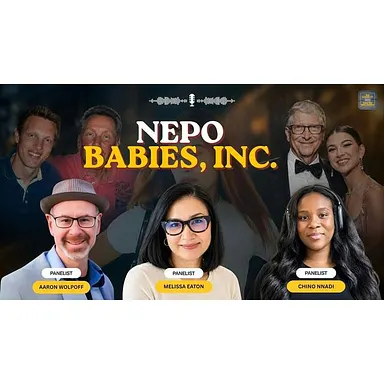
Join Chino Nnadi, Aaron Wolpoff and Melissa Eaton to unpack the world of "nepo babies" in business, which we agree is a loaded term. Using Phoebe Gates' AI shopping assistant Phia, Hailey Bieber's Rhode, David Ellison's Skydance, the Kardashian brand empire and Stella McCartney as examples, the panel breaks down what a famous name really buys: the removal of doubt, faster access to investors, and a financial safety net most bootstrapped founders never get. They also look at who's really behind many celebrity "co-founder" brands, and why the Theranos board is a warning about trusting big names over real expertise.
The conversation lands on a simple test: strip away the story, look at who's actually running the company, and judge it on retention, not reach. A head start isn't the problem. Pretending it doesn't exist is.
Panelists:
Chino Nnadi – https://www.linkedin.com/in/chino-talentstrategist/
Melissa Eaton – https://www.linkedin.com/in/mseaton/
Aaron Wolpoff – https://www.linkedin.com/in/marketingaaron/
Connect With the Show
Subscribe for more deep dives where we fix big business problems with fresh perspectives.
• Website – www.wefixeditpod.com
• Follow us on:
Instagram – https://www.instagram.com/wefixeditpod
LinkedIn – https://www.linkedin.com/company/wefixeditpod
YouTube – https://www.youtube.com/@WeFixedItPod
If you liked this episode, don’t forget to subscribe, leave a review, and share it with your friends! Keep listening to find out how we fix companies and put them back better than we found them.
Disclaimer
A quick disclaimer. We are going into this somewhat cold and nothing we say should be construed as legal advice, financial advice or anything that would get us in trouble. These are our views and opinions. We’re here to ask the kinds of questions everyone’s thinking, have an engaging conversation and maybe come to some conclusions that we feel are worth exploring.
By the end, if we fixed it, you’re welcome. All trademarks, IP and brand elements discussed are property of their respective owners.