
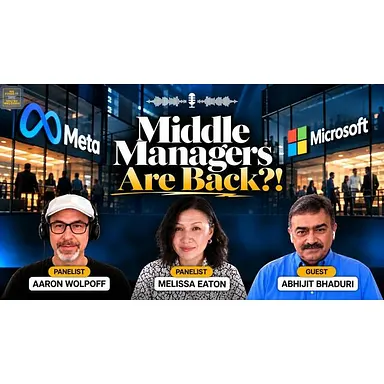
“MIDDLE MANAGERS ARE BACK?!” was turned into text by HappyScribe’s speech recognition. Related tool: notes for Microsoft Teams meetings.
Ads in this audio differ from the text. Tap the sentence you're hearing to follow along.
Synced: the text now follows the audio.
Welcome to We Fixed It. You're welcome. The show where we take over companies, you come along for the ride, and we try to put them back better than we found them.
Before we start, let's do a quick flashback to last season when we talked with Ron Hetrick from Lightcast. Ron is super smart and one of the top labor economists in the country. The problem we took on together is that companies had too many layers of middle management. There were too many managers. Turns out a lot of those companies agreed with us, but they went too far. They instituted They instituted mass layoffs, they brought in AI experts, and companies wiped out the middle-tier positions. Problem solved, right? Except huge plot twist. Just a few short months later, these same companies are realizing that maybe AI isn't the same as people, and you can't run effectively with just a top and a bottom floor. It doesn't work. So what are we going to do about that? Do we just put things back the way they were? How do we keep companies from overcorrecting again? That's what we're here to fix. We're going to get to that, and that's a big one. So let's get some more brainpower on this. Joining Melissa and me today is Abhijit Baduri, and he's a keynote speaker and author many times over. He works with companies and leadership on talent development.
He's ex-PepsiCo, ex-Microsoft, and we're really happy to have him join today's conversation as our guest. Tell us a little more about you, Abhijit.
Thank you so much, Aaron and Melissa, for having me here on the show. I've been in talent management throughout my career. I Last held the role of being the general manager for global learning and development at Microsoft. My prior roles have also been in Colgate and PepsiCo, where I headed human resources for them. And I've spent about 10 years being a consultant to various organizations. I lived and worked in Asia, in US, and India. So that's about me. And I love writing. So LinkedIn sees a lot of my posts and all of that. So yes, I love it.
That's great. We're so glad to have you here. Together with you, we're going to fix all the management problems that companies have by the end of this episode. We'll make, we'll just make it better forever. Are you up for that?
Yes, completely. Let's go.
All right, let's do it. That sounds good to me. Melissa, our advice when we tackled this before was this. If you want more job security in this labor market, don't go for the manager position. Be a valuable contributor, but don't let the company you work for add manager to your title because that might put you on the chopping block. But now being a middle manager is suddenly hot again. They're in demand. What the heck is going on here?
There is a lot going on. So yes, we talked about this in season 3. Fewer layers, fewer managers, fewer meetings. And somehow that was supposed to turn everyone into a builder or an individual contributor. Then AI came in as the next great savior behavior for every organization. It did the work. It took the meetings off the calendar. But where did all the thinkers go? And where did all the leaders go? Because here's the thing. Korn Ferry just put out data showing 73% of hiring managers say critical thinking is the number one skill that they need right now. AI skills? That ranked 5th on the list. So today, more than a third of companies are replacing entry-level roles with AI, the exact roles where people used to learn learn how to think critically and really figure out the business in the first place. So there's already a gap between what companies say they want and what they're actually building towards. And that gap is showing up fast. There's a Business Insider report that Meta is quietly asking people in its applied AI division, about 7,000, if they'd like to go back to being managers after moving them out of management not that long ago.
And it's being called Voluntary, which is corporate for, so how do you feel about doing the job that we told you you just— we just didn't need? So more importantly, is it a choice? What if you say no? So here's the tension of today. Are managers actually unnecessary, or did we delete this leadership role and leave the work behind for somebody else to absorb without the authority or the title to go with it? And there's something underneath all of that. We're trying to answer that question with a playbook from the '90s. Right? Flatten the org, cut the layers, grow the span of control. That's a decades-old org design way of thinking. But the AI tool driving this round didn't exist 18 months ago. And it's a different tool than it was 6 months ago. Meta flattened and unflattened in under a year. That's not a company that got it wrong once. That's a company finding out that the ground is moving underneath them and they're trying to keep up. So when AI can generate the answer, who decides it's the right one? And who's left to help the people actually doing the work make sense of it?
That's what we're here to unpack today. So let's go.
I mean, gosh, you have companies that made— even Meta is making sweeping declarations that, well, number one, that AI can fix everything. And number two, that they're not backing down from AI. They're not saying we're done with AI. They just found That the crew— you said the critical reasoning piece is gone from the middle of the organization. I mean, that makes sense. You took the people away. That's one thing AI can't do that people can do yet, is the same degree of critical reasoning. And they've done brain studies on this. I, you know, I'm not an expert on it, but they look at people's brain patterns when they're using AI and they, they go into passive mode, not active mode. So you think better without AI, but companies perform better with AI. So we're kind of in Weird tension right now.
I really think that, you know, especially at Meta, you know, this is really a reversal of a CX story in HR clothing, really, right? So since it's admitted internally that the AI rollout was atrocious for this applied AI team and undermined the trust of roughly 7,000 employees, leadership's now capping managers at 20 direct reports as a fix. But is that really a fix? Because you strip a manager out and you don't remove the escalation path, you just leave it unowned. And so people are really struggling and unhappy. And we really have to figure out what does that really look like in the new future? Because as I mentioned earlier, you know, that future is continually transforming. So Abhijeet, what would you say as an expert in this arena? You're really looking at it from a a global perspective, what do we need to be looking out for? What do these leaders and what do these companies really need to look out for?
You know, one of the things that we need to separate in our mind is that there is something about efficiency which machines actually help us to do. You know, so there's so much that machines can do to speed us up, make it efficient. But then there is another element which is effectiveness, you know, and that is a completely different game. I think when organizations kind of switch between having people, moving people, putting them back, doing all of that, they're sort of looking at it clinically in terms of efficiency. We moved it, we found we didn't need 20 people, we need 19. So we removed one, then we added 2 back, then we removed 3. They are completely blind to the fact that organizations may do a lot of things in the name of efficiency. What does it do to the employee population? The disengagement, if you see Gallup's polls, actually have continuously talked about this. That employees feel disengaged from the work. For them, it's a transaction. So today you need me, tomorrow you won't need me. So I know that. And therefore expecting people to go above and beyond, that is actually not a skills question at all.
It's about what I feel when I do the work. So organizations focus on how do you do the work. So therefore, if you say managers aren't being effective, they'll put training managers as the solution. Actually, what they need to really look at is the identity of being a manager. And what does it mean? What do you feel like when you become a manager? That element, you know, when you move people in and out, you create a transactional piece. You are really killing that. And therefore, it's hard to build it back because think about it. Somebody you've been friends with lets you down once today. It'll take you years before you start trusting the person again. So It takes you one act to lose trust, but many, many acts to build trust. I think that's really the difference.
I love what you say there because I think that that's one of the things that we have gotten wrong about AI is not focusing so much on separating out the benefits of AI from a productivity and efficiency perspective, but also understanding and separating that, those tasks and those things that they're doing that AI can do for you well from the actual roles of all these leaders in the organization, right? And it's not just leaders. It's, to your point, it's the identity of an employee because there's, you know, you have to— you have judgment there. You have critical thinking. You have escalations. You know, when you're doing some problem solving, you're really also owning that this is what I do and this gives me pride. That's a feeling, right? It gives me pride to work here. It gives me pride that I'm helping to better the community or better the customer experience or whatever it might look like. And I think that that's one of the things that, you know, no one is saying that AI isn't helping in that productivity and efficiency mode. But I think, you know, there's a lot of discussion now about QA.
And there's a lot of discussion about, like, what are those next steps? And it is kind of one of the things that we look backwards. I mean, you're not looking that far back, maybe a month back, and saying, oh, we made these changes in order to say that we were an AI-forward company. But then we didn't really think about the changes and how it was going to make our employees feel, let alone the managers that we let go, who were really managing all of that day-to-day kind of support and helping build that culture for the teams. And, you know, we all know that happy teams are more productive, right? That's to your point about surveys, right? You know that that is truly the case. And so how do you protect That sort of feeling is like you have to put it back at the forefront. And so I kind of have to swallow my pride a little bit here. I will applaud Meta in that they're recognizing that. But I'm not sure that the way they're going to go— they're going about it, if it was really more of a reflection of unhappiness within the team and then team not being productive enough, right, with AI, that they had to go back to those managers.
Because again, like, that's another whole we could probably spend a whole nother episode and podcast on when you're asked to kind of take on this role again, what if you don't want to?
That's true.
You know, one of the things I, I'm just gonna sort of pipe in there and add that a lot of it, you know, when companies say that we are AI forward, I mean, you can't be AI forward and employee backward, you know? So it's not gonna work, you know? But you refer to something far more fundamental that the belief is that work is only about money, that you do the work because, you need to earn. I mean, so the moment you take that kind of a perspective, you tend to view work as a transaction. That I think is a fundamental mistake because there are things you refer to, so many of them. Think about it. Why do people who are teachers in schools who are doing things here, why do they work? They could do jobs which pay them much more. Why do they do that? Because it gives them meaning. Think about belonging that comes from work. When you tell people, I belong to this organization. You have a sense of pride or you don't. I mean, so that's another part. You talked about expertise, that there is stuff only I can do, that sense of pride that you get from the work.
You know, it's an intangible feeling. Also knowing where do you belong to in this hierarchy, you know, that's very important. And there is neurological studies done by Robert Sapolsky of Stanford. He talks about the fact that baboons are just as stressed when they do not understand their place in the hierarchy. So when the people are competing for hierarchy, it causes stress. And it's equally true for human beings as it is for baboons. So you need to know, where do I belong in this hierarchy? Can somebody come and just punch me today and put me back tomorrow? That matters. So the question you raised, what if I don't want to do it? Sometimes the organizations believe that it's a one-sided equation, that I'm paying you a You do what I need you to do. So you can do that, but discretionary effort, my going above and beyond, my solving a problem I was not expected to solve, my pointing out an error which I've noticed but nobody else did, all this comes from whether I feel I belong to the organization. That is what is getting killed in this whole process.
Like the companies that say we're, we're all in on AI, they have to keep that commitment. No one's saying, AI, sorry, we experimented with AI. I guess that's, uh, you know, the human race is over it. We're doing something else now. Or they're still in it, but how do they, how do they keep sinking time, energy, commitment, and resources into that? And then also have this side pot to bring people back and pay them maybe more because now these, you know, the people, uh, now they're, they're, there's, they're competitive. It is a competitive talent pool out there. So how did— where did this magic pool of money come from to do both? I don't, I don't know where. I don't understand that. Today's episode is brought to you by Scribe. These days, companies are all about optimization. People, processes, technology. If it can be optimized, it should be, because that's what makes companies better. That's why Scribe created Scribe Optimize. Most companies know how work is supposed to get done, but how does it actually happen? Optimize has answers. It uses AI to automatically map workflows across your approved business apps, even as work moves between systems.
Goodbye team interviews and months of process mapping. Its live dashboard shows how work gets done and where time is spent. From real workflow data, you get recommendations on what to fix or automate with ROI projections you can use to make the case. And privacy is built in. Optimize only captures the apps your admin approves. And Scribe can also automatically redact sensitive data. Look, I've spent years helping companies solve problems, and visibility is key. Without it, you're guessing. Having seen Optimize in action, I'm impressed by the clarity it provides. No wonder Scribe is trusted by 94% of the Fortune 500. If you have the opportunity to fix something about your company and there's a specialized intelligence platform waiting for you, I suggest you try it for yourself. See Optimize in action at scribe.how/fixedit and mention We Fixed It for a 30-day risk-free trial. That's scribe.how/fixedit. Today's episode is brought to you by Quince. My favorite new button-down shirt's from Quince, and I've got to tell you, it's sharp. The material feels great and it fits exactly the way you hope a shirt will fit, which for some reason is harder to find than it should be, but not at Quince.
They've got everyday essentials figured out, and they do it in style. The prices are 50 to 80% less than similar brands, so you can't go wrong. And their materials are ethically sourced, so you can feel good shopping there for a lot of reasons. And they don't just elevate your wardrobe. You can shop Quince for your kitchen. They've got furniture that matches my aesthetic. There's a lot to discover. Whether you're bundling up for winter with a cashmere sweater, redesigning your home, or some of everything, I recommend checking them out. Find the fall pieces you'll reach for most at Quince. Download the Quince app for app-exclusive offers or go to quince.com. Get free shipping on your order and 365-day returns. Now available in Canada and the UK too. And when Quince asks where you heard about them, let them know it was We Fixed It, You're Welcome. It's the best way to support the show.
I don't think it's a magic pool of money. I think it's more of a shift to what is the future of a company look like. We'll talk about, like, you know, I've managed large call centers before, and there's always been, like, the sweet spot of, like, okay, how many CSRs per supervisor? 12 is about a good number, let's just say, at one point, right? And the reasoning behind that was you're going to have moments in time where you're going to need to be coaching. You're going to need to be working through performance reviews. You're going to need to be— to need to be helping train a new hire and onboarding somebody. You're going to be dealing with escalations and unhappy customers. You're going to be dealing with budgeting and finance types of things. And you're going to be dealing with workforce management and schedules and all of these kinds of, you know, hiring people, firing people, all the things. So there was all of this makeup behind an actual role that this person had. And when we look to what we're talking about with AI, and around the productivity and the task orientation and all of those kinds of things, this stuff gets left out there and it's just not there anymore.
And so the question to people like Meta, to Oracle, to other companies that are doing all these kinds of things, making these drastic changes, is where does that land? And, and to your point about the employee, so the employee then feels like, I don't know what the expectations are. Of me because I don't have somebody to go to, right? I actually am in fear of my job, right? Because I don't have a manager telling me or even showing me and mentoring me that, oh, if I stay here, do a really good job, I have a tendency towards natural leadership skills, I could actually be in that role someday, right? No, now I don't. I mean, AI's taking my job. So now I'm just, like, scared, right? So there's all of these things that I think, like, from a sense of productivity and, you know, fiscal responsibility, companies were like, we've got to be AI forward because that's what everybody wants. We've got to invest in AI. And the biggest, the biggest financial strain on any company is payroll. Right, of its employees. So where are you going to get that money to help invest in AI?
You're going to take it away from your people. And you're going to— and you're also going to, you know, take away the highest paid people, which are usually the managers. So again, it's a really interesting dilemma to be in. And I'm, you know, and I'm curious about how we think we can fix that because they're also not thinking about, you know, to the point of this panel, like emotional, the culture building, the what that really means to the future of a company, its profits, and its customers.
Well, and it's the highest paid middle people, right? But the people, the top 1% there, there's that made those overcommitments to AI. Their jobs are safe by and large. They're doing okay. It was the people under them that got impacted. But I do wonder, you know, I say companies don't like to be wrong, but what the companies, companies, I love you, but what you signaled, tell me if I'm wrong, is that if we could do this without you, meaning you, our people, we would. If this experiment was successful, we wouldn't need you. Guess what? Turns out we do. So obviously I'm curious, like, is this a big walk back? Is it just a little quiet? You know, like what's the market condition Are jobs gonna be scarce? Like, are companies gonna be filled with people again and bustling hallways, or is it just this quiet little, we'll plug and play, fill holes where we can? And, you know, like, what are we gonna see here?
You know, one of the ways to think about this is look at the paradox that when you are bringing in new technology like AI and it's moving at such a rapid pace, you are having to upskill people, you are having to change role descriptions, options, job descriptions, it's all of that. It's ironical that when you actually want people to learn, if people are stressed and scared and petrified that they're going to lose their job, or there is this unspoken, invisible fear which is looming everywhere, when you have that, that time our learning ability is the lowest. And so ironically, until people feel secure enough to learn something, you will not be able to address this problem. So you will find the gap actually increasing. And I sort of, at the risk of a generalization, I would like to say that I think most of the time Silicon Valley has been outstanding when it comes to understanding technology and building with it, and it's been terrible when it comes to understanding people and working with them.
Yeah. Well, are— so to that point, are companies ready to reinvest in the right people that have have the capacity to grow and expand, or are they looking for warm bodies?
No, I'm going to sort of reverse the question and say it's not whether companies are ready to invest in them, but are the employees willing to invest enough of themselves to trust the employer all over again? Because they're seeing what happens everywhere. One of the things that Gen Z is so averse to, taking on manager roles, et cetera, all of that, because they're saying, you're expecting me to take on a larger role and also telling me that this is the role we will delete and add back and delete and add back and delete and add back. Why do you think I'm going to do this? So this is really coming back. We have to start acknowledging that there's an element that we need to understand besides technology, because work, worker, and workplace all move in tandem. You can't change the way you work without changing the employee base. the sort of portfolio of skills that you have. And the workplace actually becomes a place where both work and worker come together to thrive. If they don't do that, it's not gonna work. So we can't do one without the other two.
I hear you. I guess what choice, you know, if you're an employee, what choice do you have? 'Cause now you were Meta, now you're ex-Meta. You had to change your LinkedIn profile. You probably aren't, maybe you're not gonna go back to Meta if they say, we, you know, we made a mistake. We thought we'd get by without you. We're so sorry, come back. I'm not saying they're saying that, but what choice do you have? Then you go to Google or you just get picked up by another company or you go work for a startup or you become a consultant, which doesn't take much work to change your title to consultant on LinkedIn. Chances are if you want to play in the big leagues, you just kind of go to the next company. And I don't know that they're thinking any different than your past employer. Yeah. In terms of investing in you as an employee.
But I do think that the point is that we as leaders are thinking differently. So the point is, I would not feel at any employee— I don't think anyone feels comfortable in a role at a company today. I would say no one feels, and especially if you're a middle manager, Because that role has been just wiped away, just like nothing. You know, I hate going on LinkedIn these days because you see people who have dedicated their entire careers to companies like Oracle or Microsoft or Google, wherever. And when I say entire careers, I'm not talking 5 years, I'm talking 20 years. And then they get an email and locked out of their account and get— that's how they get let go. You know, it's just, it is a very different world we live in today that I don't think is just generational. I mean, I do believe it's generational. I do believe Yeah. The younger generation who now is working knows that this is the environment and the landscape. I think the folks that have worked and dedicated time are disappointed because they thought that their commitment and dedication and loyalty meant something. And actually, it doesn't.
So to rebuild that, to your point, Abhijit, is that that is going to take so much more effort. And it's going to have to take on both ends an openness to be willing to participate in something that has been in the last year and 5 years, it hasn't been great if you've been a manager. So if I was a manager, I'd be like, you know what? I'd rather— to your point, Erin, I'd rather be a podcaster, or I'd rather be a consultant or a book author. Yeah. Or do something else. But I, I just think that like when you feel like you are being, you're a puppeteer, you're a marionette to the company, it doesn't feel great when you don't have control. And I think that's the thing that we feel like today is that there's no control over our own destin— destiny and our own destination even. Um, and it never, I don't know that it's ever been so up in the air as it is today.
So you say that there are 2 kinds of losses. You know, if you sort of look at the grief that we experience with any loss, there are 2 kinds. You know, one is when you leave without a goodbye, and the other is you have a goodbye, but you don't leave. Let's take the first one. You know, like someone who has Alzheimer's, you are saying that Yes, the person is still around, but it's not the same. They don't recognize you, the memories don't come to them, etc. So that's one. Then there is this entire process where you suddenly leave without a goodbye. And it's ambiguous because you don't know, like sometimes there's a soldier who's missing in action. You don't know whether the person is never going to come back or only temporarily not there. In the workplace, we have both of them happening today. One is You're suddenly asked, like you described, that you get an email and your email stops working after that and you can't access. It's just such a horrendous way to be paid back. Just imagine getting shut out of a place which you thought was yours. The keys don't work.
It's that feeling. It's that kind of a goodbye. The second is the people who survive. In this particular round, they have lived through But they know that it doesn't mean that tomorrow it's not going to happen to them. So is this tomorrow? Is it like next month? Is it in the next routine? Is it the next quarter? And there is this entire thing that, you know, it's not the same. So you are in the role, but there is something that has changed in that equation. And that needs to be acknowledged. And that, to understand that, the leaders need to take on a different lens, you know, to be able to do this. Because the damage that gets done, as we said, that you do it with one person, the survivors know that it doesn't matter how much they offer me a pizza party, it's not going to make up for this feeling that I have that I'm not as valuable. Every experienced employee today feels that it's not about my experience. I'm just a very expensive line on the budget balance sheet. So this feeling that that you are not valued for the experience, the judgment, your pattern recognition, your ability to coach, your ability to solve something which there is no playbook for.
All of that is not valued. It's just a question of you cost more than what an intern with AI could do, ergo, why keep you? So when you do that, it does something to the workforce. And this memory is not going to go away. I mean, there are lots of memories and we can think about Which may have happened 20 years back, 25 years back. We remember it vividly.
Yeah. Well, and if every day feels like your last day, or it could be, then you've created this whole transitory workforce where you never even put a picture of your kids on your desk because you might not be there tomorrow. And you do carry that kind of anxiety and grief and all those things. Even if you got picked up the next day, you get let go. Let's say best case scenario, you get let go. So the next day another company says, we'll take you. You carry that with you. Like you didn't have time to process that. And all of a sudden you're in a new situation where if they could AI their way outta your job, which might happen tomorrow, might happen in a month, might happen a generation later, you're gone too. So how do you plant roots anywhere? Today's episode is brought to you by Quince. My favorite new button-down shirts from Quince, and I've gotta tell you, it's shocking. The material feels great and it fits exactly the way you hope a shirt will fit, which for some reason is harder to find than it should be. But not at Quince. They've got everyday essentials figured out, and they do it in style.
The prices are 50 to 80% less than similar brands, so you can't go wrong. And their materials are ethically sourced, so you can feel good shopping there for a lot of reasons. And they don't just elevate your wardrobe. You can shop Quince for your kitchen, They've got furniture that matches my aesthetic. There's a lot to discover. Whether you're bundling up for winter with a cashmere sweater, redesigning your home, or some of everything, I recommend checking them out. Find the fall pieces you'll reach for most at Quince. Download the Quince app for app-exclusive offers or go to quince.com. Get free shipping on your order and 365-day returns. Now available in Canada and the UK too. And when Quince asks where you heard about Let them know it was We Fixed It, You're Welcome. It's the best way to support the show. Today's episode is brought to you by Whatnot. I recently started shopping on Whatnot, and I'm telling you, it's fun. Even though I ordered from different sellers, everything shipped really fast. I was practically waiting at the door to see what I scored. One thing was a watch, and I keep getting compliments on it.
I wouldn't have even known it existed if I hadn't discovered it on Whatnot. Plus, I got a great deal deal. And if you're buying on Whatnot, you'll be having a good time too. If you're like me, you'll be discovering products, interacting with actual people, and finding things you love without paying full retail prices. If you've got something to sell, you should check it out too. Now when I walk into shops, I find myself thinking, they could be selling on Whatnot. They would be connecting directly with buyers, showing off their products, and building a community of customers who keep coming back. And you can too. I'd absolutely recommend checking it out whether you're shopping or selling. And speaking of selling, search Whatnot, W-H-A-T-N-O-T, in the App Store, download, and you can start selling right away.
Well, I think that what happens is people translate that into a different sort of goal structure and framework, right? So, you So it used to be getting married, having kids, buying a house, living in a nice neighborhood, all that seemed— having a great job, having barbecues on weekends, going to a football game, whatever it might have been, that seemed to be satisfactory. I think that today people realize that every day could be the last day of this job. So a lot of people now work towards living their best life and not waiting for anything. And so that might be traveling, that might be exploring hobbies, that might be getting further, you know, doing something, a passion project that you really love. So that to me is a good thing because I think people are really trying to find what brings them fire. Those are the things that used to happen in your job. Now that doesn't happen there, right? You're going outside. of your company to find those things that bring you passion. And I think, Erin, you kind of hit on this, but there's a real issue for companies too, because you've now— there's this pipeline paradox in terms of you've now created almost this like contract workforce, right?
So there isn't— how are you building for the next stage? How are you building for growth? How are you building for an IPO? How are you building that when And you don't have loyal employees that really are learning and understanding and growing with the company if you aren't having that built into your organizational structure. So, I do think that's a huge issue that is going to be facing these companies is that— and Abhijit, I come from the insurance industry, and this is something that has been coming up a lot in insurance is that insurance is not a sexy— it's never been sexy— is not a sexy arena landscape. And so the need to kind of get younger, a younger generation of people excited about insurance. Yes, there are InsurTechs and startups, which is fun. Great. But like when you think about what insurance is about, you know, you really are having a whole generation of people retire. Really, you know, very soon. And so because of that, I think it's really important that we literally understand that we've got to figure out what that pipeline looks like.
People who have seen their parents getting laid off multiple times, you know, they've— or they have seen their parents live with almost like this terminal fear that, you know, my last day could be today, could be tomorrow, could be you know, a month, one year later, whatever. Yeah, it changes the way that they view work. Our work identity is shaped by that, that you kind of think that, okay, it's not something that I really need to invest in. I mean, it's something transactional. So therefore, when they come in and also the workplace has not been very inviting for them because we've said whatever the kids can do, AI can do better. But in the process, you are going to have a generation which is not going to find this opportunity to learn, make their mistakes, grow, build their confidence, do all of that. So what is the middle management that you are going to live with? I mean, so you don't have the entry-level workforce, you don't have the middle level, which is sort of going back and forth, sometimes yes, sometimes no. You have very, very few people. where organizations are now trimming down the workforce and working with far lesser number of people, you need to actually invest far more deeply to get those couple of people to really feel very committed to the work and the organization, you know, than what you would've done, let's say, when you had a very, very large, huge workforce.
Then, you know, it would all even out. Some would care, some wouldn't, and then, you know, it sort of In this situation, you actually have a scenario where it matters. Every person's commitment matters. And yet they've looked around and seen, here is how the workplaces are looking at employees. So I think the notion of what we do to invest in the people, the role of a manager, and you were talking about it a little while back, that the role of the manager is to coach, to inspire, to sort of do the that. Think about it. I mean, with teachers today, all the content that you have in the school is available for free on the internet. Why do we send the kids to school? And what's the role of the teacher? Not necessarily content, you know, to transmit the content, but to inspire. I mean, some of the teachers who made a difference were people who made me believe I could do something which I knew I couldn't. And they said, no, you Again, that is the role that is missing. So the human connection becomes even more important when you have 5 people and not 5,000 and not 500,000.
So, you know, it just means a lot more.
Yeah. And yet I am buying everything you're saying. And yet the middle, it's not the frontline people, you know, frontline people, maybe they're, once you train them, they get locked into their position and, you know, they're customer-facing. So let's keep them in that role. It's not the CEOs. They're not swapping CEOs every 2 weeks. It's the middle that just seems so disposable. And no company, I mean, tell me again, tell me if I'm wrong, no company or coalition of companies is stepping up and saying, baby, I'm sorry. Whoops, we made this, we made a mistake. We overcorrected. We let go. We did need to make some trims. We did. That was the responsible thing to do. We did need to be accountable to our shareholders. We cut 20% of our workforce. We made a mistake. We overcorrected. We went too far. Here's what we're doing about that. We are banding together. We're doing some kind of a hiring incentive program. If you worked for us before, we will find a role for you, as long as your performance was all right. If we don't have a spot for you, we're going to team up with this co— I'm grading into fix mode a little early, but I don't even think that's on the table.
I don't see companies stepping up and doing That they're just gonna keep, I guess, waiting for AI to get better and better. And, and, and I think it's just like they're in salvage mode, you know, like, like I'm saying, they're not, you know, they're not looking for the best. Okay, well, let's rehire the best people that are gonna have longevity with the company and really commit, and let's get to know them and their families. They're saying like, get someone in here who can push that button 'cause AI doesn't have a hand, you know, like, uh, and tell the people, other people to push the button 'cause they're, they stopped doing it 'cause AI didn't, you know, whatever. The system broke. So it's, it's patchwork and you can't, like, how do you build off that? Like, how do you build stability in the labor force? Again, how do you make people happy in their lives and fulfilled?
You've brought up so many good points here, Aaron, but I do think that when we think about AI as this, we've thought about it more so as the revolution of productivity and efficiency. And really it's transforming the way we also manage work. And what I mean by manage work is every single task along— and task might not be the right word, but every single component across the entire landscape of work has changed. And what needs to happen is that as we've gotten as excited as we have about inserting AI into engineering and productivity and product and things like that, we also need to think about how do How do we insert it into the actual organization in a way that makes sense? And I feel like what you've said, Erin, is that we've thrown it out there, but who's looking back on this and saying, making an assessment of the, you know, the roles of leaders, the roles of a team member, the roles of a performance coach, the roles of learning and development, the roles of HR, the roles of of all of these kinds of things that were at one point really, really a pillar of every company.
So when you think about that, those are the things that need to be touched by AI in a way that has a true critical eye, has some assessment, has an ability to really get us into the future, and is flexible in understanding that we're not going to know everything that we think we know, right? And I— this isn't really the kind of thing that people want to hear, but I do think that we really need to protect that leadership pipeline as a strategic asset. I think you have to be very strategic about this and not look at it just as a line item, which is very hard. I was the first one to say that payroll is a line item. It's the biggest cost, right? So people are looked at as line items and as numbers, but really protecting the leadership pipeline, the culture pipeline and organization so that you can actually grow that company. And I also think that from a CX perspective, um, that's my, you know, area of expertise, the customer experience with AI just lacks. To be fair, it's the same as it was when I was doing it 15 years ago and doing chat, right?
It's in a virtual Sales assistant, right? It's the same thing. So you really need AI plus human escalation because like there's ways to get to a human, or you hope to. And if you're a customer, it's so frustrating. I had this experience yesterday. I was trying to do something and I kept typing it in, and then I realized I'm like, oh, this has to be an AI bot because they're not answering the question. It's pretty direct, the question I'm asking. It was like four words, right? And And they kept sending me in a loop. And then I was like, I need to talk to an agent. And they said, okay, we'll have someone call you, put your phone number in here. Has anyone called me? No. That just makes me think I don't want to do business with this company anymore, right? I just, you know, so we really have to think about like, what is going to happen in, in terms of that? And those are the kinds of things that when you're looking at your AI strategy and you're looking at your productivity numbers and what what you're hoping to gain from it.
Yes, those are the— these things. But you know what? Every process is made to be broken. And so when it breaks, who, who picks up the pieces, right? As a customer, I want— if, if the AI bot was responsive, personalized, answered my questions, you know, effectively actually resolved my issue, then I would be happy about that. But when the bot's like, Sorry, can't help you. You're going to have to go back to your credit card company. I'm like, my credit card company told me to call you. Can
I talk to your supervisor? There is no supervisor.
And it's like the little dancing bot going across your screen. It's just so frustrating and you kind of give up. And so, I think that that's the kind of thing that we have to think about in terms of how do we it AI plus human interaction and escalation. And it's got to be kind of together. But again, I feel like AI came at us really quickly, and people went for it and didn't really think about the strategy behind it for the people that were left. I mean, we've heard the good stories, the IKEAs of the world, right? where, you know, they, they retrained their CSRs and made them designers and all this stuff, and, and they've become even more profitable than ever. Not everybody has done that and has spent that time thinking about it. So Abhijit, what would you say companies really need to do to fix this?
Today's episode is brought to you by Quince. My favorite new button-down shirt's from Quince, and I've got to tell you, it's sharp. The material feels great, and it fits exactly the way you hope a shirt fit, which for some reason is harder to find than it should be. But not at Quince. They've got everyday essentials figured out, and they do it in style. The prices are 50 to 80% less than similar brands, so you can't go wrong. And their materials are ethically sourced, so you can feel good shopping there for a lot of reasons. And they don't just elevate your wardrobe. You can shop Quince for your kitchen. They've got furniture that matches my aesthetic. There's a lot to discover. Whether you're bundling up for winter with a cashmere Redesigning your home, or some of everything, I recommend checking them out. Find the fall pieces you'll reach for most at Quince. Download the Quince app for app-exclusive offers or go to quince.com. Get free shipping on your order and 365-day returns. Now available in Canada and the UK too. And when Quince asks where you heard about them, let them know it was We Fixed It, You're Welcome.
It's the best way to support the show. Today's episode is brought to you by Whatnot. Whatnot. I recently started shopping on Whatnot, and I'm telling you, it's fun. Even though I ordered from different sellers, everything shipped really fast. I was practically waiting at the door to see what I scored. One thing was a watch, and I keep getting compliments on it. I wouldn't have even known it existed if I hadn't discovered it on Whatnot. Plus, I got a great deal. And if you're buying on Whatnot, you'll be having a good time too. If you're like me, you'll be discovering products, interacting with actual people and finding things you love without paying full retail prices. If you've got something to sell, you should check it out too. Now, when I walk into shops, I find myself thinking they could be selling on Whatnot. They would be connecting directly with buyers, showing off their products, and building a community of customers who keep coming back. And you can too! I'd absolutely recommend checking it out, whether you're shopping or selling. And speaking of selling, search Whatnot, W-H-A-T-N-O-T, in the App Download, and you can start selling right away.
I think to begin with, you know, one response to what you were talking about, customer service, which is automated. Yeah, there's nothing more frustrating than that because if it is not that simple thing, gimme the name of my bank account number, there's very, you know, for something as direct as that, yes. Anything slightly more nuanced, you've had it. Then you have to spend time figuring out how do I get a human being to speak to me? And people don't realize that you're wasting my time. You've simply passed on the burden to me that I'm going to spend hours trying to work with that incompetent bot trying to be cute by dancing around, which is nothing more annoying than that. I don't need you to do this. I just need you to solve the problem. I think organizations have to really start looking at a parallel process of looking at the technology implementation, which I think is a great thing, but also sort of really starting to look at how do we make people a part of this whole process so that they begin to invest themselves in making this better because they realize that it's going to actually make my life better.
And that also means talking to people. One distinction to keep in mind And organizations roll out change management initiatives at the drop of a hat. Change is what happens outside of you, you know, and which is what results in change fatigue. When people say, oh, okay, there's another one happening this month, that's change fatigue for you. Transformation is what happens inside you based on the change which is going on, you know? So how do you adapt to that change outside? In doing that transformation, you are actually having to invest in a human being gets it much faster. It's much easier to trust a human being than to trust a bot. Can it do some of the work? Yes. If there is a little bit of cleaning up, summarize something, yeah. I mean, all those things, yes. But anything which is a little more nuanced, judgment-oriented, relationship-oriented, and to get you a perspective which is beyond the norm. So the AI AI is extremely good at making anything which is average. Anything. You know, you want to take pictures. Yes, it can make an incompetent person like me at photography make my pictures look halfway decent.
But does it mean that the world's best photographers are now jobless? No, we value them more because we say, my God, I mean, look at the difference between what I can do with my cutting-edge phone versus somebody else. And it's the same moment. Why do their photos look so amazing? That's the difference, because the minimum threshold of competence has gone to average. So you want to write using AI, it can become average extremely quickly. So the incompetent can become average, but the average can never become excellent. This is the human space that we need to acknowledge. So when you are looking at work design, get the people to bring in their unique self. A good example of that is Scott Adams, who did create Dilbert, used to say, there are a million people who understand business better than me. There are a million people who can draw better than me. But there's only one person who can combine both of them and put an idea in 3 panels. And that's the Dilbert comic strip. That's really what each of us should be looking at, that I'm very good in, I don't know what, music, and I'm very good in doing accounting.
Can I do some of that together? I mean, in fact, talking of which, on TikTok and on Instagram, there is a Miss Excel who teaches Microsoft Excel by combining it with her electronic dance music and dancing. And she's like a rage. What she's done simply is that same Scott Adams formula, combined her passion for dance and music and combined it with the work that they're doing. It's actually making it unique and memorable. So there are millions of people who voluntarily go and do that. How many times have you seen somebody going up to you and saying voluntarily, please, can you teach me more Excel? Can you put me into a class of Excel? I'm dying to be there. You've never heard of that. That's, I think, the difference.
Okay. That's a lot to unpack. We've got to fix it. So that's what we do on this show. What I'm hearing is if you're an employee, you know, maybe the rules have changed on you. Maybe don't follow the rules anymore. You know, do things that are uniquely you and find a place for it. Find a home for it. Maybe it's not your past employer that's going to say, whoops, come on back. Or the next company over down the road. Maybe there's a whole different path that you're going to just create this value and buzzer on yourself and then figure it out for yourself. And maybe that company will buy you back at a premium and pay you to be a keynote. I don't know. But don't play by the rules of engagement because there are no rules anymore. The company's decided that if they could have replaced you, they would've. If they can replace you, they will. Here's my other part of the fix. Let's not be all negative. Companies love money and they respond to either being rewarded or punished. So let's do something tangible. Let's give companies incentives, maybe tax credits, maybe some type of public recognition for being a better employer in this new paradigm shift landscape.
So if they check certain boxes with their hiring initiatives, with their commitment to people and career development, If they take an AI pledge that says, yes, AI is part of our strategy for the foreseeable future, not going anywhere. And here are 3 things we'll never do. You know, we will never replace human skill with AI. Don't do 2 things you have to walk back in a month when AI 7.9 gets better. I don't know, whatever. Don't do things you have to automatically reverse course on. Do things you're gonna stick to as a company regardless of how good the technology gets. 3 things we'll never do. We'll never do evil with AI as a company. Google's do no evil thing. And we're going to hold onto people as long as they are good people and fit with an organization for a minimum of, I don't know, 3 years, whatever it is. But then put these companies on a good list, give them recognition, give them again financial incentives for being the better version of the companies that are out there in the paradigm shifts we're in. So 2-sided equation. make yourself as valuable as possible, not by the old rules, by your own rules.
Flip the power dynamic. Companies, be the best citizen you can be and the best employer you can be given the new rules of engagement. If we put those 2 things into a stew pot and mix 'em together, Melissa, did we fix it?
I think we got started. I think there's some other things that we talked about today that I think are really important. I think definitely separating the AI tasks from the actual role are really important. I also think that we need to protect the leadership pipeline as a strategic asset and business strategy. I also think it is important, one of the things that was brought up earlier, about really thinking about human embedded in the process and the AI strategy. And where are those points of time where humans can really actually lend a hand to that process or are really important in controls, in QA, and escalations, those kinds of things. And then I think one of the things about accountability for these companies is explaining the why when they're going through organizational change and transformation. I loved, Abhijit, what you said about that, and I think that it's important that we hold these, um, companies accountable and that they let people know that they don't have all the answers. And so things may change because building trust is not going to happen again overnight. But I think that you will see that those companies that do those kinds of things and fix those things will end up being the most profitable, will stand alone in the future, and will have a really amazing integrated AI and human organization.
I like it, Melissa. I buy that. Abhijit, if companies, if we could punish them all day long, if we give them rewards and incentives for just being better, better employers, better commitment to their employees, and employees realize that they can't, it's a different landscape, maybe they're not going to get rehired for the job they had, but they create some new set of skills and get fired that way. Is, are we, are we, do we fix it? Do we, are we creating a new, a new way to, to figure our way out through this?
I think if, you know, when people join an organization, if they were to have a sort of an understanding that the organization is going to invest while they're with the organization to train them for the next role, you know, and that could be inside the organization or outside, just something simple as that. That what can I invest in? You know, because the work that is needed to be done today, hopefully you've hired me because I can do it today. But to, you know, in a world where this is shifting, if you train me for what I could possibly do inside this organization or somewhere else on my own, that I think would be a great way to quickly win back trust. Because then I know that the company is not looking at it as a transaction. They have my long-term opportunity at heart. So I think that would go a long way and sort of really looking at that would be useful.
Well, that's gonna wrap up our episode. Before we clock out, I wanna thank Abhijit Badri for joining Melissa and me. Abhijit, you have books, you have speaking, leadership development, you run a popular newsletter. Well, tell us about your book. How could people explore what you're doing?
My new book where I've actually talked about many of these things is called AI-Dentity, which is how our identity at work is getting reshaped by AI. So this is, you know, is going to be available in another 2 weeks on Amazon. And so, you know, if you take a look at it or follow me on LinkedIn, it'll be great and I can send you the details. Thank you for having me.
Fantastic. Thanks, Abhijit. Thank you, Melissa. To our listeners, our Fixaholics, our show's burning up the charts. And it's all thanks to you. I want to manage your expectations, but our guest lineup throughout this season is amazing, and we'll keep bringing you new episodes. We've got more good ones coming up, I promise. Check out every episode from the beginning at wefixeditpod.com. If you have a topic for us, keep throwing those at us through the website. We love that. If you're a manager, an executive, or you're in the C-suite, be good to your people. They're working hard for you. And we will see you next time. Bye. We hope you enjoyed this episode of We Fixed It, You're Welcome. We go into every episode somewhat cold, and nothing we say should be construed as legal advice, financial advice, or anything that would get us in trouble. All trademarks, IP, and brand elements remain property of their respective owners.
Middle managers were supposed to be one of the layers companies could do without. Organizations flattened their org charts, invested heavily in AI, and removed roles in the name of efficiency. Now the question is whether they also removed the people who help teams think, learn, and work effectively.
Abhijit Bhaduri joins Aaron Wolpoff and Melissa Eaton to unpack the management reset happening in an AI-enabled workplace. Drawing on his experience in talent management and global learning and development, he explains why efficiency and effectiveness are not the same, how repeated restructures erode trust, and why employees need enough security to learn new skills.
The conversation explores the future of middle management, the entry-level talent pipeline, the human cost of treating employees as interchangeable line items, and why AI needs thoughtful human escalation when systems fail. The answer is not to stop using AI. It is to redesign work so technology and people can make each other more effective.
In this episode:
Why companies are reconsidering middle management
Efficiency versus effectiveness
How layoffs and reversals damage trust
Why fear makes learning harder
The role of managers in coaching, culture, and escalation
What happens when entry-level jobs disappear
Why AI needs human judgment and customer-service escalation
How employers can invest in employees’ next roles
Connect with Abhijit Bhaduri:
LinkedIn: https://www.linkedin.com/in/abhijitbhaduri/
Connect With the Show
Subscribe for more deep dives where we fix big business problems with fresh perspectives.
• Website – www.wefixeditpod.com
• Follow us on:
Instagram – https://www.instagram.com/wefixeditpod
LinkedIn – https://www.linkedin.com/company/wefixeditpod
YouTube – https://www.youtube.com/@WeFixedItPod
If you liked this episode, don’t forget to subscribe, leave a review, and share it with your friends! Keep listening to find out how we fix companies and put them back better than we found them.
Disclaimer
A quick disclaimer. We are going into this somewhat cold and nothing we say should be construed as legal advice, financial advice or anything that would get us in trouble. These are our views and opinions. We’re here to ask the kinds of questions everyone’s thinking, have an engaging conversation and maybe come to some conclusions that we feel are worth exploring.
By the end, if we fixed it, you’re welcome. All trademarks, IP and brand elements discussed are property of their respective owners.