
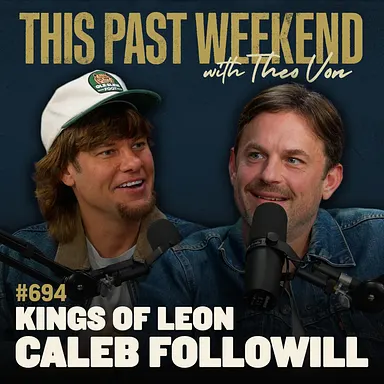
In this episode of This Past Weekend, Theo Von talks with Kings of Leon frontman Caleb Followill about growing up on the road with his evangelist father, moving from revival tents and small churches across the South. The conversation covers family poverty and the lessons Followill says it taught him, then turns to the band's early years, including a sudden breakthrough in the UK and the struggles that followed huge success.
They discuss the strain fame placed on his brothers and bandmates, his battle with drinking, and how he now approaches music and faith. Followill argues that family bonds helped the band survive, and listeners hear his reflections on what it takes to stay grounded.
In this episode Theo Von, Caleb Followill
The transcript of this Kings of Leon conversation with Caleb Followill was made with HappyScribe technology built for audio transcription.
Ads in this audio differ from the text. Tap the sentence you're hearing to follow along.
Synced: the text now follows the audio.
Ab jetzt wird's günstig, und zwar richtig. Flaschenpost ist jetzt größer, günstiger und liefert wie gewohnt bis an deine Haustür. Mit über 4.000 neuen Produkten bekommst du Lebensmittel, Getränke und noch viel mehr für deinen kompletten Wocheneinkauf. Alles so günstig wie nie zuvor. Und noch besser: Spare jetzt mit dem Code SPAR15 ganze 15 € auf deine erste Bestellung. Jetzt App öffnen, riesiges Sortiment entdecken und deinen Einkauf günstig liefern lassen. Flaschenpost.
He's a musician and a songwriter. He's a frontman for the band Kings of Leon, who have a new album, "Oh My Beloved," which comes out this Friday, November 6. Uh, he's had a wild life, and I'm thankful to sit down today with Mr. Caleb Followill.
Shine on me, and I will find a song I've been singing just for you.
Yeah, it's just so bizarre. I saw this frickin—what was this thing I saw? See if you can find this, Trevin. I saw them wash—drone washing a pet. There's like, I guess, a pet service now. Pressure washing. Via drone. There—there you go. Yeah, Chinese company uses solar cleaning drone to wash dog.
Wow. I mean, I guess I don't have a dog, but it—I think it's kind of hard to get them to get in the bath and stuff, right? So you just sneak up on them with this guy?
Yeah, I think you just call them and they come by in the morning or whatever when your dog's not expecting it. I guess it gives it.
I've got a couple of cousins that could use one of those things, bro.
Amen, bro. That's the truth, dude. Um, Caleb Followill?
Yes, sir.
Nice. Nice to see you today, man.
Yeah, man. Nice to be here. Nice to meet you.
Yeah, thanks for catching up, dude. We both ended up wearing this.
I know, man. We—we felt it. It was a denim kind of day, right?
I think it was. I think just everything feels so denim right now.
Like Ernest P. Wirl.
Yeah. Yeah, I don't know if it's that time of year. I mean, it's definitely been a beautiful time of year. This is like one of the nicest times of year in Nashville that I've ever seen with the leaves, you know?
Yeah. Yeah, I love this time of year.
Yeah.
Like when the sun's hitting them just right. I feel like they pop and you get the yellows and the reds and—yeah, it's pretty beautiful stuff. And you're from—you're Louisiana, right?
Yeah. I'm from Louisiana, man. And did you guys—you—you grew up in Oklahoma?
Well, kind of, yeah. I'm—I'm from—born in Memphis. So, um.
Oh, yeah.
The first few years we lived in Millington, Tennessee.
Is that outside of Memphis?
Yep. Just outside the home of Al Green and Justin Timberlake.
Nice. Nice combo.
There you go.
Yeah, we used to get dropped off over there by Howard Johnson's over there in Memphis.
Yeah.
Yeah. There would be like a familial exchange or something, you know? A lot of kids, they—you know, they meet up with some family member and they drop them off in a parking lot, and we'd always be at that ho jo over there.
Mm-hmm. Well, yeah, I grew up, uh, first handful of years there, but our dad was a—an evangelist, so we traveled.
Mm-hmm.
So we went, you know, back and forth, Oklahoma, but we spent a good deal in Louisiana too. And I just remember in Louisiana, my cousins from Louisiana, um, they're from Luling. You know Luling?
Oh, yeah. It's over kind of—I think it's over by Hanville maybe? Or by, uh, St. Charles.
St. Charles Parish, yes.
On the West Bank.
And I just remember we'd be there, um, and then it would be like fall or winter, and he'd always be bummed because the weather wouldn't really change. I remember he woke me up one morning and he's like, "Come outside. Come outside." And we went outside and there was just like a little bit of frost on the ground. And he was like, "Well, let's go make a snowman."
Oh, yeah, dude. Look, if you leave the freezer open for too long, somebody will try to make a little, uh, Christmas scenario in there, you know? You walk through the frozen food section, you'll start playing Christmas carols on your phone.
Oh, yeah.
You know? It's just you're looking—you're hoping for any moment of winter because there's nothing like—it's just you don't get any of it down there. And dude, yeah, you get down towards Luling, you'll have people have family members that are bait.
Yeah.
You know? It's like you'll have like.
Yeah, man. That was, uh, that was always like such a unique place to me because, you know, America has like all these different—depending on where you are, you know, people have different accents and—and different ways of life. But Louisiana is like a one-of-one.
Really is, man.
It's like everyone you talk to. And I got down with the lingo by the end of it, but like first time you—you know, you arrive and people start talking, you're just like, "I don't think I know what—" It's not like a southern country accent. It's like so different. Yeah.
Oh, yeah. Sometimes people, they don't even know the alphabet. And they're just hoping for the best, you know? They're just kind of verbally hoping you know what they're doing, you know? It's kind of—it's a lot of pressure on the listener.
Yeah, it is, yeah.
That's what I would kind of say about Louisiana. That's the dialect down there. It is big pressure on the listener.
Yeah, you gotta lean in.
Yeah, yeah. You gotta be right there with—sometimes you have to hold people's hands while they're talking. You know what I'm saying?
Yeah.
Dude, I've had to rub somebody's back to help them get through a sentence. You know what I'm saying? You see a dude hit a semicolon and he fucking—his skeleton can't handle it, you know? But I mean, it is just—it is that kind of place, you know? You'll be like, "Oh, I caught my wife on a spinnerbait or whatever." It's just fucking—it's bizarre. It really is bizarre, dude. And it's like—and, um, sorry to get animated about it. I guess I don't think about it that much, but it is a unique place, man.
Oh, yeah.
First, I didn't—I didn't—I don't think I had really much appreciation for it growing up. But then as I got older and traveled around, I'm like, "Oh, damn, there's something." And it's soggy. I mean, you'll be talking to somebody and they'll just be sinking.
They'll be sinking, yeah.
Right in front of you.
Yeah, man. I—I used to go, uh.
You have to lift them up every now and then and set them like a foot over to get through the convo.
We used to go spend like a—I would go spend summers in Louisiana. Um, as a kid, you know, as my cousin, he was my best friend, so we'd just go raise hell and, um, kind of run around and get chased by cops and stuff. We were little kids, so we'd sneak out at night after our.
Oh, yeah.
After his parents were asleep and we'd just like go break into the swimming pool and like, you know, just dive off the stuff and.
Yeah.
Get in the snack machines. And, uh, and I remember there was this one night and we were, you know, we were out and it was about 2:00 in the morning. I don't know what we were looking for. I think just some trouble.
Probably cool air too, you know? I mean, it's summer, it's so rough.
Yeah.
But go on, sorry.
Yeah, no. And then the cops, we—we saw lights. And so the next thing you know, we're kind of like in a drainage ditch, like, and it was kind of like I was only like 12, but for a moment I was like, "I think I need to make some changes. You know, this probably ain't the right thing to be doing." But then later on, I—like, we got odd jobs, like roofing houses and tebeto and.
Oh, bro.
Uh, little in New Orleans and.
Yeah, dude. Everything down there, it's flooring, bro.
Mm-hmm.
They'll put flooring on your ceiling. They don't give a damn, bro. People, they'll put linoleum around a baby, bro. They don't even care down there. Like everybody in Louisiana, I feel like, ends up doing roofing or flooring at some point, bro.
Yeah. Yeah, and my—and they—there was always like a flood. Like every year I'd come, they'd have a different color carpet. And then the next time, then finally they just went straight concrete. They were like, "We're done. We're done."
Oh, yeah, dude.
So then it'd get humid and you'd be slipping all around the living room and.
That's the devil's carpet, dude. And you know, yeah, that is so Louisiana when you finally just give in and be like, "All right, we're doing this."
We're a concrete family.
Yeah, we're a concrete family, dude. Um, bro, it's so funny that like, you know, you're talking about a place that's so flooded, you know, that's like so flood-centric, and your family had really kind of a religious upbringing.
Mm-hmm.
Um, you said your dad was an evangelist.
Yeah. So he was a preacher, but we just traveled and preached from town to town.
So like a traveling evangelist.
Yep.
And was he good at it?
Oh, man. He was—he was the best. Yeah. As a—you know, as a little kid, I—I—he was like a—I mean, people throw it around a lot, but he was a rock star, you know? He would, uh, he would see the biggest, scariest looking man in the room and he would have him laughing, and then five seconds later the man would be crying. He was kind of a comedian. I mean, he was—he was really funny. Um, but he was also, you know, a—a man who—who had been through a lot, so he could relate to—to people.
I see.
Um, so whereas a lot of people, you know, they kind of have their nose in the air, my dad was a man of the people. And I feel like that was something that kind of, you know, when we would roll into a town and, uh, take over the church for a weekend or a week or something, by the end of it, you know, I felt like everybody wanted us to stay and kind of wanted, you know, us to take over.
Wow.
Yeah.
That's almost like a rock star energy in its own right, huh?
Yeah. He was.
Just rolling in like that.
That was it, man. We lived out of the car. We, uh, most of my childhood, we didn't really have a house. We—everything was in the trunk. And we were just, yeah, man, looking out the windows, looking at the, you know, America just driving and go to towns and.
Dude, that's so cool.
You make friends, but then after a while you started to kind of—it'd break your heart because you—you wouldn't see them again. So.
Yeah.
It kind of started—you started to kind of pull away a little bit. But it was good because I was with my brothers, so, um, we always had each other. Um, but yeah, like seeing a normal childhood and boyfriend and girlfriend and high school and all that stuff was so foreign to us because, you know, that wasn't our life. It was on the road. And oddly enough, we ended up choosing a career path that kind of kept us on the road.
So, so like whenever you guys would pull into town, like did you—did the kids have like a responsibility? Did you and your siblings have a responsibility to like.
Yeah.
You know, to help build the atmosphere? Like what was—like kind of if you can just explain that to me a little.
Yeah. I mean, when we would come to town, it was a revival. So when we came to town, it was usually the church needed a spark.
Okay.
You know, things had got a little stagnant.
Yeah.
And so we would roll in and kind of fire everyone up and then we'd leave and hopefully it would keep going. Um, but us, I think, you know, we were boys—it was three boys, so like they just didn't want us to get in trouble, you know?
Ah.
And to kind of be a good example to the other kids, but, you know, we weren't really the best example, I don't think. Um.
Your adolescence too.
Yeah. We just wanted to play sport. Like whatever—if they had a basketball court at the church, it was like, "All right, sweet. We can go play some basketball. We can go whip up on some kids."
Yeah.
Um, we had that—we had our brothers, so we had kind of like a built-in team. Um, but yeah, we didn't really—we weren't that involved in the church, but we did—that is where we started singing.
Yeah.
Um, and we didn't want to do it very often. Every now and then they would—they would talk us into getting up. Um, and we'd play the drums. Uh, we—we would help along, you know, with the music.
So kind of almost whatever was needed, like if dad needed you to do something?
Yeah. You know, if we needed to go pass the plate around or, uh, you know, be the first one to go down to the altar and be a good, you know, get people feeling comfortable to go do it, we'd do that.
Amen, dude.
Yeah.
Dude, it reminds me, bro, this is so funny, man. One of my favorite movies of all time, I don't ever even talk about it, is Leap of Faith. You ever seen that movie?
Is that Steve Martin?
Yeah.
Yeah. Yeah.
Dude, I loved that movie growing up. We had one of those like—I think it was like, yeah, there it is right there. It was like a random house, one of those things where you mail them $2 and they send you six movies or whatever.
Yeah.
And then they sue you for the rest of your life or whatever for not paying them or whatever.
Yeah.
Or then they like track you down for years or whatever.
Yeah.
Because you have a copy of Curly Sue out or something that you owe them.
Oh, man. Back to Louisiana, we—me and my cousin, one night we snuck out and we went to the video store and we wanted to rent like some dirty movies. I mean, not dirty, R-rated movies.
Yeah.
I remember we got this one Jean-Claude Van Damme movie. I think it was called like Double Trouble or Double Team or something. He played twins.
Yeah.
But it had a—it had a couple of scenes that we liked. Um, and we didn't realize, you know, we had rented it on my uncle's thing, but we just left it at that house. We didn't want to get busted.
Yeah.
And then it was years later that he got the bill and he was like, "What is this?"
Yeah. They're like, "You owe $11,000."
Yeah. But that Leap of Faith, that was a—that looked like a tent revival, right?
Yeah, that was Steve Martin. It was a tent revival.
Yeah.
Bringing up just to—for a little bit of, uh, so I can just be accurate here. Yeah, this was—man, this movie, dude, he would pull in and they had this soundtrack with it and it was like, "Are you ready for a miracle?"
Oh, ready as I can be.
Remember that?
I know that one. Yeah.
Are you ready for a miracle? Let the spirit set you free.
That's awesome.
We had three movies, I think, and I watched this probably 400 times, bro. Uh, a 1992 American comedy drama film. Uh, what did it say? Uh, Slick Talking Traveling Evangelist Jonas Nightingale runs a high-tech revival scam using hidden microphone spotters and computerized databases to flee small-town congregations.
That's kind of like Fletch, right? Fletch too, isn't he? Like fake like he's a preacher and they got like some.
Yeah.
Yeah. Did you ever see The Apostle?
Uh-uh.
Oh, man, that's a good one. It was Robert Duvall. Um, that's a good one.
The Apostle?
But it's kind of a similar thing.
I'll put that on my list. I like Robert Duvall. He's in Crazy Heart. Have you seen that?
Oh, yeah. The Apostle is his best. I think it's his best work, but yeah, Crazy Heart's awesome.
Dude, yeah. That Weary Kind, that song.
Oh, man. Yeah.
If you want to cry in a parking lot.
I do.
Then yeah, then yeah, dude, put that on and just pull behind the Aldi, dude.
Yeah, let's do it.
Dude, you go park behind any Kroger and put that on. There'll be four other dudes listening to it back there. Oh, yeah, dude. That's a real—that's a song right there, man. I love that. Ryan Bingham. No, who's—who?
Bingham, yeah.
Yeah.
Is that right?
Yeah. He was in the, uh, in the movie too, I think.
Yeah, he's the—I think he's his backing band, right? He's the leader of the backing band when he rolls up to the bowling alley.
Yeah. Yeah, if you want to know if you're an alcoholic, go listen to this a few times. I think it.
Oh, yeah, man. That movie, that'll hit you.
Aw.
I watched it a couple times when we were on the road and I was pretty beat up. And yeah, it makes you—it feels like there's a spotlight on you.
Yeah.
Yeah.
Oh, dude, in the end, bro, when he go like when she shows up and she has the ring on, she met somebody.
Oh, yeah, I know that part.
I still feel bad about that. Dude, I feel like they got together after that, right? I don't think that was going to work.
Right.
Whatever relationship she was in.
She was in.
Because they had—look at the way she's looking at him. Oh, I know, dude. God, I want that. But dude, and we asked him, we actually got to interview him not too long ago.
Whoa.
Yeah, we got to sit down with him and, uh, and we asked him, we were like, "How is Bad Blake doing?" You know? And he's like, "I heard—I heard he's doing pretty good."
Oh, that's good, man.
So it's just kind of cool to like just go and like, uh, just get it kind of direct from the source.
Yeah, a lot of times you watch a movie and you, you know, you get to kind of fill out, you color in between like what—what happens afterwards.
Yeah.
And you hope it plays out the way that you imagine it plays out.
Yeah. Yeah. And the character, they just disappear out into the ether, you know?
Mm-hmm.
Unless this person, like I was even asking Jeff Bridges like, "Hey, do you ever just Bad Blake around the house and fire him up just to give him, you know, a nice afternoon or something? You know, just take him for a walk."
Yeah, I'm friends with a—with an actor that was in Tron with him, Garrett Headland. And I think when they were making that movie, maybe he was preparing for Crazy Heart.
Oh, wow.
And Garrett likes to play music too. So he would, uh, he told me like stories about him playing those songs to him before he had seen the movie.
Oh, to go get ready kind of?
Yeah. And he was just always like, "Man, you got to hear these songs. These songs are amazing."
Yeah, dude, that's cool. I don't know if I ever met Garrett or not, but, um, yeah, I just feel it would be so neat to be able to have a character that was so like kind of revered or beloved that you got to fire him up around every now and then, take him on a bike ride or something.
I know it must be weird being an actor and then you—you're like you have this one role and you're kind of identified as that.
Yeah.
You know, it's—it's weird. It's always weird if you meet like a celebrity, um, and you think you know them because you've watched them so much. And then you start talking to them like you're talking to the character from the movie and then you realize like, "Oh, man, they're not like that at all."
He hates that character.
Oh, dude. Yeah.
Well, it is kind of funny how as you like if you have some creative work and you sort of evolve over time, sometimes you start to not appreciate your like early works or sometimes they'll be like a little cringe to you or something about it maybe.
Yeah. I think you always are going to go through a period where you don't like something, but I think you come around. If you survive long enough and have a long enough career, then you can look back on the early days and, you know, you admire it a little more and you're not as, you know, embarrassed. But a lot of times when you're embarrassed about the thing that you were, you look back on that time and you're like, "Oh, that was even more embarrassing." Like the early days were better than that guy.
Oh, yeah. Oh, well, eventually you get to the point where you're like, "Oh, the second dude was way more embarrassing than the first dude."
Yeah.
That's hilarious. Um, let's go back a little bit to like the Pentecostal, like just to that traveling, like what, um, because I grew up in an area there was a lot of Pentecostals down, like down out in the country and stuff like that. And, um, and I always thought that the way that they try and communicate like with their higher power and with God and like I always really kind of admired it in a weird way. Um, because some of it was super unique, I felt like.
Yeah.
Um, what did you see? Like what is a typical or even a atypical kind of Pentecostal service like?
Oh, man, it's been a while, but it was—it was exciting. You know, we—I had—I went and visited some friends, like their—one of my friends was a Church of Christ and I went to his church and they had no music. And I was just like, everyone was falling asleep and I was like, and our—the way that we kind of did it, you know, you go in and music is kind of throughout, you know, it kind of sets the tone and you can, uh, you can kind of dictate what the night is going to be.
It's like, all right, we need some—something lively. So Nathan, my older brother, or me would get on the drums and, um, you know, kind of wake everybody up. But it was a lot of music, a lot of, uh, when my dad preached, he was mindful, you know, he wasn't one of those guys that got up and was long-winded. He was kind of—he had his hits, you know?
Yeah.
We could, you know, we could sit there and kind of quote some of the stuff. We knew what was coming and we'd be telling the kid like, "Watch, he's about to say this," or, "Watch, he's about to say this verse."
Yeah. Look out for the magic.
Oh, yeah.
Yeah.
Um, but it was—it was exciting, man. It was, uh, it was a good childhood, you know?
Yeah.
I think a lot of people would look at it and, and feel sorry for us and think like, "Oh, man, you didn't have the traditional schooling and, um, you know, you're always on the move." And, but it was exciting, you know, when you're a little kid, you're not stuck in a classroom or you're not, um, you know, stressed out about certain things. It was just like we were always on the roll, you know, always on the go.
Yeah.
Um, and it was exciting, you know, the services were cool and we'd always go to like a restaurant afterwards and eat at Shoney's and.
Oh, yeah, dude.
Yeah, man. That was good.
Shoney's was freaking crazy, dude. How great it was?
Oh, man, the floor's always slippery and staff was always pissed when you'd roll in at 10 o'clock.
Yeah.
Whole church just in there taking over.
Especially you guys.
Oh, probably not tipping. You know, now looking back, I'm sure nobody probably tipped back then. Um, but.
Oh, yeah. Especially if you're getting out of a revival and you guys are out all hyped up.
Oh, everybody's starving. They just been running the aisles for two hours.
Yeah. And when you're praying at a high level intensity, dude, the calories you're burning.
Oh, yeah. You got to carb up for that. Yeah.
Oh, yeah, dude. Oh, carbs for Christ, dude. Some of that won't even measure on a whoop bracelet, bro. Some of this praying, that should definitely—I wonder how many calories does praying burn? Let's look that up. If you don't mind, how many calories does praying burn?
They don't even want you to know. They're like, "We don't want to give you any ideas."
Praying, uh, burns about 15 to 18 calories per session or roughly 80 to 90 calories per day if you perform all five daily prayers. So that's asking a lot of people, but that's.
Yeah. How long are these prayers?
Yeah. Um, about 15, 18 calories per session. Yeah. What specifically is that? Let me see. Uh, that must be like, um, it could be a Muslim prayer. Oh, it's Islamic prayer of Salah.
All right.
But I would say 15, 18 calories per session probably seems like that would be the answer, I guess. That's not bad.
Pretty good.
Yeah. If you pray six times in a day, you could have like.
You could like a personal trainer slash preacher. You just get people to pray and then burn some calories, make a little money.
Oh, dude. Yeah. That could be the next thing. It's kind of like a—like an evangel—like a traveling evangelist, but with, um, kind of a ropes course at the end.
Yeah.
That wouldn't be bad.
Ab jetzt wird's günstig, und zwar richtig. Flaschenpost ist jetzt größer, günstiger und liefert wie gewohnt bis an deine Haustür. Mit über 4.000 neuen Produkten bekommst du Lebensmittel, Getränke und noch viel mehr für deinen kompletten Wocheneinkauf. Alles so günstig wie nie zuvor. Und noch besser: Spare jetzt mit dem Code SPAR15 ganze 15 Euro auf deine erste Bestellung. Jetzt App öffnen, riesiges Sortiment entdecken und deinen Einkauf günstig liefern lassen. Flaschenpost.
I've been thinking recently about life insurance. Oh, yeah. You know, just because I'm growing up and, you know, if something were to happen to me, I want—I want my family to just to be okay. You know, I want them to have some more support. You know, we often think about life insurance after losing somebody that we love, but it's also something to consider after new life events like becoming a parent or, or buying a home. I had a buddy who was in a, uh, in a car accident and right after that, he actually, actually asked his wife to get him a, uh, life insurance policy for Christmas, which is kind of crazy.
I, you know, I've seen a lot of date line and stuff. I don't—I don't know who you put on the policy, but, you know, it's on people's minds. Ethos has it on their mind as well. Ethos makes getting life insurance fast and easy, and it's 100% online. You can get a quote in seconds, apply in minutes, and get same-day coverage. There's no medical exam. You just answer a few simple health questions. You can get up to $3 million in coverage. Some policies are as low as $30 a month.
Take 10 minutes to get covered today with life insurance through Ethos. Get your free quote at ethos.com/weekend. That is ethos.com/weekend. Application times may vary. Rates may vary. I'd like you to imagine robbing a bank and deciding the smartest thing you could do afterwards is post about it online. I mean, that would be crazy, right? But from MGM Studios comes How to Rob a Bank.
A crew of social media savvy bank robbers broadcast their daring heists. Their growing viral fame puts them in the crosshairs of a veteran FBI agent and a brilliant software engineer. As the authorities close in, the crew pushes its limits for its most ambitious heist yet. I mean, a crew of bank robbers posting their wins for the world to see is insane. But that's where we are. Ambitious criminals with an influencer strategy.
I mean, that's something to watch. Get your payback. Amazon MGM Studios How to Rob a Bank. Only in theaters November 13th. Get your tickets now. I always thought it was interesting about Pentecostals because a lot of times you would see they would speak in tongues, right? They would kind of, or it's called, um, what is the exact word? It was.
Is there?
Oh, glossolalia. Glossolalia.
That's the first time I've ever heard that.
Glossolalia, the fluid vocalization of speech like syllables, rhythms, and sounds that lack a comprehensible meaning or known grammatical structure and is often practiced during ecstatic or charismatic religious experiences. Um, because I've found sometimes that it's hard to, it's hard to get the sounds out of yourself that like, you know, if you want to really just let yourself loose, sometimes it's hard to just get it out of you.
Yeah. Um.
And it seemed like that was like a, a branch of a religion where they kind of, they let that happen.
Yeah.
And when they would lay hands on people or when they would pray over people, I always felt that to, to me it seems very powerful.
Yeah. Yeah.
Because it's like there were more physical acts during some of those services. And I feel like that is a good thing a lot of times.
Oh, yeah. I've seen some, I've seen some, uh, some crazy experiences.
Have you?
Because there were other people that would, you know, that were evangelists, I guess you'd say, and that was more of their thing, kind of laying hands on people and, you know, I've seen healings and, you know, seen people walk that.
Really?
Weren't walking.
Wow.
We had this woman that went to her church and, uh, she was like, had cancer real bad. Like you, you look at her, she was, you know, her skin, she was gray. Um, and yeah, she, she didn't have long and, and my dad, uh, prayed for her and she's, I think she's still alive.
Wow.
Yeah. So.
You witness miracles out there.
Oh, yeah. Yeah. Yeah. There's definitely power in, you know, in prayer.
Oh, yeah. Just to be thinking of somebody else, it really is, it's almost like a, um, it feels like a superpower sometimes to sit there and be like, "Hey, let me channel whatever energy I have today."
Yeah. Man, I, I think, you know, we are capable of so much. You know, we have a lot of energy that we can direct towards one another. Um, and when you have that focus and, you know, everyone's kind of dialed into the one thing and yeah, I've, I've seen some, some pretty cool stuff.
Was there one area of the country that was like, uh, that was more prevalent for revivals? Was there one part of the country where it just really felt like, uh.
Um, I, I think it happens everywhere. I mean, our, our kind of area was in the South mainly. Um, and the South, you know, they get down.
Oh, yeah.
So yeah, it was, and then we get to like Oklahoma and that has more of like a Midwestern feel. So they were not quite as rambunctious as the Southerners, you know?
Yeah.
Um, but yeah, you know, we would do like tent revivals, like, like, uh, that thing that, um, that movie, and those were always exciting. And those happened in the South mainly because, you know, everywhere else, um, didn't have the kind of weather for it. But I remember we did have this one tent revival and I forget where we were. I think we must have been in the South, but there was a cold spell that kind of come through. And I remember when my dad finished, it was like James Brown or something, because he would like get, he'd be so wet and you just want to like put his jacket over him or something.
Um, but I remember he came to the, like afterwards he walked to the car and his hair was ice. It was like frozen because he had sweat and then it just like froze solid. It was wild. But yeah, I think the South probably, I mean, like I say, that was our, that's where we went. So I know it, I know it was big there, but we weren't like, um, you know, then you get to like the mountains and that's where you get like the snakes and stuff. That wasn't us.
That wasn't y'all.
No, no, we didn't.
Yeah. It's when the evangelism meets like kind of zookeepers or.
Yeah. Yeah. That was a little, that was a little much, you know?
Yeah.
I mean, I'm not saying that you, you know, whatever you, I'm not here to judge, but I don't think we got to bring snakes into it, you know?
I don't.
I, I think we, there's an easier way to get to God, you know?
Oh, I said in the snake-free section, bro.
Yeah. No crap.
That is it, dude. I said in the snake-free section. Snake handling, also called serpent handling, um, a religious rite observed in a small number of isolated churches, mostly in the United States, characterized as rural and part of the holiness movement. The practice began in the early 20th century in Appalachia and plays only a small part.
Kentucky.
In the church service. There you go. Early Christianity. In the second century, the Ophytes reportedly handled snakes during their services, um, and also worshiped the serpent. The practice of snake handling first appeared in American Christianity around 1910. Um.
That says Tennessee.
Yeah.
Wow. So maybe we did invent.
A lot going on around here.
Yeah.
Um, and I know from your documentary that you guys grew up in poor conditions. Um, was there, was there a lot of money to be made in evangelism?
No. Yeah, we didn't have any money. Um, we were just, you know, I guess you say paycheck to paycheck, but it was town, where some towns you get to, they don't even have any money.
Yeah.
So you're just kind of, you know, you're doing your thing and it's kind of like you get us back or whatever. I remember we, we preached at this one church and they gave us, uh, tickets to Disney World.
No way.
And so my family didn't get much, my parents didn't get much out of it, but we got to go to Disney World.
Hey, right. Man, that was the good one right there.
Um, but yeah, we were, yeah, we didn't have a lot, but we didn't realize that we didn't have a lot.
Oh, yeah.
You know, and I know it's kind of cliché, but we had a lot of love and we had each other, you know, it, it wasn't a thing where, um, and we didn't have TV and stuff, you know, we were.
Right. So you weren't always getting this reflection of the world of what you were missing.
Yeah. We didn't know. We didn't know what we didn't know, you know?
That's a good point, man. Because I think I grew up with a lot of resentment about like not having much.
Mm-hmm.
You know? But I think also it was because there wasn't much communication like, "Hey, we don't have much, but like we're good people."
Yep.
And that, you know, that doesn't define us and we are a family and that, you know, we're working together. Like I think if somebody sat down for two minutes with me and just told me those things, then I'd have had a better idea.
Yeah.
You know? Um, so I think some of that in my own role was like communication probably.
Yeah. But I feel like the more, and you see it now, I mean, I feel like the more you have kind of, it doesn't bring happiness, you know? I feel like we were really happy and we would just laugh all the time.
Oh, dude.
And whenever you're poor, but you can laugh at it, it's not like you're poor.
Yeah.
It's just kind of like you're in on the joke, you're the joke and you're in on it. It's kind of like, oh, you know, you're always making jokes about how bad it is, you know?
Oh, definitely, dude. There was nothing more fun. I was actually texting with my buddies Larry and Eddie today from, uh, uh, the street I grew up on. There was nothing more fun, dude, than making fun of each other out in the street, dude.
Oh, yeah.
I mean, it was just, dude, it was the best, bro.
I feel like those rich kids couldn't, they can't take it, you know? Like when you're poor, you can say anything and it's like, yeah, no, you know, I don't know.
You have nothing to lose, dude. One thing that my mom always said that I appreciated was she said, uh, the best thing about being poor is you have nothing to lose.
Yeah. That's true.
Say what you want, you do what you want, sue, what are you going to do?
Yeah.
They got nothing to take from you.
Take it.
Yeah. Take it.
I ain't got nothing.
It's nothing. It's nothing, dude. And I think some of the freedom sometimes, even though like I, I think it was like a lot of like probably discomfort and maybe disconnection, like that was kind of in the culture of like, like our mom would always work and stuff like that. So we would kind of be left to our own devices. But then when I look back on it, it was like I knew how to sew, I knew how to do laundry, I knew how to do all these things at five years old that were six years old that were, you know, things that other kids still would just didn't have a, an idea. I eventually knew how to re-sew a shoe.
There was like just little things I would learn, just how to take care of myself, right? And then my dad would always be like, "You're going to, you're a survivor." That's the only thing he ever said to me, right? I mean, I kind of wish he just had some other stuff, but it was like, but that's truly the thing I probably needed to hear, you know?
Yeah.
Um, I don't know. I, I don't really know what I'm talking about. I guess I'm just thinking about like, yeah, I don't know. Just, just yesterday I was thinking like, man, those are some of the coolest times ever, really.
Yeah. It's, you know, it shapes you. And now I'll tell stories to my kids. And if, you know, you feel like those stories that your parents told you about going to school uphill both ways and snow and all that kind of stuff. Um, but yeah, you know, it, I feel like it gave us thick skin, uh, put a drive in us and a hunger. Um, and it's never, it was never really for success. It was just kind of to prove our worth, you know?
That was all, that's always been something. And even now in the music industry and, you know, there's always a little bit of a chip on your shoulder from your childhood of kind of walking in a room and feeling like you don't belong in there, but you're like, by the time I leave this room, they're going to know who I am, you know? And so I feel like kind of growing up that way, you know, it, it instills that in you and it makes you, uh, and I hope that my kids have that, but they're not going to, I don't think so.
They got it way too good.
Dude, it's funny you say, uh.
My son is seven and he still can't soulish you.
Can he? Dang, dude.
Yeah. Humiliating.
Dude, I can get him a farrier course online. You can start by just learning how to hoof a horse.
There you go.
So it's like, and then you advance into just human, uh, hoofery, I guess, if you will. But, um, dude, I've never heard it said like that, that, uh, if you didn't grow up with a lot, then you felt like you had to prove your worth. Like.
Yeah.
I don't know if there's anything better in some ways. If it's not like, if it doesn't get into a negative space for you, then feeling like you have to prove your worth, you know?
Yeah. I think you always, you know, that's the one thing the older I get that I realize that you want respect, you know? You want to be respected for what you do or for who you are. My mom used to always tell me, she's like, you know, once you, once people lose respect for you, you can't get it back. She's like, so always, you know, make sure that people respect you. Um, I feel like that's the same kind of thing as like that proving your worth.
Um, yeah, you know, I mean, when you're the poor guy, uh, and you see the pretty girl, and then there's the rich dude over there.
Yeah.
You're like, how am I going to get her to look at me, you know, with this guy over here?
Yeah. With the washed hair.
Yeah, exactly. The guy with shoes over here.
Yeah, dude. My buddy had fricking washed hair, dude, and he still does.
Yeah. God. Probably blow dries it too.
What a show-off, dude.
Yeah, dude. And there's probably shampoo and he probably had soap separate too. It wasn't just like whatever's there does it all. Mouthwash.
Oh, dude. I'm trying to think of some of the things that were kind of different. I mean, my mom got a car one time and we'd go sleep in that.
Yeah.
Because it was just more comfortable in there, you know?
Yeah. I mean, we, I, I slept in, we slept in our car. That was, you know, usually we were rolling down the road, my dad was driving, but man, when I think back, I mean, I used to sleep in the back windshield. Seriously, I would sleep on the floorboard with the lump.
Oh, no.
So you kind of either have to like find a way to curl up on one side of the lump or you just slept with a lump in your back.
Yeah. Or you got to be a camel for Halloween again.
Yeah, exactly. Like there's only. But yeah, man, a car, my mom had pictures of me in a tiny little suitcase as an infant in the floorboard between her feet.
Oh.
We, we did not play by the rules, I don't think.
Little to-go item of the Lord right there.
Yeah.
God. Oh yeah, dude. I remember on the weekends, though, I didn't even think about this. I used to ride my bike around and collect aluminum. I'd go get cans everywhere. I'd be out in the woods looking for cans. I found a part of a severed hand in there one time.
Dang.
Yeah. There was something I always wanted to like, I don't know, I was going to find a way. I think something like that kind of built up. Dude, I remember, dude, I would sneak in my mom, my dude, my mom, bro. And in Louisiana, our apartment was always sinking, bro. So when it was kind of dry season in the car, because the carpet would get really wet like half the year.
Oh yeah.
Because something was wrong.
That mildew smell.
Oh God, dude. Oh, you'd be talking to somebody that have just mold spores all over them.
Oh yeah.
You fucking, you'd part your hair and have two reptiles just wiggle on out of it.
That's kind of stylish.
Yeah. It was a bit much. Um, but, uh, I remember I just elbow crawling in my mom's room, dude, quiet as shit. And I'd open her little purse thing or whatever, and she'd have $4 in there and I'd take one of them. I'd take one of them bastards.
You're taking a quarter of the, of the family's earnings.
Hey, I knew I was going to take care of it.
Yeah.
That's why I don't know what she's going to do with it.
He invested it though.
Oh, I wouldn't go spend it. I just was like, hey.
Just go show it off like, yeah, Mr. Clean Hair.
Yeah. It was a different time, dude. Um, yeah. Sometimes it's interesting to try and think about new things. I'd never thought about that though, that like if I didn't have much and I had to prove, I had to create my, myself, I had to prove my worth. I never thought about that. So sometimes it's the things you hear when you're just kind of talking with somebody, you know?
Mm-hmm.
Um, so how do you get from kind of occasionally going up and singing with your family, right? At revivals and stuff like that. How do you go from there to, um, kind of getting into music, becoming sort of, um, uh, Kings of Leon? How do you, I know that's a lot in there.
No. Yeah. It was, uh, I mean, there was, it was a bit of a, a journey of kind of maybe just trying to find who you are and what, what, what it is that you're going to do with your life, you know? I think there was a part of me that felt like I was probably going to follow in my dad's footsteps.
And be a preacher?
Yeah, I think so. I mean, that's all we knew. I, I didn't know, it's not like, you know, we had other family members that was doing something that it was like, oh, I want to be that, you know?
Right.
Um, and then we, you know, we, he also painted houses and my uncle's painted houses. So there for a little bit, we went to Oklahoma. Um, my parents split up. My dad was in Oklahoma. And so we went and we're painting houses in Oklahoma. And I was probably about 15, 16, something like that. Um, and then just like too much like, you know, huffing paint and doing all the, just being a painter, you know, always kind of high, always just felt like crap.
Always.
You got that matte finish in your eyes.
Oh yeah. Oh yeah. And then it was like one day, um, I kind of hit a wall and I was like, yeah, this ain't, this ain't it. I'm not, there's no future in this. And I actually went, um, in Oklahoma City and I don't know what I was doing, but I was in like a parking lot and there was like a, an enrollment for like the military.
Yeah.
And I, I was, you know, think, considering it. I was like, maybe I'll go do something like that. And then I heard a voice. I mean, I, you know, it sounds strange, but I heard a voice that just said, go home. And, and so I, I went back to the house and I told my brother and all of our buddies. I was like, I'm going back to Tennessee. And, um, I think everyone was just kind of like, what, why, what do you have there? Because it was just my mom and my little brother living in Jackson, Tennessee.
I was like, I think I'm going to go try to get into music. Um, and I didn't even know what that meant. Um.
But you felt like a calling towards it kind of?
Yeah. I just felt like I needed to go, you know, that, whatever that was that was talking to me was telling me like, go home. It didn't say why, but it just said go home. And so when I went back to Jackson, Tennessee, I just, I wanted to find my way into Nashville. Um, and so I would like go to the, we'd go to Kroger or something like that. And when we were checking out, there'd be like magazines like Country Weekly and stuff like that.
Yeah.
And I was like, that's Nashville. So I'd thumb through it and I'd go to the back and it was always like wanted, the wanted pages. Like we want a songwriter, a guitar player, singer. I didn't know how to do any of those. I knew how to sing. Um, but my older brother, Nathan, who was living in Oklahoma, he called me like three days after I got there and he's like, hey man, I'm coming home. He's like, I'm going to help you do that music thing.
Wow.
I was like, sweet. And so he got home and we just looked at each other like, so what, how do we do it? And he just got a pad, a pad and a pen. And we just started writing little storybook rhymes and little, I love you, do you love me, you know?
Yeah.
And just like listening to, um, like Otis Redding and Sam Cook and, um, and then just kind of started doing that. And then eventually we got songs, a couple of songs together that were decent enough to where we could sing them. And we sang a couple to my mom and she was like, you know what, boys, we're going to go to Nashville.
And y'all were in Jackson, Tennessee at the time?
Yep. We were in Jackson and her boss at the insurance company where she was the secretary, um, ended up being her husband later on. Uh.
Mm-hmm.
Yeah.
That policy, boy, that policy hitting.
Yeah. Yeah. But he was, his marriage was over, hers was over. Um, and so we came to Nashville, um, and we were living like, uh, out in, uh, like Hermitage area.
Mm-hmm.
Behind the Hooters.
Oh yeah.
Yeah. That was inspiring. Um, but yeah, we just, uh, one day we went out.
Yeah. I'd rather be in front of them, I'll tell you that. But yeah, we go on.
Um, and her, uh, Tom, Tom Murphy's his name, uh, our stepdad. And he had him a little boat. It wasn't nothing. It was just a little bass boat or something. And we went out on the lake and my mom, we were out there just kind of like floating. And my mom was like, boys, why don't y'all sing him one of y'all's songs? And so he was like, all right, here we go. And we hit him, hit him with a little acapella.
Yeah.
And instantly he went, hey, man, that's good. That's real good. That's how he talked. And he was like, I think that night we went home because me and Nathan were working at a little restaurant, um, called Tumbleweeds, I believe it was. It was a little, I was a bad waiter. It didn't last long. Um, and he was like, you know, I'm going to give y'all a little bit of money to where you can quit your job and you can go try to get your foot in the door in Nashville.
Really? So he believed in you guys some.
Yeah. So it wasn't much. It was like a, you know, a thousand dollars or something like that.
A lot of money though.
And the end of the, by the end of the month, we paid him back because we had gone and knocked on every door in Nashville. And just like in the movies, everybody slammed the door in your face. I mean, now looking back, we had long hair, they'd open the door and we'd start singing acapella. They were like, what the hell is this?
Two of the most busted looking young women I've ever seen.
Exactly.
God, she's got a nice mustache.
Yeah. Um, but then there was one, uh, our lawyer.
That's y'all?
That's us. Oh, we, that's.
That's way better than it was, huh?
We looked good there. Yeah. That was, that was after we had, you know, we had done all right. But, uh, one person didn't close the door on us and, and that kind of started it. And we got a little publishing deal and started writing songs and trying to get someone to cut a song or something. But then the songs we were writing were, weren't like country songs. And so we didn't have, we didn't know what we were. And so eventually after Nashville, I kind of said, yeah, it's not, you know, this isn't for you.
Um, our lawyer was like, let's go to New York. And so we went to New York and that was a different story because we had nine record labels that we met with and we played a couple of songs for them and we got seven record deal offers.
Wow.
So of the nine, seven of them offered us. And so we ended up living in Nashville. They didn't like what we were doing. Went to New York, got a record deal with RCA Records and then came back to Nashville. And then I remember we were at my mom's house behind the Hooters and like a limo pulled up just like Wayne's World.
Yeah.
Dude got out with a suit, walked into our garage and we're all stoned, just like, hey, he's like, yeah, play me some songs. And by that point, we had called our cousin in Mississippi and we're like, come on, man, we got a record deal. You're in the band. And our little brother was a freshman in high school at Mount Juliet. And we're like, you want to be in the band? He's like, yeah. And we're like, all right, we need a bass player.
He just dropped out?
So we had to sit down with my mom and be like, hey, Jared's not going to school tomorrow.
Did you have to sign him out or not?
I don't know how it happened, but I know my mom believed in us enough to where she was like, okay, you can drop out of school. I mean, we had dropped out too. We never had, so.
Was your mom a good judge of character, do you think?
Oh yeah.
She was.
Oh yeah.
Okay. Because that's a wild thing for a mom to kind of do that, I feel like. Because most moms, it would be like, no way. I feel like that would be the, the move maybe.
Yeah. She always knew. I mean, from a early age, um, she would always just tell us like, you're, you're going to do something great. Like you guys are special. You're, and that was probably her just being a mom, you know, you just say that because you love your kids.
Right.
But I think she really did, you know, believe that there was something that we were meant to do. Um.
And was your cousin a good.
Guitar player?
Yeah.
Uh, well, we had called him up and we were like, hey man, we got a record deal. We went to New York. Like we signed it and everything. They let they, they gave us a stretch limo to the Yankee Stadium. We went to the Yankees game. Like I just, they really did it up. That was back when the music industry had money, I guess. Um, but we're like, man, you want to come be in the band? And he's like, he's like, oh man, you know, I've been playing my guitar a little. And we said, we'll play something. So over the phone, he played, he ripped a Thin Lizzy guitar solo.
And we're like, man, that sounds good, dude. You're in the band. Come on. And so we all went to, I remember us going to the, uh, airport and you had the escalator and we just saw some flip-flops and some bell bottoms coming down.
And there he was.
And it was him. And he had told his mom, yeah, I'm just going up there for the weekend.
Yeah.
But he knew he wasn't going back.
A long weekend.
So yeah, so we're in the garage, he's there. Um, we had been practicing a few songs and the limo rolls up and this, this, uh, big wig comes in, sits on the couch that our friend had just got drunk and pissed on like two nights before.
Oh.
So it's probably still damp.
Oh yeah.
At least. Um.
Oh.
And he sat there and we ripped like three songs for him and he stood up and it was like, it was, it was big time. We had made it. So.
That's crazy, bro.
Yeah. It was wild.
I mean, looking back, do you feel like that's absolutely kind of crazy? It's kind of crazy.
Yeah. Yeah. It's like, it's like stuff you see in a movie that you're like, oh, they didn't tell the whole story. It's kind of like.
Yeah.
They, they glamorized it, but that was it, man. That's how it worked. And instantly they, we had to go make an EP, um, because we were going to make an album, but we didn't have the songs yet. We were still writing the songs.
Mm-hmm.
So we had a few songs, so we were going to go record them. We went and made the EP, um, and then we went straight to Memphis. We were going to go make a record. So while we're in Memphis, we get a call and they're like, hey, we got to pause the record. And we're like, why? They said, because the EP has just hit it big in the UK. And so we're like, what are you talking about? They're like, you guys are big. And we're sitting there like.
It sounds like a prank show almost.
I know. I know. It's wild.
Like everything you do, it's almost like, and that, and that's great. And.
Yep. And so then they were like, your boys are going to London. We're like, man, we haven't, they're like, you guys need to go play a couple of concerts. So we went and played a show in, uh, Atlanta at Smithsoil Bar.
By yourself or opening up for somebody?
We opened for Billy Joe Schaefer.
Wow.
Um, and a band, we were the first of three. There was a band called the Skeeters. We were, I don't think they're still at it. Maybe, maybe they are. I don't know. But we went and played there and then we went and played the Nick in Birmingham, Alabama. And we walked on stage at the Nick and there was one man standing in front of us and there was like a couple guys playing pool, someone at the bar.
And who was it? The IRS or whatever?
Yeah. He was the only guy that was there for the music, you know?
So they didn't even know, nobody even knew you guys were actually practicing.
Yeah. It was just like.
To get you the feel of walking out there.
We just needed to walk on a stage before we go to the UK and there's actually people there. And so the guy that was in front of us, obviously the first thing he said was free bird. And we're like, we ain't there yet, man.
Yeah. We're not even there yet.
Yeah. We don't know how to play our songs, let alone Leonard Skinners.
Bro, what the heck?
And then we, we went and played a few shows and they said, all right, you boys are going to London. We landed in London, um, on the way to the, uh, hotel, we heard our song, pulled, they pulled the van over and we're all like, eh. We get back in it. They change the station. There's another song. So of the three or four songs that were on our EP, we heard like two or three of them on the way to the hotel.
God.
So then we went and had to play, uh, our first concert and it was like the New Rock Revival is what they called it.
Mm-hmm.
So it was like a bunch of bands that had, you know, been playing. It was a band called the Dotsons from Australia and they had tight pants and ripping guitar solos.
The Dotsons.
Yeah. And there was a band called Sleepy Jackson who ended up being Empire of the Sun. Um, but these guys all got up there and were ripping, but we were more popular than them.
Oh.
So we had to play after all these guys and we didn't know what the hell we were doing.
And did that feel like scared? Like, oh my God, how can we even do this? Because that seems like, like recently, this is not a comparison at all, but recently I had to go DJ one time, right? I'd never DJed before.
Yeah.
In my life. I'm thinking like, oh, I can do this. The second I got near it and it was like, there's probably eight or 9,000 people there. I was like, I can't do that. I don't even know what I'm doing. Right?
Yeah.
Like, what did that even feel like? That had to be crazy.
I just remember before we walked on, you know, we looked at each other and we're like, what are we going to do? And I said, just play it very fast and very country. I said, because that's the one thing that these people don't have that we do. I was like, we have a southern sound. You know, these guys sound Australian, these guys sound British. And so we went up there and from the first note, man, the crowd knew the songs and it's never stopped over there for us.
It was like out of the gates, big there. And then we come back home and we land and our mom's waiting there at baggage claim. Nobody knows who we are. For years, nobody knows who we are.
No.
Yeah. It felt like.
So you had this secret place that ever, you were it was almost like kind of like all through like a Narnia or something and you're there.
Yeah. We'd go to the record, I mean, to the, uh, like Barnes and Noble or whatever it was when we got back to Nashville and we go to the magazine section and we're on the cover of like Enemy magazine and like all these British magazines. And then nobody, nobody knows who we are and everybody snickers at us when we walk into, you know, the restaurant because we got bell bottoms and we're like, yeah.
Right. You're dressed.
This was England. You'd be happy we were here.
Yeah. Viva Manchester.
Yeah.
You're just over there. Wow, bro.
Yeah.
Did, was anybody able to explain to you why you were so popular there? Like what made you so popular to that audience?
I think they, they started telling our story from the moment that our music hit the radio. And they're like, oh, check out this band, man. These guys are crazy. They're southern guys. Their dad's a preacher. They're this, they tell these gothic tales about, you know, our upbringing and stuff. And so like all the press was just fascinated with who we were, the fact that we're brothers. They didn't believe that. They would always be trying to like get us to swab, check our DNA.
They'd be like, you guys aren't brothers. Like all this is made up. And so it was once again, trying to prove our worth.
Dude, that's so wild.
Yeah. It was crazy.
Wow.
So we came home, but we played every dive in Nashville.
I see.
Before I was even, I mean, I, I wasn't old enough to be in the room. So as soon as we'd play, they'd come to like, get out.
Yeah.
Like, you know, you're not old enough to be in this bar. Um, we'd go to every writer's night, anything that we could do to kind of get experience and, and keep playing and keep writing. Um, but yeah, then we would always, like we'd always get on the airplane and go over there and it was, things were different.
Dude, that's so wild.
Yeah.
This episode is sponsored by BetterHelp. You know, I've been thinking about mental real estate recently, the things that just kind of hang around in your mind that you're ready to let go of. For me, those things are, um, am I going to be able to do everything? Am I going to be able to do things, uh, perfectly? Um, and how other people feel about me? Those are, those are mine. Those things that loiter that I just really don't have control of.
And that's where BetterHelp comes in. BetterHelp therapists are licensed experienced professionals such as psychologists, marriage and family therapists, social workers, and more. They have at least three years and 1,000 hours of hands-on experience and have the required education, training, exams, and practice. BetterHelp is now in network with more than 125 health plans with many copays as low as $15 for eligible members.
And if you don't have eligible insurance or you live outside the US, you can still get 10% off your first month. Sign up and get 10% off at betterhelp.com/theo. That's betterhelp.com/theo. Did, did you see that, um, Robbie Williams movie?
Mrs. Doubtfire?
No.
Um, it's, uh, Better Man. Dude, this movie's so good. It didn't get a lot of like acclaim or people wanted to watch it or whatever. Um, he took on this, uh.
Wait, is he the monkey?
Yeah. He just, they put a monkey face on, they turned him into a monkey, the character, for some reason. So everybody else in the movie's a human. He's a monkey. Um.
Oh.
And he doesn't act like he's a, it's just, he acts like he's a human, but he just happens to be a monkey. But this movie was great. Um.
Wow.
But it just makes you think about Robbie Williams, like so big in one place and just a different amount of an audience in another place or having to build it in another place.
Mm-hmm.
You know, I know he had kind of a similar career, kind of, uh, where he would come here and it just wasn't the same as when he was in the UK.
When we'd go over there, all of their, like all the big celebrities, we didn't know who they were.
Yeah.
Um, and then you pretty quickly start to realize who was who and, um.
Did you ever get to meet like Prince Harry or anything like that? Like, did it get like.
Oh yeah. Yeah.
Or Prince William or whatever? Who's the.
Yeah.
Or who's the prince?
Both of them were.
Yeah.
I think only one of them is now, right?
One of them got unprinced or whatever. Damn.
Did Harry lose his? I don't know.
I don't know either.
But I played ping pong with Harry. He's a good ping pong player. I know that. Uh, William never met William, but we did play a show that he was like the, he hosted it. Um, but we never actually got to meet him.
Hmm. That's wild to have that experience over there. Um, I saw where you guys had gotten a tour with Bob Dylan.
Mm. Yeah.
And we had Billy Strings on. It was probably one of my.
Yeah.
Like.
I saw that one.
Dude, what, I, I love Billy Strings.
Yeah, man. He's great.
He's just such a open book kind of, I guess.
Mm-hmm.
Um, but, uh, yeah, he had, he just had like kind of this wild experience with Bob Dylan where he had written a letter to Bob Dylan and then Bob Dylan had written him back.
Whoa.
And then, and then he got to go and tour with him in open, in open form. Um, what was it like? Was that one of your early opening experiences kind of?
Yeah. That was one of our earlier ones. And he had personally requested us. Apparently he had a radio show and we had heard kind of whispers of it, but they were like, um, his radio show every night he plays y'all and talks about you guys.
Wow.
And I think it was another thing where he liked the story. Um, and so they, you know, we got the offer and we were like, of course we want to go play with Bob Dylan. You know, that's amazing, obviously. And, uh, I remember we, we went out there and, um, you know, we never saw him. And, and then we were in the dressing room one night and I smelled like a cigarette behind me and he went like, hey. And I turned around, I was like, oh God, it was Bob Dylan.
And he was like, what's that last song you play? I said, oh, it's called Tranny. He went, that's a hell of a song. I was like, whoa, man, that's Bob Dylan just told me that. And that was it. And then the last night of the tour, um, they're like, hey, Bob wants to come say goodbye to you guys. And so he came and gave us all a hug. And that was, that was kind of it. But yeah, he was, he was one of the first, um, iconic American artists that took us under his wing and, and gave us a stage.
Hmm. Wow.
Yeah.
Yeah. There's always a lot of lore kind of around like his appearances or like his involvement sometimes with other musicians or, um, like, yeah, he seems to keep this sort of, uh, almost just like, like this shadow type of.
Yeah. His crew, his like, uh, the guy that's playing guitar with him was a friend of a, a friend of ours who lives in Nashville. And so he came to talk to us and he would, we were playing outside of Chicago and so he came over to us. He's like, where are y'all staying? And it wasn't anything nice, but it was in Chicago where we're staying. He was like, man, we're so jealous. He's like, Bob only stays in, um, holiday inns or places that he can open his window to smoke cigarettes.
Mm-hmm.
So they were staying like in a little motel and we were the opening band and we were staying in the city. So they were like, man, we wish we were staying where you guys are staying. But I think that's awesome. It's like, can you imagine if you were staying at holiday inn and.
Oh yeah.
There's, you're like, I swear that guy next to us looked like Bob Dylan smoking out of his window.
Yeah.
That was Bob Dylan.
And you could probably fit in 'cause there's probably a lot of dudes that look like Bob Dylan smoking out of their window over there.
Yeah.
That's classic, dude. Um, not, not a lot of people get to have the opportunity to kind of like go through fame, like with their brothers.
Mm-hmm.
And with family. Like, can fame and popularity, can that like even ruin like a brotherhood in a way or like what kind of extra stresses can that cause on like a brotherly relationship that some of us might not be able to see?
You know, fame is, you know, there's a lot of baggage that comes along with it. Um, a lot of pressure. Um, and to have your brothers with you kind of going through it, um, it helps, but it also, you know, it's your brothers, you're competitive. Um, so we fought a lot. Um, but we also fought together a lot. You know, it was us versus the world.
But having your brothers with you was, you know, it was great and it was awful and it was all of those things. It's just you're all going through these strange experiences and you're in room, like it's, like I said, you know, you're in these rooms where you don't feel like you belong and everybody is accomplished and everyone's like something and you, you're still in your mind. You're just these little poor kids from Tennessee or whatever. Um, so having the, my brothers with me was always awesome because we keep each other in check a little too much sometimes, you know?
Um, it was cool. And I feel like now that we've gone through everything that we've gone through, we can now appreciate it even more, you know, that we were there for each other 'cause we probably wouldn't have survived, you know? It's.
Yeah.
Like what is the survival rate of a musician, a rock band, you know, most of them die or, you know, become addicts and just lose everything and lose their minds. Um.
Yeah.
And we did a little bit of all that, but I think the fact that we were there together, we never allowed ourselves to get too far gone. You know, we could always, no matter what, you know, no matter how much fun you're having, um, you still, you look over at your little brother, you know, and you go like, damn, I'm supposed to be the one helping him, you know?
Oh, Jesus.
I'm supposed to be the good example here. You know, you see your little brother when he was little. Um, so having that to kind of keep you in check.
It helped you sometimes?
Sometimes.
Oh yeah.
Not always, but yeah.
Yeah, dude.
Sometimes, uh, but yeah, you know, anytime you can have a support system with you to go through the highs and the lows, you need that. 'Cause doing it by yourself, I, I really feel sorry for artists or musicians that kind of get so big and then, and really the whole time it's happening, you're so alone, you know? Eventually you start looking around going, these people are all making money for me.
They don't care.
Like they're employees.
Yeah.
Or even if they weren't in the beginning, sometimes friends become employees. It all becomes.
Oh yeah. Yeah. I mean, that's, that's just how it goes. And you need something to ground you. And we had each other, um, and we still need it every now and then. We still need to keep each other in check. Um, but yeah, man, it was, at times it seemed hard and at times, you know, you want to be like, you know, screw this, man. I don't need you guys. You know, I can go do this on my own. Um, but I never wanted that. You know, I always wanted us to be able to do this together, you know, 'cause that was our, our thing, you know?
It's like when we'd walk into the YMCA, it was us. We were the basketball team. Didn't matter who else was there. It was like, you're going to play against us.
Right.
You know, this is my family.
Right.
And so that's how we have always approached this career too. It doesn't matter how big the band is that might be playing after us or how many albums they've sold. It's hard to, it's hard to beat family, you know?
Mm-hmm.
Like we have something that I don't care how skilled you are at your instrument and how much money you make. When you put a family together, you have the instinct and this connection that you might not be the greatest in the world, but when you're together, it sounds like you are. And it's like, ooh, there's something there. You know, when you hear sibling harmonies, you know, you hear a brother and a sister or two brothers singing together.
Yeah.
It sounds like angels because their, their voices just link right up.
Mm-hmm.
Um, and I feel like that's, that's how we have survived as long as we have is that we have something about us that you can't quite put your finger on. And I think it's just our family connection.
It's each other.
Yeah.
Yeah. There's been times in my life where I would be like, I'd be like the one who would be like kind of telling my friends like, hey man, this isn't how, how we should be doing this. And then two weeks later, I'm the one who's like hoping that they'll be telling me like.
Oh yeah.
Hey man, this isn't how, how we should be doing this.
Yeah.
You know? Um, and I can certainly relate to like the trap of like, uh, oh, I can do this by myself.
Yeah.
Oh.
Yeah. You start to believe what you hear. And you know, there's people putting those thoughts in your head too, you know?
Oh yeah. Sometimes there's people.
It'd be so much easier if it was, you know, it saved so much money if you, if we just get you out there and you go, you know, not extra hotel rooms, not the thing. And you start to go, yeah, you know what? That sounds pretty good. That'd look good up there on Caleb Followill instead of, you know, Kings of Leon.
But that's the devil though.
Yeah. Yeah. It was actually the devil that was whispering to me.
Yeah.
He used to work for us.
Did you guys have some bad influences?
Oh, no. I mean, yes, but we didn't actually employ the devil, I don't think.
Okay.
But we could have. I don't know.
Yeah. You never know, huh?
We had a couple of demons working for us, I think, probably, but.
Sometimes it's tough to know that just like, uh, a lot of that's greed, control.
Yeah. And also to, you know, I feel like, um, people get obsessed with, I, I don't know if celebrity is the right word, but you know, you, that's why like LA has always been a weird place to me because you hear the way everyone just like there's one person at the table who's the person.
Mm-hmm.
And then everyone around them is just like filling them with such bullshit about how perfect they, you know, everything is just like candy and roses.
Yeah.
And, and you know, that starts to happen. You start to get people that, you know, they want to be a part of your, your rise or whatever. So I think their thing is like pull you away from everyone and then I'll be there with you.
Mm-hmm.
You know, it's kind of like that. I don't know.
It's also kind of scary.
Yeah.
I mean, like I remember one time I was talking with Ben Affleck and I wanted to ask him, I didn't exactly, but like whenever he became, because he and his brother both have a, have experienced fame and popularity for their, um, acting and different stuff.
Mm-hmm.
But I was like, will your brother's like affections for you ever be enough, like ever be able to live up to this, like these hypothetical affections of fans and of, of popularity? Like, so that was one thing that, but that kind of stuff's always interesting to me.
Yeah.
You know, like if Earthquake's son has a father that's famous.
Oh man.
Like, do they ever worry like how much I care about my dad will never be able to.
Yeah.
Um, be the same as how much these people that don't even know him care about him.
Yeah. Yeah. Yeah. That, that scares me all the time, you know, as a parent, you don't, first of all, you don't want them to see you the way that everyone else sees you. You know, you want them to see you as the dad, you know, that I'm here for you, you know, whatever you need, I'm the guy that's going to give it to you. I'm going to be the one that picks up the call when you need me.
Mm-hmm.
Um, but then when they see you on TV or hear your music or see the way people look at you, then they kind of start, you don't, you don't want them to see you that way. You want them to always be embarrassed by you as their dad. You know, you want to be corny and you want to be those things. Um, but like as a band, we all have experienced a level of fame or success, but I was still the one with the microphone. So even though we're all kind of doing this, you still have those moments where, you know, your ego kind of pulls you a little away from everyone.
And so I imagine there were times when they were probably all like, screw this guy, you know? Um, 'cause I'm, you know, I, I have had an ego at times and it's hard not to.
Yeah.
Um, especially if you're living a wild, crazy, you know, debaucherous life. Um, yeah, you can start to believe the hype and start to think like, yeah, I don't need these people. And I tried to not be that way. Um, but I'm sure there was levels of that. Um.
Yeah. Did you notice yourself or how do you even check back in? Right. Like, 'cause your ego's so crazy. I think about this kind of stuff a lot and it's like, it's almost like this shadow that grows, right?
Mm-hmm.
And you kind of don't even know what it's, where it's growing. Like.
Yeah.
You know, and you can kind of latch onto different ideas and it feels like its goal is just to get you to be by yourself, like this isolation thing.
Oh, yeah. And, you know, I, I went through times when I was drinking real bad and, um.
Yeah.
And that in and of itself, I felt like I was trying to punish myself because I didn't like the person that I was becoming or I didn't like the way that everyone else was seeing me. So.
Mm-hmm.
We'd be out there on the road and I was so alone, you know? Everyone hated me. Everyone in my crew, everyone in my band, you know, you could just sense it. You walk out there to do a sound check.
Everybody's afraid to look at you.
Yeah.
Oh yeah.
You just want them to look at you. You just want anyone to just make you feel like it's okay or it's not okay. You just want to feel anything.
Yeah.
You're just in a cold, empty arena and everybody's looking down. And a lot of times that's where I would end up writing songs is because I was like, well, I'm going to get, I'm going to get them to notice me.
Mm-hmm.
So I would walk up to the mic with my guitar and I would start singing something or playing something. And then slowly you hear the bass join in, then the drums come, then before you know it, you're all kind of playing. It's like, all right, we're back. We're back. Um, but yeah, I mean, it's, it's, it's hard to experience something that we've experienced and you not have little moments of selfishness and just feeling like you're better than other people. And I know they've all felt that too, you know?
Yeah.
They've had their moments where they pull away and, you know, but I guess it's part of it.
Yeah. Well, it's a crazy thing to happen in life is like some, like kind of to achieve a level, I think of popularity and a level of like, um, creation where you've created something that's kind of infected so many people, like positively infected. I mean, but like, or like, you know, uh, touched so many people.
Yeah.
Um, it's just, it's, it's, it's, it's a rare thing to happen in a human life, right?
Yeah.
And it's scary. It's, it's like, 'cause you'd think so many things would be kind of perfect from this, from that sort of experience, but there's a lot that goes on. I, I do think it's interesting that, that you said that like, you know, like you could be like so alone and you'd start in and then the other instrument would come in.
Yeah.
And you always, it's kind of cool. It's like, oh, we're putting a band back together. It's almost like, all right, this family, we're going to, we're going to make it through one more ride here.
Yep. Yep. Get the duct tape, man. We're going to, we're going to make this thing work.
Yeah. Sometimes I would get like I was in a spot where I had to drink before I would go on stage.
Yeah.
And that was tough 'cause then it was like, um, I couldn't even have fun out there in a way.
Yeah.
Unless I'd had a drink.
Oh man. Yeah. You get into a cycle.
And that's a bad place to be.
Oh yeah. It's like, well, you know, I'm a, I'm a creature of habit. So like every morning I wake up at the, you know, my habits have changed. They're better now, but I wake, I have a whole routine in the morning. And back then I had a whole routine leading up to the show. Um, and so you do the thing and then you go out there and you start to realize like this is the person they expect. So I got to keep doing it.
Mm-hmm.
You know, you got to keep being that guy out there on stage.
Right.
And I look back and there were years that I just don't remember playing a show that I enjoyed. Like I didn't, I was mad on stage and the madder I got, the more the crowd loved it. The more I spit, the more they were just like, yeah, he's doing the thing. Um.
Yeah, dude.
And you just look back and you go like, man, that was, that was a lot of, uh, a lot of years of just kind of thinking that you were doing something special, but really you were just hurting yourself and you were losing inspiration. And now, you know, a lot of times people don't really want to hear a lot of bands' newest music, you know, nobody wants to hear the new album of a band that's been around for a long time. It's like you go to a concert and they break into a new song. It's like, ah, come on.
Um, but the music that I, that we're making now, I feel like all those years of, of, uh, being in that, in that pattern, I feel like I'm making up for it now because I love doing the work now.
Mm-hmm.
I love playing the show. I love connecting with the crowd and actually talking to them. I mean, for 10 years I never spoke to the crowd ever.
Really?
I would, I thought I was Johnny Cash. I'd go out and say thank you for Kings of Leon and that was it. And we'd rip through a set and that was only talking. And now I'm like, I want to say a little something, you know, I want to see how Boise's doing tonight, you know?
Dude, that's cool, man.
Yeah.
Wow. Um, the new album is Oh, My Beloved. Um, and it's out today.
Yep.
Nice.
Yeah, man.
What makes it so that now you're at a point where you can kind of package all this together and it feels like, um, you want to make music again? Is that a safe way to say it?
Well, I just feel like with this album, I kind of really started to look back on my life and where we are now and all of the things that we have accomplished along the way through those years when I wasn't enjoying it. I can now look at it through a different lens and just be like, man, look at how far we made it. You know, we always said if we could ever sell like, uh, 10,000 albums, then that meant one time a year we could play one concert for 10,000 people.
Yeah.
We didn't realize that you have to travel. But, but like for us, it was like, you know, if we can just play a concert in front of a big crowd one day, that would be awesome.
Yeah.
And now I look back at all the things that have happened, but not just success, but like who we are now and the fact that we all are good men who are raising families and we're present and we're, we've become, you know, we've beat, we've beat the statistics, you know, we're, we survived and we're still here. Um, so I feel like a lot of these songs are full of gratitude and appreciation for the way we were raised, um, the men that we've become, the journey, just the bumpy road that led to, you know, where we are right now.
And a lot of those songs, you know, I'm, there's little lyrics throughout that are from childhood all the way to, you know, yesterday, you know, it's like, I just feel like now I'm, I'm finally, I'm okay with being me and I'm, I'm happy with, if this is the end, I'm happy with everything that we've done.
Mm-hmm.
And it's much bigger than I ever thought it could be.
Yeah. I know you guys were touring crazy, like from the 2008 album, from that success, um, till like 2011 or, or 2012.
Mm-hmm.
Um, has there been like a hiatus since then or?
No, we've been, we've been at it. We've taken a couple little breaks. Um, but we kind of like just, I feel like we kind of faded into the background a little bit. We tried to just do whatever we had to do and nothing more. Um, so a lot of people, you know, think that we haven't been working or weren't making records or touring.
Mm-hmm.
It's like we were, we just, you know, we weren't loud about it. We kind of just tried to, I don't know, we wanted to blend in. We just didn't want to stand out. Um, so there were some years, you know, that it just felt like, you know, it wasn't inspired. Um.
Well, especially with the success that you guys had, right?
Mm-hmm.
With your, I think it was the 2008 album.
Mm-hmm.
Um, I mean, that success was.
Yeah.
Astronomical.
Oh yeah. That was.
Only by the night, 2008 Kings of Leon's bestselling and, um, a successful album. Worldwide sales over 6.2 million copies sold, um, over 4.7 billion streams on Spotify. And I don't even know what date this is. Debuted at number five on the Billboard 200, 131 consecutive weeks in the top 75. You had to like y'all's music even if you didn't want to, dude.
Yeah.
That's how huge it was.
Yeah. And we didn't like it. We did, we did not like that. Um.
You didn't like what? Like how big it got, you think?
Yeah. That was, that was when like the rough times started. Um, just the real weight of like actual big time success here at home, everywhere. I'm still to this day, I mean, you know, doesn't matter where we go, we play songs from that album, Sex on Fire or You Somebody. And I've said it before, but I'm, I feel like we could play those songs at a funeral and the damn corpse would sit up and start clapping 'cause, you know, everybody knows them.
Yeah.
You know? So like any, you know.
That's a revival.
Yeah, exactly. Um, but that, you know, that, that pressure got to us. And I feel like that was when we kind of had some dark times. You know, we weren't ready for that.
Yeah. What, what, and do you think anybody could be ready for that or it's just too much like of you? You know what I'm saying?
Yeah.
Like, is it like, what is that? 'Cause it's like some people, you're right, like don't get to go to this, like it's almost like sending somebody out into space, right?
Yeah.
'Cause it's a scary place. There's just tons of whatever you want kind of.
Oh yeah.
Um, and it's all like the kind of the sin, anything you, you have access to whatever really.
Mm-hmm.
You know, and your own ego can grow. It's like, it's a scary place to go. It's a Mordor.
Yeah. Well, I feel like at that point we were kind of doing like this and it was like naturally growing and then it went and when that happened, it was like it kind of threw us all. And, and then I feel like we spent some years either trying to run away from that. And then there were times when we tried to like maybe recreate that. And it's like it was a moment that, you know, it happened. And anytime you try to repeat success, you know, it's, it doesn't happen.
It just ends up being like a watered down version of something. So yeah, those years, um, I feel like we just kind of struggled with it. And it's been recently that I feel like we've kind of found our footing and, and just like have become, you know, in my opinion, well, I don't want to say that, but I, I just, I don't care who's playing. You put us out there, we'll hold our own.
Mm-hmm.
I don't care who it is. And there was a lot of times that I couldn't say that, but we've got years of experience, but we're also, we're just in a different place now. And like I said, we, we walk out there and it's like back in the day, you know, we look at each other and go like, all right, we're about to, if there's someone here that doesn't know who we are, when we leave here, they're going to know who we are, you know? And it, it's, you know, I feel like that kind of youthful competitive, uh, spirit is, is back in us.
Like you found yourself kind of.
Yeah. Yeah. We lost ourselves for a little while. Um.
Do you think anybody would've though?
Yeah. I don't think there's, I mean, I feel like I'm, I feel like we're fairly grounded people, you know, the way that we were raised and stuff, and it affected us the way that it did. I can't imagine someone that didn't have a stable background or, you know, a supportive parents, you know, I, I. That they are the statistic that doesn't survive.
Well, yeah. I mean, it's like you guys professional wrestlers.
How, how'd you know about that?
Those guys are.
Oh, I thought you said you guys are.
The Followill boys.
Would that be a good one? Jerry the Kings of Leon Loller.
Yeah, bro. That's a good one. Um, I feel like it's like rock stars, professional wrestlers. It's not, some of them don't have a second act, a third act, you know, they don't have a, it's a dangerous life. So it's really a blessing, but it's also a challenge really.
Yeah. I mean, to be in a, like a big rock band, you kind of, you're, you're like what you're shooting for is the tiniest little window, you know? It's like that window comes and goes and then it's like, now what?
Mm-hmm.
You're either dead or you're, you know, a caricature of yourself out there bloated, like trying to put your tight pants on, go out there and do the dance.
Yeah.
That they liked back in the 2010s or whatever.
Yeah. But I think it's like you have to evolve, but then also you want to give fans what they want, right?
Yeah.
So it's, I think it's just a, in the end, it seems like it's a lot of us of coming to reckon with yourself.
Yeah.
And with whatever's going on inside of ourselves. It's like even with comedy, it's like sometimes it's like, I'll want to latch onto like things that used to work or try to do this or something, but it's like, well, that's not exactly me anymore.
Yeah.
In some ways it is. There's a part of me still there.
Yeah.
But that's not totally me. So if I just try to recreate that, which at times you'll try to and stuff.
Mm-hmm.
It's like, yeah, it's just a trap, but it's also normal to try and want to stay with what's safe, you know?
Yeah.
I mean, it's all just a, I don't know. It's all disinteresting.
It's a mind. It's a, it's, it's a mind game. Um, you learn a lot about yourself when you find success, you know? It's like, like I say, the more, I feel like the more you have, the harder it is.
Yeah.
And when you just go and you're big and then, you know, you're the, we were never that, but like I look at some of these pop stars and it's like you're the biggest thing in the world and you are all alone.
Oh, I mean, if you look at Britney Spears, she's spinning around by a fireplace with knives every day.
She's got our music in the background sometimes.
She does?
Yeah.
No way.
From Only By The Night. I'm telling you, it was a big record.
Bro, yeah. When your record is the soundtrack for Tough Times of Mental Health, that's what you've made it, dude. But isn't it crazy how we watch this and this has kind of become normal for us too, like in a way to just watch this? And those dogs spell out help sometimes with their bodies if you watch 'em long enough.
Oh man.
They'll spell it out.
She's, she's from Louisiana too, right?
I know. But it's like.
Did you guys come up together?
No, but, uh, we might've been around a little bit around the same time, couple of years, but, oh, she was a little bit younger than me, but you would definitely.
Are those real knives you think?
I mean, even if they're not, what is going on? I mean, you know what I'm saying? What's going on? And your music is inspiring it.
I know which songs you danced to right there. I know those moves.
So you tell me, dude. Um, let me see. Oh, right here it says, studies show that rock and pop stars have a mortality rate two to three times higher than the general population, and fame reduces a musician's life expectancy by roughly four to five years. Hmm. Thought it would take a little more than that off.
Four to five years. Yeah, right. What was their life expectancy before? They're dead at 23. Isn't that the number? That's a 27? What, they're supposed to live to 32? What year is this?
The club 20.
It's like the thirties.
The club 27th research published in the Journal of Epidemiology and Community Health dismissed the popular myth that rock stars uniquely die at age 27, like Jimi Hendrix or Kurt Cobain. The statistical risk is spread out over years of high-risk lifestyles. You know, it's interesting because you want to go see your rock star, right? You want to see them be a rock star, but if they were to continue to be a rock star, like they wouldn't be there to perform anymore.
Oh yeah.
Um, like I went and saw 311 the other day, like, um.
Mm-hmm.
I was in Austin and I was at the airport and, uh, and I saw this guy and I was like, man, you look so familiar. And he's like, um, I'm Nick. And I was like, I'm Theo. And I was like, Nick. And he's like, Hexum. And I was like, oh my God, dude. And I, like the biggest smile came on my face. It didn't even come from me. It just came from like, I think when I was a kid or something.
Yeah.
And I was like, hey, can I give you a hug?
Ah.
And it was just the craziest thing. It was like, I don't know. And he's like, yeah, sure, man. And so then with me and him just hugging by baggage claim, but it was like, I don't know. It was just so cool. It was like, it was just part of me that I think I'd even forgot about some of the stuff I liked so much when I was young.
Yeah.
And then hear that part of me had a moment like, and it ran into something that like kind of meant a lot to it or, and it was just like, anyway, that was like just like this moment that was like, wow, this is, um, I don't know. I gotten so busy sometimes doing whatever.
Mm-hmm.
That sometimes I've forgotten about things that really brought me a lot of joy. Um, and then anyway, we got to go to their concert and, um, Hexum is sober, right? So he doesn't drink or.
Mm-hmm.
Or do drugs.
Yeah.
So it's like, but I don't know if he had stayed on an old path if he's still, you know what I'm saying? I don't know if I get to see him again or if like a lot of your favorite musicians, if you get to see 'em again, you know?
Yeah. And if they stay on that path, the version that you do see.
Wow.
Is, is like, oh man.
Yeah.
Or Elvis, you know, his final, his final days, it's like you see him and it's like, I love Elvis obviously being a Memphis guy. Um.
Yeah, but there's something sad about it.
Yeah. Because it's like, man, you could see like he had to go up there and be Elvis and he was, he was struggling, you know? Um, and I feel like we all, if you're in music or not, we all have those musical moments from our past, from our childhood that you're just like, oh man, that, that song takes me right to this moment and that takes me there. And you want to see that. But the thing is, we all get older. We all, you know, our bodies, everything changes.
Yeah.
None of us are, none of us look the way we did in high school or college or whatever. But when you had that poster on your wall and you go to the concert, you're expecting that poster. And then it's like, here comes kind of a chubby version of it. And you're like, oh man, that ain't the poster. I want my money back.
Yeah, dude. And you know what? It's this weird thing, I think you of like. If you have some sort of popularity that happens to you of trying to live up to the poster.
Yeah.
And that's such a, it's like.
Which by the way, we need to start making posters again, man. What happened to those? He used to go to Walmart and he'd sit there and thumb through that big giant thing and it'd be like.
Oh.
The Suggy girl on a car. And then it'd be like Jonathan Taylor Thomas.
Yeah.
And then it'd be like all these like Teenie Bopper stars. And then there's Keanu Reeves and you're like, what the?
Schwarzenegger all the time.
Oh man.
Oh dude. And there would sometimes it would just be a big pair of breasts or whatever and be like, it's warm outside, ain't it? Or something. And you'd be like.
It is now.
You're like, I want this framed, mom. You know, you get something like that framed for Christmas.
Oh, we had that. I think we had, I think we had Kathy Ireland on our wall. Um, some of those old Sports Illustrated.
We had Kathy Scotland, not as good looking.
But, uh, but, but a good attitude.
Yeah. That's what we had. Oh, but yeah. Kurt Cobain, bro, when all those, and when those magazines would come, like we were like big in, uh, like Aerosmith, uh, Def Leppard, GNR, like just all those magazines. And you'd see 'em all bloodied up and stuff.
Yeah.
Like one of 'em had gotten like Sebastian Bach every week. He'd gotten hit by a bottle somewhere.
You know, outside of the rocksy.
Yeah. Always like that. And it was probably all mythological shit, but we were just sitting there just absorbing it, you know?
Oh yeah.
Dude, that was so much fun.
I miss those.
I miss some of those times, man. Um, your, your band that's going back on tour, it's the same, uh, members as always?
Yeah. Me, my two brothers, my cousin. Um, yeah, it's us, man. It's always been us. Never been anything else. Yeah.
And what's something that you kind of like admire about, uh, each one of those guys kind of?
Oh man, I love those guys. Uh, I mean, besides the fact that we've kind of all gone through it together, we all have our role. We all have, um, something that we bring to the band that makes us who we are. And it doesn't necessarily mean on stage or in the studio personality-wise. You know, Nathan being the elder statesman, he was the one that always felt like he was watching over us, you know, even when he wasn't.
He, you know, none of us were watching, we weren't watching anything. Um, but he always seemed like he was, you know, he was the guy that would, if somebody said something about us, he would push everyone behind him and want to fight for us, you know? Um, Jared is, you know, he's my little brother. He's just funny and got a big heart and, um, just, you know, we still laugh like we did back when we were kids. Um, Matthew is, you know, he's, he's the cousin.
So there's that, uh, you know, he probably has a little chip on his shoulder. Um.
Does he, 'cause he's the, 'cause he's just like a.
No, I don't think he does. He, he, you know, he's, he's always been cool. We always assumed it, but, um.
Oh yeah, the cousin.
You know, 'cause you're out there with three brothers and we all have our, you know, we have our inside jokes and now he's in on everything. But there was a couple years where I'm sure, you know, it seemed like we were.
Was it you guys against him sometimes it felt like?
No, I didn't, didn't seem like it to us, but you know, we were always trying to be funny. And usually when you're trying to be funny, it's at the expense of someone, you know?
The cousin.
Yeah. Whoever's not the brother, it's like, yeah, we're gonna pick on you or, um, but they, they all picked, they picked on me for a while too.
They did?
So we, we all got it. Yeah.
You took your turns.
Yeah.
If I had a fricking cousin, dude, the shit I would do to him.
Oh man, it's so fun.
I hope I never have one.
You probably do.
You're right.
Probably Britney Spears.
Hey, have you on the Spears, huh? I mean, damn. She looks like damn Donatello out there or something. I mean, or Raphael.
It's Raphael, right?
Yeah. I mean, she's definitely a Louisiana snapping turtle. Uh, I mean, that's crazy over there.
Um, before you leave, bro, um, how has your relationship with religion, uh, changed over time? If that's okay to ask you. Yeah. Um, well, it's, you know, it's, it's been an evolution of, um, kind of where we came from to where we are now. I think the way that we grew up, we kind of saw behind the scenes and kind of how the sausage is made, I guess you'd say.
Mm-hmm.
And so I got a little bitter for a while, um, 'cause there was times I felt like my dad kind of got pushed out because he was having normal struggles that a man goes through, but he was supposed to be this perfect man, but he wasn't. Um, and so I got bitter for a while about that. And so I feel like now my relationship with God is a personal relationship. Um, and I try to maintain it and try to, uh, you know, I pray and I read the Bible and, um, but don't put me on a pedestal.
I'm far from perfect. I'm, I make mistakes every day. I'm just like everyone else. Um, and I'm always searching. I don't know all the answers. I don't know what I believe all the time. Um, but I know I've always been searching for the answer. Um, and I'll keep searching and, and maybe one day I'll find it or maybe I won't. And the journey is awesome, you know? It's like that, that searching sometimes is the best part.
So, um, I try to raise my kids right. We, we were raised right. Um, even outside of the religious aspect, we were always just raised to be kind and, um, considerate of others. And like I said, when you grow up with nothing, you, you learn to love people for who they are. And you don't love someone because they have something or because they're doing well. Um, in fact, you, a lot of times those people put you off because they aren't authentic and they haven't had those experiences.
So, um, yeah, I don't know. I feel like I'm always, I'm always searching and, um, yeah, maybe one day, maybe one day I'll find what I'm looking for. Yeah.
I mean, I think that's probably the creative of a lot of people probably, you know?
Yeah.
The truth of, you know, a lot of people's truth is trying their best. Um, sometimes our society makes it so tough to have you have time to have peace with yourself.
Yeah.
You know, time to focus on and turn your attention to a higher power sometimes.
Yeah. And I, I feel like you're always, you know, if, if you're doing it right, um, then maybe it's not doing it right. I don't know. But I feel like you, you do try to help other people even when you're struggling. Um, you see someone, you try to pick them up and then, you know, there's that voice in your head like, why are you giving this person advice? Look at you. You don't, you don't even know the answer yourself and you're trying to, you know, but I feel like that's our, as humans, you know, you, you want to take what little experience you have and pass it on to someone.
Yeah.
And then hopefully they'll hit you with something back and you're like, oh, thank God I needed that, you know?
Oh yeah, dude. I go to recovery meetings and I'll go sit in meetings sometimes.
Mm-hmm.
And it's like, oh yeah, sometimes I'll hear somebody say something and I'll literally feel my shoulders go like.
Yeah. I'm not alone.
I took an exhale that like has been stuck in my lungs for 20 years.
Yeah.
It's like old air that won't come out. And it's like, 'cause I heard him say something that I just couldn't say or something that I needed to hear.
Yeah.
I don't even know. I don't even know sometimes what the, the unlocking is, but, um, but yeah. And then any, any break I get from thinking about myself is nice, you know?
Yeah. And hopefully you have people, um, either in your life or people that admire you and they're, you know, they're praying for you or they're trying to, you know, help you get through what you're going through, you know? And, and maybe that's why you hear someone say something and it's like, oh, someone knew I needed to hear that.
Mm-hmm.
You know? And maybe it was my, you know, my uncle that said, that prayed for me or something. And then that spoke through that guy and that guy didn't even know what he was saying, but he was talking right to me, you know?
Amen. Yeah. I feel, I think about that stuff a lot.
Yeah.
'Cause it does feel like if you're praying that there's a power in it.
Oh, there's power in it. Yeah.
You know, it feels like there's like, this is, this does something. This is not for not, you know? It's almost, it's an undeniable thing.
Yeah. Why would you do it if it wasn't?
Right.
Like, I mean, besides the burning of the calories, but, you know, lose a little weight.
Aw, dude, that's a great callback, dude. Way to bring that full circle right there, dude. Um, yeah. Do you ever see yourself ending up in a space with, uh, like doing revivals or something like that?
We always used to say, uh, when we first started that one day we could see ourselves, um, with our dad back up there and we were the band, you know, kind of like how Bob Dylan, his band was the band, you know, the band.
Mm-mm.
So they're one of our favorite bands, but they're, they're called the band. Um, they were Canadian, um, except for Levon, the drummer, he was from Arkansas, but they were Bob Dylan's band.
Hmm.
And then they went on to have massive success on their own. And so I feel like we all, you know, we imagine that one day that could be us. And in this scenario, this is a very small church in the middle of nowhere. This isn't like one of those, I've never understood those big super church things.
Right. Where the Lord comes down on a rope or whatever.
Yeah. Yeah. I never understood that stuff. But for me, it was always what church was to us, which was just four little walls. You could smell the furnace, you know? It was like everything was tight. It was all plywood and.
Yeah.
But, you know, that was the best place in the, in the town, you know, for that moment.
You got that box rocking, homie.
Oh yeah. So we could, you know, I think there's, there's that kind of romantic fantasy that perhaps one day that could happen, but.
That's cool, dude. I would love that. Like that kid, Mason Lockley. Have you ever seen that kid?
I don't know.
He's like this little kid. He does, um, he's a, I think he's Pentecostal. This him.
Whoa.
Don't add up to me. I just wanna, I just wanna point this out. Don't add up to me. You say that you're a Christian, right? Say that you're a Christian. I want you to listen to me good. You say you're a Christian, but you gay.
This kid is.
But you gay.
Oh, dang. I didn't.
You married a woman, you married a man, but you say you're a Christian.
We can find another one.
I mean, I don't know. I mean, go, go read Leviticus 18 and 22 and see what it says.
You're getting a little too close to home, bro. No, I'm just saying, bro.
That kid's wilding, bro.
I love his voice, man. How are gay Christians doing actually? Look that up. If you don't mind, that's a good, I haven't even looked that up in a long time.
You've looked it up before though.
I'm sure. Gay Christians today experience a wildly polarized landscape ranging from full theological affirmation and ordination to strict expectations of celibacy or outright exclusion. Overall, gay Christians are doing pretty good. Hell yeah. I knew it.
They're doing all right.
They're doing look, dude.
All right.
There we go, man. Um.
Well, now I'm gonna go home and watch that little kid.
Oh yeah.
You gotta send me his name, man.
Oh, I'll see.
That's gonna be, my YouTube's gonna be firing tonight when I'm falling asleep.
You say you got. Oh yeah. That's firing in Brimstone right there. That little fella. Who knows, man? Maybe if we hit another time like this, like, you know, like if we hit into some, you know, they say the world could be ended, who knows what's going on? If we hit into some grapes or ass stuff, maybe it'll be, I mean, revivals might be all they have again.
Hey, that's, it's a good time.
Oh yeah, dude. It's a good time, man. Um, you guys are doing some, uh, festivals as well. You guys just got on the, uh, Santa My Boots Festival.
Yeah.
With, uh, Morgan, Ella Langley. That's gonna be great.
Mm-hmm.
Um, dude, the bands on here are crazy.
Look, Empire of the Sun. He was, he was the Sleepy Jackson that was at that concert in London when we were so scared.
And here they are.
Yep. And he's up here on the bill.
That's Santa My Boots. Um, have you met Morgan or no?
I have not met Morgan, no. Or Ella or.
That's gonna be great, dude. Nelly.
Or Nelly.
Cole Swindell.
Or Flo Rida.
Um, the new album, Oh, My Beloved, it's out today.
Yes, sir.
Um, yeah. Caleb, thanks so much. How's your dad doing, by the way?
Oh, man, he's good. He was just here. Uh, he'll be here, uh, in a couple weeks for Thanksgiving. So yeah, he's good.
Is he still evangelizing?
No. Um, but he still gets up and preaches every now and then at, at his local church in Oklahoma.
Amen.
Yep.
Nice, man. Well, tell him we said hello.
Will do.
Um, Caleb Folwell, uh, Kings of Leon, tell your brothers and cousin that we said hello and thank you guys for, uh, just coming by.
Yeah.
And chatting with us for a bit and, um, best luck on the new tour, man, and just congratulations on being alive still.
Thanks, man. You gotta come out and, uh, have see a show with us.
I'd love to.
Yeah.
I will, man. Uh, thanks, brother.
Yeah, man. Thank you.
Now I'm just floating on the breeze and I feel I'm falling like these leaves. I must be cornerstone. Oh, but when I reach that ground, I'll share this piece of mind I found. I can feel it in my bones. But it's gonna take a little.
Ab jetzt wird's günstig und zwar richtig. Flaschenpost ist jetzt größer, günstiger und liefert wie gewohnt bis an deine Haustür. Mit über 4.000 neuen Produkten bekommst du Lebensmittel, Getränke und noch viel mehr für deinen kompletten Wocheneinkauf. Alles so günstig wie nie zuvor. Und noch besser, spare jetzt mit dem Code SPAR15 ganze 15 Euro auf deine erste Bestellung. Jetzt App öffnen, riesiges Sortiment entdecken und deinen Einkauf günstig liefern lassen. Flaschenpost.
Caleb Followill is a musician and songwriter known for fronting the band Kings of Leon. Their new album “O My Beloved” is out now everywhere.
Caleb Followill joins Theo to talk about going from a preacher’s kid to a rock star, the turmoil that comes with sudden fame, and the brotherhood that held Kings of Leon together.
Caleb Followill: https://www.instagram.com/kingsofleon/
-------------------------------------------------
Tour Dates! https://theovon.com/tour
New Merch: https://www.theovonstore.com
-------------------------------------------------
Sponsored By:
Celsius: Go to the Celsius Amazon store to check out all of their flavors. #CELSIUSBrandPartner @CelsiusOfficial https://amzn.to/3HbAtPJ
Better Help: This show is sponsored by BetterHelp. Sign up and get 10% off BetterHelp at http://BetterHelp.com/Theo
How to Rob a Bank — Only in Theaters November 13. Get your tickets now!
Ethos: Get a free quote for life insurance today through Ethos at http://ethos.com/weekend
-------------------------------------------------
Music: “Shine” by Bishop Gunn Bishop Gunn - Shine
------------------------------------------------
Submit your funny videos, TikToks, questions and topics you'd like to hear on the podcast to: tpwproducer@gmail.com
Hit the Hotline: 985-664-9503
Video Hotline for Theo Upload here: https://www.theovon.com/fan-upload
Mail stuff to:
ATTN: TPW
PO BOX 40137
Nashville TN 37204
------------------------------------------------
Find Theo:
Website: https://theovon.com
Instagram: https://instagram.com/theovon
Facebook: https://facebook.com/theovon
Facebook Group: https://www.facebook.com/groups/thispastweekend
X: https://twitter.com/theovon
YouTube: https://youtube.com/theovon
Clips Channel: https://www.youtube.com/c/TheoVonClips
Shorts Channel: https://bit.ly/3ClUj8z
------------------------------------------------
Producer: Zach https://www.instagram.com/zachdpowers
Producer: Trevyn https://www.instagram.com/trevyn.s/
Producer: Nick https://www.instagram.com/realnickdavis/
Producer: Andrew https://www.instagram.com/bleachmediaofficial/
Producer: Halston https://www.instagram.com/halstonrays/
Learn more about your ad choices. Visit megaphone.fm/adchoices